LIST OF ABBREVIATIONS USED IN THIS DICTIONARY. (continued 14)
Reading edition
Conarium, kō-nā′ri-um, n. the pineal gland of the brain.—adj. Conā′rial. [Gr. kōnarion.]
Conatus, ko-nā′tus, n. an effort: an impulse.—n. Conā′tion, the faculty of free agency, including desire and volition.—adj. Conā′tive. [L. conāri, -ātus, to endeavour.]
Concatenate, kon-kat′e-nāt, v.t. to chain or link together: to connect in a series.—n. Concatenā′tion, a series of links united: a series of things depending on each other. [L. con, together, and catena, a chain.]
Concause, kon′kawz, n. a co-operating cause.
Concave, kon′kāv, adj. curved, vaulted, or arched, applied to the inner side of any curved line or rounded body, and opposed to convex, which is applied to the outside.—n. a hollow: an arch or vault.—adv. Con′cavely.—n. Concav′ity, the quality of being concave: the inner surface of a concave or hollow body.—adjs. Concā′vo-con′cave, or Doub′le-con′cave, concave on both sides of a lens; Concā′vo-con′vex, concave on one side, and convex on the other. [L. concavus, from con, inten., and cavus, hollow. See Cave.]
Conceal, kon-sēl′, v.t. to hide completely or carefully: to keep secret; to disguise: to keep from telling.—adjs. Conceal′able, that may be concealed; Concealed′, hidden.—n. Conceal′ment, act of concealing: secrecy: disguise: hiding-place: (Shak.) a mystery. [O. Fr. conceler—L. concelāre, from con, inten., and celāre, to hide.]
Concede, kon-sēd′, v.t. to cede or give up: to quit: to surrender: to admit: to grant.—v.i. to admit or grant.—n. Conced′er. [L. concedĕre, -cessum—con, wholly and cedĕre, to yield.]
Conceit, kon-sēt′, n. over-estimate of one's self: too favourable opinion of one's own good qualities: a pleasant, fantastical, or affected notion: wit: (Spens.) idea: (Shak.) understanding: estimate.—v.t. to conceive: to think.—adj. Conceit′ed, clever, witty, fantastical (obs. uses): having a high opinion of one's self: egotistical.—adv. Conceit′edly.—n. Conceit′edness.—adj. Conceit′less (Shak.), without conceit, stupid.—Out of conceit with, no longer fond of. [Through a Fr. form conceit, from L. conceptus, pa.p. of concipĕre.]
Conceive, kon-sēv′, v.t. to receive into and form in the womb: to form in the mind: to imagine or think: to understand: to express.—v.i. to become pregnant: to think.—ns. Conceivabil′ity, Conceiv′ableness.—adj. Conceiv′able, that may be conceived, understood, or believed.—adv. Conceiv′ably.—adj. Conceived′, imagined, thought. [O. Fr. concever—L. concipĕre, conceptum, from con, and capĕre, to take.]
Concent, kon-sent′, n. a harmony or concord of sounds: concert of voices.—v.i. (Spens.) to harmonise. [L. concentus, pa.p. of concinĕre—con, together, canĕre, to sing.]
Concentrate, kon′sen-trāt, or kon-sen′-, v.t. to bring towards a common centre: to bring into a closer union: to condense, to render more intense the properties of.—adj. Concen′trated (also Con′-).—n. Concentrā′tion, act of concentrating: condensation: the keeping of the mind fixed on something.—adj. Concen′trative, tending to concentrate.—n. Concen′trativeness. [A lengthened form of Concentre.]
Concentre, kon-sent′ėr, v.i. to tend to or meet in a common centre: to be concentric.—v.t. to bring or direct to a common centre or point:—pr.p. concent′ring; pa.p. concent′red or concent′ered.—adjs. Concen′tric, -al, having a common centre.—adv. Concen′trically.—n. Concentric′ity. [Fr. concentrer—L. con, with, centrum, the centre.]
Concept, kon′sept, n. a thing conceived, a general notion.—ns. Concep′tacle, that in which anything is contained, a receptacle: (bot.) a pericarp of one valve, a follicle: a cavity enclosing the reproductive cells in certain plants and animals; Concep′tion, the act of conceiving: the thing conceived; the formation in the mind of an image or idea: a notion: (Shak.) a mere fancy: a plan: a concept; Concep′tionist.—adjs. Concep′tious (Shak.), fruitful; Concept′ive, capable of conceiving mentally; Concep′tual, pertaining to conception.—ns. Consep′tualism, the doctrine in philosophy that universals have an existence in the mind apart from any concrete embodiment; Concep′tualist, one who holds this doctrine.—adj. Conceptualis′tic. [L. concipĕre, -ceptum, to conceive.]
Concern, kon-sern′, v.t. to relate or belong to: to affect or interest: to make uneasy: to trouble: to have to do with: to be affected.—n. that which concerns or belongs to one: interest: regard: anxiety: a business, or those connected with it.—adj. Concerned′, having connection with: interested: anxious.—adv. Concern′edly.—n. Concern′edness.—prep. Concern′ing, regarding: pertaining to.—n. Concern′ment, a thing in which one is concerned: an affair: importance: interest: interference. [Fr.,—L. concernĕre, con, together, cernĕre, to see.]
Concert, kon′sėrt, n. union or agreement in any undertaking: harmony: musical harmony: a musical entertainment.—v.t. Concert′, to frame or devise together: to arrange, adjust.—p.adj. Concert′ed, mutually planned: arranged.—ns. Concertina (kon-ser-tē′na), a musical instrument consisting of a pair of bellows, usually polygonal, the sounds produced by free vibrating reeds of metal, as in the accordion; Concer′to, a musical composition for a solo instrument, with orchestral accompaniments.—Concert pitch (mus.), the pitch at which instruments for concert use are tuned. [Fr. concerter—It. concertāre, to sing in concert.]
Concession, kon-sesh′un, n. the act of conceding: the thing conceded: a grant.—adj. Conces′sible.—n. Concessionaire′, one who has obtained a concession.—adj. Conces′sionary.—n. Conces′sionist.—adj. Conces′sive, implying concession. [Concede.]
Concetto, kon-chet′to, n. an ingenious turn of expression: a conceit:—pl. Concet′ti.—n. Concet′tism, the use of concetti. [It.,—L. conceptum, conceit.]
Conch, kongk, n. a marine shell: a spiral shell used by the Tritons as a trumpet, and still used by some African peoples in war: a name for the native whites of the Bahamas, owing to their use of conchs as food: (archit.) the semidome of an apse; the apse itself.—n. Conchif′era, a term applied by Lamarck to bivalve molluscs and to very different Brachiopods.—adjs. Conchif′erous, having a shell; Conch′iform, conch-shaped.—n. Conch′oid, a plane curve invented to solve the problem of trisecting a plane angle, doubling the cube, &c.—adjs. Conchoid′al, pertaining to a conchoid: shell-like, applied to the fracture of a mineral; Concholog′ical, pertaining to conchology.—ns. Conchol′ogist; Conchol′ogy, that branch of natural history which deals with the shells of molluscs. [L. concha—Gr. kongchē; Sans. cankha, a shell; conn. with Cockle.]
Concha, kong′ka, n. the central cavity of the outer ear: the outer ear: (archit.) conch. [L. concha.]
Concierge, kong-si-erj′, n. a warden: a janitor. [Fr.; der. unknown.]
Conciliar, kon-sil′i-ar, adj. pertaining to a council.—Also Concil′iary.
Conciliate, kon-sil′i-āt, v.t. to gain, or win over: to gain the love or good-will of such as have been indifferent or hostile: to pacify.—v.i. to make friends.—adj. Concil′iable (obs.).—n. Conciliā′tion, act of conciliating.—adj. Concil′iātive.—n. Concil′iātor.—adj. Concil′iatory. [L. conciliāre, -ātum—concilium, council.]
Concinnity, kon-sin′i-ti, n. harmony: congruity: elegance.—adj. Concinn′ous, elegant: harmonious. [L. concinnus, well adjusted.]
Concipient, kon-sip′i-ent, adj. that which conceives.—n. Concip′iency.
Concise, kon-sīs′, adj. cut short: brief.—v.t. (Milt.) to mutilate.—adv. Concise′ly.—ns. Concise′ness, the quality of being concise: terseness [Fr.,—L. concidĕre, concisum, from con, and cædĕre, to cut.]
Concision, kon-sizh′on, n. mutilation: (B.) circumcision: conciseness.
Conclamation, kon-kla-mā′shun, n. a shout of many together.
Conclave, kon′klāv, n. the room in which cardinals meet to elect a pope: the body of cardinals: any close assembly.—n. Con′clavist, an attendant on a cardinal in conclave. [L. conclave, from con, together, clavis, a key.]
Conclude, kon-klōōd′, v.t. to close: to end: to oblige.—v.i. to end: to infer: to form a final judgment.—p.adj. Conclud′ed, finished: settled.—adj. Conclud′ing, final, closing.—n. Conclu′sion, act of concluding: the end, close, or last part: inference: judgment: an experiment: (Shak.) a riddle.—adjs. Conclus′ive, Conclu′sory, final: convincing.—adv. Conclus′ively.—n. Conclus′iveness.—In conclusion, finally.—To try conclusions, to experiment: to engage in a contest. [L. concludĕre, conclusum—con, together, claudĕre, to shut.]
Concoct, kon-kokt′, v.t. to digest: to prepare or mature: to make up a mixture: to plan, devise: to fabricate.—ns. Concoct′er, Concoct′or; Concoc′tion, act of concocting: ripening: preparation of a medical prescription, &c.: a made-up story.—adj. Concoct′ive, pertaining to concoction. [L. concoquĕre, concoctum—con, together, and coquĕre, to cook, to boil.]
Concomitant, kon-kom′i-tant, adj. accompanying or going along with: conjoined with.—n. he who or that which accompanies.—ns. Concom′itance, Concom′itancy, state of being concomitant.—adv. Concom′itantly. [L. con, with, and comitans, pr.p. of comitāri, to accompany—comes, a companion.]
Concord, kon′kord, or kong′-, n. state of being of the same heart or mind: union: harmony: agreement: a combination of notes which is pleasant to the ear.—v.i. to agree: to harmonise.—n. Concord′ance, agreement: an index or dictionary of the leading words or passages of a book, esp. of the Bible.—adj. Concord′ant, harmonious, united.—adv. Concord′antly.—n. Concord′at, a term, though sometimes used of secular treaties, generally employed to denote an agreement made between the pope and a secular government.—adj. Concor′dial, harmonious. [Fr. concorde—L. concordia—concors, of the same heart, from con, together, cor, cordis, the heart.]
Concorporate, kon-kor′por-āt, v.t. to unite in one body.—adj. united in one body. [L. con, together, and Corporate.]
Concourse, kon′kōrs, or kong′-, n. an assembly of persons or things running or drawn together: (Scots law) concurrence of an officer, who has legal right to grant it. [Fr.,—L. concursus—con, together, currĕre, to run.]
Concreate, kon′krē-āt, v.t. to create with or at the same time.
Concremation, kon-krē-mā′shun, n. a burning up or together, cremation.
Concrescence, kon-kres′ens, n. increment: a growing together of cells or other organisms. [L. concrescentia—con, together, crescĕre, to grow.]
Concrete, kon′krēt, adj. formed into one mass: the opposite of abstract, and denoting a particular thing: made of concrete.—n. a mass formed by parts growing or sticking together: a mixture of lime, sand, pebbles, &c., used in building.—v.t. Concrēte′, to form into a solid mass.—v.i. to harden.—adv. Concrēte′ly.—ns. Concrēte′ness; Concrē′tion, a mass concreted: a growth forming in certain parts of the body, as calculi, &c.—adjs. Concrē′tionary; Concrēt′ive, having power to concrete. [L. concretus—con, together, crescĕre, cretum, to grow.]
Concrew, kon-krōō′, v.i. (Spens.) to concrete.
Concubine, kong′kū-bīn, n. a woman who cohabits or lives with a man without being married.—n. Concū′binage, state of living together as man and wife without being married.—adj. Concū′binary. [Fr.,—L. concubina—con, together, cubāre, to lie down.]
Concupiscence, kon-kū′pis-ens, n. violent desire: sexual appetite: lust.—adjs. Concū′piscent, Concū′piscible. [Fr.,—L. concupiscentia—concupiscĕre—con, inten., cupĕre, to desire.]
Concupy, kong′kū-pi, n. (Shak.) concubine, or concupiscence, according to Schmidt.
Concur, kon-kur′, v.i. to run together: to meet in one point: to coincide: to act together: to agree: to assent to:—pr.p. concur′ring; pa.p. concurred′.—ns. Concur′rence, the meeting of lines: union: joint action: assent; Concur′rency.—adj. Concur′rent, of lines meeting in the same point: coming, acting, or existing together: united: accompanying.—n. one that concurs: a competitor: one who accompanies a sheriff's officer as witness.—adv. Concur′rently.—adj. Concur′ring, agreeing. [L. concurrĕre, from con, together, currĕre, cursum, to run.]
Concuss, kon-kus′, v.t. to disturb: to overawe: to coerce.—n. Concus′sion, state of being shaken: a violent shock caused by the sudden contact of two bodies: any undue pressure or force exerted upon any one.—adj. Concuss′ive, having the power or quality of concussion. [L. concussus—con, together, quatĕre, to shake.]
Concyclic, kon-sī′klik, adj. (geom.) lying on the circumference of one circle.
Condemn, kon-dem′, v.t. to pronounce guilty: to censure or blame: to sentence to punishment: to give up to some fate: to pronounce unfit for use.—adj. Condem′nable, blamable.—n. Condemnā′tion, state of being condemned: blame: cause of being condemned.—adj. Condem′natory, expressing or implying condemnation.—p.adj. Condemned′, pronounced to be wrong, guilty, or useless: belonging or relating to one who is sentenced to punishment, e.g. 'condemned cell:' declared dangerous and to be removed, as a house, bridge, &c. [L. condemnāre, from con, inten., and damnāre, to damage.]
Condense, kon-dens′, v.t. to compress or reduce by pressure into smaller compass: to reduce to a denser form, as vapour to liquid.—n. Condensabil′ity, the quality of being condensable.—adj. Condens′able, capable of being compressed.—v.t. Condens′āte, to condense: to compress into a closer form.—v.i. to become dense: to harden:—pr.p. condens′āting; pa.p. condens′āted.—ns. Condensā′tion, act of condensing; Condens′er, an apparatus for reducing vapours to a liquid form: an appliance for collecting or condensing electricity. [L. condensāre—con, inten., and densus, dense.]
Condescend, kon-de-send′, v.i. to descend willingly from a superior position: to act kindly to inferiors: to deign: to comply: to lower one's self.—n. Condescend′ence, condescension: (Scots law) an articulate statement annexed to a summons, setting forth the allegations in fact upon which an action is founded.—adj. Condescend′ing, yielding to inferiors: courteous: obliging: patronising.—adv. Condescend′ingly.—n. Condescens′ion, affability to inferiors: courtesy: graciousness.—Condescend upon, to specify: to mention. [L. con, inten., and descendĕre, to descend.]
Condiddle, kon-did′l, v.t. (Scot.) to steal.
Condign, kon-dīn′, adj. well merited: adequate (of punishment).—adv. Condign′ly.—n. Condign′ness. [L. condignus—con, wholly, dignus, worthy.]
Condiment, kon′di-ment, n. a seasoning used at table to give a flavour to the ordinary solid or liquid food.—v.t. to pickle. [L. condimentum—condīre, to preserve, to pickle.]
Condition, kon-dish′un, n. state in which things exist: a particular manner of being: quality: rank, as 'a person of condition:' pre-requisite: temper: a term of a contract: proposal: arrangement: (logic) that which must precede the operation of a cause: (law) a provision that upon the occurrence of an uncertain event an obligation shall come into force, or shall cease, or that the obligation shall not come into force until a certain event.—v.i. to make terms.—v.t. to agree upon: to restrict, limit: to determine.—adj. Condi′tional, depending on conditions.—n. Conditional′ity.—adv. Condi′tionally.—v.t. Condi′tionate, to condition: to qualify.—adj. Condi′tioned, having a certain condition, state, or quality: circumstanced: depending: relative—the opposite of absolute.—Conditioning House, an establishment in which the true weight, length, and condition of articles of trade and commerce are determined scientifically—the first in England established at Bradford in 1891. [L. condicio, -nis, a compact (later false spelling conditio)—condicĕre—con, together, dicĕre, to say.]
Condole, kon-dōl′, v.i. to grieve with another: to sympathise in sorrow: (Shak.) to grieve.—adj. Condol′atory, expressing condolence.—ns. Condole′ment, Condol′ence, expression of grief for another's sorrow.—adj. Condol′ent, sympathetic. [L. con, with, dolēre, to grieve.]
Condone, kon-dōn′, v.t. to forgive: to pass over.—n. Condonā′tion, forgiveness: in the legal phraseology of Britain and the United States, forgiveness granted by the injured party, which may be urged by the guilty party as a defence against an action of divorce on the ground of adultery. [L. con, inten., donāre, to give. See Donation.]
Condor, kon′dor, n. a large vulture found among the Andes of South America. [Sp.,—Peruv. cuntur.]
Condottiere, kon-dot-ti-ā′re, n. a leader of a band of military adventurers who sold their services to any party in any contest:—pl. Condottieri (-ā′rē). [It.,—condotto, way—L. con, and ducĕre, to lead.]
Conduce, kon-dūs′, v.i. to tend to some end: to contribute.—ns. Conduce′ment (Milt.), Conduc′ibleness, Conduc′iveness.—adjs. Conduc′ible, Conduc′ive, leading or tending: having power to promote: advantageous.—advs. Conduc′ibly, Conduc′ively. [L. con, together, ducĕre, ductum, to lead.]
Conduct, kon-dukt′, v.t. to lead or guide: to convey (water): to direct: to manage: to behave: (elect.) to carry or transmit.—ns. Con′duct, act or method of leading or managing: guidance: escort: guide: management: behaviour; Conductibil′ity.—adjs. Conduct′ible, capable of conducting heat, &c.: capable of being conducted or transmitted.—n. Conduc′tion, act or property of conducting or transmitting: transmission by a conductor, as heat.—adj. Conduct′ive, having the quality or power of conducting or transmitting.—ns. Conductiv′ity, a power that bodies have of transmitting heat and electricity; Conduct′or, the person or thing that conducts: a leader: a manager: a leader of an orchestra: one in charge of a bus, &c.: that which has the property of transmitting electricity, heat, &c.—n.fem. Conduct′ress. [L. conductus—conducĕre. See Conduce.]
Conduit, kun′dit, or kon′-, n. a channel or pipe to lead or convey water, &c.: a kind of fountain. [Fr. conduit—L. conductus—conducĕre, to lead.]
Condyle, kon′dil, n. a protuberance at the end of a bone serving for articulation with another bone, esp. that by which the occipital bone of the skull is articulated to the spine.—adj. Con′dyloid.—n. Condylō′ma, a growth about the anus or generative organs. [Fr.,—L.,—Gr. kondylos, knuckle.]
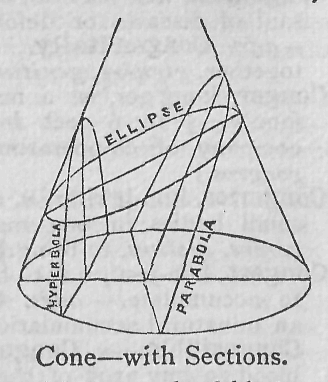
Cone, kōn, n. a solid pointed figure with a circular base: fruit shaped like a cone, as that of the pine, fir, &c.: anything shaped like a cone.—ns. Cone′-shell, a family of Gasteropod molluscs, with substantial conical shells; Cone′-wheat, a variety of wheat, with conical-shaped spike.—adjs. Conic, -al, having the form of or pertaining to a cone.—adv. Con′ically.—ns. Con′icalness, Conic′ity.—adj. Con′ico-cylin′drical.—n. Con′ics, that part of geometry which deals with the cone and its sections.—adj. Cō′niform, in the form of a cone.—Conic section, a figure made by the section of a cone by a plane. [Fr. cone—L.,—Gr. kōnos, a peak, a peg.]
Coney. See Cony.
Confab, kon-fab′, v. and n. coll. forms of Confab′ulāte, Confabulā′tion.—adj. Confab′ular.—n. Confab′ulātor.—adj. Confab′ulātory.
Confabulate, kon-fab′ū-lāt, v.i. to talk familiarly together: to chat.—n. Confabulā′tion. [L. con, together, fabulāri, to talk—fabula, a tale, fable.]
Confarreation, kon-far-re-ā′shun, n. a Roman mode of marriage, made in the presence of the high-priest and ten witnesses, at which bread made of spelt was eaten together.—adj. Confar′reate. [L. confarreatio—confarreāre, to unite by bread, to marry—con, with, far, a species of grain.]
Confect, kon′fekt, n. fruit, &c., prepared with sugar: a sweetmeat: a comfit.—v.t. Confect′, to prepare: to preserve.—n. Confec′tion, composition, compound: a composition of drugs: a sweetmeat: the French word for a ready-made article of dress for women's wear.—v.t. to make a confection, in its various uses.—ns. Confec′tionary (B.), a confectioner: a sweetmeat: a place where confections are made: confectionery; Confec′tioner, one who makes confections; Confec′tionery, a confectioner's shop: the business of a confectioner: sweetmeats in general. [L. conficĕre, confectum, to make up together—con, together, facĕre, to make.]
Confederate, kon-fed′ėr-āt, adj. leagued together: allied.—n. one united in a league: an ally: an acomplice.—v.i. and v.t. to league together or join in a league.—ns. Confed′eracy, a league or mutual engagement: persons or states united by a league: a conspiracy; Confederā′tion, a league: alliance, esp. of princes, states, &c.—adj. Confed′erātive, of or belonging to a confederation. [L. confœderāre, -ātum—con, together, fœdus, fœdĕris, a league.]
Confer, kon-fėr′, v.t. to give or bestow: to compare (notes), collate—abbrev. cf.—v.i. to talk or consult together:—pr.p. confer′ring; pa.p. conferred′.—ns. Conferee′, one conferred with; Con′ference, the act of conferring: an appointed meeting for instruction or discussion.—adjs. Conferen′tial; Confer′rable.—n. Confer′rer, one who confers. [Fr.,—L. conferre—con, together, ferre, to bring.]
Conferva, kon-fėr′va, n. a genus of lower fresh-water Algæ, forming slimy masses or tufts in ponds and stagnent pools, easily recognised by their unbranched filaments.—adj. Confer′void. [L. conferva, a kind water-plant.]
Confess, kon-fes′, v.t. to acknowledge fully, esp. something wrong: to own or admit: to make known, as sins to a priest: to hear a confession, as a priest.—v.i. to make confession.—ns. Confes′sion, acknowledgment of a crime or fault: avowal; a statement of one's religious belief: acknowledgment of sin to a priest; Confes′sional, the seat or enclosed recess where a priest hears confessions.—adj. pertaining to confession.—ns. Confes′sionalism; Confes′sionalist.—adj. Confes′sionary, of or belonging to confession.—n. a confessional.—ns. Confess′or, one who professes the Christian faith, or a priest who hears confessions and grants absolution: one who endures persecution but not death:—fem. Confess′oress; Confess′orship.—adjs. Confessed′, Confest′, admitted: avowed: evident.—advs. Confess′edly, Confest′ly.—Confession of Faith, a formulary embodying the religious beliefs of a church or sect: a creed.—Confess to, to admit, acknowledge; Stand confessed, to be revealed. [Fr. confesser—L. confitēri, confessus—con, sig. completeness, and fatēri—fāri, to speak.]
Confide, kon-fīd′, v.i. to trust wholly or have faith (with in): to rely.—v.t. to entrust, or commit to the charge of.—ns. Confidant′, one confided in or entrusted with secrets: a bosom-friend:—fem. Confidante′; Con′fidence, firm trust or belief: faith: self-reliance: firmness: boldness: presumption; Con′fidency.—adj. Con′fident, trusting firmly: having full belief: positive: bold.—n. a confidential friend.—adj. Confiden′tial, (given) in confidence: admitted to confidence: private.—advs. Confiden′tially; Con′fidently.—n. Confid′er, one who confides.—adj. Confid′ing, trustful.—adv. Confid′ingly.—n. Confid′ingness.—Confidence trick, a swindler's trick, whereby a person is induced to hand over money as a mark of confidence in the swindler; Confidant person, in Scots law, a confidential person, partner, agent, &c. [L. confidĕre—con, sig. completeness, and fidĕre, to trust.]
Configuration, kon-fig-ū-rā′shun, n. external figure or shape: outline: relative position or aspect, as of planets.—vs.t. Config′urate, Config′ure, to shape. [L. configuratio—con, together, and figurāre, to form. See Figure.]
Confine, kon′fīn, n. border, boundary, or limit—generally in pl.: (kon-fīn′) confinement: (Shak.) a prison.—v.t. Confine′, to border; to be adjacent to: to limit, enclose: to imprison.—adjs. Confin′-able; Confined′, limited: imprisoned: narrow; Confine′less (Shak.), without bound: unlimited.—ns. Confine′ment, state of being shut up: restraint: imprisonment: restraint from going abroad by sickness, and esp. of women in childbirth; Confin′er. one within the confines: (Shak.) an inhabitant.—adj. Confin′ing, bordering: limiting.—Be confined, to be limited: to be in child-bed. [Fr. confiner—L. confinis, bordering—con, together, finis, the end.]
Confirm, kon-fėrm′, v.t. to strengthen: to fix or establish: to ratify: to verify: to assure: to admit to full communion.—adj. Confirm′able.—n. Confirmā′tion, a making firm or sure: convincing proof: the rite by which persons are admitted to full communion in the R.C., Greek, Lutheran, Anglican, and other Churches.—adjs. Confirm′ative, tending to confirm; Confirm′atory, giving additional strength to: confirming; Confirmed′, settled: inveterate.—ns. Confirmee′, one to whom anything is confirmed; Confirm′er; Confirm′ing. [O. Fr. confermer—L. confirmāre—con, inten., and firmāre—firmus, firm.]
Confiscate, kon′fis-kāt, or kon-fis′-, v.t. to appropriate to the state, as a penalty: to take possession of.—adj. forfeited to the public treasury.—adjs. Confis′cable, Confis′catory, of the nature of confiscation.—ns. Confiscā′tion, the act of confiscating; Con′fiscātor, one who confiscates. [L. confiscāre, -ātum—con, together, fiscus, a basket.]
Confit, kon′fit, n. (obs.). Same as Comfit.
Confiteor, kon-fit′ē-or, n. a form of prayer or confession used in the Latin Church. [L. confiteor, I confess.]
Confiture, kon′fit-ūr, n. (obs.). Same as Comfiture.
Confix, kon-fiks′, v.t. (Shak.) to fix firmly. [L. configĕre, -fixum—con, inten., figĕre, to fix.]
Conflagrate, kon′fla-grāt, v.t. and v.i. to burn up.—adj. Conflag′rant (Milt.) burning.—n. Conflagrā′tion, a great burning or fire. [L. conflagrāre—con, inten., and flagrāre, to burn. See Flagrant.]
Conflate, kon-flāt′, v.t. to blow together: to produce: to combine two variant readings of a text into one.—n. Conflā′tion. [L. conflatus—conflāre, to blow together—con, and flāre, to blow.]
Conflict, kon′flikt, n. violent collision: a struggle or contest: a battle: a mental struggle.—v.i. Conflict′, to fight: contend: to be in opposition: to clash.—adj. Conflict′ing, clashing: contradictory.—n. Conflic′tion.—adj. Conflict′ive, tending to conflict. [L. confligĕre—con, together, and fligĕre, to strike.]
Confluence, kon′floo-ens, n. a flowing together: the place of meeting, as of rivers: a concourse: the act of meeting together.—adj. Con′fluent, flowing together: uniting.—n. a stream uniting and flowing with another.—adv. Con′fluently.—n. Con′flux, a flowing together. [L. confluĕre, confluxum, from con, together, fluĕre, to flow.]
Conform, kon-form′, v.t. to make like or of the same form with: to adapt.—v.i. to be of the same form; to comply: to obey.—n. Conformabil′ity, state of being conformable.—adj. Conform′able, corresponding in form: suitable: compliant.—adv. Conform′ably.—ns. Conformā′tion, particular form, shape, or structure: adaptation; Conform′er, Conform′ist, one who conforms, esp. with the worship of the Established Church; Conform′ity, likeness: compliance: consistency.—In conformity with, in accordance with. [L. conformāre—con, with, and formāre—forma, form.]
Confound, kon-fownd′, v.t. to overthrow, defeat: to mingle so as to make the parts indistinguishable: to throw into disorder: to perplex: to astonish.—p.adj. Confound′ed, confused: astonished: (coll.) consummate, egregious (a term of disapprobation).—advs. Confound′edly (coll.), hatefully, shamefully: cursedly; Confound′ingly, astonishingly.—Confound you, an execration or curse. [O. Fr. confondre—L. confundĕre, -fusum—con, together, fundĕre, to pour.]
Confraternity, kon-fra-tėr′ni-ti, n. a brotherhood: clan: brotherly friendship.
Confrère, kong-frār, n. a colleague: a fellow-member or associate. [Fr.,—L. con, together, frater, a brother.]
Confront, kon-frunt′, v.t. to stand in front of: to face: to oppose: to bring face to face: to compare.—n. Confrontā′tion, the bringing of people face to face. [Fr. confronter—Low L.,—L. con, together, and frons, the front. See Front.]
Confucian, kon-fū′shyan, adj. of or belonging to Confucius, the Chinese philosopher (551-479 B.C.).—ns. Confū′cianism; Confū′cianist.
Confuse, kon-fūz′, v.t. to pour or mix together so that things cannot be distinguished: to throw into disorder: to perplex.—v.i. to be confused.—adj. Confused′, perplexed: disordered.—adv. Confus′edly, in a confused manner: disorderly.—ns. Confus′edness, state of being confused: disorder; Confū′sion, the state of being confused: disorder: shame: overthrow: perplexity: embarrassment: turmoil.—adj. Confū′sive. [A doublet of Confound.]
Confute, kon-fūt′, v.t. to prove to be false: to refute: to put an end to.—adj. Confūt′able.—n. Confutā′tion.—adj. Confūt′ative, tending to confute.—n. Confute′ment. [L. confutāre—con, inten., and futis, a water-vessel, from fundĕre, to pour: to overthrow. See Futile.]
Congé. See Congee.
Congeal, kon-jēl′, v.t. to freeze: to change from fluid to solid by cold: to solidify, as by cold.—v.i. to pass from fluid to solid, as by cold: to stiffen: to coagulate.—adj. Congeal′able.—ns. Congeal′ableness; Congeal′ment, Congelā′tion, act or process of congealing: anything congealed. [L. congelāre, from con, and gelu, frost.]
Congee, kon′jē, Congé, kong′jā, n. a bow: dismissal: leave to depart.—v.i. to take leave: to bow.—Congé d'élire (Fr.), permission to elect: permission given by the crown to a dean and chapter to elect a bishop. [Fr. congé—L. commeatus, leave of absence—com, together, and meāre, to go.]
Congener, kon′je-nėr, or kon-jē′nėr, n. a person or thing of the same kind or nature.—adj. akin.—adjs. Congener′ic, -al, of the same genus, origin, or nature; Congen′erous, of the same nature or kind; Congenet′ic, alike in origin. [L.,—con, with, and genus, generis, kind.]
Congenial, kon-jē′ni-al, adj. of the same genius, spirit, or tastes: kindred, sympathetic: suitable.—n. Congenial′ity.—adv. Congē′nially. [L. con, with, and genialis, genial. See Genial.]
Congenital, kon-jen′i-tal, adj. begotten or born with, said of diseases or deformities dating from birth.—adv. Congen′itally. [L. congenitus, from con, together, gignĕre, genitum, to beget.]
Conger, kong′gėr, n. a marine bony fish in the eel family, 3 to 6 feet long—also Con′ger-eel: a company of co-operating booksellers. [L.,—Gr. gongros.]
Congeries, kon-jē′ri-ēz, n. a collection of particles or small bodies in one mass. [L.,—con, together, gerĕre, gestum, to bring.]
Congest, kon-jest′, v.t. to bring together, or heap up: to accumulate.—adjs. Congest′ed, affected with an unnatural accumulation of blood: overcrowded; Congest′ible.—n. Congest′ion, an accumulation of blood in any part of the body: fullness: an overcrowded condition.—adj. Congest′ive, indicating or tending to congestion. [L. congerĕre, congestum—con, together, and gerĕre, gestum, to bring.]
Congiary, kon′ji-ar-i, n. a gift to the Roman people or soldiery, originally in corn, oil, &c., each receiving a congius or gallon—afterwards given in money. [L. congiarium—congius, the Roman gallon.]
Conglobe, kon-glōb′, v.t. or v.i. to collect together into a globe or round mass:—pr.p. conglōb′ing; pa.p. conglōbed′.—adj. Conglob′ate, formed into a globe or ball.—v.t. to form into a globe or ball.—n. Conglobā′tion.—v.i. Conglob′ūlate, to gather into a globule or small globe. [L. con, together, and globāre, -ātum—globus, a ball, globe.]
Conglomerate, kon-glom′ėr-āt, adj. gathered into a clew or mass.—v.t. to gather into a ball.—n. a rock composed of pebbles cemented together.—n. Conglomerā′tion, state of being conglomerated: a collection of things. [L. conglomerāre, -ātum—con, together, and glomus, glomeris, a clew, akin to globus.]
Conglutinate, kon-glōō′tin-āt, v.t. to glue together: to heal by uniting.—v.i. to unite or grow together.—p.adj. Conglu′tinant.—n. Conglutinā′tion, a joining by means of some sticky substance: healing.—adj. Conglu′tinātive, having power to conglutinate.—n. Conglu′tinātor. [L. conglutināre, -ātum—con, together, and gluten, glue.]
Congou, kong′gōō, n. a kind of black tea.—Also Congo. [Chinese kung-fu, labour, referring to the labour expended in producing the tea.]
Congratulate, kon-grat′ū-lāt, v.t. to wish joy to on any fortunate event: to felicitate: to consider one's self fortunate in some matter.—adj. Congrat′ulant, expressing congratulation.—n. a congratulator.—ns. Congratulā′tion, act of congratulating: an expression of joy or sympathy; Congrat′ulator.—adj. Congrat′ulatory. [L. congratulāri, -ātus—con, inten., gratulāri—gratus, pleasing.]
Congree, kon-grē′, v.i. (Shak.) to agree together: to accord. [L. con, together, and Fr. gré, good-will—L. gratus, pleasing.]
Congreet, kon-grēt′, v.t. (Shak.) to salute mutually. [L. con, together, and Greet.]
Congregate, kong′gre-gāt, v.t. to gather together: to assemble.—v.i. to flock together.—p.adj. Congregat′ed, assembled: aggregated.—n. Congregā′tion, the act of congregating: an assemblage of persons or things: (O.T.) a name given to the children of Israel: a body of people united to worship in a particular church: the name given to the body of Protestant Reformers in Scotland in the time of Mary.—adj. Congregā′tional, pertaining to a congregation.—ns. Congregā′tionalism, a form of church government in which each congregation is independent in the management of its own affairs—also called Independency; Congregā′tionalist, adherent of Congregationalism. [L. congregāre, -ātum—con, together, and grex, gregis, a flock.]
Congress, kong′gres, n. a meeting together or assembly, as of ambassadors, &c., for political purposes: the federal legislature of the United States.—v.i. to meet in congress.—adj. Congres′sional.—n. Con′gressman, a member of congress. [L. con, together, and gradi, gressus, to step, to go.]
Congreve, kong′grēv, n. a rocket for use in war, invented by Sir William Congreve (1772-1828).—n. Con′greve-match, a kind of lucifer match, invented by Congreve.
Congrue, kong-grōō′, v.i. (Shak.) to agree.—ns. Cong′ruence, Cong′ruency, agreement: suitableness.—adj. Cong′ruent, agreeing: suitable: congruous: used of two numbers which, when divided by the same number, give the same remainder.—n. Congru′ity, agreement between things: consistency: fitness.—adj. Cong′ruous, suitable: fit: consistent.—adv. Cong′ruously.—n. Cong′ruousness. [L. congruĕre, to run together.]
Conia. See Conium.
Conic, -al; Conics. See Cone.
Coniferæ, kon-if′ėr-ē, n.pl. an order of exogenous plants, including pines, firs, &c., which bear cones, in which the seed is contained.—n. Con′ifer, one of the foregoing.—adj. Conif′erous, cone-bearing, as the fir, &c. [Cone, and L. ferre, to bear.]
Coniform. See Cone.
Conima, kon′i-ma, n. a fragrant resin for making pastilles.
Conine, kō′nin, n. an alkaloid forming the poisonous principle of hemlock.—Also Cō′nia, Cō′nicine. [Gr. kōneion, hemlock.]
Conirostral, kōn-i-ros′tral, adj. having a strong conical beak.—n.pl. Coniros′tres, a group of insessorial birds with such. [Cone, and L. rostralis—rostrum, a beak.]
Conject, kon-jekt′, v.i. (Shak.) to conjecture.
Conjecture, kon-jekt′ūr, n. a forecast: an opinion formed on slight or defective evidence: an opinion without proof: a guess: an idea.—v.t. to make conjectures regarding: to infer on slight evidence: to guess.—adjs. Conject′urable, that may be conjectured; Conject′ural, involving conjecture: given to conjecture.—adv. Conject′urally. [L. conjicĕre, conjectum, to throw together—con, together, and jacĕre, to throw.]
Conjee, Congee, kon′jē, n. water in which rice has been boiled, much used for invalids. [Anglo-Indian—Tamil kañji. Origin unknown.]
Conjoin, kon-join′, v.t. to join together: to combine.—v.i. to unite.—adjs. Conjoined′, united: in conjunction; Conjoint′, joined together: united.—adv. Conjoint′ly. [Fr. conjoindre—L. con, together, and jungĕre, junctum, to join. See Join.]
Conjugal, kon′joo-gal, adj. pertaining to marriage.—n. Conjugal′ity.—adv. Con′jugally. [L. conjugalis—conjux, one united to another, a husband or wife—con, and jugum, a yoke.]
Conjugate, kon′joo-gāt, v.t. (gram.) to give the various inflections or parts of a verb.—adj. joined: connected.—n. a word agreeing in derivation with another word.—adjs. Con′jugated, Conjugā′tional, Con′jugative, conjugate.—ns. Con′jugateness; Con′jugating; Conjugā′tion, the act of joining: union: (gram.) a term applied to a connected view or statement of the inflectional changes of form that a verb undergoes in its various relations: a class of verbs inflected in the same manner.—Conjugate axes, two axes in a conic section, such that each is parallel to the tangent at the extremity of the other; Conjugate foci (see Focus); Conjugate mirrors, two mirrors set face to face so that the rays emitted from the focus of one are first reflected from it to the and thence to its focus; Conjugation of cells, a mode of reproduction in which two apparently similar cells unite, as in Amœba, Diatoms, &c. [L. conjugāre, -ātum—con, together, and jugāre—jugum, a yoke.]
Conjunct, kon-junkt′, adj. conjoined: concurrent.—n. Conjunc′tion, connection, union: (gram.) a word that connects sentences, clauses, and words: one of the aspects of the planets, when two heavenly bodies have the same longitude—i.e. when the same perpendicular to the ecliptic passes through both.—adj. Conjunc′tional, relating to a conjunction.—adv. Conjunc′tionally.—adj. Conjunc′tive, closely united: serving to unite: connective: (gram.) introduced by a conjunction.—adv. Conjunc′tively.—n. Conjunc′tiveness.—adv. Conjunc′tly, conjointly: in union.—n. Conjunc′ture, combination of circumstances: important occasion, crisis.—Grand conjunctions, those where several planets or stars are found together. [L.,—conjungĕre. See Conjoin.]
Conjure, kun′jėr and kon-jōōr′ (con′jure, generally of the art of legerdemain, &c.; conjure′, of actions treated as religious or solemn), v.i. to practise magical arts: to make an invocation: (obs.) to conspire.—v.t. to call on or summon by a sacred name or in a solemn manner: to implore earnestly: to compel (a spirit) by incantations: to enchant: to raise up or frame needlessly; to effect by jugglery:—pr.p. con′juring; pa.p. con′jured.—ns. Conjurā′tion, act of summoning by a sacred name or solemnly: enchantment; Con′jurātor, a conspirator; Conjure′ment, adjuration; Con′jurer, -or, one who practises magic: an enchanter: (kon-jōō′ror) one bound by oath with others; Con′juring, magic-working: the production of effects apparently miraculous by natural means; Con′jury, magic. [Fr.,—L. con, together, and jurāre, to swear.]
Conk, kongk, n. the nose.—n. Conk′y (slang), a person with a large nose. [Mr F. Hindes Groome suggests that it may be back slang, conk being the illiterate spelling of the Gipsy knoc, nose.]
Connascent, kon-nas′ent, adj. born or produced at the same time.—ns. Connas′cence, Connas′cency. [L. con, with nasci, to be born.]
Connate, kon′āt, adj. born with one's self: innate: allied: congenial.—adj. Connat′ural, of the same nature with another.—v.t. Connat′uralise.—n. Connat′urality.—adv. Connat′urally.—ns. Connat′uralness; Connā′ture. [L. con, with, and nasci, natus, to be born.]
Conne, kon, v.t. (Spens.) form of Con, to know.
Connect, kon-ekt′, v.t. to tie or fasten together: to establish a relation between: to associate.—p.adj. Connect′ed, joined: united.—adv. Connect′edly, in a connected manner.—ns. Connect′er, -or, one who or that which connects.—adj. Connect′ible, capable of being connected.—ns. Connec′tion, Connex′ion, act of connecting: that which connects: a body or society held together by a bond: coherence: intercourse: context: relation: intimacy: a relative.—adjs. Connect′ive, Connex′ive (obs.), binding together.—n. a word that connects sentences and words.—adv. Connect′ively.—Connective tissue, one of the four sets of the commonest classification of animal tissues, including a great variety—e.g. bone, cartilage, ligaments, and enswathing membranes. [L. con, together, and nectĕre, to tie.]
Connictation, kon-ik-tā′shun, n. the act of winking. [L. con, and nictare, -ātum, to wink.]
Connive, kon-īv′, v.i. to wink at a fault: to take no notice: to have a private understanding.—ns. Conniv′ance, Conniv′ancy, Conniv′ence, Conniv′ency.—adj. Conniv′ent.—n. Conniv′er. [Fr.,—L. connivēre, to wink.]
Connoisseur, kon-es-sehr′, or kon-is-ūr′, n. one who knows a subject well; a critical judge in art, music, &c.—n. Connoisseur′ship, the skill of a connoisseur. [Fr. connoître—L. cognoscĕre, to know.]
Connote, kon-ōt′, v.t. to signify secondarily: to imply along with an object the inherent attributes: to include.—v.t. Con′notāte, to connote.—n. Connotā′tion, implication of something more than the denotation of an object: the aggregation of attributes connoted by a term.—adjs. Connot′ātive, Connō′tive. [L. con, with, and Note.]
Connubial, kon-ū′bi-al, adj. pertaining to marriage or to the marriage state: nuptial.—n. Connubial′ity.—adv. Connū′bially. [L. con, and nubĕre, to marry. See Nuptial.]
Connumerate, kon-nū′me-rāt, v.t. to count conjointly.—n. Connumerā′tion.
Connusance, kon′ū-sans, n. an obs. form of Cognisance.
Conoid, kōn′oid, n. anything like a cone in form.—adjs. Conoid′ic, -al, Con′oid, Conoid′al. [Gr. kōnos, a cone, eidos, form.]
Co-nominee, kō-nom-i-nē′, n. a joint-nominee.
Conquadrate, kon-kwod′rāt, v.t. to square with another.
Conquassate, kon-kwas′āt, v.t. to shake.
Conquer, kong′kėr, v.t. to gain by force or with an effort: to overcome or vanquish.—v.i. to be victor.—adj. Con′querable, that may be conquered.—n. Con′querableness.—adj. Con′quering, victorious.—adv. Con′queringly.—ns. Con′queror, one who conquers: a victor:—fem. Con′queress; Con′quest, the act of conquering: that which is conquered or acquired by physical or moral force: the act of gaining the affections of another.—Make a conquest, to conquer.—The Conqueror, William I. of England (L. Conques′tor); The Conquest, the acquisition of the throne of England by William, Duke of Normandy, in 1066. [O. Fr. conquerre—L. conquirĕre,—con, inten., quærĕre, to seek.]
Conquistador, kong-kwis′ta-dōr, n. a conqueror, applied to the conquerors of Mexico and Peru. [Sp.,—L. conquirĕre. See Conquer.]
Consanguine, kon-sang′gwin, adj. related by blood: of the same family or descent—also Consanguin′eous.—n. Consanguin′ity, relationship by blood: opposed to affinity or relationship by marriage. [L. consanguineus—con, with, sanguis, blood.]
Conscience, kon′shens, n. the knowledge of our own acts and feelings as right or wrong: sense of duty: scrupulousness: (Shak.) understanding: the faculty or principle by which we distinguish right from wrong.—adjs. Con′science-proof, unvisited by any compunctions of conscience; Con′science-smit′ten, stung by conscience; Conscien′tious, regulated by a regard to conscience: scrupulous.—adv. Conscien′tiously.—n. Conscien′tiousness.—adj. Con′scionable, governed or regulated by conscience.—n. Con′scionableness.—adv. Con′scionably.—Conscience clause, a clause in a law, affecting religious matters, to relieve persons of conscientious scruples, esp. one to prevent their children being compelled to undergo particular religious instruction; Conscience money, money given to relieve the conscience, by discharging a claim previously evaded; Case of conscience, a question in casuistry.—Good, or Bad, conscience, an approving or reproving conscience.—In all conscience, certainly: (coll.) by all that is right and fair.—Make a matter of conscience, to act according to conscience: to have scruples about.—My conscience! a vulgar exclamation of astonishment, or an asseveration.—Speak one's conscience (Shak.), to speak frankly: to give one's opinion. [Fr.,—L. conscientia, knowledge—conscīre, to know well—con, and scīre, to know.]
Conscious, kon′shus, adj. having the feeling or internal knowledge of something: aware: having the faculty of consciousness.—adv. Con′sciously.—n. Con′sciousness, the waking state of the mind: the knowledge which the mind has of its own acts and feelings: thought. [L. conscius—conscīre, to know.]
Conscribe, kon-′skrīb′, v.t. to enlist by conscription.—adj. Con′script, enrolled, registered.—n. one enrolled and liable to serve as a soldier or sailor.—v.t. to enlist.—n. Conscrip′tion, a compulsory enrolment for naval or military service: the obtaining recruits by compulsion.—adj. Conscrip′tional.—Conscript fathers (patres conscripti), the senators of ancient Rome. [L. conscribĕre, to enrol—con, together, scribĕre, to write.]
Consecrate, kon′se-krāt, v.t. to set apart for a holy use: to render holy or venerable; to hallow; to devote.—adj. consecrated: devoted: sanctified.—ns. Con′secratedness; Consecrā′tion, the act of devoting to a sacred use; Con′secrator.—adj. Con′secratory, making sacred. [L. consecrāre, -ātum, to make wholly sacred—con, and sacrāre, to set apart as sacred—sacer, sacred.]
Consectaneous, kon-sek-tā′nē-us, adj. following as a natural consequence.
Consectary, kon-sek′ta-ri, n. a deduction, corollary. [L. consectāri, freq. of consequi. See Consecution.]
Consecution, kon-se-kū′shun, n. a train of consequences or deductions: a series of things that follow one another: (mus.) succession of similar intervals in harmony.—adj. Consec′utive, following in regular order: succeeding or resulting.—adv. Consec′utively—n. Consec′utiveness. [L. consequi—con, and sequi, secutus, to follow.]
Consenescence, kon-sē-nes′ens, n. the state of growing old.—Also Consenes′cency.
Consensus, kon-sen′sus, n. agreement of various parts: agreement in opinion: unanimity.—n. Consen′sion, mutual consent.—adj. Consen′sual, relating to consent.—adv. Consen′sually.—Consensual contract, a contract requiring merely the consent of the parties. [L. consentīre. See Consent.]
Consent, kon-sent′, v.i. to be of the same mind: to agree: to give assent: to yield: to comply.—v.t. (Milt.) to allow.—n. agreement: accordance with the actions or opinions of another: concurrence: advice, counsel.—adj. Consentā′neous, agreeable or accordant: consistent with.—adv. Consentā′neously—ns. Consentā′neousness, Consentanē′ity.—n. Consen′tience, state of being consentient: imperfect consciousness.—adj. Consen′tient, agreeing in mind or in opinion.—adv. Consent′ingly.—Age of consent, the age at which a person is considered in the eyes of the law competent to give consent to certain acts; Be of consent (Shak.), to be accessory; With one consent, unanimously. [L. consentīre—con, with, sentīre, to feel, to think.]
Consequence, kon′se-kwens, n. that which follows or comes after as a result: effect: influence: importance: (pl.) a round game describing the meeting of a lady and gentleman and its consequences, each player in turn writing a part of the story, not knowing what the others have written.—v.i. (Milt.) to draw inferences.—adj. Con′sequent, following as a natural effect or deduction.—n. that which follows: the natural effect of a cause.—adj. Consequen′tial, following as a result: casual: pompous.—advs. Consequen′tially; Con′sequently. [Fr.,—L. consequi—con, together, and sequi, to follow.]
Consertion, kon-ser′shun, n. junction, adaptation.
Conserve, kon-sėrv′, v.t. to keep entire: to retain: to preserve: (obs.) to preserve in sugar.—n. something preserved, as fruits in sugar.—adj. Conser′vable.—n. Conser′vancy, a court having authority to preserve the fisheries, &c., on a river: the act of preserving.—p.adj. Conser′vant.—n. Conservā′tion, the act of conserving: the keeping entire.—adj. Conservā′tional.—n. Conser′vatism, the opinions and principles of a Conservative.—adj. Conser′vative, tending or having power to conserve.—n. (politics) one who desires to preserve the institutions of his country against innovation and change: one averse to change and progress.—ns. Conser′vativeness; Conservatoire (kon-ser-va-twär′), Conservatō′rium, a name given by the Italians to schools instituted for the purpose of advancing the study of music and maintaining its purity; Con′servātor, one who preserves from injury or violation: a guardian, custodian:—fem. Conser′vatrix; Conser′vatorship; Conser′vatory, a storehouse: a greenhouse or place in which exotic plants are kept: a school of music.—adj. preservative.—n. Conser′ver.—Conservation of energy, the law that the total amount of energy in a material system cannot be varied, provided the system neither parts with energy to other bodies nor receives it from them; Conservation of matter, the experimentally ascertained fact that no process at the command of man can either destroy or create even a single particle of matter.—Conservators of the peace, a title usually applied to knights elected in each shire, from the 12th century onwards, for the conservation of the peace. [L. conservāre—con, together, and servāre, to keep.]
Consider, kon-sid′ėr, v.t. to look at closely or carefully: to think or deliberate on: to take into account: to attend to: to reward.—v.i. to think seriously or carefully: to deliberate.—adj. Consid′erable, worthy of being considered: important: more than a little.—n. Consid′erableness.—adv. Consid′erably.—n. Consid′erance (Shak.), consideration.—adjs. Consid′erāte, Consid′erative (obs.), thoughtful: serious: prudent: thoughtful for the feelings of others.—adv. Consid′erately.—ns. Consid′erateness, thoughtfulness for others; Considerā′tion, deliberation: importance: motive or reason: compensation, reward: the reason or basis of a compact: (law) the thing given or done or abstained from by agreement with another, and in view of that other giving, doing, or abstaining from something.—prep. Consid′ering, in view of: seeing that.—adv. Consid′eringly, with consideration. [Fr.—L. considerāre, supposed to have been orig. a term of augury—con, and sidus, sideris, a star.]
Consign, kon-sīn′, v.t. to give to another: to sign or seal: to transfer: to entrust: to commit: to transmit for sale or custody.—adj. Consign′able.—ns. Consignā′tion; Consig′natory, one who signs a document jointly.—adj. Consigned′, given in trust.—ns. Consig′nature, complete signature: joint signing; Consignee′, one to whom anything is consigned or entrusted; Consign′er, Consign′or; Consign′ment, the act of consigning: the thing consigned: the writing by which anything is made over: in Mercantile Law, goods placed in the hands of an agent or factor for sale, or for some other specified purpose. [Fr.,—L. consignāre, to attest.]
Consignify, kon-sig′ni-fī, v.t. to signify or indicate in connection with something else.—n. Consignificā′-tion.—adj. Consignif′icative.
Consilience, kon-sil′i-ens, n. concurrence: coincidence.—adj. Consil′ient, agreeing. [L. con, together, and salīre, to leap.]
Consimilar, kon-sim′i-lar, adj. like each other.—ns. Consimil′itude, Consimil′ity. [L. consimilis.]
Consist, kon-sist′, v.i. to exist, subsist: to co-exist: to agree.—ns. Consist′ence, Consist′ency, a degree of density: substance: agreement: the quality of being self-consistent.—adj. Consistent, fixed: not fluid: agreeing together: uniform in thought or action.—adv. Consist′ently.—adjs. Consistō′rial, Consistō′rian.—n. Consist′ory, properly a place of assembly: the particular place where the privy-council of the Roman emperor met, the council itself: an assembly or council: a spiritual or ecclesiastical court in the R.C. Church, consisting of the pope and cardinals, and determining all such matters as the appointment of cardinals, bishops, &c.; in the Lutheran Church, exercising a supervision over religion and education, over the clergy, schoolmasters, and theological candidates; in the Reformed Church, the kirk-session, or the presbytery.—Consist in, to lie in: to depend upon: to be composed of; Consist of, to be made up of. [L. consistĕre—con, together, sistĕre, to stand.]
Consociate, kon-sō′shi-āt, v.t. and v.i. to associate together.—p.adj. Consō′ciated.—n. Consociā′tion, companionship (with): association: alliance. [L. consociāre, -ātum—con, with, sociāre, to associate—socius, a companion.]
Console, kon-sōl′, v.t. to give solace or comfort: to cheer in distress.—adj. Consol′able, that may be comforted.—v.t. Con′solate (Shak.), to console.—ns. Consolā′tion, solace: alleviation of misery: a comforting circumstance; Consolā′tion-match, -race, &c., a race, &c., in which only those who have been previously unsuccessful may compete.—adj. Consol′atory.—n. Con′soler:—fem. Con′-solātrix. [L. con, inten., and solāri, to comfort.]
Console, kon′sōl, n. (archit.) a projection resembling a bracket, frequently in the form of the letter S, used to support cornices, or for placing busts, vases, or figures on: the key-desk of an organ.—n. Con′sole-ta′ble, a table having one of its sides supported against a wall by consoles or brackets. [Fr. console; prob. conn. with Consolidate.]
Consolidate, kon-sol′i-dāt, v.t. to make solid: to form into a compact mass: to unite into one.—v.i. to grow solid or firm: to unite.—adj. made firm or solid: united.—p.adj. Consol′idated.—n. Consolidā′tion, act of making or becoming solid: confirmation.—adj. Consol′idative, tending to consolidate: having the quality of healing.—n. Consol′idator, one who or that which consolidates.—Consolidation Acts, acts of parliament which combine into one general statute several special enactments. [L. consolidāre, -ātum—con, inten., and solidus, solid.]
Consols, kon′solz, n.pl. (short for Consolidated Annuities) that part of the British national debt which consists of several stocks consolidated into one fund.
Consommé, kon-so-mā′, n. a kind of soup made from meat by slow boiling. [Fr.,—L. consummāre, to consummate.]
Consonant, kon′son-ant, adj. consistent: suitable: harmonious.—n. an articulation which can be sounded only with a vowel: a letter of the alphabet other than a vowel.—ns. Con′sonance, a state of agreement: agreement or unison of sounds: (mus.) a combination of notes which can sound together without the harshness produced by beats: concord; Con′sonancy, harmony.—adj. Consonant′al.—adv. Con′sonantly.—adj. Con′sonous, harmonious. [L. consonans, -antis, pr.p. of consonāre, to harmonise—con, with, and sonāre, to sound.]
Consort, kon′sort, n. a partner: a companion: a wife or husband: an accompanying ship: (obs.) a number of people: an orchestra: former spelling for concert.—v.t. Consort′ (Shak.), to accompany: to associate (with).—v.i. to associate or keep company: to agree.—p.adj. Consort′ed, associated.—n. Con′sortship.—In consort, in company: in harmony. [L. consors, from con, with, and sors, sortis, a lot.]
Conspecies, kon-spē′shēz, n. (zool.) a subspecies or variety.—adj. Conspecif′ic.
Conspectus, kon-spek′tus, n. a comprehensive survey: a synopsis.—n. Conspectū′ity (Shak.), sight: the eye. [L. conspectus—conspicĕre, to look at.]
Conspicuous, kon-spik′ū-us, adj. clearly seen: visible to eye or mind: prominent.—ns. Conspicū′ity, Conspic′uousness.—adv. Conspic′uously. [L. conspicuus—conspicĕre—con, inten., spicĕre, to look.]
Conspire, kon-spīr′, v.i. to plot or scheme together: to agree: to concur to one end.—v.t. to plan, devise.—n. Conspir′acy, the act of conspiring: a banding together for an evil purpose: a plot: concurrence.—adj. Conspir′ant, conspiring.—ns. Conspirā′tion, conspiracy; Conspir′ator, one who conspires:—fem. Conspir′atress.—adj. Conspiratō′rial.—n. Conspir′er (Shak.), conspirator.—adv. Conspir′ingly. [L. conspirāre—con, together, spirāre, to breathe.]
Conspissate, kon-spis′āt, v.t. to inspissate.—n. Conspissā′tion.
Conspurcation, kon-spur-kā′shun, n. (obs.) defilement. [L. conspurcāre, -ātum, to defile.]
Constable, kun′sta-bl, n. formerly a state-officer of the highest rank: the warden of a castle: a peace-officer: a policeman.—ns. Con′stablery, the charge of a constable; Con′stableship; Con′stablewick, the district of a constable; Con′stabling, acting as a constable or policeman; Constab′ulary, the body of constables of a district, town, &c.—adj. of or pertaining to constables, or peace-officers.—Constable of France, chief of the household under the old French kings, then commander-in-chief of the army, judge in questions of chivalry, tournaments, and martial displays.—High Constable, one of two constables ordained in every hundred or franchise, to make the view of armour, and to see to the conservation of the peace; High Constable of Scotland, the first subject in Scotland after the blood-royal; Lord High Constable of England, the seventh great officer of the crown, and formerly a judge in the court of chivalry.—Outrun the constable, to go too fast: to get into debt.—Special constable, a person sworn in by the justices to preserve the peace, or to execute warrants on special occasions. [O. Fr. conestable (Fr. connétable)—L. comes stabuli, count of the stabulum, stable.]
Constant, kon′stant, adj. fixed: unchangeable: firm: continual: faithful.—n. (math.) a term or quantity which does not vary throughout a given investigation: that which remains unchanged.—n. Con′stancy, fixedness: unchangeableness: faithfulness: (Shak.) perseverance: (Shak.) certainty.—adv. Con′stantly. [L. constans, -antis, from constāre, to stand firm—con, inten., stāre, to stand.]
Constantia, kon-stan′shi-a, n. a wine produced around Constantia in Cape Colony.
Constantinian, kon-stan-tin′yan, adj. pertaining to the Roman emperor, Constantine the Great (A.D. 274-337).
Constantinopolitan, kon-stan′ti-no-pol′it-an, adj. of or pertaining to Constantinople.
Constat, kon′stat, n. a certificate of what appears (constat) on record touching a matter given by the auditors of the Exchequer: an attested copy of the enrolment of letters patent.
Constellate, kon′stel-āt, or kon-stel′āt, v.t. to cluster.—v.i. to be fated, according to the position of the stars: to cluster together.—n. Constellā′tion, a group of stars: an assemblage of persons distinguished in some way: (astrol.) a particular disposition of the planets, supposed to influence the course of human life or character.—adj. Constel′latory. [L. constellatus, studded with stars—con, with, stellāre—stella, a star.]
Consternate, kon′ster-nāt, v.t. to fill with dismay.—n. Consternā′tion, terror which throws into confusion: astonishment: dismay. [L. consternāre, -ātum, from con, wholly, sternĕre, to strew.]
Constipate, kon′stip-āt, v.t. to stop up: to make costive: (obs.) to press together.—n. Constipā′tion, costiveness, an irregular and insufficient action of the bowels. [L. con, together, stipāre, -ātum, to pack.]
Constitute, kon′stit-ūt, v.t. to set up: to establish: to form or compose: to appoint: to determine.—n. Constit′uency, the whole body of voters for a member of parliament.—adj. Constit′uent, constituting or forming: essential: elemental: component.—n. an essential or elemental part: one of those who elect a representative, esp. in parliament.—n. Constitū′tion, the act of constituting: the natural condition of body or mind: disposition: a system of laws and customs established by the sovereign power of a state for its own guidance: the established form of government: a particular law or usage.—adj. Constitū′tional, inherent in the natural frame: natural: agreeable to the constitution or frame of government: essential: legal: of a sovereign who rules subject to fixed laws.—n. a walk for the sake of one's health.—v.t. Constitū′tionalise, to make constitutional.—ns. Constitū′tionalism, adherence to the principles of the constitution; Constitū′tionalist, Constitū′tionist, one who favours the constitution; Constitutional′ity, the state or quality of being constitutional.—adv. Constitū′tionally.—adj. Con′stitutive, that constitutes or establishes: having power to enact, &c.: essential. [L. constituĕre, constitutum, from con, together, and statuĕre, to make to stand, to place.]
Constrain, kon-strān′, v.t. to urge with irresistible power: to force, compel: to distress: to confine: to limit: to cause constraint.—adj. Constrain′able.—p.adj. Constrained′, forced, compelled: embarrassed.—adv. Constrain′edly.—n. Constraint′, irresistible force: compulsion: confinement: repression of one's feelings: embarrassment. [O. Fr. constraindre—L. constringĕre—con, together, stringĕre, to press. See Strain.]
Constrict, kon-strikt′, v.t. to press together: to contract: to cramp.—p.adj. Constrict′ed, narrowed: cramped: (bot.) contracted or tightened, so as to be smaller in some parts than in others.—n. Constric′tion, a pressing together: contraction: tightness.—adj. Constrict′ive.—n. Constrict′or, that which constricts or draws together: a large serpent which crushes its prey in its folds—the Boa-constrictor (q.v.). [L. constringĕre, constrictum.]
Constringe, kon-strinj′, v.t. to draw together: to cause to contract.—v.i. to contract.—n. Constrin′gency.—adj. Constrin′gent, having the quality of contracting. [L. constringĕre.]
Construct, kon-strukt′, v.t. to build up: to compile: to put together the parts of a thing: to make: to compose.—adj. constructed.—adjs. Construct′able, Construct′ible, able to be constructed.—ns. Construct′er, Construct′or; Construc′tion, the act of constructing: anything piled together, building: manner of forming: (gram.) the arrangement of words in a sentence: interpretation: meaning.—adjs. Construc′tional, pertaining to construction; Construct′ive, capable of constructing: not direct or expressed, but inferred.—adv. Construct′ively.—ns. Construct′iveness, the faculty of constructing; Construct′ure.—Construct state, in Hebrew and other Semitic languages, the state of a noun depending on another noun, which in Aryan languages would be in the genitive case—e.g. House of God—house being in the construct state.—Bear a construction, to allow of a particular interpretation. [L. construĕre, -structum—con, struĕre, to build.]
Construe, kon′strōō, or kon-strōō′, v.t. to exhibit the arrangement in another language: to translate: to explain: to interpret: to infer.—v.i. to admit of grammatical analysis.—Con′ster, an old form. [L. construĕre, constructum, to pile together.]
Constuprate, kon′stū-prāt, v.t. (obs.) to deflower.—n. Constuprā′tion.
Consubsist, kon-sub-sist′, v.i. to subsist together.
Consubstantial, kon-sub-stan′shal, adj. of the same substance, nature, or essence, esp. of the Trinity.—ns. Consubstan′tialism, the doctrine of consubstantiation; Consubstan′tialist, one who believes in consubstantiation; Consubstantial′ity.—adv. Consubstan′tially, with sameness of substance.—v.t. Consubstan′tiāte, to unite in one common substance or nature.—v.i. to become so united.—adj. united in one common substance.—ns. Consubstantiā′tion (theol.), the Lutheran doctrine of the actual, substantial presence of the body and blood of Christ co-existing in and with the bread and wine used at the Lord's Supper; Consubstantiā′tionist. [L. con, with, and Substantial.]
Consuetude, kon′swe-tūd, n. custom: familiarity.—adj. Consuetū′dinary, customary.—n. an unwritten law established by usage, derived by immemorial custom from antiquity: a ritual of customary devotions. [L. consuetudo, custom.]
Consul, kon′sul, n. one of the two chief-magistrates in the Roman republic: one commissioned to reside in a foreign country as an agent for, or representative of, a government.—n. Con′sulage, duty paid to a consul for protection of goods.—adj. Con′sular, pertaining to a consul.—n. a man of consular rank.—ns. Con′sulate, the office, residence, or jurisdiction of a consul; Con′sulship, the office, or term of office, of a consul. [L.]
Consult, kon-sult′, v.t. to ask advice of: to decide or act in favour of: to look up to for information or advice: to discuss: to consider: to take measures for the advantage of any one.—v.i. to consider in company: to take counsel.—n. (kon-sult′, or kon′sult) the act of consulting: a meeting for consultation: a council: a meeting for conspiracy or intrigue.—ns. Consul′ta, a meeting of council; Consultā′tion, deliberation, or a meeting for such, esp. of physicians or lawyers.—adj. Consult′ative, of or pertaining to consultation, esp. of bodies taking part in a consultation without voting on the decision.—ns. Consultee′, the person consulted; Consult′er, one who consults.—adjs. Consult′ing, of a physician or lawyer who gives advice; Consult′ive, pertaining to consultation; Consult′ory, Consult′atory. [L. consult-āre, inten. of consul-ĕre, to consult.]
Consume, kon-sūm′, v.t. to destroy by wasting, fire, evaporation, &c.: to use up: to devour: to waste or spend: to exhaust.—v.i. to waste away.—adj. Consum′able.—adv. Consum′edly, exceedingly—originally a fantastic variant of confoundedly, and prob. influenced in meaning by consummately.—ns. Consum′er, as opposed to producer, he who uses an article produced; Consum′ing, wasting or destroying. [L. consum-ĕre, to destroy—con, sig. completeness, sum-ĕre, sumptum, to take.]
Consummate, kon′sum-āt, or kon-sum′āt, v.t. to raise to the highest point: to perfect or finish: to make marriage legally complete by sexual intercourse.—adj. complete, supreme, perfect of its kind.—adv. Consumm′ately, perfectly.—n. Consummā′tion, act of completing: perfection: conclusion of life or of the universe: the subsequent intercourse which makes a marriage legally valid.—adj. Consumm′ative.—n. Con′summator.—adj. Consumm′atory. [L. consummare, to perfect—con, with, and summus, highest, perfect.]
Consumption, kon-sum′shun, n. the act of using up or consuming—the converse of production—also Consumpt′; pulmonary consumption, a more or less rapidly advancing process of lung destruction, with progressive emaciation—phthisis, tuberculosis.—adj. Consump′tive, wasting away: inclined to the disease consumption.—adv. Consump′tively.—ns. Consump′tiveness, a tendency to consumption; Consumptiv′ity. [See Consume.]
Consute, kon′sūt, adj. (entom.) marked as if with stitches, as the wing-covers of some beetles.—adj. Consū′tile (obs.), stitched together. [L. consuĕre, -sutum, to sew together.]
Contabescent, kon-tab-es′ent, adj. wasting away, atrophied.—n. Contabes′cence. [L. contabescentem—contabescĕre, to waste away.]
Contabulate, kon-tab′ū-lāt, v.t. to floor with boards.—n. Contabulā′tion. [L., con, with, tabula, a board.]
Contact, kon′takt, n. touching or close union: meeting: (math.) coincidence, as of two curves, in two or more successive points.—adj. Contact′ual, pertaining to contact.—Be in contact (with), to be touching anything; Make contact, to complete an electrical current. [L. conting-ĕre, contactum, to touch—con, wholly, tangĕre, to touch.]
Contadina, kon-ta-dē′na, n. an Italian peasant woman:—pl. Contadi′ne (-ne), Contadi′nas. [It.]
Contagion, kon-tā′jun, n. transmission of a disease from the sick to the healthy, either by direct contact of a part affected with the disease, or through the medium of the excretions or exhalations of the body.—n. Contā′gionist, one who believes that certain diseases are contagious.—adj. Contā′gious, that may be communicated by contact.—adv. Contā′giously.—ns. Contā′giousness; Contā′gium, the supposed morbific matter by means of which disease spreads.—Contagious Diseases Acts, a series of laws passed in 1865 and succeeding years for the better regulation of prostitutes in certain seaport and military towns. [L. contagion-em—con, together, tangĕre, to touch.]
Contain, kon-tān′, v.t. to comprise, to include: (B.) to restrain, esp. the sexual appetite.—adj. Contain′able, that may be contained.—ns. Contain′ant, Contain′er. [Through Fr. from L. continēre—con, together, tenēre, to hold.]
Contaminate, kon-tam′i-nāt, v.t. to defile by touching or mixing with: to pollute: to corrupt: to infect.—adj. Contam′inable.—n. Contaminā′tion, pollution.—adj. Contam′inative. [L. contamināre, -ātum—contamen (for contagmen), pollution. See Contact.]
Contango, kon-tang′go, n. a percentage paid by the buyer to the seller of stock for keeping back its delivery to the next settling-day, continuation—opp. to Backwardation. [From Continue.]
Conteck, kon′tek, n. (Spens.). Same as Contest. [O. Fr. contek, prob. conn. with contekier, to touch.]
Contemn, kon-tem′, v.t. to despise: to neglect, to disregard.—n. Contem′ner. [Fr.,—L. contemnĕre, -temptum, to value little—con, inten., temnĕre, to slight.]
Contemper, kon-temp′ėr, v.t. to blend together, to qualify by mixture: to adapt to anything.—ns. Contemperā′tion (obs.), Contem′perature. [L. contemperāre.]
Contemplate, kon′tem-plāt, or kon-tem′plāt, v.t. to consider or look at attentively: to meditate on or study: to intend.—v.i. to think seriously: to meditate (with on, upon).—adj. Contemp′lable.—ns. Contem′plant, Contemp′latist; Contemplā′tion, continued study of a particular subject: a meditation written, or a subject for such.—adj. and n. Contem′plative, given to contemplation.—adv. Contem′platively.—ns. Contem′plativeness; Con′templātor, one who contemplates: a student. [L. contemplāri, -ātus, to mark out carefully a templum or place for auguries—con, sig. completeness, and templum. See Consider and Temple.]
Contemporaneous, kon-tem-po-rā′ne-us, adj. living, happening, or being at the same time.—n. Contemporanē′ity (geol.), does not imply that two systems were precisely synchronous, but merely that each occupies the same relative position in the succession of systems.—adv. Contemporā′neously.—ns. Contemporā′neousness; Contem′porariness.—adj. Contem′porary, contemporaneous, occupying the same period (with).—n. one who lives at the same time: a rival newspaper or magazine.—v.t. Contem′porise, to make contemporary in mind. [L. con, together, and temporaneus—tempus, time.]
Contempt, kon-tempt′, n. scorn: disgrace: (law) disregard of the rules or an offence against the dignity of a court (with of, for).—ns. Contemptibil′ity, Contempt′ibleness.—adj. Contempt′ible, despicable.—adv. Contempt′ibly.—adj. Contempt′uous, haughty, scornful.—adv. Contempt′uously.—n. Contempt′uousness. [See Contemn.]
Contend, kon-tend′, v.i. to strive: to struggle in emulation or in opposition: to dispute or debate (with against, for, with, about): to urge one's course.—ns. Contend′ent, Contend′er, one who contends.—p.adj. Contend′ing, striving.—n. Conten′tion, a violent straining after any object: strife: debate.—adj. Conten′tious, quarrelsome.—adv. Conten′tiously.—n. Conten′tiousness. [L. contendĕre, -tentum—con, with, tendĕre, to stretch.]
Contenement, kon-ten′ē-ment, n. land connected with a tenement.
Content, kon-tent′, or kon′tent, n. that which is contained: the capacity or extent of anything: the substance: (pl.) the things contained: the list of subjects treated of in a book. [See Contain.]
Content, kon-tent′, adj. having the desires limited by present enjoyment: satisfied.—n. satisfaction—often 'heart's content.'—interj. = I am content, agreed!—the formula of assent in the House of Lords.—v.t. to make content: to satisfy the mind: to make quiet: to please.—n. Contentā′tion (obs.).—adj. Content′ed, content.—adv. Content′edly.—ns. Content′edness, Content′ment.—adj. Content′less, without content: discontented. [Fr.,—L. contentus, contained, hence satisfied—con, and tenēre, to hold.]
Conterminous, kon-tėr′min-us, adj. having a common boundary: coincident with: co-extensive with in time, substance, &c.—Also Conter′minable, Conter′minal, Conter′minant, Conter′minate. [L. conterminus, neighbouring—con, together, and terminus, a boundary.]
Contest, kon-test′, v.t. to call in question or make the subject of dispute: to strive for.—n. Con′test, a struggle for superiority: strife: debate.—adj. Contest′able.—ns. Contest′ant, one who contests; Contestā′tion, the act of contesting: contest: strife: emulation.—p.adj. Contest′ed.—adv. Contest′ingly, by contest.—Contested election, an election for a member of parliament or the like, where more than one competitor offer themselves. [Fr.,—L. contestāri, to call to witness—con, and testāri, to be a witness—testis, a witness.]
Context, kon′tekst, n. the parts of a discourse or treatise which precede and follow a special passage and fix its true meaning.—adj. Context′ual—adv. Context′ually.—n. Context′ure, the interweaving of parts into a whole: the structure or system of anything: any interwoven fabric: the composition of a writing.—v.t. (Carlyle) to weave. [L. contextus, contexĕre—con, together, texĕre, textum, to weave.]
Conticent, kon′tis-ent, adj. (Thackeray) silent. [L. conticent-em, con, and tacēre, to be silent.]
Contignation, kon-tig-nā′shun, n. joining together: any structure so joined: a framework or stage. [L. contignation-em—contignāre—con, tignum, wood.]
Contiguous, kon-tig′ū-us, adj. touching, adjoining: near.—ns. Contigū′ity, Contig′uousness.—adv. Contig′uously. [L. contiguus—contingĕre, to touch on all sides—con, wholly, tangĕre, to touch.]
Continent, kon′ti-nent, n. a large extent of land not broken up by seas: the mainland of Europe: one of the great divisions of the land surface of the globe.—adj. restraining the indulgence of pleasure, esp. sexual: temperate: virtuous.—ns. Con′tinence, Con′tinency, the restraint imposed by a person upon his desires and passions: self-restraint in sexual indulgence, often absolute: chastity.—adj. Continent′al, characteristic of a continent, as of climate, &c.: pertaining to the European continent, or to the colonies of North America at the period of independence.—n. Continent′alism, anything peculiar to the usage of the Continent.—adv. Con′tinently.—Continental system, the name given to Napoleon's plan for shutting out England from all commercial connection with Europe. [L. continentem—continēre, to contain—con, together, tenĕre, to hold.]
Contingent, kon-tin′jent, adj. dependent on something else: liable but not certain to happen: accidental.—n. an event which is liable but not certain to occur: a share or proportion, esp. of soldiers.—ns. Contin′gence, Contin′gency.—adv. Contin′gently. [L. contingent-em—con, tangĕre, to touch.]
Continue, kon-tin′ū, v.t. to draw out or prolong: to extend or increase in any way: to unite without break: to persist in.—v.i. to remain in the same place or state: to last or endure: to persevere.—adjs. Contin′uable, that may be continued; Contin′ual, without interruption: unceasing.—adv. Contin′ually.—n. Contin′uance, duration: uninterrupted succession: stay.—adjs. Contin′uant; Contin′uāte, close united: (Shak.) unbroken.—ns. Continuā′tion, constant succession: extension; Continuā′tion-day, the same as Contango-day, that on which contangoes are fixed.—adj. Contin′uātive, continuing.—n. Contin′uātor, one who continues or keeps up a series or succession.—adj. Contin′ued, uninterrupted: unceasing: extended.—adv. Contin′uedly.—ns. Contin′uedness; Contin′uer, one who continues, or has the power of persevering; Continū′ity, state of being continuous: uninterrupted connection.—adj. Contin′uous, joined together without interruption.—adv. Contin′uously.—ns. Contin′uousness; Contin′ūum, a continuous thing:—pl. Contin′ua. [Fr.,—L. continuāre—continuus, joined, connected, from continēre.]
Contline, kont′līn, n. in the stowage of casks the space between them: the spiral intervals formed between the strands of a rope, by their being twisted together. [Prob. cant.]
Conto, kont′o, n. a Portuguese money of account, a million reis = £220.
Contorniate, kon-tor′ni-āt, n. a coin or medal with a deep groove round the disc.—adj. having this.
Contorno, kon-tor′no, n. contour or outline. [It.]
Contort, kon-tort′, v.t. to twist or turn violently: to writhe.—adj. Contort′ed, twisted: folded or twisted back upon itself, as some parts of plants.—ns. Contor′tion, a violent twisting; Contor′tionist, a gymnast who practises contorted postures: one who twists words and phrases.—adj. Contort′ive, expressing contortion. [L. con, inten., and torquēre, tortum, to twist.]
Contour, kon′tōōr, or kon-tōōr′, n. the outline: the line which bounds the figure of any object.—v.t. to mark with contour lines.—Contour lines, lines drawn in a map through points all at the same height above sea-level—usually on the British Ordnance Survey maps at intervals of 50 feet. [Fr. con, and tour, a turning—L. tornus—Gr. tornos, a lathe.]
Contra, kon′tra, adv. and prep. against, opposite: in front of: to the contrary: a doublet of Counter- (mus.), signifying an octave lower than the typical form, as in contrabass, &c. See Appendix.
Contraband, kon′tra-band, adj. contrary to law: prohibited.—n. illegal traffic: prohibition: prohibited goods.—ns. Con′trabandism, trafficking in contraband goods; Con′trabandist, a smuggler.—Contraband of war, a name applied to certain commodities, as military stores, and even coal in an age of war steamers, not to be supplied by neutral to belligerent powers. [Sp. contrabanda—It. contrabbando—L. contra, against, L. L. bandum, ban.]
Contrabass, kon′tra-bās, n. the double-bass viol, giving the lower octave to the bass in the orchestra.—adj. applied to other instruments taking a similar part.—Also Contrabas′so and Count′erbase.
Contract, kon-trakt′, v.t. to draw together: to lessen: to shorten: to acquire: to incur: to bargain for: to betroth.—v.i. to shrink: to become less.—n. Con′tract, an agreement on fixed terms: a bond: a betrothment: the writing containing an agreement.—adj. Contract′ed, drawn together: narrow: mean.—adv. Contract′edly.—ns. Contract′edness; Contractibil′ity, Contract′ibleness.—adjs. Contract′ible, capable of being contracted; Contract′ile, tending or having power to contract.—ns. Contractil′ity; Contrac′tion, act of contracting: a word shortened by rejecting a part of it: a symbol for shortening in palæography, &c.—adj. Contract′ive, tending to contract.—n. Contract′or, one of the parties to a bargain or agreement: one who engages to execute work or furnish supplies at a fixed rate.—adj. Contract′ual.—Contract one's self out of, to get rid of some general obligation by making a special contract; Contract work, work done for a fixed sum estimated beforehand and paid down for the whole job. [L. contractus—con, together, trahĕre, to draw.]
Contra-dance. See Country-dance.
Contradict, kon-tra-dikt′, v.t. to oppose by words: to assert the contrary: to deny: to be contrary to in character.—adj. Contradict′able.—n. Contradic′tion, act of contradicting: a speaking against: denial: inconsistency.—adj. Contradic′tious.—advs. Contradic′tiously (rare), Contradic′torily.—adjs. Contradict′ive, Contradict′ory, affirming the contrary: inconsistent.—n. Contradict′oriness, the quality of being contradictory, [L. contradicĕre, -dictum.]
Contradistinction, kon-tra-dis-tingk′shun, n. distinction by contrast.—adj. Contradistinct′ive, distinguishing by opposite qualities.—v.t. Contradistin′guish, to mark the difference between two things by contrasting their different qualities.
Contrafissure, kon′tra-fish-ūr, n. (surg.) a fracture or contusion of the skull at a place opposite that on which the blow was received.
Contrahent, kon′tra-hent, adj. entering into a contract.—n. a contracting party. [L. contrahent-em—contrahĕre.]
Contra-indicate, kon′tra-in′di-kāt, v.t. of a disease, to show symptoms adverse to a particular treatment.—ns. Con′tra-in′dicant, Con′tra-indicā′tion.
Contraire, kon-trār, adj. an obsolete form of Contrary.
Contralateral, kon-tra-lat′e-ral, adj. occurring on the opposite side.
Contralto, kon-tral′tō, n. the deepest or lowest species of musical voice in boys, in eunuchs, and best of all in women. [See Alto and Counter (1).]
Contraplex, kon′tra-pleks, adj. (teleg.) having two currents or messages passing in opposite directions at the same time.
Contraposition, kon′tra-po-zish′un, n. opposition, contrast: (logic) an immediate inference, which consists in denying the original subject of the contradictory of the original predicate.—adj. Con′tra-pos′itive.
Contraption, kon-trap′shun, n. (U.S.) a contrivance.
Contrapuntal. See Counterpoint.
Contra-rotation, kon′tra-rō-tā′shun, n. rotation in a contrary direction.
Contrary, kon′tra-ri, adj. opposite: contradictory—Contra′riant (rare).—n. a thing that is contrary or of opposite qualities.—n.pl. Con′traries, things opposite in quality: (logic) propositions which destroy each other.—n. Contrarī′ety, opposition: inconsistency.—adv. Con′trarily.—n. Con′trariness.—adj. Contrā′rious, showing contrariety: repugnant: opposite.—advs. Contrā′riously, contrarily; Con′trariwise, on the contrary way or side: on the other hand. [L. contrarius—contra, against.]
Contrast, kon-trast′, v.i. to stand in opposition to.—v.t. to set in opposition, in order to show superiority or give effect.—n. Con′trast, opposition or unlikeness in things compared: exhibition of differences.—adj. Contrast′ive. [Fr. contraster—L. contra, opposite to, stāre, to stand.]
Contrate, kon′trāt, adj. having cogs or teeth arranged in a manner contrary to the usual one, or projecting parallel to the axis.
Contra-tenor. Same as Counter-tenor (q.v. under Counter, 1).
Contravallation, kon-tra-val-ā′shun, n. a fortification built by besiegers about the place invested. [L. contra, opposite, vallāre, ātum, to fortify.]
Contravene, kon-tra-vēn′, v.t. to oppose.—n. Contraven′tion, act of contravening: opposition: obstruction. [L. contra, against, venīre, to come.]
Contrayerva, kon-tra-yėr′va, n. a stimulating and tonic aromatic root of tropical America. [Sp. contrayerba—L. contra, against, herba, a herb.]
Contretemps, kon-tr-tang′, n. something happening inopportunely or at the wrong time, anything embarrassing, a hitch. [Fr. contre—L. contra, against, and Fr. temps—L. tempus, time.]
Contribute, kon-trib′ūt, v.t. to give along with others: to give for a common purpose: to furnish an article to a newspaper, &c.: to pay a share.—v.i. to give or bear a part.—adj. Contrib′utary, paying a share, contributable, subject to contribution.—n. Contribū′tion, a collection: a levy or charge imposed upon a people: anything furnished to a common stock: a written composition supplied to a jointly written book, newspaper, &c.—adjs. Contrib′utive, Contrib′utory, giving a share: helping.—n. Contrib′utor. [L. con, with, tribuĕre, -utum, to give.]
Contrist, kon-trist′, v.t. (obs.) to sadden.—n. Contristā′tion. [Fr.,—L. contristāre—con, inten., and tristis, sad.]
Contrite, kon′trīt, adj. broken-hearted for sin: penitent.—adv. Con′tritely.—ns. Con′triteness; Contri′tion, deep sorrow for sin: remorse. [L. contritus—conter-ĕre—con, wholly, ter-ĕre, to bruise.]
Contriturate, kon-trit′ū-rāt, v.t. to pulverise together.
Contrive, kon-trīv′, v.t. to plan: to invent: to bring about or effect: to plot.—adj. Contriv′able, that may be contrived.—ns. Contriv′ance, Contrive′ment, act of contriving: the thing contrived: invention: design: artifice; Contriv′er, a schemer, a manager. [O. Fr. controver—con-, trover, to find—L. turbāre, to disturb.]
Contrive, kon-triv′, v.t. (obs.) to spend, as time. [L. conter-ĕre, contritum, perf. contrīvi, to wear out.]
Control, kon-trōl′, n. restraint: authority: command.—v.t. to check: to restrain: to govern:—pr.p. contrōl′ling; pa.p. contrōlled′.—Formerly Comptroll′, Countrol′, Controul′.—adj. Control′lable, capable of, or subject to, control.—ns. Control′ler, Comptrol′ler, one who checks the accounts of others by a counter-roll; Control′lership; Control′ment, act or power of controlling: state of being controlled: control. [Fr. contrôle, from contre-rôle, a duplicate register—L. contra, against, rotulus, a roll.]
Controvert, kon′tro-vėrt, v.t. to oppose: to argue against: to refute.—adj. Controver′sial, relating to controversy.—n. Controver′sialist, one given to controversy.—adv. Controver′sially.—ns. Con′troversy, a debate: contest: resistance.—adj. Controvert′ible.—adv. Controvert′ibly.—n. Con′trovertist. [L. contra, against, and vert-ĕre, to turn.]
Contumacious, kon-tū-mā′shus, adj. opposing lawful authority with contempt: obstinate: stubborn.—adv. Contumā′ciously.—ns. Contumā′ciousness; Con-tumac′ity; Con′tumacy, obstinate disobedience or resistance. [L. contumax, -acis, insolent, from con, and tum-ēre, to swell, or temn-ĕre, to despise.]
Contumely, kon′tū-mel-i, n. rudeness: insolence: reproach.—adj. Contumē′lious, haughtily reproachful: insolent.—adv. Contumē′liously.—n. Contumē′liousness. [L. contumelia, which is prob. from the same source as contumacy.]
Contund, kon-tund′, v.t. to bruise or pound.—v.t. Contūse′, to beat or bruise: to crush.—n. Contū′sion, act of bruising; state of being bruised; a bruise.—adj. Contū′sive, apt to bruise. [L. contundĕre, contusum—con, and tundĕre, to bruise.]
Conundrum, kon-un′drum, n. a sort of riddle containing some odd or fanciful resemblance between things quite unlike: any puzzling question. [Ety. dub.]
Convalesce, kon-val-es′, v.i. to regain health.—ns. Convales′cence, Convales′cency, gradual recovery of health and strength.—adj. Convales′cent, gradually recovering health.—n. one recovering health. [L. con, and valesc-ĕre—val-ēre, to be strong.]
Convallaria, kon-va-lā′ri-a, n. a genus of Liliaceæ, its only species the Lily-of-the-valley. [L. convallis, a sheltered valley.]
Convection, kon-vek′shun, n. the process of transmission of heat or electricity through liquids or gases by means of currents.—adj. Convec′tive, occasioned by convection. [L.,—con, and vehĕre, to carry.]
Convenance, kong′ve-nangs, n. what is suitable or proper: (pl.) the conventional usages or social proprieties. [Fr.]
Convene, kon-vēn′, v.i. to come together: to assemble.—v.t. to call together.—adj. Convē′nable.—n. Conven′er, one who convenes a meeting: the chairman of a committee. [Fr.,—L. conven-īre, from con, together, and venīre, to come.]
Convenient, kon-vēn′yent, adj. suitable: handy: commodious.—adj. Conven′able (obs.), fitting.—ns. Conven′ience, Conven′iency, suitableness: an advantage: any particular domestic accommodation, as a closet, &c.—adv. Conven′iently. [L. convenīre.]
Convent, kon′vent, n. an association of persons secluded from the world and devoted to a religious life: the house in which they live, a monastery or nunnery.—adj. Convent′ual, belonging to a convent.—n. a monk or nun; a member of one of the two divisions of the Franciscans, following a mitigated rule—the other being the Observants. [Through Fr. from L. convent-um, convenīre, to come together.]
Conventicle, kon-vent′i-kl, n. applied in contempt to a meeting for worship of dissenters from the Established Church, applied esp. to the field-preachings of the Presbyterian ministers in the persecutions under Charles II. and James II.: any private, clandestine, or irregular meeting.—v.i. to hold such.—n. Conven′ticler. [L. conventiculum, a secret meeting of monks, dim. of conventus.]
Convention, kon-ven′shun, n. an assembly, esp. of representatives or delegates for some common object: any extraordinary assembly called upon any special occasion: any temporary treaty: an agreement: established usage: fashion.—adj. Conven′tional, formed by convention: growing out of tacit agreement or custom: customary: not spontaneous.—v.t. Conven′tionalise.—ns. Conventionalism, that which is established by tacit agreement, as a mode of speech, &c.; Conven′tionalist, one who adheres to a convention, or is swayed by conventionalism; Conventional′ity, state of being conventional: that which is established by use or custom.—adv. Conven′tionally.—adj. Conven′tionary, acting under contract.—ns. Conven′tioner, Conven′tionist. [Fr.,—L. convention-em. See Convene.]
Converge, kon-vėrj′, v.i. to tend to one point.—ns. Conver′gence, Conver′gency, act or quality of tending to one point.—adjs. Conver′gent, Conver′ging, tending to one point. [L. con, together, and vergĕre, to bend, to incline.]
Conversazione, kon-vėr-sat-se-ō′ne, n. a meeting for conversation, particularly on literary subjects:—pl. Conversaziō′ni (-nē). [It.]
Converse, kon-vėrs′, v.i. to have intercourse: to talk familiarly.—n. Con′verse, familiar intercourse: conversation.—adj. Convers′able, disposed to converse: sociable.—adv. Convers′ably.—ns. Con′versance, Con′versancy, state of being conversant: familiarity.—adj. Con′versant, acquainted by study: familiar; (B.) walking or associating with.—n. Conversā′tion, intercourse: talk: familiar discourse; (B.) behaviour or deportment.—adj. Conversā′tional.—ns. Conversā′tionalist, Conversā′tionist, one who excels in conversation; Conversā′tionism, a colloquialism.—adj. Conver′sative, ready to talk. [Fr.,—L. conversāri, to live with—con, inten., and versāre, to turn much—vertĕre, to turn.]
Convert, kon-vert′, v.t. to change or turn from one thing, condition, or religion to another: to change from an irreligious to a holy life: to alter one thing into another: to apply to a particular purpose.—n. Con′vert, one converted: one who has become religious, or who has changed his religion.—adj. Con′verse, reversed in order or relation.—n. that which is the opposite of another: a proposition converted or turned about—i.e. one in which the subject and predicate have changed places.—adv. Con′versely.—ns. Conver′sion, change from one thing, state, or religion to another: (theol.) the conscious change of heart impelling the repentant sinner to a new life: appropriation to a special purpose: (logic) act of interchanging the terms of a proposition; Con′vertend, the proposition to be converted; Convert′er, one who converts: a vessel in which materials are changed from one condition to another; Convertibil′ity, Convert′ibleness.—adjs. Convert′ible, Conver′sive (obs.), that may be converted: equivalent.—adv. Convert′ibly.—n. Con′vertite, a convert, a reformed woman. [L. convertĕre, conversum—con, and vertĕre, to turn.]
Convex, kon′veks, adj. rising into a round form on the outside, the reverse of concave.—n. the vault of heaven, &c.—adj. Convexed′, made convex.—adv. Convex′edly.—ns. Convex′ity, Con′vexness, roundness of form on the outside.—adv. Con′vexly.—adjs. Convex′o-con′cave, convex on one side, and concave on the other; Convex′o-con′vex, convex on both sides. [L. convexus—conveh-ĕre—con, together, and vehĕre, to carry.]
Convey, kon-vā′, v.t. to carry: to transmit: to impart: to steal: to communicate, as ideas: to make over in law.—adj. Convey′able.—ns. Convey′al; Convey′ance, the means of conveying: a vehicle of any kind: (law) the act of transferring property: the writing which transfers it; Convey′ancer, one whose business is the preparation of deeds for the transference of property; Convey′ancing, the business of a conveyancer; Convey′er. [O. Fr. conveier—L. con, along with, and O. Fr. veie—L. via, a way.]
Convicinity, kon-vi-sin′i-ti, n. neighbourhood.
Convict, kon-vikt′, v.t. to prove guilty: to pronounce guilty.—n. Con′vict, one convicted or found guilty of crime, esp. one who has been condemned to penal servitude.—ns. Convic′tion, act of convincing: strong belief: a proving guilty: (theol.) the condition of being consciously convicted of sin; Con′victism, the convict system.—adj. Convict′ive, able to convince or convict.—Carry conviction, to bear irresistibly the stamp or proof of truth; Under conviction, in such a state of awakened consciousness. [From root of Convince.]
Convince, kon-vins′, v.t. to subdue the mind by evidence: to satisfy as to truth or error: (B.) to convict: to refute.—n. Convince′ment.—adjs. Convinc′ible; Convinc′ing, producing conviction.—adv. Convinc′ingly. [L. convincĕre, con, sig. completeness, and vincĕre, victum, to conquer.]
Convivial, kon-viv′i-al, adj. feasting in company: relating to a feast: social: jovial.—v.i. Convive′ (Shak.), to feast together.—n. a companion at table.—ns. Conviv′ialist, a convivial fellow; Convivial′ity.—adv. Conviv′ially. [L.,—convivium, a living together, a feast—con, together, and vivĕre, to live.]
Convoke, kon-vōk′, v.t. to call together: to assemble—also Con′vocāte.—n. Convocā′tion, act of convoking: a provincial synod of clergy, the ancient ecclesiastical council of the archbishop, esp. those of the provinces of Canterbury and York in the Church of England: the great legislative assembly of the university at Oxford and elsewhere.—adj. Convocā′tional.—n. Convocā′tionist. [L. convocāre—con, together, and vocāre, -ātum, to call.]
Convolve, kon-volv′, v.t. to roll together, or one part on another.—adjs. Con′volute, -d, rolled together, or one part on another.—n. Convolū′tion, a twisting: a fold. [L. con, together, volvĕre, -utum, to roll.]
Convolvulus, kon-vol′vū-lus, n. a genus of twining or trailing plants, called also Bindweed. [L.,—convolvĕre.]
Convoy, kon-voy′, v.t. to accompany for protection.—n. Con′voy, the act of convoying: protection: that which convoys or is convoyed, esp. a ship or ships of war guarding a fleet of merchant-vessels, also the ships so protected: an honourable escort: a supply of stores, &c., under escort. [Fr. convoyer. See Convey.]
Convulse, kon-vuls′, v.t. to agitate violently: to affect by spasms.—adj. Convul′sible, subject to convulsion.—n. Convul′sion, any involuntary contraction of the voluntary muscles of the body, esp. such seizures in which the body is thrown into violent spasmodic contractions, the sensibility and voluntary motion being for a time suspended: any violent disturbance.—adjs. Convul′sional, Convul′sionary, pertaining to convulsions.—n.pl. Convul′sionaries, a fanatical sect of Jansenists who sprang up in France about 1730.—adj. Convuls′ive, attended with convulsions: spasmodic.—adv. Convuls′ively.—n. Convuls′iveness. [L. con, inten., and vellĕre, vulsum, to pluck, to pull.]
Cony, Coney, kō′ni, or kun′i, n. a rabbit: (B.) translation of Heb. shâphân, the Hyrax syriacus, or rock-badger: (obs.) an equivocal term of endearment for a woman.—n. Cō′ny-burr′ow, a rabbit-warren.—v.t. Cō′ny-catch (Shak.), to cheat.—ns. Cōny-catch′er, a cheat; Cō′ny-wool, rabbits' fur. [Prob. through O. Fr. connil, from L. cuniculus, a rabbit.]
Conyza, kō-nī′za, n. a genus of strong-smelling herbaceous composite plants—applied formerly to the fleabanes. [Gr.]
Coo, kōō, v.i. to make a sound as a dove: to caress fondly, usually in phrase, 'to bill and coo:'—pr.p. cōō′ing; pa.p. cōōed.—n. the sound emitted by doves.—adv. Coo′ingly. [From the sound.]
Cooee, kōō′ē, Cooey, koo′i, n. the signal-call of the native Australians in the bush.—v.i. to make such.
Coof, küf, n. (Scot.) a stupid fellow. [Prob. M. E. cofe, the modern Cove, a fellow.]
Cook, kook, v.t. to prepare food: to manipulate for any purpose, or falsify, as accounts, &c.: to concoct.—n. one whose business is to cook.—ns. Cook′ery, the art or practice of cooking; Cook′ery-book, a book of receipts for cooking dishes.—n.pl. Cook′ing-app′les, &c., apples, &c., sold specially for cooking.—ns. Cook′ing-range, a stove adapted for cooking several things at once; Cook′-room, a room in which food is cooked; Cook′-shop, an eating-house.—To cook one's goose (slang), to finish off, to kill. [A.S. cóc, a cook (Ger. koch), borrowed from L. coquus.]
Cook, kook, v.i. to make the sound of the cuckoo.
Cook, kook, v.i. (Scot.) to appear and disappear by turns.
Cookie, kook′i, n. a kind of sweet cake used at tea.—n. Cookie-shine, a tea-party. [Dut. koekje, a cake.]
Cool, kōōl, adj. slightly cold: free from excitement: calm: not zealous, ardent, or cordial: indifferent: impudent: colloquially of a large sum of money, as 'a cool thousand.'—v.t. to make cool: to allay or moderate, as heat, excitement, passion, &c.—v.i. to grow cool.—n. that which is cool: coolness.—n. Cool′er, anything that cools: a vessel in which something is cooled—e.g. 'a butter-cooler.'—adjs. Cool′-head′ed, not easily excited: capable of acting with composure; Cool′ish, somewhat cool; Cool′ly (Spens.), cool.—adv. in a cool manner: indifferently: impudently.—ns. Cool′ness, moderate cold: indifference: want of zeal; Cool′-tank′ard, a cooling drink of wine and water, with lemon-juice, spices, and borage: a local name of borage; Coolth (dial.), coolness. [A.S. cól; Ger. kühl. See Cold and Chill.]
Coolie, Cooly, kōōl′i, n. an Indian or Chinese labourer who has emigrated under contract to a foreign land: a European's name for a hired native labourer in India and China. [Prob. Kuli, a tribe of Guzerat; or orig. Tamil, cf. kūli, hire.]
Coom, kōōm, n. matter that gathers at the naves of wheels: soot that gathers at the mouth of an oven: coal-dust. [Prob. conn. with Ger. kahm, mould gathered on liquids.]
Coom, kōōm, n. (Scot.) the wooden centering on which a bridge is built: anything arched or vaulted.—adj. Coom′-ceiled, said of a garret with the inside ceiling sloping from the wall. [Origin obscure.]
Coomb, Comb, kōōm, n. a deep little wooded valley: a hollow on the flank of a hill. [A.S. cumb, a hollow.]
Coomb, Comb, kōōm, n. a measure of capacity = 4 bushels. [A.S. cumb, a measure.]
Coon, kōōn, n. the raccoon: a sly fellow.—A gone coon, one whose case is hopeless. [U.S.]
Coontie, Coonty, kōōn′ti, n. the arrowroot plant of Florida.
Coop, kōōp, n. a tub, cask, or barrel: a box or cage for fowls or small animals.—v.t. to confine in a coop: to shut up or confine.—n. Coop′er, one who makes tubs, casks, &c.: a mixture of stout and porter.—v.t. to repair (tubs, &c.): to prepare, patch up.—ns. Coop′erage, the work or workshop of a cooper: the sum paid for a cooper's work; Coop′ering; Coop′ery, the business of a cooper. [A.S. cýpe, a basket; cf. Ger. kufe.]
Cooper, kōōp′ėr, n. a floating grog-shop.—v.i. to supply fishing-boats at sea with liquor. [See Coper.]
Co-operate, kō-op′ėr-āt, v.i. to work together.—n. Co-operā′tion, joint operation; the association of a number of persons for the cheaper purchasing of goods, or for carrying on some branch of industry.—adjs. Co-op′erātive, Co-op′erant, working together.—n. Co-op′erātor.—Co-operating grace (theol.), the R.C., Arminian, and Socinian doctrine that the human will co-operates with the divine in the matter of saving grace. [Co-, together, and Operate.]
Co-opt, kō-opt′, v.t. to elect into any body by the votes of its members.—ns. Co-optā′tion, Co-op′tion.—adj. Co-op′tative. [L. cooptāre, -ātum—co-, together, optāre, to choose.]
Co-ordinate, kō-or′di-nāt, adj. holding the same order or rank.—v.t. to make co-ordinate.—n. a co-ordinate element: each of a system of two or more magnitudes used to define the position of a point, line, or plane, by reference to a fixed system of lines, points, &c.—n. Co-or′dinance, a joint ordinance.—adv. Co-or′dinately.—ns. Co-or′dinateness, the state of being co-ordinate: equality of rank, &c.; Co-ordinā′tion, state of being co-ordinate.—adj. Co-or′dinative, indicating co-ordination.
Coost, küst, a Scotch form of Cast.
Coot, kōōt, n. a short-tailed water-fowl, with a characteristic white spot—an extension of the bill—on the forehead; hence called bald, as in phrase, 'bald as a coot.' [M. E. cote; cf. Dut. koet.]
Coot, küt, n. (Scot.) the ankle.—adj. Coot′ie, having legs clad with feathers. [Scot.; cf. Dut. koot; Flem. keute.]
Cop, kop, n. a conical ball of thread on a spindle—also Cop′pin: (obs.) a top or head of anything.—adj. Copped, rising to a cop or head. [A.S. cop, copp.]
Cop, kop, v.t. (slang) to capture.—ns. Cop, Cop′per (slang), a policeman.
Copaiba, ko-pā′ba, n. a balsam obtained from an American tree, much used in medicine.—Also Copai′va. [Sp.,—Braz.]
Copal, kō′pal, n. a resinous substance used in varnishes. [Sp.,—Mex. copalli, resins generally.]
Copartner, kō-pärt′ner, n. a joint partner.—ns. Copart′nership, Copart′nery, Copar′cener, Copar′cenary. [L. co-, together, and Partner.]
Copatain, kop′a-tān, adj. (Shak.) of a hat, high-crowned like a sugar-loaf.
Copatriot. A form of Compatriot.
Cope, kōp, n. a covering: a cap or hood: anything spread overhead: a coping: an ecclesiastical vestment worn over the alb or surplice in processions, at solemn lauds and vespers, but not by the celebrant at mass, semicircular, without sleeves and with a hood, fastened across the breast with a clasp or morse, the straight edge usually ornamented with a broad orphrey.—v.t. to cover with a cope.—ns. Cope′-stone, Cop′ing-stone, the stone which copes or tops a wall; Cop′ing, the covering course of masonry of a wall. [From root of Cap.]
Cope, kōp, v.t. to barter or exchange. [Cf. Dut. koopen.]
Cope, kōp, v.i. to contend.—v.t. to vie with, esp. on equal terms or successfully: to match.—n. Copes′mate (Shak.), a companion. [Fr. couper—L. colaphus, a blow with the fist.]
Copeck, Kopeck, kō′pek, n. a Russian copper coin, worth from ¼ to ⅓ of a penny English. [Russ.]
Coper, kōp′ėr, n. a ship employed in surreptitiously supplying strong drink to deep-sea fishermen—often spelt Cooper.—v.i. to supply liquor in such a way. [Dut. kooper—koopen, to trade; cf. Ger. kaufen, to buy; A.S. ceápan.]
Copernican, ko-pėr′ni-kan, adj. relating to Copernicus, the famous Prussian astronomer (1473-1543), or to his system.
Cophosis, kō-fō′sis, n. total deafness. [Gr.,—kōphos, deaf.]
Cophouse, kop′hows, n. a tool-house.
Copier. See Copy.
Copious, kō′pi-us, adj. plentiful: overflowing: not concise.—adv. Cō′piously.—n. Cō′piousness. [L. copiosus—copia, plenty—co-, inten., and ops, opis, wealth.]
Copland, kop′land, n. a piece of ground terminating in a cop or acute angle.
Copopsia, kō-pop′si-a, n. fatigue of sight. [Gr. kōphos, dull, opsis, sight.]
Co-portion, kō-por′shun, n. (Spens.) equal portion or share.
Copos, kop′os, n. a morbid lassitude. [Gr.]
Copper, kop′ėr, n. a moderately hard metal of a fine red colour, perhaps the first metal employed by man: money made of copper—e.g. 'a copper' = a penny or halfpenny: a vessel made of copper.—adj. made of copper: copper-coloured.—v.t. to cover with copper.—adj. Copp′er-bott′omed, having the bottom covered with copper, as a ship—n. Copp′er-cap′tain, one who styles himself captain without grounds.—adjs. Copp′er-faced, faced with copper, as type; Copp′er-fas′tened, fastened with copper bolts.—ns. Copp′er-head, a United States snake: (U.S.) a northern sympathiser with the South in the Civil War; Copp′ering, the act of sheathing with copper: a covering of copper.—adjs. Copp′erish, Copp′ery, Cū′preous, containing or like copper.—ns. Copp′er-nick′el, arsenical nickel, niccolite; Copp′er-nose, a red nose caused by intemperance; Copp′erplate, a plate of polished copper on which something has been engraved: an impression taken from the plate; Copp′er-pyrī′tes, a double sulphide of copper and iron of yellow hue; Copp′er-smith, a smith who works in copper; Copp′er-work, a place where copper is wrought or manufactured; Copp′erworm, the ship-worm.—Hot coppers, parched tongue and throat after a bout of drinking. [Low L. cuper—L. cuprum, a contr. of cyprium aes, 'Cyprian brass,' because found in Cyprus.]
Copperas, kop′ėr-as, n. sulphate of iron, used in dyeing black, or making ink. [Fr. couperose (It. copparosa)—L. cupri rosa, rose of copper—so Diez.]
Coppice, kop′is, Copse, kops, n. a wood of small growth for periodical cutting.—n. Copse′wood.—adj. Cop′sy. [O. Fr. copeiz, wood newly cut—Low L. colpāre, to cut—L. colaphus, a blow with the fist.]
Coppin. See Cop (1).
Copple, kop′l, n. (obs.) a crest on a bird's head.—n. Copp′le-crown.—adj. Copp′le-crowned.
Copple-stone, an obsolete form of Cobble-stone.
Copra, kop′ra, n. the dried kernel of the coco-nut, yielding coco-nut oil. [Port., from Malay.]
Co-presence, ko-prez′ens, n. presence together.—adj. Co-pres′ent.
Coprolite, kop′ro-līt, n. fossilised excrement of animals in Palæozoic, Mesozoic, and Tertiary strata.—adj. Coprolit′ic. [Gr. kopros, dung, lithos, a stone.]
Coprology, kop-rol′oj-i, n. the unclean in literature and art. [Gr. kopros, dung, logia, discourse.]
Coprophagan, kop-rof′a-gan, n. a dung-beetle.—n. Coproph′agist, a dung-eater.—adj. Coproph′agous, dung-eating. [Gr. kopros, dung, phagein, to eat.]
Copsewood. See Coppice.
Copt, kopt, n. a Christian descendant of the ancient Egyptians.—adj. Cop′tic.—n. the language of the Copts. [A corr. of Gr. Aigyptios, Egyptian.]
Copula, kop′ū-la, n. that which joins together: a bond or tie: (logic) the word joining the subject and predicate.—adj. Cop′ular.—v.t. and v.i. Cop′ulāte, to unite in sexual commerce.—n. Copulā′tion, act of copulating.—adj. Cop′ulātive, uniting.—n. (gram.) a conjunction that unites ideas as well as words.—adj. Cop′ulātory. [L.,—co-, together, ap-ĕre, to join.]
Copy, kop′i, n. an imitation from an original pattern, a transcript: that which is imitated: a specimen of penmanship to be imitated: the original work from which an imitation or reproduction is made: manuscript for printing.—v.t. to write, paint, &c. after an original: to imitate: to transcribe:—pa.p. cop′ied.—ns. Cop′ier, Cop′yer, one who copies: an imitator; Cop′y-book, a book in which copies are written or printed for imitation; Cop′yhold (Eng. law), a species of estate or right of holding land, for which the owner can only show the copy of the rolls originally made by the steward of the lord's court; Cop′yholder, one who has a tenure of land by copyhold; Cop′ying-press, a machine for copying manuscript letters by pressure; Cop′yism, the practice of the copyist; Cop′yist, one whose business is to copy documents; Copy′right, the exclusive right of an author or his heirs to multiply copies of a written or printed composition, or of a work of art (for books in England the term is forty-two years, or the life of the author and seven years, whichever is longer).—adj. protected by copyright.—v.t. to secure the copyright of.—A copy of verses, a set of verses, esp. a college exercise. [Fr. copie, from L. copia, plenty; in Low L. a transcript.]
Coquelicot, kōk′li-ko, n. (Jane Austen) a brilliant red, the colour of the red poppy. [Fr.]
Coquet, Coquette, ko-ket′, v.i. to excite admiration or love.—v.t. to trifle with in love: to flirt with: to dally with:—pr.p. coquet′ting; pa.p. coquet′ted.—ns. Cō′quetry, act of coquetting: attempt to attract admiration, without serious affection: deceit in love: any kind of prettiness; Coquette′, a vain woman who seeks admiration from mere vanity: a flirt.—adj. Coquet′tish, practising coquetry: befitting a coquette.—adv. Coquet′tishly.—n. Coquet′tishness. [Fr. coqueter—coquet, dim. of coq, a cock.]
Coquilla, kok-il′ya, n. the nut of a Brazil palm, whose mottled, dark-brown endosperm is used by button-makers and turners. [Sp.; dim. of coca, shell.]
Coquimbite, kō-kim′bīt, n. a yellowish hydrous sulphate of iron—also white copperas.
Coquimbo, kō-kim′bō, n. the burrowing owl of South America.
Coquito, kō-kē′tō, n. a beautiful Chilian palm. [Sp., dim. of coco, coco-nut.]
Cor, kor, n. a Hebrew measure, the same as the homer, containing 10 ephahs or baths (10 bushels and 3 gallons).
Coracle, kor′a-kl, n. a small oval rowboat used in Wales, made of skins or oilcloth stretched on wickerwork. [W. corwgl—corwg, anything round; Gael. curach, a wicker-boat.]
Coracoid, kor′a-koid, adj. shaped like a crow's beak.—n. (anat.) an important paired bone in the breast-girdle, forming along with the scapula the articulation for the fore-limb, and always lying ventrally. [Gr. korax, korakos, a crow, and eidos, form.]
Co-radicate, kō-rad′i-kāt, adj. (philol.) of the same root.
Corage. See Courage.
Coraggio, kor-adj′o, interj. courage! [It.]
Coral, kor′al, n. a hard substance of various colours growing on the bottom of the sea, composed of the skeletons of zoophytes: a child's toy made of coral.—adj. made of or like coral.—n. Cor′al-is′land.—adjs. Corallā′ceous, like, or having the qualities of, coral; Corallif′erous, containing coral; Coral′liform, having the form of coral; Corallig′enous, producing coral; Cor′alline, of, like, or containing coral.—n. a limy seaweed of a delicate pinkish or purplish colour, common on British coasts: a coral-like substance.—n. Cor′allite, a petrified substance, in the form of coral.—adjs. Cor′alloid, -al, in the form of coral: resembling coral.—ns. Cor′al-rag, a limestone rock formed chiefly of petrified coral found in the oolite system; Cor′al-reef, a reef or bank formed by the growth and deposit of coral; Cor′al-sea, the part of the Pacific between Australia on the west and the New Hebrides on the east; Cor′al-snake, a small venomous snake, in the same family as the cobra; Cor′al-tree, a small tropical tree or shrub, producing long spikes of beautiful red flowers resembling coral; Cor′al-wood, a hard South American cabinet-wood, first yellow, then red; Cor′al-wort, a cruciferous plant in English woods—called also Tooth-wort or Tooth-violet. [O. Fr.,—L. coralium—Gr. korallion.]
Coranach. See Coronach.
Coranto, ko-rant′o, n. a rapid and lively kind of dance. [Fr. courante—L. currĕre, to run.]
Corb, korb, n. an iron basket used in raising coal. [L. corbis, a basket.]
Corban, kor′ban, n. anything devoted to God in fulfilment of a vow. [Heb. qorbān, an offering, sacrifice.]
Corbe, korb, n. (Spens.). Same as Corbel.
Corbeau, kor-bō′, n. a dark-green colour, almost black. [Fr., 'a raven.']
Corbeil, kor′bel, n. (fort.) a basket filled with earth, and set up as a protection from the fire of the enemy. [Fr. corbeille—L. corbicula, dim. of corbis, a basket.]
Corbel, kor′bel, n. (archit.) a projection of stone or wood from the face of a wall, supporting pillars or other superincumbent weights.—adj. Cor′belled.—ns. Cor′belling; Cor′bel-tā′ble, a row of corbels and the parapet or cornice they support. [O. Fr. corbel—Low L. corvellus, dim. of corvus, a raven.]
Corbiculum, kor-bik′ū-lum, n. the flattened hairy outer surface of the hind-tibia of a bee, used for carrying pollen:—pl. Corbic′ula.—adj. Corbic′ulate. [L., dim. of corbis, a basket.]
Corbie, kor′bi, n. a raven, crow.—Corbie messenger (Scot.), one who returns too late, or not at all; Corbie-steps, the stepped slopes of gables—also Crow-steps. [O. Fr. corbin—L. corvus, a crow.]
Corcass, kor′kas, n. a salt-marsh in Ireland. [Ir.]
Corchorus, kor′ko-rus, n. a genus of tropical plants cultivated for their fibre, which is the jute of commerce. [Gr.]
Corcle, kork′l, n. the embryo in the seed of a plant.—Also Cor′cule. [L. corculum, dim. of cor, heart.]
Cord, kord, n. a small rope or thick kind of string: something resembling a cord, as 'spinal cord,' 'umbilical cord,' &c.: (fig.) anything that binds or restrains: a measure of firewood, originally determined by the use of a cord or string.—v.t. to supply with a cord: to bind with a cord.—n. Cord′age, a quantity of cords or ropes, as the rigging of a ship, &c.—adj. Cord′ed, fastened with cords: furrowed, as with cords: (her.) wound about with cords: piled in 'cords.'—ns. Cord′-grass, a genus of grasses of which one species found in muddy salt-marshes is used for making ropes; Cord′ing, the act of binding: cordage; Cord′ite, an approved smokeless gunpowder, so called from its cord-like appearance; Cord′-wood, wood put up in 'cords.' [Fr. corde—L. chorda. See Chord.]
Cordelier, kor-de-lēr′, n. a Franciscan friar, so named from the knotted cord worn by him as a girdle: (pl.) name of a club in the French Revolution, from its meeting-place being an old convent of the Cordeliers. [O. Fr. cordel, dim. of corde, a rope.]
Cordial, kor′di-al, adj. hearty: with warmth of heart: sincere: affectionate: reviving the heart or spirits.—n. anything which revives or comforts the heart: a medicine or drink for refreshing the spirits.—adjs. Cor′date (bot.), heart-shaped; Cor′dial-heart′ed.—v.i. Cor′dialise, to become cordial, to fraternise.—ns. Cordial′ity, Cor′dialness.—adv. Cor′dially.—adj. Cor′diform, in the form of a heart. [Fr.,—L. cor, cordis, the heart.]
Cordillera, kor-dil-yā′ra, n. a name applied in America to a chain of mountains, as the Andes and Rocky Mountains. [Sp.,—Old Sp. cordilla—L. chorda, cord.]
Cordiner, kor′di-nėr, n. Same as Cordwainer.
Cordon, kor′don, n. a cord or ribbon bestowed as a badge of honour: (fort.) a row of stones along the line of a rampart: in military operations, a line of sentries within sight of each other, guarding a place to prevent the passage of unauthorised persons.—Cordon bleu, originally the blue ribbon which in France supported the insignia of the order of the Holy Ghost—transferred to other first-class distinctions, and playfully to a first-class cook; Cordon sanitaire, a line of sentries to guard a place infected with contagious disease. [Fr.]
Cordovan, kor′do-van, Cordwain, kord′wān, n. goatskin leather, originally from Cordova in Spain.—ns. Cord′wainer, a worker in cordovan or cordwain: a shoemaker; Cord′wainery.
Corduroy, kor′du-roi, n. a ribbed kind of fustian, a cotton stuff made after the fashion of velvet: (pl.) trousers made of corduroy.—adj. made of corduroy. [Perh. Fr. corde du roi, king's cord.]
Core, kōr, n. the heart: the inner part of anything, esp. of fruit.—v.t. to take out the core of fruit.—adjs. Cored, having the core removed; Core′less, without core: pithless: hollow.—n. Cor′er, an instrument for removing the core. [Ety. dub.; perh. conn. with L. cor, the heart.]
Core, kōr, n. a number of people. [See Corps.]
Co-regent, kō-rē′jent, n. a joint-regent.
Coregonus, ko-reg′o-nus, n. a genus of fishes in the salmon family, found esp. near the coast.—adj. Coreg′onine.
Co-relation, Co-relative. See Correlate.
Co-religionist, kō-re-lij′un-ist, n. one of the same religion as another.
Co-respondent, kō-re-spond′ent, n. (law) a man charged with adultery, and proceeded against along with the wife, who is the respondent.
Corf, korf, n. a variant of Corb (q.v.).
Coriaceous, kōr-i-ā′shus, adj. leathery: of or like leather. [L. corium—Gr. chorion, skin, leather.]
Coriander, kōr-i-an′dėr, n. an annual plant, the seeds of which when fresh have an offensive smell, used as a medicine, spice, &c.—n. Corian′der-seed. [Fr.,—L. coriandrum—Gr. koriannon.]
Corinthian, kor-inth′i-an, adj. pertaining to Corinth, a city of Greece: pertaining to an ornate order of Greek architecture, (M. Arnold) to an over-brilliant literary style: profligate.—n. a profligate: a man of fashion, a 'swell.'—n. Cor′inth (obs.), a brothel, from the notorious licentiousness of Corinth.—v.i. Corinth′ianise, to be licentious.—Corinthian brass, bronze, an alloy made in Corinth, much valued in ancient times: assurance or effrontery.
Corium, kō′ri-um, n. the innermost layer of the skin. [L., a hide.]
Co-rival, Co-rivalry, Co-rivalship. See Corrival.
Cork, kork, n. the outer bark of the cork-tree, an oak found in the south of Europe, &c.: a stopper made of cork: any stopper.—adj. made of cork.—v.t. to stop with a cork: to stop up.—ns. Cork′age, corking or uncorking of bottles: a charge made by hotel-keepers for uncorking of bottles when the liquor has not been supplied from the house; Cork′-cut′ter, one employed in cutting corks for bottles, &c.: an instrument used for this.—adj. Corked, stopped by a cork: tainted by the cork, as wine: blackened by burnt cork.—ns. Cork′er, a finisher: (slang) something conclusive; Cork′ing-pin, a large pin, probably from fastening the hair to a pad of cork; Cork′-jack′et, a jacket made of or lined with cork, to aid in swimming; Cork′-leg, an artificial leg, partly of cork; Cork′-screw, a screw for drawing corks from bottles.—adj. like a cork-screw in shape.—v.i. to move in a spiral manner.—v.t. to pull out with difficulty, as a cork: to obtain information from by force or cunning.—n. Cork′-tree, a species of oak from which cork is obtained.—adj. Cork′y, of or resembling cork: (Shak.) withered. [Sp. corcho—L. cortex, bark, rind.]
Corm, korm, Cormus, kor′mus, n. sometimes called a solid bulb—the short, bulb-like subterranean stem of many plants—e.g. crocus. [Gr. kormos, the lopped trunk of a tree.]
Cormophyte, kor′mō-fīt, n. a plant having a true axis of growth—also Cor′mogen.—adj. Cormophyt′ic.
Cormorant, kor′mo-rant, n. a genus of web-footed sea-birds, of great voracity: a glutton. [Fr. cormoran, from L. corvus marinus, the sea-crow.]
Corn, korn, n. a grain or kernel: seeds that grow in ears, as wheat, rye, &c.: grain of all kinds.—v.t. to form into grains; to sprinkle with salt in grains: to salt.—ns. Corn′-ball (U.S.), a ball of popped corn, sweetened, with white of egg; Corn′-brand′y, spirits made from grain; Corn′-bee′tle, a small beetle, the larva of which is very destructive to grain; Corn′brash, a member of the Lower Oolites (see Oolite); Corn′-cake (U.S.), a cake made of Indian-corn meal; Corn′-chand′ler, a dealer in corn; Corn′-cob, the elongated, woody receptacle constituting the ear of maize; Corn′-cock′le, a tall beautiful weed, with large purple flowers, common in corn-fields; Corn′-crake, one of the true rails, with characteristic cry, frequenting corn-fields.—adj. Corned, granulated; salted.—ns. Corn′-exchange′, a mart where grain is sampled and sold; Corn′-fac′tor, a wholesale dealer in corn; Corn′-field, a field in which corn is growing; Corn′-flag, the popular name of plants of genus Gladiolus; Corn′-flour, the name applied to the finely-ground flour of maize or Indian corn; Corn′-flow′er, a well-known composite weed of corn-fields, having a beautiful deep azure flower; Corn′-fly, Corn′-moth, insects very destructive to corn; Corn′ing-house, a place where corn is granulated; Corn′-land, ground suitable for growing corn; Corn′-law, a law made for the restriction and regulation of the trade in corn: esp. in pl. (in England), laws that restricted the importation of corn by imposing a duty, repealed in 1846; Corn′-loft, a granary; Corn′-mar′igold, a chrysanthemum common in corn-fields; Corn′-mē′ter, an official measurer of corn; Corn′-mill, a mill for grinding corn; Corn′-pars′ley, a European grain-field flower (Petroselinum segetum); Corn′-pipe, a pipe made by slitting the joint of a green stalk of corn; Corn′-popp′y, the common red poppy, a troublesome weed growing in corn-fields; Corn′-rent, a fluctuating rent paid in corn, not money; Corn′-rig (Scot.), a ridge in a corn-field; Corn′-sal′ad, a genus of humble annual weeds, found in corn-fields, of which some are used as spring salads; Corn′stone, a kind of mottled limestone, often concretionary, usually occurring in those systems which are largely composed of reddish sandstones; Corn′-van, a machine for winnowing corn; Corn′-weev′il, a small insect very destructive to stored grain.—adj. Corn′y, like corn, produced from corn: (slang) tipsy.—Corn-cob pipe, a tobacco-pipe with the bowl made of the cob of Indian corn.—Corn in Egypt, an expression signifying abundance, in reference to Gen. xlii. 2. [A.S. corn; Goth. kaurn; akin to L. granum.]