LIST OF ABBREVIATIONS USED IN THIS DICTIONARY. (continued 7)
Reading edition
Berlin, bėr′lin, n. an old-fashioned four-wheeled covered carriage, with a seat behind covered with a hood—also Ber′line.—Berlin blue, Prussian blue; Berlin wool, a fine dyed wool for worsted-work, knitting, &c.
Berm, bėrm, n. a ledge: esp. a fortification. [Fr. berme; Ger. berme.]
Bernardine, bėr′nard-in, adj. Cistercian. [From St Bernard of Clairvaux, founder of the order.]
Berob, be-rob′, v.t. (Spens.) to rob or plunder.
Berry, ber′i, n. a popular term for any small succulent fruit, but restricted in botanical language to simple fruits with pericarp succulent throughout, whether developed from superior (grape, potato, bitternut, belladonna, bryony, asparagus, tomato), or more commonly inferior ovary (gooseberry, currant, barberry, bilberry, &c.)—thus, strictly, the strawberry, raspberry, blackberry, are not berries.—v.i. to come into berry, to swell.—adj. Ber′ried, bearing berries. [A.S. berie.]
Bersaglieri, bār-sal-yā′rē, n.pl. the riflemen or sharpshooters of the Italian army, first organised in the Sardinian army in 1836. [It.; pl. of bersagliere, bersaglio, a mark.]
Berserk, -er, bėr′serk, -ėr, n. a Norse warrior whom the sight of the field of battle would fill with a frenzied and resistless fury—'the berserker rage.' [Ice. berserkr; Vigfusson explains the word as 'bear-sark,' and most probably a reference to the uncanny Werewolf superstition is involved.]
Berth, bėrth, n. a ship's station at anchor; a room or sleeping-place in a ship, a sleeping-carriage, &c.: any allotted or assigned place: a situation or place of employment, usually a comfortable one—even without such a qualifying adjective as 'a snug berth.'—v.t. to moor a ship: to furnish with a berth.—To give a wide berth to, to keep well away from generally. [A doublet of Birth; from Bear.]
Beryl, bėr′il, n. a precious stone resembling the emerald, but colourless, yellowish, greenish yellow or blue—its finer varieties are called precious beryl, and sometimes aquamarine. It has important uses as a magic crystal in which the future becomes visible.—adj. beryl-like in colour. [O. Fr. beryl—L. beryllus—Gr. bēryllos.]
Besaint, be-sānt′, v.t. to make a saint of.—pa.p. Besaint′ed, canonised: haunted with saints.
Bescatter, be-skat′ėr, v.t. to scatter over.
Bescrawl, be-skrawl′, v.t. to scrawl or scribble over.
Bescreen, be-skrēn′, v.t. to screen: to overshadow.
Bescribble, be-skrib′l, v.t. to write in a scribbling hand: to scribble about or upon.
Beseech, be-sēch′, v.t. to entreat, to implore (as a person, for a thing, or to do a thing): to ask or pray earnestly: to solicit—(Spens.) Beseeke′:—pa.t. and pa.p. besought′.—ns. Beseech′er; Beseech′ing.—adv. Beseech′ingly.—ns. Beseech′ingness; Beseech′ment. [Pfx. be-, and M. E. sechen, to Seek.]
Beseem, be-sēm′, v.t. to be seemly or fit for: to become: to be fit for or worthy of: (Spens.) to become or appear.—ns. Beseem′ing, Beseem′ingness—adv. Beseem′ingly.
Beseen, be-sēn′, pa.p. of good appearance, comely: well furnished (with well).—Besee′ is quite obsolete.
Beset, be-set′, v.t. to surround or set round with anything (now only in pa.p.): to surround with hostile intentions, to besiege: to occupy so as to allow none to go out or in: to assail, perplex, endanger, as by temptations, obstacles, &c.:—pr.p. beset′ting; pa.t. and pa.p. beset′.—ns. Beset′ment; Beset′ter.—p.adj. Beset′ting, that besets, as in 'besetting sin.'
Beshadow, be-shad′ō, v.t. to cast a shadow over.
Beshame, be-shām′, v.t. to put to shame.
Beshine, be-shīn′, v.i. to light up.—p.adj. Beshone′.
Beshrew, be-shrōō′, v.t. to invoke evil upon, to curse—now only in such mild imprecations as 'beshrew me,' or 'thee'—prob. not imperative but elliptical, like '(I) thank you.' [Pfx. be-, and Shrew.]
Beside, be-sīd′, prep. and adv. by the side of, near: over and above (in this sense, now usually Besides′), distinct from: apart from, not falling within, as of a question, resolution, &c.—Beside the mark, away from the mark aimed at, irrelevant.—To be beside one's self, to be out of one's senses. [M. E. bi siden—A.S. be si'dan, by the side (dat.).]
Besides, be-sīdz′, prep. and adv. in addition, otherwise, aside: over and above, in addition to, away from. [Beside, with the s of the adv. gen.]
Besiege, be-sēj′, v.t. to lay siege to: to beset with armed forces: to throng round.—n. Besieg′er.—adv. Besieg′ingly (rare), urgently.
Besigh, be-sī′, v.t. to sigh over.
Besing, be-sing′, v.t. to celebrate in song.—p.adj. Besung′.
Besit, be-sit′, v.t. (obs.) to besiege: to sit well on, as clothes, to become.—p.adj. Besit′ting (Spens.), becoming.
Beslave, be-slāv′, v.t. to make a slave of: to call slave.
Beslaver, be-slāv′ėr, v.t. to slaver or slobber upon: to cover with fulsome flattery.
Beslobber, be-slob′ėr, v.t. to besmear with the spittle running from one's mouth: to cover with drivelling kisses: to flatter fulsomely.—v.t. Beslub′ber, to bedaub or besmear.
Besmear, be-smēr′, v.t. to smear over: to bedaub: to pollute.
Besmirch, be-smirch′, v.t. to soil, as with smoke or soot: to sully.—v.t. Besmutch′, to besmirch.
Besmut, be-smut′, v.t. to blacken with soot.—p.adj. Besmut′ted.
Besogno, Besonio. Same as Bezonian.
Besom, bē′zum, n. an implement for sweeping, a broom: any cleansing or purifying agent: (Scot.) a term of reproach for a woman.—ns. Bē′som-head, a blockhead; Bē′som-rid′er, a witch.—To jump the besom (see Broom). [A.S. besema, besma; a common Teut. word; Ger. besen, Dut. bezem.]
Besort, be-sort′, v.t. (obs., Shak.) to match with, befit, become.—n. suitable company.
Besot, be-sot′, v.t. to make sottish, dull, or stupid: to make a sot of: to cause to dote on: to infatuate (with):—pr.p. besot′ting; pa.p. besot′ted.—p.adj. Besot′ted, infatuated.—adv. Besot′tedly.—n. Besot′tedness.
Besought, be-sawt′, pa.t. and pa.p. of Beseech.
Besouled, be-sōld′, adj. endowed with a soul.
Bespangle, be-spang′gl, v.t. to adorn with spangles, or with anything sparkling or shining.
Bespate, be-spāt′, p.adj. spit upon.
Bespatter, be-spat′ėr, v.t. to spatter or sprinkle with dirt or anything moist: to defame.
Bespeak, be-spēk′, v.t. to speak for or engage beforehand: to stipulate or ask for: to betoken.—v.i. (obs.) to speak:—pa.t. bespōke′; pa.p. bespōke′ and bespōk′en.—n. an actor's benefit, so called because the actor's friends and patrons bespeak or choose the piece to be performed that night.
Bespeckle, be-spek′l, v.t. to mark with speckles or spots.
Bespectacled, be-spek′ta-kld, pa.p. having spectacles on.
Bespeed, be-spēd′, v.t. to help on.—p.adj. Besped′.
Bespice, be-spīs′, v.t. (Shak.) to season with spice: to drug or poison.
Bespoke, be-spōk′, Bespoken, be-spōk′n, pa.p. of Bespeak, ordered, as boots, clothes, &c.
Bespot, be-spot′, v.t. to cover with spots.—p.adj. Bespot′ted.—n. Bespot′tedness.
Bespout, be-spowt′, v.t. to spout over: to declaim pompously.
Bespread, be-spred′, v.t. to spread over: to cover:—pr.p. bespread′ing; pa.t. and pa.p. bespread′.
Besprent, be-sprent′, pa.p. sprinkled over: scattered. [A.S. besprengan. See Sprinkle.]
Besprinkle, be-spring′kl, v.t. to sprinkle over.
Bessemer, bes′ėm-ėr, adj. derived from the name of the inventor, Sir H. Bessemer, applied to steel for rails, tires, ship-plates, &c., prepared by the Bessemer process.
Best, best, adj. (serves as superl. of Good) good in the highest degree: first: highest: most excellent.—n. one's utmost endeavour: the highest perfection.—adv. (superl. of Well) in the highest degree: in the best manner.—v.t. (coll.) to get the better of.—Best man and Best maid, the groomsman and bridesmaid at a wedding.—At the best, or At best, in the best possible way, at most after every allowance is made; For the best, with the best intentions; I were best = it were best for me.—To have the best of it, to gain the advantage in a contest; To make the best of one's way, to go by the best possible road; To put one's best foot foremost, to do the best, or to make the best show, one can. [A.S. betst, betest. See Better.]
Bestain, be-stān′, v.t. to stain all over.
Bestead, be-sted′, v.t. to help, relieve: to be of use to, to avail.—v.i. to profit, be advantageous.
Bestead, Bested, be-sted′, p.adj. set about (with): beset (with by, of foes; with, of dangers, &c.): situated—usually with ill, hard, &c.
Bestial, best′i-al, adj. like a beast: rude: brutally sensual.—n. (Scot.) a collective name for cattle.—v.t. Best′ialise, to make like a beast.—ns. Best′ialism, irrationality; Bestial′ity, beastliness: disgusting vice. [L. bestialis. See Beast.]
Bestiary, best′i-ar-i, n. the name given to a class of books of great popularity in the Middle Ages, describing all the animals of creation, real or fabled, generally illustrated by drawings, and allegorised for edification. [Low L. bestiarium, a menagerie.]
Bestick, be-stik′, v.t. to stick over, as with sharp points.
Bestill, be-stil′, v.t. to make quiet, to hush.
Bestir, be-stėr′, v.t. to put into lively action: arouse into activity: (refl.) to rouse one's self—p.adj. Bestir′ring.
Bestorm, be-storm′, v.t. to assail with storms or tumult.
Bestow, be-stō′, v.t. to stow, place, or put by: to give or confer: to accommodate with quarters: to apply (with on and upon): (refl., Shak.) to acquit one's self.—ns. Bestow′al, act of bestowing: disposal; Bestow′er; Bestow′ment.
Bestraddle, be-strad′dl, v.t. to bestride.
Bestraught, be-strawt′, adj. (obs.) distraught: distracted: mad. [Formed with pfx. be-, on the analogy of distraught—L. dis-tractus.]
Bestreak, be-strēk′, v.t. to overspread with streaks.
Bestrew, be-strōō′, v.t. to strew or scatter loosely over:—pa.p. bestrewed′, bestrōwn′, bestrewn′ (with).
Bestride, be-strīd′, v.t. to stride over: to sit or stand across: to defend, protect, from the sense of standing over a fallen man to defend him:—pa.t. bestrid′, bestrōde′; pa.p. bestrid′, bestrid′den.
Bestuck, be-stuk′, pa.t. and pa.p. of Bestick, to stick about, adorn: to transfix.
Bestud, be-stud′, v.t. to adorn as with studs, as the sky with stars.
Bet, bet, n. a wager: something staked to be lost or won on the result of a doubtful issue, as a horse-race, or the like.—v.t. and v.i. to lay or stake, as a bet:—pr.p. bet′ting; pa.t. and pa.p. bet or bet′ted.—ns. Bet′ter, one who bets—also Bet′tor; Bet′ting, act of betting or proposing a wager.—An even bet, an equal chance.—You bet, in American slang, certainly. [Prob. shortened from the noun Abet.]
Betake, be-tāk′, v.t. to take one's self to, to go (with self): to apply or have recourse:—pa.t. betook′; pa.p. betāk′en.
Beteem, be-tēm′, v.t. (Shak.) to grant, to suffer, to allow. [Most prob. from pfx. be-, and Teem.]
Betel, bē′tl, n. the betel-nut, or nut of the areca palm, with lime and the leaves of the Betel-Pepper, chewed by the Malays as a stimulant. [Through Port. from Malay vettila.]
Bethankit, be-thank′it, Scotch for 'God be thanked.'
Bethel, beth′el, n. a hallowed spot, a name applied by some Methodists to their places of worship: an old ship fitted up in a port as a place of worship for sailors. [Heb. Bēth-ēl, house of God.]
Bethink, be-thingk′, v.t. to think on or call to mind: to recollect (generally followed by a reflective pronoun and of): to propose to one's self.—v.i. to consider:—pa.t. and pa.p. bethought (be-thawt′). [A.S. bithencan; cf. Ger. bedenken. See Think.]
Bethrall, be-thrawl′, v.t. (Spens.) to enslave.
Bethumb, be-thum′, v.t. to mark with the thumbs:—pa.p. bethumbed′.
Bethump, be-thump′, v.t. to thump or beat soundly.
Bethwack, be-thwak′, v.t. to thrash soundly.
Betide, be-tīd′, v.i. to happen to, to befall—in third person, and often impersonally, with dative object, now little used save in phrase, 'woe betide!': (rare) to betoken:—pa.p. (Shak.) Betid′. [See Tide.]
Betime, be-tīm′, v.i. (Shak.) to betide.
Betimes, be-tīmz′, adv. in good time: early: seasonably: speedily. [Pfx. be-, and Time, with adv. gen. -s; like besides from beside.]
Betitle, be-tī′tl, v.t. to give a name to.
Betoil, be-toil′, v.t. to weary with toil.
Betoken, be-tō′kn, v.t. to show by a sign: to foreshow. [See Token.]
Betony, bet′on-i, n. a common British labiate plant growing in woods, of great repute in ancient and medieval medicine, used to dye wool yellow. [Fr.—L. betonica, vettonica.]
Betook, be-took′, pa.t. of Betake.
Betossed, be-tost′, pa.p. (Shak.) agitated.
Betray, be-trā′, v.t. to give up treacherously: to disclose in breach of trust: to let go basely or weakly: to deceive the innocent and trustful, to seduce: to discover or show: to show signs of.—ns. Betray′al, act of betraying; Betray′er, a traitor, the seducer of a trustful girl. [Pfx. be-, and O. Fr. traïr (Fr. trahir)—L. tradĕre, to deliver up.]
Betrim, be-trim′, v.t. to trim or set in order, to deck, to dress.
Betrodden, be-trod′n, pa.t. and pa.p. of Betread′, to tread over or walk upon.
Betroth, be-troth′, v.t. to contract or promise in order to marriage: to affiance: (obs.) to pledge one's self to any cause.—ns. Betroth′al, Betroth′ment, an agreement or contract with a view to marriage. [Pfx. be-, and Troth or Truth.]
Better, bet′ėr, adj. (serves as comp. of Good) good in a greater degree: preferable: improved: more suitable: larger: kinder: stronger in health.—adv. (comp. of Well) well in a greater degree: more fully or completely: over or more than: with greater advantage: (pl.) superiors.—v.t. to make better (also reflexively, to better one's self), to improve: to benefit: also with intransitive sense, to grow better.—p.adjs. Bet′tered, improved, amended; Bet′tering, improving.—ns. Bet′tering, Bet′terment, Bet′terness.—adj. Bet′termost.—Better half, a jocose term for a wife, once applied seriously to either wife or husband, and even the soul as opposed to the body.—I had better = I should hold it better to—the original construction having been a dative pronoun.—To be better off, to be in superior circumstances; To be better than one's self, to do more than one had promised; To get the better of, to gain the advantage over. [A.S. bet (adv.), betera, better; Goth. batiza, Ger. besser. Prob. cog. with Boot.]
Betty, bet′ti, n. a man who troubles himself with the women's work in a household: a slang name for a burglar's jemmy or jenny. [Betty, Bet, familiar abbrev. of Elizabeth.]
Betumbled, be-tum′bld, adj. (Shak.) tumbled or disordered.
Betutor, be-tū′tor, v.t. to tutor or instruct.
Between, be-twēn′, Betwixt, be-twikst′, prep. in the middle of two, of space, time, or degree: in the middle or intermediate space, to defend or separate: expressing reciprocal relation from one to another: by the joint action of two or more persons.—ns. Between′-decks, the space between any two decks of a ship; Between′ity (rare), state of being between.—prep. Between′-whiles, at intervals.—Between ourselves, in confidence; Betwixt and between, in a middling position.—To go between, to act as a mediator. [A.S. betwéonum betweónan—be, and twegen, twa, two, twain.]
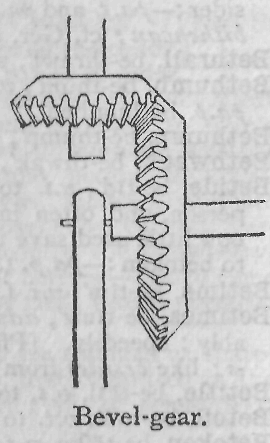
Bevel, bev′el, n. a slant or inclination of a surface: an instrument opening like a pair of compasses, and adjustable for measuring angles.—adj. having the form of a bevel: slanting.—v.t. to form with a bevel or slant:—pr.p. bev′elling; pa.p. bev′elled.—ns. Bev′el-gear, Bev′el-wheels (mech.), wheels working on each other in different planes, the cogs of the wheels being bevelled or at oblique angles to the shafts.—p.adj. Bev′elled, cut to an oblique angle, sloped off. [Fr. biveau, an instrument for measuring angles; orig. unknown.]
Bever, an obsolete form of Beaver.
Beverage, bev′ėr-āj, n. drink: a mixture of cider and water: any agreeable liquor for drinking.—n. Be′ver, a small repast between meals: (obs.) a time for drinking.—v.i. to take such a repast. [O. Fr. bevrage (Fr. breuvage), beivre—L. bibere, to drink.]
Bevy, bev′i, n. a brood or flock of birds, esp. of quails: a company, esp. of ladies. [M. E. bevey, prob. the same as O. Fr. bevee, buvee, drink, It. bevuta, a draught; the transference of sense being perh. from a drink or a drinking-bout to a drinking-party.]
Bewail, be-wāl′, v.t. to lament: to mourn loudly over (esp. the dead).—v.i. to utter lamentations.—adjs. Bewail′able, Bewail′ing. [See Wail.]
Beware, be-wār′, v.i. to be on one's guard: to be suspicious of danger: to take care (with of; with clause—lest, that, not, how). [From the words be and ware run together. See Wary.]
Beweep, be-wēp′, v.t. to weep over, to lament.—p.adj. Bewept′, disfigured by weeping.
Beweltered, be-wel′tėrd, p.adj. besmeared by weltering in blood. [Pfx. be-, and Welter.]
Bewet, be-wet′, v.t. (Shak.) to wet or moisten.
Bewig, be-wig′, to cover with a wig.—p.adj. Bewigged′.
Bewilder, be-wil′dėr, v.t. to perplex or lead astray.—p.adj. Bewil′dered, lost, confused in mind, trackless.—adj. Bewil′dering.—adv. Bewil′deringly.—n. Bewil′derment, confusion, mental confusion: perplexity. [Pfx. be-, and prov. Eng. wildern, a wilderness.]
Bewitch, be-wich′, v.t. to affect by witchcraft (mostly malignantly): to fascinate or charm.—ns. Bewitch′ery, Bewitch′ment.—adj. Bewitch′ing, charming, enchanting.—adv. Bewitch′ingly.
Bewray, be-rā′, v.t. (B.) to accuse: to point out: to betray or divulge unintentionally. [M. E. bewreien, be-, and A.S. wrégan, to accuse.]
Bey, bā, n. a Turkish governor of a town or province. [Turk. beg, pronounced bā, a governor.]
Beyond, be-yond′, prep. on the farther side of: farther onward than: out of reach of: past in time: above, superior to.—Beyond measure, excessively; Beyond seas, abroad; The back of beyond (De Quincey, &c.), a humorous phrase for any place a great way off; To be beyond one, to pass his comprehension; To go beyond, to surpass: to circumvent: (B., Shak.) to overreach. [A.S. begeondan—pfx. be-, and geond, across, beyond. See Yon.]
Bezant, be-zant′, or bez′ant, n. a gold coin, first struck at Byzantium or Constantinople: (her.) a small circle or, like a gold coin.
Bezel, bez′l, n. the part of the setting of a precious stone which encloses it: the oblique side or face of a cut gem: the grooved flange or rim in which a watch-glass is set: the slope at the edge of a chisel or plane (usually Bas′il). [From an O. Fr. word represented by mod. Fr. biseau; its ult. origin uncertain.]
Bezique, be-zēk′, n. a game at cards for two, three, or four persons, played with two to four packs, from which cards with from two to six pips have been removed. The name Bezique itself is applied to the combination of the knave of diamonds and queen of spades. [Fr. besigue, of obscure origin.]
Bezoar, bē′zōr, n. a stony concretion found in the stomachs of goats, antelopes, llamas, chamois, &c., formerly esteemed an antidote to all poisons. [Through Sp. bezaar and Ar. bāzahr, from Pers. pād-zahr, counter-poison, zahr, poison.]
Bezonian, be-zō′ni-an, n. (Shak.) a beggar, a low fellow. [It. bisogno; Sp. bisoño, Fr. bisogne.]
Bezzle, bez′l, v.i. (obs.) to drink hard: to squander:—pr.p. bezz′ling; pa.p. bezz′led. [O. Fr. besiler. See Embezzle.]
Bhang, bang, n. the native name for the Indian preparation of hemp which is smoked or swallowed for its narcotic and intoxicating qualities—in Arabic known as hashish. [See Assassin. Hind. bhāng; Pers. bang; Sans. bhangā.]
Bias, bī′as, n. a bulge or greater weight on one side of a bowl (in the game of bowling), making it slope or turn to one side: a slant or leaning to one side: a one-sided inclination of the mind, prejudice: any special influence that sways the mind.—v.t. to cause to turn to one side: to prejudice or prepossess:—pa.p. bī′ased or bī′assed.—ns. Bī′as-draw′ing (Shak.), a turn awry; Bī′asing, a bias or inclination to one side. [Fr. biais, of dubious origin; Diez suggests L. bifax, bifacem, two-faced.]
Biaxal, bī-aks′al, adj. having two optic axes.—Also Biaxial. [L. bi-, and Axial.]
Bib, bib, n. a cloth put under an infant's chin: a similar article of dress for adults, worn over the breast or above the apron.—v.t. and v.i. to drink, to tipple.—adj. Bībā′cious.—ns. Bibā′tion, tippling; Bib′ber, a tippler: chiefly used in composition as (B.) wine-bibber. [M. E. bibben, most prob. from L. bib-ĕre, to drink.]
Bib, bib, n. a fish of the same genus as the cod and haddock, also called the Pout.
Bibble-babble, bib′bl-bab′bl, n. (Shak.) idle talk. [Reduplication of Babble.]
Bible, bī′bl, n. the sacred writings of the Christian Church, consisting of the Old and New Testaments.—adj. Bib′lical, of or relating to the Bible: scriptural.—adv. Bib′lically.—ns. Bib′licism, biblical doctrine, learning, or literature; Bib′licist, Bīb′list, one versed in biblical learning: one who makes Scripture the sole rule of faith. [Fr.—Low L. biblia, fem. sing., earlier neut. pl., from Gr. ta biblia, lit. 'the books,' esp. the canonical books of Scripture, biblion, a book, dim. of biblos, papyrus, paper.]
Bibliography, bib-li-og′raf-i, n. the description or knowledge of books, in regard to their authors, subjects, editions, and history.—n. Bibliog′rapher, one versed in bibliography or the history of books.—adj. Bibliograph′ic. [Gr. biblion, a book, graphia, description.]
Bibliolatry, bib-li-ol′at-ri, n. superstitious reverence for the Bible.—ns. Bibliol′atrist, Bibliol′ater, one given to bibliolatry. [Gr. biblion, a book, latreia, worship.]
Bibliology, bib-li-ol′ō-ji, n. an account of books: biblical literature, or theology. [Gr. biblion, a book, logos, discourse.]
Bibliomancy, bib′li-ō-man-si, n. divination by selecting passages of the Bible at hazard, and drawing from them indications concerning future events. [Gr. biblion, a book, manteia, divination.]
Bibliomania, bib-li-ō-mān′i-a, n. a mania for possessing rare and curious books.—n. Bibliomān′iac, one who has a mania for possessing rare and curious books.—adj. Bibliomanī′acal. [Gr. biblion, a book, and Mania.]
Bibliophile, bib′li-ō-fīl, n. a lover of books, esp. a collector of rare books. [Fr.—Gr. biblion, a book, philos, friend.]
Bibliopole, bib′li-ō-pōl, n. a bookseller.—Also Bibliop′olist. [Gr. biblion, a book, pōleein, to sell.]
Bibulous, bib′ū-lus, adj. drinking or sucking in: spongy. [L. bibulus—bib-ĕre, to drink.]
Bicameral, bī-kam′ėr-al, adj. having two chambers. [L. bi-, twice, and camera, chamber.]
Bicarbonate, bī-kär′bon-āt, n. a carbonate or salt having two equivalents of carbonic acid to one equivalent of base. [L. bi-, twice, and Carbonate.]
Bice, bīs, n. a pale blue or green paint. [Fr. bis.]
Bicentenary, bī-sen′te-na-ri, Bicentennial, bī-sen-ten′ni-al, adj. pertaining to the two hundredth.—n. the two hundredth anniversary.
Bicephalous, bī-sef′al-us, adj. double-headed. [L. bis, twice, and Gr. kēphalē, head.]
Biceps, bī′seps, n. the muscle in front of the arm between the shoulder and elbow. [L. biceps, two-headed—bis, twice, and caput, head.]
Bichromate, bī-krō′māt, adj. having two parts of chromic acid to one of other ingredients. [L. bis, twice, and Chromate.]
Bicipital, bī-sip′it-al, adj. (anat.) having two heads or origins.—Earlier form Bicip′itous.
Bicker, bik′ėr, v.i. to contend in a petty way: to quiver: to move quickly and tremulously, as running water.—n. a fight, a quarrel: a clattering noise: a short run.—n. Bick′erment (Spens.), bickering, strife. [Acc. to Skeat, bicker = pick-er, or peck-er, to peck repeatedly with the beak.]
Bicker, bik′ėr, n. a bowl for holding liquor, esp. of wood: a vessel made of wooden staves for holding porridge. [Scot. form of Beaker.]
Biconcave, bī-kon′kāv, adj. concave on both sides. [L. bi-, twice, and Concave.]
Biconvex, bī-kon′veks, adj. convex on both sides. [L. bi-, twice, and Convex.]
Bicorporate, bī-kor′por-āt, adj. (her.) double-bodied, as the head of a lion to which two bodies are attached. [L. bis, twice, and Corporate.]
Bicuspid, bī-kus′pid, adj. having two cusps: a pre-molar tooth. [L. bi-, twice, and Cusp.]
Bicycle, bī′si-kl, n. a cycle or velocipede with two wheels furnished with rubber tires, arranged one before the other, impelled by pedals, and steered by transverse handles affixed to the front wheel—also Bike (colloq.).—n. Bī′cyclist. [Formed from L. bi-, bis, twice, and Gr. kyklos, a circle.]
Bid, bid, v.t. to offer: to propose: to proclaim, as the banns of marriage: to invite: to command: to make an offer, and to increase the amount offered for a thing—at an auction:—pr.p. bid′ding; pa.t. bid or bade; pa.p. bid, bid′den.—n. an offer of a price.—ns. Bid′der, one who bids or offers a price; Bid′ding, offer: invitation: command; Bid′ding-pray′er, a form of prayer directed to be used before all sermons, lectures, and homilies preached apart from the daily service or holy communion—as university sermons, so called because in it the preacher is directed to bid or exhort the people to pray for certain specified objects.—To bid fair, to seem likely. [A.S. béodan; Goth. biudan, Ger. bieten, to offer.]
Bid, bid, v.t. to ask for: (nearly obs.): to pray. [A.S. biddan; Goth. bidjan; Ger. bitten; the connection with Bid, to command, is dub. See Bead.]
Bide, bīd, v.t. and v.i. same as Abide, to wait for.—n. Bid′ing (Shak.), residence, habitation. [A.S. bídan; Goth. beidan.]
Bidentate, bī-dent′āt, adj. having two teeth.—Also Bident′al. [L. bi-; twice, dens, dentis, a tooth.]
Bield, bēld, n. (Wordsworth) shelter: protection. [Scot.; conn. with Bold.]
Biennial, bī-en′yal, adj. lasting two years: happening once in two years.—n. a plant that lasts two years.—adv. Bienn′ially. [L. biennalis—bi-, twice, and annus, a year.]
Bier, bēr, n. a carriage or frame of wood for bearing the dead to the grave. [A.S. bǽr; Ger. bahre, L. fer-etrum. From root of verb Bear.]
Biestings. Same as Beestings.
Bifacial, bī-fā′shyal, adj. having two like faces or opposite surfaces. [L. bi-, twice, and Facial.]
Biffins, bif′inz, n. apples slowly dried in bakers' ovens and flattened into cakes—prepared in great quantities in Norfolk. [Said to be properly beefins, because like raw beef.]
Bifidate, bif′id-āt, adj. (bot.) cleft in two.—Also Bif′id. [L. bifidus—bi-, bis, twice, and findĕre, perf. fidi, to cleave or split.]
Biflorate, bī-flō′rāt, adj. bearing two flowers. [L. bi-, twice, and flos, floris, a flower.]
Bifold, bī′fōld, adj. twofold: (Shak.) of two kinds. [L. bi-, twice, and Fold.]
Bifoliate, bī-fō′li-āt, adj. having two leaves. [L. bi-, twice, and Foliate.]
Biform, bī′form, adj. having two forms. [L. bi-, twice, and Form.]
Bifurcate, bī-fur′kāt, Bifurcated, bī-fur′kāt-ed, adj. two-forked; having two prongs or branches.—n. Bifurcā′tion, a forking or division into two branches. [L. bifurcus—bi-, bis, twice, furca, a fork.]
Big, big, adj. large or great: pregnant: great in air, mien, or spirit: loud: pompous, esp. 'to talk big,' 'look big.'—adjs. Big-bell′ied, having a big belly; pregnant (with); Big′gish, rather big.—ns. Big′ness, bulk, size; Big′wig (colloq.), a leading man, a person of some importance. [M. E. big; origin very obscure—Skeat suggests that it is bilg, the l being dropped, and compares Ice. belgja, to puff out.]
Big, big, v.t. (Scot.) to build, to pile up.—n. Big′gin, anything built, a house. [Sc. byggja; A.S. búian.]
Bigamy, big′am-i, n. the crime of having two wives or two husbands at once.—n. Big′amist, one who has committed bigamy. [Fr.—L. bi-, bis, twice, and Gr. gamos, marriage.]
Bigg, big, n. a kind of barley. [Scand.; Ice. bygg, Dan. byg.]
Biggin, big′in, n. a child's cap or hood. [Fr. béguin, from the cap worn by the Beguines, a religious society of women in France.]
Bight, bīt, n. a bend of the shore, or small bay: a bend or coil of a rope. [A.S. byht; cf. Dan. and Sw. bugt, Dut. bocht; from būgan, to bow.]
Bignonia, big-nō′ni-a, n. a genus of tropical plants with trumpet-shaped flowers, named from the Abbé Bignon, Louis XIV.'s librarian.
Bigot, big′ot, n. one blindly and obstinately devoted to a particular creed or party.—adj. Big′oted, having the qualities of a bigot.—n. Big′otry, blind or excessive zeal, esp. in religious matters. [O. Fr.; of dub. origin; variously conn. with Visigoth, they being Arians, while the Franks were orthodox; with Sp. bigote, a moustache; with Beguine (q.v.); and by Wace with a worthless legend that the Norman Rollo, in refusing to kiss the foot of Charles the Simple, said, 'Ne se, bi got.']
Bijou, be-zhōō′, n. a trinket: a jewel: a little box:—pl. Bijoux (be-zhōō′).—n. Bijou′try, jewellery: small articles of virtu. [Fr.]
Bike, bīk, n. a nest of wasps, wild bees, &c.: a swarm of people. [Scot.; ety. dub.]
Bike. See Bicycle.
Bilabiate, bī-lā′bi-āt, adj. having two lips, as some corollas. [L. bi-, twice, and Labiate.]
Bilander, bī′land-ėr, n. a two-masted hoy, having her mainsail bent to the whole length of her yard, hanging fore and aft, and inclined to the horizontal at an angle of about 45º.—Also By′lander. [Dut. bijlander.]
Bilateral, bī-lat′ėr-al, adj. having two sides.—adv. Bilat′erally. [L. bi-, twice, and Lateral.]
Bilberry, bil′ber-i, n. called also Whortleberry, a shrub and its berries, which are dark blue. [Cf. Dan. böllebær; Scot. blaeberry; Ger. blaubeere.]
Bilbo, bil′bō, n. a rapier or sword:—pl. Bilboes (bil′bōz), fetters. [From Bilbao, in Spain.]
Bile, bīl, n. a thick bitter fluid secreted by the liver—yellow in man and carnivorous animals, green in vegetable feeders: (fig.) ill-humour.—n. Bile′-duct, the duct which conveys the bile from the liver and the gall-bladder to the small intestine.—adjs. Bil′iary, belonging to or conveying bile; Bil′ious, pertaining to or affected by bile.—adv. Bil′iously. [Fr.—L. bilis.]
Bilge, bilj, n. the bulging part of a cask: the broadest part of a ship's bottom.—v.i. to spring a leak by a fracture in the bilge, as a ship.—ns. Bilge′-pump; Bilge′-wat′er.—adj. Bilg′y, having the appearance and disagreeable smell of bilge-water. [Most prob. conn. with Bulge.]
Bilharzia, bil′här-zi-a, n. a human parasitic flat worm in the fluke or Trematode order, with differentiated sexes. [From the helminthologist, Theodor Bilharz.]
Bilingual, bī-ling′wal, adj. of or containing two tongues or languages.—Also Bilin′guar. [L. bilinguis—bi-, twice, lingua, tongue.]
Biliteral, bī-lit′ėr-al, adj. consisting of two letters. [L. bi-, twice, and litera, a letter.]
Bilk, bilk, v.t. to elude; to cheat. [Perh. a dim. of Balk; at first a term in cribbage.]
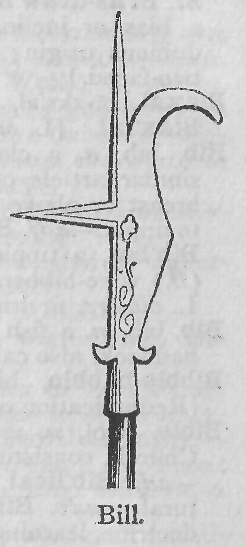
Bill, bil, n. a kind of concave battle-axe with a long wooden handle: a kind of hatchet with a long blade and wooden handle in the same line with it, often with a hooked point, used in cutting thorn hedges or in pruning.—ns. Bill′hook, a bill or hatchet having a hooked or curved point; Bill′man, a soldier armed with a bill. [A.S. bil; Ger. bille.]
Bill, bil, n. the beak of a bird, or anything like it, applied even to a sharp promontory, as Portland Bill: the point of the fluke of an anchor—hence Bill′-board, n., used to protect the planking from being injured by the bill when the anchor is weighed.—v.i. to join bills as doves: to caress fondly.—adj. Billed. [A.S. bile, most prob. the same word as the preceding.]
Bill, bil, n. an account of money: a draft of a proposed law: a written engagement to pay a sum of money at a fixed date: a placard or advertisement: any written statement of particulars: in the criminal law of England, the formal name of a written accusation of serious crime preferred before a grand-jury.—n. Bill′-book, a book used in commerce in which an entry is made of all bills accepted and received.—n.pl. Bill′-brok′ers, persons who, being skilled in the money-market, the state of mercantile and personal credit, and the rates of exchange, engage, either on their own account or that of their employers, in the purchase and sale of foreign and inland bills of exchange and promissory notes: the business of Bill′-discount′ers, or discount-brokers, again, consists in discounting or advancing the amount of bills of exchange and notes which have some time to run before they come due, on the faith of the credit of the parties to the bill.—n. Bill′-cham′ber, a department of the Court of Session in Scotland which deals with summary business—so called because formerly both summonses and diligence or execution were for the most part commenced by a writ called a bill; Bill′-stick′er, one who sticks or posts up bills or placards.—Bill of adventure, a writing by a merchant stating that goods shipped by him, and in his name, are the property of another, whose adventure or chance the transaction is—the shipping merchant, on the other hand, undertaking to account to the adventurer for the produce; Bill of complaint, the name given in the English Court of Chancery, prior to the Judicature Act of 1873, to the formal statement of the facts and prayer for relief submitted by a plaintiff to the court; Bill of costs, an account stating in detail the charges and disbursements of an attorney or solicitor in the conduct of his client's business; Bill of exceptions, a statement of objections, by way of appeal, against the decision of a judge who is trying a case with a jury in the Court of Session; Bill of exchange, a document purporting to be an instrument of pecuniary obligation for value received, and which is employed for the purpose of settling a debt in a manner convenient to the parties concerned; Bill of fare, in a hotel, the list of dishes or articles of food; Bill of health, an official certificate of the state of health on board ship before sailing; Bill of lading, a paper signed by the master of a ship, by which he makes himself responsible for the safe delivery of the goods specified therein; Bill of mortality, an official account of the births and deaths occurring in a certain district within a given time; Bill of sale, in English law, a formal deed assigning personal property, the usual mode of transferring ships, and valuable as mercantile securities over stock-in-trade, furniture, &c.; Bill of sight, an entry of imported goods of which the merchant does not know the quantity or the quality; Bill of store, a license from the customs authorities to reimport British goods formerly exported; Bill of victualling, a list of necessary stores shipped from the bonded warehouse, or for drawback on board vessels proceeding on oversea voyages. [Through Low L. billa, from L. bulla, anything round, a knob, a seal appended to a charter, hence a document bearing a seal, &c. See Bull, an edict.]
Billet, bil′et, n. a little note or paper: a ticket assigning quarters to soldiers.—v.t. to quarter or lodge, as soldiers. [Fr.; dim. of Bill.]
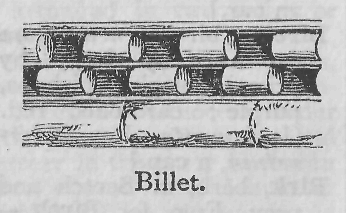
Billet, bil′et, n. a small log of wood used as fuel: (archit.) an ornament in Norman architecture resembling billets of wood.—n. Bill′et-head, a billet or round piece of wood fixed in the bow or stern of a whale-boat, round which the harpoon-line is turned when the whale is struck. [Fr. billette—bille, the young stock of a tree, prob. of Celt. orig., perh. allied to Bole, the trunk of a tree.]
Billet-doux, bil-e-dōō′, n. a sweet note: a love-letter. [Fr. billet, a letter, doux, sweet.]
Billiards, bil′yardz, n. a game played with a cue or mace and balls on a table having pockets at the sides and corners.—adj. Bill′iard.—n. Bill′iard-mark′er, a person who marks the points made by the players. [Fr. billard—bille, a ball.]
Billingsgate, bil′ingz-gāt, n. foul and abusive language like that once familiar to the ear at Billingsgate (the great fish-market of London).
Billion, bil′yun, n. a million or thousand thousand of millions (1,000,000,000,000); or, according to the French method of numeration, one thousand millions (1,000,000,000). [L. bi-, twice, and Million.]
Billon, bil′on, n. base metal: esp. an alloy of silver with copper, tin, or the like. [Fr., from same root as Billet.]
Billow, bil′ō, n. a great wave of the sea swelled by the wind: (poet.) a wave, the sea.—v.i. to roll in large waves.—adjs. Bill′owed, Bill′owy. [Scand.; Ice. bylgja; Sw. bölja, Dan. bölge, a wave. See Bilge, Bulge.]
Billy, Billie, bil′i, n. a comrade, a companion-in-arms: an Australian bushman's boiling-pan or tea-pot:—pl. Bill′ies.—n. Bill′y-goat, a he-goat. [Prob. from Bill, a familiar abbrev. of William.]
Billyboy, bil′i-boi, n. a bluff-bowed one-masted trading-vessel. [Prob. conn. with Bilander.]
Billycock, bil′i-kok, n. a man's low-crowned felt hat. [From bully-cocked, i.e. cocked like the bullies.]
Bilobed, bī′lōbd, Bilobular, bī-lob′ū-lar, adj. having two lobes. [L. bi-, twice, and lobe, a Lobule.]
Bilocation, bī-lok-ā′shun, n. the power of being in two places at the same time. [Coined from bi-, twice, and Location.]
Bilocular, bī-lok′ū-lar, adj. divided into two cells. [L. bi-, twice, and L. loculus, dim. of locus, place.]
Bimana, bīm′an-a, or bim′an-a, n. a term used by Blumenbach, Cuvier, &c., to describe the human species in contrast to other mammals—now rarely used, men and monkeys being now zoologically united in the old Linnæan order—Primates.—adj. Bī′manous.
Bimensal, bī-mens′al, adj. happening once in two months: bimonthly.—adj. Bimes′trial, of two months' duration. [L. bi-, and mensis, a month.]
Bimetallism, bī-met′al-izm, n. the name given to a monetary system in which gold and silver are on precisely the same footing as regards mintage and legal tender.—adj. Bimetal′lic, adapted to that standard.—n. and adj. Bimet′allist. [A recent coinage, from Gr. bi-, double, and Metal.]
Bimonthly, bī-munth′li, adj. once in two months; also twice a month. [L. bi-, two, and Month.]
Bin, bin, n. a place for storing corn, wine. [A.S. binn, a manger.]
Bin, bin, (Shak.) used for Be and Been.
Binary, bī′nar-i, adj. composed of two: twofold.—adjs. Bī′nate, growing in pairs: double; Binaur′al, having two ears: needing the use of both ears.—Binary scale (math.), the scale of notation whose radix or base is 2 (instead of 10); Binary theory (chem.), that which assumes all salts to contain merely two substances, either both simple, or one simple and the other a compound playing the part of a simple body. [L. binarius—bini, two by two—bis, twice.]
Bind, bīnd, v.t. to tie or fasten together with a band (with to, upon): to encircle round (with about, with): to sew a border on: to tie up or bandage a limb, or the like: to fasten together (the leaves of a book) and put a cover on: to lay under obligation to answer a charge: to oblige by oath or promise to or from an action: to restrain, to make fast any one—also of disease, a magic spell, a passion, &c.: to hold or cement firmly: to render hard.—v.i. to produce constipation:—pa.t. and pa.p. bound.—n. a stalk of hops, so called from its twining or binding itself round a pole or tree: the indurated clay of coal-mines: (mus.) the tie for grouping notes together.—ns. Bind′er, one who binds, as books or sheaves: an attachment to a reaping-machine for tying the bundles of grain cut and thrown off, a reaping-machine provided with such; Bind′ery (U.S.), a bookbinder's establishment.—adj. Bind′ing, restraining: obligatory.—n. the act of binding: anything that binds: the covering of a book.—ns. Bind′weed, the convolvulus, a genus of plants, so called from their twining or binding; Bine, the slender stem of a climbing plant.—I dare or will be bound, I will be responsible for the statement. [A.S. bindan; cog. with Ger. binden, Sans. bandh.]
Binervate, bī-nėrv′āt, adj. (bot.) applied to leaves that have two ribs or nerves: (entom.) having the wings supported by two nerves. [L. bi-, bis, twice, and Nerve.]
Bing, bing, n. a heap or pile, often applied like Bin. [Scand.]
Bingo, bing′ō, n. a familiar name for brandy. [Prob. B, and stingo.]
Bink, bingk, n. a Scotch form of Bench.
Binnacle, bin′a-kl, n. (naut.) the box in which on shipboard the compass is kept. [Formerly bittacle—Port. bitácola—L. habitaculum, a dwelling-place—habit-āre, to dwell.]
Binocle, bin′o-kl, n. a telescope through which an object can be viewed with both eyes at the same time.—adj. Binoc′ular, having two eyes: suitable for two eyes.—adv. Binoc′ularly. [L. bini, two by two, oculus, an eye.]
Binomial, bī-nōm′i-al, adj. and n. (alg.) a quantity consisting of two terms or parts, as a+b.—Binomial theorem, a series of analytical formulæ by which any power of a binomial can be expressed and developed. [L. bi-, bis, twice, and nomen, a name, a term.]
Binturong, bin′tū-rong, n. the native name for an Indian prehensile-tailed carnivore, akin to the civet.
Bio-, bī′ō, a prefix from Gr. bios, life, used in many scientific words to express having organic life.—adj. Biobibliograph′ical, dealing with the life and writings of any one.—n. Bī′oblast, a formative cell, a minute mass of bioplasm or protoplasm about to become a definite cell.—adj. Biodynam′ical.—ns. Biodynam′ics, that part of biology which deals with vital force; Biogenesis (-jen′e-sis), the process of natural generation of life from life, as opposed to spontaneous generation, or abiogenesis.—adj. Biogenet′ic.—ns. Biog′enist; Biog′eny; Biomag′netism, animal magnetism; Biom′etry, the measurement or calculation of the probable duration of life; Bī′oplasm, the germinal matter of all living beings.
Biograph, bī′o-graf, n. a name sometimes applied to a form of the zoetrope contrived so as to exhibit the successive movements of a living body, thus simulating life. [Gr. bios, life, graphein, to write, describe.]
Biography, bī-og′raf-i, n. a written account or history of the life of an individual: the art of writing such accounts.—n. Biog′rapher, one who writes biography.—adjs. Biograph′ic, -al.—adv. Biograph′ically. [Gr. bios, life, graphein, to write.]
Biology, bī-ol′oj-i, n. the science that treats of life or of organised beings, which seeks to classify and generalise the multitude of phenomena presented by and peculiar to the living world.—adj. Biolog′ical.—adv. Biolog′ically.—n. Biolo′gist, one who studies biology. [Gr. bios, life, logos, a discourse.]
Biotaxy, bī′ō-tak-si, n. classification according to the sum of the morphological character. [Gr. bios, life, and Taxis.]
Biotic, bī-ot′ik, adj. pertaining to life. [Gr. bios, life.]
Biparous, bip′ar-us, adj. bearing two at a birth. [L. bis, twice, par-ĕre, to bring forth.]
Bipartite, bi′part-īt, or bī-pärt′īt, adj. divided into two like parts.—n. Biparti′tion, the act of dividing into two corresponding parts. [L. bi-, bis, twice, partitus, divided—part-īre, to divide.]
Biped, bī′ped, n. an animal with two feet.—adjs. Bī′ped, Bī′pedal, having two feet. [L. bipes—bi-, bis, twice, ped-em, foot.]
Bipennate, bī-pen′āt, Bipennated, bī-pen′āt-ed, adj. having two wings. [L. bi-, and Pennate.]
Bipennis, bī-pen′nis, n. an axe with two blades, one on each side of the handle, usually seen depicted in the hands of the Amazons. [L.—bis, twice, penna, wing.]
Bipetalous, bī-pet′al-us, adj. having two petals or flower-leaves. [L. bi-, twice, and Petal.]
Bipinnate, bī-pin′nāt, adj. doubly pinnate. [L. bi-, twice, and Pinnate.]
Biquadratic, bī-kwod-rat′ik, n. a quantity twice squared, or raised to the fourth power.—Biquadratic equation, an equation with one unknown quantity raised to the fourth power; Biquadratic root, the square root of the square root of a number. [L. bi- twice, and quadratus, squared.]
Biquintile, bī-kwin′til, n. (astron.) the aspect of planets when they are twice the fifth part (144 degrees) of a great circle from each other. [L. bi-, twice, quintus, the fifth.]
Birch, bėrch, n. a hardy forest-tree, with smooth, white bark and very durable wood: a rod for punishment, consisting of a birch twig or twigs.—adjs. Birch, Birch′en, made of birch. [A.S. berc, bierce; Ice. björk, Sans. bhūrja.]
Bird, bėrd, n. a general name for feathered animals.—v.i. to catch or snare birds.—ns. Bird′-bolt (Shak.), a short thick bolt or arrow with a blunted point, used for killing birds without piercing them; Bird′-cage, a cage or box made of wire and wood for holding birds; Bird′-call, an instrument used by fowlers to call or allure birds to them, by imitating their notes; Bird′-catch′er, one who catches birds: a fowler; Bird′-catch′ing, the art or practice of catching birds; Bird′-cher′ry, a bush bearing an astringent wild-fruit in drupes.—adj. Bird′-eyed, having eyes quick of sight, like those of a bird: quick-sighted.—ns. Bird′-fan′cier, one who has a fancy for rearing birds: one who keeps birds for sale; Bird′ing (Shak.), catching birds by means of hawks trained for the purpose; Bird′ing-piece, a fowling-piece; Bird′-lime, a sticky substance used for catching birds; Bird′-of-Par′adise, a kind of Eastern bird with splendid plumage; Bird's′-eye, a kind of tobacco; Bird's′-nest, the nest in which a bird lays her eggs and hatches her young; Bird′-spī′der, a species of large spiders which prey on small birds, found in Brazil.—adj. Bird′-wit′ted, flighty: incapable of sustained attention.—Bird's-eye view, a general view from above, as if by a bird on the wing, a representation of such, a general view or résumé of a subject; Bird's-foot trefoil, the popular name of several leguminous plants, having clusters of cylindrical pods resembling a bird's foot.—A little bird told me, I heard in a way I will not reveal. [A.S. brid, the young of a bird, a bird: either from root of Breed (bredan, to breed) or of Birth (beran, to bear).]
Bireme, bī′rēm, n. an ancient vessel with two rows of oars. [Fr.—L. biremis—bi-, twice, and remus, an oar.]

Biretta, bir-et′a, n. a square cap worn by clergy—by priests, black; bishops, purple; cardinals, red. [It. berretta—Low L. birretum, a cap.]
Birk, bėrk, n. Scotch and prov. Eng. for Birch.—adj. Birk′en (Scot.), birchen.
Birkie, birk′i, n. a strutting or swaggering fellow: a fellow generally.—adj. active. [Scot. A dubious connection with Scand. berkja, to bark, boast, has been suggested.]
Birl, birl, v.t. to spin anything round: to throw down a coin as one's share in a joint contribution.—v.i. to whirl round. [Scot., an onomatopœic word.]
Birle, birl, v.t. and v.i. (Scot.) to ply with drink: to carouse.—ns. Birl′er (Cumberland); Birl′ing, the act of drawing liquor. [A.S. byrelian, byrele, a cup-bearer, beran, to bear.]
Birlinn, bir′lin, n. a chief's barge in the Western Isles. [Gael.]
Birminghamise, bir′ming-ham-īz, v.t. to make up artificially. [See Brummagem.]
Birostrate, bī-ros′trāt, adj. having a double beak. [L. bi-, twice, and rostratus, beaked—rostrum, a beak.]
Birr, bir, n. impetus: a violent push: stress in pronunciation: any sharp whirring sound. [Scot.; Ice. byrr, a favouring wind.]
Birse, birs, n. bristle.—adj. Birs′y.—To lick the birse, to draw a hog's bristle through the mouth—part of the ceremony of citizenship in Selkirk; To set up one's birse, to rouse the wrath of, from the habit of animals bristling up when enraged. [Scot.; A.S. byrst.]
Birsle, birs′l, v.t. to scorch, to toast. [Scot.]
Birth, bėrth, n. a ship's station at anchor. [Same as Berth.]
Birth, bėrth, n. the act of bearing or bringing forth: the offspring born: dignity of family: origin.—n. Birth′day, the day on which one is born, or the anniversary of that day.—adj. relating to the day of one's birth.—ns. Birth′day-book, a book in diary form, in which the birthdays of one's friends are entered in their autographs; Birth′dom (Shak.), birthright; Birth′-mark, a peculiar mark on one's body at birth; Birth′night, the night on which one is born, or the anniversary of that night; Birth′place, the place of one's birth; Birth′right, the right or privilege to which one is entitled by birth: native rights.—adj. Birth′-strang′led (Shak.), strangled in birth.—n. Birth′-wort, a genus of perennial plants, formerly used medicinally in cases of difficult parturition. [M. E. birÞe, prob. Scand.; cf. Goth, ga-baurÞs, Ger. ge-burt.]
Bis, bis, adv. twice: (mus.) a direction that a passage is to be repeated [L.].—n. Bīseg′ment, a segment of a line or figure cut into two equal parts.—adjs. Bīser′rate (bot.), doubly serrate; Bīsex′ual, of both sexes: (bot.) applied to flowers which contain both stamens and pistils within the same envelope.
Biscayan, bis′kā-an, adj. and n. of or pertaining to the Basque province of Biscay in Spain, or its people: Basque generally: a long heavy musket, or the bullet fired by such.
Biscuit, bis′kit, n. hard dry bread in small cakes: a kind of unglazed earthenware. [O. Fr. bescoit (mod. biscuit)—L. bis, twice, coquĕre, coctum, to cook or bake.]
Bise, bēz, n. a cold north or north-east wind prevalent at certain seasons in Switzerland and neighbouring parts of France and Italy. [Fr.]
Bisect, bī-sekt′, v.t. to cut into two equal parts.—n. Bisec′tion. [L. bi, twice, and secāre, sectum, to cut.]
Biserial, bī-sē′ri-al, adj. arranged in two series or rows. [L. bi-, and Series.]
Bishop, bish′op, n. in the Western and Eastern Churches, and in the Anglican communion, a clergyman consecrated for the spiritual direction of a diocese, under an archbishop, and over the priests or presbyters and deacons: a spiritual overseer in the early Christian Church, whether of a local church or of a number of churches—the terms bishop [Gr. episcopos] and presbyter [Gr. presbyteros] are used interchangeably in the New Testament for the officers who direct the discipline and administer the affairs of a single congregation—the differentiation in function and dignity is, however, well marked by the end of the 2d century: one of the pieces or men in chess, from the upper part being carved into the shape of a bishop's mitre (formerly the archer): a wholesome hot drink compounded of red wine (claret, Burgundy, &c.) poured warm or cold upon ripe bitter oranges, sugared and spiced to taste.—v.t. (jocularly) to play the bishop, to confirm: to supply with bishops: to let milk or the like burn while cooking.—ns. Bish′opess, a she-bishop, a bishop's wife; Bish′opric, the office and jurisdiction of a bishop: a diocese—also Bish′opdom.—Bishop in partibus (see Partibus). [A.S. biscop—L. episcopus—Gr. episcopos, an overseer—epi, upon, skop-ein, to view.]
Bisk. See Bisque (1).
Bismar, bis′mar, n. a kind of steelyard still used in Orkney. [Dan. bismer.]
Bismillah, bis-mil′a, interj. in the name of Allah or God—a common Mohammedan exclamation. [Ar.]
Bismuth, biz′muth, n. a brittle metal of a reddish-white colour used in the arts and in medicine. [Ger. bismuth, wissmuth; origin unknown.]
Bison, bī′son, or bis′on, n. a large wild animal like the bull, found in Lithuania, the Caucasus, &c., with shaggy hair and a fatty hump on its shoulders.—The American 'buffalo' is also a bison. [From L. pl. bisontes, prob. of Teut. origin; cf. Old High Ger. wisunt, A.S. wesend.]
Bisque, bisk, n. a rich soup made of meat or fish slowly stewed and seasoned, crayfish soup.—Also Bisk. [Fr.]
Bisque, bisk, n. pottery that has undergone the first firing before being glazed. [See Biscuit.]
Bisque, bisk, n. a term at tennis for the odds given by one player to another, in allowing him to score one point once during the set—a means of equalising a strong and a weak player. [Fr.]
Bissextile, bis-sext′il, n. leap-year.—adj. containing the Bissext (L. bissextus), or extra day which the Julian calendar inserts in leap-year—the sixth before the kalends of March, 24th February. [L. bis, twice, and sextus, sixth.]
Bisson, bis′son, adj. (Shak.) blind, blinding. [A.S. bísene, blind.]
Bistort, bis′tort, n. a perennial plant with astringent properties (Polygonum bistorta), so named from its twisted roots, called also Snakeweed and Adder's Wort. [Fr.—L. bistorta; bis, twice, torta, twisted.]
Bistoury, bis′tōōr-i, n. a narrow surgical knife for making incisions, having a straight, convex, or concave edge. [Fr.]
Bistre, Bister, bis′tėr, n. a pigment of a warm brown colour made from the soot of wood, esp. beechwood.—adj. Bis′tred. [Fr. bistré; origin unknown.]
Bisulcate, bī-sul′kāt, adj. (zool.) cloven-footed. [L. bi-, twice, sulcus, a furrow.]
Bisulphate, bī-sul′fāt, n. a salt of sulphuric acid, in which one-half of the hydrogen of the acid is replaced by a metal. [L. bi-, twice, and Sulphate.]
Bit, bit, n. a bite, a morsel: a small piece: the smallest degree: a small tool for boring (see Brace): the part of the bridle which the horse holds in his mouth (see Bridle)—hence, To take the bit in his teeth, to be beyond restraint.—v.t. to put the bit in the mouth; to curb or restrain:—pr.p. bit′ting; pa.p. bit′ted.—Bit by bit, piecemeal, gradually. [From Bite.]
Bitch, bich, n. the female of the dog, wolf, and fox. [A.S. bicce; Ice. bikkja.]
Bite, bīt, v.t. to seize or tear with the teeth: to sting or pain: to wound by reproach: to deceive, or take in—now only passive:—pa.t. bit; pa.p. bit or bit′ten.—n. a grasp by the teeth: a nibble at the bait by a fish: something bitten off: a mouthful.—v.t. Bite′-in, to eat out the lines of an etching with acid: to repress.—n. Bit′er, one who bites: a fish apt to take the bait: a cheat.—n. and adj. Bit′ing.—To bite the dust, to fall, to die; To bite the thumb, to express defiance by putting the thumbnail into the mouth and knocking it against the teeth. [A.S. bítan; Goth. beitan, Ice. bita, Ger. beissen.]
Bitt, bit, v.t. (naut.) to fasten round the Bitts (q.v.).
Bittacle. Same as Binnacle.
Bitter, bit′ėr, adj. biting or acrid to the taste: sharp: painful.—n. any substance having a bitter taste.—adj. Bitt′erish.—adv. Bitt′erly.—n. Bitt′erness.—n.pl. Bitt′ers, a liquid prepared from bitter herbs or roots, and used as a stomachic.—n. Bitt′er-sweet, the Woody Nightshade, a slender, climbing hedge-plant, having red poisonous berries, said to be named from its root, when chewed, having first a bitter, then a sweet taste: (Shak.) an apple that has a compound taste of sweet and bitter: a mixture of sweet and bitter. [A.S. bítan, to bite.]
Bitter (Spens.), used for Bittern.
Bittern, bit′ėrn, n. a bird of the heron family, said to have been named from the resemblance of its voice to the lowing of a bull. [M. E. bittour—Fr.—Low L. butorius (bos, taurus).]
Bittern, bit′ėrn, n. an oily liquid remaining in salt-works after the crystallisation of the salt, and used in the manufacture of Epsom salts.
Bittor, Bittour, bit′tur, n. (Dryden) the bird Bittern.
Bitts, bits, n. a frame in the forepart of a ship round which the cables are passed when the vessel rides at anchor.
Bitumen, bi-tū′men, or bit′yu-men, n. a name applied to various inflammable mineral substances, as naphtha, petroleum, asphaltum.—v.t. Bitū′minate, to mix with or make into bitumen—also Bitū′minise.—adjs. Bitū′minous, Bitūmed′ (Shak.), impregnated with bitumen. [L.]
Bivalve, bī′valv, n. an animal having a shell in two valves or parts, like the oyster: a seed-vessel of like kind.—adj. having two valves.—adj. Bivalv′ular. [L. bi-, twice, valva, a valve.]
Bivious, biv′i-us, adj. leading two, or different, ways. [L. bivius—bi-, twice, via, a way.]
Bivouac, biv′ōō-ak, n. the resting at night of soldiers in the open air, instead of under cover in camp.—v.i. to pass the night in the open air:—pr.p. biv′ouacking; pa.p. biv′ouacked. [Fr.—Ger. beiwacht, to watch beside—bei by, wachen, to watch.]
Bi-weekly, bī′-wēk′li, adj. properly, occurring once in two weeks, but usually twice in every week. [L. bi-, twice, and Week.]
Bizarre, bi-zär′, adj. odd: fantastic: extravagant.—n. Bizar′rerie. [Fr.—Sp. bizarro, high-spirited; acc. to Littré, adapted from Basque bizarre, the beard.]
Bizcacha. See Viscacha.
Blab, blab, v.i. to talk much: to tell tales.—v.t. to tell what ought to be kept secret (with out, forth):—pr.p. blab′bing; pa.p. blabbed.—n. an open-mouthed person, a tattler: tattling.—n. Blab′ber, one who blabs. [M. E. blabbe, a chatterer, also Blabber, to babble, with which cf. Norse blabbra, Ger. plappern.]
Black, blak, adj. of the darkest colour: without colour: obscure: dismal: sullen: horrible: dusky: foul, dirty: malignant: dark-haired, wearing dark armour or clothes.—n. black colour: absence of colour: a negro: mourning: the dark smut which attacks wheat: a speck of black on the face, a sooty particle in the air: black clothes, esp. dress trousers.—v.t. to make black: to soil or stain: to draw in black.—n. Black′amoor, a black Moor: a negro.—adjs. Black′-and-tan, having black hair on the back, and tan or yellowish-brown elsewhere, esp. of a terrier; Black′-a-vised, of dark complexion (probably originally black-à-vis).—v.t. Black′ball, to reject in voting by putting a black ball into a ballot-box.—ns. Black′balling, the act of so rejecting a candidate; Black′-band, iron ore containing enough of coal to calcine it; Black′-bee′tle, a cockroach; Black′berry, the berry of the bramble; Black′bird, a species of thrush of a black colour: a current name for a negro or Polynesian kidnapped for labour; Black′birding, the kidnapping of such; Black′board, a board painted black, used in schools for writing, forming figures, &c.—adjs. Black′-bod′ing, of evil omen; Black′-browed, having black eyebrows: sullen.—ns. Black′-cap, a bird, a species of warbler, so called from its black crown: (cook.) an apple roasted until it is black, and served up in a custard: the full-dress cap put on by English judges when about to pronounce sentence of death; Black′-catt′le, oxen, bulls, and cows; Black′-chalk, a variety of clay-slate of a bluish-black colour, used for drawing, and also for making black paint; Black′cock, a species of grouse, common in the north of England and in Scotland; Black′-curr′ant, a garden shrub with black fruit used in making preserves; Black′-death, a name given to the plague of the 14th century from the black spots which appeared on the skin; Black′-draught, the popular name for a purgative medicine consisting chiefly of senna and Epsom salts; Black′-drop, a liquid preparation of opium, vinegar, and sugar.—v.t. Black′en, to make black: to defame.—adj. Black′faced, having a black face: dismal.—ns. Black′-flag, the flag of a pirate, or that hoisted at the execution of a criminal—from its colour; Black′-friar, a friar of the Dominican order, so called from his black mantle (over a white woollen habit): (pl.) the region in a city, as London, where their convent stood; Blackguard (blag′ärd), originally applied to the lowest menials about a court, who took charge of the pots, kettles, &c.: a low, ill-conducted fellow.—adj. low: scurrilous.—v.t. to treat as a blackguard; v.i. to play the blackguard.—n. Black′guardism.—adv. Black′guardly.—ns. Black′-heart′edness; Black′-hole, formerly the name for the punishment-cell in a barrack: the memorable black-hole in the Fort-William barracks at Calcutta, into which, in in 1756, as many as 146 Europeans were thrust over night, of whom only 23 were found surviving in the morning; Black′ing, a substance used for blacking leather, &c.—adj. Black′ish.—ns. Black′-jack, a vessel for holding drink, originally made of leather: (naut.) the flag of a pirate; Black′-lead, a black mineral (plumbago, not lead) used in making pencils, blacking grates, &c.; Black′leg, a low, gambling fellow: a turf-swindler: a term applied by strikers to men willing to work for the wages against which themselves have struck—also Black′-neb; Black′-let′ter, the old English (also called Gothic) letter (); Black′-list, a list of defaulters; Black′-Marī′a, the closely covered, usually black-painted van in which prisoners are conveyed between the court and the prison; Black′-Mon′day, Easter Monday, so called on account of the sufferings experienced by the army of Edward III. from the severity of the weather on that day in 1360; Black′-monk, a monk of the order of St Benedict, from his garments; Black′ness; Black′-pudd′ing, a blood-pudding (q.v.).; Black′-rod, the usher of the chapter of the Garter and of the House of Lords, so called from the black wand tipped with a golden lion which he carries; Black′-sheep, a disreputable member of a family or group; Black′smith, a smith who works in iron, as opposed to a Whitesmith, or one who works in tin; Black′thorn, a species of dark-coloured thorn: the sloe: a stick made from its stem.—adjs. Black′-tressed, having black tresses; Black-visaged (blak′-viz′ājd), having a black visage or appearance.—n. Black′-wash, a lotion of calomel and lime-water: anything that blackens.—Black and blue, with the livid colour of a bruise in the flesh; Black book, an official book bound in black, a book recording the names of persons deserving punishment; Black eye, an eye of which the iris is dark—a point of beauty: a discoloration around the eye due to a blow or fall; Black fellow, a native in Australia.—In black and white, in writing or in print: in art, in no colours but black and white.—To be black in the face, to have the face purple through strangulation, passion, or effort; To be in any one's black books, to have incurred any one's displeasure; To black out, to obliterate with black. [A.S. blac, blæc, black.]

Black-art, blak′-ärt, n. necromancy: magic. [Acc. to Trench, a translation of the Low L. nigromantia, substituted erroneously for the Gr. necromanteia (see Necromancy), as if the first syllable had been L. niger, black.]
Blackmail, blak′māl, n. rent or tribute formerly paid to robbers for protection: hush-money extorted under threat of exposure or denunciation, esp. of a baseless charge.—v.t. to extort money from a person by this expedient. [Black and A.S. mal, tribute, toll.]
Blad, blad, n. a fragment of anything, a good lump. [Scot.]
Bladder, blad′ėr, n. a thin bag distended with liquid or air: the receptacle for the urine.—adjs. Bladd′ered, Bladd′ery, swollen like a bladder.—n. Bladd′erwort, a genus of slender aquatic plants, the leaves floating. [A.S. blǽdre—blawan; Old Ger. blahan, blajan, to blow; Ger. blase, bladder—blasen, to blow; cf. L. flat-us, breath.]
Blade, blād, n. the leaf or flat part of grass or corn: the cutting part of a knife, sword, &c.: the flat part of an oar: a dashing fellow.—n. Blade′bone, the flat bone at the back of the shoulder: the scapula.—adj. Blad′ed. [A.S. blæd; Ice. blad, Ger. blatt.]
Blae, blā, adj. blackish or blue in colour: livid: bleak.—n. Blae′berry, Scotch name for the bilberry or whortleberry. [M. E. blo, bloo—Scand. blá.]
Blague, blag, n. blustering humbug. [Fr.]
Blain, blān, n. a boil or blister. [A.S. blegen, a blister, prob. from blawan, to blow.]
Blame, blām, v.t. to find fault with: to censure.—n. imputation of a fault: crime: censure.—adj. Blam′able, deserving of blame: faulty.—n. Blam′ableness.—adv. Blam′ably.—adj. Blame′ful, meriting blame: criminal.—adv. Blame′fully.—n. Blame′fullness.—adj. Blameless, without blame: guiltless: innocent.—adv. Blame′lessly.—ns. Blame′lessness; Blame′worthiness, quality of being worthy of blame: blamableness.—adj. Blame′worthy, worthy of blame: culpable. [Fr. blâmer, blasmer—Gr. blasphēme-ein, to speak ill. See Blaspheme.]
Blanch, blansh, v.t. to whiten.—v.i. to grow white. [Fr. blanchir—blanc, white. See Blank.]
Blanc-mange, bla-mawngzh′, n. a white jelly prepared with milk. [Fr. blanc, white, manger, food.]
Bland, bland, adj. smooth: gentle: mild.—adv. Blandly.—n. Bland′ness. [L. blandus, perh.—mla(n)dus—Eng. mild.]
Bland, bland, n. an Orcadian name for butter-milk and water. [Scand. blanda.]
Blandish, bland′ish, v.t. to flatter and coax, to cajole.—n. Bland′ishment, act of expressing fondness: flattery: winning expressions or actions. [Fr. blandir, blandiss-, from L. blandīri.]
Blank, blangk, adj. without writing or marks, as in white paper: empty, empty of results: vacant, confused: (poetry) not having rhyme.—n. a paper without writing: a lottery-ticket having no mark, and therefore valueless: an empty space, a void, or vacancy: (archery) the white mark in the centre of a target at which an arrow is aimed, hence the object or aim of anything: a form of document having blank spaces afterwards to be filled in.—v.t. to make pale: (Milton) to confuse.—n. Blank′-cart′ridge, a cartridge without a bullet.—p.adj. Blanked, a minced form of damned, from the usual form of printing d——d.—adv. Blank′ly.—ns. Blank′ness; Blank′-verse, verse without rhyme, esp. the heroic verse of five feet. [Fr. blanc, from root of Ger. blinken, to glitter—Old High Ger. blichen, Gr. phlegein, to shine.]
Blanket, blangk′et, n. a white woollen covering for beds: a covering for horses, &c.—v.t. to cover with a blanket: to toss in a blanket.—n. Blank′eting, cloth for blankets: the punishment of being tossed in a blanket. [Fr. blanchet, dim. of blanc, from its null white colour,]
Blare, blār, v.i. to roar, to sound loudly, as a trumpet.—n. roar, noise. [M. E. blaren, orig. blasen, from A.S. blæsan, to blow. See Blast.]
Blarney, blar′ni, n. pleasing flattery or cajoling talk.—v.t. to beguile with such. [Blarney Castle, near Cork, where there is a stone difficult to reach, he who kisses which ever after possesses the gift of blarney.]
Blasé, bla-zā, adj. fatigued with pleasures, used up. [Fr. blaser.]
Blash, blash, n. watery stuff.—adj. Blash′y. [Scot.]
Blaspheme, blas-fēm′, v.t. and v.i. to speak impiously of, as of God: to curse and swear.—n. Blasphem′er.—adj. Blas′phemous, containing blasphemy: impious.—adv. Blas′phemously.—n. Blas′phemy, profane speaking: contempt or indignity offered to God. [Gr. blasphēme-ein—blaptein, to hurt, phēmi to speak. See Blame.]
Blast, blast, n. a blowing or gust of wind: a forcible stream of air: sound of a wind instrument; an explosion of gunpowder: anything pernicious.—v.t. to strike with some pernicious influence, to blight: to affect with sudden violence or calamity: to rend asunder with gunpowder.—adj. Blast′ed, blighted: cursed, damned.—ns. Blast′-fur′nace, a smelting furnace into which hot air is blown; Blast′-hole, a hole in the bottom of a pump through which water enters; Blast′ing, the separating of masses of stone by means of an explosive substance; Blast′ing-gel′atine, a powerful explosive made of gun-cotton and nitro-glycerine; Blast′ment, withering or shrivelling up caused by blasting; Blast′-pipe, a pipe in a steam-engine, to convey the waste-steam up the chimney. [A.S. blǽst; cf. Ice. beása; Ger. blasen.]
Blastoderm, blas′to-derm, n. an embryological term applied to the layer or layers of cells arising from the germinal disc, or the portion of a partially segmenting egg which undergoes division. [Gr. blasto-, blastos, a sprout, derma, dermat-, skin.]
Blatant, blāt′ant, adj. noisy, clamorous, loud.—adv. Blat′antly. [Prob. a coinage of Spenser.]
Blate, blāt, adj. bashful, timidly awkward. [Scot.; A.S. blát, pale.]
Blatter, blat′tėr, v.i. to talk overmuch, to prate.—v.i. to hurry or rush noisily.—n. a clatter of words, sound of rapid motion. [L. blaterāre.]
Blawort, blä′wort, n. the harebell: the corn blue-bottle.—Also Blē′wart. [Scot. Blae, and wort, herb.]
Blay, blā, n. the fish bleak.—Also Bley. [See Bleak, a fish.]
Blaze, blāz, n. a rush of light or of flame: a bursting out or active display: a white spot on the face of a horse or ox: a mark made on a tree by cutting off a strip of bark to mark a track or a boundary.—v.i. to burn with a flame: to throw out light.—n. Blaz′er, a cricket or golf jacket of bright colour.—Blazes, from the fires of hell, in imprecations like To blazes; also Like blazes = with fury.—To blaze a tree, to make a white mark by cutting off a piece of the bark. [A.S. blæse, a torch, from root of Blow.]
Blaze, blāz, Blazon, blā′zn, v.t. to proclaim, to spread abroad.—n. Blaz′er (Spens.), one who spreads abroad or proclaims. [Same as Blare; Blazon is the M. E. blasen, with the n retained.]
Blazon, blā′zn, v.t. to make public: to display: to draw or to explain in proper terms the figures, &c., in armorial bearings.—n. the science or rules of coats-of-arms.—ns. Blaz′oner, one who blazons: a herald: a slanderer; Blaz′onry, the art of drawing or of deciphering coats-of-arms: heraldry. [Fr. blason, a coat-of-arms, from root of Blaze.]
Bleach, blēch, v.t. to make pale or white: to whiten, as textile fabrics.—v.i. to grow white.—ns. Bleach′er, one who bleaches, or that which bleaches; Bleach′ery, a place for bleaching; Bleach′-field, a place for bleaching cloth: a bleacher's office or works; Bleach′ing, the process of whitening or decolourising cloth; Bleach′ing-green, a green for bleaching clothes on; Bleach′ing-pow′der, chloride of lime. [A.S. blǽcan, from root of Bleak.]
Bleak, blēk, adj. colourless: dull and cheerless: cold, unsheltered.—adv. Bleak′ly.—n. Bleak′ness. [A.S. blæc, blâc, pale, shining; a different word from blac (without accent), black. The root is blican, to shine.]
Bleak, blēk, n. a small white river-fish.
Blear, blēr, adj. (as in Blear-eyed, blēr′-īd) sore or inflamed: dim or blurred with inflammation. [Low Ger. bleer-oged, 'blear-eyed.']
Bleat, blēt, v.i. to cry as a sheep.—n. the cry of a sheep, any similar cry, even of the human voice.—n. Bleat′ing, the cry of a sheep. [A.S. blǽtan; L. balāre, Gr. blēchē, a bleating; root bla-; formed from the sound.]
Bleb, bleb, n. a transparent blister of the cuticle: a bubble, as in water. [See Bulb.]
Bled, bled, pa.t. and pa.p. of Bleed.
Blee, blē, n. (Mrs Browning) complexion, colour. [A.S. bléo.]
Bleed, blēd, v.i. to lose blood: to die by slaughter: to issue forth or drop as blood: to have money extorted from one: to feel great pity for, as in the phrase, 'the heart bleeds:' to be as red as blood.—v.t. to draw blood from, esp. surgically: to extort sums of money from:—pa.t. and pa.p. bled.—n. Bleed′ing, a discharge of blood: the operation of letting blood.—adj. full of compassion: emitting sap: terribly weakened by war: (Shak.) bloody. [A.S. blédan. See Blood.]
Blemish, blem′ish, n. a stain or defect: reproach.—v.t. to mark with any deformity: to tarnish: to defame.—n. Blem′ishment (Spens.), the state of being blemished, disgrace. [O. Fr. blesmir, blemir, pr.p. blemissant, to stain, of dubious origin. Prof. Skeat thinks it Scand., Ice. blâman, livid colour—blâr, Blue.]
Blench, blensh, v.i. to shrink or start back: to flinch. [From root of Blink.]
Blench, blensh, adj. or adv. based on the payment of a nominal yearly duty.—Also Blanch. [See Blank.]
Blend, blend, v.t. to mix together: to confound.—v.i. to be mingled or mixed:—pa.p. blend′ed and blent.—n. a mixture:—n. Blend′ing, the act of mingling: the process by which the fusion of paints is effected. [A.S. blandan.]
Blende, blend, n. native sulphuret of zinc. [Ger. blenden, to dazzle, from the lustre of the crystals.]
Blenheim, blen′em, n. a kind of spaniel named from the Duke of Marlborough's house.
Blennorrhœa, blen-no-rē′a, n. discharge of mucus. [Gr. blennos, mucus.]
Blenny, blen′ni, n. a genus of acanthopterygious fishes, covered with mucus or slimy matter. [Gr. blennos, mucus.]
Blent, blent, (obs.) pa.p. of Blend—mixed: mingled: (Spens.) blinded, obscured.
Bless, bles, v.t. to invoke a blessing upon: to make joyous, happy, or prosperous: to consecrate by some religious rite, to cross one's self: to extol as holy, to pronounce happy, to invoke the divine favour upon: to wish happiness to: to praise or glorify:—pa.p. blessed (blest), or blest.—adj. Bless′ed, happy: prosperous: happy in heaven, beatified.—adv. Bless′edly.—ns. Bless′edness; Bless′ing, a wish or prayer for happiness or success: any means or cause of happiness: (B.) a gift or present: a form of invoking the favour of God at a meal.—adv. Bless′ingly.—Single blessedness, the celibate life, the unmarried state generally. [A.S. blétsian, to bless, prob. from blót, sacrifice; the word taken as—benedicĕre.]
Bless, bles, v.t. (Spens.) to brandish. [Blaze(?).]
Blest, blest, pa.p. of Bless.
Blether, bleth′er, v.i. to talk garrulous nonsense.—n. fluent, garrulous nonsense—also Blath′er.—p.adj. Bleth′ering, over-talkative.—ns. Bleth′erskate, Blath′erskite (Amer.), a blustering, noisy, talkative fellow. [M. E. blather, of Scand. origin, Ice. blaðra, to talk foolishly, blaðr, nonsense.]
Blew, blōō, pa.t. of Blow.
Blewits, blū′its, n. a kind of mushroom. [Fr. Blue.]
Blight, blīt, n. a disease in plants, which blasts or withers them: anything that injures or destroys.—v.t. to affect with blight: to blast: to frustrate.—p.adj. Blight′ing, withering, blasting. [Dr Murray notes that it first appears in literature in the 17th century; prob. orig. of Scand. origin; cf. Ice. blettr, a stain; perh. related to Bleach, Bleak.]
Blin, blin, v.t. (Spens.) to cease.—n. cessation: stoppage. [A.S. blinnan, to cease, pfx. be-, and linnan, to cease.]
Blind, blīnd, adj. without sight: dark: ignorant or undiscerning: without an opening.—n. something to mislead: a window-screen: a shade.—v.t. to make blind; to darken, obscure, or deceive; to dazzle.—pa.p. blīnd′ed; pr.p. blīnd′ing.—ns. Blind′age (mil.) a temporary wooden screen faced with earth as a protection against splinters of shell and the like; Blind′-coal, non-bituminous coal.—adj. Blind′ed, deprived of sight: without intellectual discernment.—n. Blind′er, one who or that which blinds; (pl.) a horse's blinkers.—adj. Blind′fold, having the eyes bandaged, so as not to see: thoughtless: reckless.—v.t. to cover the eyes: to mislead.—adj. Blind′ing, tending to make blind.—pr.p. making blind.—adv. Blind′ly.—ns. Blind′ness, want of sight, ignorance, folly; Blind′-side, the side on which a person is blind to danger: weak point; Blind′worm, a small reptile, like a snake, having eyes so small as to be supposed blind.—Blind-man's buff, a game in which one of the party is blindfolded and tries to catch the others. [A.S. blind; Ice. blindr.]
Blink, blingk, v.i. to glance, twinkle, or wink: to see obscurely, or with the eyes half-closed: to shine unsteadily.—v.t. to shut out of sight: to avoid or evade.—n. a glimpse, glance, or wink: a momentary gleam of light, a spark.—n. Blink′ard, one who blinks or has bad eyes.—p.adj. Blinked, affected with blinking.—n.pl. Blink′ers, pieces of leather fastened to the cheek-pieces of a horse's head-stall in driving to prevent him seeing in any direction except straightforward. [M. E. a variant of blenk, prob. the same as Blench (q.v.).]
Blirt, blirt, n. (Scot.) a fit of crying.—v.i. to burst into tears. [Prob. the same as Blurt.]
Bliss, blis, n. the highest happiness: the special happiness of heaven, heaven.—adj. Bliss′ful.—adv. Bliss′fully.—n. Bliss′fulness.—adj. Bliss′less, without bliss. [A.S. blíðs, blíðe, Blithe.]
Blist, blist, pa.t. (Spens.) wounded: struck. [From Fr. blesser, to wound.]
Blister, blis′tėr, n. a thin bubble or bladder on the skin, containing watery matter: a pustule: a plaster applied to raise a blister.—v.t. to raise a blister.—ns. Blis′ter-bee′tle, Blis′ter-fly, the cantharis, or Spanish fly, used for blistering; Blis′ter-plas′ter, a plaster made of Spanish flies used to raise a blister; Blis′ter-steel, Blis′tered-steel, steel blistered in the process of manufacture, used for making tools, &c.—adj. Blis′tery. [M. E.; most prob. O. Fr. blestre, conn. with Old Norse blástr, blása, to blow; Ger. blase.]
Blithe, blīth, adj. happy: gay; sprightly.—adv. Blithe′ly.—n. Blithe′ness.—adj. Blithe′some, joyous.—adv. Blithe′somely.—n. Blithe′someness. [A.S. blíðe, joyful. See Bliss.]
Blive, blīv, adv. (Spens.). Same as Belive.
Blizzard, bliz′ard, n. a blinding storm of wind and snow, a snow-squall.—adjs. Blizz′ardly, Blizz′ardous. [A modern coinage—most prob. onomatopœic, on the analogy of blow, blast, &c.]
Bloat, blōt, v.t. to swell or puff out: to dry by smoke (applied to fish).—v.i. to swell or dilate: to grow turgid.—p.adj. Bloat′ed.—n. Bloat′er, a herring partially dried in smoke, esp. at Yarmouth. [Scand., as in Sw. blöt, soft.]
Blob, blob, n. a drop of liquid: anything soft and round, like a gooseberry: a round spot. [Imit.]
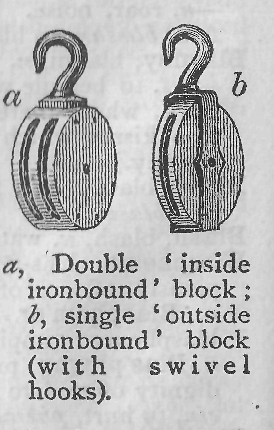
Block, blok, n. an unshaped mass of wood or stone, &c.: the wood on which criminals were wont to be beheaded: (mech.) a pulley together with its framework; a piece of wood on which something is formed: a connected group of houses: an obstruction: a blockhead.—v.t. to enclose or shut up: to obstruct: to shape or sketch out roughly.—n. Blockade′, the blocking up of a place by surrounding it with troops or by ships.—v.t. to block up by troops or ships.—ns. Block′-head, one with a head like a block, a stupid fellow; Block′-house, a small temporary fort generally made of logs.—adj. Block′ish, like a block: stupid: dull.—ns. Block′-print′ing, printing of Block′-books, from engraved wooden blocks or pages; Block′-ship, a war-ship, inefficient for service in action on account of age, but useful in defence of ports; Block′-sys′tem, a system of working trains in which no train is allowed on to a section of line so long as any other train is on that section; Block′-tin, tin in the form of blocks or ingots. [Widely spread, but acc. to Skeat, of Celt. origin, Gael. ploc, Old Ir. blog, a fragment. See Plug.]
Bloke, blōk, n. a fellow, a man familiarly. [Ety. quite unknown—at any rate not Gipsy.]
Bloncket, blongk′et, adj. (Spens.) gray. [Fr. blanchet, whitish, dim. of blanc, white.]
Blonde, blond, n. a person of fair complexion with light hair and blue eyes—opp. to Brunette.—adj. of a fair complexion: fair. [Fr.]
Blond-lace, blond′-lās, n. lace made of silk, so called from its colour.
Blont, blont, adj. (Spens.). Same as Blunt.
Blood, blud, n. the red fluid in the arteries and veins of men and animals: descent, of human beings, good birth: relationship, kindred: elliptically for a blood-horse, one of good pedigree: a rake or swaggering dandy about town: the blood-royal, as in 'princes of blood:' temperament: bloodshed or murder: the juice of anything, esp. if red: the supposed seat of passion—hence temper, anger, as in the phrase, 'his blood is up,' &c.: the sensual nature of man.—interj. 's blood—God's blood.—adjs. Blood′-bespot′ted (Shak.), spotted with blood; Blood′-bolt′ered (Shak.), sprinkled with blood as from a bolter or sieve; Blood′-bought, bought at the expense of blood or life; Blood′-froz′en (Spens.), having the blood frozen or chilled.—ns. Blood′guilt′iness, the guilt of shedding blood, as in murder; Blood′heat, heat of the same degree as that of the human blood (about 98° Fahr.); Blood′-horse, a horse of the purest and most highly prized blood, origin, or stock.—adj. Blood′-hot, as hot or warm as blood.—n. Blood′hound, a large hound formerly employed in tracing human beings: a blood-thirsty person.—adv. Blood′ily.—adj. Blood′less, without blood, dead: without the shedding of blood: (Shak.) without spirit or activity.—ns. Blood′-let′ting, the act of letting blood, or bleeding by opening a vein; Blood′-mon′ey, money earned by laying or supporting a capital charge against any one, esp. if the charge be false or made by an accomplice; Blood′-pois′oning, a name popularly, but loosely, used of pyæmia and allied diseases; Blood′-pud′ding, a pudding made with blood and other materials; Blood′-relā′tion, one related by blood or marriage; Blood′-sac′rifice (Shak.), a sacrifice made with bloodshed; Blood′shed, the shedding of blood: slaughter.—adjs. Blood′shot (of the eye), red or inflamed with blood; Blood′-sized, sized or smeared with blood.—n. Blood′-spav′in, a disease of horses consisting of the swelling of a vein on the inside of the hock, from a checking of the blood.—adj. Blood′-stained, stained with blood: guilty of murder.—ns. Blood′-stone, a dark-green variety of quartz, variegated with blood-like spots of red jasper, the heliotrope; a brown ore of iron, hematite; Blood′-suck′er, an animal that sucks blood, esp. a leech: an extortioner, one who sponges upon another.—adj. Blood′-suck′ing (Shak.), that sucks or draws blood.—ns. Blood′-tax, conscription or universal military service, as drawing from the nation a certain number of lives or recruits annually; Blood′-thirst′iness, thirst or desire for shedding blood.—adj. Blood′-thirst′y, having a thirst or desire to shed blood.—ns. Blood′-ves′sel, a vessel in which blood circulates, a vein or artery; Blood′-worm, a small red earthworm used by anglers.—adj. Blood′y, of the nature of blood: stained with blood: murderous, cruel: vulgarly, as an adj. emphasising anger or the like: as an adv. employed as a mere intensive—most prob. from the habits of the 'bloods' about the beginning of the 18th century (Etheredge, 'bloody-drunk').—v.t. to make bloody.—n. Blood′y-bones, a phrase, together with Rawhead, applied to a children's bugbear.—adjs. Blood′y-eyed; Blood′y-faced.—ns. Blood′y-flux, dysentery, in which the discharges from the bowels are mixed with blood; Blood′y-hand (her.), the armorial device of Ulster, hence of baronets.—adj. Blood′y-mind′ed.—ns. Blood′y-mind′edness; Blood′y-sweat, a sweat accompanied with the discharge of blood.—Avenger of blood, the next-of-kin to a murdered man, whose duty it was to avenge his death—the Hebrew Goël.—Eating of blood, prohibited under the Old Testament dispensation, Jews still killing their own butcher-meat.—In blood, in full vigour; In hot or cold blood, under or free from excitement or sudden passion. [A.S. blód—root blówan, to bloom; cog. with Old. Fris. blód, Ger. blut.]
Bloom, blōōm, v.i. to put forth blossoms: to flower: to be in a state of beauty or vigour: to flourish: to give a bloom or warm tint to anything.—n. a blossom or flower: the opening of flowers: rosy colour: the prime or highest perfection of anything: the first freshness of beauty of anything: the flush or glow on the cheek—(Spens.) Blosme.—p.adj. Bloom′ing, bright, shining, flourishing: (slang) full-blown.—adjs. Bloom′less, without bloom; Bloom′y, flowery: flourishing. [Ice. blóm; cf. Goth. blôma, Ger. blume.]
Bloomer, blōōm′ėr, n. and adj. a dress for women, partly resembling men's dress, devised by Mrs Bloomer of New York about 1849, consisting of a jacket with close sleeves, a skirt falling a little below the knee, and a pair of Turkish trousers.
Bloomery, blōōm′ėr-i, n. the first forge through which iron passes after it has been melted from the ore, and where it is made into Blooms, or rough ingots, for hammering or drawing out.
Blore, blōr, n. a violent gust of wind. [Prob. related to Blare and Blow.]
Blosme. See Bloom.
Blossom, blos′om, n. a flower-bud, the flower that precedes fruit.—v.i. to put forth blossoms or flowers: to flourish and prosper.—n. Bloss′oming.—adj. Bloss′omy, covered with flowers, flowery. [A.S. blóstm, blóstma, from root of Bloom.]
Blot, blot, n. a spot or stain: an obliteration, as of something written: a stain in reputation.—v.t. to spot or stain: to obliterate or destroy: to disgrace: to dry writing with blotting-paper:—pr.p. blot′ting; pa.p. blot′ted.—n. and adj. Blot′tesque, a painting executed with heavy blot-like touches, a daub or (fig.) a vigorous descriptive sketch.—n. Blotting-pā′per, unsized paper, used for absorbing ink.—adj. Blot′ty. [Prob. Scand., as in Dan. plet, Ice. blettr, a spot.]
Blot, blot, n. a piece liable to be taken at backgammon: a weak place in anything. [Ety. obscure; Dut. bloot, naked.]
Blotch, bloch, n. a dark spot on the skin: a pustule.—v.t. to mark or cover with blotches.—adjs. Blotched, Blotch′y. [Prob. formed on Blot.]
Blouse, blowz, n. a loose sack-like outer garment, somewhat like the English smock-frock. [Fr.]
Blow, blō, n. a stroke or knock: a sudden misfortune or calamity.—At a blow, by a single action, suddenly; To come to blows, To exchange blows, to come to hostilities; Without striking a blow, without a struggle. [A.S. bléowan is doubtful, cog. with Dut. blouwen, to dress (beat) flax, Ger. blāuen, to beat hard. The noun appears in the 15th century without evidence of parentage.]
Blow, blō, v.i. to bloom or blossom:—pr.p. blōw′ing; pa.p. blōwn. [A.S. blówan; Ger. blühen. See Bloom, Blossom.]
Blow, blō, v.i. to produce a current of air: to move, as air or the wind.—v.t. to drive air upon or into: to drive by a current of air, as 'to blow away, down,' &c.: to sound, as a wind-instrument: to breathe hard or with difficulty: to spout, as whales: (prov.) to boast: to spread by report: to fan or kindle:—pa.t. blew (blōō); pa.p. blown (blōn).—ns. Blow′-ball, the downy head of a dandelion in seed; Blow′er, a metal plate put upon the upper part of a fireplace, so as to increase the draught through the fire: a machine for driving a blast of air, as into a furnace; Blow′-fly, or Flesh-fly, an insect of the order Diptera, and of the large family Muscidæ, to which the common house-fly and blue-bottle belong.—p.adj. Blown, out of breath, tired: swelled: stale, worthless.—n. Blow′pipe, a pipe through which a current of air is blown on a flame, to increase its heat: a kind of weapon much used by some of the Indian tribes of South America both in hunting and war, consisting of a long straight tube in which a small poisoned arrow is placed, and forcibly expelled by the breath.—adj. Blow′y.—To blow hot and cold, to be favourable and unfavourable by turns, to be irresolute; To blow off (steam, &c.), to allow to escape, to escape forcibly; To blow one's own trumpet, to sound one's own praises; To blow over, to pass away, to subside, as a danger or a scandal; To blow up, to shatter or destroy by explosion: to scold; To blow upon, to take the bloom, freshness, or the interest off anything, to bring into discredit: to inform upon. [A.S. bláwan; Ger. blähen, blasen; L. flare.]
Blowze, blowz, n. a ruddy, fat-faced wench.—adjs. Blowzed, Blowz′y, fat and ruddy, or flushed with exercise, dishevelled, slatternly. [Perh. related to root of Blush; or of cant origin.]
Blubber, blub′ėr, n. the fat of whales and other sea animals.—v.i. to weep effusively.—p.adj. Blubb′ered, of a face swollen with weeping. [M. E. blober, bluber; most likely onomatopœic]
Blucher, blōōch′ėr, n. a strong leather half-boot or high shoe, named from Marshal Blücher, the Prussian general at Waterloo.
Bludgeon, blud′jun, n. a short stick with a heavy end to strike with. [First in 18th century; origin very obscure; from a cant word conn. with Blood.]
Blue, blōō, n. the colour of the sky when unclouded—hence the sea, the sky, as in 'a bolt from the blue:' one of the seven primary colours.—adj. of the colour blue: learned, pedantic: indecent or obscene, as in blue stories.—ns. Blue′-beard, a monster who murders a series of wives in Perrault's famous conte, before he is himself cut off: one who is 'unfortunate' with his wives after the fashion of Henry VIII.; Blue′bell, a plant that bears blue bell-shaped flowers; Blue′-bird, a small American bird akin to the warblers; Blue′-black, black with a tinge of blue; Blue′-book, the name popularly applied to the reports and other papers printed by parliament, because usually stitched up in blue paper wrappers; Blue′-bot′tle, a common name for the Blue Cornflower: a familiar name for a policeman or beadle; Blue′-cap, a fish of the salmon kind with blue spots on its head: the blue titmouse: (Shak.) a Scotchman, from his blue bonnet; Blue′-eye, a beautiful little bird in New South Wales, one or the honey-eaters; Blue′-fish, a fish of the family Scomberidæ, abundant on the east coast of North America.—n.pl. Blue′-gowns, the name commonly given to a former class of privileged mendicants in Scotland—called also the King's Bedesmen.—ns. Blue′-grass, a permanent grass found in Europe and North America; Blue′-gum, a kind of Eucalyptus; Blue′-jack′et, a seaman in the navy, as distinguished from a marine; Blue′-jay, a common North American bird of the jay family; Blue′ness; Blue′-nose, a nickname for a Nova Scotian; Blue′-pē′ter, a blue flag with white square in the centre, used in the navy as a signal for sailing; Blue′pill, a mercurial pill, used as a purgative in cases of torpid or inflamed liver; Blue′-stock′ing, a name given to learned ladies who display their acquirements in a pedantic manner, to the neglect of womanly graces—about 1750 Mrs Montague and others began to substitute literary conversation for cards, and the name implying a disregard for the conventional costume of polite society was suggested by the blue stockings of Benjamin Stillingfleet—the French bas bleu is a translation; Blue′-stone, blue copperas, sulphate of copper; Blue′-throat, or Blue′-breast, a beautiful and melodious bird, nearly allied to the nightingale; Blue′-wing, a kind of duck, either a sub-genus of Anas, or a special genus Cyanopterus—the best-known species, the Common or Lunate Blue-wing, the Blue-winged Teal of the United States.—adj. Blū′ish, slightly blue.—Blue blood, aristocratic blood—the sangre azul of the Spanish hidalgoes; Blue bonnet, a round flat cap of blue woollen, much worn in Scotland: a blue-bonneted Scotch peasant or soldier; Blue-bottle fly, the meat-fly or blow-fly; Blue-coat boy, a scholar of Christ's Hospital—also (from the blue coat having formerly been the usual dress of servants) a servant, beadle, soldier; Blue devil, an evil demon: (pl.) deep despondency, the apparitions seen in delirium tremens; Blue funk (slang), great terror; Blue ribbon, a term applied to any great prize, as the Derby stakes—from the blue ribbon worn by Knights of the Garter: the badge assumed by the so-called Blue Ribbon Army introduced from America in 1878; Blue water, the deep sea, as opposed to port or a narrow channel.—Light blue, and Dark blue, the distinctive colours in their athletic contests of Eton and Cambridge, and of Harrow and Oxford respectively; The Blues, the Royal Horse Guards; The blues (for blue devils), a colloquial expression for depression of spirits.—To be a blue, to be chosen to represent Oxford or Cambridge at an inter-university contest in cricket, football, rowing, or athletics; An old blue, one once so chosen.—To drink till all's blue, until everything around one looks blue; To look blue, to be down-spirited.—True blue, faithful to the principles of the political party wearing blue as its colour, in many places identified with Conservative. [M. E. blew—O. Fr. bleu, of Teut. origin; as also Scand. blá, which gave M. E. bla, blo, and modern blae.]
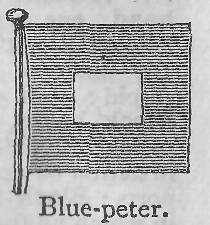
Bluff, bluf, adj. blustering: rough and hearty in manners: outspoken: steep.—n. a high steep bank overlooking the sea or a river: the act of bluffing at cards, as in poker—hence any kind of boastful swagger intended to impose upon another: (slang) an excuse.—adjs. Bluff′-bowed, having broad and flat bows, as a ship; Bluff′-head′ed, applied to a ship having her stem too straight up.—adv. Bluff′ly.—n. Bluff′ness. [Prob. Dut.]
Blunder, blun′der, v.i. to make a gross mistake, to flounder about: to utter thoughtlessly.—n. a gross mistake.—p.adj. Blun′dering, apt to make gross mistakes: apt to stumble.—To blunder away, to throw away some opportunity or advantage. [M. E. blondren; prob. conn. with Bland; perh. from Ice. blunda, to doze.]
Blunderbuss, blun′dėr-bus, n. a short hand-gun with a wide bore. [Corr. of Dut. donderbus—donder, thunder, bus, a box, barrel of a gun, a gun; Ger. donnerbüchse.]
Blunt, blunt, adj. having a dull edge or point; rough, outspoken, dull.—v.t. to dull the edge or point: to weaken.—n. (slang) money.—adj. Blunt′ish.—adv. Bluntly.—n. Blunt′ness.—adj. Blunt′-wit′ted (Shak.) dull, stupid. [Orig. sleepy, dull; prob. conn. with Ice. blunda, to doze; perh. akin to Blind.]
Blur, blur, n. a blot, stain, or spot.—v.t. to blot, stain, obscure, or blemish (with out, over):—pr.p. blur′ring; pa.p. blurred. [A variety of Blear.]
Blurt, blurt, v.t. to utter suddenly or unadvisedly (with out).—n. an abrupt outburst.—p.adj. Blurt′ing, impulsively frank. [From sound. Cf. Blirt.]
Blush, blush, n. a red glow on the face caused by shame, modesty, &c.: any reddish colour: sudden appearance.—v.i. to show shame or confusion by growing red in the face: to grow red.—n. Blush′et (Ben Jonson), a young, modest girl.—adj. Blush′ful, full of blushes: modest—n. Blush′ing, the act of turning red: the appearance of colour upon the cheek.—p.adj. showing blushes: modest.—adv. Blush′ingly.—At the first blush, at the first glance.—To put to the blush, to cause to blush. [Prob. Scand.; cog. with A.S. blysa, a blaze. See Blaze, Blowze.]
Bluster, blus′tėr, v.i. to make a noise like a blast of wind: to bully or swagger.—n. a blast or roaring as of the wind: bullying or boasting language: a storm of anger.—n. Blus′tering, a noisy blowing as of a blast: swaggering: noisy pretension.—adj. stormy: tumultuous: boastful.—adv. Blus′teringly.—adjs. Blus′terous (Shak.) noisy: boastful; Blus′tery, stormy: (Carlyle) swaggering. [An augmentative of Blast.]
Bo, bō, interj. a word used to frighten children.—To say bo to a goose, to open the mouth, to say even a word.
Boa, bō′a, n. a genus of serpents which includes the largest species of serpents (the Boa-Constric′tor), which kill their prey by constriction or pressure: a long serpent-like coil of fur, feathers, or the like, worn round the neck by ladies. [Perh. conn. with L. bos, an ox.]
Boad. Same as Abode, pa.p. of Abide: also the same as Bode.
Boanerges, bo-an-erj′es, n. a noisy preacher or shouting orator. ['Sons of thunder'—Mark, iii. 17.]
Boar, bōr, n. the male of swine, or its flesh.—adj. Boar′ish, swinish: brutal.—n. Boar′-spear, a spear used in boar-hunting. [A.S. bár; Dut. beer; Ger. bär.]
Board, bōrd, n. a broad and thin strip of timber: a table to put food on: food: a table round which persons meet for some kind of business: any council or authorised body of men, as a 'school-board:' the deck of a ship: (pl.) the stage: a kind of thick stiff paper, as in pasteboard, Bristol-board, esp. that used in the binding of books.—v.t. to cover with boards: to supply with food at fixed terms: to enter a ship: to attack.—v.i. to receive food or take meals.—ns. Board′er, one who receives board (food): one who boards a ship; Board′ing, the act of covering with boards: the covering itself: act of boarding a ship; Board′ing-house, a house where boarders are kept; Board′ing-pike, a pike used in boarding a ship, or in defending it when attacked; Board′ing-school, a school in which board is given as well as instruction; Board′-school, a school under control of a school-board, as elected by the Elementary Education Act of 1870.—n.pl. Board′-wā′ges, wages allowed to servants to keep themselves in food.—Above board, openly.—By the board, over the board or side of a ship—hence, To go by the board, to be lost or destroyed.—To sweep the board, to take all the cards. [A.S. bord, a board, the side of a ship; Ice. borð, the side of a ship: conn. either with Bear or with Broad.]
Boast, bōst, v.i. to talk vaingloriously: to brag (with of),—v.t. to brag of: speak proudly or confidently of, esp. justifiably: to magnify or exalt one's self.—n. an expression of pride: a brag: the cause of boasting.—adj. Boast′ful, given to brag.—adv. Boast′fully.—ns. Boast′fulness, Boast′ing, ostentatious display: vaunting.—adj. Boast′less, without boasting; simple, unostentatious. [M. E. bost, of doubtful origin; apparently W. bostio, Gael. bòsd, a bragging, are borrowed.]
Boat, bōt, n. a small open vessel usually moved by oars: a small ship: a vessel like a boat in shape, as a 'sauce-boat.'—v.i. to sail about in a boat.—ns. Boat′-hook, an iron hook fixed to a pole used for pulling or pushing off a boat; Boat′-house, a house or shed for a boat: Boat′ing, the art or practice of sailing in boats; Boat′man, a man who has charge of a boat: a rower.—In the same boat, in the same circumstances.—To have an oar in another's boat, to meddle with the affairs of others. [A.S. bát; Dut. boot; Fr. bateau.]
Boatswain, bōt′swān (colloq. bō′sn), n. a petty officer on board ship who looks after the boats, rigging, &c., and calls the seamen to duty with a whistle. [Boat, and swain, Scand. sveinn, a boy.]
Bob, bob, v.i. to move quickly up and down, to dangle: to fish with a bob.—v.t. to move in a short, jerking manner:—pr.p. bob′bing; pa.p. bobbed.—n. a short jerking motion: a slight blow: anything that moves with a bob or swing: a pendant: a knot of hair, as in Bob′-wig, one with the ends turned up into short curls: a bunch of lobworms, used in catching eels: any small roundish body: the refrain or burden of a song: a term in bell-ringing—a Bob minor is rung upon six bells; a Bob major on eight; a Bob royal on ten; a Bob maximus on twelve.—adj. Bob′bish, in good spirits.—n. Bob′ble, the movement of water in commotion. [Perh. Celt., Gael. baban, babag.]
Bob, bob, n. (slang) a shilling. [Hardly the O. Fr. bobe = 1½d.]
Bob, bob, Bobby, bob′i, n. a shortened familiar form of Robert: a familiar name for a policeman—from Sir Robert Peel, Home Secretary at the passing of the Metropolitan Police Act of 1828.—n. Light′-bob, a soldier of the light infantry.
Bobadil, bob′a-dil, n. a swaggering boaster, from Ben Jonson's Every Man in his Humour.
Bobbery, bob′er-i, n. a noisy row. [Hindi bāp re! O father!—Col. Yule.]
Bobbin, bob′in, n. a small piece of wood on which thread is wound.—n. Bobb′inet, a kind of fine netted lace made by machines. [Fr. bobine, prob. Celt.; cf. Gael. baban, a tassel.]
Bobolink, bob′ō-lingk, n. a North American singing bird, found in the northern states in spring and summer. [At first Bob Lincoln, from the note of the bird.]
Bobstays, bob′stāz, n.pl. (naut.) ropes or stays used to confine the bowsprit downward to the stem or cutwater, and counteract the strain of the foremast-stays.
Bobtail, bob′tāl, n. a short or cut tail: a word applied in contempt to the rabble, as in 'tag-rag and bobtail.'—adj. Bob′tailed, with tail cut short.
Bocage. See Boscage.
Bode, bōd, v.t. to portend or prophesy.—v.i. to be an omen: to foreshow.—adj. Bode′ful, boding, ominous.—n. Bode′ment, an omen, presentiment.—pr.p. Bod′ing, presaging.—n. an omen or portent. [A.S. bodian, to announce—bod, a message; allied to Bid.]
Bode, bōd (Spens.). Same as Abode.
Bodega, bo-dē′ga, n. a wine-shop. [Sp.]
Bodge, boj, v.i. to make bad work, to fail.—n. Bodg′er, a botcher, a pedlar. [A form of Botch.]
Bodice, bod′is, n. a woman's outer garment covering the waist and bust: the close-fitting waist or body of a woman's gown.
Bodikin, bod′i-kin, n. a form of an oath, ''Od's bodikins' = God's little body.
Bodkin, bod′kin, n. a small dagger: a small instrument for pricking holes or for dressing the hair: a large blunt needle.—To sit, or ride, bodkin, to be wedged in tight between two others. [Prob. conn. with W. bidog, a dagger.]
Bodle, bod′l, n. a Scotch copper coin, equal to about one-sixth of an English penny, the smallest coin. [Said to be named from a mint-master, one Bothwell.]
Bodrages, bod′rā-jiz, n.pl. (Spens.) a hostile attack, a raid. [Ir. buaidhreadh, a disturbance.]
Body, bod′i, n. the whole frame of a man or lower animal: the main part of an animal, as distinguished from the limbs: the main or middle part of anything: matter, as opposed to spirit: substance or substantial quality: a mass: a person: a number of persons united by some common tie.—v.t. to give form to: to embody:—pr.p. bod′ying; pa.p. bod′ied.—adj. Bod′iless, without a body: incorporeal.—adv. Bod′ily, relating to the body, esp. as opposed to the mind.—ns. Bod′y-col′our, a term applied to paints to express their degree of consistence, substance, and tingeing power; Bod′y-cur′er (Shak.), a doctor; Bod′yguard, a guard to protect the person, esp. of the sovereign; Bod′y-pol′itic, the collective body of the people in its political capacity; Bod′y serv′ant, a personal attendant; Bod′y-snatch′er, one who secretly disinters the bodies of the dead for the purposes of dissection. [A.S. bodig, of dubious origin.]
Bœotian, be-ō′shyan, adj. pertaining to Bœotia in Greece, noted for the dullness of its inhabitants—hence stupid, dull.
Boer, bōōr, n. a Dutch colonist at the Cape engaged in agriculture. [Dut. boer. See Boor.]
Bog, bog, n. soft ground: a marsh or quagmire.—v.t. to sink or to entangle.—n. Bog′-butt′er, a mineral substance, resembling butter, found in Irish bogs.—adj. Bogg′y.—ns. Bog′let, Bog′land; Bog′-moss, a genus of moss plants; Bog′-oak, trunks of oak embedded in bogs and preserved from decay—of a deep black colour, often used for making ornaments; Bog′-ore, a kind of iron ore found in boggy land; Bog′-spav′in, a lesion of the hock-joint of the horse, consisting in distension of the capsule enclosing the joint, usually arising suddenly from a sprain in action; Bog′-trot′ter, one who lives in a boggy country, hence an Irishman. [Ir. bogach; Gael. bog, soft.]
Boggard, Boggart. See Bogle.
Boggle, bog′l, v.i. to stop or hesitate as if at a bogle: to start with fright: to make difficulties about a thing: to equivocate.—n. a scruple, objection: a bungle.—n. Bogg′ler, one who boggles: a doubter: (Shak.) one who starts from the right path. [See Bogle.]
Bogie, Bogey, bōg′i, n. a low truck on four wheels, so constructed as to turn easily, a trolly: a revolving under-carriage, as in a locomotive engine. [Ety. unknown; perh. conn. with Bogy, a fiend.]
Bogle, bōg′l, n. a spectre or goblin: a scarecrow: a bugbear, or source of terror—also Bogg′le.—Bogg′ard is a common form in the North country. [Scot. bogle, a ghost; W. bwg, a goblin. See Bug.]
Bogus, bō′gus, adj. counterfeit, spurious. [An American cant word, of very doubtful origin—it may possibly be ult. related to Bogy.]
Bogy, Bogey, bōg′i, n. a goblin: a bugbear or special object of dread, the devil.—n. Bog′yism. [A form of Boggle and Boggard.]
Bohea, bo-hē′, n. the lowest quality of black tea: tea generally. [Chin.]
Bohemian, bo-hē′mi-an, n. and adj. applied to persons of loose or irregular habits: an artist or man of letters, or indeed any one, who sets social conventionalities aside.—n. Bohē′mianism. [Fr. bohémien, a gipsy, from the belief that these wanderers came from Bohemia.]
Boiar. Same as Boyar.
Boil, boil, v.i. to bubble up from the action of heat: to be hot: to be excited or agitated.—v.t. to heat to a boiling state: to cook or dress by boiling.—ns. Boil′er, one who boils: that in which anything is boiled: a vessel in which steam, usually for a steam-engine, is generated: a vessel for heating water for baths, &c.; Boil′ing, the bubbling up of any liquid by the application of heat: the act of dressing food by boiling water.—adj. bubbling: swelling with heat or passion.—n. Boil′ing-point, the temperature at which liquids begin to boil under heat.—To boil down, to reduce in bulk by boiling, to extract the substance of, to epitomise; To boil over, to bubble over the sides of the containing vessel, to break out into unrestrained indignation. [O. Fr. boillir—L. bullīre—bulla, a bubble.]