LIST OF ABBREVIATIONS USED IN THIS DICTIONARY. (continued 5)
Reading edition
Audacious, aw-dā′shus, adj. daring: bold: impudent.—adv. Audā′ciously.—ns. Audā′ciousness, Audacity (aw-das′i-ti). [Fr. audacieux—L. audax—audēre, to dare.]
Audible, awd′i-bl, adj. able to be heard.—ns. Aud′ibleness, Audibil′ity.—adv. Aud′ibly.—n. Aud′ience, the act of hearing: a judicial hearing: admittance to a hearing: a ceremonial interview: an assembly of hearers: a court of government or justice in Spanish America, also the territory administered by it—Sp. audiencia.—adj. Aud′ient, listening: paying attention.—n. a hearer. [L. audibilis—audīre, to hear, conn. with Ger. ous, ōtos, the ear.]
Audiometer, awd-i-om′et-ėr, n. an instrument for measuring and recording differences in the power of hearing.
Audiphone, awd′i-fōn, n. an instrument which is pressed against the upper front teeth, the convex side outwards, in order to communicate sounds to the teeth and bones of the skull, thence to the organs of hearing.
Audit, awd′it, n. an examination of accounts by one or more duly authorised persons: a calling to account generally: a statement of account: (obs.) a periodical settlement of accounts: (obs.) audience, hearing.—v.t. to examine and verify by reference to vouchers, &c.—ns. Audi′tion, the sense of hearing: the act of hearing: (rare) something heard; Aud′itor, a hearer: one who audits accounts:—fem. Aud′itress; Auditōr′ium, in an opera-house, public hall, or the like, the space allotted to the hearers: the reception-room of a monastery; Aud′itorship.—adj. Aud′itory, relating to the sense of hearing.—n. an audience: a place where lectures, &c., are heard.—Audit ale, an ale of special quality brewed for some Oxford and Cambridge colleges; orig. for use on the day of audit. [L. auditus, a hearing—audīre, to hear. See Audible.]
Augean, aw-jē′an, adj. filthy: difficult. [From Augeas, a fabled king of Elis in Greece, whose stalls, containing 3000 oxen, and uncleaned for thirty years, were swept out by Hercules in one day by his turning the river Alpheus through them.]
Auger, aw′gėr, n. a carpenter's tool used for boring holes in wood.—n. Au′ger-bit, an auger that fits into a carpenter's brace (see Brace). [A corr. of nauger, an auger, A.S. nafugár—nafu, a nave of a wheel, gár, a piercer. See Nave (of a wheel), Gore, a triangular piece.]
Aught, awt, n. a whit: ought: anything: a part. [A.S. á-wiht, contr. to áht, whence ōht, ōght, and ought. Shakespeare, Milton, and Pope use ought and aught without distinction. Awiht is from á, ó, ever, and wiht, creature, a wight, a thing.]
Augite, aw′jīt, n. one of the Pyroxene group of minerals, closely allied to hornblende, usually of a greenish colour, occurring crystallised in prisms, and forming an essential component of many igneous rocks.—adj. Augit′ic. [Gr. augē, brightness.]
Augment, awg-ment′, v.t. to increase: to make larger.—v.i. to grow larger.—n. Aug′ment, increase: (gram.) the prefixed vowel to the past tenses of the verb in Sanskrit and Greek. Sometimes applied also to such inflectional prefixes as the ge- of the German perfect participle.—adjs. Augment′able, Augment′ative, having the quality or power of augmenting.—n. (gram.) a word formed from another to express increase of its meaning.—ns. Augmentā′tion, increase: addition: (her.) an additional charge in a coat-of-arms bestowed by the sovereign as a mark of honour: (mus.) the repetition of a melody in the course of the piece in notes of greater length than the original: (Scots law) an increase of stipend obtained by a parish minister by an action raised in the Court of Teinds against the titular and heritors; Augment′er. [L. augmentum, increase—augēre, to increase, Gr. auxan-ein.]
Augur, aw′gur, n. among the Romans, one who gained knowledge of secret or future things by observing the flight and the cries of birds: a diviner; a soothsayer.—v.t. to foretell from signs.—v.i. to guess or conjecture: to forebode.—adj. Au′gural.—ns. Au′gurship; Au′gury, the art or practice of auguring: an omen.—The words Au′gurate and Augurā′tion are obsolete. [L.; prob. from avis, bird, and root, gar, in L. garrīre, to chatter, Sans. gir, speech.]
August, aw-gust′, adj. venerable: imposing: sublime: majestic—adv. August′ly.—n. August′ness. [L. augustus—augēre, to increase, honour.]
August, aw′gust, n. the eighth month of the year, so called after the Roman emperor Augustus Cæsar.
Augustan, aw-gust′an, adj. pertaining to the Emperor Augustus, or to the time in which he reigned (31 B.C.-14 A.D.)—the most brilliant age in Roman literature, hence applied to any similar age, as the reign of Anne in English, or that of Louis XIV. in French literature: classic: refined.
Augustine, aw-gust′in, Augustinian, aw-gus-tin′i-an, n. one of an order of monks who derive their name and rule from St Augustine: (theol.) one who holds the opinions of St Augustine, esp. on predestination and irresistible grace.—adj. Augustin′ian, of or relating to St Augustine.—n. Augustin′ianism.
Auk, awk, n. a genus of web-footed sea-birds, with short wings used only as paddles, found in the northern seas. The Great Auk is supposed to have become extinct in 1844. [Ice. álka.]
Aula, aw′la, n. a hall.—adj. Aulā′rian, relating to a hall.—n. at Oxford, a member of a hall, as distinguished from a collegian.—Aula regis, also called Curia Regis, a name used in English history for a feudal assembly of tenants-in-chief, for the Privy Council, and for the Court of King's Bench. [L. aula, a hall.]
Auld, awld, adj. (Scot.) old.—adjs. Auld′-far′rant (lit. 'favouring the old'), old-fashioned, wise beyond their years, as of children; Auld′-warld, old-world, ancient.—Auld langsyne, old long since, long ago.
Aulic, awl′ik, adj. pertaining to a royal court.—Aulic Council (Ger. Reichshofrath), a court or personal council of the Holy Roman Empire, established in 1501 by Maximilian I., and co-ordinate with the Imperial Chamber (Reichskammergericht). [L. aulicus—aula, Gr. aulē, a royal court.]
Aumail, aw-māl′, v.t. to enamel: (Spens.) to figure or variegate. [See Enamel.]
Aumbry, awm′bri, n. Same as Ambry.
Aumil, o′mil, n. Same as Amildar.
Aumuce, aw′mūs, n. Same as Amice.
Aunt, änt, n. a father's or a mother's sister—also the wife of one's uncle: (obs.) an old woman, a gossip, a procuress or bawd.—Aunt Sally, a pastime at English fairs, in which a wooden head is set on a pole, and in the mouth a pipe, which has to be smashed by throwing sticks or the like at it. [O. Fr. ante (Fr. tante)—L. amita, a father's sister.]
Aura, awr′a, n. a supposed subtle emanation proceeding from anything, esp. that essence which is claimed to emanate from all living things and to afford an atmosphere for the operations of animal magnetism and such-like occult phenomena: (fig.) air, distinctive character: (path.) a sensation as of a current of cold air—a premonitory symptom of epilepsy and hysteria.—adj. Aur′al, pertaining to the air, or to a subtle vapour or exhalation arising from a body. [L. aura.]
Aural, awr′al, adj. pertaining to the ear.—adv. Aur′ally. [L. auris, ear.]
Aurate, awr′āt, n. a compound of auric oxide with a base.—adjs. Aur′ated, gold-coloured: compounded with auric acid; Aur′eate, gilded: golden.—n. Aurē′ity, the peculiar properties of gold. [L. aurum, gold.]
Aurelia, awr-ēl′ya, n. the chrysalis of an insect, from its golden colour.—adj. Aurel′ian—formerly also a name for an entomologist devoted esp. to butterflies and moths. [L. aurum, gold.]

Aureola, awr-ē′o-la, n. in Christian art, the gold colour surrounding the whole figure in sacred pictures, distinct from the nimbus, which only covers the head, usually reserved for representations of the three Divine Persons, of Christ, and the Virgin and Child: (theol.) an increment to the ordinary blessedness of heaven gained by virgins, martyrs, and doctors for their triumph respectively over the flesh, the world, and the devil.—n. Aur′eole, the aureola: the gold disc round the head in early pictures symbolising glory: (fig.) a glorifying halo: a halo of radiating light, as in eclipses.—p.adj. Aur′eoled, encircled with an aureole. [L. aureolus, dim. of aureus, golden.]
Auric, awr′ik, adj. pertaining to gold: (chem.) applied to compounds in which gold combines as a triad. [L. aurum, gold.]
Auricle, awr′i-kl, n. the external ear: (pl.) the two upper cavities of the heart into which the blood comes from the veins.—adj. Aur′icled, having appendages like ears.—n. Auric′ula, a species of primrose, also called bear's ear, from the shape of its leaf.—adj. Auric′ular, pertaining to the ear: known by hearing, or by report.—adv. Auric′ularly.—adjs. Auric′ulate, Auric′ulated, ear-shaped.—Auricular confession, secret, told in the ear. [L. auricula, dim. of auris, the ear.]
Auriferous, awr-if′ėr-us, adj. bearing or yielding gold.—v.t. and v.i. Aur′ify, to turn into gold. [L. aurifer—aurum, gold, ferre, to bear.]
Auriform, awr′i-form, adj. ear-shaped. [L. auris, ear, and Form.]
Auriscope, aw′ri-skōp, n. an instrument for examining the Eustachian passage of the ear. [L. auris, ear, and Gr. skopein, to look.]
Aurist, awr′ist, n. one skilled in diseases of the ear. [L. auris, ear.]
Aurochs, awr′oks, n. the European bison or wild ox. [Ger. auerochs. Old High Ger. ûrohso, ur (L. urus, Gr. ouros), a kind of wild ox, and ochs, ox.]
Aurora, aw-rō′ra, n. the dawn: in poetry, the goddess of dawn.—adjs. Aurō′ral, Aurō′rean.—adv. Aurō′rally. [Acc. to Curtius, a reduplicated form for ausosa; from a root seen in Sans. ush, to burn; cog. with Gr. ēōs, dawn, hēlios, the sun; Etruscan, Usil, the god of the sun.]
Aurora Borealis, aw-rō′ra bō-rē-ā′lis, the northern aurora or light: a luminous meteoric phenomenon of electrical character seen in northern latitudes, with a tremulous motion, and giving forth streams of light.—Aurora Australis (aws-trā′lis), a similar phenomenon in the southern hemisphere:—pl. Aurō′ras. [L. borealis, northern—boreas, the north wind. See Austral.]
Auscultation, aws-kult-ā′shun, n. the art of discovering the condition of the lungs and heart by applying the ear or the stethoscope to the part.—v.i. to examine by auscultation.—n. Auscultā′tor, one who practises auscultation, or an instrument for such: in Germany, a title formerly given to one who had passed his first public examination in law, and who was merely retained, not yet employed or paid by government.—adj. Auscult′ātory, relating to auscultation. [L. auscultāre, to listen.]
Ausonian, aw-sō′ni-an, adj. Italian. [L. Ausonia, a poetical name for Italy.]
Auspice, aw′spis, n. an omen drawn from observing birds: augury—generally used in pl. Au′spices, protection: patronage: a good start (generally in phrase, Under the auspices of).—v.t. Au′spicate, to foreshow: to initiate or inaugurate with hopes of good luck:—pr.p. au′spicāting; pa.p. au′spicāted.—adj. Auspi′cious, having good auspices or omens of success: favourable: fortunate: propitious.—adv. Auspi′ciously.—n. Auspi′ciousness. [Fr.—L. auspicium—auspex, auspicis, a bird-seer, from avis, a bird, specĕre, to observe.]
Auster, aws′tėr, n. the south wind. [L.]
Austere, aws-tēr′, adj. harsh: severe: stern: grave: sober: severe in self-discipline, strictly moral or abstinent: severely simple, without luxury.—adv. Austere′ly.—ns. Austere′ness, Auster′ity, quality of being austere: severity of manners or life: harshness: asceticism: severe simplicity of style, dress, or habits. [L. austerus—Gr. austēros—au-ein, to dry.]
Austral, aws′tral, adj. southern.—adj. Australasian (aws-tral-ā′zhi-an), pertaining to Australasia, or the islands and island-groups that lie to the south of Asia.—n. a native or colonist of one of these.—adj. Austrā′lian, of or pertaining to Australia, a large island between the Indian and Pacific Oceans.—n. an aboriginal native of Australia proper, later also a white colonist or resident. [L. australis—auster, the south wind.]
Austrian, aws′tri-an, adj. of or pertaining to Austria, an empire of Central Europe.—n. a native of Austria.
Austringer, aw′string-ėr, n. a keeper of goshawks.—Also A′stringer. [O. Fr. ostruchier, austruchier. See Ostrich.]
Autarchy, awt′är-ki, n. absolute power. [Gr., from autos, self, and archein, to rule.]
Authentic, -al, aw-thent′ik, -al, adj. real: genuine, as opposed to counterfeit, apocryphal: original: true: entitled to acceptance, of established credibility. A distinction is sometimes made between authentic and genuine—the former, that the writing is trustworthy, as setting forth real facts; the latter, that we have it as it left its author's hands—an authentic history: a genuine text.—adv. Authent′ically. [Fr. and L. from Gr. authentēs, one who does anything with his own hand—autos, self.]
Authenticate, aw-thent′ik-āt, v.t. to make authentic: to prove genuine: to give legal validity to: to certify the authorship of.—ns. Authenticā′tion, act of authenticating: confirmation; Authentic′ity, quality of being authentic: state of being true or in accordance with fact: genuineness.
Author, awth′or, n. one who originates or brings anything into being: a beginner or first mover of any action or state of things: the writer of an original book: elliptically for an author's writings: one's authority for something: an informant:—fem. Auth′oress.—adjs. Authō′rial, Auth′orish; Authorīs′able.—n. Authorisā′tion.—v.t. Auth′orise, to give authority to: to sanction: to permit: to justify: to establish by authority.—adj. Auth′orless, anonymous.—ns. Auth′orling, a petty author; Auth′orship, Auth′oring, Auth′orism, state or quality of being an author. [Through Fr. from L. auctor—augēre, auctum, to cause things to increase, to produce.]
Authority, awth-or′it-i, n. legal power or right: power derived from office or character: weight of testimony: permission:—pl. Author′ities, precedents: opinions or sayings carrying weight: persons in power.—adj. Author′itative, having the sanction or weight of authority: dictatorial.—adv. Author′itatively.—n. Author′itativeness. [L. auctoritatem, auctoritas, auctor.]
Autobiography, aw-to-bī-og′raf-i, n. the biography or life of a person written by himself.—n. Autobiog′rapher, one who writes his own life.—adjs. Autobiograph′ic, -al. [Gr. autos, one's self, bios, life, graphein, to write.]
Auto-car, aw′to-kär, n. a vehicle for the road moved from within by steam, electric power, &c. instead of by traction. [Gr. autos, self, and Car.]
Autocarpous, aw-to-kär′pus, adj. applied to such fruit as consists only of the pericarp, with no adnate parts. [Gr. autos, self, karpos, fruit.]
Autochthon, aw-tok′thon, n. one of the primitive inhabitants of a country: an aboriginal:—pl. Autoch′thons and Autoch′thones.—adj. Autoch′thonous.—ns. Autoch′thony, Autoch′thonism, the condition of being autochthonous. [Gr.; made up of autos, self, chthōn, chthonos, the soil; the Athenians claiming to have actually sprung from the soil on which they lived.]
Autocrat, aw′to-krat, n. one who rules by his own power: an absolute sovereign.—n. Autoc′racy, an absolute government by one man: despotism.—adj. Autocrat′ic,—adv. Autocrat′ically. [Gr. autokratēs—autos, self, kratos, power.]
Auto-da-fé, aw′to-da-fā′, n. the public declaration of the judgment passed on heretics in Spain and Portugal by the Inquisition, also the infliction of the punishment which immediately followed thereupon, esp. the public burning of the victims:—pl. Autos-da-fé. [Port. auto da fé = Sp. auto de fe; auto—L. actum, act; da—L. de, of; and fe—L. fides, faith.]
Autogenous, aw-toj′e-nus, adj. self-generated: independent.—n. Autog′eny, a mode of spontaneous generation. [Gr. autogenēs, autos, self, genos, offspring.]
Autograph, aw′to-graf, n. one's own handwriting: a signature: an original manuscript.—v.t. to write with one's hand.—adj. Autograph′ic.—adv. Autograph′ically.—n. Au′tography, act of writing with one's own hand: reproduction of the outline of a writing or drawing by fac-simile. [Gr. autos, self, graphē, writing.]
Autogravure, aw-to-grav′ūr, n. a process of photo-engraving akin to autotype. [Gr. auto, self; Fr. gravure, engraving.]
Autolatry, aw-tol′a-tri, n. worship of one's self.—n. Autol′ogy is merely a justifiable enough scientific study of ourselves. [Gr. autos, self, latreia, worship.]
Autolycus, aw-tol′i-kus, n. a thief: a snapper up of unconsidered trifles: a plagiarist. [From the character in Shakespeare's Winter's Tale.]
Automaton, aw-tom′a-ton, n. a self-moving machine, or one which moves by concealed machinery: a living being regarded as without consciousness: the self-acting power of the muscular and nervous systems, by which movement is effected without intelligent determination: a human being who acts by routine, without intelligence:—pl. Autom′atons, Autom′ata.—adjs. Automat′ic, -al.—adv. Automat′ically.—ns. Autom′atism, automatic or involuntary action: power of self-moving: power of initiating vital processes from within the cell, organ, or organism, independently of any direct or immediate stimulus from without: the doctrine that animals are automata, their motions, &c., being the result of mechanical laws; Autom′atist, one who holds the doctrine of automatism. [Gr. automatos, self-moving—autos, self, and a stem mat-, to strive after, to move.]
Automobile, aw-to-mō′bil, adj. self-moving.—n. a motor-car. [Gr. autos, self, L. mobilis, mobile.]
Automorphic, aw-to-mor′fik, adj. marked by automorphism, the ascription to others of one's own characteristics. [Gr. autos, self, morphē, form.]
Autonomy, aw-ton′om-i, n. the power or right of self-government: (Kant's philos.) the doctrine that the human will carries its guiding principle within itself.—adjs. Auton′omous, Autonom′ic. [Gr.—autos, and nomos, law.]
Autonym, aw′ton-im, n. a writing published under the author's real name. [Gr. autos, self, onoma, a name.]
Autophagous, aw-tof′ag-us, adj. self-devouring.—n. Autoph′agy, sustenance by self-absorption of the tissues of the body. [Gr. autos, self, phagein, to eat.]
Autophoby, aw-tof′ob-i, n. a shrinking from making any reference to one's self. [Gr. autos, self, phobia, fear.]
Autophony, aw-tof′on-i, n. observation of the resonance of one's own voice, heard by placing the ear to the patient's chest. [Gr. autos, self, phōnē, sound.]
Autoplasty, aw′to-plas-ti, n. a mode of surgical treatment which consists in replacing a diseased part by means of healthy tissue from another part of the same body. [Gr. auto-plastos, self-formed.]
Autopsy, aw′top-si, n. personal inspection, esp. the examination of a body after death.—Also Autop′sia. [Gr.; autos, self, opsis, sight.]
Autoptic, -al, aw-topt′ik, -al, adj. seen with one's own eyes.—adv. Autopt′ically. [See Autopsy.]
Autoschediasm, aw-to-sked′i-azm, n. anything extemporised.—v.t. Autosched′iase.—adj. Autoschedias′tic. [Gr. autos, self, schedios, off-hand.]
Autotheism, aw′to-thē-izm, n. assumption of divine powers: the doctrine of the self-subsistence of God, esp. of the second person in the Trinity.—n. Au′totheist, a self-deifier. [Gr. autos, self, theos, a god.]
Autotype, aw′to-tīp, n. a true impress or copy of the original: a process of printing from a photographic negative in a permanent black or other pigment.—v.t. to reproduce by such a process.—n. Autotypog′raphy, a process by which drawings made on gelatine are transferred to a plate from which impressions may be taken. [Gr. autos, self, typos, a stamp.]
Autumn, aw′tum, n. the third season of the year when fruits are gathered in, popularly comprising the months of August, September, and October—in North America, September, October, and November. Astronomically, in the northern hemisphere, it begins at the autumnal equinox, when the sun enters Libra, 22d September, and ends at the winter solstice, when the sun enters Capricorn, 21st December.—adj. Autum′nal.—adv. Autum′nally. [L. autumnus, auctumnus, anciently referred to aug-ēre, as the season of increase; by Corssen and others, to the Sans. av, to do good to.]
Auxesis, awk-sē′sis, n. gradual deepening in force of meaning: hyperbole. [Gr.]
Auxiliar, awg-zil′yar, Auxiliary, awg-zil′yar-i, adj. helping: subsidiary, as troops.—ns. Auxil′iar, an auxiliary; Auxil′iary, a helper: an assistant: (gram.) a verb that helps to form the moods and tenses of other verbs. [L. auxiliaris—auxilium, help—aug-ēre, to increase.]
Ava, ä′va, n. native name in the Sandwich Islands for a species of cordyline yielding an intoxicating drink, also called kava: any similar drink.
Avail, a-vāl′, v.t. to be of value or service to: to benefit: to take the benefit of (used reflexively with of).—v.i. to be of use: to answer the purpose: (obs.) to take or draw advantage: (Amer.) to inform, assure of.—n. benefit: profit: service.—adj. Avail′able, that one may avail one's self of, utilise: profitable: suitable, obtainable: accessible.—ns. Avail′ableness, Availabil′ity, quality of being available: power in promoting an end in view: validity.—advs. Avail′ably; Avail′ingly, in an availing manner. [Fr.—L. ad, to, val-ēre, to be strong, to be worth.]
Avail. Same as Avale.
Avalanche, av′al-ansh, n. a mass of snow and ice sliding down from a mountain: a snow-slip.—v.i. Avāle′ (Spens.), to descend.—v.t. (Spens.) to cause to descend. [Fr. avaler, to slip down—L. ad, to, vall-em, the valley.]
Avant, av′ang, prefix used as adj. in combination, as in Av′ant-cour′ier, one who runs before, in pl. the skirmishers or advance-guard of an army; Av′ant-garde, the vanguard of an army. [Fr.;—L. ante.]
Avanturine. See Aventurine.
Avarice, av′ar-is, n. eager desire for wealth: covetousness.—adj. Avari′cious, extremely covetous: greedy.—adv. Avari′ciously.—n. Avari′ciousness. [Fr.—L. avaritia—avarus, greedy—avēre, to pant after.]
Avast, a-väst′, interj. (naut.) hold fast! stop! [Dut. houd vast, hold fast.]
Avatar, a-va-tär′, n. the descent of a Hindu deity in a visible form: incarnation: (fig.) supreme glorification of any principle. [Sans.; ava, away, down, tar, to pass over.]
Avaunt, a-vawnt′, interj. move on! begone! (Shak.) used as n. 'to give her the avaunt.'—v.i. (Spens.) to advance: (obs.) depart. [Fr. avant, forward—L. ab, from, ante, before.]
Avaunt, a-vawnt′, v.i. (Spens.) to advance boastfully. [O. Fr. avanter—Low L. vanitare, to boast—L. vanus, vain.]
Ave, ā′vē, interj. and n. be well or happy: hail, an address or prayer to the Virgin Mary: in full, Ave Marī′a.—Ave Maria, or Ave Mary, the Hail Mary, or angelic salutation (Luke, i. 28). [L. avēre, to be well or propitious. See Angelus.]
Avenaceous, av′en-ā-shus, adj. of the nature of oats. [L. avena, oats.]
Avenge, a-venj′, v.t. to vindicate: take vengeance on some one on account of some injury or wrong (with on, upon; of obsolete).—adj. Avenge′ful.—ns. Avenge′ment; Aveng′er, one who avenges:—fem. Aveng′eress. [O. Fr. avengier—L. vindicāre. See Vengeance.]
Avens, ā′vens, n. popular name of two species of Geum—the herb bennet (once used to flavour ale) and the sub-alpine mountain-avens. [Fr.]

Aventail, Aventaile, av′en-tāl, n. the flap or movable part of a helmet in front, for admitting air to the wearer. [O. Fr. esventail, air-hole—L. ex, out, ventus, wind.]
Aventre, a-ven′tr, v.t. or v.i. (Spens.) to throw, as a spear or dart. [O. Fr. venter, to cast to the wind.]
Aventure, a-vent′ūr, v.t. obsolete form of Adventure.
Aventurine, a-ven′tū-rin, n. a brown, spangled kind of Venetian glass: a kind of quartz.—Also Avan′turine. [It. avventura, chance—because of the accidental discovery of the glass.]
Avenue, av′en-ū, n. the principal approach to a country-house, usually bordered by trees: a double row of trees, with or without a road: a wide and handsome street, with or without trees, esp. in America: any passage or entrance into a place: (fig.) means of access or attainment. [Fr.: from L. ad, to, venīre, to come.]
Aver, a-vėr′, v.t. to declare to be true: to affirm or declare positively: (law) to prove or justify a plea:—pr.p. aver′ring; pa.p. averred.—n. Aver′ment, positive assertion: (law) a formal offer to prove a plea: the proof offered. [Fr. avérer—L. ad, and verus, true.]
Average, av′ėr-āj, n. the mean value or quantity of a number of values or quantities: any expense incurred beyond the freight, payable by the owner of the goods shipped, as in the phrase Petty average: any loss or damage to ship or cargo from unavoidable accidental causes—Particular average. Again, General average is the apportionment of loss caused by measures taken for the ship's safety, as cutting away the masts, throwing overboard cargo, accepting towage, or the like.—adj. containing a mean value: ordinary.—v.t. to fix an average.—v.i. to exist in, or form, a mean quantity. [Dr Murray says the word first appears about 1500 in connection with the maritime trade of the Mediterranean (Fr. avarie, Sp. averia, It. avaria); probably averia is a derivative of It. avere (O. Fr. aveir), goods, the original sense being a 'charge on property or goods.' The It. avere and O. Fr. aveir meant goods, substance, cattle—L. habēre, to have. The Old Eng. aver in the same sense is obsolete, but in Scotland aver still means an old horse.]
Averroism, av-er-ō′izm, n. the doctrine of the Arabian philosopher Averrhoes (died 1198), that the soul is perishable, the only immortal soul being the world-soul from which individual souls went forth, and to which they return.—n. Averrō′ist, one who holds this doctrine.
Averruncate, a-vėr-ungk′āt, v.t. (rare) to avert or ward off: to pull up by the roots.—ns. Averruncā′tion, act of averting: extirpation; Averrunc′ātor, an instrument for cutting off branches of trees. [L. averruncāre, to avert.]
Averse, a-vėrs′, adj. having a disinclination or hatred (with to; from is, however, still used): disliking: turned away from anything: turned backward; (her.) turned so as to show the back, as of a right hand.—n. Aversā′tion (obs.).—adv. Averse′ly.—n. Averse′ness. [L. aversus, turned away, pa.p. of avert-ĕre. See Avert.]
Aversion, a-vėr′-shun, n. dislike: hatred: the object of dislike. [See Avert.]
Avert, a-vėrt′, v.t. to turn from or aside: to prevent: ward off.—p.adj. Avert′ed.—adv. Avert′edly.—adj. Avert′ible, capable of being averted. [L. avert-ēre—ab, from, vert-ĕre, to turn.]
Avertiment, for Advertisement (Milton).
Aves, ā′vēz, n.pl. birds. [L.]
Aviary, ā′vi-ar-i, n. a place for keeping birds.—n. A′viarist, one who keeps an aviary. [L. aviarium—avis, a bird.]
Aviculture, ā′vi-kul-tūr, n. rearing of birds: bird-fancying. [L. avis, bird, and Culture.]
Avidity, a-vid′i-ti, n. eagerness: greediness.—adj. Av′id, greedy: eager. [L. aviditas—avidus, greedy—avēre, to pant after.]
Avifauna, ā′vi-fawn-a, n. the whole of the birds found in a region or country: the fauna as regards birds. [L. avis, bird, and Fauna.]
Avised. See Black-avised.
Aviso. See Adviso (under Advice).—Avis, Avise, obsolete forms of Advise.—adj. Avise′ful (Spens.), watchful, circumspect.
Avital, av′i-tal, adj. of a grandfather: ancestral. [L. avitus, pertaining to a grandfather (avus).]
Avizandum, av-iz-an′dum, n. (Scots law) private consideration of a case by a judge before giving judgment.—Also Avisan′dum. [Gerund of Low L. avisare, to advise.]
Avocado, a-vo-kä′do, n. the alligator-pear, a West Indian fruit. [Corr. from Mexican.]
Avocation, a-vo-kā′shun, n. formerly and properly, a diversion or distraction from one's regular employment—now, one's proper business = Vocation: business which calls for one's time and attention: (arch.) diversion of the thoughts from any employment: the calling of a case from an inferior to a superior court. [Through Fr. from avocation-em, a calling away—ab, from, vocāre, to call.]
Avocet, Avoset, av′o-set, n. a widely spread genus of birds, with webbed feet, long legs, bare thighs, a long, slender, upward-curved, elastic bill, and snipe-like habit. [Fr. avocette, It. avosetta.]
Avoid, a-void′, v.t. to try to escape from: to shun: (law) to invalidate: (Shak.) to leave, to quit.—adj. Avoid′able.—n. Avoid′ance, the act of avoiding or shunning: act of annulling. [Pfx. a- = Fr. es = L. ex, out, and Void.]
Avoirdupois, av-or-dū-poiz′, adj. or n. a system of weights in which the lb. equals 16 oz. [O. Fr. aveir de pes (avoir du pois), to have weight—L. hab-ēre, to have, pensum, that which is weighed.]
Avoset. See Avocet.
Avouch, a-vowch′, v.t. to avow: to assert or own positively: to maintain: guarantee; to appeal to. v.i. to give assurance of.—n. (Shak.) evidence.—adj. Avouch′able.—n. Avouch′ment. [O. Fr. avochier—L. advocāre, to call to one's aid. See Vouch.]
Avoure, a-vowr′, n. (Spens.) confession, acknowledgment, justification. [See Avow.]
Avow, a-vow′, v.t. to declare openly: to own or confess: to affirm or maintain: (law) to justify an act done.—n. a solemn promise: a vow.—pa.p. as adj. self-acknowledged.—adj. Avow′able.—ns. Avow′ableness, Avow′ance (obs.); Avow′al, a positive declaration: a frank confession.—adv. Avow′edly.—n. Avow′ry (law), the act of avowing and justifying in one's own right the distraining of goods: (obs.) advocacy considered as personified in a patron saint. [O. Fr. avouer, orig. to swear fealty to—L. ad, and Low L. votāre—votum, a vow. See Vow.]
Avulse, a-vuls′, v.t. to pluck or tear away.—n. Avul′sion, forcible separation. [L. avell-ĕre, avulsum.]
Avuncular, a-vung′kū-lar, adj. pertaining to an uncle.—v.t. or v.i. Avunc′ulise (Fuller), to act like an uncle. [L. avunculus, an uncle.]
Await, a-wāt′, v.t. to wait or look for: to be in store for: to attend: (obs.) to lie in wait for, to watch. [Through Fr. from the common Teutonic root of Ger. wacht, en, Eng. Wait.]
Awake, a-wāk′, v.t. to rouse from sleep: to rouse from a state of inaction.—v.i. to cease sleeping: to rouse one's self from sleep or indifference:—pa.p. awaked′, or awoke′.—adj. not asleep: vigilant.—adj. Awak′able, capable of being awakened.—v.t. and v.i. Awak′en, to awake: to rouse into interest or attention: (theol.) to call to a sense of sin.—adj. Awak′enable.—ns. Awak′enment, Awak′ing, Awak′ening, the act of awaking or ceasing to sleep: an arousing from indifference: a revival of religion.—To be awake to, to be fully aware of anything. [A.S. awæcnan. See Wake, Watch.]
Awanting, a-wont′ing, adj. wanting: missing. [Framed as if from a verb awant—mostly Scotch.]
Award, a-wawrd′, v.t. to adjudge: to determine.—n. judgment: final decision, esp. of arbitrators.—adj. Award′able, that may be awarded.—n. Award′ment. [O. Fr. ewarder, eswarder, from an assumed Romanic form compounded of ex, thoroughly, and guardare, watch. See Ward, Guard.]
Aware, a-wār′, adj. wary: informed, conscious (with of)—ns. Aware′dom (H. Walpole), Aware′ness. [A.S. gewær, pfx. ge-, and wær, cautious. See Wary.]
Awarn, a-wawrn′, v.t. (Spens.) to warn. [Pfx, a-, and Warn.]
Awash, a-wosh′, adv. on a level with the surface of the water: floating at the mercy of the waves. [Pfx. a-, and Wash.]
Awaste, a-wāst′, adv. wasting.
Awatch, a-wotch′, adv. watching.
Awave, a-wāv′, adv. waving.
Away, a-wā′, adv. onward, along: forthwith: in the direction of, about: absent: gone, dead, fainted.—interj. begone!—Away (elliptically), to go away, esp. imperatively, Away! or Away with you!—Away with him = take him away.—Fire away, fire at once, without hesitation.—I cannot away with = bear or endure.—Make away with, to destroy.—Once and away, once in a way (the usual modern form), once.—There away, in that direction, thereabout.—To do away (with), to make an end of anything; To explain away, to explain till the thing that needs explanation is itself removed; To fall away (with from), to desert; To fight away, to go on fighting; To work away, to keep on working. [A.S. a-weg—prep. a, on, weg, way, lit. 'on one's way.']
Awe, aw, n. reverential fear, or wonder: dread: (arch.) power to inspire awe.—v.t. to strike with or influence by fear.—adj. Awe′less, without fear.—n. Awe′lessness.—adjs. Awe′some, Aw′some (Scot.), full of awe: inspiring awe: weird, dreadful.—v.t. Awe′-strike, to strike with awe.—adjs. Awe′-struck, struck or affected with awe; Aw′ful, full of awe: dreadful: inspiring respect: expressive of awe: (slang) ugly: and as a mere intensive of anything.—adv. Aw′fully (also in slang merely = very).—n. Aw′fulness. [Ice. agi, A.S. ege, fear; cog. with Gael. eaghal; Gr. achos, anguish.]
Aweary, a-wē′ri, adj. weary (with of).—adj. Awea′ried, weary. [Pfx. a-, and Weary.]
A-weather, a-weth′ėr, adv. (naut.) towards the weather or windward side, in the direction from which the wind blows, applied to the position of a helm when its tiller is moved to the windward side of the ship—opp. to A-lee. [Prep. a, on, and Weather.]
A-week, a-wēk′, adv. phrase, in the week, per week. [Prep. a, and Week.]
A-weigh, a-wā′, adv. in the act of being weighed, as an anchor, when the strain on the cable has just raised it from the bottom. [Prep. a, and Weigh.]
Awhape, a-hwāp′, v.t. (Spens.) to strike: to terrify. [Dr Murray compares the Goth. af hwapjan, to choke, which would give an A.S. ofhweppan. See Whap.]
Awhile, a-hwīl′, adv. for some time: for a short time. [A.S. áne hwíle = a while; combined as early as 13th century.]
A-wing, a-wing′, adv. phrase, on the wing. [Prep. a, and Wing.]
Awkward, awk′ward, adj. clumsy: ungraceful: embarrassed: difficult to deal with: (Shak.) unfavourable: (obs.) froward.—adj. Awk′wardish.—adv. Awk′wardly, clumsily, embarrassingly, dangerously.—n. Awk′wardness. [Prob. Ice. afug, turned wrong way, and suff. -ward, expressing direction.]
Awl, awl, n. a pointed instrument for boring small holes in leather. [A.S. æl; cog. with Ice. alr, Ger. ahle.]
Awn, awn, n. a scale or husk: beard of corn or grass.—adjs. Awned; Awn′less; Awn′y. [Ice. ögn; Ger. ahne.]
Awning, awn′ing, n. a covering to shelter from the sun's rays. [Perh. due to the Fr. auvent, a screen of cloth before a shop window, with Eng. ending -ing. Skeat suggests Pers. áwan, áwang, anything suspended. The history of the word is still unsolved.]
Awoke, a-wōk′, did awake—pa.t. of Awake.
Awork, a-wurk′, adv. at work. [Prep. a, and Work.]
Awrack, a-rak′, adv. in a state of wreck.
Awrong, a-rong′, adv. wrongly.
Awry, a-rī′, adj. twisted to one side: distorted, crooked: wrong: perverse.—adv. unevenly: perversely: erroneously.—To look awry, to look askance at anything; To walk awry, to go wrong. [Prep. a, on, and Wry.]
Axe, Ax, aks, n. a well-known tool or instrument for hewing or chopping, usually of iron with a steel edge:—pl. Ax′es. [A.S. æx; L. ascia; Gr. axinē.]
Axile, aks′il, adj. lying in the axis of anything, as an embryo in the axis of a seed.
Axilla, aks′il-la, n. (anat.) the armpit.—ns. Ax′illa, Ax′il (bot.), the angle between the upper side of a branch and the trunk, or a petiole and the stem it springs from.—adjs. Ax′illar, Ax′illary. [L. axilla, the armpit.]
Axinomancy, aks′in-o-man-si, n. a mode of divination from the motions of an axe poised upon a stake, or of an agate placed upon a red-hot axe. [Gr. axinē, an axe, and manteia, divination.]
Axiom, aks′yum, n. a self-evident truth: a universally received principle in an art or science.—adjs. Axiomat′ic, Axiomat′ical.—adv. Axiomat′ically. [Gr. axiōma—axio-ein, to think worth, to take for granted—axios, worth.]
Axis, aks′is, n. the axle, or the line, real or imaginary, on which a body revolves: the straight line about which the parts of a body or system are systematically arranged, or which passes through the centre of all the corresponding parallel sections of it, as of a cylinder, globe, or spheroid. The axis of a curved line is formed by a right line dividing the curve into two symmetrical parts, as in the parabola, ellipse, and hyperbola:—pl. Axes (aks′ēz).—adj. Ax′ial.—adv. Ax′ially.—n. Ax′oid, a curve generated by the revolution of a point round an advancing axis.—Axis of a lens, the right line passing through a lens in such a manner as to be perpendicular to both sides of it; Axis of a telescope, a right line which passes through the centres of all the glasses in the tube; Axis of incidence, the line passing through the point of incidence perpendicularly to the refracting surface; Axis of refraction, the continuation of the same line through the refracting medium; Axis of the equator, the polar diameter of the earth, which is also the axis of rotation; Axis of the eye, the right line passing through the centres of the pupil and the crystalline lens. [L. axis; cf. Gr. axōn, Sans. aksha, A.S. eax.]
Axis, aks′is, n. the hog-deer of India. [L. axis, Pliny's name for an Indian quadruped.]
Axle, aks′l, Axle-tree, aks′l-trē, n. the pin or rod in the nave of a wheel on which the wheel turns: a pivot or support of any kind; the imaginary line of ancient cosmographers on which a planet revolved.—adj. Ax′led. [More prob. Norse öxull than a dim. from A.S. eax.]
Axolotl, aks′o-lotl, n. a reptile found in Mexico, allied to the tailed batrachia, but distinguished by retaining its gills through life. [Mexican.]
Ay, ā, interj. ah! oh! alas! esp. in ay me! [M. E. ey, ei, perh. from Fr. ahi, aï; cf. Sp. ay de mi!]
Ay, Aye, ī, adv. yea: yes: indeed.—n. Aye (ī), a vote in the affirmative: (pl.) those who vote in the affirmative. [Perh. a dial. form of aye, ever; perh. a variant of yea.]
Ayah, ā′ya, n. a native Indian waiting-maid. [Anglo-Ind.: Hind. āya, derived from the Port. aia, nurse.]
Aye, Ay, ā, adv. ever: always: for ever.—For aye, For ever and aye, for ever, to all eternity.—In combination, with sense of 'ever,' as in Shakespeare's 'aye-remaining,' &c. [Ice. ei, ever; A.S. a; conn. with Age, Ever.]
Aye-aye, ī′ī, n. a quadruped about the size of a hare found in Madagascar, closely allied to the lemurs, with much of the aspect of a squirrel. [Malagasy aiay.]
Ayelp, a-yėlp′, adv. yelping.
Ayenbite, ī′en-bīt, n. (obs.) remorse, as in the book-title Ayenbite of Inwyt ('remorse of conscience'). [M. E. ayen, again bite.]
Aygulets, obsolete form of Aiglets.
Ayme, obsolete form of Aim.
Ayry. See Eyry.
Azalea, a-zā′le-a, n. a genus of shrubby plants, with fine white, yellow, or crimson flowers, mostly natives of China or North America, closely allied to the rhododendron. [Gr. azaleos, dry—aza, dryness.]
Azimuth, az′im-uth, n. the arc of the horizon between the meridian of a place and a vertical circle passing through any celestial body.—adj. Az′imuthal, pertaining to the azimuth. [Ar. as-sumūt, as = al, the, sūmut, samt, direction. See Zenith.]
Azo-, in combination, for Azote.
Azoic, a-zō′ik, adj. without life: before the existence of animal life: formed when there was no animal life on the globe, as rocks. [Gr. a, neg., and zōē, life—za-ein, to live.]
Azonic, a-zon′ik, adj. not limited to a zone, not local. [Gr.; a, neg., zōnē, a belt region.]
Azote, a-zōt′, n. an old name for nitrogen, so called because it does not sustain animal life.—adj. Azot′ic.—v.t. Az′otise, to impregnate with acid.—n. Az′otite, a salt of azotic or nitrous acid.—adj. Azot′ous, nitrous. [Gr. a, neg., and za-ein, to live.]
Azoth, äz′ōth, n. the alchemist's name for mercury: Paracelsus's universal remedy. [From Ar. az-zāūg, az = al, the, zāūg, from Pers. zhīwah, quicksilver.]
Azrael, az′rā-el, n. in Mohammedan mythology, the angel of death.
Aztec, az′tek, adj. relating to or descended from the Aztecs, the dominant tribe in Mexico at the time of the arrival of the Spaniards.
Azure, azh′ūr, or ā′zhūr, adj. of a faint blue: sky-coloured; clear, cloudless.—n. a delicate blue colour: the sky.—adjs. Azurē′an, Az′urine, azure.—n. Az′urite, blue carbonate of copper.—adjs. Az′urn (Milton), azure; Az′ury, bluish. [O. Fr. azur—Low L. azura—Ar. (al) lazward, Pers. lājward, lapis lazuli, blue colour.]
Azygous, az′i-gus, adj. not yoked or joined with another: (anat.) not one of a pair, as a muscle. [Gr. azygos—a, neg., and zygos, a yoke, from zeugnumi, to join.]
Azymous, az′i-mus, adj. unfermented: unleavened.—ns. Az′ym, Az′yme, unleavened bread; Az′ymite, a member of a church using unleavened bread in the Eucharist—a name applied by the Eastern Church to the Western, as well as to the Armenian and Maronite Churches. [Gr. azymos—a, neg., ēzym, leaven.]
the second letter of our alphabet, called by the Phœnicians beth, 'the house,' coresponding to Greek βετα, 'beta.'—B in music is the seventh note of the scale of C major; B or B flat, a humorous euphemism for the domestic bug.
Baa, bä, n. the cry of a sheep.—v.i. to cry or bleat as a sheep.—n. Baa′ing. [From the sound.]
Baal, bā′al, n. the chief male deity of the Phœnician nations: a false god generally:—pl. Bā′alim.—ns. Bā′alism; Bā′alite. [Heb.]
Babble, bab′bl, v.i. to speak like a baby: to make a continuous murmuring sound like a brook, &c.: to make a babbling noise: to tell secrets.—v.t. to prate: to utter.—adjs. Bab′blative, Bab′bly.—ns. Bab′ble, Bab′blement, Bab′bling, idle senseless talk: prattle: confused murmur, as of a stream; Bab′bler, one who babbles. [Prob. imit., from the repeated syllable ba; cf. Dut. babbelen, Ger. pappelen, Fr. babiller.]
Babe, bāb, Baby, bā′bi, n. an infant or child: a doll, puppet: the reflection of one's self in miniature seen in the pupil of another's eye.—ns. Bā′by-farm′er, one who takes in infants to nurse on payment; Bā′byhood.—adj. Bā′byish.—n. Bā′by-jump′er, a seat suspended from the ceiling of a room by elastic straps, to enable a baby to jump. [Prob. imitative. See Babble.]
Babel, bā′bel, n. a lofty structure: a confused combination of sounds: a scene of confusion.—ns. Bā′beldom, Bā′belism. [Heb. Babel, explained in Gen. xi. as confusion.]
Babiroussa, -russa, ba-bi-rōō′sa, n. a species of wild hog found in the East Indies, often called the horned or deer hog. [Malay bâbi, hog, and rûsa, deer.]
Baboo, bä′bōō, n. orig. the Hindu title corresponding to our Mr, but often applied disparagingly to a Hindu with a superficial English education, or adjectively as in 'baboo English,' which is more copious than correct, with long and learned words often most ingeniously misapplied.—ns. Ba′boodom, Ba′booism. [Hind. bābū.]
Baboon, ba-bōōn′, n. a species of large monkey, having a long face, dog-like tusks, large lips, and a short tail.—n. Baboon′ery.—adj. Baboon′ish. [Fr. babouin; remoter origin unknown.]
Babylonian, bab-i-lōn′i-an, adj. pertaining to Babylon: hence (fig.) huge, gigantic: Romish, popish (obs. from the identification with Rome of the scarlet woman of Rev. xvii.); Babel-like, confused in language.—Also Babylon′ish.
Baccalaureate, bak-ka-law′re-āt, n. the university degree of bachelor.—adj. Baccalau′rean [Low L. baccalaureus, corrupted from, baccalarius, with some imaginary reference to bacca lauri, the laurel berry. See Bachelor.]
Baccarat, Baccara, bak-ar-ā′, n. a French game of cards played by any number of betters and a banker. [Fr. baccara.]
Baccate, bak′āt, adj. having berries: berry-like or pulpy.—adjs. Bacciferous (bak-sif′ėr-us), bearing berries; Bac′ciform, of the shape of a berry; Bacciv′orous, living on berries. [L. baccatus—bacca, a berry.]
Bacchanal, bak′a-nal, n. a worshipper of Bacchus: one who indulges in drunken revels: a dance or song in honour of Bacchus.—adj. relating to drunken revels—also Bacchanā′lian.—ns.pl. Bacchanā′lia, Bac′chanals, originally feasts in honour of Bacchus: drunken revels.—n. Bacchanā′lianism.—n. and adj. Bacchant (bak′kant), a priest of Bacchus, the god of wine: a reveller: a drunkard.—n. Bacchante (bak-kant′, bak′kant, bak-kant′i), a priestess of Bacchus, the god of wine: a female bacchanal:—pl. Bacchant′es.—adj. Bacchic (bak′kik), relating to Bacchus: jovial: drunken. [L. Bacchanalis, Bacchus, Gr. Bacchos, the god of wine.]
Baccy, Bacco, abbreviations of Tobacco.
Bacharach, bak′ar-ak, n. an excellent wine named from Bacharach, a town on the Rhine.
Bachelor, bach′el-or, n. a young knight who followed the banner of another, as being too young to display his own: an unmarried man: one who has taken his first degree at a university.—ns. Bach′elorhood, Bach′elorship; Bach′elorism, habit of a bachelor; Bach′elor's-but′ton, the popular name of the double-flowered yellow or white varieties of buttercup.—Knight bachelor, title of one who has been knighted, but not attached to any special order. [O. Fr. bacheler. Ety. disputed; acc. to Brachet from Low L. baccalarius, a farm-servant, orig. a cowherd, from bacca, Low L. for vacca, a cow.]
Bacillus, ba-sil′us, n. properly the name of a distinct genus of Schizomycetes, but popularly used in the same sense as Bacterium:—pl. Bacil′lī.—adjs. Bacil′lar, Bacil′lary, of the shape or nature of a bacillus, consisting of little rods.—n. Bacil′licide, that which destroys bacilli.—adj. Bacil′liform. [Low L. bacillus, dim. of baculus, a rod.]
Back, bak, n. a brewer's or dyer's tub or trough. [Dut. bak.]
Back, bak, n. the hinder part of the body in man, and the upper part in beasts, extending from the neck and shoulders to the extremity of the backbone: put for the whole body in speaking of clothes: the hinder part, or the part opposite to the front side: the convex part of a book, opposite to the opening of the leaves: the thick edge of a knife or the like: the upright hind part of a chair: the surface of the sea, or of a river: the keel and keelson of a ship: (football) one of the players stationed behind the 'forwards,' the full back's duty being merely to guard the goal: (mining) that side of an inclined mineral lode which is nearest the surface of the ground—the back of a level is the ground between it and the level above.—adv. to the place from which one came: to a former state or condition: behind: behind in time: in return: again.—v.t. to get upon the back of: to help, as if standing at one's back: to force back: to support one's opinion by a wager or bet—'to back a horse,' to bet money on his winning in a race, 'to back the field,' to bet upon all the horses in a field, against one in particular: to countersign a warrant, or indorse a cheque or bill; to write or print at the back of, as a parliamentary bill, or the like: to put or propel backward, or in the opposite direction, by reversing the action, as of an engine or a boat—hence the phrases, To back the oars, To back water.—v.i. to move or go back.—n. Back′-band, a broad strap or chain passing over the cart saddle, and serving to keep up the shafts of a vehicle.—v.t. Back′bite, to speak evil of any one behind his back or in his absence.—ns. Back′biter; Back′biting; Back′-board, a board placed at the back of a cart, boat, &c.: a board fastened across the back to straighten the figure; Back′bond (Scots law), a deed attaching a qualification or condition to the terms of a conveyance or other instrument—used when particular circumstances render it necessary to express in a separate form the limitations or qualifications of a right; Back′bone, the bone of the back, the vertebral column: the main support of anything: mainstay: firmness, reliableness; Back′-door, a door in the back part of a building: (attrib.) unworthily secret: clandestine.—adj. Backed, as in humpbacked.—ns. Back′-end, the later part of a season: the late autumn; Back′er, one who backs or supports another in a contest: one who bets on a horse or the like; Back′-fall, a fall on the back in wrestling—also figuratively: a lever in the coupler of an organ; Back′friend (obs.), a pretended friend: a backer, a friend who stands at one's back; Back′ground, ground at the back: a place of obscurity: the space behind the principal figures of a picture; Back′-hair, the long hair at the back of a woman's head; Back′-hand, the hand turned backwards in making a stroke: handwriting with the letters sloped backwards.—adj. Back′-hand′ed, with the hand turned backward (as of a blow): indirect.—ns. Back′-hand′er, a blow with the back of the hand: an extra glass of wine out of turn, the bottle being passed back; Back′ing, support at the back: mounting of a horse: the action of putting back: a body of helpers: anything used to form a back or line the back; Back′ing-down, shirking; Back′-lash, the jarring reaction of a wheel in a machine when the motion is not uniform; Back′-log, a log at the back of a fire.—adj. Back′most, farthest to the back.—ns. Back′-piece, Back′-plate, a piece or plate of armour for the back; Back′-set, a setting back, reverse: an eddy or counter-current; Back′side, the back or hinder side or part of anything: the hinder part of an animal; Back′-sight, in surveying, a sight taken backwards: the sight of a rifle nearer the stock; Back′-slang, slang in which every word is pronounced backwards.—v.t. Backslide′, to slide or fall back in faith or morals:—pa.p. backslid′, or backslid′den.—ns. Backslid′er; Backslid′ing.—n.pl. Back′stairs, back or private stairs of a house.—adj. secret or underhand.—n.pl. Back′stays, ropes or stays extending from the topmast-heads to the sides of a ship, and slanting a little backward, to second the shrouds in supporting the mast when strained by a weight of sail in a fresh wind: any stay or support at the back.—ns. Back′stitch, a method of sewing in which, for every new stitch, the needle enters behind, and comes out in front of, the end of the previous one; Back′sword, a sword with a back or with only one edge: a stick with a basket-handle; Backsword′man (Shak.); Back′-wash, a backward current.—v.t. to affect with back-wash: to clean the oil from wool after combing.—n. Back′water, water held back in a mill-stream or river by the obstruction of a dam below—a pool or belt of water connected with a river, but not in the line of its course or current: water thrown back by the turning of a water-wheel: a backward current of water: the swell of the sea formed by the paddles of a steamship.—n.pl. Back′woods, the forest or uncultivated part of a country beyond the cleared country, as in North American Backwoods′man.—Back! go back, turn back (imperatively).—At the back of (in U.S. often Back of), in support or pursuit; On, Upon the back of, weighing down as a burden.—To and back (Shak.), forward and backward.—To back down, to abandon one's opinion or position; To back out, to recede from an engagement or promise; To back up, to give support to; To be on one's back, to have come to the end of one's resources; To break the back of, to overburden, to complete the hardest part of a task; To cast behind the back (B.), to forgive; To set or put up the back, to arouse to resentment; To the backbone, thoroughly. [A.S. bæc, Sw. bak, Dan. bag.]
Backare, Baccare, bak′āre, interj. (Shak.) back! stand back! [Perh. for back there!]
Backet, bak′et (Scot.), n. a shallow wooden trough for carrying ashes, coals, &c. [Fr. baquet, dim. of bac, back.]
Backgammon, bak-gam′un, n. a game played by two persons on a board with dice and fifteen men or pieces each. [M.E. gamen, play; and named from the fact that the pieces are sometimes taken up and obliged to go back—that is, re-enter at the table. Always called Tables till the 17th century.]
Backsheesh, Backshish, bak′shēsh, n. a gift or present of money in the East, a gratuity or tip. [Pers.]
Backward, bak′ward, adv. towards the back: on the back: towards the past: from a better to a worse state: in a direction opposite to the normal—also Back′wards.—adj. Back′ward, keeping back: unwilling: slow: late: dull or stupid.—n. the past portion of time.—n. Back′wardation, percentage paid by a seller of stock for keeping back its delivery till the following account.—adv. Back′wardly.—n. Back′wardness.—Backward and forward, to and fro.—To ring bells backward, to ring them, beginning with the bass bell, in order to give tidings of dismay. [Back, and affix Ward, Wards, in the direction of.]
Bacon, bā′kn, n. swine's flesh salted or pickled and dried: (Shak.) a rustic, 'chaw-bacon.'—To save or sell one's bacon, i.e. one's own flesh or body. [O. Fr. bacon, of Teut. origin; cf. Old High Ger. bahho, bacho; Ger. bache.]
Baconian, bak-ōn′i-an, adj. pertaining to Lord Bacon (1561-1626), or to his philosophy, which was inductive or based on experience.
Bacterium, bak-tē′ri-um, n., Bacteria, bak-tē′ri-a, n.pl. Schizomycetes, extremely small, single-celled, fungoid plants, single or grouped, reproducing rapidly by cross division or by the formation of spores, almost always associated with the decomposition of albuminoid substances, and regarded as the germs or active cause of many diseases.—ns. Bacteriol′ogist; Bacteriol′ogy, the scientific study of bacteria. [Gr. baktērion, dim. of baktron, stick, staff.]
Baculine, bak′ū-līn, adj. pertaining to the stick or cane—in flogging. [L. baculum.]
Baculite, bak′ū-līt, n. a genus of fossil shells, allied to the ammonites, having a shell of perfectly straight form, tapering to a point. [L. baculum, a stick.]
Bad, bad, adj. ill or evil: wicked: hurtful: incorrect, faulty: unfavourable: painful:—comp. Worse; superl. Worst.—adj. Bad′dish, somewhat bad: not very good.—adv. Bad′ly.—ns. Bad′ness.—Bad blood, angry feeling; Bad coin, false coin; Bad debts, debts that cannot be recovered; Bad shot, a wrong guess.—To go bad, to decay; To go to the bad, to go to ruin; To the bad, to a bad condition: in deficit.—With bad grace, unwillingly. [Ety. very obscure. The M. E. badde is referred by Zupitza to A.S. bæddel, a hermaphrodite, bædling, an effeminate fellow.]
Bade, bad, pa.t. of Bid.
Badge, baj, n. a mark or sign by which a person or object is known or distinguished. [M.E. bage—Low L. bagia, bagea, connected by Skeat with Low L. baga, a golden ring, from L. bacca, baca, a berry, also the link of a chain.]
Badger, baj′ėr, n. a burrowing, nocturnal, hibernating animal about the size of a fox, eagerly hunted by dogs.—v.t. to pursue with eagerness, as dogs hunt the badger: to pester or worry.—ns. Badg′er-bait′ing, the sport of setting dogs to draw out a badger from its hole; Badg′er-dog, a long-bodied and short-legged dog used in drawing the badger—the Ger. dachshund.—adj. Badg′er-legged, having legs of unequal length, as the badger was vulgarly supposed to have.—adv. Badg′erly, like a badger: grayish-haired, elderly.—To overdraw one's badger, to overdraw one's banking account. [Prob. from Badge and suffix -ard, in reference to the white mark borne like a badge on its forehead. Derivations connecting the word with O. Fr. blaier, thus meaning 'little corn hoarder,' in allusion to a popular notion about the animal's habits, seem to be erroneous.]
Badinage, bad′in-äzh, n. light playful talk: banter. [Fr. badinage—badin, playful or bantering.]
Badminton, bad′min-ton, n. a cooling summer drink compounded of claret, sugar, and soda-water: a predecessor of lawn-tennis, played with shuttlecocks. [From Badminton in Gloucester, a seat of the Duke of Beaufort.]
Baff, bäf, v.t. (golf) to strike the ground with a club in playing, and so to send the ball up in the air.
Baffle, baf′fl, v.t. to check or make ineffectual: (obs.) to cheat, hoodwink, bewilder, bring to nought: (obs.) to disgrace publicly.—ns. Baf′fle (obs.), confusion, check; Baf′fler, a bewilderer, confounder.—To baffle out of (obs.), to juggle out of anything. [Prob. Scotch and connected with bauchle; but cf. Fr. beffler, from O. Fr. befe, mockery. Paul Meyer suggests a derivation from Prov. baf, interj. of disdain.]
Baft, baft, n. a coarse fabric, originally Oriental, now manufactured in and shipped from England. [Pers. baft, woven.]
Baft, baft, n. adv. and prep. behind, in the rear (mostly naut.). [A.S. beæftan, from be, by, and æftan, behind.]
Bag, bag, n. a sack, pouch: specially the silken pouch to contain the back-hair of the wig: a measure of quantity for produce: a game-bag, i.e. the quantity of fish or game secured: an udder: (vulg. in pl.) trousers.—v.i. to bulge, swell out: (naut.) to drop away from the right course.—v.t. to cram full: to put into a bag, specially of game, hence to kill game, to seize, steal:—pr.p. bag′ging; pa.p. bagged.—ns. Bag′ging, cloth or material for bags; Bag′git, a salmon that has just spawned.—adj. Bag′gy, loose like a bag: inflated, verbose.—ns. Bag′man, a familiar name for a commercial traveller; Bag′-wig, an 18th-cent. wig, the back-hair of which was enclosed in an ornamental bag.—Bag and baggage, originally a military expression, hence the phrase, 'to march out with bag and baggage,' i.e. with all belongings saved: to make an honourable retreat: now used in the sense of 'to clear out completely.'—Bag of bones, an emaciated living being.—In the bottom of the bag, remaining as a last resource; The whole bag of tricks, every expedient; To give one the bag to hold, to engage any one and meanwhile disappear; To let the cat out of the bag, to disclose the secret. [M. E. bagge, perh. Scand.; not Celtic, as Diez suggests.]
Bagasse, ba-gas′, n. refuse in sugar-making. [Fr.; Sp. bagazo, husks of grapes or olives after pressing.]
Bagatelle, bag-a-tel′, n. a trifle: a piece of music in a light style: a game played on a board (7 feet long and 21 inches broad) with nine balls and a cue, the object being to put the balls down into as many numbered holes at the farther semicircular end of the board. [Fr.—It. bagatella, a conjurer's trick, a trifle.]
Baggage, bag′āj, n. the tents, provisions, and other necessaries of an army: (U.S.) traveller's luggage; a worthless woman: a saucy woman. [O. Fr. bagage—baguer, to bind up, from which we may infer all the meanings, without reference to Fr. bagasse, It. bagáscia, a strumpet.]
Bagnio, ban′yō, n. a bath, esp. one with hot baths: an Oriental place of detention: a stew or house of ill-fame. [It. bagno—L. balneum, a bath.]
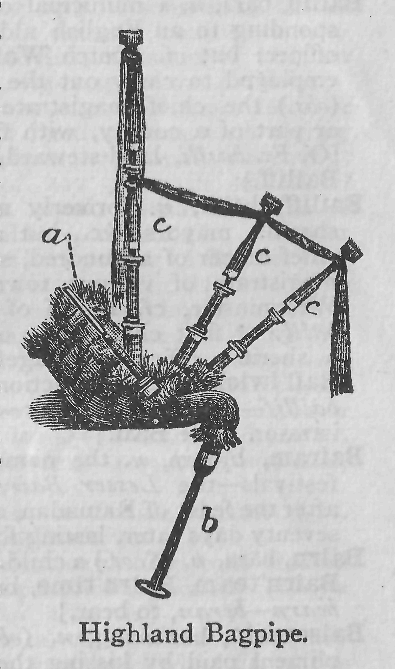
Bagpipe, bag′pīp, n. a musical wind-instrument, consisting of a leathern bag fitted with pipes. The Highland bagpipe has five pipes: a, the mouthpiece, to keep the bag filled with air; b, the chanter, having a reed and finger-holes to produce the melody; and c, three drones with reeds, tuned to act as a bass to the chanter: (pl.) an inflated, senseless talker.—n. Bag′piper.
Bah, bä, interj. an exclamation of disgust or contempt. [Fr.]
Bahadur, ba-had′ōōr, n. a title of respect often added by natives to the names of English officers in India. [Hind. bahadur, brave.]
Baignoire, bān′war, n. a box at the theatre on a level with the stalls. [Orig. = 'bathing-box,' Fr. baigner, to bathe.]
Bail, bāl, n. one who procures the release of an accused person by becoming guardian or security for his appearing in court: the security given: (Spens.) jurisdiction.—v.t. to set a person free by giving security for him: to release on the security of another.—adj. Bail′able.—ns. Bail′-bond, a bond given by a prisoner and his surety upon being bailed; Bail′-dock, Bale′-dock, a room at the Old Bailey, London, in which prisoners were kept during the trials; Bailee′, one to whom goods are delivered in trust upon a contract; Bail′er, one who delivers goods to another in trust; Bail′ment, a delivery of goods in trust: the action of bailing a prisoner; Bails′man, one who gives bail for another.—To accept, admit to, allow bail, are all said of the magistrate; the prisoner offers, surrenders to his bail; the one who provides it goes, gives, or stands bail.—To give leg bail, to be beholden to one's legs for escape. [O. Fr. bail, jurisdiction—baillier, to control, deliver. Primarily implying 'custody' or 'charge,' the word became associated with Norm. Fr. bailler, to deliver—L. bajulus.]
Bail, bāl, v.t. (rare) to confine.—To bail up (Australia), to secure a cow's head during milking: to disarm travellers so as to be able to rob them without resistance. [Prob. conn. with the preceding word.]
Bail, bāl, n. palisades, barriers: a pole separating horses in an open stable. [M. E.—O. Fr. baile, perh. from baillier, to enclose. Others suggest a derivation from L. baculum, a stick.]
Bail, bāl, n. one of the cross pieces on the top of the wicket in cricket.—n. Bail′er, a ball bowled so as to hit the bails. [Prob. conn. with the preceding word.]
Bail, bāl, v.t. to clear (a boat) of water with bails or shallow buckets.—n. a man or instrument for bailing water out of a ship, pit, &c.—Also spelled Bale. [Fr. baille, a bucket, perh. from Low L. bacula, dim. of baca.]
Bailey, bāl′i, n. the outer court of a feudal castle: either of the two courts formed by the spaces between the circuits of walls, hence Outer and Inner Bailey.—The Old Bailey in London, the Central Criminal Court, from the ancient bailey between Lud Gate and New Gate. [Fr. baille, from Low L. ballium.]
Bailie, bāl′i, n. a municipal officer in Scotland corresponding to an English alderman: (obs.) a sheriff's officer; but cf. Scotch Wat′er-bail′ies, constables employed to carry out the Tweed Fisheries Acts: (obs.) the chief magistrate of a Scottish barony or part of a county, with functions like a sheriff's. [O. Fr. bailli, land-steward, officer of justice. See Bailiff.]
Bailiff, bāl′if, n. formerly any king's officer, e.g. sheriffs, mayors, &c., but applied specially to the chief officer of a hundred, still the title of the chief magistrate of various towns (e.g. High-bailiff of Westminster, cf. Bailiff of Dover Castle, also the bailly or first civil officer of the Channel Islands: a sheriff's officer: an agent or land-steward.—n. Bail′iwick, the jurisdiction of a bailiff. [O. Fr. baillif—Low L. bajulivus—bajalus, carrier, administrator. See Bail.]
Bairam, bī′ram, n. the name of two Mohammedan festivals—the Lesser Bairam lasting three days, after the feast of Ramadan, and the Greater Bairam seventy days later, lasting four days. [Pers.]
Bairn, bārn, n. (Scot.) a child.—adj. Bairn′-like.—ns. Bairn′team, Bairn′time, brood of children. [A.S. bearn—beran, to bear.]
Baisemain, bāz′mang, n. (obs.) mostly in pl., compliment paid by kissing the hand. [Fr. baiser, to kiss, and main, hand.]
Bait, bāt, n. food put on a hook to allure fish or make them bite: any allurement or temptation: a refreshment taken on a journey, or the time taken up by such.—v.t. to set food as a lure: to give refreshment on a journey: to set dogs on a bear, badger, &c.: to worry, persecute, harass.—v.i. to take refreshment on a journey. [M. E. beyten—Scand. beita, to make to bite, causal of bíta, to bite.]
Baize, bāz, n. a coarse woollen cloth with a long nap, used mainly for coverings, linings, &c., but in some countries for clothing. [Fr. baies, pl. of bai—L. badius, bay-coloured.]
Bajan. See Bejan.
Bake, bāk, v.t. to dry, harden, or cook by the heat of the sun or of fire: to prepare bread or other food in an oven: to harden as by frost.—v.i. to work as a baker: to become firm through heat.—pa.p. baked (bākt); pr.p. bāk′ing.—ns. Bake′house, a house or place used for baking in; Bake′meat (B.), pastry, pies.—pa.p. Bak′en = baked.—ns. Bak′er, one who bakes bread, &c.—(obs.) Bax′ter; Bak′ery, a bakehouse; Bake′stone, a flat stone or plate of iron on which cakes are baked in the oven; Bak′ing, the process by which bread is baked: the quantity baked at one time. [A.S. bacan; cog. with Ger. backen, to bake, Gr. phog-ein, to roast.]
Baksheesh. See Backsheesh.
Balaam, bā′lam, n. a prophet who strives to mislead, like Balaam in Numb. xxii.-xxiv.: unimportant paragraphs kept in readiness to fill up a newspaper.—ns. Bā′laam-box, or -bas′ket, a place in which paragraphs such as the foregoing are kept in readiness; Bā′laamite.—adj. Bālaamit′ical.
Balance, bal′ans, n. an instrument for weighing, usually formed of two dishes or scales hanging from a beam supported in the middle: act of weighing two things: equality or just proportion of weight or power, as the balance of power: the sum required to make the two sides of an account equal, hence the surplus, or the sum due on an account: what is needed to produce equilibrium, a counterpoise: (watchmaking) a contrivance which regulates the speed of a clock or watch.—v.t. to weigh in a balance: to counterpoise: to compare: to settle, as an account, to examine and test accounts in book-keeping, to make the debtor and creditor sides of an account agree.—v.i. to have equal weight or power, &c.: to hesitate or fluctuate.—p.adj. Bal′anced, poised so as to preserve equilibrium: well arranged, stable.—ns. Bal′ancer, an acrobat; Bal′ance-sheet, a sheet of paper showing a summary and balance of accounts; Bal′ance-wheel, a wheel in a watch or chronometer which regulates the beat or rate. [Fr.—L. bilanx, having two scales—bis, double, lanx, lancis, a dish or scale.]
Balanus. See Acorn-shell.
Balas, bal′as, n. a variety of the spinel ruby. [O. Fr. balais (It. balascio)—Low L. balascus—Pers. Badakhshān, a place near Samarcand where they are found.]
Balata, bal′a-ta, n. the gum of the bullet or bully tree of South America, used as a substitute for gutta-percha in insulating telegraph-wires.
Balbutient, bal-bū′shi-ent, adj. stammering. [L. balbutiens—balbūtīre, to stutter.]
Balcony, balk′on-i (18th c., bal-kō′ni), n. a stage or platform projecting from the wall of a building within or without, supported by pillars or consoles, and surrounded with a balustrade or railing: in theatres, usually the gallery immediately above the dress circle.—n. Bal′conette, a miniature balcony.—adj. Bal′conied. [It. balcōne—balco, of Teut. origin; Old High Ger. balcho (Ger. balken), Eng. Balk.]
Bald, bawld, adj. without hair (feathers, &c.) on the head (or on other parts of the body): bare, unadorned, destitute of literary grace: paltry, trivial: undisguised.—ns. Bald′-coot, popular name for the coot, from its pure white wide frontal plate: a monk—also Bald′icoot; Bald′-ea′gle, a common but inaccurate name for the American white-headed eagle, used as the national emblem.—adj. Bald′-faced, having white on the face, as a horse.—n. Bald′head, a person bald on the head.—adjs. Bald′-headed; Bald′ish, somewhat bald.—adv. Bald′ly.—ns. Bald′ness; Bald′pate, one destitute of hair: a kind of wild-duck.—adjs. Bald′pate, Bald′pated, destitute of hair. [Orig. 'shining,' 'white,' Ir. and Gael. bàl, 'white' spot; but perh. conn. with ball in the sense of 'rounded,' whence 'smooth,' 'hairless.']
Baldachin, bal′da-kin, n. silk brocade: a canopy, either supported on pillars, or fastened to the wall, over a throne, pulpit, or altar, &c.: in R.C. processions, a canopy borne over the priest who carries the Host. [It. baldacchino, Fr. baldaquin, a canopy, from It. Baldacco, Bagdad, whence was brought the stuff of which they were made.]
Balderdash, bawl′dėr-dash, n. idle senseless talk: anything jumbled together without judgment: obscene language or writing. [Ety. dub.; but cf. the prov. Eng. balder, to use coarse language, Dut. balderen, to roar. Some adduce Welsh baldorrdus—baldordd, idle noisy talk.]
Baldmoney, bawld′mun-i, n. popular name for several kinds of Gentian. [Ety. quite unknown.]
Baldrick, bawld′rik, n. a warrior's belt or shoulder-sash: (Spens.) the zodiac, being regarded as a gem-studded belt. [O. Fr. baldrei (Mid. High Ger. balderich, girdle)—Low L. baldringus, perh. from L. balteus.]
Bale, bāl, n. a bundle, or package of goods: (obs.) the set of dice for any special game.—v.t. to make into bales. [M. E. bale, perh. from O. Fr. bale—Old High Ger. balla, palla, ball. See Ball.]
Bale, bāl, v.t. to throw out water [See Bail.]
Bale, bāl, n. evil, injury, mischief: misery: woe.—adj. Bale′ful, full of misery, destructive: full of sorrow, sad.—adv. Bale′fully.—n. Bale′fulness.—Bliss and bale are often alliteratively opposed; also Boot and bale. [A.S. bealu; Old High Ger. balo; Ice. böl.]
Bale, bāl, n. (arch.—Morris) a fire, funeral pyre: (Scot.) a beacon-fire.—n. Bale′-fire, a blazing fire: a beacon-fire: a bonfire. Spenser confounds with Bale, woe. [A.S. bæl; Scand. bál; cog. with Gr. phalos, bright. See Beltane.]
Baleen, bā-lēn′, n. the whalebone of commerce. [Fr.—L. balæna, whale.]
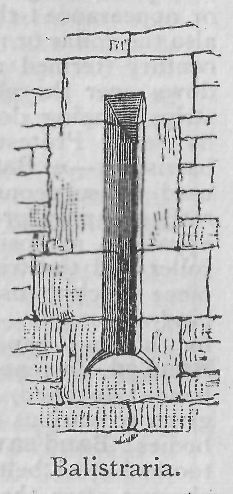
Balistraria, bal-is-trār′i-a, n. an aperture or loophole in the wall of a fortification through which crossbowmen might discharge their bolts.—n. Bal′ister (obs.), name for an arbalester or crossbowman, also an arbalest or crossbow itself. [Low L. ballistrarius, balistra, a variant form of ballista, a crossbow.]
Balk, Baulk, bawk, n. a ridge left unploughed, intentionally or through carelessness: (obs.) an omission: squared timber: a tie-beam of a house, stretching from wall to wall, esp. when laid so as to form a loft, 'the balks:' (obs.) the beam of a balance: the rope by which fishing-nets are fastened together: a hindrance or disappointment.—v.t. to ignore, pass over: refuse: avoid: let slip: to check, disappoint, or elude: to meet arguments with objections.—v.i. to swerve, pull up: (Spens.) lie out of the way.—n. Balk′-line, in billiards, a line drawn across the table 28½ inches from the face of the bottom cushion—a ball is said to be in balk when within this space. [A.S. balca, ridge; Old High Ger. balcho.]
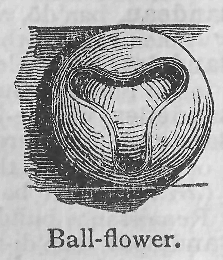
Ball, bawl, n. anything round: any celestial body, esp. the 'globe:' the golden orb borne with the sceptre as the emblem of sovereignty: a globular body to play with in tennis, football, golf, billiards, &c.: any rounded protuberant part of the body: a bullet, or any missile thrown from an engine of war: a rounded mass of anything: a throw or delivery of the ball at cricket: a well-known game played with a ball.—v.i. to gather itself into a ball, become clogged.—ns. Ball′-cart′ridge, a cartridge containing both powder and ball [Ball and Cartridge]; Ball′-cock, the stopcock of a cistern, attached to one end of a lever, at the other end of which is a hollow metal ball which rises and falls with the water, thus regulating the supply; Ball′-flow′er, an ornament of the decorated style of Gothic architecture, resembling a ball placed in a circular flower.—adj. Ball′-proof, proof against balls discharged from firearms.—Ball and socket, a joint formed of a ball partly enclosed in a cup, thus insuring great strength; Ball of the eye, the eye within the lids and socket.—No ball, a ball unfairly bowled.—Three golden or brass balls, the sign of a pawnbroker.—To have the ball at one's feet, to have a thing in one's power; To keep the ball up or rolling, to keep from flagging; To take up the ball, to take one's turn in anything.—Wide ball, one out of the batsman's reach. [M. E. bal, Scand. böllr; cog. with Old High Ger. ballo, pallo.]
Ball, bawl, n. an entertainment of dancing.—n. Ball′room.—To open the ball, to begin the dancing, to begin operations. [O. Fr. bal, baller, to dance—Low L. ballare, referred by some to Gr. ballizein.]
Ballad, bal′lad, n. a simple spirited narrative poem in short stanzas of two or four lines, in which a story is told in straightforward verse, often with great elaborateness and detail in incident, but always with graphic simplicity and force—a sort of minor epic: a simple song, usually of a romantic or sentimental nature, in two or more verses, each sung to the same melody, as in the so-called Ballad Concerts: any popular song, often scurrilous.—ns. Bal′ladist, a writer or singer of ballads; Bal′lad-monger, a dealer in ballads. [Fr. ballade, from ballare, to dance, being orig. a song sung to the rhythmic movement of a dancing chorus—a dramatic poem sung or acted in the dance, of which a shadow survives in the ring-songs of our children.]
Ballade, ba-lad′, n. a poem of one or more terns or triplets of seven or eight lined stanzas, each ending with the same line as refrain, and usually an envoy: now frequently used of any poem in stanzas of equal length.—Ballade royal, stanzas of seven or eight lines of ten syllables—called also Rime or Rhythm royal. [An earlier spelling of Ballad.]
Balladine, bal′a-dēn, n. a female public dancer. [Fr.]
Ballast, bal′last, n. heavy matter employed to give a ship sufficient immersion in the water, to insure her safe sailing with spread canvas, when her cargo and equipment are too light: that which renders anything steady.—v.t. to load with ballast: to make or keep steady: (Shak.) load.—n. Bal′last-heav′er. [Probably the Old Sw. barlast—bar, bare, and last, load, the mere load.]
Ballerina, bal-ler-ēn′a, n. a female dancer:—pl. Ballerine (bal-ler-in′), Ballerin′as. [It.]
Ballet, bal′lā, n. a theatrical exhibition composed of dancing, posturing, and pantomimic action: (obs.) a dance. [Fr.; dim. of bal, a dance.]
Ballista, Balista, bal-lis′ta, n. a Roman military engine in the form of a crossbow, which, like the catapulta and the onager, propelled large and heavy missiles, chiefly through the reaction of a tightly twisted rope, or else by a violent movement of levers.—adj. Ballis′tic, projectile.—ns. Ballis′tic-pen′dulum, an instrument for ascertaining the velocity of military projectiles; Ballis′tite, an improved kind of gunpowder. [L.—Gr. ballein, to throw.]
Ballium, bal′li-um, n. the Low L. form of Bailey.
Balloon, bal-lōōn′, n. an inflated air-tight envelope of paper or silk, constructed to float in the air and carry a considerable weight when filled with heated air or light gas: anything inflated, empty: (obs.) a game played with a large inflated ball.—v.i. to ascend in a balloon: to puff out like a balloon.—n. Balloon′ist, an aeronaut. [It. ballone, augmentative of balla, ball.]
Ballot, bal′ut, n. a little ball or ticket used in voting: a method of secret voting by putting a ball or ticket into an urn or box.—v.i. to vote by ballot: to select by secret voting (with for): draw lots for:—pr.p. bal′loting; pa.p. bal′loted.—ns. Bal′lotage, in France, the second ballot to decide which of two candidates has come nearest to the legal majority; Bal′lot-box, a box to receive balls or tickets when voting by ballot. [It. ballotta, dim. of balla, ball. See Ball.]
Balm, bäm, n. an aromatic substance: a fragrant and healing ointment: aromatic fragrance: anything that heals or soothes pain: a tree yielding balm: name of some fragrant garden herbs.—v.t. (arch.) to embalm: (Shak.) to anoint with fragrant oil: (arch.) to soothe.—n. Balm′iness.—adj. Balm′y, fragrant: mild and soothing: bearing balm.—Balm, or Balsam, of Gilead, the resin of the tree Balsamodendron Gileadense, formerly esteemed as an antiseptic, the name originating in the belief that this is the substance mentioned in the Bible as found in Gilead, and called in the English translation 'balm.' [O. Fr. basme—L. balsamum. See Balsam.]
Balm-cricket, bäm′-krik′et, n. (Tennyson) a cicada. [Ger. baum, a tree, and Cricket.]
Balmoral, bal-mor′al, n. a kind of Scotch cap: a figured woollen petticoat: a kind of boot lacing in front.
Balneology, bal-ne-ol′o-ji, n. the scientific study of bathing and of mineral springs. [L. balneum, bath.]
Balsam, bawl′sam, n. the common name of a genus of succulent herbaceous plants: a resinous oily substance generally supposed to be derived from a species of Balsamodendron, early famous in the East for its fragrance and medicinal virtues: (fig.) any healing agent.—v.t. to heal: (rare) embalm.—adjs. Balsam′ic, Bal′samous, having the qualities of balsam: soothing; Balsamif′erous, producing balsam; Bal′samy, fragrant.—Canada balsam, a kind of turpentine obtained from the Balm of Gilead fir. [L. balsamum—Gr. balsamon; prob. of Semitic origin.]
Baltimore, bal′tim-ōr, n. a finch-like perching bird of the starling family, very common in North America, called also Baltimore oriole, Fire-bird, &c. [From Lord Baltimore, whose livery was orange and black—its colour.]
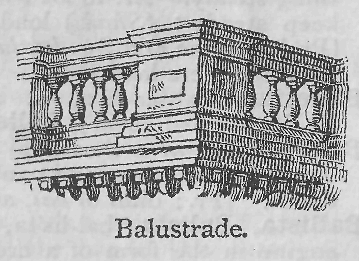
Baluster, bal′ust-ėr, n. a small pillar used as a support to the rail of a staircase, &c.—adj. Bal′ustered.—n. Bal′ustrade, a row of balusters joined by a rail, forming an ornamental parapet to a balcony, &c. [Fr. balustre—Low L. balaustium—Gr. balaustion, the flower of the pomegranate; from the similarity of form.]
Bam, bam, n. a slang word for a hoax: a false tale.—v.t. to cheat or hoax. [See Bamboozle.]
Bambino, bam-bi′no, n. a term in art descriptive of the child Jesus, esp. of the swaddled figure of the infant Saviour exhibited at Christmas in Catholic churches. [It., dim. of bambo.]
Bamboo, bam-bōō′, n. a gigantic Indian reed or grass, with hollow-jointed stem, and of hard texture. [Malay bambu.]
Bamboozle, bam-bōō′zl, v.t. to deceive: to confound or mystify.—n. Bamboo′zlement. [Of cant origin—but not Gipsy; first appears about 1700.]
Ban, ban, n. a proclamation: sentence of banishment: outlawry: anathematisation: a denunciation: a curse.—v.t. (arch.) to curse: (prov.) to chide or rail upon: to anathematise: to proscribe. [A.S. bannan, to summon; the noun bann does not appear in A.S. (which has gebann), but is a common Teut. word, as in Old High Ger. and Scand. bann. The O. Fr. ban and Low L. bannum are of the same origin.]
Ban, ban, n. the governor of a Banat, an old name for the military divisions on the eastern boundaries of the Hungarian kingdom.—ns. Banate, Bannat. [Pers. bān, lord.]
Banal, bān′al, or ban′al, adj. commonplace, trivial.—n. Banal′ity, triviality. [Fr.]
Banana, ba-nä′na, n. a gigantic herbaceous plant, remarkable for its nutritious fruit. [Sp. or Port. banana, from the native name in Guinea.]
Banbury, ban′ber-i, n. a kind of cake made at Banbury, a town in Oxfordshire.
Banco, bang′ko, n. a commercial term meaning the standard money in which a bank keeps its accounts, as distinguished from the current money of the place.—In banco, applied to the sittings of a superior court of common law as a full court distinguished from sittings at Nisi Prius or on circuit. [It. See Bank.]
Band, band, n. that by which loose things are held together: (fig.) a moral bond of restraint or of obligation: a tie or connecting piece: (pl.) shackles, bonds, fetters (B.): (arch.) an agreement or promise given: (arch.) security given: (Spens.) a pledge. [M. E. band, bond; A.S. bend, from bindan, to bind. See Bind.]
Band, band, n. a strip of cloth, or the like, to bind round anything, as a hat-band, waist-band, &c.: a stripe crossing a surface distinguished by its colour or appearance: the neck-band or collar of a shirt, also the collar or ruff worn by both sexes in the 17th century (termed a falling-band later, when turned down over the shoulders): (pl.) the pair of linen strips hanging down in front from the collar, worn by some Protestant clergymen and by English barristers.—n. Band′age, a strip or swathe of cloth used by surgeons to keep a part of the body at rest, to apply pressure, or to retain dressings or apparatus in position—the two chief varieties, the roller and the triangular handkerchief bandage: a piece of cloth used to blindfold the eyes.—v.t. to bind with such.—n. Band′box, a light kind of box for holding bands, caps, millinery, &c.—p.adj. Band′ed, fastened as with a band: striped with bands: leagued, allied.—ns. Band′fish, a name given to various kinds of fish with long, thin, flat bodies; Band′saw, an endless saw, consisting of a toothed steel belt; Band′ster, one who binds the sheaves after the reapers. [M. E. bande—O. Fr. bande, of Teut. origin; cf. A.S. bindan; Ger. binde, a band, Eng. Bind.]
Band, band, n. a number of persons bound together for any common purpose: a troop of conspirators, confederates, &c.: a body of musicians, the company of musicians attached to a particular regiment in the army: (Scot.) band = bond.—v.t. to bind together.—v.i. to associate, assemble, confederate.—ns. Band′master, the leader of a band of musicians; Bands′man, a member of a band of musicians; Band′-stand, a platform for accommodating a band of musicians.—Band of Hope, an association of young persons—often mere infants—pledged to lifelong abstinence from alcoholic drinks—first instituted about 1847. [Fr. bande, of Teut. origin; cf. Bend, Bind.]
Band, band, v.t. (Spens.) to ban or banish.
Band, an obsolete pa.t. of Bind.
Bandana, Bandanna, ban-dan′a, n. a kind of silk or cotton coloured handkerchief, with a pattern of spots or diamond prints, originally from India. [Hind. bandhnū, the mode of dyeing these, bāndh, a cord.]
Bandeau, ban′dō, n. a fillet or narrow band worn by women to bind their hair:—pl. Ban′deaux. [Fr.]
Bandelet, band′e-let, n. (archit.) a small flat moulding or fillet surrounding a column. [Fr. bandelette.]
Bandelier, ban-de-lēr′, n. a form of Bandoleer.
Banderol, Banderole, ban′de-rōl, n. a small banner or streamer, as that borne on the shaft of a lance: (archit.) a flat band with an inscription common in Renaissance buildings. [Fr.]
Bandicoot, ban′di-kōōt, n. a genus of insectivorous marsupials found in Australia: the largest species of rat, found in India and Ceylon, called also Malabar rat and Pig-rat. [Telegu pandikokku, pig-rat.]
Bandied. See Bandy.
Bandit, ban′dit, n. an outlaw: a robber:—pl. Ban′dits, Banditt′i. [It. bandito—Low L. bannire, bandire, to proclaim. See Ban.]
Bandog, ban′dog, n. a dog tied up as a watch-dog, or because of its ferocity. [Band, fastening, and Dog.]
Bandoleer, Bandolier, ban-do-lēr′, n. a leathern belt worn by musketeers, to which their ammunition was fixed. [O. Fr. bandouillere—It. bandoliera, banda, a band.]
Bandoline, ban′do-lin, n. a gummy substance used for stiffening the hair and keeping it in shape. [Prob. from Band.]
Bandore, ban-dōr′, n. a musical instrument like a guitar, with three or more strings. [Sp. bandurria, Fr. mandore; L. pandura, Gr. pandoura.]
Bandrol, band′rōl, n. Same as Banderol.
Bands, of clergymen and barristers. See Band (2).
Bandy, ban′di, n. a club bent at the end for striking a ball: a game at ball with such a club (bandy-ball = hockey).—v.t. to beat to and fro as with a bandy: to toss from one to another (as words with any one) = to discuss or debate; to give and take blows or reproaches: (Shak.) to fight, strive:—pa.p. ban′died.—n. Ban′dying.—adj. Ban′dy-legged, having bandy or crooked legs. [Fr. bander, perh. conn. with bande, a side.]
Bane, bān, n. destruction: death: mischief: poison.—v.t. (arch.) to harm, to poison.—adj. Bane′ful, destructive.—adv. Bane′fully.—n. Bane′fulness. [A.S. bana, a murderer; Ice. bani, death.]
Bang, bang, n. a heavy blow: a sudden loud noise: an explosion.—v.t. to beat: to strike violently: to slam, as a door: to make a loud noise: to beat or surpass, to bounce upon.—interj. Bang, used with verbs like 'go,' &c., and in such a phrase as 'bang off.'—p.adj. Bang′ing, dealing blows: overwhelming.—adj. Bang′-up (slang), in the height of style or fashion.—n. Bang′ster (prov.), a braggart, a victor. [Scand. banga, to hammer; cf. Ger. bengel, a cudgel.]
Bang, bang, n. a woman's hair cut square across the brow.—p.adj. Banged, wearing the hair in such a way.—n. Bang′-tail, a horse's tail with the end squared. [An Americanism, doubtless from the phrase 'bang off.']
Bang. Same as Bhang.
Bangle, bang′gl, n. a ring, bracelet, or anklet.—adj. Ban′gled, adorned with such. [Hind. bangrī.]
Banian, Banyan, ban′yan, n. an Indian tree of the fig family, remarkable for its vast rooting branches: a Hindu trader, esp. from Guzerat, sometimes loosely applied to all Hindus in Western Asia: a loose flannel jacket or gown worn in India.—Banian days, a sailor's phrase, meaning days on which no meat is served out, hence days of short commons generally, from the abstinence from flesh of the Banian merchants. [Port. banian, perh. through Ar. banyān, from Hind. banya—Sans. vanij, a merchant.]
Banish, ban′ish, v.t. to condemn to exile: to drive away: to expel (with from, out of).—n. Ban′ishment, exile. [Fr. bannir—Low L. bannire, to proclaim. See Ban.]
Banister, ban′istėr, n. a corr. of Baluster.
Banjo, ban′jo, n. a musical instrument of the guitar kind, played with the fingers, but without frets to guide the stopping, having a long neck, a body of stretched parchment like a drum, and from five to nine catgut strings. [Corr. of Fr. bandore or pandore—L. pandura—Gr. pandoura.]
Bank, bangk, n. a mound or ridge of earth: the earthy margin of a river, lake, &c.: the raised edge of a road, railway cutting, &c.: (min.) the surface at the pit-mouth, as in banksman: rising ground in the sea.—v.t. to enclose with a bank: to deposit or pile up: to make up a fire by covering it with a heap of fuel so pressed down as to remain a long time burning slowly—banked fires.—n. Banks′man, an overseer at a pit-mouth.—From bank to bank, from the time the collier begins to descend the pit for his spell of work till he reaches the top again. [M. E. banke, of Scand. origin; cog. with Bank, Bench.]
Bank, bangk, n. a bench in a galley: a tier or rank of oars: the bench on which judges sat. [O. Fr. banc, of Teut. origin, cog. with the foregoing word.]
Bank, bangk, n. a place where money is deposited: an institution for the keeping, lending, and exchanging, &c. of money: in games of hazard, the money the proprietor, who plays against all the others, has before him.—v.t. to deposit in a bank, as money.—ns. Bank′-ā′gent, the head of a branch bank; Bank′-bill, a bill drawn by one bank upon another, payable at a future date, or on demand; Bank′-cheque, an order to pay issued upon a bank; Bank′er, one who keeps a bank: one employed in banking business:—fem. Bank′eress; Bank′-hol′iday, a day on which banks are legally closed, bills falling due on these being payable the following day; Bank′ing, the business of a banker.—adj. pertaining to a bank.—ns. Bank′-note, a note issued by a bank, which passes as money, being payable to bearer on demand; Bank′-pap′er, bank-notes in circulation; Bank′-stock, a share or shares in the capital stock of a bank; Branch′-bank, a branch office of a bank; Sav′ings-bank, one intended originally to develop a spirit of saving amongst the poor.—Bank annuities, the consolidated three per cent. annuities—British Government funds.—Bank of issue, one that issues its own notes, or promises to pay; Joint-stock bank, one of which the capital is subscribed by a large number of shareholders; Private bank, one carried on by any number of persons less than ten.—To break the bank, to win, as in faro, from the management a certain sum which has been fixed upon as the limit the bank is willing to lose on any one day; To play against the bank, to take the risks of a game against the manager who holds the bank, as at rouge-et-noir, &c. [Fr. banque, of Teut. origin, cog. with two foregoing words.]
Bankrupt, bangk′rupt, n. one who breaks or fails in business; an insolvent person.—adj. insolvent: destitute (with of).—n. Bank′ruptcy, the state of being or act of becoming bankrupt. [Fr. banque-route, It. banca rotta.]
Banksia, bangk′sia, n. a genus of Australian shrubs, named in honour of Sir Joseph Banks (1744-1820).
Banner, ban′ėr, n. a military standard: a flag or ensign bearing some device, as in processions, &c.—adj. Ban′nered, furnished with banners. [O. Fr. banere—Low L. bandum, bannum; cog. with Band and Bind.]
Banneret, ban′ėr-et, n. a higher class of knight, inferior to a baron. [Fr. dim. of Banner.]
Bannerol, ban′ėr-ol, n. Same as Banderol.
Banning, ban′ning, n. cursing. [See Ban.]
Bannock, ban′nok, n. a flat home-made cake of oatmeal, barley, or pease-meal. [Gael. bannach.]
Banns, banz, n.pl. a proclamation of marriage.—To forbid the banns, to make formal objection to a projected marriage. [From Ban.]
Banquet, bangk′wet, n. a feast: any rich treat or entertainment: a course of sweetmeats, fruit, and wine, separately, or after the principal meal—still used in the Scotch phrase, 'a cake and wine banquet.'—v.t. to give a feast to.—v.i. to fare sumptuously.—ns. Banq′ueter, Banq′ueteer; Banq′ueting; Banq′ueting-house. [Fr.;—banc, bench, like It. banchetto, from banco.]
Banquette, bang-ket′, n. a raised way inside a parapet; the long seat behind the driver in a French diligence. [Fr.; It. banchetta, dim. of banca, seat.]
Banshee, ban′shē, n. a female fairy in Ireland and elsewhere, who makes herself known by wailings and shrieks before a death in the particular family to which she is attached. [Ir. bean sídhe, Old Ir. ben síde, woman of the fairies.]
Bantam, ban′tam, n. a small variety of the common domestic fowl, supposed to be named from Bantam in Java, notable for courage.—adj. of bantam-breed: little and combative.
Banter, bant′ėr, v.t. to assail with good-humoured raillery: to joke or jest at: (arch.) to impose upon, trick.—n. humorous raillery: jesting.—ns. Bant′erer; Bant′ering.—adv. Bant′eringly.—adj. Bant′ery (Carlyle). [Ety. quite unknown.]
Banting, bant′ing, n. a system of diet for reducing superfluous fat.—n. Bant′ingism. [From W. Banting (1797-1878), a London cabinetmaker, who recommended it to the public in 1863.]
Bantling, bant′ling, n. a child. [So called from the bands in which it is wrapped.]
Bantu, ban′tōō, n. a native name sometimes applied to the South African family of languages and the peoples speaking these, including Kaffirs and Zulus, Bechuans, and the peoples from the Hottentot country to the Gulf of Guinea.
Banxring, bangks′ring, n. a small insectivorous animal of Java and Sumatra. [Jav.]
Banyan. See Banian.
Baobab, bā′o-bab, n. a magnificent tree, native to tropical Western Africa, whose trunk is 20 to 30 feet thick, called also the Monkey-bread Tree. [African.]
Baphomet, baf′ō-mėt, n. the alleged name of a mysterious idol the Templars were accused of worshipping.—adj. Baph′ometic. [A medieval corr. of the name Mahomet.]
Baptise, bapt-īz′, v.t. to administer baptism to: to christen, give a name to.—n. Bapt′ism, immersion in or sprinkling with water as a religious ceremony—a sign and seal of the covenant of grace. It is symbolic of spiritual purification, and as a religious rite marks initiation into the Christian community.—adj. Baptis′mal.—adv. Baptis′mally.—ns. Bapt′ist, one who baptises: one who approves only of baptising by immersion, and that only to persons who profess their faith in Christ; Bap′tistery, a place where baptism is administered, either a separate building or a portion of a church.—Baptismal regeneration, the doctrine of the remission of sin original and actual, and of the new birth into the life of sanctifying grace, in and through the sacrament of baptism; Baptism by desire, the grace given to a believer who ardently desires baptism, but dies before he can receive it; Baptism for the dead, the vicarious baptism of a living Christian for an unbaptised dead Christian, who was thereby accounted baptised and received into bliss—it is supposed to be alluded to in 1 Cor. xv. 29; Baptism of blood, martyrdom for Christ's sake; Baptism of fire, the gift of the Holy Spirit: martyrdom by fire for Christ's sake: (fig.) any trying ordeal to be endured, as a young soldier's first experience of being under fire; Clinical baptism, baptism administered to sick persons; Conditional (or Hypothetical) baptism, baptism administered to those about whom it is doubtful whether they were baptised or whether the form of their earlier baptism was valid; Name of baptism, the Christian or personal name given at baptism; Private baptism, baptism administered at home, or elsewhere, not in the church. [Gr. baptiz-ein—bapt-ein, to dip in water.]
Bar, bär, n. a rod of any solid substance: a bolt: a hindrance or obstruction—the barrier of a city or street, as the bars of York, Temple Bar, a toll-bar: a bank of sand or other matter at the mouth of a river: any terminus or limit (of life)—e.g. as in To cross the bar: the railing that encloses a space in a tavern, the counter across which drinks are served, a public-house: the wooden rail dividing off the judge's seat, at which prisoners are placed for arraignment or sentence—hence, To appear at the bar, To pass the bar = to be formally referred for trial from a lower court to a higher: any tribunal: the pleaders in a court as distinguished from the judges: a division in music.—v.t. to fasten or secure, as with a bar: to hinder or exclude:—pr.p. bar′ring; pa.p. barred.—ns. Bar′-ī′ron, iron in malleable bars; Bar′maid, a female waiter at the bar of a tavern or hotel.—prep. Bar′ring, excepting, saving.—ns. Bar′ring-out, the shutting of the school-room doors and windows by the pupils against the master, in order to enforce assent to their demands; Bar′wood, a kind of red dye-wood imported from Africa in bars. [O. Fr. barre—Low L. barra, perh. of Celt. origin.]
Baracan. Same as Barracan.
Baragouin, bä-rag-wēn, n. any jargon or unintelligible language. [Fr.; from Bret. bara, bread, and gwîn, wine, supposed to have originated in the Breton soldiers' astonishment at white bread.]
Barb, bärb, n. the beard-like jag near the point of an arrow, fish-hook, &c.—v.t. to arm with barbs, as an arrow, &c.: to shave, trim, mow, to pierce, as with a barb.—adjs. Barb′ate (bot.), bearing a hairy tuft; Barb′ated, barbed, bearded.—n. Barbe, a term applied by the Waldenses to their teachers.—adjs. Barbed, furnished with a barb: of a horse, armed or caparisoned with a barb or bard; Barb′ellate (bot.), having barbed or bearded bristles. [Fr.—L. barba, a beard.]
Barb, bärb, n. a swift kind of horse, the breed of which came from Barbary in North Africa.
Barbacan. See Barbican.
Barbarous, bär′bar-us, adj. uncivilised: rude: savage: brutal.—adjs. Bar′baresque, pertaining to Barbary: barbarous, esp. in art; Barbār′ian, uncivilised: savage: without taste or refinement: foreign.—n. an uncivilised man, a savage: a cruel, brutal man.—adj. Barbar′ic, foreign: uncivilised.—n. Barbarisā′tion.—v.t. Bar′barise, to make barbarous: to corrupt as a language.—ns. Bar′barism, savage life: rudeness of manners: an incorrect form of speech; Barbar′ity, savageness: cruelty.—adv. Bar′barously.—n. Bar′barousness. [L.—Gr. barbaros, foreign, lit. stammering, from the unfamiliar sound of foreign tongues.]
Barbary ape, bär′bar-i āp, n. the magot, or small tailless ape found in Africa and also on the rock of Gibraltar.
Barbecue, bärb′e-kū, v.t. to roast whole, as a pig: to cure flesh by exposing it on a barbecue.—n. a framework on which to dry and smoke meat above a fire: an animal roasted whole: an open floor on which coffee-beans and the like are spread out to dry: (Amer.) a large social or political entertainment, where the hospitalities are on a lavish scale. [Sp. barbacoa—Haytian barbacòa, a framework of sticks set upon posts.]
Barbel, bärb′el, n. a fresh-water fish with beard-like appendages at its mouth. [O. Fr. barbel—Low L. barbellus—L. barba, a beard.]
Barber, bärb′ėr, n. one who shaves beards and dresses hair.—ns. Barb′er-mong′er (Shak.), a man decked out by his barber, a fop; Barb′er-sur′geon, one who let blood and drew teeth as well as shaved—the company of Barber-surgeons was incorporated in 1461, but by an act in 1545 barbers were confined to the more humble function.—Barber's block, a round block on which wigs are made; Barber's pole, the barber's sign in England, a pole striped spirally with alternate bands of colours, generally red or black and white, having often a brass basin hung at the end. [Fr.—L. barba, a beard.]
Barberry, bär′ber-i, n. a thorny shrub with yellow flowers and red berries, common in hedges. [Low L. berberis; the Ar. barbaris is borrowed.]
Barbette, bar-bėt′, n. an earthen terrace inside the parapet of a rampart, serving as a platform for heavy guns: in ironclad ships, a heavily armoured redoubt amidships. [Fr.]
Barbican, bär′bi-kan, n. a projecting watch-tower over the gate of a castle or fortified town, esp. the outwork intended to defend the drawbridge. [O. Fr. barbacane, also in Sp., Port., and It. forms; perh. of Ar. or Pers. origin. Col. Yule suggests bābkhānah, gate-house, name in the East for a towered gateway.]
Barbule, bärb′ūl, n. (bot.) a small barb or beard: a pointed barb-like process fringing the barbs of a feather. [See Barbel.]
Barcarolle, bär′ka-rōl, n. a boat-song of the Venetian gondoliers: a musical composition of a similar character. [It. barcaruolo, a boatman, from barca, a bark, a barge, a boat.]
Bard, bärd, n. a poet and singer among the ancient Celts: a poet—dims. Bard′ling, Bard′let, poetaster.—n. Bard′-craft (Browning).—adj. Bard′ic. [Gael. and Ir. bàrd.]
Barded, bärd′ed, adj. caparisoned, as horses.—n. Bard (obs.), the protective covering of a war-horse or a man-at-arms. [Fr. barde—Sp. albarda, pack-saddle, perh. from Ar. al-barda‛ah; al, the, and barda‛ah, mule's pack-saddle.]
Bare, bār, adj. uncovered: naked: open to view: poor, scanty: unadorned: (Shak.) unarmed: mere or by itself: (Shak.) paltry, desolate: empty: (Spens.) rude.—v.t. to strip or uncover.—adj. Bare′backed, with bare back: unsaddled.—n. Bare′bone (Shak.), a very lean person.—adj. Bare′faced, with the face uncovered: (Shak.) avowed: impudent.—adv. Bare′facedly.—n. Bare′facedness.—adjs. Bare′foot, -ed, having the feet bare, often of some monastic orders; Bare′-gnawn (Shak.), gnawed bare; Bare′headed, having the head bare; Bar′ish (Carlyle), somewhat bare; Bare′legged, having the legs bare.—adv. Bare′ly.—ns. Bare′ness; Bare′sark, a fierce Norse fighter, a berserker.—adv. in a shirt only. [A.S. bær; Ger. baar, bar; Ice. berr.]
Bare, bār, old pa.t. of Bear.
Barage, ba-rāzh′, n. a light, silky dress-stuff, named from Barèges in the Pyrenees.
Bargain, bär′gin, n. a contract or agreement: a favourable transaction: an advantageous purchase: (Shak.) chaffering.—v.i. to make a contract or agreement: to chaffer: to count on, take into consideration (with for): to lose by bad bargaining (with away).—n. Bar′gainer.—Bargain and sale, in law, a mode of conveyance whereby property may be assigned or transferred for valuable consideration.—Into the bargain, over and above; To make the best of a bad bargain, to make the best of difficult circumstances; To sell any one a bargain (Shak.), to befool him; To strike a bargain, to come to terms about a purchase. [O. Fr. bargaigner—Low L. barcaniare; acc. to Diez from barca, a boat.]
Barge, bärj, n. flat-bottomed freight boat, with or without sails, used on rivers and canals: the second boat of a man-of-war: a large pleasure or state boat.—ns. Bar′gee, a bargeman; Barge′man, The manager of a barge; Barge′-mas′ter, the proprietor of a barge. [O. Fr. barge—Low L. barga. Prob. a doublet of Bark, a barge.]
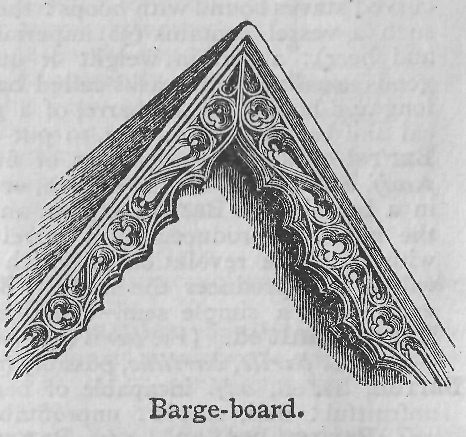
Barge-board, barj′-bōrd, n. a board extending along the edge of the gable of a house to cover the rafters and keep out the rain. [The barge here may be conn. with Low L. bargus, a gallows.]
Barghest, bär′gest, n. a dog-like goblin portending death. [Perh. conn. with Ger. berg-geist, mountain-ghost.]
Baric. See Barium.
Barilla, bar-il′a, n. an impure carbonate of soda obtained by burning several marine plants (that grow chiefly on the east coast of Spain), used in the manufacture of soap, glass, &c. [Sp. barrilla.]
Baritone, bar′i-tōn. Same as Barytone.
Barium, bā′ri-um, n. the metal present in heavy spar (sulphate of baryta) and baryta, formerly thought to be white, but now known to possess a yellow colour.—adj. Bar′ic. [From Baryta; cf. soda, sodium.]
Bark, bärk, n. the abrupt cry uttered by a dog, wolf, &c.—v.i. to yelp like a dog: to clamour.—v.t. (Spens.) to utter with a bark.—n. Bark′er, a shop-tout: (slang) a pistol, cannon.—His bark is worse than his bite, his angry expressions are worse than his actual deeds. [A.S. beorcan, prob. a variety of brecan, to crack, snap. See Break.]
Bark, Barque, bärk, n. a barge: a ship of small size, square-sterned, without head-rails: technically, a three-masted vessel whose mizzen-mast is fore-and-aft rigged instead of being square-rigged, like the fore and main masts—barks of over 3000 tons are now frequently built.—ns. Bar′kantine, Bar′quentine, a three-masted vessel, with the fore-mast square-rigged, and the main-mast and mizzen-mast fore-and-aft rigged. [Fr. barque—Low L. barca; perh. from Gr. baris, a Nile-boat.]
Bark, bärk, n. the rind or covering of the trunk and branches of a tree: that used in tanning or dyeing, or the residue thereof, laid upon a street to deaden the sound, &c.: the envelopment or outer covering of anything.—v.t. to strip or peel the bark from: to rub off (skin).—n. Bark′-bed, a hotbed made of spent bark.—v.t. Bark′en, to dry up into a barky substance.—v.i. to become like bark.—adjs. Bark′less; Bark′y.—Cinchona, Jesuits', Peruvian bark, the bark of the cinchona, from which quinine is made. [Scand. börkr; Dan. bark.]
Barker's mill, bärk′ėrz mil, a water-wheel invented in the 18th century by Dr Barker.
Barley, bär′li, n. a hardy grain used for food, but chiefly for making malt liquors and spirits.—ns. Bar′ley-bree, -broth, strong ale; Bar′ley-corn, personified as John Barleycorn, the grain from which malt is made: a single grain of barley: a measure of length = ⅓ of an inch; Bar′ley-su′gar, a mixture of sugar with a decoction of pearl-barley, boiled till it is candied; Bar′ley-wat′er, a decoction of pearl-barley; Pearl′-bar′ley, the grain stripped of husk and pellicle, and completely rounded by grinding; Pot′-bar′ley, the grain deprived by milling of its outer husk, used in making broth, &c. [A.S. bærlíc, bere, and suffix -líc.]
Barley, bär′li, interj. (Scot.) a term used in games in demand of a truce, parley (of which it is most prob. a corruption).
Barley-brake, bär′li-brāk, n. an old country game, originally played by three couples, of which one, left in a middle den called 'hell,' had to catch the others, who could break or separate when about to be overtaken. [Perh. from the grain, barley, because often played in a barley-field; or perh. from the word preceding.]
Barm, bärm, n. froth of beer or other fermenting liquor, used as leaven: yeast.—adjs. Barm′y; Barm′y-brained, flighty. [A.S. beorma; cog. with Dan. bärme, Ger. bärme.]
Barmbrack, bärm′brak, n. a currant-bun. [Ir. bairigen breac, speckled cake.]
Barm-cloth, bärm′-kloth, n. (Morris) an apron. [A.S. barm, bosom, -beran, to bear, and Cloth.]
Barmecide, bär′me-sīd, n. one who offers an imaginary or pretended banquet or other benefit.—adjs. Bar′mecide, Barmecī′dal. [From a story in the Arabian Nights, in which a beggar is entertained to an imaginary feast by one of the Barmecides, a Persian family who attained to great influence at the court of the Abbasside caliphs.]
Barmkin, bärm′kin, n. the rampart of a castle.
Barn, bärn, n. a building in which grain, hay, &c. are stored.—v.t. to store in a barn.—ns. and adjs. Barn′-door, Barn′-yard, as in barn-yard fowl.—n. Barn′-owl, the commonest of British owls.—Barn-door, in cricket, used of a player who blocks every ball: humorously, any large target. [A.S. bere-ern, contracted bern, from bere, barley, ern, a house.]