LIST OF ABBREVIATIONS USED IN THIS DICTIONARY. (continued 9)
Reading edition
Brougham, brōō′am, or brōōm, n. a one-horse close carriage, either two or four wheeled, named after Lord Brougham (1778-1868).
Brought, brawt, pa.t. and pa.p. of Bring.
Brow, brow, n. the eyebrow: the ridge over the eyes: the forehead: the edge of a hill: a gallery in a coalmine running across the face of the coal: (fig.) aspect, appearance.—v.t. Brow′beat, to bear down with stern looks or speech: to bully.—adjs. Brow′-bound, having the brow bound as with a crown: crowned; Brow′less, without shame. [A.S. brú; Ice. brün.]
Brown, brown, adj. of a dark or dusky colour, inclining to red or yellow: dark-complexioned: sunburnt.—n. a dark-reddish colour: (slang) a copper.—v.t. to make brown, or give a brown colour to: to roast brown.—ns. Brown′-bess, the old British flint-lock musket—from the brown walnut stock; Brown′-bill, a foot-soldier's or watchman's halbert, painted brown; Brown′-bread, bread of a brown colour, made of unbolted flour; Brown′-coal, commonly called Lignite, an imperfect kind of coal which exhibits more of its woody structure than ordinary coal; Brown′-George, a hard biscuit: a brown earthen vessel; Brown′ing, the process of imparting a brown colour to iron articles: a preparation for giving a brown colour to gravy, &c., or for dressing brown leather.—adj. Brown′ish.—ns. Brown′ness; Brown′-pā′per, coarse and strong paper used chiefly for wrapping; Brown′-spar, a name given to certain varieties of dolomite or magnesian limestone, distinguished by their brownish colour; Brown′-stout, a kind of porter; Brown′-stud′y, gloomy reverie: absent-mindedness.—adj. Brown′y (Shak.), of a brown colour.—To do brown (slang), to do thoroughly, to deceive or take in completely. [A.S. brún; Dut. bruin, Ger. braun.]
Brownie, brown′i, n. a kind of domestic spirit in the folklore of Scotland, represented as a good-humoured, drudging goblin, who attached himself to farmhouses, and occupied himself overnight in churning, thrashing corn, and the like. [Brown.]
Brownist, brown′ist, n. one holding the Church principles of Robert Browne (1550-1633), which may be said to have given birth to the Independents or Congregationalists of England.
Browse, browz, v.t. and v.i. to feed on the shoots or leaves of plants.—ns. Browse, Brows′ing, the shoots and leaves of plants: fodder: the action of the verb browse. [O. Fr. brouster (Fr. brouter)—broust, a sprout.]
Browst, browst, n. (Scot.) a brewing. [Brew.]
Bruckle, bruk′l, adj. (Scot.) liable to break, brittle. [A.S. brucol—brekan, to Break.]
Bruin, brōō′in, n. a bear, so called from the name of the bear in the famous beast-epic Reynard the Fox, just as reynard and chanticleer have also passed from proper names into common names, often written without capitals. [Bruin = brown.]
Bruise, brōōz, v.t. to crush by beating or pounding: to oppress: to box or fight with the fists: to ride recklessly in hunting, careless alike of horse and crops: to reduce to small fragments.—n. a wound made by anything heavy and blunt.—p.adj. Bruised, hurt by a heavy blow, with skin crushed and discoloured.—n. Bruis′er, one that bruises: a boxer.—p.adj. Bruis′ing, boxing. [A.S. brýsan, to crush, with which, says Dr Murray, afterwards coalesced Fr. brisie-r; bruisier, bruser, to break.]
Bruit, brōōt, n. noise: something noised abroad: a rumour or report.—v.t. to noise abroad: to report: to celebrate. [Fr. bruit—Fr. bruire; cf. Low L. brugītus; prob. imit.]
Brulzie, bruilzie, brül′yi, n. Scotch and northern form of Broil.
Brumaire, brōōmār′, n. the second month in the French revolutionary calendar, extending from Oct. 22 to Nov. 20. [Fr. brume, fog—L. bruma, winter.]
Brume, brōōm, n. fog.—adjs. Brum′al, relating to winter; Brum′ous, foggy, wintry. [L. bruma, winter, contr. from brevima, the shortest day.]
Brummagem, brum′a-jem, adj. showy but worthless, sham, counterfeit. [From a popular pronunciation of Birmingham.]
Brunette, brōōn-et′, n. a girl with a brown or dark complexion. [Fr. dim. of brun, brown.]
Brunonian, brōō-no′ni-an, adj. relating to the system of medicine founded by Dr John Brown of Edinburgh (1736-88)—all diseases sthenic, those depending on an excess of excitement, or asthenic, those resulting from a deficiency of it.
Brunt, brunt, n. the shock of an onset or contest: the force of a blow: the chief stress or crisis of anything.—v.t. to bear the brunt of. [Ice. bruna, to advance like fire, is usually given; Dr Murray suggests that it may be an onomatopœia of Eng. itself (cf. Dunt), or connected with burnt—Scot. brunt.]
Brush, brush, n. an instrument for removing dust, usually made of bristles, twigs, feathers, or stiff grass stems: a kind of hair-pencil used by painters: a painter, one who uses the brush: brushwood: a skirmish or encounter: the tail of a fox: (elect.) a brush-like discharge of sparks: one of the bundles of copper wires or flexible strips in contact with the commutator of the armature on opposite sides, and which carry off the positive and negative currents of electricity generated.—v.t. to remove dust, &c., from by sweeping: to touch lightly in passing: remove (with off): to thrash.—v.i. to move over lightly: to make off with a rush.—n. Brush′ing, the act of rubbing or sweeping.—adj. in a lively manner: brisk.—ns. Brush′-wheel, a wheel used in light machinery to turn another by having the rubbing surface covered with stiff hairs or bristles; Brush′wood, rough close bushes: a thicket.—adj. Brush′y, rough, rugged.—To brush up, to brighten, revive. [O. Fr. brosse, a brush, brushwood—Low L. bruscia; Diez connects the Fr. with Old High Ger. burst, bursta, bristle.]
Brusque, brōōsk, adj. blunt, abrupt in manner, rude.—adv. Brusque′ly.—ns. Brusque′ness; Brusque′rie. [Fr. brusque; rude. See Brisk.]
Brussels, brus′elz, n. contracted from Brussels-carpet, a kind of carpet in which the worsted threads are arranged in the warp, and are interwoven into a network of linen. Still, the bulk of the carpet consists of wool.—n.pl. Bruss′els-sprouts, a variety of the common cabbage with sprouts like miniature cabbages. [Named from Brussels in Belgium.]
Brust, brust, pa.p. (Spens.). Same as Burst.
Brute, brōōt, adj. belonging to the lower animals: irrational: stupid: rude.—n. one of the lower animals.—adj. Brut′al, like a brute: unfeeling: inhuman.—v.t. Brut′alise, to make like a brute, to degrade.—v.i. to live like a brute.—n. Brutal′ity.—adv. Brut′ally.—n. Brute′ness, brute-like state: brutality: (Spens.) stupidity.—v.t. Brut′ify, to make brutal, stupid, or uncivilised:—pr.p. brutify′ing; pa.p. brutifīed′.—adj. Brut′ish, brutal: (B.) unwise.—adv. Brut′ishly.—n. Brut′ishness.—The brute creation, the lower animals. [Fr. brut—L. brutus, dull, irrational.]
Brutus, brōō′tus, n. a kind of wig: a way of wearing the hair brushed back from the forehead, popular at the time of the French Revolution, when it was an affectation to admire the old Romans, as Brutus.
Bryology, brī-ol′o-ji, n. the study of mosses. [Gr. bryon, moss, and logia—legein, to speak.]
Bryony, brī′o-ni, n. a wild climbing plant, common in English hedgerows.—Black bryony, a climbing plant similar to bryony in habit and disposition, but which may be readily distinguished by its simple, entire, heart-shaped leaves, which are smooth and somewhat glossy. [L.—Gr. bryōnia.]
Bryozoa, brī-ō-zō′a, n.pl. an old name for the Polyzoa, from their resemblance to mosses.
Brythonic, brīth-on′ik, adj. a name introduced by Prof. Rhys for the second of the two great divisions of Celtic ethnology. The Goidelic or Gadhelic group embraces Irish, Manx, and Gaelic; the Brythonic group, Welsh, Breton, and Cornish. [Brython, one of the Welsh words for the Welsh and so-called Ancient Britons.]
Bub, bub, n. (slang) strong drink.
Bubalis, bū′bal-is, n. a genus in the Antelope division of hollow-horned, even-toed Ruminants, not to be confused with the genus Bubalus, the Buffalo. [Gr.]
Bubble, bub′l, n. a bladder of water blown out with air: anything empty: a cheating scheme.—adj. unsubstantial, deceptive.—v.i. to rise in bubbles.—v.t. to cheat with bubble schemes:—pr.p. bubb′ling; pa.p. bubb′led.—adj. Bubb′ly.—n. Bubb′ly-jock, a Scotch name for a turkey-cock.—Bubble and squeak, meat and cabbage fried together.—To bubble over, as of a pot boiling, with anger, mirth, &c. [Cf. Sw. bubbla, Dut. bobbel.]
Bubo, bū′bo, n. an inflammatory swelling of the glands in the groin or armpit.—adj. Bubon′ic, accompanied by buboes.—n. Būb′ukle, a ridiculous word of Fluellen's for a red pimple, corrupted from bubo and carbuncle. [L.—Gr. boubōn, the groin.]
Buccal, buk′al, adj. pertaining to the cheek. [L.]
Buccaneer, Buccanier, buk-an-ēr′, n. one of the piratical adventurers in the West Indies during the 17th century, who plundered the Spaniards chiefly.—v.i. to act as a buccaneer.—n. Buccaneer′ing.—adj. Buccaneer′ish. [Fr. boucaner, to smoke meat—Carib. boucan, a wooden gridiron. The French settlers in the W.I. cooked their meat on a boucan in native fashion, and were hence called boucaniers.]
Buccinator, buk-sin-ā′tor, n. the name of a flat muscle forming the wall of the cheek, assisting in mastication and in the blowing of wind-instruments.—adj. Buccinat′ory. [L.;—buccinare.]
Bucentaur, bōō-sen′tawr, n. a mythical monster half man and half bull: the state barge of Venice used annually on Ascension Day in the ancient ceremony of the marriage of the state with the Adriatic. [It. bucentoro, usually explained as from Gr. bous, an ox, kentauros, a centaur.]
Bucephalus, bū-sef′a-lus, n. the famous war-horse of Alexander the Great: a familiar name for a riding-horse. [Gr.; bous, ox, kephalē, head.]
Buck, buk, n. the male of the deer, goat, hare, and rabbit—often used specifically of the male of the fallow-deer: a dashing young fellow.—v.i. (of a horse or mule—a Buck′jumper) to attempt to throw by a series of rapid jumps into the air, coming down with the back arched, the head down, and the forelegs stiff: (U.S.) to make obstinate resistance to any improvements.—ns. Buck′een, a poor Irish gentleman, without means to support his gentility; Buck′-eye, the American horse-chestnut; Buck′horn, the material of a buck's horn; Buck′-hound, a small kind of staghound used for hunting bucks; Buck′-shot, a large kind of shot, used in shooting deer; Buck′skin, a soft leather made of deerskin or sheepskin: a strong twilled woollen cloth, cropped of nap and carefully finished.—adj. made of the skin of a buck.—n.pl. Buck′skins, breeches made usually of the cloth, not of the leather.—ns. Buck′thorn, a genus of shrubs, the berry of which supplies the sap-green used by painters; Buck′-tooth, a projecting tooth. [A.S. buc, bucca; Dut. bok, Ger. bock, a he-goat.]
Buck, buk, v.t. to soak or steep in lye, a process in bleaching.—n. lye in which clothes are bleached.—n. Buck′-bas′ket, a basket in which clothes are carried to be bucked. [Ety. obscure; M. E. bouken; cog. words are Ger. bäuchen, beuchen.]
Buckbean, buk′bēn, n. the marsh-trefoil, a plant common in bogs in Britain. [Corr. of Bogbean.]
Bucket, buk′et, n. a vessel for drawing or holding water, &c.; one of the compartments on the circumference of a water-wheel, or one of the scoops of a dredging-machine: the leather socket for holding the whip in driving, or for the carbine or lance when mounted: a name given to the pitcher in some orchids.—ns. Buck′etful, as much as a bucket will hold; Buck′eting (U.S.), jerky rowing; Buck′et-shop, slang term for the offices of 'outside brokers'—mere agents for bets on the rise or fall of prices of stock, &c.; Buck′et-wheel, a contrivance for raising water by means of buckets attached to the circumference of a wheel.—Give the bucket, to dismiss; Kick the bucket (slang), to die. [Prob. conn. with A.S. búc, a pitcher; or O. Fr. buket, a pail. Not Gael. bucaid, a bucket.]
Buckie, buk′i, n. (Scot.) a shellfish such as the whelk: a refractory person. [Scot., prob. related somehow to L. buccinum, a shellfish.]
Buckle, buk′l, n. a metal instrument consisting of a rim and tongue, used for fastening straps or bands in dress, harness, &c.—v.t. to fasten with a buckle: to prepare for action: to engage in close fight.—v.i. to bend or bulge out: to engage with zeal in a task.—n. Buck′ler, a small shield used for parrying. [Fr. boucle, the boss of a shield, a ring—Low L. buccula, dim. of bucca, a cheek.]
Buckra, buk′ra, n. a word used by West Indian and American negroes for a white man—said in a dialect of the Calabar coast to mean 'demon.'
Buckram, buk′ram, n. a coarse open-woven fabric of cotton or linen made very stiff with size, used for the framework of ladies' bonnets, for the inside of belts and collars of dresses, and for bookbinding: stiffness in manners and appearance.—adj. made of buckram: stiff: precise.—v.t. to give the quality of buckram. [O. Fr. boquerant.]
Buckshish. Same as Backsheesh.
Buckwheat, buk′hwēt, n. a species of Polygonum, grown in Germany, Brittany, &c., for feeding horses, cattle, and poultry—buckwheat cakes are esteemed on American breakfast-tables. [Prob. Dut. boekweit, or Ger. buckweize.]
Bucolic, -al, bū-kol′ik, -al, adj. pertaining to the tending of cattle: pastoral: rustic, countrified.—n. Bucol′ic, a pastoral poem. [L.—Gr. boukolikos—boukolos, a herdsman.]
Bud, bud, n. the first shoot of a tree or plant: used of young people, as a term of endearment.—v.i. to put forth buds: to begin to grow.—v.t. to put forth as buds: to graft, as a plant, by inserting a bud under the bark of another tree:—pr.p. bud′ding; pa.p. bud′ded.—n. Bud′ding, a method of propagation by means of buds.—adjs. Bud′dy; Bud′less.—To nip in the bud, to destroy at its very beginning. [M. E. budde; prob. related to Dut. bot, a bud.]
Buddha, bōōd′da, n. an epithet applied to Sakyamuni or Gautama, the founder of the Buddhist religion.—ns. Bud′dhism, the religion founded by Buddha; Bud′dhist, a believer in Buddhism.—adjs. Buddhist′ic, Bud′dhist, pertaining to Buddhism.—Esoteric Buddhism (see Theosophy). [Sans. buddha, wise, from budh, to know.]
Buddle, bud′l, v.t. to wash ore with a buddle or inclined hutch over which water flows.
Budge, buj, v.i. and v.t. to move or stir.—n. Budg′er, one who stirs. [Fr. bouger—It. bulicare, to boil, to bubble—L. bullire.]
Budge, buj, n. lambskin fur.—adj. pompous: stiff. [Derivation unknown.]
Budget, buj′et, n. a sack with its contents: a compact collection of things: a socket in which the end of a cavalry carbine rests: that miscellaneous collection of matters which aggregate into the annual financial statement made to parliament by the Chancellor of the Exchequer. [Fr. bougette, dim. of bouge, a pouch—L. bulga.]
Buff, buf, n. a pliant and uncracking leather used for soldiers' belts and other military purposes, made out of salted and dried South American light ox and cow hides: a military coat: the colour of buff: a light yellow: the bare skin: (pl.) certain regiments in the British army, so named from their buff-coloured facings—e.g. East Kent Regiment, Ross-shire Buffs.—ns. Buff′-coat, a strong military coat: a soldier; Buff′-wheel, Buff′-stick, a wheel or stick covered with buff-leather or the like, and sprinkled with emery, for polishing.—In buff, naked. [Fr. buffle, a buffalo.]
Buff, buf, n. (obs.) a buffet, blow, or stroke.—v.t. to strike. [O. Fr. buffe, a blow.]
Buffalo, buf′a-lō, n. a genus of the ox kind, the tame, often domesticated Asiatic buffalo, and the entirely wild and fierce Cape buffalo. The so-called American buffalo is really a 'bison.' [It. buffalo, through L. from Gr. boubalos.]
Buffer, buf′ėr, n. a mechanical apparatus for deadening the force of a concussion, as in railway carriages: a fellow, as in 'old buffer.'—n. Buff′er-state, a neutral country lying between two others, whose relations are or may become strained.
Buffet, buf′et, n. a blow with the fist, a slap.—v.t. to strike with the hand or fist: to contend against.—n. Buff′eting, a striking with the hand, boxing: contention. [O. Fr. bufet—bufe, a blow, esp. on the cheek.]
Buffet, buf′et, n. a kind of sideboard: a low stool: a refreshment-bar (in this sense often pronounced buf'ā). [Fr. buffet; origin unknown.]
Buffoon, buf-ōōn′, n. one who amuses by jests, grimaces, &c.: a clown: a fool.—ns. Buff′o, the comic actor in an opera; Buffoon′ery, the practices of a buffoon; ludicrous or vulgar jesting. [Fr. bouffon—It. buffone, buffare, to jest.]
Bug, bug, n. an object of terror.—ns. Big-bug (slang), an aristocrat; Bug′aboo, a bogy, or object of terror; Bug′bear, an object of terror, generally imaginary.—adj. causing fright. [M. E. bugge, prob. W. bwg, a hobgoblin.]
Bug, bug, n. a name applied loosely to certain insects, esp. to one (Cimex lectularius) that infests houses and beds: in America applied to any insect.
Buggery, bug′gėr-i, n. the crime of bestiality, unnatural vice. [Fr. bougre—L. Bulgarus, a Bulgarian, a heretic.]
Buggy, bug′i, n. a name given to several kinds of light carriages or gigs—in America, a light one-horse, four-wheeled vehicle with one seat; in England, two-wheeled; in India, provided with a hood to ward off the sun. [By some conn. with Bogie; ety. really quite unknown.]
Bugle, bū′gl, Bugle-horn, bū′gl-horn, n. a hunting-horn, originally a buffalo-horn: a treble musical instrument, usually made of copper, like the trumpet, but having the bell less expanded and the tube shorter and more conical: (Spens.) a buffalo or wild ox—dim. Bū′glet.—v.i. Bū′gle, to sound a bugle.—n. Bū′gler, one who plays upon the bugle. [O. Fr. bugle;—L. buculus, dim. of bos, an ox.]
Bugle, bū′gl, n. a slender elongated kind of bead, usually black.—adj. (Shak.) like bugles. [Prob. conn. with Low L. bugulus; prob. obscurely conn. with Dut. beugel, a ring.]
Bugle, bū′gl, n. a palæarctic genus of plants of the natural order Labiatæ, with blue or sometimes white or purple flowers. [Fr., It. bugola—Low L. bugula, bugillo.]
Bugloss, bū′glos, n. a name popularly applied to many plants of the natural order Boragineæ, more strictly to Anchusa arvensis, a common weed in corn-fields in Britain. [Fr. buglosse—L. buglossa—Gr. bouglōssos—bous, ox, glōssa, tongue.]
Bugong, bū′gong, n. a noctuoid moth.
Buhl, būl, n. unburnished gold, brass, or mother-of-pearl worked in patterns for inlaying: furniture ornamented with such. [From André Charles Boule (1642-1732), a cabinet-maker in the service of Louis XIV.]
Buhrstone, bur′stōn, n. a variety of quartz, containing many small empty cells, which give it a peculiar roughness of surface, particularly adapting it for millstones.—Often Burr′-stone. [Perh. conn. with Burr, from its roughness.]
Build, bild, v.t. to erect, as a house or bridge: to form or construct, as a railway, &c.—v.i. to depend (with on, upon):—pa.p. built or build′ed.—n. construction: make.—ns. Build′er, one who builds, or who controls the actual work of building; Build′ing, the art of erecting houses, &c.: anything built: a house.—p.adj. Built, formed or shaped.—Build in, to enclose by building; Build up, to close up by building, as a door: to erect any edifice, as a reputation: to edify spiritually, as the church. [A.S. gebyld, bold, a dwelling, from an assumed byldan, to build.]
Buirdly, bürd′li, adj. stalwart, large and well made. [Scot., a variant of Burly.]
Buisson, bwē-song, n. a fruit-tree trained on a low stem, the branches closely pruned. [Fr.]
Buist, büst, n. (Scot.) a mark put on sheep or cattle to indicate ownership: a box.—v.t. to mark with such. [Ety. dub.]
Bukshi, Bukshee, buk′shē, n. the paymaster in native Indian states. [Hind. bakshi—baksh, pay.]
Bulb, bulb, n. an onion-like root: any protuberance or enlargement resembling such.—v.i. to form bulbs: to bulge out or swell.—adjs. Bul′bar, Bulbed, Bul′bous, Bulbā′ceous, Bulb′iform, Bulbif′erous, Bul′bose, Bul′by.—ns. Bul′bule, a little bulb: a young bulb which grows from an old one; Bul′bus, a bulb. [L. bulbus—Gr. bolbos, an onion.]
Bulbul, bool′bool, n. the Persian nightingale. [Arab.]
Buldering, bul′der-ing, adj. (prov.) hot, sultry.
Bulgarian, bul-gā′ri-an, adj. pertaining to Bulgaria or its language.—n. a native of Bulgaria: the Bulgarian language (Slavonic).—n. Bul′gar, a member of an ancient Finnic or Ugrian tribe which moved from the Volga towards Bulgaria.—adj. Bulgar′ic.—n. the ancient language of the foregoing.
Bulge, bulj, n. the widest part of a cask, a round protuberance, swelling.—v.i. to swell out.—ns. Bul′ger, a wooden golf-club with a convex face; Bul′giness.—adj. Bul′gy—To get the bulge on one (slang), to get a decided advantage over a person. [O. Fr. boulge, prob. L. bulga, a leather knapsack; a Gallic word.]
Bulimy, būl′i-mi, n. an unnatural hunger. [Gr.; bous, ox, limos, hunger.]
Bulk, bulk, n. a stall or framework built in front of a shop.—n. Bulk′er, a street thief or strumpet. [Ety. dub.; Prof. Skeat suggests Scand. bálk-r, beam, and Dr Murray quotes also an A.S. bolca, gangway of a ship.]
Bulk, bulk, n. magnitude or size: the greater part: any huge body or structure: the whole cargo in the hold of a ship.—v.i. to be in bulk: to be of weight or importance.—v.t. to put or hold in bulk.—ns. Bulk′head, a partition separating one part of the interior of a ship from another, either transverse or longitudinal, and usually made watertight; Bulk′iness.—adj. Bulk′y, having bulk: of great size, unwieldy.—Collision bulkhead, that nearest the bow—usually the only one in sailing-ships.—To load in bulk, to put the cargo in loose; To sell in bulk, to sell the cargo as it is in the hold: to sell in large quantities. [Prob. Scand.; Ice. bulki, a heap.]
Bull, bool, n. the male of the ox kind: an old male whale, fur-seal, &c.: a sign of the zodiac: one who tries artificially and unduly to raise the price of stocks, and speculates on a rise.—adj. denoting largeness of size—used in composition, as bull-trout: favourable to the bulls, rising.—v.t. to try to raise, as the price of shares, artificially: to copulate with a cow, of a bull.—v.i. to be in heat, of a cow.—ns. Bull′-baiting, the sport of baiting or exciting bulls with dogs; Bull′-bat (U.S.), the night-hawk or goat-sucker; Bull′-beef, the beef or flesh of bulls, coarse beef: (Shak., in pl.) Bull′-beeves; Bull′-begg′ar, a hobgoblin, &c.; Bull′-calf, a male calf: a stupid fellow, a lout; Bull′-dance, a dance of men only; Bull′dog, a breed of dogs of great courage, formerly used for baiting bulls, its general appearance that of a smooth-coated, compact dog, low in stature, but broad and powerful, with a massive head, large in proportion to its body: a person of obstinate courage: a short-barrelled revolver of large calibre: a proctor's attendant at Oxford and Cambridge.—v.t. Bull′-dose (U.S.) to intimidate, bully: flog.—n. Bull′-dōs′er.—adj. Bull′-faced, having a large face.—ns. Bull′-fight, a popular spectacle in Spain, in which a bull is goaded to fury in a kind of circus by mounted picadores armed with lances, and finally despatched by a specially skilful espada or swordsman; Bull′-fight′er; Bull′-finch, a species of red-breasted finch a little larger than the common linnet, closely allied to the grossbeaks and crossbills: a kind of hedge hard to jump; Bull′-frog, a large North American frog.—adj. Bull′-front′ed, having a front or forehead like a bull.—n. Bull′-head, or Miller's Thumb, a small river fish remarkable for its large, flat head.—adj. Bull′-head′ed, impetuous and obstinate.—n. Bull′-head′edness.—adj. Bull′ish.—ns. Bull′ock, an ox or castrated bull; Bull′-roar′er, a provincial English name for a boy's plaything, made of an oblong piece of wood, to one end of which a string is tied, then twisted tightly round the finger, when the whole is whirled rapidly round and round until a loud and peculiar whirring noise is produced—the native Australian turndun, the rhombos of the Greek mysteries; Bull's′-eye, the central boss formed in making a sheet of blown glass (hence adj. Bull's′-eyed), a round piece of glass in a lantern, a policeman's lantern, a round opening or window: the centre of a target, of a different colour from the rest, and usually round: a thick lump of coloured or striped candy; Bull′-terr′ier, a species of dog, a cross-breed between the bulldog and the terrier; Bull′-trout, a large trout of the salmon genus, also migratory in its habits, often called the Gray Trout; Bull′-whack, a heavy whip.—v.t. to lash with such.—n. Bull′wort, the bishop's weed.—Bull into, to plunge hastily into.—A bull in a china-shop, a synonym for a man who does harm through ignorance or fury, a man completely out of place.—Take the bull by the horns, to face a danger or difficulty with courage, to take the initiative boldly in a struggle. [M.E. bole, prob. Scand. bole, boli; most prob. cog. with Bellow.]
Bull, bool, n. an edict of the pope which has his seal affixed.—adj. Bullan′tic—n. Bull′ary, a collection of papal bulls. [L. bulla, a knob, a leaden seal.]
Bull, bool, n. a ludicrous blunder in speech implying some obvious absurdity or contradiction, often said to be an especial prerogative of Irishmen—'I was a fine child, but they changed me.' [Prob. O. Fr. boul, cheat.]
Bull, bool, n. drink made by pouring water into a cask that had held liquor.
Bulla, bool′a, n. a round metal ornament worn by ancient Roman children: a seal attached to a document: anything rounded or globular. [L.]
Bullace, bool′lās, n. a shrub closely allied to the sloe and the plum, its fruit making excellent pies or tarts. [O. Fr. beloce, of uncertain origin; prob. Celt.]
Bullate, bul′āt, adj. blistered, inflated—ns. Bullā′tion; Bulles′cence.
Bullary, bul′a-ri, n. a house in which salt is prepared by boiling.
Buller, bool′er, n. the boiling of a torrent. [Dan. bulder.]
Bullet, bool′et, n. the projectile of lead or other metal discharged from any kind of small-arm: a plumb or sinker in fishing.—n. Bull′et-head, a head round like a bullet: (U.S.) an obstinate fellow.—adjs. Bull′et-head′ed; Bull′et-proof, proof against bullets. [Fr. boulet, dim. of boule, a ball—L. bulla. See Bull, an edict.]
Bulletin, bool′e-tin, n. an official report of public news. [Fr.,—It. bullettino.]
Bullion, bool′yun, n. gold and silver in the mass and uncoined, though occasionally used as practically synonymous with the precious metals, coined and uncoined: a heavy twisted cord fringe, often covered with gold or silver wire.—n. Bull′ionist, one in favour of an exclusive metallic currency. [Ety. dub.; but apparently related to Low L. bullio, a boiling, melting.]
Bully, bool′i, n. a blustering, noisy, overbearing fellow: a ruffian hired to beat or intimidate any one: a fellow who lives upon the gains of a prostitute: (obs.) a term of familiarity to either man or woman.—adj. blustering: brisk: (U.S.) first-rate.—v.i. to bluster.—v.t. to threaten in a noisy way:—pr.p. bull′ying; pa.p. bull′ied.—n. Bull′yism.—v.t. Bull′yrag (coll.), to assail with abusive language, to overawe.—ns. Bull′yragging; Bull′y-rook, a bully.—Bully for you, bravo! [Perh. Dut. boel, a lover; cf. Ger. buhle.]
Bully, bool′i, n. a miner's hammer.
Bully-tree, bool′i-trē, n. a name given to several West Indian sapotaceous trees yielding good timber.—Also Bull′et-tree, Bull′etrie, Boll′etrie.
Bulrush, bool′rush, n. a large strong rush, which grows on wet land or in water—often applied to the cat's-tail (Typha).—adj. Bul′rushy.
Bulse, buls, n. a bag for diamonds, &c.: a package or certain quantity of such. [Port. bolsa—Low L. bursa, a purse. See Purse.]
Bulwark, bool′wark, n. a fortification or rampart: a breakwater or sea-wall: any means of defence or security.—v.t. to defend. [Cf. Ger. bollwerk.]
Bum, bum, n. (Shak.) the buttocks.—ns. Bum′-bail′iff, an under-bailiff; Bum′-boat, boat for carrying provisions to a ship, originally a Thames scavenger's boat. [Ety. dub., prob. from bump, from sense of 'swelling.']
Bum, bum, v.i. to hum or make a murmuring sound, as a bee: (slang) to live dissolutely.—pr.p. bum′ming; pa.p. bummed.—n. a humming sound: a spree, debauch: a dissipated fellow. [Onomatopœic.]
Bumbaze, bum′bāz, v.t. to confound, bamboozle.
Bumble-bee, bum′bl-bē, n. a large kind of bee that makes a bumming or humming noise: the humble-bee.—n. Bum′-clock (Scot.), a drone-beetle. [M. E. bumble, freq. of Bum, and Bee.]
Bumbledom, bum′bl-dom, n. fussy pomposity. [From Bumble, name of the beadle in Dickens's Oliver Twist.]
Bumble-foot, bum′bl-foot, n. a disease of domestic fowls, marked by inflammation of the ball of the foot: a club-foot.—adj. Bum′ble-foot′ed, club-footed.
Bumble-puppy, bum′bl-pup′i, n. whist played regardless of rules: the game of nine-holes.—n. Bum′ble-pupp′ist, one who plays whist without knowing the game.
Bumbo, bum′bō, n. a punch of rum or gin with sugar, nutmeg, &c.
Bumkin, Bumpkin, bum′kin, n. a short beam of timber projecting from each bow of a ship, for the purpose of extending the lower corner of the foresail to windward: a small outrigger over the stern of a boat, usually serving to extend the mizzen. [From Boom, and dim. termination kin.]
Bummalo, bum′a-lō, n. a small fish dried and salted all round the coast of India—Bombay duck and nehar.—Also Bummalō′ti. [East Ind.]
Bummaree, bum′ar-ē, n. a middleman in the Billingsgate fish-market. [Ety. unknown: hardly the Fr. bonne marée, good fresh sea-fish.]
Bummer, bum′ėr, n. a plundering straggler or camp-follower during the American Civil War: a dissolute fellow, a loafer, a sponge.
Bummle, bum′l, v.i. (prov.) to blunder.—n. an idle fellow.
Bummock, bum′ok, n. (Scot.) a brewing of ale. [Ety. unknown.]
Bump, bump, v.i. to make a heavy or loud noise.—v.t. to strike with a dull sound: to strike against: to overtake and impinge upon the stern or side of a boat by the boat following, the bumper consequently taking the place of the bumped in rank—also 'to make a bump:' to spread out material in printing so as to fill any desired number of pages.—n. a dull heavy blow: a thump: a lump caused by a blow, one of the protuberances on the surface of the skull confidently associated by phrenologists with certain distinct qualities or propensities of the mind, hence colloquially for organ: the noise of the bittern.—n. Bump′er, a cup or glass filled to the brim for drinking a toast: anything large or generous in measure: a crowded house at a theatre or concert.—adj. as in a 'bumper house.'—v.i. to drink bumpers.—n. Bumpol′ogy, phrenology.—adj. Bump′y. [Onomatopœic.]
Bumpkin, bump′kin, n. an awkward, clumsy rustic: a clown.—adj. Bump′kinish. [Prob. Dut. boomken, a log.]
Bumptious, bump′shus, adj. offensively self-assertive.—adv. Bump′tiously.—n. Bump′tiousness. [Prob. formed from Bump.]
Bun, bun, n. a kind of sweet cake. [Prob. from O. Fr. bugne, a swelling.]
Bun, bun, n. a dry stalk: a hare's scut: a rabbit. [Prob. Gael. bun, a root.]
Bunce, buns, n. (slang) extra gain—used as an interjection.
Bunch, bunsh, n. a number of things tied together or growing together: a definite quantity fastened together, as of linen yarn (180,000 yards), &c.: a cluster: something in the form of a tuft or knot.—v.i. to swell out in a bunch.—v.t. to make a bunch of, to concentrate.—adjs. Bunch′-backed (Shak.), having a bunch on the back, crook-backed; Bunched, humped, protuberant.—ns. Bunch′-grass, a name applied to several West American grasses, growing in clumps; Bunch′iness, the quality of being bunchy: state of growing in bunches.—adj. Bunch′y, growing in bunches or like a bunch, bulging.—Bunch of fives, the fist with the five fingers clenched. [Ety. obscure.]
Buncombe. See Bunkum.
Bundesrath, bōōn′des-rät, n. the Federal Council of the German Empire, its members annually appointed by the governments of the various states.
Bundle, bun′dl, n. a number of things loosely bound together: an aggregation of one or more kinds of tissue traversing other tissues: a definite measure or quantity, as two reams of paper, twenty hanks of linen yarn, &c.—v.t. to bind or tie into bundles.—v.i. to pack up one's things for a journey, to go hurriedly or in confusion (with away, off, out).—n. Bun′dling, an old custom in Wales, New England, and elsewhere for sweethearts to sleep on the same bed without undressing.—To bundle off, bundle out, to send away unceremoniously or summarily. [Conn. with Bind and Bond.]
Bung, bung, n. the stopper of the hole in a barrel: a large cork: (Shak.) a sharper.—v.t. to stop up with a bung: to thrash severely.—ns. Bung′-hole, a hole in a cask through which it is filled, closed by a bung; Bung′-vent, a small hole in a bung to let gasses escape, &c.—Bung up, to bruise. [Ety. dub.]
Bungalow, bung′ga-lō, n. the kind of house usually occupied by Europeans in the interior of India, and commonly provided for officers' quarters in cantonments.—Dâk-bungalows are houses for travellers. [Hind. banglā, Bengalese.]
Bungle, bung′l, n. anything clumsily done: a gross blunder.—v.i. to act in a clumsy, awkward manner.—v.t. to make or mend clumsily: to manage awkwardly.—p.adj. Bung′led, done clumsily.—n. Bung′ler.—p.adj. Bung′ling, clumsy, awkward: unskilfully or ill done.—adv. Bung′lingly. [Ety. obscure; prob. onomatopœic; Prof. Skeat quotes a dial. Sw. bangla, to work ineffectually; Mr F. Hindes Groome suggests Gipsy bongo, left, awkward.]
Bunion, bun′yun, n. a lump or inflamed swelling on the ball of the great toe. [Ety. unknown; Prof. Skeat suggests It. bugnone, a botch.]
Bunk, bungk, n. a box or recess in a ship's cabin, a sleeping-berth anywhere.—v.i. to occupy the same bunk, sleep together.—n. Bunk′er, a large bin or chest used for stowing various things, as coals, &c.: a hazard in a golf-links, originally confined to sand-pits, but now often used for hazards generally. [Prob. of Scand. origin; cf. Ice. bunki, Dan. bunke, a heap.]
Bunko, Bunco, bung′kō, n. (U.S.) a form of confidence-trick by which a simple fellow is swindled or taken somewhere and robbed.—v.t. to rob or swindle in such a way.—n. Bunk′o-steer′er, that one of the swindling confederates who allures the victim.
Bunkum, bung′kum, n. empty clap-trap oratory, bombastic speechmaking intended for the newspapers rather than to persuade the audience.—Also Bun′combe. [From Buncombe, the name of a county in North Carolina. Bartlett quotes a story of how its member once went on talking in congress, explaining apologetically to the few hearers that remained that he was 'only talking for Buncombe.']
Bunny, bun′i, n. a pet name for a rabbit. [Ety. unknown; prob. conn. with Gael. bun, a root.]
Bunodont, bū′nō-dont, adj. having tuberculate molars—opp. to Lophodont. [Gr. bounos, a rounded hill, odous, odontos, a tooth.]
Bunsen, bōōn′sen, or bun′sen, adj. applied to some of the inventions of the great chemist, R. W. Bunsen of Heidelberg.—n. Bun′sen-burn′er, a gas-burner in which a plentiful supply of air is caused to mingle with the gas before ignition, so that a smokeless flame of low luminosity but great heating power is the result.
Bunt, bunt, n. a parasitic disease of wheat and other grains.—adjs. Bunt′ed, Bunt′y. [Ety. unknown.]
Bunt, bunt, n. the bagging part of a fishing-net, a sail, &c.—v.i. to belly, as a sail. [Ety. unknown.]
Bunt, bunt, v.i. to push with the horns, butt: to spring, rear.—n. a push.—n. Bunt′ing, pushing: a boys' game, played with sticks and a small piece of wood: a strong timber, a stout prop.
Bunter, bunt′ėr, n. a rag-picker, a low woman.
Bunting, bunt′ing, n. a thin worsted stuff of which ships' colours are made. [Ety. dub.]
Bunting, bunt′ing, n. a genus of birds in the Finch family nearly allied to the crossbills.
Buntline, bunt′līn, n. a rope passing from the foot-rope of a square sail, led up to the masthead and thence on deck, to help in hauling the sail up to the yard.
Buoy, boi, n. a floating cask or light piece of wood fastened by a rope or chain to indicate shoals, the position of a ship's anchor, &c.—v.t. to fix buoys or marks: to keep afloat, bear up, or sustain: to raise the spirits.—ns. Buoy′age, a series of buoys or floating beacons to mark the course for vessels: the providing of buoys; Buoy′ancy, capacity for floating lightly on water or in the air: specific lightness: (fig.) lightness of spirit, cheerfulness.—adj. Buoy′ant, light: cheerful.—n. Buoy′antness. [Dut. boei, buoy, fetter, through Romance forms (Norman boie), from Low L. boia, a collar of leather.]
Buphaga, bū′fā-ga, n. a small genus of African perching birds, nearly related to the starlings, feeding on the larvæ of gadflies and the like, which they find on the backs of cattle, camels, &c.—Also Beef-eater and Ox-pecker. [Gr., bous, an ox, phagein, to eat.]
Buprestis, bū-pres′tis, n. a genus of beetles, typical of a large family, Buprestidæ, those occurring in warmer countries having lively colour and metallic sheen—some known as Golden Beetles. [L.,—Gr. bouprestis, bous, an ox, prēthein, to swell.]
Bur, Burr, bur, the prickly seed-case or head of certain plants, which sticks to clothes: any impediment or inconvenient adherent: any lump, ridge, &c., more or less sharp, a knot on a tree, knot in thread, knob at the base of a deer's horn, &c.: waste raw silk: the sweetbread or pancreas: (Scot.) club-moss: the name for various tools and appliances, as the triangular chisel for clearing the corners of mortises, &c.: the blank driven out of a piece of sheet-metal by a punch: a partly vitrified brick.—ns. Bur′dock, a dock with a bur or prickly head; Bur′-this′tle, the spear-thistle.—Bur in the throat, something seeming to stick in the throat, producing a choking sensation. [Cog. with Dan. borre, a bur.]
Bur, Burr, bur, n. the rough sound of r pronounced in the throat, as in Northumberland—v.i. to whisper hoarsely, to murmur. [Usually associated with preceding, but perh. from the sound.]
Bur, bur, n. in an engraving, a slight ridge of metal raised on the edges of a line by the graver or the dry point, producing an effect like a smear, but dexterously used by some etchers, as Rembrandt, to deepen their shadows.
Burble, burb′l, n. trouble, disorder.—v.t. to trouble, confuse. [Scot.; prob. conn. with O. Fr. barbouiller, to confound.]
Burbot, bur′bot, n. a fresh-water fish, like the eel, having a longish beard on its lower jaw. [Fr. barbote—L. barba, a beard.]
Burd, burd, n. (obs.) for Bird, a poetic name for a girl or lady.—n. Bur′dalane, the last surviving child of a family.
Burdash, burd′ash, n. a fringed sash worn round the waist by fine gentlemen in the time of Anne and George I.
Burden, bur′dn, n. a load: weight: cargo: that which is grievous, oppressive, or difficult to bear, as blame, sin, sorrow, &c.: birth.—v.t. to load: to oppress: to encumber.—adjs. Bur′denous, Bur′densome, heavy: oppressive.—Burden of proof, in legal procedure, signifies the obligation to establish by evidence certain disputed facts. [A.S. byrthen—beran, to bear.]
Burden, bur′dn, n. part of a song repeated at the end of every stanza, refrain: the leading idea of anything: a load of care, sorrow, or responsibility. [Fr. bourdon, a humming tone in music—Low L. burdo, a drone or non-working bee.]
Burden, bur′dn, n. (Spens.) a pilgrim's staff. [See Bourdon.]
Burdock. See Bur (1).
Bureau, būr′ō, n. a writing-table or chest of drawers: a room or office where such a table is used: a department for the transacting of public business:—pl. Bureaux (būr′ō), Bureaus (būr′ōz). [Fr. bureau—O. Fr. burel, russet cloth—L. burrus, red.]
Bureaucracy, būrō′kras-i, n. a system of government centralised in graded series of officials, responsible only to their chiefs, and controlling every detail of public and private life.—ns. Bureau′crat, Bureau′cratist, one who advocates government by bureaucracy.—adj. Bureaucrat′ic, relating to or having the nature of a bureaucracy.—adv. Bureaucrat′ically. [Bureau, and Gr. kratein, to govern.]
Burette, bū-ret′, n. a flask-shaped vessel for holding liquids, an altar-cruet. [Fr.]
Burgage, bur′gāj, n. a tenure in socage for a yearly rent: a tenure in Scotland in royal burghs under nominal service of watching. [O. Fr.]
Burgamot. Same as Bergamot.
Burganet, bur′ga-net, n. a 16th-century helmet.—Also Bur′gonet. [Lit. 'Burgundian.']
Burgee, bur′jē, n. a swallow-tailed flag or pennant: a kind of small coal for furnaces.
Burgeon, bur′jun, n. and v.i. Same as Bourgeon.
Burgh, bur′ō, n. the Scotch word corresponding to the English Borough.—ns. Burg (same as Borough); Burg′age, a system of tenure where the king or other person is lord of an ancient borough, city, or town, by which the citizens hold their lands or tenements, for a certain annual rent; Burgess (bur′jes), Bur′gher, an inhabitant of a borough: a citizen or freeman: a magistrate of certain towns: one able to take the usual burgesses' oath (see Antiburgher).—adj. Bur′ghal, relating to a burgh.—n. Burg′omaster, the chief magistrate of a German or a Dutch borough, answering to the English term mayor.—Burgh of barony, a corporation consisting of the inhabitants of a determinate tract of land within the barony, and municipally governed by magistrates and a council whose election is either vested in the baron superior of the district, or vested in the inhabitants themselves; Burgh of regality, a burgh of barony, spiritual or temporal, enfranchised by crown charter, with regal or exclusive criminal jurisdiction within their own territories.—Parliamentary burgh, one like Paisley, Greenock, Leith, whose boundaries, as first fixed in 1832, were adopted for municipal purposes, with regard to which they stand practically in the same position as royal burghs; Police burgh, a burgh constituted by the sheriff for purposes of improvement and police, the local authority being the police commissioners; Royal burgh, a corporate body deriving its existence, constitution, and rights from a royal charter, such being either actual and express, or presumed to have existed.
Burglar, burg′lar, n. one who breaks into a house by night to steal.—v.t. and v.i. to commit burglary.—adj. Burglār′ious.—adv. Burglār′iously.—v.t. Burg′larise.—n. Burg′lary, breaking into a house by night to steal. [Ety. dub.]
Burgonet. See Burganet.
Burgoo, bur′gōō, n. a dish made of boiled oatmeal seasoned with salt, butter, and sugar, used by seamen. [Derivation unknown.]
Burgrave, bur′grāv, n. the governor of a town or castle. [Ger. burg-graf.]
Burgundy, bur′gun-di, n. a generous French red wine, so called from Burgundy, the district where it is made.
Burial, ber′i-al, n. the act of laying a dead body in the grave: interment.—ns. Bur′ial-aisle, an aisle in a church used for burials; Bur′ial-ground, Bur′ial-place, a piece of ground set apart for burying.—Burial service, a religious service or form of ritual accompanying a burial; Burial society, an insurance society for providing the expenses of burial. [A.S. byrgels, a tomb. See Bury.]
Burin, būr′in, n. a kind of chisel of tempered steel, used in copper engraving—the distinctive style of a master is frequently described by such expressions as a soft, a graphic, or a brilliant burin.—n. Bur′inist, an engraver. [Fr.; from root of Bore.]
Burke, burk, v.t. to murder, esp. by stifling: hence (fig.) to put an end to quietly. [From Burke, an Edinburgh Irishman (hanged 1829), who committed the crime in order to sell the bodies of his victims for dissection.]
Burl, burl, n. a small knot in thread, a knot in wood.—v.t. to pick knots, &c., from, in finishing cloth.—ns. Bur′ling-ī′ron; Bur′ling-machine′.—adj. Bur′ly, knotty.
Burlap, bur′lap, n. a coarse canvas for wrappings, &c.—usually in pl. [Origin unknown.]
Burlesque, bur-lesk′, n. a ludicrous representation—in speaking, acting, writing, drawing—a low and rude grade of the comic, whose legitimate office is to turn to laughter pretension and affectation.—adj. jocular: comical.—v.t. to turn into burlesque: to ridicule.—p.adj. Burlesqued′, caricatured.—adv. Burlesque′ly. [It. burlesco; prob. from Low L. burra, a flock of wool, a trifle.]
Burletta, bur-let′a, n. a musical farce: comic opera. [It.;—dim. of burla, a jest.]
Burly, bur′li, adj. bulky: boisterous, bluff.—n. Bur′liness. [M. E. borlich; prob. Old High Ger. burlīh, high, bōr, a height.]
Burmese, bur′mēz, adj. relating to Burma in Farther India, or its language.—n. a native of Burma, or the language of Burma—also Bur′man.
Burn, burn, n. a small stream or brook: a spring or fountain. [A.S. burna; cog. with Dut. and Ger. born.]
Burn, burn, v.t. to consume or injure by fire.—v.i. to be on fire: to feel excess of heat: to be inflamed with passion:—pa.p. burned or burnt.—n. a hurt or mark caused by fire.—ns. Burn′er, the part of a lamp or gas-jet from which the flame arises; Burn′ing, act of consuming by fire: conflagration: inflammation.—adj. very hot: scorching: ardent: excessive.—ns. Burn′ing-glass, a convex lens concentrating the sun's rays at its focus; Burn′ing-house, a kiln; Burn′ing-mirr′or, a concave mirror for producing heat by concentrating the sun's rays; Burn′ing-point, the temperature at which a volatile oil in an open vessel will take fire from a match held close to its surface; Burnt′-ear, a kind of smut in oats, wheat, &c., caused by a microscopic fungus; Burnt′-off′ering, something offered and burned upon an altar as a sacrifice—amongst the Hebrews, apparently offerings of dedication and to some extent of expiation; Burnt′-sienn′a (see Sienna); Burn′-the-wind (Scot.), a blacksmith.—Burn a hole in one's pocket, said of money, when one is eager to spend it; Burn blue, to burn with a bluish flame like that of brimstone; Burn daylight (Shak.), to waste time in superfluous actions; Burn down, to burn to the ground; Burn in, to eat into, as fire: to fix and render durable, as colours, by means of intense heat, to imprint indelibly on the mind; Burning bush, the emblem of the Presbyterian churches of Scotland, with the motto, 'Nec tamen consumebatur,' adopted from Ex. iii. 2, in memory of the unconquerable courage of the Covenanters under the cruel persecutions of the 17th century; Burning question, one being keenly discussed; Burn one's boats, to cut one's self off, as Cortes did, from all chance of retreat, to stake everything on success; Burn one's fingers, to suffer from interfering in others' affairs, from embarking in speculations, &c.; Burn out, to destroy by means of burning: to burn till the fire dies down from want of fuel; Burn the water, to spear salmon by torchlight; Burn up, to consume completely by fire: to be burned completely. [A.S.; the weak verb bœrnan, bœrnde, bœrned, has been confused with beornan, byrnan, barn, bornen; cf. Ger. brennen, to burn.]
Burnet, bur′net, n. the English name of two closely united genera of Rosaceæ—the Great Burnet common in meadows all over Europe; the Common Burnet growing on chalky soils, its slightly astringent leaves used in salads or soups, also as an ingredient in 'cool tankard.' [From its brown flowers.]
Burnish, burn′ish, v.t. to polish: to make bright by rubbing.—n. polish: lustre.—ns. Burn′isher, an instrument employed in burnishing; Burn′ishing; Burn′ishment.
Burnous, bur-nōōs′, n. a mantle with a hood much worn by the Arabs. [Fr.—Ar. burnus.]
Burnt, pa.p. of Burn (q.v.).
Burr. Same as Bur (q.v.).
Burrel, bur′el, n. a kind of coarse russet cloth in medieval times. [See Bureau.]
Burro, bur′ō, n. a donkey. [Sp.]
Burrock, bur′ok, n. a small weir or dam in a river, to direct the current toward fish-traps.
Burrow, bur′ō, n. a hole in the ground dug by certain animals for shelter or defence.—v.i. to make holes underground as rabbits: to dwell in a concealed place.—ns. Burr′ow-duck, the sheldrake or bergander; Burr′owing-owl, a small long-legged diurnal American owl nesting in burrows; Burr′owstown (Scot.), a town that is a burgh. [Ety. obscure; prob. a variant of Borough—A.S. beorgan, to protect.]
Bursa, bur′sa, n. a pouch or sac, esp. a synovial cavity formed where tendons pass over the harder parts of the body:—pl. Bur′sæ (-sē).—adj. Bur′sal.—ns. Bursā′lis, a muscle moving the nictitating membrane, as in birds; Bursal′ogy, knowledge about the bursæ. [See Bursar.]
Bursar, burs′ar, n. one who keeps the purse, a treasurer: in Scotland, a student maintained at a university by funds derived from endowment.—adj. Bursar′ial.—ns. Burs′arship, the office of a bursar; Burs′ary, in Scotland, the allowance paid to a bursar; Burse, a purse, an obsolete form of Bourse.—adjs. Bursic′ulate, bursiform: resembling a small pouch, or provided with such; Burs′iform, pouch-shaped. [Low L. bursarius—bursa, a purse—Gr. byrsa, skin or leather.]
Bursch, bōōrsh, n. a German student:—pl. Bursch′en.—n. Bursch′enism. [Ger. bursch, a companion, student.]
Burst, burst, v.t. to break into pieces: to break open suddenly or by violence: to disturb, interrupt.—v.i. to fly open or break in pieces: to break forth or away: to break into some sudden expression of feeling—e.g. 'to burst into song:'—pa.t. and pa.p. burst.—n. a sudden outbreak: a hard gallop: a spurt: a drunken bout.—Burst in, to force one's way violently into; Burst into blossom, to begin to blossom; Burst into tears, to fall a-crying; Burst out, to force one's way out violently; Burst up (coll.), to explode: to fail, become bankrupt.—A burst up, a collapse, failure.—On the burst, on the spree. [A.S. berstan; Ger. bersten; Gael. brisd, to break.]
Bursten, bur′stn, obs. pa.p. of Burst.
Burthen, bur′thn, n. and v.t. For Burden.
Burton, bur′ton, n. a tackle variously used.
Bury, ber′i, v.t. to hide in the ground: to cover: to place in the grave, as a dead body: to hide or blot out of remembrance:—pr.p. bur′ying; pa.p. bur′ied.—ns. Bur′ying-ground, Bur′ying-place, ground set apart for burying the dead: a graveyard.—Bury the hatchet, to cease strife. [A.S. byrgan, to bury; Ger. bergen, to hide.]
Bury, ber′i, n. a delicate pear of several varieties.—Also Burr′el, Burr′el-pear. [Cf. the Fr. beurré, as in 'Beurré d'Angoulême.']
Bus, Buss, bus, n. Short for Omnibus.
Busby, bus′bi, n. a fur hat with short bag hanging down from the top on its right side, of the same colour as the facings of the regiment, worn by hussars, and, in the British army, by horse artillerymen also. [Prob. Hung.]
Buscon, bus′kon, n. (U.S.) a miner paid by a percentage of the ore he raises. [Sp.]
Bush, boosh, n. a shrub thick with branches: anything of bushy tuft-like shape: any wild uncultivated country, esp. at the Cape or in Australia: a bunch of ivy hung up as a tavern sign, a tavern itself—'Good wine needs no bush.'—v.i. to grow thick or bushy.—v.t. to set bushes about, support with bushes: to cover seeds by means of the bush-harrow.—n. Bush′-cat, the serval.—adj. Bushed, lost in the bush.—ns. Bush′-harr′ow, a light kind of harrow used for covering grass-seeds, formed of a barred frame interwoven with bushes or branches; Bush′iness; Bush′man, a settler in the uncleared land of America or the Colonies, a woodsman: one of a native race in South Africa (Dut. boschjesman); Bush′-rang′er, in Australia, a lawless fellow, often an escaped criminal, who takes to the bush and lives by robbery; Bush′-shrike, a tropical American ant-thrush; Bush′tit, a small long-tailed titmouse of West America, building a large hanging-nest.—v.i. Bush′-whack, to range through the bush: to fight in guerilla warfare.—ns. Bush′-whack′er, a guerilla fighter: a country lout: a short heavy scythe for cutting bushes; Bush′-whack′ing, the habits or practice of bush-whackers: the process of forcing a way for a boat by pulling at the bushes overhanging a stream.—adj. Bush′y, full of bushes: thick and spreading.—Beat about the bush, to go round about anything, to evade coming to the point. [M. E. busk, busch; from a Teut. root found in Ger. busch, Low L. boscus, Fr. bois.]
Bush, boosh, n. the metal box or lining of any cylinder in which an axle works.—v.t. to furnish with a bush.—n. Bush′-met′al, hard brass, gun-metal, a composition of copper and tin, used for journals, bearings, &c. [Dut. bus—L. buxus, the box-tree.]
Bushel, boosh′el, n. a dry measure of 8 gallons, for measuring grain, fruit, &c. [O. Fr. boissiel, from the root of Box.]
Bushel, boosh′el, v.t. and v.i. (U.S.) to mend or alter, as men's clothes.—ns. Bush′eller; Bush′elling; Bush′el-wom′an.
Business, biz′nes, n. employment: engagment: trade, profession, or occupation: one's concerns or affairs: a matter or affair: (theat.) action as distinguished from dialogue.—adj. Bus′iness-like, methodical, systematic, practical.—Do the business for, to settle, make an end of: to ruin.—Genteel business (theat.), such parts as require good dressing.—Make it one's business, to undertake to accomplish something or see it done; Mean business, to be in earnest; Mind one's own business, to confine one's self to one's own affairs.—Send about one's business, to dismiss promptly.
Busk, busk, v.t. or v.i. to prepare: to dress one's self. [Ice. búa, to prepare, and -sk, contr. of sik, the recip. pron.—self.]
Busk, busk, n. the piece of bone, wood, or steel in the front of a woman's stays: a corset.—adj. Busked. [Fr. busc, which Scheler thinks a doublet of bois; Littré, the same as It. busto, a bust.]
Busk, busk, v.i. (naut.) to cruise along a shore, to beat about: to seek. [Prob. Sp. buscar, to seek.]
Busket, busk′et, n. (Spens.) a little bush.
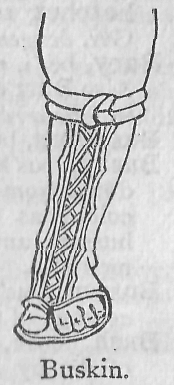
Buskin, busk′in, n. a kind of half-boot with high heels worn in ancient times by actors of tragedy—hence, the tragic drama as distinguished from comedy: a half-boot.—adj. Busk′ined, dressed in buskins, noting tragedy: tragic: dignified. [Ety. uncertain; cognates may be found in the O. Fr. brousequin; Dut. broos-ken; Sp. borceguí.]
Busky, busk′i, adj. (Shak.). Same as Bosky.
Buss, bus, n. a rude or playful kiss, a smack.—v.t. to kiss, esp. in a rude or playful manner. [M. E. bass, prob. from Old Ger. bussen, to kiss, but modified by Fr. baiser, to kiss, from L. basium, a kiss.]
Buss, bus, n. a small two-masted Dutch vessel, used in the herring and mackerel fisheries. [O. Fr. busse, Low L. bussa; cf. Ger. büse.]
Bussu-palm, bus′soo-päm, n. a palm growing along the Amazon, with leaves as long as 30 feet and 5 feet broad, forming good thatch.
Bust, bust, n. a sculpture representing the head and breast of a person: the upper part of the human body, a woman's bosom.—adj. Bust′ed, breasted: adorned with busts. [Fr. buste; It. and Sp. busto.]
Bust, bust, n. and v. a vulgar form of Burst.—n. Bust′er, something large: a frolic: (slang) a roisterer.
Bustard, bus′tard, n. a genus of birds, sometimes made the type of a large family, usually ranked in the order of marsh birds like the cranes. [Fr. bistard, corr. from L. avis tarda, slow bird.]
Bustle, bus′l, v.i. to busy one's self noisily: to be active, often with more noise than actual work.—n. hurried activity: stir: tumult.—n. Bust′ler. [There is a M. E. bustelen, of doubtful relations; perh. conn. with bluster, or with Ice. bustl, a splash, or with A.S. bysig, busy.]
Bustle, bus′l, n. a stuffed pad or cushion worn by ladies under the skirt of their dress, the intention to improve the figure.
Busy, biz′i, adj. fully employed: active: diligent: meddling.—v.t. to make busy: to occupy:—pr.p. busying (biz′i-ing); pa.p. busied (biz′id).—adv. Bus′ily.—n. Bus′ybody, one busy about others' affairs, a meddling person.—adj. Bus′yless (Shak.), without business.—n. Bus′yness, state of being busy. [A.S. bysig.]
But, but, prep. or conj. without: except: besides: only: yet: still.—Used as a noun for a verbal objection; also as a verb, as in Scott's 'but me no buts.'—adj. (Scot.) outside, as in 'but end.'—But and ben, a house having an outer and an inner room. [A.S. be-útan, bútan, without—be, by, and útan, out—near and yet outside.]
But, but, n. Same as Butt.
Butcher, booch′ėr, n. one whose business is to slaughter animals for food: one who delights in bloody deeds.—v.t. to slaughter animals for food: to put to a bloody death, to kill cruelly: (fig.) to spoil anything, as a bad actor or the like.—ns. Butch′er-bird, a shrike; Butch′ering, Butch′ing, the act of killing for food, or cruelly.—adv. Butch′erly, butcher-like, cruel, murderous.—ns. Butch′er-meat, Butch′er's-meat, the flesh of animals slaughtered by butchers, as distinguished from fish, fowls, and game; Butch′er's-broom, a genus of plants of the lily order, the common one being an evergreen shrub, a bunch of which is used by butchers for sweeping their blocks; Butch′ery, great or cruel slaughter: a slaughter-house or shambles. [O. Fr. bochier, bouchier, one who kills he-goats—boc, a he-goat; allied to Eng. Buck.]
But-end. Same as Butt-end.
Butler, but′lėr, n. a servant who has charge of the liquors, plate, &c.—v.i. to act as butler.—ns. But′lership, But′lerage; But′lery, the butler's pantry. [Norm. Fr. butuiller—Low L. buticularius. See Bottle.]
Butment. Same as Abutment.
Butt, but, v.i. and v.t. to strike with the head, as a goat, &c.—n. a push with the head of an animal.—n. Butt′er, an animal that butts. [O. Fr. boter, to push, strike.]
Butt, but, n. a large cask: a wine-butt = 126 gallons, a beer and sherry butt = 108 gallons. [Cf. Fr. botte, Sp. bota, Low L. butta.]
Butt, but, n. a mark for archery practice: a mound behind musketry or artillery targets: one who is made the object of ridicule.—n. Butt′-shaft (Shak.), a shaft or arrow for shooting at butts with. [Fr. but, goal.]
Butt, but, or in longer form, Butt′-end, n. the thick and heavy end: the stump. [Ety. dub.]
Butt, but, n. an ox-hide minus the offal or pieces round the margins.
Butte, būt, but, n. any conspicuous and isolated hill or peak, esp. in the Rocky Mountain region. [Fr.]
Butter, but′ėr, n. an oily substance obtained from cream by churning.—v.t. to spread over with butter.—ns. Butt′er-bird, the name in Jamaica for the rice-bunting; Butt′er-boat, a table vessel for holding melted butter; Butt′er-bump, a bittern; Butt′er-bur, -dock, the sweet coltsfoot; Butt′ercup, a plant of the Crowfoot genus, with a cup-like flower of a golden yellow; Butt′er-fing′ers, one who lets a cricket-ball he ought to catch slip through his fingers; Butt′er-fish (see Gunnel); Butt′erfly, the name of an extensive group of beautiful winged insects: (fig.) a light-headed person.—adj. light, flighty, like a butterfly.—ns. Butt′erine, an artificial fatty compound sold as a substitute for butter—since 1887 only allowed to be sold under the names margarine or oleo-margarine; Butt′er-milk, the milk that remains after the butter has been separated from the cream by churning; Butt′er-nut, the oily nut of the North American white walnut, the tree itself or its light-coloured close-grained wood: the nut of a lofty timber-tree of Guiana—the souari-nut; Butt′er-scotch, a kind of toffee containing a large admixture of butter; Butt′er-tree, a genus of plants found in the East Indies and in Africa, remarkable for a sweet buttery substance yielded by their seeds when boiled; Butt′er-wife, Butt′er-wom′an, a woman who makes and sells butter; Butt′er-wort, a genus of small plants found in marshy places, so called either from the power of the leaves to coagulate milk, or from their peculiar sliminess.—adj. Butt′ery, like butter. [A.S. butere; Ger. butter; both from L. butyrum—Gr. boutyron—bous ox, tyros, cheese.]
Buttery, but′ėr-i, n. a storeroom in a house for provisions, esp. liquors.—ns. Butt′ery-bar, the ledge for holding tankards in the buttery; Butt′ery-hatch, a half-door over which provisions are handed from the buttery. [Fr. bouteillerie, lit. 'place for bottles.' See Butler, Bottle.]
Buttock, but′ok, n. the rump or protuberant part of the body behind: a term in wrestling.—ns. Butt′ock-mail (Scot.), the fine formerly exacted by the Church as part of the discipline for the offence of fornication. [Dim. of Butt, end.]
Button, but′n, n. a knob of metal, bone, &c., used to fasten the dress: the knob at the end of a foil: the head of an unexpanded mushroom: the knob of an electric bell, &c.: anything of small value, as in the phrase, 'I don't care a button:' a person who acts as a decoy: (pl.) young mushrooms, sheep's dung.—v.t. to fasten by means of buttons: to close up tightly.—v.i. to be fastened with buttons.—ns. Butt′on-bush, a North American shrub of the madder family, having globular flower-heads; Butt′on-hole, the hole or slit in the dress by which the button is held.—v.t. to detain in talk, as if by taking hold of a man by the button.—ns. Butt′on-hook, a hook for pulling the buttons of gloves and shoes through the button-holes; Butt′on-wood, a small West Indian evergreen tree of the myrobalan family: the plane-tree of the United States—also Butt′on-ball and incorrectly Sycamore.—adj. Butt′ony, decorated with buttons.—Boy in buttons, a boy servant in livery, a page. [Fr. bouton, any small projection, from bouter, to push.]
Buttress, but′res, n. a projecting support built on to the outside of a wall: any support or prop.—v.t. to prop or support, as by a buttress. [Acc. to Dr Murray, perh. from O. Fr. bouterez, apparently from bouter, to push, bear against.]
Butty, but′i, n. (prov.) a chum, comrade, esp. one who takes a contract for working out a certain area of coal, or a partner in such.—ns. Butt′y-coll′ier; Butt′y-gang.
Butyric, bū-tir′ik, adj. pertaining to or derived from butter.—n. Bū′tyl, an alcohol radical.—adj. Butyrā′ceous, buttery, containing butter.—n. Bū′tyrate, a salt of butyric acid.—Butyric acid, a volatile fatty acid possessing the disagreeable odour of rancid butter. [L. butyrum.]
Buxom, buks′um, adj. yielding, elastic: gay, lively, jolly.—n. Bux′omness, the quality of being buxom: liveliness: gaiety. [M. E. buhsum, pliable, obedient—A.S. búgan, to bow, yield, and affix Some.]
Buy, bī, v.t. to purchase for money: to bribe: to obtain in exchange for something:—pr.p. buy′ing; pa.t. and pa.p. bought (bawt).—adj. Buy′able, capable of being bought.—n. Buy′er, one who buys, a purchaser.—Buy and sell (Shak.), to barter; Buy in, to purchase a stock: to buy back for the owner at an auction; Buy off, or out, to gain release from military service by payment of money; Buy over, to gain by bribery; Buy up, to purchase the whole stock. [A.S. bycgan; Goth. bugjan.]
Buzz, buz, v.i. to make a humming noise like bees.—v.t. to whisper or spread secretly.—n. the noise of bees and flies: a humming sound: a whispered report.—n. Buzz′er, one who buzzes: (Shak.) a whisperer or tell-tale.—adv. Buzz′ingly.—adj. Buzz′y. [From the sound.]
Buzz, buz, v.t. to drink to the bottom.
Buzzard, buz′ard, n. a bird of prey of the falcon family: a blockhead: a name for some night moths and cockchafers.—n. Buzz′ard-clock, a cockchafer, the dor. [Fr. busard; prob. from L. buteo, a kind of falcon.]
By, bī, prep. at the side of: near to: through, denoting the agent, cause, means, &c.—adv. near: passing near: in presence of: aside, away.—adv. By′-and-by, soon, presently.—ns. By′-blow, a side blow: an illegitimate child; By′-cor′ner, an out-of-the-way place; By′-drink′ing (Shak.), drinking between meals; By′-elec′tion, a parliamentary election during the sitting of parliament: By′-end, a subsidiary aim; By′-form, a form of a word slightly varying from it; By′-gō′ing, the action of passing by, esp. In the by-going.—adj. By′gone.—ns. By′-lane, a side lane or passage out of the common road; By′-mō′tive, an unavowed motive; By′name, a nickname; By′-pass′age, a side passage.—adj. By′-past (Shak.), past: gone by.—ns. By′path, a side path; By′-place, a retired place; By′play, a scene carried on, subordinate to and apart from the main part of the play; By′-prō′duct, an accessory product resulting from some specific process or manufacture; By′road, a retired side road; By′room (Shak.), a side or private room; By′-speech, a casual speech; By′stander, one who stands by or near one—hence a looker-on; By′-street, an obscure street; By′-thing, a thing of minor importance; By′-time, leisure time; By′way, a private and obscure way; By′word, a common saying: a proverb: an object of common derision; By′work, work for leisure hours.—By-the-by, By the way, in passing.—Let bygones be bygones, let the past alone. [A.S. bi, big; Ger. bei, L. ambi.]
By, Bye, bī, n. anything of minor importance, a side issue, a thing not directly aimed at: the condition of being odd, as opposed to even, the state of being left without a competitor, as in tennis, &c.: in cricket, a run stolen by the batsman on the ball passing the wicket-keeper and long-stop, the batsman not having struck the ball.—By-the-bye, or -by, incidentally, by the way.
Bycocket, bī′kok-et, n. a turned-up peaked cap worn by noble persons in the 15th century—sometimes erroneously abacot. [O. Fr. bicoquet, prob. bi- (L. bis), double, coque, a shell.]
Byde, bīd, v.i. Same as Bide.
Bylander, obsolete form of Bilander.
Bylaw, Bye-law, bī′-law, n. the law of a city, town, or private corporation: a supplementary law or regulation. [The same as Byrlaw, from Ice. byarlög, Dan. by-lov, town-law; Scot. bir-law; from Ice. bua, to dwell. See Bower. By, town, is the suffix in many place-names. The by in bylaw is generally confused with the preposition.]
Bynempt, bī-nempt′, pa.t. of obsolete verb Bename (Spens.), named. [A.S. pfx. by-, be-, and nemnen, to name. See Name.]
Byous, bī′us, adj. (Scot.) extraordinary.—adv. By′ously.
Byre, bīr, n. (Scot.) a cow-house. [A.S. býre pl. dwellings—búr, a bower. See Bower.]
Byrlady, bir-lā′di, contraction for By our Lady.
Byrlaw, bir′law, n. a sort of popular jurisprudence formerly in use in Scotland, in villages and among husbandmen, concerning neighbourhood to be kept among themselves.—n. Byr′law-man, still in parts of Scotland, an arbiter, oddsman, or umpire. [A.S. burh, a borough.]
Byronic, bī-ron′ik, adj. possessing the characteristics of Lord Byron (1788-1824), or of his poetry, overstrained in sentiment or passion, cynical and libertine.—adv. Byron′ically.—n. By′ronism.
Byssolite, bis′o-līt, n. an olive-green variety of actinolite, in long crystals.—Also Amian′tus. [Gr. byssos, byssus, lithos, stone.]
Byssus, bis′us, n. a fine yellowish flax, and the linen made from it: the bundle of fine silky filaments by which many shellfish attach themselves to rocks, &c.: a genus of cryptogamic plants of a silky fibrous texture found on decaying wood, in mines, &c., and other dark places.—adjs. Byssif′erous, bearing or having a byssus; Byss′ine, made of fine linen. [L.—Gr. byssos, a fine flaxen or silky substance.]
Byzant, biz′ant. Same as Bezant.
Byzantine, biz-an′tīn, biz′-, adj. relating to Byzantium or Constantinople.—n. an inhabitant thereof.—n. Byzan′tinism, the manifestation of Byzantine characteristics.—Byzantine architecture, the style prevalent in the Eastern Empire down to 1453, marked by the round arch springing from columns or piers, the dome supported upon pendentives, capitals elaborately sculptured, mosaic or other incrustations, &c.; Byzantine Church, the Eastern or Greek Church; Byzantine Empire, the Eastern or Greek Empire from 395 A.D. to 1453; Byzantine historians, the series of Greek chroniclers of the affairs of the Byzantine Empire down to its fall in 1453.

the third letter of our alphabet, originally having the sound of g, then of k, and finally, in some languages, equivalent to s: (mus.) name of one of the notes of the gamut, also the sound on which the system is founded—the scale C major has neither flats nor sharps, and therefore is called the natural scale.
Caaba, kä′a-ba, n. the Moslem Holy of Holies, a square building at Mecca, containing the famous Black Stone built into the south-east corner at a height convenient for being kissed. [Ar.]
Caaing-whale, kä′ing-hwāl, n. one of the Cetacea, in the dolphin family, very gregarious, and oftener stranded than any other 'whale'—16 to 24 feet long, and 10 feet in girth. Other names are Pilot-whale, Black-fish, Social Whale, Grindhval. [Scot. ca, to drive.]
Cab, kab, n. a public carriage of various sizes and shapes, with two or four wheels, drawn by one horse.—ns. Cab′by, a shortened form of Cab′man, one who drives a cab for hire; Cab′-stand, a place where cabs stand for hire; Cab′-tout, one whose business it is to call cabs.—Cabmen's shelter, a place of shelter for cabmen while waiting for hire. [Shortened from Cabriolet.]
Cab, kab, n. a Hebrew dry measure = nearly three pints. [Heb. kab—kabab, to hollow.]
Cabal, ka-bal′, n. a small party united for some secret design: the plot itself: a name in English history esp. given to five unpopular ministers of Charles II. (1672), whose initials happened to make up the word.—v.i. to form a party for a secret purpose: to plot:—pr.p. cabal′ling.—n. Cabal′ler, a plotter or intriguer. [Fr. cabale; from Cabala.]
Caballero, kä-bä-lyā′rō, n. a Spanish gentleman: a Spanish dance.
Caballine, kab′a-lin, adj. pertaining to, or suited to, a horse. [L. caballinus—caballus, a horse.]
Cabaret, kab′a-ret, n. a small tavern. [Fr., prob. for cabanaret—cabane, a hut.]
Cabas, Caba, kab′a, n. a woman's work-basket or reticule: a rush basket or pannier. [Fr.]
Cabbage, kab′āj, n. a well-known kitchen vegetable.—ns. Cabb′age-butt′erfly, a large butterfly whose larvæ injure the leaves of cabbage and other cruciferous plants; Cabb′age-moth, a moth whose larva feeds on the cabbage; Cabb′age-palm, Cabb′age-tree, a name given in different countries to different species of palm, the great terminal bud of which is eaten cooked like cabbage, or sometimes also raw in salads; Cabb′age-rose, a species of rose which has a thick form like a cabbage-head; Cabb′age-worm, the larva of the cabbage-butterfly or of the cabbage-moth. [Fr. caboche, head (choux cabus, a cabbage); from L. caput, the head.]
Cabbage, kab′āj, v.t. and v.i. to purloin, esp. a tailor of portions of a customer's cloth.—n. cloth so appropriated.
Cabbala, Cabala, kab′a-la, n. a secret science of the Jewish rabbis for the interpretation of the hidden sense of Scripture, claimed to be handed down by oral tradition.—ns. Cabb′alism, the science of the cabbala; Cabb′alist, one versed in the cabbala.—adjs. Cabbalist′ic, -al, relating to the cabbala: having a hidden meaning. [Heb. qabbālāh, tradition, qibbēl, to receive.]
Caber, kāb′ėr, n. a pole, generally the stem of a young tree, which is poised and tossed or hurled by Highland athletes. [Gael.]
Cabin, kab′in, n. a hut or cottage: a small room, esp. in a ship, for officers or passengers—hence Cab′in-pass′enger, one paying for superior accommodation.—v.t. to shut up in a cabin.—v.i. to dwell in a cabin.—n. Cab′in-boy, a boy who waits on the officers or those who live in the cabin of a ship. [Fr. cabane—Low L. capanna.]
Cabinet, kab′in-et, n. (obs.) a little cabin or hut: (Shak.) the bed or nest of a beast or bird: a small room, closet, or private apartment: a case of drawers for articles of value: a private room for consultation, esp. a king's—hence The Cabinet, a limited number of the chief ministers who govern England, being the leaders of the majority in parliament.—ns. Cab′inet-coun′cil, a council or consultation of the members of the Cabinet; Cab′inet-edi′tion (of a book), one less in size and price than a library edition, but still elegant in format; Cab′inet-mak′er, a maker of cabinets and other fine furniture; Cab′inet-phō′tograph, one of the size larger than a carte-de-visite. [Dim. of Cabin; cf. mod. Fr. cabinet.]
Cabiri, ka-bī′rī, n.pl. ancient divinities of Semitic origin, associated with fire and creative energy, worshipped in mysteries in Lemnos, Samothrace, and Indros—also Cabei′ri.—adjs. Cabir′ian, Cabir′ic.
Cable, kā′bl, n. a strong rope or chain which ties anything, esp. a ship to her anchor: a nautical measure of 100 fathoms; a cable for submarine telegraphs composed of wires embedded in gutta-percha and encased in coiled strands of iron wire; a bundle of insulated wires laid underground in a street: a cable-message.—v.t. to provide with a cable, to tie up: to transmit a message, or to communicate with any one by submarine telegram.—ns. Cā′blegram, a message sent by submarine telegraph cable; Cā′ble-mould′ing, a bead or moulding carved in imitation of a thick rope; Cā′bling, a bead or moulding like a thick rope, often worked in flutes: the filling of flutes with a moulding like a cable.—Slip the cable, to let it run out. [Fr.—Low L. caplum, a halter—cap-ĕre, to hold.]
Cabob, ka-bob′, n. an Oriental dish of pieces of meat roasted with herbs: roast meat generally in India. [Ar. kabāb.]
Caboched, Caboshed, ka-bosht′, adj. (her.) bearing the head of an animal, with only the face seen. [Fr. caboché—L. caput, head.]
Cabochon, ka-bō-shong, n. a precious stone polished but uncut.—En cabochon, rounded on top and flat on back, without facets—garnets, moonstone, &c. [Fr.]
Caboodle, ka-bōō′dl, n. (slang) crowd, company.
Caboose, ka-bōōs′, n. the kitchen or cooking-stove of a ship. [Dut. kombuis; cf. Ger. kabuse.]
Cabriole. See Capriole.
Cabriolet, kab-ri-ō-lā′, n. a covered carriage with two or four wheels drawn by one horse. [Fr. See Capriole. By 1830 shortened into Cab.]
Cacao, ka-kā′o, ka-kä′o, n. the chocolate-tree, from the seeds of which chocolate is made. [Mex. cacauatl.]
Cachæmia, Cachemia, ka-kē′mi-a, n. a morbid state of the blood.—adj. Cachē′mic. [Gr. kakos, bad, haima, blood.]
Cachalot, kash′a-lot, n. the sperm-whale. [Fr.]
Cache, kash, n. a hiding-place for treasure, for stores of provisions, ammunition, &c.: the stores themselves so hidden.—v.t. to hide anything.—n. Cache′pot, an ornamental flower-pot enclosing a common one of earthenware. [Fr. cacher, to hide.]
Cachet, kash′ā, n. a seal, any distinctive stamp.—Lettre de cachet, a letter under the private seal of the king of France under the old régime, by which the royal pleasure was made known to individuals, and the administration of justice often interfered with. [Fr.]
Cachexy, ka-kek′si, n. a bad state of body: a depraved habit of mind.—adjs. Cachec′tic, -al. [L.—Gr. kachexia—kakos, bad, hexis, condition.]
Cachinnation, kak-in-ā′shun, n. loud laughter.—adj. Cachin′natory. [L. cachinnation-em, cachinnāre, to laugh loudly—from the sound.]
Cacholong, kash′o-long, n. a variety of quartz or of opal, generally of a milky colour. [Fr.]
Cacholot. Same as Cachalot.
Cachou, kash′ōō, n. a sweetmeat, made in the form of a pill, of extract of liquorice, cashew-nut, or the like, used by some smokers in the hope to sweeten their breath. [Fr.]
Cachucha, kach′ōōch-a, n. a lively Spanish dance. [Sp.]
Cacique, ka-sēk′, n. a native chief among the West Indian aborigines. [Haytian.]
Cackle, kak′l, n. the sound made by a hen or goose.—v.i. to make such a sound.—ns. Cack′ler, a fowl that cackles: a talkative, gossiping person; Cack′ling, noise of a goose or hen. [M. E. cakelen; cog. with Dut. hakelen.]
Cacodemon, kak-o-dē′mon, n. an evil spirit: (Shak.) a nightmare. [Gr. kakos, bad, and Demon.]
Cacodyl, kak′o-dil, n. a colourless stinking liquid, composed of arsenic, carbon, and hydrogen. [Gr. kakōdēs, ill-smelling.]
Cacoethes, kak-o-ē′thēz, n. an obstinate habit or disposition. [Gr. kakos, bad, ēthos, habit.]
Cacogastric, kak-ō-gas′trik, adj. pertaining to a disordered stomach, dyspeptic. [Gr. kakos, bad, gastēr, the stomach.]
Cacography, kak-og′ra-fi, n. bad writing or spelling.—adj. Cacograph′ic [Gr. kakos, bad, and graphia, writing.]
Cacolet, kak′o-lā, n. a military mule-litter for sick and wounded. [Fr.; prob. Basque.]
Cacology, ka-kol′o-ji, n. bad grammar or pronunciation. [Gr. kakos, bad, logos, speech.]
Cacoon, ka-kōōn′, n. a large seed of a tropical climber of the bean family, used for making scent-bottles, snuff boxes, purses, &c.: a purgative and emetic seed of a tropical American climber of the gourd family.
Cacophony, ka-kof′ō-ni, n. a disagreeable sound: discord of sounds.—adjs. Cacoph′onous, Cacophon′ic, -al, Cacophō′nious, harsh-sounding. [Gr. kakos, bad, phōnē, sound.]
Cactus, kak′tus, n. an American plant, generally with prickles instead of leaves.—adj. Cactā′ceous, pertaining to or like the cactus. [Gr., a prickly plant found in Sicily.]
Cad, kad, n. a low, mean, or vulgar fellow: a bus driver or conductor, a tavern-yard loafer.—adj. Cad′dish. [Short for Cadet.]
Cadastral, ka-das′tral, adj. pertaining to a Cadastre or public register of the lands of a country for fiscal purposes: applied also to a survey on a large scale, like our Ordnance Survey on the scale of 25 inches to the mile. [Fr.—Low L. capitastrum, register for a poll-tax—L. caput, the head.]
Cadaverous, ka-dav′ė-rus, adj. looking like a dead body: sickly-looking.—n. Cadāv′er (surg. and anat.), a corpse.—adj. Cadav′eric.—n. Cadav′erousness. [L. cadaver, a dead body—cad-ĕre, to fall dead.]
Caddice, Caddis, kad′dis, n. the larva of the May-fly and other species of Phryganea, which lives in water in a sheath formed of fragments of wood, stone, shell, leaves, &c., open at both ends—caddis-worms form excellent bait for trout.—n. Cad′dis-fly.
Caddie, kad′i, n. a lad who attends a golfer at play, carrying his clubs: in 18th century a messenger or errand porter in Edinburgh. [See Cadet.]
Caddis, kad′dis, n. (Shak.) worsted ribbon. [O. Fr. cadaz, cadas.]
Caddy, kad′i, n. a small box for holding tea. [Malay kati, the weight of the small packets in which tea is made up.]
Cade, kād, n. a barrel or cask. [Fr.—L. cadus, a cask.]
Cade, kād, n. and adj. a lamb or colt brought up by hand, a pet lamb. [Ety. unknown.]
Cadeau, kad′o, n. a present. [Fr.]
Cadenas, kad′e-nas, n. in medieval times, a locked casket containing a great man's table requisites, knife, fork, spoon, &c., often in the form of a ship. [O. Fr.,—L. catena, a chain.]
Cadence, kā′dens, n. the fall of the voice at the end of a sentence: tone, sound, modulation.—adj. Cā′denced, rhythmical.—n. Cā′dency, regularity of movement: (her.) the relative status of younger sons.—adj. Cā′dent (Shak.), falling.—n. Caden′za, a flourish given by a solo voice or instrument at the close of a movement. [Fr.—L. cad-ĕre, to fall.]
Cadet, ka-det′, n. the younger or youngest son: a member of the younger branch of a family: in the army, one who serves as a private to become an officer: a student in a military school.—n. Cadet′ship.—Cadet corps, parties of boys undergoing military training. [Fr. cadet, formerly capdet—Low L. capitettum, dim. of caput, the head.]
Cadge, kaj, v.i. to beg or go about begging.—n. Cadg′er, a carrier who collects country produce, a hawker: a fellow who picks up his living about the streets. [Prob. conn. with Catch.]
Cadgy, kaj′i, adj. (prov.) frolicsome: wanton. [Cf. Dan. kaad, wanton, Ice. kátr, merry.]
Cadi, kā′di, n. a judge in Mohammedan countries. [Ar. qādī, a judge.]
Cadmean, kad-mē′an, adj. relating to Cadmus, who introduced the original Greek alphabet.
Cadmia, kad′mi-a, n. oxide of zinc, containing from 10 to 20 per cent. of cadmium. [Gr. kadmia, kadmeia (ge), Cadmean (earth), calamine.]
Cadmium, kad′mi-um, n. a white metal occurring in zinc ores. [See Cadmia.]
Cadrans, kad′rans, n. a wooden instrument by which a gem is adjusted while being cut. [Fr. cadran, a quadrant.]
Cadre, kad′r, n. a nucleus, framework, esp. the permanent skeleton of a regiment or corps, the commissioned and non-commissioned officers, &c., around whom the rank and file may be quickly grouped. [Fr.]
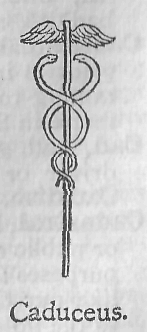
Caduceus, ka-dū′se-us, n. (myth.) the rod carried by Mercury, the messenger of the gods—a wand surmounted with two wings and entwined by two serpents.—adj. Cadū′cean. [L., akin to Gr. kērukeion, a herald's wand—kērux, a herald.]
Caducibranchiate, ka-dūi-si-brang′ki-āt, adj. losing the gills on attaining maturity, as all the salamanders.—n.pl. Caducibranchiā′ta. [L. caducus, caducous, branchiæ, gills.]
Caducous, ka-dū′kus, adj. falling early, as leaves or flowers.—n. Cadū′city, transitoriness, senility. [L. caducus—cad-ĕre, to fall.]
Cæcum, sē′kum, n. a blind sac: a sac or bag having only one opening, connected with the intestine of an animal.—adj. Cæ′cal. [L.—cæcus, blind.]
Caen-stone, kā′en-stōn, n. a cream-coloured limestone brought from Caen in France.
Cæsar, sē′zar, n. an absolute monarch, an autocrat, from the Roman dictator Caius Julius Cæsar (100-44 B.C.).—adj. Cæsar′ean, relating to Julius Cæsar.—ns. Cæ′sarism; Cæ′sarist; Cæ′sarship.—Cæsarean operation, the popular name for Hysterotomy, the delivery of a child by cutting through the walls of the abdomen, as is said to have been the case with Cæsar.
Cæsium, sēz′i-um, n. a silver-white, soft, and extensile alkaline metal, almost always found along with rubidium, discovered by Bunsen and Kirchhoff in 1860 by spectrum analysis.—adj. Cæs′ious, bluish green. [L. cæsius, bluish gray.]
Cæsura, Cesura, sē-zū′ra, n. a syllable cut off at the end of a word after the completion of a foot: a pause in a verse.—adj. Cæsū′ral. [L.—cædĕre, cæsum, to cut off.]
Café, käf′ā, n. a coffee-house, a restaurant.—Café chantant, a public place of entertainment where the guests hear music while sipping their liquor. [Fr.]
Caffeine, kaf′e-in, or kaf-ē′in, n. the alkaloid or active principle of coffee and tea. [Fr. caféine. See Coffee.]
Caffre, kaf′fėr, n. more correctly Kafir (q.v.).
Caftan, kaf′tan, n. a Persian or Turkish vest. [Turk. qaftán.]
Cage, kāj, n. a place of confinement: a box made of wire and wood for holding birds or small animals: (mining) a frame with one or more platforms for cars, used in hoisting in a vertical shaft: the framework supporting a peal of bells.—v.t. to imprison in a cage—p.adj. Caged, confined.—ns. Cage′ling, a bird kept in a cage; Cage′-work, open work like the bars of a cage. [Fr.—L. cavea, a hollow place.]
Cagot, kag′ō, n. one of an outcast race found scattered in the district of the western Pyrenees, most likely the descendants of lepers. [Fr.; origin unknown.]
Cahier, ka-yā′, n. a writing-book, memorandum or report: a memorial. [Fr.]
Cahoot, ka-hōōt′, n. (U.S.) company or partnership.
Caillach, kīl′yah, n. an old woman. [Gael. cailleach.]
Caimac, Caimacam. See Kaimakam.
Caiman. Same as Cayman.
Cain, kān, n. a murderer, from Cain, who killed his brother Abel (Gen. iv.).—adj. Cain′-col′oured (Shak.), reddish, the traditional colour of the hair of Cain and Judas.—n. Cain′ite, a descendant of Cain: a member of a 2d-century set of Gnostics who revered Cain and Judas.
Cain, Kain, kān, n. in old Scots law, rent paid in kind, esp. in poultry, &c.—To pay the cain, to pay the penalty. [Ir. and Gael, cáin, rent, tax.]
Cainozoic, kā-no-zō′ik, adj. belonging to the third of the great periods of geology, the same as the Tertiary (q.v.). [Gr. kainos, newly made, recent, zōon, animal.]
Caique, kä-ēk′, n. a light skiff used on the Bosporus: the skiff of a galley. [Fr.,—Turk. kaik, a boat.]
Caird, kārd, n. a tramping tinker, a gipsy, a vagrant. [Gael. and Ir. ceard.]
Cairn, kārn, n. a heap of stones, esp. one raised over a grave, or as a landmark on a mountain-top.—n. Cairn′gorm-stone, or simply Cairngorm, a name often given by jewellers to brown or yellow quartz or rock-crystal, because found among the Cairngorm Mountains in Aberdeenshire. [Celt. carn.]
Caisson, kās′on, n. a tumbril or ammunition wagon: a chest filled with explosive materials: a strong case for keeping out the water while the foundations of a bridge are being built: an apparatus for lifting a vessel out of the water for repairs or inspection: the pontoon or floating gate used to close a dry-dock. [Fr., from caisse, a case or chest. See Case.]
Caitiff, kā′tif, n. a mean despicable fellow.—adj. mean, base.—n. Cai′tive (Spens.), captive, subject. [O. Fr. caitif, (Fr. chétif)—L. captivus, a captive—cap-ĕre, to take.]
Cajole, ka-jōl′, v.t. to coax: to cheat by flattery.—ns. Cajole′ment, coaxing for the purpose of deluding: wheedling language: flattery; Cajol′er; Cajol′ery. [Fr. cajoler, to chatter; ety. dub.]
Cajuput, kaj′i-put, n. a pungent, volatile, aromatic oil, distilled from the leaves of two trees native to Australia.—Also Caj′eput. [Malay.]
Cake, kāk, n. a piece of dough that is baked: a small loaf of fine bread: any flattened mass baked, as pan-cake, &c., or as soap, wax, tobacco, &c.: a thin hard-baked kind of oaten-bread—whence Scotland is styled the 'Land of Cakes:' fancy bread, sweetened: a composition of bread with butter, sugar, spices, currants, raisins, &c., baked into any form—plum-cake, tea-cake, wedding-cake.—v.t. to form into a cake or hard mass.—v.i. to become baked or hardened.—adj. Cak′y.—Cakes and ale, a phrase covering vaguely all the good things of life.—To take the cake (slang), to carry off the honours, rank first. [Scand. kaka; cog. with Ger. kuche, Dut. koek.]
Calabar-bean, käl′a-bär-bēn, n. the seed of Physostigma venenosum, the ordeal bean of Old Calabar, used in the form of an emulsion in cases of witchcraft, the accused being plainly innocent if he can throw off the poison by vomiting.
Calabash, kal′a-bash, n. a tree of tropical America, bearing a large melon-like fruit, the shell of which, called a calabash, is used for domestic purposes, as holding liquids, &c. [Fr. calebasse—Sp. calabaza—Pers. kharbuz, melon.]
Calaboose, kal′a-bōōs, n. a prison in New Orleans, esp. a common lock-up. [Sp. calabozo, a dungeon.]
Caladium, kal-ā′di-um, n. a genus of plants of the Arum family, with edible starchy root-stocks. [Latinised from Malay kélādy.]
Calamanco, kal-a-mangk′o, n. a satin-twilled woollen stuff, checkered or brocaded in the warp. [Dut. kalamink, Ger. kalmank, Fr. calmande; origin unknown.]
Calamander, kal′a-man-dėr, n. a hard and valuable cabinet-wood of a brownish colour, with black stripes, brought from India and Ceylon. [Prob. Singh.]
Calamary, kal′a-mar-i, n. a popular name applied to numerous forms of cuttle-fish or Cephalopoda, more esp. to Loligo vulgaris.—Also Squid. [Sp. calamar—Fr. calmar—L. calamarius, calamus, a pen.]
Calamine, kal′a-mīn, n. an ore consisting essentially of carbonate of zinc. [Fr.—Low L. calamina, most prob. from L. cadmia.]
Calamint, kal′a-mint, n. a genus of Labiate plants closely allied to balm and thyme. [Fr.—Low L. calamentum, through L. from Gr. kalaminthē.]
Calamite, kal′a-mīt, n. a fossil plant abundant in the coal-measures, believed to be a kind of gigantic horse-tails (Equisetaceæ). [Formed from L. calamus, a reed.]
Calamity, kal-am′i-ti, n. a great misfortune: affliction.—adj. Calam′itous, making wretched, disastrous.—adv. Calam′itously, in a calamitous manner.—n. Calam′itousness, the quality of producing distress: distress: misery. [Fr. calamité—L. calamitat-em.]
Calamus, kal′a-mus, n. the traditional name of the sweet flag, which is no doubt the Calamus aromaticus of Roman authors, and probably the sweet calamus and sweet cane of Scripture, but not the fragrant lemon-grass of India: a genus of palms whose stems make canes or rattans: the reed pen used by the ancients in writing. [L.—Gr.]
Calash, ka-lash′, n. a light low-wheeled carriage with a folding top: a silk and whalebone hood worn by ladies to shade the face. [Fr. calèche; of Slav. origin, as Bohem. kolésa, Russ. koleso, a wheel.]
Calavance, kal′a-vans, n. a name for certain varieties of pulse.—Also Car′avance. [Sp. garbanzo, chickpea, said to be the Basque garbantzu.]
Calcaneum, kal-kā′nē-um, n. a bone of the tarsus or ankle, forming in man the prominence of the heel, the os calcis: in birds, the hypotarsus.—adjs. Calcā′neal, Calcā′nean. [L., the heel—calx, the heel.]
Calcar, kal′kar, n. (bot.) a spur or spur-like projection, esp. from the base of a petal: (anat.) an eminence in the lateral ventricles of the brain, the hippocampus minor or calcar avis.—adjs. Cal′carate; Calcar′iform; Cal′carine. [L., a spur—calx, calcis, the heel.]
Calcar, kal′kar, n. an oven or furnace for calcining the materials of frit before melting—also Fritting-furnace: an arch or oven for annealing.
Calcareous, kal-kā′re-us, adj. like or containing chalk or lime, whether waters, rocks, or soils.—n. Calcā′reousness.—adj. Calcarif′erous, better Calcif′erous, containing lime. [L. calcarius, from calx, lime.]
Calceamentum, kal-sē-a-men′tum, n. a red silk embroidered sandal forming part of the insignia of the Holy Roman Empire. [L.]
Calced, kalst, adj. shod, wearing shoes—opp. to Discalced—of Carmelites.—v.t. Cal′cēate, to shoe.—adjs. Cal′cēate, -d, shod; Cal′cēiform (bot.), having the form of a slipper; Cal′cēolate, calceiform. [Low L. calceus, a shoe—calx, calcis, the heel.]
Calceolaria, kal-se-o-lā′ri-a, n. a South American genus of Scrophulariaceæ, largely cultivated as half-hardy or greenhouse plants for the beauty and variety in colour of the two-lipped slipper-like flowers. [L. calceolus, dim. of calceus, a shoe.]
Calcium, kal′si-um, n. the metal present in chalk, stucco, and other compounds of lime.—adjs. Cal′cic, containing calcium; Cal′cific, calcifying or calcified.—v.i. Cal′cificā′tion, the process of calcifying, a changing into lime.—adjs. Cal′ciform, like chalk, pebbly; Calcif′ugous, avoiding limestone.—v.t. and v.i. Cal′cify, to make calcic: to turn into bony tissue.—adjs. Calcig′enous, forming lime; Calcig′erous, containing lime.—n. Cal′cimine, a white or tinted wash for ceilings, walls, &c., consisting of whiting, with glue, &c.—v.t. to wash with such.—adj. Cal′cinable, capable of being calcined.—n. Calcinā′tion.—v.t. Cal′cine, or Calcine′, to reduce to a calx or chalky powder by the action of heat, to burn to ashes.—v.i. to become a calx or powder by heat.—ns. Cal′cite, native calcium carbonate, or carbonate of lime—also called Calcā′reous spar and Calc′spar; Calc′-sin′ter, Calc′-tuff, Tra′vertin, a porous deposit from springs or rivers which in flowing through limestone rocks have become charged with calcium carbonate. [Formed from L. calx, chalk.]
Calcography. See Chalcography.
Calculate, kal′kū-lāt, v.t. to count or reckon: to think out: to adapt, fit (only passive, with for): (U.S.) to think, purpose.—v.i. to make a calculation: to estimate.—adjs. Cal′culable; Cal′culating, given to forethought, deliberately selfish and scheming.—n. Calculā′tion, the art or process of calculating: estimate: forecast.—adj. Cal′culātive, relating to calculation.—n. Cal′culātor, one who calculates. [L. calculāre, -ātum, to reckon by help of little stones—calculus, dim. of calx, a little stone.]
Calculus, kal′kū-lus, n. a stone-like concretion which forms in certain parts of the body: one of the higher branches of mathematics:—pl. Calculi (kal′kū-li).—adj. Cal′culose, stony or like stone: gritty: affected with stone or with gravel.—Calculus of finite differences not merely does not consider differentials, but does not assume continuity.—Differential calculus, a method of treating the values of ratios of differentials or the increments of quantities continually varying; Integral calculus, the summation of an infinite series of differentials. [L.—calx.]
Caldron. Same as Cauldron.
Caledonian, kal-e-dō′ni-an, adj. pertaining to Caledonia, or Scotland.—n. a Scotchman.
Calefaction, kal-e-fak′shun, adj. act of heating: state of being heated.—adj. Calefā′cient, warming.—n. anything that warms: a blister or superficial stimulant.—adj. Calefac′tive, communicating heat.—n. Calefac′tor, a small stove.—adj. Calefac′tory, warming.—n. a room in which monks warmed themselves: a warming-pan, a pome.—v.t. and v.i. Cal′efy, to grow warm: to make warm.—n. Cales′cence, increasing warmth. [L.,—calēre, to grow hot, facĕre, to make.]
Calendar, kal′en-dar, n. the mode of adjusting the natural divisions of time with respect to each other for the purposes of civil life: an almanac or table of months, days, and seasons, or of special facts, &c., as in the 'gardener's calendar,' &c.: a list of documents arranged chronologically with summaries of contents, as in 'calendar of state papers:' a list of canonised saints, or of prisoners awaiting trial: any list or record.—v.t. to place in a list: to analyse and index.—ns. Cal′endarer, Cal′endarist. [O. Fr. calendier—L. calendarium, an account-book, kalendæ, calends.]
Calender, kal′en-dėr, n. a press consisting of two rollers for smoothing and dressing cloth, paper, &c.: a person who calenders, properly a calendrer.—v.t. to dress in a calender.—ns. Cal′endering; Cal′endrer, one whose business it is to calender cloth; Cal′endry, a place where calendering is done. [Fr. calandre—L. cylindrus—L. kylindros.]
Calender, kal′en-dėr, n. a word somewhat loosely used for dervish in Persia and Central Asia. [Pers.]
Calends, kal′endz, n. among the Romans, the first day of each month. [L. Kalendæ—calăre, Gr. kalein, to call, because the beginning of the month was proclaimed.]
Calenture, kal′en-tūr, n. a kind of fever or delirium occurring on board ship in hot climates. [Fr. and Sp.—L. calent-em, calēre, to be hot.]
Calescence. See Calefaction.
Calf, käf, n. the young of the cow and of some other animals, as marine mammals: calf-skin leather, bookbinding in such: a stupid or a cowardly person:—pl. Calves (kävz).—ns. Calf′-love, an attachment between a boy and girl; Calf's′-foot, Calves'-foot, the foot of the calf, used in making a palatable jelly; Calf′-skin, the skin of the calf, making a good leather for bookbinding and shoes.—Divinity calf, a dark-brown calf bookbinding, with blind stamping, and without gilding—common in the binding of theological books; Golden calf, the idol set up by Aaron during the absence of Moses on Sinai, or those erected by Jeroboam at Bethel and Dan: worship of Mammon or wealth; Half-calf, a bookbinding in which the back and corners are in calf-skin; Mottled calf, a light coloured bookbinding, decorated by the sprinkling of acid in drops; Smooth calf, a binding in plain or undecorated calf leather.—The calves of our lips (Hosea, xiv. 2), an offering of praise (the Septuagint reads, 'The fruit of our lips').—Tree calf, a bright brown calf bookbinding, stained by acids with a pattern resembling the trunk and branches of a tree. [A.S. cealf; Ger. kalb.]
Calf, käf, n. the thick fleshy part of the leg behind.—adj. Calf′less, with a thin, poor calf. [Ice. kalfi; perh. the same word as the preceding.]
Caliban, kal′i-ban, n. a man of beastly nature, from the monster in Shakespeare's Tempest.
Calibre, Caliber, kal′i-bėr, n. the size of the bore of a gun: diameter: intellectual capacity.—adj. Cal′ibered.—v.t. Cal′ibrāte, to determine the calibre of.—n. Calibrā′tion. [Fr. calibre, the bore of a gun; prob. L. quā librā, with what weight, or from Ar. qālib, a form.]
Calico, kal′i-kō, n. a cotton cloth, first brought from Calicut in India: plain white unprinted cotton cloth, bleached or unbleached: coarse printed cotton cloth.—adj. made of calico: spotted—n. Cal′ico-print′er, one employed in printing calicoes.
Calid, kal′id, adj. warm.—n. Calid′ity. [L. calidus, hot.]
Calif, Caliph, kā′lif, or kal′if, n. the name assumed by the successors of Mohammed.—ns. Cal′ifate, Cal′iphate, the office, rank, or government of a calif. [Fr.—Ar. khalīfah, a successor.]
Caliginous, kal-ij′en-us, adj. dim, obscure, dark.—n. Caliginos′ity. [L. caliginos-us.]
Caligraphy. See under Calligraphy.
Calipash, kal′i-pash, n. the part of a turtle close to the upper shell, consisting of a fatty gelatinous substance of a dull greenish colour.—n. Cal′ipee, the white portion from the belly—a fatty gelatinous substance of a light-yellowish colour. [Prob. corr. of West Ind. words.]
Calipers, kal′i-pėrz, Caliper-compasses, kal′i-pėr-kum′pasez, n.pl. compasses with legs suitable for measuring the inside or outside diameter of bodies. [Corr. of Caliber.]
Caliph, Caliphate. See Calif.
Calippic, kal-ip′ik, adj. four Metonic cycles less one day, or seventy-six years. [From the Greek astronomer Callipus, a contemporary of Aristotle.]
Calisaya, kal-i-sā′ya, n. a variety of Peruvian bark.
Caliver, kal′i-vėr, n. (Shak.) a kind of light musket. [Same as Calibre.]
Calix. See Calyx.
Calixtin, Calixtine, kal-iks′tin, adj. of or belonging to the more moderate party among the Hussites, so called from their demanding the cup (L. calix) as well as the bread for the laity—also called U′traquists (L. uterque, both).—n. a follower of the Syncretist Lutheran divine, George Calixtus (1586-1656).
Calk. See Caulk.
Calk, kawk, n. a pointed piece of iron on a horse-shoe to prevent slipping—also Calk′in and Calk′er.—v.t. to provide a shoe with a calk. [L. calc-em, calx, a heel.]
Calk, Calque, kawk, v.t. to chalk, as the back of a drawing, &c., in order to transfer it, to copy by tracing.—n. Calk′ing, the copying of a picture by means of tracing.
Call, kawl, v.i. to cry aloud (with out; to, after, at, up, down): to make a short visit (with upon, for, at).—v.t. to name: to summon: to appoint or proclaim: to designate or reckon: to select for a special office, as in 'called to be an apostle,' 'to be called to the bar:' (coll.) to call bad names to some one.—n. a summons or invitation: an impulse: a demand: a short visit: a shrill whistle: the cry of a bird: admission to the rank of barrister: an invitation to the pastorate of a congregation, also the written form of such with appended list of names of persons concurring: (coll.) occasion, cause.—ns. Call′-at-large, a form of pastoral call sometimes adopted by a presbytery where a congregation is not unanimous, in which the name of the person to be called is not inscribed beforehand, and names cannot be adhibited by mandate; Call′-bird, a bird trained to allure others into snares; Call′-boy, a boy who waits upon the prompter in a theatre, and calls the actors when wanted on the stage; Call′er, one who pays a short visit; Call′ing, that station to which a person is called by Providence to fill: one's trade, profession, or occupation; Call′ing-crab, a popular name for the fiddler-crab, which waves its larger claw when disturbed; Call′-note, the note by which a bird or beast calls its young.—Call attention to, to point out; Call away, to divert the mind; Call back, to recall; Call for, to ask loudly: claim; Call forth, to bring or summon to action; Call for trumps, to lay down such cards at whist as will induce one's partner to lead a trump; Call in, to bring in from outside, as the notes in circulation, &c.; Call in question, to challenge; Call off, to summon away; Call on, or upon, to invoke, appeal to; Call out, to challenge to fight, esp. a duel: to summon to service, bring into operation; Call over, to read aloud a list; Call to account, to summon to render an account; Call up, to summon from beneath, or to a tribunal. [A.S. ceallian; Ice. kalla, Dut. kallen.]
Call, kawl, n. (Spens.) a caul or cap.
Callant, käl′ant, n. a lad. [A modern Scotch word; Dut. kalant.]
Caller, kal′ėr, adj. fresh: (Scot.) cool. [Prob. the same as Calver.]
Callet, kal′et, n. (Shak.) a scold, a woman of bad character, a trull. [Prob. Fr. caillette, a frivolous gossip; or prob. the Gael. caille, girl, may be related.]
Callid, kal′id, adj. shrewd.—n. Callid′ity, shrewdness. [L. callidus, expert.]
Calligraphy, Caligraphy, kal-lig′ra-fi, n. fine penmanship; characteristic style of writing.—adjs. Calligraph′ic, -al.—ns. Callig′raphist, Callig′rapher. [Gr., kalos, beautiful, graphein, to write.]
Calliope, kal-ī′o-pe, n. the muse of epic poetry: an instrument producing musical notes by means of steam-whistles, played by a keyboard. [Gr.]
Callipers. Same as Calipers.
Callisthenics, kal-is-then′iks, n.pl. exercises for the purpose of promoting gracefulness as well as strength of body.—adj. Callisthen′ic. [Gr. kalos, beautiful, sthenos, strength.]
Callous, kal′us, adj. hardened: unfeeling or insensible.—n. Callos′ity, a hard swelling on the skin.—adv. Call′ously.—n. Call′ousness. [L. callosus—callus, hard skin.]
Callow, kal′ō, adj. not covered with feathers: unfledged, unbearded: inexperienced: low-lying and liable to be submerged.—n. an alluvial flat. [A.S. calu; Ger. kahl, L. calvus, bald.]
Callus, kal′us, n. a thickening of the skin: a term employed in old surgical works for the exuded material by which fractures of bones are consolidated together. [L.]
Calm, käm, adj. still or quiet: serene, tranquil.—n. absence of wind—also in pl.: repose: serenity of feelings or actions.—v.t. to make calm: to quiet.—ns. Calm′ant, Calm′ative—in medical language.—adjs. Calm′ative, Calm′ant, Calmed, Calm′y (Spens.)—adv. Calm′ly.—n. Calm′ness. [Fr. calme (It. calma), from Low L. cauma—Gr. kauma, noonday heat—kai-ein, to burn.]
Calmuck. See Kalmuck.
Calomel, kal′ō-mel, n. the popular name of one of the compounds of mercury and chlorine, much used in medicine. [Fr. calomel, which Littré derives from Gr. kalos, fair, melas, black.]
Caloric, ka-lor′ik, n. heat: the supposed principle or cause of heat.—n. Calores′cence, the transmutation of heat rays into luminous rays.—adj. Calorif′ic, causing heat: heating.—ns. Calorificā′tion; Calorim′eter, an instrument for measuring the specific heat of a body; Calorim′etry, the art or process of measuring heat; Cal′orist, one who held heat to be a subtle fluid called caloric; Cal′ory, the usually accepted thermal unit, being the quantity of heat necessary to raise the temperature of a kilogram of water from 0° to 1° centigrade. [Fr. calorique, formed by Lavoisier from L. calor, heat.]
Calotte, kal-ot′, n. a plain skull-cap or coif worn by R.C. clergy. [Fr.]
Calotype, kal′ō-tīp, n. a kind of photography.—n. Cal′otypist, one who makes calotypes. [Gr. kalos, beautiful, typos, an image. Name given in 1840 by W. H. Fox Talbot (1800-77) to his method of photographing by the action of light on nitrate of silver.]
Caloyer, ka-loi′ėr, n. a Greek monk, esp. of the order of St Basil. [Fr.,—It.—Late Gr. kalogēros, kalos, beautiful, gēros, aged.]
Calp, kalp, n. the name applied in Ireland to beds of shale, sandstone, &c. containing thin seams of coal.
Calpac, Calpack, kal′pak, n. a triangular felt cap, worn by Turks and Tartars. [Turk.]
Calque. See Calk (3).
Caltrop, kal′trop, n. an instrument armed with four spikes, so arranged that one always stands upright, used to obstruct the progress of an enemy's cavalry, or of besiegers of a fortification.—Also Cal′trap. [A.S. coltetræppe, calcatrippe—L. calc-em, heel, trappa, a trap.]
Calumba, ka-lum′ba, n. the root of an East African plant, extensively used in medicine as a stomachic and tonic. [From Colombo in Ceylon.]
Calumet, kal′ū-met, n. the 'peace pipe' of the North American Indians, a tobacco-pipe having a stem of reed or painted wood about 2½ feet long, decorated with feathers, with a large bowl, usually of soap-stone. [Calumet is a Norman name for a shepherd's pipe (Fr. chalumeau—L. calamellus, calamus), given by the early French settlers from its resemblance.]