LIST OF ABBREVIATIONS USED IN THIS DICTIONARY. (continued 11)
Reading edition
Catchpole, -poll, kach′pōl, n. a constable, petty officer of justice. [Through O. Fr. from Low L. cachepolus, chassipullus, one who chases fowls. See Chase and Pullet.]
Catchup, Catsup. See Ketchup.
Cate. See Cates.
Catechise, kat′e-kīz, v.t. to instruct by question and answer: to question as to belief: to examine systematically, to take to task.—adjs. Catechet′ic, -al, relating to a catechism or oral instruction in the first principles, esp. of Christianity.—adv. Catechet′ically.—ns. Catechet′ics, the art or practice of teaching by question and answer: that part of theology which treats of Catechē′sis, or primary oral instruction, as that given to catechumens; Cat′echiser; Cat′echising, an examination by questioning; Cat′echism, any compendious system of teaching drawn up in the form of question and answer; Cat′echist, one who catechises, a teacher of catechumens, a native teacher in a mission church.—adjs. Catechist′ic, -al, Catechis′mal, pertaining to a catechist or catechism. [L. catechismus, formed from Gr. katēchiz-ein, katēche-ein, to din into the ears—kata, down, ēchē, a sound.]
Catechu, kat′e-shoo, n. a substance used in tanning and dyeing, and medicinally as an astringent, obtained from the heart-wood of several East Indian trees, as the betel-nut, &c. [Tamil.]
Catechumen, kat-e-kū′men, n. one who is being taught the rudiments of Christianity: the appellation given in the early Christian Church to those converted Jews and heathens who had not yet received baptism, but were undergoing a course of training and instruction preparatory to it.—adj. Catechumen′ical.—adv. Catechumen′ically.—ns. Catechū′menship, Catechū′menism, Catechū′menate. [Gr. katēchoumenos, being taught, pr.p. pass. of katēche-ein, to teach.]
Category, kat′e-gor-i, n. what may be affirmed of a class: a class or order.—adjs. Categoremat′ic, capable of being used by itself as a term; Categor′ical, positive: absolute: without exception.—adv. Categor′ically, absolutely: without qualification: expressly.—n. Categor′icalness, the quality of being absolute and unqualified.—n.pl. Cat′egories (phil.), the highest classes under which objects of philosophy can be systematically arranged, understood as an attempt at a comprehensive classification of all that exists: in Kant's system, the root-notions of the understanding, the specific forms of the a priori or formal element in rational cognition (quantity, quality, relation, modality, &c.).—v.t. Cat′egorise, to place in a category or list: to class.—n. Categor′ist, one who categorises.—Categorical imperative, in the ethics of Kant, the absolute unconditional command of the moral law, irrespective of every ulterior end or aim—universally authoritative, belonging to the fixed law of nature—'Act from a maxim at all times fit for law universal.' [Gr. katēgoria, katēgoros, an accuser, kata, down, against, agora, assembly.]
Catelectrode, kat-ē-lek′trōd, n. a negative electrode or cathode. [Gr. kata, down, and Electrode.]
Catenary, kat-ē′nar-i, n. the curve formed by a flexible homogeneous cord (such as a chain), hanging freely between two points of support, and acted on by no other force than gravity.—adj. relating to a chain, like a chain—also Catenā′rian.—n. Catē′na, a chain or connected series, as in Catena Patrum, a chronological series of extracts from the Fathers on any doctrine of theology.—v.t. Cat′enāte to connect as in a chain.—n. Catenā′tion. [L. catenarius, pertaining to a chain—catēna, chain.]
Cater, kā′tėr, v.i. to provide food, entertainment, &c. (with for).—ns. Cā′terer; Cā′teress; Cā′tering. [Lit. to act as a cater, the word being orig. a substantive, and spelled catour, an aphetised form of acater, acatour. See Acater.]
Cateran, kat′er-an, n. a Highland reiver or freebooter, a robber or brigand generally. [Gael. ceathairne, peasantry, Ir. ceithern, a band of soldiers.]
Cater-cousin, kā′tėr-kuz′n, n. a term implying familiarity, affection, sympathy, rather than kindred. [More prob. conn. with Cater than quatre or quarter.]
Caterpillar, kat′ėr-pil-ar, n. a grub that lives upon the leaves of plants. [Prob. O. Fr. chatepeleuse, 'hairy cat;' chate, a she-cat—L. catus, peleuse, hairy—L. pilosus, pilum.]
Caterwaul, kat′ėr-wawl, n. the shriek or cry emitted by the cat when in heat.—v.i. to make such a noise, to make any discordant sound: to behave lasciviously: to quarrel like cats.—n. Cat′erwauling. [The second part is prob. imit.]
Cates, kātz, n.pl. dainty food.
Catgut. See Cat.
Catharist, kath′ar-ist, n. one professing a higher standard of purity in life and doctrine, a puritan: esp. a member of a Manichean heretical sect of the Middle Ages, which spread over the whole of southern and western Europe—confounded with the kindred sect of Paulicians, reaching the greatest numbers in southern France, where, as the Albigenses, they were ruthlessly stamped out by the Inquisition.—n. Cath′arism. [Gr. katharistai, katharizein, to purify.]
Cathartic, -al, kath-ärt′ik, -al, adj. having the power of cleansing the stomach and bowels: purgative.—v.t. Cath′arise, to render absolutely clean.—ns. Cathar′sis, evacuation of the bowels; Cathart′ic, a purgative medicine; Cathar′tin, the purgative principle of senna. [Gr. kathartikos, fit for cleansing, katharos, clean.]
Cathead. See Cat.
Cathedral, kath-ēd′ral, n. the principal church of a diocese, in which is the seat or throne of a bishop.—adj. belonging to a cathedral.—n. Cathed′ra, a bishop's seat, the episcopal dignity—ex cathedra, from the chair, officially given forth.—adjs. Cathedral′ic, Cathedralesque′, Cathed′raled, vaulted like a cathedral.—n. Cathed′ralism, the cathedral system.—adj. Cathedrat′ic, promulgated ex cathedra, authoritative. [L. cathedra—Gr. kathedra, a seat.]
Catherine-wheel, kath′e-rin-hwēl, n. (archit.) an ornamented window or compartment of a window, of a circular form, with radiating divisions of various colours: (her.) a wheel set round with teeth: a kind of firework which in burning rotates like a wheel.—Catherine pear, a small and early variety of pear.—Turn Catherine-wheels, to make a series of somersaults sideways. [From St Catherine of Alexandria, whom legend makes to suffer martyrdom in the 4th century by torture on a wheel.]
Catheter, kath′e-tėr, n. a tube to be introduced through the urethra into the bladder to draw off the urine, or for injecting air or fluids into the Eustachian tube.—ns. Cath′eterism; Cathetom′eter, an instrument for measuring small differences of level of different liquids in tubes; Cath′etus, a straight line falling perpendicularly on another straight line or surface. [Gr. kathetos, perpendicular, kathetēr, from kathienai, to send down.]
Cathisma, ka-thiz′ma, n. in Greek use, a portion of the psalter, there being altogether twenty cathismata: a troparion or short hymn used as a response. [Gr., kathizein, to sit down.]
Cathode, kath-ōd′, n. the negative pole or electrode of a galvanic battery, as opposed to anode: the surface in contact with the negative pole: the object to be coated in electroplating—adj. Cath′odal. [Gr. kathodos, a going down, kata, down, hodos, a way.]
Cat-hole. See Cat.
Catholic, kath′ol-ik, adj. universal: general, embracing the whole body of Christians: orthodox, as opposed to heterodox and sectarian—applied esp. to the Christian Church before the great schism between the East and the West: liberal, the opposite of exclusive: relating to the name claimed by its adherents for the Church of Rome as the alleged sole visible representative of the church founded by Christ and His apostles—the characteristic marks of the Catholic Church being universality, antiquity, unity: relating to the Roman Catholics.—n. an adherent of the R.C. Church.—v.t. Cathol′icise, to make Catholic.—ns. Cathol′icism, Catholic′ity, universality: liberality or breadth of view: the tenets of the R.C. Church; Cathol′icon, a universal remedy or panacea; Cathol′icos, the Patriarch of Armenia.—Catholic creditor (law of Scot.), one whose debt is secured over several or the whole subjects belonging to the debtor—e.g. over two or more heritable estates; Catholic emancipation, the relief of the Roman Catholics from certain vexatious penal regulations and restrictions, granted in 1829; Catholic or General epistles, the name given to certain epistles in the canon addressed not to particular churches or individuals, but either to the Church universal or to a large and indefinite circle of readers—originally only 1 John and 1 Peter, but, as early as the 3d century, also James, Jude, 2 Peter, 2 and 3 John; Catholic king, a title given specially to the king of Spain.—Old Catholics, the title assumed by a number of Catholics who at Munich protested against the new dogma of the personal infallibility of the pope in all ex cathedrâ deliverances proclaimed by the Vatican Council in 1870—now a considerable communion or church in Germany and Switzerland. [Gr. katholicos, universal—kata, throughout, holos, the whole.]
Catiline, kat′il-īn, n. the type of a daring and reckless conspirator, from L. Sergius Catilina, whose plot to destroy Rome was foiled by Cicero, 63 B.C.—adj. Cat′ilinārian.
Catkin. See Cat.
Cat-log, kat′-log, n. (Shak.). Catalogue.
Catonian, ka-tō′ni-an, adj. resembling Cato, the Roman Censor (died 149 B.C.), or Cato Uticensis (95-46 B.C.), both remarkable for gravity of manners—hence grave, severe, unbending.
Catoptric, kat-op′trik, adj. relating to catoptrics or vision by reflection.—n.pl. Catop′trics, the part of optics which treats of reflected light. [Gr.; from katoptron, a mirror—kata, against, optesthai, to see.]
Cat's-tail. See Cat.
Cattle, kat′l, n.pl. beasts of pasture, esp. oxen, bulls, and cows: sometimes also horses, sheep, &c.—ns. Catt′leman, one who tends cattle, or who rears them on a ranch; Catt′le-plague, plague or disease among cattle, esp. that known as rinderpest or steppe murrain; Catt′le-show, an exhibition or show of cattle or other domestic animals in competition for prizes. [O. Fr. catel, chatel—Low L. captale, orig. capital, property in general, then esp. animals—L. capitalis, chief—caput, the head, beasts in early times forming the chief part of property.]
Catty, kat′i, n. the Chinese kin or pound, usually a little over 1¼ lb. avoirdupois.
Caucasian, kaw-kā′zhi-an, adj. pertaining to Mount Caucasus or the country around it.—n. the name adopted by Blumenbach for one of his main ethnological divisions of mankind, by him made to include the two great groups, the Aryan and the Semitic; used by later anthropologists for the fair type of man as opposed to the Mongolic or yellow type.
Caucus, kaw′kus, n. a private meeting of political wire-pullers to agree upon candidates to be proposed for an ensuing election, or to fix the business to be laid before a general meeting of their party: applied loosely to any influential committee in a constituency. [Ety. dub.; perh. John Smith's Algonkin word Caw-cawaassough, an adviser; perh. a corr. of 'caulkers' meetings.']
Caudal, kaw′dal, adj. pertaining to the tail: having a tail or something like one.—adj. Cau′dāte, tailed. [L. cauda.]
Caudex, kaw′deks, n. (bot.) the stem of a tree, esp. of a palm or tree-fern:—pl. Caud′ices, Caud′exes.—n. Caudicle, the stalk of the pollen-masses of certain orchids. [L.]
Caudle, kaw′dl, n. a warm drink, sweetened and spiced, given to the sick, esp. women in childbed.—v.t. to give a caudle to, to mix. [O. Fr. chaudel—L. calidus, hot.]
Caudron, kaw′dron, n. (Spens.). Same as Cauldron.
Caught, kawt, pa.t. and pa.p. of Catch.
Cauk, kawk, n. chalk: sulphate of baryta or heavy spar. [A form of Chalk.]
Cauker. See Caulk.
Caul, kawl, n. a net or covering for the head: the membrane covering the head of some infants at their birth. [O. Fr. cale, a little cap, prob. Celt.; cf. Ir. calla, a veil, hood.]
Cauld, kawld, n. (Scot.) a dam in a stream, a weir.
Cauldrife, kawld′-rīf, adj. (Scot.) cold, chilly, lifeless, without vigour.
Cauldron, Caldron, kawl′dron, n. a large kettle for boiling or heating liquids. [O. Fr. caudron—L. caldarium—calidus, hot—calēre, to be hot.]
Caulescent, kaw-les′ent, adj. (bot.) having a stem rising above the ground—also Caulif′erous.—n. Cau′licle, a rudimentary stem.—adj. Caulic′olous, growing on a stem.—n.pl. Cauliculā′ta, the black or antipatharian corals.—adj. Caulic′ulāte.—n. Caulic′ulus, one of the slender stems springing from the caules or main stalks supporting the volutes in the Corinthian capital.—adjs. Caul′iform, having the form of a stem; Caulig′enous, borne upon the stem; Caul′inary, Cau′line, belonging to a stem.—n. Cau′lis, the stem of a plant: one of the main stems at the angles of the Corinthian capital. [L. caulis, a stalk.]
Cauliflower, kaw′li-flow′ėr, n. a variety of cabbage, the eatable part of which is the deformed inflorescence or head. [Earlier cole-florye, colie-florie—Low L. cauli-flora—L. caulis, cabbage. See Cole and Flower.]
Caulk, Calk, kawk, v.t. to press oakum and untwisted rope into the seams of a ship to render it watertight.—ns. Caulk′er, one who caulks: a dram: a big lie—also Cauk′er; Caulk′ing; Caulk′ing-ī′ron, an instrument like a chisel used for pressing oakum into the seams of ships. [O. Fr. cauquer, to press—L. caclāre, to tread—calx, heel.]
Cause, kawz, n. that which produces an effect: that by or through which anything happens: motive: inducement: a legal action between contending parties: sake, advantage: that side of a question which is taken up by an individual or party: (Shak.) accusation: (Shak.) matter, affair in general.—v.t. to produce: to make to exist: to bring about: (Spens.) to give excuses.—conj. (dial.) because.—adj. Caus′al, relating to a cause or causes.—n. Causal′ity, the working of a cause: (phren.) the faculty of tracing effects to their causes.—adv. Caus′ally, according to the order of causes.—ns. Causā′tion, the act of causing: the bringing about of an effect; the relation of cause and effect; Causā′tionism, the theory of causation; Causā′tionist, a believer in the foregoing.—adj. Caus′ative, expressing causation.—n. a form of verb or noun expressing such.—adv. Caus′atively.—adj. Cause′less, having no cause or occasion.—adv. Cause′lessly.—ns. Cause′lessness; Caus′er, one who causes an effect to be produced.—Cause célèbre, a convenient French term for a specially interesting and important legal trial, criminal or civil.—Final cause, the end or object for which a thing is done, esp. the design of the universe; First cause, the original cause or creator of all.—Hour of cause (Scot.), hour or time of trial.—Secondary causes, such as are derived from a primary or first cause.—Have or Show cause, to have to give reasons for a certain line of action; Make common cause (with), to unite for a common object; Show cause (Eng. law), to argue against the confirmation of a provisional order or judgment.—For Occasional causes, see Occasionalism. [Fr.,—L. causa.]
Causerie, kōz′ri, n. a talk or gossip: a paragraph of chat about literature or art; a short and informal essay on any subject in a newspaper or magazine—as in Sainte-Beuve's famous Causeries du Lundi. [Fr.]
Causeway, kawz′wā, Causey, kawz′e, n. a raised way through a marsh: a pathway raised and paved with stone: a paved street.—v.t. to pave.—p.adjs. Cause′wayed, Caus′eyed. [Causeway is formed from Causey and Way. Causey is in M. E. causee—O. Fr. caucie—Low L. calciata—L. calx, heel.]
Caustic, kaws′tik, adj. burning: (fig.) bitter, severe, cutting: (math.) noting an envelope of rays of light proceeding from a fixed point and reflected (catacaustic) or refracted (diacaustic) by a surface or a curve.—n. a substance that exerts a corroding or disintegrating action on the skin and flesh.—adv. Caus′tically.—n. Caustic′ity, quality of being caustic.—Caustic alkali (chem.), a name given to the hydrates of potassium and sodium, called caustic potash and caustic soda respectively; Caustic ammonia, ammonia as a gas, or in solution; Caustic lime, quicklime.—Common caustic, potash; Lunar caustic, nitrate of silver in sticks for surgical use. [L.,—Gr. kaustikos—kai-ein, kaus-ein, to burn.]
Cautel, kaw′tel, n. (Shak.) craft: insidious purpose: caution: wariness: a traditionary caution or written direction about the proper manner of administering the sacraments.—adj. Cau′telous (Shak.), cautious: insidious: artful. [Fr. cautèle—L. cautela—cavēre, cautum, to guard against.]
Cauterise, kaw′tėr-īz, v.t. to burn with a caustic or a hot iron: (fig.) to sear.—ns. Cau′ter, Cau′tery, a burning with caustics or a hot iron: a burning iron or caustic used for burning tissue; Cauterisā′tion, Cau′terism. [Fr. cautériser—Low L. cauterizāre—Gr. kautēr, a hot iron—kai-ein, to burn.]
Caution, kaw′shun, n. heedfulness: security: warning: a surety: (Scot.) bail.—v.t. to warn to take care.—adj. Cau′tionary, containing caution: given as a pledge.—ns. Cau′tioner, one who cautions or advises: (Scots law) a surety; Cau′tionry, the act of giving security for another.—adj. Cau′tious, possessing or using caution: watchful: prudent.—adv. Cau′tiously.—n. Cau′tiousness.—Caution money, money paid in advance as security for good behaviour. [Fr.,—L. caution-em—cavēre, to beware.]
Cavalcade, kav-al-kād′, n. a train or procession of persons on horseback.—v.i. to go in a cavalcade. [Fr., through It. and Low L. forms from L. caballus, a horse.]
Cavalier, kav-al-ēr′, n. a knight: a Royalist in the great Civil War: a swaggering fellow: a gallant or gentleman in attendance upon a lady, as her escort or partner in a dance or the like: in military fortification, a raised work so situated as to command the neighbouring country.—adj. like a cavalier: gay: war-like: haughty, supercilious, free-and-easy.—v.i. to act as cavalier.—adj. Cavalier′ish.—n. Cavalier′ism.—adv. Cavalier′ly.—n. Cavalier′o, a cavalier.—Cavaliere-servente (It.), one who waits upon a lady, esp. a married lady, with fantastic devotion—a cicisbeo. [Fr.,—It. cavallo. See Cavalcade.]
Cavalry, kav′al-ri, n. horse-soldiers: a troop of horse or horsemen. [Fr. cavallerie—It. cavalleria—L. caballarius, horseman.]
Cavass. See Kavass.
Cavatina, kav-at-ē′na, n. a short form of operatic air, of a smooth and melodious character, differing from the ordinary aria in consisting only of one part, and frequently appearing as part of a grand scena. [It.]
Cave, kāv, n. a hollow place in the earth: a den: any small faction of seceders from a political party.—v.t. to hollow out.—v.i. to lodge in a cave.—n. Cave′-bear (Ursus spelæus), a fossil bear of the Quaternary epoch.—n.pl. Cave′-dwell′ers, prehistoric men who lived in caves.—n. Cav′ing, yielding.—To cave in, of land, to slip, to fall into a hollow: to yield to outside pressure, to give way, collapse. [Fr.,—L. cavus, hollow.]
Caveat, kā′ve-at, n. a notice or warning: a formal warning, entered in the books of a court or public office, that no step shall be taken in a particular matter without notice to the person lodging the caveat, so that he may appear and object. [L., 'let him take care'—cavēre, to take care.]
Cavendish, kav′en-dish, n. tobacco moistened and pressed into quadrangular cakes. [Possibly from the name of the original manufacturer.]
Cavern, kav′ėrn, n. a deep hollow place in the earth.—v.t. to put in a cavern: to hollow out, in the form of a cavern.—adjs. Cav′erned, full of caverns: dwelling in a cavern; Cav′ernous, hollow: full of caverns.—adv. Cav′ernously.—adj. Caver′nūlous, full of little cavities. [Fr.,—L. caverna—cavus, hollow.]
Cavesson, kav′es-on, n. a nose-band for a horse. [Fr.,—It.—L. capitia, capitium, a head-covering.]
Cavetto, ka-vet′to, n. a hollowed moulding whose curvature is the quarter of a circle, used chiefly in cornices. [It.; dim. of cavo—L. cavus, hollow.]
Caviare, Caviar, kav-i-är′, or kav-i-ār′ (originally four syllables), n. an article of food made from the salted roes of the sturgeon, &c.: (fig.) something whose flavour is too fine for the vulgar taste. [Prob. the 16th-cent. It. caviale; the Turk, khāvyār is prob. borrowed.]
Cavicorn, kav′i-korn, adj. hollow-horned, as a ruminant.—n. one of the Cavicor′nia, a family contrasted with the solid-horned ruminants, or deer (Cervidæ). [L. cavus, hollow, cornu, a horn.]
Cavie, kāv′i, n. a hen-coop or cage. [Dut. kevie; Ger. käfig.]
Cavil, kav′il, v.t. to make empty, trifling objections: to use false arguments:—pr.p. cav′illing; pa.p. cav′illed.—n. a frivolous objection.—ns. Cavillā′tion, Cav′illing; Cav′iller. [O. Fr. caviller—L. cavillāri, to practise jesting—cavilla, jesting.]
Cavity, kav′it-i, n. a hollow place: hollowness: an opening.—adj. Cav′itied. [L. cavitas, -tatem—cavus, hollow.]
Cavo-rilievo, kä′vō-rē-lyā′vō, n. a kind of relief in which the highest surface is level with the plane of the original stone, which is left round the outlines of the design.—Also Intaglio-rilievo and Cœlanaglyphic sculpture. [It. cavo, hollow, rilievo, relief. See Cave and Relief.]
Cavort, kav-ort′, v.i. (U.S. slang) to curvet, bound. [Explained as a corr. of Curvet.]
Cavy, kāv′i, n. a genus of Rodents, best known by the domesticated species, the common guinea-pig. [Cabiai, the native name in French Guiana.]
Caw, kaw, v.i. to cry as a crow.—n. the cry of a crow—also Kaw.—n. Caw′ing. [From the sound.]
Cawk, kawk, n. a miner's familiar name for heavy spar. [Prov. Eng. cauk, Chalk.]
Cawker. Same as Calker.
Caxon, kak′son, n. a kind of wig formerly worn. [Origin obscure.]
Caxton, kaks′ton, n. a book printed by William Caxton (1422-91), the first English printer: a kind of printing-type in imitation of Caxton's.
Cay, kā, n. a low islet, the same as Key. [Sp. cayo.]
Cayenne, kā-en′, Cayenne-pepper, kā-en′-pep′ėr, n. a very pungent red pepper, made from several species of capsicum.—adj. Cayenned′, seasoned with cayenne. [Usually referred to Cayenne in French Guiana; but there is little doubt the word is Brazilian.]
Cayman, kā′man, n. a local name loosely applied to various species of alligator—to that of the Mississippi, and more frequently to others found in tropical or subtropical America. [Sp. caiman, most prob. Carib.]
Cazique, a form of Cacique.
Cease, sēs, v.i. to give over: to stop: to be at an end (with from).—v.t. to put an end to.—n. (Shak.) extinction.—adj. Cease′less, without ceasing: incessant.—adv. Cease′lessly.—n. Ceas′ing.—Without cease, continually. [Fr. cesser—L. cessāre, to give over—cedĕre, to yield, give up.]
Cebadilla. See Cevadilla.
Cebus, sē′bus, n. a genus of South American monkeys—Cebidæ (seb′i-dē) is sometimes applied to all the broad-nosed New-World monkeys (Platyrrhini) with prehensile tails, in contrast to the Pithecidæ. [Gr. kēbos.]
Cecidomyia, ses-i-dom-ī′ya, n. a genus of dipterous (two-winged) insects in the Tipularia (gnat and mosquito) division. [Gr. kēkis, -idos, juice.]
Cecils, sē′silz, n.pl. minced meat, bread crumbs, onions, &c., made up into balls and fried.
Cecity, sē′si-ti, n. blindness. [L. cæcitas—cæcus, blind.]
Cedar, sē′dar, n. a large evergreen tree remarkable for the durability and fragrance of its wood; applied also to many more or less similar trees, as the Barbadoes cedar, properly a juniper, and the Bastard Barbadoes cedar, properly a Cedrela (used for canoes, cigar-boxes, blacklead pencils).—adj. made of cedar.—adjs. Cē′dared, covered with cedars; Cē′darn (Milton), pertaining to or made of cedar; Cē′drine, belonging to the cedar-tree; Cē′dry, obsolete form of Cē′dary, having the colour or properties of cedar. [L.—Gr. kedros.]
Cede, sēd, v.t. to yield or give up to another.—v.i. to give way. [L. cedĕre, cessum, to yield, give up.]
Cedilla, se-dil′la, n. a mark placed under the letter c (thus ç), esp. in French, to show that it is to have its soft sound of s, where one would expect the hard, as before a, o, u. [Sp. (Fr. cédille, It. zediglia), all from zēta, the Greek name of z.]
Cedrate, sē′drāt, n. the citron. [Fr.,—L. citrus.]
Cedrela, sed′rē-la, n. a tropical genus of Meliaceæ, allied to mahogany, whose wood is popularly called cedar.—adj. Cedrelā′ceous. [Gr. kedrelatē—kedros, cedar, elatē, the silver fir.]
Cedula, sed′ū-lä, n. a South American promissory-note or mortgage-bond on lands. [Sp. Cf. Schedule.]
Cee-spring, C-spring, sē′-spring, n. a spring supporting the frame of a carriage, in the shape of a C.
Ceil, Ciel, sēl, v.t. to overlay the inner roof of a room, generally to plaster it: to wainscot.—n. Ceil′ing, the inner roof of a room. [Prob. conn. with Fr. ciel, It. cielo, Low L. cælum, a canopy.]
Celadon, sel′a-don, n. a pale-green colour. [Fr.]
Celandine, sel′an-dīn, n. swallow-wort, the popular name (and corruption) of Chelidonium majus, a perennial papaveraceous (poppy) herb, so named because it was supposed to flower when the swallows appeared, and to perish when they departed. [O. Fr. celidoine—Gr. chelidonion—chelidōn, a swallow.]
Celebrate, sel′e-brāt, v.t. to make famous: to distinguish by solemn ceremonies, as a festival or an event: to perform with proper rites and ceremonies, as mass, the eucharist, marriage, &c.: to publish the praises of.—n. Cel′ebrant, one who celebrates: the principal officiant at the holy communion.—adj. Cel′ebrated, distinguished: famous.—ns. Celebrā′tion, act of celebrating any solemn ceremony, as the eucharist (high, if with music, &c.; low, if without): an extolling; Celebrāt′or, one who celebrates; Celeb′rity, the condition of being celebrated: fame: notoriety: a person of distinction or fame. [L. celebrāre, -ātum—celeber, frequented.]
Celerity, sel-er′it-i, n. quickness: rapidity of motion. [Fr.,—L. celeritas—celer, quick.]
Celery, sel′er-i, n. a kitchen vegetable cultivated for its long blanched succulent stalks. [Fr. céleri—L. and Gr. selīnon, parsley.]
Celestial, sel-est′yal, adj. heavenly: dwelling in heaven: in the visible heavens.—n. an inhabitant of heaven.—adv. Celest′ially.—The Celestial Empire, a name for China. [Through Fr. from L. cœlestis—cœlum, heaven.]
Celestine, sel′es-tīn, or sel-es′tin, n. one of an order of monks following the rule of St Benedict, wearing a white garment with black hood and scapulary, founded about 1254 by Peter da Murrone, who became Pope Celestine V. in 1294, and resigned after five years—'the great refusal' of Dante.
Celestine, sel′es-tin, n. a mineral, native sulphate of strontia.—Also Cel′estite. [From its sky-blue colour.]
Celiac, sē′li-ak, adj. Same as Cœliac.
Celibacy, sel′i-bas-i, or se-lib′as-i, n. a single life: an unmarried state.—adjs. Celibatā′rian, favouring celibacy; Cel′ibate, living single.—n. one unmarried, or not allowed to marry. [L. cœlebs, single.]
Cell, sel, n. a small room in a prison, monastery, &c.: a cave: a small shut cavity: the grave: a unit-mass of living matter, whether rounded off by itself, as in the simplest plants or animals, and in the youngest stage of all organisms, or associated with other cells to form a higher unity.—adjs. Celled, having cells, cellular; Cellif′erous, having or producing cells; Cell′ular, Cell′ulated, consisting of or containing cells.—n. Cell′ule, a little cell.—adj. Cellulif′erous, having or producing little cells.—n. Cell′uloid, a hard elastic compound used for ivory, obtained by hydraulic pressure from pyroxylin, mixed with camphor, &c.—adj. Cell′ulose, containing cells.—n. the substance of which the permanent cell-membranes of plants are composed. [O. Fr. celle—L. cella, conn. with celāre, to cover.]
Cella, sel′a, n. the body of the temple, as distinguished from the portico, &c.
Cellar, sel′ar, n. any underground room or vault: a cell underground, where stores are kept, esp. wine, &c.—v.t. to store in a cellar.—ns. Cell′arage, space for cellars: cellars: charge for storing in cellars; Cell′arer, Cell′arist, one who has charge of the cellar: an officer in a monastery who has the charge of procuring and keeping the provisions; Cell′aret, an ornamental case for holding bottles; Cell′arman, one who has the care of a cellar.—adj. Cell′arous (Dickens), belonging to a cellar: excavated: sunken. [O. Fr. celier—L. cellarium—cella.]
Cello, chel′o, for Violoncello; sometimes written 'Cello.—Cellist, 'Cellist, for Violoncellist.
Cellulares, sel-ū-lā′rez, n.pl. a name sometimes applied to the Cryptogamia—properly only to the mosses and lower cryptogams.
Celt, selt, n. a cutting instrument of stone or bronze found in ancient barrows. [Founded on Celte, perh. a misreading for certe ('surely'), in the Vulgate, Job, xix. 24, there being apparently no such Latin word as celtes, a chisel.]
Celt, selt, n. one of the Celts, an Aryan race, now represented by the Bretons, the Welsh, the Irish, and the Scottish Highlanders—also Kelt.—adj. Celt′ic.—ns. Celt′icism, a Celtic idiom or custom; Celtomā′nia. [L. Celtæ; Gr. Keltoi or Keltai.]
Cement, se-ment′, n. anything that makes two bodies stick together: mortar: a bond of union.—v.t. to unite with cement: to join firmly.—n. Cementā′tion, the act of cementing: the process by which iron is turned into steel, glass into porcelain, &c.—done by surrounding them with a cement or powder and exposing them to heat.—adjs. Cement′atory, Cementi′tious, having the quality of cementing or uniting firmly. [O. Fr. ciment—L. cæmentum, chip of stone used to fill up in building a wall, cædimentum—cædĕre, to cut.]
Cemetery, sem′e-tėr-i, n. a burying-ground. [Low L. cæmeterium—Gr. koimētērion.]
Cenacle, sen′a-kl, n. a supper-room, esp. that in which the Last Supper was eaten by Jesus and His disciples. [Fr. cénacle—L. cenaculum.]
Cenobite. Same as Cœnobite.
Cenotaph, sen′ō-taf, n. a sepulchral monument to one who is buried elsewhere. [Fr.,—L.—Gr. kenotaphion—kenos, empty, and taphos, a tomb.]
Cenozoic, sē-no-zō′ik, adj. Same as Cainozoic.
Cense, sens, v.t. to burn incense before: (obs.) to think.—n. (obs.) a public rate or tax: rank, condition. [See Census.]
Censer, sens′ėr, n. a pan in which incense is burned. [O. Fr. censier, encensier (mod. encensoir)—Low L. incensorium—L. incendĕre, incensum, to burn.]
Censor, sen′sor, n. in ancient Rome, an officer who kept account of the property of the citizens, imposed taxes, and watched over their morals: an officer who examines books or newspapers before they are printed: one who censures or blames.—adjs. Censō′rial, belonging to a censor, or to the correction of public morals; Censō′rious, expressing censure: fault-finding—also Censō′rian.—adv. Censō′riously.—ns. Censō′riousness; Cen′sorship, office of censor: time during which he holds office.—Censorship of the press, a regulation of certain governments, by which books and newspapers must be examined by officers, whose approval is necessary to their publication. [L.,—censēre, to weigh, to estimate.]
Censure, sen′shūr, n. an unfavourable judgment: blame: reproof: (obs.) criticism, judgment generally.—v.t. to blame: to condemn as wrong.—adj. Cen′surable, deserving of censure: blamable.—n. Cen′surableness.—adv. Cen′surably. [L. censūra, an opinion, a severe judgment—censēre, to estimate or judge.]
Census, sen′sus, n. an official enumeration of the inhabitants of a country, and of statistics relating to them.—adj. Cen′sual, relating to or containing a census. [L. census, a register.]
Cent, sent, n. a hundred: an American coin—the hundredth part of a dollar.—ns. Cent′age, rate by the hundred; Cent′al, a weight of 100 lb. proposed for general adoption, legalised in 1878.—Per cent., by the hundred. [L. centum, a hundred.]
Centaur, sen′tawr, n. a fabulous monster, half-man, half-horse.—adj. Centau′rian. [L.,—Gr. kentauros; ety. dub.]
Centaury, sen′taw-ri, n. an annual with pink or rose-coloured flowers, possessing the tonic and other medicinal virtues of gentian, esteemed in medicine since the days of Galen.
Centenary, sen′tin-ar-i (also sometimes sen-tēn′ar-i and even sen-ten′ar-i), n. a hundred: a century or hundred years.—adj. pertaining to a hundred.—ns. Centenā′rian, one a hundred years old; Centenā′rianism; Centenier (sen′ten-ēr), a centurion: a police-officer in Jersey. [L.,—centeni, a hundred each—centum.]
Centennial, sen-ten′i-al, adj. happening once in a hundred years.—n. a hundredth anniversary. [Coined from L. centum, and annus, a year.]
Center. See Centre.
Centering, sen′tėr-ing, n. (archit.) the framework upon which an arch or vault of stone, brick, or iron is supported during its construction.
Centesimal, sen-tes′i-mal, adj. hundredth.—adv. Centes′imally. [L. centesimus—centum.]
Centifolious, sen-ti-fō′li-us, adj. hundred-leaved.
Centigrade, sen′ti-grād, adj. having a hundred degrees: divided into a hundred degrees, as the centigrade thermometer constructed by Celsius (1701-44), in which freezing-point is zero and boiling-point is 100° (for its relation to the Fahrenheit scale, see Thermometer). [L. centum, and gradus, a step, a degree.]
Centigramme, sen′ti-gram, n. in the Metric System, the hundredth part of a gramme, or .1543248 of a gr. troy. [Fr.,—L. centum, a hundred, and Gramme.]
Centilitre, sen′ti-lē-tr, n. the hundredth part of a litre, a little more than 6⁄10ths of a cubic inch. [Fr.,—L. centum, a hundred, and Litre.]
Centime, sen-tēm′, n. the hundredth part of anything, esp. a French coin, the hundredth part of a franc. [Fr.,—L. centum, a hundred.]
Centimetre, sen′ti-mē-tr, n. a lineal measure, the hundredth part of a metre—0.3937 inches. [Fr.,—L. centum, a hundred, metrum, Gr. metron, a measure.]
Centinel. Same as Sentinel.
Centipede, sen′ti-pēd, n. a general name for the members of one of the orders of the class Myriapoda, being segmented animals bearing jointed appendages, having a well-defined head furnished with feelers and jaws, and breathing by means of air-tubes or tracheæ. [L. centum, and pes, pedis, a foot.]
Centner, sent′ner, n. a common name on the Continent for a hundredweight.
Cento, sen′to, n. a name applied to literary trivialities in the form of poems manufactured by putting together distinct verses or passages of one author, or of several authors, so as to make a new meaning: a composition formed by joining scraps from other authors: expressing contempt, a mere string of commonplace phrases and quotations:—pl. usually Cen′tos.—ns. Cen′toist; Cen′tonism, Cen′toism. [L. cento, Gr. kentrōn, patchwork.]
Centre, Center, sen′tėr, n. the middle point of anything, esp. a circle or sphere: the middle: the point toward which all things move or are drawn: the chief leader of an organisation—head-centre: the men of moderate political opinions in the French Chamber, sitting right in front of the president, with extreme men on the right and on the left—further subdivisions are Right-centre and Left-centre: the Ultramontane party in Germany.—v.t. to place on or collect to a centre.—v.i. to be placed in the middle:—pr.p. cen′tring, cen′tering; pa.p. cen′tred, cen′tered.—adj. Cen′tral, belonging to the centre, principal, dominant: belonging to a nerve-centre, of affections caused by injury to the brain or spinal cord.—ns. Centralisā′tion, Cen′tralism, the tendency to administer by the sovereign or central government matters which would be otherwise under local management.—v.t. Cen′tralise, to draw to a centre.—n. Central′ity, central position.—advs. Cen′trally, Cen′trically.—ns. Cen′tre-bit, a joiner's tool, turning on a centre, for boring circular holes—one of the chief tools of the burglar; Cen′tre-board, a shifting keel, fitted to drop below and in line with the keel proper in order to increase or diminish the draught of a boat—much used in United States racing yachts; Cen′tre-piece, an ornament for the middle of a table, ceiling, &c.—adjs. Cen′tric, Cen′trical, relating to, placed in, or containing the centre.—ns. Cen′tricalness, Centric′ity; Cen′trum, the body of a vertebra.—Central fire, said of a cartridge in which the fulminate is placed in the centre of the base, as opposed to rim fire; Central forces, forces whose action is to cause a moving body to tend towards a fixed point called the centre of force.—Centre of attraction, the point to which bodies tend by the force of gravity; Centre of buoyancy, or displacement, the point in an immersed body at which the resultant vertical pressure may be supposed to act; Centre of gravity, a certain point, invariably situated with regard to the body, through which the resultant of the attracting forces between the earth and its several molecules always passes; Centre of inertia, or mass, the centre of a set of parallel forces acting on all the particles of a body, each force being proportional to the mass of the particle on which it acts; Centre of oscillation, the point in a body occupied by that particle which is accelerated and retarded to an equal amount, and which therefore moves as if it were a single pendulum unconnected with the rest of the body; Centre of percussion, the point in which the direction of a blow, given to a body, intersects the plane in which the fixed axis and the centre of inertia lie, making the body begin to rotate about a fixed axis, without causing any pressure on the axis; Centre of pressure, the point at which the direction of a single force, which is equivalent to the fluid pressure on the plane surface, meets the surface. [Fr.,—L. centrum—Gr. kentron, a sharp point.]
Centrifugal, sen-trif′ū-gal, adj. relating to the force directed towards the centre of curvature constantly required to keep a body moving in a curve instead of in its natural straight line: (bot.) applied to an inflorescence when the development proceeds from the apex towards the base of the axis or leaf, as opposed to centripetal, when it is from the base upwards towards the apex.—n. Cen′trifuge, a centrifugal machine. [L. centrum, and fug-ĕre, to flee from.]
Centripetal, sen-trip′et-al, adj. of a force impelling a body towards some point as a centre. [L. centrum, and pet-ĕre, to seek.]
Centrobaric, sen-tro-bar′ik, adj. relating to the centre of gravity. [L. centrum, and Gr. baros, weight.]
Centrode, sen′trōd, n. a locus traced out by the successive positions of an instantaneous centre of pure rotation.
Centumvir, sen-tum′vir, n. one of the Roman judges chosen annually for civil suits, originally 105 in number (three from each of the thirty-five tribes):—pl. Centum′virī.—n. Centum′virate. [L. centum, a hundred, and vir, a man.]
Centuple, sen′tū-pl, adj. hundredfold.—v.t. Centū′plicate, to multiply a hundred times.—n. Centuplicā′tion. [L. centuplex—centum, and plicāre, to fold.]
Century, sen′tū-ri, n. a hundred, or something consisting of a hundred in number, as sonnets, &c.: a hundred years.—adj. Centū′rial.—ns. Centū′riātor, the centuriators of Magdeburg were a group of Reformed divines who in the 16th century compiled a church history in 13 vols., each volume covering a century; Centū′rion, among the Romans, the commander of a hundred men.—Century plant (see Agave). [L. centuria—centum.]
Ceorl, churl, n. before the Norman Conquest an ordinary freeman not of noble birth. [A.S.]
Cephalaspis, sef-a-las′pis, n. a genus of fossil Ganoid fishes found in the Upper Silurian and Devonian measures. [Gr. kephalē, the head, aspis, a shield.]
Cephalic, se-fal′ik, adj. belonging to the head—also Cephalis′tic.—ns. Cephalag′ra, gout in the head; Cephalal′gia, Ceph′algy, headache.—adjs. Cephalal′gic; Ceph′alate, having a head, as a mollusc.—n. Cephalī′tis, inflammation of the brain.—adjs. Ceph′aloid, in the form of the head: spherical.—ns. Ceph′alo-thō′rax, the anterior division of the body in arthropods; Cephalot′omy, the dissection of the head.—adj. Ceph′alous, having a head. [Gr. kephalikos—kephalē, the head.]
Cephalopoda, sef-al-op′od-a, n.pl. the highest class of molluscs, usually large animals, exclusively marine, with well-developed head region, but having the ventral surface grown round the mouth and split up into arms bearing suckers—more commonly cuttlefish.—adj. Ceph′alopod. [Gr. kephalē, the head, pous, podos, the foot.]
Cephaloptera, sef-a-lop′tėr-a, n. a name formerly used for a genus of rays. [Gr. kephalē, the head, ptera, wings.]
Ceramic, se-ram′ik, adj. pertaining to pottery. [Gr. keramos, potter's earth.]
Cerasine, ser′a-sin, n. the insoluble portion of the gum which exudes from the cherry, &c. [L. cerasus, Gr. kerasos, the cherry-tree.]
Cerastes, se-ras′tēz, n. a genus of poisonous snakes having a horny process over each eye. [L.; Gr. kerastēs—keras, a horn.]
Cerate, sē′rāt, n. a compound of wax with other oily or medicinal substances in such proportions as to form a stiff ointment.—adj. Cē′rated.—n. Cero′mancy, divination from figures produced by melted wax when dropped into water. [L. cerāre, cerātum, to cover with wax, cera, wax.]
Ceratitis, ser-a-tī′tis, n. inflammation of the cornea.—Also Keratī′tis.
Ceratode, ser′a-tōd, n. the horny skeletal substance of sponges—also Cer′atose.—adjs. Cerat′odous, Cer′atose.
Ceratoid, ser′a-toid, adj. horny.
Ceraunic, se-raw′nik, adj. pertaining to, or produced by, thunder.—ns. Cerau′nite, a belemnite; Cerau′noscope, an apparatus for imitating thunder and lightning in ancient mysteries. [Gr. keraunos, a thunderbolt.]
Cerberus, ser′bėr-us, n. (myth.) the monster that guarded the entrance to Hades, a dog with three, according to some a hundred, heads.—adj. Cerbē′rian. [L.—Gr. Kerberos.]
Cercaria, ser-kā′ri-a, n. the technical name applied to an embryonic form of many flukes.—adj. Cercā′rian. [Gr. kerkos, a tail.]
Cere, sēr, v.t. to cover with wax.—n. the bare waxlike patch at the base of the upper part of the beak in birds.—adj. Cerā′ceous, of or like wax.—ns. Cerā′go, a wax-like substance (bee-bread) used by bees as food; Cere′cloth, Cere′ment, a cloth dipped in melted wax in which to wrap a dead body: a winding-sheet or grave-clothes generally.—adjs. Cē′reous, waxy; Cē′ric.—ns. Cē′rin, Cē′rine, the portion of wax which dissolves in boiling alcohol: a waxy substance obtained by boiling grated cork in alcohol; Cē′rograph, a writing on wax: an encaustic painting.—adjs. Cerograph′ic, -al.—ns. Cerog′raphist; Cerog′raphy, the art of writing or engraving on wax.—adj. Ceroplas′tic, modelled or moulded in wax.—n. the art of modelling in wax.—n. Cer′osine, a wax-like substance produced on the surface of certain species of sugar-cane. [L. cera, cog. with Gr. kēros, wax; Gr. graphein, to write, plassein, to mould.]
Cereal. See Ceres.
Cerebrum, ser′e-brum, n. the front and larger part of the brain.—adjs. Cerebell′ar, Cerebell′ous.—n. Cerebell′um, the hinder and lower part of the brain.—adj. Cer′ebral, pertaining to the cerebrum.—ns. Cer′ebralism, the theory that all mental operations originate in the cerebrum; Cer′ebralist.—v.i. Cer′ebrate, to show brain action.—n. Cerebrā′tion, action of the brain, conscious or unconscious, marked by molecular changes in the cerebrum.—adjs. Cer′ebric, cerebral; Cereb′riform, brain-shaped.—ns. Cer′ebrin, a name given to several nitrogenous non-phosphorised substances obtained from the brain; Cerebrī′tis, inflammation of the cerebrum.—adj. Cer′ebro-spīn′al, relating to the brain and spinal cord together.—Cerebral hemispheres, the two great divisions of the cerebrum. [L. cerebrum, the brain; prob. cog. with Gr. kara, the head, kranion, the cranium.]
Ceremony, ser′e-mo-ni, n. a sacred rite: the outward form, religious or otherwise: any empty form without inwardness: pomp or state; a portent or omen.—adj. Ceremō′nial, relating to ceremony.—n. outward form: a system of ceremonies.—n. Ceremō′nialism, adherence to outward form.—adv. Ceremō′nially.—adj. Ceremō′nious, full of ceremony: particular in observing forms: precise.—adv. Ceremō′niously.—n. Ceremōniousness.—Master of ceremonies, the person who directs the form and order of the ceremonies to be observed on some public occasion. [Fr.—L. cærimonia, sanctity.]
Ceres, sē′rēz, n. the Roman name for the Greek Demētēr, goddess of tillage and corn.—adj. Cē′real, relating to corn or edible grain.—n.pl. Cē′reals, the grains used as food, such as wheat, barley, &c. [L. prob. from root of creāre, to create.]
Cereus, sē′ri-us, n. a large genus of cactuses, including some of the most imposing forms. [L., 'waxen.']
Cerge, sėrj, n. a large wax-candle burned before the altar.—Also Cierge, Serge. [O. Fr.,—L. cereus—cera, wax.]
Cerinthian, ser-in′thi-an, adj. pertaining to Cerinthus, one of the earliest heretics in the Christian Church, against whose crude Gnosticism the Gospel of John was written, according to Irenæus.
Ceriph. Same as Serif.
Cerise, ser-ēz′, n. and adj. a light and clear red colour. [Fr., 'cherry.']
Cerium, sē′ri-um, n. a rare metal found in the mineral Cē′rite, which is its hydrated silicate. [Named from the plant Ceres.]
Cern, sėrn (Shak.). Concern.
Ceromancy. See Cerate.
Ceroon. See Seroon.
Ceroplastic. See Cere.
Certain, sėr′tān, or sėr′tin, adj. sure: not to be doubted: resolved: fixed: regular: inevitable: some: one.—advs. Cer′tainly, (Scot.) Cer′ty, Cer′tie.—ns. Cer′titude, Cer′tainty.—'A certain person,' implying some degree of contempt; A lady of a certain age, of an age best not stated accurately—at least no longer young.—For certain, assuredly.—Moral certainty, a conviction so justifiable that one is morally entitled to act on it. [O. Fr.,—L. certus—cern-ĕre, to decide.]
Certes, sėr′tēz, adv. certainly: in sooth. [Fr.]
Certificate, sėr-tif′i-kāt, n. a written declaration of some fact: a testimonial of character or definite statement of qualifications.—v.t. to give a certificate.—ns. Certificā′tion; Certif′icatory, a certificate—also adj.—n. Cer′tifier, one who certifies.—v.t. Cer′tify, to make known as certain: to inform: to declare in writing:—pr.p. cer′tifying; pa.p. cer′tified. [Fr. certificat—L. certificāre, certus, and facĕre, to make.]
Certiorari, sėr-shi-o-rā′ri, n. the writ by which, since the abolition of imprisonment for debt and the consequent disuse of the better-known writ, habeas corpus, causes are removed from inferior courts of record into the High Court of Justice. [Low L., 'be informed of'—certior, comp. of certus, certain.]
Cerulean, se-rū′le-an, adj. sky-blue: dark-blue; sea-green.—adj. Cerū′leous. [L. cæruleus.]
Cerulein, sėr-ū′lē-in, n. a coal-tar colour chiefly used in dyeing cotton fabrics, producing fast olive-green shades.
Cerumen, se-rū′men, n. the yellow waxy matter secreted in the ear.—adj. Cerū′minous. [L. cera, wax.]
Ceruse, sē′rōōs, or ser-ūs′, n. white-lead, the native carbonate of lead.—n. Cē′rusite. [Fr.,—L. cerussa, conn. with cera, wax.]
Cervical, sėr′vi-kal, adj. belonging to the neck. [Fr.,—L. cervix, cervicis, the neck.]
Cervine, sėr′vīn, adj. relating to deer. [L. cervinus, cervus, a stag.]
Cesarean. See Cæsarean.
Cesarevitch. See Czar.
Cespitose, ses′pi-tōs, adj. turfy: growing in tufts.—Also Ces′pitous. [L. cespes, cespitis, turf.]
Cess, ses, n. a tax, a local rate.—v.t. to impose a tax.—Out of all cesse (Shak.), excessively, immoderately. [Shortened from Assess.]
Cessation, ses-ā′shun, n. a ceasing or stopping: a rest: a pause. [Fr.,—L. cessation-em. See Cease.]
Cesse, ses, v.i. (Spens.). Same as Cease.
Cession, sesh′un, n. a yielding up.—n. Ces′sionary, one to whom an assignment has been legally made.—Cessio bonōrum (Scots law), before 1880 a debtor's surrender of his estate to his creditors in return for a judicial protection from imprisonment in respect of his debts. [Fr.—L. cession-em. See Cede.]
Cesspool, ses′pōōl, n. a pool or hollow in which filthy water collects. [Acc. to Skeat, from Celt. soss-pool, a pool into which foul messes flow. Cf. Scot. soss, a mixed dirty mess.]
Cestoid, ses′toid, n. one of a family of flat worms of internal parasitic habit, having a long strap-like body divided into numerous segments: a tapeworm.—Also Cestoid′ean. [L. cestus, Gr. kestos, a girdle, a strap, and eidos, form.]
Cestracion, ses-trā′si-on, n. a generic name for the hammer-headed sharks. [Formed from Gr. kestra, a weapon.]
Cestui, sest′wē, n. any person who—in such phrases as Cestui que trust, a person entitled to the benefit of a trust, a beneficiary in Scots law phraseology. [O. Fr.]
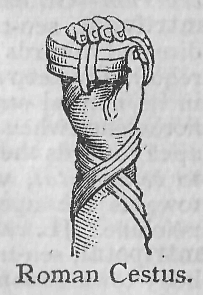
Cestus, ses′tus, n. the girdle of Venus, which had power to awaken love: an ancient boxing-glove loaded with lead or iron. [L.—Gr. kestos, a girdle.]
Cesura. See Cæsura.
Cesure, sē′zūr, n. a breaking off: (Spens.) a cæsura.
Cetacea, se-tā′shi-a, n.pl. an order of mammals of aquatic habit and fish-like form, including the Toothed whales, or Odontoceti, and the Baleen whales, or Mystacoceti. To the former belong the Sperm whales, the Bottlenose, the genus Platanista and its allies, and the great family of Dolphins; to the latter, the Right Whale (Balæna), the Humpbacks, and the Rorquals.—n. Cetā′cean.—adj. Cetā′ceous.—n. Cetol′ogy, that part of zoology which treats of whales. [L.,—Gr. kētos, any sea-monster.]
Ceteosaurus, set-e-o-saw′rus, n. a large dinosaurian reptile belonging to the Jurassic system. [Gr. kētos, whale, sauros, lizard.]
Cevadilla, sev-a-dil′a, n. the dark acrid seeds of a Mexican bulbous plant of the lily family, yielding veratrin, formerly used as an anthelmintic: the plant itself.—Also Cebadill′a. [Sp.,—L. cibāre, to feed, cibus, food.]
Ceylonese, sē-lon-ēz′, adj. of or belonging to Ceylon.—n. a native of Ceylon.
Chablis, shab′lē, n. a celebrated white Burgundy wine made at Chablis, near Auxerre, in France.
Chabouk, tschä′bōōk, n. a Persian horsewhip. [Pers.]
Chace. See Chase (1).
Chack, chak, n. a snack or slight hasty meal. [Imit.]
Chacma, chak′ma, n. a South African baboon.
Chaco. Same as Shako.
Chaconne, shak-on′, n. an old dance, with slow movement, the music, a series of variations on a ground bass, mostly eight bars in length, appearing in sonatas as well as ballets. [Fr.,—Sp. chacona—Basque chucun, pretty.]
Chad, shad, n. a kind of fish. [See Shad.]
Chætodon, kē′to-don, n. a typical genus of a family of bony fishes, known as Squamipennes. [Gr. chaitē, hair, odous, odont-, tooth.]
Chætopod, kē′to-pod, n. a class of worms including familiar types like the Earthworm, the Fisherman's Lobworm, and the Sea-mouse—often included under the title of Annelids or ringed worms. [Gr. chaitē, hair, and pous, pod-, foot.]
Chafe, chāf, v.t. to make hot by rubbing: to fret or wear by rubbing: to cause to fret or rage (with against, at).—v.i. to fret or rage.—n. heat caused by rubbing: rage: passion.—ns. Chaf′er (obs.), a chafing-dish, a saucepan; Chaf′ing-dish, a dish or vessel in which anything is made hot: a kind of portable grate; Chaf′ing-gear, mats, spun-yarn, battens, &c., put upon the rigging and spars of a ship to prevent their being chafed. [Fr. chauffer—L. calefacĕre—calēre, to be hot, and facĕre, to make.]
Chafer, chāf′ėr, n. a kind of beetle, the cockchafer. [A.S. cefer; cog. with Dut. kever, Ger. käfer.]
Chaff, chaf, n. a general name for the husks of corn or other grain as threshed or winnowed: refuse, or worthless matter: light banter, badinage.—v.t. to banter, or tease, by some raillery.—ns. Chaff′-cut′ter, Chaff′-en′gine, a machine for cutting straw or hay into chaff.—n. and p.adj. Chaff′ing.—adv. Chaff′ingly.—adjs. Chaff′less; Chaff′y. [A.S. ceaf; cf. Dut. kaf.]
Chaffer, chaf′ėr, v.t. to buy.—v.i. to bargain: to haggle about the price.—ns. Chaff′erer, a haggler about the price; Chaff′ery, buying and selling: (Spens.) haggling. [M. E. chapfare, a bargain, from A.S. ceap, price, faru, way.]
Chaffinch, chaf′insh, n. a little song-bird of the finch family. [Said to delight in chaff. See Finch.]
Chaffron. See Chamfrain.
Chaft, chaft, n. (Scot. and Northern English) the jaw. [Ice. kjaptr; cf. Sw. käft, Dan. kieft.]
Chagan, kag-än′, n. an early form of Khan.
Chagrin, sha-grēn′, n. that which wears or gnaws the mind: vexation: annoyance.—v.t. to vex or annoy.—p.adj. Chagrined′. [Fr. chagrin, shagreen, rough skin, ill-humour.]
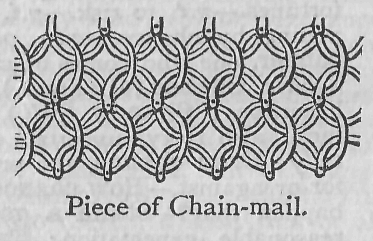
Chain, chān, n. a series of links or rings passing through one another: a number of things coming after each other: anything that binds: a connected course or train of events: in surveying, often called Gunter's chain, a measure of 100 links, 66 feet long (10 sq. chains make an acre): (pl.) fetters, bonds, confinement generally.—v.t. to fasten: to fetter: to restrain: (Shak.) to embrace.—ns. Chain′-arm′our, chain-mail; Chain′-bolt, a large bolt used to secure the chain-plates to the ship's side; Chain′-bridge, a bridge suspended on chains: a suspension-bridge; Chain′-cā′ble, a cable composed of iron links.—p.adj. Chained, bound or fastened, as with a chain: fitted with a chain.—n. Chain′-gang, a gang of convicts chained together.—adj. Chain′less, without chains: unfettered.—ns. Chain′let, a small chain; Chain′-mail, mail or armour made of iron links connected together, much used in Europe in the 12th and 13th centuries; Chain′-mould′ing, moulding in the form of a chain; Chain′-pier, a pier supported by chains like a chain-bridge.—n.pl. Chain′-plates, on shipboard, iron plates bolted below the channels to serve as attachments for the dead-eyes, through which the standing rigging or shrouds and back-stays are rove and secured.—ns. Chain′-pump, a pump consisting of buckets or plates fastened to an endless iron chain, and used for raising water; Chain′-rule, an arithmetical rule, so called from the terms of the problem being stated as equations, and connected, as if by a chain, so as to obtain by one operation the same result as would be obtained by a number of different operations in simple proportion: the rule for solving problems by compound proportion; Chain′-shot, two bullets or half-bullets fastened together by a chain, used formerly in naval engagements to destroy rigging, now replaced by case-shot and shrapnel-shell; Chain′-stitch, a peculiar kind of stitch resembling the links of a chain; Chain′-work, work consisting of threads, cords, &c., wrought with open spaces like the links of a chain: network. [Fr. chaine—L. catēna.]
Chair, chār, n. a movable seat for one, with a back to it: a covered vehicle for one person, as a sedan-chair: the seat or office of one in authority, as a judge, a bishop, or the person presiding over any meeting—hence 'to take the chair' = to assume the place of president; 'to address the chair' = to direct one's speech to the chairman; 'to support the chair' = to uphold the authority of the chairman—often, when endangered in a public meeting, asserted by cries of 'Chair!': the seat from which a professor delivers his lectures, the office or function of a professor—'socialists of the chair' = mere doctrinaire or theoretical advocates of socialism: cast-iron supports for rails under the permanent way in a railway, held by wooden wedges, and spiked on to transverse wooden sleepers.—v.t. to place in a seat of authority: to carry publicly in triumph.—n. Chair′-bed, a kind of chair capable of being turned into a bed.—n.pl. Chair′-days (Shak.), used figuratively to denote the evening of life.—ns. Chair′man, the man who takes the chair, or presides at an assembly or meeting: one who carries a sedan or Bath chair; Chair′manship; Chair′-or′gan, a corruption of choir-organ (q.v.); Chair′woman. [Fr. chaire—L.—Gr. kathedra.]
Chaise, shāz, n. a light open carriage for one or more persons: a travelling carriage (see Post-chaise).—adj. Chaise′less.—n. Chaise-longue, a couch. [Fr., a Parisian pronunciation of chaire. See Chair.]
Chal, chal, n. fellow: person:—fem. Chai. [Gipsy.]
Chalcedony, kal-sed′ō-ni, or kal′-, n. a beautiful mineral of the quartz family, consisting of quartz with some admixture of opal—it is generally translucent, has a somewhat waxy lustre, and is in colour generally white or bluish-white.—adj. Chalcedon′ic.—n. Chalced′onyx, an agate formed of a white opaque chalcedony alternating with a grayish translucent chalcedony. [Prob. from Chalcedon, in Asia Minor.]
Chalcography, kal-kog′ra-fi, n. the art of engraving on copper or brass.—ns. Chalcog′rapher, Chalcog′raphist. [Gr. chalkos, copper, graphein, to write.]
Chaldaic, kal-dā′ik, Chaldee, kal′dē, adj. relating to Chaldea.—n. the language of the Chaldeans.—n. Chal′dāism, a Chaldaic idiom.—adj. Chaldē′an, Chaldaic.—n. a native of Chaldea.
Chalder, chawl′dėr, n. an old Scotch dry measure, containing 16 bolls. [Prob. a form of Chaldron.]
Chaldron, chawl′drun, n. an old coal-measure, holding 36 heaped bushels (= 25½ cwt.). [Fr. chaudron. See Cauldron.]
Chalet, sha-lā′, n. a summer hut used by Swiss herdsmen among the Alps: a urinal. [Fr.]
Chalice, chal′is, n. a cup or bowl: a communion-cup.—adj. Chal′iced, cup-like. [Fr. calice—L. calix, calicis; Gr. kylix, a cup. Calyx is a different word, but from the same root.]
Chalk, chawk, n. the well-known white substance, a carbonate of lime.—v.t. to rub or manure with chalk.—v.i. to mark with chalk: in a tavern, to write the score with chalk.—ns. Chalk′iness; Chalk′-pit, a pit in which chalk is dug; Chalk′-stone, a stone or piece of chalk: (pl.) the white concretions formed round the joints in chronic gout.—adj. Chalk′y.—Chalk for cheese, a small price for a good article.—Chalking the door, in Scotland, a form of warning tenants to remove from burghal tenements.—Chalk out, to trace out, as with chalk, to plan.—By a long chalk, by a considerable distance, referring to the habit of scoring with chalk. [A.S. cealc, like Fr. chaux, is from L. calx, limestone.]
Challenge, chal′enj, v.t. to call on one to settle a matter by fighting or by any kind of contest: to claim as one's own: to accuse; to object to.—n. a summons to a contest of any kind, but esp. a duel: a calling of any one or anything in question: exception to a juror: the demand of a sentry.—adj. Chall′engeable, that may be challenged.—n. Chall′enger, one who challenges to a combat of any kind: a claimant: one who objects, calls in question. [O. Fr. chalenge, a dispute, a claim—L. calumnia, a false accusation—calvi, calvĕre, to deceive.]
Challis, shal′is, or shal′i, n. a fine fabric of silk and worsted used for ladies' dresses. [Fr.]
Chalumeau, shal-ū-mō′, n. a musical instrument: a shepherd's pipe. [Fr.,—O. Fr. chalemel—Low L. calamellus, dim. of calamus, a pipe, a reed.]
Chalybean, ka-lib′ē-an, adj. (Milton) forged by the Chalybes: well tempered.—adj. Chalyb′eāte, containing iron.—n. a water or other liquor containing iron. [Gr. chalyps, chalybos, steel, so called from the Chalybes, a nation in Pontus famous for steel.]
Chalybite, kal′i-bīt, n. native iron protocarbonate—siderite.
Cham, kam, n. an obsolete form of Khan.
Chamade, sham′ad, n. a signal inviting a parley. [Fr.]
Chamber, chām′bėr, n. an apartment: the place where an assembly meets: an assembly or body of men met for some purpose, as a chamber of commerce: a hall of justice: a compartment: a cavity: the back end of the bore of a gun.—v.t. to put in a chamber: to confine.—v.i. to be wanton.—ns. Cham′ber-coun′cil (Shak.), a private or secret council; Cham′ber-coun′sel, -coun′sellor, a counsel who gives his advice privately, but does not plead in court.—adj. Cham′bered.—ns. Cham′berer, a man of intrigue: (Shak.) a gallant; Cham′ber-fell′ow, one occupying the same chamber.—n.pl. Cham′ber-hang′ings (Shak.), the hangings or tapestry of a chamber.—ns. Cham′bering (B.), lewd behaviour; Cham′ber-lye (Shak.), urine; Cham′ber-maid, a female servant who has the care of bedrooms; Cham′ber-pot, a necessary bedroom vessel—often merely Cham′ber; Cham′ber-prac′tice, the business of a chamber-counsellor (q.v.). [Fr. chambre—L. camera—Gr. kamara, a vault, a room.]
Chamberlain, chām′bėr-lān, or -lin, n. an officer appointed by a king or nobleman, or by a corporation, to perform domestic and ceremonial duties.—n. Cham′berlainship.—Lord Chamberlain, an officer of high standing in the royal household, having control over all the officers and servants 'above stairs,' except those of the bedchamber, over the establishment attached to the Chapel Royal, the physicians, surgeons, and apothecaries of the household; Lord Great Chamberlain, a hereditary officer who has the government of the palace of Westminster, and upon solemn occasions the keys of Westminster Hall and of the Court of Requests are delivered to him. [O. Fr. chambrelenc; Old Ger. chamerling—L. camera, a chamber, and affix -ling or -lenc = Eng. -ling in hireling.]
Chambertin, shang′bert-ang, n. a famous red Burgundy from the vineyard of that name near Dijon, in France.
Chameleon, ka-mēl′yun, n. a small lizard famous for changing its colour: (fig.) an inconstant person.—adjs. Chamel′eonic, Chamel′eon-like. [L. chamæleon—Gr. chamaileōn—chamai (= L. humi), on the ground, dwarf, and leōn, a lion.]
Chamelot, kam′e-lot, n. (Spens.). Camlet.
Chamfer, cham′fėr, n. a bevel or slope made by paring off the edge of anything originally right-angled, either in wood or stone work: a groove, channel, or furrow.—v.t. to cut or grind off bevel-wise, as a corner: to channel or make furrows upon; to flute, as a column.—adj. Cham′fered, furrowed, grooved, wrinkled. [Fr. chanfrein—O. Fr. chanfraindre, which acc. to Dr Murray may be from chant fraindre—L. cantum frangĕre, to break the edge or side.]
Chamfrain, cham′fren, n. a piece of leather or plate of steel to protect the face of a horse in battle.—Also Cham′fron, Chaf′fron. [Fr. chanfrein; origin unknown.]
Chamlet, kam′let, n. Same as Camlet.
Chamois, sha′moi, sham′i, or sham′waw, n. a goat-like species or genus of antelope inhabiting the Alps and other high mountains of southern and central Europe: a soft kind of leather originally made from its skin. [Fr.,—Teut.; cf. mod. Ger. gemse, a chamois.]
Chamomile. See Camomile.
Champ, champ, v.i. to make a snapping noise with the jaws in chewing.—v.t. to bite or chew: to crush: to mash.—n. champing.—n. Champ′ing, the action of the verb champ: mashing. [Older form cham, most prob. from Scand.]
Champac, cham′pak, n. an Indian tree of great beauty, much venerated by Brahminists and Buddhists.—Also Cham′pak. [Hind.]
Champagne, sham-pān′, n. a light sparkling wine from Champagne in France. Still or non-effervescent champagne is also made.
Champaign, sham-pān′, adj. level, open.—n. an open, level country.—n. Champ (her.), the field of a shield.—The Champagne, level land. [A doublet of Campaign, from O. Fr. champaigne—L. campania, a plain.]
Champerty, sham′pėr-ti, n. an illegal bargain whereby the one party is to assist the other in recovering property, and is to share in the proceeds.—n. Cham′part, the division of the produce of land, the right of the feudal lord. [Norm. Fr.—L. campi pars, part of the field.]
Champignon, sham-pin′yon, n. a mushroom, esp. the Fairy-ring Agaric. [Fr.]
Champion, cham′pi-un, n. one who fights in single combat for himself or for another: one who defends a cause: a successful combatant: in boxing, running, &c., one who has excelled all others: a hero:—fem. Cham′pioness.—adj. acting as champion, first: first-class.—v.t. (obs.) to challenge: to defend: to support.—n. Cham′pionship. [Fr.,—Low L. campio, campion-em—L. campus, a plain, a place for games.]
Chance, chans, n. that which falls out or happens: an unexpected event: risk: opportunity: possibility of something happening: probability: (pl.) misfortunes.—v.t. to risk.—v.i. to happen.—adj. happening by chance.—adv. perchance.—n. Chance′-com′er, one who comes by chance or unexpectedly.—adjs. Chance′ful (Spens.), full of risk or danger, hazardous; Chanc′y (coll.), lucky, bringing good luck: also risky, uncertain.—By chance, accidentally; Even chance, the probability being equally for or against.—How chance? (Shak.) how does it happen that?—Stand a good chance, to have a reasonable expectation; Take one's chance, to accept what happens: to risk an undertaking; The main chance, the chief object (often used of matrimony): what is most important. [O. Fr. cheance—Low L. cadentia—L. cadĕre, to fall.]
Chancel, chan′sel, n. the eastern part of a church, originally separated from the nave by a screen of lattice-work, so as to prevent general access thereto, though not to interrupt either sight or sound. [O. Fr.,—L. cancelli, lattices.]
Chancellor, chan′sel-or, n. (Shak.) secretary: the president of a court of chancery or other court: the official who keeps the registers of an order of knighthood: the titular head of a university: (Scot.) the foreman of a jury.—ns. Chan′cellorship; Chan′cellory.—Chancellor of a cathedral, an officer who formerly had charge of the chapter library, custody of the common seal, superintendence of the choir practices, and headship of the cathedral schools; Chancellor of a diocese, an ecclesiastical judge uniting the functions of vicar-general and official principal, appointed to assist the bishop in questions of ecclesiastical law, and hold his courts for him; Chancellor of the Exchequer, the chief minister of finance in the British government; Lord Chancellor, Lord High Chancellor, the presiding judge of the Court of Chancery, the keeper of the great seal, and the first lay person of the state after the blood-royal. [Fr. chancelier—Low L. cancellarius, orig. an officer that had charge of records, and stood near the cancelli (L.), the crossbars that surrounded the judgment-seat.]
Chance-medley, chans′-med-li, n. homicide justifiable because done in the hot blood caused by an unprovoked assault—the word has no reference to homicide by accident: inadvertency. [O. Fr. chance medlée, mingled chance. 'From the fact that medley is also a noun, and chance-medley a possible combination in the sense of "fortuitous medley," the meaning has often been mistaken' (Dr Murray).]
Chancery, chan′sėr-i, n. formerly the highest court of justice next to the House of Lords, presided over by the Lord High Chancellor—now a division of the High Court of Justice: a court of record generally: (slang) the position of a boxer's head when under his adversary's arm: (obs.) the office of a chancellor or ambassador.—Chancery office, in Scotland, an office in the General Register House at Edinburgh, managed by a director, in which all royal charters of novodamus, patents of dignities, gifts of offices, remissions, legitimations, presentations, commissions, and other writs appointed to pass the Great and Quarter Seals are recorded.—In Chancery, in litigation, as an estate: (slang) in an awkward predicament. [Fr. chancellerie.]
Chancre, shang′kėr, n. an ulcer arising from the direct application of syphilitic poison.—adjs. Chan′croid, Chan′crous. [Fr.; a form of Canker.]
Chandelier, shan-de-lēr′, n. a frame with branches for holding lights.—ns. Chand′ler, originally a candle maker and dealer: a dealer generally; Chand′lering.—adv. Chand′lerly.—ns. Chand′lery, goods sold by a chandler; Ship′-chand′ler, dealer in general stores for ships. [Fr.,—Low L. candelaria, a candlestick—L. candēla, a candle.]
Change, chānj, v.t. to alter or make different: to put or give for another: to make to pass from one state to another: to exchange.—v.i. to suffer change: to change one's clothes.—n. the act of changing: alteration or variation of any kind: (Shak.) exchange: (Shak.) fickleness: a shift: variety: small coin: also used as a short term for the Exchange.—ns. Changeabil′ity, Change′ableness, fickleness: power of being changed.—adj. Change′able, subject or prone to change: fickle: inconstant.—adv. Change′ably.—adj. Change′ful, full of change: changeable.—adv. Change′fully.—ns. Change′fulness; Change′-house (Scot.), a small inn or alehouse.—adj. Change′less, without change: constant.—ns. Change′ling, a child taken or left by the fairies in place of another—usually an under-sized, crabbed child: one apt to change; Chang′er, one who changes the form of anything: one employed in changing or discounting money; Chang′ing-piece (Shak.), a fickle person.—Change colour, to blush or turn pale; Change one's mind, to form a different opinion; Change one's self, to change one's clothes; Change one's tune, to change from joy to sorrow: to change one's manner of speaking.—Put the change on, to delude, trick.—Ring the changes, to go through the various changes in ringing a peal of bells: to go over in every possible order: to pass counterfeit money: to bemuddle a shopman into giving too much change. [Fr. changer—Late L. cambiāre—L. cambīre, to barter.]
Chank, changk, Chank-shell, changk′-shel, n. the popular name of the shell of several species of Turbinella, a genus of Gasteropod molluscs, natives of the East Indian seas, used as ornaments by Hindu women. [Hind. cantch.]
Channel, chan′el, n. the bed of a stream of water: the deeper part of a strait, bay, or harbour: a strait or narrow sea: a groove or furrow: means of passing or conveying: (Scot.) gravel.—v.t. to make a channel: to furrow: to convey.—p.adj. Chann′elled.—The Channel, the English Channel. [O. Fr. chanel, canel—L. canalis, a canal.]
Channel, chan′el, n. a flat piece of wood or iron projecting horizontally from a ship's side to spread the shrouds and keep them clear of the bulwarks—fore, main, and mizzen channels. [Corr. of Chain-wale. Cf. Gunnel.]
Chanson, shan′son, n. a song.—n. Chan′sonette. [Fr.]
Chant, chant, v.t. to sing: to celebrate in song: to recite in a singing manner: to sell horses fraudulently.—n. song: melody: a kind of sacred music, in which prose is sung.—ns. Chant′er, Chant′or, a singer: a precentor: in a bagpipe, the pipe with finger-holes, on which the melody is played: one who cries up horses; Chant′ress; Chant′ry, an endowment, or chapel, for the chanting of masses; Chant′y, a sailor's song, usually with a drawling refrain, sung in concert while raising the anchor, &c. [Fr. chanter—L. cantāre, canĕre, to sing.]
Chantage, shan-täj′, chant′āj, n. extortion of money by threats of scandalous revelations. [Fr.]
Chanterelle, shan-ter-el′, n. the highest string of the violin, &c.: a yellowish edible mushroom. [Fr.]
Chanticleer, chant′i-klēr, n. a cock. [From the name of the cock in the old beast-epic of Reynard the Fox.] [O. Fr. chanter, to sing, cler, clear.]
Chaos, kā′os, n. shapeless mass: disorder: the state of matter before it was reduced to order by the Creator.—adj. Chaot′ic, confused.—adv. Chaot′ically. [Gr.]
Chap, chap, v.i. to crack: to strike, of a clock, &c.: to knock at a door.—v.t. to fissure.—n. crack: an open fissure in the skin, caused by exposure to frost: a knock.—adj. Chap′less.—p.adj. Chapped, cracked, of a heavy soil in dry weather, or of the skin in frost: cut short.—adj. Chap′py. [M. E. chappen; cog. with Dut. and Ger. kappen.]
Chap, chap, n. a fellow, originally a customer, from Chapman.—n. Chap′pie, a familiar diminutive.
Chap, chap, n. generally pl. the jaws.—adj. Chap′fall′en, a variant of Chop-fallen (q.v.). [Northern Eng. and Scot. chafts—Scand., as Ice. kjaptr, the jaw.]
Chaparral, chap-a-ral′, n. dense tangled brushwood. [Sp., prob. Basque achaparra.]
Chap-book. See Chapman.
Chape, chāp, n. the plate of metal at the point of a scabbard: the catch or hook by which the sheath of a weapon was attached to the belt.—adj. Chape′less. [Fr.,—Low L. capa, a cap.]
Chapeau, sha-pō′, n. a hat. [Fr.]
Chapel, chap′el, n. a place of worship inferior or subordinate to a regular church, or attached to a palace, garrison, prison, school, college, &c.: an oratory in a mausoleum, &c., or a cell of a church containing its own altar: a dissenters' place of worship, as of Nonconformists in England, Roman Catholics or Episcopalians in Scotland, &c.: a chapel service—hence 'to keep one's chapels'—to make the requisite number of attendances at such: an association of workmen in a printing-office.—n. Chap′elry, the jurisdiction of a chapel.—Chapel cart (see Cart).—Chapel of ease, a chapel for worshippers far from the parish church; Chapel Royal, the oratory of a royal palace; Lady chapel, such a chapel dedicated to the Virgin; Proprietary chapel, one that is the property of a private person or persons. [O. Fr. capele—Low L. cappella, dim. of cappa, a cloak or cope; orig. from the cloak of St Martin.]
Chaperon, shap′e-rōn, n. a kind of hood or cap: one who attends a lady in public places as a protector.—v.t. to attend a lady to public places.—n. Chap′eronage. [Fr., a large hood—chape, a hooded cloak—Low L. cappa. See Cape.]
Chapiter, chap′i-tėr, n. the head or capital of a column. [Fr. chapitel—Low L. capitellum, dim. of L. caput, the head.]
Chaplain, chap′lān, or chap′lin, n. a clergyman attached to a ship of war, a regiment, a public institution, or private family.—ns. Chap′laincy, Chap′lainry, Chap′lainship. [O. Fr. chapelain—Low L. capellanus—capella. See Chapel.]
Chaplet, chap′let, n. a garland or wreath for the head: a circlet of gold, &c.: a string of beads used in counting prayers, one-third of a rosary in length: anything in a string: a metal support of a cylindrical pipe.—adj. Chap′leted. [O. Fr. chapelet—chape, a head-dress.]
Chapman, chap′man, n. one who buys or sells: an itinerant dealer, a pedlar: (obs.) a purchaser.—n. Chap′-book, a name given to the books which were formerly sold by chapmen. [A.S. céap-man—céap, trade, and mann, man; cf. Ger. kaufmann, and see Cheap.]
Chapter, chap′tėr, n. a main division of a book, or of anything: a subject or category generally: an assembly of the canons of a cathedral or collegiate church, or the members of a religious or military order: an organised branch of some society or fraternity.—v.t. to put into chapters: to take to task.—n. Chap′ter-house.—Chapter-and-verse, the exact reference to the passage of the authority for one's statements.—The chapter of accidents, the catalogue of unforeseen events.—To the end of the chapter, throughout the whole subject. [O. Fr. chapitre—L. capitulum, dim. of caput, the head. From the practice of reading to the assembled canons or monks a capitulum or chapter of their rule, or of the Scriptures, the men themselves came to be called in a body the capitulum or chapter, and their meeting-place the chapter-house.]
Chaptrel, chap′trel, n. the capital of a pillar which supports an arch. [Dim. of Chapiter.]
Char, chär, n. a small fish of the salmon kind, found in mountain lakes and rivers. [Prob. Celt.; cf. Gael, ceara, red, blood-coloured.]
Char, chär, v.t. to roast or burn until reduced to carbon or coal, to scorch:—pr.p. char′ring; pa.p. charred.—adj. Char′ry, pertaining to charcoal. [Prob. formed from char-coal.]
Char. See Chare.
Char-à-banc, shar′-a-bang, n. a long light vehicle with transverse seats. [Fr.]
Character, kar′ak-tėr, n. a letter, sign, figure, stamp, or distinctive mark: a mark of any kind, a symbol in writing, &c.: writing generally, handwriting: a secret cipher: any essential feature or peculiarity: nature: (obs.) personal appearance: the aggregate of peculiar qualities which constitutes personal or national individuality: moral qualities especially, the reputation of possessing such: a formal statement of the qualities of a person who has been in one's service or employment: official position, rank, or status, or a person who has filled such: a person noted for eccentricity: a personality as created in a play or novel (Shak. Char′act).—v.t. to engrave, imprint, write: to represent, delineate, or describe.—n. Characterisā′tion.—v.t. Char′acterise, to describe by peculiar qualities: to distinguish or designate.—ns. Char′acterism; Characteris′tic, that which marks or constitutes the character.—adjs. Characteris′tic, -al, marking or constituting the peculiar nature.—adv. Characteris′tically.—adj. Char′acterless, without character or distinctive qualities.—ns. Char′acterlessness; Char′actery, writing: impression: that which is charactered.—In character, in harmony with the part assumed, appropriate, as a Character actor, one who tries to represent eccentricities. [Fr. caractère—L. character—Gr. charaktēr, from charass-ein, to cut, engrave.]
Charade, shar-äd′, n. a species of riddle, the subject of which is a word proposed for solution from an enigmatical description of its component syllables and of the whole—the charade is often acted. [Fr.; ety. dub. Littré gives Prov. charrada, chatter; Prof. Skeat quotes Sp. charrada, the speech of a clown.]
Charcoal, chär′kōl, n. charred wood or coal made by charring wood; the carbonaceous residue of vegetable, animal, or mineral substances when they have undergone smothered combustion. [The first element of the word is of doubtful origin.]
Chare, chār, Char, chär, n. an occasional piece of work, an odd job: (pl.) household work—in America usually Chore.—v.i. to do odd jobs of work: to do house-cleaning.—n. Char′woman, a woman hired by the day to do odd jobs of domestic work. [A.S. cerran, cierran, to turn.]
Charet, chär′et, n. (Spens.) same as Chariot.
Charge, chärj, v.t. to load, to put into, to fill (with): to load heavily, burden: to fill completely: to cause to receive electricity: to lay a task upon one, to enjoin, command: to deliver officially an injunction, as a judge to a jury, a bishop or archdeacon to his clergy, or a senior to a junior minister at a Presbyterian ordination: to bring an accusation against: to exact a sum of money from, to ask as the price.—v.i. to make an onset.—n. that which is laid on: cost or price: the load of powder, &c., for a gun: attack or onset: care, custody: the object of care, esp. a minister of religion's flock or parish: an accumulation of electricity in a Leyden jar: command: exhortation: accusation: (pl.) expenses.—adj. Charge′able, liable to be charged, imputable: blamable: (B.) burdensome.—n. Charge′ableness.—adv. Charge′ably.—adj. Charge′ful (Shak.), expensive.—n. Charge′-house (Shak.), a common school where a fee was charged, in distinction to a free-school.—adj. Charge′less.—n. Charg′er, a flat dish capable of holding a large joint, a platter: a war-horse.—Give in charge, to hand over to the police. [Fr. charger—Low L. carricāre, to load—L. carrus, a wagon. See Car, Cargo.]
Chargé-d'affaires, shar′zhā-da-fār′, n. a fourth-class diplomatic agent, accredited, not to the sovereign, but to the department for foreign affairs—he also holds his credentials only from the minister: the person in charge for the time. [Fr.]
Charily, Chariness. See Chary.
Chariot, char′i-ot, n. a four-wheeled pleasure or state carriage: a car used in ancient warfare: a light four-wheeled carriage with back-seats.—v.t. to carry in a chariot.—v.i. to ride in a chariot.—n. Charioteer′, one who drives a chariot.—v.t. and v.i. to drive or to ride in such. [Fr., dim. of char, a Car.]
Charism, kar′izm, n. a free gift of grace.—adj. Charismat′ic. [Gr. charisma—charis, grace.]
Charity, char′i-ti, n. (N.T.) universal love: the disposition to think favourably of others, and do them good: almsgiving: (pl.) affections.—adj. Char′itable, of or relating to charity: liberal to the poor.—n. Char′itableness.—adv. Char′itably.—Cold as charity, an ironical phrase implying the coldness of much so-called charity, which should naturally be warm. [Fr. charité—L. caritat-em, carus, dear.]
Charivari, shär′i-vär′i, n. a French term used to designate a wild tumult and uproar, produced by the beating of pans, kettles, and dishes, mingled with whistling, bawling, groans, and hisses, expressive of displeasure against an individual—the 'rough music' not unknown in England as a popular protest against an unequal marriage, or the like. [Ety. dub.; the word, as suggesting derision, has been adopted as a name by satirical journals.]
Chark, chärk, v.t. to burn to charcoal.—n. charcoal, coke.
Charlatan, shär′la-tan, n. a mere talking pretender: a quack.—adj. Charlatan′ic.—ns. Char′latanism, Char′latanry. [Fr.,—It. ciarlatano—ciarlare, to chatter, an imit. word.]
Charles's Wain, n. a name given to the seven bright stars in Ursa Major, the Plough. [A.S. Carles wægn, Carl being Charlemagne.]
Charley, Charlie, chär′li, n. a night-watchman: the small triangular beard familiar in the portraits of Charles I.: the fox.—n. Char′ley-pitch′er (slang), one who makes a living by the thimble-and-pea trick.
Charlock, chär′lok, n. a plant of the mustard family, with yellow flowers, that grows as a weed in cornfields. [A.S. cerlic.]
Charlotte, shär′lot, n. a dish of apple marmalade covered with crumbs of toast.—Charlotte russe, a custard enclosed in a kind of sponge-cake.
Charm, chärm, n. a spell: something thought to possess occult power, a metrical form of words: attractiveness: a trinket worn on a watch-guard: the blended singing of birds, children, &c.: (pl.) female beauty or other personal attractions: that which can please irresistibly.—v.t. to influence by a charm: to subdue by secret influence: to enchant: to delight, to allure.—adj. Charmed, protected, as by a special charm.—n. Charm′er.—adj. Charm′ful, abounding with charms.—p.adj. Charm′ing, highly pleasing: delightful: fascinating.—adv. Charm′ingly.—adj. Charm′less, wanting or destitute of charms. [Fr. charme—L. carmen, a song.]
Charneco, chär′ne-ko, n. (Shak.) a kind of sweet wine. [Prob. from the name of a village near Lisbon.]
Charnel, chär′nel, adj. of, or pertaining to, a charnel or burial-place, as in 'charnel-vault,' &c.: sepulchral, death-like.—n. Char′nel-house, a place where the bones of the dead are deposited. [O. Fr. charnel—Low L. carnāle—L. carnalis, caro, carnis, flesh.]
Charon, kā′ron, n. in Greek mythology, the ferryman who rowed the shades of the dead across the river Styx in the lower world: a ferryman generally. [Gr.]
Charpie, shär′pē, n. lint shredded down so as to form a soft material for dressing wounds. [O. Fr. charpir—L. carpĕre, to pluck.]
Charpoy, char′poi, n. the common Indian bedstead, sometimes handsomely wrought and painted. [Hind. chaārpāī—Pers. chihār-pāī, four feet.]
Charqui, chär′kē, n. beef cut into long strips and dried in the sun—jerked beef. [Peruv.]
Charr. Same as Char (1).
Chart, chärt, n. a marine or hydrographical map, exhibiting a portion of a sea or other water, with the islands, coasts of contiguous land, soundings, currents, &c: an outline-map, or a tabular statement giving information of any kind.—adjs. Chartā′ceous; Chart′less. [O. Fr. charte—L. charta, a paper.]
Charter, chärt′er, n. any formal writing in evidence of a grant, contract, or other transaction, conferring or confirming titles, rights, or privileges, or the like: the formal deed by which a sovereign guarantees the rights and privileges of his subjects, like the famous Mag′na Chart′a, signed by King John at Runnymede, 15th June 1215, or the Charte of Louis XVIII. at the Restoration in 1814, or that sworn by Louis-Philippe, 29th August 1830: any instrument by which powers and privileges are conferred by the state on a select body of persons for a special object, as the 'charter of a bank:' a patent: grant, allowance: immunity.—v.t. to establish by charter: to let or hire, as a ship, on contract.—p.adj. Chart′ered, granted or protected by a charter: privileged: licensed: hired by contract. [O. Fr. chartre—L. cartula, carta.]
Charterhouse, chärt′ėr-hows, n. a Carthusian monastery: the famous hospital and school instituted in London in 1611, on the site of a Carthusian monastery—now transferred—the 'masterpiece of Protestant English charity' in Fuller's phrase.—ns. Char′treuse, a Carthusian monastery, esp. the original one, the Grande Chartreuse near Grenoble in France: a famous liqueur, green, yellow, or white, long manufactured here by the monks from aromatic herbs and brandy: a kind of enamelled pottery: a pale greenish colour; Char′treux, a Carthusian: the Charterhouse School.
Charter-party, chärt′ėr-pär′ti, n. the common written form in which the contract of affreightment is expressed—viz. the hiring of the whole or part of a ship for the conveyance of goods. [Fr. charte-partie, lit. a divided charter, as the practice was to divide it in two and give a half to each person. L. charta partīta.]
Chartism, chärt′izm, n. a movement in Great Britain for the extension of political power to the working-classes, rising out of widespread national distress and popular disappointment with the results of the Reform Bill of 1832—its programme, the 'People's Charter,' drawn up in 1838, with six points: (1) Manhood Suffrage; (2) Equal Electoral Districts; (3) Vote by Ballot; (4) Annual Parliaments; (5) Abolition of Property Qualification; and (6) Payment of Members of the House of Commons.—n. Chart′ist, a supporter of chartism.
Chartography. See Cartography.
Chartreuse, Chartreux. See Charterhouse.
Chartulary. Same as Cartulary.
Charwoman. See Chare.
Chary, chār′i, adj. sparing: cautious.—adv. Char′ily.—n. Char′iness. [A.S. cearig—cearu, care.]
Charybdis, kar-ib′dis, n. a dangerous whirlpool between Italy and Sicily, and opposite to Scylla, the two together providing a proverbial alternative of ruin hardly to be escaped.
Chase, chās, v.t. to pursue: to hunt: to drive away, put to flight.—n. pursuit: a hunting: that which is hunted: ground abounding in game.—n. Chase′port, the porthole at the bow or stern of a vessel, through which the chase-gun is fired.—Beasts of chase, properly the buck, doe, fox, marten, and roe: wild beasts that are hunted generally.—Wild-goose chase, any foolish or profitless pursuit. [O. Fr. chacier, chasser—L. captāre, freq. of capĕre, to take.]
Chase, chās, v.t. to decorate metal-work, whether hammered or punched up, by engraving the exterior.—ns. Chas′er, one who practises chasing; Chas′ing, the art of representing figures in bas-relief by punching them out from behind, and then carving them on the front: the art of cutting the threads of screws. [Short for Enchase.]
Chase, chās, n. a case or frame for holding types: a groove. [Fr. châsse, a shrine, a setting—L. capsa, a chest. See Case.]
Chasericulture, chas-er-i-kul′tūr, n. the combined industries of tea-growing and of silk-production. [A combination of Chinese cha, tea, chasze, the former tea valuers of Canton, and L. sericum, silk.]
Chasm, kazm, n. a yawning or gaping hollow: a gap or opening: a void space.—adjs. Chasmed; Chasm′y. [Gr. chasma, from chain-ein, to gape; cf. Chaos.]
Chasse, shäs, n. a dram or liqueur taken after coffee, to remove the taste.—Also Chasse-café [Fr. chasse-café—chasser, to chase, remove.]
Chassé, shäs′ā, n. a kind of gliding step in dancing.—v.t. to make such a step: (slang) to dismiss. [Fr.]
Chassepot, shas′po, n. the kind of bolt-action breechloading rifle adopted by the French army in 1866. [From Antoine Alphonse Chassepot, the inventor.]
Chasseur, sha-sār′, n. a hunter or huntsman: one of a select body of French light troops, either infantry or cavalry; a domestic dressed in military garb in the houses of the great. [Fr. chasser, to hunt.]
Chaste, chāst, adj. modest; refined; virtuous: pure in taste and style.—adv. Chaste′ly.—ns. Chaste′ness, the quality of being chaste; Chas′tity, sexual purity: virginity: refinement of language: moderation. [O. Fr. chaste—L. castus, pure.]
Chasten, chās′n, v.t. to free from faults by punishing—hence to punish, to purify or refine: to restrain or moderate.—p.adj. Chas′tened, purified: modest.—n. Chas′tenment.
Chastise, chas-tīz′, v.t. to inflict punishment upon for the purpose of correction: to reduce to order or to obedience.—adj. Chastīs′able.—n. Chas′tisement.
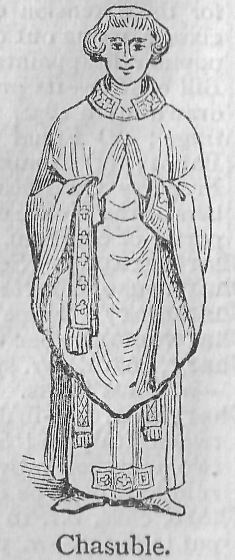
Chasuble, chaz′ū-bl, n. a sleeveless vestment worn over the alb by the priest while celebrating mass. [O. Fr. chesible—Low L. casubula—L. casula, a mantle, dim. of casa, a hut.]
Chat, chat, v.i. to talk idly or familiarly:—pr.p. chat′ting; pa.p. chat′ted.—n. familiar, idle talk.—n. Chat′tiness.—adj. Chat′ty, given to chat, talkative. [Short for Chatter.]
Chat, chat, n. a genus of small birds in the thrush family, of which the wheatear is a familiar example. [From the sound of their voice.]
Chateau, sha-tō′, n. a castle, a great country-seat, esp. in France (common in place-names, and connected with wines, as 'Château Lafitte,' 'Château Yqem,' &c.).—ns. Chatelain (shat′e-lān), a castellan; Chat′elaine, a female castellan: an ornamental appendage, suitable to a lady chatelaine, consisting of short chains bearing keys, corkscrew, scissors, &c., attached to the waist-belt: a similar thing in miniature attached to the watch-chain.—Château en Espagne, a castle in the air. [O. Fr. chastel (Fr. château)—L. castellum, dim. of castrum, a fort.]
Chaton, sha-tong′, n. the head of a ring. [Fr.]
Chatoyant, shat-oi′ant, adj. with a changing lustre, like a cat's eye in the dark. [Fr.]
Chatta, chät′a, n. an umbrella. [Hind.]
Chattel, chat′l, n. any kind of property which is not freehold, distinguished further into chattels-real and chattels-personal, the latter being mere personal movables—money, plate, cattle, and the like; the former including leasehold interests.—Goods and chattels, all corporeal movables. [O. Fr. chatel—Low L. captale—L. capitale, &c., property, goods.]
Chatter, chat′er, v.i. to talk idly or rapidly: to sound as the teeth when one shivers.—ns. Chatt′erbox, one who chatters or talks incessantly; Chatt′erer, one that chatters: an idle talker: a significant popular name applied to the birds of a small family of finch-like perching birds, as the Bohemian wax-wing and the cedar bird of America; Chatt′ering, noise like that made by a magpie, or by the striking together of the teeth: idle talk. [From the sound.]
Chatty, chat′i, n. an earthen water-pot in India. [Hind.]
Chaucerian, chä-sē′ri-an, adj. pertaining to Chaucer, or like him.—n. a devoted student of Chaucer.—n. Chau′cerism, anything characteristic of Chaucer.
Chaud-mellé, shōd-mā′lā, n. a fight arising in the heat of passion: the killing of a man in such a fight.—Also Chaud′-med′ley. [O. Fr. chaude-mellee, hot fight. See Mêlée.]
Chaufe, Chauff (Spens.). Forms of Chafe.
Chauffer, chaw′fėr, n. a metal box for holding fire, a portable furnace or stove. [See Chafer.]
Chauffeur, shōf-fėr, n. a motor-car attendant. [Fr.]
Chausses, shōs, or shō′sez, n.pl. any closely fitting covering for the legs, hose generally: the defence-pieces for the legs in ancient armour.—n. Chaussure′, a general name for boots and shoes. [O. Fr. chauces—L. calcias, pl. of calcia, hose.]
Chautauquan, sha-taw′kwan, adj. pertaining to a system of instruction for adults by home reading and study under guidance, evolved from the Chautauqua Literary and Scientific Circle, organised in 1878.
Chauvinism, shō′vin-izm, n. an absurdly extravagant pride in one's country, with a corresponding contempt for foreign nations—the French equivalent of the Jingoism of London music-halls.—ns. Chau′vin, Chau′vinist.—adj. Chauvinist′ic. [Fr. chauvinisme, from Chauvin, a figure in La Cocarde tricolore.]
Chavender, chav′en-der, n. the chub or cheven.
Chaw, chaw, n. (Spens.) the jaw—usually pl.—v.t. to chew, still used of tobacco.—n. Chaw′-bā′con, a country clown, a rustic fellow.—Chawed up, destroyed. [See Jaw.]
Chawdron, chaw′dron, n. (Shak.) part of the entrails of an animal. [O. Fr. chaudun.]
Chay, a vulgar form of Chaise.
Chaya-root. Same as Shaya-root.
Cheap, chēp, adj. low in price: of a place where prices are low, as 'a cheap market:' of a low price in relation to the value: easily obtained: of small value, or reckoned at such.—v.t. Cheap′en, to ask the price of a thing: to make cheap, to lower the price of: to lower the reputation of: to beat down the price of.—n. Cheap′ener.—adv. Cheap′ly.—n. Cheap′ness.—Cheap Jack, or John, a travelling hawker who pretends to give great bargains; Cheap labour, labour paid at a poor rate; Cheap trip, an excursion by rail or steamer at a reduced fare; Cheap-tripper, one who goes on such a trip.—Dirt cheap, ridiculously cheap.—On the cheap, cheap or cheaply.—To be cheap of anything (Scot.), to get off with less than one deserved or expected, as of punishment. [Orig. good cheap, i.e. a good bargain; A.S. ceap, price, a bargain; A.S. céapian, Ice. kaupa, Ger. kaufen, to buy; Scot. coup—all borrowed from L. caupo, a huckster.]
Cheat, chēt, v.t. to deceive, defraud, impose upon.—v.i. to practise deceit.—n. a fraud: one who cheats.—ns. Cheat′er, one who cheats: (Shak.) an officer who collected the fines to be paid into the Exchequer; Cheat′ery (coll.), cheating.—Put a cheat upon, to deceive.—Tame cheater, a decoy. [M. E. cheten, a form of escheten, to escheat.]
Check, chek, v.t. to bring to a stand: to restrain or hinder: to rebuke: to control an account, &c., by comparison with certified data, vouchers, &c.: to place in check at chess: to mark with a pattern of crossing lines.—n. a term in chess when one party obliges the other either to move or guard his king: anything that checks: a sudden stop, repulse, or rebuff: (B., Shak.) a rebuke: a mark put against items in a list: an order for money (usually written Cheque): any counter-register used as security, a counterfoil: a token, of printed paper or metal, given to a railroad passenger to make secure the after-identification of his luggage, to a person leaving his seat in a theatre with the intention of returning, &c.: (U.S.) a counter used in games at cards—hence 'to pass in one's checks' = to die: a pattern of cross lines forming small squares, as in a chessboard: any fabric woven with such a pattern.—adj. (her.) divided into small squares by transverse, perpendicular, and horizontal lines.—ns. Check′-clerk, a clerk who checks accounts, &c.; Check′er, one who hinders or rebukes; Check′er-board, a board on which checkers or draughts is played; Check′-key, a latch-key; Check′mate, in chess, a check given to the adversary's king when in a position in which it can neither be protected nor moved out of check, so that the game is finished: a complete check: defeat: overthrow.—v.t. in chess, to make a movement which ends the game: to defeat.—ns. Check′-rein, a coupling rein, a strap hindering the horse from lowering its head; Check′-string, a string by which the occupant of a carriage may attract the driver's notice; Check′-tak′er, the collector of admission tickets at a theatre, railway-train, &c.; Check′-weigh′er, one who on the part of the men checks the weight of coal sent up to the pit-mouth. [O. Fr. eschec, eschac (Low L. scaccus, scāchus, It. scacco, Sp. jaque, Ger. scach), through Ar. from Pers. shāh, king—Checkmate being O. Fr. eschec mat—Ar. shāh māt(a), 'the king is dead,' i.e. can make no further move.]
Checker. See Chequer.
Checker-berry, chek′ėr-beri, n. an American name for the winter-green (q.v.).
Checkers, chek′ėrz, n.pl. the game of draughts.
Checklaton, chek′la-ton, n. (Spens.) a cloth of gold or other rich material.—Also Cic′latoun. [O. Fr. ciclaton, from Ar., prob. from the same root as scarlet.]
Cheddar, ched′ar, n. an excellent kind of cheese first made in Somersetshire. [From the village of Cheddar in Somersetshire.]
Cheek, chēk, n. the side of the face below the eye, the fleshy lateral wall of the mouth: effrontery, impudence, as in 'to have the cheek' to do anything, 'to give cheek:' one of the side-posts of a door or window: the cheek-strap of a horse's bridle, the ring at the end of the bit: anything arranged in internal pairs.—v.t. to address insolently.—ns. Cheek′bone, the bone of the cheek; Cheek′-pouch, a dilatation of the skin of the cheek, forming a bag outside the teeth, as in monkeys, &c.; Cheek′-tooth, a molar tooth.—adj. Cheek′y, insolent, saucy.—Cheek by jowl, side by side.—To one's own cheek, for one's own private use. [A.S. céce, céace, the cheek, jaw; cf. Dut. kaak.]
Cheep, chēp, v.i. to chirp, as a young bird.—n. any similar sound. [From the sound, like Chirp.]
Cheer, chēr, n. disposition, frame of mind (with good, &c.): joy: a shout of approval or welcome: kind treatment: entertainment: fare, food.—v.t. to comfort: to encourage: to applaud: to inspirit—'to cheer up.'—v.i. in such phrases as 'How cheer'st thou?'—refl. as in 'Cheer thee.'—n. Cheer′er, one who, or that which, cheers.—adj. Cheer′ful, of good spirits: joyful: lively.—advs. Cheer′fully, Cheer′ily.—ns. Cheer′fulness; Cheer′iness; Cheer′ishness (Milton), cheerfulness.—adj. Cheer′less, without comfort: gloomy.—n. Cheer′lessness.—adj. Cheer′ly, cheerful.—adv. in a cheery manner: heartily.—adj. Cheer′y, cheerful: promoting cheerfulness. [O. Fr. chiere, the countenance—Low L. cara, the face.]
Cheese, chēz, n. a wholesome article of food, made into a round form, from the curd of milk coagulated by rennet, separated from the whey, and pressed into a hard mass.—ns. Cheese′-cake, a cake made of soft curds, sugar, and butter, or whipped egg and sugar; Cheese′-hop′per, the larva of a small fly, remarkable for its leaping power, found in cheese; Cheese′-mite, a very small insect which breeds in cheese; Cheese′-mong′er, a dealer in cheese; Cheese′-par′ing (Shak.), paring, or rind, of cheese.—adj. mean and parsimonious.—ns. Cheese′-press, a machine in which curds for cheese are pressed; Cheese′-renn′et, the plant Ladies' bed-straw, so called because used as rennet in curdling milk; Cheese′-vat, a vat or wooden case in which curds are pressed; Chees′iness.—adj. Chees′y, having the nature of cheese.—Cheese it (slang), stop, have done, run off.—Green Cheese, cheese not yet dried.—To make cheeses, to whirl round and then sink down suddenly so as to make the petticoats stand out like a cheese. [A.S. cése, cýse, curdled milk (Ger. käse)—L. caseus.]
Cheese, chēz, n. (slang) the correct thing, of excellent quality, [Colonel Yule explains it as Pers. and Hind. chīz, thing, the expression having formerly been common among young Anglo-Indians, e.g. 'These cheroots are the real chīz,' i.e. the real thing.]
Cheetah, chē′tah, n. an Eastern animal like the leopard, used in hunting. [Hind, chītā—Sans. chitraka, chitrakāya, having a speckled body.]
Chef, shef, n. a master-cook; a reliquary in the shape of a head.—adj. chief, as in Chef d'œuvre, masterpiece, [Fr. See Chief.]
Cheiromancy, kī′ro-man-si, n. the art of telling fortunes by the lineaments of the hand—also Cheiros′ophy.—adj. Cheirosoph′ical.—n. Cheiros′ophist, [Gr. cheir, the hand, manteia, prophecy.]
Cheiroptera, kī-rop′tėr-a, n.pl. the order of Bats.—adj. Cheirop′terous. [Gr. cheir, the hand, pteron, a wing.]
Cheirotherium, kī-ro-thēr′i-um, n. the name originally given to the Labyrinthodont, from its peculiar hand-like impressions in the Triassic rocks.—adj. Cheirothē′rian. [Gr. cheir, hand, thērion, beast.]
Chela, kē′la, n. the prehensile claw of a crab or scorpion.—adj. Chē′late.—n. Chē′lifer, the book-scorpion.—adjs. Chelif′erous; Chē′liform. [L.,—Gr. chēlē.]
Chela, chē′la, n. a novice in esoteric Buddhism.—n. Chē′laship. [Hind. chēlā, servant.]
Chelicera, kēl-is′er-a, n. a technical term, usually restricted to the biting organs which form the first pair of appendages in spiders, scorpions, and other Arachnida:—pl. Chelic′eræ (-rē). [Gr. chēlē, a crab's claw, keras, horn.]
Chelonia, ke-lō′ni-a, n. an order of vertebrate animals including the tortoise and turtle.—adj. and n. Chelō′nian. [Gr. chelōnē, a tortoise.]
Chemise, she-mēz′, n. a woman's shirt or sark, a smock or shift.—n. Chemisette′, a kind of bodice worn by women, the lace or muslin which fills up the open front of a woman's dress. [Fr. chemise—Low L. camisia, a nightgown, surplice.]
Chemistry, kem′is-tri, formerly Chym′istry, n. the science which treats of the properties of substances both elementary and compound, and of the laws of their combination and action one upon another.—adjs. Chem′ic, -al (Chem′ico-, in many compound words), Chemiat′ric (a Paracelsian term, Gr. chēmeia, chemistry, iatreia, medical treatment).—adv. Chem′ically.—n.pl. Chem′icals, substances which form the subject of chemical effects.—ns. Chem′ism, chemical action; Chem′ist, one skilled in chemistry, specially a druggist or apothecary.—Chemical affinity, the name given to the tendency to combine with one another which is exhibited by many substances, or to the force by which the substances constituting a compound are held together; Chemical notation, a method of expressing the composition of chemical substances and representing chemical changes, by certain known symbols and formulæ; Chemical works, manufactories where chemical processes are carried on for trade, as alkali works, &c. [From Alchemy (q.v.).]
Chemitype, kemi′-tīp, n. the chemical process for obtaining casts in relief from an engraving.—n. Chem′itypy.
Chemosh, kē′mosh, n. the national god of Moab: any false god.
Chenille, she-nēl′, n. a thick, velvety-looking cord of silk or wool (and so resembling a caterpillar), used in ornamental sewing and manufactured trimmings. [Fr. chenille, a caterpillar—L. canicula, a hairy little dog, canis, a dog.]
Cheque, Check, chek, n. a money order on a banker payable at demand.—ns. Cheque′-book, a book containing cheque forms given by a bank to its customers; Cheq′uer, Check′er, a chess-board: alternation of colours, as on a chess-board: (pl.) draughts: chess-men.—v.t. to mark in squares of different colours: to variegate: interrupt.—adjs. Cheq′uered, Check′ered, variegated, like a chess-board: varying in character.—ns. Cheq′uer-work, any pattern having alternating squares of different colours; Blank′-cheque, a cheque signed by the owner, but without having the amount to be drawn indicated; Cross′-cheque, an ordinary cheque with two transverse lines drawn across it, which have the effect of making it payable only through a banker. [See Check.]
Cherimoyer, cher-i-moi′er, n. a Peruvian fruit resembling the custard-apple.—Also Chirimoy′a.
Cherish, cher′ish, v.t. to protect and treat with affection: to nurture, nurse: to entertain in the mind.—n. Cher′ishment. [Fr. chérir, chérissant—cher, dear—L. carus.]
Cheroot, she-rōōt′, n. a cigar not pointed at either end. [Fr. cheroute, representing the Tamil name shuruttu, a roll (Colonel Yule).]
Cheroot. See Shaya-root.
Cherry, cher′i, n. a small bright-red stone-fruit: the tree that bears it.—adj. like a cherry in colour: ruddy.—ns. Cherr′y-brand′y, a pleasant liqueur made by steeping Morello cherries in brandy; Cherr′y-lau′rel, the common English name for the Cerasus Lauro-Cerasus of Asia Minor; Cherr′y-pepp′er, a West Indian species of Capsicum; Cherr′y-pie, a pie made of cherries; the common heliotrope; Cherr′y-pit, a game which consists in throwing cherry-stones into a small hole; Cherr′y-stone, the hard seed of the cherry. [A.S. ciris—L. cerasus—Gr. kerasos, a cherry-tree, said to be so named from Cerasus, a town in Pontus, from which the cherry was brought.]
Cherry, cher′i, v.t. (Spens.) to cheer.
Chersonese, ker′so-nēz, n. a peninsula, [Gr. cher-sonēsos—chersos, land, dry land, nēsos, an island.]
Chert, chėrt, n. a kind of quartz or flint: hornstone.—adj. Chert′y, like or containing chert. [Prob. Celt.; Ir. ceart, a pebble.]
Cherub, cher′ub, n. a winged creature with human face, represented as associated with Jehovah, esp. drawing his chariot-throne: a celestial spirit: a beautiful child:—pl. Cher′ubs, Cher′ubim, Cher′ubims.—adjs. Cheru′bic, -al, Cherubim′ic, angelic.—adv. Cheru′bically.—n. Cher′ubin (Shak.), a cherub. [Heb. k’rūb, pl. k’rūbīm.]
Cherup, cher′up, v.t. to urge on by chirruping.
Chervil, chėr′vil, n. an umbelliferous plant, cultivated as a pot-herb, and used in soups and for a garnish, &c., in the same manner as parsley. In Scotland the plant is commonly called Myrrh. [A.S. cerfille (Ger. kerbel)—L. cærefolium—Gr. chairephyllon.]
Chesil, chez′il, n. gravel: shingle: bran.—Also Chisel. [A.S. cisil.]
Chess, ches, n. a game of skill for two persons or parties, played with figures or 'pieces,' which are moved on a chequered board.—n. Chess′-board, the board on which chess is played.—n.pl. Chess′-men, pieces used in chess. [Fr. échecs; It. scacchi; Ger. schach. Orig. from Pers. sháh, a king.]
Chess, ches, n. one of the parallel planks of a pontoon-bridge—generally in pl.
Chessel, ches′el, n. a cheese mould or vat.
Chest, chest, n. a large strong box: the part of the body between the neck and the abdomen, the thorax.—adj. Chest′ed, having a chest: placed in a chest.—n. Chest′-note, in singing or speaking, a deep note, the lowest sound of the voice. [A.S. cyst; Scot. kist—L. cista—Gr. kistē.]
Chestnut, Chesnut, ches′nut, n. a nut or fruit enclosed in a prickly case: the tree that bears it: (slang) a stale joke or story.—adj. of a chestnut colour, reddish-brown. [O. Fr. chastaigne—L. castanea—Gr. kastanon, from Castana, in Pontus.]
Chetvert, chet′vert, n. a Russian dry measure, equal to 8 chevteriks.
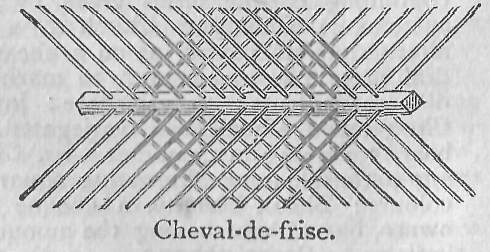
Cheval-de-frise, she-val′-de-frēz, n. a piece of timber armed with spikes, used to defend a passage or to stop cavalry:—pl. Chevaux-de-frise (she-vō′-).—n. Cheval′-glass, a large glass or mirror supported on a frame. [Fr.,—cheval, horse; Frise, Friesland.]
Chevalier, shev-a-lēr′, n. a cavalier: a knight: a gallant. [Fr.,—cheval—L. caballus, a horse.]
Chevelure, shev′e-lūr, n. a head of hair: a periwig: the nebulous part of a comet. [Fr.,—L. capillatura—capillus, hair.]
Cheven, chev′en, n. the chub.—Also Chev′in.
Cheverel, chev′ėr-el, n. a kid: soft, flexible leather made of kid-skin.—adj. like kid leather, pliable. [Fr. chevreau, a kid—chèvre; L. capra, a goat.]
Chevesaile, chev′e-sāl, n. an ornamental collar of a coat. [O. Fr. chevesaile—chevece, the neck.]
Cheviot, chē′vi-ot, or chev′i-ot, n. a hardy breed of short-wooled sheep reared on the Cheviot Hills: a cloth made from their wool.
Chevisance, shev′i-zäns, n. (Spens.) achievement, performance. [Fr.,—chevir, to accomplish; chef, the head, the end.]
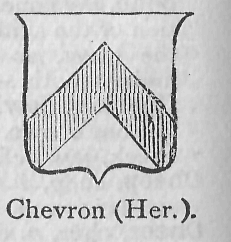
Chevron, shev′ron, n. a rafter: (her.) the representation of two rafters of a house meeting at the top: the V-shaped band of worsted braid or gold lace worn on the sleeve of a non-commissioned officer's coat.—adjs. Chevrone′, Chev′roned. [Fr. chevron (Sp. cabrio), a rafter—L. capreolus, dim. of caper, a goat.]
Chevy, chev′i, Chivy, chiv′i, n. a cry, shout: a hunt.—v.t. to chase. [Perh. from 'Chevy Chase,' a well-known ballad relating a Border battle.]
Chew, chōō, v.t. to cut and bruise with the teeth: to masticate: (fig.) to meditate, reflect.—n. action of chewing: a quid of tobacco.—ns. Chew′et, a kind of pie or pudding made of various ingredients mixed together; Chew′ing-gum, a preparation made from a gum called chicle, produced by a Mexican tree allied to the india-rubber tree, sweetened and flavoured.—Chew the cud, to masticate a second time food that has already been swallowed and passed into the first stomach: to ruminate in thought. [A.S. ceówan; Ger. kauen; cf. Jaw.]