LIST OF ABBREVIATIONS USED IN THIS DICTIONARY. (continued 15)
Reading edition
Corn, korn, n. a small hard growth chiefly on the toe or foot, resulting from an increase of thickness of the cuticle, caused by excessive pressure or friction on the part.—adj. Cor′neous, horny.—n. Corn′-plas′ter, a remedial plaster applied to a corn.—adj. Corn′y, of or pertaining to corns: horny.—Tread on one's corns, to injure one's feelings. [O. Fr.,—L. cornu, a horn.]
Cornage, korn′āj, n. an ancient tenure of land in the north country, the tenant being bound to blow a horn in case of a Scottish foray.
Cornea, kor′ne-a, n. the transparent horny membrane which forms the front covering of the eye.—adj. Cor′neal.
Cornel, kor′nel, n. the cornelian cherry or dogwood, a small tree native to southern Europe.—Also Cor′nel-tree, Cornē′lian-tree. [O. Fr. cornille—Low L. corniola, cornolium—L. cornus, cornel.]
Cornelian, kor-nē′li-an, n. a precious stone, a variety of chalcedony.—Also Carnē′lian (q.v.). [Fr. cornaline—L. cornu, a horn.]
Corner, kor′nėr, n. the point where two lines meet: a secret or confined place: an embarrassing position, difficulty: (obs.) a point in a rubber at whist: a free kick given to the opposite side when a player in football kicks the ball over his own goal-line: an operation by which the whole of a stock or commodity is bought up, so that speculative sellers are compelled to buy, to meet their engagements, at the corner-men's own price.—v.t. to supply with corners: to put in a corner: to put in a fix or difficulty.—adj. Cor′nered, having corners: put in a difficult position.—n. Cor′ner-stone, the stone which unites the two walls of a building at a corner: the principal stone, esp. the corner of the foundation of a building—hence (fig.) something of very great importance.—n.pl. Cor′ner-teeth, the lateral incisors of a horse, above and below.—adv. Cor′ner-wise, with the corner in front: diagonally.—Cut off a corner, to take a short cut; Done in a corner, done secretly: Drive into a corner, to put in a fix: to bring to bay; Keep a corner, to reserve a place; The Corner (slang), Tattersall's betting-rooms in London, till 1867 at Hyde Park Corner; Turn the corner, to go round the corner: to get past a difficulty; Within the four corners of, contained in (of a document, &c.). [O. Fr. corniere—L. cornu.]
Cornet, kor′net, n. a brass treble wind-instrument, with a cup mouthpiece—also Cor′net-à-pis′ton, -ons: formerly the lowest grade of commissioned officer in the cavalry—the office was abolished in 1871, sub-lieutenant being substituted.—ns. Cor′netcy, the commission or rank of a cornet; Cor′netist, Cor′nist, a solo cornet-player. [Fr. cornet, dim. of corne, a horn, trumpet. See Corn, lit. horn.]
Cornice, kor′nis, n. (classical archit.) the uppermost member of the entablature, surmounting the frieze: plaster mouldings round the ceiling of rooms at its junction with the walls.—v.t. to furnish with a cornice.—p.adj. Cor′niced.—ns. Cor′nice-hook, -pole, -rail, a hook, pole, rail, for hanging pictures, curtains, &c.—n. Cor′nice-ring, a ring or moulding on a cannon next below the muzzle-ring. [Fr.,—It., perh. Gr. korōnis, a curved line; cf. L. corona.]
Corniculate, kor-nik′ū-lāt, adj. horned: shaped like a horn.—n. Cor′nicle, a little horn or horn-like process.—adj. Cornif′ic, producing horn.—n. Cornificā′tion.—adjs. Cor′niform, in the form of a horn; Corni′gerous, bearing horns. [L. cornu, horn, forma, form, gerĕre, to bear.]
Cornish, korn′ish, adj. pertaining to Cornwall.—n. the people or dialect of Cornwall.—n. Corn′ishman.
Corno, kor′no, n. the French horn.—Corno di bassetto, the basset-horn: an organ-stop. [It.,—L. cornu, a horn.]
Cornopean, kor-nō′pe-an, n. Same as Cornet-à-piston. [See Cornet.]
Cornu, kor′nū, n. a horn (a horn-like part or process):—pl. Cor′nua.—adj. Cor′nual.—Cornu ammonis, the hippocampus major. [L.]
Cornubianite, kor-nū′bi-an-īt, n. a dark-blue laminated rock found in Cornwall with granite.
Cornucopia, kor-nū-kō′pi-a, n. the horn of plenty: according to the fable, the horn of the goat that suckled Jupiter, placed among the stars as an emblem of plenty.—adj. Cornucō′pian, plentiful. [L. cornu, and copia, plenty.]
Cornulites, kor-nū-lī′tez, n.pl. a genus of tubicolous annelids.
Cornute, kor-nūt′, v.t. (obs.) to make a cuckold.—adjs. Cornute′, -d, having horns.—n. Cornut′o (obs.), a cuckold. [L. cornutus, horned—cornu, horn.]
Corocore, kor′ō-kōr, n. a Malay form of boat.
Corody. See Corrody.
Corolla, kō-rol′a, n. the inner circle or whorl of the floral envelopes.—adjs. Corollā′ceous; Corollate, -d.—n. Cor′ollet, a floret of an aggregate flower.—adjs. Corollif′erous; Corolli′florous, Corolliflō′ral; Coroll′iform; Coroll′ine. [L. corolla, dim. of corona, a crown.]
Corollary, kor-ol′a-ri, or kor′ol-a-ri, n. an inference or deduction from recognised facts: a consequence or result. [L. corollarium, a garland—corolla.]
Corona, ko-rō′na, n. (archit.) the large, flat, projecting member of a cornice which crowns the entablature: (bot.) the crown-like appendage at the top of compound flowers: (astron.) the luminous circle or halo which surrounds the moon during a solar total eclipse: (anat.) a term used to signify the upper surface of certain parts of the body: a round pendent chandelier:—pl. usually Corō′næ.—n. Cor′onal, a crown or garland: the frontal bone of the skull.—adjs. Cor′onal, Cor′onary, pertaining to a crown, or to the top of the head; Cor′onāte, -d, crowned, applied to shells with a row of projections round the apex.—ns. Coronā′tion, the act of crowning a sovereign; Corō′nis, a sign (′) marking a crasis, as κἄν = καὶ ἄν; Cor′onule (bot.), an appendage like a small crown. [L. corona, a crown.]
Coronach, kor′o-nah, n. a funeral dirge or lamentation. [Ir. coranach, Gael. corranach.]
Coroner, kor′o-nėr, n. an officer whose duty is to hold inquest into the causes of accidental or suspicious deaths. [Late L. coronator—L. corona.]
Coronet, kor′o-net, n. a small crown inferior to the sovereign's, worn by the nobility: an ornamental head-dress: the part of a horse's pastern just above the coffin—also Cor′net.—adj. Cor′oneted. [O. Fr., dim. of corone, crown.]
Coronoid, kor′o-noid, or kor-ō′noid, adj. (anat.) resembling the beak of a crow, as the coronoid process of the lower jaw. [Gr. korōnē, a crow, eidos, form.]
Corozo, kor-ō′zo, n. a South American tree from whose seed is formed vegetable ivory.
Corporal, kor′po-ral, n. in the British army, the grade of non-commissioned officer next in rank to a sergeant; in the navy, a petty officer under a master-at-arms.—n. Cor′poralship. [Fr. caporal—It. caporale—capo, the head—L. caput, the head.]
Corporal, kor′po-ral, adj. belonging or relating to the body: having a body: not spiritual.—n. the cloth used in Catholic churches for covering the elements of the Eucharist—also Cor′porale, Cor′poras (obs.).—n. Corporal′ity, state of being corporal—opp. to Spirituality.—adv. Cor′porally.—adj. Cor′porate, legally united into a body so as to act as an individual: belonging to a corporation: united.—adv. Cor′porately.—ns. Cor′porateness; Corporā′tion, a body or society authorised by law to act as one individual: rotundity of figure, a pot-belly.—adj. Cor′porātive.—n. Cor′porātor, a member of a corporation.—adj. Corpō′real, having a body or substance; material.—v.i. and v.t. Corpō′realise.—ns. Corpō′realism, materialism; Corpō′realist, a materialist; Corporeal′ity.—adv. Corpō′really.—ns. Corporē′ity; Corporificā′tion, act of corporifying.—v.t. Corpor′ify, to embody: solidify.—Corporal punishment, punishment inflicted on the body, as flogging, &c.—Aggregate corporation, a corporation consisting of several persons; Sole corporation, a corporation which consists of one person and his successors. [L. corporalis—corpus, corpŏris, the body.]
Corposant, kor′po-zant, n. St Elmo's fire, a ball of fire sometimes seen about a ship during a storm. [Port.,—L. corpus sanctum, holy body.]
Corps, kōr, n. a division of an army forming a tactical unit—usually Corps d'armée, or army corps:—pl. Corps (kōrz).—Corps de ballet, the company of ballet dancers at a theatre; Corps de garde, the body of soldiers stationed on guard, their station, a guard-house; Corps diplomatique, the whole diplomatic staff at a particular capital. [Fr., from L. corpus.]
Corpse, korps, or kors, n. the dead body of a human being.—ns. Corpse′-can′dle, a light seen hovering over a grave—an omen of death; Corpse′-gate, the lichgate (see Lichgate). [M. E. corps, earlier cors—O. Fr. cors, the body—L. corpus.]
Corpus, kor′pus, n. a body: any special structure or function in the body; the whole body of literature on any subject.—ns. Cor′pulence, Cor′pulency, fleshiness of body; excessive fatness.—adj. Cor′pulent, fleshy or fat.—adv. Cor′pulently.—n. Cor′puscle, a minute particle; a physical atom—also Corpus′cule.—adjs. Corpus′cular, Corpusculā′rian, pertaining to corpuscles.—ns. Corpusculā′rian, one who holds the corpuscular philosophy; Corpuscular′ity.—Corpus Christi, the festival in honour of the Consecrated Host, held on the Thursday after the festival of the Trinity; Corpus delicti, a criminal law term in Scotland to signify the body or substance of the crime charged.—Corpuscular theory of light, or Emission theory (see Emit). [L. corpus, the body.]
Corradiate, kor-rād′ī-āt, v.i. to radiate together.—n. Corradiā′tion.
Corral, kor-al′, n. an enclosure for cattle, &c.—v.t. to form such. [Sp.]
Correct, kor-ekt′, v.t. to make right: to remove faults: to punish: to counterbalance: to bring into a normal state.—adj. made right or straight: free from faults: true.—adjs. Correct′able, Correct′ible.—adv. Correct′ly.—n. Correc′tion, amendment: punishment: bodily chastisement.—adjs. Correc′tional, Correct′ive, tending, or having the power, to correct.—ns. Correc′tioner (Shak.), one who administers correction; Correct′ive, that which corrects; Correct′ness; Correct′or, he who, or that which, corrects: a director or governor.—adj. Correct′ory, corrective.—Under correction, subject to correction—often used as a formal expression of deference to a superior authority. [L. corrigĕre, correctum—cor, inten., regĕre, to rule.]
Correg′idor, ko-rej′i-dōr, n. the chief magistrate of a Spanish town.
Correlate, kor′e-lāt, v.i. to be mutually related, as father and son.—n. Correlā′tion.—adj. Correl′ative, mutually or reciprocally related.—n. a person or thing correspondingly related to another person or thing.—adv. Correl′atively.—ns. Correl′ativeness, Correlativ′ity. [Coined from L. cor, with, and Relate.]
Correligionist. See Co-religionist.
Correption, kor-ep′shun, n. shortening in pronunciation: (obs.) reproof.
Correspond, kor-e-spond′, v.i. to answer, suit, agree (with to, with): to hold intercourse, esp. by sending and receiving letters.—ns. Correspond′ence, Correspond′ency, suitableness, harmony, relation of agreement: friendly intercourse: communication by means of letters: letters which pass between correspondents.—adj. Correspond′ent, agreeing with: suitable.—n. one with whom intercourse is kept up by letters: one who contributes letters to a journal.—adv. Correspond′ently.—adj. Correspond′ing, correspondent: answering: suiting: carrying on correspondence by letters.—adv. Correspond′ingly.—adj. Correspon′sive, corresponding: answering.—Doctrine of correspondences, the theory of Swedenborg that there is a spiritual antitype corresponding to every natural object, and that Scripture contains the key to these correspondences. [Coined from L. cor, with, and respondēre.]
Corridor, kor′i-dōr, n. a passage-way or open gallery communicating with separate chambers.—n. Corr′idor-train, a train in which one can pass along from one carriage to another without having to leave the train. [Fr.,—It. corridore, a runner, a running—It. correre, to run—L. currĕre.]
Corrie, kor′i, n. a term applied in Scotland and Ireland to semicircular recesses or cirques in mountains, generally flanked by steep and lofty hills. [Gael. coire, a cauldron, or large pot.]
Corrigendum, kor-i-jen′dum, n. that which requires correction:—pl. Corrigen′da, corrections to be made in a book. [L., gerundive of corrigĕre, to correct.]
Corrigent, kor′i-jent, adj. corrective.—n. a corrective.
Corrigible, kor′i-ji-bl, adj. that may be corrected: open to correction.—n. Corrigibil′ity.
Corrival, kor-rī′val, n. a fellow-rival: a competitor: an equal.—adj. contending: emulous.—v.i. and v.t. to rival: to vie with.—ns. Corrī′valry; Corrī′valship. [L. con, with, and Rival.]
Corroborate, kor-ob′o-rāt, v.t. to confirm: to make more certain.—adjs. Corrob′orant, Corrob′orative, tending to confirm.—n. that which corroborates.—ns. Corroborā′tion, confirmation; Corrob′orator.—adj. Corrob′oratory, corroborative. [L. cor, inten., and roborāre, -ātum, to make strong. See Robust.]
Corroboree, ko-rob′ō-ri, n. Australian name for a gathering of aborigines, held on moonlight nights, when they engage in dancing and other exercises.
Corrode, kor-ōd′, v.t. to eat away by degrees: to rust.—v.i. to be eaten away.—adj. Corrod′ent, having the power of corroding.—n. that which corrodes.—ns. Corrodibil′ity, Corrosibil′ity, Corrō′sibleness.—adjs. Corrod′ible, Corros′ible, that may be corroded.—n. Corrō′sion, act of eating or wasting away.—adj. Corros′ive, having the quality of eating away.—n. that which has the power of corroding.—adv. Corros′ively.—n. Corros′iveness.—Corrosive sublimate, the popular name of the highly poisonous bichloride of mercury (mercuric chloride). [L. cor, inten., rodĕre, rosum, to gnaw.]
Corrody, Corody, kor′o-di, n. an allowance: pension: originally the right of the lord to claim free lodging from the vassal. [O. Fr. conroi.]
Corrugate, kor′oo-gāt, v.t. to wrinkle or draw into folds.—p.adjs. Corr′ugant; Corr′ugated.—ns. Corrugā′tion, the act of wrinkling or being wrinkled: a wrinkle; Corr′ugator (anat.) one of the two muscles that wrinkle the brow.—Corrugated metal, metal passed between pairs of rollers with ridged surfaces, the ridges of one fitting into the hollows of the other, the plates operated on being bent and compressed into the wavy outline of the rolls. [L. cor, inten., rugāre, -ātum, to wrinkle—ruga, a wrinkle.]
Corrupt, kor-upt′, v.t. to make putrid: to defile: to mar: to debase: to bribe.—v.i. to rot: to lose purity.—adj. putrid: depraved: defiled: not genuine: full of errors.—ns. Corrupt′er; Corruptibil′ity, Corrupt′ibleness.—adj. Corrupt′ible, liable to be corrupted.—adv. Corrupt′ibly.—ns. Corrup′tion, rottenness: putrid matter: impurity: bribery; Corrup′tionist, one who defends or who practises corruption.—adj. Corrupt′ive, having the quality of corrupting.—adv. Corrupt′ly.—n. Corrupt′ness. [L. cor, inten., and rumpĕre, ruptum, to break.]
Corsage, kor′sāj, n. the bodice or waist of a woman's dress. [O. Fr.,—cors—L. corpus, the body.]
Corsair, kor′sār, n. a pirate: a pirate's vessel. [Fr. corsaire, one who makes the course or ranges—L. cursus, a running—currĕre, to run.]
Corse, kors, n. a poetic form of Corpse.
Corselet. Same as Corslet.
Corset, kor′set, n. a closely-fitting inner bodice, stiffened with whalebone, &c., and laced up: stays. [Dim. of O. Fr. cors—L. corpus, the body.]
Corslet, Corselet, kors′let, n. a cuirass, formerly the usual body-covering of pikemen, chiefly of leather, and pistol-proof.—p.adj. Cors′leted. [Fr. corselet, dim. of O. Fr. cors—L. corpus, the body.]
Corsned, kors′ned, n. a kind of ordeal, wherein the accused was required to swallow consecrated bread and cheese; if it stuck in his throat he was pronounced guilty. [A.S. corsnǽd—cor, trial, from coren, pa.p. of céosan, to choose, and snǽd, a piece, from snídan, to cut.]
Cortege, kor-tāzh′, n. a train of attendants: a procession, a funeral procession. [Fr.,—It. corteggio—corte, court.]
Cortes, kor′tes, n. the parliament of Spain and Portugal. [Sp., pl. of corte, a court.]
Cortex, kor′teks, n. the bark or skin of a plant: a covering.—adjs. Cor′tical, pertaining to the cortex: external; Cor′ticate, -d, furnished with bark; Corticif′ėrous, producing bark; Cortic′iform, resembling bark; Cor′ticole, Cortic′olous, growing on bark; Cor′ticose, barky. [L. cortex, corticis, bark.]
Cortile, kor-tē′le, n. an enclosed courtyard within a building, generally roofless. [It.]
Corundum, ko-run′dum, n. a mineral consisting of mere alumina, yet of great specific gravity—about four times that of water—and second in hardness only to the diamond. [Hind. kurund.]
Coruscate, kor′us-kāt, v.i. to sparkle: to throw off flashes of light.—adj. Corus′cant, flashing.—n. Coruscā′tion, a glittering: sudden flash of light. [L. coruscāre, -ātum, to vibrate, glitter.]
Corvée, kor-vā′, n. the obligations on the inhabitants of districts to perform gratuitous labour (such as the maintenance of roads) for the sovereign or feudal lord. [Fr.,—Low L. corrogata—L. corrogāre—cor, together, regāre, to ask.]
Corvet. Same as Curvet.
Corvette, kor-vet′, n. a flush-decked vessel, ship, or barque, rigged, having only one tier of guns, either on the upper or main deck. [Fr.,—Sp. corbeta—L. corbīta, a slow-sailing ship, from corbis, a basket.]
Corvine, kor′vīn, adj. pertaining to the crow.—n. Cor′vus, the typical genus of Corvinæ: a hooked ram for destroying walls: a southern constellation: a grappling-hook in ancient Roman naval warfare. [L. corvinus—corvus, a crow.]
Corybant, kor′i-bant, n. a priest of Cybele, whose rites were accompanied with noisy music and wild dances:—Eng. pl. Cor′ybants; L. pl. Corybantes (kor-i-ban′tēz).—adj. Coryban′tic, wildly excited.—n. Cor′ybantism. [Gr. korybas, korybantos.]
Corydaline, kor′id-a-lin, n. an alkaloid obtained from the root of Corydalis tuberosa.
Corydon, kor′i-don, n. generic name for a rustic. [L. and Gr. proper name applied to a shepherd.]
Corylus, kor′i-lus, n. a genus of small trees, including the common hazel. [L.]
Corymb, kor′imb, n. (bot.) a convex flower-cluster of indefinite inflorescence.—adjs. Corym′biate, -d; Corymbif′erous; Corym′bose, Corym′bous, Corym′bulous. [L. corymbus—Gr. korymbos, a cluster.]
Corymbus, ko-rim′bus, n. the knot on the top of the head into which girls gathered their hair. [Gr.]
Corypha, kor′i-fa, n. a genus of tropical Asian palms with fan-shaped leaves. [Gr. koryphē, the top.]
Coryphæus, kor-i-fē′us, n. the chief or leader, esp. the leader of a chorus.—n. Coryphée (kor-i-fā′), the principal danseuse in the ballet. [L.,—Gr. koryphaios—koryphē, the head.]
Coryphene, kor′i-fēn, n. a fish of the genus Coryphæna, which includes the dolphins. [Gr.]
Corystes, ko-ris′tēz, n.pl. a genus of long-armed crabs, of family Corystidæ. [Gr. korys, helmet.]
Coryza, ko-rī′za, n. a cold in the head. [L.,—Gr.]
Cosaque, kos-ak′, n. a cracker bon-bon.
Coscinomancy, kos′i-no-man-si, n. an ancient mode of divination by a sieve and pair of shears. [Gr. koskinon, a sieve, manteia, divination.]
Cose, kōz, v.i. to make one's self cosy.—adj. Cosh (Scot.), cosy, snug. [See Cosy.]
Cosecant, kō-sē′kant, n. (trig.) the secant of the complement of an angle.
Coseismal, kō-sīs′mal, adj. experiencing an earthquake shock simultaneously at all points.—Also Coseis′mic.
Co-sentient, kō-sen′shi-ent, adj. perceiving together.
Cosh. See Cose.
Cosher, kosh′ėr, v.t. to pamper, to coddle.—v.i. to chat in a friendly way.
Coshery, kosh′ėr-i, n. the ancient right of an Irish chief to quarter himself and his retainers on his tenantry—also Cosh′ering.—v.i. Cosh′er, to live on dependants.—n. Cosh′erer. [Ir. coisir, a feast.]
Cosier. Same as Cozier.
Co-signatory, kō-sig′na-tō-ri, adj. uniting with others in signing: one who does so.—adj. Co-signif′icative, having the same signification.
Cosinage, kus′nāj, n. collateral relationship.—Also Cos′enage.
Co-sine, kō′-sīn, n. the sine of the complement of a given angle (whose co-sine it is).
Cosmetic, koz-met′ik, adj. improving beauty, esp. that of the complexion.—n. a preparation for beautifying the skin and hair.—adj. Cosmet′ical.—adv. Cosmet′ically.—v.t. Cosmet′icise.—n. Cosmet′icism. [Gr. kosmētikos—kosmein—kosmos, order.]
Cosmic. See Cosmos.
Cosmogony, koz-mog′o-ni, n. the theory of the origin of the universe and its inhabitants—also Cosmog′eny.—adjs. Cosmogonet′ic; Cosmog′onal, Cosmogon′ic, -al, relating to cosmogony.—n. Cosmog′onist, one who speculates on the origin of the universe. [Gr. kosmogonia—kosmos, and root of gignesthai, to be born.]
Cosmography, koz-mog′ra-fi, n. a description of the world: the science of the constitution of the universe.—n. Cosmog′rapher.—adjs. Cosmograph′ic, -al. [Gr.,—kosmos, and graphein, to write.]
Cosmology, koz-mol′o-ji, n. the science of the universe as a whole: a treatise on the structure and parts of the system of creation.—adj. Cosmolog′ical.—n. Cosmol′ogist, one versed in cosmology.—adj. Cosmoplas′tic, moulding the universe. [Gr. kosmos, and logia, discourse.]
Cosmopolitan, koz-mo-pol′i-tan, n. a citizen of the world: one free from local or national prejudices—also Cosmop′olite.—adj. belonging to all parts of the world: unprejudiced.—ns. Cosmopol′itanism, Cosmop′olitism, Cosmopol′icy (Shelley).—adjs. Cosmopol′itic, -polit′ical. [Gr. kosmopolitēs—kosmos, and politēs, a citizen—polis, a city.]
Cosmorama, koz-mo-rä′ma, n. a view, or a series of views, of different parts of the world.—adj. Cosmoram′ic. [Gr. kosmos, and horama, a spectacle.]
Cosmos, koz′mos, n. the world as an orderly or systematic whole—opp. to Chaos: order.—adjs. Cos′mic, relating to the cosmos: orderly; Cos′mical, cosmic: (astron.) happening at sunrise: rising with the sun.—adv. Cos′mically.—ns. Cos′mism, the notion of the cosmos as a self-existing whole; Cos′mist, a secularist; Cos′mocrat, ruler of the world.—adj. Cosmocrat′ic.—ns. Cos′molabe, a kind of astrolabe—also Pantocosm; Cosmol′atry, worship paid to the world; Cosmom′etry, the art of measuring the world; Cos′mosphere, an apparatus for showing the position of the earth at any given time with reference to the fixed stars; Cosmothē′ism, the belief that identifies God with the cosmos: pantheism.—adjs. Cosmothet′ic, -al, assuming an external world. [Gr.]
Co-sphered, kō-sfērd′, adj. being in the same sphere.
Coss, kos, n. a measure of distance in India, averaging about 1¾ mile. [Hindi kōs—Sans. kroça, a call.]
Cossack, kos′ak, n. one of a people in south-eastern Russia, forming splendid light cavalry. [Turk.]
Cossas, kos′az, n.pl. plain muslins. [East Ind.]
Cosset, kos′set, n. a lamb reared in the house without a dam: a pet.—v.t. to fondle. [Ety. dub.]
Cost, kost, v.t. to bring a certain price: to require to be laid out or suffered:—pa.t. and pa.p. cost.—n. what is laid out or suffered to obtain anything: (pl.) expenses of a lawsuit.—adj. Cost′-free, free of charge.—n. Cost′liness.—adv. Cost′ly, of great cost: high-priced: valuable.—Cost price, the price which the merchant pays.—Prime cost, the price of production, without regard to profit. [O. Fr. couster (Fr. coûter)—L. constāre, to stand at.]
Costal, kos′tal, adj. relating to the ribs, or to the side of the body.—adjs. Cos′tāte, -d, ribbed: having the appearance of ribs. [L. costa, a rib.]
Costard, kos′tard, n. a large kind of apple: the human head (contemptuously).—ns. Cos′tardmonger, Cos′ter, Cos′termonger, a seller of apples and other fruit: an itinerant seller of fruit: a term of abuse. [Perh. from L. costa, a rib.]
Costean, kos-tēn′, v.i. to try to find a lode by sinking pits down to bed-rock.—ns. Cost′-book, a book containing the names and shares of the joint adventurers in a mine; Costean′ing; Costean′-pit. [Corn. cothas, dropped, stean, tin.]
Costive, kos′tiv, adj. having the motion of the bowels too slow: constipated.—adv. Cos′tively.—n. Cos′tiveness, slowness in the action of the bowels. [Fr. constipé. See Constipate.]
Costmary, kost′mār-i, n. a herbaceous perennial composite of southern Europe, introduced from Italy in 1568, and cultivated in gardens for the fragrance of the leaves. [L. costum—Gr. kostos, an Oriental aromatic plant, and Maria, the Virgin Mary.]
Costrel, kos′trel, n. a kind of bottle with ears, to be hung at the waist. [O. Fr. costerel.]
Costume, kos-tūm′, or kos′tūm, n. the manner of dressing prevalent at a particular period or place: dress, esp. a woman's dress.—v.t. to dress.—p.adj. Costumed′.—ns. Costum′er, Costum′ier, one who makes or deals in costumes. [Fr.,—It.,—Low L. costuma—L. consuetudo, custom.]
Co-supreme, kō-sū-prēm′, n. (obs.) a sharer with another in supremacy.
Co-surety, kō-shōōr′ti, n. one who is surety along with others.
Cosy, Cozy, kō′zi, adj. (Scot.) snug: comfortable.—n. a covering used for a teapot, to keep the tea warm—also Tea′-cō′sy.—adv. Cō′sily. [Ety. dub.]
Cot, kot, n. a small dwelling, a cottage.—ns. Cot′-folk (Scot.), cottars; Cot′-house, a house occupied by a cottar; Cot′-land, land belonging to a cottage; Cot′-quean (Shak.), a man who busies himself with women's affairs.—adj. Cot′ted, lined with cots.—n. Cot′-town, a number of cot-houses. [A.S. cot; cf. Ice. kot, Dut. kot.]
Cot, kot, n. a small bed: a swinging bed of canvas, suspended from the beams of a ship, for the officers: a bed for a child, a crib. [Anglo-Ind.—Hind. khāt.]
Cot, kot, n. a small boat. [Ir.]
Co-tangent, kō-tan′jent, n. the tangent of the complement of an angle.
Cote, kōt, n. a cot: a place for animals, as dove-cote or dove-cot, sheep-cote. [A.S. cote. Cf. Cot (1).]
Cote, kōt, v.t. to pass by: to outstrip, leave behind. [Der. obscure; perh. conn. with Coast.]
Cotemporaneous, -temporary. Same as Contemporaneous, -temporary.
Co-tenant, kō-ten′ant, n. one who is a tenant along with another.—n. Co-ten′ancy.
Coterie, kō′te-rē, n. a number of persons meeting familiarly for social, literary, or other purposes. [Fr.; orig. a number of peasants obtaining a joint tenure of land from a lord—Low L. cota, a hut. See Cot.]
Coterminous. Same as Conterminous.
Cothurn, kō′thurn, Cothurnus, kō-thur′nus, n. a buskin or high boot laced in front, worn in tragic performances. [L. cothurnus—Gr. kothornos.]
Coticular, ko-tik′ū-lar, adj. pertaining to whetstones. [L.]
Co-tidal, kō-tīd′al, adj. noting an equality in the tides, applied to lines on a chart or map passing through places that have high tide at the same time.
Cotillion, ko-til′yun, Cotillon, ko-ti′yong, n. a brisk dance by eight persons. [Fr.,—cotte, a coat—Low L. cotta, a tunic. See Coat.]
Cotinga, kō-ting′ga, n. a genus of passerine birds of bright plumage, represented by six species in central and in tropical South America. [Native name.]
Cotise, Cottise, kō′tis, n. (her.) one of the diminutives of the bend (q.v.).—v.t. to border a bend, &c., with cotises, barrulets, &c. [Fr. cotice; origin obscure.]
Cotoneaster, kō-tō-ni-as′tėr, n. a genus of shrubs or small trees, closely allied to the hawthorn and medlar. [Formed from L. cotonea, quince.]
Cotswold, kots′wold, n. a breed of sheep.—Cotswold lions, sheep.
Cotta, kot′a, n. a surplice. [Low L. cotta.]
Cottabus, kot′a-bus, n. an amusement in ancient Greece among young men, consisting in throwing wine into a vessel, success at which betokened fortune in love. [L.,—Gr. kottabos.]
Cottage, kot′āj, n. a small dwelling-house, esp. of labourers, varying greatly in size, appearance, and comfort: a country residence.—adj. Cott′aged, covered with cottages.—n. Cott′ager, one who dwells in a cottage, esp. of labourers.—Cottage allotments, pieces of land allotted to cottagers to be cultivated as gardens; Cottage piano, a small upright piano. [See Cot.]
Cottar, Cotter, kot′ėr, n. (Scot.) a peasant occupying a cot or cottage for which he has to give labour.—ns. Cott′ier, a cottar: an Irish tenant; Cott′ierism, the cottier system of land tenure.
Cotter, kot′ėr, n. a pin or wedge for fastening and tightening. [Origin obscure.]
Cotton, kot′n, n. a soft substance like fine wool, got from the pods of the cotton-plant: cloth made of cotton.—adj. made of cotton.—v.t. to provide with cotton.—v.i. to agree: to be attached to (the connection of the intransitive meanings is unknown).—ns. Cottonade′, a name given to an inferior kind of cotton cloth; Cott′on-gin, a machine for separating the seeds from the fibre of cotton; Cott′on-grass, a genus of Cyperaceæ in which the perigone or covering of united bracts, which in this order enclose the ripening ovary, is developed into long, silky, or cottony hairs; Cottonoc′racy, the cotton planting or the cotton manufacturing interest; Cott′on-plant, one of various plants of the genus Gossypium, natural order Malvaceæ, yielding the textile substance cotton; Cott′on-press, a press for compressing cotton into bales; Cott′on-seed, the seed of the cotton-plant, yielding a valuable oil; Cott′on-spin′ner, one who spins cotton, or employs those who do; Cott′on-tail, the ordinary United States rabbit; Cott′on-this′tle, a strong thistle covered with a cottony down; Cott′on-tree, the American cotton-wood: the Indian Bombax malabaricum; Cott′on-weed, cudweed or everlasting; Cott′on-wood, any one of several American species of poplar; Cott′on-wool, cotton in its raw or woolly state.—adj. Cott′ony, like cotton: soft: downy. [Fr. coton—Ar. qutun.]
Cotyle, kot′i-lē, n. an ancient Greek drinking-cup: (zool.) a cup-like cavity:—pl. Cot′ylæ, or Cot′yles.—adj. Cotyl′iform. [Gr.]
Cotyledon, kot-i-lē′don, n. (bot.) the term applied to the seed-leaves of the embryo: the seed-leaf.—adjs. Cotylē′donary; Cotylē′donous, pertaining to or having cotyledons or seed-lobes; Cot′yloid, cup-shaped. [L.,—Gr. kotylēdōn—kotylē, a cup.]
Coucal, kōō′kal, n. a genus of common bush-birds in Africa and India.
Couch, kowch, v.t. to lay down on a bed, &c.: to lower: to level: to arrange in language, to express: to depress or remove a cataract in the eye.—v.i. to lie down for the purpose of sleep, concealment, &c.: to bend or stoop in reverence.—n. any place for rest or sleep: a bed: the lair of a wild beast.—adj. Couch′ant, couching or lying down: (her.) of a beast lying down with his head up.—ns. Couch′-fell′ow, Couch′-mate, a bed-fellow; Couching.—Couch a spear, to fix it in its rest at the side of the armour. [Fr. coucher, to lie down—L. collocāre, to place—com, together, locus, a place.]
Couch, kowch, Couch-grass, kowch′-gras, n. a grass of the same genus with wheat, but a widespread and troublesome weed. [A variant of Quitch.]
Couchee, kōō′shā, n. an evening party or reception. [Fr. couché. See Couch.]
Cougar, kōō′gar, n. an American animal, same as the puma. [Fr. couguar, from native name.]
Cough, kof, n. an effort of the lungs to throw off injurious matter, accompanied by a harsh sound, proceeding from the throat.—v.i. to make this effort.—v.t. to expel from the throat or lungs by a cough.—ns. Cough′-drop, -loz′enge, a sweetmeat taken to cure coughing; Cough′er; Cough′ing,—Cough down, to drown a speaker's voice by coughing, so that he must stop. [M. E. coughen; cf. Dut. kuchen, Ger. keuchen, keichen, to gasp.]
Could, kood, pa.t. of Can. [M. E. coude, couth—A.S. cúðe for cunðe, was able; l is inserted from the influence of would and should.]
Coulée, kōō-lā′, or kōō′li, n. a ravine, esp. one worn out by water. [Fr.,—couler, to flow.]
Couleur, kool′ār, n. French word for Colour.—n. Coul′eur-de-rose′, rose colour.—adv. in a favourable light: fanciful.
Coulisse, kōō-lis′, n. a piece of grooved wood, as the slides in which the side-scenes of a theatre run—hence, the side-scene of a theatre. [Fr.,—couler, to glide, to flow—L. colāre, to flow.]
Couloir, kool-wär, n. a gully filled with snow. [Fr.]
Coulomb, koo-lom′, n. the unit of quantity in measuring current electricity: the quantity furnished by a current of one ampere in one second. [From the French physicist, C. A. de Coulomb (1736-1806).]
Coulter. See Colter.
Coumarine, koo′ma-rin, n. a crystalline compound obtained in Tonka beans, &c.—also Cu′marin.—adjs. Cou′maric, Coumaril′ic.
Council, kown′sil, n. an assembly called together for deliberation or advice: the body of men constituting such an assembly: the body of men directing the affairs of the city: an assembly of ecclesiastics met to regulate doctrine or discipline (diocesan, provincial, national, general, or œcumenical).—ns. Coun′cil-board, the board or table round which a council meets for deliberation: the council itself; Coun′cil-cham′ber, the room where a council is held; Coun′cillor, a member of a council, esp. of a common council; Coun′cil-man, a member of a municipal council.—Council of war, a conference of military or naval officers called to meet and consult with the commander.—General council, one called by an invitation to the church at large, also Œcumenical, if received by the Catholic Church in general—as the first seven, 325-787.—In council, in the council-chamber: in giving advice.—Privy-council (see Privy). [Fr. concile—L. concilium.]
Counsel, kown′sel, n. consultation: deliberation: advice: plan: purpose: one who gives counsel, a barrister or advocate.—v.t. to give advice: to warn:—pr.p. coun′selling; pa.p. coun′selled.—n. Coun′sel-keep′er (Shak.), one who can keep counsel or a secret.—adjs. Coun′sel-keep′ing (Shak.), keeping counsel or secrets; Coun′sellable, that may be counselled.—ns. Coun′sellor, one who counsels: a barrister; Coun′sellorship.—Counsel of perfection, a declaration of our Lord's, not absolutely imperative, but commended as the means of reaching greater perfection; Keep counsel, to keep a secret; King's counsel (K.C.), a barrister-at-law appointed by letters-patent—the office is honorary, but gives the right of precedence in all the courts. [Fr. conseil—L. consilium, advice—consulĕre, to consult.]
Count, kownt, n. on the Continent, a title of nobility equal in rank to an English earl:—fem. Count′ess, the wife of a count or earl (fem. of earl).—ns. Count′ship, a count's dignity or domain (also used as a title); Coun′ty, a portion of a country separated for the administration of justice: a shire; Coun′ty-fam′ily, a family of the nobility or gentry (Coun′ty-people), with estates and a seat in the county. [O. Fr. conte—L. comes, comitis, a companion, con, with, īre, itum, to go.]
Count, kownt, v.t. to number, sum up: to ascribe: esteem: consider.—v.i. to add to or increase a number by being counted to it: to depend.—n. act of numbering: the number counted: a particular charge in an indictment.—adj. Count′able, capable of being counted.—ns. Count′er, he who or that which counts: that which indicates a number: a piece of metal, &c., used in reckoning: a table on which money is counted or goods laid; Count′ing-house, Count′ing-room, the house or room in which merchants keep their accounts and transact business.—adj. Count′less, that cannot be counted: innumerable.—n. Count′-wheel, a wheel with notched edge controlling the stroke of a clock in sounding the hours. [O. Fr. cunter (Fr. compter)—L. computāre.]
Countenance, kown′ten-ans, n. the face: the expression of the face: appearance.—v.t. to favour or approve.—n. Coun′tenancer.—Change countenance, to change the expression of the face; His countenance fell, he became dejected or angry; In countenance, unabashed—opp. to Out of countenance. [O. Fr. contenance—L. continentia, restraint, demeanour—L. continēre, to contain.]
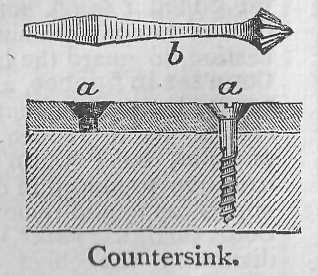
Counter, kown′tėr, adv. against: in opposition.—adj. contrary: opposite.—n. that which is counter of opposite: (mus.) the voice-part set in immediate contrast with the air: (fencing) a parry in which one foil follows the other in a small circle: the part of a horse's breast between the shoulders and under the neck: (naut.) the part of a ship between the water-line and the knuckle of the stern.—v.t. Counteract′, to act counter or in opposition to: to hinder or defeat.—n. Counterac′tion.—adj. Counteract′ive, tending to counteract.—n. one who or that which counteracts.—adv. Counteract′ively.—ns. Coun′ter-ag′ent, anything which counteracts; Coun′ter-approach′, a work thrown up outside a besieged place to command or check the approaches of the besieger; Coun′ter-attrac′tion, attraction in an opposite direction.—adj. Coun′ter-attract′ive, attracting in an opposite direction.—v.t. Counterbal′ance, to balance by weight on the opposite side: to act against with equal weight, power, or influence.—ns. Coun′terbalance, an equal weight, power, or agency working in opposition; Coun′terbase (see Contrabass); Coun′ter-batt′ery (mil.), a battery erected to oppose another; Coun′ter-blast, something done in opposition to another thing; Coun′ter-bond, a bond to protect from contingent loss one who has given bond for another.—v.t. Coun′ter-brace (naut.), to brace or fasten (the head-yards and after-yards) in opposite ways.—n. the lee-brace of the fore-topsail-yard.—n. Coun′terbuff, a stroke that stops motion or causes a recoil.—v.t. to drive back by such.—ns. Coun′ter-cast (Spens.), a contrary cast, counterplot, trick; Coun′ter-cast′er (Shak.), one who casts accounts: a book-keeper—used in contempt; Coun′ter-change, (Shak.), exchange, reciprocation.—p.adj. Coun′terchanged′, exchanged: (her.) intermixed or set one against the other, as the colours of the field and charge.—n. Coun′ter-charge, a charge brought forward in opposition to another charge.—v.t. Coun′tercharm, to destroy or dissolve the effects of another charm.—n. that which destroys the effects of another charm.—v.t. Coun′ter-check, to check by some obstacle: to rebuke.—ns. Counter-check′, a check in opposition to another: a rebuke; Counter-claim, kown′tėr-klām, n. a cross-demand brought forward as a partial or complete set-off against another claim.; Coun′ter-curr′ent, a current flowing in an opposite direction; Coun′ter-drain, a drain alongside a canal, &c., to carry off water oozing out.—v.t. Coun′terdraw, to trace on oiled paper or other transparent material.—ns. Coun′ter-ev′idence, evidence brought forward in opposition to other evidence; Coun′terfoil, the corresponding part of a bank cheque, &c., retained by the giver; Coun′ter-force, an opposing force; Coun′ter-fort (fort.), a buttress, or arch behind the revetments or retaining walls of the ditches of permanent fortifications; Coun′ter-gauge, an adjustable scribing gauge for marking the measurements of a mortise on a piece to be tenoned; Coun′ter-guard (fort.), an outwork consisting of two lines of rampart running parallel to the faces of the bastion, to guard the bastion from being breached; Coun′ter-in′fluence, an opposing influence; Coun′ter-irr′itant, an agent or substance applied to the skin so as to redden, to vesicate, or to produce pustules, &c.; Coun′ter-irritā′tion, an artificial irritation produced in one part of the body to act in opposition to and remove already existing irritation; Coun′terlight (paint.), a light opposite to any object, disturbing the effect of its light.—v.i. Coun′termarch, to march back or in a direction contrary to a former one.—n. a marching backward or in a direction different from a former one: (mil.) an evolution by which a body of men change front, and still retain the same men in the front rank: change of measures.—n. Coun′termark, an additional mark put on a bale of goods belonging to several merchants, so that it may not be opened except in the presence of all the owners: a mark put on standard metal by the London Goldsmiths' Company in addition to the artificer's: an artificial cavity made in the teeth of horses to disguise their age.—v.t. Coun′termine, to make a mine in opposition to: to oppose by means of a countermine: (fig.) to frustrate by secret working:—pr.p. countermin′ing; pa.p. countermined′.—ns. Coun′ter-mine (mil.), a mine or chamber excavated by the besieged to counteract or destroy the mines made by the besiegers: (fig.) any means of counteraction; Coun′ter-mō′tion, an opposite motion; Coun′ter-move, -move′ment, a contrary move, movement.—v.t. Coun′termure, to fortify a wall with another wall.—ns. Coun′ter-ō′pening, an aperture or vent on the opposite side, or in a different place; Coun′ter-pace, a step in opposition to another, a contrary measure.—adj. Coun′ter-paled (her.), divided equally, as an escutcheon, first palewise, then by a line fesswise, with two tinctures countercharged.—ns. Coun′ter-parole′, a word in addition to the password; Coun′terpart, the part that answers to another part: that which fits into or completes another, having the qualities which another lacks, and so an opposite.—adj. Coun′ter-pass′ant (her.), denoting two animals in a coat of arms represented as passing each other the contrary way.—n. Coun′terplea, a replication to a plea or request.—v.t. Counterplead′, to plead the contrary of; Coun′terplot′, to plot against in order to frustrate another plot:—pr.p. counterplot′ting; pa.p. counterplot′ted.—n. a plot or stratagem opposed to another plot.—v.t. Coun′terpoise, to poise or weigh against or on the opposite side: to act in opposition to with equal effect.—n. an equally heavy weight in the other scale—(Spens.) Coun′terpoys.—ns. Coun′ter-pois′on, a poison used as the antidote of another; Coun′ter-pres′sure, opposing pressure; Coun′ter-proof, an inverted impression obtained from a newly printed proof of an engraving, by laying it, while the ink is still wet, upon plain paper, and passing it through the press; Coun′ter-revolū′tion, a subsequent revolution counteracting the effect of a previous; Coun′ter-roll, a copy of the rolls relating to appeals, inquests, &c., serving as a check on another's roll; Coun′ter-round, a body of officers which goes to inspect the rounds.—adj. Coun′tersā′lient (her.), salient in opposite directions.—n. Coun′terscarp (fort.), the side of the ditch nearest to the besiegers and opposite to the scarp.—v.t. Counterseal′ (Shak.), to seal along with others.—ns. Coun′ter-secur′ity, security given to one who has become surety for another; Coun′ter-sense, an interpretation contrary to the real sense.—v.t. Countersign′, to sign on the opposite side of a writing: to sign in addition to the signature of a superior, to attest the authenticity of a writing.—ns. Coun′tersign, a military private sign or word, which must be given in order to pass a sentry: a counter-signature; Coun′ter-sig′nal, a signal used as an answer to another; Coun′ter-sig′nature, a name countersigned to a writing.—v.t. Coun′tersink, to bevel the edge of a hole, as for the head of a screw-nail (a a in fig.)—it is usually done by a Countersink-bit (b in fig.) in a brace.—ns. Coun′ter-stand, opposition, resistance; Coun′ter-state′ment, a statement in opposition to another statement; Coun′ter-stroke (Spens.), a stroke given in return for another stroke; Coun′ter-tal′ly, a tally serving as a check to another; Coun′ter-ten′or, name applied to alto when sung by a male voice (so called because a contrast to tenor); Coun′ter-time, the resistance of a horse that interrupts his cadence and the measure of his manège: resistance, opposition; Coun′terturn, a turn in a play different from what was expected.—v.t. Countervail′, to be of avail against: to act against with equal effect: to be of equal value to: to compensate [Counter and Avail].—n. Coun′ter-view, an opposing view: a posture in which two persons face each other: opposition: contrast.—v.t. Coun′ter-vote, to vote in opposition to; Coun′ter-weigh, to weigh against, counterbalance.—ns. Coun′ter-weight, a weight in an opposite scale.—v.i. Coun′ter-wheel, to wheel in an opposite direction.—n. Coun′ter-work, a work raised in opposition to another.—v.t. to work in opposition to.—p.adj. Coun′ter-wrought. [Fr.,—L. contra, against.]
Counter, kown′tėr, n. (Spens.) encounter.—v.t. to encounter: to contradict.
Counterfeit, kown′tėr-fit, -fēt, v.t. to imitate: to copy without authority: to forge.—n. something false or copied, or that pretends to be true and original.—adj. pretended: made in imitation of: forged: false.—n. Coun′terfeiter, one who counterfeits.—adv. Coun′terfeitly, in a counterfeit manner: falsely.—n. Coun′ter-fes′ance (Spens.), act of counterfeiting: forgery. [O. Fr. contrefet, from contrefaire, to imitate—L. contra, against, facĕre, to do.]
Countermand, kown-tėr-mand′, v.t. to give a command in opposition to one already given: to revoke.—n. a revocation of a former order.—adj. Countermand′able. [O. Fr. contremander—L. contra, against, and mandāre, to order.]
Counterpane, kown′tėr-pān, n. a coverlet for a bed, stitched or woven in squares.—Older form Coun′terpoint. [A corr. of O. Fr. contrepointe, which is a corr. of coultepointe—L. culcita puncta, a stitched pillow or cover. See Quilt.]
Counterpoint, kown′tėr-point, n. (mus.) the art of combining melodies: the setting of a harmony of one or more parts to a melody: the art of composition.—adj. Contrapunt′al.—n. Contrapunt′ist. [Fr.,—contre, against, point, a point.]
Country, kun′tri, n. a rural region as distinct from a town: a tract of land: the land in which one was born, or in which one resides.—adj. belonging to the country: rustic: rude.—p.adj. Coun′trified.—v.t. Coun′trify, to make rustic.—ns. Coun′try-box, a country-house; Coun′try-dance, a dance practised by country people: a dance in which an indefinite number of couples can take part, the gentlemen being arranged at the commencement on one side, and the ladies on the other.—n.pl. Coun′try-folk, the inhabitants of the country.—ns. Coun′try-house, -seat, the residence of a country gentleman; Coun′tryman, one who lives in the country: a farmer: one born in the same country with another; Coun′try-side, a district or part of the country; Coun′try-woman, a woman who dwells in the country: a woman born in the same country.—Country cousin, a relative from the country, unaccustomed to town sights or manners; Country gentleman, a landed proprietor who resides on his estate in the country; Country town, a small town in a rural district, depending on the agricultural industry of the surrounding country.—Go to the country, in parliamentary usage, to appeal to the feeling of the community by a general election. [O. Fr., contrée—Low L. contrata, contrada, an extension of L. contra, over against.]
County. See Count (1).
Coup, kōō, n. a blow, stroke, a successful hit: (billiards) the act of putting a ball in a pocket without having hit another ball.—Coup d'état, a sudden or violent stroke of state policy, as that by which Louis Napoleon subverted the constitution (Dec. 2, 1851); Coup de grâce, the finishing blow by which a tortured man is put out of pain, any decisive stroke generally; Coup de main, a sudden and overpowering attack; Coup de maître, a master-stroke; Coup de théâtre, a sudden and sensational turn in a piece: Coup d'œil, a general view of a scene or subject taken in at a glance. [Fr.,—L.,—colaphos, a blow.]
Coup, kowp, v.t. to exchange or barter.—n. Coup′er, a dealer. [Scot., from Ice., kaupa, to buy.]
Coup, kowp, v.t. to overturn. [Scot.; perh. originally the same word as Cope.]
Coupé, kōō-pā, n. the front part of a French stagecoach: a four-wheeled carriage seated for two inside, with a separate seat for the driver: the front compartment of a railway carriage.—adj. Couped (her.), cut evenly off, as the head or limb of an animal. [Fr. couper, to cut.]
Coupee, koo-pē′, n. in dancing, a salute to a partner, while resting on one foot and swinging the other backward or forward. [Fr.,—couper, to cut.]
Couple, kup′l, n. that which joins two things together: two of a kind joined together, or connected: two: one pair at a dance: a pair: esp. of married or betrothed persons: (statics) a pair of equal forces acting on the same body in opposite and parallel directions.—v.t. to join together.—v.i. to pair sexually.—ns. Coup′lement, union: a couple; Coup′ler, one who or that which couples or unites; Coup′let, two lines of verse that rhyme with each other; Coup′ling, that which connects, an appliance for transmitting motion in machinery; Coup′ling-box, the box or ring of metal connecting the contiguous ends of two lengths of shafts; Coup′ling-pin, a pin or bolt used in coupling machinery.—adj. Well-coupled, of a horse, well formed at the part where the back joins the rump. [O. Fr. cople—L. copula.]
Coupon, kōō′pong, n. a billet, check, or other slip of paper cut off from its counterpart: one of a series of tickets which are vouchers that certain payments will be made or services be performed, at various times or places, in consideration of money paid: a dividend or interest warrant presented for payment by holders of debentures. [Fr.,—couper, to cut off.]
Coupure, koo-pūr′, n. an entrenchment made by the besieged behind a breach: a passage cut to facilitate sallies. [Fr.,—couper, to cut.]
Courage, kur′āj, n. the quality that enables men to meet dangers without fear: bravery: spirit.—interj. take courage!—adj. Courā′geous, full of courage: brave.—adv. Courā′geously.—n. Courā′geousness.—Dutch courage, a fictitious courage induced by drinking; Pluck up one's courage, to nerve one's self to something daring; The courage of one's convictions, courage to act up to or consistently with one's opinions. [O. Fr. corage (Fr. courage), from L. cor, the heart.]
Courant, kōō-ränt′, adj. (her.) in a running attitude.—ns. Courante′, Courant′, an old dance with a kind of gliding step. [See Current.]
Courap, koo-rap′, n. an itching skin disease, common in India, with eruptions on face, breast, groin, &c.
Courb, kōōrb, v.i. (Shak.) to bend, stoop to supplicate.—adj. (Shak.) bent. [Fr.,—L. curvāre, to bend.]
Courbaril, koor′ba-ril, n. gum animé.
Courbette. Same as Curvet. [Fr.,—It. corvetta.]
Coure, obsolete form of Cower.
Courier, kōō′ri-ėr, n. a runner: a messenger: a state messenger: a travelling attendant: a frequent title of newspapers. [Fr.,—L. currĕre, to run.]
Course, kōrs, n. the act of running: the road or tract on which one runs: the direction pursued: a voyage: a race: regular progress from point to point: habitual method of procedure: a prescribed series, as of lectures, &c.: each of the successive divisions of a meal, as dinner: conduct: a range of bricks or stones on the same level in building: (naut.) one of the sails bent to a ship's lower yards, as the main-sail, called the main-course, the fore-sail or fore-course, and the cross-jack or mizzen-course: (pl.) the menses.—v.t. to run, chase, or hunt after.—v.i. to move with speed, as in a race or hunt.—ns. Cours′er, a runner: a swift horse: one who courses or hunts; Cours′ing, hunting with greyhounds; Cours′ing-joint, a joint between two courses of masonry.—In course, in regular order: (coll.) of course; Of course, by natural consequence, or by settled rule. [Fr. cours—L. cursus, from currĕre, cursum, to run.]
Court, kōrt, n. a space enclosed: a space surrounded by houses: the palace of a sovereign: the body of persons who form his suite or council: attention: civility, as 'to pay court:' (law) the hall of justice; the judges and officials who preside there: any body of persons assembled to decide causes, whether civil, military, or ecclesiastical.—v.t. to pay attentions to: to woo: to solicit: to seek.—ns. Court′-bar′on, the assembly of freehold tenants of a manor under a lord; Court′-card (see Coat-card); Court′-cup′board (Shak.), a movable cupboard or sideboard on which plate was displayed; Court′-day, a day on which a judicial court sits; Court′-dress, the special regulation costume worn on state or ceremonious occasions; Court′-dress′er, a flatterer.—adj. Courteous (kurt′yus), of court-like manners: polite: respectful: obliging.—adv. Courteously (kurt′-).—ns. Courteousness, (kurt′-); Court′-fool, a fool or jester, formerly kept at court for amusement; Court′-guide, a guide to, or directory of, the names and residences of the nobility in a town; Court′-hand, a modification of the Norman handwriting, as distinguished from the modern or Italian handwriting, in use in the English law-courts from the 16th century to the reign of George II.; Court′-house, a building where the law-courts are held; Court′ier, one who frequents courts or palaces: one who courts or flatters; Court′ierism, the behaviour or practices of a courtier.—adv. Court′ierly.—ns. Court′ing, paying addresses to a woman, wooing; (Spens.) attendance at court; Court′-leet, a court of record held in a manor before the lord or his steward; Court′let, a petty court.—adj. Court′-like, courtly: polite.—ns. Court′liness; Court′ling, a hanger-on at court.—adj. Court′ly, having manners like those at a court: elegant.—ns. Court′-mar′tial, a court held by officers of the army or navy for the trial of offences against military or naval laws:—pl. Courts′-mar′tial; one improvised in time of war round an upturned drum for summary judgment is a Drumhead court-martial; Court′-plas′ter, sticking-plaster made of silk, originally applied as patches on the face by ladies at court; Court′-roll, the record of a court of justice; Court′ship, courtly behaviour: the act of wooing with intention to marry; Court′-sword, a light dress-sword worn as part of court-dress; Court′yard, a court or enclosed ground before a house.—Court holy water, empty compliments: (obs.) flattery. [O. Fr. cort (Fr. cour)—Low L. cortis, a courtyard—L. cors, cohors, an enclosure; akin to Gr. chortos, an enclosed place, L. hortus, a garden. See Yard.]
Courtesan, -zan, kōrt′e-zan, or kurt′e-zan, n. a court-mistress: a woman of the town, a whore. [Fr.,—It. cortigiana.]
Courtesy, kort′e-si, or kurt′e-si, n. courtliness: elegance of manner: an act of civility or respect: a curtsy: (law) the life interest which the surviving husband has in the real or heritable estate of his wife.—v.i. to make a curtsy.—pr.p. court′esying; pa.p. court′esied.—n.pl. Court′esy-tī′tles, titles really invalid, but allowed by the usage of society—as to children of peers. [O. Fr. courtoisie.]
Couscous, kus′kus, n. an African dish of granulated flour steamed over broth. [Ar. kuskus.]
Cousin, kuz′n, n. formerly a kinsman generally; now, the son or daughter of an uncle or aunt: a term used by a sovereign in addressing another, or to one of his own noblemen: something kindred or related to another.—ns. Cous′in-ger′man, a first cousin: something closely related; Cous′inhood, Cous′inship.—adj. Cous′inly, like, or having the relation of, a cousin.—n. Cous′inry, cousins collectively.—First cousins, children of brothers and sisters—also called Cousins-german, Full cousins; First cousin once removed, the son or daughter of a cousin-german—sometimes loosely called Second cousin; Second cousins, the children of first cousins. [Fr.,—L. consobrinus—con, sig. connection, and sobrinus for sororinus, applied to the children of sisters—soror, a sister.]
Couteau, koo-tō′, n. a large knife.—Couteau de chasse, a hunting-knife. [Fr.]
Couter, kōō′tėr, n. (slang) a sovereign. [Said to be from Gipsy cuta, a gold piece.]
Couth, kōōth (Spens.), obsolete pa.t. of Can. [See Could.]
Couthie, kōōth′i, adj. friendly, kindly. [Scot.]
Couvade, kōō-väd′, n. a custom among savages in many parts of the world for the father to take to his bed at the birth of a child, and submit to certain restrictions of food, &c. [Erroneously attributed to the Basques; the O. Fr. couvade, from couver, to hatch, never having had this special meaning.]
Cove, kōv, n. a small inlet of the sea: a bay: a cavern or rocky recess: (archit.) a concave arch or vault.—v.t. to overarch, and thus form a hollow.—adj. Coved, formed with an arch.—n. Cove′let, a small cove. [A.S. cófa, a room; Ice. kofi, Ger. koben.]
Cove, kōv, n. (slang) a fellow, a customer:—fem. Cov′ess—dim. Cov′ey. [Prob. conn. with Chap.]
Coven, kōv′en, n. a muster of witches.—n. Cov′entree, a point of muster before a Scottish mansion.
Covenant, kuv′e-nant, n. a mutual agreement: the writing containing the agreement: an engagement entered into between God and a person or a people—the Old Covenant, the Jewish dispensation; the New Covenant, the new relation to God opened up by Jesus Christ.—v.i. to enter into an agreement: to contract or bargain.—n. Cov′enant-break′er, one who violates a covenant.—adj. Cov′enanted, holding a position under a covenant or contract.—ns. Covenantee′, the person to whom a covenant is made; Cov′enanter (usually in Scot. Covenant′er), one who signed or adhered to the Scottish National Covenant of 1638—the Solemn League and Covenant of 1643 was in effect an international treaty between Scotland and England for securing civil and religious liberty; Cov′enantor, that party to a covenant who subjects himself to the penalty of its breach.—Covenant of grace, redemption, that by which life is freely offered to sinners on condition of faith in Christ; Covenant of works, that made with Adam as federal representative of the human race on condition of obedience. [O. Fr.,—L. con, together, and venīre, to come.]
Covent, kov′ent, n. (Shak.) a convent.
Coventry, kuv′ent-ri, n.—in phrase, To send to Coventry = to shut a man out of any special society.
Cover, kuv′ėr, v.t. to hide: to clothe: to extend over: to brood or sit on: to be sufficient for: to protect: to table a coin of equal value in wagering: to copulate with—esp. of a stallion: to screen: to aim directly at.—v.i. to spread over so as to conceal something: to lay a table for a meal: to put one's hat on.—n. that which protects: undergrowth, thicket, concealing game, &c.: the table requisites for one person—plate, knife, fork, napkin, &c.: deceitfulness: a swindler's confederate.—adj. Cov′ered, intended or used for shelter or concealment: roofed over: with the hat on.—ns. Cover′ed-way; Cov′ert-way (fort.), a path about thirty feet wide outside the ditch of a fort, and so far sunk below the crest of the glacis as to afford cover or shelter to the soldiers; Cover′ing, anything that covers.—adj. Cov′ert, covered: concealed: secret.—n. a place that covers or affords protection.—ns. Cov′ert-coat, a short light overcoat; Cov′ert-coat′ing, cloth for such.—adv. Cov′ertly, in a covered or concealed manner.—n. Cov′erture, covering, shelter: (law) the condition of a married woman as legally under the protection of her husband.—Cover into, to transfer into; Cover shorts, to buy in such stocks as have been sold short, in order to meet one's engagements, &c.; Cover the buckle, to execute a difficult step in dancing. [Fr. couvrir (It. coprire)—L. co-operīre—con, and operīre, to cover.]
Coverlet, kuv′ėr-let, n. a bedcover.—Also Cov′erlid. [Fr. couvrelit, couvre, lit—L. lectum, a bed.]
Covet, kuv′et, v.t. to desire or wish for eagerly: to wish for what is unlawful.—v.i. to desire (with for).—adjs. Cov′etable; Cov′eted.—adv. Cov′etingly.—ns. Cov′etise (obs.), covetousness: ardent desire; Cov′etiveness (obs.), acquisitiveness.—adj. Cov′etous, inordinately desirous: avaricious.—adv. Cov′etously.—n. Cov′etousness. [O. Fr. coveiter (Fr. convoiter)—L. cupiditat-em—cupĕre, to desire.]
Covey, kuv′i, n. a brood or hatch of partridges: a small flock of birds—said of game: a party, a set. [O. Fr. covée—L. cubāre, to lie down.]
Covin, kuv′in, n. a compact: a conspiracy.—adjs. Cov′inous, Cov′enous, deceitful. [O. Fr. covin—Late L. convenium—L. convena, a meeting—con, together, venīre, to come.]
Coving, kō′ving, n. the projection of upper stories over lower: the vertical sides connecting the jambs with the breast of a fireplace. [See Cove.]
Cow, kow, n. the female of the bovine animals: the female of certain other animals, as the elephant, &c.—older plurals, Kine and Kye, the latter now only Scotch.—ns. Cow′-bane, the water-hemlock, often destructive to cattle; Cow′-berr′y, the red whortleberry; Cow′-bird, -bunt′ing, an American starling which accompanies cattle, and drops its eggs into other birds' nests; Cow′-boy, a boy who has the care of cows: (U.S.) a man who has the charge of cattle on a ranch; Cow′-calf, a female calf; Cow′-catch′er (U.S.), an apparatus on the front of railway engines to throw off obstacles; Cow′-cher′vil, -pars′ley, -weed, an umbelliferous European plant of the hedges and woods; Cow′feeder, a dairyman, cowherd; Cow′-grass, the zigzag clover: a variety of red clover; Cow′-heel, an ox-foot stewed to a jelly; Cow′herd, one who herds cows; Cow′hide, the hide of a cow: the hide of a cow made into leather: a coarse whip made of twisted strips of cowhide.—v.t. to whip with a cowhide.—n. Cow′-house, a place in which cows are stalled, a byre.—adj. Cow′ish, like a cow: (Shak.) cowardly.—ns. Cow′-leech, a cow-doctor; Cow′lick, a tuft of turned-up hair on the forehead; Cow′-pars′nip, an umbelliferous plant, used as food for hogs and cattle; Cow′-plant, a perennial plant of Ceylon, with a milky juice; Cow′-pox, a disease which appears in pimples on the teats of the cow, the matter thereof used for vaccination; Cow′-tree, a South American tree that produces a nourishing fluid resembling milk; Cow′-wheat, a genus of annual plants, with yellow flowers and seeds somewhat like grains of wheat. [A.S. cú, pl. cý; Ger. kuh; Sans. go.]
Cow, kow, v.t. to subdue: keep under: to dishearten.—adjs. Cowed, depressed; Cow′ish (Shak.), easily cowed, timorous: mean. [Perh. from Ice. kúga; Dan. kue, to subdue.]
Cowan, kow′an, n. (Scot.) a mason who never served an apprenticeship: one who tries to enter a mason's lodge, or the like, surreptitiously.
Coward, kow′ard, n. a faint-hearted person: one without courage.—v.t. to intimidate.—adjs. Cow′ard, Cow′ardly, afraid of danger: timid: mean.—ns. Cow′ardice, want of courage: timidity.—Cow′ardree (Spens.); Cow′ardliness.—adv. Cow′ardly.—n. Cow′ardship (Shak.), the quality of being a coward. [O. Fr. couard (It. codardo)—L. cauda, a tail.]
Cowdie-gum, -pine; Cowrie-pine. See Kauri.
Cower, kow′er, v.i. to sink down through fear, &c.: to crouch, for protection or in fear.—adv. Cow′eringly. [Cf. Ice. kúra, Dan. kure, to lie quiet.]
Cowhage, kow′āj, n. the hairs of the pods of a tropical climbing plant of the bean family, administered as a mechanical vermifuge, the pods themselves or the plant. [Hind. kawānch, koānch.]
Cowl, kowl, n. a cap or hood: a monk's hood: the badge of monkhood: a monk: a cover for a chimney.—v.t. to make a monk of: to cover like a cowl.—adj. Cowled, wearing a cowl. [A.S. cufle; Ice. cofl; akin to L. cucullus, hood.]
Cowl-staff, kowl′-staf, n. (Shak.) a staff or pole on which a basket or vessel is supported between two persons. [O. Fr. cuvele—L. cupella, dim. of cupa, a cask, and staff.]
Cowrie, Cowry, kow′ri, n. a large genus of Gasteropods, including over a hundred species, some of which are familiar as decorative objects, and as a medium of exchange with uncivilised peoples. [Hindi kaurī.]
Cowslip, kow′slip, n. a beautiful and fragrant species of primrose, common in English pastures.—adj. Cow′slip'd, covered with cowslips. [A.S. cú, cow, slyppe, perh. cow-dung.]
Coxcomb, koks′kōm, n. a strip of red cloth notched like a cock's comb, which professional fools used to wear: a fool: a fop.—adjs. Coxcom′bical, Coxcom′ical, foppish: vain.—n. Coxcombical′ity.—adv. Coxcom′bically.—n. Cox′combry, the manner of a coxcomb. [Cockscomb.]
Coxiness, koks′i-nes, n. state of being cocksy, bumptiousness.
Coxswain, Cockswain, kok′swān, or kok′sn, n. a seaman who steers a boat, and under the superior officer takes charge of it. [Cock, a boat, and Swain.]
Coy, koy, adj. modest: bashful: shy.—v.t. (Shak.) to caress: (Shak.) to disdain.—adj. Coy′ish, somewhat coy.—adv. Coy′ishly.—n. Coy′ishness.—adv. Coy′ly.—n. Coy′ness. [Fr. coi—L. quietus, quiet.]
Coyote, ko-yōt′e, n. a prairie wolf, abundant in Mexico and Texas. [Mex. coyotl.]
Coypu, koi′pōō, n. a large rodent in the porcupine section of the order, common in South America—living in burrows near water, feeding on aquatic plants. [Native name.]
Coystrel, Coystril. Same as Coistril.
Coz, kuz, n. a contraction of Cousin.
Coze, kōz, n. (Jane Austen) a cosy chat.
Cozen, kuz′n, v.t. to flatter: to cheat.—ns. Coz′enage, the practice of cheating: deceit; Coz′ener. [Perh. from Fr. cousiner, to claim kindred for one's own advantage, play the parasite—cousin, a cousin.]
Cozier, Cosier, kō′zi-ėr, n. a cobbler. [O. Fr. cousere—L. consuĕre, to sew together.]
Cozy. See Cosy.
Crab, krab, n. a popular name applied to any of the short-tailed division of decapod crustaceans: a sign in the zodiac: a portable winch: a sour-tempered person: the lowest throw at hazard—two aces.—adj. Crabb′ed, ill-natured: harsh: rough: difficult, perplexing.—adv. Crabb′edly.—n. Crabb′edness.—adj. Crab′-faced, having a sour, peevish countenance.—n. Crab′ite, a fossil crab or crayfish.—adj. Crab′-like, moving like a crab.—n. Crab′-louse, a crab-shaped louse infesting the hair of the pubis, &c.—n.pl. Crab's′-eyes, the scarlet seeds of an East Indian bead-tree: a concretion of carbonate of lime in the stomach of the cray-fish.—v.i. Crab′-sī′dle, to go sideways like a crab.—n.pl. Crab′-yaws, a name applied to the tumours of frambœsia on the soles and palms.—Catch a crab, in rowing, to sink the oar too deeply in the water: to miss the water altogether in making the stroke. [A.S. crabba; Ger. krabbe.]
Crab, krab, Crab-apple, krab′-ap-l, n. a wild bitter apple.—ns. Crab′-stick, a stick made out of the crab-tree; Crab′-tree, the tree that bears crab-apples.—adj. like a crab-tree, crooked. [Perh. conn. with Crabbed.]
Crab-oil, Crab-wood. See Carapa.
Crabro, krā′brō, n. the typical genus of Crabronidæ, a family of fossorial hymenopters: a hornet. [L.]
Crack, krak, v.i. to utter a sharp sudden sound: to split: to boast: to chat.—v.t. to produce a sudden noise: to break into chinks: to split: to break partially or wholly: to open (a bottle).—n. a sudden sharp splitting sound: a chink: a flaw: a blow, a smack: friendly chat: (slang) housebreaking: a craze: one who has a craze: a pert boy.—adj. (coll.) excellent.—n. Crack′-brain, a crazy person.—adjs. Crack′-brained; Cracked, rent: damaged: crazy.—ns. Crack′er, one who or that which cracks: a boaster, a lie: the pin-tail duck: (U.S.) a thin crisp biscuit: a bonbon, or a small firework, exploding when pulled asunder: (U.S.) a poor white; Crack′-halt′er, Crack′-hemp (Shak.), Crack′-rope, one likely to be hanged.—adj. Crack′-jaw, of a word, hard to pronounce.—ns. Cracks′man, a burglar; Crack′-tryst, one who breaks an engagement.—Crack credit, to destroy one's credit; Crack tryst, to break an engagement; Crack up, to praise. [A.S. cracian, to crack; cf. Dut. kraken, Gael. crac.]
Crack, krak, n. (Scot.) a moment, an instant.
Crackle, krak′l, v.i. to give out slight but frequent cracks.—n. the giving out of slight cracks.—ns. Crack′lin, a kind of china-ware, purposely cracked in the kiln as an ornament; Crack′ling, the rind of roast pork: (pl.) skinny parts of suet without tallow: three stripes of velvet worn on the sleeves of students at St John's College, Cambridge.—adj. Crack′ly, brittle.—n. Crack′nel, a light, brittle biscuit: (pl.) pieces of fat pork fried crisp.
Cracovian, kra-kō′vi-an, adj. pertaining to Cracow.—ns. Cracovienne′, a graceful Polish dance, resembling the mazourka: the music for such; Crac′owe, a long-toed boot fashionable under Richard II.
Cradle, krā′dl, n. a bed or crib in which children are rocked: (fig.) infancy: the place where one is born and brought up: a frame in which anything is imbedded: a case for a broken limb: a frame under a ship for launching it: a box on rockers for washing auriferous dirt.—v.t. to lay or rock in a cradle: to nurture.—adj. Crā′dled, laid in a cradle.—ns. Crā′dle-scythe, a broad scythe used in a cradle for cutting grain; Crā′dle-walk, an avenue arched over with trees; Crā′dling.—From the cradle, from birth, from the first. [A.S. cradol; ety. obscure.]
Craft, kraft, n. cunning: artifice: dexterity: art: trade: occupation: small ships.—v.i. to exercise one's craft (Shak., Cor., IV. vi. 118).—adv. Craft′ily.—n. Craft′iness.—adj. Craft′less, free from craft.—ns. Crafts′man, one engaged in a craft; Crafts′manship, Craft′manship; Crafts′master, one skilled in a craft.—adj. Craft′y, having skill: cunning: deceitful. [A.S. cræft; Ger. kraft, power.]
Crag, krag, n. a rough steep rock or point: (geol.) a bed of gravel mixed with shells.—adjs. Crag′ged, Crag′gy, full of crags or broken rocks: rough: rugged.—ns. Crag′gedness, Crag′giness; Crags′man, one skilled in climbing rocks. [W. craig, a rock, car-eg, a stone; Gael. creag, carraig.]
Crag, Cragge, krag, n. the neck.—Scotch forms, Craig, Craig′ie. [Cf. Dut. kraag, Ger. kragen, the neck.]
Crake, krāk, v.i. to utter a cry like a crow, &c.—n. Crake′-berr′y, the crow-berry.
Crake, krāk, n. a crow, raven, corncrake: (obs.) a boast. [See Corncrake.]
Cram, kram, v.t. to press close: to stuff: to fill to superfluity: (slang) to make believe false or exaggerated tales: to teach for a special examination, only giving instruction useful for passing that examination.—v.i. to eat greedily: to get up a subject by cram:—pr.p. cram′ming; pa.p. crammed.—n. a crush: (slang) a lie: information that has been crammed: the system of cramming.—adjs. Cram′-full; Cram′mable; Crammed.—n. Cram′mer, one who prepares students for examination by cramming them. [A.S. crammian; Ice. kremja, to squeeze; Dan. kramme, to crumple.]
Crambo, kram′bo, n. a game in which one gives a word to which another finds a rhyme: rime.—ns. Cram′boclink, -jingle, riming. [Prob. from L. crambe repetita, cabbage served up again.]
Crambus, kram′bus, n. a genus of pyralid moths, the veneers or grass-moths—family Crambidæ, subfamily Crambinæ. [Gr. krambos, dry.]
Crame, krām, n. (Scot.) a booth for selling goods.
Cramoisy, kram′oiz-i, Cramesy, kram′ez-i, adj. and n. crimson. [See Crimson.]
Cramp, kramp, n. an involuntary and painful contraction of a voluntary muscle or group of muscles: restraint: a piece of iron bent at the ends, for holding together wood, stone, &c.: a tool used by carpenters and others, having a movable part which can be screwed tight so as to press things together.—adj. hard to make out (used of handwriting): cramped: narrow.—v.t. to affect with spasms: to confine: to hinder: to fasten with a cramp-iron.—ns. Cramp′bark, the popular American name of the medicinal Viburnum Oxycoccus; Cramp′-bone, the patella of the sheep, an old charm for cramp; Cramp′-fish, the electric ray or torpedo; Cramp′-ī′ron, a piece of metal bent at both ends for binding things together; Cramp′on, a grappling-iron: a pointed plate for the foot in hill-climbing; Cramp′-ring, a ring formerly blessed by the sovereign on Good-Friday against cramp and the falling sickness.—adj. Cramp′y, affected or diseased with cramp: producing cramp.—Bather's cramp, the popular name for paralysis attacking a person while bathing; Writer's cramp, or Scrivener's palsy, a common disease affecting those in the habit of constant writing, the muscles refusing to obey only on attempting to write. [O. Fr. crampe; cf. Dut. kramp, Ger. krampf.]
Cran, kran, n. a measure of capacity in Scotland for herrings when just taken out of the net. It amounts to 37½ imperial gallons, and comprises about 750 herrings on an average.—Coup the cran (Scot.), to be upset. [Prob. from Gael. crann, a measure.]
Cranberry, kran′ber-i, n. a genus of small evergreen shrubs growing in peaty bogs and marshy grounds: the berry much used for tarts. [For crane-berry; a late word; origin obscure; cf. Ger. kranbeere or kranich-beere.]
Cranch. Same as Craunch.
Crane, krān, n. a large wading bird, with long legs, neck, and bill: a bent pipe for drawing liquor out of a cask: a machine for raising heavy weights—both named from their likeness to the bird.—v.t. to raise with a crane.—v.i. to stretch out the neck: to pull up before a jump.—ns. Cran′age, the use of a crane: the price paid for the use of it; Crane′-fly, a genus of dipterous insects, nearly allied to the gnats, with very long legs.—adj. Crane′-necked.—n. Crane's′-bill, the Geranium, from a lengthened appendage of the seed-vessel. [A.S. cran; Ger. kranich, W. garan.]
Crane. Same as Cranium.
Cranium, krā′ni-um, n. the skull: the bones enclosing the brain.—adj. Crā′nial, pertaining to the cranium.—n. Craniog′nomy, cranial physiognomy.—adj. Craniolog′ical.—ns. Craniol′ogist, one skilled in craniology; Craniol′ogy, the study of skulls: phrenology; Craniom′eter, an instrument for measuring the skull; Craniom′etry, the measurement of skulls; Craninos′copist, a phrenologist; Cranios′copy, phrenology; Craniot′omy (obstetrics), the act of breaking down the head of the fœtus. [Low L. cranium—Gr. kranion, from karē, the head.]
Crank, krangk, n. a crook or bend: a conceit in speech: a whim: (mach.) a lever or arm on a shaft, driven by hand or by a connecting-rod, its object being to convert reciprocating motion into rotary motion.—v.i. to move in a zizag manner.—v.t. to shape like a crank: to provide with a crank.—adj. crooked: crabbed: loose or slack.—adv. Crank′ily.—n. Crank′iness.—adj. Crank′y, crooked: infirm: full of whims: cross. [M. E. kranke—A.S. crincan, to yield; cf. Ger. krank.]
Crank, krangk, adj. brisk: merry. [Origin unknown.]
Crank, krangk, Crank-sided, krangk-sī′ded, adj. (naut.) liable to be upset—n. Crank′ness, liability to be upset. [Ety. uncertain.]
Crankle, krangk′l, Crinkle, kringk′l, n. a turn, winding, or wrinkle, an angular protuberance.—v.t. to bend: to twist.
Crannog, kran′og, n. the name given in Scotland and Ireland to a fortified island (partly natural and partly artificial) in a lake, once used as a dwelling-place and place of refuge. [Gael. crann, a tree.]
Cranny, kran′i, n. a rent: a chink: a secret place.—v.i. to enter crannies.—adj. Crann′ied, having crannies, rents, or fissures. [Fr. cran, a notch.]
Cranreuch, kran′ruh, n. (Scot.) hoar-frost. [Gael.]
Crants, krantz, n. (Shak.) the garland carried before the bier of a maiden and hung over her grave. [From Ger. kranz, a wreath, a garland.]
Crape, krāp, n. a thin silk fabric, tightly twisted, without removing the natural gum—usually dyed black, used for mournings.—adj. made of crape.—v.t. to clothe with crape: to frizzle (hair).—adj. Crap′y. [O. Fr. crespe (Fr. crêpe)—L. crispus, crisp.]
Crappit-head, krap′it-hed, n. a haddock's head stuffed with a compound of oatmeal, suet, onions, and pepper. [Crappit, from a Scotch word, crap, to cram.]
Crapulence, krap′ū-lens, n. sickness caused by an overdose of drink.—adjs. Crap′ulous, Crap′ulent. [Fr. crapule—L. crapula, intoxication.]
Crare, Crayer, krār, n. a trading vessel. [O. Fr. craier—Late L. craiera; origin dub.]
Crase. Obsolete form of Craze.
Crash, krash, n. a noise as of things breaking or being crushed by falling; the shock of two bodies meeting: the failure of a commercial undertaking.—v.i. to fall to pieces with a loud noise: to move with such a noise.—v.t. to dash in pieces. [From the sound.]
Crash, krash, n. a coarse strong linen.
Crasis, krā′sis, n. the mixture of different elements in the constitution of the body: temperament: (gram.) the mingling or contraction of two vowels into one long vowel, or into a diphthong. [Gr. krasis—kerannynai, to mix.]
Crass, kras, adj. gross: thick: dense: stupid.—ns. Crassament′um, the thick part of coagulated blood: the clot; Crass′itude, coarseness: density: stupidity.—adv. Crass′ly.—n. Crass′ness.—n.pl. Crassulā′ceæ, an order of herbaceous or shrubby, succulent plants—including the Stone-crop and House-leek. [O. Fr. cras—L. crassus.]
Cratægus, kra-tē′gus, n. a genus of thorny shrubs, of the rose family, in north temperate regions. [Gr.]
Cratch, krach, n. a crib to hold hay for cattle, a manger.—n.pl. Cratches, a swelling on a horse's pastern, under the fetlock. [Fr. crèche, a manger; from a Teut. root, whence also crib.]
Crate, krāt, n. a wicker-work case for packing crockery in, or for carrying fruit. [L. cratis, a hurdle. See Cradle.]
Crater, krāt′ėr, n. the bowl-shaped mouth of a volcano.—adjs. Crat′eriform, or Crater′iform, shaped like a crater; Crat′erous. [L.,—Gr. kratēr, a large bowl for mixing wine, from kerannynai, to mix.]
Craunch, kranch. A form of Crunch.
Cravat, kra-vat′, n. a kind of neckcloth worn chiefly by men.—v.t. to dress in a cravat.—adj. Cravat′ted, wearing a cravat. [Fr. cravate—introduced in 1636 from the Cravates or Croatians.]
Crave, krāv, v.t. to beg earnestly: to beseech: to demand or require: to long for.—ns. Crav′er, one who craves: a beggar; Crav′ing, desire: longing. [A.S. crafian, to crave; Ice. krefja.]
Craven, krāv′n, n. a coward: a spiritless fellow.—adj. cowardly: spiritless.—v.t. to render spiritless.—adv. Crav′enly.—n. Crav′enness.—To cry craven, to surrender. [M. E. cravant—O. Fr. participle cravanté, corresponding to L. crepant-em, crepāre, to rattle, to break; some explain M. E. cravant as O. Fr. creant, as in recreant.]
Craw, kraw, n. the crop, throat, or first stomach of fowls: the stomach of animals generally. [M. E. crawe; not found in A.S.; cf. Dut. kraag, neck.]
Crawfish. See Crayfish.
Crawl, krawl, v.i. to move slowly along the ground, as a worm: to creep: to move feebly, stealthily, or sneakingly: to be covered with crawling things.—n. the act of crawling.—ns. Crawl′er, one who or that which crawls: a reptile; Crawl′ing.—adv. Crawl′y (coll.), with a creepy feeling. [Scand.; Ice. krafla, Dan. kravle; Ger. krabbeln, to creep.]
Crawl, krawl, n. a pen for keeping fish: a kraal.
Crax, kraks, n. the typical genus of birds of family Cracidæ.
Crayfish, krā′fish, Crawfish, kraw′fish, n. a large fresh-water crustacean in the long-tailed division of the order Decapoda: the small spiny lobster. [M. E. crevice—O. Fr. crevice (Fr. écrevisse, a crayfish)—Old High Ger. krebiz, a Crab.]
Crayon, krā′on, n. a pencil made of chalk or pipeclay, variously coloured, used for drawing: a drawing done with crayons.—v.t. to draw with a crayon.—In crayons, of a picture, made by crayons. [Fr. crayon—craie, chalk, from L. creta, chalk.]
Craze, krāz, v.t. to weaken: to derange (applied to the intellect): (obs.) to break.—v.i. to become mad.—n. a crack or flaw: insanity.—adj. Crazed, deranged.—adv. Craz′ily.—ns. Craz′iness; Craz′ing-mill, a mill for crushing tin-ore.—adj. Craz′y, frail: insane: demented. [Scand.; Sw. krasa, Dan. krase, to crackle; whence also Fr. écraser, to crush.]
Creagh, Creach, kreh, n. a foray, raid: booty. [Gael.]
Creak, krēk, v.i. to make a sharp, grating sound, as of a hinge, &c.—n. a grating noise, as of an unoiled hinge.—adv. Creak′ily.—adj. Creak′y. [From the sound, like crake and croak.]
Cream, krēm, n. the oily substance which forms on milk, yielding butter when churned: the best part of anything: any cream-like preparation, as cold cream for the skin, &c., or any dish largely made of cream, or like cream, as chocolate-cream, ice-cream, whipped-cream, &c.—v.t. to take off the cream.—v.i. to gather or form cream.—ns. Cream′-cake, a kind of cake filled with custard made of cream, &c.; Cream′-cheese, cheese made of cream.—adj. Cream′-col′oured, of the colour of cream, light yellow.—n. Cream′ery, an establishment where butter and cheese are made from the milk supplied by a number of producers: a shop for milk, butter, &c.—adj. Cream′-faced, pale-faced.—ns. Cream′-fruit, the fruit of a creeping West African plant of the dogbane family, yielding a cream-like juice; Cream′iness.—adj. Cream′-laid, of a cream-colour and laid, or bearing linear water-lines as if laid.—ns. Cream′-nut, the Brazil nut; Cream′-slice, a wooden blade for skimming cream from milk.—adjs. Cream′-wove, woven of a cream-colour; Cream′y, full of or like cream: gathering like cream.—Cream of tartar, a white crystalline compound made by purifying argol, bitartrate of potash. [O. Fr. cresme, creme—L. chrisma.]
Creance, krē′ans, n. the cord which secures the hawk while being trained. [Fr.]
Creant, krē′ant, adj. creating: formative.
Crease, krēs, n. a mark made by folding or doubling anything: (cricket) a line indicating the boundaries of a particular space, as the position of a batter and bowler.—v.t. to make creases in anything.—v.i. to become creased.—adj. Creas′y, full of creases. [Prob. Celt., as Bret. krīz, &c.]
Crease. See Creese.
Creasote. See Creosote.
Create, krē-āt′, v.t. to bring into being or form out of nothing: to beget: to form: to invest with a new form, office, or character: to produce.—adj. Creāt′able.—n. Creā′tion, the act of creating, esp. the universe: that which is created, the world, the universe.—adj. Creā′tional.—ns. Creā′tionism, the theory of special creation, opp. to Evolutionism: the theory that God immediately creates a soul for every human being born—opp. to Traducianism; Creā′tionist.—adj. Creā′tive, having power to create: that creates.—adv. Creā′tively.—ns. Creā′tiveness; Creā′tor, he who creates: a maker:—fem. Creā′trix, Creā′tress; Creā′torship.—adjs. Crea′tural, Crea′turely, pertaining to a creature or thing created.—ns. Creature (krē′tūr), whatever has been created, animate or inanimate, esp. every animated being, an animal, a man: a term of contempt or of endearment: a dependent, instrument, or puppet; Crea′tureship.—The Creator, the Supreme Being, God.—Creature comforts, material comforts, food, &c.: liquor, esp. whisky. [L. creāre, -ātum; Gr. krain-ein, to fulfil.]
Creatine, krē′a-tin, n. a constant and characteristic constituent of the striped muscle of vertebrates—also Kre′atine.—adj. Creat′ic, relating to flesh.—n. Cre′atinine, dehydrated form, a constant constituent of urine, found also in fish muscles. [Gr. kreas, kreatos, flesh.]
Crèche, kresh, n. a sort of public nursery for children, while their mothers are at work. [Fr.]
Credence, krē′dens, n. belief: trust: the small table beside the altar on which the bread and wine are placed before being consecrated.—n. Creden′dum, a thing to be believed, an act of faith:—pl. Credenda.—adjs. Crē′dent, easy of belief; Creden′tial, giving a title to belief or credit.—n. that which entitles to credit or confidence: (pl.) esp. the letters by which one claims confidence or authority among strangers.—ns. Credibil′ity, Cred′ibleness.—adj. Credible (kred′-), that may be believed.—adv. Cred′ibly.—n. Cred′it, belief: esteem: reputation: honour: good character: sale on trust: time allowed for payment: the side of an account on which payments received are entered: a sum placed at a person's disposal in a bank on which he may draw to its amount.—v.t. to believe: to trust: to sell or lend to on trust: to enter on the credit side of an account: to set to the credit of.—adj. Cred′itable, trustworthy: bringing credit or honour.—n. Cred′itableness.—adv. Cred′itably.—ns. Cred′itor, one to whom a debt is due:—fem. Cred′itrix; Crē′do, the Creed, or a musical setting of it for church services; Credū′lity, credulousness: disposition to believe on insufficient evidence.—adj. Cred′ulous, easy of belief: apt to believe without sufficient evidence: unsuspecting.—adv. Cred′ulously.—ns. Cred′ulousness; Creed, a summary of articles of religious belief, esp. those called the Apostles', Nicene, and Athanasian: any system of belief. [Fr.,—Low L. credentia—L. credent-, believing, pr.p. of credĕre.]
Creek, krēk, n. a small inlet or bay of the sea, or the tidal estuary of a river: any turn or winding: in America and Australia, a small river.—adj. Creek′y, full of creeks: winding. [Prob. Scand., Ice. kriki, a nook; cf. Dut. kreek, a bay.]
Creel, krēl, n. a basket, esp. an angler's basket. [Prob. Celt; cf. Old Ir. criol, a chest.]
Creep, krēp, v.i. to move on the belly, like a snake: to move slowly: to grow along the ground or on supports, as a vine: to fawn or cringe: to have the physical sensation of something creeping over or under the skin: to shudder at from fear or repugnance: to drag with a creeper, as a river-bottom:—pr.p. creep′ing; pa.t. and pa.p. crept.—ns. Creep′er, a creeping plant: a genus of small climbing birds; Creep′-hole, a hole into which to creep: a subterfuge; Creep′ie, a low stool, the old Scotch stool of repentance.—adv. Creep′ingly.—adj. Creep′y. [A.S. creópan; Dut. kruipen.]
Creese, Crease, krēs, n. a Malay dagger with a wavy blade—also Kris.—v.t. to stab with a creese.
Creesh, krēsh, v.t. (Scot.) to grease.—n. grease.—adj. Creesh′y. [O. Fr. craisse—L. crassus, fat.]
Cremaillere, kre-mal-yār′, n. a line of fortification built zigzag to give wider range in firing. [Fr.]
Cremation, krem-ā′shun, n. act of burning, esp. of the dead.—v.t. Cremate′.—ns. Cremā′tionist, one who advocates cremation; Cremat′or, Crematōr′ium, Crem′atory, a place where cremation is done.—adj. Crematōr′ial. [L.,—cremāre, to burn.]
Cremona, krem-ō′na, n. a superior kind of violin made at Cremona in Italy.—adj. Cremonese′.
Cremor, krē′mor, n. thick juice.
Cremosin, krem′ō-zin, n. crimson (Spens.).
Crenate, -d, krē′nāt, -ed, adj. (bot.) having the edge notched.—ns. Crē′na, a furrow or notch; Crenā′tion; Cren′ature.—adjs. Cren′ulate, -d, finely notched or crenate. [L. crena, a notch.]
Crenel, kren′el, Crenelle, kre-nel′, n. (archit.) an opening in a parapet for shooting through: a battlement—dim. Cren′elet.—n. Crenaux (krē′nō), crenellations or loopholes in a fortress.—v.t. Cren′ellate.—adjs. Crenellāt′ed, furnished with battlements: indented.—n. Crenellā′tion.—adjs. Crenelle′ (her.), embattled; Crenelled′, having embrasures. [Fr.,—Low L. crena, a notch.]
Creole, krē′ōl, n. and adj. strictly applied in the former Spanish, French, and Portuguese colonies of America, Africa, and the East Indies to natives of pure European blood (sangre azul), in opposition to immigrants themselves born in Europe, or to the offspring of mixed blood, as mulattoes, quadroons, Eurasians, &c.: (U.S.) applied only to the native French stock in Louisiana: a negro born in the West Indies—earlier Creō′lian. [Fr. créole—Sp. criollo, contr. of criadillo, 'a little nursling,' dim. of criado—criar, lit. to create, also to bring up, to nurse—L. creāre.]
Creophagous, krē-of′a-gus, adj. flesh-eating. [Gr. kreas, flesh, phagein, to eat.]
Creosote, krē′o-sōt, Creasote, krē′a-sōt, n. an oily, colourless liquid obtained from the tar produced by the destructive distillation of wood. [Gr. kreas, flesh, sōtēr, saviour—sōz-ein, to save.]
Crepance, krē′pans, n. a wound on a horse's hind ankle-joint, caused by striking with the shoe of the other hind-foot.—Also Crē′pane. [L. crepāre, to break.]
Crêpe, krāp, v.t. to frizz, as hair. [See Crape.]
Crepitate, krep′i-tāt, v.i. to crackle, snap.—adj. Crep′itant, crackling.—n. Crepitā′tion, the characteristic sound detected in the lungs by auscultation.—adj. Crep′itātive.—n. Crep′itus. [L. crepitāre, -ātum, freq. of crepāre, to crack, rattle.]
Crepon, krep′on, n. a woollen or silk crapy stuff. [Fr.]
Crept, krept, pa.t. and pa.p. of Creep.
Crepuscular, kre-pus′kū-lar, adj. of or pertaining to twilight—also Crepus′culous.—ns. Crepus′cule, Crepus′cle, twilight. [L. crepusculum—creper, dusky, obscure.]
Crescendo, kres-en′dō, adv. (mus.) gradually increasing in force or loudness.—n. a passage marked by this.—Often cres., cresc., or .

Crescent, kres′ent, adj. increasing: shaped like the new or old moon.—n. the moon as she increases towards half-moon: a figure like the crescent moon, as that on the Turkish standard: the standard itself: the Turkish power: a range of buildings in curved form.—n. Cres′centade, a religious war for Islam.—adjs. Cres′cented, Crescent′ic, formed like a crescent; Cres′cive (Shak.), increasing. [L. crescens, crescent-is, pr.p. of crescĕre, to grow.]
Cress, kres, n. the name of several species of plants like the water-cress, which grow in moist places, and have pungent leaves used as salads and medicinally.—adj. Cress′y, abounding in cresses. [A.S. cresse, cerse; cf. Dut. kers, Ger. kresse.]
Cresset, kres′et, n. an iron basket, jar, or open lamp filled with combustible material, placed on a beacon, lighthouse, wharf, &c.: a torch generally. [O. Fr. cresset, crasset (Fr. creuset)—Old Dut. kruysel, a hanging lamp.]
Crest, krest, n. the comb or tuft on the head of a cock and other birds: the summit of anything, as a roof-ridge, hill, wave: the mane of a horse, &c.: (anat.) a ridge along the surface of a bone: a plume of feathers or other ornament on the top of a helmet: (her.) an accessory figure originally surmounting the helmet, placed on a wreath, &c., also used separately as a personal cognisance on plate, &c.—v.t. to furnish with, or serve for, a crest, to surmount.—p.adj. Crest′ed, having a crest: (bot.) having an elevated appendage like a crest.—adjs. Crest′fallen, dejected: heartless; Crest′less, without a crest: not of high birth.—ns. Crest′-marine′, rock samphire; Crestol′atry, toadyism. [O. Fr. creste (mod. crête)—L. crista.]
Cretaceous, krē-tā′shus, adj. composed of or like chalk.—adj. Crē′tāted, rubbed with chalk.—n. Cretifac′tion.—v.i. Crē′tify, to become impregnated with salts of lime. [L. cretaceus, from creta, chalk.]
Cretic, krē′tik, adj. and n. Cretan, belonging to Crete: a metrical foot consisting of one short syllable between two long.—n. Crē′tism, a lie.
Cretinism, krē′tin-izm, n. a state of defective mental development, associated with bodily deformity or arrested growth, occurring esp. in connection with enlargement of the thyroid gland or goitre in the lower Alpine valleys.—n. Crē′tin, one affected with cretinism.—adjs. Crē′tinous, Crē′tinised. [Fr. crétin—Swiss crestin—L. christian-us, prob. implying that, after all, they are human, or that they are (from their fatuousness) incapable of sin—cf. the frequent use of innocent.]
Cretonne, kret-on′, or kret′on, n. a strong printed cotton fabric used for curtains or for covering furniture. [Fr., prob. from Creton in Normandy.]
Cretose, krē′tōs, adj. chalky.
Creutzer. Same as Kreutzer.
Creux, krė, n. the reverse of relief in sculpture, intaglio. [Fr.]
Crevasse, krev-as′, n. a crack or split, esp. applied to a cleft in a glacier: (U.S.) a breach in a canal or river bank.—v.t. to fissure with crevasses. [Fr.]
Crevet, krev′et, n. a variant of Cruet, a goldsmith's melting-pot.
Crevice, krev′is, n. a crack or rent: a narrow opening. [O. Fr. crevace—L. L.,—L. crepāre, to creak.]
Crew, krōō, n. a company, squad, or gang, often in a bad or contemptuous sense: a ship's company. [O. Fr. creue, increase—croistre, to grow.]
Crew, krōō, pa.t. of Crow.
Crewe, krōō, n. (Spens.) a cruse. [O. Fr. crue.]
Crewel, krōō′el, n. a fine worsted yarn used for embroidery and tapestry: work in crewels.—v.t. to work in such.—ns. Crew′elist; Crew′ellery. [Orig. a monosyllable, crule, crewle; ety. dub.]
Crewels, krōō′elz, n.pl. (Scot.) the king's evil, scrofula. [Fr. ēcrouelles.]
Crib, krib, n. the rack or manger of a stable: a stall for oxen: a child's bed; a small cottage or hovel, a confined place: (coll.) a translation of a classic baldly literal, for lazy schoolboys.—v.t. to put away in a crib, confine: to pilfer: to plagiarise:—pr.p. crib′bing; pa.p. cribbed.—n. Crib′-bit′ing, a vicious habit of horses, consisting in biting the manger. [A.S. crib; Ger. krippe.]
Cribbage, krib′āj, n. a game at cards played by two, three, or four persons, so called from crib, the name given to certain cards laid aside from his hand by each player, and which belong to the dealer.—n. Cribb′age-board, a board with holes for keeping by means of pegs the score at cribbage.
Cribble, krib′l, n. a coarse screen or sieve used for sand, gravel, or corn: coarse flour or meal.—v.t. to sift or riddle.—adjs. Crib′rāte, Crib′rose, perforated like a sieve.—n. Cribrā′tion, act of sifting.—adj. Crib′riform, shaped like a sieve. [L. cribellum, dim. of cribrum, a sieve.]
Cribellum, kri-bel′um, n. an accessory spinning-organ of certain spiders—also Cribrell′um:—pl. Cribell′a.
Criblé, krē-blā, adj. punctured like a sieve, dotted. [Fr.]
Cricetus, kri-sē′tus, n. the typical genus of Cricetinæ, a sub-family of muroid rodents with cheek-pouches.
Crick, krik, n. a spasm or cramp of the muscles, esp. of the neck. [Prob. onomatopœic.]
Cricket, krik′et, n. a saltatory, orthopterous insect, allied to grasshoppers and locusts. [O. Fr. criquet; cf. Dut. krekel, Ger. kreckel.]
Cricket, krik′et, n. an outdoor game played with bats, a ball, and wickets, between two sides of eleven each.—v.i. to play at cricket.—ns. Crick′eter, one who plays at cricket; Crick′et-match, a match at cricket. [Fr. criquet; further ety. dub. Not the A.S. crycc, a stick.]
Cricket, krik′et, n. (Scot.) a low stool.
Cricoid, krī′koid, adj. (anat.) ring-shaped. [Gr. krikos, a ring, and eidos, form.]
Cried, krīd, pa.t. and pa.p. of Cry.—n. Crī′er, one who cries or proclaims, esp. an officer whose duty is to make public proclamations.—Cried down, or Decried, denounced, belittled; Cried up, extolled.
Crime, krīm, n. a violation of law: an act punishable by law: offence: sin.—adjs. Crime′ful, criminal; Crime′less, without crime, innocent; Criminal (krim′-), relating to crime: guilty of crime: violating laws.—n. one guilty of crime.—ns. Crim′inalist, one versed in criminal law; Criminal′ity, guiltiness.—adv. Crim′inally.—v.t. Crim′ināte, to accuse.—n. Criminā′tion, act of criminating: accusation.—adjs. Crim′inātive, Crim′inātory, involving crimination or accusation.—ns. Criminol′ogist; Criminol′ogy, that branch of anthropology which treats of crime and criminals.—adj. Crim′inous, criminal—now chiefly in the phrase 'a criminous clerk.'—n. Crim′inousness.—Criminal conversation, often Crim. con., adultery. [Fr.,—L. crimen.]
Crimine, Crimini, krim′i-ne, interj. an ejaculation of surprise or impatience.
Crimp, krimp, adj. made crisp or brittle.—v.t. to wrinkle: to plait: to make crisp: to seize or decoy sailors or soldiers.—n. one who presses or decoys.—ns. Crimp′age, act of crimping; Crimp′er, one who or that which crimps or corrugates; Crimp′ing-ī′ron, an iron instrument used for crimping hair; Crimp′ing-machine′, a machine for forming crimps or plaits on ruffles.—v.t. Crimp′le, to contract or draw together: to plait: to curl. [A dim. of cramp; Dut. krimpen, to shrink.]
Crimson, krim′zn, n. a deep red colour, tinged with blue: red in general.—adj. deep red.—v.t. to dye crimson.—v.i. to become crimson: to blush. [M. E. crimosin—O. Fr. cramoisin; from Ar. qermazi, the cochineal insect, from which it is made.]
Crinal, krī′nal, adj. of or belonging to the hair.—adjs. Crin′ate, -d, having hair; Crinicul′tural, relating to the culture or growth of the hair; Crinig′erous, hairy; Crī′nite, hairy: (bot.) resembling a tuft of hair. [L. crinalis—crinis, the hair.]
Crine, krīn, v.i. (Scot.) to shrink or shrivel. [Gael. crìon, dry.]
Cringe, krinj, v.i. to bend or crouch with servility: to submit: to fawn: to flatter with mean servility.—n. a servile obeisance.—ns. Cringe′ling, Crin′ger, one who cringes.—adv. Crin′gingly, in an obsequious manner. [Related to A.S. crincan, cringan, to shrink. Cf. Crank, weak.]
Cringle, kring′gl, n. a small piece of rope worked into the bolt-rope of a sail, and containing a metal ring or thimble. [Teut.; cf. Ger. kringel.]
Crinite. See Crinal, Crinoidea.
Crinkle, krink′l, v.t. to twist, wrinkle, crimp.—v.i. to wrinkle up, curl.—n. a wrinkle.—adj. Crink′ly, wrinkly.—n. and adj. Crink′um-crank′um, a word applied familiarly to things intricate or crooked.
Crinoidea, krī-noid′ē-a, n.pl. a class of Echinodermata, sometimes called feather-stars or sea-lilies, and well known in fossil forms as encrinites or stone-lilies.—n. Cri′nite, a fossil crinoid.—adjs. and ns. Crinoid′, Crinoid′ean.—adj. Crinoid′al. [Gr. krinon, a lily, and eidos, form.]
Crinoline, krin′o-lin, n. a name originally given by the French modistes to a stiff fabric of horse-hair, employed to distend women's attire: a hooped petticoat or skirt made to project all round by means of steel-wire: a netting round ships as a guard against torpedoes.—n. Crin′olette, a small crinoline causing the dress to project behind only—akin to the bustle and dress-improver.—adj. Crin′olined. [Fr., crin—L. crinis, hair, and lin—L. linum, flax.]
Crinose, krī′nōs, adj. hairy. [L. crinis, hair.]
Crio-sphinx, krī′ō-sfingks, n. a ram-headed sphinx. [Gr. krios, a ram, sphingx, a sphinx.]
Cripple, krip′l, n. a lame person.—adj. lame.—v.t. to make lame: to lame: disable, impair the efficiency of.—ns. Cripp′ledom; Cripp′ling, a prop set up as a support against the side of a building. [A.S. crypel; conn. with Creep.]
Crisis, krī′sis, n. point or time for deciding anything, the decisive moment or turning-point:—pl. Crises (krī′sēz). [Gr. krisis, from krinein, to separate.]
Crisp, krisp, adj. curling closely: having a wavy surface: so dry as to be crumbled easily: brittle, or short, as 'crisp cakes,' &c.: fresh and bracing, as 'crisp air:' firm, the opposite of limp or flabby, as a 'crisp style' in writing.—v.t. to curl or twist: to make crisp or wavy.—adjs. Cris′pāte, -d, having a crisped or wavy appearance.—ns. Crispā′tion; Crisp′ature, a curling; Crisp′er, one who or that which crisps; Crisp′ing-ī′ron, -pin, a curling-iron.—adv. Crisp′ly.—n. Crisp′ness.—adj. Crisp′y. [A.S.,—L. crispus.]
Crispin, kris′pin, n. a shoemaker, from Crispin of Soissons, the patron saint of shoemakers, martyred 25th October 287.
Criss-cross, kris′-kros, n. a mark formed by two lines in the form of a cross, as the signature of a person unable to write his name: a child's game played on a slate, the lines being drawn in the form of a cross.—v.i. to intersect frequently.
Cristate, kris′tāt, adj. crested.—n. Cris′ta, a crest.—adjs. Cris′tiform; Cristim′anous, having crested claws.
Criterion, krī-tē′ri-on, n. a means or standard of judging: a test: a rule, standard, or canon:—pl. Critē′ria. [Gr., from kritēs, a judge.]
Crith, krith, n. a chemical unit of mass for gases, the mass of one litre of hydrogen. [Gr. krithē, barley.]
Crithomancy, krith′o-man-si, n. divination by the meal strewed over the victims of sacrifice. [Gr. krithē, barley, and manteia, divination.]
Critic, krit′ik, n. one skilled in estimating the quality of literary or artistic work: a professional reviewer: one skilled in textual or biblical criticism, literature, the fine arts, &c.: a fault-finder.—adj. Crit′ical, relating to criticism: discriminating: captious: decisive.—adv. Crit′ically.—ns. Crit′icalness, Critical′ity; Crit′icaster, Crit′ickin, a petty critic.—adj. Criticīs′able.—v.t. Crit′icise, to pass judgment on: to censure.—ns. Crit′icism, the art of judging, esp. in literature or the fine arts: a critical judgment or observation; Critique (kri-tēk′), a critical examination of any production: a review.—Critical angle, the least angle of incidence at which a ray is totally reflected; Critical philosophy, that of Kant as based on a critical examination of the faculty of knowledge; Critical point, that temperature below which a substance may, and above which it cannot, be liquefied by pressure alone.—Higher or Historical criticism, as distinguished from Textual or Verbal criticism, the inquiry into the composition, date, and authenticity of the books of Scripture, from historical and literary considerations. [Gr. kritikos—krinein, to judge.]
Croak, krōk, v.i. to utter a low hoarse sound, as a frog or raven: to grumble: to forebode evil: to utter croakingly: (slang) to die.—n. the sound of a frog or raven.—n. Croak′er.—adv. Croak′ily.—n. Croak′ing.—adj. Croak′y. [From the sound. Cf. Crake, Crow.]
Croat, krō′at, n. a native of Croatia, esp. one serving as a soldier in the Austrian army.
Croceous, krō′shi-us, adj. saffron-coloured.
Croche, krō′she, n. one of the buds or knobs at the top of a deer's horn. [Fr.]
Crochet, krō′shā, n. a kind of handiwork in fancy worsted, cotton, or silk—an extensive system of looping, by means of a small hook.—v.i. to do such work. [Fr. crochet—croche, croc, a hook.]
Crocidolite, kro-sid′o-līt, n. a mineral consisting mainly of silicate of iron, in asbestos-like fibres. [From Gr. krokis, -idos, cloth, and lithos, stone.]
Crock, krok, n. a pot or jar.—n. Crock′ery, earthenware: vessels formed of baked clay. [A.S. croc; Ger. krug; perh. of Celt. origin, as in W. crochan, a pot, Gael. krogan, a pitcher.]
Crock, krok, n. dirt, smut.—v.i. to dirty.
Crock, krok, n. an old ewe: an old horse. [Cf. Norw. and Sw. krake, a poor beast.]
Crocket, krok′et, n. (archit.) an ornament on the angles of spires, canopies, &c., like curled leaves or flowers.
Crocodile, krok′o-dīl, n. a genus of large amphibious saurian reptiles, including the crocodile of the Nile, and also the alligators and gavials.—adj. and n. Crocodil′ian.—n. Crocodil′ity, captious arguing.—Crocodile tears, affected tears, hypocritical grief—from the old story that crocodiles (which have large lachrymal glands) shed tears over the hard necessity of killing animals for food. [O. Fr. cocodrille—L. crocodilus—Gr. krokodeilos, a lizard.]
Crocus, krō′kus, n. a bulbous plant with brilliant yellow or purple flowers: (slang) a quack doctor. [L. crocus—Gr. krokos; prob. of Eastern origin, as Heb. karkom, and Ar. kurkum, saffron.]
Croft, kroft, n. a small piece arable land adjoining a dwelling: a kind of small farm.—ns. Croft′er; Croft′ing. [A.S. croft; perh. cog. with Dut. kroft, or with Gael. croit.]
Croissant. Same as Crescent.
Croma, krō′ma, n. (mus.) an eighth note, or quaver.—Also Crome.
Crome, krōm, Cromb, krōōm, n. a hook or crook.—v.t. to draw with such. [Cf. Dut. kram.]
Cromlech, krom′lek, n. a term applied in Brittany to a group of standing stones, a stone circle: formerly applied to a dolmen, with which it is still sometimes confounded in England (see Dolmen). [W. cromlech—crom, curved, circular, and llech, a stone.]
Cromorna, krō-mor′na, n. a clarinet-like reed-stop in an organ. [Fr.,—Ger. krummhorn.]
Crone, krōn, n. an old woman, usually in contempt—sometimes an old man. [Perh. O. Fr. carogne, a crabbed woman; or Celt., as in Ir. crion, withered.]
Cronet, krō′net, n. the hair growing over the top of a horse's hoof.
Crony, krōn′i, n. an old and intimate companion. [Ety. unknown.]
Croodle, krōōd′l, v.i. to cower down, or cling close to anything. [Prob. related to Cuddle.]
Croodle, krōōd′l, v.i. (Scot.), to coo like a dove, to coax.
Crook, krōōk, n. a bend, anything bent: a curved tube used to lower the pitch of a cornet, &c.: the bending of the body in reverence: a staff bent at the end, as a shepherd's or bishop's: an artifice or trick: (Spens.) gibbet.—v.t. to bend or form into a hook: to turn from the straight line or from what is right.—v.i. to bend or be bent.—n. Crook′back (Shak.), a hunchback.—adj. Crook′backed; Crook′ed, bent like a crook: not straight: deviating from rectitude, perverse.—adv. Crook′edly.—n. Crook′edness.—adjs. Crook′-kneed; Crook′-shoul′dered.—A crook in the lot, any trial in one's experience. [Prob. Scand.; cf. Ice. krókr, Dan. krog.]
Crool, krool, v.i. to mutter. [Imit.]
Croon, krōōn, v.t. (Scot.) to utter a low, monotonous, inarticulate sound like a baby: to sing or hum in an undertone.—n. Croon′ing, a low murmuring sound. [Cf. Dut. kreunen, to groan.]
Crop, krop, n. all the produce of a field of grain: anything gathered or cropped: an entire ox-hide: the craw of a bird: (archit.) a finial: a whip-handle: the cutting the hair short.—v.t. to cut off the top or ends: to cut short or close: to mow, reap, or gather.—v.i. to yield:—pr.p. crop′ping; pa.p. cropped.—n. Crop′-ear, one having cropped or cut ears.—adj. Crop′ful (Milt.), satiated.—ns. Crop′per, one who or that which crops: a plant which furnishes a crop: one who raises a crop for a share of it: a kind of fancy pigeon remarkable for its large crop; Crop′ping, act of cutting off: the raising of crops: (geol.) an outcrop; Crop′py, one of the Irish rebels of 1798 who cut their hair short in imitation of the French Revolutionists.—adj. Crop′-sick, sick of a surfeit.—Crop out, to appear above the surface; Crop up, to come up incidentally. [A.S. crop, the top shoot of a plant, the crop of a bird; Dut. crop, a bird's crop.]
Cropper, krop′ėr, n. a fall; failure.—Come a cropper, to have a fall, perhaps from phrase 'neck and crop.'
Croquet, krō′kā, n. a game in which two or more players try to drive wooden balls, by means of long-handled mallets, through a series of arches set in the ground. [North Fr. croquet, a dial. form of crochet, dim. of croc, croche, a crook.]
Croquette, krok-et′, n. a ball of minced meat or fish, seasoned and fried. [Fr. croquer, to crunch.]
Crore, krōr, n. the sum of ten millions, or one hundred lacs. [Hind.]
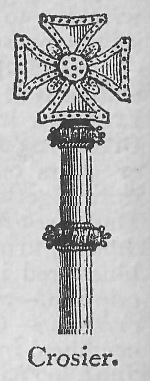
Crosier, Crozier, krō′zhėr, n. a cross mounted on a staff, borne before archbishops and patriarchs—often confounded with the pastoral staff.—adj. Crō′siered. [O. Fr. crocier—Late L. crociarius—L. crux, a cross.]
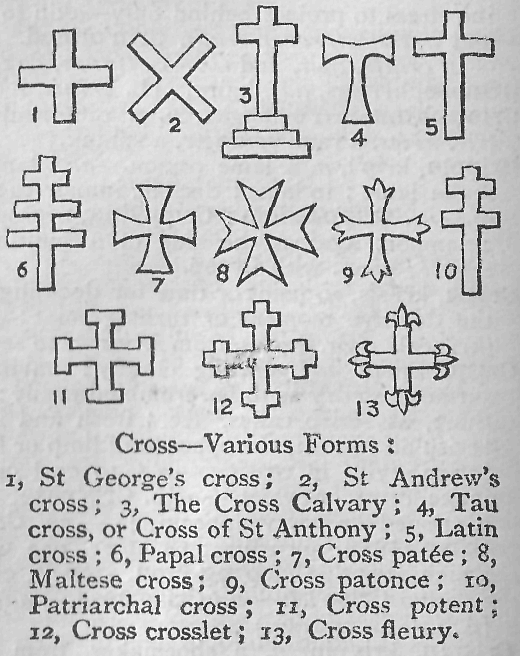
Cross, kros, n. a gibbet on which malefactors were hung, consisting of two pieces of timber, one placed crosswise on the other, either thus or : the instrument on which Christ suffered, and thus the symbol of the Christian religion: the sufferings of Christ: the atonement effected by these: a representation of the cross, a staff surmounted by a cross, a monument, model, or ornament in the form of a cross, esp. that in this form in the centre of a town at which proclamations are made, &c.: (Scot.) a signal or call to arms sent throughout a district, being a cross of two sticks charred and dipped in blood (Fiery cross): the transverse part of an anchor, or the like: a surveyor's cross-staff: anything that crosses or thwarts: a crossing or crossway: adversity or affliction in general.—v.t. to mark with a cross, or to make the sign of the cross.—ns. Cross′-aisle, a transept aisle of a cruciform church; Cross′-bear′er, one who carries a cross in a procession; Cross′-bun, a bun marked with the form of a cross, eaten on Good-Friday; Cross′ing, the making the sign of the cross; Cross′-stitch, a double stitch in the form of a cross; Cross′let, a little cross.—Crost, obsolete pa.p. of Cross.—Cross-and-pile, the obverse and reverse side of a coin, head and tail; Cross of Calvary, the Latin cross or cross of crucifixion elevated on three steps; Cross of Jerusalem, one having each arm capped by a cross-bar; Cross of Lorraine, a cross with two horizontal arms, combining the Greek and Latin crosses; Cross of St James, a Latin cross figured as a sword; Cross of St Patrick, the saltier cross of Ireland (red on a white ground).—Cross one's mind, to flash across the mind; Cross the path of any one, to thwart him.—Ansate cross (crux ansata), a common symbol of immortality in ancient Egypt; Archiepiscopal cross, the pastoral staff surmounted by a cross; Buddhist cross, the gammadion or fylfot, with returned arms, a symbol found in prehistoric remains in Italy and elsewhere; Capital cross, a Greek cross having each extremity terminated in an ornament like a Tuscan capital; Capuchin-cross, a cross having each arm terminated by a ball; Celtic cross, a type of cross found in Ireland and in the north and west of Scotland, varying from a cross incised on a flat slate to an elaborate cruciform monument—some crosses of this type show Scandinavian workmanship, and hence are often called Runic crosses; Greek cross, an upright cross with limbs of equal length—the well-known Cross of St George (red on a white ground); Latin cross (crux immissa), an upright cross having the lower limb longer than the others; Maltese cross, the badge of the knights of Malta, converging to a point in the centre, with two points to each limb; Norman cross, an elaborate memorial cross like a Gothic turret set on the ground, or on the base of a few steps, with niches for figures and pinnacles; Patriarchal cross, a cross with two horizontal bars; Rouen cross, a cross in fretwork, as a brooch or pendant; St Andrew's cross (crux decussata), or Cross saltier, a cross of two shafts of equal length crossed diagonally at the middle—the saltier cross of Scotland (white on a blue ground); St Anthony's cross (crux commissa), shaped like a ; Southern cross, a constellation in the Antarctic region where the stars are in the form of a cross. [O. Fr. crois (Fr. croix)—L. cruc-em, orig. an upright post to which latterly a cross-piece was added.]