LIST OF ABBREVIATIONS USED IN THIS DICTIONARY. (continued 16)
Reading edition


Cross, kros, adj. lying across: transverse: oblique: opposite: adverse: ill-tempered: interchanged: dishonest: balancing, neutralising.—adv. across.—n. a crossing or mixing of breeds, esp. of cattle: something intermediate in character between two other things: dishonest practices, esp. in a sporting contest when one of the parties corruptly allows himself to be beaten.—v.t. to lay one body or draw one line across another: to cancel by drawing cross lines: to pass from side to side: to write across a bank-cheque the name of a banking company, or simply '& Co.' between the lines, to be filled up with the name of a banking company, through whom alone it may be paid: to obstruct: to thwart: to interfere with.—v.i. to lie or be athwart: to move or pass from place to place.—n. Cross′-ac′tion (law), an action brought by the defender against the pursuer in the same cause.—adjs. Cross′-armed, having the arms crossed: (bot.) brachiate; Cross′-band′ed, having the grain of the veneer run across that of the rail—of a hand-rail.—n. Cross′-bar, a transverse bar: a kind of lever.—adj. Cross′-barred.—ns. Cross′-beam, a large beam stretching across a building and serving to hold its sides together; Cross′-bench, in the House of Lords, certain benches so placed, on which independent members sometimes sit; Cross′-bill, a bill brought by the defendant in a Chancery suit against the plaintiff; Cross′-bill, a genus of birds resembling bullfinches, linnets, &c., with the mandibles of the bill crossing each other near the points; Cross′-birth, a birth in which the child lies transversely in the uterus.—v.t. Cross′bite, to bite the biter.—n.pl. Cross′-bones, a figure of two thigh-bones laid across each other—together with the skull, a conventional emblem of death.—ns. Cross′bow, a weapon for shooting arrows, formed of a bow placed crosswise on a stock; Cross′bower, -bowman, one who uses a crossbow.—adj. Cross′-bred.—ns. Cross′-breed, a breed produced by the crossing or intermixing of different races; Cross′-breed′ing; Cross′-butt′ock, a particular throw over the hip in wrestling; Cross′-cheque (see Cheque).—adj. Cross′-coun′try, across the fields rather than by the road.—n. Cross′-cut, a short road across from one point to another.—v.t. to cut across.—ns. Cross′cut-saw, a large saw worked by two men, one at each end, for cutting beams crosswise; Cross′-divi′sion, the division of any group into divisions that cut across each other and produce confusion.—adj. Crossed, marked by a line drawn crosswise, often denoting cancellation: folded: cruciate.—n. Cross′-examinā′tion.—v.t. Cross′-exam′ine, to test the evidence of a witness by subjecting him to an examination by the opposite party.—adj. Cross′-eyed, having a squint.—ns. Cross′-fertilisā′tion, the fecundation of a plant by pollen from another; Cross′-fire (mil.), the crossing of lines of fire from two or more points; Cross′-gar′net, a T-shaped hinge.—adjs. Cross′-gar′tered (Shak.), wearing the garters crossed on the leg; Cross′-grained, having the grain or fibres crossed or intertwined: perverse: contrary: intractable.—ns. Cross′-grain′edness; Cross′-guard, the bar, at right angles to the blade, forming the hilt-guard of a sword; Cross′-hatch′ing, the art of shading by parallel intersecting lines; Cross′-head, a beam across the head of something, esp. the bar at the end of the piston-rod of a steam-engine; Cross′ing, act of going across: the place where a roadway, &c. may be crossed: intersection: act of thwarting: cross-breeding.—adj. Cross′-legged, having the legs crossed.—adv. Cross′ly.—ns. Cross′ness; Cross′-patch, an ill-natured person; Cross′-piece, a piece of material of any kind crossing another: (naut.) a timber over the windlass, with pins for belaying the running rigging; Cross′-pur′pose, a contrary purpose: contradictory conduct or system: an enigmatical game; Cross′-quar′ters, an ornament of tracery like the four petals of a cruciform flower: a quatrefoil.—v.t. Cross′-ques′tion, to question minutely, to cross-examine.—ns. Cross′-ref′erence, a reference in a book to another title or passage; Cross′-road, a road crossing the principal road, a bypath; Cross′-row (same as Christ-cross-row); Cross′-sea, a sea that sets at an angle to the direction of the wind; Cross′-sill, a railroad sleeper lying under the rails transversely as a support to the stringer; Cross′-spring′er, a cross-rib in a groined vault; Cross′-staff, a surveying instrument consisting of a staff surmounted with a brass circle divided into four equal parts by two intersecting lines; Cross′-stone, chiastolite: staurolite: harmotome; Cross′-tie, in a railroad, a timber placed under opposite rails as a support; Cross′-tin′ing, a mode of harrowing crosswise.—n.pl. Cross′trees, pieces of timber placed across the upper end of the lower-masts and top-masts of a ship.—ns. Cross′-vault′ing, vaulting formed by the intersection of two or more simple vaults; Cross′way, a way that crosses another; Cross′-wind, an unfavourable wind, a side-wind.—adv. Cross′wise, in the form of a cross: across.—Cross as two sticks, particularly perverse and disagreeable.—Cross the path of any one, to thwart him; Cross one's mind, to flash across the mind.
Crosse, kros, n. the implement used in lacrosse.
Crossette, kro-set′, n. a small projecting part of an impost-stone at the extremity of an arch: a shoulder in an arch-stone fitting into the stone next to it. [Fr.]
Crotalaria, krō-ta-lā′ri-a, n. a genus of Leguminosæ, the rattlewort. [Gr. krotalon, a rattle.]
Crotalidæ, krō-tal′i-dē, n.pl. a family of venomous serpents, including rattlesnakes, copper-heads, &c.
Crotalo, krō′ta-lō, n. a Turkish musical instrument, like the ancient cymbalum.
Crotch, kroch, n. a fork, as of a tree: the bifurcation of the human body.—adj. Crotched. [Ety. obscure.]
Crotchet, kroch′et, n. a hook: a note in music, equal to half a minim, : a crooked or perverse fancy: a whim, or conceit.—adjs. Crotch′eted, Crotch′ety, having crotchets or peculiarities: whimsical.—n. Crotch′eteer, a crotchety person. [Fr. crochet, dim. of croche, a hook. See Crochet.]

Croton, krō′ton, n. a genus of tropical plants, producing a brownish-yellow oil, having a hot, biting taste.—ns. Crō′tonate, a salt formed by the union of crotonic acid with a base; Crō′ton-oil, a powerful purgative oil, expressed from the seeds of the Croton tiglium, also used externally.—Croton′ic acid, an acid obtained from croton-oil. [Gr. krotōn, a tick or mite, which the seed of the plant resembles.]
Crottles, krot′ls, n.pl. lichens used for dyeing. [Gael. crotal.]
Crouch, krowch, v.i. to squat or lie close to the ground: to cringe: to fawn. [Possibly crook.]
Crouched-friars = Crutched-friars. See Crutch.
Crouch-ware, krowch′-wār, n. a finely finished pottery made with an admixture of pipe-clay in Shropshire: the famous salt-glazed stoneware made at Burslem.
Croup, krōōp, n. a severe disease in the throat of children, accompanied by a hoarse cough.—v.i. to cry or speak hoarsely.—n. Croup′iness.—adjs. Croup′ous, Croup′y. [A.S. kropan, to cry; Scot. roup, croup, hoarseness; from the sound.]
Croup, krōōp, n. the rump of a horse: the place behind the saddle.—n. Croup′on (obs.), the croup: the human buttocks. [Fr. croupe, a protuberance; allied to Crop.]
Croupade, kroo-pād′, n. in the manège, a leap in which the horse draws up his hind-legs toward the belly. [Fr.]
Crouper, krōōp′ėr, n. obsolete form of Crupper.
Croupier, krōō′pi-ėr, n. one who sits at the lower end of the table as assistant-chairman at a public dinner: a vice-president: he who watches the cards and collects the money at the gaming-table. [Fr., 'one who rides on the croup.']
Crouse, krōōs, adj. (Scot.) lively, pert.—adv. boldly, pertly.—adv. Crouse′ly. [M. E. crūs; cf. Ger. kraus, Dut. kroes, crisp, cross.]
Crout, krowt, n. See Sauer-kraut.
Crow, krō, n. a large bird, generally black, of the genus Corvus, which includes magpies, nut-crackers, jays, choughs, &c.: the cry of a cock: a crow-bar.—v.i. to croak: to cry as a cock, in joy or defiance: to boast, swagger (with over):—pa.t. crew (krōō) or crowed; pa.p. crowed.—ns. Crow′-bar, a large iron bar mostly bent at the end, to be used as a lever; Crow′-berr′y, a small creeping shrub, producing small black berries; Crow′-flow′er (Shak.), perhaps the same as Crow′foot, a common weed, the flower of which is like a crow's foot, the buttercup: crow's-foot: a number of lines rove through a long wooden block, supporting the backbone of an awning horizontally; Crow′-keep′er (Shak.), a scarecrow; Crow′-quill, a pen made of the quill of a crow, &c., for fine writing or etching; Crow's′-bill, Crow′-bill (surg.), a kind of forceps for extracting bullets, &c., from wounds; Crow's′-foot, one of the wrinkles produced by age, spreading out from the corners of the eyes: (mil.) a caltrop; Crow's′-nest (naut.), a shelter at the top-gallant mast-head of whalers for the man on the lookout.—n.pl. Crow′-steps (see Corbie).—n. Crow′-toe (Milt.), probably the same as Crowfoot.—As the crow flies, in a straight line; Eat crow, or boiled crow, to be forced to do something very disagreeable; Have a crow to pluck with, to have something to settle with some one. [A.S. crawe, a crow, crawan, to cry like a cock; imit.]
Crowd, krowd, n. a number of persons or things closely pressed together, without order: the rabble: multitude.—v.t. to gather into a lump or crowd: to fill by pressing or driving together: to compress.—v.i. to press on: to press together in numbers: to swarm.—p.adj. Crowd′ed.—Crowd sail, to carry a press of sail for speed. [A.S. crúdan, to press.]
Crowd, krowd, n. (obs.) an ancient musical instrument of the nature of the violin.—n. Crowd′er (obs.), a fiddler. [W. crwth, a hollow protuberance, a fiddle; Gael., Ir. cruit.]
Crowdie, krowd′i, n. a mixture of meal and water: (Scot.) brose. [Der. unknown.]
Crown, krown, n. the diadem or state-cap of royalty: regal power: the sovereign: honour: reward, as the 'martyr's crown:' the top of anything, esp. of the head: completion: accomplishment; a coin stamped with a crown, esp. the silver 5s. piece—used also as the translation of the old French écu, worth from six francs (or livres) to three francs: a size of paper, because originally water-marked with a crown: (archit.) a species of spire or lantern, formed by converging flying-buttresses.—v.t. to cover or invest with a crown: to invest with royal dignity: to adorn: to dignify: to complete happily.—ns. Crown′-ag′ent, a solicitor in Scotland who prepares criminal prosecutions; Crown′-ant′ler, the uppermost antler of the horn of a stag; Crown′-col′ony, a colony whose administration is directly under the home government; Crown Derby porcelain (see Porcelain).—p.adj. Crowned, having or wearing a crown: rewarded: consummated.—ns. Crown′er (Shak.), a corruption of coroner; Crown′et, a coronet: (Shak.) that which crowns or accomplishes; Crown′-glass, a kind of window-glass formed in circular plates or discs; Crown′-impē′rial, a plant, a species of fritillary; Crown′ing.—n.pl. Crown′-jew′els, jewels pertaining to the crown or sovereign.—ns. Crown′-land, land belonging to the crown or sovereign; Crown′-law′yer, the lawyer who acts for the crown in criminal cases.—adj. Crown′less.—ns. Crown′let, a small crown; Crown′-liv′ing, a church living in the gift of the crown; Crown-office, the office for the business of the crown side of the King's Bench: the office in which the great seal is affixed; Crown′-pā′per, in England, a printing-paper of the size 15 × 20 in.: in America, a writing-paper 15 × 19 in.; Crown′-post, the same as King-post (q.v.); Crown′-prince, the prince who succeeds to the crown; Crown′-saw, a circular saw made by cutting teeth round a cylinder; Crown′-wheel, a wheel resembling a crown, with teeth or cogs set at right angles to its plane; Crown′-wit′ness, a witness for the crown in a criminal prosecution instituted by it; Crown′work (fort.), an outwork composed of a bastion between two curtains, with demi-bastions at the extremes.—Crown of the causeway, the middle of the street. [O. Fr. corone (Fr. couronne)—L. corona; cf. Gr. korōnos, curved.]
Croze, krōz, n. the groove in the staves of a cask in which the edge of the head is set.
Crozier. See Crosier.
Crucial, krōō′shi-al, adj. testing, searching, from the practice of marking a testing instance with a cross to draw attention to it.—adj. Cru′ciāte (bot.), arranged in the form of a cross, as leaves or petals. [Fr. crucial, from L. crux, crucis, a cross.]
Crucian, Crusian, kroo′shi-an, n. the German carp, having no barbels.
Crucible, krōō′si-bl, n. an earthen pot for melting ores, metals, &c. [Low L. crucibulum, most prob. from L. crux.]
Cruciferæ, kroo-sif′ėr-ē, n. a natural order of exogenous plants (many edible), having a corolla of four petals arranged in the form of a cross.—n. Cruc′ifer, a cross-bearer in a procession.—adj. Crucif′erous (bot.), bearing four petals in the form of a cross. [L. crux, crucis, a cross, ferre, to bear.]
Crucify, krōō′si-fī, v.t. to put to death by fixing the hands and feet to a cross: to subdue completely: to mortify: to torment:—pa.p. cru′cified.—ns. Crucifī′er, one who crucifies; Cru′cifix, a figure or picture of Christ fixed to the cross; Crucifix′ion, death on the cross, esp. that of Christ.—adjs. Cru′ciform, in the form of a cross; Crucig′erous, bearing a cross. [O. Fr. crucifier—L. crucifigĕre, crucifixum—crux, and figĕre, to fix.]
Crude, krōōd, adj. raw, unprepared: not reduced to order or form: unfinished: undigested: immature.—adv. Crude′ly.—ns. Crude′ness; Crud′ity, rawness: unripeness: that which is crude.—adj. Crud′y (Shak.), crude, raw. [L. crudus, raw.]
Cruel, krōō′el, adj. disposed to inflict pain, or pleased at suffering: void of pity, merciless, savage: severe.—adj. Cru′el-heart′ed, delighting in cruelty: hard-hearted: unrelenting.—adv. Cru′elly.—ns. Cru′elness (obs.); Cru′elty. [Fr. cruel—L. crudelis.]
Cruet, krōō′et, n. a small jar or phial for sauces and condiments.—n. Cru′et-stand, a stand or frame for holding cruets. [Acc. to Skeat, prob. formed from Dut. kruik, a jar = Eng. crock; and acc. to E. Müller, dim. of O. Fr. cruye (mod. Fr. cruche, cruchette, a jar), from root of crock.]
Cruise, krōōz, v.i. to sail to and fro: to rove on the sea.—n. a sailing to and fro: a voyage in various directions in search of an enemy, or for the protection of vessels.—n. Cruis′er. [Dut. kruisen, to cross—kruis, a cross.]
Cruisie. See Crusie.
Cruisken, kroos′ken, n. (Ir.) a small bottle.—Also Cruis′keen.
Cruive, Cruve, krōōv, n. (Scot.) a sty, hovel: a wattled hedge built on tidal flats for catching fish.
Cruller, krul′ėr, n. a cake cut from rolled dough made of eggs, butter, sugar, flour, &c., fried crisp in boiling lard. [Cf. Dut. krullen, to curl.]
Crumb, krum, n. a small bit or morsel of bread: a small particle of anything: the soft part of bread.—v.t. to break into crumbs: to fill with crumbs.—ns. Crumb′-brush, a brush for sweeping crumbs off the table; Crumb′-cloth, a cloth laid under a table to keep falling crumbs from the carpet.—adjs. Crumb′y, Crum′my, in crumbs: soft. [A.S. cruma; Dut. kruim; Ger. krume; allied to crimp.]
Crumble, krum′bl, v.t. to break into crumbs: to scatter in crumbs.—v.i. to fall into small pieces: to decay.—n. a crumb: that which crumbles easily.—adj. Crumb′ly, apt to crumble, brittle. [Orig. dim. of Crumb; Dut. kruimelen; Ger. krümeln.]
Crumenal, krōō′me-nal, n. (Spens.) a purse. [From L. crumena, a purse.]
Crump, krump, adj. crooked: wrinkled.—ns. Crum′my, a cow with a crumpled horn; Crump′et, a kind of crumby or soft cake or muffin.—adj. Crump′y, crump: easily broken. [A.S. crump—crumb, crooked; Ger. krumm. Cf. Cramp, Crimp.]
Crumple, krump′l, v.t. to contort: to mark with or draw into folds or wrinkles: to crease.—v.i. to become wrinkled: to contract or shrink.—adj. Crump′led.—n. Crump′ling. [Formed from Crump.]
Crunch, krunsh, v.t. to crush with the teeth: to chew anything hard, and so make a noise.—n. the act of crunching. [From the sound; cf. Fr. grincer.]
Crunkle, krunk′l, v.i. to crumple.
Crunt, krunt, n. (Scot.) a blow on the head.
Cruor, krōō′or, n. coagulated blood.—n. Cru′orine, the red colouring matter of blood corpuscles.
Crup, krup, adj. (prov.) brittle.
Crupper, krup′ėr, n. a strap of leather fastened to the saddle and passing under the horse's tail to keep the saddle in its place: the hind part of a horse. [Fr. cropière—crope, the croup.]
Crural, krōō′ral, adj. belonging to or shaped like a leg. [L. cruralis, from crus, cruris, the leg.]
Crusade, kroo-sād′, n. a military expedition under the banner of the cross to recover the Holy Land from the Turks: any daring or romantic undertaking.—v.i. to go on a crusade.—n. Crusad′er, one engaged in a crusade. [Fr. croisade—Prov. crozada—croz, a cross—L. crux, a cross.]
Crusado, kroo-sā′do, n. a Portuguese coin, so called because marked with a cross. [Port. cruzado.]
Cruse, krōōz, n. an earthen pot: a small cup or bottle. [Cf. Ice. krus; Dan. kruus; Ger. krause.]
Cruset, krōō′set, n. a goldsmith's crucible. [Fr. creuset.]
Crush, krush, v.t. to break or bruise: to squeeze together: to beat down or overwhelm: to subdue: to ruin.—v.i. to become broken under pressure.—n. a violet squeezing: a vast crowd of persons or things.—adj. Crushed, broken by pressure: subdued: oppressed.—ns. Crush′er, he who, or that which, crushes or subdues: (slang) a policeman; Crush′-hat, a hat so constructed as to collapse and become flat: an opera-hat.—adj. Crush′ing, bruising: overwhelming.—adv. Crush′ingly.—n. Crush′-room, a room in a theatre, &c., where the audience may promenade during the intervals of the entertainment.—Crush a cup, to empty a cup: to quaff.—Crushed strawberry, of the colour of strawberries that have been crushed. [O. Fr. croissir; per. cog. with Mid. High Ger. krosen, to crunch.]
Crusie, Crusy, krōōz′i, n. (Scot.) a lamp which burns oil. [From Cruset.]
Crust, krust, n. the hard rind or outside coating of anything: the outer part of bread: covering of a pie, &c.: (geol.) the solid exterior of the earth.—v.t. to cover with a crust or hard case.—v.i. to gather into a hard crust.—adj. Crustāt′ed, covered with a crust.—n. Crustā′tion, an adherent crust.—adv. Crust′ily.—n. Crust′iness.—adj. Crust′y, of the nature of or having a crust, as port or other wine: having a hard or harsh exterior: hard: snappy: surly. [O. Fr.,—L. crusta, rind.]
Crusta, krus′ta, n. something, as a gem, prepared for inlaying: a hard coating: a cocktail served in a glass, its rim encrusted in sugar:—pl. Crustæ (ē).
Crustacea, krus-tā′shi-a, n.pl. a large class of Arthropod animals, almost all aquatic, including crabs, lobsters, shrimps, sand-hoppers, wood-lice, water-fleas, barnacles, acorn-shells, &c.—n. Crustā′cean, one of the crustacea.—adj. Crustaceolog′ical.—ns. Crustaceol′ogist; Crustaceol′ogy, the science which treats of the crustacea.—adjs. Crustā′ceous, Crustā′cean, pertaining to the crustacea, or shellfish.
Crut, krut, n. (prov.) a dwarf.
Crutch, kruch, n. a staff with a cross-piece at the head to place under the arm of a lame person: any support like a crutch.—v.t. to support: to prop.—v.i. to go on crutches.—adj. Crutched, marked by the sign of or wearing a cross.—n.pl. Crutched′-frī′ars, an order of friars so called from the sign of the cross which they wore—Crouched- or Crossed-friars. [From root of Crook; perh. modified by L. crux.]
Crux, kruks, n. a cross: (fig.) something that occasions difficulty. [L. crux, a cross.]
Crwth, kröth, n. an old Welsh stringed instrument, four of its six strings played with a bow, two twitched by the thumb. [W.]
Cry, krī, v.i. to utter a shrill loud sound, esp. one expressive of pain or grief: to lament: to weep: to bawl.—v.t. to utter loudly: to proclaim or make public:—pa.t. and pa.p. cried.—n. any loud sound, esp. of grief or pain: a fit of weeping: a pack of hounds, hence of people: particular sound uttered by an animal: bawling: lamentation: prayer: clamour:—pl. Cries.—ns. Crī′er; Cry′ing, act of calling loudly: weeping.—adj. calling loudly: claiming notice: notorious.—Cry against, to protest against; Cry down, to condemn: to decry; Cry off, to withdraw from a bargain; Cry on, to call upon: to invoke; Cry up, to praise: extol.—A far cry, a great distance; Great cry and little wool, appearance without reality: much ado about nothing; Hue and cry (see Hue); In full cry, in full pursuit, used of dogs in hunt; Within cry of, within hearing distance. [Fr. crier—L. quiritāre, to scream—freq. of L. queri, to lament.]
Cryolite, krī′o-līt, n. a mineral found on the coast of Greenland, consisting mainly of a fluoride of aluminium in combination with fluoride of sodium. [Gr. kryos, frost, and lithos, a stone.]
Cryophorus, krī-of′o-rus, n. an instrument for showing the decrease of temperature in water by evaporation. [Gr. kryos, frost, and pherein, to bear.]
Crypt, kript, n. an underground cell or chapel, esp. one used for burial.—adjs. Cryp′tic, -al, hidden: secret: unseen. [L. crypta—Gr. kryptē—kryptein, to conceal. Doublet of Grot.]
Cryptogamia, krip-to-gā′mi-a, n. the class of flowerless plants, or those which have their fructification concealed.—n. Cryp′togam.—adjs. Cryptogā′mian, Cryptogam′ic, Cryptog′amous.—ns. Cryptog′amist; Cryptog′amy. [Gr. kryptos, concealed, and gamos, marriage.]
Cryptogram, krip′tō-gram, n. a cryptograph.—ns. Cryptad′ia, things to be kept secret; Cryptol′ogy, secret language; Cryp′tonym, a secret name.
Cryptography, krip-tog′ra-fi, n. the art of secret writing: the character or cipher so used.—ns. Crypt′ograph; Cryptog′rapher.—adjs. Cryptograph′ic, -al. [Gr. kryptos, secret, and graphein, to write.]
Crystal, kris′tal, n. a superior kind of quartz, clear like ice: (chem.) a piece of matter which has assumed a definite geometrical form, with plane faces.—adjs. Crys′tal, Crys′tallīne, consisting of or like crystal in clearness, &c.; Crys′talform; Crys′tallīsable, capable of being crystallised or formed into crystals.—n. Crystallīsā′tion, the act of crystallising.—v.t. Crys′tallīse, to reduce to the form of a crystal.—v.i. to assume a crystalline form.—ns. Crys′tallite; Crystallogen′esis.—adj. Crystallogen′ic.—n. Crystallog′rapher, one skilled in crystallography.—adj. Crystallograph′ic—n. Crystallog′raphy, the science of crystallisation.—adj. Crys′talloid, having the form of a crystal.—n. a name given by Graham to a class of substances which when in solution pass easily through membranes.—n. Crys′tallomancy, a mode of divination by means of transparent bodies. [O. Fr. cristol—L. crystallum—Gr. krystallos, ice—kryos, frost.]
Ctenoid, tē′noid, adj. comb-shaped, applied by Agassiz to the scales and fins of certain fishes, as the perch, &c.—adj. and n. Ctenoid′ean. [Gr. kteis, ktenos, a comb, eidos, form.]
Ctenophora, ten-of′o-ra, n.pl. a sub-class of Cœlenterates—beautifully delicate, free-swimming marine organisms, generally globular, moving by means of comb-like plates. [Gr. kteis, ktenos, a comb, pherein, to carry.]
Cub, kub, n. the young of certain animals, as foxes, &c.: a whelp: a young boy or girl (in contempt).—v.i. to bring forth young:—pr.p. cub′bing; pa.p. cubbed.—adjs. Cub′bish, like a cub: awkward; Cub′-drawn (Shak.), drawn or sucked by cubs.—n. Cub′hood.—adj. Cub′less, without cubs. [Prob. Celt., as Ir. cuib, a whelp, from cu, a dog.]
Cub, kub, n. a cattle-pen: chest.
Cuban, kū′ban, n. a native of the island of Cuba in the West Indies.—adj. pertaining to Cuba.
Cube, kūb, n. a solid body having six equal square faces, a solid square: the third power of a number, as—2 × 2 × 2 = 8.—v.t. to raise to the third power.—ns. Cū′bage, Cubā′tion, Cū′bature, the act of finding the solid or cubic content of a body: the result thus found.—adjs. Cū′bic, -al, pertaining to a cube: of the third power or degree: solid.—adv. Cū′bically.—n. Cū′bicalness, state or quality of being cubical.—adjs. Cū′biform; Cū′boid, Cuboid′al, resembling a cube in shape.—Cube root, the number or quantity that produces a given cube by being raised to the third power—thus 2 is the cube root of 8. [Fr.,—L. cubus—Gr. kybos, a die.]
Cubeb, kū′beb, n. the dried berry of Piper cubeba, a climbing shrub, native to Sumatra—useful as a stomachic and carminative in indigestion, for piles and for sore throats.—n. Cubeb′in, a crystallising substance in cubebs. [Fr. cubèbe—Ar. kabābah.]
Cubica, kū′bi-ka, n. a fine worsted for linings.
Cubicle, kū′bi-kl, n. a bedroom.
Cubit, kū′bit, n. a measure employed by the ancients, equal to the length of the arm from the elbow to the tip of the middle-finger, from 18 to 22 inches—also Cū′bitus.—adj. Cū′bital, of the length of a cubit. [L. cubitum, the elbow; cf. L. cubāre, to lie down.]
Cucking-stool, kuk′ing-stōōl, n. a stool in which scolds and other culprits were placed, usually before their own door, to be pelted by the mob. [Mentioned in Domesday Book as in use in Chester, and called cathedra stercoris. From an obs. word cuck, to ease one's self; cf. Ice. kúka.]
Cuckold, kuk′old, n. a man whose wife has proved unfaithful.—v.t. to wrong (a husband) by unchastity.—v.t. Cuck′oldise, to make a cuckold.—adv. Cuck′oldly (Shak.).—ns. Cuck′old-mak′er; Cuck′oldom, state of a cuckold: act of adultery; Cuck′oldry, adultery. [O. Fr. cucuault—cucu, cuckoo.]
Cuckoo, kook′kōō, n. a bird which cries cuckoo, remarkable for laying its eggs in the nests of other birds.—ns. Cuck′oo-bud (Shak.), name of a plant; Cuck′oo-clock, a clock in which the hours are told by a cuckoo-call; Cuck′oo-flow′er, a species of Cardamine—called also Lady's Smock; Cuck′oo-pint, the Wake-robin, Arum maculatum; Cuck′oo-spit, -spit′tle, a frothy spittle, made by many insects parasitic on plants, surrounding the larvæ and pupæ.
Cucullate, -d, kū′kul-lāt, -ed, adj. hooded: shaped like a hood. [L. cucullatus—cucullus, a hood.]
Cucumber, kū′kum-bėr, n. a creeping plant, with heart-shaped leaves, rough with bristly hairs, and large oblong fruit used as a salad and pickle—a native of southern Asia.—adj. Cucum′iform. [L. cucumis, cucumeris.]
Cucurbit, kū′kur-bit, n. a chemical vessel used in distillation, originally shaped like a gourd.—adjs. Cucur′bital, Cucurbitā′ceous, pertaining to the Cucurbitaceæ, mostly herbaceous climbers, as the gourd, melon, &c.; Cucur′bitive, like a gourd-seed. [Fr. cucurbite—L. cucurbita, a gourd.]
Cud, kud, n. the food brought from the first stomach of a ruminating animal back into the mouth and chewed again.—n. Cud′weed, the popular name for many species of plants covered with a cottony down.—Chew the cud, to meditate. [A.S. cwidu.]
Cudbear, kud′bār, n. a purple or violet coloured powder prepared from a lichen, used in dyeing. [A corr. of Cuthbert—from Dr Cuthbert Gordon, who first made it an article of commerce.]
Cuddle, kud′l, v.t. to hug: to embrace: to fondle.—v.i. to lie close and snug together.—n. a close embrace. [Perh. a freq. of M. E. couth, cosy.]
Cuddy, kud′i, n. a small cabin or cookroom, in the fore-part of a boat or lighter: in large vessels, the officers' cabin under the poopdeck. [Origin uncertain; cf. Fr. cahute; Dut. kajuit; Ger. kajüte.]
Cuddy, kud′i, n. the right of a lord to entertainment from his tenant: rent: (Spens.) Cuddeehih. [Corr. of Ir. cuid oidhche—cuid, a share, oidhche, night.]
Cuddy, Cuddie, kud′i, n. a donkey: (Scot.) a stupid person. [Perh. formed from Cuthbert.]
Cudgel, kud′jel, n. a heavy staff: a club.—v.t. to beat with a cudgel:—pr.p. cud′gelling; pa.p. cud′gelled.—ns. Cud′geller; Cud′gelling.—adj. Cud′gel-proof, not to be hurt by beating.—Take up the cudgels, to engage in a contest. [A.S. cycgel.]
Cue, kū, n. the last words of an actor's speech serving as a hint to the next speaker: any hint: the part one has to play. [Acc. to some from Fr. queue, tail, as the ending words of the last speech; in 17th cent. written Q, and derived from L. quando, 'when,' i.e. when the actor was to begin.]
Cue, kū, n. a twist of hair at the back of the head: a rod used in playing billiards.—v.t. of the hair, to form in a cue. [Fr. queue—L. cauda, a tail.]
Cuff, kuf, n. a stroke with the open hand.—v.t. to strike with the open hand: to beat. [Origin obscure; cf. Sw. kuffa, to knock.]
Cuff, kuf, n. the end of the sleeve near the wrist: a covering for the wrist: a handcuff (q.v.). [Prob. cog. with Coif.]
Cuff, kuf, n. Scotch form of Scruff.—Cuff of the neck. See Scruff.
Cuffin, kuf′in, n. a man: a justice of the peace. [Thieves' slang.]
Cufic, kūf′ik, adj. of or pertaining to Cufa, esp. applied to the kind of writing of the scholars of Cufa in Asiatic Turkey, seat of the most expert copyists of the Koran.
Cuirass, kwi-ras′, or kū-, n. a defensive covering for the breast and back, of leather or iron fastened with straps and buckles, &c.—v.t. to furnish with such.—n. Cuirassier′, a horse-soldier armed with such. [Fr. cuirasse—cuir, leather—L. corium, skin leather.]
Cuir-bouilli, kwēr-bōō′lyi, n. leather softened by boiling, then dried, retaining the impressions made on it.—Also Cuir-bouilly.
Cuisine, kwe-zēn′, n. a kitchen or cooking department: cookery.—n. Cuisin′ier, a cook. [Fr. (It. cucina)—L. coquina—coquĕre, to cook.]
Cuisse, kwis, Cuish, kwish, n. armour for the thighs, consisting of iron plates laid horizontally over each other and riveted together. [Fr. cuisse (It. coscia, the thigh)—L. coxa, the hip.]
Cuiter, küt′ėr, v.t. (Scot.) to fondle, pamper.
Cuittle, küt′l, v.t. to curry: (Scot.) to cajole.
Culch, kulch, n. (prov.) rubbish.
Culdee, kul′dē, n. one of a fraternity of monks living in Scotland in the 8th century in groups of cells. [Acc. to Reeves and Skene, the old Ir. céle dé, 'servants of God,' or 'companions of God'—Latinised by Boece into Culdei, as if cultores Dei.]
Cul-de-four, kōō-de-foor, n. (archit.) a sort of low spherical vault, oven-like.—ns. Cul-de-lampe, an ornamental design used in filling up blank spaces in a book; Cul-de-sac, a street, &c., closed at one end: a blind alley. [Fr. cul, bottom—L. culus; Fr. four, furnace, lampe, lamp, sac, sack.]
Culet, kū′let, n. the small flat surface at the back or bottom of a brilliant: the part of armour protecting the body behind, from the waist downwards—also Culette. [O. Fr., cul—L. culus, the rump.]
Culex, kū′leks, n. the typical genus of Culicidæ or gnats—adj. Culic′iform, gnat-like. [L.]
Culinary, kū′lin-ar-i, adj. pertaining to the kitchen or to cookery: used in the kitchen. [L. culinarius—culina, a kitchen.]
Cull, kul, v.t. to select, pick out.—ns. Cull′er; Cull′ing. [Fr. cueillir, to gather—L. colligĕre—col, together, legĕre, to gather. Doublet of Collect.]
Cullender. See Colander.
Cullet, kul′et, n. refuse glass.
Cullion, kul′yun, n. a wretch: a cowardly fellow.—adj. Cull′ionly (Shak.), mean, base. [Fr. couillon, a poltroon (It. coglione)—L. coleus, a leather bag.]
Cullis, kul′is, n. a gutter in a roof: a groove, as for a side-scene in a theatre. [Fr. coulisse.]
Cully, kul′i, n. a mean dupe.—v.t. to deceive meanly:—pa.p. cull′ied.—ns. Cull, a dupe; Cull′yism, state of being a cully. [Prob. a contr. of Cullion.]
Culm, kulm, n. the stalk or stem of corn or of grasses.—v.i. to form a culm.—adj. Culmif′erous, having a culm. [L. culmus, a stalk.]
Culm, kulm, n. coal-dust: name given in some parts of England to anthracite or stone-coal.—adj. Culmif′erous, producing culm. [See Coom.]
Culmen, kul′men, n. highest point: the median length-wise ridge of a bird's upper mandible. [L.]
Culminate, kul′min-āt, v.i. (astron.) to be vertical or at the highest point of altitude: to reach the highest point (with in).—adj. Cul′minant, at its highest point.—n. Culminā′tion, act of culminating: the top: (astron.) transit of a body across the meridian or highest point for the day. [Low L. culmināre, from L. culmen, properly columen, a summit.]
Culottic, kul-ot′ic, adj. wearing trousers: (Carlyle) respectable. [Fr. culotte, breeches.]
Culpable, kul′pa-bl, adj. faulty: criminal.—ns. Culpabil′ity, Cul′pableness, liability to blame.—adv. Cul′pably.—adj. Cul′patory, expressive of blame. [O. Fr. coupable—L. culpabilis—culpa, a fault.]
Culprit, kul′prit, n. one in fault: a criminal: (Eng. law) a prisoner accused but not yet tried. [From the fusion in legal phraseology of cul. (culpable, culpabilis), and prit, prist (O. Fr. prest), ready. Not culpate—law L. culpatus, a person accused.]
Cult, kult, n. a system of religious belief, worship.—Also Cult′us. [L. cultus—colĕre, to worship.]
Culter, kul′tėr, n. obsolete form of Coulter.—adjs. Cultiros′tral, Culturos′tral; Cul′trate, -d, shaped like a pruning-knife; Cul′triform, in the form of a pruning-knife: sharp-edged.
Cultism, kult′ism, n. a style of writing after the manner of Luis de Góngora y Argote (1561-1627), a Spanish lyric poet—estilo culto, being florid, pedantic, often obscure.—ns. Cult′ist, Cult′orist. [Sp. culte, elegant—L. cultus.]
Cultivate, kul′ti-vāt, v.i. to till or produce by tillage: to prepare for crops: to devote attention to: to civilise or refine.—adjs. Cul′tivable, Cultivat′able, capable of being cultivated.—ns. Cultivā′tion, the art or practice of cultivating: civilisation: refinement; Cul′tivator.—Cultivate a person's friendship, to endeavour to get his good-will. [Low L. cultivāre, -ātum—L. colĕre, to till, to worship.]
Culture, kul′tūr, n. cultivation: the state of being cultivated: refinement the result of cultivation.—v.t. to cultivate: to improve.—adjs. Cul′turable; Cul′tural.—p.adj. Cul′tured, cultivated: well educated: refined.—adj. Cul′tureless. [L. cultūra—colĕre.]
Cultus. See Cult.
Culver, kul′vėr, n. a dove: a pigeon.—n. Cul′ver-key, an herb, probably the columbine, having key-shaped flowerets.—adj. Cul′vertailed, dovetailed. [A.S. culfre, prob. from L. columba.]
Culverin, kul′vėr-in, n. one of the earlier forms of cannon of great length, generally an 18-pounder, weighing 50 cwt.—ns. Cul′verineer; Dem′i-cul′verin, a 9-pounder, weighing 30 cwt. [Fr. coulevrine, from couleuvre, a serpent.]
Culver's physic, root, n. popular name of a kind of speedwell, the rhizome of Veronica virginica, used medicinally. [Prob. from one Dr Culver.]
Culvert, kul′vėrt, n. an arched channel of masonry for carrying water beneath a road, railway, &c. [Perh. from Fr. couler, to flow—L. colāre.]
Culvertage, kul′ver-tāj, n. degradation of a vassal to the position of a serf. [O. Fr. culvert, a serf.]
Cumbent, kum′bent, adj. lying down; reclining. [L. cumbens, -entis, pr.p. of cumbĕre, to lie down.]
Cumber, kum′bėr, v.t. to trouble or hinder with something useless: to retard, trouble.—n. encumbrance: cumbering.—adj. Cum′bered, hampered: obstructed.—ns. Cum′berer; Cum′ber-ground, a useless thing, from Luke, xiii. 7.—adj. Cum′berless, unencumbered.—ns. Cum′berment, Cum′brance, encumbrance.—adjs. Cum′bersome, unwieldy: heavy; Cum′brous, hindering: obstructing: heavy.—adv. Cum′brously.—n. Cum′brousness. [O. Fr. combrer, to hinder—Low L. cumbrus, a heap; corr. of L. cumulus, a heap.]
Cumbrian, kum′bri-an, adj. (geol.) of or pertaining to a system of slaty rocks best developed in Cumberland and Westmorland, now merged in the Cambrian or Silurian system.
Cumin, Cummin, kum′in, n. an umbelliferous plant, common in Egypt, and cultivated in southern Europe and India—its seeds, resembling the caraway, valuable as carminatives. [L. cuminum—Gr. kyminon, cog. with Heb. kammôn.]
Cummer, kum′ėr, Kimmer, kim′ėr, n. a gossip: a woman: (Scot.) a girl. [Fr. commère—L. con, with, mater, mother.]
Cummerbund, kum′ėr-bund, n. a waist-belt, a sash. [Anglo-Ind.—Pers. kamarband, a loin-band.]
Cumshaw, kum′shaw, n. a gift, a tip. [Pidgin-English.]
Cumulate, kūm′ū-lāt, v.t. to heap together: to accumulate.—adjs. Cum′ulate, -d, heaped up.—n. Cumulā′tion (= Accumulation).—adj. Cum′ulative, increasing by successive additions.—adv. Cum′ulatively. [L. cumulāre, -ātum—cumulus, a heap.]
Cumulus, kū′mū-lus, n. a heap; a kind of cloud common in summer, consisting of rounded heaps with a darker horizontal base.—adjs. Cū′muliform; Cū′mulose.—n. Cū′mulo-strā′tus, a cloud looking like a combination of the cumulus and stratus. [L. cumulus, a heap, and stratus.]
Cunabula, kū-nab′ul-a, n.pl. a cradle. [L.]
Cunarder, kūn-ard′ėr, n. one of a certain line of steamships between England and America. [Founded by Sir Samuel Cunard (1787-1865).]
Cunctator, kungk-tā′tor, n. one who delays or puts off.—n. Cunctā′tion, delay.—adjs. Cunctā′tious, Cunctā′tive, Cunctā′tory, inclined to delay. [L.,—cunctāri, to delay.]
Cuneal, kū′ne-al, Cuneate, kū′ne-āt, adj. of the form of a wedge.—adjs. Cunē′iform, Cū′niform, wedge-shaped—specially applied to the old Babylonian and Assyrian writing, of which the characters have a wedge-shape. [L. cuneus, a wedge.]
Cunette. See Cuvette.
Cunning, kun′ing, adj. knowing: skilful: artful: crafty.—n. knowledge: skill: faculty of using stratagem to accomplish a purpose: artifice.—adv. Cunn′ingly.—n. Cunn′ingness, quality of being cunning: artfulness, slyness. [A.S. cunnan, to know.]
Cup, kup, n. a vessel used to contain liquid: a drinking-vessel: the liquid contained in a cup: that which we must receive or undergo: afflictions: blessings.—v.i. to extract blood from the body by means of cupping-glasses: (Shak.) to make drunk:—pr.p. cup′ping; pa.p. cupped.—ns. Cup′-bear′er, one who attends at a feast to fill out and hand the wine; Cupboard (kub′urd), a place for keeping victuals, dishes, &c.—v.t. to store.—ns. Cup′board-love, -faith, love or faith indulged in for a material end; Cup′ful, as much as fills a cup:—pl. Cup′fuls; Cup′-gall, a cup-shaped gall in oak-leaves; Cup′-lī′chen, or -moss, a species of Cladonia; Cup′man, a boon companion; Cup′per, a cup-bearer: one professionally engaged in cupping; Cup′ping, the application of cups from which the air has been exhausted to a scarified part of the skin for the purpose of drawing blood; Cup′ping-glass, a glass used in the operation of cupping; Dry′-cup′ping, the application of cups without previous scarification; Lov′ing-cup, a cup (from which all drink) passed round at the close of a feast.—Cry cupboard, to cry for food; In his cups, under the influence of liquor; Many a slip between the cup and the lip, a proverb signifying that something adverse may occur at the last moment. [A.S. cuppe (Fr. coupe, It. coppa, a cup, the head); all from L. cupa, cuppa, a tub.]
Cupel, kū′pel, n. a small vessel used by goldsmiths in assaying precious metals.—v.t. to assay in a cupel.—n. Cupellā′tion, the process of assaying precious metals. [L. cupella, dim. of cupa. See Cup.]
Cupidity, kū-pid′i-ti, n. covetousness.—n. Cū′pid, the god of love. [L. cupiditas—cupĕre, to desire.]
Cupola, kū′po-la, n. a spherical vault, or concave ceiling, on the top of a building: the internal part of a dome: a dome.—v.t. to furnish with such. [It.; dim. of Low L. cupa, a cup—L. cupa, a tub.]
Cupreous, kūp′rē-us, Cupric, kūp′rik, adj. of or containing copper.—adj. Cuprif′erous, producing copper.—n. Cū′prite, the red oxide of copper. [L. cuprum, copper, ferre, to bear.]
Cupressus, kū-pres′us, n. the cypress genus of coniferous trees. [L.]
Cupule, kū′pūl, n. (bot.) a shortened axis with a number of more or less cohering bracts enclosing the ripening fruit—also Cū′pula.—adj. Cupulif′erous, bearing cupules. [L. cupula, dim. of cupa, a tub, and ferre, to carry.]
Cur, kur, n. a worthless dog, of low breed: a churlish fellow.—adj. Cur′rish.—adv. Cur′rishly.—n. Cur′rishness. [M. E. curre; cf. Old Dut. korre, Dan. kurre, to whir.]
Curaçoa, koo-ra-sō′a, n. a liqueur so named from the island of Curaçao in the West Indies, where it was first made.—Also Curaça′o.
Curari, koo-rä′ri, n. a poison used by South American Indians for their arrows—also Cura′ra.—n. Cura′rine, a highly poisonous alkaloid extracted from curari. [From the native name.]
Curassow, kū-ras′ō, n. a large turkey-like South American bird.
Curate, kūr′āt, n. one who has the cure of souls: an inferior clergyman in the Church of England, assisting a rector or vicar.—ns. Cur′acy, Cur′ateship, the office, employment, or benefice of a curate. [Low L. curatus, from L. cura, care.]
Curator, kūr-ā′tor, n. one who has the charge of anything: a superintendent: one appointed by law as guardian: a member of a board for electing university professors and the like:—fem. Curā′trix.—n. Curā′torship, the office of a curator. [L. curator, an overseer—curāre, to cure.]
Curb, kurb, v.t. to bend to one's will: to subdue: to restrain or check: to furnish with or guide by a curb.—n. that which curbs: a check or hinderance: a chain or strap attached to the bit of a bridle for restraining the horse.—adjs. Curb′able; Curb′less.—ns. Curb′-roof, a roof whose upper rafters have a less inclination than the lower ones; Curb′stone, Kerb′stone, a stone placed edgeways against earth or stone work to check it. [Fr. courber, from L. curvus, crooked, bent.]
Curch, kurch, n. a covering for the head, a kerchief.
Curculio, kur-kū′li-o, n. the fruit-weevil. [L.]
Curcuma, kur′kū-ma, n. a genus of plants yielding turmeric.—n. Cur′cumine, the colouring matter of turmeric. [Fr.,—Ar. kurkum, saffron.]
Curd, kurd, n. milk thickened or coagulated: the cheese part of milk, as distinguished from the whey.—n. Curd′iness.—v.i. Curd′le, to turn into curd: to congeal: to thicken.—v.t. to congeal.—adj. Curd′y, like or full of curd. [Prob. Celt.; Gael. gruth, Ir. cruth.]
Cure, kūr, n. care of souls or spiritual charge: care of the sick: act of healing: that which heals: a remedy, or course of remedial treatment.—v.t. to heal: to preserve, as by drying, salting, &c.:—pr.p. cūr′ing; pa.p. cūred.—adj. Cur′able, that may be cured.—ns. Cur′ableness, Curabil′ity, quality of being curable; Cure′-all, a panacea.—adjs. Cur′ative, Cur′atory, tending to cure; Cure′less, that cannot be cured.—ns. Cur′er, one who cures: a physician; Cur′ing-house, a house or place in which anything is cured, esp. a building in which sugar is drained, as in the West Indies. [O. Fr. cure—-L. cura, care; not the same as Care.]
Curé, kū′rā, n. a parish priest in France.
Curfew, kur′fū, n. in feudal times the ringing of a bell at eight o'clock, as a signal to put out all fires and lights. [O. Fr. covrefeu; couvrir, to cover, feu, fire—L. focus.]
Curia, kū′ri-a, n. one of the ten divisions of a Roman tribe: a building in which the senate met, a provincial senate: a court, legislative or judicial: the court of the papal see.—ns. Cū′rialism; Cū′rialist.—adj. Curialist′ic. [L.]
Curiet, kū′ri-et, n. (Spens.) a cuirass.
Curio, kū′ri-o, n. any article of virtu or bric-à-brac, or anything considered rare and curious.—n. Curiō′so, a collector or admirer of curios.
Curious, kū′ri-us, adj. anxious to learn: inquisitive: showing great care or nicety: skilfully made: singular: rare.—n. Curios′ity, state or quality of being curious: inquisitiveness: that which is curious: anything rare or unusual.—adv. Cū′riously.—n. Cū′riousness.—Curious arts (B.), magical practices. [Fr. curieux—L. curiosus—cura.]
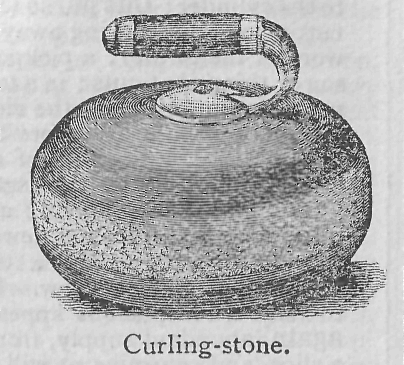
Curl, kurl, v.t. to twist into ringlets: to coil.—v.i. to shrink into ringlets: to rise in undulations: to writhe: to ripple: to play at the game of curling.—n. a ringlet of hair, or what is like it: a wave, bending, or twist.—adjs. Curled; Curled′-pate (Shak.), having curled hair.—ns. Curl′er, one who, or that which, curls: a player at the game of curling; Curl′icue, a fantastic curl; Curl′iewurlie (Scot.), any fantastic round ornament; Curl′iness; Curl′ing, a game, common in Scotland, consisting in hurling heavy smooth stones along a sheet of ice.—ns.pl. Curl′ing ī′rons, Curl′ing-tongs, an iron instrument used for curling the hair.—n. Curl′ing-stone, a heavy stone with a handle, used in curling.—adjs. Curl′y, having curls: full of curls; Curl′y-head′ed. [M. E. crull; Dut. krullen, Dan. krolle, to curl.]
Curlew, kur′lū, n. one of the wading-birds, having a very long slender bill and legs, and a short tail. [O. Fr. corlieu; prob. from its cry.]
Curmudgeon, kur-muj′un, n. an avaricious, ill-natured fellow: a miser.—adj. Curmud′geonly. [Earlier corn-mudgin; mudge, mooch; M. E. muchen—O. Fr. mucier, to hide.]
Curmurring, kur-mur′ing, n. a rumbling sound, esp. that made in the bowels by flatulence. [Imit.]
Curr, kur, v.i. to cry like an owl, to purr like a cat, &c. [Imit.]
Currach, -agh, kur′ach, n. a coracle. [Gael.]
Currant, kur′ant, n. a small kind of raisin or dried grape imported from the Levant: the fruit of several species of ribes.—ns. Curr′ant-jell′y; Curr′ant-wine. [From Corinth.]
Current, kur′ent, adj. running or flowing: passing from person to person: generally received: now passing: present.—n. a running or flowing: a stream: a portion of water or air moving in a certain direction: course.—n. Curr′ency, circulation: that which circulates, as the money of a country: general estimation.—adv. Curr′ently.—n. Curr′entness, state of being current: general acceptance.—Pass current, to be received as genuine. [L. currens, -ent-is—currĕre), to run.]
Curricle, kur-i′kl, n. a two-wheeled open chaise, drawn by two horses abreast: a chariot.—n. Curric′ulum, a course, esp. the course of study at a university. [L. curriculum, from currĕre.]
Currish, Currishly, &c. See Cur.
Curry, kur′i, n. a kind of sauce or seasoning much used in India, compounded of pepper, ginger, and other spices: a stew mixed with curry-powder.—n. Curr′y-pow′der. [Tamil kari, sauce.]
Curry, kur′i, v.t. to dress leather: to rub down and dress a horse: to beat: to scratch:—pr.p. curr′ying; pa.p. curr′ied.—ns. Curr′ier, one who curries or dresses tanned leather; Curr′y-comb, an iron instrument or comb used for currying or cleaning horses; Curr′ying.—Curry favour (corruption of Curry favell, to curry the chestnut horse), to seek favour by flattery. [O. Fr. correier (mod. corroyer), conrei, outfit, from a supposed Low L. form conredāre, con-, with, rēdāre, seen in Array.]
Curry, Currie, obsolete forms of Quarry.
Curse, kurs, v.t. to invoke or wish evil upon: to devote to perdition: to vex or torment.—v.i. to utter imprecations: to swear.—n. the invocation or wishing of evil or harm upon: evil invoked on another: torment: any great evil.—adj. Curs′ed, under a curse: blasted by a curse: hateful.—adv. Curs′edly.—ns. Curs′edness; Curs′er; Curs′ing.—adj. Curst, cursed: deserving a curse: ill-tempered: shrewish: froward.—n. Curst′ness, state of being curst: peevishness: frowardness. [A.S. cursian—curs, a curse; ety. dub.; not conn. with Cross.]
Cursitor, kur′si-tor, n. a clerk or officer in the Court of Chancery who makes out original writs. [Low L. cursitor, from the words 'de cursu,' applied in the statute to ordinary writs.]
Cursive, kur′siv, adj. written with a running hand, of handwriting: flowing.—adv. Cur′sively. [Low L. cursivus—L. currĕre, to run.]
Cursorial, kur-sō′ri-al, adj. adapted for running.—n.pl. Cursō′res, an order of birds variously limited.
Cursory, kur′sor-i, adj. hasty: superficial: careless.—adj. Cur′sorary (Shak.), cursory.—adv. Cur′sorily.—n. Cur′soriness. [L. currĕre, cursum, to run.]
Curst. See Curse.
Cursus, kur′sus, n. a race-course: a form of daily prayer or service; an academic curriculum. [L.]
Curt, kurt, adj. short: concise: discourteously brief or summary.—adj. Curt′āte, shortened or reduced; applied to the distance of a planet from the sun or earth reduced to the plane of the ecliptic.—n. Curtā′tion.—adv. Curt′ly.—n. Curt′ness. [L. curtus, shortened.]
Curtail, kur-tāl′, v.t. to cut short: to cut off a part: to abridge:—pr.p. curtail′ing; pa.p. curtailed′.—ns. Curtail′ment; Curtail′-step, the rounded step at the bottom of a stair. [Old spelling curtal, O. Fr. courtault (It. cortaldo)—L. curtus.]
Curtain, kur′tin, n. drapery hung round and enclosing a bed, &c.: the part of a rampart between two bastions.—v.t. to enclose or furnish with curtains.—n. Cur′tain-lec′ture, a lecture or reproof given in bed by a wife to her husband.—Behind the curtain, away from public view; Draw the curtain, to draw it aside, so as to show what is behind, or in front of anything so as to hide it. [O. Fr. cortine—Low L. cortina; prob. L. cors, cortis, a court.]
Curtal, kur′tal, n. a horse with a curt or docked tail: anything docked or cut short.—adj. docked or shortened.—n. Cur′tal-frī′ar (Scott), a friar with a short frock. [Fr. courtaud—court. See Curtail.]
Curtal-ax, kur′tal-aks, Curt-axe, kurt′aks, n. (Spens.), a short, broad sword. [A corr. of the earlier forms coutelas, curtelas. See Cutlass.]
Curtilage, kur′til-āj, n. a court attached to a dwelling-house. [O. Fr. courtillage. See Court.]
Curtsy, Curtsey, kurt′si, n. an obeisance, made by bending the knees, proper to women and children.—v.i. to make a curtsy. [See Courtesy.]
Curule, kū′rōōl, adj. applied to a chair in which the higher Roman magistrates had a right to sit. [L. curulis—currus, a chariot.]
Curve, kurv, n. anything bent: a bent or curved line: an arch.—v.t. to bend: to form into a curve.—adjs. Cur′vāte, -d, curved or bent in a regular form.—n. Curvā′tion.—adj. Cur′vative.—n. Cur′vature, a curving or bending: the continual bending or the amount of bending from a straight line.—adjs. Curved; Cur′vicaudate, having a crooked tail; Curvicos′tate, having curved ribs; Curvifō′liate, having curved leaves; Cur′viform; Cur′ving; Curviros′tral, with the bill curved downward; Cur′vital, of or pertaining to curvature.—n. Cur′vity, the state of being curved. [L. curvus, crooked.]
Curvet, kur′vet, kur-vet′, n. a light leap of a horse in which he raises his forelegs together, next the hindlegs with a spring before the forelegs touch the ground: a leap, frolic.—v.i. (kur-vet′, kur′vet) to leap in curvets: to frisk:—pr.p. curvet′ting, curvet′ing; pa.p. cur′veted. [It. corvetta, dim. of corvo—L. curvus.]
Curvilinear, kur-vi-lin′i-ar, Curvilineal, kur-vi-lin′i-al, adj. bounded by curved lines.—n. Curvilinear′ity. [L. curvus, and linearis—linea, a line.]
Cuscus, kus′kus, n. the grain of the African millet. Same as Couscous. [Fr. couscou.]
Cuscus, kus′kus, n. the fibrous root of an Indian grass, used for making fans, &c. [Pers. khas khas.]
Cushat, koosh′at, n. the ringdove or wood-pigeon. [A.S. cúscute, the former part of dub. origin, the latter derived from scéotan, to shoot.]
Cushion, koosh′un, n. a case filled with some soft, elastic stuff, for resting on: a pillow: the 'pillow' used in making bone-lace: an engraver's pad: the rubber of an electrical machine: a pad supporting a woman's hair: the elastic lining of the inner side of a billiard-table: a body of steam remaining in the cylinder of a steam-engine, acting as a buffer to the piston.—v.t. to seat on or furnish with a cushion.—p.adj. Cush′ioned, furnished with a cushion, padded: having cushion-tires.—ns. Cush′ionet, a little cushion; Cush′ion-tire, a bicycle tire made of india-rubber tubing, with india-rubber stuffing.—adj. Cush′iony, like a cushion, soft. [O. Fr. coissin—L. coxinum, coxa, hip.]
Cusk, kusk, n. the torsk: the burbot.
Cusp, kusp, n. a point: the point or horn of the moon, &c.: (archit.) a small projecting ornament common in Gothic tracery.—adjs. Cus′pidāte, -d (bot.), having a sharp end, as the canine teeth. [L. cuspis, cuspid-is, a point.]
Cuspidor, kus′pi-dor, n. a spittoon.—Also Cus′pidore. [Port.,—L. conspuĕre, to spit upon.]
Cuss, kus, n. (slang) a fellow: an expletive.—adj. Cuss′ed, cursed.—n. Cuss′edness, contrariness. [Obviously Curse; prob. in the personal sense with a supposed reference to Customer.]
Custard, kus′tard, n. a composition of milk, eggs, &c., sweetened and flavoured.—ns. Cus′tard-app′le, the fruit of a West Indian tree, having an eatable pulp, like a custard; Cus′tard-coff′in (Shak.), the paste or crust which covers a custard. [Earlier custade, a corr. of crustade, a pie with crust. See Crust.]
Custody, kus′to-di, n. a watching or guarding: care: security: imprisonment.—adj. Custō′dial.—ns. Custō′dian, Cus′tode, Custō′dier, Cus′tos, one who has care, esp. of some public building. [L. custodia, from custos, custodis, a keeper.]
Custom, kus′tum, n. what one is wont to do: usage: frequent repetition of the same act: regular trade or business: a tax on goods: (pl.) duties imposed on imports and exports.—adj. Cus′tomable, customary: common.—adv. Cus′tomarily.—n. Cus′tomariness.—adjs. Cus′tomary, according to use and wont: holding or held by custom; Cus′tomed, accustomed: usual.—ns. Cus′tomer, one accustomed to frequent a certain place of business: a buyer: (slang) a person; Cus′tom-house, the place where customs or duties on exports and imports are collected.—adj. Cus′tom-shrunk (Shak.), having fewer customers than formerly. [O. Fr. custume, costume—L. consuetud-inem, consuescĕre, to accustom.]
Custrel, kus′trėl, n. attendant on a knight: a villain. [O. Fr. coustillier, coustille, a dagger.]
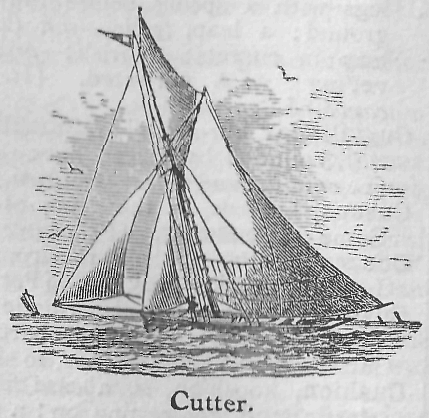
Cut, kut, v.t. to make an incision in: to cleave or pass through: to divide: to carve, hew, or fashion by cutting: to wound or hurt: to affect deeply: to shorten: to break off acquaintance with, to pass intentionally without saluting: to renounce, give up: to castrate: to perform or execute, as 'to cut a caper.'—v.i. to make an incision: to pass, go quickly: (slang) to run away, to be off: to twiddle the feet rapidly in dancing:—pr.p. cut′ting; pa.t. and pa.p. cut.—n. a cleaving or dividing: a stroke or blow: an act of unkindness: the card obtained by cutting or dividing the pack: an incision or wound: a piece cut off: an engraved block, or the picture from it: manner of cutting, or, fashion: (pl.) a lot.—n. Cut′away′, a coat with the skirt cut away in a curve in front—also adj.—ns. Cut′-off, that which cuts off or shortens, a straighter road, a shorter channel cut by a river across a bend: a contrivance for saving steam by regulating its admission to the cylinder; Cut′purse (Shak.), one who stole by cutting off and carrying away purses (the purses being worn at the girdle): a pickpocket; Cut′ter, the person or thing that cuts: in a tailor's shop, the one who measures and cuts out the cloth: a small vessel with one mast, a mainsail, a forestaysail, and a jib set to bowsprit-end, any sloop of narrow beam and deep draught; Cut′-throat, an assassin: ruffian; Cut′ting, a dividing or lopping off: an incision: a piece cut off: a paragraph from a newspaper: a piece of road or railway excavated: a twig; Cut′-wa′ter, the fore-part of a ship's prow.—Cut a dash, or figure, to make a conspicuous appearance; Cut-and-come-again, abundant supply, from the notion of cutting a slice, and returning at will for another; Cut-and-cover, a method of forming a tunnel by cutting out, arching it over, and then covering in; Cut-and-dry, or Cut-and-dried, ready made, without the merit of freshness—from the state of herbs in the shop instead of the field; Cut and run, to be off quickly; Cut down, to take down the body of one hanged by cutting the rope: to reduce, curtail; Cut in, to strike into, as to a conversation, a game at whist; Cut it too fat, to overdo a thing; Cut off, to destroy, put to an untimely death: intercept: stop; Cut off with a shilling, to disinherit, bequeathing only a shilling; Cut one's stick, to take one's departure; Cut out, to shape: contrive: debar: supplant: to take a ship out of a harbour, &c., by getting between her and the shore; Cut short, to abridge: check; Cut the coat according to the cloth, to adapt one's self to circumstances; Cut the teeth, to have the teeth grow through the gums—of an infant; Cut the throat of (fig.), to destroy utterly; Cut up, to carve: eradicate: criticise severely: turn out (well or ill) when divided into parts; Cut up rough, to become quarrelsome.—A cut above (coll.), a degree or stage above; Short cut, or Near cut, a short way. [Prob. W. cwtau, shorten.]
Cutaneous. See Cutis.
Cutch, kuch, n. the commercial name for catechu, from the Indian name kut.
Cutcherry, kuch′ėr-i, n. an office for public business, a court-house.—Also Cutch′ery. [Hind.]
Cute, kūt, adj. an aphetic form of Acute.
Cuthbert, kuth′bert, n. the apostle of Northumbria (635-687), whose name lives in (St) Cuthbert's Beads, a popular name for the perforated joints of encrinites found on Holy Island; (St) Cuthbert's duck, the eider-duck.
Cutikins, kōō′ti-kinz, n.pl. (Scot.) spatterdashes—also Cuitikins.
Cutis, kū′tis, n. the skin: the true skin, as distinguished from the cuticle.—adj. Cutān′eous, belonging to the skin.—n. Cū′ticle, the outermost or thin skin.—adj. Cutic′ular, belonging to the cuticle. [L.]
Cutlass, kut′las, n. a short, broad sword, with one cutting edge, used in the navy. [Fr. coutelas, augmentative of couteau, knife, from L. cultellus, dim. of culter, a ploughshare, a knife.]
Cutler, kut′lėr, n. one who makes or sells knives.—n. Cut′lery, the business of a cutler: edged or cutting instruments in general. [Fr. coutelier, coutel, knife.]
Cutlet, kut′let, n. a slice of meat cut off for cooking, esp. of mutton or veal—generally the rib and the meat belonging to it. [Fr. côtelette, dim. of côte, from L. costa, a rib.]
Cuttle, kut′l, n. a kind of mollusc, remarkable for its power of ejecting a black inky liquid—also Cutt′le-fish.—n. Cutt′le-bone, the internal shell or bone of the cuttle-fish, used for making tooth-powder and for polishing the softer metals. [A.S. cudele.]
Cutto, Cuttoe, kut′o, n. a large knife.
Cutty, kut′i, adj. (Scot.) short, curtailed.—n. a short clay pipe: a short, dumpy girl: applied to a woman, a term of reprobation, serious or playful.—n. Cutt′y-stool, the stool of repentance in old Scotch church discipline. [Cut.]
Cuvette, küv-et′, n. a trench sunk along the middle of a dry ditch or moat.—Also Cunette′. [Fr.]
Cyanogen, sī-an′o-jen, n. a compound of carbon, obtained by decomposing the cyanide of mercury by heat, so called from being an essential ingredient in the formation of Prussian blue.—n. Cy′anate, a salt of cyanic acid.—adj. Cyan′ic, of or belonging to cyanogen.—ns. Cy′anide, a direct compound of cyanogen with a metal; Cy′anine, the blue colouring matter of violets, &c.; Cy′anite, a mineral composed of alumina and silica, generally sky-blue; Cyanom′eter, an instrument for measuring the degrees of blueness of the sky or ocean; Cyanō′sis, morbid lividness of the skin, blue jaundice.—adj. Cyanot′ic.—ns. Cyan′otype, a photograph on paper sensitised by a cyanide; Cyan′uret, a cyanide.—Cyanic acid, an acid composed of cyanogen and oxygen. [Gr. kyanos, blue.]
Cyar, sī′ar, n. the internal auditory meatus.
Cyathiform, sī′a-thi-form, adj. like a cup a little widened at top.
Cycad, sī′kad, n. an order allied to Coniferæ, but in appearance rather resembling ferns and palms.—adj. Cycadā′ceous. [Formed from Gr. kykas, an erroneous form of koikas, koiks, the doom-palm.]
Cyclamen, sik′lä-men, n. a genus of Primulaceæ, native to southern Europe. [Formed from Gr. kyklamis, -inos.]
Cycle, sī′kl, n. a period of time in which events happen in a certain order, and which constantly repeats itself: an imaginary circle or orbit in the heavens: a series of poems, prose romances, &c., centring round a figure or event—also Cy′clus: an abbreviation for bicycle and tricycle.—v.i. to move in cycles: to ride or take exercise on a bicycle or tricycle.—adjs. Cy′clic, -al, pertaining to or containing a cycle.—ns. Cy′clist, for bicyclist or tricyclist; Cy′clograph, an instrument for describing the arcs of circles that have too large a curvature for compasses; Cy′cloid, a figure like a circle: a curve made by a point in a circle, when the circle is rolled along a straight line.—adj. Cycloid′al.—ns. Cycloid′ian, one of the fourth order of fishes, according to the classification of Agassiz, having cycloid scales with smooth edges, as the salmon; Cyclom′eter, an instrument for measuring circular arcs: an apparatus attached to the wheel of a cycle for registering the distance traversed; Cy′clorn, a cycle-horn. [Gr. kyklos, a circle.]
Cyclone, sī′klōn, n. a circular or rotatory storm.—adj. Cyclon′ic. [Coined from Gr. kyklōn, pr.p. of kykloein, to whirl round—kyklos.]
Cyclopædia, Cyclopedia, sī-klō-pē′di-a, n. the circle or compass of human knowledge: a work containing information on every department, or on a particular department, of knowledge, usually arranged alphabetically.—adjs. Cyclopæ′dic, Cyclope′dic. [Gr. kyklos, a circle, and paideia, learning.]
Cyclops, sī′klops, n. one of a fabled race of giants who lived chiefly in Sicily, with one eye in the middle of the forehead: a genus of minute freshwater copepods with an eye in front:—pl. Cyclō′pes.—adjs. Cyclopē′an, Cyclop′ic, relating to or like the Cyclops: giant-like: vast: pertaining to a prehistoric style of masonry with immense stones of irregular form. [Gr. kyklōps—kyklos, a circle, and ōps, an eye.]
Cyclorama, sī-klo-rä′ma, n. a circular panorama painted on the inside of a cylindrical surface appearing in natural perspective. [Formed from Gr. kyklos, circle, horama, view.]
Cyclosis, sī-klō′sis, n. circulation, as of blood.
Cyclyolostomous, sī-klos′tō-mus, adj. round-mouthed, as a lamprey.
Cyclostyle, sī′klo-stīl, n. an apparatus for multiplying copies of a writing. [Formed from Gr. kyklos, circle, and Style.]
Cyder. Same as Cider.
Cygnet, sig′net, n. a young swan. [Acc. to Diez, a dim. of Fr. cygne, whose old form cisne (Sp. cisne, a swan) is from Low L. cecinus, not conn. with L. cygnus, Gr. kyknos, a swan.]
Cylinder, sil′in-dėr, n. a solid circular or roller-like body, whose ends are equal parallel circles: (mech.) applied to many cylindrical parts of machines, as any rotating cylindrical portion of a printing-press.—adjs. Cylindrā′ceous, somewhat cylindrical; Cylin′dric, -al, having the form or properties of a cylinder.—n. Cylindric′ity.—adj. Cylin′driform, in the form of a cylinder.—n. Cyl′indroid, a body like a cylinder, but having its base elliptical. [Gr. kylindros, kylindein, to roll.]
Cyma, sī′ma, n. a moulding of the cornice, an ogee.—ns. Cym′agraph, an instrument for tracing the outline of mouldings; Cymā′tium, a cyma. [Gr. kyma, a billow.]
Cymar, si-mär′, n. a loose light dress worn by ladies. [See Chimer.]
Cymbal, sim′bal, n. a hollow brass, basin-like, musical instrument, beaten together in pairs.—ns. Cym′balist, a cymbal-player; Cym′balo, the dulcimer.—adj. Cym′biform, boat-shaped. [L. cymbalum—Gr. kymbanon—kymbē, the hollow of a vessel.]
Cyme, sīm, n. a young shoot: (bot.) term applied to all forms of inflorescence which are definite or centrifugal.—adjs. Cym′oid, Cym′ose, Cym′ous. [L. cyma—Gr. kyma, a sprout.]
Cymophane, sī′mō-fān, n. chrysoberyl.—adj. Cymoph′anous, opalescent. [Formed from Gr. kyma, wave, phainein, to show.]
Cymric, kim′rik, adj. Welsh.—n. Cym′ry, the Welsh, [W. Cymru, Wales.]
Cynanche, si-nang′kē, n. a name of various diseases of the throat or windpipe, esp. quinsy. [Gr., kyōn, a dog, anchein, to throttle.]
Cynic, -al, sin′ik, -al, adj. dog-like: surly: snarling: austere; misanthropic.—ns. Cynan′thropy, lycanthropy; Cyn′ic, one of a sect of philosophers founded by Antisthenes of Athens (born c. 444 B.C.), characterised by an ostentatious contempt for riches, arts, science, and amusements—so called from their morose manners: a morose man: a snarler; Cyn′icism, surliness: contempt for human nature: heartlessness, misanthropy.—adv. Cyn′ically.—n. Cyn′icalness. [Gr. kynikos, dog-like—kyōn, kynos, a dog; cf. L. can-is.]
Cynocephalus, sī-no-sef′al-us, n. the dog-faced baboon: a race of men with dogs' heads. [Gr. kyōn, kynos, dog, kephalē, head.]
Cynosure, sin′o-shōōr, or sī′, n. the dog's tail, a constellation (Ursa minor) containing the north-star; hence anything that strongly attracts attention or admiration. [Gr. kyōn, kynos, a dog, oura, a tail.]
Cyperus, sip-ē′rus, n. a tropical genus of Cyperaceæ.—adj. Cyperā′ceous, belonging to, or like, sedge plants. [From Gr. kypeiros, sedge.]
Cypher. Same as Cipher.
Cy pres, sē prā, in the law of charitable trusts in England, the principle of applying the money to some object as near as possible to the one specified, when this has become impracticable. [O. Fr.]
Cypress, sī′pres, n. an evergreen tree whose branches used to be carried at funerals; hence a symbol of death.—adj. Cyp′rine. [O. Fr. ciprès (Fr. cyprès)—L. cupressus—Gr. kyparissos.]
Cyprian, sip′ri-an, adj. belonging to the island of Cyprus: lewd, licentious—Cyprus being the place where Venus was worshipped.—n. a native of Cyprus—also Cyp′riot: a lewd woman.
Cyprus, sī′prus, n. a thin, transparent, black stuff, a kind of crape.—n. Cy′prus-lawn (Milt.). [Prob. named from the island of Cyprus.]
Cyrenaic, sī-rin-ā′ik, adj. pertaining to Cyrene, or to the hedonism of its philosopher Aristippus, a pupil of Socrates.
Cyrillic, sir-il′ik, adj. pertaining to the alphabet attributed to St Cyril (9th cent.), distinguished from the other Slavonic alphabet, the Glagolitic.
Cyst, sist, n. a bag in animal bodies containing morbid matter.—adjs. Cyst′ic, Cyst′iform, Cystoid′, having the form of, or contained in, a cyst or bag.—ns. Cys′ticle, a small cyst; Cystī′tis, inflammation of the bladder; Cys′tocele, a hernia formed by the protrusion of the bladder; Cystō′ma, a tumour containing cysts; Cystot′omy, the operation of cutting into the bladder to remove extraneous matter. [Low L. cystis—Gr. kystis, a bladder.]
Cytherean, sith-e-rē′an, adj. pertaining to Venus. [L. Cythereus—Cythera, an island in the Ægean Sea (now Cerigo), celebrated for the worship of Venus.]
Cytisus, sit′i-sus, n. a group of hardy leguminous shrubby plants, with yellow, white, or purple flowers, chiefly in the warmer temperate parts of the Old World. [Gr. kytisos.]
Cytoblast, sī′to-blast, n. the nucleus or germinal spot of a cellule, from which the organic cell is developed.—n. Cytogen′esis, cell-formation. [Gr. kytos, a vessel, blastanein, to bud.]
Czar, Tsar, tsär, or zär, n. the emperor of Russia:—fem. Czari′na, Tsari′na.—ns. Czar′evitch, Tsar-, a son of a czar.—Cesar′evitch is the title of the eldest son, and Cesarev′na, of his wife.—ns. Czarev′na, Tsarev′na, a daughter of a czar. [Russ. tsari, a king; conn. with Ger. kaiser, ult. from L. cæsar, a king or emperor.]
Czardas, zär′das (Hung. pron. chär′dosh), n. a Hungarian national dance, consisting of two sections—a slow movement called a lassu or lassan, and a quick step, the friss or friska.
Czech, tshek, n. a member of the most westerly branch of the Slavic family of races, the term including the Bohemians, or Czechs proper, the Moravians, and the Slovaks: the language of the Czechs, Bohemian, closely allied to Polish.—adj., also Czech′ic.
the fourth letter in our alphabet, as well as in the Phœnician, Hebrew, Greek, and Latin, from which last it was immediately derived—its sound the soft dental mute: (mus.) the second note in the natural scale.
Dab, dab, v.t. to strike gently with something soft or moist, to smear:—pr.p. dab′bing; pa.p. dabbed.—n. a gentle blow: a small lump of anything soft or moist: a species of flounder of light-brown colour, with small dark spots and rough, close-set scales.—ns. Dab′ber, a sort of pad for dabbing ink on engraved wood blocks or plates; Dab′chick, a small water-fowl, a kind of grebe. [First about 1300; cf. Old Dut. dabben, to pinch; Ger. tappe, a pat. Confused with Daub and Tap.]
Dab, dab, n. an expert person.—n. Dab′ster (coll.). [Prob. a corr. of Adept.]
Dabble, dab′l, v.t. to spatter with moisture.—v.i. to play in water with hands or feet: to do anything in a trifling way.—n. Dabb′ler, one who does things superficially.—adv. Dabb′lingly. [Freq. of Dab.]
Da capo, dä kä′pō, a term in music, frequently placed at the end of a movement, indicating that the performer must return to the beginning of the music—usually written D.C. [It., 'from the beginning'—L. de, from, caput, head.]
Dace, dās, Dare, dār, Dart, därt, n. a small river fish of the carp family, and of the same genus as the roach, chub, minnow, &c. [M. E. darce—O. Fr. dars—Low L. dardus, a dart or javelin—of Teut. origin. So called from its quickness.]
Dachshund, daks′hoond, n. a badger-dog. [Ger. dachs, a badger, hund, dog.]
Dacker, dak′ėr, Daker, dā′kėr, v.i. (Scot.) to lounge, saunter.—Also Daik′er.
Dacoit, da-koit′, n. one of a gang of robbers in India and Burma—also Dakoit′.—ns. Dacoit′y, Dacoit′age, robbery by gang-robbers, brigandage. [Hind. dākāīt, a robber.]
Dacryoma, dak-ri-ō′ma, n. stoppage of the tear duct. [Formed from Gr. dakry, a tear.]
Dactyl, dak′til, n. in Latin and Greek poetry, a foot of three syllables, one long followed by two short, so called from its likeness to the joints of a finger; in English, a foot of three syllables, with the first accented, as mer'rily, vi'olate.—adjs. Dac′tylar, Dactyl′ic, relating to or consisting chiefly of dactyls.—ns. Dactyl′iomancy, divination by means of a finger-ring; Dac′tylist; Dactylog′raphy, the science of finger-rings; Dactylol′ogy, the art of talking with the fingers, like the deaf and dumb. [L. dactylus—Gr. daktylos, a finger.]
Dad, dad, Daddy, dad′i, n. father, a word used by children.—n. Dadd′y-long-legs, the crane-fly, a familiar insect with long body, legs, and antennæ. [Prob. Celt., W. tad, Bret, tad, tat; cf. Gr. tata.]
Dad, dad, v.t. to throw against something: to dash.—n. a lump: a piece: a blow. [Der. unknown.]
Daddle, dad′l, v.i. to walk in an unsteady manner, as a child or very old person: to totter:—pr.p. dadd′ling; pa.p. dadd′led. [Perh. conn. with Dawdle.]
Daddle, dad′l, n. (slang) the hand.
Daddock, dad′ok, n. (prov.) the heart of a rotten tree.
Dado, dā′do, n. in classical architecture, the cubic block forming the body of a pedestal: a skirting of wood along the lower part of the walls of a room, often represented merely by wall-paper, painting, &c. [It.,—L. datus (talus, a die, being understood), given or thrown forth—dāre, to give.]
Dædal, dē′dal, Dædalian, de-dā′li-an, adj. formed with art: displaying artistic skill: intricate. [From L. Dædalus, Gr. Daidalos, the mythical artist who constructed the Cretan labyrinth.]
Dæmon, dē′mon, n. a spirit holding a middle place between gods and men, like the dæmon or good genius of Socrates.—adj. Dæ′monic, supernatural: of power or intelligence more than human. [L. dæmon—Gr. daimōn, a spirit, a genius, and later a devil. See Demon.]
Daff, daf, v.i. to play, to play the fool.—n. Daff′ing (Scot.), foolery, gaiety. [M. E. daf, deaf, prob. Ice. dawfr (Sw. döf, Dan. döv), deaf.]
Daff, daf, v.t. (Shak.) to put off. [A variant of Doff.]
Daffodil, daf′o-dil, Daffodilly, daf′o-dil-i, Daffodowndilly, daf′o-down-dil′i, n. a yellow flower of the lily tribe—also called King's spear. [M. E. affodille—O. Fr. asphodile—Gr. asphodelus; the d is prefixed accidentally.]
Daft, daft, adj. (Scot.) silly, weak-minded, insane, unreasonably merry.—adv. Daft′ly.—n. Daft′ness. [See Daff.]
Dag, dag, n. a dagger: a hand-gun or heavy pistol, used in the 15th and 16th centuries.—Also Dagge. [Fr. dague; Celt.; cf. Bret. dag.]
Dagger, dag′ėr, n. a short sword for stabbing at close quarters: (print.) a mark of reference (), the double dagger () being another.—At daggers drawn, in a state of hostility; Look daggers, to look in a hostile manner. [M. E. dagger—W. dagr (Ir. daigear); cf. Fr. dague.]


Daggle, dag′l, v.t. and v.i. to wet or grow wet by dragging on the wet ground.—n. Dagg′le-tail, a slattern.—adj. slatternly. [Freq. of prov. Eng. dag, to sprinkle, from a Scand. root seen in Sw. dagg.]
Dago, dā′go, n. (U.S.) a name applied loosely to Spanish- and Italian-born men. [Prob. a corr. of Sp. Diego—L. Jacobus.]
Dagoba, dag′o-ba, n. in Ceylon, a dome-like structure of solid masonry, containing relics of a Buddhist saint. [Singh. dāgaba.]
Dagon, dā′gon, n. the national god of the Philistines, half-man, half-fish. [Heb. dāgōn—dag, fish.]
Daguerreotype, da-ger′o-tīp, n. a method of taking pictures on metal plates by the light of the sun: a photograph fixed on a plate of copper by a certain process.—adj. Daguer′rēan.—n. Daguerrē′otypy, the art of daguerreotyping. [Fr., from Louis Daguerre (1789-1851).]
Dagwood. See Dogwood.
Dahabeeah, da-ha-bē′a, n. a Nile-boat with oars, one or two masts, and lateen sails.—Also Dahabi′eh, Dahabi′yeh. [Ar. dahabīya.]
Dahlia, dāl′i-a, n. a genus of garden plants with large flowers. [From Dahl, a Swedish botanist.]
Daidle, dā′dl, v.i. a Scotch form of daddle: also to draggle.—adj. Daid′ling, feeble: dawdling.
Daiker, dā′ker, v.i. (prov.) to deck out.
Daily, dā′li, adj. and adv. every day.—n. a daily paper.
Daimio, dī′myo, n. a Japanese territorial noble under the old feudal system. [Jap.]
Dainty, dān′ti, adj. pleasant to the palate: delicate: fastidious: (Spens.) elegant.—n. that which is dainty, a delicacy.—adj. Daint (Spens.).—adv. Dain′tily.—n. Dain′tiness. [M. E. deintee, anything worthy or costly. O. Fr. daintié, worthiness—L. dignitat-em—dignus, worthy.]
Dairy, dā′ri, n. the place where milk is kept, and butter and cheese made: an establishment for the supply of milk.—ns. Dai′ry-farm; Dai′rying; Dai′rymaid; Dai′ryman. [M. E. deye.—Ice. deigja, a dairymaid; orig. a kneader of dough.]
Dais, dā′is, n. a raised floor at the upper end of the dining-hall where the high table stood: a raised floor with a seat and canopy: the canopy over an altar, &c. [O. Fr. dais—Low L. discus, a table—L. discus, a quoit—Gr. diskos, a disc.]
Daisy, dā′zi, n. a common wild-flower, growing in pastures and meadows—the name given also to other plants, as the Ox-eye daisy, which is a chrysanthemum.—adj. Dai′sied, covered with daisies.—n. Dai′sy-cut′ter, a fast-going horse that does not lift its feet high: a cricket-ball skimmed along the ground. [A. S. dæges eáge, day's eye, the sun.]
Dak, däk, Dawk, dawk, n. in India, the mail-post: travelling in palanquins carried by relays of bearers. [Hind. dāk, a relay of men.]
Dakoit. See Dacoit.
Dalai-lama. See Lama.
Dale, dāl, Dell, del, n. the low ground between hills: the valley through which a river flows.—n. Dales′man, specifically, an inhabitant of the dales of the Lake District. [Ice. dalr, Sw. dal; Ger. thal.]
Dali, dä′li, n. a timber-tree of Guiana, its wood used for staves, &c.
Dalila. See Delilah.
Dall, dal, n. a tile with incised surface: (pl.) rapids.
Dallop, dal′op, n. (prov.), a tuft of grass.
Dally, dal′i, v.i. to lose time by idleness or trifling: to play: to exchange caresses:—pa.p. dall′ied.—ns. Dall′iance, dallying, toying, or trifling: interchange of embraces: delay; Dall′ier, a trifler. [M. E. dalien, to play; prob. from A.S. dweligan, to err; cf. Ice. dvala, to delay, Dut. dwalen, to err; prob. conn. with dwell.]
Dalmahoy, dal′ma-hoi, n. a bushy bob-wig, worn in the 18th cent. by chemists, &c.
Dalmatian, dal-mā′shun, adj. belonging to Dalmatia, a strip of Austrian territory along the Adriatic.—Dalmatian dog, the spotted coach-dog, resembling the pointer in shape.
Dalmatic, dal-mat′ik, n. a loose-fitting, wide-sleeved ecclesiastical vestment, worn specially by deacons in the R.C. Church, also sometimes by bishops. [Low L. dalmatica, a robe worn by persons of rank in the early Christian centuries, on the pattern of a dress worn in Dalmatia.]
Dalt, dält, n. (Scot.) a foster-child. [Gael. dalta.]
Daltonism, dal′ton-izm, n. colour-blindness: inability to distinguish certain colours.—adj. Daltō′nian. [So called from the chemist John Dalton (1766-1844), who had this infirmity.]
Dam, dam, n. an embankment to restrain water: the water thus confined.—v.t. to keep back water by a bank:—pr.p. dam′ming; pa.p. dammed. [Teut.; Dut. dam, Ger. damm, &c.]
Dam, dam, n. a mother, applied to quadrupeds. [A form of dame.]
Damage, dam′āj, n. hurt, injury, loss: the value of what is lost: (coll.) cost: (pl.) the pecuniary reparation due for loss or injury sustained by one person through the fault or negligence of another.—v.t. to harm.—v.i. to take injury.—adj. Dam′ageable. [O. Fr. damage (Fr. dommage)—L. damnum, loss.]
Daman, dam′an, n. the Syrian hyrax, the cony of the Bible. [Syrian.]
Damar. Same as Dammar.
Damascene, da′mas-ēn, adj. of Damascus.—v.t. same as Damaskeen.
Damask, dam′ask, n. figured stuff, originally of silk, now of linen, cotton, or wool, the figure being woven, not printed.—v.t. to flower or variegate, as cloth.—adj. of a red colour, like that of a damask rose.—v.t. Damaskeen′, to decorate metal (esp. steel) by inlaying or encrusting on it patterns like damask in other metals: to ornament with flowery patterns, to damask.—ns. Damaskeen′ing, Damasceen′ing, the watered or striated structure seen in certain sword-blades and other weapons: the ornamental incrustation with gold and silver of steel and iron surfaces; Damaskin′, a Damascus blade: a damaskeened blade; Dam′ask-plum, the damson; Dam′ask-rose, a species of pink-rose; Dam′ask-steel, Damascus steel; Dam′assin, damask with flowered patterns in gold or silver thread.—Damascus blade, a Damascus sword, the surface marked by wavy and variegating lines. [From Damascus, in Syria, where damask was orig. made.]
Damboard, dam′bōrd, Dambrod, dam′brod, n. (Scot.) a draughtboard, the pieces being dams. [Fr. jeu de dames, copied by the Germans as damenspiel, by the Swedes as damspel, &c., perhaps from the movement of the pieces being like those of the queen (reine or dame) in chess.]
Dame, dām, n. the mistress of a house: a matron: a noble lady.—ns. Dame′-school, a school for children kept by a woman; Dame's′-vī′olet, a genus of cruciferous plants, formerly cultivated by ladies in pots for its sweet scent at night. [Fr. dame—L. domina, a mistress, fem. of dominus, a master.]
Dammar, dam′mar, n. a resin, used for making varnish, obtained from a genus of East Indian conifers.
Damn, dam, v.t. to censure or condemn: to sentence to eternal punishment: to doom.—n. an oath: a curse.—adj. Dam′nable, deserving or tending to damnation: hateful: pernicious.—n. Dam′nableness.—adv. Dam′nably.—n. Damnā′tion, condemnation: (theol.) the punishment of the impenitent in the future state: eternal punishment.—adj. Dam′natory, consigning to damnation.—p.adj. Damned, sentenced to everlasting punishment: hateful: a profane intensive, meaning merely thorough (often written d——d, and softened into darned, dashed, &c.).—adv. very, exceedingly.—adj. Damnif′ic.—n. Damnificā′tion.—v.t. Dam′nify, to cause loss to.—adj. Dam′ning, exposing to condemnation. [Fr. damner—L. damnāre, to condemn—damnum, loss.]
Damoclean, dam-ō-clē′an, adj. like Damocles, flatterer of Dionysius of Syracuse, taught the insecurity of happiness by being made to sit through the feast with a sword suspended by a single hair over his head.
Damosel, dam′o-sel, n. Same as Damsel.
Damp, damp, n. vapour, mist: moist air: lowness of spirits: (pl.) dangerous vapours in mines, &c.—v.t. to wet slightly: to chill: to discourage: to check: to make dull.—adj. moist, foggy: sometimes in the form Damp′y.—v.t. and v.i. Damp′en, to make or become damp or moist.—n. Damp′er, that which checks or moderates: a mechanical appliance for reducing currents, musical vibration, &c.: (Australia) a kind of unfermented bread.—adj. Damp′ish, somewhat damp.—n. Damp′ishness.—adv. Damp′ly.—n. Damp′ness.—Damping off (hort.), the death of plants from excess of moisture. [M. E. dampen; akin to Dut. damp, Ger. dampf, vapour.]
Damsel, dam′zel, n. a young unmarried woman: a girl. [O. Fr. damoisele (Fr. demoiselle), a page—Low L. domicellus, dim. of L. dominus, a lord.]
Damson, dam′zn, n. a rather small oval fruited variety of the common plum, esteemed for preserving. [Shortened from Damascene—Damascus.]
Dan, dan, n. a title of honour equivalent to Master or Sir. [O. Fr. dan. (Sp. don; Port. dom)—L. dominus, lord. See Dame.]
Dan, dan, n. (prov.) a box for carrying coal: a tub.
Danakil, dan′a-kil, n. the name given to the numerous nomad and fisher tribes on the coast of North-east Africa. [Ar.]
Dance, dans, v.i. to move with measured steps to music: to spring.—v.t. to make to dance or jump.—n. the movement of one or more persons with measured steps to music: the tune to which dancing is performed.—ns. Dance′-mū′sic, music specially arranged for accompanying dancing; Danc′er, one who practises dancing; Danc′ing, the act or art of moving in the dance; Danc′ing-girl, a professional dancer; Danc′ing-mas′ter, a teacher of dancing.—Dance a bear (obs.), to exhibit a performing bear; Dance attendance, to wait obsequiously; Dance of death, a series of allegorical paintings symbolising the universal power of death, represented as a skeleton; Dance upon nothing, to be hanged.—Lead a person a dance, to set him on an undertaking under false hopes: to delude.—Merry dancers, the aurora. [O. Fr. danser, from Teut.; Old High Ger. danson, to draw along.]
Dancette, dan-set′, n. (her.) a zigzag or indented line or figure: the chevron or zigzag moulding common in Romanesque architecture—also adj. [O. Fr. dent, dant, tooth, notch—L. dens.]
Dandelion, dan-de-lī′un, n. a common plant with a yellow flower, its leaves with jagged tooth-like edges. [Fr. dent de lion, tooth of the lion.]
Dander, dan′dėr, Daunder, dawn′dėr, v.i. (Scot.) to walk leisurely or idly. [Akin to dandle.]
Dander, n. a form of Dandruff (vulg.), anger: passion.—Raise a person's dander, to put him in a temper.
Dander, n. (Scot.) furnace cinders. [Ety. dub.]
Dandle, dan′dl, v.t. to play with: to fondle or toss in the arms, as a baby. [Prob. Teut.; cf. Ger. tändeln—tand, a toy.]
Dandriff, dand′rif, Dandruff, dand′ruf, n. a scaly scurf which forms on the surface of the skin under the hair and beard. [Perh. from W. ton, surface, skin, and drwg, bad (Skeat).]
Dandy, dan′di, n. a foppish, silly fellow: one who pays much attention to dress.—v.t. Dan′dify, to dress up as a dandy.—adv. Dan′dily, like a dandy.—ns. Dan′dy-brush, a hard brush of whalebone bristles; Dan′dy-cock, a bantam; Dan′dy-fē′ver (see Dengue); Dan′dy-horse, a velocipede.—adj. Dan′dyish.—n. Dan′dyism. [Perh. from Fr. dandin, a ninny; and prob. from root of dandle.]
Dandy, dan′di, n. a sloop-like vessel having a jigger-mast abaft.—n. Dandy-rigged cutter.
Dandyprat, dan′di-prat, n. a dwarf: an urchin. [Ety. dub.]
Dane, dān, n. a native of Denmark.—adj. Dan′ish, belonging to Denmark.—n. the language of the Danes—(Spens.) Danisk.
Danegeld, dān′geld, n. a tax imposed in the 10th cent., to buy off the Danes or to defend the country against them. [A.S. Dene, Danes, geid, a payment.]
Dang, dang, v.t. a minced form of damn.
Danger, dān′jėr, n. peril, hazard, or risk: insecurity: (obs.) power.—v.t. (Shak.) to endanger.—adj. Dan′gerous, full of danger: unsafe: insecure.—adv. Dan′gerously.—ns. Dan′gerousness; Dan′ger-sig′nal. [O. Fr. dangier, absolute power (of a feudal lord), hence power to hurt.—Low L. dominium, feudal authority—L. dominus, a lord. See Dungeon.]
Dangle, dang′gl, v.t. to hang loosely or with a swinging motion: to follow any one about.—v.t. to make to dangle.—n. Dan′gler, one who dangles about others, esp. about women. [Scand., Dan. dangle, to dangle; cf. Ice. dingla, to swing; Sw. danka, to saunter.]
Daniel, dan′yel, n. in phrase A second Daniel, a wise judge, with reference to the interposition of the wise young Daniel to save Susannah, in one of the Apocryphal additions to the book of Daniel.
Danite, dan′īt, n. one of a secret society amongst the early Mormons. [In allusion to Gen. xlix. 16, 17.]
Dank, dangk, adj. moist, wet.—n. (Milt.) water.—adj. Dank′ish, somewhat dank or damp. [Perh. conn. with dew. See also Daggle.]
Dannebrog, dān′e-brog, n. the second of the Danish orders instituted by King Waldemar in 1219. [Dan., 'the Danish banner.']
Danseuse, dong-süz′, n. a female dancer: a ballet dancer. [Fr.]
Dansker, dan′skėr, n. (Shak.) a Dane.
Dantean, dan′te-an, Dantesque, dan′tesk, adj. like the poet Dante: sublime: austere.—ns. Dan′tist, a Dante scholar; Dantoph′ilist, a lover of Dante.
Danton, dan′ton, v.t. (Scot.) to subdue, to daunt. [A form of daunt.]
Danubian, dan-ū′bi-an, adj. pertaining to or bordering on the Danube.—Danubian Principalities, a name applied to Moldavia and Wallachia.
Dap, dap, v.i. to drop the bait gently into the water.
Daphne, daf′nē, n. a genus of shrubs or small trees. [Gr.]
Dapper, dap′ėr, adj. quick: little and active: neat: spruce.—n. Dapp′erling, a dapper little fellow. [Dut. dapper, brave; cf. Ger. tapfer, quick, brave.]
Dapple, dap′l, adj. marked with spots.—v.t. to variegate with spots.—adjs. Dapp′erly (Scot.), variegated; Dapp′le-bay, of bay colour, variegated with dapples; Dapp′led; Dapp′le-gray. [See Dimple.]
Darbies, där′biz, n.pl. (slang) handcuffs. [App. from the personal name Darby.]
Darbyites, där′bi-īts, n.pl. a name given to the Plymouth Brethren. [From their principal founder, J. N. Darby (1800-82).]
Dare, dār, v.i. to be bold enough: to venture:—pa.t. durst.—v.t. to challenge: to defy.—n. (Shak.) boldness, a challenge.—n. Dare′-dev′il, a rash, venturesome fellow.—adj. unreasonably rash and reckless.—adjs. Dare′ful (Shak.), full of daring, adventurous; Dar′ing, bold: courageous: fearless.—n. boldness.—n. Dar′ing-do (see Derring-doe).—adj. Dar′ing-hard′y (Shak.), foolhardy.—adv. Dar′ingly.—I dare say, I suppose. [A.S. durran, pres. dearr; Goth. daursan; akin to Gr. tharsein.]
Dare, dār, v.t. to frighten, terrify. [M. E. daren, to be in fear; cf. Dan. dirre, to tremble.]
Dare, dār. Same as Dace.
Darg, darg, n. a day's work: (Scot.) a task. [Contr. from dawerk, day-wark, day-work.]
Daric, dar′ik, n. an old gold coin larger than an English sovereign, named after Darius I. of Persia.
Dark, därk, adj. without light: black, or somewhat black: gloomy: difficult to understand: unenlightened: secret: sinister.—n. absence of light: obscurity: a state of ignorance.—adv. (Shak.) in a state of dark.—v.t. Dark′en, to make dark: to render ignorant: to sully.—v.i. to grow dark or darker.—n. Dark′-house (Shak.), a mad-house.—adj. Dark′ish, somewhat dark: dusky.—v.i. Dark′le, to grow dark.—adv. and adj. Dark′ling, dark: in the dark.—advs. Dark′lings (poet.), in the dark; Dark′ly.—n. Dark′ness.—adj. Dark′some, dark: (poet.) gloomy.—ns. Dark′y, Dark′ey, a negro: (slang) a policeman's lantern.—Dark ages, the period of intellectual darkness in Europe, from the 5th to the 15th century.—Darken the door, to enter in at the door.—A dark horse, in racing, a horse whose capabilities are not known: a candidate about whom it is not known till the last moment that he is a candidate.—Keep dark, to be silent or secret; Keep it dark, to conceal.—The prince of darkness, Satan. [A.S. deorc.]
Darling, där′ling, n. a little dear: one dearly beloved: a favourite. [Dear, and dim. suff. -ling = l-ing.]
Darn, därn, v.t. to mend a hole by imitating the texture of the stuff.—n. the place darned.—n. Darn′ing-needle. [W. darn, a piece, a patch.]
Darn, därn, v.i. a minced form of damn.
Darnel, där′nel, n. an annual of the rye-grass genus, the tares of Scripture. [Prob. conn. with O. Fr. darne, stupid, from its supposed narcotic properties.]
Darraign, Darrain. See Derain.
Dart, därt, n. a pointed weapon for throwing with the hand: anything that pierces.—v.t. to hurl suddenly: to send or shoot forth.—v.i. to start or shoot forth rapidly—freq. Dar′tle.—adv. Dart′ingly. [O. Fr. dart; from a Low Ger. root.]
Dart. See Dace.
Darter, därt′ėr, n. a genus of birds nearly allied to cormorants, heron-like in gait and gesture.
Dartre, där′tr, n. herpes.—adj. Dar′trous. [Fr.]
Darwinism, där′win-ism, n. the theory of the origin of species propounded by C. Darwin (1809-82).—adjs. Darwin′ian, Darwin′ical.
Dash, dash, v.t. to throw violently: to break by throwing together: to throw water suddenly: to bespatter: to destroy or frustrate: to mix or adulterate.—v.i. to strike against: to break against, as water: to rush with violence.—n. a violent striking: a rushing or violent onset: a blow: a mark (—) at a break in a sentence: ostentation: a slight admixture.—ns. Dash′-board, a board or leathern frame in front of a carriage, to keep off splashes of mud; Dash′er, one who dashes: (coll.) one who makes a great show.—adj. Dash′ing, rushing: reckless: hasty and rash: gallant.—adv. Dash′ingly.—ns. Dash′-pot, a device for preventing too sudden motion in some part of an apparatus; Dash′-wheel, a wheel-shaped box with compartments, in which cotton cloth is washed by the revolution of the wheel in liquid.—Dash off, to sketch hastily; Dash out, to knock out by striking against something. [M. E. daschen, dassen, to rush, or strike with violence—Scand.; cf. Dan. daske, to slap].
Dastard, das′tard, n. a cowardly fellow.—adj. shrinking from danger: cowardly.—adj. and adv. Das′tardly.—ns. Das′tardness, Das′tardliness, Das′tardy. [From a Scand. stem dast = Eng. dazed, and Fr. suffix -ard. See Daze.]
Dasymeter, da-sim′e-tėr, n. an instrument for testing the density of gases. [Gr. dasys, thick, metron, measure.]
Dasypus, das′i-pus, n. a genus of armadillos.
Dasyure, das′i-yōōr, n. a small carnivorous quadruped of Australia and Tasmania. [Formed from Gr. dasys, hairy, oura, tail.]
Data, dā′ta, n.pl. facts given or admitted from which other facts may be deduced:—sing. Dā′tum. [L. datum, data, given—dăre, to give.]
Datary, dā′ta-ri, n. an officer in the papal chancery, who dates and despatches documents, grants, &c.—n. Datā′ria, the office of such. [Low L. datarius—L. datum—dăre, to give.]
Date, dāt, n. the time of any event: a stipulated time: age, period of time.—v.t. to affix the date to.—v.t. to reckon: to begin.—adj. Date′less, without date: without fixed limit: undatable.—Out of date, antiquated; Up to date, adapted or corrected to the present time: modern. [O. Fr. date—L. datum, as in datum Romæ = given or written at Rome.]
Date, dāt, n. the fruit of the date-palm.—ns. Date′-palm, Date′-tree, the tree on which it grows, a native of the northern half of Africa and the south-west of Asia; Date′-plum; Date′-sug′ar. [Fr. datte—L. dactylus—Gr. daktylos, a finger.]
Dative, dāt′iv, adj. that is given or appointed.—n. the dative case, the oblique case of nouns, &c.—generally indicated in English by to or for. [L. dativus.]
Datolite, dat′ō-līt, n. a vitreous calcium borosilicate.
Datum, dā′tum (see Data).—n. Dā′tum-line, the horizontal base-line from which heights and depths are measured.
Datura, dā-tū′ra, n. a genus of plants, of which one, D. stramonium, or thorn-apple, has strongly narcotic properties.—n. Dat′urine, a poisonous alkaloid in the foregoing. [Hind. dhatūrā.]
Daub, dawb, v.t. to smear: to paint coarsely.—n. a coarse painting.—ns. Daub′er, one who daubs: a coarse painter; Daub′ery, Daub′ry (Shak.), a daubing, or crudely artful device; Daub′ing.—adj. Daub′y, sticky. [O. Fr. dauber, to plaster—L. dealbāre, to whitewash—de, down, and albus, white.]
Daud, daud, v.t. (Scot.) to knock, thump.—n. a lump: large piece.—Also Dawd.
Daughter, daw′tėr, n. a female child: a female descendant: woman (generally).—ns. Daugh′ter-in-law, a son's wife; Daugh′terliness; Daugh′terling, a little daughter.—adj. Daugh′terly, like or becoming a daughter. [A.S. dohtor; Scot. dochter, Ger. tochter, Gr. thygatēr.]
Daunder, Dauner. Same as Dander.
Daunt, dänt, or dawnt, v.t. to frighten: to discourage: to subdue.—adj. Daunt′less, not to be daunted.—adv. Daunt′lessly.—n. Daunt′lessness.—v.t. Daun′ton, to subdue: to dare. [O. Fr. danter (Fr. dompter)—L. domitāre—domāre, to tame.]
Dauphin, daw′fin, n. the name given to the eldest son of the king of France, from 1349 down to 1830:—fem. Dau′phiness. [O. Fr. daulphin (Fr. dauphin)—L. delphinus, a dolphin. From the dolphins in the crest of Viennois.]
Daur, dawr, a Scotch form of dare.
Dautie. See Dawtie.
Dauw, daw, n. the South African name of Burchell's zebra.
Davenport, dā′ven-port, n. a small ornamental writing-desk. [From the maker.]
Davenport-trick, dā′ven-port-trik, n. the artifice by which a man can free himself from ropes wound round him and tied.
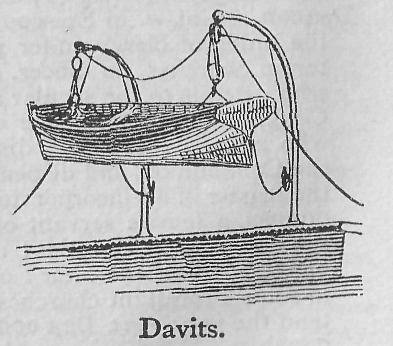
Davit, dāv′it, n. one of a pair of pieces of timber or iron, projecting over a ship's side or stern, having tackle to raise a boat by. [Cf. Fr. davier, a forceps.]
Davy, dā′vi, Davy-lamp, dā′vi-lamp, n. the safety-lamp for coal-miners of Sir Humphry Davy (1778-1829).
Davy Jones, dā′vi jōnz, n. a sailor's familiar name for the (malignant) spirit of the sea, the devil; hence Davy Jones's locker, of the sea, as the grave of men drowned at sea. [Said by some to be a compound of Duffy, a West Indian spirit name, and Jonah.]
Daw, daw, v.i. an old English form of dawn.
Daw, daw, n. a bird of the crow kind: a jackdaw.—adj. Daw′ish. [From its cry.]
Dawdle, daw′dl, v.i. to waste time by trifling: to act or move slowly.—n. Daw′dler. [Allied to dandle and dandy.]
Dawk. See Dak.
Dawn, dawn, v.i. to become day: to begin to grow light: to begin to appear.—n. daybreak: beginning.—Also Dawn′ing. [A.S. dagian, to dawn, dæg, day.]
Dawnering = dandering. [See Dander (1).]
Dawtie, daw′ti, n. (Scot.) a darling: a beloved child—also Daut′ie.—v.t. Daut, to fondle.
Day, dā, n. the time of light, from sunrise to sunset: the time from morning till night: twenty-four hours, the time the earth takes to make a revolution on her axis—this being the solar or natural day as distinguished from the sidereal day, between two transits of the same star: a man's period of existence or influence: a time or period.—ns. Day′-bed (Shak.), a couch or sofa; Day′-blind′ness, a defect of vision, in which objects are best seen by a dim light; Day′-book, a book in which merchants, &c., enter the transactions of every day; Day′break; Day′-coal, the upper stratum of coal; Day′-dream, a dreaming or musing while awake; Day′-fly, a fly which lives in its perfect form only for a day, one of the ephemera; Day′-lā′bour; Day′-lā′bourer; Day′light; Day′-lil′y, a flower whose blossoms last only for a day, the hemerocallis.—adj. Day′long, during the whole day.—ns. Day′-peep (Milt.), the dawn; Day′-schol′ar, a boy who attends a boarding-school during the school-hours, but boards at home; Day′-school, a school held during the day, as opposed both to a night-school and to a boarding-school; Day′-sight = night-blindness; Days′man, one who appoints a day to hear a cause: an umpire; Day′spring, dawn; Day′star, the morning star; Day′time.—adj. Day′-wea′ried (Shak.), wearied with the work of the day.—n. Day′-work.—Day by day, daily; Day of doom, the judgment day; Days of grace, three days allowed for payment of bills, &c., beyond the day named.—Name the day, to fix the day of marriage.—One of these days, an indefinite reference to the near future.—The day, the time spoken of: (Scot.) to-day; The other day, not long ago; The time of day, a greeting, as, 'to give a person the time of day,' to greet him. [A.S. dæg; Ger. tag; not conn. with L. dies.]
Dayak. See Dyak.
Day-woman, dā′-woom′an, n. (Shak.) a dairymaid.
Daze, dāz, v.t. to stun, to stupefy. [Ice. dasa, to be breathless; cf. A.S. dwæs, foolish.]
Dazzle, daz′l, v.t. to daze or overpower with any strong light: to confound by brilliancy, beauty, or cleverness.—ns. Dazz′lement, the act of dazzling: that which dazzles; Dazz′ler; Dazz′ling.—adv. Dazz′lingly. [Freq. of daze.]
Deacon, dē′kn, n. in Episcopal churches, a member of the order of clergy under priests: in some Presbyterian churches, an officer, distinct from the elders, who attends to the secular affairs of the church: in Congregational and some other churches, an officer who advises the pastor, distributes the elements at the Communion, and dispenses charity: in Scotland, the master of an incorporated company:—fem. Dea′coness, a female servant of the Christian society in the time of the apostles: in a convent, a nun who has the care of the altar: one of an order of women in some Protestant churches who nurse the sick and tend the poor.—ns. Dea′conhood, Dea′conry, Dea′conship. [L. diaconus—Gr. diakonos, a servant.]
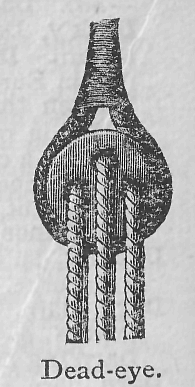
Dead, ded, adj. without life: death-like: at rest, of a ball: cold and cheerless: without vegetation: utter: unerring.—v.t. to deaden, dull.—adv. in a dead manner.—n. the time of greatest stillness, as 'the dead of night.'—adjs. Dead′-alive′, Dead′-and-alive′, dull, uneventful; Dead′-beat, quite overcome; Dead′-born, still-born.—n.pl. Dead′-clothes, clothes in which to bury the dead.—n. Dead′-col′ouring, the first broad outlines of a picture.—adjs. Dead′-do′ing (Spens.), putting to death, destructive; Dead′-drunk, completely drunk.—v.t. Dead′en, to make dead: to deprive partly of vigour or sensation: to blunt: to lessen.—ns. Dead′-eye, (naut.), a round, flattish wooden block with a rope or iron band passing round it, and pierced with three holes for a lanyard; Dead′-fall, a trap operated by a weight that, when its support is removed, falls upon and kills or holds an animal; Dead′-freight, money paid for the empty space in a ship by a person who engages to freight her, but fails to make out a full cargo; Dead′-head (U.S.), one who is allowed, without payment, to ride in a public carriage, sit in a theatre, or hold a privilege having a money value; Dead′-heat, a heat or race in which no one gains the advantage; Dead′-house, the house or room where (in hospitals, police-offices, &c.) dead bodies are kept till buried: a mortuary; Dead′-lett′er, a letter undelivered and unclaimed at the post-office: a law or ordinance which has been made but never enforced; Dead′-lev′el, a stretch of land without any rising ground: sameness; Dead′-lift, a lift made without help, leverage, &c.; hence an effort under discouraging conditions.—n.pl. Dead′-lights, storm-shutters for a cabin window.—ns. Dead′liness; Dead′-lock, the case when matters have become so complicated that all is at a complete standstill.—adj. Dead′ly, causing death: fatal: implacable.—adv. in a manner resembling death.—ns. Dead′ly-night′shade, the plant Belladonna (q.v.); Dead′-march, a piece of solemn music played at funeral processions, esp. of soldiers; Dead′-meat, the flesh of animals ready for the market.—n.pl. Dead′-men, empty bottles after a carouse.—ns. Dead′ness; Dead′-nett′le, a genus of plants of the natural order Labiatæ, so called because they resemble nettles but do not sting; Dead′-pay, continued pay dishonestly drawn for men actually dead; Dead′-reck′oning, an estimation of a ship's place simply by the log-book; Dead′-rope, a rope not running in any block; Dead′-set, a determined and prolonged attempt; Dead′-shot, an unerring marksman.—adj. Dead′-stroke, without recoil.—ns. Dead′-wall, a wall unbroken by windows or other openings; Dead′-wa′ter, the eddy water closing in behind a ship's stern as she sails; Dead′-weight, a heavy or oppressive burden; Dead′-wind, a wind coming directly ahead or opposed to a ship's course; Dead′-wood, pieces of timber laid on the upper side of the keel at either end, useless material; Dead′-work, work, itself unprofitable, which is necessary as a preliminary, as the opening of a mine.—Dead as a door-nail, absolutely dead; Dead language, one no longer spoken; Dead-men's bells, the foxglove; Dead-men's fingers, a very common cœlenterate belonging to the Actinozoa—also Cow-paps and Mermaid's glove; Dead-men's shoes, a situation formerly held by some one now dead; Dead's part (Scots law), the part of a man's movable property which he may bequeath by will, and which is not due to wife and children.—Be dead set against, to be utterly opposed to.—Put the dead wood on (U.S. slang), to gain a great advantage over. [A.S. deád; Goth. dauths, Ger. todt, from root of die.]
Deaf, def, adj. dull of hearing: unable to hear at all: not willing to hear: inattentive.—v.t. Deaf′en, to make deaf, partly or altogether: to stun: to render impervious to sound.—n. Deaf′ening, stuffing put into floors, partition-walls, &c. to prevent sounds from passing through.—adv. Deaf′ly.—ns. Deaf′-mute, one who is both deaf and dumb; Deaf′ness. [A.S. deáf; Dut. doof, Ger. taub.]
Deal, dēl, n. a portion; an indefinite quantity: a large quantity; the act of dividing cards: (U.S.) a bargain: a fir or pine board: timber.—v.t. to divide, to distribute: to throw about: to deliver.—v.i. to transact business: to act: to distribute cards.—pa.t. and pa.p. dealt (delt).—ns. Deal′er, one who deals: a trader; Deal′-fish, a genus of ribbon-fishes; Deal′ing, manner of acting towards others: intercourse of trade. [A.S. dǽlan—dǽl, a part; Ger. theilen—theil, a part or division. A doublet of dole. By some, however, deal, a plank, is taken as a doublet of thill, from A.S. thel, a plank.]
Deambulatory, dē-am′bū-la-to-ri, n. a passage or aisle round the choir and apse of a church. [L. deambulāre, -ātum, to walk about.]
Dean, dēn, n. a small valley.—Also Dene. [A.S. denu, a valley. Cf. Den.]
Dean, dēn, n. a dignitary in cathedral and collegiate churches who presides over the other clergy: the president of faculty in a college; the chief chaplain of the Chapel Royal: the chief judge of the Court of Arches: the president of a trade-guild.—ns. Dean′ery, the office of a dean: a dean's house; Dean′ship, the office or dignity of a dean.—Dean of Arches, dean of the Court of Arches (see Arch); Dean of Faculty, president of the Faculty of Advocates in Scotland: Dean of Guild, a municipal functionary in Scotland, who has authority over building and altering of houses.—Rural dean, one who, under the bishop, has the special care and inspection of the clergy in certain parishes. [O. Fr. deien (Fr. doyen)—Low L. decanus, a chief of ten—L. decem, ten.]
Dear, dēr, adj. high in price: costly: scarce: highly valued: beloved: (Shak.), earnest, inmost.—n. one who is dear or beloved.—adv. at a high price.—adj. Dear′-bought.—n. Dear′ling (Spens.), a darling.—adj. Dear′-loved.—adv. Dear′ly.—ns. Dear′ness; Dear′y, one who is dear. [A.S. deóre, dýre; cog. with Ger. theuer.]
Dear, dēr, interj. indicating surprise, pity, or other emotion, as in 'Oh dear!' 'Dear me!' 'Dear, dear!'—prob. elliptical in 'Dear help us!' &c. [Sometimes doubtfully referred to Dio mio (It. 'My God'), or to some compound of Fr. Dieu.]
Dearn, Dearnful, Dernly. See Dern, &c.
Dearth, dėrth, n. dearness, high price: scarcity: want: famine; barrenness.—adj. Dearth′ful (Scot.), expensive.
Deasil, dē′shēl, n. (Scot.) motion according to the apparent course of the sun—opp. to Withershins.—Also Dea′soil, Dei′sheal, Dea′siul. [Gael.]
Dearticulate, dē-ar-tik′ū-lāt, v.t. to disjoint.
Deaspirate, dē-as′pir-āt, v.t. to remove the aspirate.
Death, deth, n. state of being dead: extinction or cessation of life: manner of dying: mortality: a deadly plague: cause of death: spiritual lifelessness: the killing of the animal in hunting.—ns. Death′-add′er, a poisonous Australian snake; Death′-ag′ony, the struggle often preceding death; Death′-bed, the bed on which one dies, the last illness; Death′-bell, the passing bell; Death′-blow, a blow that causes death; Death′-damp, a cold, clammy sweat preceding death.—n.pl. Death′-dū′ties, duties paid to government on the inheritance of property, real or personal, after the death of the former owner.—n. Death′-fire, a kind of light supposed to presage death.—adjs. Death′ful, Death′ly, deadly, destructive; Death′less, never dying: everlasting.—n. Death′lessness.—adj. Death′-like (Shak.), like a dead person, deadly.—n. Death′liness.—adj. Death′-marked, marked for or by death, destined to die.—n. Death′-mask, a plaster-cast taken from the face after death.—adj. Death′-prac′tised (Shak.), threatened with death by malicious arts.—ns. Death′-rate, the proportion of deaths to the population; Death′-ratt′le, a rattling in the throat which sometimes accompanies the last uneasy breathings of a dying person; Death's′-door, the point of death; Death's′-head, the skull of a human skeleton, or a figure of it; Death's′-man (Shak.), the public executioner; Death′-stroke, a death-blow; Death′-throe, the dying agony; Death′-tō′ken (Shak.), a sign or token of impending death, a plague-spot; Death′-trap, an unsafe building, vessel, or place that shuts up its occupants to almost certain death; Death′-warr′ant, an order from the authorities for the execution of a criminal; Death′-watch, a watch by a dying person: a popular name for several insects which produce a ticking noise, specially audible in the stillness of a death-chamber; Death′-wound, a wound which caused death.—Death's′-head moth, a species of hawk-moth, having pale markings on the back of the thorax somewhat like a skull.—Be death on, to be fond of, to be good at; Be in at the death, in hunting, to be up on the animal before the dogs have killed it.—Do, or Put, to death, to kill: to cause to be killed.—Gates, or Jaws, of death, death's door, the point of death.—To death, expressive of intensity, very much. [A.S. deáth; Ger. tod. See Dead and Die.]