LIST OF ABBREVIATIONS USED IN THIS DICTIONARY. (continued 12)
Reading edition
Chewet, chōō′et, n. a chough; (Shak.) a chatterer. [Fr. chouette, an owl.]
Chian, kī′an, adj. pertaining to Chios in the Ægean Sea.
Chianti, kē-an′ti, n. a red wine of Tuscany.
Chiaroscuro, kyär′o-skū-ro, n. distribution or blending of light and shade, the art of representing light in shadow and shadow in light.
Chiasm, kī′azm, n. (anat.) a decussation or intersection, esp. that of the optic nerves—also Chias′ma.—n. Chias′mus (rhet.), contrast by parallelism in reverse order, as 'Do not live to eat, but eat to live.'—adj. Chias′tic. [Gr. chiasma, two lines crossed as in the letter X.]
Chiaus, chows, n. Same as Chouse.
Chibouk, Chibouque, chi-book′, n. a long straight-stemmed Turkish pipe for smoking. [Turk.]
Chic, shēk, n. style, fashion: adroitness.—adj. stylish, 'up to the mark.' [Fr.]
Chica, chē′ka, n. an orange-red dye-stuff, obtained by boiling the leaves of the Bignonia, a climber of the banks of the Cassiquiare and the Orinoco. [Native name.]
Chicane, shi-kān′, v.i. to use shifts and tricks.—v.t. to deceive.—n. a trick or artifice.—ns. Chicā′ner, one who chicanes: a quibbler; Chicā′nery, trickery or artifice, esp. in legal proceedings: quibbling; Chicā′ning, quibbling. [Fr. chicane, sharp practice at law, most prob. from Late Gr. tzykanion, a game at mall, tzykaniz-ein, to play at mall—Pers. tchaugān, a crooked mallet.]
Chiccory. See Chicory.
Chich, chich, n. a dwarf pea. Same as Chick-pea.
Chicha, chēch′a, n. a South American liquor fermented from maize. [Haytian.]
Chick, chik, n. the young of fowls, esp. of the hen: a child, as a term of endearment.—ns. Chick′a-bid′dy, Chick′-a-did′dle, terms of endearment addressed to children; Chick′en, the young of birds, esp. of the hen: its flesh: a child: a faint-hearted person; Chick′en-haz′ard, a game at dice (see Hazard); Chick′en-heart, a cowardly person.—adj. Chick′en-heart′ed.—ns. Chick′en-pox, a contagious febrile disease, chiefly of children, and bearing some resemblance to a very mild form of small-pox; Chick′ling, a little chicken; Chick′weed, a species of stitchwort, and one of the most common weeds of gardens and cultivated fields—for making poultices, and for feeding cage-birds, which are very fond of its leaves and seeds.—Mother Carey's chicken, a sailor's name for the Stormy Petrel; No chicken, one no longer young. [A.S. cicen; cf. Dut. kieken, Ger. küchlein.]
Chick-pea, chik′-pē, n. a dwarf species of pea cultivated for food in the south of Europe and other places. [Fr. chiche—L. cicer, and Pea.]
Chicory, Chiccory, chik′o-ri, n. a plant whose long carrot-like root is ground to adulterate coffee.—Also Suc′cory. [Fr. chicorée—L. cichorium, succory—Gr. kichōrion.]
Chide, chīd, v.t. to scold, rebuke, reprove by words: to be noisy about, as the sea.—v.i. to make a snarling, murmuring sound, as a dog or trumpet:—pr.p. chid′ing; pa.t. chid, (obs.) chōde; pa.p. chid, chidd′en.—ns. Chid′er (Shak.), a quarrelsome person; Chid′ing, scolding. [A.S. cídan.]
Chief, chēf, adj. head: principal, highest, first: (Scot.) intimate.—adv. chiefly.—n. a head or principal person: a leader: the principal part or top of anything: (her.) an ordinary, consisting of the upper part of the field cut off by a horizontal line, generally made to occupy one-third of the area of the shield.—ns. Chief′-bar′on, the President of the Court of Exchequer; Chief′dom, Chief′ship, state of being chief: sovereignty; Chief′ery, an Irish chieftaincy: the dues paid to a chief; Chief′ess, a female chief; Chief′-jus′tice (see Justice).—adj. Chief′less, without a chief or leader.—adv. Chief′ly, in the first place: principally: for the most part.—ns. Chief′ry, a rent paid to the supreme lord: a chief's lands; Chief′tain, the head of a clan: a leader or commander:—fem. Chief′tainess; Chief′taincy, Chief′tainship; Chief′tainry.—In chief (her.) means that the charge is borne in the upper part of the shield: applied to holding land directly from the sovereign: at the head, as commander-in-chief. [Fr. chef—L. caput, the head.]
Chield, chēld, n. (Scot.) a lad, a young man.—Also Chiel. [A form of Child.]
Chiff-chaff, chif′-chaf, n. a small species of Warbler, so called from the resemblance of its notes to the syllables which form its name.
Chiffon, shif′ong, n. any merely ornamental part of a woman's dress.—n. Chiffonier′, an ornamental cupboard: (Fr.) a rag-picker. [Fr.—chiffe, rag.]
Chiffre, shē′fr, n. (mus.) a figure used to denote the harmony. [Fr.]
Chig, chig, v.t. (prov.) to chew.—n. a chew, quid.
Chignon, shē′nyong, n. a general term for the long back-hair of women, when gathered up and folded into a roll on the back of the head and neck. [Fr., meaning first the nape of the neck, the joints of which are like the links of a chain—chaînon, the link of a chain—chaîne, a chain.]
Chigoe, chig′ō, Chigre, Chigger, chig′ėr, n. a species of flea of the West Indies, the female of which buries itself beneath the toe-nails, and produces troublesome sores. [Fr. chique.]
Chikara, chi-kä′rä′, n. a four-horned goat-like antelope of Bengal.
Chikara, chik′a′rä, n. a Hindu musical instrument of the violin class.
Chilblain, chil′blān, n. a localised inflammation of the skin which occurs in cold weather on hands and feet, more rarely on ears and nose. [Chill and Blain.]
Child, chīld, n. an infant or very young person: (Shak.) a female infant: one intimately related to one older: expressing origin or relation, e.g. child of the East, child of shame, child of God, &c.: a disciple: a youth of gentle birth, esp. in ballads, &c.—sometimes Childe and Chylde: (pl.) offspring: descendants: inhabitants:—pl. Chil′dren.—ns. Child′-bear′ing, the act of bringing forth children; Child′bed, the state of a woman brought to bed with child; Child′birth, the giving birth to a child: parturition; Child′-crow′ing, a nervous affection with spasm of the muscles closing the glottis.—adj. Child′ed (Shak.), possessed of a child.—n. Child′hood, state of being a child: the time of one's being a child.—adjs. Child′ing (Shak.), fruitful, teeming; Child′ish, of or like a child: silly: trifling.—adv. Child′ishly.—ns. Child′ishness, Child′ness, what is natural to a child: puerility.—adjs. Child′less, without children; Child′-like, like a child: becoming a child: docile: innocent.—n. Child′-wife, a very young wife.—Child's play, something very easy to do: something slight.—From or Of a Child, since the days of childhood.—Second childhood, the childishness of old age.—With child, pregnant, e.g. Get with child, Be or Go with child. [A.S. cild, pl. cild, later cildru, -ra. The Ger. equivalent word is kind.]
Childermas-day, chil′dėr-mas-dā, n. an anniversary in the Church of England, called also Innocents' Day, held 28th December, to commemorate the slaying of the children by Herod. [Child, Mass, and Day.]
Chiliad, kil′i-ad, n. the number 1000: 1000 of anything.—ns. Chil′iagon, a plane figure having 1000 angles; Chil′iahēdron, a solid figure having 1000 sides; Chil′iarch, a leader or commander of a thousand men; Chil′iarchy, the position of chiliarch; Chil′iasm, the doctrine that Christ will reign bodily upon the earth for 1000 years; Chil′iast, one who holds this opinion. [Gr.,—chilioi, 1000.]
Chill, chil, n. coldness: a cold that causes shivering: anything that damps or disheartens.—adj. shivering with cold: slightly cold: opposite of cordial.—v.i. to grow cold.—v.t. to make chill or cold: to blast with cold: to discourage.—adj. Chilled, made cold: hardened by chilling, as iron.—n. Chill′iness.—adj. Chill′ing, cooling, cold.—n. Chill′ness.—adj. Chilly, that chills: somewhat chill.—Take the chill off, to give a slight heat: to make lukewarm. [A.S. cele, ciele, cold. See Cold, Cool.]
Chilli, chil′li, n. the seed pod or fruit of the capsicum, extremely pungent and stimulant, and employed in sauces, mixed pickles, &c.; when dried and ground, forms the spice called Cayenne pepper. [The Mexican name.]
Chillum, chil′um, n. the part of a hookah containing the tobacco and charcoal balls: a hookah itself: the act of smoking it. [Hind. chilam.]
Chiltern Hundreds. See Hundreds.
Chime, chīm, n. the harmonious sound of bells or other musical instruments: agreement of sound or of relation: harmony: (pl.) a set of bells.—v.i. to sound in harmony: to jingle: to accord or agree: to rhyme.—v.t. to strike, or cause to sound in harmony: to say words over mechanically.—Chime in, to join in, in agreement; Chime in with, to agree, or fall in with. [M. E. chimbe, prob. O. Fr. cymbale—L. cymbalum, a cymbal.]
Chime, Chimb, chīm, n. the rim formed by the ends of the staves of a cask: (naut.) a hollowed or bevelled channel in the waterway of a ship's deck. [Cog. with Dut. kim, Ger. kimme, edge.]
Chimer, shim′er, Chimere, shi-mēr, n. the upper robe worn by a bishop, to which lawn sleeves are attached. [O. Fr. chamarre; Sp. zamarra, chamarra, sheepskin.]
Chimera, Chimæra, ki-mē′ra, n. a fabulous, fire-spouting monster, with a lion's head, a serpent's tail, and a goat's body: any idle or wild fancy: a picture of an animal having its parts made up of various animals: a genus of cartilaginous fishes, often ranked along with the sharks and rays.—adjs. Chimer′ic, -al, of the nature of a chimera: wild: fanciful.—adv. Chimer′ically. [L.,—Gr. chimaira, a she-goat.]
Chimney, chim′ni, n. a passage for the escape of smoke or heated air from a furnace: in houses, that part of the passage which is built above the roof: anything of a like shape.—ns. Chim′ney-can, or -pot, a cylindrical pipe of earthenware or other material placed at the top of a chimney to increase the draught; Chim′ney-cor′ner, in old chimneys, the space between the fire and the wall forming the sides of the fireplace: fireside, commonly spoken of as the place for the aged and infirm; Chim′ney-piece, a shelf over the fireplace; Chim′ney-shaft, the stalk of a chimney which rises above the building; Chim′ney-Stack, a group of chimneys carried up together; Chim′ney-stalk, a very tall chimney; Chim′ney-swall′ow, the Hirundo rustica, a very common swallow: the chimney-swift; Chim′ney-sweep, Chim′ney-sweep′er, one who sweeps or cleans chimneys; Chim′ney-top, the top of a chimney.—Chimney-pot hat, a familiar name for the ordinary cylindrical hat of gentlemen. [Fr. cheminée—L. camīnus; Gr. kaminos, a furnace.]
Chimpanzee, chim-pan′zē, n. an African ape, the highest of the anthropoid or more man-like apes, belonging to the same genus as the gorilla. [West African.]
Chin, chin, n. the jutting part of the face below the mouth.—Up to the chin, deeply immersed. [A.S. cin; Ger. kinn, Gr. genys.]
China, chīn′a, n. fine kind of earthenware, originally made in China: porcelain.—ns. Chin′a-bark, a common name of cinchona bark (derived not from the empire of China, but from. Kina or Quina, the Peruvian name of cinchona—see Quinine); Chin′a-clay, a fine white clay used in making porcelain; Chin′a-grass (Bœhmeria nivea), a small shrubby-like plant, allied to the nettle, native to China; the fibre of this plant used for making ropes and cordage, and also in China for the manufacture of grass-cloth; Chin′a-ink (see Ink); Chin′aman, a native of China; Chin′a-root, the root-stock of a Chinese shrubby plant, formerly used in Europe medicinally, but still in the East as a remedy in rheumatic or syphilitic cases; Chin′a-rose, a name applied to several varieties of garden roses; Chin′a-shop, a shop in which china, crockery, &c. are sold; Chin′a-ware, porcelain-ware; Chinee′, a Chinaman.—adj. Chinese′, of or belonging to China.—China aster (see Aster).
Chinch, chinch, n. the bed-bug in America. [Sp.,—L. cimic-em.]
Chinchilla, chin-chil′la, n. a small rodent quadruped of South America, valued for its soft gray fur: the fur itself. [Sp.]
Chincough, chin′kof, n. a disease, esp. of children, attended with violent fits of coughing: whooping-cough. [For chink-cough; Scot. kink-host, Dut. kinkhoest. See Chink and Cough.]
Chine, chīn, n. the spine or backbone: a piece of the backbone and adjoining parts for cooking: a ridge, crest.—v.t. (Spens.) to break the back. [O. Fr. eschine, prob. from Old High Ger. scina, a pin, thorn.]
Chiné, shē-nā′, adj. mottled in appearance, the warp being dyed in different colours, or from threads of different colours twisted together. [Fr., lit. 'Chinese.']
Chine, chīn, n. a ravine. [A.S. cinu, a cleft.]
Chink, chingk, n. a cleft, a narrow opening.—v.i. to crack.—v.t. to fill up cracks.—adj. Chink′y, full of chinks. [Apparently formed upon M. E. chine, a crack—A.S. cinu, a cleft.]
Chink, chingk, n. the clink, as of coins.—v.i. to give forth a sharp sound. [From the sound.]
Chink, chingk, n. a gasp for breath.—v.i. to gasp—the northern form Kink. [Cf. Dut. kinken, to cough; Ger. keichen, to gasp.]
Chinkapin, ching′ka-pin, n. the dwarf chestnut, a native of the United States.—Also Chin′capin. [Ind.]
Chinook, chin-ōōk′, n. a trader's jargon, consisting of words from French and English, as well as Chinook and other Indian tongues.
Chintz, chints, n. a highly glazed printed calico, with a pattern generally in several colours on a white or light-coloured ground. [Orig. pl. of Hind, chint, spotted cotton-cloth.]
Chip, chip, v.t. to chop or cut into small pieces: to hew: of chickens, to break the shell of the egg in hatching: to pare away the crust of bread, &c.: to bet:—pr.p. chip′ping; pa.p. chipped.—n. a small piece of wood or other substance chopped off: (slang) a sovereign.—n. Chip′-hat, a cheap kind of hat, made of what is popularly called Brazilian grass, but really consisting of strips of the leaves of a palm (Chamærops argentea) imported from Cuba.—adj. Chip′py, abounding in chips: dry as a chip: seedy from an overdose of liquor.—Chip in, to supply one's part.—A chip of the old block, one with the characteristics of his father. [M. E. chippen, to cut in pieces. Conn. with Chop.]
Chipmuck, Chipmunk, chip′muk, -mungk, n. a kind of squirrel, common in North America.
Chippendale, chip′pen-dāl, adj. applied to a light style of drawing-room furniture, after the name of a well-known cabinet-maker of the 18th century. The name is also applied to a style of book plates.
Chiragra, kī-rag′ra, n. gout in the hand.—adjs. Chirag′ric, -al. [Gr.]
Chirimoya. See Cherimoyer.
Chirk, chėrk, v.i. (Scot.) to grate: to chirp or squeak. [A.S. cearcian, to creak.]
Chirl, chirl, v.i. to emit a low sound: to warble.—n. a kind of musical warble. [Scot., from the sound. See Chirr.]
Chirm, chėrm, v.i. to cry out: to chirp.—n. noise, din, hum of voices. [A.S. cirman, to cry out; cf. Dut. kermen.]
Chirognomy, kī-rog′nō-mi, n. the so-called art or science of judging character from the lines of the hand, palmistry.—adj. Chirognom′ic. [Gr. cheir, the hand, gnōmē, understanding.]
Chirograph, kī-rog-raf′, n. any written or signed document.—ns. Chirog′rapher, Chirog′raphist, one who professes the art of writing—-adj. Chirograph′ic—n. Chirog′raphy, the art of writing, or penmanship. [Gr. cheir, the hand, graphē, writing.]
Chirology, kī-rol′o-ji, n. the art of discoursing with the hands or by signs, as the deaf and dumb do.—n. Chirol′ogist, one who converses by signs with the hands. [Gr. cheir, the hand, logia, a discourse.]
Chiromancy. Same as Cheiromancy.
Chiropodist, kī-rop′o-dist, n. a hand and foot doctor: one who removes corns, bunions, warts, &c. [Gr. cheir, the hand, and pous, podos, the foot.]
Chirp, chėrp, n. the sharp, shrill sound of certain birds and insects.—v.i. to make such a sound; to talk in a happy and lively strain.—v.t. to cheer.—n. Chirp′er, a little bird: a chirping-cup.—adj. Chirp′ing, merry: cheering.—n. Chirp′ing-cup, a cup that cheers.—adj. Chirp′y, lively: merry. [From the sound.]
Chirr, chėr, v.i. to chirp, as is done by the cricket or grasshopper. [From the sound.]
Chirrup, chir′up, v.i. to chirp: to make a sound with the mouth to urge on a horse: to cheer up. [Lengthened form of Chirp, and then brought into connection with cheer up.]
Chirt, chėrt, n. a squeeze.—v.t. to squeeze. [Conn. with Chirr.]
Chirur′geon, Chirur′gery, Chirur′gical, old forms of Surgeon, Surgery, Surgical.—adv. Chirur′geonly (Shak.), in a manner becoming a surgeon. [Fr. chirurgien—Gr. cheirourgos—cheir, the hand, ergon, a work.]
Chisel, chiz′el, n. an iron or steel tool to cut or hollow out wood, stone, &c.: esp. the tool of the sculptor.—v.t. to cut, carve, &c. with a chisel: (slang) to cheat:—pr.p. chis′elling; pa.p. chis′elled.—adj. Chis′elled, cut with a chisel; (fig.) having sharp outlines, as cut by a chisel.—n. Chis′elling.—adj. Chis′el-shaped.—n. Chis′el-tooth, the scalpriform perennial incisor of a rodent. [O. Fr. cisel—L. cædĕre, to cut.]
Chisel, chiz′el, n. See Chesil.
Chisleu, chis′lū, n. the ninth month of the Jewish year, including parts of November and December. [Heb.]
Chit, chit, n. a note: an order or pass.—Also Chit′ty. [Hind. chitthi.]
Chit, chit, n. a baby: a lively or pert young child: contemptuously, a young woman or girl. [A.S. cith, a young tender shoot.]
Chitchat, chit′chat, n. chatting or idle talk: prattle: gossip. [A reduplication of Chat.]
Chitin, kī′tin, n. the substance which forms most of the hard parts of jointed footed animals.—adj. Chī′tinous. [Fr. chitine—Gr. chiton, a tunic.]
Chiton, kī′ton, n. the ancient Greek tunic: a genus of marine molluscs. [Gr. chitōn, a tunic]
Chitter, chit′ėr, v.i. (Scot.) to shiver.—n. Chitt′ering. [Cf. Chatter.]
Chitterling, chit′ėr-ling, n. the smaller intestines of a pig or other edible animal: a frill—prov. forms, Chidling, Chitling, Chitter. [Ety. dub.]
Chivalry, shiv′al-ri, n. the usages and qualifications of chevaliers or knights: bravery and courtesy: the system of knighthood in feudal times.—adjs. Chival′ric, Chiv′alrous, pertaining to chivalry: bold: gallant.—adv. Chiv′alrously.—n. Chiv′alrousness. [Fr. chevalerie—cheval—Low L. caballus, a horse.]
Chive, chīv, n. an herb like the leek and onion, with small, flat, clustered bulbs: a small bulb.—Also Cive. [Fr. cive—L. cæpa, an onion.]
Chivy, chiv′vy, or Chevy, chev′vy, n. a hunting cry.—v.t. to chase.—v.i. to scamper. [Prob. from the Border battle of Chevy Chase.]
Chlamys, klā′mis, n. an ancient Greek short cloak or mantle for men: a purple cope: a genus of phytophagous beetles. [Gr.]
Chloasma, klō-az′ma, n. a skin-disease marked by yellowish-brown patches. [Gr. chloē, verdure.]
Chlorine, klō′rin, n. a yellowish-green gas with a peculiar and suffocating odour.—ns. Chlō′ral, a limpid, colourless, oily liquid, with a peculiar penetrating odour, formed when anhydrous alcohol is acted on by dry chlorine gas; Chlō′ralism, the habit of using chloral, a morbid state induced by such; Chlō′rate, a salt composed of chloric acid and a base.—adj. Chlō′ric, of or from chlorine.—n. Chlō′ride, a compound of chlorine with some other substance, as potash, soda, &c.—v.t. Chlō′ridise, to convert into a chloride: (phot.) to cover with chloride of silver—also Chlō′ridate.—n. Chlorinā′tion, the process of getting gold, &c., out of ore by the use of chlorine.—v.t. Chlō′rinise, to combine or otherwise treat with chlorine—also Chlō′rinate.—ns. Chlō′rite, a mineral consisting of silica, alumina, &c., in variable proportions—it is of a green colour, rather soft, and is easily scratched with a knife; Chlō′rodyne, a patent medicine containing opium, chloroform, &c., used for allaying pain and inducing sleep; Chlō′roform, a limpid, mobile, colourless, volatile liquid, with a characteristic odour and a strong sweetish taste, used to induce insensibility.—adj. Chlō′roid, like chlorine.—ns. Chlōrom′eter, an instrument for measuring the bleaching powers of chloride of lime; Chlōrom′etry, the process of testing the decolouring power of any compound of chlorine; Chlō′rophyl, the ordinary colouring matter of vegetation, consisting of minute soft granules in the cells; Chlorō′sis, properly green-sickness, a peculiar form of anæmia or bloodlessness, common in young women, and connected with the disorders incident to the critical period of life.—adjs. Chlōrot′ic, pertaining to chlorosis; Chlō′rous, full of chlorine.—Chloric acid, a syrupy liquid, with faint chlorine colour and acid reaction. [Gr. chlōros, pale-green.]
Chobdar, chob′dar, n. a frequent attendant of Indian nobles, and formerly also of Anglo-Indian officials of rank, carrying a staff overlaid with silver. [Pers.]
Chock, chok, v.t. to fasten as with a block or wedge.—n. a wedge to keep a cask from rolling: a log.—adjs. Chock′-full, Choke′-full, quite full; Chock′-tight, very tight. [See Choke.]
Chocolate, chok′ō-lāt, n. a preparation of the seeds of Theobroma cacao, made by grinding the seeds mixed with water to a very fine paste: a beverage made by dissolving this paste in boiling water.—adj. chocolate-coloured, dark reddish-brown: made of or flavoured with chocolate. [Sp. chocolate; from Mex. chocolatl, chocolate.]
Chode, chōd, an obsolete pa.t. of Chide.
Choice, chois, n. act or power of choosing: the thing chosen: alternative: preference: the preferable or best part.—adj. worthy of being chosen: select: appropriate.—adjs. Choice′-drawn (Shak.), selected with care; Choice′ful (Spens.), making many choices, fickle.—adv. Choice′ly, with discrimination or care.—n. Choice′ness, particular value: excellence: nicety.—Hobson's choice, the alternative of a thing offered or nothing, from Hobson, a Cambridge carrier and innkeeper, who insisted on lending out the horse nearest the stable door, or none at all.—Make choice of, to select; Take one's choice, to take what one wishes. [Fr. choix—choisir; cf. Choose.]
Choir, kwīr, n. a chorus or band of singers, esp. those belonging to a church: the part of a church appropriated to the singers: the part of a cathedral separated from the nave by a rail or screen.—v.i. (Shak.) to sing in chorus.—ns. Choir′-or′gan, one of the departments of a cathedral organ, standing behind the great-organ, having its tones less powerful, and more fitted to accompany the voice; Choir′screen, a screen of lattice-work, separating the choir from the nave, so as to prevent general access thereto, though not to interrupt either sight or sound.—adj. Chō′ral, belonging to a chorus or choir.—ns. Chōral′, Chorale′, a simple harmonised composition, with slow rhythm: a tune written for a psalm or hymn: in R.C. usage, any part of the service sung by the whole choir.—adv. Chō′rally, in the manner of a chorus: so as to suit a choir. [Fr. chœur—L. chorus—Gr. choros.]
Choke, chōk, v.t. to throttle: to suffocate: to stop or obstruct: to suppress.—v.i. to be choked or suffocated.—n. the action of choking.—n. Choke′-bore, the bore of a gun when narrowed at the muzzle so as to concentrate the shot: a shot-gun so bored.—v.t. to bore in such a way.—n. Choke′-cherr′y, a name given to certain nearly allied species of cherry, natives of North America, whose fruit, though at first rather agreeable, is afterwards astringent in the mouth.—adj. Choked, suffocated, clogged.—n. Choke′damp, the carbonic acid gas given off by coal which accumulates in coal-mines, and may suffocate those exposed to it.—adj. Choke′-full (see Chock-full).—ns. Chok′er, one who chokes: a neckerchief; Chok′ing, suffocation.—adj. smothering.—adj. Chok′y, tending to choke: inclined to choke.—Choke off, to put an end to, as if by choking; Choke up, to obstruct completely, to suffocate.—White choker, a white neckerchief worn by clergymen, &c. [Prob. from sound.]
Choky, chō′ki, n. a prison: a toll-station. [Hind.]
Cholæmia, Cholemia, ko-lē′mi-a, n. a morbid accumulation of the constituents of bile in the blood.—adj. Cholæ′mic. [Gr. cholē, bile, haima, blood.]
Cholagogue, kol′a-gog, n. a purgative causing evacuations of bile.—adj. Cholagog′ic. [Gr. cholē, bile, agōgos, leading.]
Choler, kol′ėr, n. the bile: (Shak.) biliousness: anger, irascibility.—adj. Chol′eric, full of choler: passionate. [Fr.,—L.,—Gr. cholera—cholē, bile.]
Cholera, kol′ėr-a, n. a highly infectious and deadly disease characterised by bilious vomiting and purging.—adj. Cholerā′ic.—British cholera, an acute catarrhal affection of the mucous membrane of the stomach and small intestines. [Gr. cholera.]
Cholesterine, ko-les′te-rin, n. a substance occurring abundantly in bile and biliary calculi, probably a monovalent alcohol.—adj. Cholester′ic. [Gr. cholē, bile, stereos, solid.]
Choliamb, kō′li-amb, n. a variety of iambic trimeter, having a trochee for an iambus as the sixth foot.—adj. Choliam′bic. [L.,—Gr. chōliambos—chōlos, lame, iambos, iambus.]
Choltry, chōl′tri, n. a khan or caravansary for travellers: a shed used as a place of assembly.—Also Choul′try. [Malayalam.]
Chondrify, kon′dri-fī, v.t. to convert into cartilage.—v.i. to be converted into cartilage.—n. Chondrificā′tion. [Gr. chondros, cartilage.]
Chondroid, kon′droid, adj. cartilaginous.—ns. Chon′drin, the proper substance of cartilage; Chondrī′tis, inflammation of cartilage; Chondrogen′esis, the formation of cartilage.—adj. Chondrogenet′ic.—ns. Chondrog′raphy, a description of the cartilages; Chondrol′ogy, the knowledge of the cartilages.
Chondropterygian, kon-drop-te-rij′i-an, adj. gristly-finned, belonging to the Chondropterygii, a group of fishes variously defined in different systems. [Gr. chondros, cartilage, pterygion, dim. of pteryx, a wing.]
Choose, chōōz, v.t. to take one thing in preference to another: to select.—v.i. to will or determine: to think fit:—pa.t. chōse; pa.p. chōs′en.—ns. Choos′er (Shak.), one who chooses; Choos′ing, choice: selection.—Cannot choose, can have no alternative.—Not much to choose between, each about equally bad.—Pick and choose, to select with care. [A.S. céosan, Dut. kiesen.]
Chop, chop, v.t. to cut with a sudden blow: to cut into small pieces: (Milton) to change: to exchange or barter: (Milton) to trade in: to bandy words.—v.i. to change about: to shift suddenly, as the wind.—n. a blow: a piece cut off: a slice of mutton or pork, containing a rib: a change: vicissitude.—ns. Chop′-house, a house where mutton-chops and beef-steaks are served: an eating-house; Chop′per, one who or that which chops: a cleaver; Chop′ping-knife, a knife for chopping or mincing meat.—adj. Chop′py, full of chops or cracks: running in irregular waves—also Chop′ping.—Chop and change, to buy and sell: to change about; Chop at, to aim a blow at; Chop in, to break in, interrupt; Chop logic, to dispute in logical terms: to bandy words; Chop up, to cut into small pieces.—A chop-logic (Shak.), a contentious fellow. [A form of Chap.]
Chop, chop, n. the chap or jaw, generally used in pl.: a person with fat cheeks: the mouth of anything, as a cannon.—adj. Chop′-fall′en, lit. having the chop or lower jaw fallen down: cast-down: dejected. [See Chap (3).]
Chop, chop, n. in China and India, an official mark or seal: a license or passport which has been sealed. [Hind. chhāp, seal, impression.]
Chopin, chop′in, n. an old French liquid measure containing nearly an English imperial pint: a Scotch measure containing about an English quart. [O. Fr. chopine, Old Dut. schoppe; Scot. chappin, Ger. schoppen, a pint.]
Chopine, chop-ēn′, chop′in, n. a high clog or patten introduced into England from Venice during the reign of Elizabeth. [Sp. chapin.]
Chopping, chop′ing, adj. stout, strapping, plump.
Chop-sticks, chop′-stiks, n.pl. two small sticks of wood, ivory, &c., used by the Chinese instead of knife and fork. [Chop, a corr. of kih, quick.]
Choragus, ko-rā′gus, n. in Athens, the person appointed to organise the chorus: the leader of a choir.—adj. Chorag′ic, pertaining to a choragus.—Choragic monument, a small temple on which were dedicated the tripods given in the Dionysian contests to the victorious chorus. [Gr. chorēgos—choros, chorus, and agein, to lead.]
Choral, Chorale. See Choir.
Chord, kord, n. (mus.) the simultaneous and harmonious union of sounds of a different pitch.—The Common chord is a note with its third and perfect fifth reckoned upwards. [Formed from Accord.]
Chord, kord, n. the string of a musical instrument: (fig.) of the emotions: (geom.) a straight line joining the extremities of an arc: a straight line joining any two points in the curve of a circle, ellipse, &c. [L. chorda—Gr. chordē, an intestine.]
Chorea, ko-rē′a, n. St Vitus's dance, a nervous disease causing irregular and involuntary movements of the limbs or face. [L.,—Gr. choreia, a dancing.]
Choree, kō′rē, n. a trochee.—Also Chorē′us. [L.,—Gr.]
Choreography. See Chorus.
Chorepiscopal, kō-re-pis′ko-pal, adj. pertaining to a local or suffragan bishop. [Gr. chōra, place.]
Choriamb, kō′ri-amb, n. a metrical foot of four syllables, the first and last long, the two others short.—adj. and n. Choriam′bic. [Gr. choriambos—choreios, a trochee, iambos, iambus.]
Chorion, kō′ri-on, n. the outer fœtal envelope: the external membrane of the seeds of plants:—pl. Chō′ria.—adj. Chō′roid. [Gr.]
Chorography, kō-rog′ra-fi, n. the description of the geographical features of a particular region.—adjs. Chorograph′ic, -al; Chorolog′ical.—ns. Chorol′ogist; Chorol′ogy, the science of the geographical distribution of plants and animals.
Chorus, kō′rus, n. a band of singers and dancers, esp. in the Greek plays: a company of singers: that which is sung by a chorus: the combination of several voices in one simultaneous utterance: the part of a song in which the company join the singer.—adj. Choreograph′ic.—ns. Choreog′raphy, Chorog′raphy, the notation of dancing.—adj. Chō′ric.—ns. Chō′rist, Chor′ister, a member of a choir. [L.,—Gr. choros, dance.]
Chose, Chosen. See Choose.
Chough, chuf, n. a kind of jackdaw which frequents rocky places on the seacoast. [A.S. céo; from the cry of the bird. See Caw.]
Choultry. See Choltry.
Chouse, chows, n. (obs.) a cheat: one easily cheated: a trick.—v.t. to cheat, swindle. [Prob. from Turk. chaush, a messenger or envoy.]
Chout, chowt, n. one-fourth part of the revenue extorted by the Mahrattas as blackmail: blackmail, extortion. [Hind. chauth, the fourth part.]
Chow-chow, chow′-chow, n. a mixture of food such as the Chinese use, e.g. preserved pickles.—adj. miscellaneous, mixed. [Pigeon-English.]
Chowder, chow′dėr, n. a dish made of a mixture of fish and biscuits. [Fr. chaudière, a pot.]
Chowry, chow′ri, n. an instrument used for driving away flies. [Hindi, chaunri.]
Chrematistic, krē-ma-tis′tik, adj. pertaining to finance.—n. Chrematis′tics, the science of wealth. [Gr.,—chrēma, a thing.]
Choy-root. See Shaya-root.
Chrestomathy, kres-tom′a-thi, n. a book of selections from foreign languages, usually for beginners.—adjs. Chrestomath′ic, -al. [Gr. chrēstos, useful, mathein, to know.]
Chrism, krizm, n. consecrated or holy oil: unction: confirmation: chrisom. (q.v.).—adj. Chris′mal, pertaining to chrism.—n. a case for containing chrism: a pyx: a veil used in christening.—ns. Chris′matory, a vessel for containing chrism; Chris′om, a white cloth laid by the priest on a child newly anointed with chrism after its baptism: the child itself.—Chrisom child (Shak.), a child still wearing the chrisom cloth: an innocent child. [O. Fr. chresme (Fr. chrême)—Gr. chrisma, from chriein, chrisein, to anoint.]
Christ, krīst, n. the Anointed, the Messiah.—ns. Christ-cross-row (kris′-kros-rō), the alphabet, from the use in horn-books of having a cross at the beginning; Chrīst's-thorn, a kind of prickly shrub common in Palestine and south of Europe, so called because supposed to have been the plant from which the crown of thorns was made.—v.t. Christen (kris′n), to baptise in the name of Christ: to give a name to.—ns. Chris′tendom, that part of the world in which Christianity is the received religion: the whole body of Christians; Chris′tening, the ceremony of baptism; Chrīst′hood, the condition of being the Christ or Messiah; Christ′ian, a follower of Christ: (coll.) a human being.—adj. relating to Christ or His religion: being in the spirit of Christ.—v.t. Christ′ianise, to make Christian: to convert to Christianity.—ns. Christ′ianism, Christian′ity, the religion of Christ: the spirit of this religion.—adjs. Christ′ian-like, Christ′ianly.—ns. Christ′ianness, Christ′liness.—adjs. Christ′less, Christ′ly.—Christian era, the era counted from the birth of Christ; Christian name, the name given when christened, as distinguished from the surname. [A.S. crist—Gr. Christos—and chriein, chrisein, to anoint.]
Christadelphian, kris-ta-del′fi-an, n. a member of a small religious body holding conditional immortality, denying a personal devil, &c.—sometimes called Thomasites from Dr John Thomas of Brooklyn (1805-71). [Lit. 'Brethren of Christ,' Gr. Christos, Christ, and adelphos, brother.]
Christmas, kris′mas, n. an annual festival, originally a mass, in memory of the birth of Christ, held on the 25th of December.—ns. Christ′mas-box, a box containing Christmas presents: a Christmas gift; Christ′mas-card, a card, more or less ornamented, sent from friend to friend at this season; Christ′mas-eve, the evening before Christmas; Christ′mas-rose, or -flow′er, the Helleborus niger, flowering in winter; Christ′mas-tree, a tree, usually fir, set up in a room, and loaded with Christmas presents. [Christ and Mass.]
Christology, kris-tol′o-ji, n. that branch of theology which treats of the nature and person of Christ.—adj. Christolog′ical.—n. Christol′ogist. [Gr. Christos, and logia, a discourse.]
Christom, kris′um, n. (Shak.). Same as Chrisom, under Chrism (q.v.).
Christophany, kris-tof′a-ni, n. an appearance of Christ to men. [Gr. Christos, and phainein, to appear.]
Chromatic, krō-mat′ik, adj. relating to colours: coloured: (mus.) relating to notes in a melodic progression, which are raised or lowered by accidentals, without changing the key of the passage, and also to chords in which such notes occur.—ns. Chrōm′ate, a salt of chromic acid; Chrōmat′ics, the science of colours.—v.t. Chrō′matise, to impregnate with a chromate.—ns. Chrōmatog′raphy, a treatise on colours; Chrōmatol′ogy, the science of colours, or a treatise thereon; Chrōmat′ophore, one of the pigment-cells in animals: one of the granules in protoplasm: one of the brightly coloured bead-like bodies in the oral disc of certain actinias, &c.; Chrōmatop′sia, coloured vision; Chrō′matrope, an arrangement in a magic-lantern by which effects like those of the kaleidoscope are produced; Chrō′matype, Chrō′motype, a photographic process by which a coloured impression of a picture is obtained.—adj. relating to the chromatype.—ns. Chrōme, Chrō′mium, a metal remarkable for the beautiful colours of its compounds.—adj. Chrōm′ic.—ns. Chrō′mite, a mineral consisting of oxide of chromium and iron; Chrō′mo-lith′ograph, or merely Chrō′mo, a lithograph printed in colours; Chrō′molithog′raphy; Chrō′mosphere, a layer of incandescent red gas surrounding the sun through which the light of the photosphere passes—also Chrōmat′osphere; Chrō′mo-typog′raphy, typography in colours; Chrō′mo-xy′lograph, a picture printed in colours from wooden blocks; Chrō′mo-xylog′raphy.—Chromatic scale, a scale proceeding by semitones; Chromic acid, an acid of chromium, of an orange-red colour, much used in dyeing and bleaching. [Gr. chrōmatikos—chrōma, colour.]
Chronic, -al, kron′ik, -al, adj. lasting a long time: of a disease, deep seated or long continued, as opposed to acute.—n. Chron′ic, chronic invalid. [Gr. chronikos—chronos, time.]
Chronicle, kron′i-kl, n. a bare record of events in order of time: a history: (pl.) name of two of the Old Testament books: a story, account.—v.t. to record.—n. Chron′icler, a historian. [O. Fr. chronique—L.—Gr. chronika, annals—chronos, time.]
Chronogram, kron′o-gram, n. an inscription in which the time or date of an event is given by certain of the letters printed larger than the rest. [Gr. chronos, time, gramma, a letter—graphein, to write.]
Chronograph, kron′o-graf, n. a chronogram: an instrument for taking exact measurements of time, or for recording graphically the moment or duration of an event.—ns. Chronog′rapher, a chronicler; Chronog′raphy, chronology. [Gr. chronos, time, graphein, to write.]
Chronology, kron-ol′o-ji, n. the science of time.—ns. Chronol′oger, Chronol′ogist.—adjs. Chronolog′ic, -al.—adv. Chronolog′ically. [Gr. chronos, time, logia, a discourse.]
Chronometer, kron-om′e-tėr, n. an instrument for measuring time: a watch.—adjs. Chronomet′ric, -al.—n. Chronom′etry, the art of measuring time by means of instruments: measurement of time. [Gr. chronos, and metron, a measure.]
Chronoscope, kron′ō-skōp, n. an instrument for measuring very short intervals of time, esp. with projectiles.
Chrysalis, kris′a-lis, Chrysalid, kris′a-lid, n. a term originally applied to the golden-coloured resting stages in the life-history of many butterflies, but sometimes extended to all forms of pupæ or nymphs: the shell whence the insect comes:—pl. Chrysal′ides (i-dēz).—adjs. Chrys′alid, Chrys′aline, Chrys′aloid. [Gr. chrysallis—chrysos, gold.]
Chrysanthemum, kris-an′the-mum, n. a genus of composite plants to which belong the corn marigold and ox-eye daisy. [Gr. chrysos, gold, anthemon, flower.]
Chryselephantine, kris-el-e-fan′tin, adj. noting the art of making statues jointly of gold and ivory. [Gr. chrysos, gold, elephantinos, made of ivory—elephas, -antos, ivory.]
Chrysoberyl, kris′o-ber-il, n. a mineral of various shades of greenish-yellow or gold colour. [Gr. chrysos, gold, and Beryl.]
Chrysocolla, kris-ō-kol′a, n. a silicate of protoxide of copper, bluish-green. [Gr. chrysos, gold, kolla, glue.]
Chrysocracy, kri-sok′ra-si, n. the rule of wealth. [Gr. chrysos, gold, kratein, to rule.]
Chrysolite, kris′ō-līt, n. a yellow or green precious stone. [Gr. chrysos, and lithos, a stone.]
Chrysophan, kris′ō-fan, n. an orange-coloured bitter substance found in rhubarb.—adj. Chrysophan′ic. [Gr. chrysos, gold, phanēs, appearing.]
Chrysophilite, kri-sof′i-līt, n. a lover of gold.
Chrysophyll, kris′ō-fil, n. the yellow colouring matter in the green chlorophyl pigment of plants.—Also Xanthophyl. [Gr. chrysos, gold, phyllon, a leaf.]
Chrysoprase, kris′o-prāz, n. a variety of chalcedony: (B.) a yellowish-green stone, nature unknown. [Gr. chrysos, and prason, a leek.]
Chrysotype, kris′o-tīp, n. a process of taking pictures by photography, on paper impregnated with a neutral solution of chloride of gold. [Gr. chrysos, gold, typos, impression.]
Chthonian, thō′ni-an, adj. pertaining to the under world, subterranean.—Also Chthon′ic. [Gr. chthōn, the ground.]
Chub, chub, n. a small fat river-fish.—adjs. Chubbed, Chub′by, short and thick, plump; Chub′-faced, plump-faced.—n. Chub′biness.
Chubb, chub, n. a patent lock invented by Chubb, a locksmith in London—much used for safes, &c.—Also Chubb′-lock.
Chuck, chuk, n. the call of a hen: a chicken (dim. Chuck′ie): a word of endearment.—v.i. to call, as a hen. [A variety of Cluck.]
Chuck, chuk, n. a gentle blow, as under the chin: (coll.) a toss or throw; any game of pitch and toss.—v.t. to pat gently, as under the chin: to toss: to pitch.—n. Chuck′-far′thing, a game in which a farthing is chucked into a hole. [Fr. choquer, to jolt; allied to Shock.]
Chuck, chuk, n. a pebble or small stone: a game with such stones, often called Chuck′ies: an instrument for holding an object so that it can be rotated, as upon the mandrel of a lathe. [Der. uncertain; cf. It. cioco, a block, stump.]
Chuck-full. Same as Chock-full (q.v. under Chock).
Chuckle, chuk′l, n. a kind of laugh: the cry of a hen.—v.t. to call, as a hen does her chickens: to caress.—v.i. to laugh in a quiet, suppressed manner, indicating derision or enjoyment.—n. Chuck′ling. [Akin to Chuck, to call.]
Chuckle, chuk′l, adj. clumsy.—n. Chuck′le-head, a loutish fellow. [Prob. Chock, a log.]
Chuff, chuf, n. a clown: a surly fellow.—n. Chuf′finess, boorishness.—adj. Chuf′fy, coarse and surly. [M. E. chuffe, choffe, a boor (origin unknown), conn. with Scotch coof, akin to Ice. kueif.]
Chum, chum, n. a chamber-fellow: friend or associate, chiefly among schoolboys and students.—v.i. and v.t. to occupy, or to put one into, the same room with another.—n. Chum′mage, the quartering of two or more persons in one room: a fee demanded from a new chum.—adj. Chum′my, sociable.—n. a chimney-sweeper's boy: a chum. [Perh. a mutilation of Chamber-fellow.]
Chump, chump, an end lump of wood: a blockhead: the head.—Off his chump—out of his mind.
Chunk, chungk, n. a thick piece of anything, as wood, bread, &c. [Perh. related to Chuck.]
Church, church, n. a house set apart for Christian worship: the whole body of Christians: the clergy: any particular sect or denomination of Christians: any body professing a common creed, not necessarily Christian.—v.t. to perform with any one the giving of thanks in church, more esp. of a woman after childbirth, or of a newly-married couple on first appearing at church after marriage.—ns. Church′-ale, a strong ale brewed for a church festival: the festival at which the ale was drunk; Church′-bench (Shak.), a seat in the porch of a church; Church′-court, a court for deciding ecclesiastical causes, a presbytery, synod, or general assembly; Church′-gō′ing, the act of going to church, esp. habitually; Church′ing, the first appearance of a woman in church after childbirth; Church′ism, adherence to the forms or principles of some church.—adj. Church′less, not belonging to a church: (Tennyson) without church approval.—ns. Church′man, a clergyman or ecclesiastic: a member or upholder of the established church; Church′-rate, an assessment for the sustentation of the fabric, &c., of the parish church; Church′-serv′ice, the form of religious service followed in a church, order of public worship, a book containing such; Church′-text, a thin and tall form of black-letter print; Churchwar′den, an officer who represents the interests of a parish or church: a long clay-pipe; Church′way, the public way or road that leads to the church; Church′woman, a female member of the Anglican Church.—adj. Church′y, obtrusively devoted to the church.—n. Church′yard, the burial-ground round a church.—Church history, the description of the course of development through which the church as a whole, as well as its special departments and various institutions, has passed, from the time of its foundation down to our own day; Church militant, the church on earth in its struggle against evil; Church triumphant, the portion of the church which has overcome and left this world.—Visible and Invisible church (see Visible). [A.S. circe (Scot, kirk; Ger. kirche)—Gr. kyriakon, belonging to the Lord—Kyrios, the Lord.]
Churl, churl, n. a rustic, labourer: an ill-bred, surly fellow.—adj. Churl′ish, rude: surly: ill-bred.—adv. Churl′ishly.—n. Churl′ishness. [A.S. ceorl, a countryman; Ice. karl, Ger. kerl, a man; Scot. carl.]
Churn, churn, n. a machine used for the production of butter from cream or from whole milk.—v.t. to agitate cream so as to obtain butter.—v.i. to perform the act of churning.—ns. Churn′-drill, a drill worked by hand, not struck with the hammer, a jumper; Churn′ing, the act of making butter: the quantity of butter made at once; Churn′-staff, the plunger used in an upright churn: the sun-spurge. [A.S. cyrin; Ice. kirna, a churn; Dut. and Ger. kernen, to churn.]
Churr, chėr, n. a low sound made by certain birds.—v.i. to make this sound. [Prob. imit.]
Churrus, chur′us, n. the resinous exudation of Cannabis indica, which, in its milder preparations, known as bhang, &c., is used as a narcotic and intoxicant. [Hind. charas.]
Chuse, chōōz, v.t. a form of Choose.
Chut, chut, interj. an expression of impatience.
Chute, shōōt, n. a waterfall, rapid: a channel down which to pass water, logs, rubbish, &c. [Fr. chute, a fall.]
Chutnee, Chutny, chut′ne, n. an East Indian condiment, a compound of mangoes, chillies, or capsicum, and lime-juice, &c. [Hind. chatni.]
Chyle, kīl, n. a white fluid drawn from the food while in the intestines.—adjs. Chylā′ceous, Chylif′ic, Chyl′ous; Chylifac′tive, having the power to make chyle.—n. Chylificā′tion.—v.t. and v.i. Chyl′ify, to convert, or be converted, into chyle.—n. Chylū′ria, a discharge of milky urine. [Fr.,—Gr. chylos, juice—cheein, to pour.]
Chyme, kīm, n. the pulp to which the food is reduced in the stomach.—n. Chymificā′tion, the act of being formed into chyme.—v.t. Chym′ify, to form into chyme.—adj. Chym′ous. [Gr. chymos, from cheein.]
Chymical, Chymistry, obsolete forms of Chemical, Chemistry.
Chynd, chīnd, p.adj. (Spens.) cut into chines.
Cibol, sib′ol, n. a variety of onion. [Fr. ciboule (Sp. cebolla)—Low L. cepola, dim. of L. cepa, an onion.]
Ciborium, si-bō′ri-um, n. (R.C. Church) a vessel nearly resembling a chalice, with an arched cover, in which the Host is deposited: a canopy supported on four pillars over the high altar:—pl. Cibō′ria. [L., a drinking-cup—Gr. kibōrion, the seed-vessel of the Egyptian bean.]
Cicada, si-kā′da, Cicala, si-kā′la, n. an insect remarkable for its chirping sound. [L. cicada.]
Cicatrix, sik-ā′triks, or sik′a-triks, n. the scar over a wound after it is healed—also Cic′atrice: scar in the bark of a tree: (Shak.) mark, impression.—ns. Cicatric′ula, the germinating point in the yolk of an egg; Cicatrisā′tion, the process of healing over.—v.t. Cic′atrise, to help the formation of a cicatrix on a wound or ulcer: to scar.—v.i. to heal. [Fr.,—L. cicatrix, a scar.]
Cicely, sis′e-li, n. a genus of umbelliferous plants nearly allied to chervil. [L. and Gr. seseli.]
Cicerone, chich-er-ō′ni, or sis-e-rō′ne, n. one who shows strangers the curiosities of a place: a guide.—v.i. to act as cicerone.—adjs. Cicerō′nian, Ciceron′ic.—ns. Cicerō′nianism, the character of Cicero's Latin style; Ciceron′ism, Ciceron′age, Cicerone′ship, the function of a guide. [It.,—L. Cicero, the Roman orator.]
Cicisbeo, chē-chēs-bā′o, n. a married woman's gallant or cavaliere servente in Italy:—pl. Cicisbe′i.—n. Cicisbē′ism. [It.]
Ciclatoun. See Checklaton.
Cicuta, si-kū′ta, n. a genus of umbelliferous plants with poisonous roots—water-hemlock or cowbane. [L., hemlock.]
Cid, sid, n. a chief, captain, a hero, from the famous 11th-cent. Castilian warrior against the Moors, styled el Cid Campeador, whose real name was Rodrigo, or Ruy, Diaz (i.e. 'son of Diego'). The name Cid is the Ar. seid, seiyid, lord.
Cider, sī′dėr, n. a drink made from apples.—ns. Cī′der-and, a mixture of cider and other spirits; Cī′der-cup, a drink of sweetened cider, with other ingredients; Cī′derkin, an inferior cider. [Fr. cidre—L.,—Gr. sikera, strong drink—Heb. shakar, to be intoxicated.]
Ci-devant, sē-de-vong′, adj. former. [Fr.]
Ciel. See Ceil.
Cierge. See Cerge.
Cigar, si-gär′, n. a roll of tobacco-leaves for smoking.—n. Cigarette′, a little cigar made of finely-cut tobacco rolled in thin paper. [Sp. cigarro.]
Cilia, sil′i-a, n.pl. hair-like lashes borne by cells.—adjs. Cil′iary, Cil′iāte, Cil′iāted, Cilif′erous, having cilia; Cil′iīform, very thin and slender like cilia. [L. cilium, pl. cilia, eyelids, eyelashes.]
Cilice, sil′is, n. hair-cloth: a penitential garment made of hair-cloth.—adj. Cilic′ious. [L.,—Gr. kilikion, a cloth made of Cilician goat's hair.]
Cimar. Same as Simar.
Cimbric, sim′brik, adj. pertaining to the ancient Cimbri, a people from central and northern Europe, crushed by Marius, 101 B.C.—Also Cim′brian. [Sometimes made Celtic by a desperate analogy with the name Cymry.]
Cimex, si-meks′, n. a bug.—adjs. Cimic′ic, Cimic′ious.—n. Cimicif′uga, the genus of bugworts or bugbanes, natural order Ranunculaceæ. [L. cimex.]
Cimier, sē-myā′, n. the crest of a helmet. [Fr.]
Cimmerian, sim-ē′ri-an, adj. relating to the Cimmerii, a tribe fabled to have lived in perpetual darkness: extremely dark.
Cimolite, sim′ō-līt, n. a species of clay, or hydrous silicate of aluminium, used as fuller's earth. [Gr. kimōlia, prob. from Kimōlos, an island of the Cyclades.]
Cinch, sinch, n. a saddle-girth.—v.i. to tighten the cinch. [Sp. cincha—L. cingula.]
Cinchona, sin-kō′na, n. a genus of trees, yielding the bark so much valued in medicine, from which the most important alkaloids, quinine and its congeners, are obtained—also called Peruvian bark.—adjs. Cinchonā′ceous, Cinchon′ic.—n. Cin′chonine, an alkaloid obtained from the bark of several species of cinchona.—adj. Cinchonin′ic.—n. Cinchonisā′tion.—v.t. Cin′chonise, to bring under the influence of cinchona or quinine.—n. Cin′chonism, a morbid state due to overdoses of cinchona or quinine. [Said to be so named from the Countess of Chinchon, who was cured of a fever by it in 1638.]
Cincture, singk′tūr, n. a girdle or belt: a moulding round a column.—v.t. to gird, encompass.—adjs. Cinct, surrounded; Cinc′tured, having a cincture. [L. cinctura—cingĕre, cinctum, to gird.]
Cinder, sin′dėr, n. the refuse of burned coals: anything charred by fire: (slang) some strong stimulant put in tea, soda-water, &c.—ns. Cinderel′la, a scullery-maid; Cinderel′la-dance, an early dancing-party ending at midnight—from the nursery tale.—adj. Cin′dery. [A.S. sinder, scoriæ, slag.]
Cinematograph. See Kinematograph.
Cinenchyma, si-neng′ki-ma, n. laticiferous tissue, consisting of irregularly branching and anastomosing vessels.—adj. Cinenchym′atous. [Gr. kinein, to move, engchyma, infusion.]
Cineraria, sin-e-rā′ri-a, n. a genus of plants, with flowers of various colours, chiefly belonging to South Africa, but also grown in greenhouses in Britain and elsewhere. [L. cinerarius—cinis, cineris, ashes.]
Cinerary, sin′e-ra-ri, adj. pertaining to ashes.—ns. Cinerā′tion; Cinerāt′or; Cinē′rea, gray or cellular, as distinguished from white or fibrous, nerve tissue.—adjs. Cinē′real; Cinē′reous, ashy-gray; Cineres′cent, becoming ashy-gray; Cineri′tious, ashy-gray: pertaining to gray nerve tissue. [L. cinereus, ashy—cinis, cineris, ashes.]
Cingalese, sing′ga-lēz, n. a native of Ceylon.—adj. belonging to Ceylon.
Cingulum, sing′gū-lum, n. the girdle of an alb. [L.—cingĕre, to gird.]
Cinnabar, sin′a-bar, n. sulphuret of mercury, called vermilion when used as a pigment.—adj. vermilion-coloured.—adjs. Cinnabar′ic, Cinn′abarine. [L.,—Gr. kinnabari, a dye, from Persian.]
Cinnamon, sin′a-mon, n. the spicy bark of a laurel in Ceylon: the tree.—adj. cinnamon-coloured.—adjs. Cinnam′ic, Cinnamon′ic, obtained from, or consisting of, cinnamon.—n. Cinn′amon-stone, a kind of stone found in Ceylon, of a cinnamon or reddish-brown colour, sometimes cut for jewellery. [L. cinnamomum—Heb. kinnamon.]
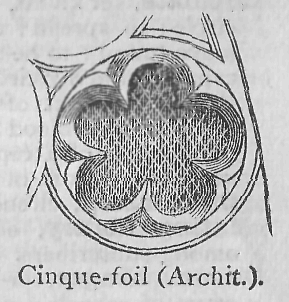
Cinque, singk, n. the number five as on dice.—ns. Cinque′-cen′to (It., 'five hundred'), a phrase sometimes applied, in treating of architecture and art, to the Renaissance period, which began about 1500; Cinque′-foil (her.), a common bearing representing a flower with five petals borne full-faced and without a stalk: (bot.) species of plants of the genus Potentilla: the five-bladed clover; Cinque′-pace (Shak.), a kind of dance, the pace or movement of which is characterised by five beats.—n.pl. Cinque′-ports, the five ancient ports on the south of England lying opposite to France—Sandwich, Dover, Hythe, Romney, and Hastings.—adj. Cinque′-spot′ted (Shak.), having five spots. [Fr.]
Cipher, sī′fėr, n. (arith.) the character 0: any of the nine figures: anything of little value, whether persons or things: a nonentity: an interweaving of the initials of a name: a secret kind of writing.—v.i. to work at arithmetic: to write in cipher: of an organ-pipe, to sound independent of the organ: (Shak.) to decipher.—ns. Cī′phering; Cī′pher-key, a key to a cipher or piece of secret writing. [O. Fr. cifre, Fr. chiffre—Ar. sifr, empty.]
Cipolin, sip′ō-lin, n. a granular limestone containing mica.—Also Cipollino (chē-pol-lē′nō). [It.,—cipolla, an onion.]
Cippus, sip′us, n. the stocks: a monumental pillar. [L. cippus, a post.]
Circa, sir′ka, prep. and adv. about, around. [L.]
Circassian, sėr-kash′yan, adj. belonging to Circassia, a district of Russia, on the north of Mount Caucasus: a kind of light cashmere of silk and mohair—generally Circassienne′ (Fr. fem.).
Circean, sėr-sē′an, adj. relating to the beautiful sorceress Circe, who transformed the companions of Ulysses into swine by a magic beverage: infatuating and degrading.—Also Circæ′an.
Circensian, sir-sen′shi-an, adj. relating to the Circus Maximus in Rome, where the games and contests were held.—Also Circen′sial (obs.). [L. circensis—circus.]
Circle, sėr′kl, n. a plane figure bounded by one line every point of which is equally distant from a certain point called the centre: the line which bounds the figure: a ring: a planet's orbit: a series ending where it began: a figure in magic; a company surrounding the principal person: those of a certain class or society.—v.t. to move round: to encompass.—v.i. to move in a circle: to stand in a circle.—adjs. Cir′cinate; Cir′cled, circular: encircled.—ns. Cir′cler; Cir′clet; Cir′cling, motion in a circle: a revolution.—Dress′ cir′cle (see Dress); Fair′y-cir′cle, -ring (see Fairy).—Reasoning in a circle, assuming what is to be proved as the basis of the argument. [A.S. circul—L. circulus, dim. of circus; allied to A.S. hring, a ring.]
Circuit, sėr′kit, n. the act of moving round: area, extent: a round made in the exercise of a calling, esp. the round made by the judges for holding the courts of law: the judges making the round: (Shak.) diadem.—v.t. to go round.—n. Circuiteer′, a judge: one who goes on a circuit.—adj. Circū′itous, round about.—adv. Circū′itously.—n. Circū′ity, motion in a circle: an indirect course.—Make a circuit, to go round. [Fr.,—L. circuitus—circuīre, circum, round, īre, to go.]
Circular, sėr′kū-lar, adj. round: ending in itself: addressed to a circle of persons.—n. a note sent round to a circle or number of persons.—n. Circular′ity.—adv. Cir′cularly.—Circular notes, bank-notes issued for the convenience of travellers, being a kind of bill personal to the bearer, who is given also a corresponding 'letter of indication' addressed to foreign bankers.
Circulate, sėr′kū-lāt, v.t. to make to go round as in a circle: to spread: to repeat (of decimals).—v.i. to move round: to be spread about.—adj. Cir′culable, capable of being circulated.—ns. Cir′culant; Circulā′tion, the act of moving in a circle: the movement of the blood: the sale of a periodical: the publication of a report or of a book: the money in use at any time in a country.—adjs. Cir′culative, Cir′culatory, circulating.—n. Cir′culator.—Circulating library, one where books are circulated among subscribers. [L. circulāre, -ātum.]
Circumambages, sėr-kum-am′baj-ez, n.pl. roundabout ways of speech.—adj. Circumambā′gious, roundabout in speech.—ns. Circumam′bience, Circumam′biency.—adj. Circumam′bient, going round about.—n. Circumben′dibus, a roundabout method or course: a circumlocution. [L. circum, about, ambīre, to go round.]
Circumambulate, sėr-kum-am′bū-lāt, v.i. to walk round about.—n. Circumambulā′tion. [L. ambulāre, -ātum, to walk.]
Circumcise, sėr′kum-sīz, v.t. to cut off the foreskin according to the Jewish law: (fig.) to purify.—p.adj. Cir′cumcised, that has undergone circumcision: purified, chastened.—ns. Cir′cumciser, one who circumcises; Circumci′sion, the act of circumcising. [L. circumcidĕre, circumcisum—cædĕre, to cut.]
Circumdenudation, sėr-kum-de-nūd-ā′shun, n. (geol.) denudation or erosion round an elevated tract left isolated.
Circumduct, sėr′kum-dukt, v.t. to lead around or about, to revolve round an imaginary axis so as to describe a cone: (Scots law) to close a case to further proof.—n. Circumduc′tion.—adj. Circumduct′ory. [L. circum, about, ducĕre, ductum, to lead.]
Circumference, sėr-kum′fėr-ens, n. the boundary-line of any round body, esp. of a circle: the line surrounding anything: area: compass: distance round.—adj. Circumferen′tial—n. Circumferent′or, an instrument used by surveyors and miners for measuring horizontal angles, consisting of a graduated circle, an index, and a magnetic needle suspended over the centre of a circle—now superseded by the Theodolite. [L. circum, about, ferre, to carry.]
Circumflect, sėr′kum-flekt, v.t. to mark with a circumflex.—ns. Cir′cumflex, an accent (^) denoting a rising and falling of the voice on a vowel or syllable; Circumflex′ion, a bending round. [L. flectĕre, flexum, to bend.]
Circumfluence, sėr-kum′flōō-ens, n. a flowing round.—adj. Circum′fluent, flowing round. [L. fluĕre, to flow.]
Circumforaneous, sėr-kum-fō-rā′ne-us, adj. wandering about as from market to market, vagrant.—Also Circumfora′nean. [L., circum, about, forum, the forum, market-place.]
Circumfuse, sėr-kum-fūz′, v.t. to pour around.—p.adj. Circumfused′.—adj. Circumfus′ile, molten.—n. Circumfū′sion. [L. fundĕre, fusum, to pour.]
Circumgyrate, sėr-kum-jī′rāt, v.i. to go round and round.—n. Circumgyrā′tion.—adj. Circumgy′ratory. [L. gyrāre, -ātum, to turn.]
Circumjacent, sėr-kum-jā′sent, adj. lying round: bordering on every side.—n. Circumja′cency. [L. jacens, lying—jacēre, to lie.]
Circumlittoral, sėr-kum-lit′ō-ral, adj. adjacent to the shore-line. [L. circum, about, litus, litoris, the shore.]
Circumlocution, sėr-kum-lō-kū′shun, n. roundabout speaking: a manner of expression in which many unnecessary words are used.—v.i. Cir′cumlocute, to use circumlocution.—n. Circumlocū′tionist, one who practises circumlocution.—adj. Circumloc′utory.—Circumlocution office, a name given by Dickens in Little Dorrit to the government offices, owing to their dilatoriness in attending to business. [L. loqui, locutus, to speak.]
Circummure, sėr-kum-mūr′, v.t. (Shak.) to wall round. [L. murus, a wall.]
Circumnavigate, sėr-kum-nav′i-gāt, v.t. to sail round.—adj. Circumnav′igable, capable of being circumnavigated.—ns. Circumnavigā′tion; Circumnav′igator, one who sails round. [See Navigate.]
Circumnutation, sėr-kum-nū-tā′shun, n. a nodding or turning successively towards all points of the compass, as in the tendrils of plants.—v.i. Circumnū′tate.—adj. Circumnū′tatory. [L. circum, about, nutāre, -ātum, to nod.]
Circumpolar, sėr-kum-pō′lar, adj. situated round the pole. [See Polar.]
Circumpose, sėr′kum-pōz, v.t. to place round.—n. Circumposi′tion, the act of placing round. [See Position.]
Circumscribe, sėr-kum-skrīb′, v.t. to draw a line round: to enclose within certain limits, to curtail, abridge.—adj. Circumscrib′able, able to be circumscribed.—ns. Circumscrib′er, one who circumscribes; Circumscrip′tion, limitation: the line that limits: a circumscribed place.—adj. Circumscrip′tive, marking the external form or outline. [L. scribĕre, to write.]
Circumspect, sėr′kum-spekt, adj. looking round on all sides watchfully: cautious: prudent.—n. Circumspec′tion, watchfulness: caution: examining.—adj. Circumspec′tive, looking around: wary.—adv. Cir′cumspectly.—n. Cir′cumspectness. [L. specĕre, spectum, to look.]
Circumstance, sėr′kum-stans, n. the logical surroundings of an action: an accident or event: ceremony: detail: (pl.) the state of one's affairs.—v.t. to place in particular circumstances:—pa.p. cir′cumstanced.—adj. Circumstan′tial, consisting of details: minute.—n. Circumstantial′ity, the quality of being circumstantial: minuteness in details: a detail.—adv. Circumstan′tially.—n.pl. Circumstan′tials, incidentals: details.—v.t. Circumstan′tiate, to prove by circumstances: to describe exactly.—Circumstantial evidence, evidence which is not positive nor direct, but which is gathered inferentially from the circumstances in the case.—In good or bad circumstances, prosperous or unprosperous; In, Under the circumstances, owing to certain conditions. [L. stans, stantis, standing—stāre, to stand.]
Circumvallate, sėr-kum′val-āt, v.t. to surround with a rampart.—n. Circumvallā′tion, a surrounding with a wall: a wall or fortification surrounding a town or fort. [L. vallum, rampart.]
Circumvent, sėr-kum-vent′, v.t. to come round or outwit a person: to deceive or cheat.—n. Circumven′tion.—adj. Circumvent′ive, deceiving by artifices. [L. venīre, to come.]
Circumvolve, sėr-kum-volv′, v.t. to roll round.—v.i. to revolve:—pr.p. circumvolv′ing; pa.p. circumvolved′.—n. Circumvolū′tion, a turning or rolling round: anything winding or sinuous. [L. volvĕre, volutum, to roll.]
Circus, sėr′kus, n. a circular building for the exhibition of games: a place for the exhibition of feats of horsemanship: a group of houses arranged in the form of a circle: applied to nature, as, e.g., high hills surrounding a plain.—n. Cirque (sėrk), a circus: a ring of some sort. [L. circus; cog. with Gr. kirkos.]
Cirrhopod, Cirrhopoda, older forms of Cirriped, Cirripeda.
Cirripeda, sir-rip′e-da, Cirripedia, sir-rip-ē′di-a, n. a degenerate sub-class of Crustacea, including the numerous forms of Barnacles and Acorn-shells.—n. Cir′riped, one of the Cirripeda. [L. cirrus, a tuft of hair, and pes, a foot.]
Cirrus, sir′us, n. the highest form of clouds consisting of curling fibres: (bot.) a tendril: (zool.) any curled filament:—pl. Cirri (sir′ī).—adjs. Cirr′ate, Cirr′iform, like a cirrus; Cirr′igrade, moving by cirri.—n. Cirr′o-cū′mulus, a fleecy cloud intermediate between the cirrus and cumulus.—adj. Cirr′ose, with tendrils.—n. Cirr′o-strā′tus, a mottled-looking cloud intermediate between the cirrus and stratus.—adj. Cirr′ous, having a cirrus. [L.]
Cisalpine, sis-alp′in, adj. on this side—i.e. on the Roman side—of the Alps.—So Cisatlan′tic; Cisleith′an, on this side the Leitha, which separates the archduchy of Austria and Hungary; Cismon′tane, on this side the mountains—opp. to Ultramontane; Cis′padane, on this side the Po; Cispon′tine, on this side of the bridges, viz. in London, north of the Thames. [L. cis, on this side.]
Ciselure, sēz′lūr, n. the art or operation of chasing, the chasing upon a piece of metal-work.—n. Cis′eleur, a chaser. [Fr.]
Cissoid, sis′soid, n. a plane curve consisting of two infinite branches symmetrically placed with reference to the diameter of a circle, so that at one of its extremities they form a Cusp (q.v.), while the tangent to the circle at the other extremity is their common asymptote. [Gr. kissoeidēs.]
Cist, sist, n. a tomb consisting of a stone chest covered with stone slabs.—adjs. Cist′ed, containing cists; Cist′ic, like a cist. [See Chest.]
Cistella, sis-tel′a, n. the capsular shield of some lichens. [L., dim. of cista, a box.]
Cistercian, sis-ter′shan, n. one of the order of monks established in 1098 in the forest of Citeaux (Cistercium), in France—an offshoot of the Benedictines.
Cistern, sis′tėrn, n. any receptacle for holding water or other liquid: a reservoir: in a steam-engine, the vessel surrounding the condenser. [L. cisterna, from cista, a chest.]
Cistus, sis′tus, n. Rock-rose, a genus of exogenous shrubby plants, cultivated for the beauty of their flowers:—pl. Cis′tuses (-ēz) and Cis′ti (′tī). [Low L., from Gr. kistos, the rock-rose.]
Cistvaen. See Kistvaen.
Cit, sit, n. shortened from citizen, and used as a term of contempt:—fem. Cit′ess (Dryden). [See Citizen.]
Citadel, sit′a-del, n. a fortress in or near a city: the place where the guns are kept in an ironclad man-of-war. [It. cittadella, dim. of città, a city. See City.]
Cite, sīt, v.t. to call or summon: to summon to answer in court: to quote: to name: to adduce as proof.—adj. Cit′able, that can be cited.—ns. Cit′al, summons to appear: (Shak.) accusation, reproof; Citā′tion, an official summons to appear: the document containing the summons: the act of quoting: the passage or name quoted; Citā′tor, one who cites.—adj. Cit′ātory, having to do with citation, addicted to citation. [L. citāre, -ātum, to call, inten. of ciēre, cīre, to make to go.]
Cithara, sith′a-ra, n. an ancient musical instrument closely resembling the guitar.—n. Cith′arist, a player on it.—adj. Citharist′ic.—ns. Cith′er, Cith′ern, Cit′tern, a metal-stringed musical instrument, played with a plectrum. [L.,—Gr. kithara. A doublet of Guitar.]
Citigrade, sit′i-grād, adj. moving quickly: applied to a tribe of spiders of remarkably quick motions. [L. citus, quick, gradus, a step.]
Citizen, sit′i-zen, n. an inhabitant of a city: a member of a state: a townsman: a freeman:—fem. Cit′izeness.—adj. (Shak.) like a citizen.—v.t. Cit′izenise, to make a citizen of.—ns. Cit′izenry, the general body of citizens; Cit′izenship, the rights of a citizen. [M. E. citesein—O. Fr. citeain. See City.]
Citole, sit′ōl, n. a small dulcimer used in medieval times. [O. Fr.,—L. cithara.]
Citron, sit′run, n. the fruit of the citron-tree, resembling a lemon.—n. Cit′rate, a salt of citric acid.—adjs. Cit′reous, citrine; Cit′ric, derived from the citron; Cit′rine, dark and greenish yellow, like a citron or lemon.—n. citrine colour: a rock crystal of this colour.—ns. Cit′ron-wood, Cit′rus-wood, the most costly furniture-wood of the ancient Romans.—Citric acid, the acid to which lemon and lime juice owe their sourness. [Fr.,—L. citrus—Gr. kitron, a citron.]
Cittern. Same as Cither (q.v. under Cithara).
City, sit′i, n. a large town: a town with a corporation.—n.pl. Cit′y-commis′sioners, officials who attend to the drainage, &c.—n. Cit′y-mis′sion, a mission for evangelising the poor classes in the large cities.—adj. Civ′ic, pertaining to a city or citizen.—City of God, Heavenly city, &c., the ideal of the Church of Christ in glory; City of refuge, by the Jewish law a city where the perpetrator of an accidental murder might flee for refuge.—Eternal city, Rome; Holy city, Jerusalem.—The City, The City of London, that part of London where business is principally carried on. [Fr. cité, a city—L. civitas, the state—civis, a citizen.]
Cive, sīv, n. See Chive.
Civet, siv′et, n. a perfume obtained from the civet or Civ′et-cat, a small carnivorous animal of Africa, India, &c. [Fr. civette—Ar. zabad.]
Civic. See City.
Civil, siv′il, adj. pertaining to the community: having the refinement of city-bred people: polite: commercial, not military: lay, secular, or temporal, not ecclesiastical: pertaining to the individual citizen: (law) relating to private relations amongst citizens, and such suits as arise out of these, as opposed to criminal: (theol.) naturally good, as opposed to good through regeneration.—ns. Civil′ian, a professor or student of civil law (not canon law): one engaged in civil as distinguished from military and other pursuits; Civ′ilist, one versed in civil law; Civil′ity, good-breeding: politeness.—adv. Civ′illy.—adj. Civ′il-suit′ed (Milton), sombrely clad.—n. Civ′ism, good citizenship, state of being well-affected to the government.—Civil death, the loss of all civil and legal but not natural privileges, as by outlawry: Civil engineer, one who plans rail-ways, docks, &c., as opposed to a military engineer, or to a mechanical engineer, who makes machines, &c.; Civil law, as opposed to criminal law: the law laid down by a state regarding the rights of the inhabitants; Civil list, now the expenses of the sovereign's household only; Civil list pensions, those granted by royal favour; Civil service, the paid service of the state, in so far as it is not military or naval; Civil war, a war between citizens of the same state. [L. civīlis—civis.]
Civilise, siv′il-īz, v.t. to reclaim from barbarism: to instruct in arts and refinements.—adj. Civ′ilisable.—n. Civilisā′tion, state of being civilised—p.adj. Civ′ilised.—n. Civ′iliser.
Clabber, klab′ėr, n. (Scot.). [Gael. clabar, mud.]
Clachan, kla′han, n. (Scot.) a small village. [Gael. clachan—clach, stone.]
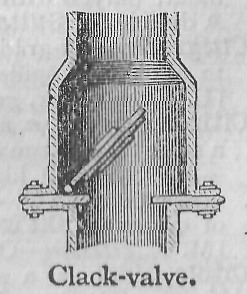
Clack, klak, v.i. to make a sudden sharp noise as by striking: to chatter: to cackle.—n. a sharp, sudden sound; sound of voices: an instrument making this kind of noise: (coll.) the tongue.—ns. Clack′-box, the box containing the clack-valve of an engine; Clack′-dish (Shak.), a wooden dish carried by beggars, having a movable cover which they clacked to attract attention; Clack′er; Clack′-valve, a valve used in pumps, having a flap or a hinge which lifts up to let the fluid pass, but prevents the fluid from returning by falling back over the aperture. [From the sound.]
Clad, klad, pa.t. and pa.p. of Clothe.
Claes, klāz, n.pl. Scotch for Clothes.
Clag, klag, v.i. (prov.) to stick.—adj. Clag′gy, sticky. [Prob. Scand.; Dan. klag, mud.]
Claim, klām, v.t. to call for: to demand as a right.—n. a demand for something supposed due: right or ground for demanding: the thing claimed.—adj. Claim′able, that can be claimed.—n. Claim′ant, one who makes a claim.—Lay claim to, to assert a right. [O. Fr. claimer—L. clamāre, to call out.]
Clairaudience, klār-awd′i-ens, n. the alleged power of hearing things not present to the senses.—n. Clairaud′ient. [Fr. clair—L. clarus, clear, and Audience.]
Clair-obscure, Clare-obscure, klār-ob-skūr′. Same as Chiaroscuro (q.v.). [Fr. clair—L. clarus, clear, and Fr. obscur—L. obscurus, obscure.]
Clairschach, klār′shäh, n. the old Celtic harp strung with wire.
Clairvoyance, klār-voi′ans, n. the alleged power of seeing things not present to the senses.—n. Clairvoy′ant, one who is said to have this power. [Fr., clair—L. clarus, clear, and Fr. voir—L. vidēre, to see.]
Clam, klam, n. a species of bivalve shellfish: an instrument for holding. [A.S. clam, fetter; cf. Ger. klamm; Dan. klamme.]
Clam, klam, v.t. to clog: to smear; pr.p. clam′ming; pa.p. clammed.—n. dampness.—adv. Clam′mily.—n. Clam′miness.—adj. Clam′my, sticky: moist and adhesive. [A.S. clæman, to anoint; cf. Dut., Dan. klam, damp.]
Clam, klam, n. noise produced in ringing a chime of bells at once.—v.t. or v.i. to produce a clam. [Prob. onomatopœic.]
Clamant, klam′ant, adj. calling aloud or earnestly.—n. Clam′ancy, urgency. [L. clamāre, to cry out.]
Clamber, klam′bėr, v.i. to climb with difficulty, grasping with the hands and feet.—n. the act of clambering. [From root of Clump; cf. Ger. klammern—klemmen, to squeeze or hold tightly.]
Clamjamphrie, klam-jam′fri, n. (Scot.) rubbish: nonsense: rabble. [Der. uncertain.]
Clamour, klam′or, n. a loud continuous outcry: uproar; any loud noise.—v.i. to cry aloud in demand: to make a loud continuous outcry.—adj. Clam′orous, noisy, boisterous.—adv. Clam′orously.—ns. Clam′-orousness; Clam′ourer. [L. clamor.]
Clamp, klamp, n. a piece of timber, iron, &c., used to fasten things together or to strengthen any framework: any instrument for holding.—v.t. to bind with clamps. [From a root seen in A.S. clam, fetter; Dut. klamp, a clamp, and akin to Eng. Clip, Climb.]
Clamp, klamp, n. a heavy tread.—v.i. to tread heavily. [Prob. from the sound.]
Clamper, klam′pėr, v.t. to botch up. [Der. unknown; prob. conn. with Clamp, a piece of timber, &c.]
Clan, klan, n. a tribe or collection of families subject to a single chieftain, bearing the same surname, and supposed to have a common ancestor: a clique, sect: a collective name for a number of persons or things.—adj. Clan′nish, closely united, like the members of a clan.—adv. Clan′nishly.—ns. Clan′nishness; Clan′ship, association of families under a chieftain: feeling of loyalty to a clan; Clans′man, a member of a clan. [Gael. clann, offspring, tribe—L. planta, a shoot.]
Clandestine, klan-des′tin, adj. concealed or hidden: private: sly.—adv. Clandes′tinely. [L. clandestinus—clam, secretly.]
Clang, klang, v.i. to produce a sharp, ringing sound.—v.t. to cause to clang.—n. a sharp, ringing sound, like that made by metallic substances struck together: (fig.) sound, the cry of some birds.—n. Clang′ing, the sound corresponding to the verb.—adj. Clang′orous.—adv. Clang′orously.—n. Clang′our, a clang: a sharp, shrill, harsh sound.—v.i. to make a clangour. [L. clangĕre; Ger. klang; formed from the sound.]
Clank, klangk, n. a sharp sound, less prolonged than a clang, such as is made by a chain.—v.t. or v.i. to make or cause a clank.—n. Clank′ing, the action of the verb clank.—adj. Clank′less, without clank. [Prob. formed under the influence of Clink and Clang.]
Clap, klap, n. the noise made by the sudden striking together of two things, as the hands: a burst of sound: a slap.—v.t. to strike together so as to make a noise: to thrust or drive together suddenly: to fasten promptly: to pat with the hand in a friendly manner: to applaud with the hands: to bang: to imprison—e.g. 'to clap one in prison.'—v.i. to strike the hands together: to strike together with noise: to applaud:—pr.p. clap′ping; pa.p. clapped.—ns. Clap′-board, a thin board used in covering wooden houses; Clap′-bread, a kind of hard-baked oatmeal cake; Clap′-dish (same as Clack-dish); Clap′-net, a kind of net which is made to clap together suddenly by pulling a string; Clap′per, one who claps: that which claps, as the tongue of a bell: a glib tongue.—v.t. Clap′per-claw, to claw or scratch: (Shak.) to scold.—ns. Clap′ping, noise of striking: applause; Clap′-sill, the bottom part of the frame on which lock-gates shut—called also Lock-sill; Clap′trap (Shak.), a trick to gain applause: flashy display: empty words; Claptrap′pery.—adj. Claptrap′pish.—Clap eyes on, to see; Clap hands (Shak.), to make an agreement; Clap hold of, to seize roughly; Clap up (Shak.), to conclude suddenly. [Ice. klappa, to pat; Dut. and Ger. klappen.]
Clap, klap, n. gonorrhea. [Cf. Dut. klapoor.]
Claque, klak, n. an institution for securing the success of a public performance, by bestowing upon it preconcerted applause.—n. Claq′ueur, a member of the claque. [Fr. claquer, to clap.]
Clarabella, klar-a-bel′a, n. an organ-stop of a sweet fluty tone.
Clarence, klar′ens, n. a four-wheeled carriage, seated inside for two or more persons. [Named after William IV. when Duke of Clarence.]
Clarenceux, Clarencieux, klar′en-sū, n. (her.) the second king-of-arms in England, so named from the Duke of Clarence, son of Edward III.
Clarendon, klar′en-don, n. (print.) a form of type having a heavy face.
Clare-obscure. Same as Chiaroscuro.
Claret, klar′et, n. originally applied to wines of a light-red colour, but now used in England for the dark-red wines of Bordeaux: (slang) blood.—v.i. to drink claret.—ns. Clar′et-cup, a drink made up of iced claret, brandy, sugar, &c.; Clar′et-jug, a fancy jug for holding claret. [Fr. clairet—clair—L. clarus, clear.]
Clarify, klar′i-fī, v.t. to make clear or pure.—v.i. to become clear:—pr.p. clar′ifying; pa.p. clar′ified.—ns. Clarificā′tion; Clar′ifier, that which clarifies or purifies. [L. clarus, clear, and facĕre, to make.]
Clarion, klar′i-on, n. a kind of trumpet whose note is clear and shrill: the sound of a trumpet, or a sound resembling that of a trumpet.—ns. Clar′inet, Clar′ionet, a wind-instrument, usually of wood, in which the sound is produced by a single thin reed.—The Bass Clarinet is pitched an octave lower than the ordinary clarinet. [Fr. clairon—clair—L. clarus, clear.]
Clarity, klar′i-ti, n. clearness. [M. E. clarté—L. claritas.]
Clarty, klar′ti, adj. (Scot.) sticky and dirty. [Der. unknown.]
Clary, klār′i, n. a biennial with clammy stem, large, heart-shaped, rough, doubly crenate leaves, and whorls of pale-blue flowers in loose terminal spikes, with large coloured bracts. [Low L. sclarea. Origin unknown.]
Clash, klash, n. a loud noise, such as is caused by the striking together of weapons: opposition: contradiction: (Scot.) chatter, country talk.—v.i. to dash noisily together: to meet in opposition: to act in a contrary direction: to disagree: (Scot.) to gossip.—v.t. to strike noisily against.—n. Clash′ing, a striking against: opposition. [Formed from the sound, like Ger. and Sw. klatsch.]
Clasp, klasp, n. a hook for fastening: an embrace.—v.t. to fasten with a clasp: to enclose and hold in the hand or arms: to embrace.—ns. Clasp′er, that which clasps: the tendril of a plant; Clasp′ing; Clasp′-knife, a knife the blade of which folds into the handle. [M. E. clapse, from the root of A.S. clyppan, to embrace. See Clip.]
Class, klas, n. a rank or order of persons or things: high rank or social standing: a number of students or scholars who are taught together: a scientific division or arrangement: the position in order of merit of students after examination.—v.t. to form into a class or classes: to arrange methodically.—v.i. to take rank.—adjs. Class′able, Class′ible, capable of being classed.—ns. Class′-fell′ow, Class′-mate, a pupil in the same class at school or college; Class′ic, any great writer or work: a student of the ancient classics: a standard work: (pl.) Greek, Roman, and modern writers of the first rank, or their works.—adjs. Class′ic, -al, of the highest class or rank, esp. in literature: originally and chiefly used of the best Greek and Roman writers: (as opposed to Romantic) like in style to the authors of Greece and Rome: chaste, refined, in keeping with classical art: famous for literary or historical reasons.—ns. Classical′ity, Class′icalness, the quality of being classical.—adv. Class′ically.—ns. Class′icism, a classical idiom; Class′icist, one versed in the classics, or devoted to their being retained in education; Class′-lead′er, the leader of a class in a Methodist church; Class′man, one who has gained honours of a certain class at the Oxford examinations—opp. to Passman.—Classic races, the five chief annual horse-races—the Two Thousand, One Thousand, Derby, Oaks, and St Leger.—Take a class, to take honours in an examination, as opposed to the mere 'pass.' [Fr. classe—L. classis, cog. with L. calāre, Gr. kalein.]
Classify, klas′i-fī, v.t. to make or form into classes: to arrange:—pr.p. class′ifying; pa.p. class′ified.—adjs. Classifī′able, capable of being classified; Classif′ic, denoting classes.—n. Classificā′tion, act of forming into classes: distribution into classes.—adj. Class′ificātory.—n. Class′ifīer. [L. classis, and facĕre, to make.]
Classis, klas′is, n. a group: judicatory. [L.]
Clastic, klas′tik, adj. breaking into fragments, fragmental. [Gr. klastos—klan, to break.]
Clatch, klach, v.t. (Scot.) to daub.—n. mire, anything for daubing.
Clatch, klach, v.t. (Scot.) to finish carelessly, to botch.—n. a piece of work spoiled or botched.
Clatch, klach, n. (Scot.) a kind of gig.
Clathrate, klath′rāt, adj. latticed—also Clath′roid.—adjs. Clath′rose, crossed by deep rectangular furrows; Clath′rulate, finely clathrate. [L. clath-rāre, -ātum, to furnish with a lattice—Gr. klēthra, a lattice.]
Clatter, klat′ėr, n. a repeated rattling noise: a repetition of abrupt, sharp sounds: noisy talk: (Burns) gossip.—v.i. to make rattling sounds: to rattle with the tongue: to talk fast and idly.—v.t. to strike so as to produce a rattling.—adv. Clatt′eringly. [Acc. to Skeat, clatter = clacker, a freq. of Clack.]
Claude Lorraine glass, n. a convex mirror, usually coloured, employed for viewing landscape. [Named after the painter Claude Lorraine (1600-82).]
Claudian, klaw′di-an, adj. pertaining to the Roman emperors of the Claudian gens (Tiberius, Caligula, Claudius, Nero), or their period (14-68 A.D.).
Claudication, klaw-di-kā′shun, n. a halting, a limp. [L.,—claudus, lame.]
Claught, kläht, v.t. (Scot.) to snatch.—n. a hold, catch. [Cf. Cleek.]
Clause, klawz, n. a sentence or part of a sentence: an article or part of a contract, will, &c.—adj. Claus′ular, pertaining to, or consisting of, a clause or clauses. [Fr. clause—L. clausus—claudĕre, to shut.]
Claustral, klaws′tral, adj. cloistral, secluded, pertaining to a claustrum.—ns. Claustrā′tion, the act of shutting in a cloister; Claustrophō′bia, a morbid dread of confined places.—adj. Claustrophob′ic.
Claustrum, klaws′trum, n. a thin layer of gray matter in the substance of the hemispheres of the brain:—pl. Claus′tra. [L.]
Claut, klat, n. a kind of rake: (Scot.) what is raked, a rakeful.—v.t. to scratch, claw.—n.pl. Clats, slops.—adj. Clat′ty, dirty. [Perh. conn. with Claw.]
Clavate, -d, klā′vāt, -ed, adj. (bot.) club-shaped: gradually thickening to the top.—n. Clavā′tion, articulation in a socket.—adjs. Clav′ellate, having club-shaped processes; Clav′iform, in the form of a club.—n. Clav′iger, a club-bearer.—adj. Clavig′erous, club-bearing. [From L. clava, a club.]
Clave, klāv, pa.t. of Cleave.
Clavecin, klav′e-sin, n. a harpsichord.—n. Clav′ecinist (Browning), a player on the clavecin. [Fr. clavecin—L. clavis, a key.]
Claver, klā′vėr, n. idle talk, gossip.—v.i. to talk idly. [Scotch; der. uncertain; cf. Gael. clabaire.]
Clavichord, klav′i-kord, n. an obsolete musical instrument, of the same form as the Harpsichord and Spinet.—n. Clav′iharp, a harp struck with keys like a piano. [L. clavis, a key, chorda, a string.]
Clavicle, klav′i-kl, n. an important part of the pectoral girdle of vertebrates, best known in the collar-bone of man and in the merry-thought of birds—also Clavic′ula.—adj. Clavic′ular. [Fr. clavicule—L. clavicula, dim. of clavis, a key.]
Clavicorn, klav′i-korn, adj. having clavate antennæ.—n. a member of the Clavicornia, a group of Coleoptera or beetles. [L. clava, a club, cornu, a horn.]
Clavier, kla-vēr′, n. the keyboard of a musical instrument: a stringed instrument, esp. the pianoforte. [Fr.,—L. clavis, a key.]
Clavis, klă′vis, n. a key, hence a clue or aid for solving problems, interpreting a cipher, &c.:—pl. Clā′ves.—n. Clav′iger, one who keeps a key, a custodian.—adj. Clavig′erous, keeping keys. [L., a key.]
Claw, klaw, n. the hooked nail of a beast or bird: the whole foot of an animal with hooked nails: anything like a claw: an instrument shaped like a claw.—v.t. to scratch or tear as with the claws or nails: to scrape; to seize: (fig.) to flatter, fawn on.—n. Claw′back, a toady, flatterer.—adj. Clawed, having claws.—ns. Claw-hamm′er, a hammer with one part of the head divided into two claws, with which to extract nails; Claw′-hamm′er-coat, a facetious name for a dress-coat.—adj. Claw′less.—Claw me and I'll claw thee, favour me and I shall do you good in return. [A.S. clawu; cog. with Ger. klaue; akin to Cleave, to stick.]
Clay, klā, n. a tenacious ductile earth: earth in general: the human body: short for clay-pipe, a tobacco-pipe made of baked clay.—v.t. to purify with clay, as sugar.—adjs. Clay′-brained (Shak.), stupid; Clay′-cold, cold as clay, lifeless.—n. Clay′-eat′er, one addicted to chewing a fatty clay—in Brazil and elsewhere.—adjs. Clayed, clay-like; Clay′ey, made of clay: covered with clay.—n. Clay′-ground, ground consisting mainly of clay.—adj. Clay′ish, of the nature of clay.—ns. Clay′-marl, a whitish chalky clay; Clay′-mill, a mill for preparing clay; Clay′-slate, an argillaceous rock, splitting readily into thin sheets; Clay′stone, one of the concretionary nodules in alluvial deposits.—Wet one's clay, to drink. [A.S. clæg; cf. Dan. klæg, Ger. klei.]
Claymore, klā′mōr, n. a large sword formerly used by the Scottish Highlanders, the old Celtic one-handed, two-edged longsword, now applied inaccurately to the basket-hilted sword of the officers of Highland regiments. [Gael. claidheamh-mor—Gael. and Ir. claidheamh, sword, mor, great.]
Clean, klē′n, adj. free from dirt, stain, or whatever defiles: pure: guiltless: neat: complete.—adv. quite: entirely: cleverly.—v.t. to make clean, or free from dirt.—ns. Clean′or, that which cleans; Clean′ing, the act of making clean.—adj. Clean′-limbed, having well-proportioned limbs: smart.—n. Clean′liness.—adj. Clean′ly, clean in habits or person: pure: neat.—adv. in a cleanly manner.—n. Clean′ness.—adj. Clean′-tim′bered (Shak.), well-proportioned.—Clean bill of health (see Bill of health).—Have clean hands, to be free from the guilt of wrong-doing.—Make a clean breast of, to own up frankly, to confess fully; Show a clean pair of heels, to escape by running.—The clean thing, the right thing to do. [A.S. clǽne; W., Gael. glan, shine, polish; Ger. klein, small.]
Cleanse, klenz, v.t. to make clean or pure.—adj. Cleans′able.—ns. Cleans′er, one who, or that which, cleanses; Cleans′ing, purification.
Clear, klēr, adj. pure, bright, undimmed: free from obstruction or difficulty: plain, distinct: without blemish, defect, drawback, or diminution: conspicuous: transparent.—adv. in a clear manner: plainly: wholly: quite.—v.t. to make clear: to empty: to free from obscurity, obstruction, or guilt: to free, acquit, or vindicate; to leap, or pass by or over; to make profit: to settle a bill.—v.i. to become clear: to grow free, bright, or transparent.—ns. Clear′age, a piece of land cleared; Clear′ance, act of clearing: removal of hinderances: a certificate that a ship has been cleared at the custom-house—that is, has satisfied all demands and procured permission to sail.—adjs. Clear′-eyed, clear-sighted, discerning; Clear′-head′ed, having a clear understanding, sagacious.—ns. Clear′ing, the act of making clear: a tract of land cleared of wood, &c., for cultivation: a method by which bankers exchange cheques and drafts, and arrange the differences; Clear′ing-house, a place in London where such clearing business is done; Clear′ing-nut, the seed of Strychnos potatorum, used in the East Indies for clearing muddy water.—adv. Clear′ly, in a clear manner: distinctly.—ns. Clear′ness; Clear′-obscure′ (see Chiaroscuro).—adj. Clear′-sight′ed, having clearness of sight: discerning.—ns. Clear′-sight′edness; Clear′-starch′er, a laundress; Clear′-starch′ing, the act of stiffening linen with clear starch; Clear-story (see Clerestory).—Clear out, to be off; Clear the way, to make the way open; Clear up, to become clear. [Fr. clair—L. clarus, clear.]
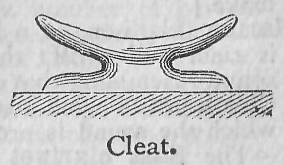
Cleat, klēt, n. a wedge: a piece of wood nailed across anything to keep it in its place or give it an additional strength: a piece of wood fastened on parts of a ship, and having holes or recesses for fastening ropes.—v.t. to strengthen with a cleat. [From a supposed A.S. cléat; cf. Dut. kloot; Dan. klode; Ger. kloss.]
Cleave, klēv, v.t. to divide, to split: to separate with violence: to go through: to pierce.—v.i. to part asunder: to crack:—pr.p. cleav′ing; pa.t. clōve or cleft; pa.p. clov′en or cleft.—adj. Cleav′able, capable of being cleft.—ns. Cleav′age, a condition of rocks in which they split easily into thin plates; Cleav′er, one who or that which cleaves: a butcher's chopper; Cleav′ers, Cliv′ers, goose-grass—Galium aperine, diuretic and sudorific.—adj. Cleav′ing, splitting. [A.S. cleófan; cog. with Ger. klieben.]
Cleave, klēv, v.i. to stick or adhere: to unite:—pr.p. cleav′ing; pa.t. cleaved or clāve; pa.p. cleaved.—n. Cleav′ing, the act of adhering. [A.S. clifian; cog. with Ger. kleben, Dut. kleven.]
Cleché, klesh′ā, adj. (her.) voided or hollowed throughout, as a cross showing only a narrow bolder. [Fr.]
Cleck, klek, v.t. to hatch.—n. Cleck′ing, a brood. [Scot.,—Ice. klekja; cf. Dan. klække, to hatch.]
Cleddyo, kled′yō, n. an antique leaf-shaped bronze Celtic sword. [W. cleddeu, cleddyf; L. gladius.]
Cleek, klēk, n. a large hook for catching hold of something, used in fishing, &c.: an iron-headed golf-club: a peg.—v.t. to seize, snatch. [M. E. kleken; perh. related to Clutch.]
Clef, klef, n. a musical character placed on the staff by which the absolute pitch of the notes is fixed. [Fr., from L. clavis; Gr. kleis, a key.]
Cleft, kleft, pa.t. and pa.p. of Cleave.
Cleft, kleft, n. an opening made by cleaving or splitting: a crack, fissure, or chink.—Also Clift (B.). [Cf. Ger. kluft, Dan. klyft, a hole.]
Cleft-palate. See Palate.
Cleg, kleg, n. the gadfly, horse-fly. [Ice. kleggi.]
Clem, klem, v.i. and v.t. to starve. [Prov. Eng. clam; Ger. klemmen, to pinch.]
Clematis, klem′a-tis, n. a creeping plant, called also Virgin's Bower and Traveller's Joy. [L.,—Gr. klēmatis—klēma, a twig.]
Clement, klem′ent, adj. mild: gentle: kind: merciful.—ns. Clem′ence (Spens.), Clem′ency, the quality of being clement: mildness: readiness to forgive.—adv. Clem′ently. [Fr.,—L. clemens.]
Clench, klensh. Same as Clinch.
Clepe, klēp, v.t. (arch.) to call: to name.—pa.p. Yclept. [A.S. clipian, to call.]
Clepsydra, klep′si-dra, n. an instrument used by the Greeks and Romans for measuring time by the trickling of water. [L.,—Gr. klepsydra—kleptein, klepsein, to steal, hydōr, water.]
Clerestory, Clear-story, clēr-stō′ri, n. an upper row of windows rising above the adjoining parts of the building, probably so named as admitting clearness or light—esp. applied to the windows in the upper part of the central nave of churches.
Clergy, klėr′ji, n. the ministers of the Christian religion, as holders of an allotted office, in contradistinction to the laity.—adjs. Cler′gyable, Cler′giable, entitled to or admitting of the benefit of clergy.—ns. Cler′gyman, one of the clergy, a regularly ordained minister; Cler′gy-wom′an, a woman belonging to a clergyman's family.—adjs. Cler′ic, -al, belonging to the clergy: pertaining to a clerk.—ns. Cler′ic, a clergyman; Cler′icalism, undue influence of the clergy, sacerdotalism; Cler′icate, clerical position; Cleric′ity, state of being a clergyman; Cler′isy, the class of learned men, scholars.—Clergyman's sore throat, chronic pharyngitis.—Benefit of clergy, originally an exemption of clergymen, in certain cases, from criminal process before a secular judge, but later covering the first offence of all who could read.—Black clergy, in Russia, the regular or monastic, as distinct from the secular or parochial, clergy. [Fr. clergé—L.,—Gr. klērikos, from klēros, a lot, then the clergy.]
Clerk, klärk, or klerk, n. a clergyman or priest: a scholar: one who leads the responses in the English Church service: in common use, one employed as a writer, assistant, copyist, account-keeper, or correspondent in an office.—v.i. to act as clerk.—adj. Cler′ical, pertaining to a clerk or copyist, as in 'clerical error.'—ns. Clerk′dom, Clerk′ship; Clerk′ery, Clerk′age, the work of a clerk.—adjs. Clerk′ish, like a clerk; Clerk′less, ignorant; Clerk′-like, scholarly.—n. Clerk′ling, a young clerk.—adj. Clerk′ly, scholarly.—adv. in a scholar-like or learned manner.—Clerk of the weather, an imaginary functionary facetiously supposed to direct the weather.—Bible clerk, a scholar who reads the lessons in some college chapels. [A.S. clerc, a priest—Late L. clericus. See Clergy.]
Cleromancy, kler′o-man-si, n. divination by lots. [Gr. klēros, lot, manteia, divination.]
Cler-story, an obsolete form of Clerestory.
Cleuch, Cleugh, klūh, n. a ravine with steep and precipitous sides. [Scotch form of Clough.]
Cleve, klēv, n. cliff: hillside. [Now rare. M. E. cleof, a variant of Cliff.]
Clever, klev′ėr, adj. able or dexterous: ingenious: skilful: (U.S.) good-natured.—ns. Cleveral′ity, Clev′erness.—adj. Clev′erish, somewhat clever.—adv. Clev′erly. [Ety. dub.]
Clew, Clue, klōō, n. a ball of thread, or the thread in it: a thread that guides through a labyrinth: anything that solves a mystery: the corner of a sail.—v.t. to coil up into a clew or ball: to truss or tie up sails to the yards.—n. Clew′-gar′net (naut.), a tackle for clewing up the smaller square sails for furling.—n.pl. Clew′-lines, ropes on the smaller square sails by which they are clewed up for furling. [A.S. cliwen; cf. Dut. kluwen; Ger. knäuel.]
Cliché, klē-shā′, n. the impression made by a die in any soft metal: an electrotype or stereotype plate. [Fr.,—clicher, to stereotype.]
Click, klik, n. a short, sharp clack or sound: anything that makes such a sound, as a small piece of iron falling into a notched wheel: a latch for a gate.—v.i. to make a light, sharp sound.—ns. Click′-clack, a continuous clicking noise; Click′er, the compositor who distributes the copy among a companionship of printers, makes up pages, &c.: one who cuts up leather for the uppers and soles of boots and shoes; Click′ing, the action of the verb. [Dim. of Clack.]
Client, klī′ent, n. one who employs a lawyer: a dependent.—n. Clī′entage, the whole number of one's clients: the client's relation to the patron.—adj. Clīent′al.—ns. Clī′entele, a following: the whole connection of a lawyer, shopkeeper, &c.; Clī′entship. [L. cliens, for cluens, one who hears or listens (to advice), from cluēre, to hear.]
Cliff, klif, n. (mus.). Same as Clef.
Cliff, klif, n. a high steep rock: the steep side of a mountain.—adjs. Cliffed, Cliff′y, having cliffs: craggy. [A.S. clif; Dut. clif; Ice. klif.]
Clift. See Cleft (2).
Clift, klift, n. same as Cliff, the form arising under the influence of Cleft.—adjs. Clift′ed, Clift′y, broken into cliffs.
Climacteric, klim-ak-tėr′ik, or klim-ak′tėr-ik, n. a critical period in human life, in which some great bodily change is supposed to take place: a critical time.—adj. pertaining to such a period: critical.—adj. Climacter′ical.—The grand climacteric, the sixty-third year, supposed to be a critical period for men. [Gr. klimaktēr—klimax, a ladder.]
Climate, klī′māt, n. the condition of a country or place with regard to temperature, moisture, &c.: (fig.) character of something.—v.i. (Shak.) to remain in a certain place.—adjs. Clī′matal, Climat′ic, -al, relating to climate.—v.t. Clī′matise (see Acclimatise).—adj. Climatograph′ical.—n. Climatog′raphy, a description of climates.—adj. Climatolog′ical, relating to climatology.—ns. Climatol′ogist, one skilled in the science of climatology; Climatol′ogy, the science of climates, or an investigation of the causes on which the climate of a place depends; Clī′mature (Shak.), climate. [Fr.,—L.,—Gr. klima, klimatos, slope—klinein, to slope.]
Climax, klī′maks, n. (rhet.) the arranging of the particulars of a portion of a discourse so as to rise in strength to the last: the last term of the rhetorical arrangement: a culmination.—v.i. to ascend in a climax: to culminate.—adjs. Climact′ic, -al, pertaining to a climax.—adv. Climact′ically. [Gr. klimax, a ladder—from klinein, to slope.]
Climb, klīm, v.i. or v.t. to ascend or mount by clutching with the hands and feet: to ascend with difficulty: to mount.—adj. Climb′able, capable of being climbed.—ns. Climb′er, one who or that which climbs: (pl.) an old-fashioned popular title for several orders of birds whose feet are mainly adapted for climbing: (bot.) those plants which, having weak stems, seek support from other objects, chiefly from other plants, in order to ascend from the ground; Climb′ing. [A.S. climban; cf. Ger. klimmen; conn. with Clamber and Cleave, to stick.]
Clime, klīm, n. a country, region, tract. [A variety of Climate.]
Clinamen, klin-ā′men, n. inclination. [L. clināre, to incline.]
Clinanthium, klin-an′thi-um, n. the receptacle in a composite plant. [Gr. klinē, a bed, anthos, a flower.]
Clinch, klinsh, Clench, klensh, v.t. to fasten or rivet a nail by bending the point and beating the bent part flat against the object through which the nail was driven: to grasp tightly: to set firmly, as the teeth: to fasten on: (fig.) to drive home an argument: to settle or confirm.—n. something set firmly: the fastening of a nail by beating it back, as in the verb: a pun.—n. Clinch′er, one that clinches: a decisive argument.—adj. Clinch′er-built (same as Clinker-built).—n. Clinch′er-work, the disposition of the side planks of a vessel, when the lower edge of one row overlaps the row next under it. [Causal form of klink, to strike smartly; Dut. and Ger. klinken, to rivet a bolt.]
Cling, kling, v.i. to adhere or stick close by winding round: to adhere in interest or affection: to remain by an opinion: of wood, to shrink.—v.t. to attach: to shrivel:—pa.t. and pa.p. clung.—n. adherence.—adjs. Cling′stone, having the pulp adhering firmly to the stone (of peaches)—opp. to Freestone; Cling′y, sticky. [A.S. clingan, to shrivel up, to draw together.]
Clinic, -al, klin′ik, -al, adj. pertaining to a bed: (med.) applied to instruction given in hospitals at the bedside of the patient.—n. Clin′ic, one confined to bed by sickness: the teaching of medicine or surgery practically at the bedside of the patient—also Clin′ique.—adv. Clin′ically.—Clinical baptism, baptism administered to persons on their sick-bed; Clinical convert, one converted on his death-bed; Clinical medicine, or surgery, medicine or surgery as taught by clinics, a Clinical lecture being one delivered to students at the bedside of the sick. [Gr. klinikos—klinē, a bed, from klinein, to recline.]
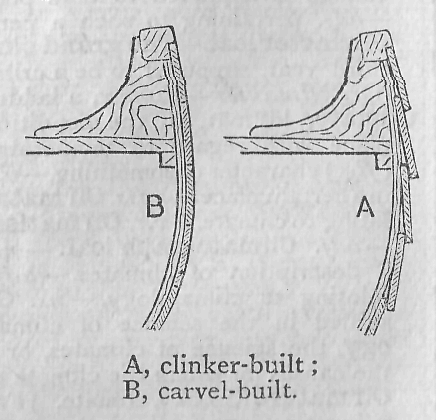
Clink, klingk, n. a ringing sound made by the striking together of sounding bodies: jingle.—v.t. to cause to make a ringing sound.—v.i. to ring or jingle: to go with a clinking sound.—n. Clink′er, the name given to the scales or globules of black oxide of iron, obtained from red-hot iron under the blows of a hammer: the slags of iron furnaces: the cindery-like masses which form the crust of some lava-flows.—adj. Clink′er-built, made of planks which overlap each other below (as distinguished from carvel-built) and are fastened together with clinched nails.—n. Clink′stone, a greenish-gray or brownish compact, or very finely crystalline igneous rock, splitting into slabs, which give a metallic clink when struck by a hammer. [A form of Click and Clank.]
Clink, klingk, v.t. to clinch: to rivet. [Scot. for Clinch.]
Clinometer, klī-nom′e-tėr, n. an instrument for measuring the angle of inclination or dip of a stratum.—adj. Clinomet′ric.—n. Clinom′etry. [Gr. klinein, to incline, metron, a measure.]
Clinquant, klingk′ant, adj. shining like tinsel: glittering.—n. tinsel: glitter. [Fr.,—Dut. klinken, to clink.]
Clio, klī′o, n. the muse of history and epic poetry: (zool.) a genus of shell-less molluscs in the class of Pteropods, swarming in northern and southern seas, and named by the whalers 'whales' food,' one species of which constitutes a principal part of the food of whales. [Gr. kleein, to call.]
Clip, klip, v.t. to cut by making the blades of shears meet: to cut off: to debase the coin by cutting off the edges: to diminish.—v.i. to go quickly:—pr.p. clip′ping; pa.p. clipped.—n. the thing clipped off, as the wool that has been shorn off sheep: a smart blow.—adj. Clipped, cut short.—ns. Clip′per, one that clips: a sharp-built, fast-sailing vessel: (slang) a dashing person; Clip′ping, the act of cutting, esp. debasing coin by cutting off the edges: the thing clipped off.—adj. superb: fast-going.—Clip the wings, to cut a bird's wings to prevent it from flying: (fig.) to restrain ambition: to deprive of the means of rising. [Prob. from Ice. klippa, to cut; Dan. klippe.]
Clip, klip, v.t. (Shak.) to embrace: to encircle: to hold firmly.—n. an instrument for holding things firm. [A.S. clyppan, to embrace; Ice. klýpa, to pinch; Ger. kluppe, pincers.]
Clique, klēk, n. a group of persons in union for a purpose: a party or faction: a gang—used generally in a bad sense.—adj. Cliqu′ish, relating to a clique.—ns. Cliqu′ishness; Cliqu′ism, tendency to form cliques. [Fr.; prob. from root of click, and so = a noisy conclave. Acc. to Littré, orig. in sense of Claque.]
Clish-clash, klish′-klash, Clishmaclaver, klish′maklāv′ėr, n. gossip. [Scot.]
Clistogamy, klis-tog′a-mi, n. a peculiar dimorphism in the flowers of a plant when these do not expand and are systematically close or self-fertilised.—adjs. Clistog′amous, Clistogam′ic. [Gr. kleistos, closed, gamos, marriage.]
Clitellum, kli-tel′um, n. the saddle of an annelid, as the earthworm:—pl. Clitell′a. [L.]
Clithral, klith′ral, adj. with a roof that forms a complete covering. [Gr.]
Clitoris, klī′tō-ris, n. a homologue of the penis present, as a rudimentary organ, in the female of many higher vertebrates.—ns. Clī′torism; Clitorī′tis. [Gr.]
Clitter, klit′ėr, v.t. and v.i. to make, or cause to make, a shrill rattling noise.—n. Clitt′er-clatt′er, idle talk, chatter. [Related to Clatter.]
Clivers. Same as Cleavers (q.v. under Cleave).
Cloaca, klō-ā′ka, n. a sewer: a privy: a cavity in birds and reptiles, in which the intestinal and urinary ducts terminate: a sink of moral filth:—pl. Cloacæ (klō-ā′sē).—adjs. Cloā′cal, Cloā′cinal. [L. cloāca—cluĕre, to purge.]
Cloak, Cloke, klōk, n. a loose outer garment: a covering: that which conceals: a disguise, pretext.—v.t. to clothe with a cloak: to cover: to conceal.—ns. Cloak′-bag (obs.), a portmanteau; Cloak′-room, a room set apart for keeping cloaks, coats, hats, &c., at a theatre, railway station, &c. [O. Fr. cloke, cloque—Low L. cloca, a bell, also a horseman's cape, because bell-shaped, from root of Clock.]
Cloam, klōm, n. and adj. earthenware, clay, or made of such. [A.S. clám, mud. See Clay.]
Clobber, klob′ėr, n. a paste used by shoemakers to hide the cracks in leather. [Ety. dub.]
Clock, klok, n. a machine for measuring time, marking the time by the position of its 'hands' upon the dial-plate, or by the striking of a hammer on a bell: (Shak.) the striking of the hour.—n. Clock′work, the works or machinery of a clock: machinery steady and regular like that of a clock.—adj. automatic.—Go like clockwork, to go along smoothly and without a hitch.—Know what o'clock it is, to be wide awake, to know how things are. [M. E. clokke, prob. through O. Fr. from Low L. cloca, clocca, a bell; mod. Fr. cloche, Dut. klok; Ger. glocke, a bell.]
Clock, klok, n. an ornament worked on the side of a stocking.—adj. Clocked, ornamented with clocks.
Clock, klok, n. a beetle—common name in Scotland.
Clock, klok, v.i. (Scot.) to cluck: to hatch.—n. Clock′er, a clocking hen. [A.S. cloccian; Dut. klokken.]
Clod, klod, n. a thick round mass or lump, that sticks together, esp. of earth or turf: a concreted mass: the ground: the body of man, as formed of clay: a stupid fellow.—v.t. to pelt.—v.i. to throw clods: (Scot.) to throw:—pr.p. clod′ding; pa.p. clod′ded.—adjs. Clod′dish; Clod′dy, abounding in clods: earthy.—n. Clod′hopper, a countryman: a peasant: a dolt.—adj. Clodhop′ping, boorish.—adv. Clod′ly.—ns. Clod′pate, Clod′poll, a stupid fellow.—adj. Clodpat′ed, stupid. [A later form of Clot.]
Cloff, klof, n. a cleft. [Cf. Ice. klof.]
Cloff, klof, n. an allowance, on buying goods wholesale, of 2 lb. in every 3 cwt., after tare and tret have been deducted. [Der. unknown.]
Clog, klog, n. a piece of wood: anything hindering motion: an obstruction: an impediment: a shoe with a wooden sole.—v.t. to fasten a piece of wood to: to accumulate in a mass and cause a stoppage: to obstruct: to encumber: to put clogs on.—ns. Clog′-al′manac, an early form of almanac having the indicating characters notched on wood, horn, &c.; Clog′-dance, a dance performed with clogs, the clatter keeping time to the music.—adj. Clogged, encumbered.—ns. Clog′ger, one who makes clogs; Clog′giness.—adj. Clog′gy, lumpy, sticky. [Ety. dub.; prob. related to Clay; cf. Scot. clag, to cover with mud; claggy, muddy, sticky.]
Cloison, kloi′son, n. a partition, dividing fillet or band.—n. Cloi′sonnage, the process of executing cloisonné work.—adj. Cloisonné, partitioned—of a surface decoration in enamel, the outlines of the design formed by small fillets of metal, the interstices filled with coloured enamel paste, vitrified.—n. work of this kind. [Fr.]
Cloister, klois′tėr, n. a covered arcade forming part of a monastic or collegiate establishment: a place of religious retirement, a monastery or nunnery: an enclosed place.—v.t. to confine in a cloister: to confine within walls.—adjs. Clois′teral, Clois′tral, Claus′tral, pertaining or confined to a cloister: secluded; Clois′tered, dwelling in cloisters.—ns. Clois′terer, one belonging to a cloister; Clois′ter-garth, the court or yard enclosed by a cloister; Clois′tress (Shak.), a nun.—The cloister, the monastic life. [O. Fr. cloistre (A.S. clauster)—L. claustrum—claudĕre, clausum, to shut.]
Cloke, klōk, n. Same as Cloak.
Clomb, klōm, old pa.t. of Climb.
Clonic, klon′ik, adj. pertaining to clonus, with alternate convulsive contractions and relaxations of the muscles (of spasms)—opp. to Tonic.—n. Clō′nus, a clonic spasm. [Gr.]
Cloop, kloop, n. the sound made when the cork is drawn from a bottle. [From the sound.]
Cloot, kloot, n. a cloven hoof: (pl.) the devil.—n. Cloot′ie, the devil, because of his cloven hoof. [Scot.; ety. dub.]
Close, klōs, adj. shut up: with no opening: confined, unventilated: stifling: narrow: stingy: near, in time or place: intimate: compact, as opposed to discursive: crowded: hidden: reserved: private: secret.—adv. in a close manner: tightly; nearly: densely.—n. an enclosed place: a small enclosed field: a narrow passage of a street: the precinct of a cathedral.—adjs. Close′-band′ed, closely united; Close′-barred, firmly closed; Close′-bod′ied, fitting close to the body.—n. Close′-corporā′tion, a corporation which fills up its own vacancies, without outside interference.—adjs. Close′-fist′ed, Close′-hand′ed, penurious, covetous; Close′-grained, with the fibres, &c., close together, compact; Close′-hauled, noting the trim of a ship when sailing as near as possible to the wind.—adv. Close′ly.—ns. Close′ness; Close′-stool, a chamber utensil enclosed in a box or stool; Close′-sea′son, Close′-time, a time of the year when it is against the law to kill certain animals, esp. game.—adj. Close′-tongued (Shak.), cautious in speaking. [Fr. clos, shut—L. claudĕre, clausum, to shut.]
Close, klōz, v.t. to make close: to draw together and unite: to finish.—v.i. to come together: to grapple: to come to an end (with).—n. the manner or time of closing: a pause or stop: the end: junction: (Shak.) encounter.—ns. Clos′er, one who concludes; Clos′ing, enclosing: ending: agreement; Clos′ure, the act of closing: the end: the stopping of a debate in the House of Commons by the vote of the House.—Close a bargain, to make an agreement; Close with, to accede to: to grapple with.—With closed doors, in private, the public being excluded, as in special cases in court, &c.
Closet, kloz′et, n. a small private room: a recess off a room: a privy: the private chamber of a sovereign, an apartment for private audience or council, or for private or domestic devotions.—v.t. to shut up in or take into a closet: to conceal:—pr.p. clos′eting; pa.p. clos′eted.—n. Bed′-clos′et, a small recess for a bed. [O. Fr. closet, dim. of clos. See Close.]
Clot, klot, n. a mass of soft or fluid matter concreted, as blood.—v.i. to form into clots: to coagulate:—pr.p. clot′ting; pa.p. clot′ted.—n. Clot′poll (Shak.), a clodpoll, a blockhead.—v.t. Clot′ter, to coagulate.—ns. Clot′tiness; Clot′ting, coagulation.—adj. Clot′ty.—Clotted (also Clouted) cream, a famous Devonshire dainty, skimmed off milk that has been 'scalded' or heated after standing 24 hours, with a little sugar thrown on the top. [A.S. clott, a clod of earth; cf. Dut. klos, block; Dan. klods; Ger. klotz.]
Cloth, kloth, n. woven material from which garments or coverings are made: clothing: the usual dress of a trade or profession, esp. the clerical:—pl. Cloths.—v.t. Clothe (klōth), to cover with a garment: to provide with clothes: (fig.) to invest as with a garment: to cover:—pr.p. clōth′ing; pa.t. and pa.p. clōthed or clad.—n.pl. Clothes (klōthz, coll. klōz), garments or articles of dress: blankets for a bed.—ns. Clothes′-bas′ket, a large basket for holding and carrying clothes; Clothes′-brush, a brush for clothes; Clothes′-horse, Clothes′-screen, a frame for hanging clothes on to dry; Clothes′-line, a rope or wire for hanging clothes on to dry; Clothes′-moth, one of various tineas whose larvæ feed on furs, woollens, &c., spinning cases out of these; Clothes′-pin, a forked piece of wood to secure clothes on a line; Clothes′-press, a place for holding clothes; Cloth′-hall, a cloth-exchange building or market; Cloth′ier, one who makes or sells cloth; Cloth′ing, clothes, garments: covering; Cloth′-yard, formerly the yard by which cloth was measured.—Cloth of gold, a tissue consisting of threads of gold and silk or wool; Cloth of state, a canopy; Cloth-yard shaft, an arrow a cloth-yard long.—Clothe in words, to express ideas in words; Clothe on, or upon, to invest: to cover.—American cloth, a kind of enamelled cloth, used for covering chairs, &c.—The cloth, the clerical profession: the clergy. [A.S. cláth, cloth; Ger. kleid, a garment.]