LIST OF ABBREVIATIONS USED IN THIS DICTIONARY. (continued 6)
Reading edition
Barnaby, bärn′a-bi, n. form of Barnabas, the apostle.—n. Bar′nabite, a member of the congregation of regular canons of St Paul, founded at Milan in 1530, so called from their preaching in the church of St Barnabas there.—Barnaby-day, Barnaby bright, or Long Barnaby, St Barnabas' Day, 11th June, in Old Style reckoned the longest day.
Barnacle, bär′na-kl, n. a shellfish which adheres to rocks and the bottoms of ships: a companion who sticks closely.—n. Bar′nacle-goose, a species of wild goose belonging to the Northern seas, so called from a notion that they were produced from the barnacles mentioned. [O. Fr. bernaque—Low L. bernaca; by some referred to a supposed form pernacula, dim. of perna, a kind of shellfish; by others to a Celtic origin.]
Barnacle, bär′na-kl, n. an instrument consisting of two branches joined by a hinge, placed on the nose of horses to keep them quiet: (pl.) a colloquial term for 'spectacles.'—adj. Bar′nacled. [O. Fr. bernac, of which bernacle seems to be a dim. form. The sense of 'spectacles' has been traced to O. Fr. bericle, eye-glass—berillus, beryl; but this is improbable.]
Barney, bär′ni, n. (slang) humbug: a prize-fight.
Barnumise, bär′num-īz, v.t. to advertise and display on a great scale.—n. Bar′numism. [From Barnum, a great showman (1810-91).]
Barograph, bar′o-graf, n. a barometer which records automatically variations of atmospheric pressure. [Gr. baros, weight, graphein, to write.]
Barometer, bar-om′et-ėr, n. an instrument by which the weight or pressure of the atmosphere is measured, and changes of weather, or heights above sea-level, indicated.—adj. Baromet′ric.—adv. Baromet′rically.—n. Barom′etry. [Gr. baros, weight, metron, measure.]
Barometz, bar′o-metz, n. the hairy prostrate stem of a fern found near the Caspian Sea, at one time supposed to be at once plant and animal, to grow on a stalk, and to eat grass like a lamb, &c.; hence also called, as by Mandeville, the Scythian Lamb. [Erroneous form of Russ. baranetz, dim. of baran, ram.]
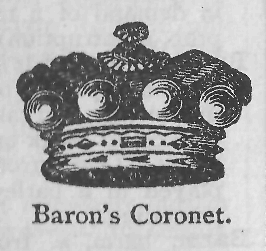
Baron, bar′on, n. a title of rank, the lowest in the House of Peers: formerly a title of the judges of the Court of Exchequer: in feudal times the tenants-in-chief of the Crown, later the peers or great lords of the realm generally: till 1832, the name for the parliamentary representatives of the Cinque Ports: in Germany, the signification, instead of becoming restricted as in England, has become extended—the greater or dynasty barons having all been elevated to higher titles, a large number being designated barons in virtue of a diploma from some reigning prince, the title being used also by all his descendants.—ns. Bar′onage, the whole body of barons; Bar′on-bail′ie, a magistrate appointed by the lord-superior in a burgh of barony; Bar′oness, a baron's wife, or a lady holding a baronial title in her own right.—adj. Barōn′ial, pertaining to a baron or barony.—n. Bar′ony, the territory of a baron: in Ireland, a division of a county: in Scotland, a large freehold estate, or manor, even though not carrying with it a baron's title and rank: the rank of baron.—Baron of beef, a joint consisting of two sirloins left uncut at the backbone. [O. Fr. barun, -on—Low L. baro, -onem; in the Romance tongues the word meant a man as opposed to a woman, a strong man, a warrior; traced by some to Celt. bar, a hero; by others to Old High Ger. bero, bearer, carrier.]
Baronet, bar′on-et, n. the lowest hereditary title in the United Kingdom (of England—now of Great Britain—since 1611; of Scotland—or of Nova Scotia—since 1625; of Ireland, since 1619).—ns. Bar′onetage, the whole body of baronets: a list of such; Bar′onetcy.—adj. Baronet′ical. [Dim. of Baron.]
Baroque, bar-ōk′, adj. originally a jeweller's term, but applied in art generally to extravagant ornamental designs: whimsical, odd. [Fr. baroque; perh. from L. verruca, wart, but referred by some to Ar. burāq, hard earth mixed with stones.]
Baroscope, bar′ō-skōp, n. an instrument for indicating changes in the density of the air. [Gr. baros, weight, skopein, to see.]
Barouche, ba-rōōsh′, n. a double-seated four-wheeled carriage with a falling top. [It. baroccio—L. birotus, two-wheeled, from bis, twice, rota, a wheel.]
Barque. Same as Bark (2).
Barquentine, bär′ken-tēn, n. same as Barkantine (q.v. under Bark, a ship). [Formed from Barque, like Brigantine from Brig.]
Barracan, bar′a-kan, n. a thick, strong stuff resembling camlet. [Fr.; It.—Ar. barrakān, a dark dress, Pers. barak, a stuff made of camel's hair.]
Barrace, bar′as, n. (obs.) the lists in a tournament. [O. Fr. barras—barre, bar.]
Barrack, bar′ak, n. a building for soldiers, esp. in garrison (generally in pl.). [Fr. baraque (It. baracca, Sp. barraca, a tent); acc. to Diez from barra, bar.]
Barracoon, bar′a-kōōn, n. a depôt for slaves. [Sp.—barraca.]
Barracoota, -cuda, bar′a-kōō′ta, -kōō′da, n. a voracious West Indian fish.—Also Barracou′ta, an Australian food-fish. [Sp.]
Barrage, bär′āj, n. the forming of an artificial bar in order to deepen a river. [Fr. barrage—barre, bar.]
Barrator, bar-āt′or, n. one who vexatiously stirs up lawsuits, quarrels, &c.—adj. Bar′ratrous.—adv. Bar′ratrously.—n. Bar′ratry, fraudulent practices on the part of the master or mariners of a ship to the prejudice of the owners: vexatious litigation, or the stirring up of suits and quarrels among subjects, forbidden under penalties to lawyers: traffic in offices of church or state. [O. Fr. barateor—barat, deceit; traced by some to Gr. prattein, by others to a Celt. or a Scand. origin.]
Barrel, bar′el, n. a cylindrical wooden vessel made of curved staves bound with hoops: the quantity which such a vessel contains (36 imperial gallons of ale and beer): a certain weight or quantity of other goods usually sold in casks called barrels: anything long and hollow, as the barrel of a gun, or cylindrical and barrel-shaped.—v.t. to put in a barrel.—n. Bar′rel-bulk, a measurement of five cubic feet.—p.adj. Bar′relled, having a barrel or barrels: placed in a barrel.—ns. Bar′rel-or′gan, an organ in which the music is produced by a barrel or cylinder set with pins, the revolution of which opens the key-valves and produces the music; Barrel-vault, a vault with a simple semi-cylindrical roof.—adj. Bar′rel-vault′ed. [Fr. baril (Sp. barril, It. barile)—Low L. barile, barillus, possibly from barra, bar.]
Barren, bar′en, adj. incapable of bearing offspring: unfruitful: dull, stupid: unprofitable (with of).—adj. Bar′ren-beat′en.—adv. Bar′renly.—n. Bar′renness.—adjs. Bar′ren-spir′ited; Bar′ren-wit′ted. [O. Fr. barain, brahain, brehaing, perh. from bar, man, as if 'male-like, not producing offspring.']
Barret, bar′et, n. a flat cap, esp. the Biretta (q.v.). [Fr. barrette, Sp. birreta. See Biretta.]
Barricade, bar′ik-ād, n. a temporary fortification raised to hinder the advance of an enemy, as in the street fights of Parisian insurrections.—v.t. to obstruct: to fortify.—Earlier form Barricā′do. [Fr.; barrique, a cask, the first street barricades having consisted of casks filled with stones, &c. See Bar.]
Barrico, bar-ē′ko, n. a small cask. [Sp.]
Barrier, bar′i-ėr, n. a defence against attack: a limit or boundary: a fence, railing, gate where customs are collected: the lists in a tournament: any obstacle that keeps apart: (pl.) a martial exercise in 15th and 16th centuries.—v.t. to shut by means of a barrier.—n. Bar′rier-reef, a coral-reef surrounding an island or fringing a coast with a navigable channel inside.—Barrier Act, an act passed by the General Assembly of the Church of Scotland in 1697 as a security against innovations, decreeing that changes in the law of the Church, even when approved by the Assembly, shall not become law till approved also by a majority of presbyteries. [O. Fr. barrière—Low L. barraria—barra, bar.]
Barrister, bar′is-tėr, n. one who is qualified to plead at the bar in an English or Irish law-court.—adj. Barristēr′ial.—n. Bar′ristership.—Revising barrister, a barrister appointed annually by the English judges to revise the lists and settle who are the persons entitled to vote for members of parliament. [From barra, bar, the suffix being undetermined.]
Barrow, bar′rō, n. a small hand or one-wheel carriage used to bear or convey a load.—n. Bar′row-tram, the shaft of a barrow. [M. E. barewe, from an assumed A.S. form bearwe—beran, to bear.]
Barrow, bar′rō, n. originally a mountain, hillock: a mound raised over graves in former times. [A.S. beorg; cog. with Ger. berg.]
Barrow, bar′rō, n. a long sleeveless flannel garment for infants. [A.S. beorgan, to protect.]
Bar-sinister. Variant of Baton-sinister (q.v. under Baton).
Barter, bär′tėr, v.t. to give one thing in exchange for another (with for, away).—v.i. to traffic by exchanging.—n. traffic by exchange of commodities.—n. Bar′terer, one who barters. [Prob. from O. Fr. barat.]
Bartholomew-tide, bar-thol′o-mū-tīd, n. the day of the festival of St Bartholomew, 24th August: the name was also applied to things sold at the fair.—Often spelt Bar′tlemy.—Black Bartholomew, 24th August 1662, the day on which the Act of Uniformity came into force within the Church of England.
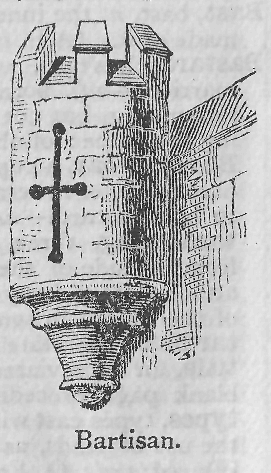
Bartisan, bär′ti-zan, n. a small overhanging turret projecting from an angle on the top of a tower. [Apparently an adaptation by Scott of Scot. bertisene, traceable to O. Fr. bretesche, a parapet of wood.]
Barton, bar′ton, n. a farm-yard. [A.S. bere-tún, yard, bere, barley, and tún, enclosure.]
Barycentric, bar-i-sen′trik, adj. pertaining to the centre of gravity. [Gr. barys, heavy, kentron, centre.]
Baryta, ba-rī′ta, Barytes, ba-rī′tēz, n. the earth present in the minerals witherite and heavy spar.—adj. Baryt′ic, of or containing baryta. [From Gr. barys, heavy.]
Barytone, bar′i-tōn, n. a deep-toned male voice between bass and tenor: a singer with such a voice: in Greek, applied to words not having an acute accent on the last syllable. [Through Fr. from Gr. barys, heavy, deep, and tonos, a tone.]
Basalt, bas-awlt′, n. a hard, dark-coloured rock of igneous origin.—adj. Basalt′ic. [L. basaltes, an African word.]
Basanite, bas′an-īt, n. a kind of quartz serviceable for testing the purity of the precious metals by the marks made. [Gr. basanos, touchstone.]
Basbleu. Same as Blue-stocking (q.v. under Blue).
Bascinet. Same as Basinet.
Bascule, bas′kūl, n. an apparatus of the lever kind, in which one end is raised while the other is depressed. [Fr. bas, down, and cul, the posteriors.]
Base, bās, n. that on which a thing rests: foot: bottom: foundation: support: the chief ingredient, as in dyeing and chemistry: the starting-point, in a race: the fixed goal across which the ball is struck in hockey, the fixed stations at base-ball: the point from which the operations of a campaign are conducted: a measured line serving as a basis for trigonometrical calculations: the surface on which a plane or solid figure stands: (chem.) a term applied to a compound body, generally consisting of a metal united with oxygen; (archit.) the foot or lower member of a pillar, on which the shaft rests: (her.) the lower portion of the shield—any figure placed on it is said to be 'in base:' a small portion of the base of a shield parted off by a horizontal line is sometimes called a base.—v.t. to found or place on a base:—pr.p. bās′ing; pa.p. based (bāst).—adjs. Bas′al, Bas′ilar, pertaining to or situated at the base, esp. of the skull; Base′less, without a base or foundation.—ns. Base′lessness; Base′ment, the base or lowest story of a building.—adj. Bas′en-wide (Spens.), widely extended.—n. Base′-plate, the foundation plate of a piece of heavy machinery.—n.pl. Bas′es, a kind of embroidered mantle which hung down from the middle to about the knees or lower, worn by knights on horseback: (Spens.) armour for the legs.—ns. Base′-string, the string of a musical instrument that gives the lowest note; Base′-vīol (same as Bass-viol).—adj. Bas′ic (chem.), belonging to or of the nature of a base.—v.t. Bas′ify (chem.), to convert into a salifiable base:—pr.p. bās′ifying; pa.p. bās′ifīed. [Fr.—L.—Gr. basis—ba-, in bainein, to go.]
Base, bās, adj. low in place, value, estimation, or principle: mean: vile: worthless: debased: counterfeit: (law) servile, as opposed to free: humble: (B. and Shak.) lowly.—adj. Base′-born, illegitimate.—adv. Base′ly.—adj. Base′-mind′ed, of a low mind or spirit: mean.—n. Base′ness.—adj. Base′-spir′ited, mean-spirited. [Fr. bas—Low L. bassus, thick, fat, a vulgar Roman word, found also in name Bassus.]
Base, bās, v.t. a form of Abase.
Base, bās, n. an old game played by two sides occupying contiguous spaces, called bases or homes, off which any player is liable to be touched with the hand or struck by a ball by the enemy, and so attached to their sides. Forms of this game are known as Prisoner's Base or Bars, and Rounders, and the national American game of Base-ball is a development from it.
Base-ball, bās′-bawl, n. a game played with a bat and a ball, and run round bases, marking the circuit to be taken by each player of the inside after striking the ball. There are nine players on each side; the pitcher, of the one side, throws the ball; one of the other side tries to hit it as it passes him; and the runs to the bases are regulated according as the ball falls inside or outside certain lines, &c. A development from rounders, base-ball has been the American national game since 1865. [Coupled with cricket in Jane Austen's Northanger Abbey (written 1798).]
Basecourt, bās′kōrt, n. the outer court of a mansion, which contained the stable-yard and servants' accommodation, as distinguished from the principal quadrangle: an inferior court of justice. [Fr. basse-court.]
Basenet. Same as Basinet.
Bash, bash, v.t. to beat or smash in.—n. Bash. [Prob. Scand.]
Bashaw, ba-shaw′, n. a pasha: a haughty man—now usually written Pasha or Pacha (q.v.).—ns. Bashaw′ism, Bashaw′ship. [Turk.]
Bashful, bash′fōōl, adj. easily confused: modest: shy: wanting confidence.—v.i. Bash (Spens.), to be abashed.—adv. Bash′fully.—n. Bash′fulness.—adj. Bash′less, unashamed. [See Abash.]
Bashi-bazouk, bash′i-ba-zōōk′, n. a Turkish irregular trooper. They are mostly Asiatics, and are brutal plundering ruffians, capable, as in 1876 in Bulgaria, of the most devilish atrocities. [Turk. bashi-bozuq.]
Bashlyk, bash′lik, n. a kind of hood with long ends worn in Russia. [Russ. bashluikŭ, a Caucasian hood.]
Basil, baz′il, n. a mainly tropical or subtropical genus of Labiatæ, characterised by a pleasant aromatic smell and taste, and reckoned amongst sweet herbs.—Sweet basil is an Indian annual long cultivated in Europe for seasoning purposes. [O. Fr. basile—L. basilisca—Gr. basilikon, royal.]
Basil, baz′il, n. a sheepskin roughly tanned and undressed.
Basil. See Bezel.
Basilica, baz-il′ik-a, n. among the Romans, a large oblong hall, with double colonnades and a semicircular apse at the end, used for judicial and commercial purposes—many of them were afterwards converted into Christian churches: a magnificent church built after the plan of the ancient basilica.—adj. Basil′ican. [L. basilica, Gr. basilikē (oikia, a house), belonging to a king, from basileus, a king.]
Basilicon, baz-il′ik-on, n. a name given to various kinds of ointment as possessing sovereign virtues. [Gr. basilikon, royal.]
Basilisk, baz′il-isk, n. a fabulous creature, about a foot long, with a black-and-yellow skin and fiery red eyes, so named, according to Pliny, from the crest on the head like a crown—variously regarded as a kind of dragon or cockatrice: in modern zoology, a harmless crested lizard of tropical South America: an ancient brass cannon throwing a shot of about 200 lb. weight. [Gr. basiliskos, dim. of basileus, a king.]
Basin, bās′n, n. a wide open vessel or dish: any hollow place containing water, as a dock: the area drained by a river and its tributaries. [O. Fr. bacin—Low L. bachinus, perh. from the Celtic.]
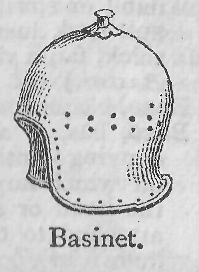
Basinet, bas′i-net, n. a light globular headpiece worn alone with a visor, or with the great helm resting on the shoulders, worn over it.—Also Bas′net.
Basis, bās′is, n. the foundation, or that on which a thing rests: the pedestal of a column: the groundwork or first principle:—pl. Bas′es. [See Base (1).]
Bask, bask, v.i. to lie in the warmth or sunshine. [Scand. badask, to bathe.]
Basket, bas′ket, n. a vessel made of plaited twigs, rushes, or other flexible materials.—ns. Bas′ketful, as much as fills a basket; Bas′ket-hilt, the hilt of a sword with a covering wrought like basket-work to defend the hand from injury; Bas′ket-mak′er; Bas′ket-work, any structure of interlaced twigs or the like. [Prob. the L. bascauda; the W. basged is apparently borrowed from the English.]
Basque, bask, adj. relating to the Basques, or their wonderful language, with its extreme variability of dialects—the only example of a consistently incorporating language.—n. a native of the Basque provinces: the distinctive language of the Basques: a kind of short-skirted jacket worn by women, a continuation of the bodice a little below the waist.—adj. Basqued (baskt), furnished with a basque.—n. Basq′uine, an outer petticoat worn by Basque and Spanish women. [Fr. Basque—Low L. Vasco, an inhabitant of Vasconia, whence Gascony. The Basques themselves call their tongue Eskuara, Euscara, whence the Fr. Euscarien.]
Bas-relief, bä-re-lēf′, Bass-relief, bas′re-lēf′, n. (sculp.) figures which do not stand far out from the ground on which they are formed—also used in the Italian form Bass′o-rilie′vo. [See Base, low, and Relief.]
Bass, bās, n. the low or grave part in music.—adj. low, deep, grave.—v.t. to sound in a deep tone.—ns. Bass′-horn, a musical wind-instrument, a modification of the bassoon, much lower and deeper in its tones; Thor′ough-bass, the theory of harmony. [See Base, low.]
Bass. Same as Bast.
Bass, Basse, bas, n. a marine fish allied to the perch. [A.S. bærs; cf. Ger. bars, the perch.]
Bassa, bas′sa, n. Same as Bashaw.
Basset, bas′et, n. a short-legged dog used in unearthing foxes and badgers: an old Venetian game at cards, resembling faro, widely popular in the 18th century: (geol.) the outcrop or emergence of mineral strata at the surface.—v.i. to incline upward so as to appear at the surface, to crop up.—n. Bas′set-horn (It. corno di bassetto), the richest and softest of all wind-instruments, similar to a clarionet in tone and fingering, but with a twice-bent wooden tube, having a compass of two and a half octaves. [Fr. bas, low.]
Bassinet, Bassinette, bas′si-net, n. a kind of basket with a hood in which an infant is placed as in a cradle: a similarly shaped perambulator. [Fr. dim. of basin, a basin.]
Basso, bas′so, n. the same as Bass (1): also a bass singer.
Bassoon, bas-ōōn′, n. (It. fagotto) a musical wind-instrument filling an important place in the modern orchestra, of the reed species, made of maple-wood or plane-tree, its compass from B flat below the bass stave to C in the treble.—The Double bassoon (It. contrafagotto) sounds an octave lower.—n. Bassoon′ist. [It. bassone, augmentative of basso, low, from root of Base.]
Bass-viol, bās′-vī′ol, n. a musical instrument with four strings, used for playing the bass in concerted music; the violoncello. [See Bass, low, and Viol.]
Bast, bast, n. the inner bark of the lime-tree: matting made of it. [A.S. bæst; Dut., Dan., Ger. bast.]
Bastard, bas′tard, n. a child born of parents not married.—adj. born out of wedlock: not genuine: resembling, but not identical with, the species bearing the name: of abnormal shape or size: false.—n. Bas′tard-bar, a popular but inaccurate name for the baton-sinister in heraldry.—v.t. Bas′tardise, to prove to be a bastard.—adv. Bas′tardly (obs.).—ns. Bas′tard-wing, three, four, or five feathers springing from the side of the wing of a bird near the point, attached to a bony process which is the homologue of the thumb in some mammalia; Bas′tardy, Bas′tardism, the state of being a bastard.—Bastard title, an abbreviated title of a book on an otherwise blank page preceding the full title-page; Bastard types, types cast with an extra deep bevel to obviate the use of leads, as Longprimer face on Pica body. [Fr. bâtard; O. Fr. fils de bast, son of the pack-saddle, bast (bât) being a coarse saddle for beasts of burden.]
Baste, bāst, v.t. to beat with a stick. [Prob. conn. with Ice. beysta, Dan. böste, to beat.]
Baste, bāst, v.t. to drop fat or butter over meat while roasting to keep it from burning and to improve the flavour. [Ety. unknown.]
Baste, bāst, v.t. to sew slightly or with long stitches. [O. Fr. bastír, from Old High Ger. bestan, to sew.]
Bastille, bast-ēl′, n. an old fortress in Paris long used as a stale prison, and demolished by a revolutionary mob in July 1789: any prison regarded as a symbol of tyranny. [Fr.—O. Fr. bastir (Fr. bâtir), to build.]
Bastinado, bast-in-ād′o, v.t. to beat with a baton or stick, esp. on the soles of the feet (a form of punishment in the East):—pr.p. bastinād′ing or bastinād′oing; pa.p. bastinād′ed or bastinād′oed.—ns. Bastinade′, Bastinād′o. [Sp. bastonada, Fr. bastonnade—baston, bâton. See Baton.]
Bastion, bast′yun, n. a kind of tower at the angles of a fortification.—adj. Bast′ioned. [Fr.—O. Fr. bastir, to build.]
Bat, bat, n. a heavy stick: a flat club for striking the ball in cricket, a club for base-balls, a batsman: the clown's sword in a pantomime: a piece of brick: (slang) rate of speed, style.—v.i. to use the bat in cricket:—pr.p. bat′ting; pa.p. bat′ted.—ns. Bat′ter, Bats′man, one who wields the bat at cricket, &c.; Bat′ting, the management of a bat in playing games: cotton fibre prepared in sheets. [Perh. from A.S. bat (a doubtful form), prob. Celt. bat, staff.]
Bat, bat, n. an animal with a body like a mouse, but which flies on wings attached mainly to its fore-feet, but extending along its sides to the hind-feet. [M. E. bakke, apparently from Scand.; cf. Dan. aftenbakke, evening-bat.]
Batable, bāt′a-bl, adj. debatable, disputable. [A contr. of Debatable.]
Batata, ba-tä′ta, n. a plant with tuberous roots, the sweet potato. [Sp. batata, potato.]
Batavian, ba-tā′vi-an, adj. pertaining to the ancient Batavi in the Low Countries, or to the modern Dutch, their descendants.
Batch, bach, n. the quantity of bread baked or of anything made or got ready at one time: a set. [From Bake.]
Bate. Same as Abate.
Bate, bāt, n. (Spens.) strife, contention.—adj. Bate′-breed′ing (Shak.). [Abbrev. of Debate.]
Bate, bāt, n. diminution (dial., esp. in combination).
Bate, bāt, v.i. (Shak.) to beat the wings impatiently: (obs.) to be impatient. [O. E. batre—Low L. batĕre.]
Bateau, bä-to′, n. a light river-boat, esp. those used on Canadian rivers. [Fr.—O. Fr. batel, boat.]
Bateless, bāt′les, adj. (Shak.) that cannot be bated or blunted.
Batfowling, bat′fowl-ing, n. the catching birds at night when at roost. [Bat, club, and Fowl.]
Bath, bäth, n. water for plunging the body into: a bathing: a house for bathing: a place for undergoing medical treatment by means of bathing: (phot.) a solution in which plates are plunged:—pl. Baths (bäthz).—ns. Bath′-brick, a preparation of siliceous silt, manufactured at Bridgwater in the form of bricks, and used in cleaning knives; Bath′chair, a large wheeled chair for invalids; Bath′house; Bath′man; Bath′room; Bath′-stone, a building stone quarried at Bath; Bath′woman; Blood′-bath, a massacre.—Bath Guide, a poem of the 18th century, often taken as a type of 'Society' verse.—Order of the Bath, an English order of knighthood, so named from the bath before installation (including three classes—military and civil knights grand-cross, G.C.B.; knights commanders, K.C.B.; and companions, C.B.). [A.S. bæth, cog. with Ger. bad.]
Bath, bäth, n. the largest Jewish liquid measure, containing about six gallons. [Heb.]
Bathe, bāth, v.t. to wash as in a bath: to wash or moisten with any liquid: to moisten, suffuse, encompass.—v.i. to take a bath.—n. the act of taking a bath.—ns. Bath′ing-box, a box for bathers to undress and dress in; Bath′ing-machine′, a small carriage in which a bather may be carried out into water conveniently deep for bathing. [A.S. bathian; Old High Ger. badôn, bathôn (Ger. baden).]
Bathometer, bath-om′et-ėr, n. an instrument for ascertaining depth. [Gr. bathos, depth, metron, measure.]
Bathorse, baw′hors, n. a packhorse carrying the baggage of an officer. [Fr. bât, a pack-saddle.]
Bathos, bā′thos, n. a ludicrous descent from the elevated to the mean in writing or speech.—adj. Bathet′ic, irregularly formed on the analogy of pathos, pathetic. [Gr. bathos, depth, from bathys, deep.]
Bathybius, bath-ib′i-us, n. name given to a supposed low form of life at the bottom of some parts of the deep sea. [Formed from Gr. bathys, deep, and bios, life.]
Bathymetry, bath-im′et-ri, n. the science of measuring the depth of seas and lakes. [Gr. bathys, deep, metria, measurement.]
Bating, bāt′ing, prep. abating, excepting.
Batiste, ba-tēst′, n. usual French name for cambric: applied in commerce to a fine texture of linen and cotton. [Littré derives from Baptiste, the original maker; others from its use in wiping the heads of children after baptism.]
Batlet, bat′let, n. a wooden mallet used by laundresses for beating clothes. [Dim. of Bat.]
Batman, bat′man, baw′man, n. a man who has charge of a bathorse. [See Bathorse.]
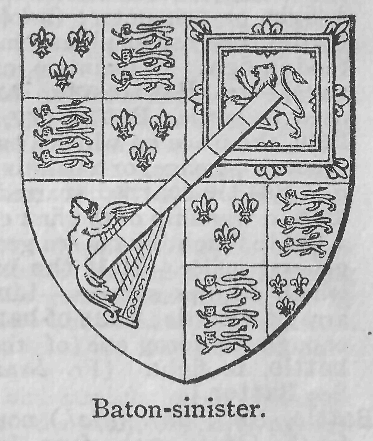
Baton, bat′on, Batoon, ba-toon′, n. a staff or truncheon, esp. of a policeman: a marshal's staff.—v.t. to strike with a baton.—n. Bat′on-sin′ister, a well-known heraldic indication of illegitimacy, improperly called Bar-sinister, a diminutive of a bend-sinister, not extending to the sides of the shield, so as to resemble a marshal's baton laid diagonally over the family arms from left to right. [Fr. bâton—Low L. basto, a stick; of unknown origin.]
Batrachia, ba-trā′ki-a, n.pl. the order of reptiles which includes the frogs.—adj. and n. Batrā′chian. [From Gr. batrachos, a frog.]
Batswing, bats′wing, n. a kind of gas-burner, with a slit at the top which causes the flame to take the shape of a bat's wing.
Batta, bat′ta, n. an allowance to officers in the British Indian army in addition to their ordinary pay: subsistence money. [Hind.]
Battailant, bat′tāl-ant, adj. (Spens.) fighting.—adj. Bat′tailous (arch.), war-like. [Fr. bataillant, pr.p. of batailler, to fight. See Battle.]
Battalia, bat-tāl′ya, n. the order of battle: the main body of an army in array. [It. battaglia. Doublet of Battle.]
Battalia pie, bat-tāl′ya pī, titbits in a pie: articles like pin-cushions, embroidered by nuns in convents with scenes from the Bible. [Corrupted from Fr. béatilles, dim. formed from L. beatus.]
Battalion, bat-al′yun, n. a body of soldiers consisting of several companies: a body of men drawn up in battle-array. [Fr.; from root of Battle.]
Battels, bat′lz, n.pl. an Oxford term signifying accounts for provisions received from college kitchens and butteries: applied generally to the whole of the sums for tuition, &c., charged in college accounts.—v.i. Bat′till, Bat′tel (Spens.), to fatten. [Late L. batilli, perh. conn. with Battle, to feed.]
Batten, bat′n, v.i. to grow fat: to live in luxury.—v.t. (obs.) to fatten. [Ice. batna, to grow better—bati, advantage; cf. Dut. baten, to avail.]
Batten, bat′n, n. a piece of board: a ledge, clamp: in ships, a strip of wood used to fasten down the hatches.—n. Bat′tening, battens forming a structure. [Same as Baton.]
Batter, bat′er, v.t. to beat with successive blows: to wear with beating or by use: to attack with artillery.—n. ingredients beaten along with some liquid into a paste: paste for sticking.—ns. Bat′tering-charge, the full charge of powder for a cannon; Bat′tering-ram, an ancient engine for battering down walls, consisting of a large beam with an iron head like that of a ram. [O. Fr. batre (Fr. battre), from the root of Bat.]
Batter, bat′ėr, n. the inclination of a wall from the perpendicular.—v.i. to slope backward from the perpendicular. [Perh. from Fr. battre, to beat down.]
Battery, bat′ėr-i, n. (Shak.) a wound: a number of cannon with their equipment: the place on which cannon are mounted: the men and horses attending one battery, constituting the unit in the artillery: an instrument used in electric and galvanic experiments: (law) an assault by beating or wounding: apparatus for preparing or serving meals.—Cross batteries, two batteries commanding the same spot from different directions; Floating battery (see Float); Masked battery, a battery in action out of the enemy's view; To change one's battery, to alter the direction of attacking.
Battle, bat′l, n. a contest between opposing armies: a fight or encounter: (arch.) a body of troops in battle array, esp. in phrase 'main battle.'—v.i. to contend in fight: to maintain, champion (with against, with).—ns. Bat′tle-axe, -ax, a kind of axe once used in battle; Bat′tle-cry, a war-shout; Bat′tlefield, the place on which a battle is fought; Bat′tle-piece, a passage, or a painting, describing a battle.—adj. Bat′tle-scarred, scarred in battle.—ns. Bat′tleship, a war-ship of the first class; Pitched′-bat′tle, a battle fought on chosen ground.—Battle royal, a general mêlée—Half the battle, said of anything which ensures success.—Line of battle, troops in array for battle; Line-of-battle ship, a ship strong enough to form one of the line.—To join, do battle, to fight. [Fr. bataille—battre, to beat. See Batter.]
Battle, bat′l, adj. (dial.) nourishing.—v.t. (obs.) to feed. [Most prob. from Ice. bati, improvement. See Batten.]
Battledoor, Battledore, bat′l-dōr, n. a light bat for striking a ball or shuttlecock.—Not to know a B from a battledoor, to be thoroughly ignorant. [Sp. batidor, a beater, a washing-beetle; but this is doubtful.]
Battlement, bat′l-ment, n. a wall or parapet on the top of a building with openings or embrasures, originally used only on fortifications: the towering roof of heaven,—adj. Bat′tlemented, fortified with battlements—also pa.p. Bat′tled (poet.).
Battology, bat-ol′o-ji, n. repetition in speech or writing.—adj. Battolog′ical. [Gr. battos, a person who repeated himself, and legein, to speak.]
Battue, bat-tōō′, n. a method of hunting in which the woods are beaten and the game driven from cover into some place for the convenience of the shooters: any indiscriminate slaughter. [Fr.—battre, to beat.]
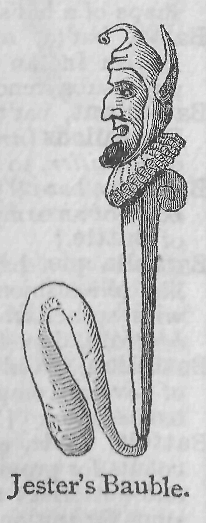
Bauble, baw′bl, n. a trifling piece of finery: a child's plaything: a stick surmounted by a head with ass's ears, and forming the mock emblem of the court-jester: a piece of childish foolery: (Shak.) a foolish person.—adj. Bau′bling (obs.), trifling. [O. Fr. babel, prob. from the root seen in L. babulus, a babbler.]
Baudekin, bawd′i-kin, Bawdkin, bawd′kin. Same as Baldachin.
Baudric, bawd′rik. Same as Baldrick.
Baudrons, bawd′runs, n. Scotch name for the cat. [Perh. of Celt. origin; cf. Ir. beadrac, frolicsome, Gael. beadrach, a frolicsome girl.]
Bauk, Baulk. Same as Balk.
Bausond, bawz′ond, adj. (obs.) having white spots, esp. on the forehead, or a white stripe down the face.—adj. Baus′on-faced (Scott), with a face like a badger. [O. Fr. bausant (It. balzano), black and white spotted. Further ety. dub.]
Bauxite, bō′zīt, n. a clay found at Les Baux, near Arles, yielding alumina.—Also Beau′xite.
Bavardage, bav-ar-dāj′, n. chattering. [Fr. bavard, garrulous—bave, drivel.]
Bavin, bav′in, n. a fagot of brushwood.—Bavin wits (Shak.), wits that blaze and die like bavins. [O. Fr. baffe, a fagot; but this is doubtful.]
Bawbee, baw-bē′, n. a halfpenny: originally a Scotch coin of base silver equivalent to six Scotch pennies. [Ety. dub., but very prob. derived from a 16th-cent. Scotch mint-master, the laird of Sillebawby; others identify with 'baby.']
Bawble. Same as Bauble.
Bawcock, baw′kok, n. (Shak.) a fine fellow. [From Fr. beau, fine, and coq, a cock.]
Bawd, bawd, n. a procurer or procuress of women for lewd purposes—fem. only since about 1700.—n. Bawd′ry.—adj. Bawd′y, obscene, unchaste, filthy.—n. Bawd′y-house, a brothel. [Perh. abbrev. from Bawd′strot, a word for a pander, now obsolete, derived from O. Fr. baldestrot—bald, gay, and perh. the Teut. root found in strut.]
Bawd, bawd, n. (Shak.) a hare. [Perh. a contr. of Baudrons.]
Bawl, bawl, v.i. to shout or cry out loudly (with at, against).—n. a loud cry or shout.—n. Bawl′er. [Perh. from Low L. baulare, to bark like a dog; but cf. Ice. baula, to low like a cow, baula, a cow.]
Bawn, bawn, n. a fortification round a house: an enclosure for cattle. [Ir. bábhun, enclosure.]
Baxter. See Bake.
Bay, bā, adj. reddish brown inclining to chestnut.—n. elliptical for 'bay-horse.'—n. Bayard (bā′ard), a bay-horse: a name for any horse generally, from 'Bayard,' the famous bay-coloured magic horse given to Renaud by Charlemagne: a man recklessly blind to danger: a fellow bold in his ignorance: a type of the knight, from Bayard (1476-1524), 'the knight without fear and without reproach.' [Fr. bai—L. badius, chestnut-coloured.]
Bay, bā, n. an inlet of the sea with a wider opening than a gulf: an inward bend of the shore. [Fr. baie—Low L. baia, a harbour.]
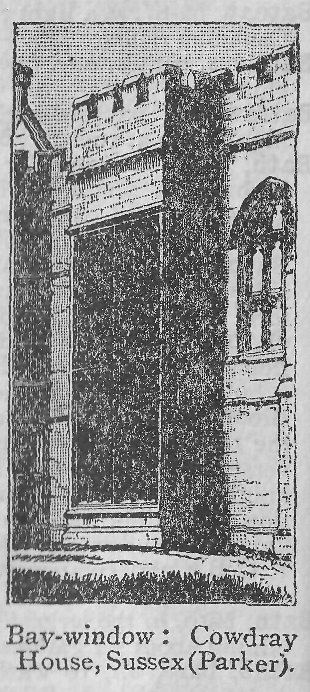
Bay, bā, n. the space between two columns: (Shak.) the space under one house gable: any recess.—n. Bay′-win′dow, any window forming a recess.—adj. Bay′-win′dowed. [O. Fr. baée—baer, to gape, be open; prob. conn. with the foregoing word.]
Bay, bā, n. the laurel-tree: (pl.) an honorary garland or crown of victory, originally of laurel: literary renown.—ns. Bay′berry; Bay′-rum, an aromatic stimulant used for the skin and hair, and prepared by distilling the leaves of the bay-berry (Pimenta acris) with rum, or otherwise mixing the volatile oil of the leaves with alcohol. [O. Fr. baie, a berry—L. baca.]
Bay, bā, n. barking, baying (esp. of a dog when in pursuit): the combined cry of hounds in conflict with a hunted animal: used often of the last stand of a hunted animal when it faces the hounds at close quarters.—v.i. to bark (esp. of large dogs).—v.t. to bark at: to utter by baying: to follow with barking: to bring to bay.—To hold, keep at bay, said of the hunted animal; To stand, be, at bay, at close quarters. [These senses show a confusion of two distinct words, according to Murray: (1) to hold at bay = O. Fr. tenir a bay = It. tenere a bada, bay, bada, denoting the suspense indicated by the open mouth; (2) in the phrase 'to stand at bay,' the word points to O. Fr. abai, barking, bayer, to bark.]
Bay, Baye, bā, v.t. (Spens.) to bathe.
Bayadère, bā-ya-dēr′, n. a Hindu dancing-girl. [Fr.—Port. bailadeira.]
Bayonet, bā′on-et, n. a stabbing instrument of steel fixed to the muzzle of a musket or rifle: military force: (pl.) soldiers armed with bayonets.—v.t. to stab with a bayonet. [Fr. baïonnette, perh. from Bayonne, in France, where it was supposed to have been first made; others derive from O. Fr. bayon, arrow.]
Bayou, bā′ōō, n. name given to the marshy offshoots of lakes and rivers, esp. in North America. [Perh. corrupted from Fr. boyau, gut.]
Bay-salt, bā′-sält, n. salt obtained by slow evaporation originally from sea-water. [Prob. from Bay, an inlet, and Salt.]
Bazaar, Bazar, ba-zär′, n. an Eastern marketplace or exchange: a fancy fair in imitation of an Eastern bazaar. [Pers. bāzār, a market.]
Bdellium, del′i-um, n. a kind of gum. [Gr. bdellion, used to translate, but prob. unconnected with Heb. b'dōlakh, Gen. ii. 12.]
Be, bē, v.i. to live: to exist: to have a certain state or quality:—pr.p. bē′ing; pa.p. been.—n. Be′-all (Shak.), the whole being. [A.S. béon; Ger. bin; Gael. bi, to exist; W. byw, to live; Gr. phu-ein, L. fui, fio, Sans. bhu, to be, orig. meaning to grow.]
Beach, bēch, n. the shore of the sea or of a lake, esp. when sandy or pebbly: the strand.—v.t. to haul a boat up on the beach.—n. Beach′-comb′er, a long rolling wave: a drunken loafer about the wharfs in Pacific seaports: a settler on a Pacific island who maintains himself by pearl-fishery, and often by less reputable means.—adjs. Beached, having a beach, driven on a beach; Beach′y, pebbly. [Orig. a prov. Eng. word for shingle. The derivation from Ice. bakki, bank, is untenable.]
Beacon, bē′kn, n. a fire on an eminence used as a sign of danger: a hill on which such could be lighted: anything that warns of danger, esp. an erection of stone, wood, or iron often bearing a light, and marking rocks or shoals in rivers or navigable channels.—v.t. to act as a beacon to: to light up: to mark by means of beacons.—n. Float′ing-bea′con, a light-ship. [A.S. béacn, a beacon, a sign.]
Bead, bēd, n. a little ball pierced for stringing, a series of which forms the rosary or paternoster, used in counting the prayers recited: any small ball of glass, amber, &c. strung in a series to form a necklace: a bead-like drop: the small knob of metal forming the front-sight of a gun—whence the Americanism, To draw a bead upon = to take aim at: (archit.) a narrow moulding with semicircular section.—v.t. to furnish with beads.—v.i. to form a bead or beads.—adj. Bead′ed, furnished with beads.—ns. Bead′-house, a house for poor people who were required to pray for the soul of the founder: an almshouse; Bead′ing, a moulding in imitation of beads.—adj. Bead′-proof, of such proof or strength as to carry beads or bubbles when shaken, as alcoholic liquors.—ns. Bead′-roll, in pre-Reformation times, a roll or list of the dead to be prayed for, hence a list of names, a long series: a rosary; Beads′man, Bedes′man, one employed to pray for others, or one endowed to do so: (Scot.) a public alms-man or licensed beggar:—fem. Beads′woman.—adj. Bead′y, bead-like, small and bright (of eyes): covered with beads or bubbles.—To say, tell, count one's beads, to offer a prayer. [A.S. bed, gebed, a prayer, from biddan, to pray. See Bid.]
Beadle, bēd′l, n. a mace-bearer (esp. of the 'bedels' or 'bedells,' official attendants of the Oxford and Cambridge vice-chancellors): a petty officer of a church, college, parish, &c.: a parish officer with the power of punishing petty offenders: in Scotland, used of the 'church-officer' attending on the clergyman: (obs.) a messenger or crier of a court.—ns. Bead′ledom, Bead′lehood, stupid officiousness; Bead′leship, Bed′elship, the office of beadle or bedel. [A.S. bydel—béodan, to proclaim, to bid.]
Beadman. Same as Beadsman (q.v. under Bead).
Beagle, bē′gl, n. a small hound tracking by scent, formerly much used in hunting hares, but now superseded by the harrier: a spy: a bailiff: a small kind of shark.—The beagle was often followed by men on foot, hence Foot′-bea′gle. [Ety. unknown. The Fr. bigle is borrowed from English. Dr Murray suggests Fr. bégueule, from béer, to gape, and gueule, throat.]
Beak, bēk, n. the bill of a bird: anything pointed or projecting: the nose: in the ancient galley, a pointed iron fastened to the prow for piercing the enemy's vessel: (slang) a magistrate.—adj. Beaked (bēkt). [O. Fr. bec—Low L. beccus, of Celt. (Gaulish) origin.]
Beaker, bēk′ėr, n. a large drinking-bowl or cup, or its contents: a glass vessel marked for measuring liquids, with a beak or pointed mouth, used by chemists. [Scand. bikarr (Scot. bicker), prob. from Low L. bicarium, acc. to Diez from Gr. bikos, a drinking-bowl.]
Beam, bēm, n. a large and straight piece of timber or iron forming one of the main supports against lateral pressure of a building, ship, &c.: (fig.) from the figure of the mote and the beam—Matt. vii. 3: any of the transverse pieces of framing extending across a ship's hull, the greatest width of a ship or boat: the part of a balance from which the scales hang: the pole of a carriage: a cylinder of wood in a loom: a ray of light.—v.t. to send forth light: to shine.—n. Beam′-en′gine, a steam-engine which has a beam connecting the piston-rod with the crank of the wheel-shaft, as distinguished from one that has its piston-rod directly attached to the crank.—adv. Beam′ily.—n. Beam′iness.—adjs. Beam′less, without beams: emitting no rays of light; Beam′y, shining.—A beam sea, one rolling against the ship's side.—Before the beam, the bearing of any object when seen more in advance than on the beam; Abaft the beam, the reverse.—Lee or Weather beam, the side away from or towards the wind.—On her beam ends, a phrase applied to the position of a ship when so much inclined to one side that the beams become nearly vertical.—On the starboard beam, applied to any distant point out at sea, at right angles to the keel, and on the starboard or right-hand (as viewed from the stern) side of the ship; On the port beam similarly applies to the left hand. [A.S. béam, a tree, stock of a tree, a ray of light; Ger. baum, a tree; Gr. phyma, a growth—phy-ein, to grow.]
Bean, bēn, n. the name of several kinds of leguminous plants and their seeds: applied also to the seeds of some other plants, from their bean-like form, as the Calabar bean, &c.—ns. Bean′-feast, an annual dinner given by employers to their hands, perhaps from there having been served on such occasions beans or a Bean′-goose, a species of goose said to be so called from its fondness for devouring new-sown beans; Bean′-king, the king of the festivities on Twelfth Night, chosen on his finding a bean hidden in the Twelfth Cake. [A.S. béan; Ger. bohne, W. ffäen; L. faba.]
Bear, bār, v.t. to carry or support: to endure: to admit of: to be entitled to: to afford: to import: to manage: to behave or conduct one's self: to bring forth or produce.—v.i. to suffer: to be patient: to have reference to: to press (with on or upon): to be situated:—pr.p. bear′ing; pa.t. bōre; pa.p. bōrne (but the pa.p. when used to mean 'brought forth' is born).—adj. Bear′able, that may be borne or endured.—n. Bear′ableness.—adv. Bear′ably.—ns. Bear′er, one who or that which bears, esp. one who assists in carrying a body to the grave: a carrier or messenger; Bear′ing, behaviour: situation of one object with regard to another: relation: that which is borne upon an escutcheon: (mach.) the part of a shaft or axle in contact with its supports; Bear′ing-cloth, the mantle or cloth in which a child was carried to the font; Bear′ing-rein, the fixed rein between the bit and the saddle, by which a horse's head is held up in driving and its neck made to arch.—Bear hard (Shak.), to press or urge; Bear in hand (Shak.), to keep in expectation, to flatter one's hopes; To bear a hand, to give assistance; To bear away, to sail away; To bear down (with upon or towards), to sail with the wind; To bear out, to corroborate; To bear up, to keep up one's courage; To bear up for (a place), to sail towards; To bear with, to make allowance for; To be borne in (upon the) mind, to be forcibly impressed upon it; To bring to bear, to bring into operation (with against, upon); To lose one's bearings, to become uncertain as to one's position. [A.S. beran; Goth. bairan, L. ferre, Gr. pher-ein, Sans. bhri.]
Bear, an obsolete form of Bier.
Bear, bār, n. a heavy quadruped of the order Carnivora, with long shaggy hair and hooked claws: any rude, rough, or ill-bred fellow: one who sells stocks for delivery at a future date, anticipating a fall in price so that he may buy first at an advantage—opp. to Bull: the old phrase 'a bearskin jobber' suggests an origin in the common proverb, 'to sell the bearskin before one has caught the bear' (hence To bear, to speculate for a fall): (astron.) the name of two constellations, the Great and the Little Bear.—ns. Bear′-ber′ry, a trailing plant of the heath family, a species of the Arbutus; Bear′bine, a species of convolvulus, closely allied to the bindweed; Bear′-gar′den, an enclosure where bears are kept; a rude, turbulent assembly.—adj. Bear′ish, like a bear.—ns. Bear′ishness; Bear′-lead′er, a person who leads about a bear for exhibition: the tutor or governor of a youth at the university or on travel; Bear's′-breech, a common name for plants of the genus Acanthus; Bear's′-ear, a common English name for the auricula; Bear's′-foot, a species of hellebore; Bear′skin, the skin of a bear: a shaggy woollen cloth for overcoats: the high fur cap worn by the Guards in England; Bear′-ward, a warden or keeper of bears. [A.S. bera; Ger. bär; cf. L. fera, a wild beast, akin to Gr. thēr, Æolian phēr.]
Bear, bēr, n. barley, applied in Scotland to the now little grown variety Hordeum hexastichon. [A.S. bere.]
Beard, bērd, n. the hair that grows on the chin and adjacent parts of a grown man's face: the tuft on the lower jaw of a goat, seal, &c.: the barbel of the cod, loach, &c.; prickles on the ears of corn: the barb of an arrow: the gills of oysters, &c.—v.t. to take by the beard: to oppose to the face.—adj. Beard′ed, having a beard: prickly: barbed.—n. Beard′-grass, a kind of bearded grass.—adj. Beard′less. [A.S.; W. barf, Ger. bart, Russ. boroda, L. barba.]
Beast, bēst, n. an irrational animal, as opposed to man: a four-footed animal: a brutal person: the Beast, Antichrist in the Revelation—dim. Beast′ies.—n.pl. Beast′-fā′bles, stories in which animals play human parts—a widely-spread primitive form of literature, often surviving in more or less developed forms in the more advanced civilisations.—ns. Beast′hood; Beast′lihead (Spens.), the state or nature of a beast, beastliness; Beast′liness.—adj. Beast′ly, like a beast in actions or behaviour: coarse: obscene: (colloq.) vile, disagreeable. [O. Fr. beste (Fr. bête)—L. bestia.]
Beastings. Same as Biestings.
Beat, bēt, v.t. to strike repeatedly: to break or bruise: to strike, as bushes, in order to rouse game: to thrash: to overcome: to be too difficult for: to spread flat and thin by beating with a tool, as gold by a gold-beater—also To beat out.—v.i. to give strokes repeatedly: to throb: to dash, as a flood or storm:—pr.p. beat′ing; pa.t. beat; pa.p. beat′en.—n. a recurrent stroke: a stroke recurring at intervals, or its sound, as of a watch or the pulse: a round or course, as a policeman's beat: a place of resort.—adj. weary: fatigued.—adj. Beat′en, made smooth or hard by beating or treading: trite: worn by use.—ns. Beat′er, one that beats or strikes: one who rouses or beats up game: a crushing instrument; Beat′ing, the act of striking: chastisement by blows: regular pulsation or throbbing: rousing of game: exercising the brain.—Beaten work, metal shaped by being hammered on an anvil or block of the necessary shape.—Dead beat, completely exhausted.—To beat about the bush, to approach a subject in an indirect way; To beat a retreat, to retreat, originally to beat the drum as a signal for retreat; To beat off, to drive back; To beat out, to work out fully, to make gold or silver leaf out of solid metal; To beat the air, to fight to no purpose, or against an imaginary enemy; To beat the bounds, to trace out the boundaries of a parish in a periodic survey or perambulation, certain natural objects in the line of journey being formally struck with a rod, and sometimes also the boys whipped to make them remember; To beat the brains, to puzzle one's brains about something; To beat the tattoo (mil.), to sound the drum for evening roll-call; To beat up, to alarm by a sudden attack: to disturb: to pay an untimeous visit to any one—also in 'to beat up for recruits,' to go about a town to enlist men. [A.S. béatan, pa.t. béot.]
Beath, bēth, v.t. (Spens.) to bathe. [A.S. bethian, to foment.]
Beatify, bē-at′i-fī, v.t. to make blessed or happy: to declare to be in the enjoyment of eternal happiness in heaven.—adjs. Beatif′ic, -al, making supremely happy.—adv. Beatif′ically.—n. Beatificā′tion, act of beatifying: (R.C. Church) a declaration by the Pope that a person is blessed in heaven, authorising a certain definite form of public reverence payable to him—the first step to canonisation.—Beatific vision, a glimpse of the glory of heaven, esp. that which first bursts upon the disembodied soul. [L. beatus, blessed, and facĕre, to make.]
Beatitude, bē-at′i-tūd, n. heavenly happiness, or happiness of the highest kind: (pl.) sayings of Christ in Matt. v., declaring the possessors of certain virtues to be blessed. [L. beatitudo—beatus, blessed.]
Beau, bō, n. a man attentive to dress or fashion: a fop or dandy: a lover:—pl. Beaux (bōz):—fem. Belle.—n. Beau′-idē′al, ideal excellence, or an imaginary standard of perfection: the person in which such is realised.—adj. Beau′ish.—ns. Beau′-monde, the gay or fashionable world; Beaupere′ (Spens.), a term of courtesy for 'father,' esp. of ecclesiastical persons: a companion. [Fr. beau, bel—L. bellus, fine, gay, as if for a benulus, dim. of benus = bonus, good.]
Beaujolais, bō-zhō-lā, n. a kind of red wine produced in South-eastern France. [From Beaujolais, a subdivision of the old province of Lyonnais.]
Beaune, bōn, n. a red wine of Burgundy. [From the town of Beaune.]
Beauty, bū′ti, n. a pleasing combination of qualities in a person or object: a particular grace or excellence: a beautiful person, esp. a woman, also applied collectively to the beautiful women of a special place: (pl.) beautiful passages or extracts from the poets.—v.t. (Shak.) to make beautiful.—adj. Beau′teous, full of beauty: fair: handsome.—adv. Beau′teously.—ns. Beau′teousness; Beau′tifier, one who or that which beautifies or makes beautiful.—adj. Beau′tiful, fair: with qualities that give delight to the senses, esp. the eye and ear, or which awaken admiration in the mind.—adv. Beau′tifully.—v.t. Beau′tify, to make beautiful: to grace: to adorn.—v.i. (rare) to become beautiful, or more beautiful.—ns. Beau′ty-sleep, the sleep before midnight, considered the most refreshing; Beau′ty-spot, a patch placed on the face to heighten or draw attention to a woman's beauty; a foil, or anything that emphasises beauty by contrast. [O. Fr. biaute (Fr. beauté)—Low L. bellitat-em—L. bellus.]
Beauxite. See Bauxite.
Beaver, bēv′ėr, n. an amphibious rodent quadruped valuable for its fur: the fur of the beaver: a hat made of the beaver's fur: a hat: a glove of beaver fur.—adj. Beav′erish (Carlyle), like a beaver, merely instinctive.—n. Beav′ery, a place where beavers are kept. [A.S. befer, beofor; Dut. bever, Ger. biber, Gael, beabhar, L. fiber.]
Beaver, bēv′ėr, n. in medieval armour, the covering for the lower part of the face, the visor being that for the upper part—later the movable beaver was confounded with the visor.—adj. Beav′ered. [So called from a fancied likeness to a child's bib. O. Fr. bavière, from bave, slaver.]
Bebeeru, bē-bē′rōō, n. the native name of the green-heart tree of Guiana.—n. Bebeerine (bē-bē′rin), an alkaloid yielded by it, and used as a substitute for quinine.
Beblubbered, be-blub′ėrd, p.adj. disfigured by weeping [Pfx. be-, and Blubber.]
Becall, be-kawl′, v.t. to call names, miscall.
Becalm, be-käm′, v.t. to make calm, still, or quiet.—p.adj. Becalmed′, motionless from want of wind. [Pfx. be-, and Calm.]
Became, be-kām′, pa.t. of Become.
Because, be-kawz′, adv. and conj. because of: for the reason that: on account of: for (followed by of). [Prep. by, and Cause.]
Beccafico, bek-a-fē′ko, n. a small bird of the family of Sylviadæ or Warblers, considered a delicacy by the Italians:—pl. Beccafi′coes. [It., from beccare to peck, and fico, a fig.]
Bechance, be-chans′, v.t. to happen by chance: to befall—adv. by chance: accidentally. [A.S. be-, by, and Chance.]
Becharm, be-chärm′, v.t. to charm: to enchant.
Bêche-de-mer, bāsh′-dė-mār, n. the trepang or sea-slug, a species of Holothuria, much esteemed in China as a food delicacy. [Fr.]
Beck, bek, n. (Spens.). Same as Beak.
Beck, bek, n. a brook. [Ice. bekkr; Ger. bach.]
Beck, bek, n. a sign with the finger or head: a nod: (Scot.) a gesture of salutation.—v.i. to make such a sign.—v.t. to call by a nod.—At one's beck, subject to one's will. [A contr. of Beckon.]
Becket, bek′et, n. (naut.) a loop of rope having a knot at one end and an eye at the other: a large hook, or a wooden bracket used to keep loose tackle or spars in a convenient place. [Prob. Dut. bogt, bocht, a 'bend' of rope.]
Beckon, bek′n, v.t. to nod or make a sign to. [A.S. bíecnan—béacn, a sign. See Beacon.]
Becloud, be-klowd′, v.t. to obscure by clouds: to dim.
Become, be-kum′, v.i. to pass from one state to another: to come to be: to be the fate or end of (followed by of).—v.t. to suit or befit, to grace or adorn fittingly (with dat. object):—pa.t. becāme′; pa.p. become′.—adj. Becom′ing, suitable to: graceful.—adv. Becom′ingly.—n. Becom′ingness. [A.S. becuman. See Come.]
Becurl, be-kurl′, v.t. to curl.
Bed, bed, n. a couch or place to sleep on: a plot in a garden: a place in which anything rests, in carpentry, architecture, &c.: conjugal union, the marriage-bed, matrimonial rights and duties: the channel of a river: (geol.) a layer or stratum.—v.t. to place in bed, as a couple after a wedding: to provide a bed, or to make a bed, for: to sow or plant: to lay in layers.—v.i. to cohabit or use the same bed with another:—pr.p. bed′ding; pa.p. bed′ded.—ns. Bed′chamber (see Bed′room); Bed′ding, a collective name for the mattress, bed-clothes, &c., also litter for cattle.—adj. Bed′fast, confined to bed.—ns. Bed′fellow, a sharer of the same bed; Bed′maker, the name at Cambridge and elsewhere for those who make the beds and sweep the rooms in college; Bed′-of-hon′our, the grave of a soldier who has fallen in battle; Bed′-of-jus′tice (Fr. lit. de justice), the king's throne in the Parlement of Paris, also a sitting at which the king was present, chiefly for the registration of his own decrees; Bed′plate (mech.), the foundation plate of an engine, lathe, &c.; Bed′post, a post forming an angle of a bedstead, often in former days high enough to support a canopy; Bed′presser (Shak.), a heavy, lazy fellow.—adjs. Bed′rid, Bed′ridden, confined to bed by age or sickness: worn out.—ns. Bed′right (Shak.), the privilege of the marriage-bed; Bed′rock, the solid rock underneath superficial formations; Bed′room, a room in which there is a bed: a sleeping apartment—Bedchamber was the earlier form.—n.pl. Bed′-sores, painful ulcers that often arise in a long confinement to bed, esp. over the bony prominences of the body—the lower parts of the spine, the haunch bones, the heel, and the elbow.—ns. Bed′-staff, a staff or stick formerly used about a bed, in old times a handy weapon, whence perhaps the phrase, 'in the twinkling of a bed-staff;' Bed′stead, a frame for supporting a bed; Bed′straw, the name applied to a genus of the Rubiaceæ, of which eleven species are found in England, the most familiar our Lady's Bedstraw, or Yellow Bedstraw (Galium verum), sometimes called Cheese Rennet from its property of curdling milk; Bed′swerver (Shak.), one who is false to his marriage vow; Bed′tick, the case in which feathers, hair, chaff, &c. are put for bedding.—adv. Bed′ward, in the direction of bed: towards bedtime.—n. Bed′work (Shak.), work easily performed, as if done in bed.—Bed and board, food and lodging: full connubial relations; Bed of down, or roses, any easy or comfortable place.—Lords of the Bedchamber, twelve officers in the British royal household who wait in turn upon the sovereign's person; in the reign of a queen the office is performed by ladies.—To be brought to bed, to be confined in child-birth (with of); To keep one's bed, to remain in bed; To lie in the bed one has made, to have to accept the consequences of one's own conduct; To make a bed, to put a bed in order after it has been used. [A.S. bed; Ger. bett, Ice. bedr.]
Bedabble, be-dab′l, v.t. to dabble or wet. [Pfx. be-, and Dabble.]
Bedad, be-dad′, interj. an Irish minced oath, from begad = by God.
Bedaggle, be-dag′l, v.t. to soil by dragging along the wet ground.
Bedarken, be-dark′n, v.t. to cover with darkness.
Bedash, be-dash′, v.t. to bespatter with water.
Bedaub, be-dawb′, v.t. to daub over or smear with any dirty matter.
Bedazzle, be-daz′l, v.t. to dazzle or overpower by any strong light.—pa.p. Bedaz′zled, Bedazed′, stupefied, besotted.—n. Bedaz′zlement.
Bede. Same as Bead, a prayer.
Bedeafen, be-def′n, v.t. to make deaf: to stun.
Bedeck, be-dek′, v.t. to deck or ornament.
Bedeguar, bed′e-gar, n. a soft spongy gall found on the branches of some species of roses, esp. the sweet-brier, called also the sweet-brier sponge. [Through Fr. from Pers. and Ar. bādā-war, lit. 'wind-brought.']
Bedel, bē′dl, Bedell, be-del′, archaic forms of Beadle (q.v.), still used at Oxford and Cambridge.
Bedesman. Same as Beadsman (q.v. under Bead).
Bedevil, be-dev′il, v.t. to throw into confusion: to 'play the devil' with: to torment: to treat with devilish malignity.—pass. to be possessed of a devil, to be devil-rid.—n. Bedev′ilment.
Bedew, be-dū′, v.t. to moisten gently, as with dew.
Bedight, be-dīt′, adj. (poet.) adorned. [Pfx. be-, and Dight.]
Bedim, be-dim′, v.t. to make dim or dark.—pa.p. Bedimmed′.
Bedizen, be-dīz′n, v.t. to dress gaudily.—adj. Bediz′ened.—n. Bediz′enment.
Bedlam, bed′lam, n. an asylum for lunatics: a madhouse: a place of uproar.—adj. fit for a madhouse.—ns. Bed′lamism, anything characteristic of madness; Bed′lamite, a madman. [Corrupted from Bethlehem (St Mary of Bethlehem), the name of a priory in London, afterwards converted into a madhouse.]
Bedouin, bed′ōō-in, n. the name given to those Arabs who live in tents and lead a nomadic life. [Fr.—Ar. bādāwin, dwellers in the desert.]
Bedraggle, be-drag′l, v.t. to soil by dragging in the wet or dirt—most common, the p.adj. Bedrag′gled. [See Draggle.]
Bedral, bed′ral, n. a beadle.—Also Bed′eral. [A Scand. form of Beadle.]
Bedrench, be-drensh′, v.t. to drench or wet thoroughly.
Bedrop, be-drop′, v.t. to drop upon.—pa.p. Bedropt′, sprinkled as with drops: strewn.
Beduck, be-duk′, v.t. to duck or plunge under water.
Beduin, a form of Bedouin.
Bedung, be-dung′, v.t. to manure: to befoul with dung.
Bedust, be-dust′, v.t. to cover with dust.
Bedwarf, be-dwawrf′, v.t. to make dwarfish.
Bedye, be-dī′, v.t. (Spens.) to dye or stain.
Bee, bē, n. a four-winged insect that makes honey: (U.S.) a gathering of persons to unite their labour for the benefit of one individual or family, or for some joint amusement or exercise, as 'a quilting bee,' 'a husking bee,' 'a spelling bee' (from the bee's habit of combined labour).—Compound words are Bee′-flow′er, Bee′-gar′den, Bee′-house, Bee′-mas′ter.—ns. Bee′-bread, the pollen of flowers collected by bees as food for their young; Bee′-eat′er, a brightly-plumaged family of birds nearly allied to the kingfisher, which feeds on bees; Bee′-glue, the soft glutinous matter by which bees fix their combs to the hive; Bee′hive, a case or box in which bees are kept, of straw-work, wood, &c.—Scotch Bee-skep.—adj. shaped like a beehive, dome-shaped.—ns. Bee′-line, the most direct road from one point to another, like the honey-laden bee's way home to the hive; Bee′-moth, a species of moth whose larvæ are very destructive to young bees; Bees′wax, the wax secreted by bees, and used by them in constructing their cells.—v.t. to polish with beeswax.—n. Bees′wing, a filmy crust of tartar formed in port and some other wines after long keeping.—adj. Bees′winged, so old as to show beeswing.—A bee in one's bonnet, a whimsical or crazy fancy on some point. [A. S. béo; Ger. biene.]
Beech, bēch, n. a common forest tree with smooth silvery-looking bark and small edible nuts.—adj. Beech′en.—ns. Beech′-mast, the mast or nuts of the beech-tree, which yield a valuable oil; Beech′-oil, oil expressed from the nuts of the beech-tree. [A.S. bóece, béce; Ger. buche, L. fagus, Gr. phēgos—from root of phag-ein, to eat.]
Beef, bēf, n. the flesh of an ox or cow:—pl. Beeves, used in original sense, oxen.—adj. consisting of beef.—ns. Beef′-eat′er (bēf′-ēt′ėr), a popular name for a yeoman of the sovereign's guard, also of the warders of the Tower of London [the obvious ety. is the right one, there being no such form as buffetier, connected with buffet, a sideboard, as often stated]; Beef′iness; Beef′steak, a thick slice of beef for broiling or frying; Beef′tea, a stimulating rather than nutritious food for invalids, being the juice of beef strained off, after simmering chopped beef in water.—adjs. Beef′-wit′ted, Beef′-brained, dull or heavy in wits: stupid.—n. Beef′-wood, an Australian wood, of reddish colour, used in cabinetwork.—adj. Beef′y, like beef, fleshy, stolid. [O. Fr. boef (Fr. bœuf)—L. bos, bovis; cf. Gr. bous, Gael. bò, Sans. go, A.S. cú.]
Beelzebub, bē-el′ze-bub, n. the name under which the Philistines at Ekron worshipped their god Baal or Bel: (New Test.) the prince of the evil spirits. [Heb. ba'al z'būb, fly-lord.]
Been, bēn, pa.p. of Be.
Beenah, bē′na, n. a primitive form of marriage (the name taken from Ceylon) in which the man goes to live with his wife's family—he is an unimportant person in the family, and the children are not counted his, but belong to the family and kindred of the wife.
Beer, bēr, n. an alcoholic beverage made by fermentation from malted barley flavoured with hops. It was anciently distinguished from ale by being hopped; now beer is the generic name of malt liquor, including ale and porter.—ns. Beer′-en′gine, Beer′-pump, a machine for drawing beer up from the casks to the bar; Beer′-house, a house where beer or malt liquors are sold; Beer′iness; Beer′-mon′ey, money given to soldiers in the British army, in lieu of beer and spirits.—adj. Beer′y, of or affected by beer.—Beer and skittles, a phrase used vaguely for Bohemian pleasures, from a simple form supposed to be a rustic ideal.—Bitter beer = pale ale, a highly hopped beer made from the very finest selected malt and hops; Mild or Sweet ale being of greater gravity or strength, and comparatively lightly hopped; Black beer, a kind of beer made at Danzig, black and syrupy; Small beer, weak beer, hence trifling things, as in the familiar phrase, 'to think no small beer of one's self.' [A.S. béor; Ger. and Dut. bier, Ice. bjorr.]
Beestings, bēst′ingz, n. the first milk drawn from a cow after calving. [A.S. býsting, béost; Ger. and Dut. biest.]
Beet, bēt, n. a plant with a carrot-shaped succulent root, eaten as food, from which sugar is extracted.—ns. Beet′-fly, a two-winged insect, which deposits its eggs on beet or mangel-wurzel, and whose larvæ are injurious to the plant; Beet′root, the root of the beet plant. [A.S. béte (Fr. bette)—L. bēta.]
Beet, Bete, bēt, v.t. (obs. except dial.) to improve, mend, to kindle a fire, to rouse. [A.S. bóetan, bétan; cf. bót, Boot.]
Beetle, bē′tl, n. an order of insects technically known as Coleoptera, usually with four wings, the front pair forming hard and horny covers for those behind, which alone are used in flight.—The Black Beetle or cockroach is not a true beetle. [M.E. bityl—A.S. bitula, bitela, bítan, to bite.]
Beetle, bē′tl, n. a heavy wooden mallet used for driving wedges, crushing or beating down paving-stones, or the like: a wooden pestle-shaped utensil for mashing potatoes, beating linen, &c.—n. Bee′tle-head, a heavy, stupid fellow.—adj. Bee′tle-head′ed. [A.S. bíetel; cog. with béatan, to beat.]
Beetle-browed, bē′tl-browd, adj. with overhanging or prominent brow: scowling.—v.i. Bee′tle, to jut, to hang over—first used by Shakespeare.—n. Beet′ling.—p.adj. jutting out: prominent: overhanging. [Dr Murray notes that the word is first found in the compound bitel-browed, in the 14th century, and favours the explanation, 'with eyebrows like a beetle's'—i.e. projecting eyebrows. See Beetle (1).]
Beeves, bēvz, n.pl. cattle, oxen. [See Beef.]
Befall, be-fawl′, v.t. to fall or happen to: to occur to.—v.i. to happen or come to pass: (Spens.) to fall in one's way:—pr.p. befall′ing; pa.t. befell′; pa.p. befall′en. [A.S. befeallan. See Fall.]
Befana, Beffana, be-fä′na, n. an Epiphany present or gift—a corruption of Epiphania, which name in Italy has become personified for children as a toy-bringing witch or fairy called La Befana.
Befit, be-fit′, v.t. to fit, or be suitable to: to be proper to, or right for:—pr.p. befit′ting; pa.p. befit′ted.—adj. Befit′ting.—adv. Befit′tingly. [Pfx. be-, and Fit.]
Beflower, be-flow′ėr, v.t. to cover or besprinkle with flowers.
Befoam, be-fōm′, v.t. to bespatter or cover with foam.
Befogged, be-fogd′, adj. enveloped in fog: confused.
Befool, be-fōōl′, v.t. to make a fool of, or deceive: to treat as a fool.
Before, be-fōr′, prep. in front of (time or place): in presence or sight of (Before God): under the cognisance of, as in before the court, the magistrate, or the house: previous to: in preference to: superior to.—adv. in front: sooner than hitherto.—conj. previous to the time when (often with that).—advs. Before′hand, before the time: by way of preparation; Before′time, in former time.—To be beforehand with, to forestall in any action. [A.S. beforan. See Fore.]
Befortune, be-for′tūn, v.t. (Shak.) to happen to, to befall.
Befoul, be-fowl′, v.t. to make foul: to soil.
Befriend, be-frend′, v.t. to act as a friend to: to favour.
Befringe, be-frinj′, v.t. to adorn with fringes.
Beg. Same as Bey.
Beg, beg, v.i. to ask alms or charity, esp. habitually (with of, from; for, of the thing asked).—v.t. to ask earnestly: to beseech: to pray: to take for granted what ought to have been proved, esp. in the phrase in logic, 'to beg the question'—the fallacy of the Petitio Principii:—pr.p. beg′ging; pa.p. begged.—n. Beg′gar, one who begs: one who lives by begging: a mean fellow, a poor fellow—often used with a playful and even affectionate sense.—v.t. to reduce to beggary: to exhaust or impoverish: (fig.) to go beyond the resources of, as of description.—ns. Beg′gardom, the fraternity of beggars; Beg′garliness.—adj. Beggarly, poor: mean: worthless.—adv. meanly.—ns. Beg′gar-my-neigh′bour, a game at cards which goes on till one of the players has gained all the other's cards; Beg′gary, extreme poverty.—adv. Beg′gingly.—To beg off, to obtain another's release through entreaty, to seek that one's self may be relieved of some penalty or liability.—To go a-begging, to be in want of a purchaser, or of a person to fill it (of a situation, &c.). [The ety. is very obscure; the words beg and beggar first appear in the 13th century, and Dr Murray thinks the most likely derivation is from the O. Fr. begart, begard, and begar (L. beghardus = beghard), or its synonym beguine and derivative verb beguigner, beguiner, to act the beguin. The Beghards or Beguines were a lay mendicant order, and in the 13th century mendicants calling themselves by these names swarmed over Western Europe.]
Begad, be-gad′, interj. a minced oath, softened from 'By God.'
Began, bē-gan′, pa.t. of Begin.
Begem, be-jem′, v.t. to adorn, as with gems.
Beget, be-get′, v.t. to produce or cause: to generate: to produce as an effect, to cause:—pr.p. beget′ting; pa.t. begat′, begot′; pa.p. begot′, begot′ten.—n. Beget′ter, one who begets: a father: the agent that occasions or originates anything. [A.S. begitan, to acquire. See Get.]
Beghard. See Beg.
Begift, be-gift′, v.t. to present with gifts.
Begild, be-gild′, v.t. to gild: to cover or overlay with gold-leaf.
Begin, be-gin′, v.i. to take rise: to enter on something new: to commence.—v.t. to enter on: to commence (with at, with, upon):—pr.p. begin′ning; pa.t. began′; pa.p. begun′.—ns. Begin′ner, one who begins: one who is beginning to learn or practise anything; Begin′ning, origin or commencement: rudiments—(Spens.) Beginne′.—adj. Begin′ningless. [A.S. beginnan (more usually onginnan), from be, and ginnan, to begin.]
Begird, be-gird′, v.t. to gird or bind with a girdle; to surround or encompass (with):—pa.t. begirt′, begird′ed; pa.p. begirt′. [A.S. begyrdan. See Gird.]
Beglerbeg, bėg′lėr-bėg, n. the governor of a Turkish province, in rank next to the grand vizier. [Turk., lit. 'bey of beys.']
Begloom, be-glōōm′, v.t. to render gloomy.
Begnaw, be-naw′, v.t. to gnaw or bite, to eat away.
Begone, be-gon′, interj. lit. be gone! be off! get away! In Woe′-begone′, beset with woe, we have the pa.p. of A.S. begán, to go round, to beset.
Begonia, be-gōn′ya, n. a genus of plants cultivated in our greenhouses for their pink flowers and their remarkable unequal-sided and often coloured leaves—'Elephant's Ears,' 'Angel's Wings.' [Named from the botanist Michel Begon, 1638-1710.]
Begored, be-gōrd′, adj. (Spens.) besmeared with gore.
Begot, be-got′, Begotten, be-got′n, pa.p. of Beget.
Begrime, be-grīm′, v.t. to grime or soil deeply.
Begrudge, be-gruj′, v.t. to grudge: to envy any one the possession of.
Beguile, be-gīl′, v.t. to cheat or deceive: to divert attention from anything tedious or painful: to divert or amuse: to wile any one into some course.—ns. Beguile′ment; Beguil′er.—adv. Beguil′ingly. [See Guile.]
Beguines, beg′in (see Beg).—n. Beguinage (beg′in-āj), an establishment for Beguines.
Begum, bē′gum, n. a Hindu princess or lady of rank. [Urdu begam.]
Begun, be-gun′, pa.p. of Begin.
Behalf, be-häf′, n. favour or benefit: cause: sake, account: part—only in phrases 'on,' 'in behalf of,' 'on his behalf.' [M. E. behalve—A.S. be healfe, by the side. See Half.]
Behappen, be-hap′n, v.t. (Spens.) to happen to.
Behave, be-hāv′, v.t. to bear or carry, to conduct (with self).—v.i. to conduct one's self, also to conduct one's self well: to act.—n. Behaviour (be-hāv′yür), conduct: manners or deportment, esp. good manners: general course of life: treatment of others.—To be upon one's behaviour, to be placed where one's best behaviour is politic or necessary. [Formed, according to Dr Murray, in 15th century from be- and Have; apparently unconnected with A.S. behabban.]
Behead, be-hed′, v.t. to cut off the head.—ns. Behead′al (rare); Behead′ing, the act of cutting off the head.
Beheld, be-held′, pa.t. and pa.p. of Behold.
Behemoth, bē′he-moth, n. an animal described in the book of Job, usually taken to be the hippopotamus. [Either the pl. of Heb. behêmâh, a beast, or a Hebraistic form of the Egyptian p-ehe-mout, 'water-ox.']
Behest, be-hest′, n. command: charge. [A.S. behǽs, a promise. See Hest.]
Behight, be-hīt′, v.t. (Spens.) to promise, to entrust, to speak to, to command, to reckon or esteem to be:—pr.p. behīght′ing; pa.t. behōte′; pa.p. behīght.—n. (obs.) a vow, a promise. [A.S. behátan, be-, and hátan, to call.]
Behind, be-hīnd′, prep. at the back of (place, or as support): remaining after or coming after (time, rank, order): inferior to, or not so far advanced as.—adv. at the back, in the rear: backward: past.—adj. or adv. Behind′hand, being behind: tardy, or in arrears of debt, &c.: clandestine. [A.S. behindan; Ger. hinten. See Hind.]
Behold, be-hōld′, v.t. to look upon: to contemplate.—v.i. to look: to fix the attention:—pa.t. and pa.p. beheld′.—imper. or interj. see! lo! observe!—adj. Behold′en, bound in gratitude: obliged (with to).—n. Behold′er, one who beholds: an onlooker.—adj. Behold′ing (Shak.), beholden.—n. (Shak.) sight, contemplation. [A.S. behealdan, to hold, observe—pfx. be-, and healdan, to hold.]
Behoof, be-hōōf′, n. benefit: convenience (with to, for, on).
Behot, Behote (Spens.) pa.t. of Behight.
Behove, Behoove, be-hōōv, v.t. to be fit, right, or necessary for—now only used impersonally with it.—adj. Behove′ful, useful: profitable.—adv. Behove′fully (obs.). [M. E. behóf, dat. behove; A.S. behófian, to be fit, to stand in need of.]
Behowl, be-howl′, v.t. (Shak.) to howl at. Warburton first suggested this as an emendation for 'behold' in Midsummer Night's Dream, V. 379.
Beige, bāzh, n. a woollen fabric made of undyed wool. [Fr.]
Bein, bēn, adj. and adv. (Scot.) comfortable: well off: well found: (slang) good.—n. Bein′ness. [M. E. bene, of dubious origin; the derivation has been sought in Scand. beinn, or in L. bene, Fr. bien.]
Being, bē′ing, n. existence: substance: essence: any person or thing existing.—adj. Bē′ing, existing, present.—adj. Bē′ingless.—n. Bē′ingness. [From the pr.p. of Be.]
Beinked, bē-inkt′, p.adj. smeared with ink.
Bejade, be-jād′, v.t. (obs.) to tire out.
Bejan, bē′jan, n. a freshman at the universities of Aberdeen and St Andrews, and formerly in several continental universities. [Fr. bejaune, a novice, from bec jaune, 'yellow beak,' a term used for a nestling or unfledged bird.]
Bejesuit, be-jėz′ū-it, v.t. to initiate or seduce into Jesuitism.
Bejewel, be-jōō′ėl, v.t. to deck with jewels.
Bekah, bē′ka, n. (B.) a half-shekel (4.39 drs. avoir.). [Heb.]
Bekiss, be-kis′, v.t. to cover with kisses.
Beknave, be-nāv′, v.t. to call or treat as a knave.
Beknown, bē-nōn′, p.adj. known, acquainted.
Belabour, be-lā′bur, v.t. to beat soundly.
Bel-accoyle, bel-ak-koil′, n. (Spens.) favourable or kind reception. [O. Fr. bel acoil, fair welcome. See Accoil.]
Belace, be-lās′, v.t. to adorn with lace.
Belamour, bel′a-mōōr, n. (Spens.) a gallant: a fair lady: a kind of flower. [Fr. bel amour, fair love.]
Belamy, bel′a-mi, n. (Spens.) a good or intimate friend. [Fr. bel ami, fair friend.]
Belate, be-lāt′, v.t. to make late: to retard:—pr.p. belāt′ing; pa.p. belāt′ed.—p.adj. Belāt′ed, made too late: out of date: benighted.—n. Belāt′edness.
Belaud, be-lawd′, v.t. to laud or praise highly.
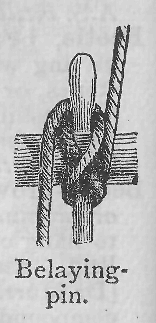
Belay, be-lā′, v.t. (naut.) to fasten a running rope by coiling it round a cleat or Belay′ing-pin: to make fast: (Spens.) to lay ornament round anything.—Belay there (naut. slang), hold! that is enough. [A.S. belecgan; Ger. belegen, Dut. beleggen. See Lay.]
Belch, belch, belsh, v.t. to void wind from the stomach by the mouth: to eject violently: to cast up, as of the smoke from a volcano or a cannon.—n. eructation. [A.S. bealcian; Dut. balken.]
Belcher, bel′sher, n. a neckerchief with dark-blue ground, mottled with white spots, each having a dark-blue spot in the centre. [From Jim Belcher, a famous English boxer.]
Beldam, Beldame, bel′dam, n. an old woman, esp. an ugly one: a hag, a furious woman: (obs.) a grandmother. [Formed from dam, mother, and bel-, expressing relationship. Cf. belsire.]
Beleaguer, be-lēg′ėr, v.t. to lay siege to.—n. Beleag′uerment. [Dut. belegeren, to besiege—be, and leger, camp. See Leaguer.]
Belee, be-lē′, v.t. (Shak.) to place on the lee-side of.
Belemnite, bel′em-nīt, n. a fossil pointed like a dart, being the internal shell of a genus of cephalopods, formerly known as Thunder-bolt, Thunder-stone, Elf-bolt. [Gr. belemnitēs—belemnon, a dart.]
Belfry, bel′fri, n. the part of a steeple or tower in which bells are hung: a bell-tower, sometimes standing apart: a movable wooden tower, used in the Middle Ages in attacking a fortification.—adj. Bel′fried, having a belfry. [Orig. and properly a watch-tower, from O. Fr. berfroi—Mid. High Ger. berchfrit—frid, frit, a tower, bergan, to protect.]
Belgard, bel-gärd′, n. (Spens.) fair or kind looks. [It. bel guardo, lovely look.]
Belgian, bel′ji-an, adj. belonging to Belgium, a country of Europe.—n. a native of Belgium.
Belgic, bel′jik, adj. pertaining to the Belgæ who anciently possessed Belgium, or to Belgium. [L. Belgicus—Belgæ, the Belgians.]
Belgravian, bel-grā′vi-an, adj. belonging to Belgravia (a fashionable part of London), or to fashionable life: aristocratic.
Belial, bēl′yal, n. a name for the devil, and, in Milton, for one of the fallen angels. Not a proper name in Old Test. [Heb. b’li-ya‛al, b’li, without ya‛al, usefulness.]
Belie, be-lī′, v.t. to give the lie to: to speak falsely of: to present in a false character: to counterfeit: to be false to: falsify: (Shak.) to fill with lies:—pr.p. bely′ing; pa.p. belīed′. [A.S. be, and Lie.]
Believe, be-lēv′, v.t. to regard as true: to trust in.—v.i. to be firmly persuaded of anything: to exercise faith (with in, on): to think or suppose.—n. Belief′, persuasion of the truth of anything: faith: the opinion or doctrine believed: intuition, natural judgment (as used by some philosophers).—adjs. Belief′less; Believ′able, that may be believed.—n. Believ′er, one who believes: a professor of Christianity.—p.adj. Believ′ing, trustful.—adv. Believ′ingly.—The Belief (arch.), the Apostles' Creed.—To make believe, to pretend. [M. E. bileven—bi-, be-, and leven. Murray says that believe is an erroneous spelling of the 17th century, prob. after relieve. The A.S. form geléfan survived to the 14th century; the present compound, which superseded it, appears in the 12th century.]
Belike, be-līk′, adv. probably: perhaps. [A.S. pfx. be-, and Like.]
Belittle, be-lit′l, v.t. to make small: to cause to appear small, to depreciate or disparage.—n. Belit′tlement.—adj. Belit′tling. [Pfx. be-, and Little.]
Belive, be-līv′, adv. (Scot.) with speed: soon, erelong. [M. E. bi life; be, bí, by, life, dat. of līf, life.]
Bell, bel, n. a hollow vessel of metal, which gives forth a ringing sound when struck by the tongue or clapper suspended inside—as in church-bell, hand-bell, alarm-bell, night-bell, marriage-bell, &c.: a corolla shaped like a bell: the body of a Corinthian or composite capital, without the surrounding foliage: anything bell-shaped, as in diving-bell, bell-glass, the bell or outward-turned orifice of a trumpet, &c.: a bell rung to tell the hour: (naut.) the bell struck on shipboard every half-hour as many times as there are half-hours of the watch elapsed—'two bells,' 'three bells,' &c., meaning that there are two or three half-hours past; the watch of four hours is eight bells.—v.t. to furnish with a bell, esp. in To bell the cat, to take the leading part in any hazardous movement, from the ancient fable of the mice who proposed to hang a warning bell round the cat's neck.—ns. Bell′cote (archit.), an ornamental structure made to contain one or two bells, and often crowned by a small spire; Bell′-crank, a rectangular lever in the form of a crank, used for changing the direction of bell-wires; Bell′-found′er, one who founds or casts bells; Bell′-glass, a bell-shaped glass for sheltering flowers; Bell′-hang′er, one who hangs and repairs bells; Bell′man, one who rings a bell, esp. on the streets, before making public announcements: a town-crier; Bell′-met′al, the metal of which bells are made—an alloy of copper and tin; Bell′-punch, a hand-punch containing a signal-bell, used for punching a hole in a ticket in order to keep a record of the number of fares taken; Bell′-ring′er, one whose business it is to ring a bell on stated occasions: a performer with musical hand-bells; Bell′-rope, the rope by which a bell is rung.—adj. Bell′-shaped.—ns. Bell′-tow′er, a tower built to contain one or more bells, a campanile; Bell′-tur′ret, a turret containing a bell-chamber, usually crowned with a spire; Bell′-weth′er, the leading sheep of a flock, on whose neck a bell is hung: (fig.) any loud, turbulent fellow, esp. the leader of a mob.—Bell, book, and candle, a phrase popularly used in reference to a form of excommunication ending with the words, 'Do to [shut] the book, quench the candle, ring the bell.'—To bear or carry off the bell, to have or to gain the first place. [A.S. belle; cog. with Dut. bel.]
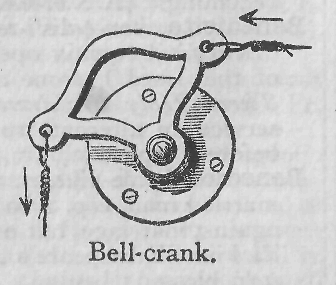
Bell, bel, n. a bubble formed in a liquid. [Ety. dub.; cf. Dut. bel, a bubble in water, perh. from L. bulla, bubble in water.]
Bell, bel, v.i. to bellow, roar: to utter loudly.—n. the cry of a stag at rutting-time. [A.S. bellan, to roar; cf. Ger. bellen.]
Belladonna, bel′la-don-na, n. the deadly nightshade or dwale, all parts of which are narcotic and poisonous from the presence therein of the alkaloid atropia: the drug prepared from the foregoing. [It. bella donna, fair lady; one property of belladonna is to enlarge the pupil, and so add a brilliance to the eyes.]
Bellarmine, bel′lar-mēn, n. a large stoneware drinking jug with a big belly and a narrow neck, decorated with a bearded face, originally that of Cardinal Bellarmine, made in mockery by the Dutch Protestants.
Belle, bel, n. a handsome woman: the chief beauty of a place: a fair lady generally. [Fr. belle—L. bella, bellus.]
Belles-lettres, bel-let′r, n.pl. polite or elegant literature, including poetry, fiction, criticism, æsthetics, &c.—ns. Bellet′rist, Bellet′trist.—adj. Belletris′tic. [Fr., lit. 'fine letters.']
Bellibone, bel′i-bōn, n. (Spens.) a beautiful and good woman.
Bellicose, bel′ik-ōs, adj. contentious, war-like.—adv. Bel′licosely.—n. Bellicos′ity. [L. bellicosus.]
Bellied, bel′lid, p.adj. with a belly, esp. a big belly, pot-bellied: bulging: puffed out. [See Belly.]
Belligerent, bel-ij′ėr-ėnt, adj. carrying on regular war.—n. a party or person waging such.—n. Bellig′erency. [L. belligerant-em, belligerāre, to wage war.]
Bellona, bel′lō-na, n. the Roman goddess of war—hence (fig.) a woman of great spirit and vigour.
Bellow, bel′lō, v.i. to roar like a bull: to make any violent outcry, often with sense of contempt or ridicule: to shout aloud: to roar, as of cannon, the ocean, &c.—with objective, to give forth a loud sound.—n. the roar of a bull: any deep sound or cry. [M. E. belwen; there is an A.S. bellan, to roar.]
Bellows, bel′lōz, or bel′lus, n.pl. an instrument for producing a current of air so as to blow up a fire, either in a kitchen, a furnace, or a forge—or for producing the current of air by which the pipes and reeds of an organ are sounded: (fig.) that which fans the fire of hatred, jealousy, &c.: the lungs. [Same as Belly (q.v.); now used only in pl., the sing. not having survived the 15th century.]
Belly, bel′li, n. the part of the body between the breast and the thighs, containing the bowels: the stomach, as the receptacle of the food: the bowels proper: the womb or uterus: the interior of anything: the bulging part of anything, as a bottle, or any concave or hollow surface, as of a sail: the inner or lower surface of anything, as opposed to the back, as of a violin, &c.—adj. ventral, abdominal: (theol.) belonging to the flesh, carnal.—v.i. to swell or bulge out.—ns. Bel′ly-band, a saddle-girth: a band fastened to the shafts of a vehicle, and passing under the belly of the horse drawing it; Bel′lyful, a sufficiency; Bel′ly-god, one who makes a god of his belly, a glutton.—p.adj. Bel′lying.—n. Bel′ly-tim′ber, provisions. [M. E. bali, bely—A.S. bælig, belig; bælg, belg, bag.]
Belomancy, bel′o-man-si, n. a kind of divination by means of arrows. [Gr. belos, a dart, manteia, divination.]
Belong, be-long′, v.i. to go along with: to pertain to: to be one's property: to be a part of, or appendage of, or in any way connected with: to be specially the business of: (U.S.) to be a native of, or have a residence in.—n.pl. Belong′ings, circumstances or relations of any person: possessions: persons connected, relatives: accessories. [Bi-, be-longen, intens. of longen, with pfx. be-. See Long.]
Beloved, be-luvd′, or be-luv′ed, p.adj. much loved, very dear—often compounded with well-; best-, &c.—n. one who is much loved.—adj. Belov′ing (Shak.) = loving.
Below, be-lō′, prep. beneath in place, rank, or quality: underneath: not worthy of.—adv. in a lower place: (fig.) on earth, or in hell, as opposed to heaven. [Pfx. be-, and adj. Low.]
Belt, belt, n. a girdle, zone, or band: such a piece, as of leather, worn by way of ornament, or given as a prize or badge of victory in wrestling or the like: a broad strip of anything, different in colour or material: that which confines or restrains: (geog.) a strait.—v.t. to surround with a belt, or to invest formally with such, as in knighting a man: to encircle: to thrash with a belt.—p.adj. Belt′ed, wearing a belt, of a knight: marked with a belt, as the 'belted kingfisher.'—n. Belt′ing, flexible belts for the transmission of motion in machinery, made of leather, indiarubber, &c.—as in chainbelt, crossed belt, endless belt, &c.; a thrashing.—To hold the belt, to hold the championship in wrestling, boxing, or the like. [A.S. belt; Ice. belti, Gael. balt, L. balteus.]
Beltane, bel′tān, n. an ancient Celtic heathen festival, held in the beginning of May, when bonfires were lighted on the hills: the first day of May (O.S.)—one of the four old quarter-days of Scotland, the others being Lammas, Hallowmas, and Candlemas.—adj. in Beltane games, &c. [Gael. bealltainn, beilteine; usually explained as 'Beal's fire,' Beal being a supposed Celtic deity who has been courageously identified with the Baal or Bel of the Phœnicians and other Semitic peoples, and Gael. teine, fire. But even this last is doubtful.]
Beluga, be-lōō′ga, n. the white whale, one of the dolphin family, closely allied to the narwhal, 12 to 16 feet long, of creamy-white colour, found in droves round Greenland and all over the Arctic seas: applied also to a great Russian sturgeon—the Acipenser Huso. [Russ.]
Belvedere, bel′ve-dēr, n. a pavilion or raised turret or lantern on the top of a house, open for the view, or to admit the cool evening breeze: a summer-house on an eminence in a park or garden. [It. belvedere; bel, beautiful, vedere, a view.]
Bema, bē′ma, n. the tribune or rostrum from which Athenian orators made their speeches—hence the apse or chancel of a basilica. [Gr. bēma, a step.]
Bemad, be-mad′, v.t. to madden.
Bemaul, be-mawl′, v.t. to maul thoroughly.
Bemazed, be-māzd′, p.adj. stupefied, bewildered.
Bembex, bem′beks, n. a genus of solitary sand-wasps, with broad heads and very large eyes, noted for their making a loud buzz during their rapid flight. [Gr. bembix.]
Bemean, be-mēn′, v.t. to make mean, to lower or debase: (obs.) to signify.
Bemire, be-mīr′, v.t. to soil with mire.—p.adj. Bemired′.
Bemoan, be-mōn′, v.t. to lament: bewail: to pity.—v.i. to grieve.—ns. Bemoan′er; Bemoan′ing.
Bemock, be-mok′, v.t. to mock at, to deride.
Bemoil, be-moil′, v.t. (Shak.) to bemire, to bedraggle.
Bemonster, be-mon′ster, v.t. to make monstrous: to regard or treat as a monster.
Bemouth, be-mowth′, v.i. to declaim, to overpraise.
Bemud, be-mud′, v.t. to bespatter with mud: to confuse.
Bemuddle, be-mud′l, v.t. to confuse or muddle completely.
Bemuffle, be-muf′l, v.t. to wrap or muffle up completely.
Bemuse, be-mūz′, v.t. to put in confusion: stupefy.
Ben, ben, n. a mountain peak. [Gael. beann.]
Ben, ben, prep. and adv. in toward the inner apartment of a house.—n. the inner apartment of a house, as opposed to the But or kitchen through which one must generally pass first.—To be far ben with one, to be on terms of great intimacy or friendship with; To live but and ben, to live respectively in these rooms, in close neighbourhood with any one. [M. E. binne—A.S. binnan, within.]
Bench, bensh, n. a long seat or form with or without a back: a seat in a boat: a mechanic's work-table: a judge's seat: the body or assembly of judges: a tribunal: the dignity of holding an official seat, as the 'bench of bishops,' the 'civic bench.'—v.t. to place on or furnish with benches.—ns. Bench′er, a senior member of an inn of court; Bench′ership; Bench′-mark, a surveyor's mark cut on a rock, gatepost, wall, or the like, into which a crooked iron is set so as to form a bench or temporary support for the levelling instrument; Bench′-war′rant, one issued by a judge rather than a justice or magistrate. [A.S. benc; cog. with Ger. and Dut. bank.]
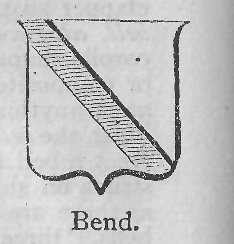
Bend, bend, v.t. to curve or bow: to make crooked: to turn or incline—mostly in passive, to be inclined to, towards, to be given to: to subdue: to direct to a certain point: to apply closely, to strain, to nerve one's self to: (naut.) to tie, fasten, make fast.—v.i. to be crooked or curved: to incline in any direction: to stoop: to lean: to bow in submission (with to, before, towards):—pa.p. bend′ed or bent.—n. a curve or crook: the bent part of anything; (her.) one of the nine ordinaries, consisting of the space contained between two parallel lines crossing the shield diagonally from dexter chief to sinister base. It is said to occupy a fifth part of the shield unless charged, when it occupies a third part—its diminutives are the Bendlet, Cotise, and Ribbon.—Bend sinister, an occasionally occurring variety of the bend, drawn from sinister chief to dexter base. [Old Eng. bendan.]
Bend, bend, n. in leather, half a butt cut lengthwise.
Beneath, be-nēth′, prep. under, or lower in place: inside of, behind: unworthy the dignity of, unbecoming. [A.S. bi-nathan.]
Benedicite, ben-ē-dis′i-te, n. the canticle beginning 'Benedicite omnia opera Domini' ('O all ye works of the Lord'), from the Apocryphal Song of the Three Holy Children—in the Anglican morning service an alternate to the Te Deum: the blessing before a repast.
Benedict, ben′e-dikt, n. a common name for a newly married man, esp. a bachelor who has long held out against marriage, but at last succumbed—from Benedick in Shakespeare's Much Ado about Nothing.—adj. blessed: benign.
Benedictine, ben-e-dik′tin, adj. pertaining to St Benedict or his monastic rule.—n. a Black Friar or monk of the order founded at Monte Cassino by St Benedict of Nursia (480-543), which became famous for its learning: a cordial or liqueur resembling Chartreuse, distilled at Fécamp in Normandy—once distilled by Benedictine monks.
Benediction, ben-e-dik′shun, n. a solemn invocation of the divine blessing on men or things—a priestly benediction is defined by Romanists as a formula of imperative prayer which transmits a certain grace or virtue to the object over which it is pronounced: a brief and popular service in the Romish Church, consisting of certain canticles and antiphons sung in presence of the host, and concluding with the priest making the sign of the cross over the people with the monstrance, and giving in silence the benediction of the most holy sacrament.—adj. Benedict′ory.—n. Benedict′us, the canticle of Zacharias (Luke, i. 68-79), used in the Roman service of matin-lauds, and occurring after the second lesson in Anglican matins.—p.adj. Benedight′ (Longfellow), blessed.—Apostolic benediction, that given in 2 Cor. xiii. 14.
Benefaction, ben-e-fak′shun, n. the act of doing good: a good deed done or benefit conferred: a grant or endowment.—n. Benefac′tor, one who gives a benefit to another, esp. one who leaves a legacy to some charitable or religious institution, a patron:—fem. Benefac′tress.—adj. Benefac′tory. [L. benefaction-em.]
Benefice, ben′e-fis, n. any kind of church promotion or dignity, esp. with cure of souls, such as rectories, vicarages, and other parochial cures, as distinguished from bishoprics, deaneries, cathedral preferments, &c.: an ecclesiastical living.—adj. Ben′eficed, possessed of a benefice. [Through Fr. from L. beneficium.]
Beneficence, be-nef′i-sens, n. active goodness: kindness: charity: a beneficent gift.—n. Benefic′ency (obs.).—adjs. Benef′icent; Beneficen′tial.—adv. Benef′icently. [L. beneficentia.]
Beneficial, ben-e-fish′al, adj. useful; advantageous: (law) enjoying the usufruct of property.—adj. Benef′ic, of good influence astrologically: beneficent, kindly.—adv. Benefic′ially.—ns. Benefic′ialness; Benefic′iary, a legal term to denote a person who enjoys, or has the prospect of enjoying, any interest or estate held in trust by others. [L. beneficium.]
Benefit, ben′e-fit, n. a kindness: a favour: any advantage, natural or other: a performance at a theatre, the proceeds of which go to one of the company.—v.t. to do good to.—v.i. to gain advantage (with from),—ns. Ben′efit-of-cler′gy, in old English law, the exemption of the persons of ecclesiastics from criminal process before a secular judge, they being responsible only to their ordinary. This privilege, at first limited to those in actual orders, was in 1350 extended to all manner of clerks, and in later practice to all who could read, whether of clergy or laity; Ben′efit-of-in′ventory (Scots law), a legal privilege whereby an heir secured himself against unlimited liability for his ancestor, by giving up within the annus deliberandi an inventory of his heritage or real estate, to the extent of which alone was the heir liable.—Benefit societies, associations for mutual benefit chiefly among the labouring classes, better known as Friendly societies. [M. E. benfet, through Fr. from L. benefactum.]
Benet, be-net′, v.t. to catch in a net, to ensnare.
Benet, ben′et, n. an exorcist, the third of the four lesser orders in the Roman Church. [Through Fr. from L. benedict-us, blessed.]
Benevolence, ben-ev′ol-ens, n. disposition to do good: an act of kindness: generosity: a gift of money, esp. for support of the poor: (Eng. hist.) a kind of forced loan or contribution, levied by kings without legal authority, first so called under Edward IV. in 1473.—adj. Benev′olent, charitable, generous, well disposed to.—adv. Benev′olently. [Through Fr. from L. benevolentia.]
Bengali, ben-gaw′lē, adj. of or belonging to Bengal.—n. a native of Bengal: the language of Bengal.—n. Bengal′-light, a brilliant signal-light used at sea in a case of shipwreck, and in ordinary pyrotechny for illuminating a district of country—prepared from nitre, sulphur, and the black sulphide of antimony.
Benighted, be-nīt′ed, adj. overtaken by night: involved in darkness, intellectual or moral: ignorant.—v.t. Benight′, to involve in such darkness: to cloud with disappointment.—ns. Benight′ening; Benight′er; Benight′ing; Benight′ment. [Pfx. be- and Night.]
Benign, ben-īn′, adj. favourable, esp. in astrology, as opposed to malign: gracious: kindly: (med.) of a mild type, as opposed to malignant: salubrious.—n. Benig′nancy, benignant quality.—adj. Benig′nant, kind: gracious: beneficial.—adv. Benig′nantly.—n. Benig′nity, goodness of disposition: kindness: graciousness: favourable circumstances—of climate, weather, disease, planets.—adv. Benign′ly. [O. Fr. benigne—L. benignus, for benigenus; bene, well, genus, born.]
Benison, ben′izn, n. benediction, blessing, esp. blessing of God. [O. Fr. beneiçun—L. benediction-em.]
Benitier, bā-nē′tiā, n. the vase or vessel for holy water in R.C. churches, known in England as the holy-water font, vat, pot, stone, stock, or stoup. [Fr.—Low L. benedictarium—L. benedictus.]
Benjamin, ben′jä-min, n. a kind of overcoat formerly worn by men. [Suggested possibly by 'Joseph's coat.' The Gipsy béngari, 'waistcoat,' has been proposed as an etymon.]
Benjamin, ben′jä-min, n. gum benjamin, an essence made from benzoin.—n. Ben′jamin-tree, a North American aromatic shrub, with stimulant tonic bark and berries: the tree which yields benzoin—Styrax Benzoin. [A corr. of Benzoin.]
Bennet, ben′et, n. the herb Bennet or common avens (Geum urbanum), a yellow-flowered wayside plant throughout Europe. [Through Fr. from L. 'herba benedicta,' the flower being a protective against the devil.]
Bennet, ben′et, n. the same as Bent, indeed an earlier form.
Bent, bent, pa.t. and pa.p. of Bend.
Bent, bent, n. leaning or bias: tendency: intention: natural inclination of the mind towards anything: the condition of being bent, curved form: (rare) slope or declivity: (Shak.) a cast, as of the eye: the extent to which a bow may be bent—degree of tension, capacity of endurance, as in the phrase 'to the top of one's bent' = to the full measure of one's inclination. [See Bend.]
Bent, bent, n. any stiff or wiry grass: the old dried stalks of grasses: a special genus (Agrostis) containing about sixty species of grasses, all slender and delicate in appearance, and some useful as pasture-grasses and for hay: a place covered with such, a heath: a hillside.—Often Bent′-grass.—Ben′net is a variant, a name applied to the wild barley-grass.—adj. Bent′y.—To take to the bent (Scot.), to fly to the moors, to escape from some danger by flight. [A.S. beonet, found in place-names, as Beonetléah, Bentley; the history is obscure, but the word is doubtless Teut.; cf. Ger. binse.]
Benthamism, ben′tham-izm, n. a name applied to the social and political doctrines of Jeremy Bentham (1748-1832), whose leading principle is the doctrine of utility, that happiness is identical with pleasure, summed up in Priestley's famous phrase, 'the greatest happiness of the greatest number.'
Benumb, be-num′, v.t. to make insensible or powerless: to stupefy (now chiefly of cold): to deaden the feelings: to paralyse generally.—p.adj. Benumbed′.—ns. Benumbed′ness, Benumb′ment. [Pfx. be- and Numb.]
Benzene, ben′zēn, n. a compound of carbon and hydrogen, discovered by Faraday in 1825, in a tarry liquid resulting from the distillation of oil. It is found amongst the products of the destructive distillation of a great many organic bodies, but the most abundant source is coal-tar. It must not be confounded with benzine or benzoyl, which names have at different times been used for benzene.—Ben′zine is the name given to a distillate from American petroleum, which is much used as a substitute for turpentine, and for dissolving oils and fats; Ben′zoyl is the commercial name applied to a mixture of substances, including benzene and its homologues.—Ben′zol is synonymous with benzene, while Ben′zoline is a name applied to benzine and impure benzene indiscriminately.
Benzoin, ben′zō-in, or -zoin, n. gum benjamin, the aromatic and resinous juice of the Styrax Benzoin of Java and Sumatra. It is used in perfumery, in pastilles, and for incense, and its compound tincture yields Friar's Balsam or Jesuit's Drops, and is used in making court-plaster. [In the 16th century, Benjoin. Most prob. through It. from Ar. lubān jāwī, frankincense of Java, Sumatra, &c.]
Bepaint, be-pānt′, v.t. to paint over: to colour.
Bepat, be-pat′, v.t. to pat frequently, to beat.
Bepatched, be-patcht′, p.adj. mended with patches: wearing patches on the face by way of adornment.
Bepearl, be-pėrl′, v.t. to cover over with pearls.
Bepelt, be-pėlt′, v.t. to pelt vigorously.
Bepepper, be-pep′ėr, v.t. to pelt with a rain of shot or of blows.
Bepester, be-pest′ėr, v.t. to vex or pester greatly.
Bepity, be-pit′i, v.t. to pity greatly.
Beplumed, be-plōōmd′, p.adj. adorned with feathers.
Bepommel, be-pom′el, v.t. to pommel soundly.
Bepowder, be-pow′dėr, v.t. to powder over.
Bepraise, be-prāz′, v.t. to praise extravagantly.
Beprose, be-prōz′, v.t. to reduce to prose: to discuss in prose, and tediously.
Bepuff, be-puf′, v.t. to puff out: to praise beyond measure.
Bequeath, be-kwēth′, v.t. to leave personal property by will to another: to transmit to posterity, to leave behind: to commit or entrust to any one.—adj. Bequeath′able.—ns. Bequeath′al, Bequeath′ment. [A.S. becweðan; pfx. be-,and cweðan, to say. See Quoth.]
Bequest, be-kwest′, n. act of bequeathing: that which is bequeathed, a legacy. [M. E. bi-queste—A.S. bi'-cwiss; bi'-, a form of pfx. be-, qithan, to say. See Quoth.]
Berate, be-rāt′, v.t. (U.S.) to scold or chide vigorously.
Berber, bėr′bėr, n. and adj. a member of one of the Hamitic tribes inhabiting the mountainous regions of Barbary and the northern portions of the Great Desert, originally occupying the whole southern coast of the Mediterranean: the language spoken by the Berbers. [Derived by Barth either from the name of their supposed ancestor, Ber, which we recognise in the L. A-fer, an African; or from the Gr. and L. term Barbari.]
Bere, another spelling of Bear, barley (q.v.).
Berean, bē-rē′an, n. one of an extinct Scottish sect of the 18th century, named from the people of Berea (Acts, xvii. 11, who derived all knowledge of God from the Bible, but differed little from ordinary Calvinists.
Bereave, be-rēv′, v.t. to rob a person of anything valued: to leave destitute:—pa.t. and pa.p. bereaved′—the latter also Bereft′.—adj. Bereaved′, robbed by death of some dear relative or friend.—n. Bereave′ment, the fact or state of being so bereaved. [A.S. beréafian, to plunder. See Reave.]
Beret, Berret, bėr′et, n. a flat woollen cap worn by the Basques. [Fr.]
Berg, berg, n. a mass or mountain of ice.—ns. Berg′fall, the fall of a mountain rock; Berg′field, an expanse of ice covered with bergs. [See Iceberg.]
Bergamask, bėr′ga-mask, adj. of or pertaining to Bergamo, whose natives are clownish in manners and dialect.—n. a rustic dance of theirs.
Bergamot, bėr′ga-mot, n. a kind of citron whose aromatic rind yields the well-known oil of Bergamot, used in making pomades, fragrant essences, eau de Cologne, liqueurs, &c.: the essence so extracted. [From the town of Bergamo.]
Bergamot, bėr′ga-mot, n. a group of varieties of pear of fine flavour. [Fr.—It.—Turk. begarmūdi.]
Bergmehl, bėrg′māl, n. a deposit of diatomaceous white earth or powder, that used in Norway to be mixed with flour and used as food. [Ger. 'mountain-flour.']
Beriberi, ber′i-ber-i, n. an Eastern disease marked by anæmia, paralysis, and dropsical symptoms. [Singh.]
Berkeleianism, berk′lē-an-izm, n. the philosophy of Bishop Berkeley (1685-1753), who maintained that the world we see and touch is not an abstract independent substance, of which conscious mind may be an effect, but is the very world which is presented to our senses, and which depends for its actuality on being perceived.—adj. and n. Berkelei′an.