LIST OF ABBREVIATIONS USED IN THIS DICTIONARY. (continued 18)
Reading edition
Device, de-vīs′, n. that which is devised or designed: contrivance: power of devising: genius: (her.) the emblem borne upon a shield: a picture of some kind, with a motto illustrative of a man's life or character, borne by an individual rather than by a family.—adj. Device′ful (Spens.), full of devices. [O. Fr. devise. See Devise.]
Devil, dev′l, v.t. (cook.) to season highly and broil.—v.i. to perform another man's drudgery (esp. to devil for a barrister).
Devil, dev′l, n. the supreme spirit of evil, Satan: any evil spirit: a false god: a very wicked person: a fellow, as in 'Poor devil:' an expletive, in 'What the devil,' &c.—ns. Dev′ildom; Dev′iless; Dev′ilet; Dev′il-fish, a name for the fishing-frog or angler, for the giant-ray of the United States, and for other large and ugly fishes; Dev′il-in-the-bush, a garden flower, also called Love-in-a-mist.—adj. Dev′ilish, fiendish, malignant.—adv. (coll.) very: exceedingly.—adv. Dev′ilishly.—ns. Dev′ilism; Dev′ilkin.—adj. Dev′il-may-care, reckless, audacious.—ns. Dev′ilment; Dev′il-on-the-neck, an old instrument of torture; Dev′ilry; Dev′ilship; Dev′iltry; Dev′il-wor′ship, the worship of the devil, or of devils; Dev′il-wor′shipper.—Devil a bit, not at all; Devil of a mess, a very bad mess.—Devil's advocate, a name given to the Promoter of the Faith, an advocate at the papal court, whose duty it is to propose all reasonable objections against a person's claims to canonisation; Devil's bit, a popular name for scabious; Devil's books, playing-cards; Devil's coach-horse, a large dark-coloured beetle; Devil's dozen, thirteen (like baker's dozen); Devil's dung, a popular name for asafœtida; Devil's dust, shoddy made by a machine called the devil; Devil's own, a name given to the 88th Regiment in the Peninsular war, as also to the Inns of Court volunteers; Devil's snuff-box, the puff-ball, a kind of fungus; Devil's tattoo (see Tattoo); Devil to pay, serious trouble ahead—said to be from the difficulty of paying, or caulking, an awkward and inaccessible seam in a ship.—Cartesian devil (see Cartesian); Printer's devil, the youngest apprentice in a printing-office: a printer's errand-boy; Tasmanian devil, the ursine dasyure, a Tasmanian carnivore.—Play the devil with, to bring to utter ruin. [A.S. deóful, deófol—L. diabolus—Gr. diabolos, from diaballein, to throw across, to slander, from dia, across, and ballein, to throw; cf. Ger. teufel, Fr. diable, It. diavolo, Sp. diablo.]
Devious, dē′vi-us, adj. from or out of the way: roundabout: erring.—adv. Dē′viously.—n. Dē′viousness. [L. devius. See Deviate.]
Devise, de-vīz′, v.t. to imagine: to scheme: to contrive: to give by will: to bequeath.—v.i. to consider, scheme.—n. act of bequeathing: a will: property bequeathed by will.—adj. Devis′able.—ns. Devis′al; Devisē[e]′, one to whom real estate is bequeathed; Devis′er, one who contrives; Devis′or, one who bequeaths. [O. Fr. deviser, devise—Low L. divisa, a division of goods, a mark, a device—L. dividĕre, divisum, to divide.]
Devitalise, de-vī′ta-līz, v.t. to deprive of vitality or life-giving qualities.—n. Devitalisā′tion.
Devitrify, de-vit′ri-fī, v.t. to take away or greatly diminish the vitreous quality of.—n. Devitrificā′tion, loss or diminution of the vitreous nature.
Devocalise, de-vō′ka-līz, v.t. to make voiceless: to reduce the vowel element in a sound or syllable.
Devoid, de-void′, adj. destitute: free from. [O. Fr. desvoidier, des—L. dis-, away, voidier—L. viduāre, viduus, deprived.]
Devoir, dev-wawr′, n. what is due, duty: service: an act of civility. [Fr.,—L. debēre, to owe.]
Devolution, dev-ol-ū′shun, n. a passing from one person to another. [See Devolve.]
Devolve, de-volv′, v.t. to roll down: to hand down: to deliver over.—v.i. to roll down: to fall or pass over.—n. Devolve′ment. [L. devolvĕre, -volūtum—de, down, volvĕre, -ūtum, to roll.]
Devonian, de-vō′ni-an, adj. belonging to Devonshire: belonging to a system of geological strata which abound in Devonshire, closely corresponding to Old Red Sandstone.
Devonport, dev′on-pōrt, n. a small ornamental writing-table, fitted with drawers, &c.
Devonshire cream = Clotted cream. See Clot.
Devote, de-vōt′, v.t. to vow: to set apart or dedicate by solemn act: to doom: to give up wholly.—adj. Devōt′ed, given up, as by a vow: doomed: strongly attached: zealous.—adv. Devōt′edly.—ns. Devōt′edness; Devotēē′, one wholly or superstitiously devoted, esp. to religion: a fanatic; Devōte′ment (Shak.); Devō′tion, consecration: giving up of the mind to the worship of God: piety: prayer: strong affection or attachment: ardour: (pl.) prayers: (obs.) religious offerings: alms.—adj. Devō′tional.—ns. Devō′tionalist, Devō′tionist.—adv. Devō′tionally. [L. devovēre, devōtum—de, a way, and vovēre, to vow.]
Devour, de-vowr′, v.t. to swallow greedily: to eat up: to consume or waste with violence or wantonness: to destroy: to gaze intently on.—n. Devour′er.—adj. Devour′ing.—adv. Devour′ingly.—n. Devour′ment. [O. Fr. devorer—L. devorāre—de, inten., and vorāre, to swallow. See Voracious.]
Devout, de-vowt′, adj. given up to religious thoughts and exercises: pious: solemn: earnest.—adv. Devout′ly.—n. Devout′ness. [O. Fr. devot—L. devotus. See Devote.]
Dew, dū, n. moisture deposited from the air on cooling, esp. at night, in minute specks upon the surface of objects: early freshness (esp. in Dew of his youth).—v.t. to wet with dew: to moisten.—ns. Dew′berr′y, a kind of bramble or blackberry having a bluish dew-like bloom on the fruit; Dew′-claw, a rudimentary inner toe of a dog's hind-foot; Dew′drop; Dew′fall, the falling of dew, the time it falls; Dew′point, the temperature at which dew begins to form; Dew′-rett′ing, the process of rotting away the gummy part of hemp or flax by exposure on the grass to dew and rain; Dew′stone, a Nottinghamshire limestone; Dew′-worm, the common earthworm.—adj. Dew′y.—Mountain dew (slang), whisky, originally illicitly distilled or smuggled spirits. [A.S. deáw; cf. Ice. dögg, Ger. thau, dew.]
Dew, dū, n. an obsolete spelling of due.
Dewan, dē-wan′, n. in India, a financial minister, the native steward of a business-house.—ns. Dewan′i, Dewan′ny, the office of dewan. [Hind.]
Dewitt, dē-wit′, v.t. to lynch—from the fate of Jan and Cornelius De Witt in Holland in 1672.
Dewlap, dū′lap, n. the pendulous skin under the throat of oxen, dogs, &c.: the fleshy wattle of the turkey.—adjs. Dew′lapped, Dew′lapt. [Prob. dew and A.S. læppa, a loose hanging piece.]
Dexter, deks′tėr, adj. on the right-hand side: right: (her.) of that side of the shield on the right-hand side of the wearer, to the spectator's left.—n. Dexter′ity, right-handedness: cleverness: readiness and skill: adroitness.—adjs. Dex′terous, Dex′trous, right-handed: adroit: subtle.—adv. Dex′terously.—n. Dex′terousness.—adj. Dex′tral, right, as opposed to left.—n. Dextral′ity, right-handedness.—adv. Dex′trally.—adjs. Dex′tro-gȳ′rate, causing to turn to the right hand; Dex′trorse, Dextror′sal, rising from right to left. [L. dexter; Gr. dexios, Sans. dakshina, on the right, on the south.]
Dextrine, deks′trin, n. starch altered by the action of acids, diastase, or heat till it loses its gelatinous character, so called because when viewed through polarised light it turns the plane of polarisation to the right.—n. Dex′trose, a glucose sugar, found in grapes, &c., and manufactured from starch by means of sulphuric acid. [Fr.,—L. dexter.]
Dey, dā, n. a dairy-maid. [See Dairy.]
Dey, dā, n. a name given to the pasha or governor of Algiers before the French conquest. [Turk, dái, orig. a maternal uncle, a familiar title of the chief of the Janizaries.]
Dharma, där′ma, n. the righteousness that underlies the law: the law. [Sans.]
Dhobie, dō′bi, n. an Indian washerman. [Hind.]
Dhole, dōl, n. the Indian wild dog. [Ind. word.]
Dhooly, dōō′li, n. a covered litter.—Also Doo′lie. [Hind. doli.]
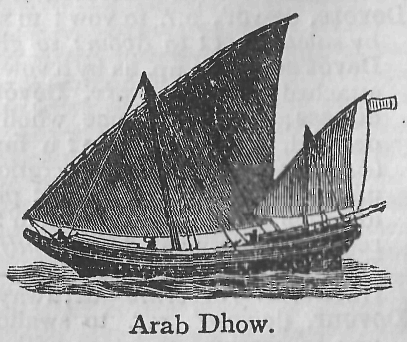
Dhow, dow, n. a native vessel on the eastern African and western Indian coasts, with lateen sails: an Arab slaver.
Dhurra. Same as Durra.
Diabase, dī′a-bās, n. a compact igneous rock, an altered form of basalt—included under the popular names greenstone and trap.—adj. Diabā′sic.
Diabaterial, dī-a-ba-tē′ri-al, adj. crossing the boundaries. [Gr. diabatos—dia, across, bainein, to go.]
Diabetes, dī-a-bē′tēz, n. a disease marked by a morbid and excessive discharge of urine.—adjs. Diabet′ic, -al. [Gr., from diabainein, dia, through, and bainein, to go.]
Diablerie, Diablery, di-ab-le-rē′, n. magic: the black art: sorcery. [Fr.,—diable. See Devil.]
Diabolic, -al, dī-a-bol′ik, -al, adj. devilish.—adv. Diabol′ically.—v.t. Diab′olise, to render devilish.—ns. Diab′olism, devilish conduct: sorcery or black magic; Diabol′ogy, the doctrine of devils. [L.,—Gr. diabolikos, diabolos, the devil. See Devil.]
Diacatholicon, dī-a-ka-thol′i-kon, n. a purgative electuary.
Diacaustic, dī-a-kaws′tik, adj. pertaining to curves formed by the intersections of rays of refracted light.—n. a curve so formed. [Formed from Gr. dia, through, and caustic.]
Diachastic, dī-a-kas′tik, adj. cleaving apart. [Gr.]
Diachylon, dī-ak′i-lon, Diachylum, dī-ak′i-lum, n. common sticking-plaster. [Gr. diachylos—dia, and chylos, juice.]
Diachyma, dī-ak′i-ma, n. the parenchyma of leaves. [Gr. dia, through, chyma, juice.]
Diacodium, dī-a-kō′di-um, n. a syrup of poppies. [L.,—Gr. dia, through, kōdeia, a poppy-head.]
Diaconate, dī-ak′o-nāt, n. the office of a deacon.—adj. Diac′onal, pertaining to a deacon.
Diaconicon, dī-a-kon′i-kon, n. a sacristy for sacred vessels, in a Greek church, on the south side of the bema or sanctuary.
Diacoustic, dī-a-kows′tik, adj. pertaining to the refraction of sound through various mediums.—n. Diacous′tics, the branch of physics which deals with refracted sounds. [Formed from Gr. dia, through, and acoustics.]
Diacritic, -al, dī-a-krit′ik, -al, adj. distinguishing between—used of marks or points attached to the letters of various languages. [Gr. diakritikos, diakrinein—dia, between, and krinein, to distinguish. See Critic.]
Diactine, dī-ak′tin, adj. having two rays.—Also Diac′tinal.
Diactinic, dī-ak-tin′ik, adj. capable of transmitting the actinic rays of the sun.
Diadelphous, dī-a-del′fus, adj. grouped together in two sets—of the stamens of plants.—n. Dī′adelph. [Formed from Gr. di-, double, and adelphos, brother.]
Diadem, dī′a-dem, n. a band or fillet worn round the head as a badge of royalty: a crown: royalty.—adj. Dī′ademed, wearing a diadem.—Diadem spider, the common garden spider—from its markings. [O. Fr. diademe—L. diadema—Gr. diadēma—dia, round, and deein, to bind.]
Diadexis, dī-a-dek′sis, n. (path.) the transformation of one disease into another, differing both in location and character. [Gr.]
Diadochi, dī-ad′o-kī, n. the generals who became monarchs of the various kingdoms (Syria, Egypt, &c.) into which the empire of Alexander the Great split after his death (323 B.C.). [Gr. diadochos, succeeding, a successor; diadechesthai, to succeed.]
Diadrom, dī′a-drom, n. a course or passing: a vibration. [Gr.]
Diæresis, Dieresis, dī-ēr′e-sis, n. a mark (¨) placed over one of two vowels to show that each is to be pronounced separately, as aërial:—pl. Diær′eses, Dier′eses. [Gr.,—dia, apart, hairein, to take.]
Diaglyph, dī′a-glif, n. an intaglio. [Gr.]
Diagnosis, dī-ag-nō′sis, n. the distinguishing a disease by means of its symptoms: a brief description:—pl. Diagnō′ses.—v.t. Dī′agnose, to ascertain from symptoms, as a disease.—adj. Dīagnos′tic, distinguishing: characteristic.—n. that by which anything is known: a symptom.—n.pl. Diagnos′tics, the branch of medicine to which the skill in noting and interpreting symptoms belongs. [Gr., dia, between, gnōsis—gnōnai, to know.]
Diagometer, dī-a-gom′e-tėr, n. a form of electroscope for ascertaining conducting power. [Gr. diagein, to conduct, metron, a measure.]
Diagonal, dī-ag′o-nal, adj. through the corners, or from an angle to an opposite angle of a four or many sided figure.—n. a straight line so drawn.—adv. Diag′onally.—Diagonal scale, a scale for laying down small fractions of the unit of measurement, the parallel lines drawn lengthwise on its surface being divided into sections by lines drawn crosswise, and in one end section being intersected by a series of other parallel lines drawn obliquely at equal distances across them. [Fr.,—L. diagonalis, from Gr. diagōnios—dia, through, and gōnia, a corner.]
Diagram, dī′a-gram, n. a figure or plan drawn in outline to illustrate any statement: a record traced by an automatic indicator.—adj. Diagrammat′ic.—adv. Diagrammat′ically.—n. Dī′agraph, an instrument for enabling unskilled persons to draw objects in outline.—adj. Diagraph′ic. [L.,—Gr. diagramma—dia, round, graphein, to write.]
Diaheliotropic, dī-a-hē-li-ō-trop′ik, adj. (bot.) turning transversely to the light.—n. Diaheliot′ropism. [Gr. dia, across, and heliotropic.]
Dial, dī′al, n. an instrument for showing the time of day by the sun's shadow: a timepiece: the face of a watch or clock: a circular plate on which a movable index shows the degree of pressure, &c.—v.t. to measure, as with a dial.—ns. Dī′alist, a maker of dials: one skilled in dialling; Dī′alling, the art of constructing dials: the science which explains the measuring of time by the sun-dial: surveying by help of a compass with sights, such as is called a 'miner's dial;' Dīal-plate. [M. E. dial—Low L. dialis, daily—L. dies, a day.]
Dialect, dī′a-lekt, n. a variety or form of a language peculiar to a district: a non-literary vernacular: a peculiar manner of speaking.—adj. Dialect′al.—adv. Dialect′ally.—ns. Dialect′icism; Dialectol′ogist; Dialectol′ogy. [Through Fr. and L. from Gr. dialektos, speech, manner of speech, peculiarity of speech—dia, between, legein, to speak.]
Dialectic, -al, dī-a-lek′tik, -al, adj. pertaining to dialect or to discourse: pertaining to dialectics: logical.—ns. Dialec′tic, Dialect′ics, art of discussing: that branch of logic which teaches the rules and modes of reasoning.—adv. Dialec′tically.—n. Dialecti′cian, one skilled in dialectics, a logician. [Gr. dialektikos.]
Diallage, dī-al′a-jē, n. (rhet.) a figure of speech by which arguments, after having been considered from various points of view, are all brought to bear upon one point. [Gr.]
Diallage, dī′al-āj, n. a mineral nearly allied to augite, brown, gray, or green in colour, laminated in structure, with a metallic lustre when broken across.—adjs. Diallag′ic, Dial′lagoid. [Gr. diallagē, change—dia, between, allassein, to change—allos, other.]
Dialogite, dī-al′ō-jīt, n. a rose-red carbonate of manganese—also Rhodochrosite.
Dialogue, dī′a-log, n. conversation between two or more persons, esp. of a formal or imaginary nature.—v.i. and v.t. (Shak.) to put into dialogue form.—adjs. Dialog′ic, Dialogist′ic, -al (-loj-), in the form of a dialogue.—v.i. Dial′ogise (′oj-), to discourse in dialogue.—n. Dial′ogist (′oj-), a speaker in, or writer of, a dialogue. [Fr.,—L. dialogus—Gr. dialogos, a conversation—dialegesthai, to discourse.]
Dialuric, dī-a-lū′rik, adj. pertaining to alloxan and uric acid.—n. Dialū′rate, a salt of dialuric acid.
Dialysis, dī-al′i-sis, n. (chem.) the separation of substances by diffusion through a membranous septum or partition: diæresis: dissolution:—pl. Dial′yses.—adj. Dialys′able.—v.t. Dī′alyse, to separate by dialysis.—n. Dī′alyser.—adj. Dialyt′ic. [Gr. dialysis—dia, asunder, lyein, to loose.]
Diamagnetic, dī-a-mag-net′ik, adj. cross-magnetic—applied to any substance, such as a rod of bismuth or glass, which, when suspended between the poles of a magnet, arranges itself across the line joining the poles (a rod of iron or of sealing-wax so held arranges itself parallel to the line joining the poles, and is said to be Paramagnetic).—adv. Diamagnet′ically.—n. Diamag′netism, the form of magnetic action possessed by diamagnetic bodies: the branch of magnetism which deals with diamagnetic phenomena. [Gr. dia, through, magnētēs, magnēs, a magnet.]
Diamantiferous, dī-a-man-tif′er-us, adj. yielding diamonds. [Fr. diamantifère.]
Diamesogamous, dī-a-me-sog′a-mus, adj. (bot.) fertilised by intermediary means.
Diameter, dī-am′e-tėr, n. the measure through or across: a straight line passing through the centre of a circle or other figure, terminated at both ends by the circumference.—adjs. Diam′etral, Diamet′ric, -al, in the direction of a diameter: pertaining to the diameter: like the opposite ends of the diameter (as in diametrical opposition).—advs. Diam′etrally, in a diametral manner; Diamet′rically, exactly.—Tactical diameter, the space covered by a steamer in turning 180° out of her original course. [Through Fr. and L. from Gr. diametros—dia, through, metrein, to measure.]
Diamond, dī′a-mond, n. the most valuable of all gems, and the hardest of all substances: a four-sided figure with two obtuse and two acute angles: one of the four suits of cards: one of the smallest kinds of English printing type.—adj. resembling diamonds: made of diamonds: marked with diamonds: lozenge-shaped, rhombic.—ns. Dī′amond-bee′tle, a beautiful sparkling South American weevil; Dī′amond-cut′ting, diamond-setting; Dī′amond-drill, an annular borer whose bit is set with borts; Dī′amond-dust, Dī′amond-pow′der, the powder made by the friction of diamonds on one another in the course of polishing.—adjs. Dī′amonded, furnished with diamonds; Diamondif′erous, yielding diamonds.—n. Dī′amond-wheel, a wheel covered with diamond-dust and oil for polishing diamonds and other precious stones.—Diamond cut diamond, the case of an encounter between two very sharp persons.—Rough diamond, an uncut diamond: a person of great worth, though of rude exterior and unpolished manners. [M. E. adamaunt—O. Fr. adamant—L. adamanta, accus. of adamas—Gr. adamas, adamantos, adamant—a, not, damaein, to tame.]
Diana, di-ā′na, or dī-an′a, n. an ancient Italian goddess of light, the moon-goddess, representative of chastity and hunting, afterwards identified with the Greek Artemis.—Diana of the Ephesians, a goddess of fertility worshipped at Ephesus.
Diandria, dī-an′dri-a, n. a class of plants in the Linnæan system having two stamens.—n. Dian′der, a plant with two stamens.—adjs. Dian′drian, Dian′drous. [Gr. dis, twice, double, anēr, andros, a man.]
Dianodal, dī-a-nō′dal, adj. (math.) passing through a node.
Dianoetic, dī-a-nō-et′ik, adj. capable of thought, thinking: belonging to the ratiocinative faculties of the mind. [Gr. dianoētikos—dia, through, noein, to think.]
Dianthus, dī-an′thus, n. the genus of herbaceous flowers to which carnations and pinks belong. [Gr. dianthēs—dis, di-, two, anthos, a flower.]
Diapason, dī-a-pā′zon, n. a whole octave: a harmony: a full volume of various sounds in concord: correct pitch: the two foundation-stops of an organ (open and stopped diapason)—(Spens.) Dī′apase. [Gr. dia, through, and pasōn, gen. pl. of pas, all—part of the Gr. phrase, dia pasōn chordōn symphōnia, concord through all the notes.]
Diapedesis, dī-a-pe-dē′sis, n. (physiol.) the migration of white blood-corpuscles through the walls of the blood-vessels without apparent rupture.—adj. Diapedet′ic. [Gr., dia, through, pēdan, to leap.]
Diapente, dī-a-pen′tē, n. (mus.) the interval of a fifth: a composition in pharmacy of five ingredients. [Gr.]
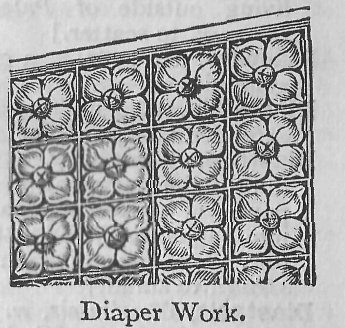
Diaper, dī′a-pėr, n. unbleached linen cloth woven in slightly defined figures, used for towels, &c.: a pattern for ornamentation, woven, not coloured, in textiles: a floral or geometric pattern in low relief in architecture, often repeated over a considerable surface.—v.t. to variegate with figures, as diaper.—n. Dī′apering. [O. Fr. diaspre, diapre—Low L. diasprus—Byzantine Gr. diaspros, dia, through, aspros, white.]
Diaphanous, dī-af′a-nus, adj. shining or appearing through, transparent, clear—also Diaphan′ic.—ns. Dī′aphane, a diaphanous figured silk fabric; Diaphanom′eter, an instrument for testing the transparency of the air; Diaphan′oscope, a darkened box for viewing transparent positive photographs; Diaphan′otype, a picture produced by colouring on the back a positive lightly printed on translucent paper, and placing this exactly over a strong duplicate print.—adv. Diaph′anously.—ns. Diaph′anousness, Diaphanē′ity. [Gr. diaphanes—dia, through, and phainein, to show, shine.]
Diaphonics, dī-a-fon′iks, n. Same as Diacoustics. [Gr. dia, through, phonē, sound.]
Diaphoretic, dī-a-fo-ret′ik, adj. promoting perspiration.—n. a sudorific or medicine that increases perspiration.—n. Diaphorē′sis, perspiration artificially induced. [Gr.,—diaphorein, to carry off—dia, through, pherein, to bear.]
Diaphragm, dī′a-fram, n. a thin partition or dividing membrane: the midriff, a structure separating the chest from the abdomen: a metal plate with a central hole, for cutting off side-rays in a camera, &c.—adjs. Diaphragmat′ic, Diaphrag′mal.—n. Diaphragmatī′tis, inflammation of the diaphragm. [Gr. diaphragma—dia, across, phragnynai, to fence.]
Diaphysis, dī-af′i-sis, n. (bot.) an abnormal elongation of the axis of a flower or of an inflorescence: (anat.) the continuity of a bone between its two ends. [Gr. dia, through, phyesthai, to grow.]
Diaplasis, dī-ap′la-sis, n. (surg.) reduction, of a dislocation, &c.—adj. Diaplas′tic. [Gr.]
Diapnoic, dī-ap-nō′ik, adj. producing slight perspiration—also Diapnot′ic—n. a mild diaphoretic.
Diapositive, dī-a-poz′i-tiv, n. a transparent photographic positive, such as a lantern slide.
Diapyetic, dī-a-pī-et′ik, adj. producing suppuration.—n. a medicine with this property.—n. Diapyē′sis, suppuration. [Gr.]
Diarchy, dī′ar-ki, n. a form of government in which two persons are jointly vested with supreme power—less correctly Dī′narchy. [Formed from Gr. di-, two, archein, to rule.]
Diarrhœa, Diarrhea, dī-a-rē′a, n. a persistent purging or looseness of the bowels.—adjs. Diarrhœ′al, Diarrhœ′ic, Diarrhœt′ic (also -rhē′al, -rhē′ic, -rhet′ic). [Gr. diarroia—dia, through, and rhein, to flow.]
Diarthrosis, dī-ar-thrō′sis, n. the general name for all forms of articulation which admit of the motion of one bone upon another, free arthrosis—including Enarthrosis, Ginglymus, and Cyclarthrosis. [Gr.]
Diary, dī′a-ri, n. a daily record: a journal.—adjs. Diā′rial, Diā′rian.—v.t. or v.i. Dī′arise.—n. Dī′arist, one who keeps a diary. [L. diarium.]
Diascordium, dī-a-skor′di-um, n. an electuary prepared with scordium or water-germander. [Gr. dia, through, and skordion.]
Diaskeuast, dī-as-kew′ast, n. a reviser: an interpolator.—n. Diaskeu′asis, reviewing. [Gr. diaskeuazein, to make ready—dia, through, skeuos, a tool.]
Diaspora, dī-as′por-a, n. dispersion, used collectively for the dispersed Jews after the Babylonian captivity, and also in the apostolic age for the Jews living outside of Palestine. [Gr. dia, through, speirein, to scatter.]
Diaspore, dī′a-spōr, n. a grayish, infusible hydrate of aluminium.
Diastaltic, dī-a-stal′tik, adj. (Greek mus.) dilated, extended: bold. [Gr., diastellein, to expand.]
Diastase, dī′as-tās, n. a peculiar ferment developed during the germination of all seeds, which has the power of converting starch into dextrine and then into sugar.—adj. Diastat′ic—adv. Diastat′ically. [Gr. diastasis, division—dia, through, histanai, stēnai, to stand.]
Diastasis, dī-as′ta-sis, n. (surg.) separation of bones without fracture. [Gr.]
Diastema, dī-a-stē′ma, n. a natural space between two consecutive teeth, or series of teeth.—adj. Diastemat′ic. [Gr.]
Diastole, dī-as′to-lē, n. dilation of the heart, auricles, and arteries—opp. to Systole, or contraction of the same: the protracting of a short syllable, as before a pause.—adj. Diastol′ic. [Gr. diastolē—dia, asunder, and stellein, to place.]
Diastyle, dī′a-stīl, adj. (archit.) marked by wide intercolumniation. [Gr.]
Diatessaron, dī-a-tes′a-rōn, n. a harmony of the four gospels, esp. the earliest, that of Tatian (prob. 110-180 A.D.): (mus.) the interval of a fourth: an electuary of four ingredients. [Gr., for dia tessarōn, through, or composed of four.]
Diathermal, dī-a-thėr′mal, adj. letting heat through, permeable by radiating heat—also Diather′manous, Diather′mous, Diather′mic.—ns. Diather′mance, -cy. [Gr. dia, through, thermos, heat.]
Diathesis, dī-ath′e-sis, n. a particular condition or habit of body, esp. one predisposing to certain diseases: a habit of mind.—adj. Diathet′ic. [Gr.,—dia, asunder, tithenai, to place.]
Diatom, dī′a-tom, n. one of an order of microscopic unicellular algæ, of the Diatomaceæ.—adj. Diatomā′ceous.—n. Diat′omite, diatomaceous earth. [Gr. diatomos—dia, through, temnein, to cut.]
Diatomic, dī-a-tom′ik, adj. consisting of two atoms. [Gr. di-, dis, two, and atom.]
Diatomous, dī-at′ō-mus, adj. having crystals with one distinct diagonal cleavage.
Diatonic, dī-a-ton′ik, adj. proceeding by the tones and intervals of the natural scale in music.—adv. Diaton′ically. [Gr.,—dia, through, tonos, tone.]
Diatribe, dī′a-trīb, n. a continued discourse or disputation: an invective harangue.—n. Dī′atrībist, a writer or utterer of such. [Gr. diatribē—dia, through, tribein, to rub, wear away.]
Dib, dib, v.i. to dip, as in angling:—pr.p. dib′bing; pa.p. dibbed. [A form of dab.]
Dib, dib, n. one of the small bones of a sheep's leg: (pl.) a children's game, played by throwing up such small bones or stones (Dib′-stones) from the palm and catching them on the back of the hand—(Scot.) Chuckie-stanes, or Chucks: (slang) money.
Dibasic, dī-bā′sik, adj. having two bases: of acids, with two atoms of hydrogen replaceable by a base or bases. [Gr. di-, two, and basic.]
Dibble, dib′l, n. a pointed tool used for making holes to put seed or plants in—also Dibb′er.—v.t. Dibb′le, to plant with a dibble.—v.i. to make holes: to dip, as in angling.—n. Dibb′ler. [Freq. of dib, a form of dab.]
Dibranchiata, dī-brang-ki-ā′ta, n. one of the two orders of cephalopoda, having two gills.—adj. Dibran′chiate. [Gr. di-, two, branchia, gills.]
Dicacity, dik-as′i-ti, n. raillery, pert speech.—adj. Dicā′cious. [L. dicax, sarcastic.]
Dicast, Dikast, dī′kast, n. one of the 6000 Athenians annually chosen to act as judges.—n. Dicas′tery, their court. [Gr. dikastēs, dikē, justice.]
Dicatalectic, dī-kat-a-lek′tik, adj. doubly catalectic, both at the middle and end of the verse. [Gr. di-, double. See Catalectic.]
Dice, pl. of Die, 2 (q.v.).—v.i. to play with dice.
Dice-coal, dīs′-kōl, n. a kind of coal which readily splits into cubical pieces.
Dicentra, dī-sen′tra, n. a genus of plants including the flower Bleeding-heart (D. spectabilis).—Also Diel′ytra. [Gr. di-, double, kentron, a point.]
Dicephalous, dī-sef′a-lus, adj. two-headed. [Gr. dikephalos—di-, double, kephalē, a head.]
Dichastasis, dī-kas′ta-sis, n. spontaneous subdivision.—adj. Dichas′tic. [Gr.]
Dichlamydeous, dī-kla-mid′ē-us, adj. having both a calyx and a corolla.
Dichogamy, dī-kog′a-mi, n. an arrangement for preventing the self-fertilisation of hermaphrodite flowers, the stamens and stigmas ripening at different times.—adj. Dichog′amous. [Gr. dicha, in two, gamos, marriage.]
Dichord, dī′kord, n. an ancient two-stringed lute.
Dichotomy, dī-kot′o-mi, n. a division into two parts.—v.t. and v.i. Dichot′omise.—adj. Dichot′omous.—adv. Dichot′omously. [Gr., from dicha, in two, and temnein, to cut.]
Dichroism, dī′krō-izm, n. the property of showing different colours when viewed in different directions exhibited by doubly refracting crystals.—adjs. Dichrō′ic, Dichrois′tic.—n. Dī′chroscope, an instrument for testing the dichroism of crystals.—adj. Dichroscop′ic.
Dichromatism, dī-krō′ma-tizm, n. (zool.) the quality of presenting, in different individuals, two different colours or systems of colouration.—adj. Dichromat′ic.
Dichromism, dī-krō′mizm, n. an inability to distinguish more than two of the primary colours.—adj. Dichrō′mic.
Dicht, diht, v.t. (Scot.) to wipe.
Dick, dik, n. (slang) fine words, for Dictionary: for Declaration, as 'to take one's dick,' and prob. 'up to dick' = excellent, also properly.
Dickens, dik′enz, n. the deuce, the devil, as in 'What the dickens.'—Play the dickens with, to play the deuce with. [For devil, confused with Dickon = Richard.]
Dicker, dik′ėr, n. (Amer.) petty trade by barter, &c.—v.i. to haggle. [Prob. the obs. dicker, the number ten, esp. of hides or skins.]
Dickey, Dicky, dik′i, n. a leathern apron for a gig, &c.: the driver's seat in a carriage: a seat for servants at the back of a carriage: a false shirt-front. [Perh. from dick, a prov. Eng. word for a leathern apron; Prob. Dut. dek, a cover.]
Dicky, dickey, dik′i, n. (East Anglian) an ass.—n. Dick′y-bird, a small bird. [From Dick, familiar of Richard—like Jack, in jackass.]
Diclinic, dī-klin′ik, adj. (crystal.) having two of the intersections of the axes oblique.—Also Dī′clinate, Dī′clinous.
Diclinous, dī′kli-nus, adj. having the stamens and pistils in separate flowers.—n. Dī′clinism. [Gr. di-, asunder, and klinē, a bed.]
Dicoccous, dī-kok′us, adj. (bot.) formed of two cocci.
Dicœlous, dī-sē′lus, adj. cupped or hollowed at both ends.
Dicotyledon, dī-kot-i-lē′don, n. a plant having two seed-lobes.—adj. Dicotylē′donous. [Gr. di-, two, and cotyledon.]
Dicrotic, dī-krot′ik, adj. double-beating—also Dī′crotous.—n. Dī′crotism. [Gr., di-, two, krotos, beat.]
Dictate, dik′tāt, v.t. to tell another what to say or write: to communicate with authority: to point out: to command—(arch. Dict).—n. an order, rule, or direction: impulse.—ns. Dictā′tion, act, art, or practice of dictating: overbearing command; Dictā′tor, one invested for a time with absolute authority—originally an extraordinary Roman magistrate:—fem. Dictā′tress, Dictātrix.—adj. Dictatō′rial, like a dictator: absolute: authoritative.—adv. Dictatō′rially.—ns. Dictā′torship, Dic′tature.—adj. Dic′tatory. [L. dictāre, -ātum—dicĕre, to say.]
Diction, dik′shun, n. a saying or speaking: manner of speaking or expressing: choice of words: style. [L., from dicĕre, dictum, to say.]
Dictionary, dik′shun-a-ri, n. a book containing the words of a language alphabetically arranged, with their meanings, etymology, &c.: a lexicon: a work containing information on any department of knowledge, alphabetically arranged. [Low L. dictionarium. See Diction.]
Dictum, dik′tum, n. something said: a saying: an authoritative saying:—pl. Dic′ta. [L.]
Dictyogen, dik′ti-o-jen, n. a plant with net-veined leaves. [Gr. diktyon, a net; -genēs, producing.]
Dicynodont, di-sin′o-dont, n. an extinct reptile, allied to tortoises on one hand and mammals on the other. [Formed from Gr. di-, two, cyōn, dog, and odous, odontos, tooth.]
Did, did, Didst, didst, pa.t. of Do.
Didache, did′a-kē, n. the Teaching of the Twelve Apostles (see under Apostle). [Gr., 'teaching.']
Didactic, -al, di-dak′tik, -al, adj. fitted or intended to teach: instructive: perceptive.—adv. Didac′tically.—n. Didac′ticism.—n.pl. Didactics, the art or science of teaching. [Gr. didaktikos—didaskein, to teach; akin to L. doc-ēre, disc-ĕre.]
Didactyl, dī-dak′til, adj. having only two digits—also Didac′tylous.—n. Didac′tyl, an animal with two toes only on each foot.
Didapper, did′ap-ėr, n. a water-bird that is constantly dipping or diving under water—also called the Dabchick. [A compound of dive and dapper (which is a variant of dipper). See Dip and Dive.]
Didascalic, did-as-kal′ik, adj. didactic.
Didder, did′ėr, v.i. (prov.) to shake.
Diddle, did′l, v.t. to cajole, swindle.—n. Didd′ler.
Didecahedral, dī-dek-a-hē′dral, adj. (crystal.), having five planes on each extremity.
Didelphia, dī-del′fi-a, n.pl. the marsupialia, or marsupial implacental mammals, one of the three sub-classes of Mammalia.—adjs. Didel′phian, Didel′phic. [Gr. di-, double, delphys, womb.]
Dido, dī′dō, n. (slang) an antic caper.—Cut up didoes, to behave in an extravagant way.
Didodecahedral, dī-do-dek-a-hē′dral, adj. of a six-sided-prism, truncated on the lateral edges, and acuminated on the extremities with six planes.
Didrachma, dī-drak′ma, n. a double drachma.
Diduction, dī-duk′shun, n. separation by withdrawing one part from the other.
Didunculus, di-dung′kū-lus, n. a remarkable genus of pigeons—the tooth-billed pigeon of Samoa.
Didymium, dī-dim′i-um, n. a supposed element discovered in 1841, so named from being, as it were, twin brother of lanthamum.
Didymous, did′i-mus, adj. twin.
Didynamia, did-i-nā′mi-a, n. a class of plants in the Linnæan system having in the flower four stamens in pairs of unequal length.—adjs. Didynā′mian, Didyn′amous. [Gr. di-, double, dynamis, strength.]
Die, dī, v.i. to lose life: to perish: to wither: to languish: to become insensible:—pr.p. dy′ing; pa.t. and pa.p. died (dīd).—adj. Die′-away′, languishing.—Die away, to disappear by degrees, become gradually inaudible; Die game, to keep up one's spirit to the last; Die hard, to struggle hard against death, to be long in dying; Die off, to die quickly or in large numbers; Die out, to become extinct, to disappear. [From a Scand. root seen in Ice. deyja, Dan. d[ö]e, Scot. dee; akin to Mid. High Ger. touwen, whence Ger. tod, todt. The A.S. word is steorfan, whence our starve.]
Die, dī, n. a small cube used in gaming by being thrown from a box: any small cubical body: hazard:—pl. Dice (dīs).—n. Dice′-box.—adj. Diced, ornamented with square or diamond-shaped figures.—ns. Dice′-play; Dice′-play′er, Dī′cer; Dī′cing-house.—The die is cast, the question is decided. [O. Fr. det, pl. dez (Prov. dat, It. dado), from Low L. dadus—L. dātus, given or cast (talus, a piece of bone used in play, being understood). Doublets, dado, date.]
Die, dī, n. a stamp for impressing coin, &c.: the cubical part of a pedestal:—pl. Dies (dīz).—ns. Die′-sink′er; Die′-sink′ing, the engraving of dies; Die′-stock, a contrivance for holding the dies used in screw-cutting; Die′-work, ornamentation of a metal surface by impressions with a die. [See above.]
Dieb, dēb, n. a jackal of northern Africa.
Diegesis, dī-e-jē′sis, n. (rhet.) in an oration, the narration of the facts. [Gr.]
Dielectric, dī-e-lek′trik, adj. non-conducting: transmitting electric effects without conducting.—n. a substance through which electric force acts. [Gr. dia, through, and electric.]
Dielytra, dī-el′i-tra, n. an erroneous name for dicentra.
Diesis, dī′e-sis, n. (mus.) the difference in tone between a major and a minor semitone: (print.) the double dagger (‡).
Dies Iræ, dī′ēz ī′rē, n. the name given (from the opening words) to a famous hymn on the last judgment (c. 1250 A.D.). [L., 'day of wrath.']
Dies non, dī′ēz non, a day on which law courts may not be held. [From L. dies non juridicus, same as dies nefastus, an unlawful day.]
Diet, dī′et, n. mode of living, with especial reference to food: food prescribed by a physician: allowance of provisions.—v.t. to furnish with food.—v.i. to eat: to take food according to rule.—n. Dietā′rian, one who observes prescribed rules for diet.—adj. Dī′etary, pertaining to diet or the rules of diet.—n. course of diet: allowance of food, esp. in large institutions.—ns. Dī′et-drink, medicated liquor; Dī′eter (Shak.), one who diets or prepares food by rule.—adjs. Dietet′ic, -al, pertaining to diet.—adv. Dietet′ically.—ns. Dietet′ics, rules for regulating diet; Dietet′ist, one who lays stress on diet; Dī′etist, an authority on diet. [Fr. diète—Low L. diæta—Gr. diaita, mode of living, diet.]
Diet, dī′et, n. an assembly of princes and delegates, the chief national council in several countries in Europe: (Scots law) the proceedings under a criminal libel: a clerical or ecclesiastical function in Scotland, a diet of worship.—n. Dī′etine, a minor or local diet.—Desert the diet, to abandon criminal proceedings under a particular libel—in Scotch usage. [O. Fr. diete—Low L. diæta—Gr. diaita; or acc. to Littré, from L. dies, a (set) day, with which usage cf. Ger. tag, a day, reichstag.]
Diffarreation, di-far-ē-ā′shun, n. the parting of a cake of spelt—a ceremony at a Roman divorce. [L.]
Differ, dif′ėr, v.i. to be unlike, distinct, or various (used by itself, or followed by with, from, to): to disagree (with from, with): to fall out, dispute (with):—pr.p. diff′ering; pa.p. diff′ered.—ns. Diff′erence, Diff′erency (Shak.), dissimilarity: the quality distinguishing one thing from another: a contention or quarrel: the point in dispute: the excess of one quantity or number over another: (her.) the modification of an achievement of arms to indicate the wearer's relation to the head of the house, as by marks of cadency.—v.t. to make a difference between things.—adj. Diff′erent, distinct: separate: unlike: not the same (with from, not to).—n. Differen′tia (logic), the characteristic quality or attribute of a species.—adj. Differen′tial, creating a difference: special: (math.) pertaining to a quantity or difference infinitely small (see Calculus).—adv. Differen′tially.—v.t. Differen′tiāte, to make different: to create a difference between: to classify as different.—v.i. to become different by specialisation: (math.) to obtain the differential or differential coefficient of.—n. Differentiā′tion, the act of distinguishing or describing a thing by giving its differentia: exact definition: a change by which organs or structures become specialised or modified: (math.) the act or process of differentiating.—adv. Diff′erently.—Differential gear, gear for communicating differential motion; Differential motion, an apparatus by which the difference of two velocities is communicated, as in the Differential screw, a combination of male and female screws; Differential thermometer, a thermometer for marking minute differences of temperature. [L. differre—dif (= dis), apart, ferre, to bear.]
Difficult, dif′i-kult, adj. not easy: hard to be done: requiring labour and pains: hard to please: not easily persuaded.—adv. Diff′icultly.—n. Diff′iculty, laboriousness: obstacle: objection: that which cannot be easily understood or believed: embarrassment of affairs: a quarrel. [The adj. was formed from difficulty, in place of the old form difficile. Fr. difficulté—L. difficultas = difficilitas—difficilis—dif (= dis), neg., and facilis, easy.]
Diffident, dif′i-dent, adj. wanting faith in: distrustful of one's self: modest: bashful.—n. Diff′idence, want of confidence: want of self-reliance: modesty: bashfulness.—adv. Diff′idently. [L., pr.p. of diffidĕre, to distrust—dif (= dis), neg., fīdĕre, to trust—fĭdes, faith.]
Diffluent, dif′loo-ent, adj. tending to flow away readily.
Difform, dif′orm, adj. not uniform, irregular in form.—n. Diffor′mity.
Diffract, dif-frakt′, v.t. to break or separate into parts, as rays of light.—n. Diffrac′tion, a name for certain phenomena connected with light passing through a narrow opening or by the edge of an opaque body: the spreading of the rays, with interference phenomena, coloured and other.—adj. Diffrac′tive.—n. Diffrangibil′ity.—adj. Diffran′gible. [L. diffringĕre, diffractum—dis, asunder, frangĕre, to break.]
Diffuse, dif-ūz′, v.t. to pour out all round: to send out in all directions: to scatter: to circulate: to publish.—v.i. to spread, as a liquid does.—pa.p. and adj. Diffused′, spread widely: loose.—adv. Diffus′edly.—ns. Diffus′edness; Diffus′er; Diffusibil′ity.—adj. Diffus′ible, that may be diffused.—ns. Diffū′sion, a spreading or scattering abroad: extension: distribution: in the case of gases or liquids in contact, mixture through each other; Diffū′sion-tube, an instrument for determining the rate of diffusion for different gases.—adj. Diffus′ive, extending: spreading widely.—adv. Diffus′ively.—n. Diffus′iveness. [L. diffundĕre, diffūsum—dif (= dis), asunder, fundĕre, to pour out.]
Diffuse, dif-ūs′, adj. diffused: widely spread: wordy: not concise.—adv. Diffuse′ly.—n. Diffuse′ness.
Dig, dig, v.t. to excavate: to turn up the earth: to cultivate with a spade: to poke or thrust, as one's elbow into another's side, or spurs into a horse.—v.i. to till the ground; to occupy one's self in digging; (U.S. slang) to study hard:—pr.p. dig′ging; pa.t. and pa.p. dug, (B.) digged.—n. a thrust, a poke: (U.S. slang) a hard student.—adj. Dig′gable, that may be dug.—n. Dig′ger, a person or animal that digs: a machine for digging, as a steam-digger.—n.pl. Dig′gings, places where mining is carried on, esp. for gold: (slang, orig. American) lodgings, rooms.—Dig in, to cover over by digging: to work hard; Dig out (U.S. slang), to decamp.—Digger Indians, degraded Indian tribes of California and Nevada, who live by digging roots. [Prob. O. Fr. diguer, to dig; of Teut. origin.]
Digamma, dī-gam′ma, n. an obsolete letter of the Greek alphabet, having the force of our W. [So called from its form (), like one capital Γ (gamma) placed over another.]

Digamy, dig′a-mi, n. a second marriage.—n. Dig′amist.—adj. Dig′amous (bot.), androgynous. [Gr. dis, twice, and gamos, marriage.]
Digastric, dī-gas′trik, adj. double-bellied, or fleshy at each end, as is one of the muscles of the lower jaw. [Gr. di-, double, gastēr, the belly.]
Digenesis, dī-jen′e-sis, n. reproduction by two methods, a sexual followed by an assexual.—adj. Digenet′ic.
Digest, di-jest′, v.t. to dissolve food in the stomach: to soften by heat and moisture: to distribute and arrange: to prepare or classify in the mind: to think over.—v.i. to be dissolved in the stomach: to be softened by heat and moisture.—adv. Digest′edly.—n. Digest′er, one who digests: a close vessel in which by heat and pressure strong extracts are made from animal and vegetable substances.—n. Digestibil′ity.—adj. Digest′ible, that may be digested.—n. Diges′tion, the dissolving of the food in the stomach: orderly arrangement: exposing to slow heat, &c.—adj. Digest′ive, pertaining to digestion: promoting digestion.—adv. Digest′ively. [L. digerĕre, digestum, to carry asunder or dissolve—di (= dis), asunder, and gerĕre, to bear.]
Digest, dī′jest, n. a body of laws collected and arranged, esp. the Justinian code of civil laws. [L. digesta, neut. pl. of digestus, pa.p. of digerĕre, to carry apart, to arrange.]
Dight, dīt, adj. disposed, adorned.—adv. finely.—Also Dight′ly. [A.S. dihtan, to arrange, prescribe, from L. dictāre, to dictate, whence Ger. dichten, to write poetry, and the Scotch verb dight, to dress, used of stones, flour, &c.]
Digit, dij′it, n. a finger's breadth or ¾ inch: from the habit of counting on the fingers, any one of the nine numbers: the twelfth part of the diameter of the sun or moon.—adj. Dig′ital, pertaining to the fingers.—n. finger: a key of a piano, &c.—ns. Digitā′lia, Dig′italine, Dig′italin, the active principles of digitalis; Digitā′lis, a genus of plants, including the foxglove; Digitā′ria, a genus of grasses with digitate spikes.—adjs. Digitate, -d, consisting of several finger-like sections.—adv. Dig′itately.—n. Digitā′tion, finger-like arrangement: a finger-like process.—adj. Digit′iform, formed like fingers; Dig′itigrade, walking on the toes.—n. an animal that walks on its toes, as the lion—opp. to Plantigrade.—ns. Dig′itigradism; Digitō′rium, a small portable instrument used for making the fingers flexible for piano-playing. [L. digitus, a finger or toe, akin to Gr. daktylos.]
Diglyph, dī′glif, n. (archit.) an ornament consisting of a double groove.
Dignify, dig′ni-fī, v.t. to invest with honour: to exalt:—pr.p. dig′nifying; pa.p. dig′nified.—n. Dignificā′tion.—adj. Dig′nified, marked with dignity: exalted: noble: grave. [Low L. dignificāre—dignus, worthy, facĕre, to make.]
Dignity, dig′ni-ti, n. the state of being dignified: elevation of mind or character: grandeur of mien: elevation in rank, place, &c.: degree of excellence: preferment: high office: a dignitary.—n. Dig′nitary, one in a dignified position or rank, esp. in the church. [Fr. dignité—L. dignitas—dignus, worthy.]
Digraph, dī′graf, n. two letters expressing but one sound, as ph in digraph. [Gr. di-, twice, graphē, a mark, a character—graphein, to write.]
Digress, di-gres′, v.i. to step aside or go from the main subject: to introduce irrelevant matter.—n. Digres′sion, a going from the main point: a part of a discourse not upon the main subject.—adjs. Digres′sional, Digress′ive, of the nature of a digression: departing from the main subject.—adv. Digress′ively. [L. digredi, digressus—di, aside, gradi, to step. See Grade.]
Digynia, dī-jin′i-a, n. an order of plants having in the flower two styles or a deeply cleft style.—adjs. Digyn′ian, Dig′ynous. [Gr. dis, twice, and gynē, a woman.]
Dihedral, dī-hē′dral, adj. having two sides, or two plane faces—also Diē′dral.—n. Dihē′dron. [Gr. di-, two, hedra, a seat.]
Dihexagonal, dī-heks-ag′ō-nal, adj. twelve-sided.
Dihexahedral, dī-heks-a-hē′dral, adj. pertaining to a six-sided prism having three planes on the extremities.—n. Dihexahē′dron.
Dijudicate, dī-jōō′di-kāt, v.t. and v.i. to judge between two: to decide.—n. Dijudicā′tion. [L. di, asunder, and judicāre, judge.]
Dike, dīk, n. a trench, or the earth dug out and thrown up: a ditch: a mound raised to prevent inundation: in Scotland, a wall (Dry-stane dike, a wall without mortar; Fail-dike, a wall of turf), sometimes even a thorn-hedge: (geol.) a wall-like mass of igneous rock in the fissures of stratified rocks.—v.t. to surround with a dike or bank. [A.S. díc; Dut. dijk, Ger. teich, a pond; perh. conn. with Gr. teichos, a wall or rampart. See Dig, Ditch.]
Dilacerate, di-las′ėr-āt, v.t. to rend or tear asunder.—n. Dilacerā′tion. [L. di, asunder, and lacerate.]
Dilapidate, di-lap′i-dāt, v.t. to pull stone from stone: to lay waste: to suffer to go to ruin.—adj. Dilap′idated, in ruins.—ns. Dilapidā′tion, the state of ruin: impairing of church property during an incumbency: (pl.) money paid at the end of an incumbency by the incumbent or his heirs for the purpose of putting the parsonage, &c. in good repair for the succeeding incumbent; Dilap′idator. [L. dilapidāre—di, asunder, lapis, lapidis, a stone.]
Dilate, di-lāt′, v.t. to spread out in all directions: to enlarge: the opposite of contract.—v.i. to widen: to swell out: to speak at length.—ns. Dilātabil′ity, Dilāt′ancy, Dilatā′tion, Dilā′tion, expansion.—adjs. Dilāt′able, that may be dilated or expanded; Dilā′tant.—ns. Dī′latātor, Dilāt′or, Dilāt′er.—adj. Dilāt′ive. [L. dilatus (used as pa.p. of differre), from di (= dis), apart, and latus, borne.]
Dilatory, dil′a-tor-i, adj. slow: given to procrastination: loitering: tending to delay.—adv. Dil′atorily.—n. Dil′atoriness. [L. dilatorius, extending or putting off (time). See Dilate.]
Dilemma, di-lem′a, n. a form of argument in which the maintainer of a certain proposition is committed to accept one of two alternative propositions each of which contradicts his original contention: a position where each of two alternative courses (or of all the feasible courses) is eminently undesirable: a trying practical difficulty. The argument was called a 'horned syllogism,' and the victim compared to a man certain to be impaled on one or other of the horns of an infuriated bull, hence the Horns of a dilemma: the usual phrase Landed in a dilemma is, or suggests, a mixed metaphor.—adj. Dilemmat′ic. [L.,—Gr. dilēmma—di-, twice, double, lēmma, an assumption—lambanein, to take.]
Dilettante, dil-et-an′te, n. one who loves the fine arts, but in a superficial way and without serious purpose (the amateur usually practises them): a dabbler in art, science, or literature:—pl. Dilettan′ti (′tē).—adj. Dilettan′tish.—ns. Dilettan′tism, Dilettan′teism. [It., pr.p. of dilettare, to take delight in—L. delectāre, to delight.]
Diligent, dil′i-jent, adj. steady and earnest in application: industrious.—n. Dil′igence, steady application: industry: (Scots law) a warrant to produce witnesses, books, &c., or a process by which persons or goods are attached: a French or continental stage-coach (also pronounced dē-lē-zhongs)—also Dill′y.—adv. Dil′igently. [Fr.,—diligens, -entis, pr.p. of L. diligĕre, to choose.]
Dill, dil, n. an umbelliferous annual, the seeds used in medicine.—n. Dill′-wa′ter, a stomachic and carminative. [A.S. dile; Ger. and Sw. dill.]
Dilling, dil′ing, n. a darling: the youngest child, the weakling of a litter.
Dilly-bag, dil′i-bag, n. an Australian native-made rush or bark-bag.—Also Dill′i, Dill′y.
Dilly-dally, dil′i-dal′i, v.i. to loiter, trifle. [A kind of reduplication of dally. Cf. Shilly-shally.]
Dilogy, dil′ō-ji, n. repetition: intentional ambiguity.—adj. Dilog′ical.
Dilucidate, di-lū′si-dāt, v.t. (obs.) to elucidate.—adj. Dilū′cid.—n. Dilucidā′tion.
Dilute, dil-ūt′, v.t. to make thinner or more liquid: to diminish the strength, flavour, &c. of, by mixing, esp. with water.—v.i. to become mixed.—adj. diminished in strength by mixing with water.—adj. Dil′uent, diluting.—n. that which dilutes.—ns. Dilute′ness; Dilū′tion. [L. diluĕre, dilūtum—di, away from, luĕre, to wash.]
Diluvium, dil-ū′vi-um, n. an inundation or flood: (geol.) a deposit of sand, gravel, &c. made by extraordinary currents of water—also Dilū′vion.—adjs. Dilū′vial, Dilū′vian, pertaining to a flood, esp. that in the time of Noah: caused by a deluge: composed of diluvium.—n. Dilū′vialist, one who explains geological phenomena by the Flood. [L. diluvium—diluĕre.]
Dim, dim, adj. not bright or distinct: obscure: mysterious: not seeing clearly.—v.t. to make dark: to obscure.—v.i. to become dim:—pr.p. dim′ming; pa.p. dimmed.—adv. Dim′ly.—adj. Dim′mish, somewhat dim.—n. Dim′ness. [A.S. dim; akin to Ice. dimmr, dark, and Ger. dämmerung, twilight.]
Dime, dīm, n. the tenth part of an American dollar, 10 cents, nearly equal to 5d.—Dime museum, a cheap show; Dime novel, a cheap novel, usually sensational. [Fr., orig. disme, from L. decima (pars, a part, being understood), a tenth part.]
Dimension, di-men′shun, n. usually in pl., measure in length, breadth, and thickness (the three dimensions of space): extent: size.—adjs. Dimen′sional, concerning dimension (one-dimensional, two-dimensional, three-dimensional space = space of one, two, three dimensions); Dimen′sioned, having dimension; Dimen′sionless.—Dimension work, masonry in stones of specified size.—Fourth dimension, an additional dimension attributed to space by a hypothetical speculation. [Fr.,—L. dimensio—dimetīri, dimensus—di(= dis), apart, metīri, to measure.]
Dimerous, dim′e-rus, adj. consisting of two parts: (bot.) with two members in each whorl: (entom.) having two-jointed tarsi.—n. Dim′erism. [Gr., di-, double, meros, a part.]
Dimeter, dim′e-tėr, adj. containing two metres or measures.—n. a verse of two measures. [L.,—Gr. dimetros—di-, twice, metron, a measure.]
Dimethylaniline, di-meth-il-an′i-lin, n. an oily liquid: aniline heated with methyl alcohol and hydrochloric acid—from which dyes are obtained. [L. di-, twice, methyl, and aniline.]
Dimetric, dī-met′rik, adj. (crystal.) tetragonal.
Dimidiate, di-mid′i-āt, adj. divided into halves: having a shape that appears as if halved.—v.t. (her.) to represent the half of.—n. Dimidiā′tion. [L. dimidiāre, -ātum, to halve—dimidius; half—dis, twice, medius, the middle.]
Diminish, di-min′ish, v.t. to make less: to take a part from: to degrade.—v.i. to grow or appear less: to subside.—adj. Dimin′ishable.—p.adj. Dimin′ished, made smaller, humbled: (mus.) lessened by a half-step, as an interval.—adv. Dimin′ishingly. [Coined by adding di to the word minish, an imitation of L. diminuĕre—di = dis, apart, minuĕre, to make less.]
Diminuendo, di-min-ū-en′dō, adv. (mus.) a direction to let the sound die away, marked thus . [It.,—L. diminuendus, fut. part. pass. of diminuĕre, diminūtum, to lessen.]

Diminution, dim-in-ū′shun, n. a lessening: degradation.—adj. Dimin′utive, of a diminished size: small: contracted.—n. (gram.) a word formed from another to express a little one of the kind.—adv. Dimin′utively.—n. Dimin′utiveness.
Dimissory, dim′is-or-i, adj. sending away or giving leave to depart to another jurisdiction. [L. dimissorius—dimittĕre, dimissum.]
Dimity, dim′i-ti, n. a kind of stout white cotton cloth, striped or figured in the loom by weaving with two threads. [Through the L., from Gr. dimitos—di-, twice, mitos, a thread.]
Dimorphism, dī-mor′fizm, n. (bot.) a state in which two forms of flower, leaf, &c. are produced by the same species of plant: the property of crystallising in two forms.—adjs. Dimor′phic, Dimor′phous. [Gr. di-, twice, morphē, form.]
Dimple, dim′pl, n. a small hollow: a small natural depression on the face.—v.i. to form dimples.—v.t. to mark with dimples.—p.adj. Dim′pled.—n. Dim′plement.—adj. Dim′ply. [Dim. of dip, with inserted m. Another dim. is dapple.]
Dimyarian, dim-i-ā′ri-an, adj. double-muscled (of bivalve shells like the clam)—also Dim′yary.—n.pl. Dimyā′ria. [Gr. di-, two, mys, a muscle.]
Din, din, n. a loud continued noise.—v.t. to assail (the ears) with noise: to annoy with clamour: to obtrude noisily (as to din one's complaints into their ears):—pr.p. din′ning; pa.p. dinned.—adj. Din′ful. [A.S. dyn, dyne; cf. Ice. dynr, Dan. dön, noise.]
Dinanderie, dē-nong′de-rē, n. domestic utensils of copper, esp. such as are quaint and artistic—applied also to Indian and Levantine brass-ware. [Fr., from Dinant in Belgium.]
Dinar, dē-när′, n. an ancient Arab gold coin of 65 grains weight. [L. denarius.]
Dinarchy. See Diarchy.
Dindle. See Dinnle.
Dine, dīn, v.i. to take dinner.—v.t. to give a dinner to.—n. (obs.) dinner-time.—ns. Din′er-out, one who goes much to dinner-parties; Dinette′, a preliminary dinner, luncheon; Din′ing-hall; Din′ing-room; Din′ing-tā′ble.—Dine out, to dine elsewhere than at home; Dine with Duke Humphrey, to go without a meal, like those who, unable to procure a dinner, loitered about Duke Humphrey's Walk in Old St Paul's. [O. Fr. disner (Fr. dîner)—Low L. disjunāre, for disjejunāre, to break one's fast—L. dis-, and jejunus, fasting (cf. Déjeuner). Others explain disnare as from decenāre—L. de, inten., and cenāre, to dine.]
Ding, ding, v.t. to throw, dash, or hurl: to beat: (arch.) to urge or enforce: (Scot.) to defeat, non-plus—also, as v.i., to be defeated: to descend, fall, as of continued heavy rain or snow falling.—Ding doun (Scot.), to knock or throw down. [M. E. dingen; cf. Ice. dengja, Sw. dänga, to bang.]
Ding, ding, v.i. to ring, keep sounding.—v.t. to reiterate to a wearisome degree.—n. Ding′-dong, the sound of bells ringing: monotony: sameness. [Imit. Cf. Ring.]
Dingle, ding′gl, n. a little hollow or narrow valley. [Prob. conn. with dimple and dip.]
Dingle-dangle, ding′gl-dang′gl, adv. hanging loose: swinging backwards and forwards. [A duplication of Dangle.]
Dingo, ding′gō, n. the native dog of Australia.
Dingy, Dingey, ding′gi, n. the smallest ship's boat: in India, a canoe. [Beng. dingī, a boat.]
Dingy, din′ji, adj. of a dim or dark colour: dull: soiled.—n. Din′giness. [Acc. to Skeat = dungy.]
Dinic, din′ik, adj. relating to vertigo or dizziness.—n. a remedy for dizziness. [Gr. dinos, whirling.]
Dink, dingk, adj. (Scot.) braw, trim.—v.t. to dress neatly.
Dinmont, din′mont, n. a Border name for a wether between the first and second shearing.
Dinner, din′ėr, n. the chief meal of the day: a feast.—ns. Dinnerette′, a little dinner; Dinn′er-hour.—adj. Dinn′erless.—ns. Dinn′er-tā′ble; Dinn′er-time; Dinn′er-wag′on, a set of light movable shelves for a dining-room. [O. Fr. disner, prop. breakfast. See Dine.]
Dinnle, din′l, v.i. (Scot.) to tingle.—n. a thrill.—Also Din′dle.
Dinoceras, dī-nos′er-as, n. an extinct genus of mammals found in Wyoming, approaching the elephant in size, and named from three pairs of osseous protuberances on the skull. [Formed from Gr. deinos, terrible, keras, horn.]
Dinornis, dī-nor′nis, n. a genus of large extinct birds, the bones of which are found in New Zealand. [Formed from Gr. deinos, terrible, and ornis, a bird.]
Dinosaur, dī′no-sawr, n. a gigantic extinct reptile, which attained a length of eighty feet. [Formed from Gr. deinos, terrible, and sauros, lizard.]
Dinotherium, dī-no-thē′ri-um, n. an extinct animal of huge size, with elephant-like tusks and trunk. [Gr. deinos, terrible, thērion, a beast.]
Dint, dint, n. a blow or stroke: the mark of a blow (often Dent): force: power (as in 'by dint of').—v.t. to make a dint in. [A.S. dynt, a blow; Scot. dunt, a blow with a dull sound, Ice. dyntr.]
Diocese, dī′ō-sēs, n. the circuit or extent of a bishop's jurisdiction.—adj. Diocesan (dī-os′es-an, or dī′ō-sē-san), pertaining to a diocese.—n. a bishop as regards his diocese: one of the clergy in the diocese. [Through Fr. and L. from Gr. dioikēsis, dioikein, to keep house—di, for dia, sig. completeness, oikein, to manage a household—oikos, a house.]
Diodon, dī′o-don, n. a genus of globe-fishes which have all their teeth consolidated on the jaws, so as to make them like the beak of a bird. [Gr. dis, twice, double, odous, odontos, a tooth.]
Diœcia, dī-ē′shi-a, n. a class of plants having the stamens on one plant and the pistils on another.—adjs. Diœ′cious, Diœ′cian.—adv. Diœ′ciously.—n. Diœ′ciousness. [Gr. di-, twice, oikos, a house.]
Diogenic, dī-o-jen′ik, adj. resembling the Cynic philosopher Diogenes (412-323 B.C.), cynical.
Dionæa, dī-ō-nē′a, n. Venus's fly-trap: an American insectivorous plant. [L., from Gr., a name of Aphrodite or Venus, from her mother Diōnē.]
Dionysia, dī-o-niz′i-a, n.pl. dramatic and orgiastic festivals in honour of Dionysus (Bacchus), god of wine.—adjs. Dionys′iac, Dionys′ian.
Diophantine, dī-o-fan′tīn, adj. pertaining to the Alexandrian mathematician Diophantus (c. 275 A.D.).—Diophantine analysis, the part of algebra which treats of finding particular rational values for general expressions under a surd form.
Diopside, dī-op′sid, n. a grayish and readily cleavable variety of pyroxene. [Gr., dia, through, opsis, a view.]
Diopsis, dī-op′sis, n. a genus of dipterous insects, of the fly family.
Dioptase, dī-op′tās, n. emerald copper ore.
Dioptrate, dī-op′trāt, adj. (entom.) divided transversely.
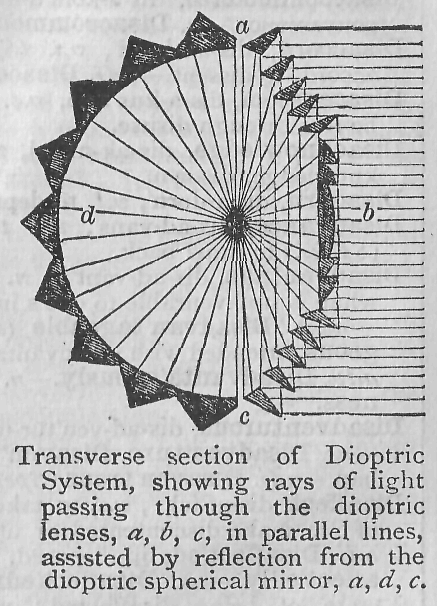
Dioptric, -al, dī-op′trik, -al, adj. pertaining to dioptrics.—ns. Diop′ter, an ancient form of theodolite: the index-arm of a graduated circle; Diop′trics, the part of optics which treats of the transmission of light from one medium to another.—Dioptric system, in lighthouses (as opposed to reflecting system), illumination from a central lamp whose rays are transmitted through a combination of lenses. [Gr. dia, through, opt-, as in opsesthai, to see, &c.]
Diorama, dī-ō-rä′ma, n. an exhibition of pictures, illuminated, and viewed through an opening in the wall of a darkened chamber.—adj. Dioram′ic. [Gr. dia, through, horama, a sight.]
Diorism, dī′ō-rizm, n. distinction, definition.—adjs. Dioris′tic, -al.—adv. Dioris′tically. [Gr. diorizein, to divide, dia, through, horos, a boundary.]
Diorite, dī′o-rīt, n. a crystalline granular igneous rock composed of feldspar and hornblende. [Gr. diorizein, to distinguish—dia, through, horos, a boundary.]
Diorthosis, dī-or-thō′sis, n. (surg.) the reduction of a dislocation, the correction of a deformity: a critical revision of a text.—adj. Diorthrot′ic. [Gr., dia, through, orthos, straight.]
Dioscorea, di-os-kōr′e-a, n. a genus of twining plants, containing the yams.—n. Dioscorā′ceæ, the order to which Dioscorea belongs.—adj. Dioscorā′ceous. [From the 1st-cent. Greek physician Dioscorides.]
Dioscuri, di-os-kū′ri, n.pl. Castor and Pollux, as sons of Jupiter. [Gr. Dios, gen. of Zeus (Jupiter), and koros (Ion. kouros), a son, a lad.]
Diosmosis, dī-oz-mō′zis, n. the transfusion of a liquid through a membrane.—Also Dios′mose. [Gr. dia, through, ōsmos, a pushing—ōthein, to thrust.]
Diota, dī-ō′ta, n. a two-handled Roman vase.
Diothelism, dī-oth′e-lizm, n. the doctrine that Christ during His life on earth possessed two wills, a human and a divine—opp. to Monothelism—also Dyoth′elism.—n. Dioth′elite, one who holds this.
Dioxide, dī-oks′īd, n. an oxide containing two equivalents of oxygen to one of a metal. [Gr. di-, twice, and oxide.]
Dip, dip, v.t. to dive or plunge into any liquid for a moment: to lower and raise again (as a flag): to baptise by immersion.—v.i. to sink: to enter slightly: to look cursorily: to incline downwards:—pr.p. dip′ping; pa.p. dipped.—n. inclination downwards: a sloping: (geol.) the angle a stratum of rock makes with a horizontal plane: a bath: a candle made by dipping a wick in tallow.—Dip of the horizon, the angle of the horizon below the level of the eye; Dip of the needle, the angle a balanced magnetic needle makes with the plane of the horizon, measured by the Dipping needle, or Compass. [A.S. dyppan, causal of dýpan, to plunge in—deóp, deep; cf. Dan. dyppe; Ger. taufen, to immerse.]
Dipchick, dip′chik, n. Same as Dabchick.
Dipetalous, dī-pet′a-lus, adj. having two petals. [Gr. di-, twice, and petal.]
Diphtheria, dif-thē′ri-a, n. a throat disease in which the air-passages become covered and impeded with a leathery membrane, and a dangerous fever is present.—adj. Diphtherit′ic. [A coinage of 1859 from Gr. diphthera, leather.]
Diphthong, dif′thong, or dip′thong, n. two vowel-sounds pronounced as one syllable.—adj. Diphthong′al, relating to a diphthong.—adv. Diphthong′ally.—n. Diphthongā′tion.—v.t. Diph′thongise. [Through Fr. from Gr. diphthongos, with two sounds—di-, twice, phthongos, sound.]
Diphycercal, dif-i-ser′kal, adj. having the tail symmetrical (of fishes).—Also Diph′ycerc. [Formed from Gr. diphyēs, of double nature, kerkos, a tail.]
Diphyllous, dī-fil′us, adj. having two leaves. [Gr. di-, twice, and phyllon, a leaf.]
Diphyodont, dif′i-ō-dont, adj. having two sets of teeth.—n. a mammal possessing such.
Diphysite, dif′i-sīt, n. one who holds the doctrine of Diph′ysitism, or the belief of the existence of two natures in Christ, a divine and a human—opp. to Monophysite; less correctly Dioph′ysite, Diophys′itism. [Gr. di-, two, physis, nature.]
Dipleidoscope, di-plī′dō-skōp, n. an instrument for ascertaining the moment of passage of the sun or a star over the meridian. [Formed from Gr. diploos, double, eidos, appearance, skopein, to view.]
Diplex, dī′pleks, adj. pertaining to the transmission of two simultaneous messages over one wire in the same direction.
Diploe, dip′lō-ē, n. (anat.) the spongy tissue between the hard inner and outer tables of the skull.
Diplogenic, dip-lō-jen′ik, adj. producing two bodies.—n. Diplogen′esis, the production in duplicate of parts normally single. [Gr. diploos, double, genesis, generation.]
Diploma, di-plō′ma, n. a writing conferring some honour or privilege, as a university degree, &c.—v.t. to furnish with a diploma. [L.,—Gr. diplōma, a letter folded double—diploos, double.]
Diplomacy, di-plō′ma-si, n. the art of negotiation, esp. of treaties between states: political skill.—n. Diplomat′ic, a minister at a foreign court: (pl.) the science of deciphering ancient writings, as charters, decrees, &c.—paleography.—adjs. Diplomat′ic, -al, pertaining to diplomacy: skilful in negotiation.—adv. Diplomat′ically.—v.i. and v.t. Diplō′matise, to practise, or effect by, diplomacy.—ns. Diplō′matist, Dip′lōmat, one skilled in diplomacy; Diplomatol′ogy, the study or science of diplomatics, charters, decrees, &c.—Diplomatic corps, or Corps diplomatique, the whole body of foreign diplomatists resident at any court.
Diplopia, dip′-lō′pi-a, n. double vision.
Diplozoon, dip-lō-zō′on, n. a remarkable flat worm or Trematode, consisting of two organisms fused together. [Gr. diploos, double, zōon, an animal.]
Dipnoi, dip′noi, n.pl. the lung fishes.—adj. Dip′noous, having both lungs and gills.
Dipody, dip′o-di, n. (pros.) a double foot.
Dipolar, dī-pō′lar, adj. having two poles.
Dipper, dip′ėr, n. a genus of birds in the Thrush family that find their food by diving into streams or lakes: a kind of Baptist or Dunker.
Diprismatic, dī-priz-mat′ik, adj. doubly prismatic.
Dipsacus, dip′sa-kus, n. the teasel. [Gr. dipsa, thirst, because the leaf-axils hold water.]
Dipsas, dip′sas, n. a snake whose bite was believed to cause intense thirst: a genus of non-venomous snakes. [Gr. dipsas—dipsa, thirst.]
Dipsector, dip′sekt-or, n. an instrument for observing the dip of the horizon. [Dip and sector.]
Dipsomania, dip-sō-mā′ni-a, n. a morbid craving for alcoholic stimulants.—ns. Dipsomā′niac, one who suffers from the foregoing; Dipsop′athy, treatment by restricting a patient's drink; Dipsō′sis, morbid thirst. [Gr. dipsa, thirst, and mania, madness.]
Diptera, dip′ter-a, n.pl. two-winged insects or flies.—ns. Dip′teran, a dipterous insect; Dip′teros, a building with double peristyle or colonnade.—adjs. Dip′terous, Dip′teral. [Gr. dipteros, two-winged, di-, twice, pteron, a wing.]
Diptych, dip′tik, n. a double-folding writing-tablet: a register of bishops, saints, &c. read aloud during the eucharist: a pair of pictures as folding-tablets. [Gr. diptychos—di-, and ptyssein, to fold.]
Dirdum, dir′dum, n. (Scot.) uproar: a scolding.
Dire, dīr, adj. dreadful: calamitous in a high degree—(poet.) Dire′ful.—adv. Dire′fully.—n. Dire′fulness. [L. dirus; cf. Gr. deinos, frightful.]
Direct, di-rekt′, adj. quite straight: straightforward: in the line of descent: outspoken: sincere: unambiguous: unsophisticated in manner.—v.t. to keep or lay quite straight: to point or aim straightly or correctly: to point out the proper course to: to guide: to order: to mark with the name and residence of a person.—v.i. to act as director.—n. Direc′tion, aim at a certain point: the line of course in which anything moves: guidance: command: the body of persons who guide or manage a matter: the written name and residence of a person.—adjs. Direc′tional; Direct′ive, having power or tendency to direct.—adv. Direct′ly, in a direct manner: without intermediary: immediately (in time and otherwise).—ns. Direct′ness; Direct′or, one who directs: a manager or governor: a counsellor: a father confessor or spiritual guide: part of a machine or instrument which guides its motion:—fem. Direct′ress, Direct′rix.—ns. Direct′orāte, Direct′orship, the office, or a body of, directors.—adjs. Directō′rial; Direct′ory, containing directions: guiding.—n. a body of directions: a guide: a book with the names and residences of the inhabitants of a place: a body of directors: the Directoire, or French Republican government of 1795-99.—n. Direct′rix, a line serving to describe a circle. [L. dirigĕre, directum—di, apart, and regĕre, to rule, to make straight.]
Dirge, dėrj, n. a funeral song or hymn. [Contracted from dirige, the first word of an antiphon sung in the office for the dead—the words from the Vulgate, Psalm v. 8. L. dirigĕre, to direct.]
Dirhem, dir′hem, n. an oriental weight and silver coin, originally two-thirds of an Attic drachma.—Also Dir′ham, Der′ham. [Ar., Pers., and Turk. modifications of the Greek drachmē, a drachma or dram.]
Dirigible, dir′i-ji-bl, adj. that can be directed.—adj. Dir′igent, directing. [See Direct.]
Diriment, dir′i-ment, adj. nullifying. [L. dirimĕre.]
Dirk, dėrk, n. a Highland dagger or poniard: a side-arm worn by midshipmen and cadets of the royal navy.—v.t. to stab with a dirk. [Scot. durk; from the Celt., as in Ir. duirc.]
Dirk, dėrk, adj. (Spens.) dark.—v.t. (Spens.) to darken. [See Dark.]
Dirl, dirl, v.i. (Scot.) to thrill, vibrate.—n. a vibration, a sensation of tingling as after a blow.
Dirt, dėrt, n. any filthy substance, such as dung, mud, &c.: loose earth.—v.t. to make dirty.—n. Dirt′-bed, a quarryman's term for several layers in the Purbeck group.—adj. Dirt′-cheap, cheap as dirt, very cheap.—n. Dirt′-eating, a practice of using some kinds of clay for food, as among the Ottomacs of South America: a morbid impulse to eat dirt, amongst negroes (Cachexia Africana) and pregnant women.—adv. Dirt′ily.—ns. Dirt′iness; Dirt′-pie, clay moulded by children's hands in the form of a pie.—adjs. Dirt′-rotten (Shak.), wholly decayed; Dirt′y, foul, filthy: unclean in thought or conversation: despicable: mean.—v.t. to soil with dirt: to sully:—pr.p. dirt′ying; pa.p. dirt′ied.—Eat dirt, submissively to acquiesce in a humiliation; Throw dirt at, to abuse scurrilously or slanderously. [M. E. drit—Scand., Ice. drit, excrement.]
Dis, dis, n. a name for Pluto, sometimes the infernal world. [L., cog. with deus, divus.]
Disable, dis-ā′bl, v.t. to deprive of power: to weaken: to disqualify.—ns. Disā′blement, Disabil′ity, want of power; want of legal qualification: disqualification.
Disabuse, dis-ab-ūz′, v.t. to undeceive: to set right.
Disaccommodate, dis-a-kom′ō-dāt, v.t. to put to inconvenience.—n. Disaccommodā′tion.
Disaccord, dis-ak-kord′, v.i. (Spens.) to refuse to accord, to dissent.—adj. Disaccord′ant.
Disaccustom, dis-a-kus′tom, v.t. to make a habit to be lost through disuse.
Disacknowledge, dis-ak-nol′ej, v.t. to refuse to acknowledge, disown.
Disadorn, dis-a-dorn′, v.t. to deprive of ornaments.
Disadvance, dis-ad-vans′, v.t. to cause to retreat: (Spens.) to draw back.
Disadvantage, dis-ad-vant′āj, n. want of advantage: what is unfavourable to one's interest: loss: injury.—adjs. Disadvan′tageable (obs.); Disadvantā′geous, attended with disadvantage: unfavourable.—adv. Disadvantā′geously.—n. Disadvantā′geousness.
Disadventurous, dis-ad-ven′tūr-us, adj. unfortunate.—ns. Disadven′ture, Disaven′ture (Spens.), a mishap.—adj. Disaven′trous (Spens.), unfortunate.
Disaffect, dis-af-fekt′, v.t. to take away the affection of: to make discontented or unfriendly.—pa.p. and adj. Disaffect′ed, ill-disposed, disloyal.—adv. Disaffect′edly.—ns. Disaffect′edness, Disaffec′tion, state of being disaffected: want of affection or friendliness: disloyalty: hostility: ill-will.—adj. Disaffec′tionate.
Disaffirm, dis-af-fėrm′, v.t. to deny (what has been affirmed): to contradict.—ns. Disaffirm′ance, Disaffirma′tion.
Disafforest, dis-af-for′est, v.t. to deprive of the privilege of forest laws: to bring into the condition of common land.—ns. Disafforestā′tion, Disaffor′estment (see Disforest). [L. dis, neg., and Low L. afforestāre, to make into a forest. See Forest.]
Disaggregate, dis-ag′greg-āt, v.t. to separate into component parts.—n. Disaggregā′tion.
Disagree, dis-a-grē′, v.i. to differ or be at variance: to dissent: to quarrel: to prove unsuitable or a source of annoyance, as of food disagreeing with the stomach.—adj. Disagree′able, not agreeable: unpleasant: offensive.—ns. Disagree′ableness, Disagreeabil′ity.—n.pl. Disagree′ables, annoyances.—adv. Disagree′ably.—n. Disagree′ment, want of agreement: difference: unsuitableness: dispute.
Disallow, dis-al-low′, v.t. not to allow: to refuse permission to: to deny the authority of: to reject.—adj. Disallow′able.—n. Disallow′ance.
Disally, dis-al-lī′, v.t. to break the alliance of: (Milt.) to separate, sunder.
Disanchor, dis-angk′ur, v.t. to free from the anchor.—v.i. to weigh anchor.
Disanimate, dis-an′i-māt, v.t. to deprive of spirit or animation: (Shak.) to deject.
Disannex, dis-a-neks′, v.t. to disjoin.
Disannul, dis-an-nul′, v.t. to annul completely.—ns. Disannul′ler; Disannul′ment, Disannul′ling.
Disanoint, dis-a-noint′, v.t. to undo the anointing or consecration of.
Disapparal, dis-ap-par′el, v.t. to disrobe.
Disappear, dis-ap-pēr′, v.i. to vanish from sight.—n. Disappear′ance, a ceasing to appear: removal from sight, flight, secret withdrawal.
Disappoint, dis-ap-point′, v.t. to frustrate of what is appointed: to deprive one of what he expected.—p.adjs. Disappoint′ed, balked: frustrated: (Shak.) unprepared or ill-prepared; Disappoint′ing, causing disappointment.—n. Disappoint′ment, the defeat of one's hopes: frustration: the vexation accompanying failure. [O. Fr. desapointer—des = L. dis, away, and apointer, to appoint. See Appoint.]
Disapprobation, dis-ap-prob-ā′shun, n. censure: dislike.—adjs. Disap′probātive, Disap′probātry.
Disappropriate, dis-ap-prō′pri-āt, v.t. to take away from that to which anything has been appropriated.—adj. deprived of appropriation.
Disapprove, dis-a-prōōv′, v.t. to give an unfavourable opinion of, to regard as bad or blameworthy (usually followed with of): to reject.—n. Disapprov′al.—adv. Disapprov′ingly.
Disarm, diz-ärm′, v.t. to deprive of arms: to render defenceless: to quell: to deprive of the power to hurt: to reduce to a peace footing.—v.i. to disband troops, reduce national armaments to a peace footing.—n. Disarm′ament. [O. Fr. desarmer, des—L. dis-, neg., armer, to arm.]
Disarrange, dis-ar-rānj′, v.t. to undo the arrangement of: to disorder: to derange.—n. Disarrange′ment.
Disarray, dis-ar-rā′, v.t. to break the array of: to throw into disorder: to strip of array or dress.—n. want of array or order: undress. [O. Fr. desarroi, des—L. dis, away, arroi. See Array.]
Disarticulate, dis-ar-tik′ūl-āt, v.t. to separate the joints of.—n. Disarticulā′tion.
Disassociate, dis-as-sō′shi-āt, v.t. to disconnect things associated: to dissociate.—n. Disassociā′tion.
Disaster, diz-as′tėr, n. an adverse or unfortunate event: a great and sudden misfortune: calamity.—adj. Disas′trous, calamitous, ruinous: gloomy, foreboding disaster.—adv. Disas′trously. [O. Fr. desastre, des—L. dis, with evil sense, astre—L. astrum, a star, destiny.]
Disattach, dis-a-tach′, v.t. to undo what is attached.—n. Disattach′ment.
Disattire, dis-at-tīr′, v.t. to divest of attire or dress: (Spens.) to undress.
Disattune, dis-at-tūn′, v.t. to put out of harmony.
Disauthorise, dis-aw′thor-īz, v.t. to deprive of authority.
Disaventure (Spens.) = disadventure.
Disavouch, dis-a-vowch′, v.t. to disavow.
Disavow, dis-a-vow′, v.t. to disclaim knowledge of, sanction of, or connection with: to disown: to deny.—n. Disavow′al. [O. Fr. desavouer, des—L. dis, away, avouer, to avow.]
Disband, dis-band′, v.t. to break up a band: to disperse, esp. of troops.—v.i. to break up.—n. Disband′ment. [O. Fr. desbander, des—L. dis, neg., bander.]
Disbar, dis-bär′, v.t. to expel a barrister from the bar.
Disbark, dis-bärk′, v.t. to land from a ship: to disembark. [O. Fr. desbarquer, des—L. dis, neg., barque, bark.]
Disbark, dis-bärk′, v.t. to strip of bark, to bark.
Disbelieve, dis-be-lēv′, v.t. to refuse belief or credit to: to deny the truth of, esp. of religious dogmas.—ns. Disbelief′; Disbeliev′er.
Disbench, dis-bensh′, v.t. (Shak.) to drive from a bench or seat: to deprive of the privilege of a bencher (e.g. in the Inns of Court).
Disbend, dis-bend′, v.t. to unbend.
Disbloom, dis-blōōm′, v.t. to deprive of bloom or blossoms.
Disbodied, dis-bod′id, adj. disembodied.
Disbosom, dis-booz′um, v.t. to make known, reveal.
Disbowel, dis-bow′el, v.t. (fig.) to disembowel:—pr.p. disbow′elling; pa.p. disbow′elled.
Disbranch, dis-bransh′, v.t. to break off, as a branch from a tree: to sever.
Disbud, dis-bud′, v.t. to deprive of buds or shoots.
Disburden, dis-bur′dn, Disburthen, dis-bur′thn, v.t. to unburden or rid of a burden: to free.
Disburse, dis-burs′, v.t. to pay out.—n. Disburse′ment, a paying out: that which is paid out. [O. Fr. desbourser, des—L. dis, apart, and bourse, a purse.]
Disc, Disk, disk, n. the face of a round plate, any flat, round object: the face of a celestial body: (bot.) the flat surface of an organ, as a leaf, any flat, round growth.—adjs. Disc′al; Discif′erous; Disciflō′ral; Dis′ciform. [L. discus—Gr. diskos, a round plate, a quoit—dikein, to cast. See Desk, Dish.]
Discage, dis-kāj′, v.t. to take out of a cage.
Discalced, dis-kalsd′, adj. without shoes, barefooted, a term for a branch of the Carmelite order. [L. discalceātus—dis, neg., and calceāre, -ātum, to shoe, calceus, a shoe—calx, the heel.]
Discandy, dis-kan′di, v.i. (Shak.) to dissolve or melt from a state of being candied.
Discant, dis′kant. Same as Descant.
Discapacitate, dis-ka-pas′i-tāt, v.t. to incapacitate.
Discard, dis-kärd, v.t. and v.i. to throw away, as not needed or not allowed by the game, said of cards: in whist, to throw down a (useless) card of another suit when one cannot follow suit and cannot or will not trump: to cast off: to discharge: to reject.—n. the act of discarding: the card or cards thrown out of the hand.—n. Discard′ment.
Discase, dis-kās′, v.t. (Shak.) to remove a case or covering from, to undress.
Discept, dis-ept′, v.i. (Browning) to dispute, debate.—n. Disceptā′tion.—adj. Disceptā′tious.—n. Disceptā′tor.—adj. Disceptatō′rial. [L. disceptare, -ātum, to contend.]
Discern, diz-ėrn′, v.t. to distinguish clearly by the eye or understanding: to judge (sometimes with between).—n. Discern′er.—adj. Discern′ible.—adv. Discern′ibly.—p.adj. Discern′ing, discriminating, acute.—n. Discern′ment, power or faculty of discriminating: judgment: acuteness. [L. discern˘ere—dis, thoroughly, and cernĕre, to sift, perceive.]
Discerp, di-serp′, v.t. to separate.—n. Discerpibil′ity, capability of being disunited.—adjs. Discerp′ible, Discerp′tible.—n. Discerp′tion.—adj. Discerp′tive. [L. discerpĕre, to tear in pieces.]
Discharge, dis-chärj′, v.t. to free from a load or charge: to unload or remove the cargo: to set free: to acquit: to dismiss: to fire, as a gun: to let out or emit: to perform, as duties: to pay, as an account.—n. act of discharging: unloading: acquittance: dismissal: a flowing out: payment: performance: that which is discharged.—n. Discharg′er. [O. Fr. descharger—des, apart, and charger, to load.]
Discharity, dis-char′i-ti, n. want of charity.
Discharm, dis-chärm, v.t. to remove the charm, or power of a charm, from.
Dischurch, dis-church′, v.t. to deprive of church rank or privileges.
Discide, dis-sīd′, v.t. (Spens.) to cut asunder, to divide. [L. dis, asunder, and cœdĕre, to cut.]
Discinct, dis-singkt′, adj. ungirded. [L. discingĕre, -cinctum, to ungird.]
Disciple, dis-ī′pl, n. one who professes to receive instruction from another: one who follows or believes in the doctrine of another: a follower, esp. one of the twelve disciples of Christ.—v.t. (Spens.) to teach.—n. Discī′pleship.—Disciples of Christ, a denomination of American Baptists, also known as Campbellites. [Fr.,—L. discipulus, from discĕre, to learn; akin to docēre, to teach.]
Discipline, dis′i-plin, n. instruction: training, or mode of life in accordance with rules: subjection to control: order: severe training: mortification: punishment: an instrument of penance or punishment.—v.t. to subject to discipline: to train: to educate: to bring under control: to chastise.—adjs. Dis′ciplinable; Dis′ciplinal.—ns. Dis′ciplinant, one who subjects himself to a certain discipline, esp. one of an order of Spanish flagellants; Disciplinā′rian, one who enforces strict discipline; Disciplinā′rium, a scourge for penitential flogging.—adj. Dis′ciplinary, of the nature of discipline—n. Dis′cipliner, one who disciplines.—First, and Second, Book of Discipline, two documents (1560 and 1578) embodying the constitution and order of procedure of the Church of Scotland from the period of the Reformation. [L. disciplina, from discipulus.]
Discission, di-sish′un, n. an incision into a tumour or cataract. [See Discide.]
Disclaim, dis-klām′, v.t. to renounce all claim to: to refuse to acknowledge or be responsible for: to reject.—v.i. to give up all claim (with in).—ns. Disclaim′er, a denial, disavowal, or renunciation; Disclamā′tion, a disavowal. [O. Fr. disclaimer—L. dis, apart, clamāre, to cry out.]
Disclose, dis-klōz′, v.t. to unclose: to open: to lay open: to bring to light: to reveal.—n. Disclō′sure, act of disclosing: a bringing to light or revealing: that which is disclosed or revealed. [O. Fr. desclos—L. discludēre—dis, apart, claudĕre, to shut, close.]
Discobolus, dis-kob′o-lus, n. 'the disc-thrower,' the name of several famous statues of athletes. [L.,—Gr. diskos, a quoit, ballein, to throw.]
Discoid, -al, dis′koid, -al, adj. having the form of a disc. [Gr. diskos, and eidos, form.]
Discolour, dis-kul′ur, v.t. to take away colour from: to change or to spoil the natural colour of: to alter the appearance of: to mark with other colours, to stain: to dirty, disfigure.—n. Discolorā′tion, act of discolouring: state of being discoloured: stain.—p.adj. Discol′oured, stained, &c.: (Spens.) many-coloured. [O. Fr. descolorer—L. dis, apart, and colorāre—color; colour.]
Discomfit, dis-kum′fit, v.t. to disconcert, to balk: to defeat or rout;—pr.p. discom′fiting; pa.p. discom′fited.—n. (Milt.) defeat.—n. Discom′fiture. [O. Fr. desconfit, pa.p. of desconfire—L. dis, neg., conficĕre, to prepare—con, inten., facĕre, to make.]
Discomfort, dis-kum′furt, n. want of comfort: uneasiness: pain.—v.t. to deprive of comfort: to make uneasy: to pain: to grieve.—adj. Discom′fortable, causing discomfort: uncomfortable. [O. Fr. desconforter—des, apart, conforter, to comfort.]
Discommend, dis-kom-end′, v.t. to blame.—adj. Discommend′able.—ns. Discommend′ableness, Discommendā′tion.
Discommission, dis-kom-ish′un, v.t. (Milt.) to deprive of a commission.
Discommode, dis-kom-ōd′, v.t. to incommode.—adj. Discommō′dious.—adv. Discommō′diously.—n. Discommod′ity, inconvenience.
Discommon, dis-kom′un, v.t. to deprive of the right of common, or, at Oxford and Cambridge, of dealing with undergraduates.
Discommunity, dis-kom-ūn′i-ti, n. want of community.
Discompose, dis-kom-pōz′, v.t. to deprive of composure: to disarrange, to disorder: to disturb: to agitate.—n. Discompō′sure.
Disconcert, dis-kon-sėrt′, v.t. to deprive of harmony or agreement: to disturb: to frustrate: to defeat: to put out of countenance.—n. Discon′cert, disunion; Disconcer′tion, confusion; Disconcert′ment. [O. Fr. disconcerter—des = L. dis, apart, and concerter, to concert.]
Disconformable, dis-kon-form′a-bl, adj. not conformable.—n. Disconform′ity, want of conformity: inconsistency.
Discongruity, dis-kon-grōō′i-ti, n. incongruity.
Disconnect, dis-kon-ekt′, v.t. to separate or disjoin (with from).—p.adj. Disconnect′ed, separated: loosely united, as of a discourse.—adv. Disconnect′edly.—n. Disconnec′tion.
Disconsent, dis-kon-sent′, v.i. to differ, dissent.
Disconsolate, dis-kon′sō-lāt, adj. without consolation or comfort: hopeless: sad.—adv. Discon′solately.—ns. Discon′solateness, Disconsolā′tion. [L. dis, neg., and consolāri, consolātus, to console.]
Discontent, dis-kon-tent′, adj. not content: dissatisfied: ill-humoured: peevish.—n. want of content: dissatisfaction: ill-humour.—v.t. to deprive of content: to stir up to ill-will.—adj. Discontent′ed, dissatisfied.—adv. Discontent′edly.—n. Discontent′edness.—adj. Discontent′ful.—p.adj. Discontent′ing, not contenting or satisfying: (Shak.) discontented.—n. Discontent′ment, the opposite of contentment: ill-humour.
Discontinue, dis-kon-tin′ū, v.t. to cease to continue: to put an end to: to leave off: to stop.—v.i. to cease: to be separated from.—ns. Discontin′uance, Discontinuā′tion, a breaking off or ceasing; Discontinū′ity.—adj. Discontin′uous, not continuous: broken off: separated: interrupted by intervening spaces.—adv. Discontin′uously. [O. Fr. discontinuer—L. dis, neg., and continuāre, to continue.]
Discophora, dis-kof′ō-ra, n.pl. the discoidal hydrozoans—jelly-fishes, &c.—n. Discoph′oran, one of the foregoing.—adj. Discoph′orous, having a gelatinous bell or disc. [Gr.]
Discord, dis′kord, n. opposite of concord: disagreement, strife: difference or contrariety of qualities: a combination of inharmonious sounds: uproarious noise.—v.i. Discord′, to disagree.—ns. Discord′ance, Discord′ancy.—adj. Discord′ant, without concord or agreement: inconsistent: contradictory: harsh: jarring.—adv. Discord′antly.—adj. Discord′ful (Spens.).—Apple of discord (see Apple). [O. Fr. descord—L. discordia—dis, neg., and cor, cordis, the heart.]
Discorporate, dis-kor′pō-rāt, adj. disembodied.
Discounsel, dis-kown′sel, v.t. (Spens.) to dissuade. [O. Fr. desconseillier—des, apart, and conseillier, to counsel.]
Discount, dis′kownt, n. a sum taken from the reckoning: a sum returned to the payer of an account: a deduction made for interest in advancing money on a bill.—v.t. Discount′, to allow discount: to advance money on, deducting discount: to put a reduced value on, as in an extravagant statement or fabulous story.—v.i. to practise discounting.—adj. Discount′able.—ns. Dis′count-brok′er, one who cashes notes or bills of exchange at a discount; Discount′er.—At a discount, below par: not sought after: superfluous: depreciated in value. [O. Fr. descompter, des—L. dis, away, compter, to count.]
Discountenance, dis-kown′ten-ans, v.t. (obs.) to put out of countenance: to abash: to refuse countenance or support to: to discourage.—n. cold treatment: disapprobation. [O. Fr. descontenancer, des-, neg., contenance, countenance.]
Discourage, dis-kur′āj, v.t. to take away the courage of: to dishearten: to seek to check by showing disfavour to.—n. Discour′agement, act of discouraging: that which discourages: dejection.—p.adj. Discour′aging, disheartening, depressing.—adv. Discour′agingly. [O. Fr. descourager. See Courage.]
Discourse, dis-kōrs′, n. speech or language generally: conversation: the reasoning faculty: a treatise: a sermon.—v.i. to talk or converse: to reason: to treat formally.—v.t. to utter or give forth.—n. Discours′er (Shak.).—adj. Discours′ive. [Fr. discours—L. discursus—dis, away, currĕre, to run.]
Discourteous, dis-kurt′yus, adj. wanting in good manners; uncivil: rude.—adv. Discourt′eously.—ns. Discourt′eousness, Discourt′esy. [O. Fr. descourtois, des—L. dis, neg., cortois, courteous.]
Discous, disk′us, adj. disc-like: broad: flat.
Discover, dis-kuv′ėr, v.t. to uncover: to lay open or expose: to exhibit: to make known: to find out: to espy.—adj. Discoverable.—ns. Discov′erer; Discov′ery, the act of finding out: the thing discovered. [O. Fr. descouvrir, des—L. dis, away, couvrir, to cover.]
Discovert, dis-kuv′ert, adj. (law) not under the bonds of matrimony, either of a spinster or widow.—n. Discov′erture. [Lit. uncovered, unprotected; O. Fr. descovert. See Discover.]
Discredit, dis-kred′it, n. want of credit: bad credit: ill-repute: disgrace.—v.t. to refuse credit to, or belief in: to deprive of credibility: to deprive of credit: to disgrace.—adj. Discred′itable, not creditable: disgraceful.—adv. Discred′itably.
Discreet, dis-krēt′, adj. having discernment: wary: circumspect: prudent.—adv. Discreetly.—n. Discreet′ness. [O. Fr. discret—L. discrētus—discernĕre, to separate, to perceive.]
Discrepancy, dis-krep′an-si, or dis′krep-an-si, n. disagreement, variance of facts or sentiments—(obs.) Discrep′ance.—adj. Discrep′ant, contrary, disagreeing. [Through Fr. from L. discrepan(t)s, different—dis, asunder, and crepans, pr.p. of crepāre, to sound.]
Discrete, dis-krēt′, adj. separate: consisting of distinct parts: referring to distinct objects—opposite of concrete.—adv. Discrete′ly.—n. Discrete′ness.—adj. Discret′ive, separating: disjunctive.—adv. Discret′ively. [A doublet of discreet.]
Discretion, dis-kresh′un, n. quality of being discreet: prudence: liberty to act at pleasure.—adjs. Discre′tional, Discre′tionary, left to discretion: unrestricted,—advs. Discre′tionally, Discre′tionarily.—Age, Years, of discretion, mature years; At discretion, according to one's own judgment; Be at one's discretion, to be completely under another person's power or control; Surrender at discretion, to surrender unconditionally, that is, to another's discretion. [Through Fr. from L. discretion-em, discernĕre, -crētum.]
Discriminate, dis-krim′i-nāt, v.t. to note the difference: to distinguish: to select from others.—v.i. to make a difference or distinction: to distinguish.—adv. Discrim′inately.—p.adj. Discrim′inating, noting distinctions: gifted with judgment and penetration.—adv. Discrim′inatingly.—n. Discriminā′tion, act or quality of distinguishing: acuteness: discernment, judgment.—adj. Discrim′inative, that marks a difference: characteristic: observing distinctions.—adv. Discrim′inatively.—n. Discrim′inātor. [L. discrimināre, -ātum—discrimen, discriminis, that which separates, discernĕre, discern.]
Discrown, dis-krown′, v.t. to deprive of a crown.
Disculpate, dis-kul′pāt, v.t. to free from blame.
Discumber, dis-kum′bėr, v.t. to disencumber.
Discure, dis-kūr′, v.t. (Spens.) to discover.
Discursive, dis-kur′siv, adj. running from one thing to another: roving, desultory: proceeding regularly from premises to conclusion: intellectual, rational.—ns. Discur′sion, desultory talk: act of reasoning; Discur′sist, a disputer.—adv. Discur′sively.—n. Discur′siveness.—adj. Discur′sory, discursive.—n. Discur′sus, argument. [See Discourse.]
Discus, dis′kus, n. a quoit, disc. [L.,—Gr. diskos.]
Discuss, dis-kus′, v.t. to examine in detail, or by disputation: to debate: to sift: (coll.) to consume, as a bottle of wine.—adj. Discuss′able.—n. Discus′sion, debate: (surg.) dispersion of a tumour.—adjs. Discuss′ive, Discū′tient, able or tending to discuss or disperse tumours.—n. Discū′tient, a medicine with this property. [L. discutĕre, discussum—dis, asunder, quatĕre, to shake.]
Disdain, dis-dān′, v.t. to think unworthy: to reject as unsuitable: to scorn.—n. a feeling of scorn or aversion: haughtiness.—adjs. Disdained′ (Shak.), disdainful; Disdain′ful.—adv. Disdain′fully.—n. Disdain′fulness. [O. Fr. desdaigner—L. dedignāri, de, dis, neg., and dignus, worthy.]
Disease, diz-ēz′, n. a disorder or want of health in mind or body: ailment: cause of pain.—v.t. (Spens.) to make uneasy.—p.adj. Diseased′, affected with disease.—n. Diseas′edness.—adj. Disease′ful. [O. Fr. desaise, des—L. dis, neg., aise, ease.]
Disedge, dis-ej′, v.t. (Shak.) to deprive of the edge: to blunt; to dull.
Disedify, dis-ed′i-fī, v.t. to do the reverse of edifying: to scandalise.—n. Disedificā′tion.
Disembark, dis-em-bärk′, v.t. to land persons, troops, &c.: to take out of a ship.—v.i. to quit a ship: to land.—ns. Disembarkā′tion, Disembark′ment. [O. Fr. desembarquer, des-—L. dis, neg., embarquer. See Embark.]
Disembarrass, dis-em-bär′as, v.t. to free from embarrassment or perplexity.—n. Disembarr′assment. [O. Fr. disembarrasser, des—L. dis, neg., embarrasser. See Embarrass.]
Disembellish, dis-em-bel′ish, v.t. to deprive of embellishment.
Disembitter, dis-em-bit′ėr, v.t. to free from bitterness.
Disembody, dis-em-bod′i, v.t. to take away from or out of the body (esp. of disembodied spirits): to discharge from military service or array.—n. Disembod′iment.
Disembogue, dis-em-bōg′, v.t. and v.i. to discharge at the mouth, as a stream.—n. Disembogue′ment. [Sp. desembocar, des—L. dis, asunder, embocar, to enter the mouth, em-—L. im, in, into, boca—L. bucca, a cheek, the mouth.]
Disembosom, dis-em-bōōz′um, v.t. to separate from the bosom: to disburden one's self of a secret.
Disembowel, dis-em-bow′el, v.t. to take out the bowels of: to tear out the inside of a thing.—n. Disembow′elment.
Disembrangle, dis-em-brang′gl, v.t. to free from dispute.
Disembroil, dis-em-broil′, v.t. to free from broil or confusion.
Disemburden, dis-em-bur′dn, v.t. to disburden.
Disemploy, dis-em-ploi′, v.t. to relieve of employment.—adj. Disemployed′.
Disenable, dis-en-ā′bl, v.t. to make unable: to disable: (obs.) to deprive of power.
Disenchain, dis-en-chān′, v.t. to free from restraint.
Disenchant, dis-en-chant′, v.t. to free from enchantment, to disillusionise.—ns. Disenchant′er:—fem. Disenchant′ress; Disenchant′ment. [O. Fr. desenchanter, des—L. dis, neg., enchanter, to enchant.]
Disenclose, dis-en-klōz′, v.t. to free from the condition of being enclosed: to dispark.—Also Disinclose.
Disencumber, dis-en-kum′bėr, v.t. to free from encumbrance: to disburden.—n. Disencum′brance.
Disendow, dis-en-dow′, v.t. to take away the endowments (esp. of an established church).—adj. Disendowed′.—n. Disendow′ment.
Disenfranchise, dis-en-fran′chiz, v.t. (rare) to disfranchise: to deprive of suffrage.—n. Disenfran′chisement.
Disengage, dis-en-gāj′, v.t. to separate or free from being engaged: to separate: to set free: to release.—ns. Disengag′edness; Disengage′ment. [O. Fr. desengager, des-—L. dis, neg., engager, to engage.]
Disennoble, dis-en-nō′bl, v.t. to deprive of title, or of what ennobles: to degrade.
Disenrol, dis-en-rōl′, v.t. to remove from a roll.
Disenshroud, dis-en-shrowd′, v.t. to divest of a shroud, to unveil.
Disenslave, dis-en-slāv′, v.t. to free from bondage.
Disentail, dis-en-tāl′, v.t. to break the entail of (an estate): to divest.—n. the act of disentailing.
Disentangle, dis-en-tang′gl, v.t. to free from entanglement or disorder: to unravel: to disengage or set free.—n. Disentang′lement.
Disenthral, Disenthrall, dis-en-thrawl′, v.t. to free from enthralment.—n. Disenthral′ment.
Disenthrone, dis-en-thrōn′, v.t. (Milt.) to dethrone.
Disentitle, dis-en-tī′tl, v.t. to deprive of title.
Disentomb, dis-en-tōōm′, v.t. to take out from a tomb.
Disentrail, dis-en′trāl, v.t. (Spens.) to disembowel.
Disentrance, dis-en-trans′, v.t. to awaken from a trance or deep sleep: to arouse from a reverie.—n. Disentrance′ment.
Disentwine, dis-en-twīn′, v.t. to untwine.
Disenvelop, dis-en-vel′op, v.t. to free from that in which a thing is enveloped, to unfold.
Disenviron, dis-en-vī′ron, v.t. to deprive of its environment.
Disespouse, dis-es-powz′, v.t. (Milt.) to separate after espousal or betrothment.
Disestablish, dis-es-tab′lish, v.t. to take away what has been established or settled, esp. of the standing of church as established by law.—n. Disestab′lishment.
Disesteem, dis-es-tēm′, n. want of esteem: disregard.—v.t. to disapprove: to dislike.—n. Disestimā′tion.
Disfame, dis-fām′, n. evil reputation.
Disfavour, dis-fā′vur, n. want of favour: displeasure: dislike.—v.t. to withhold favour from: to disapprove: to oppose.—n. Disfā′vourer.
Disfeature, dis-fē′tūr, v.t. to deprive of a feature: to deface.
Disfellowship, dis-fel′ō-ship, n. want of, or exclusion from, fellowship.—v.t. to excommunicate.
Disfigure, dis-fig′ūr, v.t. to spoil the figure of: to change to a worse form: to spoil the beauty of: to deform.—ns. Disfig′urement, Disfigurā′tion. [O. Fr. desfigurer—L. dis, neg., figurāre, to figure.]
Disflesh, dis-flesh′, v.t. to deprive of flesh, to disembody.
Disforest, dis-for′est, v.t. to strip of trees: to disafforest.
Disform, dis-form′, v.t. to alter the form of.
Disfranchise, dis-fran′chiz, v.t. to deprive of a franchise, or of rights and privileges, esp. that of voting for a M.P.—n. Disfran′chisement.
Disfrock, dis-frok′, v.t. to unfrock, deprive of clerical garb.
Disfurnish, dis-fur′nish, v.t. (Shak.) to strip, render destitute.—n. Disfur′nishment.
Disgarnish, dis-gar′nish, v.t. to despoil.
Disgarrison, dis-gar′i-sn, v.t. to deprive of a garrison.
Disgavel, dis-gav′el, v.t. to relieve from the tenure of gavelkind.
Disglorify, dis-glō′ri-fī, v.t. (Milt.) to deprive of glory.
Disgodded, dis-god′ed, adj. deprived of divinity.
Disgorge, dis-gorj′, v.t. to discharge from the throat: to vomit: to throw out with violence: to give up what has been seized.—n. Disgorge′ment. [O. Fr. desgorger, des, away, gorge, throat. See Gorge.]
Disgospel, dis-gos′pel, v.i. to act in a manner not becoming the gospel.
Disgown, dis-gown′, v.t. or v.i. to deprive of his gown: to divest one's self of a clerical gown, to renounce orders.
Disgrace, dis-grās′, n. state of being out of grace or favour, or of being dishonoured: cause of shame: dishonour.—v.t. to put out of favour: to bring disgrace or shame upon.—adj. Disgrace′ful, bringing disgrace: causing shame: dishonourable.—adv. Disgrace′fully.—ns. Disgrace′fulness; Disgrā′cer.—adj. Disgrā′cious (Shak.), ungracious, unpleasing. [O. Fr.,—L. dis, neg., and gratia, favour, grace.]
Disgrade, dis-grād′, v.t. to deprive of any rank or status.—n. Disgradā′tion.
Disgregation, dis-grē-gā′shun, n. separation, esp. of molecules.
Disgruntle, dis-grun′tl, v.t. (prov.) to disappoint, disgust.—adj. Disgrun′tled, rendered sulky. [Dis- and gruntle, to grunt, to be sulky.]
Disguise, dis-gīz′, v.t. to change the guise or appearance of: to conceal by a dress intended to deceive, or by a counterfeit manner and appearance: to intoxicate (usually 'disguised in liquor')—n. a dress intended to conceal the wearer: a false appearance: change of behaviour in intoxication.—adv. Disguis′edly.—ns. Disguis′edness; Disguise′ment; Disguis′er; Disguis′ing. [O. Fr. desguiser—des, neg., guise, manner, guise.]
Disgust, dis-gust′, n. loathing: strong dislike.—v.t. to excite disgust in: to offend the taste of: to displease.—adv. Disgust′edly.—adjs. Disgust′ing, Disgust′ful.—adv. Disgust′ingly.—ns. Disgust′ingness, Disgust′fulness. [O. Fr. desgouster—des (= L. dis), and gouster—L. gustāre, to taste.]
Dish, dish, n. a plate: a vessel in which food is served: the food in a dish: a particular kind of food: the condition of having a dish shape, concavity of form.—v.t. to put in a dish, for table: (coll.) to outwit, to defeat.—ns. Dish′-clout, Dish′-cloth; Dish′-cov′er, a cover for a dish to keep it hot.—adj. Dish′-faced; having a round, flat face.—ns. Dish′ful; Dish′ing, putting in a dish.—adj. hollow like a dish.—n. Dish′-wa′ter, water in which dishes have been washed.—Dish up, to serve up, esp. figuratively of old materials cooked up anew. [A.S. disc, a plate, a dish, a table—L. discus. Doublets, disc and desk; cf. Ger. tisch, a table.]
Dishabilitate, dis-ha-bil′i-tāt, v.t. to disqualify: to attaint.—n. Dishabilitā′tion.
Dishabille, dis-a-bil′. Same as Deshabille.
Dishabit, dis-hab′it, v.t. (Shak.) to drive from a habitation. [O. Fr. deshabiter—L. dis, neg., habitāre, to inhabit.]
Dishallow, dis-hal′ō, v.t. to desecrate.
Disharmony, dis-har′mo-ni, n. lack of harmony: discord: incongruity.—adj. Disharmō′nious.—adv. Disharmō′niously.—v.t. and v.i. Dishar′monise, to put out of, or be out of, harmony.
Dishearten, dis-härt′n, v.t. to deprive of heart, courage, or spirits: to discourage: to depress.—adjs. Disheart′ened; Disheart′ening.
Dishelm, dis-helm′, v.t. to divest of a helmet.
Disherit, dis-her′it, v.t. (Spens.) to disinherit.—ns. Disher′ison; Disher′itor. [O. Fr. desheriter—L. dis, neg., Late L. hereditāre, to inherit.]
Dishevel, di-shev′el, v.t. to disorder the hair: to cause the hair to hang loose.—v.i. to spread in disorder:—pr.p. dishev′elling; pa.p. dishev′elled.—n. Dishev′elment. [O. Fr. discheveler—Low L. discapillāre, to tear out or disorder the hair—L. dis, in different directions, capillus, the hair.]
Dishome, dis-hōm′, v.t. to deprive of a home.
Dishonest, diz-on′est, adj. not honest: wanting integrity: disposed to cheat: insincere: (Shak.) unchaste.—adv. Dishon′estly.—n. Dishon′esty. [O. Fr. deshonneste, des—L. dis, neg., honneste—L. honestus, honest.]
Dishonour, diz-on′ur, n. want of honour: disgrace: shame: reproach.—v.t. to deprive of honour: to disgrace: to cause shame to: to seduce: to degrade: to refuse the payment of, as a cheque.—adjs. Dishon′orary, causing dishonour; Dishon′ourable, having no sense of honour: disgraceful.—n. Dishon′ourableness.—adv. Dishon′ourably.—n. Dishon′ourer. [O. Fr. deshonneur, des—L. dis, neg., honneur—L. honor, honour.]
Dishorn, dis-horn′, v.t. to deprive of horns.
Dishorse, dis-hors′, v.t. to unhorse.
Dishumour, dis-hū′mur, n. ill-humour.
Disillude, dis-il-lūd′, v.t. to free from illusion.—n. Disillū′sion, a freeing from illusion: state of being disillusionised.—v.t. to free from illusion, disenchant.—adj. Disillū′sionary.—v.t. Disillū′sionise.—n. Disillū′sionment.—adj. Disillū′sive.
Disilliuminate, dis-il-lū′mi-nāt, v.t. to destroy the light of, to darken.
Disimagine, dis-i-maj′in, v.t. to banish from the imagination.
Disimmure, dis-im-mūr′, v.t. to release from imprisonment.
Disimpassioned, dis-im-pash′und, adj. free from the influence of passion, tranquil.
Disimprison, dis-im-priz′n, v.t. to free from prison or restraint.—n. Disimpris′onment.
Disimprove, dis-im-prōōv′, v.t. and v.i. to render worse, to grow worse.
Disincarcerate, dis-in-kär′sėr-āt, v.t. to free from prison.—n. Disincarcerā′tion.
Disinclination, dis-in-kli-nā′shun, n. want of inclination: unwillingness.—v.t. Disincline′, to turn away inclination from: to excite the dislike or aversion of.—adj. Disinclined′, not inclined: averse.
Disinclose. See Disenclose.
Disincorporate, dis-in-kor′po-rāt, v.t. to deprive of corporate rights.—n. Disincorporā′tion.
Disindividualise, dis-in-di-vid′ū-al-īz, v.t. to deprive of individuality.
Disinfect, dis-in-fekt′, v.t. to free from infection: to purify from infectious germs.—ns. Disinfect′ant, anything that destroys the causes of infection; Disinfec′tion; Disinfect′or.
Disingenuous, dis-in-jen′ū-us, adj. not ingenuous: not frank or open: crafty.—adv. Disingen′uously.—n. Disingen′uousness.
Disinherit, dis-in-her′it, v.t. to cut off from hereditary rights: to deprive of an inheritance.—ns. Disinher′ison, act of disinheriting; Disinher′itance.
Disinhume, dis-in-hūm′, v.t. to take out of the earth, to disinter.
Disintegrate, dis-in′te-grāt, or diz-, v.t. to separate into integrant parts: to break up.—adjs. Disin′tegrable, Disin′tegrative.—ns. Disintegrā′tion; Disin′tegrator, a machine for crushing or pulverising oil-cake, mineral ores, &c.
Disinter, dis-in-tėr′, v.t. to take out of a grave: to bring from obscurity into view.—n. Disinter′ment.
Disinterested, dis-in′tėr-est-ed, adj. not interested or influenced by private feelings or considerations: impartial: unselfish, generous.—adv. Disin′terestedly.—n. Disin′terestedness.—adj. Disin′teresting (obs.), not interesting. [Corr. of disinterest = disinteress'd, O. Fr. des—L. dis, neg., interessé, interested in. See Interest.]
Disinthral. Same as Disenthral.
Disintricate, dis-in′tri-kāt, v.t. to free from intricacy.
Disinure, dis-in-ūr′, v.t. (Milt.) to render unfamiliar.
Disinvest, dis-in-vest′, v.t. to divest.—n. Disinvest′iture, the action of disinvesting.
Disinvigorate, dis-in-vig′or-āt, v.t. to weaken.
Disinvolve, dis-in-volv′, v.t. to unfold, to disentangle.
Disippus, di-sip′us, n. an American papilionid butterfly.
Disjaskit, dis-jas′kit, adj. (Scot.) jaded, worn out. [Prob. dejected.]
Disjoin, dis-join′, or diz-, v.t. to separate what has been joined.—v.t. Disjoint′, to put out of joint: to separate united parts: to break the natural order or relations of things: to make incoherent.—p.adj. Disjoint′ed, incoherent, esp. of discourse: badly assorted.—adv. Disjoint′edly.—n. Disjoint′edness. [O. Fr. desjoindre—L. disjungĕre—dis, apart, jungĕre, to join.]
Disjunct, dis-jungkt′, adj. disjoined—n. Disjunc′tion, the act of disjoining: disunion: separation.—adj. Disjunct′ive, disjoining: tending to separate: (gram.) uniting sentences but disjoining the sense, or rather marking an adverse sense.—n. a word which disjoins.—adv. Disjunct′ively.—ns. Disjunct′or; Disjunct′ure. [O. Fr. desjoinct, desjoindre. See above.]
Disjune, a Scotch form of dejeune, dejeuner (q.v.).
Disk. Same as Disc.
Disleaf, dis-lēf′, v.t. to deprive of leaves.—Also Disleave′.
Disleal, dis-lēl′, adj. (Spens.) disloyal, dishonourable. [See Disloyal.]
Dislike, dis-līk′, v.t. to be displeased with: to disapprove of: to have an aversion to.—n. disinclination: aversion: distaste: disapproval.—adjs. Dislike′able, Dislik′able; Dislike′ful (Spens.)—v.t. Dislik′en (Shak.), to make unlike.—n. Dislike′ness (obs.), unlikeness. [L. dis, neg., and like; the genuine Eng. word is mislike.]
Dislimb, dis-lim′, v.t. to tear the limbs from.
Dislimn, dis-lim′, v.t. (Shak.) to strike out what has been limned or painted, to efface.
Dislink, dis-lingk′, v.t. to unlink, to separate.
Disload, dis-lōd′, v.t. to unload, to disburden.
Dislocate, dis′lō-kāt, v.t. to displace: to put out of joint.—adv. Dislocā′tedly.—n. Dislocā′tion, a dislocated joint: displacement: (geol.) a 'fault,' or displacement of stratified rocks. [Low L. dislocāre, -ātum—L., dis, apart, locāre, to place.]
Dislodge, dis-loj′, v.t. to drive from a lodgment or place of rest: to drive from a place of hiding or of defence.—v.i. to go away.—n. Dislodg′ment. [O. Fr. desloger, des—L. dis, apart, loger, to lodge.]
Disloign, dis-loin′, v.t. (Spens.) to put far apart or at a distance, to remove. [O. Fr. desloignier, des—L. dis, apart, loignier, to remove.]
Disloyal, dis-loi′al, adj. not loyal: false to one's sovereign: faithless: treacherous.—adv. Disloy′ally.—n. Disloy′alty. [O. Fr. desloyal, des—L. dis, neg., loyal, leial—L. legalis, legal.]
Dislustre, dis-lus′tėr, v.t. to deprive of lustre.
Dismal, diz′mal, adj. gloomy: dreary: sorrowful: depressing.—adv. Dis′mally.—ns. Dis′malness, Dismal′ity.—n.pl. Dis′mals, mournings.—The dismals, the dumps. [O. Fr. dismal = L. dies mali, evil, unlucky days. Skeat makes O. Fr. dismal correspond to Low L. decimalis, of a tenth, pertaining to tithes—L. decimus, tenth—decem, ten.]
Disman, dis-man′, v.t. to deprive of men (of a country, or ship): to unman: to deprive of human character (of the body by death).
Dismantle, dis-man′tl, v.t. to strip: to deprive of furniture, fittings, &c., so as to render useless: of a fortified town, to raze the fortifications. [O. Fr. desmanteller—des—L. dis, away, manteler, mantel, a mantle.]
Dismask, dis-mask′, v.t. to strip a mask from: to remove a disguise from: to uncover. [O. Fr. desmasquer, des—L. dis, neg., masquer, to mask.]
Dismast, dis-mast′, v.t. to deprive of a mast or masts.—n. Dismast′ment.
Dismay, dis-mā′, v.t. to terrify: to discourage.—n. loss of strength and courage through fear.—n. Dismay′edness.—adj. Dismay′ful (Spens.). [A hybrid word, from an O. Fr. desmayer—des (= L. dis), and Old High Ger. magan (Ger. mögen) = A.S. magan, to have might or power. See May.]
Dismayd, dis-mād′, adj. (Spens.) misshapen, deformed.
Dismayl, dis-māl′, v.t. to deprive of mail: (Spens.) to break open one's coat of mail. [O. Fr. desmailler, des—L. dis, neg., maille, mail.]
Disme, dēm, n. a tenth: (Shak.) the number ten. [O. Fr. See Dime.]
Dismember, dis-mem′bėr, v.t. to divide member from member: to separate a limb from the body: to disjoint: to tear to pieces.—ns. Dismem′berment; Dismem′brator. [O. Fr. desmembrer, des—L. dis, neg., membre, a member.]
Dismiss, dis-mis′, v.t. to send away: to despatch: to discard: to remove from office or employment: (law) to reject, to put out of court, to discharge.—ns. Dismiss′al, Dismis′sion.—adjs. Dismiss′ive, Dismiss′ory. [L. dis, away, mittĕre, missum, to send.]
Dismortgage, dis-mor′gāj, v.t. to redeem from mortgage.
Dismount, dis-mownt′, v.i. to come down: to come off a horse.—v.t. to throw or bring down from any elevated place: to throw off their carriages, as cannon: to unhorse. [O. Fr. desmonter, des—L. dis, neg., monter, to mount.]
Disnatured, dis-nā′tūrd, adj. unnatural, devoid of natural affection.—v.t. Disnat′uralise, to make alien or unnatural.
Disnest, dis-nest′, v.t. to dislodge from a nest.
Disobedient, dis-o-bē′di-ent, adj. neglecting or refusing to obey.—n. Disobē′dience, neglect or refusal to obey: violation of orders.—adv. Disobē′diently.
Disobey, dis-o-bā′, v.t. to neglect or refuse to obey or do what is commanded. [O. Fr. desobeir—des (= L. dis), and obeir, to obey.]
Disoblige, dis-o-blīj′, v.t. to offend by an act of unkindness or incivility: to do something against the wishes of another: to injure slightly.—n. Disobligā′tion, freedom from obligation: act of disobliging.—adj. Disob′ligatory, releasing from obligation.—n. Disoblige′ment.—adj. Disoblig′ing, not obliging: not careful to attend to the wishes of others: unaccommodating: unkind.—adv. Disoblig′ingly.—n. Disoblig′ingness. [O. Fr. desobliger, des (= L. dis), neg., obliger, to oblige.]
Disomatous, dī-sō′ma-tus, adj. having two bodies.
Disorbed, dis-orbd′, adj. (Shak.) thrown from its orbit, as a star.
Disorder, dis-or′dėr, n. want of order: confusion: disturbance: breach of the peace: disease.—v.t. to throw out of order: to disarrange: to disturb: to produce disease.—adj. Disor′dered, confused, deranged.—n. Disor′derliness.—adj. Disor′derly, out of order: in confusion: irregular: lawless: defying the restraints of decency.—adv. confusedly: in a lawless manner.—Disorderly house, a brothel. [O. Fr. desordre, des (= L. dis), neg., ordre, order.]
Disordinate, dis-or′din-āt, adj. (rare) not in order: irregular.—adv. Disor′dinately.
Disorganise, dis-or′gan-īz, v.t. to destroy the organic structure of: to break up a union of parts: to disorder.—adj. Disorgan′ic.—n. Disorganisā′tion.
Disorient, dis-ō′ri-ent, v.t. to turn from the east: to confuse as to direction in general—also Disorien′tate.—n. Disorientā′tion.
Disown, diz-ōn′, v.t. to refuse to own or acknowledge as belonging to one's self: to deny: to repudiate, cast off—n. Disown′ment.
Disoxydate, dis-ok′si-dāt, v.t. to deoxidate or deprive of oxygen.—Also Disox′ygenate.
Dispace, dis-pās′, v.i. (Spens.) to pace to and fro, to range about.
Disparage, dis-par′āj, v.t. to dishonour by comparison with what is inferior: to lower in rank or estimation: to talk slightingly of.—ns. Dispar′agement; Dispar′ager.—adv. Dispar′agingly. [O. Fr. desparager—des (—L. dis), neg., and Low L. paragium, equality of birth—L. par, equal.]
Disparate, dis′par-āt, adj. unequal: incapable of being compared.—n. Disparate′ness.—n.pl. Dis′parates, things or characters of different species. [L. disparātus—dis, neg., and parāre, make equal.]
Disparity, dis-par′i-ti, n. inequality: unlikeness so great as to render comparison difficult and union unsuitable.
Dispark, dis-pärk′, v.t. to throw open enclosed ground.
Dispart, dis-pärt′, v.t. to part asunder: to divide, to separate.—v.i. to separate.—n. the difference between the thickness of metal at the breech and the mouth of a gun.
Dispassion, dis-pash′un, n. freedom from passion: a calm state of mind.—adj. Dispas′sionāte, free from passion: unmoved by feelings: cool: impartial.—adv. Dispas′sionātely.
Dispatch. Same as Despatch.
Dispathy, dis′pa-thi, n. difference of feeling, the opposite of sympathy.
Dispauperise, dis-paw-per-īz′, v.t. to free from pauperism or from paupers.—v.t. Dispau′per, to declare no longer a pauper.
Dispeace, dis-pēs′, n. lack of peace: dissension. [A recent coinage from dis, neg., and peace.]
Dispel, dis-pel′, v.t. to drive away: to make disappear: to banish:—pr.p. dispel′ling; pa.p. dispelled′. [L. dispellĕre—dis, away, pellĕre, to drive.]
Dispence, dis-pens′ (Spens.). Same as Dispense.
Dispend, dis-pend′, v.t. (arch.) to expend, pay out. [O. Fr.,—L. dis, out of, and pendĕre, to weigh.]
Dispensable, dis-pens′a-bl, adj. that may be dispensed, or dispensed with: (arch.) pardonable.—ns. Dispensabil′ity, Dispens′ableness.
Dispensary, dis-pens′ar-i, n. a place where medicines are dispensed, esp. to the poor, gratis.
Dispensation, dis-pen-sā′shun, n. the act of dispensing or dealing out: various methods or stages of God's dealing with His creatures—Patriarchal, Mosaic, Christian: the distribution of good and evil in the divine government: license or permission to neglect a rule.—adjs. Dispens′ative, Dispens′atory, granting dispensation.—advs. Dispens′atively, Dispens′atorily.—n. Dispens′atory, a book containing medical prescriptions.—adj. Dispens′ing.
Dispense, dis-pens′, v.t. to deal out in portions: to distribute: to administer: (Spens.) to pay for.—n. expense: profession: abundance.—adj. Dispensed′.—n. Dispens′er.—Dispense with, to permit the want of: to do without. [Fr. dispenser—L. dis, asunder, pensare, inten. of pendĕre, to weigh.]
Dispeople, dis-pē′pl, v.t. to empty of inhabitants.
Dispermous, dī-spėrm′us, adj. having only two seeds. [Gr. di-, twofold, sperma, a seed.]
Disperse, dis-pėrs′, v.t. to scatter in all directions: to spread: to diffuse: to drive asunder: to cause to vanish.—v.i. to separate: to spread abroad: to vanish.—n. Dispers′al.—adv. Dispers′edly.—ns. Dispers′edness; Dispers′er.—adj. Dispers′ive, tending to disperse. [L. dispergere, dispersum—di, asunder, apart, spargĕre, to scatter.]
Dispersion, dis-pėr′shun, n. a scattering, or state of being scattered: (med.) the removal of inflammation: (opt.) the separation of light into its different rays: the Diaspora (q.v.).
Dispersonate, dis-per′son-āt, v.t. to divest of personality.
Dispirit, dis-pir′it, v.t. to dishearten: to discourage.—p.adj. Dispir′ited, dejected: feeble, spiritless.—adv. Dispir′itedly.—n. Dispir′itedness.—p.adj. Dispir′iting, disheartening.—n. Dispir′itment.
Dispiteous, dis-pit′e-us, adj. pitiless.—adv. Dispit′eously.—n. Dispit′eousness. [See Despite.]
Displace, dis-plās′, v.t. to put out of place: to disarrange: to remove from a state, office, or dignity.—adj. Displace′able.—n. Displace′ment, a putting out of place: the difference between the position of a body at a given time and that occupied at first: the quantity of water displaced by a ship afloat. [O. Fr. desplacer—L. dis, neg., and place.]
Displant, dis-plant′, v.t. to remove anything from where it has been planted or placed: to drive from an abode.—n. Displantā′tion. [Through Fr. from L. dis, neg., and plantāre, to plant.]
Display, dis-plā′, v.t. to unfold or spread out: to exhibit: to set out ostentatiously: (print.) to make prominent by large type, wide spacing, &c.—n. a displaying or unfolding: exhibition: ostentatious show.—p.adj. Displayed′, unfolded: spread: printed in prominent letters: (her.) erect, with wings expanded, as a bird.—n. Display′er. [O. Fr. despleier—des (= L. dis), neg., and plier, ploier—L. plicāre, to fold; doublet, deploy. See Ply.]
Disple, dis′pl, v.t. (Spens.) to discipline, chastise. [A contraction of disciple.]
Displease, dis-plēz′, v.t. to offend: to make angry in a slight degree: to be disagreeable to.—v.i. to raise aversion.—n. Displeas′ance (Spens.), displeasure.—adj. Displeas′ant (obs.).—p.adj. Displeased′, vexed, annoyed.—adv. Displeas′edly.—n. Displeas′edness.—p.adj. Displeas′ing, causing displeasure: giving offence.—adv. Displeas′ingly.—n. Displeas′ingness. [O. Fr. desplaisir, des—L. dis, neg., plaisir, to please.]
Displeasure, dis-plezh′ūr, n. the feeling of one who is offended: anger: cause of irritation.—v.t. (arch.) to displease, offend.
Displenish, dis-plen′ish, v.t. to deprive of plenishing or furniture, implements, &c.: to sell the plenishing of.—n. Displen′ishment.
Displode, dis-plōd′, v.t. (Milt.) to discharge, to explode.—v.i. to explode.—n. Displo′sion. [L. displodĕre—dis, asunder, plaudĕre, to beat.]
Displume, dis-plōōm′, v.t. to deprive of plumes or feathers.
Dispondee, dī-spon′dē, n. a double spondee.—adj. Dispondā′ic.
Dispone, dis-pōn′, v.t. (arch.) to set in order, dispose: (Scots law) to make over to another: to convey legally.—n. Disponee′, the person to whom anything is disponed. [Fr.,—L. disponĕre, to arrange.]
Disponge, Dispunge, dis-punj′, v.t. (Shak.) to sprinkle, as with water from a sponge.
Disport, dis-pōrt′, v.t. and v.i. usually reflexive, to divert, amuse, enjoy one's self: to move in gaiety.—n. Disport′ment. [O. Fr. desporter (with se), to carry one's self away from one's work, to amuse one's self, from des (= L. dis), and porter—L. portāre, to carry. See Sport.]
Dispose, dis-pōz′, v.t. to arrange: to distribute: to apply to a particular purpose: to make over by sale, gift, &c.: to bestow: to incline.—n. disposal, management: behaviour, disposition.—adj. Dispos′able.—n. Dispos′al, the act of disposing: order: arrangement: management: right of bestowing.—p.adj. Disposed′, inclined, of a certain disposition (with well, ill, &c.).—adv. Dispos′edly, in good order: with measured steps.—n. Dispos′er.—p.adj. Dispos′ing, that disposes.—adv. Dispos′ingly.—Dispose of, to place in any condition: to apply to any purpose: to part with: to get rid of: to sell. [Fr. disposer, dis—L. dis, asunder, poser, to place.]