LIST OF ABBREVIATIONS USED IN THIS DICTIONARY. (continued 4)
Reading edition
Aquilon, ak′wi-lon, n. (Shak.) the north wind. [L. aquilo, -onis.]
Arab, ar′ab, n. a native of Arabia: an Arab horse, noted for its gracefulness and speed: a neglected or homeless boy or girl—usually Street or City Arab.—adj. of or belonging to Arabia.—adj. Arāb′ian, relating to Arabia.—n. a native of Arabia.—adj. Ar′abic, relating to Arabia, or to its language.—n. the language of Arabia.—ns. Ar′abism, an Arabic idiom; Ar′abist, one skilled in the Arabic language or literature; Ar′aby, a poetical form of Arabia. [L. Arabs, Arab-em—Gr. Araps.]
Araba, ar-ä′ba, n. a heavy screened wagon used by the Tartars.—Also Ar′ba and Arō′ba. [Ar. and Pers. arābah.]

Arabesque, ar′ab-esk, adj. after the manner of Arabian designs.—n. a fantastic painted or sculptured ornament among the Spanish Moors, consisting of foliage and other parts of plants curiously intertwined.—adj. Ar′abesqued, so ornamented. [Fr.—It. arabesco; -esco corresponding to Eng. -ish.]
Arabine, ar′ab-in, n. the essential principle of gum-arabic.
Arable, ar′a-bl, adj. fit for ploughing or tillage. [L. arabilis—ara-re, cog. with Gr. aro-ein, to plough, A.S. erian, Eng. Ear (v.t.), Ir. araim.]
Arachnida, a-rak′ni-da, n.pl. a sub-class of Tracheate Arthropoda, embracing spiders, scorpions, mites, &c., first separated by Lamarck from the Insecta of Linnæus.—adj. Arach′nidan.—n. and adj. Arach′noid, like a cobweb.—adjs. Arachnoi′dal, Arachnolog′ical.—n. Arachno′logist, one who devotes himself to the study of arachnida.—Arachnoid membrane, one of the three coverings of the brain and spinal cord, situated between the dura-mater and the pia-mater, non-vascular, transparent, thin. [Gr. arachnē, spider.]
Aragonite, ar′a-gon-īt, n. a variety of calcium carbonate. [Aragon, in Spain.]
Araise, a-rāz′, v.t. (Shak.) to raise from the dead. [Pfx. a-, and Raise.]
Aramaic, ar-a-mā′ik, adj. relating to Aramæa, the whole of the country to the north-east of Palestine, or to its language—also Aramē′an, Ar′amite.—n. Aramā′ism, an Aramaic idiom.
Araneiform, ar-a-nē′i-form, adj. in the form of a spider.—adj. Aranē′idan.—n. Araneol′ogist = Arachnol′ogist.—adj. Aran′eous, like a spider's web. [L. arānea, spider, and Form.]
Araphorostic, ar-af-or-os′tik, adj. (Lytton) seamless.—Also Arophos′tic. [Formed from Gr. arraphos, unsewed—a, neg., and hropt-ein, to sew.]
Araucaria, ar-aw-kā′ri-a, n. a genus of lofty evergreen trees of the natural order Coniferæ or Pines, natives of S. America and Australasia. [Arauco, name of a province, whence Araucania, a district in S. Chili.]
Arbalest, är′bal-est, n. a crossbow of steel or horn used in war and the chase—also Ar′balist, Ar′blast, Arcū′balist.—ns. Ar′balister, Ar′balester, one armed with an arbalest. [O. Fr. arbaleste—L. arcuballista—arcus, bow, and ballista, engine for throwing missiles.]
Arbiter, är′bit-ėr, n. one chosen by parties in controversy to decide between them: a judge having absolute power of decision: an arbitrator: umpire:—fem. Ar′bitress.—ns. Ar′bitrage, exercise of the functions of the arbiter; Arbit′rament, Arbit′rement, the decision of an arbiter: determination: choice.—v.i. Ar′bitrate, to act as an arbiter: to determine.—ns. Arbitrā′tion; Ar′bitrātor (same as Arbiter):—fem. Ar′bitrātrix.—Arbitration of exchange, the determination of the rate of exchange between two currencies when there are one or more intermediate places through which the operations must pass.—To submit to arbitration, to defer a matter of private, public, or international controversy to the judgment of certain persons selected. [L.—ar = ad, to, and bit-ĕre (cog. with Gr. bai-nein), to go or come; sig. one who comes to look on, a witness, a judge.]
Arbitrary, är′bi-trar-i, adj. not bound by rules: despotic, absolute, arising from accident rather than from rule, varying, uncertain.—adv. Ar′bitrarily.—n. Ar′bitrariness. [L. arbitrarius, arbiter.]
Arblast. See Arbalest.
Arbor, är′bur, n. the Latin word for tree.—adjs. Arborā′ceous, Arbōr′eal, of tree-like character.—n. Arbor-day, in many of the United States, a day yearly set apart for the general planting of trees by school children—in Canada, the first Friday in May.—adj. Arbōr′eous, of or belonging to trees.—ns. Arbores′cence, Arborisā′tion, tree-like growth.—adj. Arbores′cent, growing or formed like a tree: (archit.) branching like a tree.—ns. Ar′boret (obs.), shrubbery: (Spens.) a little tree, shrub; Arborē′tum, a place in which specimens of trees and shrubs are cultivated:—pl. Arborē′ta.—adj. Arboricul′tural.—ns. Ar′boriculture, forestry, the culture of trees, esp. timber-trees; Arboricul′turist; Ar′borist, one who studies trees.—adj. Ar′borous, formed by trees.—Arbor vitæ, a popular name of several evergreen shrubs of the genus Thuja. When the human cerebellum is cut vertically, a tree-like appearance seen receives this name.
Arbor, är′bur, n. the main support of a machine: an axis or spindle on which a wheel revolves. [L.]
Arbour, är′bur, n. an enclosed seat in a garden, covered with branches of trees, plants, &c.: a bower: a shaded walk.—adj. Ar′boured. [See Harbour.]
Arbute, är′būt, n. the strawberry-tree: an evergreen shrub, which bears a scarlet fruit somewhat resembling the strawberry.—Also Ar′butus. [L. arbutus, akin to arbor, tree.]
Arc, ärk, n. a segment of a circle or other curve. [O. Fr.—L. arcus, a bow.]
Arcade, ärk-ād′, n. a row of arches supported by columns—the Gothic counterpart to the classical colonnade: the row of piers, or columns and arches, by which the aisles are divided from the nave of a church, or by which cloisters are enclosed: a walk arched over: a long arched gallery lined with shops on both sides. [Fr.—L. arcata, arched. See Arch.]
Arcadian, ark-ād′i-an, adj. pertaining to Arcadia (poet. Ar′cady), a district in Greece whose people were primitive in manners and given to music and dancing: pastoral: simple, innocent.—n. Arcad′ianism.—adv. Arcad′ianly.
Arcanum, ärk-ān′um, n. a secret: a mystery: a secret remedy or elixir:—pl. Arcan′a.—adj. Arcane′ (rare). [L.—arcanus—arca, a chest.]
Arcature, ar-ka-tūr, n. French for arcade, a small arcade: a blind arcade for decorating wall spaces.
Arch, ärch, n. a concave construction of stones or other materials, built or turned on a centering over an open space, so as by mutual pressure to support each other and sustain a superincumbent weight.—v.t. to cover with an arch: to bend into the form of an arch.—p.adj. Arched, made with an arch, or like an arch.—ns. Arch′let, a little arch; Arch′way, an arched or vaulted passage, esp. that leading into a castle.—Arches, or Court of Arches, the ecclesiastical court of appeal for the province of Canterbury, formerly held at the church of St-Mary-le-Bow (or 'of the Arches'), from the arches that support its steeple. [O. Fr.,—L. arca, chest.]
Arch, ärch, adj. cunning: waggish: roguish: shrewd, now mostly of women and children.—adv. Arch′ly.—n. Arch′ness. [Derived from the prefix arch-, in its use in words like arch-rogue, &c.]
Arch, ärch (ärk in archangel), adj. used as a prefix, now chiefly as an intensive in an odious sense: the first or chief.—ns. Arch′-en′emy, a chief enemy: Satan—also Arch′-foe; Arch′-fiend, the supreme fiend: Satan; Arch′-flā′men, a chief flamen or priest; Arch-he′resy; Arch′-he′retic, a leader of heresy; Arch′-mock′ (Shak.), the height of mockery; Arch′-pī′rate, a chief pirate; Arch′-pō′et, a chief poet: (obs.) a poet-laureate; Arch′-prel′ate, a chief prelate; Arch′-priest′, a chief priest: in early times, a kind of vicar to the bishop—later, a rural dean: the title given to the superiors appointed by the Pope to govern the secular priests sent into England from the foreign seminaries during the period 1598-1621; Arch′-trait′or, a chief traitor, sometimes applied esp. to the devil, or to Judas. [A.S. arce, ærce, through L. from Gr. archi, cog. with arch-ein, to begin.]
Archæology, ärk-e-ol′oj-i, n. a knowledge of ancient art, customs, &c.: the science which deduces a knowledge of past times from the study of their existing remains.—adj. Archæolog′ical.—adv. Archæolog′ically.—n. Archæol′ogist. [Gr. archaios, ancient—archē, beginning, and logos, discourse.]
Archæopteryx, ār-kē-op′tėr-iks, n. the oldest known fossil bird, found in the Jurassic limestone of Bavaria, having a long bony tail of twenty vertebræ. [Gr. archaios, ancient, pteryx, wing.]
Archaic, -al, ärk-ā′ik, -al, adj. ancient: obsolete, esp. of language.—adj. Archæan (ärk-ē′an), of or belonging to the earliest zoological period.—n. Archæog′raphy.—adj. Archæozō′ic. (Gr. zōē, life), pertaining to the era of the earliest living beings on the earth.—adv. Archā′ically.—n. Archā′icism.—v.t. Ar′chāise, to imitate the archaic.—ns. Archā′ism, an archaic or obsolete word or phrase; Archā′ist (Mrs Browning).—adj. Archāis′tic, affectedly or imitatively archaic. [Gr. archaikos—archaios, ancient—archē, beginning.]
Archangel, ärk-ān′jel, n. an angel of the highest order.—adj. Archangel′ic. [Arch, chief, and Angel.]
Archbishop, ärch-bish′up, n. a chief bishop: a metropolitan bishop who superintends the conduct of the suffragan bishops in his province, and also exercises episcopal authority in his own diocese.—n. Archbish′opric. [Arch, chief, and Bishop.]
Archdeacon, ärch-dē′kn, n. a chief deacon: the ecclesiastical dignitary having the chief supervision of a diocese or part of it, next under the bishop—the 'bishop's eye.'—ns. Archdeac′onry, the office, jurisdiction, or residence of an archdeacon; Archdeac′onship, the office of an archdeacon.—adj. Archidīac′onal.—n. Archidīac′onate. [Arch, chief, and Deacon.]
Archdiocese, ärch-dī′o-sēz, n. the diocese of an archbishop. [Arch, chief, and Diocese.]
Archduke, ärch-dūk′, n. a duke of specially exalted rank: a prince of Austria:—fem. Archduch′ess.—adj. Archdū′cal.—ns. Archduch′y, Archduke′dom, the territory of an archduke or archduchess. [Arch, chief, and Duke.]
Archer, ärch′ėr, n. one who shoots with a bow and arrows:—fem. Arch′eress.—ns. Arch′er-fish, an acanthopterygious fish of India which catches insects by shooting water at them from its mouth; Arch′ery, the art of shooting with the bow: a company of archers. [O. Fr. archier—L. arcari-um, arcus, a bow.]
Archetype, ärk′e-tīp, n. the original pattern or model, a prototype.—adj. Archetyp′al. [Gr. archetypon, archi-, and typos, a model.]
Archiepiscopal, ärk-i-ep-is′kop-al, adj. belonging to an archbishop.—ns. Archiepis′copacy, Archiepis′copate, dignity or province of an archbishop. [See Episcopal.]
Archil, är′kil, n. a colouring substance obtained from various species of lichens. [Corrupt form of Orchil—O. Fr. orchel, orseil (Fr. orseille)—It. orcello, origin undetermined.]
Archilochian, är-ki-lō′ki-an, adj. pertaining to the Greek lyric poet Archilochus of Paros (714-676 B.C.), the supposed originator of iambic metre, noted for the bitterness of his satire—hence the proverbial phrases, 'Archilochian bitterness' and 'Parian verse:' a lesser Archilochian verse = a dactylic hexameter alternating with a penthemim; a greater Archilochian, a verse consisting of four dactyls and three trochees.
Archimage, är′ki-māj, n. a chief magician or enchanter. [Gr. archi-, chief, and L. magus, a magician.]
Archimandrite, är-ki-man′drīt, n. in the Greek Church, the superior of a monastery, an abbot: sometimes the superintendent of several monasteries. [Late Gr. archimandritēs—pfx. archi, first, and mandra, an enclosure, a monastery.]
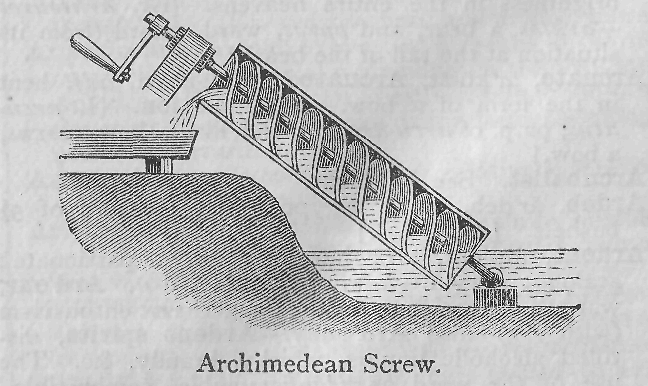
Archimedean, ärk-i-me-dē′an, adj. pertaining to Archimedes, a celebrated Greek mathematician of Syracuse (287-212 B.C.).—Archimedean screw, a machine for raising water, in its simplest form consisting of a flexible tube bent spirally round a solid cylinder, the ends of which are furnished with pivots, so as to admit of the whole turning round its axis.—Principle of Archimedes, a fundamental law in Hydrostatics, that a body when immersed in a fluid weighs less than it does in vacuo by the weight of the fluid it displaces.
Archipelago, ärk-i-pel′a-gō, n. the chief sea of the Greeks, or the Ægean Sea: a sea abounding in small islands, also a group of such islands:—pl. Archipel′agoes.—adj. Archipelagic (-aj′ik). [An Italian compound from Gr. archi-, chief, pelagos, sea.]
Architect, ärk′i-tekt, n. a master-builder: one who designs buildings and superintends their erection: a maker: any contriver, as the Creator.—adjs. Architecton′ic, pertaining to architecture: constructive: controlling, having direction: (metaph.) pertaining to the arrangement of knowledge.—n. the science of architecture: the systematic arrangement of knowledge.—adj. Architect′ural.—n. Architect′ure, the art or science of building: structure: in specific sense, one of the fine arts, the art of architecture—also used of any distinct style, e.g. Gothic, Byzantine architecture. [Gr. architektōn—archi-, chief, and tektōn, a builder.]
Architrave, ärk′i-trāv, n. (archit.) the lowest division of the entablature resting immediately on the abacus of the column: collective name for the various parts, jambs, lintels, &c. which surround a door or window.—p.adj. Arch′itraved. [It. from Gr. archi-, chief, and L. trab-em, trabs, a beam.]
Archives, ärk′īvz, n. the place in which government records are kept: (pl.) public records—also figuratively in both senses.—adj. Arch′ival, pertaining to, or contained in, archives or records.—n. Arch′ivist, a keeper of archives or records. [Fr.—Gr. archeion, magisterial residence—archē, government.]
Archivolt, är′ki-volt, n. the band or moulding which runs round the lower part of the archstones of an arch. [Fr. archivolte, It. archivolto—L. arcus, an arch, volta, a vault.]
Archology, ärk-ol′oj-i, n. (rare) doctrine of the origin of things: the science of government. [Gr. archē, beginning, logos, discourse.]
Archon, ärk′on, n. one of nine chief magistrates of ancient Athens.—ns. Arch′onship, the office of an archon; Arch′ontate, the archon's tenure of office. [Gr. arch-ein, to be first, to rule.]
Archwise, ärch′wīz, adv. in the form of an arch. [Arch, and Wise, way.]
Arctic, ärk′tik, adj. relating to the constellation the Great Bear, or to the north, used figuratively to express extreme cold.—Arctic Circle, a circle drawn round the North Pole, at a distance of 23½ degrees. [O. Fr. artique—L. arcticus—Gr. arktikos—arktos, a bear.]
Arcturus, ärk-tū′rus, n. the Bear-ward, a yellow star in the northern hemisphere, fourth in order of brightness in the entire heavens. [Gr. arktouros—arktos, a bear, and ouros, ward, guard (from its situation at the tail of the bear).]
Arcuate, är′kū-āt, Arcuated, är′kū-āt-ed, adj. bent in the form of a bow.—n. Arcuā′tion. [L. arcuatus, pa.p. of arcu-āre, to bend like a bow—arcus, a bow.]
Arcubalist. See Arbalest.
Ardeb, är′deb, n. an Egyptian dry measure of 5½ bushels. [Ar. irdab.]
Ardent, ärd′ent, adj. burning: fiery: passionate: zealous: fervid.—adv. Ard′ently.—n. Ard′our, warmth of passion or feeling: eagerness: enthusiasm (with for)—also Ard′ency.—Ardent spirits, distilled alcoholic liquors, whisky, brandy, &c. The use of the word as = 'inflammable, combustible,' is obsolete, except in this phrase. [L. ardent-em, ardē-re, to burn.]
Arduous, ärd′ū-us, adj. deep, difficult to climb: difficult to accomplish: laborious.—adv. Ard′uously.—n. Ard′uousness. [L. arduus, high; cog. with Celt. ard, high.]
Are, ar, n. the unit of the French land measure, containing 100 sq. metres = 119.6 English sq. yards. [Fr.—L. area.]
Are, är, the plural of the present indicative of the verb To be. [Old Northumbrian aron, of Scand. origin. This form ousted the older A.S. sind, sindon. Both are cog. with Sans. s-anti, Gr. eis-in, L. sunt, Ger. s-ind.]
Area, ā′rē-a, n. any plane surface or enclosed space: the sunken space around the basement of a building: (fig.) extent conceived by the mind: (geom.) the superficial contents of any figure. [L. area.]
Aread, Arede, a-rēd′, v.t. (obs.) to make known, utter: guess: interpret, explain: to counsel, advise. [A.S. arédan. See Read.]
Arear, a-rēr′, adv. in the rear. [A.S. pfx. a-, on, to, and Rear.]
Areca, ar′ē-ka, n. a genus of palm, one species of which, the Betel-nut Palm, or Penang Palm (Areca catechu), bears nuts with austere and astringent properties, which are chewed by the Malays with a little lime in a leaf of the betel-pepper, making the lips and spittle red.
Arefaction, ar-e-fak′shun, n. (obs.) the action of drying.—v.t. and v.i. Ar′efy, to dry up, wither. [L. arefacĕre, to make dry—arēre, to be dry, and facĕre, to make.]
Arena, a-rē′na, n. part of the ancient amphitheatre strewed with sand for the combats of gladiators and wild beasts: any place of public contest: a battlefield: place of action of any kind.—adj. Arenā′ceous, sandy: dry: (geol.) applied to rocks composed entirely or largely of grains of quartz.—ns. Arenā′ria, the sandwort, a genus of low herbs allied to the chickweeds; Arenā′tion, the application of hot sand to the body as a remedy. [L. arēna, sand.]
Areography, ā-re-ō′gra-fi, n. description of the physical features of the planet Mars. [Gr. Arēs, Mars, and graphein, to write.]
Areola, a-rē′o-la, n. a small area: (bot.) any slightly sunk spot, on the surface: (physiol.) the interstice in the tissue of an organised substance: any circular spot such as that around the human nipple:—pl. Arē′olæ.—adj. Arē′olate, divided into small areas.—n. Areolā′tion, division into areolæ. [L. areola, a dim. of Area.]
Areometer, Aræometer, ā-re-om′e-tėr, n. an instrument for determining specific gravity, called also Hydrometer.—n. Areom′etry, the measuring the specific gravity of bodies. [Gr. araios, thin, and Meter.]
Areopagus, ar-e-op′ag-us, n. Mars' Hill, on which the supreme court of ancient Athens was held: the court itself: also used of any important tribunal.—n. Areop′agite, a member of the Areopagus.—adj. Areopagit′ic, pertaining to the Areopagus.—n. a speech on the model of Isocrates's oration of that name addressed to the Areopagus. [Gr. Areios pagos, hill of Ares, or Mars.]
Aret, Arette, a-ret′, v.t. (Spens.) to entrust, commit a charge to. [O. Fr. arete-r, à-, to, reter—L. reputāre, to reckon.]
Arête, ar-āt′, n. a sharp ridge: esp. in French Switzerland, a rocky edge on a mountain. [Fr.—L. arista, an ear of corn, fish-bone, spine.]
Arew, a-rōō′, adv. (Spens.) arow, in a row.
Argal, ar′gal, adv. (Shak.) corruption of L. ergo, therefore: hence as a noun = a clumsy piece of reasoning.
Argali, är′ga-li, n. the great wild sheep of Siberia and Central Asia. [Mongol.]
Argand, ar′gand, n. applied to a lamp and gas-burner invented by Aimé Argand (1755-1803).
Argent, ärj′ent, adj. and n. silver, or like silver, silvery-white: (her.) the silver or white colour in armorial bearings: (poet.) esp. in compounds like argent-clear, argent-lidded.—adjs. Argent′al; Argentif′erous, bearing or containing silver; Ar′gentine, relating to or like silver: sounding like silver.—n. (nat. hist.) white metal coated with silver: a genus of small bony fishes with silvery sides, fished for the nacre which they contain. [Fr.—L. argentum, silver.]
Argil, är′jil, n. potter's clay: pure clay or alumina.—adjs. Argillā′ceous, of the nature of clay; Argillif′erous, bearing or abounding in clay. [L. argilla, Gr. argilos, white clay—argēs, white.]
Argive, ar′jīv, adj. belonging to Argos: Greek.
Argol, är′gol, n. a hard crust formed on the sides of wine-vessels, from which cream of tartar and tartaric acid are obtained—generally of a reddish tinge. [Prob. conn. with Gr. argos, white.]
Argon, ar′gon, n. a constituent element of our atmosphere, discovered in 1894 by Rayleigh and Ramsay.
Argonaut, är′go-nawt, n. one of those who sailed in the ship Argo in search of the golden fleece: also (nat. hist.) a name of the nautilus, a mollusc of the octopod type.—adj. Argonaut′ic. [Gr. Argō, and nautēs, a sailor.]
Argosy, är′go-si, n. a large merchant-vessel richly laden, esp. those of Ragusa and Venice: also figuratively. [The forms ragosie, rhaguse, used equally with argosie, argosey, &c., point to the derivation from It. Ragusea, a ship belonging to Ragusa, a great medieval port on the Adriatic, spelt in 16th-cent. English as Aragouse, Arragosa.]
Argot, är′go, or är′got, n. slang, originally that of thieves and vagabonds: cant. [Fr.; of unknown origin.]
Argue, ärg′ū, v.t. prove or evince: to prove by argument: to discuss: (obs.) to accuse.—v.i. to offer reasons: to dispute (with against, for, with, about):—pr.p. arg′ūing; pa.p. arg′ūed.—adj. Arg′ūable, capable of being argued.—n. Arg′ūer, one who argues: a reasoner.—To argue (a person) into, or out of, to persuade him into, or out of, a certain course of action. [O. Fr. arguer—L. argutāre, freq. of arguĕre, to prove.]
Argufy, ärg′ū-fī, v.i. to be evidence of something: to be of importance: to argue, wrangle.—v.t. to weary with wrangling. [Illiterate corr. of Argue.]
Argument, ärg′ū-ment, n. a statement, or reason based on such, offered as proof: a series of reasons or a step in such: discussion: subject of a discourse: summary of the subject-matter of a book: (obs.) matter of controversy.—adjs. Argument′able, Argument′al.—n. Argumentā′tion, an arguing or reasoning.—adj. Argument′ative.—adv. Argument′atively.—n. Argument′ativeness. [L. argumentum. See Argue.]
Argumentum, ärg-ū-ment′um, n. an argument.—The following are forms of indirect argument:—Argumentum ad hominem, an appeal to the known prepossessions or previous admissions of an opponent; Argumentum ad ignorantiam, an argument founded on the ignorance of an opponent; Argumentum ad invidiam, an argument appealing to the prejudices of the person addressed; Argumentum ad judicium, an appeal to the common-sense of mankind; Argumentum ad verecundiam, an appeal to our reverence for some respected authority; Argumentum baculinum, the argument of the cudgel—most concise of arguments, an appeal to force; Argumentum per impossibile, or Reductio ad absurdum, the proof of a conclusion derived from the absurdity of a contradictory supposition.—For the Ontological, Cosmological, Teleological, and Moral arguments in Theism, see under these adjectives.
Argus, ärg′us, n. any very quick-eyed or watchful person, from Argus, described in Greek mythology as having had a hundred eyes, some of which were always awake: a genus of gallinaceous birds, remarkable for magnificence of plumage—the only known species, the Argus pheasant, native to Sumatra, &c. [Gr.—argos, bright.]
Argute, är-gūt′, adj. shrill in sound: keen: shrewd.—adv. Argute′ly.—n. Argute′ness. [L. argutus.]
Argyria, ar-jir′i-a, n. silver poisoning. [Gr. argyros, silver.]
Aria, ā′ri-a, n. an air or rhythmical song introduced in a cantata, oratorio, or opera, and intended for one voice supported by instruments. [It., from root of Air.]
Arian, ā′ri-an, adj. pertaining to Arius of Alexandria (died 336), who denied the divinity of Christ.—n. one who adheres to the doctrines of Arius: a Unitarian.—v.t. A′rianise.—n. A′rianism, the doctrines of the Arians.
Arid, ar′id, adj. dry: parched.—ns. Arid′ity, Ar′idness. [L. aridus.]
Ariel, ā′ri-el, n. a man's name in the Old Testament, variously explained as 'lion of God,' 'hearth of God:' in later demonology, a water-spirit: an angel: a spirit of the air. [Heb. ariēl.]
Ariel, ā′ri-el, n. a species of gazelle in Western Asia. [Ar. aryil.]
Aries, ā′ri-ēz, n. the Ram, the first of the signs of the zodiac, which the sun enters on 21st March. [L.]
Arietta, ar-i-et′ta, n. a little aria or air.—Also Ariette′. [It. arietta, dim. of aria.]
Aright, a-rīt′, adv. in a right way: rightly.
Aril, ar′il, Arillus, a-ril′lus, n. a peculiar covering of the seed of some plants, formed by an expansion of the cord (funiculus) which attaches the ovule to the placenta, or of the placenta itself.—adjs. Ar′illary, Ar′illated, having an aril. [Low L. arillus.]
Arimaspian, ar-im-as′pi-an, adj. pertaining to the Arimaspi, described by Herodotus as a one-eyed and fierce people inhabiting the most northern region in the world, waging perpetual warfare with the neighbouring griffins for their hoarded gold.
Ariot, ä-rī′ot, adv. in riot, riotously.
Aripple, ä-rip′l, adv. in a ripple, rippling.
Arise, a-rīz′, v.i. to rise up: to come up so as to be heard: to ascend: to come into view: to spring:—pa.t. arose′; pa.p. aris′en. [Pfx. a-, up, out, and Rise.]
Aristarch, ar′is-tärk, n. a severe critic. [From Aristarchus, a grammarian of Alexandria about 160 B.C.]
Aristate, a-ris′tāt, adj. (bot.) having awns. [L. arista, an awn.]
Aristocracy, ar-is-tok′ras-i, n. government by the men of best birth or condition: political power of a privileged order: the nobility or chief persons of a state: the upper classes generally, also the persons noted for superiority in any quality, taken collectively—also Aristarch′y (rare).—n. Aristocrat (ar′is-to-krat, or ar-is′-), one who belongs to or favours an aristocracy: a haughty person.—adjs. Aristocrat′ic, -al, belonging to aristocracy: gentlemanly, stylish.—adv. Aristocrat′ically.—n. Aristocrat′ism. [Gr. aristos, best, and kratos, power.]
Aristolochia, ar-is-tō-lō′ki-a, n. a genus of shrubs, many climbers, specially abundant in tropical South America. [Gr.; aristos, best, locheia, child-birth, the roots of several species being formerly thought useful in parturition.]
Aristotelian, ar-is-to-tē′li-an, adj. relating to Aristotle or to his philosophy.
Arithmancy, ar′ith-man-si, n. divination by numbers.—Also Arith′momancy. [Gr. arithmos, number, and manteia, divination.]
Arithmetic, ar-ith′met-ik, n. the science of numbers: the art of reckoning by figures: a treatise on reckoning.—adj. Arithmet′ical.—adv. Arithmet′ically.—n. Arithmetic′ian, one skilled in arithmetic—Arithmetical progression, a series of numbers that increase or diminish by a common difference, as 7, 10, 13, 16, 19, 22; or 12, 10½, 9, 7½, 6. To find the sum of such a series, multiply the sum of the first and last terms by half the number of terms. [Gr. arithmētikē (technē, art), relating to numbers—arithmos, number.]
Arithmocracy, ar-ith-mok′ras-i, n. a democracy of mere numbers.—adj. Arithmocrat′ic. [A coinage of Kingsley—Gr. arithmos, number, kratia, rule.]
Arithmometer, ar-ith-mom′et-ėr, n. an instrument for working out arithmetical calculations. [Gr. arithmos, number, metron, measure.]
Ark, ärk, n. a chest or coffer: in Jewish history, the wooden coffer in which the Tables of the Law were kept—hence To touch or Lay hands on the ark, to touch irreverently what is sacred (2 Sam. vi. 6): a large floating vessel, like that in which Noah escaped the Deluge (Gen. vi.-viii.).—adj. and n. Ark′ite. [A.S. arc—L. arca, a chest—arcēre, to guard.]
Arles, ärlz, or ārlz, n. earnest money given in confirmation of a bargain, or of the engagement of a servant.—ns. Arle′-pen′ny, Arles′-pen′ny. [Scot. and northern Eng.; M. E. erles—O. Fr. erres (mod. Fr. arrhes)—L. arrha.]
Arm, ärm, n. the limb extending from the shoulder to the hand: anything projecting from the main body, as an inlet of the sea, a rail or support from a chair, sofa, or the like: one of the branches into which a main trunk divides: (fig.) power.—ns. Arm′-chair, a chair with arms; Arm′ful; Arm′-hole, the hole in a garment through which the arm is put.—adv. Arm′-in-arm, with arms interlinked, in close communion.—adj. Arm′less.—ns. Arm′let, a bracelet; Arm′-pit, the pit or hollow under the shoulder.—At arm's length, away from any friendliness or familiarity.—Right arm, the main support or assistant; Secular arm, the secular or temporal authority, as distinguished from the spiritual or ecclesiastical.—With open arms, with hearty welcome. [A.S.; cog. with L. armus, the shoulder-joint, Gr. harmos, a joint.]
Arm, ärm, n. a weapon: a branch of the military service:—pl. Arms, weapons of offence and defence: war, hostilities: deeds or exploits of war: armorial ensigns.—v.t. Arm, to furnish with arms or weapons: to fortify.—v.i. to take arms.—n. Ar′mature, armour: any apparatus for defence: a piece of iron connecting the poles of a bent magnet.—adj. Armed (ärmd, or arm′ed), furnished with arms: provided with means of defence: (bot.) having prickles or thorns: (her.) having part of the body different in colour from the rest, as a beak, claws, &c. of a bird.—n.pl. Fire′arms, such weapons as employ gunpowder, as guns and pistols.—n. Man′-at-arms, a fully equipped and practised fighting man.—n.pl. Small′-arms, such as do not require carriages, as opposed to artillery.—Armed to the teeth, completely armed.—College of Arms, the Heralds' College, which grants armorial bearings.—In arms with, quartered with; Of all arms, of every kind of troops; Stand of arms, a complete equipment of arms for one soldier.—The armed eye, strengthened with a magnifying-glass, as opp. to naked eye.—To lay down arms, to surrender or submit; Up in arms, in readiness to fight. [Through Fr. from L. arma; cog. with Arm.]
Armada, ärm-ā′da, n. a fleet of armed ships, esp. the self-styled Invincible Armada sent by Philip II. against England in 1588. [Sp.—L. armata, armare, to arm.]
Armadillo, ärm-a-dil′o, n. a small American edentate quadruped, having its body armed with bands of bony plates:—pl. Armadill′os. [Sp., dim. of armado, armed.]
Armageddon, är-mag-ed′on, n. the great symbolical battlefield of the Apocalypse, in which the final struggle between the powers of good and evil is to be fought out. [The name was no doubt suggested by the famous battlefield of Megiddo, in the plain of Esdraelon.]
Armament, ärm′a-ment, n. forces armed or equipped for war: munitions of war, esp. the great guns with which a ship is armed. [L. armamenta—arma.]
Armenian, ar-mē′ni-an, adj. belonging to Armenia, in Western Asia: belonging to the Armenian branch of the Christian Church.—n. a native of Armenia.
Armet, är′met, n. a helmet introduced about 1450 in place of the basinet, consisting of an iron cap, spreading over the back of the neck, having in front the visor, beaver, and gorget. [Fr.]
Armgaunt, ärm′gänt, adj. (Shak. once, Ant. and Cleop. I. v. 48), with gaunt limbs (?). The word has not been satisfactorily explained, and is most likely an error.
Armiger, är′mi-jėr, n. an armour-bearer: one entitled to a coat-of-arms: an esquire—also Armi′gero (Shak.).—adj. Armi′gerous. [L.; arma, arms, gerĕre, to bear.]
Armillary, är′mil-lar-i, or är-mil′lar-i, adj. resembling an armlet or bracelet: consisting of rings or circles.—n. Armil′la, in archæology, a bracelet: one of the coronation ornaments: the regalia.—Armillary sphere, an instrument constructed to show the motions of the heavenly bodies. [L. armilla, an armlet. See Arm (1).]
Arminian, ar-min′yan, n. a follower of Arminius (1560-1609), a Dutch divine, who denied the Calvinistic doctrine of absolute predestination, as well as irresistible grace.—adj. holding the doctrines of Arminius.—n. Armin′ianism.
Armipotent, ärm-ip′ō-tent, adj. powerful in arms. [L. arma, arms, potens, -entis, powerful.]
Armistice, ärm′ist-is, n. a short suspension of hostilities: a truce. [Fr.—Low L. armistitium, from L. arma, arms, sistĕre—stitum, to stop.]
Armoire, arm′war, n. an ambry or cupboard. [Fr.]
Armoric, ar-mor′ik, n. the language of the inhabitants of Armorica, the ancient name for Brittany. [L. Armoricus—Celt. are-mor, before the sea.]
Armour, ärm′ur, n. defensive arms or dress: heraldic insignia: plating of ships of war.—adj. Armō′rial, belonging to armour, or to the arms of a family.—ns. Arm′our-bear′er; Arm′ourer, a maker or repairer of, or one who has the charge of, armour.—adj. Arm′our-plat′ed.—ns. Arm′oury, Arm′ory, the place in which arms are made or kept: a collection of ancient armour; Coat′-arm′our, originally a vest of silk embroidered in colours, worn by a knight over his armour. [See Arm (2).]
Armozeen, Armozine, är-mo-zēn′, n. a kind of taffeta or plain silk, usually black, used for clerical gowns. [Fr. armoisin.]
Army, ärm′i, n. a large body of men armed for war and under military command: a body of men banded together in a special cause, whether travestying military methods, as the 'Salvation Army,' or not, as the 'Blue Ribbon Army:' a host: a great number.—ns. Arm′y-Corps (-kōr), a main division of an army, a miniature army comprising all arms of the service; Arm′y-list, a list of all commissioned officers, issued periodically by the War Office; Arm′y-worm, a European grub which collects in vast armies. [Fr. armée—L. armata, armāre.]
Arnica, är′ni-ka, n. a genus of composite plants, of which the species A. montana, or Mountain Tobacco, formerly enjoyed a great repute in medicine as a stimulant in paralytic affections, low fevers, &c.—its flowers still yield a tincture externally applied to wounds and bruises. [Mod. L.; origin unknown.]
Arnotto, ar-not′to. See Anatta.
Aroint, a-roint′, interj. (Shak.) away! begone! used only twice in the phrase, 'Aroint thee, witch:' to bid begone (arch. usage in Browning).—v.t. to drive or frighten away. [Origin unknown; perh. in some provincialism, like the Yorkshire rynd-ta, 'round-thee,' 'move-round,' spoken to a cow in her stall.]
Aroma, a-rō′ma, n. sweet smell: the odorous principle of plants: (fig.) flavour or peculiar charm of any kind.—adj. Aromat′ic, fragrant: spicy.—v.t. Arō′matise, to render aromatic: to perfume:—pr.p. arō′matising; pa.p. arō′matised. [Through Fr. and L. from Gr. arōma.]
Arose, a-rōz′, pa.t. of Arise.
Around, a-rownd′, prep. on all sides of: (Amer.) round about.—adv. on every side: in a circle: (Amer.) round, all about, [a, on, and Round.]
Arouse, a-rowz′, v.t. and v.i. same as Rouse.—ns. Arouse, Arous′al (rare).
Arow, a-rō′, adv. in a row: one following the other. [Prep. a, and Row.]
Aroynt. Same as Aroint.
Arpeggio, är-pej′ō, n. (mus.) a chord of which the notes are given, not simultaneously, but in rapid succession. [It. arpeggiare, to play upon the harp—arpa, harp.]
Arpent, är′pent, n. an old French measure for land still used in Quebec and Louisiana = 100 sq. perches, varying with the perch from 1¼ acre to 5⁄6 of an acre. [Fr.—L. arepennis, said to be a Gallic word.]
Arquebuse, är′kwi-bus, n. an old-fashioned hand-gun—also Har′quebus.—n. Arquebusier′. [Fr. arquebuse—Dut. haakbus—haak, hook, and bus, box, barrel of a gun; Ger. hakenbüchse.]
Arracacha, ar-a-kach′ä, n. an umbelliferous plant with esculent roots, native to the northern parts of South America. [Native Ind. name.]
Arrack, ar′ak, n. an ardent spirit used in the East, procured from toddy or the fermented juice of the coco and other palms, as well as from rice and jaggery sugar. [Ar. ‛araq, juice.]
Arrah, ar′a, interj. Anglo-Irish expletive of emotion, wonder, &c.
Arraign, ar-rān′, v.t. to call one to account: to put a prisoner upon trial: to accuse publicly.—ns. Arraign′er; Arraign′ing; Arraign′ment. [O. Fr. aresnier—Low L. arrationāre—L. ad, to, rationem, reason.]
Arrange, ar-rānj′, v.t. to set in a rank or row: to put in order: to settle: (mus.) to adapt a composition for instruments or voices for which it was not originally written, as when orchestral or vocal compositions are set for the pianoforte, or the reverse.—v.i. to come to an agreement.—n. Arrange′ment, act of arranging: classification: settlement. [O. Fr. arangier—à (—L. ad, to), and rangier, rengier. See Range.]
Arrant, ar′rant, adj. downright, notorious (used in a bad sense): unmitigated.—adv. Ar′rantly. [A variant of Errant. From its use in phrases like 'arrant thief,' it passed naturally into a general term used with other terms of abuse.]
Arras, ar′ras, n. tapestry: a hanging screen of such hung round the walls of rooms.—p.adj. Ar′rased, covered with arras.—n. Ar′rasene, an embroidery material of wool and silk stitched in like crewels. [From Arras in Northern France, where first manufactured.]
Arraught, ar-rawt′, adj. (Spens.) seized on by force:—pa.t. and pa.p. of Arreach. [See Reach.]
Array, ar-rā′, n. order: dress: equipage.—v.t. to put in order: to arrange: to dress, adorn, or equip. [O. Fr. arroi, array, equipage—L. ad, and a Teut. root, found in Eng. Ready, Ger. bereit, A.S. gerǽde, preparation, Dan. rede, order.]
Arrear, ar-rēr′, n. that which is in the rear or behind: that which remains unpaid or undone (used mostly in pl.).—adv. Arrear′, backward, behind.—n. Arrear′age (Shak.), arrears. [O. Fr. arere, ariere (Fr. arrière)—L. ad, to, retro, back, behind.]
Arrect, a-rekt′, adj. upright: erected, as the ears: on the alert. [L. arrectus.]
Arrest, ar-rest′, v.t. to stop: to seize: to catch the attention: to apprehend by legal authority.—n. stoppage: seizure by warrant.—adj. Arrest′able, liable to be arrested.—n. Arrestā′tion, the act of arresting: arrest.—adj. Arrest′ive, with a tendency to arrest.—n. Arrest′ment (law), detention of a person arrested till liberated on bail, or by security: (Scots law) the process which prohibits a debtor from making payment to his creditor until another debt due to the person making use of the arrestment by such creditor is paid. [O. Fr. arester—L. ad, to, restāre, to stand still.]
Arret, ar-ret′, or a-rā′, n. decision: judgment of a tribunal—properly of the king or parliament of France. [Fr. arrêt. See Arrest.]
Arride, a-rīd′, v.t. (Lamb) to please, gratify. [L. arridē-re.]
Arrière-ban, är′yer-bän, or ä-rēr′ban, n. in feudal times, the sovereign's summons to all freemen to take the field: the army thus collected. [O. Fr. ariereban, Old High Ger. hari, army, and ban, public proclamation.]
Arris, ar′ris, n. a sharp ridge or edge on stone or metal. [See Arête.]
Arrive, ar-rīv′, v.i. to reach any place: to attain to any object (with at).—ns. Arrīv′al, the act of arriving: persons or things that arrive; Arrīv′ance (Shak.), company arriving. [O. Fr. ariver—Low L. adripāre—L. ad, to, ripa, a bank.]
Arroba, a-rō′ba, n. a weight of 25 or more pounds, used in Spanish and Portuguese regions. [Ar.]
Arrogate, ar′rog-āt, v.t. to claim as one's own: to claim proudly or unduly.—ns. Ar′rogance, Ar′rogancy, undue assumption of importance.—adj. Ar′rogant, claiming too much: overbearing.—adv. Ar′rogantly.—n. Arrogā′tion, act of arrogating: undue assumption. [L. arrogāre—ad, to, rogāre, -ātum, to ask, to claim.]
Arrondissement, ar-ron′dēs-mäng, n. a subdivision of a French department, comprising a number of communes. [Fr.—arrondir, to make round.]
Arrow, ar′rō, n. a straight, pointed weapon, made to be shot from a bow: any arrow-shaped pin or ornament: the chief shoot of a plant, esp. the flowering stem of the sugar-cane.—n. Ar′row-head, the head or pointed part of an arrow: an aquatic plant native to England, with arrow-shaped leaves rising above the water—reputed good for hydrophobia.—adj. Ar′row-head′ed, shaped like the head of an arrow.—n. Ar′row-shot, the distance traversed by an arrow.—adj. Ar′rowy, of or like arrows. [A.S. earh, arwe; cog. with L. arcus; akin to Ice. ör, örvar.]
Arrowroot, ar′rō-rōōt, n. a starch obtained from the roots of certain plants growing chiefly in West Indies, and much used as food for invalids and children. [Said to be so named because used by the Indians of South America as an antidote against wounds caused by poisoned arrows.]
'Arry, ar′i, n. a jovial vulgar fellow who drops his h's:—fem. 'Ar′riet.—adj. 'Ar′ryish, in holiday spirits. [From the vulgar Cockney pronunciation of Harry.]
Arse, ärs, n. the posterior parts of an animal.—adv. and adj. Ars′y-vers′y, backside foremost, contrary. [A.S. ears; Ger. arsch, Sw. ars; cog. with Gr. orros.]
Arsenal, är′se-nal, n. a dock possessing naval stores: a public magazine or manufactory of naval and military stores. [It. arzenale, arsenale (Sp., Fr. arsenal)—Ar. dār aççinā‛ah, workshop; dār, house, al, the, cinā‛ah, art.]
Arsenic, ar′sen-ik, n. one of the chemical elements: a mineral poison: a soft, gray-coloured metal.—ns. Ar′senate, Arsē′niate, a salt of arsenic acid.—adjs. Arsen′ic, -al, composed of or containing arsenic: in chemistry, applied to compounds; Arsē′nious, of or containing arsenic.—n. Ar′senite, a salt of arsenious acid. [Gr. arsenikon, arsen, male; the alchemists fancied some metals male, others female.]
Arsis, ar′sis, n. grammatical term applied to the elevation of the voice to a higher pitch in speaking: (mus.) the strong position in a bar: the strong syllable in English metre:—pl. Ar′sēs. [L.—Gr. arsis—airein, to lift.]
Arson, ärs′on, n. the crime of wilfully burning houses or other buildings.—ns. Ar′sonite, Ar′sonist (rare). [O. Fr. arson—L. arsion-em, ardēre, arsum, to burn.]
Art, ärt, 2d pers. sing. of the present tense of the verb To be. [A.S. eart.]
Art, ärt, n. practical skill guided by rules: human skill as opposed to nature: skill as applied to subjects of taste, the fine arts—music, painting, sculpture, architecture, and poetry: (pl.) specially used of certain branches of learning to be acquired as necessary for pursuit of higher studies, or for the work of life, as in phrase 'faculty of arts, master of arts:' the rules and methods of doing certain actions: a profession, skilled trade, or craft: contrivance: cunning, artfulness, or address: artifice, special faculty of some kind acquired by practice, skill, dexterity, knack: special faculty of giving expression to æsthetic or artistic quality, as in art-furniture, &c., supposed, by the buyer, in this respect, to justify its price.—adj. Art′ful, full of art: (arch.) dexterous, clever: cunning: produced by art.—adv. Art′fully.—n. Art′fulness.—adj. Art′less, simple: (rare) inartistic: guileless, unaffected.—adv. Art′lessly.—ns. Art′lessness; Arts′man, one who cultivates some practical knowledge: (arch.) a man skilled in arts or in learning.—n.pl. Art′-un′ions, associations having for their object the promotion of an interest in the fine arts.—Art and part, as in the phrase 'to be art and part in,' originally in legal expressions like 'to be concerned in either by art or part'—i.e. either by art in contriving or by part in actual execution; now loosely used in the sense of participating, sharing.—Useful arts as opposed to Fine arts, those in which the hands and body are more concerned than the mind.—Science and Art differ essentially in their aims—Science, in Mill's words, 'takes cognisance of a phenomenon, and endeavours to ascertain its law; Art proposes to itself an end, and looks out for means to effect it.' [L. ars, artis. See Arm.]
Artemisia, är-tē-miz′i-a, n. a genus of composite plants, with a peculiarly bitter taste, including Wormwood, Southernwood, &c.
Artery, är′tėr-i, n. a tube or vessel which conveys blood from the heart (see Aorta)—also metaphorically: any main channel of communication.—adj. Artēr′ial—v.t. Artēr′ialise, to make arterial.—ns. Artēriot′omy, the cutting or opening of an artery, to let blood; Arterī′tis, inflammation of an artery. [L.—Gr. artēria, orig. the windpipe most probably—Gr. air-ein, to raise. The ancient conception of the artery as an air-duct gave rise to the derivation from Gr. aēr, air.]
Artesian, är-tē′zhan, adj. applied to wells made by boring until water is reached. [From Artois (L. Artesium), in the north of France, where the oldest known well of this kind in Europe was sunk in 1126.]
Arthritis, ar-thrī′tis, n. inflammation of a joint: gout.—adj. Arthrit′ic, relating to or affecting the joints: gouty. [Gr. arthritikos—arthron, a joint.]
Arthropoda, ar-throp′od-a, n.pl. a great division of the animal kingdom, the body consisting of a definite number of segments, each having a pair of hollow jointed limbs into which the body muscles proceed. It again divides into two great groups—the water-breathers or Branchiata, and the air-breathers or Tracheata.—adj. Arthrop′odal. [Gr. arthron, joint, and pous, pod-os, a foot.]
Artichoke, är′ti-chōk, n. a thistle-like, perennial, eatable plant with large scaly heads, like the cone of the pine, now growing wild in the south of Europe, though probably a native of Asia.—Jerusalem artichoke, a totally different plant, a species of sunflower, bearing tubers like those of the potato, Jerusalem being a corr. of It. girasole ('turn-sun'), sunflower. By a quibble on Jerusalem, the soup made from it is called Palestine soup. [Old It. articiocco (It. carciofo)—Old Sp. alcarchofa—Ar. al-kharshōfa, al-kharshuf. Popular definitions are many—e.g. the plant that chokes the garden or the heart.]
Article, ärt′i-kl, n. a separate element, member, or part of anything: a particular substance: a single clause or term: a distinct point in an agreement, or an agreement looked at as complete, as in 'articles of apprenticeship,' &c.: rules or conditions generally: a section of any document: a literary composition in a journal, newspaper, encyclopædia, &c., treating of a subject distinctly and independently: (gram.) the name given to the adjectives the (definite article) and a or an (indefinite article).—v.t. to draw up or bind by articles: to indict, charge with specific accusations: bind by articles of apprenticeship.—adj. Artic′ular, belonging to the joints.—Articles of association, regulations for the business of a joint-stock company registered under the Companies Acts; Articles of faith, binding statement of points held by a particular Church; Articles of war, code of regulations for the government and discipline of the army and navy.—In the article of death (L. in articulo mortis), at the point of death.—Lords of the Articles, a standing committee of the Scottish parliament who drafted the measures to be submitted.—The Thirty-nine Articles, the articles of religious belief finally agreed upon by the entire bishops and clergy of the Church of England in 1562. [L. articulus, a little joint—artus, a joint.]
Articulata, är-tik-ū-lā′ta, n. one of the great primary divisions of the animal kingdom, according to Cuvier, including those animals of which the body is divided into a number of distinct joints—viz. the higher worms or Annelids, and also the Insects, Crustaceans, Arachnids, and Myriopods.
Articulate, är-tik′ūl-āt, adj. distinct: clear.—v.t. to joint: to form into distinct sounds, syllables, or words.—v.i. to speak distinctly.—adv. Artic′ulately.—ns. Artic′ulateness; Articulā′tion, a joining as of the bones: part between two joints: distinctness, or distinct utterance: a consonant; Artic′ulator, one who articulates or speaks: one who articulates bones and mounts skeletons. [L. articulāre, -ātum, to furnish with joints, to utter distinctly. See Article.]
Artifice, art′i-fis, n. artificer's work: a contrivance: a trick or fraud.—n. Artif′icer, a workman: an inventor.—adj. Artificial (ärt-i-fish′yal), made by art: not natural: cultivated: not indigenous: feigned: not natural in manners, affected.—v.t. and v.i. Artific′ialise, to render artificial.—ns. Artificial′ity, Artific′ialness.—adv. Artific′ially. [L. artificium—artifex, -ficis, an artificer—ars, artis, and facĕre, to make.]
Artillery, är-til′ėr-i, n. offensive weapons of war, esp. cannon, mortars, &c.: the men who manage them: a branch of the military service: gunnery.—ns. Artill′erist, one skilled in artillery or gunnery; Artill′ery-man, a soldier of the artillery. [O. Fr. artillerie, artiller, to arm; through a supposed Low L. artillāre—L. ars, artis, art.]
Artiodactyla, är-ti-o-dak′til-a, n. a sub-order of the great mammalian order of Ungulata, having the third digit unsymmetrical in itself, but forming a symmetrical pair with the fourth digit—as distinguished from the Perissodactyla (horse, tapir, rhinoceros), which have the third digit of each limb symmetrical in itself, an odd number of digits on the hind-foot, and at least twenty-two dorso-lumbar vertebræ. The Artiodactyla, again, divide into two groups, the Non-Ruminantia and the Ruminantia.
Artisan, ärt′i-zan, n. one skilled in any art or trade: a mechanic. [Fr.—It. artigiano, ult. from L. artitus, skilled in the arts—ars, artis, art.]
Artist, ärt′ist, n. one who practises an art, esp. one of the fine arts, as painting, sculpture, engraving, or architecture.—adjs. Artist′ic, -al, according to art.—adv. Artist′ically.—n. Art′istry, artistic pursuits: artistic workmanship, quality, or ability. [Fr. artiste, It. artista—L. ars, artis, art.]
Artiste, är-tēst′, n. one dexterous or tasteful in any art, as an opera dancer, a cook, a hairdresser, &c. [Fr.]
Art-union. See Art.
Arum, ā′rum, n. a genus of plants represented in England by the Cuckoo-pint or Wake Robin (A. maculatum), whose root yields a wholesome farina known as Portland Sago or Arrowroot. [L.—Gr. aron.]
Arundinaceous, a-run-di-nā′shus, adj. relating to or like a reed.—Also Arundin′eous. [L. arundinaceus—arundo, a reed.]
Aruspex, Aruspice, Aruspicy. See Haruspex.
Arvicola, är-vik′ō-lä, n. the general name of the family of animals to which belong the water-vole and field-vole. [Coined from L. arvum, a field, colĕ-re, to inhabit.]
Ary, ä′ri, e′ri, adj. (prov.) any. [A modification of e'er a for ever a. Cf. Nary.]
Aryan, ar′i-an, or ā′ri-an, adj. relating to the family of nations otherwise called Indo-European (comprehending the inhabitants of Europe—except the Basques, Turks, Magyars, and Finns—and those of Armenia, Persia, and North Hindustan), or to their languages—Sanskrit, Zend, Greek, Latin, Celtic, Teutonic, Slavonic, Lettic.—v.t. Aryanise′. [L. arianus, belonging to Ariana or Aria (Gr. Areia), the east part of Ancient Persia—Sans. Arya (cf. Old Pers. Ariya, and Irān, Persia), often traced to a root ar, plough.]
As, az, adv., conj., and pron. in that degree, so far, as ... as: the consequent in a co-relation expressing quantity, degree, &c., as ... as, such ... as, same ... as: since, because: when, while: expressing merely continuation or expansion, for instance: similarly: for example: while: in like manner: that, who, which (after such, same).—As concerning, As to, As for, so far as concerns; As it were, so to speak, in some sort; As much, the same; As well (as), just as much (as), equally (with). [A worn-down form of all-so, A.S. all-swá, wholly so.]
As, as, n. in Norse mythology, one of the gods, the inhabitants of Asgard:—pl. Aesir (ā′ser). [Ice. āss, a god (pl. æsir)—A.S. ōs, seen in such proper names as Oswold, Osric.]
As, as, n. Latin unit of weight, 12 ounces (L. unciæ): a copper coin, the unit of the early monetary system of Rome.
Asafœtida, as-a-fet′i-da, n. a medicinal gum-resin, having an offensive smell, procured by drying the milky juice which flows from the root of the plant Ferula (Narthex) asafœtida. [Pers. azā, mastic, and L. fœtida, stinking.]
Åsar, ē′sar, n.pl. the Swedish name for those long, winding banks and ridges of gravel and sand which occur abundantly in the low grounds of Sweden, supposed to mark the site of sub-glacial streams and rivers.—These åsar are the same as the Irish eskar and the Scotch kames.
Asarabacca, as-a-ra-bak′a, n. a European plant, a species of Asarum, having acrid properties, formerly used in the preparation of snuffs for catarrh, &c. [L. asarum, bacca, a berry.]
Asbestos, az-best′os, n. an incombustible mineral, a variety of hornblende, of a fine fibrous texture, resembling flax: (fig.) anything unquenchable.—adjs. Asbes′tic, Asbes′tous, Asbes′tine, of or like asbestos: incombustible. [Gr.; (lit.) unquenchable—a, neg., sbestos, extinguished.]
Ascaris, as′ka-ris, n. a genus of parasitic worms, of the family Ascar′idæ, infesting the small intestines. [Gr. askaris, pl. askarides.]
Ascend, as-send′, v.i. to climb or mount up: to rise, literally or figuratively: to go backwards in the order of time.—v.t. to climb or go up on: to mount.—adjs. Ascend′able, Ascend′ible.—Ascending rhythm, in prosody, a rhythm in which the arsis follows the thesis, as an iambic or anapæstic rhythm: opposed to descending rhythms, as the trochaic and dactylic. [L. ascendĕre, ascensum—ad, and scandĕre, to climb.]
Ascension, as-sen′shun, n. a rising or going up.—adjs. Ascend′ant, -ent, superior: above the horizon.—n. superiority: (astrol.) the part of the ecliptic rising above the horizon at the time of one's birth; it was supposed to have commanding influence over the person's life, hence the phrase, 'in the ascendant:' superiority or great influence: (rare) an ancestor.—n. Ascend′ency, controlling influence—also Ascend′ancy, Ascend′ance, Ascend′ence (rare).—adj. Ascen′sional, relating to ascension.—n. Ascen′sion-day, the festival held on Holy Thursday, ten days before Whitsunday, to commemorate Christ's ascension to heaven.—adj. Ascen′sive, rising: causing to rise.—n. Ascent′, act of ascending: upward movement, as of a balloon: way of ascending: degree of elevation or advancement: slope or gradient: a flight of steps.—Line of ascent, ancestry.—Right ascension (astron.), the name applied to one of the arcs which determine the position relatively to the equator of a heavenly body on the celestial sphere, the other being the declinator. [L. ascensio—ascendĕre.]
Ascertain, as-sėr-tān′, v.t. to determine: to obtain certain knowledge of: (rare) to insure, certify, make certain.—adj. Ascertain′able.—n. Ascertain′ment. [O. Fr. acertener. See Certain.]
Ascetic, as-set′ik, n. one who rigidly denies himself ordinary sensual gratifications for conscience' sake, one who aims to compass holiness through self-mortification, the flesh being considered as the seat of sin, and therefore to be chastened: a strict hermit.—adjs. Ascet′ic, -al, excessively rigid: austere: recluse.—adv. Ascet′ically.—n. Ascet′icism. [Gr. askētikos (adj. askētēs), one that uses exercises to train himself—askein, to work, take exercise, (eccles.) to mortify the body.]
Ascian, ash′yan, n. name given to the inhabitants of the torrid zone, who are shadowless at certain seasons, from the sun being right over their heads. [Gr. askios, shadowless—a, neg., skia, a shadow.]
Ascidians, a-sid′i-anz, n.pl. a group belonging to the tunicate Mollusca, forming a class of degenerate survivors of ancestral vertebrates, asymmetrical marine animals with a tubular heart and no feet, of a double-mouthed flask shape, found at low-water mark on the sea-beach.—n. Ascid′ium, a genus of Ascidians: (bot.) a pitcher-shaped, leafy formation, as in the Nepenthes. [Gr. askidion, dim. of askos, a leathern bag, wine-skin.]
Ascititious. Same as Adscititious.
Asclepiad, as-klē′pi-ad, Asclepiadic, as-klē-pi-ad′ik, n. in ancient prosody, a verse consisting of a spondee, two (or three) choriambi, and an iambus: —adj. Asclepiad′ic. [Asclepiadēs, a Greek poet.]

Asclepiads, as-klē′pi-adz, n.pl. an order of Greek physicians, priests of Asclepius or Æsculapius, the god of medicine. [Gr. asklēpius, Asclepius.]
Asclepias, as-klē′pi-as, n. a genus of plants, native to North America, giving name to the natural order of the Asclepidaceæ, and containing the milk-weed, swallow-wort, &c.
Ascribe, a-skrīb′, v.t. to attribute, impute, or assign.—adj. Ascrib′able.—n. Ascrip′tion, act of ascribing or imputing: any expression of ascribing, or any formula for such, like the one ascribing glory to God repeated at the end of a sermon. [L. ascribĕre, -scriptum—ad, to, scrib-ĕre, to write.]
Aseity, a-sē′i-ti, n. self-origination. [L. a, from, se, self.]
Aseptic, a-sep′tik, adj. not liable to decay or putrefaction.—n. Asep′ticism. [From Gr. a, neg., sēptos, sēpomai, to decay.]
Asexual, a-seks′ū-al, adj. without sex, once applied to cryptogams—agamic. [Gr. a, neg., and Sexual.]
Asgard, as′gärd, n. the heaven of Norse mythology, abode of the twelve gods and twenty-six goddesses, and of heroes slain in battle. [Ice. asgardhr, āss, a god, gardhr, an enclosure.]
Ash, ash, n. a well-known timber tree, or its wood, which is white, tough, and hard, much used in carpentry and wheel-work: the ashen shaft of a spear, or a spear itself.—adj. Ash′en.—n. Ground′-ash, or Ash′-plant, an ash sapling.—Mountain ash, the rowan-tree; Quaking ash, the aspen. [A.S. æsc—Ger. esche, Ice. askr.]
Ashake, a-shāk′, adv. phrase, shaking. [Prep. a, and Shake.]
Ashamed, a-shāmd′, adj. affected with shame (with of for the cause of shame; for, the person).—v.t. and v.i. Ashame′, to feel shame: to put to shame.—n. Ashamed′ness.—p.adj. Asham′ing. [Pa.p. of old verb ashame.]
Ashes, ash′ez, n.pl. the dust or remains of anything burnt: the remains of the human body when burnt: (fig.) a dead body: used to express pallor, from the colour of wood-ashes, as in 'pale as ashes,' 'ashy-pale.'—n. Ash′-buck′et, a box or bucket in which house-ashes and general refuse are collected for removal.—adjs. Ash′en, Ash′en-gray.—ns. Ash′ery, a place where potash or pearl-ash is made; Ash′-heap, a heap of ashes and household refuse; Ash′-leach, a tub in which alkaline salts are dissolved from wood-ashes; Ash′-pan, a kind of tray fitted underneath a grate to receive the ashes.—adjs. Ash′y, Ash′y-gray.—To lay in ashes, to destroy utterly by burning. [A.S. asce; Ice. aska.]
Ashet, ash′et, n. (now only Scot.) a large flat dish in which meat is served. [Fr. assiette.]
Ashiver, a-shiv′ėr, adv. phrase, quivering.
Ashkenazim, ash-kē-naz′im, n.pl. the Polish and German Jews, as distinguished from the Sephardim, the Spanish and Portuguese Jews. [Heb. Ashkenaz, the name of a northern people in Gen. x., located in Arabia, by later Jews identified with Germany.]
Ashlar, ash′lar, Ashler, ash′lėr, n. hewn or squared stone used in facing a wall, as distinguished from rough, as it comes from the quarry—also in Ash′lar-work, as opposed to Rubble-work.—p.adj. Ash′lared.—n. Ash′laring. [O. Fr. aiseler—L. axillaris, axilla, dim. of axis, assis, axle; also plank (cf. Fr. ais, It. asse.]
Ashore, a-shōr′, adv. on shore. [Prep. a, and Shore.]
Ash-Wednesday, ash-wenz′dā, n. the first day of Lent, so called from the Roman Catholic custom of sprinkling ashes on the head.
Asian, āzh′yan, or āsh′i-an, Asiatic, ā-zhi-at′ik, or āsh-i-at′ik, adj. belonging to Asia: florid in literature or art.—n. Asiat′icism, imitation of Asiatic or Eastern manners.
Aside, a-sīd′, adv. on or to one side: privately: apart.—n. words spoken in an undertone, so as not to be heard by some person present, words spoken by an actor which the other persons on the stage are supposed not to hear: an indirect effort of any kind.—adj. private, apart.—To set aside, to quash (a judgment).
Asinego, as-i-nē′go, n. (Shak.) a stupid fellow.—Also Asini′co. [Sp. asnico—dim. of asno, L. asinus, ass.]
Asinine, as′in-īn, adj. of or like an ass.—n. Asinin′ity. [See Ass.]
Ask, ask, v.t. to seek: to request, inquire, beg, question, invite.—v.i. to request: to make inquiry (with about and for—as to ask one after or for another). [A.S. áscian, ácsian; Ger. heischen, Ice. æskja, Sans. esh, to desire.]
Askance, a-skans′, Askant, a-skant′, adv. sideways: awry: obliquely: with a side glance, or with a side meaning.—v.t. (Shak.) to turn aside.—To eye, look, or view askance, to look at with suspicion. [Ety. very obscure; perh. conn. with It. a schiáncio, slopingly, or with Ice. á-ská, as in Askew.]
Askew, a-skū′, adv. obliquely: aside: awry. [See Askance.]
Aslake, a-slāk′, v.t. (arch.) to slake: to mitigate. [Prep. a, and Slake.]
Aslant, a-slant′, adj. or adv. obliquely.—Also Asklent′ (Scot.).
Asleep, a-slēp′, adj. or adv. in sleep: sleeping: in the sleep of death, dead. [Prep. a, and Sleep.]
Aslope, a-slōp′, adj. or adv. on the slope.
Asmoulder, a-smōl′der, adv. phrase, smouldering.
Asnort, a-snort′, adv. phrase, snorting. [Prep. a, and Snort.]
Asp, asp, Aspic, asp′ik, n. a popular name applied loosely to various genera of venomous serpents—now chiefly to the Vipera aspis of Southern Europe. Cleopatra's asp was probably the small Vipera hasselquistii, or horned viper: the biblical asp (Heb. pethen) was probably the Egyptian juggler's snake (Naja haje). [L.—Gr. aspis.]
Asparagus, as-par′a-gus, n. a plant cultivated for its young shoots, esteemed as a table delicacy.—n. Aspar′agine, a nitrogenised crystallised substance found in asparagus and other vegetables.—Sparrow-grass was long the form of the word in English. [L.—Gr. asparagos.]
Aspect, as′pekt (in Shak. and elsewhere, as-pekt′), n. look: view: appearance, also applied figuratively to the mind: position in relation to the points of the compass: the situation of one planet with respect to another, as seen from the earth.—v.i. (obs.) to look at.—adj. As′pectable, visible, worth looking at. [L. aspectus—ad, at, specĕre, to look.]
Aspen, asp′en, n. the trembling poplar.—adj. made of or like the aspen: tremulous: timorous.—adj. As′pen-like. [A.S. æspe, Ger. espe.]
Asper, as′pėr, n. a small silver Turkish coin.
Asperated. See Aspirate.
Asperges, as-per′jes, n. a short service introductory to the mass, so called from the words Asperges me, Domine, hyssopo et mundabor (Ps. li.).
Aspergill, -um, as′pėr-jil, -um, n. a kind of brush used in R.C. churches for sprinkling holy water on the people.—Also Asperge′, Asper′soir. [L. aspergĕre, to sprinkle, and dim. suffix.]
Aspergillum, as-pėr-jil′um, n. a remarkable genus of boring Lamellibranch Molluscs, in which the shell has the form of an elongated cone, terminating at the lower end in a disc, pierced by numerous small tubular holes.—n. Aspergil′lus, the name of a genus of minute fungi or moulds occurring on decaying substances of various kinds.
Asperity, as-per′i-ti, n. roughness: harshness: bitter coldness. [L. asperitat-em, asper, rough.]
Aspermous, a-spėr′mus, Aspermatous, a-spėr′ma-tus, adj. without seeds. [Gr. a, neg., sperma, seed.]
Asperse, as-pėrs′, v.t. to slander or calumniate: to bespatter (with).—n. Asper′sion, calumny: slander: (Shak.) a shower or spray.—adjs. Aspers′ive, Aspers′ory, tending to asperse: defamatory.
Aspersorium, as-per-sōr′i-um, n. a vessel used in R.C. churches for holding holy water.
Asphalt, as-falt′, or as′falt, Asphaltum, as-falt′um, n. a black or dark-brown, hard, bituminous substance, anciently used as a cement, and now for paving, cisterns, water-pipes, &c.—v.t. Asphalt′, to lay or cover with asphalt.—adj. Asphalt′ic. [Gr. asphaltos, from an Eastern word.]
Aspheterism, as-fet′er-izm, n. (Southey) denial of the right of private property.—v.i. Asphet′erise. [Gr. a, neg., and spheteros, one's own.]
Asphodel, as′fo-del, n. a kind of lily—in Greek mythology, the peculiar plant of the dead. In Greece they cover the bleakest hillsides with enduring blossom.—adj. Elysian. [Gr. asphodelos, a plant of the lily kind; cf. Homer's asphodelos leimōn, the meadow of the dead. See Daffodil.]
Asphyxia, as-fik′si-a, n. (lit.) suspended animation, suffocation, when the blood is in such a state as to render impossible a sufficiently free exchange of carbonic acid for oxygen—also Asphyx′y.—n. Asphyx′iant, a chemical substance which produces asphyxia.—adj. Asphyx′iāted.—ns. Asphyxiā′tion; Asphyx′iātor. [Gr., a stopping of the pulse—a, neg., sphyxis, the pulse.]
Aspic, Aspick, as′pik, n. (poet.) a venomous serpent. [See Asp.]
Aspic, as′pik, n. a savoury meat-jelly containing fish, game, hard-boiled eggs, &c. [Littré suggests its derivation from aspic, asp, because it is 'cold as an aspic,' a French proverb.]
Aspirant, as-pīr′ant, or as′pir-ant, n. one who aspires (with after, for): a candidate.—adj. ambitious: mounting up (rare in both senses). [See Aspire.]
Aspirate, as′pir-āt, v.t. to pronounce with a full breathing, as the letter h in house.—n. a mark of aspiration, the rough breathing in Greek (‛): an aspirated letter.—p.adj. As′perated, made harsh.—ns. Aspirā′tion, pronunciation of a letter with a full breathing: an aspirated sound (like Gr. ch, th, &c.): drawing air in; Aspirā′tor, an apparatus for drawing air or other gases through bottles or other vessels: (med.) an instrument for removing fluids from the cavities of the body.—adj. Aspīr′atory, relating to breathing.—To drop one's aspirates, not to pronounce h, a mark of imperfect education or humble social standing. [See Aspire.]
Aspire, as-pīr′ (followed by to or after with the object, or by an infinitive), v.i. to desire eagerly: to aim at high things: to tower up.—n. Aspirā′tion, eager desire.—adj. Aspīr′ing.—adv. Aspīr′ingly.—n. Aspīr′ingness. [Fr.—L. aspirāre, -ātum—ad, to, spirāre, to breathe.]
Asplenium, as-plē′ni-um, n. spleenwort, a genus of ferns, mostly tropical, with long or linear sori, with indusium arising laterally from above a vein—including the lady-fern, black maiden-hair, &c. [Gr. asplēnion.]
Asport, as-pōrt′, v.t. (rare) to carry away, esp. in a bad sense.—n. Asportā′tion, feloniously carrying away. [L. asportāre—abs, away, and portāre, to carry.]
Aspout, a-spowt′, adv. phrase, spouting.
Asprawl, a-sprawl′, adv. phrase, sprawling.
Aspread, a-spred′, adv. phrase, spread out.
Asprout, a-sprowt′, adv. phrase, sprouting.
Asquat, a-skwät′, adv. phrase, squatting.
Asquint, a-skwint′, adv. and adj. towards the corner of the eye: obliquely.
Ass, as, n. a well-known quadruped of the horse family: (fig.) a dull, stupid fellow.—Asses' bridge, or Pons asinorum, a humorous name for the fifth proposition of the first book of Euclid. [A.S. assa, the earlier Teutonic form being esol, esil (Goth. asilus)—L. asinus; Gr. onos, ass. Perh. ult. of Semitic origin, as in Heb. āthōn, a she-ass.]
Assafetida. Same as Asafœtida.
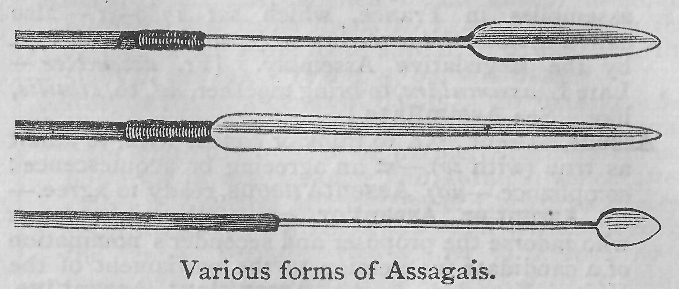
Assagai, Assegai, as′sa-gī, n. a slender spear of hard wood, tipped with iron, some for hurling, some for thrusting with—used by the South African tribes, notably the war-like Zulus.—v.t. to kill or slay with an assagai. [Through Fr. or Port. from Ar. azzaghāyah, az = al, the zaghāyah, a Berber word.]
Assail, as-sāl′, v.t. to assault: to attack.—adj. Assail′able.—ns. Assail′ant, one who assails or attacks; Assail′ment. [O. Fr. asaillir—L. assilīre—ad, upon, and salīre, to leap.]
Assassin, as-as′in, n. one who, usually for a reward, kills by surprise or secretly.—v.t. Assas′sinate, to murder by surprise or secret assault: (Milton) to maltreat: also figuratively, to destroy by treacherous means, as a reputation.—n. (obs.) one who assassinates.—ns. Assassinā′tion, secret murder; Assas′sinator. [Through Fr. or It. from Ar. hashshāshīn, 'hashish-eaters,' a military and religious order in Syria, of the 11th century, who became notorious for their secret murders in obedience to the will of their chief, and fortified themselves for their adventures by hashish, an intoxicating drug or drink made from hemp.]
Assault, as-sawlt′, n. a sudden attack: a storming, as of a town: (Eng. law) unlawful attempt to apply force to the person of another—when force is actually applied, the act amounts to battery: an attack of any sort by arguments, appeals, &c.—v.t. to make an assault or attack upon: (law) to make an assault.—n. Assault′er.—Assault at arms, a display of attack and defence in fencing. [O. Fr. asaut—L. ad, upon, saltus, a leap, salīre, to leap. See Assail.]
Assay, as-sā′, v.t. to determine the proportions of a metal in an ore or alloy: endeavour (more usually Essay): (Spens.) to affect or move: (Shak.) to put one to the proof, as to accost with a particular purpose, to measure swords with another, &c.: (poet.) put to proof, examine by trial.—v.i. to attempt.—n. the determination of the quantity of metal in an ore or alloy: the trial of anything, as in the ancient custom of tasting the drink before handing it to a king or noble: an attempt or endeavour: probation or trial: (Spens.) ascertained purity.—ns. Assay′er, one who assays, esp. metals; Assay′ing, the process of assaying or determining the proportion of pure metal in an ore or alloy; Assay′-mas′ter, the officer who determines the amount of gold or silver in coin or bullion. [O. Fr. assayer, n. assai. See Essay.]
Assegai, Assegay. Same as Assagai.
Assemble, as-sem′bl, v.t. to call or bring together: to collect.—v.i. to meet together.—ns. Assem′blage, a collection of persons or things; Assem′blance (Spens.), an assembling: (Shak.) semblance: representation; Assem′bly, the act of assembling: the company so assembled: a gathering of persons for any purpose, as for religious worship or social entertainment: specially applied to the lower house of the legislature in some of the United States and British colonies: (mil.) a drum-beat, esp. that before a march, upon which the soldiers strike their tents; Assem′bly-room, a room in which persons assemble, especially for dancing.—General Assembly, in Scotland, Ireland, and the United States, the highest court of the Presbyterian Church; Legislative Assembly, in many of the British colonies, the title of the lower house of the legislature; National Assembly, the first of the revolutionary assemblies in France, which sat 1789-91—also called the Constituent Assembly, superseded in 1791 by the Legislative Assembly. [Fr. assembler—Late L. assimulāre, to bring together, ad, to, similis, like. See Assimilate.]
Assent, as-sent′, v.i. to think or concur with, to admit as true (with to).—n. an agreeing or acquiescence: compliance.—adj. Assentā′neous, ready to agree.—ns. Assent′er, Assent′or, one of the eight voters who indorse the proposer and seconder's nomination of a candidate for election to the parliament of the United Kingdom.—adjs. Assen′tient, Assent′ive.—adv. Assent′ingly.—n. Assent′iveness.—Royal Assent, in England, the sovereign's formal acquiescence in a measure which has passed the two Houses of Parliament. [O. Fr. asenter, assent—L. assentāre, assentīre, L. ad, to, sentīre, to think.]
Assentation, as-sen-tā′shun, n. obsequious assent, adulation.—n. As′sentator (obs.).—adv. Assent′atorily (obs.). [L. assentāri, to flatter, freq. of assentīri, assent, agree.]
Assert, as-sėrt′, v.t. to vindicate or defend by arguments or measures (now used only of the cause as object or reflexive): to declare strongly: to lay claim to or insist upon anything: to affirm: (rare) to bear evidence of.—adj. Assert′able.—ns. Assert′er, Assert′or, a champion, one who makes a positive statement; Asser′tion, affirmation: the act of claiming one's rights: averment.—adj. Assert′ive, asserting or confirming confidently: positive: dogmatic.—adv. Assert′ively.—n. Assert′iveness.—adj. Assert′ory, affirmative.—To assert one's self, to defend one's rights or opinions, sometimes with unnecessary zeal, to thrust one's self forward. [L. asserĕre (superl. assertum), aliquem manu in libertatem, to lay hands on a slave in token of manumission, hence to protect, affirm, declare—ad, to, and serĕre, to join. Cf. Series.]
Assess, as-ses′, v.t. to fix the amount of, as a tax (with upon): to tax or fine: to fix the value or profits of, for taxation (with at): to estimate.—adj. Assess′able.—ns. Assess′ment, act of assessing: a valuation for the purpose of taxation: a tax; Assess′or, a legal adviser who sits beside a magistrate: one who assesses taxes: one who shares another's dignity.—adj. Assessō′rial.—n. Assess′orship. [Fr.—L. assessāre, freq. of assidēre, assessum, to sit by, esp. of judges in a court, from ad, to, at, sedēre, to sit.]
Assets, as′sets, n.pl. the property of a deceased or insolvent person, considered as chargeable for all debts, &c.: the entire property of all sorts belonging to a merchant or to a trading association. [From the Anglo-Fr. law phrase aver assetz, to have sufficient, O. Fr. asez, enough—L. ad, to, satis, enough.]
Asseverate, as-sev′ėr-āt, v.t. to declare solemnly—an earlier form is Assev′er.—adv. Asseverat′ingly.—n. Asseverā′tion, any solemn affirmation or confirmation. [L. asseverāre, -ātum—ad, to, severus, serious. See Severe.]
Assiduity, as-sid-ū′i-ti, n. constant application or diligence: (pl.) constant attentions, as to a lady.—adj. Assid′uous, constant or unwearied in application: diligent.—adv. Assid′uously.—n. Assid′uousness. [L. assiduitas—assiduus, sitting close at—ad, to, at, sedēre, to sit.]
Assiege, as-sēj′, v.t. (Spens.) to besiege. [See Siege.]
Assiento, as-ē-en′to, n. a word especially applied to an exclusive contract between Spain and some foreign nation for the supply of African slaves for its American possessions. [Sp., a seat, a seat in a court, a treaty.]
Assign, as-sīn′, v.t. to sign or mark out to one: to allot: to appoint: to allege: to transfer: to ascribe or refer to: to suggest: to fix, as a time: to point out exactly.—n. one to whom any property or right is made over: (pl.) appendages (Shak.).—adj. Assign′able, that may be assigned.—ns. Assignā′tion, an appointment to meet, used chiefly of love-trysts, and mostly in a bad sense: (Scots law) the making over of any right to another, equivalent to Assignment; Assignee (as-sin-ē′), one to whom any right or property is assigned: (pl.) the trustees of a sequestrated estate; Assign′ment, act of assigning: anything assigned: the writing by which a transfer is made: (Spens.) design. [Fr.—L. assignāre, to mark out—ad, to, signum, a mark or sign.]
Assignat, as-sin-yä′, n. one of the notes (chiefly for 100 francs = £4 each) in the paper currency first issued in 1790 by the French revolutionary government as bonds on the security of the appropriated church lands.
Assimilate, as-sim′il-āt, v.t. to make similar or like to: to convert into a like substance, as food in our bodies (with to, with).—v.i. to become like, or to be incorporated in.—n. Assim′ilability (Coleridge).—adj. Assim′ilable.—n. Assimilā′tion.—adj. Assim′ilātive, having the power or tendency to assimilate. [L. assimilāre, -ātum—ad, to, similis, like.]
Assist, as-sist′, v.t. to help.—v.i. to be present at a ceremony: (Shak.) to accompany.—n. Assist′ance, help: relief.—adj. Assist′ant, helping or lending aid.—n. one who assists: a helper. [L. assistĕre, to stand by—ad, to, sistĕre.]
Assize, as-sīz′, v.t. to assess: to set or fix the quantity or price.—n. a statute settling the weight, measure, or price of anything: (Scot.) a trial by jury, the jury: judgment, sentence, the Last Judgment: (pl.) the sessions or sittings of a court held periodically in English counties, at which causes are tried by judges of the High Court of Justice on circuit and a jury.—n. Assiz′er, an officer who inspects weights and measures. [O. Fr. assise, an assembly of judges, a set rate—asseoir—L. assidēre.]
Associate, as-sō′shi-āt, v.t. to join with, as a friend or partner: to unite in the same body.—v.i. to keep company (with): to combine or unite.—ns. Associabil′ity, Assō′ciableness.—adjs. Assō′ciable, that may be joined or associated: sociable: companionable; Assō′ciate, joined or connected with.—n. one joined or connected with another: a companion, friend, partner, or ally.—ns. Assō′ciateship, office of an associate; Associā′tion, act of associating: union or combination: a society of persons joined together to promote some object.—adj. Assō′ciātive, tending to association.—Association football, the game as formulated by the Football Association (formed in 1863).—Association (of Ideas), applied to laws of mental combination which facilitate recollection: similarity: contiguity, repetition. [L. associātum, associāre—ad, to socius, a companion.]
Assoil, as-soil′, v.t. to loosen from: to absolve or acquit: to solve: (Spens.) to remove, to let loose, to renew, to get rid of.—n. Assoil′ment. [Through Fr. from L.—L. ab, from, solvĕre, to loose.]
Assoil, as-soil′, v.t. to soil, stain, or make dirty. [L. ad, and Soil. See Soil (2).]
Assoilzie, as-soil′yē, v.i. to free one accused from a charge: a Scots law term, the same as the archaic assoil, to absolve from sin, discharge, pardon. See Absolvitor, under Absolve. [Through Fr. from L. absolvĕre.]
Assonance, as′son-ans, n. a correspondence in sound: in Spanish and Portuguese poetry, a kind of rhyme, consisting in the coincidence of the vowels of the corresponding syllables, without regard to the consonants, as in mate and shape, feel and need.—adjs. As′ssonant, resembling in sound; As′sonantal, As′sonantic.—v.t. As′sonate, to correspond in sound. [Fr.—L. assonāre, as = ad-, to, sonāre, to sound.]
Assort, as-sort′, v.t. to separate into classes: to arrange.—v.i. to agree or be in accordance with: to fall into a class with, suit well with: (arch.) to keep company with.—p.adj. Assort′ed, classified, arranged in sorts.—ns. Assort′edness; Assort′ment, act of assorting: a quantity or number of things assorted: variety. [Fr. assortir—L. ad, to, sors, a lot.]
Assot, as-sot′, v.t. (Spens.) to besot, to infatuate.—p.adj. Assot′, or Assot′ted (Spens.), infatuated. [O. Fr. asoter—à, to, sot, foolish. See Sot.]
Assuage, as-swāj′, v.t. to soften, mitigate, or allay.—v.i. to abate or subside: to diminish.—n. Assuage′ment, abatement: mitigation.—adj. Assuā′sive, softening, mild. [O. Fr., formed as if from a L. assuaviāre—ad, to, suavis, mild.]
Assubjugate, as-sub′jōō-gāt, v.t. (Shak.) to reduce to subjugation.
Assuefaction, as-wē-fak′shun, n. (Sir T. Browne) the act of accustoming, habituation. [L. assuefacĕre—assuetus, accustomed, and facĕre, to make.]
Assuetude, as′wē-tūd, n. (obs.) custom, habit. [L. assuetus.]
Assume, as-sūm′, v.t. to adopt, take in: to take up, to take upon one's self: to take for granted: to arrogate: to pretend to possess.—v.i. to claim unduly: to be arrogant.—adjs. Assum′able, Assump′tive, that may be assumed.—adv. Assum′ably, presumably.—adj. Assumed′, appropriated, usurped: pretended: taken as the basis of argument.—advs. Assum′edly, Assum′ingly.—adj. Assum′ing, haughty: arrogant. [L. assumĕre—ad, to, sumĕre, sumptum, to take.]
Assumpsit, a-sump′sit, n. an action at law, wherein the plaintiff asserts that the defendant undertook (L. assumpsit) to do a certain act and failed to fulfil his promise: in the United States, the most common form of action.
Assumption, as-sum′shun, n. act of assuming: a supposition: the thing supposed, a proposition: (logic) the minor premise in a syllogism.—Assumption of the Virgin, a church festival kept on the 15th of August, based on the notion that after the death of Mary, her soul and body were preserved from corruption and taken up to heaven by Christ and His angels.—Deed of assumption (Scots law), a deed executed by trustees under a trust-deed assuming a new trustee or settlement. [L. See Assume.]
Assure, a-shōōr′, v.t. to make sure or secure: to give confidence: (Shak.) to betroth: to tell positively: to insure.—adj. Assur′able.—n. Assur′ance, confidence: feeling of certainty: self-reliance: impudence: positive declaration: insurance, as applied to lives: the securing of a title to property: (theol.) subjective certainty of one's salvation: a solemn declaration or promise, a certain proof: surety, warrant.—adj. Assured′, certain: without doubt: insured: overbold.—adv. Assur′edly.—ns. Assur′edness; Assur′er, one who gives assurance: an insurer or underwriter: one who insures his life. [O. Fr. aseürer (Fr. assurer)—Late L. adsecurāre—ad, to, securus, safe. See Sure.]
Assurgent, as-ur′jent, adj. rising, ascending: (bot.) rising in a curve to an erect position: (her.) of a bearing depicted as rising from the sea.—n. Assur′gency, the tendency to rise.
Asswage. A form of Assuage.
Assyrian, as-sir′i-an, adj. belonging to Assyria.—n. an inhabitant of Assyria: the language of Assyria.—ns. Assyriol′ogist; Assyriol′ogy, the science of Assyrian antiquities. [Gr. Assurios—Assuria, Assyria.]
Astare, a-stār′, adv. phrase, staring.
Astart, a-start′, v.i. (Spens.) to start up suddenly: to happen, fall out.—adv. with a start, suddenly. [Pfx. a-, and Start.]
Astatic, a-stat′ik, adj. having a tendency not to stand still: losing polarity, as a magnetic needle. [Gr. neg., astatos—a, neg., statos, verb. adj. of histanai, to stand.]
Astay, a-stā′, adv. applied to an anchor when, in lifting it, the cable forms such an angle with the surface of the water as to appear in a line with the stays of the ship. [Prep. a, on, and Stay.]
Aster, as′tėr, n. a genus of plants of the natural order Compositæ, with showy radiated flowers varying from white to lilac-blue or purple, mostly perennial, flowering in late summer and autumn, hence often called in England Michaelmas or Christmas daisies.—China aster, the best-known and most valued of the family, brought from China to France by a missionary in the 18th century. [Gr. astēr, a star.]
Asterias, as-tēr′i-as, n. a genus of Echinoderms, containing the common five-rayed starfish. [Gr. astērias, a fish—astēr, a star.]
Asterisk, as′tėr-isk, n. a star, used in printing as a reference to a note at the bottom or on the margin of the page, and sometimes as a mark of the omission of words, thus *.—n. As′terism, a group or collection of small stars: a constellation: three asterisks placed to direct attention to a passage: a property of some minerals which show a star-shaped luminous figure when viewed by reflected light—e.g. the asteriated sapphire. [Gr. asteriskos, dim. of aster, a star.]
Astern, a-stėrn′, adv. in the stern: towards the hinder part of a ship: behind. [Prep. a, and Stern.]
Asteroid, as′tėr-oid, n. one of the minor planetary bodies revolving between the orbits of Mars and Jupiter.—adj. Asteroid′al. [Gr. astēr, a star, eidos, form.]
Astert, a-stėrt′. Same as Astart.
Asthenia, as-thē-nī′a, n. debility, lack of strength.—adj. Asthen′ic [Gr. a, priv., and sthenos, strength.]
Asthma, ast′ma, n. a chronic disorder of the organs of respiration, characterised by the occurrence of paroxysms in which the breathing becomes difficult, and accompanied by wheezing and a distressing feeling of tightness in the chest.—adjs. Asthmat′ic, -al, pertaining to or affected by asthma.—adv. Asthmat′ically. [Gr. asthma, asthmat-os—az-ein, to breathe hard, a-ein, to blow.]
Astigmatism, a-stig′ma-tizm, n. a defective condition of the eye, in which rays proceeding to the eye from one point are not correctly brought to a focus at one point.—adj. Astigmat′ic. [Gr. a, neg., and stigma, stigmat-os, a point.]
Astir, a-stir′, prep. phr. or adv. on the move, out of bed, in motion or excitement. [Prep. a, and Stir.]
Astomatous, as-tom′a-tus, adj. having no mouth, used of a division of the protozoa.
Astonish, as-ton′ish, v.t. to impress with sudden surprise or wonder: to amaze: (Shak.) to stun—older form Aston′y, whence the p.adj. Aston′ied, dazed, bewildered, greatly astonished.—Aston′, Astun′, Astoned′, Astunned′, are obsolete.—p.adj. Aston′ished, amazed: (obs.) stunned.—adj. Aston′ishing, very wonderful, amazing.—adv. Aston′ishingly.—n. Aston′ishment, amazement: wonder: a cause for astonishment. [From the earlier form, Astone; O. Fr. estoner; L. attonāre, to strike with a thunderbolt.]
Astound, as-townd′, v.t. to amaze, to strike dumb with astonishment:—pa.p. astound′ed; pr.p. astound′ing.—pa.p. Astound′ (arch.).—p.adj. Astound′ing. [Astound (adj.) is developed from Astoned, hence the verb is a doublet of Astonish.]
Astraddle, a-strad′dl, adv. sitting astride. [Prep. a, on, and Straddle.]
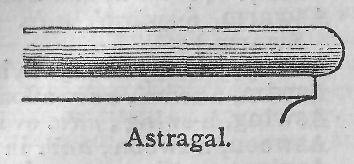
Astragal, as′tra-gal, n. (archit.) a small semicircular moulding or bead encircling a column: a round moulding near the mouth of a cannon: the bars which hold the panes of a window. [Gr. astragalos, one of the vertebræ, a moulding.]
Astragalus, as-trag′al-us, n. a bone of the foot, forming with the leg-bones the hinge of the ankle-joint, by a convex upper surface and smooth sides. [Gr.]
Astrakhan, as′tra-kan, n. name given to lamb-skins with a curled wool obtained from Astrakhan on the Caspian Sea: a rough fabric made in imitation of it.
Astral, as′tral, adj. belonging to the stars: starry: in the science of Theosophy, descriptive of a supersensible substance supposed to pervade all space and enter into all bodies.—Astral body, a living form composed of astral fluid, a ghost or wraith; Astral spirits, pervading spirits supposed to animate the heavenly bodies, forming, as it were, their souls—among the most potent of demoniacal spirits in medieval demonology. [L. astralis, astrum, a star.]
Astrand, a-strand′, adv. stranded. [Prep. a, on, and Strand.]
Astray, a-strā′, adv. out of the right way. [Prep. a, on, and Stray.]
Astriction, as-trik′shun, n. a binding or contraction: restriction.—v.t. Astrict′, to bind, restrict. [L. astriction-em, astringĕre. See Astringent.]
Astride, a-strīd′, adv. with the legs apart, or across. [Prep. a, on, and Stride.]
Astringent, as-trin′jent, adj. binding: contracting: strengthening.—n. a medicine that causes costiveness.—v.t. Astringe′, to bind together: to draw tight: hence to render constipated.—n. Astrin′gency.—adv. Astrin′gently. [L. astringent-em, astringĕre—ad, to, stringĕre, to bind.]
Astrolabe, as′trō-lāb, n. an instrument for measuring the altitudes of the sun or stars, now superseded by Hadley's quadrant and sextant. [Gr.; astron, a star, labb-, lambano, I take.]
Astrolatry, as-trol′a-tri, n. the worship of the stars. [Gr. astron, a star, latreia, worship.]
Astrology, as-trol′o-ji, n. the infant stage of the science of the stars, out of which grew Astronomy; it was occupied chiefly in determining from the positions and motions of the heavenly bodies their supposed influence on human and terrestrial affairs.—n. Astrol′oger, one versed in astrology.—adjs. Astrolog′ic, -al.—adv. Astrolog′ically. [Gr. astrologia—astron, star, logos, knowledge.]
Astronomy, as-tron′om-i, n. the laws or science of the stars or heavenly bodies.—n. Astron′omer, one versed in astronomy.—adj. Astronom′ic.—adv. Astronom′ically.—v.t. Astron′omise. [Gr. astronomia—astron, star, nomos, a law.]
Astrophel, as′tro-fel, n. a name applied by Spenser to some kind of bitter herb.
Astrut, a-strut′, adv. in a strutting manner. [Prep. a, on, and Strut.]
Astute, ast-ūt′, adj. crafty: cunning: shrewd: sagacious.—adv. Astute′ly.—n. Astute′ness.—The adj. Astū′cious, adv. Astū′ciously, and n. Astū′city are all rare. [L. astutus—astus, crafty, akin perhaps to Acute.]
Astylar, a-stī′lar, adj. without columns. [Gr. a, neg., stylos, a column.]
Asudden, a-sud′en, adv. suddenly. [Prep. a, and Sudden.]
Asunder, a-sun′dėr, adv. apart: into parts: separately. [Prep. a, and Sunder.]
Aswarm, a-swärm′, adv. swarming. [Prep. a, and Swarm.]
Asway, a-swā′, adv. swaying.
Aswim, a-swim′, adv. afloat.
Aswing, a-swing′, adv. swinging.
Aswoon, a-swōōn′, adv. in a swoon.
Asylum, a-sīl′um, n. a place of refuge for debtors and for such as were accused of some crime: an institution for the care or relief of the unfortunate, such as the blind or insane: any place of refuge or protection. [L.—Gr. asylon—a, neg., sylē, right of seizure.]
Asymmetry, a-sim′e-tri, n. want of symmetry or proportion between parts.—adjs. Asymmet′ric, -al.—adv. Asymmet′rically. [Gr. See Symmetry.]
Asymptote, a′sim-tōt, n. (math.) a line that continually approaches nearer to some curve without ever meeting it.—adjs. Asymptot′ic, -al.—adv. Asymptot′ically. [Gr. asymptōtos, not coinciding—a, not, syn, with, ptōtos, apt to fall, pipt-ein, to fall.]
Asynartete, a-sin′ar-tēt, adj. and n. not connected, consisting of two members having different rhythms; a verse of such a kind.—Also Asyn′artetic. [Gr.; a, neg., syn, together, arta-ein, to knit.]
Asynchronism, a-sin′kro-nizm, n. want of synchronism or correspondence in time.—adj. Asyn′chronous.
Asyndeton, a-sin′de-ton, n. (rhet.) a figure in which the conjunctions are omitted, as in Matt. x. 8.—adj. Asyndet′ic. [Gr.; a, neg., syndetos, bound together, syn, together, dein, to bind.]
Asyntactic, as-in-tak′tik, adj. loosely put together, irregular, ungrammatical. [Gr.; a, neg., syntaktos, syntass-ein, to put in order together.]
Asystole, a-sis′to-lē, n. (med.) the condition of a heart the left ventricle of which is unable to empty itself.—Also Asys′tolism. [Made up of Gr. a, neg., systolē, contraction.]
At, at, prep. denoting presence, nearness, or relation. Often used elliptically, as in 'At him, good dog.' [A.S. æt; cog. with Goth, and Ice. at, L. ad; Sans. adhi, on.]
Atabal, at′a-bal, n. a Moorish kettledrum. [Sp.—Ar. at-tabl, the drum.]
Ataghan. Same as Yataghan.
Atavism, at′av-izm, n. frequent appearance of ancestral, but not parental, characteristics in an animal or plant: reversion to an original type.—adj. At′avistic. [L. atavus—avus, a grandfather.]
Ataxia, at-ak′si-a, Ataxy, a-tax′i, or at′ax-i, n. (med.) irregularity of the functions of the body through disease, esp. inability to co-ordinate voluntary movements, as in locomotor ataxy. [Gr.; a, neg., taktos, tassein, to arrange.]
Ate, et, or āt, pa.t. of Eat.
Ate, ā′tē, n. (myth.) the goddess of mischief and of all rash actions and their results. [Gr.]
Atelier, at-el-yā′, n. a workshop, esp. an artist's studio. [Fr.]
Athanasia, ath-a-nā′si-a, n. deathlessness.—Also Athan′asy. [Gr.; athanatos, a, neg., thanatos, death.]
Athanasian, ath-a-nāz′yan, adj. relating to Athanasius (296-373), or to the creed erroneously attributed to him.
Athanor, ath′a-nor, n. a self-feeding digesting furnace, used by the alchemists, in which a uniform heat was maintained. [Ar. at-tannur, at = al, the nūr, fire.]
Atheism, ā′the-izm, n. disbelief in the existence of God.—v.i. and v.t. A′theise, to talk or write as an atheist.—n. A′theist, one who disbelieves in the existence of God.—adjs. Atheist′ic, -al.—adv. Atheist′ically.—adj. A′theous (Milton), atheistic. [Fr. athéisme—Gr. a, neg., and theos, God.]
Atheling, ath′el-ing, n. a member of a noble family, latterly a prince of the blood royal, or the heir-apparent. [A.S. ætheling; Ger. adel.]
Athenæum, Atheneum, ath-e-nē′um, n. a temple of Athēna or Minerva at Athens, in which scholars and poets read their works: a public institution for lectures, reading, &c. [Gr. Athēnaion—Athēna or Athēnē, the goddess Minerva.]
Athenian, a-thē′ni-an, adj. relating to Athens, the capital of Greece.—n. a native of Athens.
Atheology, a-thē-ol′oj-i, n. opposition to theology.—adj. Atheolog′ical. [Gr. atheos, without God, logia, discourse.]
Atherine, ath′er-īn, n. a genus of small fishes, allied to the Gray Mullet family, abundant in the Mediterranean—one species (Atherina presbyter), found on the south coast of England, is often sold as a smelt. [Gr.]
Athermancy, ath-er′man-si, n. the property of stopping radiant heat.—adj. Ather′manous. [Gr. a, neg., thermain-ein, to heat.]
Atheroma, ath′er-ō-ma, n. a name formerly applied to cysts on the scalp, with contents of the consistence of porridge, but now only used of a common form of inflammation of arteries.—adj. Atherom′atous. [Gr.; atharē, porridge.]
Athirst, a-thėrst′, adj. thirsty: eager for. [A.S. of thyrst. See Thirst.]
Athlete, ath′lēt, n. a contender for victory in feats of strength: one vigorous in body or mind. The form Athlē′ta survived till the later half of the 18th century.—adj. Athlet′ic, relating to athletics: strong, vigorous.—adv. Athlet′ically.—n. Athleticism (ath-let′i-sizm), the act of engaging in athletic exercises: devotion to athletics.—n.pl. Athlet′ics, the art of wrestling, running, &c.: athletic sports. [Gr. athlētēs—athlos, contest.]
Athrill, a-thril′, adv. thrilling.
Athrob, a-throb′, adv. throbbing.
Athwart, a-thwawrt′, prep. across.—adv. sidewise: wrongly: perplexingly. [Prep. a, on, and Thwart.]
Atilt, a-tilt′, adv. on tilt: as a tilter.
Atimy, at′i-mi, n. loss of honour: in ancient Athens, loss of civil rights, public disgrace. [Gr. atimia—a, neg., timē, honour.]
Atkins. See Tommy Atkins.
Atlantean, at-lan-tē′an, adj. relating to or like Atlas, gigantic: also relating to Atlan′tis, according to ancient tradition, a vast island in the Atlantic Ocean, or to Bacon's ideal commonwealth of that name. [See Atlas.]
Atlantes, at-lan′tēz, n.pl. figures of men used instead of columns. [From Atlas.]
Atlantic, at-lan′tik, adj. pertaining to Atlas, or to the Atlantic Ocean.—n. the ocean between Europe, Africa, and America. [From Mount Atlas, in the north-west of Africa, named from the Titan, Atlas.]
Atlas, at′las, n. that piece of the human vertebral column which articulates with the skull, so called because it supports the head: a collection of maps. [Gr. Atlas, Atlantis, a Titan who bore the world on his shoulders, and whose figure used to be given on the title-page of atlases.]
Atlas, at′las, n. a kind of silk-satin manufactured in the East. [Ar.]
Atmology, at-mol′o-ji, n. the science of the phenomena of aqueous vapour.—n. Atmol′ogist. [Gr. atmos, vapour, and logia, discourse—legein, to speak.]
Atmolysis, at-mol′i-sis, n. a method of separating a mixture of gases by taking advantage of their different rates of passage through a porous septum. [Gr. atmos, vapour, and lysis, loosing—lyein, to loose.]
Atmometer, at-mom′e-tėr, n. an instrument for measuring the rate of evaporation from a moist surface. [Gr. atmos, vapour, and Meter.]
Atmosphere, at′mo-sfēr, n. the gaseous envelope that surrounds the earth or any of the heavenly bodies: any gaseous medium: a conventional unit of atmospheric pressure: (fig.) any surrounding influence.—adjs. Atmospher′ic, -al, of or depending on the atmosphere.—adv. Atmospher′ically.—Atmospheric engine, a variety of steam-engine in which the steam is admitted only to the under side of the piston; Atmospheric hammer, a hammer driven by means of compressed air; Atmospheric railway, a railway where the motive-power is derived from the pressure of the atmosphere acting on a piston working in an iron tube of uniform bore. [Gr. atmos, air, sphaira, a sphere.]
Atoll, a-tol′, or at′ol, n. a coral island consisting of a circular belt of coral enclosing a central lagoon. [A Malay word.]
Atom, at′om, n. a particle of matter so small that it cannot be cut or divided, the unit of matter; anything very small.—adjs. Atom′ic, -al, pertaining to atoms.—ns. Atomic′ity; Atomisā′tion (med.) the reduction of liquids to the form of spray; At′omism, the doctrine that atoms arranged themselves into the universe: the atomic theory; At′omist, one who believes in atomism.—adj. Atomis′tic.—adv. Atomist′ically.—n. At′omy, an atom, or mote: (Shak.) a pygmy.—Atomic philosophy, a system of philosophy enunciated by Democritus, which taught that the ultimate constituents of all things are indivisible particles, differing in form and in their relations to each other; Atomic theory, the hypothesis that all chemical combinations take place between the ultimate particles of bodies, uniting each atom to atom, or in proportions expressed by some simple multiple of the number of atoms. [Gr. atomos—a, not, temnein, tamein, to cut. See Atom.]
Atomy, at′om-i, n. (Shak.) a skeleton, walking skeleton. [Formerly also atamy and natomy, for anatomy, mistakingly divided an atomy.]
Atone, at-ōn′, adv. (Spens.) at one, at once, together. [M.E. also attone, earlier atoon, aton, at one, at on.]
Atone, at-ōn′, v.i. to give satisfaction or make reparation (with for): to make up for deficiencies: (Shak.) to agree, be in accordance.—v.t. to appease, to expiate: (arch.) harmonise, or reconcile.—ns. Atone′ment, the act of atoning; reconciliation: expiation: reparation: esp. (theol.) the reconciliation of God and man by means of the incarnation and death of Christ; Aton′er.—adv. Aton′ingly. [See Atone, above.]
Atony, at′on-i, n. want of tone or energy: debility: relaxation.—adj. At′onic (pros.), without tone: unaccented. [Gr. atonia—a, neg., tonos, tone, strength. See Tone.]
Atop, a-top′, adv. on or at the top. [Prep. a, and Top.]
Atrabiliar, at-ra-bil′i-ar, adj. of a melancholy temperament: hypochondriac: splenetic, acrimonious.—Also Atrabil′iary, Atrabil′ious. [L. ater, atra, black, bilis, gall, bile. See Bile.]
Atramental, at-ra-men′tal, adj. (Sir T. Browne) inky, black. [From L. atramentum, ink—atra, black.]
Atremble, a-trem′bl, adv. trembling.
Atrip, a-trip′, adv. said of an anchor when it is just drawn out of the ground in a perpendicular direction—of a sail, when it is hoisted from the cap, sheeted home, and ready for trimming. [Prep. a, on, and Trip.]
Atrium, ā′tri-um, n. the entrance-hall or chief apartment of a Roman house. [Prob. orig. the kitchen, and so lit. 'the apartment blackened with smoke'—L. ater, black; others connect the word with ædes, orig. a fireplace, then a house, a temple.]
Atrocious, a-trō′shus, adj. extremely cruel or wicked: heinous: very grievous: execrable.—adv. Atrō′ciously.—ns. Atrō′ciousness; Atroc′ity, atrociousness: an atrocious act. [L. atrox, atrocis, cruel—ater, black.]
Atropal, at′ro-pal, adj. (bot.) not inverted. [Gr. atropos—a, neg., and trepein, to turn.]
Atrophy, a′trof-i, n. an alteration of the vital processes in a living organism, either animal or vegetable, resulting in a diminution of size and functional activity of the whole organism (general atrophy), or of certain of its organs or tissues: emaciation.—adjs. Atroph′ic, At′rophied. [Gr. a, neg., and trophē, nourishment.]
Atropia, a-trō′pi-a, Atropin, Atropine, at′ro-pin, n. a poisonous alkaloid existing in the deadly nightshade.—n. At′ropism, poisoning by atropin. [From Gr. Atropos, one of the Fates, who cuts the thread of life.]
Attach, at-tach′, v.t. to bind or fasten: to seize: to gain over: to connect, associate: to join to in action or function: (Shak.) to arrest.—v.i. to adhere, to be fastened upon: (rare) to come into effect.—adj. Attach′able.—p.adj. Attached′, fastened, fixed, joined by taste or affection (with to), fond, devoted to.—n. Attach′ment, a bond of fidelity or affection: the seizure of any one's goods or person by virtue of a legal process. [O. Fr. atachier, from à (—L. ad), and the root of Tack (q.v.).]
Attaché, a-ta′shā, n. a young diplomatist attached to the suite of an ambassador. [Participle of Fr. attacher, to attach.]
Attack, at-tak′, v.t. to fall upon violently: to assault: to assail with unfriendly words or writing: to begin to affect, fall upon (of diseases).—n. an assault or onset: the offensive part in any contest: the beginning of active operations on anything, even dinner: severe criticism or calumny.—adj. Attack′able. [Fr. attaquer. See Attach, of which it is a doublet.]
Attain, at-tān′, v.t. to reach or gain by effort: to obtain: to reach a place: to reach.—v.i. to come or arrive: to reach.—adj. Attain′able, that may be reached.—ns. Attain′ableness, Attainabil′ity; Attain′ment, act of attaining: the thing attained: acquisition: (pl.) acquirements in learning. [O. Fr. ataindre—L. atting-ĕre—ad, to, tang-ĕre, to touch.]
Attainder, at-tān′dėr, n. act of attainting: (law) loss of civil rights through conviction for high-treason.—v.t. Attaint′, to convict: to deprive of rights for being convicted of treason: to accuse of: disgrace, stain (from a fancied connection with taint).—n. (arch.) the act of touching, a hit (in tilting): (Shak.) infection: attainder: a stain, disgrace.—Older pa.p. Attaint′—(Shak.) corrupted, tainted.—ns. Attaint′ment, Attaint′ure, state of being attainted. [O. Fr. ataindre—L. atting-ĕre. See Attain.]
Attar, at′ar, n. a very fragrant essential oil made in Turkey and other Eastern lands, chiefly from the damask rose.—Also Otto. [Pers. atar.]
Attask, at-task′, v.t. to task. [Pfx. a-, and Task.]
Attemper, at-tem′pėr, v.t. to mix in due proportion: to modify or moderate: to adapt.—p.adj. Attem′pered, tempered, mild, regulated. [O. Fr. atemprer—L. attemperāre—ad, to, and temperāre. See Temper.]
Attempt, at-temt′, v.t. to try or endeavour: to try to obtain: tempt, entice: to make an effort or attack upon.—v.i. to make an attempt or trial.—n. a trial: endeavour or effort: a personal assault: (Milton) temptation: (law) any act which can fairly be described as one of a series which, if uninterrupted and successful, would constitute a crime.—n. Attemptabil′ity.—adj. Attempt′able, that may be attempted.—n. Attempt′er (Milton), a tempter. [O. Fr. atempter—L. attentāre—ad, and tem-pt, tentāre, to try—tendĕre, to stretch.]
Attend, at-tend′, v.t. to wait on or accompany: to be present at: to wait for: to give attention (with to).—v.i. to yield attention: to act as an attendant: to wait, be consequent (with to, on, upon).—ns. Attend′ance, act of attending: (B.) attention, careful regard: presence: the persons attending; Attend′ancy (obs.), attendance, a retinue: (obs.) relative position.—adj. Attend′ant, giving attendance: accompanying.—n. one who attends or accompanies: a servant: what accompanies or follows: (law) one who owes a duty or service to another.—ns. Attend′er, one who gives heed: a companion:—fem. Atten′dress; Attend′ment (Sir T. Browne), attention.—adj. Attent′ (Spens.), giving attention.—n. (Spens.) attention.—In attendance on, waiting upon, attending. [O. Fr. atendre—L. attendĕre—ad, to, tendĕre, to stretch.]
Attention, at-ten′shun, n. act of attending, as in to pay, give, call, or attract attention: steady application of the mind: heed: civility, courtesy: care.—interj. (mil.) a cautionary word used as a command to execute some manœuvre.—adj. Attent′ive, full of attention: courteous, mindful.—adv. Attent′ively.—n. Attenti′veness. [L. attention-em—attend-ĕre. See Attend.]
Attenuate, at-ten′ū-āt, v.t. to make thin or lean: to break down into finer parts: to reduce in density: reduce in strength or value, simplify.—v.i. to become thin or fine: to grow less.—n. Atten′uant, anything possessing this property.—adjs. Atten′uate, Atten′uated, made thin or slender: dilute, rarefied:—n. Attenuā′tion, process of making slender: reduction of intensity, density, or force: specially in homeopathy, the reduction of the active principles of medicines to minute doses. [L. attenuāre, -ātum—ad, to, tenuis, thin.]
Attest, at-test′, v.t. to testify or bear witness to: to affirm by signature or oath: to give proof of, to manifest: (obs.) to call to witness.—v.i. to bear witness.—n. (Shak.) witness, testimony.—adjs. Attest′able, Attest′ative.—ns. Attestā′tion, act of attesting: administration of an oath; Attest′or, Attest′er, one who attests or vouches for. [L. attestāri, ad, to, testis, a witness.]
Attic, at′ik, adj. pertaining to Attica or to Athens: chaste, refined, elegant like the Athenians.—v.t. Att′icise, to make conformable to the language or idiom of Attica.—v.i. to use the idioms of the Athenians: to side with the Athenians, to affect Attic or Greek style or manners.—n. At′ticism.—Attic salt, wit of a dry, delicate, and refined quality. [Gr. Attikos, Attic, Athenian, Attikē, Attica, perh. from aktē, headland, though connected by some with astu, city.]
Attic, at′ik, n. (archit.) a low story above the cornice that terminates the main part of an elevation: a room in the roof of a house. [Introduced in architecture from the idea that the feature to which it alluded was constructed in the Athenian manner.]
Attire, at-tīr′, v.t. to dress, array, or adorn: to prepare.—n. dress: any kind of covering, even the plants that clothe the soil: (Shak.) a dress or costume.—ns. Attire′ment, Attir′ing. [O. Fr. atirer, put in order—à tire, in a row—à (L. ad), to, and tire, tiere, order, dress. See Tier.]
Attitude, at′ti-tūd, n. posture, or position: gesture: any condition of things or relation of persons viewed as expressing some thought, feeling, &c.—adj. Attitud′inal.—n. Attitudinā′rian, one who studies attitudes.—v.i. Attitud′inise, to assume affected attitudes.—n. Attitudinī′ser.—To strike an attitude, to assume a position or figure to indicate a feeling or emotion not really felt. [Fr. or It. from L. aptitudin-em, aptus, fit.]
Attollent, at-tol′lent, adj. lifting up, raising.—n. a muscle with this function. [L. attollens, -entis, pr.p. of attollĕre, to lift up—ad, to, tollĕre, to lift.]
Attorney, at-tur′ni, n. one legally authorised to act for another—hence the sense of the phrases 'in person' and 'by attorney:' one legally qualified to manage cases in a court of law: a solicitor—a solicitor or attorney prepares cases and does general law business, while a barrister pleads before the courts: (pl.) Attor′neys.—v.t. Attor′ney (Shak.), to perform by proxy, to employ as a proxy.—ns. Attor′ney-gen′eral, the first ministerial law-officer of the Crown in England and Ireland: the title of the king's attorney in the duchies of Lancaster and Cornwall, and the county palatine of Durham: in the United States, one of the seven officials who constitute the president's cabinet, the head of the department of Justice; Attor′neyship, Attor′neyism, Attor′neydom.—Attorney-at-law, or Public attorney, a professional and duly qualified legal agent; Attorney in fact, or Private attorney, one duly appointed by letter or power of attorney to act for another in matters of contract, money payments, and the like.—Letter warrant, or Power of attorney, the formal instrument by one person authorising another to perform certain acts for him. [O. Fr. atorne—Low L. attornatus—atornāre, to commit business to another. See Turn.]
Attract, at-trakt′, v.t. to draw to or cause to approach: to allure: to entice: to draw forth.—adj. Attract′able, that may be attracted.—n. Attrac′tion, act of attracting: the force which draws or tends to draw bodies or their particles to each other: that which attracts.—adj. Attract′ive, having the power of attracting: alluring.—advs. Attract′ively, Attract′ingly.—ns. Attract′iveness, Attractabil′ity; Attract′or, Attract′er, an agent of attraction. [L. attrahĕre, attractus—ad, to, trahĕre, to draw.]
Attrahent, at′tra-hent, adj. attracting or drawing.—n. that which attracts. [L. attrahens, -entis, pr.p. of attrahĕre. See Attract.]
Attrap, at-trap′, v.t. (Spens.) to adorn with trappings: to dress or array. [L. ad, to, and Trap.]
Attribute, at-trib′ūt, v.t. to ascribe, assign, or consider as belonging.—adj. Attrib′utable.—ns. At′tribute, that which is attributed: that which is inherent in, or inseparable from, anything: that which can be predicated of anything: a quality or property; Attribū′tion, act of attributing: that which is attributed: commendation.—adj. Attrib′utive, expressing an attribute.—n. a word denoting an attribute. [L. attribuĕre, -tributum—ad, to, tribu-ĕre, to give.]
Attrist, at-trist′, v.t. (obs.) to sadden. [Fr.—L. ad, to, tristis, sad.]
Attrite, at-trīt′, adj. worn by rubbing or friction: (theol.) repentant through fear of punishment, not yet from the love of God.—n. Attri′tion, the rubbing of one thing against another: a wearing by friction: (theol.) a defective or imperfect sorrow for sin. [L. attritus—atter-ĕre—ad, and terĕre, tritum, to rub.]
Attune, at-tūn′, v.t. to put in tune: to make one sound accord with another: to arrange fitly: to make musical.—n. Attune′ment. [L. ad, to, and Tune.]
Atwain, a-twān′, adv. in twain: (arch.) asunder. [Prep. a, and Twain.]
Atween, a-twēn′, adv. (Spens.) between. [Prep. a, and Twain.]
Atwixt, a-twikst′, adv. (Spens.) betwixt, between. [Pfx. a-, and 'twixt, Betwixt.]
Aubade, ō-bäd′, n. a musical announcement of dawn: a sunrise song. [Fr. aube, dawn—L. alba, white.]
Auberge, ō-bėrj′, n. an inn.—adj. Auberg′ical (H. Walpole).—n. Aubergiste (ō-bėrj-ēst′). [Fr., of Teut. origin. See Harbour.]
Aubergine, ō′ber-jēn, n. the fruit of the egg-plant, the brinjal. [Fr. dim. of auberge, a kind of peach—Sp. albérchigo—Ar. al, the, pérsigo—L. persicum, a peach.]
Auburn, aw′burn, adj. reddish brown. [The old meaning was a light yellow, or lightish hue; Low L. alburnus, whitish—L. albus, white.]
Auction, awk′shun, n. a public sale in which the bidder offers an increase on the price offered by another, and the articles go to him who bids highest.—v.t. to sell by auction.—adj. Auc′tionary.—n. Auctioneer′, one who is licensed to sell by auction.—v.t. to sell by auction.—Dutch auction, a kind of mock auction at which the salesman starts at a high price, and comes down till he meets a bidder. [L. auction-em, an increasing—augēre, auctum, to increase.]
Auctorial, awk′tōr-i-al, adj. of or pertaining to an author or his trade. [L. auctor.]