LIST OF ABBREVIATIONS USED IN THIS DICTIONARY. (continued 2)
Reading edition
Affy, af-fī′, v.t. (obs.) to pledge one's faith to, to betroth.—v.i. to trust or confide:—pr.p. affy′ing; pa.p. affīed′. [O. Fr. afier—Low L. affīdāre—ad, to, fides, faith. See Affiance.]
Afield, a-fēld′, adv. to, in, or on the field.
Afire, a-fīr′, adv. on fire: in a state of inflammation.
Aflame, a-flām′, adj. and adv. flaming: glowing. [Pfx. a-, and Flame.]
Afloat, a-flōt′, adv. or adj. floating: at sea: unfixed: in circulation.
Afoot, a-foot′, adv. on foot: astir.
Afore, a-fōr′, prep. (B. and Shak.) beforehand, previously.
Aforehand, a-fōr′hand, adv. before the regular time of accomplishment: in advance.
Aforesaid, a-fōr′sed, adj. said or named before.
Aforethought, a-fōr′thawt, adj. thought of or meditated before: premeditated.
Aforetime, a-fōr′tīm, adv. in former or past times.
Afoul, a-fowl′, adj. or adv. entangled: in collision (with of).
Afraid, a-frād′, adj. struck with fear: timid. [See Affray.]
Afresh, a-fresh′, adv. anew.
African, af′rik-an, adj. pertaining to Africa—also Af′ric.—ns. Af′rican, a native of Africa; Africand′er, one born of white parents in Cape Colony or other parts of South Africa. [L. Africus, Africanus—Afer, African.]
Afrit, a-frit′, n. an evil demon in Arabian mythology.—Also Afreet′. [Ar. ‛ifrīt, a demon.]
Afront, a-frunt′, adv. (obs.) in front.
Aft, aft, adj. or adv. behind: near or towards the stern of a vessel. [A.S. æft-an.]
After, aft′ėr, prep. and adv. behind in place: later in time: following in search of: in imitation of: in proportion to, or in agreement with: concerning: subsequent to, or subsequently: afterward: after the manner of, or in imitation of.—adj. behind in place: later in time: more toward the stern of a vessel. [A.S. æfter, comp. of af, or of, the primary meaning being 'more off,' 'farther away;' -ter as a comparative affix is seen in L. al-ter, Eng. o-ther. See Of.]
Afterbirth, aft′ėr-bėrth, n. the placenta and membranes which are expelled from the uterus of the mother after the birth.
Afterclap, aft′ėr-klap, n. an unexpected event happening after an affair is supposed to be at an end.
Aftercrop, aft′ėr-krop, n. a second crop in the same year.
After-damp, aft′ėr-damp, n. choke-damp, arising in coal-mines after an explosion of fire-damp.
Aftereye, aft-ėr-ī′, v.t. (Shak.) to look after.
Aftergame, aft′ėr-gām, n. a second game played to reverse the issue of the first, hence the means employed after the first turn of affairs.
Afterglow, aft′ėr-glō, n. the glow often seen in the sky after sunset.
Afterguard, aft′ėr-gärd, n. the men on the quarter-deck and poop who work the after sails, not needing to go aloft: a drudge or person in a mean capacity.
After-hands, af′ter-handz, n.pl. (Tenn.) future labourers.
After-image, aft′ėr-im′āj, n. the image that remains for a brief period after the eye has been withdrawn from the object.
Afterings, aft′ėr-ingz, n. the last milk drawn in milking.
Aftermath, aft′ėr-math, n. a second mowing of grass in the same season. [See Mow, Meadow.]
Aftermost, aft′ėr-mōst, adj. hindmost. [A.S. æftemest; Goth. af-tuma, -tuma, being equiv. to L. -tumus in op-tumus, best. Goth. has also af-tum-ists = A.S. æf-tem-est, which is thus a double superlative.—Thus in aftermost, r is intrusive and -most is not the adv. most.]
Afternoon, aft′ėr-nōōn, n. the time between noon and evening.—n. Aft′er-morn (Tenn.), the morrow.
Afterpains, aft′ėr-pānz, n. the pains which succeed childbirth and the expulsion of the afterbirth.
Afterpiece, aft′ėr-pēs, n. a farce or other minor piece performed after a play.
Aftersupper, aft′ėr-sup-pėr, n. the time between supper and bedtime.
Afterthought, aft′ėr-thawt, n. thought or reflection after an action: a later thought.
Afterward, aft′ėr-ward, Afterwards, aft′ėr-wardz, adv. in after-time: later: subsequently. [A.S. æftenweard.]
Aga, Agha, ā′ga, n. a Turkish commander or chief officer. [Turk. aghā, Pers. ak, aka, a lord.]
Again, a-gen′, adv. once more: in return: back. [A.S. on-geán, again, opposite; Ger. ent-gegen.]
Against, a-genst′, also a-gānst′, prep. opposite to: in opposition to: in contact or collision with: in provision for: in exchange for, instead of: (B. and Shak.) by the time that, elliptically for 'against (the time) at which' or 'that I come.' [Formed from again, with genitive ending -es, as whilst from while—the -t being a later addition, as in amongs-t, amids-t, &c.]
Agami, ag′a-mi, n. the golden-breasted trumpeter, a grallatorial bird of South America. [Native name.]
Agamogenesis, a-gam-o-jen′e-sis, n. reproduction without sex, found among lower animals and in plants. [Gr. a, priv., gamos, marriage, genesis, reproduction.]
Agamous, ag′a-mus, adj. (bot.) having no visible flowers or organs of fructification. [Gr. agamos—a, neg., and gamos, marriage.]
Agape, ag′a-pē, n. a love-feast, held by the early Christians at communion time, when contributions were made for the poor:—pl. Ag′apæ.—n. Agapem′onē (Gr., 'love abode'), a community of religious visionaries with unedifying ideas about the sexual relations, founded in 1859 at Charlinch, near Bridgwater, by one H. J. Prince, formerly an Anglican clergyman. [Gr. agapē, love.]
Agape, a-gāp′, adj. or adv. gaping from wonder, expectation, or attention. [Lit., 'on gape.']
Agaric, ag′ar-ik, n. a family of fungi, including the mushroom. [Gr. agarikon.]
Agastric, a-gas′trik, adj. having no stomach. [Gr. a, neg., and gastēr, stomach.]
Agate, ag′āt, n. a precious stone composed of layers of quartz, of different tints.—adj. Agatif′erous. [Gr. achatēs, said to be so called because first found near the river Achates in Sicily.]
Agate, a-gāt′, adv. agoing, on the way. [Prep. a, and Gate; a northern word.]
Agave, a-gā′ve, n. a genus of herbaceous plants, natives of the warmer parts of America, which in Mexico usually flower about the seventh or eighth year, the stem rising to a height of forty feet. It is called also the American Aloe and Century Plant, receiving the latter name from the number of years (40-60, popularly a hundred) it takes to flower in our hot-houses.
Agazed, a-gāzd′, adj. (Shak.) struck with amazement. [Prob. a variant of Aghast.]
Age, āj, n. the ordinary length of human life: the time during which a person or thing has lived or existed: mature years: legal maturity (at 21 years), or time of life with regard to crime, contracts, marriage, &c.: a period of time: any great period of human history, as the Golden Age, the Bronze Age, the Middle Ages, or of individual history, as the age of infancy, the five—or seven—so-called ages of man: a generation of men: a century.—v.i. to grow old:—pr.p. āg′ing; pa.p. āg′ed.—adj. Aged (āj′ed), advanced in age: having a certain age.—n.pl. old people.—n. Agedness (āj′ed-nes), condition of being aged or old.—adjs. Age′less; Age′long. [O. Fr. edage (Fr. âge)—L. ætas = ævitas—L. ævum, age; cog. with Ever.]
Agen, a-gen′, adv. Same as Again.
Agenda, aj-end′a, n. things to be done: a memorandum-book: (obs.) a ritual. [L. agendus, fut. perf. pass. of agĕre, to do.]
Agent, āj′ent, n. a person or thing that acts or exerts power: any natural force acting on matter: one authorised or delegated to transact business for another.—n. Ag′ency, the office or business, operation or action, of an agent; instrumentality.—Law agent, a general term in Scotland, including Writers to the Signet, Solicitors to the Supreme Court, and Procurators in the sheriff courts—the requirements are an indentured apprenticeship of five years to a law agent, the passing of examinations in general knowledge and in law, and formal admission by the Court of Session. [L. agĕre, to do. See Act.]
Agglomerate, ag-glom′ėr-āt, v.t. to make into a ball: to collect into a mass.—v.i. to grow into a mass.—adjs. Agglom′erate, Agglom′erated, collected into a heap or mass.—n. Agglomerā′tion, a growing or heaping together: a mass: a cluster.—adj. Agglom′erative. [Agglomerāre, -ātum—ad, to, L. glomus, glomeris, a ball. See Clew, Globe.]
Agglutinate, ag-glōōt′in-āt, v.t. to cause to adhere by glue or cement.—adj. Agglut′inant, uniting or causing to stick together.—ns. Agglut′inate, Agglut′inative, a classification formerly much used in contrast to inflectional, to describe such languages as Turkish, which show, in the words of Whitney, an inferior degree of integration in the elements of their words, or of unification of words, the suffixes and prefixes retaining a certain independence of one another and of the root or stem to which they are added; Agglutinā′tion, the act of uniting, as by glue: adhesion of parts.—adj. Agglut′inative, tending to or having power to cause adhesion. [L. agglutināre—ad, to, gluten, glue. See Glue.]
Aggrace, ag-grās′, v.t. (Spens.) to grace, to favour.—n. kindness: favour. [Low L. aggratiāre—L. ad, to, gratia, grace.]
Aggrandise, ag′grand-īz, v.t. to make great or larger: to make greater in power, rank, or honour.—ns. Aggrandisā′tion; Aggrandisement (ag′grand-īz-ment, or ag-grand′iz-ment), act of aggrandising: state of being aggrandised. [Fr., from L. ad, to, and grandis, large.]
Aggrate, ag-grāt′, v.t. (obs.) to gratify or please. [It. aggratare—L. ad, to, gratus, pleasing. See Grace.]
Aggravate, ag′grav-āt, v.t. to make worse: to provoke.—adj. Ag′gravating.—adv. Ag′gravatingly.—n. Aggravā′tion, a making worse: any quality or circumstance which makes a thing worse: an exaggeration. [L. aggravāre—ad, to, gravis, heavy. See Grave.]
Aggregate, ag′greg-āt, v.t. to collect into a mass: to accumulate.—v.i. (rare) to add as a member to a society: to combine with.—adj. formed of parts taken together.—n. the sum total.—adv. Ag′gregately.—n. Aggregā′tion, act of aggregating: state of being collected together: an aggregate.—adj. Ag′gregative. [L. aggregāre, -ātum, to bring together, as a flock—ad, to, grex, gregis, a flock.]
Aggress, ag-gres′, v.i. to make a first attack: to begin a quarrel: to intrude.—adj. Aggress′ive, making the first attack, or prone to do so: offensive as opposed to defensive.—ns. Aggress′iveness; Aggress′or, one who attacks first. [L. aggredi, -gressus—ad, to, gradi, to step.]
Aggression, ag-gresh′un, n. first act of hostility or injury: a breach of the peace: an attack on public privileges. [L. aggredi, -gressus—ad, to, gradi, to step.]
Aggrieve, ag-grēv′, v.t. to press heavily upon: to pain or injure. [O. Fr. agrever (Sp. agraviar)—L. ad, to, and gravis, heavy. See Grief, Grieve.]
Aghast, a-gast′, adj. stupefied with horror. [Properly agast; M. E. agasten, to terrify; A.S. intens. pfx. á-, and gæstan, to terrify. The primary notion of the root gæs- (Goth. gais-) is to fix, stick; to root to the spot with terror. See Gaze.]
Agile, aj′il, adj. active: nimble.—n. Agil′ity, quickness of motion: nimbleness—also Ag′ileness. [Fr.—L. agilis—agĕre, to do or act.]
Agio, ā′ji-o, n. the difference between the real and nominal value of money, or between metallic and paper money: the variations from fixed pars or rates of exchange: discount. [It. agio, aggio, ease, convenience.]
Agiotage, aj′i-o-tāj, n. exchange business, hence the manœuvres of speculators to raise or depress the funds: stock-jobbing.
Agist, a-jist′, v.t. to take in the cattle of others to graze for a certain sum: to charge lands or the like with any public burden.—ns. Agist′ment, the action of agisting: the price paid for cattle pasturing on the land: a burden or tax; Agist′or, Agist′er, an officer who takes charge of cattle agisted. [O. Fr. agister—L. jacitāre, jacēre, to lie.]
Agitate, aj′i-tāt, v.t. to keep moving: to stir violently: to disturb: to discuss, or keep up the discussion of a question.—n. Agitā′tion, commotion: perturbation of mind: discussion: public excitement.—adj. Ag′itative.—n. Ag′itator, one who excites or keeps up a public agitation. [L. agitāre, freq. of agĕre, to put in motion. See Act.]
Aglet, Aiglet, ā′glet, n. the tag or point of the lace or string by which different parts of dress were fastened together, orig. to facilitate passing through the eyelet-holes, afterwards themselves ornamental, like Shakespeare's aglet-baby, and still surviving in the so-called aiguillettes or tagged points of braid hanging from the shoulder in some military and naval uniforms: a technical name for white stay-laces. [Fr. aiguillette, dim. of aiguille, a needle—from L. acucula = acicula, dim. of acus, a needle.]
Agley, Aglee, a-glē′, adv. (Scot.) off the right line: wrong. [Pfx. a-, and Scot. gley, gleg, squint.]
Aglimmer, a-glim′ėr, adv. in a glimmering state.
Aglow, a-glō′, adj. and adv. very warm: red-hot.
Agnail, ag′nāl, n. an inflammation round the toe- or finger-nail: a whitlow: a hangnail. [A.S. angnægl—ang, tight, and nægl, a nail; confounded in meaning by the dictionary-makers with Fr. angonailles, blotches, sores—Low L. anguinalia, carbuncles.]
Agname, ag′nām, n. a name over and above the name and surname.—adj. Ag′named, styled by such a name. [L. ag = ad, and Name; formed after L. agnomen.]
Agnate, ag′nāt, adj. related on the father's side: allied.—n. a relation by the father's side.—adjs. Agnat′ic, Agnat′ical.—adv. Agnat′ically.—n. Agnā′tion. [L. agnat-us—ad, to, nasci, to be born. See Cognate.]
Agnise, ag-nīz′, v.t. (arch.) to acknowledge, to confess. [L. agnoscĕre—ad, to, gnoscĕre, noscĕre, to know.]
Agnomen, ag-nō′men, n. a surname added to the family name, generally on account of some great exploit, as Africanus to P. Cornelius Scipio. [L.—ad, to, and gnomen, nomen, a name.]
Agnostic, ag-nos′tik, n. one who holds that we know nothing of things beyond material phenomena—that a First Cause and an unseen world are things unknown and apparently unknowable.—n. Agnos′ticism. [Coined by Prof. Huxley in 1869 from the word in Acts, xvii. 23; a, privative, and Gr. gnōstikos, good at knowing. See Gnostic.]
Agnus Dei, ag′nus-dē′ī, a part of the Mass beginning with the words Agnus Dei, also the music set to it: a figure of a lamb emblematic of Christ, bearing with its right foot the banner of the cross, and having the nimbus inscribed with the cross around its head: a round cake of wax stamped with such a figure, and blessed by the Pope. [L., lit. 'lamb of God.']
Ago, a-gō′, Agone, a-gon′, adv. gone: past: since. [Pa.p. of A.S. āgān, to pass away—inten. pfx. ā-, and gān, to go.]
Agog, a-gog′, adj. or adv. eager: astir. [Perh. connected with O. Fr. en gogues; estre en ses gogues, to be frolicsome, or Fr. vivre à gogo, to live in abundance. The ultimate origin is unknown.]
Agoing, a-gō′ing, adv. going on: current.
Agone. See Ago.
Agonic, ag′on-ik, adj. having or making no angle.—Agonic line, the line of no magnetic variation—an irregular line passing through the magnetic poles of the earth, along which the magnetic needle points directly north or south. [Gr. agōnos; a, neg., gōnia, angle.]
Agonist, ag′o-nist, n. one who contends for a prize in public games.—adjs. Agonist′ic, -al, relating to athletic contests: combative.—adv. Agonist′ically.—n. Agonist′ics, the art and theory of games and prize-fighting. [See Agony.]
Agony, ag′o-ni, n. a violent struggle: extreme suffering: the death struggle in particular: Christ's anguish in Gethsemane.—v.t. Ag′onise, to struggle, suffer agony: to subject to agony.—adj. Ag′onising, causing agony.—adv. Ag′onisingly.—Agony column, the part of a newspaper containing special advertisements, as for missing friends and the like. [Gr.—agōn, contest.]
Agood, a-good′, adv. (obs.) in good earnest, heartily. [A.S. pfx. a-, and Good.]
Agora, ag′o-ra, n. an assembly, hence a place of assembly, the market-place. [Gr.]
Agouta, a-gōō′ta, n. a rat-like animal of Hayti.
Agouti, a-gōō′ti, n. a small South American rodent allied to the guinea-pig. [Native word.]
Agraffe, a-graf′, n. a kind of clasp or hook. [Fr. agrafe, a clasp—Low L. grappa, Old High Ger. chrapfo (Ger. krappen), a hook.]
Agrarian, ag-rā′ri-an, adj. relating to land, or its management, as in 'agrarian crime,' &c., applied esp. to Roman laws for the equal distribution of the public lands: rural.—n. Agrā′rianism, an equal division of lands: a political movement in favour of interference with the ordinary conditions of private property in land. [L. agrarius—ager, a field. See Acre.]
Agree, a-grē′, v.i. to be of one mind: to concur: to assent to: to be consistent, to harmonise: to determine, to settle: to resemble, to suit: (gram.) to be in concord with—taking the same gender, number, case, or person: to do well with climate, &c. (followed by with before the person or thing agreeing: by upon, on, for, to, in before the condition of the agreement):—pa.p. agreed′.—adj. Agree′able, suitable: pleasant: favourable to, consenting to.—n. Agree′ableness, suitableness: conformity: quality of pleasing—also Agreeabil′ity.—adv. Agree′ably.—n. Agree′ment, concord: conformity: harmony: a bargain or contract. [O. Fr. agréer, to accept kindly—L. ad, to, and gratus, pleasing.]
Agrestic, a-gres′tik, adj. pertaining to the fields: rural: unpolished. [L. agrestis—ager, a field.]
Agriculture, ag′ri-kult-ūr, n. the art or practice of cultivating the land.—adj. Agricult′ural, relating to agriculture.—n. Agricult′urist, one skilled in agriculture: a farmer—also Agricult′uralist. [L. agricultura—ager, a field, cultura, cultivation. See Culture.]
Agrimony, ag′ri-mun-i, n. a genus of plants of the rose-group, with small yellow flowers and bitter taste. [L. agrimonia, for argemonia, Gr. argemōnē.]
Agrin, a-grin′, adv. on the grin.
Agrise, a-grīz′, v.t. (obs.) to terrify, to make frightful. [A.S. āgrīsan, to dread.]
Agronomial, ag-rō-nō′mi-al, adj. relating to the management of farms—also Agronom′ic.—n. Agron′omy, agricultural pursuits. [Gr. agronomos; agros, a field, nemein, to deal out.]
Aground, a-grownd′, adv. stranded.
Aguardiente, a-gwär-di-ėn′tė, n. a kind of grape-brandy made in Spain and Portugal: any spirituous liquor, applied even to Mexican pulque. [Sp., from agua ardiente, burning water; agua—L. aqua; ardiente, arder—L. ardēre, to burn.]
Ague, ā′gū, n. a fever coming in periodical fits, accompanied with shivering: chilliness: quaking.—adj. A′gued, struck with ague: shivering: cold; A′guish. [O. Fr. aigue (Fr. aigu, sharp)—L. acutus. See Acute.]
Aguerried, a-ger′id, adj. inured to war, or instructed in it. [Fr. aguerrir, to make warlike; à—Lat. ad, to, and guerre, war.]
Aguise, a-gīz′, v.t. (Spens.) to dress, to adorn. [Pfx. a-, and Guise.]
Ah, ä, interj. an exclamation of surprise, joy, pity, complaint, &c.
Aha, ä-hä′, interj. an exclamation of exultation, pleasure, surprise, or contempt.
Ahead, a-hed′, adv. farther on: in advance: headlong, as in the phrase 'to go ahead.'
Aheap, a-hēp′, adv. in a heap: in a state of collapse through terror or astonishment.
Aheight, a-hīt′, adv. (arch.) on high, aloft.
Ahem, a-hem′, interj. a lengthened form of Hem.
Ahithophel. See Achitophel.
Ahigh, a-hī′, adv. an obsolete form of On high.
Ahold, a-hōld′, adv. (Shak.) near the wind, so as to keep clear of the land.
Ahorseback, a-hors′bak, adv. on horseback.
Ahoy, a-hoi′, interj. a nautical term used in hailing. [Form of interj. Hoy.]
Ahull, a-hul′, adv. (naut.) with sails furled, and helm lashed to the lee-side, driving before the wind, stern foremost.
Ahungered, a-hung′gėrd, adj. oppressed with hunger. [Erroneously written an hungered, as in Bible.]
Aiblins, āb′linz, adv. (Scot.) perhaps, possibly. [See Able.]
Aid, ād, v.t. to help, assist.—n. help: assistance, as in defending an action: an auxiliary: subsidy or money grant to the king.—n. Aid′ance, aid, help, support.—adj. Aid′ant, (arch.) aiding, helping.—n. Aid′er, one who brings aid: a helper.—adjs. Aid′ful; Aid′less.—Court of Aids, the court that supervised the customs duties. [O. Fr. aider—L. adjutāre—ad, and juvāre, jutum, to help.]
Aide-de-camp, ād′-de-kong, n. an officer who carries the orders of a general on the field, and brings him intelligence:—pl. Aides′-de-camp. [Fr., assistant on the field.]
Aiery, a variant of Aerie.
Aigrette, ā′gret, n. (zool.) a small white heron: (bot.) the down attached to vegetable seeds, as in the thistle: a plume composed of feathers, or of precious stones, like a heron's crest. [Fr. aigrette.]
Aiguille, ā-gwēl′, n. a sharp, needle-like peak of rock, applied esp. to many of the peaks near Mont Blanc: a slender boring-drill for blasting. [Fr. See Aglet.]
Aiguillette. See Aglet.
Ail, āl, v.i. to feel pain: to be in trouble.—v.t. to trouble, afflict—obs. except in impers. phrase 'What ails you?'—n. trouble: indisposition.—n. Ail′ment, pain: indisposition: disease. [A.S. eglan, to pain. See Awe.]
Ailanto, ēl-an′to, n. a lofty and beautiful tree, native to South-eastern Asia, but grown to shade public walks in France and Italy. Its leaves give food to a species of silkworm—it is sometimes called the Vernis du Japon, or Japan Varnish, apparently by confusion with certain species of Rhus.—Also Ailan′tus. [Native Amboyna name, meaning 'tree of the gods.']
Ailette, āl-let′, n. an iron plate once worn by men-at-arms for defence on the shoulder. [Fr., dim. of aille—L. ala, a wing.]
Aim, ām, v.i. to point at with a weapon: to direct the intention or endeavour (at): (obs.) to conjecture.—v.t. to point, as a weapon or firearm.—n. the pointing of a weapon: the thing pointed at: design: intention.—adj. Aim′less, without aim.—adv. Aim′lessly.—n. Aim′worthiness, good aim.—To cry aim, in old writers, to encourage archers when shooting by crying 'aim,' hence to applaud or encourage. [O. Fr. esmer, to reckon—L. æstimāre, to estimate. See Estimate.]
Ain't, ānt, a colloquial contracted form of are not—also An't = aren't, are not.—An't (Shak.) occurs as a variant of on't = on it, of it.
Air, ār, n. the fluid we breathe: the atmosphere: any special condition of atmosphere, as in 'the night-air,' 'to take the air:' a light breeze: publicity: the bearing of a person: outward appearance, manner, look: an assumed or affected manner: (mus.) a rhythmical melody: a song, also specially a sprightly song: the soprano part in a harmonised composition, being that which gives it its character: (pl.) affectation.—v.t. to expose to the air: to dry: to expose to warm air: (obs.) to take an airing.—ns. Air′-bath, an arrangement for drying substances in air of any desired temperature; Air′-bed, a bed for the sick, inflated with air; Air′-blad′der, in some fishes, an organ containing air, by which they maintain their equilibrium in the water; Air′-brake, a railway brake worked by compressed air.—adj. Air′-built, built in air: having no solid foundation.—ns. Air′-cell, a cavity containing air; Air′-cush′ion, an air-tight cushion, which can be inflated; Air′-drain, an ample space at the foot of foundation walls, for the sake of dryness.—adj. Air′drawn, drawn in air: visionary: (Shak.) imaginary.—ns. Air′-en′gine, an engine put in motion by air expanded by heat; Air′-gas, illuminating gas made by charging atmospheric air with vapour of petroleum or other hydrocarbon; Air′-gun, a gun which discharges bullets by means of compressed air.—adv. Air′ily, gaily.—ns. Air′iness, state of being airy; openness: liveliness; Air′ing, exposure to the air or fire: a short excursion in the open air; Air′-jack′et, a jacket with air-tight cavities, which being inflated renders a person buoyant in water.—adj. Air′less, void of air: not having free communication with the open air.—ns. Air′-lock, a small chamber for the entrance and exit of men and materials, at the top of the caisson or hollow cylinder used for founding the piers of bridges under water; Air′-pump, an instrument for pumping the air out of a vessel; Air′-sac, an air-cell or air-space, esp. in the bones of birds; Air′-shaft, a passage for air into a mine; Air′-ship, a navigable balloon; Air′-space, the cubic content of a room, hospital-ward, or the like, with reference to the respirable air contained in it.—adj. Air′-tight, so tight as not to admit air.—n. Air′-ves′sel, a vessel or tube containing air.—adv. Air′wards, up in the air.—adj. Air′y, consisting of or relating to air: open to the air: like air: unsubstantial: light of heart: sprightly.—To take air, to get wind, to become publicly known. [Fr.—L. aër—Gr.]
Airling, ār′ling, n. (obs.) a thoughtless, gay person.
Airt, ārt, n. (Scot.) direction, quarter. [Gael. aird, àrd; Ir. ard.]
Aisle, īl, n. any lateral division of any part of a church, whether of nave, choir, or transept. The word is often erroneously applied to the passage in a church between the pews or seats.—adj. Aisled, (īld), having aisles. [O. Fr. ele, aisle (Fr. aile)—L. axilla, ala, a wing.]
Ait, āt, n. a small island in a river or lake. [A.S. forms, íget, ígeoth, supply the key to the word, but its history is obscure.]
Aitchbone, āch′bōn, n. the bone of the rump: the cut of beef over this bone. [Orig. nache- or nagebone; O. Fr. nache, nage—L. nates, buttock; a nache became aitch, and erroneously edge-bone.]
Ajar, a-jär′, adv. partly open. [A.S. on, on, cyrr, a turn.]
Ajee, Agee, a-jē′, adv. (Scot. and prov.) aside, off the straight, ajar. [Prep. a, and gee, to move to one side; jee, a call to a horse to move to one side.]
Ajutage, Adjutage, ad′joo-tāj, n. a tube adjusted to an orifice through which water is discharged. [Fr.—Fr. ajouter. See Adjust.]
Ake, āk, old form of Ache.
Akee, a-kē′, n. the fruit of a small African sapindaceous tree, now common in the West Indies.
Akimbo, a-kim′bo, adj. with hand on hip and elbow bent outward. [Ety. uncertain; Skeat suggests the Ice. kengboginn, bent into a crook, from kengr, a crook, twist, kink, and boginn, bowed. Others connect the -kim with Keen.]
Akin, a-kin′, adj. of kin: related by blood: having the same properties. [Of and Kin.]
Alabaster, al′a-bas-tėr, n. a semi-transparent kind of gypsum or sulphate of lime: the fine limestone deposited as stalagmites and stalactites.—adj. made of alabaster.—adj. Alabas′trian. [Gr. alabastros, said to be derived from Alabastron, a town in Egypt.]
Alack, a-lak′, interj. an exclamation denoting sorrow.
Alack-a-day, a-lak′-a-dā, interj. (rare) an exclamation of sadness. [Interj. ah, lak (Lack), and Day.]
Alacrity, a-lak′ri-ti, n. briskness: cheerful readiness: promptitude. [L. alacris, brisk.]
Alalia, a-lā′li-a, n. loss of speech. [Gr. a, priv., and lalein, to talk.]
Alameda, a-la-mē′da, n. a public walk or promenade between two rows of trees. [Sp.]
Alamode, a-la-mōd′, adv. and adj. according to the mode or fashion.—n. a light kind of glossy silk for scarfs, hat-bands, &c.—n. Alamodal′ity (rare).—Alamode beef, beef larded and stewed with vegetables. [Fr. à la mode.]
Alamort, a-la-mort′, adj. half-dead: in a depressed condition: dejected. Sometimes erroneously All amort. [Fr. à la mort, to death. See Mortal.]
Aland, a-land′, adv. on or to land: landed.
Alar, ā′lar, adj. of, or having, wings.—Also A′lary. [L. ala, a wing.]
Alarm, a-lärm′, n. notice of danger: sudden surprise with fear: a mechanical contrivance to arouse from sleep: a call to arms.—v.t. to call to arms: to give notice of danger: to fill with dread.—adv. Alarm′ingly.—n. Alarm′ist, one who excites alarm: one given to prophesy danger.—adj. alarming. [Fr. alarme—It. all' arme, to arms—L. ad, to, arma, arms.]
Alarum, al-är′um, n. and v.t. same as Alarm—now used, except poetically, only of an alarum-clock.
Alas, a-las′, interj. expressive of grief.—Alas the day, Alas the while (in old writers), ah! unhappy day, or time. [O. Fr. ha las, a las (mod. Fr. hélas); ha! and las, lasse, wretched, weary—L. lassus, wearied.]
Alate, a-lāt′, adv. (arch.) lately. [A.S. pfx. a-, on, and Late.]
Alate, al′āt, adj. winged: (bot.) bordered by a leafy expansion.—Also Al′ated. [L. alatus—ala, a wing.]
Alb, alb, n. in R.C. churches, a white linen vestment with tight sleeves, reaching to the feet, worn by the officiating priest at the celebration of the eucharist, under the chasuble, cope, or dalmatic. [A.S. albe—Low L. alba, L. albus, white.]
Albacore, al′ba-kōr, n. a large species of the tunny fish, found in West Indian waters. [Port.—Ar. al, the, bukr, pl. bakārat, a young camel.]
Albata, al-bā′ta, n. a white silvery alloy of nickel, zinc, and copper—also British plate and German Silver. [L., albāre, to whiten, albus, white.]
Albatross, al′ba-tros, n. a large, long-winged, web-footed sea-bird of remarkable powers of flight, found abundantly in the Southern Ocean, particularly near the Cape of Good Hope. [Corr. from Alcatras (q.v.), perh. with reference to albus, white, from its colour.]
Albe, Ale-be, awl-bē′, obs. forms of Albeit.
Albeit, awl-bē′it, adv. although it be: notwithstanding: even if, although. [All be it (that) = all though it be that]
Albert, al′bert, n. a short kind of watch-chain. [Named from Prince Albert, husband of Queen Victoria.]
Albescent, al-bes′ent, adj. becoming white: whitish.—n. Albes′cence. [L. albescens, -entis, pr.p. of albescĕre, to grow white—albus, white.]
Albespyne, Albespine, al′be-spīn, n. whitethorn, hawthorn. [O. Fr. albespine, aubespine (Fr. aubépine)—L. alba spina, white thorn.]
Albigenses, al-bi-jen′sēz, n.pl. a name applied to antisacerdotal sects in the south of France during the 12th and 13th centuries, infected with Manichæan heresy, and extirpated with the most horrible cruelties. [The town Albi.]
Albino, al-bī′no, n. a human being or animal whose skin and hair are abnormally white, and the pupil of the eye of pink colour:—fem. Albī′ness:—pl. Albī′nos.—n. Al′binism, state or condition of being an albino. [Sp. albino, whitish—L. albus, white.]
Albite, al′bīt, n. a species of mineral of the felspar family, of a white colour, and forming a constituent of many kinds of rocks. [From L. albus, white.]
Albugineous, al-bū-jin′e-us, adj. like the white of an egg or of the eye. [L. albugo, albuginis, whiteness, from albus, white.]
Album, al′bum, n. among the Romans, a white tablet or register on which the prætor's edicts and such public notices were recorded: a blank book for the insertion of portraits, autographs, poetical extracts, memorial verses, postage-stamps, or the like.—adj. Al′bumē′an, and n. Al′bumess, whimsical coinages of Charles Lamb. [L. albus, white.]
Albumen, al-bū′men, n. the white of eggs: a like substance found in animal and vegetable bodies.—ns. Albū′min, one of the classes of albuminoids, such as are soluble in water, or in dilute acids or alkalis; Albū′minate, one of a class of bodies in which albumin appears in weak combination with a base.—v.t. Albuminise′ (phot.), to cover or impregnate with albumen: to coat paper with an albuminous solution.—adj. Albū′minous, like or containing albumen: insipid. [L.—albus, white.]
Albuminoid, al-bū′min-oid, adj. like albumen.—n. one of a class of nitrogenous compounds derived from animal tissues. [Albumen, and Gr. eidos, form.]
Alburnum, al-burn′um, n. in trees, the white and soft parts of wood between the inner bark and the heart-wood.—adj. Alburn′ous. [L.—albus, white.]
Alcahest. See Alkahest.
Alcaic, al-kā′ik, adj. of or pertaining to the Greek lyrical poet, Alcæus (c. 600 B.C.), or to the kind of verse invented by him. The most common form consists of an anacrusis, a trochee, a spondee, and two dactyls; a second, of a catalectic iambic pentameter, the third foot always being a spondee; a third, of two dactyls followed by two trochees. The most common arrangement was two lines of (1), followed by one of (2) and one of (3). Cf. Tennyson's 'O mighty-mouth'd inventor of harmonies.'
Alcaid, Alcayde, al-kād′, n. a governor: a chief magistrate: a gaoler. [Sp. and Port.—Ar. alkāīd—al, the, qāīd, a leader, qāda, to lead.]
Alcalde, al-kal′dā, n. a judge. [Sp.—Ar. al-qādī.]
Alcatras, al′ka-tras, n. a name applied loosely to several large ocean birds, as the pelican, gannet, frigate-bird, and even the albatross. [Sp. alcatraz, a white pelican.]
Alchemy, Alchymy, al′ki-mi, n. the infant stage of chemistry, as astrology was of astronomy.—A chief pursuit of the alchemists was to transmute the other metals into gold, and to discover the elixir of life.—adj. Alchem′ic—n. Al′chemist, one skilled in alchemy. [Ar. Al-kīmīā—al, the, and kīmīā—late Gr. chēmeia, 'transmution,' prob. as specially an Egyptian art, from Khem, the native name of Egypt; confused with Gr. chūmeia, pouring, from chein, to pour, hence the old spellings alchymy, chymistry.]
Alcohol, al′kō-hol, n. pure spirit, a liquid generated by the fermentation of sugar and other saccharine matter, and forming the intoxicating element of fermented liquors.—adj. Alcohol′ic, of or like alcohol.—n. Alcoholisā′tion.—v.t. Al′coholise, to convert into alcohol, or saturate with it: to rectify.—n. Al′coholism, a term employed to denote the symptoms of disease produced by alcoholic poisoning.—Absolute alcohol, alcohol entirely free from water. [Ar. al-koh'l—al, the, koh'l, fine powder of antimony used in the East to stain the eyelids.]
Alcoholometer, al-kō-hol-om′e-tėr, n. an instrument for ascertaining the strength of spirits.—n. Alcoholom′etry, the process of such measurement. [Alcohol and Meter.]
Alcoran, al′kō-ran, n. the Koran. [Al, the Arabic article.]
Alcove, al′kōv, or al-kōv′, n. a recess in a room: any recess: a shady retreat. [Sp. alcoba, a place in a room railed off to hold a bed—Ar. al, the, qobbah, a vault.]
Aldehyde, al′dē-hīd, n. a volatile fluid with a suffocating smell, obtained by the oxidation of alcohol: a large class of compounds intermediate between alcohols and acids. [From Al. dehyd., a contr. for Alcohol dehydrogenatum.]
Alder, awl′dėr, n. a tree related to the birch, usually growing in moist ground. [A.S. alor; Ger. erle; L. alnus.]
Alder-liefest, awl-dėr-lēf′est, adj. (Shak.) most beloved of all. [The M. E. gen. pl. forms alra, alre, aller, alder, survived till about 1600; for liefest, see Lief.]
Alderman, awl′dėr-man, n. in English and Irish boroughs, a civic dignitary next in rank to the mayor.—They are usually chosen for three years; those of London are chosen for life.—The name was assumed incongruously enough for superior members of the county councils set up in England in 1888: in Anglo-Saxon times, the governor of a shire until by Canute displaced by the earl; thenceforward, any head man of a guild.—adjs. Alderman′ic, Al′dermanlike, Al′dermanly, pompous and portly. [A.S. ealdor (from eald, old), senior, chief; ealdorman, ruler, king, chief magistrate.]
Aldern, awl′dėrn, adj. made of alder.
Aldine, al′dīn, adj. applied to books printed by Aldus Manutius of Venice, in 16th century.
Ale, āl, n. a beverage made from an infusion of malt by fermentation: a festival, so called from the liquor drunk.—ns. Ale′berry, a beverage made from ale; Ale′conner, an ale-taster, a civic officer appointed to test the quality of the ale brewed—A.S. cunnere, a trier; Ale′-house, a house in which ale is sold. [A.S. alu; Ice. öl.]
Aleatory, ā′lē-a-tō-ri, adj. depending on the throw of the dice: dependent on certain contingencies. [L. āleātōrius, ālea, a die.]
Alee, a-lē′, adv. on the lee-side. [See Lee.]
Aleft, a-left′, adv. on or to the left hand.
Alegar, al′e-gar, n. sour ale. [Ale, and Fr. aigre—L. acer, sour.]
Aleger, al′e-jėr, adj. (Bacon) lively, cheerful. [O. Fr. alègre—L. alācr-em.]
Alegge, an obsolete form of Allege.
Alembic, al-em′bik, n. a vessel used by the old chemists in distillation. [Ar. al, the, anbīq—Gr. ambiks, a cup.]
Alength, a-length′, adv. at full length. [A.S. pfx. a-, on, and Length.]
Alerce, a-lers′, n. the wood of the sandarac-tree: the Chilian Arbor vitæ—both of the pine family. [Sp.—Ar. al arza, cedar.]
Alert, al-ėrt′, adj. watchful: brisk.—n. a sudden attack or surprise.—adv. Alert′ly.—n. Alert′ness.—Upon the alert, upon the watch. [Fr.—It. all' erta, on the erect—erto, L. erectus, erect.]
Alew, a-lū′ (Spens.) an obsolete form of Halloo.
Alewife, āl′wīf, n. a fish of the same genus as the shad, about a foot in length, common on the east coast of North America. [Said to be a corr. of aloofe, the Indian name of a fish.]
Alexandrian, al-egz-an′dri-an, adj. relating to Alexandria in Egypt, or its school of philosophy: relating to Alexander.
Alexandrine, al-egz-an′drin, n. a rhyming verse of twelve syllables, six iambic feet, so-called from its use in old French poems on Alexander the Great. It is the ordinary verse of French tragedy. French Alexandrines are arranged in couplets, alternately acatalectic with masculine rhymes, and hypercatalectic with feminine rhymes.
Alfa, al′fa, n. an African name for esparto grass—also spelt Halfa.
Alfalfa, al-fal′fa, n. a Spanish name for a variety of lucerne—used also in some parts of the United States. [Sp. alfalfa, three-leaved grass; Ar. alfacfacah.]
Alfresco, al-fresk′o, adv. on the fresh, as to paint al fresco = on the fresh plaster: in the fresh or cool air. [It.]
Algæ, al′jē, n. (bot.) a division of plants, embracing seaweeds. [L., pl. of alga, seaweed.]
Algates, al′gāts, adv. (obs.) always, altogether, at all events, nevertheless.—Also Al′gate. [Lit. alle gate, every way. See Gate.]
Algebra, al′je-bra, n. a method of calculating by symbols—by means of letters employed to represent the numbers, and signs to represent their relations, thus forming a kind of universal arithmetic.—adjs. Algebrā′ic, -al, pertaining to algebra.—n. Algebrā′ist, one skilled in algebra. [It. and Sp., from Ar. al-jebr, the resetting of anything broken, hence combination; jabara, to reunite.]
Algerine, al′je-rēn, adj. of or belonging to Algeria in Northern Africa.—n. a native of Algeria: a pirate.
Algorism, al′go-rizm, n. the Arabic system of numeration: arithmetic.—Also Al′gorithm [Through O. Fr. and Late L. from Ar. al-khowārazmī, the native of Khwārazm, the mathematician Abu Ja'far Mohammed Ben Musa (9th century).]
Algous, al′gus, adj. relating to or like the algæ or seaweeds.
Alguazil, al-gwaz′il, n. in Spain, a warrant officer or sergeant. [Sp.—Ar. al-wazīr. See Vizier.]
Algum, al′gum. Same as Almug.
Alhambresque, al-ham′bresk, adj. after the style of the rich ornamentation of the Alhambra, a palace of the Moorish kings of Granada in Spain.
Alias, ā′li-as, adv. otherwise.—n. an assumed name:—pl. A′liases. [L. alias, at another time, otherwise—alius, Gr. allos, other.]
Alibi, al′i-bī, n. the plea that a person charged with a crime was elsewhere when it was committed. [L.—alius, other, ibi, there.]
Alicant, al′i-kant, n. a Spanish wine formerly much esteemed, said to have been made near Alicante in Spain.
Alien, āl′yen, adj. foreign: different in nature: adverse to.—n. one belonging to another country: one not entitled to the rights of citizenship.—n. Al′ienage, state of being an alien. [L. alienus—alius, other.]
Alienate, āl′yen-āt, v.t. to transfer a right or title to another: to withdraw the affections: to misapply.—adj. withdrawn: estranged.—n. Alienabil′ity.—adj. Al′ienable, capable of being transferred to another.—ns. Alienā′tion; Alienā′tor.—adj. Al′iened, made alien, estranged.—n. Al′ienism, the position of being a foreigner. [L. See Alien.]
Alienist, āl′yen-ist, n. one who specially treats mental diseases. [Fr.]
Alife, a-līf′, adv. (obs.) on my life, as one's life, excessively.
Alight, a-līt′, v.i. to come down, as from a horse (from): to descend: to land anywhere (upon): to fall upon. [A.S. alíhtan, to come down. See Light, v.]
Alight, a-līt′, adj. on fire: lighted up. [a, on, and Light. See Light, n.]
Align, a-līn′, v.t. to regulate by a line: to arrange in line, as troops.—n. Align′ment, a laying out by a line: arrangement of soldiers in a line or lines: the ground-plan of a railway or road. [Fr. aligner—L. ad, and linea, a line.]
Alike, a-līk′, adj. like one another: having resemblance.—adv. in the same manner or form: equally: similarly. [A.S. gelíc, anlíc, onlíc. See Like.]
Aliment, al′i-ment, n. nourishment: food: provision for maintenance, alimony: support.—v.t. to support, sustain: make provision for the maintenance of.—adjs. Aliment′al, supplying food; Aliment′ary, pertaining to aliment: nutritive.—ns. Alimentā′tion, the act or state of nourishing or of being nourished; Aliment′iveness (phrenol.), desire for food or drink; Al′imony, an allowance for support made to a wife when legally separated from her husband, or temporarily while the process is pending.—Alimentary canal, the principal part of the digestive apparatus of animals, in man extending, with convolutions, about 30 feet from the mouth to the anus—including pharynx, œsophagus, stomach, small and large intestine, &c. [L. alimentum—alĕre, to nourish.]
Alineation. See Allineation.
Aliped, al′i-ped, adj. wing-footed.—n. an animal whose toes are connected by a membrane serving as a wing, as the bat. [L. alipes—ala, a wing, and pes, pedis, a foot.]
Aliquant, al′i-kwant, adj. an aliquant part of a number is one that will not divide it without a remainder, thus 5 is an aliquant part of 12. [L. aliquantum, somewhat, alius, another, and quantus, how great.]
Aliquot, al′i-kwot, adj. such a part of a number as will divide it without a remainder. [L. aliquot, some, several—alius, other, quot, how many.]
Alisma, al-iz′ma, n. a small genus of aquatic plants, the chief being the common water-plantain. [Gr.]
Alive, a-līv′, adj. in life: susceptible. [Prep. a = on, and A.S. lífe, dat. of líf, life.]
Alizarin, a-liz′a-rēn, n. a colouring matter used in the dyeing of Turkey red, formerly extracted from madder, the commercial name of which in the Levant is alizari. [Fr.; Ar. al, the, and 'açārah, juice pressed out.]
Alkahest, Alcahest, al′ka-hest, n. the universal solvent of the alchemists. [A coinage of Paracelsus—on Arabic analogies.]
Alkali, al′ka-li, or -lī, n. (chem.) a substance which combines with an acid and neutralises it, forming a salt. Potash, soda, and lime are alkalies; they have an acrid taste (that of soap), and turn vegetable blues to green:—pl. Al′kalies.—n. Alkales′cency, tendency to become alkaline.—adj. Alkales′cent, tending to become alkaline: slightly alkaline.—n. Alkalim′eter, an instrument for measuring the strength of alkalies.—adj. Alkaline (al′ka-līn, or -lin), having the properties of an alkali.—n. Alkalin′ity.—v.t. Al′kalise, to render alkaline:—pr.p. al′kalīsing; pa.p. al′kalīsed. See Acid. [Ar. al-qalīy, ashes.]
Alkalify, al′ka-li-fī, v.t. to convert into an alkali.—v.i. to become alkaline:—pr.p. al′kalifying; pa.p. al′kalifīed.—adj. Alkalifī′able, capable of being converted into an alkali. [Alkali, and L. facĕre, to make.]
Alkaloid, al′ka-loid, n. a vegetable principle possessing in some degree alkaline properties.—adj. pertaining to or resembling alkali. [Alkali, and Gr. eidos, form or resemblance.]
Alkanet, al′ka-net, n. a plant, native of the Levant and Southern Europe, cultivated for its root, which yields a red colouring matter: the dye itself. [Sp. alcaneta.]
Alkoran, n. Same as Alcoran.
All, awl, adj. the whole of: every one of: any whatever.—adv. wholly: completely: entirely: (Shak.) only, alone.—n. the whole: everything: the totality of things—the universe.—n. All′-Fath′er, God.—All (obs.), entirely, altogether, as in 'all to-brake' (Judges, ix. 53). The prefix to- originally belonged to the verb (tó brecan), but as verbs with this prefix were rarely used without all, the fact was forgotten, and the to was erroneously regarded as belonging to the all. Hence came into use all-to = wholly, utterly; All but, everything short of, almost; All in all, all things in all respects, all or everything together—(adverbially) altogether; All over, thoroughly, entirely; All over with, finished, done with (also coll., All up with); All right, a colloquial phrase expressing assent or approbation; All's one, it is just the same; All to one (obs.), altogether.—After all, when everything has been considered, nevertheless; And all, and everything else; And all that, and all the rest of it, et cetera; At all, in the least degree or to the least extent.—For all, notwithstanding; For good and all, finally.—Once for all, once only. [A.S. all, eal; Ger. all, Gael. uile, W. oll.]
Allah, al′la, n. the Arabic name of the one God. [Ar. al-ilâh, 'the worthy to be adored.']
Allantois, a-lan′tō-is, n. a membranous sac-like appendage for effecting oxygenation in the embryos of mammals, birds, and reptiles.—adjs. Allantō′ic, Allan′toid. [Gr. allas, a sausage.]
Allay, al-lā′, v.t. to lighten, relieve: to make quiet or calm.—n. Allay′ment (obs.), state of being allayed: state of rest: that which allays. [M. E. forms, aleggen, aleyen (A.S. a-lecgan; lecgan, causal of licgan, to lie); identical in form, and accordingly confounded in meaning with M. E. words of Latin origin; alegge (later allege, now obs.)—L. alleviāre; alaye (modern allay, alloy)—L. alligāre; aleye (obs.)—L. allegāre; alegge (modern allege)—Low L. ex-litigāre.]
Allay, an obsolete form of Alloy.
Alledge. Old spelling of Allege.
Allege, al-lej′, v.t. to produce as an argument or plea: to assert: (B.) to give proofs—n. Allegā′tion, an assertion.—p.adj. Alleged′, cited, quoted. [Through O. Fr. forms from Low L. ex-litigāre, to clear at law. See Allay above.]
Allegiance, al-lēj′i-ans, n. the duty of a subject to his liege or sovereign.—adj. Allē′giant. [L. ad, to, and Liege.]
Allegory, al′le-gor-i, n. a description of one thing under the image of another.—adjs. Allegor′ic, -al, in the form of an allegory: figurative.—adv. Allegor′ically.—v.t. Al′legorise, to put in form of an allegory.—v.i. to use allegory.—ns. Al′legorist, one who uses allegory; Allegorizā′tion. [Gr. allēgoria; allos, other, and agoreuein, to speak.]
Allegro, al-lē′grō, adv. and adj. (mus.) a word denoting a brisk movement.—adv. and adj. Allegret′to, somewhat brisk. [It.—L. alacer, brisk.]
Alleluia, Alleluiah, al-le-lōō′ya. Same as Halleluiah.
Allemande, al′le-mand, n. a name given to various Germain dances: (mus.) the first movement after the prelude in a suite. [Fr. Allemande, German.]
Allenarly, al-len′ar-li, adv. solely, only—obsolete save only in Scotch conveyancing. [All, and anerly, formed from ane, one.]
Alleviate, al-lēv′i-āt, v.t. to make light: to mitigate.—ns. Alleviā′tion; Allev′iātor. [L. ad, levis, light.]
Alley, al′li, n. a walk in a garden or shrubbery: a passage in a city narrower than a street: a long narrow enclosure for playing at bowls or skittles:—pl. All′eys. [O. Fr. alee (Fr. allée), a passage, from aller, to go, O. Fr. aner, most prob. from L. adnāre, to go to by water, or aditāre, adīre.]
Alley, Ally, al′li, n. a name given by boys to a choice taw or large marble. [Contraction of alabaster, of which it was originally made.]
All-fired, awl-fīrd′, adj. (slang) infernal.—adv. excessively. [A softening of hell-fired, U.S.]
All-fools′-day, awl-fōōlz′-dā, n. April first. [From the sportive deceptions practised on that day.]
All-fours, awl-fōrz′, n.pl. (preceded by on) on four legs, or on two hands and two feet: a game at cards played by two, so called from the four particulars by which the reckoning is made—high, low, Jack, and the game: also a game at dominoes.
All-hail, awl-hāl′, interj. all health! a phrase of salutation. [See Hail, interj.]
All-hallow, awl-hal′lō, All-hallows, awl-hal′lōz, n. the day of all the holy ones. See All-saints. [All and Hallow.]
All-hallow-mass. See Hallow-mass.
All-hallown, awl-hal′lōn, n. (Shak.) fine summer weather late in the season—near All-hallows-day.
All-hallow-tide, awl-hal′lō-tīd, n. the time near All-hallows-day. [See Hallow and Tide.]
Allheal, awl-hēl′, n. (obs.) a balsam for all wounds, a panacea—applied to various plants, as the mistletoe, the great valerian, &c.
Alliaceous, al-li-ā′shus, adj. pertaining to, or having the properties of allium or garlic. [L. allium, garlic.]
Alliance, al-lī′ans, n. state of being allied: union by marriage or treaty. [See Ally.]
Alligation, al-li-gā′shun, n. (arith.) a rule for finding the price of a compound of ingredients of different values. [L. alligatio, a binding together—ad, to, and ligāre, to bind.]
Alligator, al′li-gā-tur, n. an animal of the crocodile genus, found in America. [Sp. el lagarto—L. lacerta, a lizard.]
Allineation, Alineation, al-lin-e-ā′shun, n. the position of two or more bodies in a straight line with a given point.
Allision, al-lizh′un, n. a striking against. [L. allisio, from allidĕre—ad, and lædĕre, to hurt.]
Alliteration, al-lit-ėr-ā′shun, n. the recurrence of the same letter at the beginning of two or more words following close to each other, as in Churchill's 'apt alliteration's artful aid:' the recurrence of the same initial sound in the first accented syllables of words: initial rhyme—the characteristic structure of versification of Old English and Teutonic languages generally. Every alliterative couplet had two accented syllables, containing the same initial consonants, one in each of the two sections.—v.i. Allit′erate, to begin with the same letter: to constitute alliteration.—adj. Allit′erative. [Fr.—L. ad, to, and litera, a letter.]
Allocate, al′lo-kāt, v.t. to place: to assign to each his share.—n. Allocā′tion, act of allocating: allotment: an allowance made upon an account. [L. allocāre, ad, to, and locāre, locus, a place.]
Allocution, al-lo-kū′shun, n. a formal address, esp. of the Pope to his clergy. [L. allocutionem—ad, to, and loqui, locutus, to speak.]
Allodial, al-lō′di-al, adj. held independent of a superior: freehold—opp. to Feudal.
Allodium, al-lō′di-um, n. freehold estate: land held in the possession of the owner without being subject to a feudal superior.—Also Allod, Alod. [Low L. allōdium—Ger. alôd, allôd.]
Allograph, al′lō-graf, n. a writing made by one person on behalf of another. [Gr. allos, other, graphē, writing.]
Allopathy, al-lop′a-thi, n. a name given by homeopathists to the current or orthodox medical practice, to distinguish it from their own Homeopathy.—adj. Allopath′ic—ns. Allop′athist, Allopath. [Coined by Hahnemann (1755-1843), Ger. allopathie—Gr. allos, other, patheia, pathos, suffering.]
Allophylian, al-lō-fīl′i-an, adj. of another race, alien—applied by Prichard (1786-1848) to the Turanian or non-Aryan and non-Semitic languages of Europe and Asia.—n. Allophyle′. [L.—Gr. allophȳlos, of another tribe; allos, other, phȳlē, a tribe.]
Allot, al-lot′, v.t. to divide as by lot: to distribute in portions: to parcel out:—pr.p. allot′ting; pa.p. allot′ted.—n. Allot′ment, the act of allotting: part or share allotted: a portion of a field assigned to a cottager to labour for himself. [O. Fr. aloter; lot is Teut., seen in Goth. hlauts, A.S. hlot.]
Allotropy, al-lot′ro-pi, n. the property in some elements, as carbon, of existing in more than one form.—adj. Allot′ropic. [Gr.; allos, another, and tropos, form.]
Alloverishness, awl-ō′vėr-ish-nes, n. a general sense of indisposition over the whole body, a feeling of discomfort, malaise.—adj. Allō′verish.
Allow, al-low′, v.t. to grant: to permit: to acknowledge: to abate: make allowance for: (obs.) invest, entrust: assert, say (coll. in U.S.).—adj. Allow′able, that may be allowed: not forbidden: lawful.—n. Allow′ableness.—adv. Allow′ably.—n. Allow′ance, that which is allowed: a limited portion of anything: a stated quantity—of money, &c., to meet expenses: abatement: approbation: permission.—v.t. to put any one upon an allowance: to supply anything in limited quantities.—To make allowance for, to take excusing circumstances into account. [O. Fr. alouer, to grant—L. ad, to, and locāre, to place.—Allow, in the sense of approve or sanction, as used in B. and by old writers, has its root in L. allaudāre—ad-, and laudāre, to praise.]
Alloy, al-loi′, v.t. to mix one metal with another: to reduce the purity of a metal by mixing a baser one with it: (fig.) to debase: to temper or qualify.—n. a mixture of two or more metals (when mercury is one of the ingredients, it is an amalgam): a baser metal mixed with a finer: anything that deteriorates.—n. Alloy′age, the act of alloying or mixing metals: a mixture of different metals. [O. Fr. alei (Fr. aloi), aleier—L. alligāre. The modern Fr. words aloi and aloyer were confounded with Fr. à loi, to law, and the same confusion was transferred into English.]
All-saints'-day, awl-sānts′-dā, n. November 1, a feast of the Church in honour of all the saints collectively. [See All-hallows.]
All-souls'-day, awl-sōlz′-dā, n. November 2, a feast of the Roman Catholic Church kept in commemoration of all the faithful departed, for the eternal repose of their souls.
Allspice, awl′spīs, n. a name given to a kind of spice called Pimenta or Jamaica pepper, from its being supposed to combine the flavour of cinnamon, nutmeg, and cloves. [All and Spice.]
Allude, al-lūd′, v.i. to mention slightly, or convey an indirect reference to, in passing: to refer to.—n. Allū′sion, an indirect reference.—adj. Allus′ive, alluding to: hinting at: referring to indirectly.—adv. Allus′ively.—Allusive arms (her.), also canting or punning arms, and armes parlantes, those in which the charges convey reference to the bearer's name or title, as the column of the Colonna family, the Vele calf (O. Fr. veël, a calf), the Arundel martlets (O. Fr. arondel, a young swallow). [L. alludĕre—ad, at, ludĕre, lusum, to play.]
Allumette, al-ū-mėt′, n. a match for lighting. [Fr.]
Allure, al-lūr′, v.t. to draw on as by a lure or bait: to entice.—n. Allure′ment.—adj. Allur′ing, enticing: seductive: charming.—adv. Allur′ingly. [O. Fr. alurer—à, to, lurer, to Lure.]
Alluvion, al-lū′vi-un, n. land gained from the sea by the washing up of sand and earth. [L. alluvio—alluĕre. See Alluvium.]
Alluvium, al-lū′vi-um, n. the mass of water-borne matter deposited by rivers on lower lands:—pl. Allū′via.—adj. Allū′vial. [L.—alluĕre, to wash to or on—ad, and luĕre = lavāre, to wash.]
Ally, al-lī′, v.t. to form a relation by marriage, friendship, treaty, or resemblance.—pa.p. and adj. Allied′.—n. Ally (al-lī′, or al′lī), a confederate: a prince or state united by treaty or league:—pl. Allīes′, or Al′līes. [O. Fr. alier—L. alligāre—ad, to, ligāre, to bind.]
Alma, Almah, al′ma, n. an Egyptian dancing-girl.—Also Alme, Almeh. [Ar. ‛almah, learned, ‛alamah, to know.]
Almacantar, al-mak-an′tar, n. a name for circles of altitude parallel to the horizon, and hence for an astronomical instrument for determining time and latitude. [Ar. almuqantarāt, qantarah, an arch.]
Almagest, al′ma-jest, n. a collection of problems in geometry and astronomy, drawn up by the Egyptian astronomer Ptolemy (about 140 A.D.), so named by the Arabs as the greatest and largest on the subject. [Ar. al, the, and Gr. megistos, greatest.]
Almain, al′mān, n. (obs.) an inhabitant of Germany: a kind of dance music in slow time. [Fr. Allemand—Allemanni, an ancient German tribe.]
Almanac, al′ma-nak, n. a register of the days, weeks, and months of the year, &c.—n. Almanog′rapher, an almanac-maker. [Most prob. the original of the word as in Fr., It., and Sp. was a Spanish-Arabic al-manākh. Eusebius has almenichiaka, an Egyptian word, prob. sig. 'daily observation of things,' but the history of the word has not been traced, and it is hazardous without evidence to connect this with the Arabic word.]
Almandine, al′man-dīn, n. a red transparent variety of the garnet.—Also Al′mandin. [Earlier Alabandine—Low L. alabandina—Alabanda, a town in Caria, a province of Asia Minor, where it was found.]
Almighty, awl-mīt′i, adj. possessing all might or power: omnipotent: very powerful generally: (slang) mighty, great.—Older form Almight′.—adv. Almight′ily.—ns. Almight′iness, Almight′yship.—The Almighty, God; The almighty dollar, a phrase of Washington Irving's, expressive of the greatness of the power of money. [A.S. ælmeahtig. See All and Mighty.]
Almner, an old spelling of Almoner.
Almond, ä′mund, n. the fruit of the almond-tree.—n.pl. Almonds (ä′mundz), the tonsils or glands of the throat, so called from their resemblance to the fruit of the almond-tree. [O. Fr. almande (Fr. amande)—L. amygdalum—Gr. amygdalē.]
Almoner, al′mun-ėr, n. a distributer of alms.—n. Al′monry, the place where alms are distributed. [O. Fr. aumoner, aumonier (Fr. aumônier)—Low L. eleemosynarius (adj.). See Alms.]
Almost, awl′mōst, adv. nearly, all but, very nearly. [All and Most.]
Almry, äm′ri, n. Same as Almonry.
Alms, ämz, n. relief given out of pity to the poor.—ns. Alms′-deed, a charitable deed; Alms′-drink (Shak.), leavings of drink; Alms′-fee, an annual tax of one penny on every hearth, formerly sent from England to Rome, Peter's pence; Alms′house, a house endowed for the support and lodging of the poor; Alms′-man, a man who lives by alms. [A.S. ælmysse, through Late L., from Gr. eleēmosynē—eleos, compassion. Dr Murray notes the Scot. and North Country almous, awmous, as an independent adoption of the cognate Norse almusa; and the legal Almoign, Almoin, perpetual tenure by free gift of charity, from O. Fr., perhaps due to a confusion with alimonium.]
Almuce, an early form of Amice.
Almug, al′mug, n. the wood of a tree described in the Bible as brought from Ophir in the time of Solomon, for the house and temple at Jerusalem, and for musical instruments—probably the red sandalwood of India. [Heb. algummîm, almuggîm. The better form is Algum.]
Aloe, al′ō, n. a genus of plants of considerable medicinal importance, of the 200 species of which as many as 170 are indigenous to the Cape Colony.—The so-called American Aloe is a totally different plant (see Agave).—adj. Al′oed, planted or shaded with aloes.—The Aloes wood of the Bible was the heart-wood of Aquilaria ovata and Aquilaria Agallochum, large spreading trees. The wood contains a dark-coloured, fragrant, resinous substance, much prized for the odour it diffuses in burning. [The word was used erroneously in the Septuagint and New Testament as a translation of the Heb. ahālīm, ahālōth (Gr. agallochon), an aromatic resin or wood—called later in Gr. xylaloē, from which descend lignum aloes, lign-aloes, wood-aloes, and aloes-wood.—A.S. aluwan—L. aloē—Gr. aloē.]
Aloes, al′ōz, a purgative bitter drug, the inspissated juice of the leaves of several almost tree-like species of aloe. Used both as a sing. n., and as a pl. of Aloe.—n. and adj. Aloet′ic, a medicine containing a large proportion of aloes.
Aloft, a-loft′, adv. on high: overhead: at a great height: (naut.) above the deck, at the masthead: sometimes used as equivalent to aloof (Mad. D'Arblay). [Scand.; Icel. á lopt (pron. loft), expressing motion; á lopti, expressing position. Pfx. a- = Icel. á = A.S. on, in. See Loft.]
Alone, al-ōn′, adj. single: solitary: alone of its kind: of itself, or by themselves.—adv. singly, by one's self only.—n. Alone′ness [All and One.]
Along, a-long′, adv. by or through the length of: lengthwise: throughout: onward: (fol. by with) in company of.—prep. by the side of: near.—n.pl. Along′shore-men, labourers employed about the docks or wharves in the Thames and other rivers.—prep. Along′side, by the side, beside.—Along of, (arch. or dial.) owing to. [A.S. andlang—pfx. and-, against, and lang, Long.]
Alongst, a-longst′, prep. (obs. except dial.) along: by the length. [M. E. alongest, from along, with adv. gen. -es.]
Aloof, a-lōōf′, adv. at a distance: apart.—n. Aloof′ness, withdrawal from common action or sympathy. [Pfx. a- (—A.S. on), on, and Loof, prob. Dut. loef. See Luff.]
Alopecia, al-o-pē′si-a, n. baldness: a skin-disease producing this. [Gr. alopekia, fox-mange.]
Aloud, a-lowd′, adv. with a loud voice: loudly. [Prep. a (—A.S. on), and hlúd, noise; Ger. laut.]
Alow, a-lō′, adv. in a low place—opp. to Aloft.
Alow, al-low′, adv. (Scot.) ablaze. [Prep. a, and Low, a flame.]
Alp, alp, n. a high mountain:—pl. Alps, specially applied to the lofty ranges of Switzerland.—adjs. Alp′en; Alpine (alp′in, or alp′īn), pertaining to the Alps, or to any lofty mountains: very high.—ns. Al′pinist, Alpes′trian, one devoted to Alpine climbing. [L.; of Celtic origin; cf. Gael. alp, a mountain; allied to L. albus, white (with snow).]
Alpaca, al-pak′a, n. the Peruvian sheep, akin to the llama, having long silken wool: cloth made of its wool. [Sp. alpaca or al-paco, from al, Arab. article, and paco, most prob. a Peruvian word.]
Alpenhorn, al′pen-horn, n. a long powerful horn, wide and curved at the mouth, used chiefly by Alpine cowherds.—Also Alp′horn. [Gr. Alpen, of the Alps, horn, horn.]
Alpenstock, alp′n-stok, n. a long stick or staff used by travellers in climbing the Alps. [Ger. Alpen, of the Alps; stock, stick.]
Alpha, al′fa, n. the first letter of the Greek alphabet: the first or beginning. [Gr. alpha—Heb. aleph, an ox, the name of the first letter of the Phœnician and Hebrew alphabet. See A.]
Alphabet, al′fa-bet, n. the letters of a language arranged in the usual order.—n. Alphabetā′rian, one learning his alphabet, a beginner: a student of alphabets.—adjs. Alphabet′ic, -al, relating to or in the order of an alphabet.—adv. Alphabet′ically.—v.t. Al′phabetise, to arrange alphabetically:—pr.p. al′phabetīsing; pa.p. al′phabetīsed. [Gr. alpha, beta, the first two Greek letters.]
Alphonsine, al′fons-īn, adj. of Alphonso (X.) the Wise, king of Castile, pertaining to his planetary tables, completed in 1252.
Already, awl-red′i, adv. previously, or before the time specified.—Sometimes used adjectively = present. [All and Ready.]
Als, an old form of Also.
Alsatian, al-sā′shi-an, adj. of or pertaining to Alsatia (Ger. Elsass), a province between France and Germany.—n. a rogue or debauchee, such as haunted Alsatia—a cant name for Whitefriars, a district in London between the Thames and Fleet Street, which enjoyed privileges of sanctuary down to 1697, and was consequently infested with lawless characters. See Scott's Fortunes of Nigel.
Also, awl′so, adv. in like manner: further. [Compounded of all and so; A.S. al and swá.]
Alt, alt, n. high tone, in voice or instrument.—In alt, in the octave above the treble stave beginning with G; (fig.) in an exalted and high-flown mood.
Altaltissimo, alt-al-tis′si-mo, n. the very highest summit. [It. reduplicated comp. of alto, high, and altissimo, highest.]
Altar, awlt′ar, n. an elevated place or structure, block or stone, or the like, on which sacrifices were anciently offered: in Christian churches, the table on which the officiating priest consecrates the eucharist: the communion table: (fig.) a place of worship.—ns. Alt′arage, offerings made upon the altar during the offertory, provided for the maintenance of the priest; Alt′ar-cloth, the covering of the altar, placed over and around it, of silk, velvet, satin, or cloth, often used as including the frontal (antependium), and the super-frontal; Alt′arpiece, a decorative screen, retable, or reredos, placed behind an altar—a work of art, whether a sacred painting or sculpture.—n.pl. Alt′ar-rails, rails separating the sacrarium from the rest of the chancel.—ns. Alt′ar-stone, the slab forming the top or chief part of an altar; Alt′ar-tomb, a monumental memorial, in form like an altar, often with a canopy. These were often placed over the vaults or burying-place, and frequently on the north and south walls of choirs, aisles, and chantry chapels.—adj. Alt′arwise, placed like an altar—north and south, at the upper end of the chancel.—Family altar, the practice or the place of private devotional worship in the family; High altar, the principal altar in a cathedral or other church having more than one altar; Portable altar, a small tablet of marble, jasper, or precious stone, used by special license for Mass when said away from the parish altar, in oratories or other similar places. It was termed super-altare, because commonly placed upon some other altar, or some fitting construction of wood or stone. [L. altāre—altus, high.]
Altazimuth, alt-az′i-muth, n. an instrument devised by Sir G. B. Airy for determining the apparent places of the heavenly bodies on the celestial sphere. [A contr. for 'altitude and azimuth instrument.']
Alter, awl′tėr, v.t. to make different: to change: (U.S.) to castrate.—v.i. to become different: to vary.—ns. Alterabil′ity, Al′terableness.—adj. Al′terable, that may be altered.—adv. Al′terably.—adj. Al′terant, altering: having the power of producing changes.—n. Alterā′tion, change.—adj. Al′terative, having power to alter.—n. a medicine that makes a change in the vital functions.—n. Alter′ity (Coleridge), the state of being other or different. [L. alter, another—al (root of alius, other), and the old comp. suffix -ter = Eng. -ther.]
Altercate, al′tėr-kāt, v.i. to dispute or wrangle.—n. Altercā′tion, contention: controversy.—adj. Altercā′tive. [L. altercāri, -catus, to bandy words from one to the other (alter).]
Alter ego, al′tėr ē′go, n. second self, counterpart, double. [L. alter, other; ego, I.]
Alternate, al′tėr-nāt, or al-tėr′nāt, v.t. to cause to follow by turns or one after the other.—v.i. to happen by turns: to follow every other or second time—also Al′ternise.—adjs. Al′tern (Milton), alternate, acting by turns; Alter′nant (geol.), in alternate layers; Alter′nate, one after the other: by turns.—adv. Alter′nately.—ns. Alter′nateness, Alter′nacy (rare); Alternā′tion, the act of alternating: interchange: reading or singing antiphonally.—adj. Alter′native, offering a choice of two things.—n. a choice between two things.—adv. Alter′natively. [L. alter, other.]
Althæa, al-thē′a, n. a genus of plants including the marsh mallow and the hollyhock. [Gr.]
Although, awl-thō′, conj. admitting all that: notwithstanding that. [See Though.]
Altimeter, al-tim′e-tėr, n. an instrument for measuring heights.—adj. Altimet′rical.—n. Altim′etry. [L. altus, high, and Meter.]
Altissimo, al-tis′si-mo, adj. (mus.) in phrase 'in altissimo,' in the second octave above the treble stave beginning with G. [It. altissimo, superl. of alto, high.]
Altitude, alt′i-tude, n. height: a point or position at a height above the sea: high rank or eminence.—n.pl. Alt′itudes, passion, excitement.—adj. Altitū′dinal.—n. Altitudinā′rian, one given to flightiness in doctrine or belief. [L. altitudo—altus, high.]
Alto, alt′o, n. (mus.) properly the same as counter-tenor, the male voice of the highest pitch (now principally falsetto), and not the lowest female voice, which is properly contralto, though in printed music the second part in a quartet is always called alto. [It.—L. altus, high.]
Altogether, awl-too-geth′ėr, adv. all together: wholly: completely: without exception.
Alto-relievo, Alto-rilievo, alt′o-re-lē′vo, n. high relief: figures projected by at least half their thickness from the background on which they are sculptured. [It. alto, high. See Relief.]
Altruism, al′trōō-ism, n. the principle of living and acting for the interest of others.—adj. Altruist′ic.—adv. Altruist′ically. [Fr. altruisme, formed by Comte from It. altrui—L. alter, another.]
Alum, al′um, n. a mineral salt, the double sulphate of alumina and potash, used as a mordant in dyeing and for many purposes.—adj. Al′umish, having the character or taste of alum.—ns. Al′um-shale, or -slate, a slate consisting mainly of clay, iron pyrites, and coaly matter, from which alum is obtained. [L. alumen.]
Alumina, al-ū′min-a, Alumine, al′ū-min, n. one of the earths, the characteristic ingredient of common clay—the oxide of aluminium.—adj. Alū′minous, containing alum or alumina. [L. alumen, alum.]
Aluminium, al-ū-min′i-um, n. the metallic base of alumina; a metal somewhat resembling silver, and remarkable for its lightness, now made from Bauxite.—Aluminium bronze, an alloy lighter than gold, but like it in colour. [First called Aluminum by the discoverer, Sir H. Davy (1778-1829).]
Alumnus, al-um′nus, n. one educated at a college is called an alumnus of it:—pl. Alum′ni.—n. Alum′niate, the period of pupilage. [L.,—alĕre, to nourish.]
Alunite, al′un-īt, n. a mineral consisting of common alum together with normal hydrate of aluminium.—Also Alum-stone, Alumin′ilite.
Alure, al-lūr′, n. (obs.) a place to walk in, a gallery, a covered passage. [O. Fr. aleure, aller, to go.]
Alveary, al′ve-ar-i, n. a beehive: (anat.) the hollow of the external ear.—adj. Al′veolate, pitted like a honeycomb. [L. alvearium, beehive—alveus, a hollow vessel.]
Alveolar, al′ve-o-lar, adj. (anat.) of or belonging to the sockets of the teeth, as the alveolar arch, the part of the upper jaw in which the teeth are placed—also Al′veolary.—n. Al′veole, the hollow or socket of a tooth—more common Alvē′olus.
Alvine, al′vin, adj. of or from the belly. [From L. alvus, belly.]
Always, awl′wāz, Alway, awl′wā, adv. through all ways: continually: for ever. [Gen. case of Alway.]
Am, am, the 1st pers. sing, of the verb To be. [A.S. eom; Gr. ei-mi; Lat. s-u-m (as-(u)-mi); Goth. -im; Sans. as-mi.]
Amadou, am′a-dōō, n. a soft spongy substance, growing as a fungus on forest trees, used as a styptic and as tinder. [Fr. amadouer, to allure (as in the phrase 'to coax a fire'); prob. of Scand. origin; cf. Norse mata, to feed.]
Amain, a-mān′, adv. with main force or strength: violently: at full speed: exceedingly. [Pfx. a- = on, and Main.]
Amalgam, a-mal′gam, n. a compound of mercury with another metal: any soft mixture: a combination of various elements: one of the ingredients in an alloy.—v.t. Amal′gamate, to mix mercury with another metal: to compound.—v.i. to unite in an amalgam: to blend.—n. Amalgamā′tion, the blending of different things: a homogeneous union of diverse elements.—adj. Amalgamā′tive. [L. and Gr. malagma, an emollient—Gr. malassein, to soften.]
Amandine, am′an-din, n. a kind of cold cream prepared from sweet almonds. [Fr.—amande, almond.]
Amanuensis, a-man-ū-en′sis, n. one who writes to dictation: a copyist: a secretary:—pl. Amanuen′sēs. [L.—ab, from, and manus, the hand.]
Amaracus, a-mar′a-kus, n. (Tennyson) marjoram. [L.—Gr.]
Amaranth, -us, am′ar-anth, -us, n. a genus of plants with richly-coloured flowers, that last long without withering, as Love-lies-bleeding, early employed as an emblem of immortality.—adj. Amaranth′ine, pertaining to amaranth: unfading. [Through Fr. and L. from Gr. amarantos, unfading—a, neg., and root mar, to waste away; allied to L. mori, to die.]
Amaryllis, am-a-ril′is, n. a genus of bulbous-rooted plants, including the narcissus, jonquil, &c. [Amaryllis, the name of a country girl in Theocritus and Virgil.]
Amass, a-mas′, v.t. to gather in large quantity: to accumulate.—adjs. Amass′able.—pa.p. Amassed′.—n. Amass′ment. [Fr. amasser—L. ad, to, and massa, a mass.]
Amasthenic, am-as-then′ik, adj. uniting all the chemical rays of light into one focus, applied to a lens perfect for photographic purposes. [Gr. hama, together, sthenos, force.]
Amate, a-māt′, v.t. to accompany: (Spens.) to match. [Pfx. a-, and Mate.]
Amate, a-māt′, v.t. (arch.) to subdue, to daunt, to stupefy. [O. Fr. amatir, to subdue.]
Amateur, am′at-ūr, or am-at-ār′, n. one who cultivates a particular study or art for the love of it, and not professionally: in general terms, one who plays a game for pleasure, as distinguished from a professional who plays for money—nearly every game has its special definition to meet its own requirements.—adjs. Amateur; Amateur′ish, imperfect and defective, as the work of an amateur rather than a professional hand.—adv. Amateur′ishly.—ns. Amateur′ishness; Amateur′ism, Amateur′ship. [Fr.—L. amator, a lover, amāre, to love.]
Amative, am′at-iv, adj. relating to love: amorous.—n. Am′ativeness, propensity to love or to sexuality. [From L. amāre, -ātum, to love.]
Amatory, am′at-or-i, adj. relating to or causing love: affectionate.—adjs. Am′atory, Amatō′rial, Amatō′rian (obs.).—adv. Amatō′rially.
Amaurosis, am-aw-rō′sis, n. total blindness when no change can be seen in the eye sufficient to account for it; Amblyopia being partial loss of sight under similar circumstances. The old name was Gutta serena—the 'drop serene' of Paradise Lost, iii. 25.—adj. Amaurō′tic. [Gr. amaurōsis, amauros, dark.]
Amaze, a-māz′, v.t. to confound with surprise or wonder.—n. astonishment: perplexity (much less common than Amaze′ment).—adv. Amaz′edly, with amazement or wonder.—n. Amaze′ment, Amaz′edness (rare), surprise mingled with wonder: astonishment.—p.adj. Amaze′ing, causing amazement, astonishment: astonishing.—adv. Amaz′ingly. [Pfx. a-, and Maze.]
Amazon, am′az-on, n. one of a fabled nation of female warriors: a masculine woman: a virago.—adj. Amazō′nian, of or like an Amazon: of masculine manners: warlike. [Popular Gr. ety. from a, neg., mazos, a breast—they being fabled to cut off the right breast that they might draw the bow to its head (of course all this is idle); some have suggested an original in the Circassian maza, the moon.]
Ambage, am′bāj, n. roundabout phrases: circuitous paths, windings: dark and mysterious courses:—pl. Am′bages.—adj. Ambā′gious, circumlocutory: circuitous.—adv. Ambā′giously.—n. Ambā′giousness—adj. Ambā′gitory (rare).
Ambassador, am-bas′a-dur, n. a diplomatic minister of the highest order sent by one sovereign power to another:—fem. Ambass′adress.—adj. Ambassadō′rial.—n. Ambass′adorship.—n. Ambass′age—now usually Embassage, the position, or the business, of an ambassador: a number of men despatched on an embassy or mission.—Ambassador Extraordinary, an ambassador sent on a special occasion, as distinguished from the ordinary or resident ambassador. [It. ambasciadore—L. ambactus, derived by Grimm from Goth. andbahts, a servant, whence Ger. amt, office; by Zeuss and others traced to a Celtic source, and identified with W. amaeth, a husbandman.]
Ambe, am′bē, n. an old mechanical contrivance, ascribed to Hippocrates, for reducing dislocations of the shoulder. [Gr. ambē, Ionic for ambōn, a ridge.]
Amber, am′bėr, n. a yellowish fossil resin, used in making ornaments.—adjs. Am′bered (obs.), flavoured with amber or ambergris; Amb′ery. [Fr.—Ar. ‛anbar, ambergris.]
Ambergris, am′bėr-grēs, n. a fragrant substance of an ash-gray colour, found floating on the sea or on the seacoast of warm countries, and in the intestines of the spermaceti whale. [Fr. ambre gris, gray amber.]
Amberite, am′be-rīt, n. a smokeless powder.
Ambidexter, am-bi-deks′tėr, adj. and n. able to use both hands with equal facility: double-dealing, or a double-dealer.—n. Ambi′dexter′ity, superior cleverness or adaptability.—adj. Ambidex′trous. [L. ambo, both, dexter, right hand.]
Ambient, am′bi-ent, adj. going round: surrounding: investing.—n. an encompassing sphere: the air or sky. [L. ambi, about, iens, ientis, pr.p. of eo, īre, to go.]
Ambiguous, am-big′ū-us, adj. of doubtful signification: indistinct: wavering or uncertain: equivocal.—n. Ambigū′ity, uncertainty or dubiousness of meaning—also Ambig′uousness.—adv. Ambig′uously. [L. ambiguus—ambigĕre, to go about—ambi, about, agĕre, to drive.]
Ambit, am′bit, n. a circuit: a space surrounding a house or town: extent of meaning of words, &c.
Ambition, am-bish′un, n. the desire of power, honour, fame, excellence.—n. Ambi′tionist (Carlyle), an ambitious man.—adj. Ambi′tious, full of ambition (with of, formerly for): strongly desirous of anything—esp. power: aspiring: indicating ambition: showy or pretentious.—adv. Ambi′tiously.—n. Ambi′tiousness. [Fr.—L. ambition-em, the going about—that is, the canvassing for votes practised by candidates for office in Rome—ambi, about, and īre, itum, to go.]
Amble, am′bl, v.i. to move as a horse by lifting together both legs on one side alternately with those on the other side: to move at an easy pace affectedly.—n. a pace of a horse between a trot and a walk.—n. Am′bler, a horse that ambles: one who ambles in walking or dancing.—n. and adj. Am′bling. [Fr. ambler—L. ambulā-re, to walk about.]
Amblygon, am′bli-gon, adj. obtuse-angled. [Gr. amblus, obtuse, gonia, angle.]
Amblyopia, am-bli-ō′pi-a, n. dullness of sight (see Amaurosis).—n. Amblyop′sis, the bony fish found in the Mammoth Cave of Kentucky, the rudimentariness of whose eyes is due to darkness and consequent disuse. [Gr.—amblys, dull, ōps, eye.]
Amblystoma, am-blis′tō-ma, n. a genus of tailed amphibians in the gill-less or salamandroid sub-order—the adult form of axolotl. [Gr. amblys, blunt, stoma, mouth.]
Ambo, am′bō, n. a kind of reading-desk or pulpit, which in early Christian churches was placed in the choir. The ambo had two ascents—one from the east, and the other from the west. [Gr. ambōn, a rising.]
Ambrosia, am-brō′zhi-a, n. the fabled food of the gods, which gave immortal youth and beauty to those who ate it: the anointing oil of the gods: any finely-flavoured beverage: something delightfully sweet and pleasing.—adj. Ambrō′sial, fragrant: delicious: immortal: heavenly.—adv. Ambrō′sially.—adj. Ambrō′sian, relating to ambrosia: relating to St Ambrose, bishop of Milan in the 4th century. [L.—Gr. ambrosios = ambrotos, immortal—a, neg., and brotos, mortal, for mrotos, Sans. mrita, dead—mri (L. mori), to die.]
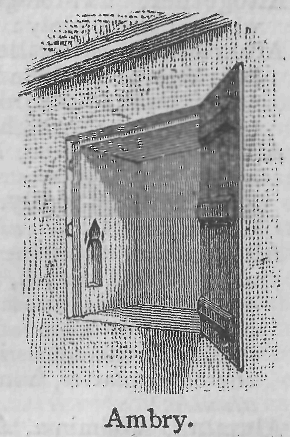
Ambry, am′bri, n. a niche in churches in which the sacred utensils were kept: a cupboard for victuals. [O. Fr. armarie, a repository for arms (Fr. armoire, a cupboard)—L. armarium, a chest for arms—arma, arms.]
Ambs-ace, āmz′-ās, n. double ace: the lowest possible throw at dice: ill-luck: worthlessness. [O. Fr. ambes as—L. ambas as. See Ace.]
Ambulacrum, am-bū-lā′krum, n. a row of pores in the shell of an echinoderm, as a sea-urchin, through which the tube-feet protrude.—adj. Ambulā′cral. [L., a walk—ambulāre, to walk.]
Ambulance, am′būl-ans, n. a carriage which follows an army and serves as a movable hospital for the wounded—also used as an adj., as in ambulance wagon.—n. Ambulan′cier, a man attached to an ambulance.—adj. Am′bulant, walking: moving from place to place: (rare) unfixed.—v.t. and v.i. Am′bulate (rare), to walk.—p.adj. Am′bulating.—n. Ambulā′tion.—adj. Am′bulatory, having the power or faculty of walking: moving from place to place, not stationary: mutable.—n. any part of a building intended for walking in, as the aisles of a church, or the cloisters of a monastery: any kind of corridor. [Fr.—L. ambulans, -antis, pr.p. of ambulāre, to walk about.]
Ambuscade, am′busk-ād, n. a hiding to attack by surprise: a body of troops in concealment: the hidden place of ambush—used also as a verb.—n. Ambuscā′do, a now archaic form of Ambuscade (common in 17th century):—pl. Ambuscā′does. [Fr. embuscade. See Ambush.]
Ambush, am′boosh, n. and v. same meanings as Ambuscade.—n. Am′bushment (B.), ambush. [O. Fr. embusche (mod. embûche), embuscher, Low L. emboscāre—in-, in, and boscus, a bush.]
Ameer, or Amere, a-mēr′, n. a title of honour, also of an independent ruler in Mohammedan countries. [Ar. amīr. See Admiral.]
Ameliorate, a-mēl′yor-āt, v.t. to make better: to improve.—v.i. to grow better.—n. Ameliorā′tion, the condition of being made better: improvement or the means of such.—adj. Amel′iorative. [L. ad, to, and melior, better.]
Amen, ā′men′, or ä′men′, interj. so let it be!—v.t. to say amen to anything, to ratify solemnly. [Gr.—Heb. āmēn, firm, true.]
Amenable, a-mēn′a-bl, adj. easy to be led or governed: liable or subject to.—ns. Amenabil′ity, Amen′ableness.—adv. Amen′ably. [Fr. amener, to lead—a = L. ad, and mener, to lead—Low L. mināre, to lead, to drive (as cattle)—L. mināri, to threaten.]
Amenage, am′e-nāj, v.t. (Spens.) to manage. [O. Fr. amenager. See Manage.]
Amenance, am′e-nans, n. (Spens.) conduct, behaviour. [O. Fr. amenance, from root of Amenable.]
Amend, a-mend′, v.t. to correct: to improve: to alter in detail, as a bill before parliament, often so fundamentally as to overthrow entirely the thing originally proposed.—v.i. to grow or become better.—adjs. Amend′able, Amend′atory, corrective.—n. Amend′ment, correction: improvement: an alteration proposed on a bill under consideration: a counter-proposal put before a public meeting: a counter-motion.—n.pl. Amends′, supply of a loss: compensation: reparation. [Fr. amender for emender—L. emendāre, to remove a fault—e, ex, out of, and menda, a fault.]
Amende, ä-mend′, n. a fine, penalty.—Amende honorable, a public confession and apology made for any offence. [Fr. See Amend.]
Amenity, am-en′i-ti, n. pleasantness, as regards situation, climate, manners, or disposition. [Fr. aménité—L. amœnitas—amœnus, pleasant, from root of am-āre, to love.]
Amenorrhœa, Amenorrhea, a-men-ō-rē′a, n. absence of menstruation. [From Gr. a, priv., mēn, month, roia, a flowing.]
Amentum, a-men′tum, Ament, am′ent, n. a scaly sort of spike, as of the willow: a catkin:—pl. Amen′ta.—adjs. Amentā′ceous, Amen′tal. [L. amentum, thong.]
Amerce, a-mėrs′, v.t. to punish by a fine: to deprive of anything, or inflict loss upon.—n. Amerce′ment, a penalty inflicted—also Amerc′iament. [O. Fr. amercier, to impose a fine—L. merces, wages, fine.]
American, a-mer′ik-an, adj. pertaining to America, esp. to the United States.—n. a native of America.—v.t. Amer′icanise, to render American.—n. Amer′icanism, a custom, characteristic, word, phrase, or idiom peculiar to Americans: condition of being an American citizen: devotion to American institutions. [From America, so called unfairly from Amerigo Vespucci, a navigator who explored a small part of South America seven years after the first voyage of Columbus.]
Amethyst, a′meth-ist, n. a bluish-violet variety of quartz of which drinking cups used to be made, which the ancients supposed prevented drunkenness.—adj. Amethyst′ine, [Gr. amethystos—a, neg., methy-ein, to be drunken—methū, wine, cog. with Eng. mead, Sans. madhu, sweet.]
Amiable, ām′i-a-bl, adj. lovable: worthy of love: of sweet disposition.—ns. Amiabil′ity, Am′iableness, quality of being amiable, or of exciting love.—adv. Am′iably. [O. Fr. amiable, friendly—L. amicabilis, from amicus, a friend; there is a confusion in meaning with O. Fr. amable (mod. Fr. aimable), lovable—L. amabilis—am-āre, to love.]
Amiantus, a-mi-ant′us, n. the finest fibrous variety of asbestos—it can be made into cloth which when stained is readily cleansed by fire.—Also Amianth′us. [Gr. amiantos, unpollutable—a, neg.,and miain-ein, to soil.]
Amicable, am′ik-a-bl, adj. friendly.—ns. Amicabil′ity, Am′icableness.—adv. Am′icably. [L. amicabilis—amicus, a friend, am-āre, to love.]
Amice, am′is, n. a flowing cloak formerly worn by priests and pilgrims: a strip of fine linen, with a piece of embroidered cloth sewn upon it, worn formerly on the head, now upon the shoulders, by Roman Catholic priests in the service of the Mass. [O. Fr. amit—L. amictus, amic-ĕre, to wrap about—amb, about, and jac-ĕre, to throw.]
Amice, am′is, n. a furred hood with long ends hanging down in front, originally a cap or covering for the head, afterwards a hood, or cape with a hood, later a mere college hood. [O. Fr. aumuce, of doubtful origin; but at any rate cog. with Ger. mutse, mütze, Scot. mutch.]
Amid, a-mid′, Amidst, a-midst′, prep. in the middle or midst: among.—adv. Amid′most (W. Morris), in the very middle of.—adv. and n. Amid′ships, half-way between the stem and stern of a ship, [a, on, and Mid.]
Amide, am′īd, n. one of the compound ammonias derived from one or more molecules of common ammonia, by exchanging one or more of the three hydrogen atoms for acid radicals of equivalent acidity.
Amine, am′īn, n. one of the compound ammonias, in which one or more of the three hydrogen atoms in ammonia are exchanged for alcohol or other positive radicals, or for a metal.
Amildar, am′il-dar, n. a factor or manager in India: a collector of revenue amongst the Mahrattas. [Hind. ‛amaldār—Ar. ‛amal, work.]
Amir, a-mēr′. Same as Ameer.
Amiss, a-mis′, adj. in error: wrong.—adv. in a faulty manner.—n. Amiss′ibility.—adjs. Amiss′ible; Amiss′ing, wanting, lost. [a, on, and Miss, failure.]
Amity, am′i-ti, n. friendship: good-will. [Fr. amitié—ami—L. amicitia, friendship, amicus, a friend. See Amicable.]
Ammiral, an old spelling of Admiral.
Ammonia, am-mōn′i-a, n. a pungent gas yielded by smelling-salts, burning feathers, &c.: a solution of ammonia in water (properly liquid ammonia): a name of a large series of compounds, analogous to ammonia, including amines, amides, and alkalamides.—adjs. Ammon′iac, Ammonī′acal, pertaining to, or having the properties of, ammonia.—ns. Ammon′iac, Ammonī′acum, a whitish gum resin of bitter taste and heavy smell, the inspissated juice of a Persian umbelliferous plant—used in medicine for its stimulant and expectorant qualities; Ammon′iaphone, an instrument invented about 1880, said to improve the quality of the singing and speaking voice, being an apparatus for inhaling peroxide of hydrogen and free ammonia.—adj. Ammōn′iated, containing ammonia.—n. Ammon′ium, the hypothetical base of ammonia. [From sal-ammoniac, or smelling-salts, first obtained by heating camel's dung in Libya, near the temple of Jupiter Ammon.]
Ammonite, am′mon-īt, n. the fossil shell of an extinct genus of molluscs, so called because they resemble the horns on the statue of Jupiter Ammon, worshipped as a ram.
Ammunition, am-mūn-ish′un, n. anything used for munition or defence: military stores, formerly of all kinds (as still in the word used adjectively, as in ammunition wagon, &c.), now esp. powder, balls, bombs, &c.—v.t. to supply with ammunition. [O. Fr. amunition. See Munition.]
Amnesia, am-nē′si-a, n. loss of memory. [Gr. amnesia]
Amnesty, am′nest-i, n. a general pardon of political offenders: an act of oblivion.—v.t. to give amnesty to. [Gr. a-mnestos, not remembered.]
Amnion, am′ni-on, n. the innermost membrane enveloping the embryo of reptiles, birds, and mammals. [Gr.—amnos, a lamb.]
Amœba, a-mēb′a, n. a name given to a number of the simplest animals or Protozoa, which consist of unit masses of living matter. They flow out in all directions in blunt processes (pseudopodia, 'false feet'), and have thus an endlessly varying form, hence the name:—pl. Amœb′æ.—adjs. Amœb′iform, Amœb′oid. [Gr. amoibē, change.]
Amœbæan, am-e-bē′an, adj. answering alternately, responsive, as in some of Virgil's eclogues. [L.—Gr. amoibaios, amoibē, change, alternation.]
Amomum, a-mō′mum, n. a genus of herbaceous tropical plants (nat. ord. Scitamineæ), allied to the ginger-plant, several species yielding the cardamoms and grains of paradise of commerce. [Gr. amōmon.]
Among, a-mung′, Amongst, a-mungst′, prep. of the number of: amidst. [A.S. on-gemang—mengan, to mingle.]
Amontillado, a-mon-til-yä′do, n. a dry or little sweet kind of sherry of a light colour and body. [Sp.]
Amoret, am′or-et, n. (obs.) a sweetheart. [O. Fr. amorette—L. amor-em.]
Amoretto, am-or-et′to, n. a lover: a cupid:—pl. Amoret′ti. [It.]
Amornings, a-morn′ingz, adv. (obs.) of mornings. [Of and Morning.]
Amoroso, am-or-ro′so, adj. (mus.) tender: descriptive of love.—n. one in love, a gallant:—pl. Amorō′si.—n. Amorō′sity (rare), fondness.
Amorous, am′or-us, adj. easily inspired with love: fondly in love (with of): relating to love.—n. Am′orist, a lover: a gallant.—adv. Am′orously.—n. Am′orousness. [O. Fr. amorous (Fr. amoureux)—L. amoros-um, amor, love.]
Amorpha, a-mor′fa, n. a genus of North American shrubs of the bean family, the false indigoes or lead-plants—also bastard or wild indigo.
Amorphism, a-mor′fizm, n. a state of being amorphous or without crystallisation even in the minutest particles.—adj. Amor′phous, without regular shape, shapeless, uncrystallised. [Gr. a, neg., morphē, form.]
Amort, a-mort′, adj. (obs. or arch. merely) spiritless, dejected.—n. Amortisā′tion.—v.t. Amort′īse, to alienate in mortmain: to convey to a corporation:—pr.p. amort′īsing; pa.p. amort′īsed. [Fr. à, to, mort, death. See Mortal.]
Amount, a-mownt′, v.i. to mount or rise to: to result in: to come in meaning or substance to (with to).—n. the whole sum: the effect or result. [O. Fr. amonter, to ascend—L. ad, to, mont, mons, a mountain.]
Amour, am-ōōr′, n. a love intrigue, or illicit affection: a love affair (humorously only, for the old innocent sense is now obsolete).—n. Amourette′, a petty love affair: the love-grass, or quaking-grass: a cupid.—Amour propre, self-esteem ready to take offence at slights. [Fr.—L. amor, love.]
Amove, a-mōōv′, v.t. (Spens.) to stir up: to affect:—pr.p. amov′ing; pa.p. amoved′. [L. admovēre—ad, to, and mov-ēre, to move.]
Amove, a-mōōv′, v.t. to remove, esp. from a place (obsolete except in law). [O. Fr. amover—L. amovēre, ab, from, mov-ēre, to move.]
Ampère, am-pehr′, n. in electricity, unit of current. [From Ampère, a French electrician who died in 1836.]
Ampersand, am′pėrs-and, n. a name formerly in use for the character & (also called short and), commonly placed at the end of the alphabet in primers.—Also Am′perzand, Am′pussy-and, and simply Am′passy. [A corr. of and per se and—that is, & standing by itself means and.]
Amphibalus, am-fib′a-lus, n. an ecclesiastical vestment like the chasuble. [L.—Gr., from amphi, around, ball-ein, to cast.]
Amphibia, am-fib′i-a, Amphibials, Amphibians, n.pl. animals capable of living both under water and on land.—n. Amphib′ian.—adj. Amphib′ious. [L.—Gr., from amphi, both, bios, life.]
Amphibole, am-fib′ol-ē, n. the name of a group of minerals which are essentially silicates of lime and magnesia, but these bases are often partly replaced by alumina, and oxides of iron and manganese—tremolite, nephrite (jade), and hornblende. [Gr.]
Amphibology, am-fib-ol′o-ji, n. the use of ambiguous phrases or such as can be construed in two senses. A good example is Shakespeare's 'The duke yet lives that Henry shall depose' (2 Henry VI., I. iv. 33)—also Amphib′oly.—adjs. Amphib′olous, Amphibol′ic. [Gr., from amphi, on both sides, ball-ein, to throw.]
Amphibrach, am′fi-brak, n. in prosody, a foot of three syllables—a short, a long, and a short, as ămārĕ. The name is sometimes applied in English to such a word as amusement, where an accented syllable falls between two unaccented. [L.—Gr., made up of Gr. amphi, on each side, brachys, short.]
Amphictyonic, am-fik-ti-on′ik, adj. The Amphictyonic Council was an old Greek assembly composed of deputies (Amphictyons) from twelve of the leading states.—n. Amphic′tyony, an association of such states. [Gr. amphiktyones, 'those dwelling around.']
Amphimacer, am-fim′a-sėr, n. in prosody, a foot of three syllables, the middle one short, and the first and last long, as cārĭtās. Sometimes applied to such Eng. words as runaway. [Gr., 'long at both ends;' amphi, on both sides, makros, long.]
Amphioxus, am-fī-oks′us, n. the lancelet, one of the lowest backboned animals, found on the sandy coasts of warm and temperate seas. The body is about two inches long and pointed at both ends. [Gr. amphi, on both sides, and oxys, sharp.]
Amphipods, am′fi-pods, n. an order of small sessile-eyed crustaceans—a familiar example is the sand-hopper. [Gr. amphi, both ways, pous, podos, a foot.]
Amphisbæna, am-fis-bē′na, n. a family of lizard-snakes, chiefly found in tropical America, which have their tails so rounded as to give them the appearance of having a head at both ends.—adj. Amphisbē′nic. [Gr. amphisbaina—amphi, amphis, both ways, and bain-ein, to go.]
Amphiscians, am-fish′i-anz, n.pl. the inhabitants of the torrid zone, whose shadows are thrown both ways—that is, to the north one part of the year, and to the south the other part, according as the sun is north or south of the equator. [Gr. amphiskios—amphi, both ways, skia, a shadow.]
Amphistomous, am-fis′tō-mus, adj. having a mouth-like orifice at either end, as some parasitic worms. [Gr., amphistomos, double mouthed.]
Amphitheatre, am-fi-thē′a-tėr, n. an oval or circular edifice having rows of seats one above another, around an open space, called the arena, in which public spectacles are exhibited: anything like an amphitheatre in form.—adjs. Amphitheat′rical, Amphitheat′ral.—adv. Amphitheat′rically. [Gr. amphi, round about, theatron, a place for seeing—theaomai, to see.]
Amphitryon, am-fit′ri-on, n. a host or entertainer. [From Amphitryon in Molière's comedy, who gives a great dinner. Amphitryon in Gr. mythology was husband of Alcmene, who was deceived by Zeus in her husband's semblance, and so became the mother of Hercules.]
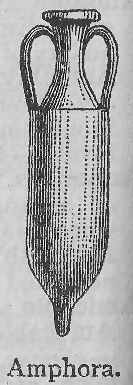
Amphora, am′fō-ra, n. a two-handled vessel or jar used by the Greeks and Romans for holding liquids.—adj. Am′phoric (med.), like the sound produced by speaking into an amphora or any large vessel with a small mouth. [Gr. amphoreus, amphiphoreus—amphi, on both sides, pher-ein, to bear.]
Ample, am′pl, adj. spacious: large enough: abundant: liberal: copious, or of great length.—ns. Am′pleness; Ampliā′tion, enlarging, an enlargement.—adj. Ampliā′tive (rare).—adv. Am′ply. [Fr.—L. amplus, large.]
Amplexicaul, am-pleks′i-kawl, adj. (bot.) nearly surrounding the stem—said of sessile leaves. [Modern L. amplexicaulis—L. amplexus, embrace, and caulis, stem.]
Amplify, am′pli-fī, v.t. to make more copious in expression: to add to.—n. Amplificā′tion, enlargement.—adj. Amplificā′tory.—n. Am′plifier, one who amplifies: a lens which enlarges the field of vision. [L. amplus, large, and fac-ĕre, to make.]
Amplitude, am′pli-tūd, n. largeness: abundance: width: splendour: wide range of mind: the distance from the east point of a horizon at which a heavenly body rises, or from the west point at which it sets. [Fr.—L. amplitudo.]
Ampul, am′pul, n. a small earthenware or glass vessel of an oblong globular form, used for containing consecrated oil or wine and water for the eucharistic service—now more commonly Ampul′la. [O. Fr. ampole—L. ampulla.]
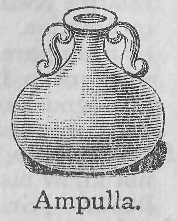
Ampulla, am-pul′la, n. a small two-handled flask or bottle for holding liquids or unguents: a vessel for holding consecrated oil or chrism, esp. at the coronation of kings: a kind of cruet of transparent glass for holding the wine and water used at the altar: (biol.) the dilated end of any canal or duct in an animal body, also the spongiole of a root in plants.—adjs. Ampullā′ceous, Am′pullar, Am′pullary, Am′pullate.—n. Ampullos′ity, turgidity of language, bombast. [L.; made up of amb, on both sides, and olla, a jar; or an irregular dim. of amphora, a flagon.]
Amputate, am′pūt-āt, v.t. to cut off, as a limb of an animal.—n. Amputā′tion. [L. amb, round about, putāre, to cut.]
Amrita, am-rē′ta, n. the drink of the gods in Hindu mythology. [Sans.]
Amuck, a-muk′, adv. madly: in murderous frenzy—hardly ever used save in the phrase 'to run amuck.' [Malay, amoq, intoxicated or excited to madness.]
Amulet, am′ū-let, n. a gem, scroll, or other object carried about the person, as a charm against sickness, harm, or witchcraft. [Fr.—L. amulētum, a word of unknown origin; curiously like the mod. Ar. himalat, lit. 'a carrier,' applied to a shoulder-belt, by which a small Koran is hung on the breast.]
Amuse, a-mūz′, v.t. to occupy pleasantly: to divert: to beguile with expectation: (obs.) occupy the attention with: (arch.) to beguile.—adj. Amus′able, capable of being amused.—n. Amuse′ment, that which amuses: pastime.—adj. Amus′ing, affording amusement: entertaining.—adv. Amus′ingly.—n. Amus′ingness.—adj. Amus′ive (rare), having the power to amuse or entertain.—n. Amus′iveness. [Fr. amuser.]
Amusette, am-ū-zėt′, n. a light field-gun invented by Marshal Saxe. [Fr.]
Amutter, a-mut′ėr, adv. in a muttering state.
Amygdalate, a-mig′da-lāt, adj. pertaining to, like, or made of almonds.—adj. Amygdalā′ceous, akin to the almond. [L. amygdala—Gr. amygdalē, an almond.]
Amygdalin, Amygdaline, a-mig′da-lin, n. a crystalline principle existing in the kernel of bitter almonds.
Amygdaloid, a-mig′da-loid, n. a variety of basaltic rock containing almond-shaped nodules of other minerals, as quartz, felspar.—adj. Amygdaloi′dal. [Gr. amygdalē, and eidos, form.]
Amyl, am′il, n. the fifth in the series of the alcohol radicals, a natural product of the distillation of coal. As thus found, two molecules are united together, usually called diamyl, being a colourless liquid with an agreeable smell and burning taste.—n. Am′ylene. [Gr. amylon, starchy, fine meal.]
Amylaceous, am-i-lā′shus, adj. pertaining to or resembling starch. [L. amylum, starch—Gr. amylon.]
Amyloid, am′i-loid, n. a half-gelatinous substance like starch, found in some seeds.—adj. Amyloid′al. [Gr. amylon, the finest flour, starch; lit. 'unground'—a, neg., mylē, a mill, and eidos, form.]
An, an, adj. one: the indefinite article, used before words beginning with the sound of a vowel. [A.S. ān. See One.]
An, an, conj. if. [A form of And.]
Ana, ā′na, a suffix to names of persons or places, denoting a collection of memorable sayings, items of gossip, or miscellaneous facts, as Johnsoniana, Tunbrigiana, &c.: applied also to the literature of some special subject, as Boxiana, Burnsiana, Shakespeariana.—n.pl. specially a collection of the table-talk of some one. [The neut. pl. termination of L. adjectives in -anus = pertaining to.]
Anabaptist, an-a-bapt′ist, n. one who holds that baptism ought to be administered only to adults (by immersion), and therefore that those baptised in infancy ought to be baptised again.—The name is disclaimed by recent opponents of infant baptism both in England and the Continent.—v.i. Anabap′tise.—n. Anabapt′ism.—adj. Anabaptist′ic. [Gr. ana, again, baptiz-ein, to dip in water, to baptise.]
Anabasis, an-ab′a-sis, n. a military advance into the interior of a country—specially the title of the famous story of the unfortunate expedition of Cyrus the Younger against his brother Artaxerxes, and of the retreat of his 10,000 Greek allies under the conduct of Xenophon. [Gr.; made up of ana, up, and bain-ein, to go.]
Anableps, an′a-bleps, n. a genus of bony fishes with open air-bladders, and projecting eyes divided into an upper and lower portion, so that each eye has two pupils. [Gr. anablepsis, 'a looking up.']
Anabolism, an-ab′ol-izm, n. the constructive processes within the protoplasm, by which food or other material, at a relatively low level, passes through an ascending series of ever more complex and unstable combinations, till it is finally worked up into living matter. [Gr. anabolē, 'rising up.']
Anacanthous, an-a-kan′thus, adj. without spine. [Gr. an-, without, akantha, spine.]
Anacard, an′a-kard, n. the cashew-nut, the fruit of the Anacardium occidentale. [Gr., made up of ana, according to, and kardia, heart, from the shape of the fruit.]
Anacatharsis, an-a-kath-ar′sis, n. vomiting or expectoration.—n. Anacathar′tic, a medicine with this effect—expectorants, emetics, sternutatorics, &c. [Gr.; made up of ana, up, and kathair-ein, to cleanse.]
Anacharis, an-ak′ar-is, n. a North American weed found in ponds and slow streams, which was first found in Britain in 1842, and is now very troublesome in the Trent, Derwent, and other rivers. [Made up of Gr. ana, up, and charis, grace.]
Anachorism, a-nak′ō-rizm, n. (rare) something incongruous with the spirit of the country. [Coined on the analogy of anachronism, from Gr. ana, back, and chōrion, country, with suff. ism.]
Anachronism, an-a′kron-izm, n. an error in regard to time, whereby a thing is assigned to an earlier or to a later age than it belongs to: anything out of keeping with the time.—v.t. Ana′chronise.—n. Ana′chronist.—adjs. Anachronist′ic, Ana′chronous.—adv. Ana′chronously. [Gr. ana, backwards, chronos, time.]
Anaclastic, an-a-klas′tik, adj. pertaining to refraction: bending back. [Gr. ana, back, klaein, break off.]
Anacoluthon, an-a-ko-lū′thon, n. want of sequence in the construction of a sentence, when the latter part does not grammatically correspond with the former: a sentence exhibiting an Anacoluthia, or the passing from one construction to another before the former is completed. [Gr. anakolouthos—a, an, neg., and akolouthos, following.]
Anaconda, an-a-kon′da, n. a large South American water-snake of the Python family, closely related to the boa-constrictor. [Singhalese (?).]
Anacreontic, an-a-kre-ont′ik, adj. after the manner of the Greek poet Anacreon: free, convivial, erotic.—n. a poem in this vein.—adv. Anacreont′ically.
Anacrusis, an-a-krōō′sis, n. (pros.) an upward beat at the beginning of a verse, consisting of one or two unaccented syllables introductory to the just rhythm. [Gr. from ana, up, krou-ein, to strike.]
Anadem, an′a-dem, n. a band or fillet bound round the head: a wreath or chaplet of flowers. [Gr. anadēma—ana, up, and de-ein, to bind.]
Anadromous, an-ad′rō-mus, adj. ascending rivers to spawn. [Gr. ana, up, dromos, running.]
Anæmia, an-ēm′i-a, n. a term employed to denote those conditions in which there is a deficiency of blood or of its red corpuscles: lack or poverty of blood marked by paleness and languor.—adj. Anæm′ic. [Gr.; made up of an, neg., haima, blood.]
Anaerobia, an-ā-ėr-ō′bi-a, n.pl. (biol.) bacteria which flourish without free oxygen.—adj. Anaerō′bic.
Anæsthetic, an-ēs-thet′ik, adj. producing insensibility to external impressions.—n. a substance, as chloroform or cocaine, that produces insensibility, whether general or local.—ns. Anæsthē′sia, Anæsthē′sis, loss of feeling, insensibility.—adv. Anæsthet′ically.—v.t. Anæs′thetise. [Gr. a, an, neg., aisthēsis, sensation—aisthanomai, to feel.]
Anaglyph, an′a-glif, n. an ornament carved in low relief.—adj. Anaglypt′ic. [Gr.; ana, up, glyph-ein, to carve.]
Anaglyptography, an-a-glip-tog′ra-fi, n. the art of engraving so as to give the subject the appearance of being raised from the surface of the paper as if embossed—used in representing coins, &c. [Gr. anaglyptos, embossed, and graphia, writing.]
Anagogy, an′a-goj-i, n. the mystical interpretation or hidden sense of words.—adjs. Anagog′ic, Anagog′ical.—adv. Anagog′ically. [Gr. anagōgē, elevation, an-ag-ein, to lift up.]
Anagram, an′a-gram, n. a word or sentence formed by rewriting (in a different order) the letters of another word or sentence: as, 'live' = 'evil,' 'Quid est veritas? = 'Est vir qui adest,' and 'Florence Nightingale' = 'Flit on, cheering angel.'—Many pseudonyms are merely anagrams, as 'Voltaire' = 'Arouet l. i.'—that is, 'Arouet le jeune (the younger).'—adjs. Anagrammat′ic, Anagrammat′ical.—adv. Anagrammat′ically.—v.t. Anagram′matīse, to transpose, so as to form an anagram.—ns. Anagram′matism, the practice of making anagrams; Anagram′matist, a maker of anagrams. [Gr. ana, again, graph-ein, to write.]
Anagraph, an′a-graf, n. a catalogue or inventory: a description. [Gr. anagraphē—ana, up, out, graph-ein, to write.]
Anal, ān′al, adj. pertaining to or near the anus.
Analects, an′a-lekts, n.pl. collections of literary fragments—also Analec′ta.—adj. Analec′tic. [Gr. analektos—analegein, to collect—ana, up, legein, to gather.]
Analeptic, an-a-lep′tik, adj. restorative: comforting. [Gr. analēptikos, restorative—analēpsis, recovery—ana, up, and lambanō, lēpsomai, to take.]
Analgesia, an-al-jē′zi-a, n. painlessness, insensibility to pain. [Gr. an-, priv., and algein, to feel pain.]
Analogy, an-al′o-ji, n. an agreement or correspondence in certain respects between things otherwise different—a resemblance of relations, as in the phrase, 'Knowledge is to the mind what light is to the eye:' relation in general: likeness: (geom.) proportion or the equality of ratios: (gram.) the correspondence of a word or phrase with the genius of a language, as learned from the manner in which its words and phrases are ordinarily formed: similarity of derivative or inflectional processes.—adjs. Analog′ical, Anal′ogic.—adv. Analog′ically.—v.t. Anal′ogise, to explain or consider by analogy:—pr.p. anal′ogīsing; pa.p. anal′ogīsed.—ns. Anal′ogism (obs.), investigation by analogy: argument from cause to effect; Anal′ogist, one who adheres to analogy; Anal′ogon = analogue.—adj. Anal′ogous, having analogy: bearing some correspondence with or resemblance to: similar in certain circumstances or relations (with to).—adv. Anal′ogously.—ns. Anal′ogousness; An′alogue, a word or body bearing analogy to, or resembling, another: (biol.) a term used to denote physiological, independent of morphological resemblance.—Organs are analogous to one another, or are analogues, when they perform the same function, though they may be altogether different in structure; as the wings of a bird and the wings of an insect. Again, organs are homologous, or homologues, when they are constructed on the same plan, undergo a similar development, and bear the same relative position, and this independent of either form or function. Thus the arms of a man and the wings of a bird are homologues of one another, while the wing of a bird and the wing of a bat are both analogous and homologous. [Gr. ana, according to, and logos, ratio.]
Analphabete, an-al′fa-bēt, n. and adj. one who does not know his alphabet, an illiterate.—adj. Analphabet′ic. [Gr. an, neg., and Alphabet.]
Analysis, an-al′is-is, n. a resolving or separating a thing into its elements or component parts—the tracing of things to their source, and so discovering the general principles underlying individual phenomena. Its converse is synthesis, the explanation of certain phenomena by means of principles which are for this purpose assumed as established. Analysis as the resolution of our experience into its original elements, is an artificial separation; while synthesis is an artificial reconstruction: (gram.) the arrangement into its logical and grammatical elements of a sentence or part of a sentence:—pl. Anal′yses.—adj. Analys′able.—n. Analysā′tion.—v.t. An′alyse, to resolve a whole into its elements: to separate into component parts.—n. An′alyst, one skilled in analysis, esp. chemical analysis.—adjs. Analyt′ic, -al, pertaining to analysis: resolving into first principles.—adv. Analyt′ically.—n.pl. Analyt′ics, the name given by Aristotle to his treatises on logic.—Analytical geometry, geometry treated by means of ordinary algebra, with a reference, direct or indirect, to a system of co-ordinates; Analytic method (logic) proceeds regressively or inductively to the recognition of general principles, as opposed to the Synthetic method, which advances from principles to particulars. [Gr. analysis, analy-ein, to unloose, ana, up, ly-ein, to loose.]
Anamnesis, an-am-nēs′is, n. the recalling of things past to memory: the recollection of the Platonic pre-existence: the history of his illness given by the patient to his physician. [Gr.]
Anamorphosis, an-a-mor′fo-sis, n. a figure, appearing from one view-point irregular or deformed, but from another regular and in proportion: (bot.) a gradual transformation, or an abnormal development of any part.—adj. Anamor′phous. [Gr.; ana, back, morphōsis, a shaping—morphē, shape.]