LIST OF ABBREVIATIONS USED IN THIS DICTIONARY. (continued 8)
Reading edition
Boil, boil, n. an inflamed swelling or tumour. [A.S. býl; Ger. beule.]
Boisterous, bois′tėr-us, adj. wild: noisy: turbulent: stormy.—adv. Bois′terously.—n. Bois′terousness. [M. E. boistous, approximating, but not in sense, to the O. Fr. boisteus, whence modern boiteux, lame. The Celtic words throw no light upon its origin.]
Bolas, bō′las, n. missiles used by the South American gauchos, consisting of balls or stones strung together, swung round the head and hurled, usually so as to entangle the legs of an animal running. [Sp.]
Bold, bōld, adj. daring or courageous: forward or impudent: presumptuous: executed with spirit: striking to the sight, well marked: steep or abrupt.—v.t. Bold′en (obs.), to make bold.—adj. Bold′faced, impudent.—adv. Bold′ly.—n. Bold′ness.—To make bold, to take the liberty, to make free. [A.S. bald; Old High Ger. bald, Ice. ballr.]
Bole, bōl, n. the round stem or body of a tree. [Scand. bolr; Ger. bohle, a plank.]
Bole, bōl, n. an earthy mineral resembling clay in structure, and consisting essentially of silica, alumina, red oxide of iron, and water; the bole of Lemnos, Lemnian Earth, is red in colour, and was once used as a tonic and astringent medicine. [Gr. bōlos, a clod.]
Bole, bōl, n. a recess in a wall: an opening to admit light and air. [Scot.; origin unknown.]
Bolero, bo-lā′ro, or bo-lē′ro, n. Spanish national dance: also the air to which it is danced. [Sp.]
Boletus, bol-ē′tus, n. a genus of fungi, having a pore-like surface occupying the place of gills. [Gr. bōlitēs, mushroom.]
Bolide, bol′īd, n. a large meteor or fireball. [Fr.—L. bolid-em, bolis—Gr. bolis, ballein, to throw.]
Bolin, an obsolete form of Bowline.
Boll, bōl, n. one of the round heads or seed-vessels of flax, poppy, &c.: a pod or capsule.—p.adjs. Bolled (bōld), swollen, podded; Bollen (bōln), swollen (Shak.). [A form of Bowl; A.S. bolla.]
Boll, bōl, n. a measure of capacity for grain, &c., used in Scotland and the north of England—in Scotland = 6 imperial bushels; in England, varying from 2 to 6 bushels: also a measure of weight, containing, for flour, 140 lb. [Scot. bow; prob. a Scand. word; cf. Ice. bolli.]
Bollandist, bol′an-dist, n. one of the Jesuit writers who continued the Acta Sanctorum (q.v.), begun by John Bolland (1596-1665).
Bollard, bol′ard, n. a post on a wharf to which vessels are secured: a thick piece of wood on the forepart of a whale-boat, round which the line is turned when a whale is harpooned. [Prob. Bole.]
Bologna, bol-ōn′ya, adj. from a town of Italy, which gives its name to Bologna phial, Bologna phosphorus, and Bologna or 'Polony' sausages.—adj. Bologn′ese.
Bolometer, bō-lom′e-tėr, n. an instrument for measuring minute amounts of radiant heat. [Gr. bolē, ray (ballein, to throw), metron, a measure.]
Bolster, bōl′stėr, n. a long round pillow or cushion: a pad: anything resembling it in form or use, esp. any piece of mechanism affording a support against pressure.—v.t. to support with a bolster: to hold up.—p.adj. Bol′stered, supported: swelled out.—n. Bol′stering, a propping up or supporting. [A.S. bolster; from root of Bowl.]
Bolt, bōlt, n. a bar or pin used to fasten a door, &c.: an arrow: a thunderbolt, as in 'a bolt from the blue.'—v.t. to fasten with a bolt: to throw or utter precipitately: to expel suddenly: to swallow hastily.—v.i. to rush away (like a bolt from a bow): to start up: (U.S.) to break away from one's political party.—ns. Bolt′-head, the head of a bolt: a chemical flask; Bolt′-rope, a rope sewed all round the edge of a sail to prevent it from tearing; Bolt′sprit (same as Bowsprit).—adv. Bolt′-up′right, upright and straight as a bolt or arrow.—n. Bolt′-up′rightness. [A.S. bolt; Old High Ger. bolz.]
Bolt, bōlt, v.t. (better spelling, Boult), to sift, to separate the bran from, as flour: to examine by sifting: to sift through coarse cloth.—ns. Bolt′er, a sieve: a machine for separating bran from flour; Bolt′ing, the process by which anything is bolted or sifted; Bolt′ing-hutch, a hutch or large box into which flour falls when it is bolted. [O. Fr. bulter, or buleter = bureter, from bure—Low L. burra, a coarse reddish-brown cloth—Gr. pyrros, reddish.]
Bolus, bō′lus, n. a rounded mass of anything: a large pill. [L. bolus—Gr. bōlos, a lump.]
Bomb, bom, or bum, n. a hollow projectile, usually of cast-iron, fired from a mortar, filled with gunpowder and fitted with a time-fuse: any similar missile or case of explosives, as a dynamite bomb.—n. Bom′bard, an engine or great gun for throwing bombs: (Shak.) a barrel or large vessel for holding liquor.—v.t. Bombard′, to attack with bombs.—ns. Bombardier′, the lowest non-commissioned officer in the British artillery, formerly a man employed about the mortars and howitzers; Bombard′ment; Bombar′don, a deep-toned brass instrument, with a tube likened to a bombard.—adj. Bomb′-proof, proof or secure against the force of bombs.—ns. Bomb′-shell (same as Bomb); Bomb′-vess′el, Bomb′-ketch, a vessel for carrying the mortars used in bombarding from the sea.—Bombardier beetle, a name given to several species of beetles, which discharge an acrid volatile fluid with explosive force from the abdomen. [Fr. bombe—L. bombus—Gr. bombos, a humming sound—an imitative word.]
Bombasine, Bombazine, bom′-, bum-ba-zēn′, n. a twilled or corded fabric of silk and worsted, or of cotton and worsted.—n. Bom′bax, a genus of silk-cotton trees, native to tropical America. [Fr. bombasin—Low L. bombasinum—Gr. bombyx, silk.]
Bombast, bom′-, bum′bast, n. inflated or high-sounding language: originally cotton or any soft material used for stuffing garments.—adj. Bombas′tic, high-sounding: inflated. [Low L. bombax, cotton—Gr. bombyx, silk.]
Bombax. See Bombasine.
Bombay-duck, bom-bā′-duk, n. a fish of the family Scopelidæ, nearly allied to the salmon and trout family, which is salted, dried, and eaten as a relish.
Bombyx, bom′biks, n. the silkworm. [Gr.]
Bon, bong, adj. good—French, occurring in some English but not Anglicised phrases, as Bon accord, good-will, agreement; Bon mot, a jest or smart saying; Bon ton, good style, the fashionable world; Bon vivant, one who lives well or luxuriously.
Bona fide, bō′na fīd′ā, adv. and adj. in good faith, with sincerity, genuine. [L.]
Bonanza, bon-an′za, n. a term common in the Pacific States for a rich mass of gold: any mine of wealth or stroke of luck. [Sp.]
Bonapartism, bō′na-pärt-izm, n. attachment to the dynasty of Napoleon Bonaparte, Emperor of the French.—n. Bō′napartist.
Bona-roba, bō′na-rō′ba, n. (Shak.) a showy wanton, a courtesan. [It. buona roba, lit. a fine gown.]
Bonbon, bong′bong, n. a sweetmeat.—n. Bonbon′iere, a fancy box for holding such. [Fr., 'very good'—bon, good.]
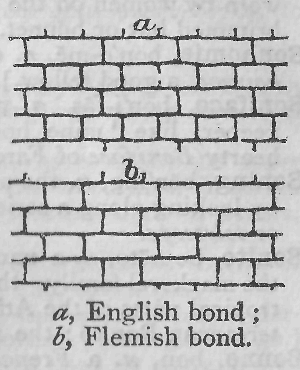
Bond, bond, n. that which binds, a band: link of connection or union: a writing of obligation to pay a sum or to perform a contract: any constraining or any cementing force: in building, the connection of one stone or brick with another, made by lapping the one over the other as the work is carried up, as in English bond, Flemish bond, &c.: (pl.) imprisonment, captivity.—adj. bound: in a state of servitude.—v.t. to put imported goods in the customs' warehouses till the duties on them are paid—hence Bonded stores or warehouses, To take out of bond, &c.—p.adj. Bond′ed, secured by bond, as duties.—ns. Bond′er, a binding stone or brick; Bond′-hold′er, a person who holds bonds of a private person or public company; Bond′ing, that arrangement by which goods remain in the customs' warehouses till the duties are paid; Bond′maid, Bond′woman, Bonds′woman, a woman-slave; Bond′man, a man-slave; Bond′manship; Bond′serv′ant, a slave; Bond′-serv′ice, the condition of a bond-servant: slavery; Bond′-slave, a slave; Bonds′man, a bondman or slave: a surety; Bond′-stone, a stone which reaches a considerable distance into or entirely through a wall for the purpose of binding it together; Bond′-tim′ber, timber built into a wall as it is carried up for the purpose of binding it together in a longitudinal direction.—Bonded debt, the debt of a corporation represented by the bonds it has issued, as contrasted with its floating debt. [A variant of band—A.S. bindan, to bind.]
Bondage, bond′āj, n. state of being bound: captivity: slavery.—n. Bond′ager, a female outworker in the Border and North country, whom the hind or married cottar was bound to provide for the farm-work. [O. Fr.; Low L. bondagium, a kind of tenure. Acc. to Skeat, this is from A.S. bonda, a boor, a householder, from Ice. bóndi = búandi, a tiller, a husbandman, búa, to till, cog. with A.S. búan.]
Bone, bōn, n. a hard substance forming the skeleton of mammalian animals: a piece of the skeleton of an animal: (pl.) the bones collectively: mortal remains: pieces of bone held between the fingers of the hand and rattled together to keep time to music: dice, as made of bone, ivory, &c.—v.t. to take the bones out of, as meat: to seize, to steal.—ns. Bone′-ache (Shak.), aching or pain in the bones; Bone′-ash, Bone′-earth, the remains when bones are burnt in an open furnace; Bone′-black, the remains when bones are heated in a close vessel.—adj. Boned—used in composition, as high-boned: having bones: having the bones removed.—ns. Bone′-dust, ground or pulverised bones, used in agriculture; Bone′-lace, lace woven with bobbins, which were frequently made of bone.—adj. Bone′less, wanting bones.—ns. Bone′-set′ter, one who treats broken bones without being a duly qualified surgeon; Bone′-shāk′er, a name familiarly given to the earlier forms of bicycle before india-rubber tires; Bone′-spav′in, a bony excrescence or hard swelling on the inside of the hock of a horse.—adj. Bon′y, full of, or consisting of, bones.—A bone of contention, something that causes strife; A bone to pick, something to occupy one, a difficulty, a grievance, controversy, dispute.—To make no bones of, to have no scruples in regard to something; To the bone, to the inmost part. [A.S. bán, Ger. bein.]
Bonfire, bon′fīr, n. a large fire in the open air on occasions of public rejoicing, &c.—originally a fire in which bones were burnt. [Not Fr. bon, good, and Fire.]
Bongrace, bon′grās, n. a shade from the sun once worn by women on the front of the bonnet: a broad-brimmed hat or bonnet. [Fr.]
Bonhomie, bon′o-mē, n. easy good-nature. [Fr.; bon homme, a good fellow.]
Boniface, bon′i-fās, n. a generic name for an innkeeper, like 'mine host' or 'landlord'—from the hearty Boniface of Farquhar's Beaux' Stratagem.
Boning, bōn′ing, n. the act of estimating straightness by looking along a series of poles, as in boning-rod or telescope.
Bonito, bo-nēto, n. a name given to several fishes of the mackerel family—the Stripe-bellied Tunny of the tropical parts of the Atlantic and Pacific; the Mediterranean Bonito; the Plain Bonito. [Sp.]
Bonne, bon, n. a French nursemaid. [Fr.; fem. of bon, good.]
Bonne-bouche, bon-bōōsh, n. a delicious morsel. [Fr.]
Bonnet, bon′et, n. a covering for the head worn by women, without a brim, tied on by strings, and now letting the whole face be seen, although formerly a bonnet (esp. a Poke′-bonn′et) covered the sides of the face: a soft cap: the velvet cap within a coronet: (fort.) a small work before the salient or flanked angle of the ravelin: (naut.) an additional part laced to the foot of jibs, or other fore-and-aft sails, to gather more wind: a wire-covering over a chimney-top: a decoy or pretended player or bidder at a gaming-table or an auction, the accomplice of a thimble-rigger or other petty swindler.—v.t. to put a bonnet on: to crush a man's hat over his eyes.—adj. and p.adj. Bonn′eted.—ns. Bonn′et-piece, a gold coin of James V. of Scotland, on which the king wears a bonnet instead of a crown; Bonn′et-rouge, the red cap of liberty of the French Revolution, shaped like a nightcap.—Bonnet laird, a Scotch name for a petty landowner who wore a bonnet, not the hat of the gentry.—Balmoral bonnet, a flat cap resembling the Scotch (Lowland) bonnet; Glengarry bonnet, rising to a point in front, with ribbons hanging down behind; Scotch bonnet, of a broad, round, flat shape, of dark-blue colour, with a tuft on the top, the fabric thick-milled woollen, without seam or lining—like the Basque béret. [O. Fr.—Low L. bonnetum, orig. the name of a stuff.]
Bonny, bon′i, adj. beautiful: handsome: gay: plump: pleasant-looking: as a general term expressing appreciation = considerable, &c., often ironically: cheerful: (Shak.) stout, strong.—adv. Bonn′ily, beautifully: gaily.—n. Bonn′iness, handsomeness: gaiety. [Fr. bon, bonne—L. bonus.]
Bonspiel, bon′spēl, n. a great curling-match. [Dr Murray suggests an assumed Dut. bondspel, from bond = verbond, 'covenant, alliance, compact,' and; spel, play; the word having entered Scotch as a whole, spiel, spel, having never been in common use for 'play.']
Bonus, bōn′us, n. a premium beyond the usual interest for a loan: an extra dividend to shareholders: an extra gratuity paid to workmen: a douceur or bribe. [L. bonus, good.]
Bonze, bon′ze, n. a Buddhist priest. [Jap. bonzó or bonzi, a priest.]
Boo, Booh, bōō, interj. a sound expressive of disapprobation or contempt.—v.i. to utter 'boo!' to hoot.—v.t. Boo′-hoo′, to weep noisily.
Booby, bōō′bi, n. a silly or stupid fellow: a sea-bird, of the gannet tribe, remarkable for its apparent stupidity in allowing itself to be knocked down with a stick.—adjs. Boo′by, Boo′byish, like a booby: stupid.—ns. Boo′byism; Boo′by-trap, a rude form of practical joke among boys, by which something is made to fall upon some one entering a door, or the like. [Sp. bobo, a dolt: may prob. be cog. with Ger. bube.]
Boodle, bōōd′l, n. a crowd, pack—'the whole boodle:' stock-in-trade, capital. [May be conn. with Dut. boedel.]
Boodle, bōōd′l, n. (slang) a stupid noodle.
Boody, bōōd′i, v.i. to sulk or mope. [Fr. bouder, to pout.]
Book, book, n. a collection of sheets of paper bound together, either printed, written on, or blank: a literary composition: a division of a volume or subject: the Bible: a betting-book, or record of bets made with different people: (fig.) any source of instruction: the libretto of an opera, &c.: (pl.) formal accounts of transactions, as minutes of meetings, records kept of his business by a merchant.—v.t. to write in a book.—ns. Book′-account′, an account of debt or credit in a book; Book′binder, one who binds books; Book′binding, the art or practice of binding or putting the boards on books; Book′-case, a case with shelves for books; Book′-club, an association of persons who buy new books for circulation among themselves; Book′-debt, a debt for articles charged by the seller in his book-account.—adj. Book′ful, full of information gathered from books.—ns. Book′-hold′er, one who holds the book of the play and prompts the actor in the theatre; Book′-hunt′er, one who rejoices in discovering rare books; Book′ing-of′fice, an office where names are booked or tickets are taken.—adj. Book′ish, fond of books: acquainted only with books.—ns. Book′ishness; Book′-keep′ing, the art of keeping accounts in a regular and systematic manner; Book′-land, land taken from the folcland or common land, and granted by bóc or written charter to a private owner; Book′-learn′ing, learning got from books, as opposed to practical knowledge.—adj. Book′less, without books, unlearned.—ns. Book′let, a small book; Book′-mak′er, one who makes up books from the writings of others, a compiler: one who makes a system of bets in such a way that the gains must exceed the losses, entering them in a memorandum book; Book′-mak′ing, the art or practice of compiling books from the writings of others: compilation: systematic betting; Book′-man, a scholar, student; Book′-mark, something placed in a book to mark a particular page or passage; Book′-mate (Shak.), a mate or companion in the study of books: a schoolfellow; Book′-mus′lin, muslin used in bookbinding; Book′-oath (Shak.), an oath made on the Book or Bible; Book′plate, a label usually pasted inside the cover of a book, bearing the owner's name, crest, coat-of-arms, or peculiar device; Book′-post, the department in the Post-office for the transmission of books; Book′seller, one who sells books; Book′selling; Book′shelf, a shelf on which books are placed; Book′shop, a shop where books are sold; Book′-stall, a stall or stand, generally in the open air, where books are sold; Book′-stand, a book-stall: a stand or support for holding up a book when reading; Book′-trade, the trade of dealing in books; Book′worm, a worm or mite that eats holes in books: a hard reader: one who reads without discrimination or profit.—To be upon the books, to have one's name in an official list; To bring to book, to bring to account; To take a leaf out of another's book, to follow the example of some one; To talk like a book, to talk pedantically, or in a preternaturally well-informed manner. [A.S. bóc, a book, the beech; Ger. buche, the beech, buch, a book, because the Teutons first wrote on beechen boards.]
Boom, bōōm, n. a pole by which a sail is stretched: a chain or bar stretched across a harbour. [Dut. boom, a beam, a tree.]
Boom, bōōm, v.i. to make a hollow sound or roar: to go on with a rush, to become suddenly prosperous.—v.t. to push anything into sudden prominence:—pa.p. boomed (bōōmd); pr.p. boom′ing.—n. a hollow roar, as of the sea, the cry of the bittern, &c.: a sudden increase of activity in business, or the like—often the direct consequence of puffing advertisements or less legitimate intrigues.—p.adj. Boom′ing, rushing with violence. [From a Low Ger. root found in A.S. byme, a trumpet, Dut. bommen, to drum; like Bomb, of imit. origin.]
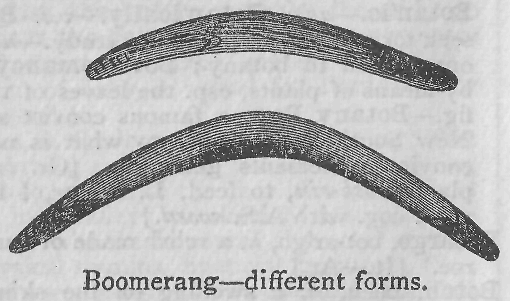
Boomerang, bōōm′e-rang, n. a hard-wood missile used by the natives of Australia, shaped like the segment of a circle, and so balanced that when thrown to a distance it returns towards the thrower. [Australian.]
Boon, bōōn, n. a petition: a gift or favour. [Ice. bôn, a prayer; A.S. ben.]
Boon, bōōn, adj. gay, merry, or kind. [Fr. bon—L. bonus, good.]
Boor, bōōr, n. a countryman, a peasant: a Dutch colonist in South Africa: a coarse or awkward person.—adj. Boor′ish, like a boor: awkward or rude.—adv. Boor′ishly.—n. Boor′ishness. [Dut. boer; Ger. bauer. The A.S. gebúr, a farmer, may explain the East Anglian bor, neighbour, as a form of address.]
Boord, an obsolete form of Board.
Boose. See Bouse.
Boot, bōōt, n. a covering for the foot and lower part of the leg generally made of leather: an infamous instrument of judicial torture, in which the legs were forced into a strong case and wedges driven in until bone, muscle, and marrow were crushed together—also Boot′ikin: a box or receptacle in a coach.—v.t. to put on boots.—n. Boot′-clos′er, one who closes the upper leathers of boots.—pa.p. Boot′ed, having boots on, equipped for riding.—ns. Boot′-hook, an instrument for pulling on long boots; Boot′hose (Shak.), hose or stockings used in place of boots; Boot′-jack, an instrument for taking off boots; Boot′lace, a lace for fastening boots; Boot′-last, Boot′-tree, the last or wooden mould on which boots or shoes are made or stretched to keep their shape.—adj. Boot′less, without boots: referring also, as in Tennyson's metaphorical use, 'wedded to a bootless calf,' to the ancient custom at a marriage by proxy of the quasi bridegroom putting one unbooted leg into the bride's bed.—n. Boots, the servant at an inn who cleans the boots, runs messages, &c.—in combination, as Lazyboots, Slyboots.—Boot and saddle (a corr. of Fr. bouteselle, place saddle), the signal to cavalry to mount.—Like old boots (slang), vigorously, heartily.—Six feet in his boots, quite six feet high.—To die in his boots, to be cut off in the midst of health, as by the rope; To have one's heart in one's boots, to be in a state of extreme terror. [O. Fr. bote (mod. botte)—Low L. botta, bota, of dubious origin.]
Boot, bōōt, v.t. to profit or advantage.—n. advantage: profit: any reparation or compensation paid, like the man-bote of old English law: (Shak.) booty.—adj. Boot′less, without boot or profit: useless.—adv. Boot′lessly.—n. Boot′lessness.—To boot, in addition; To make boot of (Shak.), to make profit of. [A.S. bót, compensation, amends, whence betan, to amend, to make Better.]
Bootes, bo-ō′tez, n. a northern constellation beside the Great Bear, containing the bright star Arcturus. [Gr.; an ox-driver.]
Booth, bōōth, n. a hut or temporary erection formed of slight materials: a covered stall at a fair or market. [Ice. buð, Ger. bude.]
Booty, bōōt′i, n. spoil taken in war or by force: plunder, a prize.—To play booty, to join with others in order to cheat one player, to play a game with intention to lose. [Ice. býti, share—býta, to divide.]
Booze. See Bouse.
Bo-peep, bo-pēp′, n. a simple play among children in which one peeps from behind something and cries 'Bo.'
Bora, bō′ra, n. a strong north-east wind in the upper Adriatic. [Diez explains the word as a Venetian variant of It. borea—L. boreas; acc. to others, Slav.; cf. Servian bura.]
Borachio, bor-ach′i-o, n. a Spanish wine-bottle of leather: a drunken fellow. [Sp. borracha.]
Borage, bur′āj, n. a plant of the genus Borago, formerly in great repute as a cordial. [Low L. borago.]
Borax, bō′raks, n. a mineral salt used for soldering, as a flux in metallurgy, in enamelling and glazing, as a mordant in dyeing, as a substitute for soap, and also in medicine.—adj. Borac′ic, of or relating to borax.—ns. Bor′acite, a mineral composed of boracic acid and carbonate of magnesia; Bō′rate, a salt of boracic acid.—Boracic acid, an acid obtained by dissolving borax, and also found native in mineral springs in Italy. [Through Fr. and Low L. borax, borac-em, from Ar. bûraq.]
Bordar, bord′ar, n. a villein who held his hut at his lord's pleasure. [Low L. bordarius; of Teut. origin. See Board.]
Bordeaux, bor-dō′, n. claret, wine of Bordeaux, a great city in the south-west of France.
Bordel, bor′del, n. a house for prostitution. [O. Fr. bordel, a cabin—Low L. borda.]
Border, bord′ėr, n. the edge or margin of anything: the march or boundary of a country, esp. that between England and Scotland: a flower-bed in a garden: a piece of ornamental edging or trimming round a garment, &c.—v.i. to resemble (with on): to be adjacent (with upon, with).—v.t. to make or adorn with a border: to bound.—ns. Bord′erer, one who dwells on the border of a country; Bord′er-land.—adj. Bord′erless. [O. Fr. bordure; from root of Board.]
Bord-raging. See Bodraging.
Bordure, bor′dūr, n. (her.) a border surrounding a shield, generally said to occupy one-fifth of the field. [Border.]
Bore, bōr, v.t. to pierce so as to form a hole; to weary or annoy.—n. a hole made by boring: the size of the cavity of a gun; a person or thing that wearies (not from the foregoing, according to Dr Murray, who says both verb and noun arose after 1750).—ns. Bor′er, the person or thing that bores: a genus of sea-worms that pierce wood; a name common to many insects that pierce wood; Bor′ing, the act of making a hole in anything: a hole made by boring: (pl.) the chips produced by boring. [A.S. borian, to bore; cf. Ger. bohren; allied to L. for-āre, to bore, Gr. pharynx, the gullet.]
Bore, bōr, did bear, pa.t. of Bear.
Bore, bōr, n. a tidal flood which rushes with great violence up the estuaries of certain rivers, also called Eagre. [Ice. bára, a wave or swell.]
Boreas, bō′re-as, n. the north wind.—adj. Bō′real. [L. and Gr.]
Boric. Same as Boracic (q.v. under Borax).
Born, bawrn,—pa.p. of Bear, to bring forth.—Born again, having received new spiritual life or regeneration through Christ.—Born in, or with, inherited by birth; Born of, sprung from.—A born fool, one whose folly is from his birth—also in compounds, as English-born, eldest-born, base-born, gently-born, well-born, &c.—In one's born days, in one's life-time.
Borne, bōrn, pa.p. of Bear, to carry.
Borné, bor′nā, adj. limited, narrow-minded. [Fr. pa.p. of borner, to limit.]
Boron, bō′ron, n. a simple non-metallic element present in borax and boracic acid, obtained in crystals which resemble diamonds. [See Borax.]
Borough, bur′ō, n. a town with a corporation and special privileges granted by royal charter; a town that sends representatives to parliament.—ns. Bor′ough-English, a custom in some ancient English boroughs, by which estates descend to the youngest son or the youngest brother; Bor′oughmonger, one who buys or sells the patronage of boroughs; Bor′ough-reeve, the chief municipal official in some unincorporated English towns prior to 1835.—Close or Pocket borough, a borough the representation of which was in the nomination of some person—common before 1832; County borough, a borough of above 50,000 inhabitants, constituted by the Local Government Act of 1888; Rotten borough, one which still returned members to parliament although the constituency had disappeared—all abolished in 1832.—The Scotch terms are grouped under Burgh. [A.S. burg, burh, a city, from beorgan; Ger. bergen, to protect.]
Borrel, bor′el, adj. (Spens.) rustic, clownish. [O. Fr. burel, coarse cloth worn by peasantry.]
Borrow, bor′ō, v.t. to obtain on loan or trust: to adopt from a foreign source: to derive one's authority from another (with from, of).—p.adj. Borr′owed, taken on loan, counterfeit, assumed.—n. Borr′ower.—Borrowing days, the last three days of March (O.S.), supposed in Scotch folklore to have been borrowed by March from April, and to be especially stormy. [A.S. borgian—borg, borh, a pledge, security.]
Borstall, bor′stal, n. a way up a hill, still used in the district of the Downs. [A.S. beorh, a hill, and stigel, a stile.]
Bort, bort, n. diamond-dust. [Fr.]
Borzoi, bor′zoi, n. a breed of dogs of great grace and beauty, in shape like a gigantic greyhound, though covered with a soft coat about the length of a deerhound's. [Russ.]
Boscage, bosk′āj, n. thick foliage: woodland. [Fr. boscage, bocage—Low L. boscus (hence Fr. bois), conn. with Ger. busch, Eng. Bush.]
Bosh, bosh, n. used also as interj. nonsense, foolish talk or opinions. [Turk. bosh, worthless, frequent in Morier's popular novel Ayesha (1834).]
Bosky, bosk′i, adj. woody or bushy: shady.—ns. Bosk′et, Bosk (Tennyson), a thicket.
Bosom, bōōz′um, n. the breast of a human being, or the part of the dress which covers it: (fig.) the seat of the passions and feelings: the heart: embrace, enclosure, as within the arms: any close or secret receptacle.—adj. (in composition) confidential: intimate.—v.t. to enclose in the bosom.—Abraham's bosom, the abode of the blessed dead.—To take to one's bosom, to marry: to make an intimate friend of. [A.S. bósm; Ger. busen.]
Boson, bō′sn, n. a corruption of Boatswain.
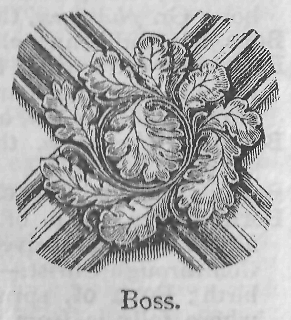
Boss, bos, n. a knob or stud: a raised ornament.—v.t. to ornament with bosses.—adj. Boss′y, having bosses.—p.adj. Bossed, embossed. [O. Fr. boce (Fr. bosse), from Old Ger. bôzan, to beat.]
Boss, bos, n. the chief or leader: the master, manager, or foreman: the person who pulls the wires in political intrigues.—adj. chief: excellent.—v.t. to manage or control.—To boss the show, to be supreme director of an enterprise. [Amer.; from the New York Dutch baas, master; cog. with Ger. base, a cousin.]
Bostangi, bos-tan′ji, n. a Turkish guard of the palace. [Turk.]
Boston, bost′on, n. a game at cards, somewhat similar to whist. [From Boston in Mass., U.S.]
Boswellian, bos-wel′li-an, adj. after the manner of Boswell, the famous biographer of Samuel Johnson.—v.i. Bos′wellise, to write after the manner of Boswell—full of an absolute admiration for one's hero and interest in him descending to the smallest particulars.—n. Bos′wellism.
Bot. See Bots.
Botany, bot′an-i, n. the science of plants.—adj. Botan′ic.—adv. Botan′ically.—v.i. Bot′anise, to seek for and collect plants for study.—ns. Bot′anist, one skilled in botany; Bot′anomancy, divination by means of plants, esp. the leaves of the sage and fig.—Botany Bay, a famous convict settlement in New South Wales, near to what is now Sydney: convict settlements generally. [Gr. botanē, herb, plant—bosk-ein, to feed, L. vescor, I feed myself; perh. cog. with A.S. woed.]
Botargo, bot-ar′go, n. a relish made of mullet or tunny roe. [It.—Ar.]
Botch, boch, n. a swelling on the skin: a clumsy patch: ill-finished work.—v.t. to patch or mend clumsily: to put together unsuitably or unskilfully.—ns. Botch′er, one who botches; Botch′work, Botch′ery.—adj. Botch′y, marked with or full of botches. [From root of Boss.]
Botfly. See Bots.
Both, bōth, adj. and pron. the two: the one and the other.—conj. as well: on the one side. [Ice. bathi, Ger. beide; A.S. bâ; cf. L. am-bo, Gr. am-phō, Sans. ubha, orig. ambha.]
Bother, both′ėr, v.t. to perplex or tease.—ns. Both′er; Botherā′tion.—adj. Both′ersome. [Murray notes that the word first appeared in the writings of Irish-born men, as Dr Sheridan, Swift, and Sterne. Perh. from Ir. buaidhirt, trouble.]
Bothy, Bothie, both′i, n. a humble cottage or hut: a temporary house for men engaged in some common work, esp. the barely furnished quarters provided for farm-servants, generally unmarried men, in the eastern and north-eastern counties of Scotland.—The Bothy system is apparently economical, but is detrimental to health and to morality.
Botoné, Bottony, bot′un-i, adj. (her.) having buds or knobs at the extremity, applied to a cross having each arm terminated in three buds, like trefoil. [O. Fr. See Button.]
Bo-tree, bō′-trē, n. the name given in Ceylon to the Pipal or Peepul of India (Ficus religiosa), held sacred by the Buddhists, and planted close by every temple. [Singh. bo, from Pali bodhi, perfect knowledge.]
Bots, Botts, botz, n. the larvæ of the botfly found in the flesh and in the intestines of animals.—n. Bot′fly, a family of dipterous insects, resembling the blue-bottle fly, which deposit their eggs on cattle. [Ety. unknown; hardly conn. with Bite.]
Bottine, bot′ēn, n. a high boot, a half-boot. [Fr., dim. of botte, a boot.]
Bottle, bot′l, n. a bundle of hay.—To look for a needle in a bottle of hay, to engage in a hopeless search. [O. Fr. botel.]
Bottle, bot′l, n. a hollow vessel for holding liquids: the contents of such a vessel: the habit of drinking.—v.t. to enclose in bottles.—n. Bott′le-chart, one which purports to show the track of sealed bottles thrown from ships into the sea.—p.adj. Bott′led, enclosed in bottles: shaped or protuberant like a bottle: kept in restraint.—ns. Bott′le-glass, a coarse green glass used in the making of bottles; Bott′le-gourd, or False Calabash, a climbing, musky-scented Indian annual, whose fruit is shaped like a bottle, an urn, or a club.—adjs. Bott′le-green, dark green in colour, like bottle-glass.—Bott′le-head, Bott′le-nosed, having a rounded prominent head, with a short snout, as a certain genus of whale.—ns. Bott′le-hold′er, one who attends upon a boxer at a prize-fight, a backer or supporter generally; Bott′le-imp, an imp supposed to be confined in a bottle; Bott′le-wash′er, one whose business it is to wash out the bottles, a factotum generally.—A three-bottle man, one who could drink three bottles without losing his decorum.—To bottle off, to draw from the cask and put into bottles; To bottle up (one's wrath, &c.), to keep enclosed as in a bottle; To bring up on the bottle, to rear an infant artificially rather than by the breast; To pass the bottle, to make the drink go round; To pass the bottle of smoke, to acquiesce in some falsehood, to make pretence. [O. Fr. bouteille, dim. of botte, a vessel for liquids—Low L. butis, a vessel.]
Bottom, bot′um, n. the lowest part of anything: that on which anything rests or is founded: the sitting part of the human body: the foot of a page, &c.: low land, as in a valley: the keel of a ship, hence the vessel itself: the fundamental character of anything, as physical stamina, financial resources, &c.: the portion of a wig hanging down over the shoulder, as in 'full-bottom'—full-bottomed wig: (Shak.) a ball of thread.—v.t. to found or rest upon: (Shak.) to wind round or upon.—adj. Bott′omed.—ns. Bott′om-glade, a glade or open space in a bottom or valley; Bott′om-grass (Shak.) grass growing on bottom lands.—adj. Bott′omless.—n. Bott′omry, a contract by which money is borrowed on the security of a ship or bottom.—Bottomless pit—hell.—At bottom, in reality.—From the bottom of the heart, from the very heart.—To be at the bottom of, to be the real origin of; To stand on one's own bottom, to be independent of; To touch bottom, to reach the lowest point. [A.S. botm; Ger. boden; conn. with L. fundus, bottom, Gael. bonn, the sole.]
Bottony. See Botoné.
Boudoir, bōōd′war, n. a lady's private room. [Fr.—bouder, to pout, to be sulky.]
Bouffant, boof′ang, adj. puffed out, in dressmaking. [Fr.]
Bouffe. See Opera-bouffe.
Bougainvillæa, bōōg-ān-vil-ē′a, n. a neotropical genus of Nyctaginaceæ, frequently trained over trellises or under the roofs of greenhouses, their triplets of flowers almost concealed by rosy or purple bracts. [From the first French circumnavigator of the globe, Louis Antoine de Bougainville (1729-1811).]
Bough, bow, n. a branch of a tree: the gallows. [A.S. bóg, bóh, an arm, the shoulder (Ger. bug, the shoulder, the bow of a ship)—A.S. bugan, to bend.]
Bought, bawt, pa.t. and pa.p. of Buy.—Bought′en in an archaic form.
Bought, bowt, n. a bight or bend: (Spens.) a twist or coil: the bend of a sling in which the stone is placed. [See Bight.]
Bougie, bōō′zhi, n. an instrument made of elastic, gum, wax, or metal, for distending contracted mucous canals, as the gullet, bowels, or urethra. [Fr. a 'wax candle,' because the instrument was orig. made of waxed linen, from Bougie in Algeria.]
Bouillabaisse, bōō-lya-bās′, n. a Provençal kind of fish chowder, familiar through Thackeray's appreciative ballad. [Fr.]
Bouilli, bōō′-yē, n. boiled or stewed meat.—n. Bouillon (bōō-yong), soup. [Fr. See Boil.]
Boulder, bōld′ėr, n. a large stone rounded by the action of water: (geol.) a mass of rock transported by natural agencies from its native bed.—adj. containing boulders.—n. Bould′er-clay (see Till, 4). [Acc. to Wedgwood, from Swed. bullra, Dan. buldre, to roar like thunder, as large pebbles do.]
Boulevard, bōōl′e-vär, n. a broad walk or promenade bordered with trees, originally applied to those formed upon the demolished fortifications of a town.—n. Boul′evardier, a frequenter of the boulevards. [Fr.—Ger. bollwerk. See Bulwark.]
Bouleversement, bōōl-vers-mang, n. an overturning. [Fr.]
Boult, bōlt, v.t. (Spens.). Same as Bolt (2).
Boun, Bowne, bown, v.t. (used refl.) to prepare one's self, to have recourse to.—v.i. to prepare, dress: to set out, to go to a place—(Spens.) Bound. [Boun, earlier form of bound—revived by Scott.]
Bounce, bowns, v.i. to jump or spring suddenly: to bound like a ball, to throw one's self about: (obs.) to beat: to burst into or out of a room, &c.: to boast, to exaggerate.—n. a heavy, sudden blow: a leap or spring: a boast: a bold lie.—adv. and interj. expressing sudden movement.—n. Bounc′er, one who bounces: something big: a bully: a liar.—adj. Bounc′ing, large and heavy: lusty: swaggering. [Dut. bonzen, to strike, from bons, a blow.]
Bound, bownd, pa.t. and pa.p. of Bind, confined, bandaged: intimately connected with—'bound up in:' of books, having a cover of, as 'bound in morocco,' &c. (with in): under obligation or necessity to, as 'bound to win.'—n. Bound′-bail′iff, a sheriff's officer, so called from his bond given to the sheriff for the discharge of his duty.
Bound, bownd, n. a limit or boundary: the limit of anything, as patience—'to break bounds,' to go beyond what is reasonable or allowable: (pl.) a border-land, land generally within certain understood limits, the district.—v.t. to set bounds to: to limit, restrain, or surround.—n. Bound′ary, a visible limit: border: termination.—p.adj. Bound′ed, restricted, cramped.—n. Bound′er, a boisterous or overbearing person.—adj. Bound′less, having no limit: vast.—n. Bound′lessness. [O. Fr. bonne—Low L. bodina, of doubtful origin; cf. Bret. bonn, a boundary.]
Bound, bownd, v.i. to spring or leap.—n. a spring or leap.—p.adj. Bound′ing, moving forward with a bound: leaping.—By leaps and bounds, by startlingly rapid stages. [Fr. bondir, to spring, in O. Fr. to resound—L. bombitāre. See Boom, the sound.]
Bound, bownd, adj. ready to go—as in 'outward bound,' &c. [Ice. búinn, pa.p of búa, to prepare.]
Bounden, bownd′n, adj. binding: required: obligatory. [From Bind.]
Bounty, bown′ti, n. liberality in bestowing gifts: the gift bestowed: money offered as an inducement to enter the army, or as a premium to encourage any branch of industry.—adjs. Boun′teous, Boun′tiful, liberal in giving: generous.—advs. Boun′teously, Boun′tifully.—ns. Boun′teousness, Boun′tifulness; Boun′tihood.—Lady Bountiful, a character in Farquhar's Beaux' Stratagem, now used for the great lady of any district. [O. Fr. bontet (bonté), goodness—L. bonitatem—bonus—good.]
Bouquet, bōōk′ā, n. a bunch of flowers: a nosegay: the perfume exhaled by wine. [Fr. bosquet, dim. of bois, a wood—It. bosco. See Boscage, Bush.]
Bourasque, bōō-rask′, n. a tempest. [Fr. bourrasque; It. borasco, a storm.]
Bourbonist, bōōr′bun-ist, n. an adherent of the Bourbons, the old French royal dynasty.
Bourd, bōōrd, n. (Spens.) a jest, sport.—n. Bourd′er (obs.), a jester. [O. Fr. bourde, origin unknown.]
Bourdon, bōōr′dun, n. the refrain of a song: a bass stop in an organ or harmonium. [See Burden.]
Bourdon, bōōr′dun, n. (obs.) a pilgrim's staff: a club. [Fr.—Low L. burdon-em, a mule.]
Bourg, burg, n. Same as Burgh, Borough.
Bourgeois, bur-jois′, n. a kind of printing type, larger than brevier and smaller than longprimer. [Fr.—perh. from the name of the typefounder.]
Bourgeoisie, bōōrzh′waw-zē, n. the middle class of citizens, esp. traders. [From Fr. bourgeois, a citizen, often taken as a typical word for the mercantile middle class—used also adjectively, like such in manners or ways of thinking.]
Bourgeon, bur′jun, v.i. to put forth sprouts or buds: to grow. [Fr. bourgeon, a bud, shoot.]
Bourignian, bōōr-in′yan, adj. of or pertaining to Antoinette Bourignon (1616-80), a religious visionary who made religion consist in inward emotion, not in knowledge or practice.—Bourign′ianism was strong in Scotland about the beginning of the 18th century, and ministers at ordination renounced it down till 1889.
Bourlaw. See Byrlaw.
Bourn, Bourne, bōrn, or bōōrn, n. a boundary, a limit, or goal: (Keats) domain. [Fr. borne, a limit. See Bound (2).]
Bourn, Bourne. See Burn (1).
Bourse, bōōrs, n. an exchange where merchants meet for business. [Fr. bourse. See Purse.]
Bourtree, bōōr′trē, n. the elder-tree—also Boun′tree.—n. Bour′tree-gun, a pop-gun made of a piece of its wood by taking out the pith. [Scot.; ety. unknown.]
Bouse, Booze, Boose, bōōz, v.i. to drink deeply.—n. a drinking bout.—adj. Bous′ing, drinking.—n. Bous′ingken, a low drinking-shop.—adj. Bous′y, inclined to bouse: drunken. [Dut. buysen, to drink deeply—buis, a tube or flask; allied to Box.]
Boustrophedon, bow-strof-ē′don, adj. and adv. written ploughwise, alternately from right to left and from left to right—a form of alphabetic writing intermediate between the oldest Greek inscriptions (from right to left, as in Semitic scripts) and the more convenient method of left to right (from 7th century). [Gr.; bou-strophos, ox-turning.]
Bout, bowt, n. a turn, trial, or round: an attempt: a contest or trial—a fencing bout, or a continued fit of drinking. [Doublet of Bight; from root of Bow, to bend.]
Boutade, bōō-tad′, n. a sudden outburst. [Fr.; bouter, to thrust.]
Bouts-rimés, bōō-rē-mā′, n.pl. rhyming words given out by some one of a party as the endings of a stanza, the others having to fill up the lines as best they may. [Fr.]
Bovine, bō′vīn, adj. pertaining to cattle. [L. bos, bovis, Gr. bous, an ox or cow.]
Bovril, bov′ril, n. a registered trade-mark applied to a special meat extract. [Coined from Gr. bous, bovis, an ox, and vril, the electric fluid represented as the one common origin of the forces in matter, in Lytton's novel The Coming Race, 1871.]
Bow, bow, v.i. to bend the body in saluting a person, acknowledging a compliment, &c.: to submit.—v.t. to bend or incline downwards, to crush down (with down, to, in or out, up or down).—n. a bending of the body in saluting a person.—adj. Bow′-backed, crook-backed.—A bowing acquaintance, a slight acquaintance.—To make one's bow, to retire ceremoniously, to leave the stage. [A.S. búgan, to bend; akin to L. fug-ĕre, to flee, to yield.]
Bow, bō, n. a piece of elastic wood or other material for shooting arrows, bent by means of a string stretched between its two ends: anything of a bent or curved shape, as the rainbow: the instrument by which the strings of a violin are sounded: a ring of metal forming a handle: a knot composed of one or of two loops and two ends (single bow, double bow), a looped knot of ribbons, a necktie or the like, so tied.—adj. Bow′bent (Milton), bent like a bow.—n. Bow′-boy, a boy archer: (Shak.) Cupid.—n.pl. Bow′-com′passes, compasses, one leg of which slides on a bow or curved plate of metal to steady its motion: a small pair of compasses for describing circles with ink or pencil.—adj. Bowed.—ns. Bow′-hand, in archery, the left hand, the one by which the bow is held: (mus.) the right hand, the one that draws the bow; Bow′-leg, a leg crooked like a bow.—adj. Bow′-legged, having crooked legs.—ns. Bow′line, a rope from the weather side of the square sails (to which it is fastened by bridles) to the larboard or starboard bow, to keep the sail close to the wind; Bow′man, an archer; Bow′shot, the distance to which an arrow can be shot from a bow; Bow′string, the string by which a bow is drawn: a string with which the Turks strangled offenders; Bow′-win′dow, a bent or semicircular window.—adj. Bow′-win′dowed (slang), pot-bellied.—n. Bow′yer (obs.), a bowman: a maker of bows.—Bowline knot, a simple but secure knot, used in fastening the bowline bridles to the cringles.—On the bow hand, wide of the mark.—To draw the long bow, to make extravagant statements; To have two (or more) strings to one's bow, to have other alternatives. [A.S. boga; cog. with Ger. bogen.]
Bow, bow, n. the general name for the stem and forepart of a ship, or that which cuts the water—often used in pl., the ship being considered to have starboard and port bows, meeting at the stem.—ns. Bow′er, Bow′er-anch′or, an anchor at the bow or forepart of a ship—usually two, the best-bower and the small-bower; Bow′-oar, the oar nearest the bow.—A bold, or bluff, bow, a broad bow; A lean bow, a narrow one.—On the bow, within 45° of the point right ahead.
Bowdlerise, bowd′lėr-īz, v.t. to expurgate a book or writing, to remove indelicate words or phrases, esp. to do so unnecessarily.—ns. Bowdlerisā′tion; Bowd′leriser; Bowd′lerism. [From Dr T. Bowdler (1754-1825), who published an expurgated Shakespeare in ten volumes in 1818.]
Bowels, bow′elz, n.pl. the interior parts of the body, the entrails, the intestines: the interior part of anything: (fig.) the heart, pity, tenderness (the emotions being supposed to be seated in the bowels—B. and Shak.).—v.t. Bow′el, to take out the bowels. [O. Fr. boel—L. botellus, a sausage, also an intestine.]
Bower, bow′ėr, n. a shady enclosure or recess in a garden, an arbour: an inner apartment, esp. the private room of a lady, a boudoir.—n. Bow′er-bird, an Australian bird of the Starling family, remarkable for its habit of making bower-like erections ornamented with gay feathers, shells, &c.—adj. Bow′ery, containing bowers: shady. [A.S. búr, a chamber; Scot, byre—root A.S. búan, to dwell.]
Bower, bow′ėr, n. the name in euchre for the two highest cards, the knave of trumps, and the other knave of the same colour, the right and left bower respectively. [Ger. bauer, peasant.]
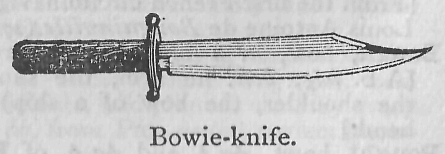
Bowie-knife, bō′i-nīf, n. a dagger-knife with a blade about twelve inches long, carried in the southern states of America—so named from its inventor, Colonel Bowie.
Bowl, bōl, n. a wooden ball used for rolling along the ground.—v.t. and v.i. to play at bowls: to roll along like a bowl: to throw a ball, as in cricket.—ns. Bowl′er, one who plays at bowls: one who bowls the ball in cricket; Bowl′ing, the act of playing at bowls, or of throwing a ball, as in cricket; Bowl′ing-al′ley, a long narrow covered place for bowling; Bowl′ing-green, a green or grassy plat kept smooth for bowling. [Fr. boule—L. bulla.]
Bowl, bōl, n. a basin for domestic use, esp. of earthenware or porcelain, nearly hemispherical in shape: a large punch-bowl, for brewing punch in: a round drinking-cup, rather wide than deep—hence 'the bowl,' 'the flowing bowl,' as synonyms for conviviality; the round hollow part of anything. [A.S. bolla. See Bole.]
Bowlder, bōld′ėr, n. Same as Boulder.
Bowse. Same as Bouse.
Bowsprit, bō′sprit, n. a strong spar projecting over the stem-head or bows of a sailing-ship, and also of a steamship when her stem is of the curved or cutwater description. [Dut. boegspriet.]
Box, boks, n. a tree remarkable for the hardness and smoothness of its wood—also Box-tree (Shak.): a case or receptacle for holding anything: the contents of a box: a small house or lodge, as a shooting-box, &c.: in a theatre, a small enclosure with several seats—the boxes = their occupants, the ladies: an old square pew or similar enclosure, as a sentry-box, signal-box, &c.: the driver's seat on a carriage: the case in which the ship's compass is kept.—v.t. to put into or furnish with boxes: (slang) to overturn a watchman in his box.—ns. Box′-bed, a kind of bed once common in Scotch cottages, having its ends, sides, and roof of wood, and capable of being closed in front by two sliding panels; Box′-day, one of the Court of Session vacation days when papers ordered to be deposited in court must be lodged.—adj. Box′en, made of or like boxwood.—ns. Box′ing-day, in England, the day after Christmas, when boxes or presents are given; Box′-ī′ron, a hollow smoothing-iron which is heated by a heater put into it; Box′-keep′er, an attendant who opens the doors of boxes at theatres or other places of public amusement; Box′-lobb′y, the lobby leading to the boxes in a theatre; Box′wood, wood of the box-tree.—In the wrong box, in a false position, in a scrape.—To be in a box, to be in a fix; To box Harry, to take a beefsteak, mutton-chop, or bacon and eggs with tea or ale, instead of the regulation dinner of the commercial traveller; To box the compass, to name the 32 points in their order and backwards, hence to make a complete roundabout in any opinion. [A.S. box—L. buxus—Gr. pyxos, the tree, pyxis, a box.]
Box, boks, n. a blow on the head or ear with the hand.—v.t. to strike with the hand or fist.—v.i. to fight with the fists.—ns. Box′er; Box′ing, the act of fighting with the fists: a combat with the fists; Box′ing-glove, a padded glove worn in boxing.
Boxhaul, boks′hawl, v.t. to veer a ship sharp round on her heel, by putting the helm a-lee, bracing the head-yards flat aback, and hauling to windward the head-sheets.
Boy, boy, n. a male child: a lad: a young man generally, used for 'man' in Ireland and elsewhere: (Shak.) a camp-follower: (obs.) knave: a native servant in South India, China, a male negro slave or native labourer in the South Seas.—v.t. to play the boy.—n. Boy′hood.—adj. Boy′ish.—adv. Boy′ishly.—n. Boy′ishness.—Boy's love, a popular name for southernwood; Boy's play, trifling. [M. E. boi, boy; Fris. boi; Dut. boef, Ger. bube.]
Boyar, boy′är, n. an order of the old Russian aristocracy, holding the chief military and civil offices prior to the reforms of Peter the Great.
Boycott, boy′kot, v.t. to shut out from all social and commercial intercourse—a kind of secular excommunication. [From Captain Boycott of County Mayo, who was so treated by his neighbours in Dec. 1880.]
Brabble, brab′bl, v.i. to babble or clamour: to brawl or wrangle.—n. (Shak.) a clamorous contest, a brawl: a quibble. [Dut. brabbelen, to stammer, to jabber.]
Braccio, brach′yo, n. an Italian measure of length, varying from half a yard to a yard:—pl. Braccia (brach-ya). [It., an arm.]
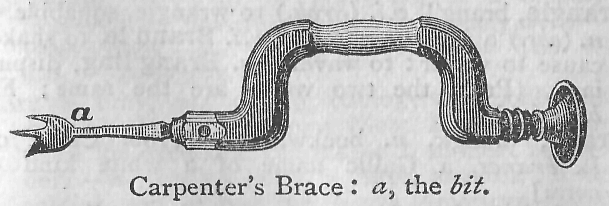
Brace, brās, n. anything that draws together and holds tightly: a bandage: a pair or couple: an instrument of wood or iron used by carpenters and metal-workers for turning boring tools: in printing, a mark connecting two or more words or lines (}): (pl.) straps for supporting the trousers: ropes for squaring or traversing horizontally the yards of a ship.—v.t. to tighten or strengthen, to give firmness to.—adj. Brac′ing, giving strength or tone. [O. Fr. brace (Fr. bras), the arm, power—L. brachium, Gr. brachiōn, the arm, as holding together.]
Brace, brās, v.t. (Spens.) to embrace, encompass.
Bracelet, brās′let, n. an ornament for the wrist. [Fr.; dim. of O. Fr. brac. See Brace.]
Brach, brach, n. a dog for the chase, a bitch-hound. [O. Fr. brachet, pl. brachès, dim. of brac—Low L. bracco, of Teut. origin.]
Brachial, brak′i-al, adj. belonging to the arm.—Brachial artery, the great arterial trunk supplying the upper extremity between the armpit and the elbow—the direct continuation of the axillary artery. [See Brace.]
Brachiopoda, brak-i-op′o-da, Brachiopods, brak′i-o-pods, n.pl. a class of shelled animals having certain affinities with worms and with Polyzoa, but less with molluscs, provided with two long arm-like processes arising from the sides of the mouth, probably respiratory, and certainly serving to waft little food particles to the mouth. [Gr. brachiōn, an arm, and pous, pod-os, a foot.]
Brachycephalic, brak-i-sef-al′ik (also sef′-), Brachycephalous, brak-i-sef′al-us, adj. short-headed, applied in ethnology to skulls of which the breadth is at least four-fifths of the length—opp. to Dolichocephalic.
Brachypterous, brak-ip′tėr-us, adj. lit. short-winged: having wings which, when folded, do not reach to the base of the tail. [Gr. brachys, short, pteron, a wing.]
Brack, brak, n. a flaw in cloth. [See Break.]
Bracken, brak′en, n. fern. [See Brake.]
Bracket, brak′et, n. a support for something fastened to a wall, the ornamental metal pipe bearing gas-lamps, &c.: (pl.) in printing, the marks [ ] used to enclose one or more words: one of the side pieces of a gun-carriage, supporting the trunnions.—v.t. to support by brackets: to enclose by brackets: to group two names, as in an honour list, implying equality. [Fr. braguette; Sp. bragueta—L. braca, bracæ, breeches.]
Brackish, brak′ish, adj. saltish: applied to water mixed with salt or with sea-water.—n. Brack′ishness. [Dut. brak, brackish; prob. the same as brak, refuse.]
Bract, brakt, n. an irregularly developed leaf at the base of the flower-stalk.—adjs. Brac′teal, Brac′teate, Bract′ed, Brac′teolate.—n. Brac′teole, a little bract at the base of the stalk of a single flower which is itself on a main stalk supporting several flowers.—adj. Bract′less, destitute of bracts. [L. bractea, a thin plate of metal, gold-leaf.]
Brad, brad, n. a small nail having a slight projection at the top on one side instead of a head.—n. Brad′awl, an awl to pierce holes. [Scot. brod, an instrument for pricking with; Ice. broddr, a pointed piece of iron.]
Bradypeptic, brad-i-pep′tik, adj. slow of digestion. [Gr. bradys, slow, and Peptic.]
Brae, brā, n. (Scot.) the slope above a river bank, a hill-slope. [Scand. brá.]
Brag, brag, v.i. to boast or bluster:—pr.p. brag′ging; pa.p. bragged.—n. a boast or boasting: the thing boasted of: a game at cards, very like poker.—adj. Brag′ging.—advs. Brag′gingly, Brag′ly (Spens.). [Most prob. Celt.; cf. W. bragio, to boast; Ir. bragaim. The Fr. braguer, to brag, and bragard, a braggart, are not the parents of the Eng. word.]
Braggadocio, brag-a-dō′shi-o, n. and adj. a braggart or boaster: empty boasting. [From Braggadochio, a boastful character in Spenser's Faerie Queene.]
Braggart, brag′art, adj. boastful.—n. a vain boaster.—n. Bragg′ardism (Shak.), boastfulness. [Fr. bragard, vain, bragging; prob. of Celt. origin; Diez prefers Scand., and quotes Sw. brak, Dan. brag, &c.]
Brahman, brä′man, Brahmin, brä′min, n. a person of the highest or priestly caste among the Hindus.—adjs. Brahman′ic, -al, Brahmin′ic, -al, Brah′minee, appropriated to the Brahmans.—ns. Brah′manism, Brah′minism, one of the religions of India, the worship of Brahma. [From Brahma, the supreme post-Vedic Hindu deity.]
Braid, brād, v.t. to plait or entwine.—n. cord, or other texture made by plaiting.—p.adj. Braid′ed, plaited, embroidered, trimmed with braid.—n. Braid′ing, the act of making braids: embroidery with braid. [A.S. bregdan; Ice. bregða, to weave.]
Braid, brād, adj. (Shak.) dissembling, deceitful. [A.S. brægd, falsehood, from bregdan, brægd, to weave.]
Braid, brād, v.t. (Shak.) to upbraid, to reproach. [Prob. from Abraid, or Braid (1).]
Braidism, brād′ism, n. mesmerism or hypnotism. [From Dr James Braid, who practised it about 1842.]
Brail, brāl, n. a piece of leather to bind up a hawk's wing: (pl.) the feathers about a hawk's rump: (naut.) one of the ropes used to truss up a sail.—v.t. to haul in, as a sail, by pulling upon the brails. [O. Fr. brail—L. bracale, a waist-belt for holding up the breeches—bracæ.]
Braille, brāl, n. and adj. a kind of type for the blind, having arbitrary signs consisting of varying combinations of six points arranged thus (), there being sixty-two possible combinations of these six points. [From Louis Braille, the inventor.]

Brain, brān, n. the term applied to that part of the central nervous system which in vertebrated animals is contained within the cranium or skull, and in the invertebrata, to the nervous ganglia near the head end of the body: the seat of the intellect and of sensation: the intellect.—v.t. to dash out the brains of: (Shak.) to conceive of.—n. Brain′-cor′al, the popular name of certain kinds of coral, so called from their general resemblance to a brain.—p.adj. Brained, having brains.—n. Brain′-fe′ver, a loose popular term which includes congestion of the brain and its membranes, delirium tremens, and inflammation of the brain substance itself.—adjs. Brain′ish (Shak.), brain-sick, hot-headed, furious; Brain′less, without brains or understanding: silly.—n. Brain′-pan, the skull.—adj. Brain′-sick, diseased in the understanding, deranged.—adv. Brain′sick′ly (Shak.).—n. Brain′-sick′ness. [A.S. brægn; Dut. brein, prov. Ger. bregen]
Braird, brārd, n. the first shoots of corn or other crop.—v.i. to appear above ground. [Orig. Scot.; A.S. brerd, the edge, and brord, a point.]
Braise, brāz, v.t. to stew meat together with slices of bacon, &c., properly with a charcoal fire above and below the braising-pan.—p.adj. Braised. [Fr. braiser.]
Brake, brāk, obsolete, pa.t. of Break.
Brake, brāk, n. a fern: a place overgrown with ferns or briers; a thicket.—adj. Brak′y. [A doublet of Bracken; ety. dub.]
Brake, brāk, n. an instrument to break flax or hemp: a harrow: a contrivance for retarding by friction the speed of carriages, wagons, trains, or revolving drums.—adj. Brake′less, without a brake.—ns. Brake′man, the man whose business it is to manage the brake of a railway-train; Brake′-van, the carriage wherein the brake is worked; Brake′-wheel, the wheel to which a brake is applied. [From root of Break; cf. Dut. braak, a flax-brake.]
Brake, brāk, n. a handle, as of a pump: a lever for working a machine. [Prob. through O. Fr. brac, from L. brachium, an arm.]
Bramah-press, brä′ma-pres, n. a hydraulic press invented by Joseph Bramah of London (1748-1814), inventor also of the Bramah-lock, &c.
Bramble, bram′bl, n. a wild prickly shrub bearing blackberries, a blackberry bush: any rough prickly shrub.—ns. Bram′ble-berr′y, Bram′ble-bush, a collection of brambles growing together; Bram′ble-finch, Bram′bling, a bird nearly allied to the chaffinch.—adj. Bram′bly. [A.S. brémel; Dut. braam, Ger. brom-beere.]
Brame, brām, n. (Spens.) sharp passion, longing. [It. brama.]
Bran, bran, n. the refuse of grain: the inner husks of corn sifted from the flour: the coarser part of anything.—n. Bran′fulness.—adj. Bran′ny. [O. Fr. bran, bran; prob. Celt.]
Brancard, brank′ard, n. a horse litter. [Fr.]
Branch, bransh, n. a shoot or arm-like limb of a tree: anything like a limb of a tree: any offshoot or subdivision, a section or department of a subject: any subordinate division of a business, &c., as a branch-bank or pawn-shop.—v.t. to divide into branches.—v.i. to spread out as a branch (with out, off, from).—adj. Branched.—ns. Branch′er, a young hawk or other bird when it leaves the nest and begins to take to the branches; Branch′ery, branches collectively.—adjs. Branch′ing, furnished with or shooting out branches; Branch′less.—ns. Branch′let, a little branch; Branch′-pī′lot, one who holds the Trinity House certificate; Branch′-work, ornamental figured patterns.—adj. Branch′y.—Root and branch, thoroughly—used also adjectively, as in a 'root-and-branch' policy. [Fr. branche—Low L. branca, a beast's paw—L. brachium.]
Branchiæ, brangk′i-ē, n.pl. gills.—adjs. Branch′ial; Branch′iate, furnished with branchiæ.—n. Branchiop′oda, a sub-order of Crustaceans in the order with leaf-like feet (Phyllopods), to which the gills are attached. [L.—Gr.]
Brand, brand, n. a piece of wood burning or partly burned: a mark burned into anything with a hot iron: a trade-mark, made by burning or otherwise, as on casks: a particular sort of goods, from the trade-marks by which they are known, as cigars, &c.: a sword, so called from its glitter: a mark of infamy: a general name for the fungoid diseases or blights of grain crops—bunt, mildew, rust, and smut.—v.t. to burn or mark with a hot iron: to fix a mark of infamy upon.—adj. Brand′ed.—n. Brand′er, a gridiron.—v.t. to cook on the gridiron, as beef-steaks.—p.adjs. Brand′ered, Brand′ering.—ns. Brand′ing-ī′ron, Brand′-ī′ron, an iron to brand with: a trivet or tripod to set a pot or kettle upon: (Spens.) a sword—also Brand′ise, a trivet; Brand′ling, a red worm used by anglers, found commonly in tan-pits.—adj. Brand′-new, quite new (as if newly from the fire).—n. Brand′reth, a stand of wood for a cask or hayrick, a rail round a well.—A brand from the burning, one snatched out of a pressing danger—from Amos, iv. 11. [A.S. brand, brond, from root of Burn.]
Brandish, brand′ish, v.t. to wave or flourish as a brand or weapon.—n. a waving or flourish. [Fr. brandissant—brandir, from root of Brand.]
Brandy, brand′i, n. an ardent spirit distilled from wine.—adj. Bran′died, heartened or strengthened with brandy.—n. Brand′y-pawnee′, brandy and water. [Formerly brandwine—Dut. brandewijn—branden, to burn, to distil, and wijn, wine; cf. Ger. branntwein.]
Brangle, brang′l, v.i. (arch.) to wrangle, squabble.—n. (obs.) a brawl.—v.t. and v.i. Brand′le, to shake, cause to waver: to waver.—n. Brang′ling, disputing. [Prob. the two words are the same; Fr. branler.]
Brank, brangk, n. buckwheat. [Prob. Celt.; cf. L. brance, a Gallic name of a white kind of corn.]
Brank, brangk, v.i. to prance, toss the head: to strut or swagger.—adj. Brank′y (Scot.), showy. [Prob. a variant of Prank.]
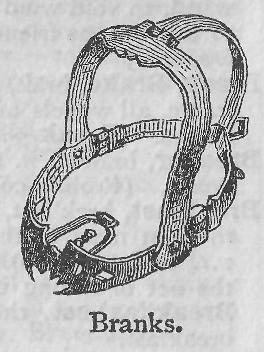
Branks, brangks, n. (seldom in sing.) a scold's bridle, having a hinged iron framework to enclose the head and a bit or gag to fit into the mouth and compress the tongue. [Scot.; ety. very obscure; cf. M. E. bernak, whence Barnacle and Brake; Ger. pranger, the pillory, Dut. prang, a fetter; the Gael. brangus, brangas, is most prob. borrowed.]
Brankursine, brangk′ur-sin, n. the plant Acanthus, called also Bear's-breech. [Low L. branca, ursina, a bear's paw.]
Bran-new, bran′-nū, adj. corruption of Brand-new.
Bransle, bran′sl, n. (obs.) a dance: a song for dance music. [Fr.]
Brant-goose. See Brent-goose.
Brantle, bran′tl, n. a kind of dance.
Brasero. Same as Brazier (q.v. under Braze).
Brash, brash, n. broken and angular fragments of rock which occasionally form the basement bed of alluvial deposits: fragments of crushed ice: clippings of hedges or trees.—adj. Brash′y. [Prob. Fr. brèche.]
Brash, brash, n. a slight attack of illness: an eructation or belching of acid water from the stomach—water-brash: a sudden burst of rain: (obs.) an attack.—v.t. to disturb. [Scot.; prob. onomatopœic.]
Brass, bräs, n. an alloy of copper and zinc: (fig.) impudence: money in cash: a monumental plate of brass inlaid on slabs of stone in the pavements of ancient churches.—n.pl. Brass′arts, the brass pieces which, in plate armour, protected the upper part of the arms, and united the shoulder and elbow pieces.—ns. Brass′-band, a band or company of musicians who perform on brass instruments; Brass′et, a casque or armour covering for the head: a helmet; Brass′found′er, a maker of articles in brass.—adjs. Brass′-paved (Spens.), durable, as if paved with brass; Brass′-vis′aged, brazen-faced, impudent.—n. Brass′y, a wooden golf-club with a brass sole.—adj. of or like brass: impudent: unfeeling: pitiless: harsh in tone. [A.S. braes; prob. related to Sw. brasa, fire.]
Brasserie, bras′er-ē, n. in France, any beer garden or saloon. [Fr.]
Brassica, bras′i-ka, n. the turnip and cabbage genus of Cruciferæ. [L.]
Brast. Same as Burst.
Brat, brat, n. a contemptuous name for a child, as in 'beggar's brat:' any over-garment of coarse cloth, a child's pinafore, an apron.—n. Brat′chet, a little brat—better Brat′ling. [A.S. bratt; of Celtic origin, Old Ir. brat, a plaid, Gael. brat, an apron.]
Brattice, brat′is, n. a wooden partition, as in the shaft of a coal-pit, &c.—v.t. to line with wood the sides of a shaft, &c.—n. Bratt′ice-cloth, strong tarred cloth used in mines in place of wooden bratticing. [O. Fr. breteske—Low L. bretachia; prob. Teut.]
Brattling, brat′ling, n. a clattering noise: quarrel: tumult—also Brat′tle.—v.i. Brat′tle, to make a clattering noise. [Onomatopœic.]
Bravado, brav-ā′do, or brav-ä′do, n. a display of bravery: a boastful threat: a swaggerer:—pl. Bravā′does.—v.i. to play the bravado. [Sp. bravada. See Brave.]
Brave, brāv, adj. daring, courageous: noble: finely dressed, showy, handsome (Scot. Braw): a general word for excellent, capital.—v.t. to meet boldly: to defy.—n. (obs.) a bully, a hired assassin: a brave soldier, esp. among the North American Indians: (arch.) bravado: (arch.) bravo.—adv. Brave′ly (Scot. Braw′ly), excellently, well.—n. Brav′ery, courage: heroism: finery, showy dress. [Fr. brave; It. and Sp. bravo; prob. from Celt., as in Bret. braga, to strut about, Gael. breagh, fine. See Brag.]
Bravo, bräv′o, n. a daring villain: a hired assassin:—pl. Bravoes (bräv′ōz). [It. and Sp.]
Bravo, bräv′o, interj. well done: excellent. [It.]
Bravura, bräv-ōōr′a, n. (mus.) a term applied to a florid air or song with difficult and rapid passages requiring great spirit and dash in execution. [It.]
Brawl, brawl, n. a noisy quarrel.—v.i. to quarrel noisily: to murmur or gurgle.—n. Brawl′ing, the act of quarrelling noisily.—adj. quarrelsome: noisy. [M. E. brallen, of doubtful origin; prob. cog. with Dut. brallen, Ger. prahlen, to boast.]
Brawl, brawl, n. a kind of French dance. [Fr. braule.]
Brawn, brawn, n. muscle, esp. of the arm or calf of the leg: thick flesh: muscular strength: a boar: a preparation of meat made from pig's head and ox-feet, cut up, boiled, and pickled.—adj. Brawned.—n. Brawn′iness, quality of being brawny: muscularity.—adj. Brawn′y, fleshy: muscular: strong. [O. Fr. braon, from Old Ger. brato, flesh (for roasting), Old Ger. brâto (Ger. braten), to roast.]
Braxy, brak′si, n. and adj. a Scotch name loosely used for several totally different disorders of sheep.—Braxy mutton, the flesh of a braxy sheep; also, generally, of any sheep that has died of disease or accident. [Prob. the original form is bracks, the sing. of which is a variant of Break.]
Bray, brā, v.t. to break, pound, or grind small, as in a mortar.—n. Bray′er, an instrument to grind or spread ink in printing. [O. Fr. breier (Fr. broyer); It. brigare.]
Bray, brā, n. the cry of the ass: any harsh grating sound.—v.i. to cry like an ass: to give forth harsh sounds, esp. of the trumpet.—ns. Bray′er, one who brays like an ass; Bray′ing, the noise of an ass: any harsh noise.—adj. making a harsh noise. [O. Fr. brai, brait; braire—Low L. bragire, prob. of Celt. origin.]
Braze, brāz, v.t. to solder with an alloy of brass and zinc.—adj. Brā′zen, of or belonging to brass: impudent.—v.t. to face or confront with impudence—as in 'to brazen it out.'—n. Brā′zen-face, one having a brazen or impudent face: one remarkable for impudence.—adj. Brā′zen-faced, impudent.—adv. Brā′zenly.—ns. Brā′zenness, Brā′zenry, effrontery; Brā′zier, Brā′sier, a pan for holding burning coals—also Bras′ero; Brāz′ing, soldering. [O. Fr. braser, to burn; most prob. related to Brass.]
Brazier, brā′zi-ėr, n. one who works in Brass (q.v.).
Brazil, bra-zil′, n. usually Brazil′-wood, the hard reddish wood of an East Indian tree, known as sappan, used in dyeing.—n. Brazil′ian, a native of Brazil, in South America.—adj. belonging to Brazil.—n. Brazil′-nut, the edible seed of a large tree, native of Brazil. [O. Fr. bresil (Sp. brasil, It. brasile)—Low L. brasilium, a red dye-wood, brought from the East, itself prob. a corr. of some Oriental word. When a similar wood was discovered in South America the country became known as terra de brasil, land of red dye-wood, whence Brasil, Brazil.]
Breach, brēch, n. a break or opening, as in the walls of a fortress: a breaking of law, &c., violation of contract, covenant, promise, &c.: a quarrel: a broken condition or part of anything, a break: a gap in a fortification—hence 'to stand in the breach,' often used figuratively: a break in a coast-line, bay, harbour, creek (Judges, v. 17).—v.t. to make a breach or opening in a wall, &c.—Breach of promise, often used simply for breach of promise of marriage; Breach of the peace, a violation of the public peace by riot or the like. [A.S. bryce, brice; related to Break.]
Bread, bred, n. food made of flour or meal baked: food: livelihood.—ns. Bread′-bas′ket, a basket for holding bread: (slang) the stomach; Bread′-chip′per (Shak.), one who chips bread, an under-butler; Bread′-corn, corn of which bread is made.—n.pl. Bread′-crumbs, bread crumbled down for dressing dishes of fried fish, &c.—n. Bread′fruit-tree, a tree of the South Sea Islands, producing a fruit which, when roasted, forms a good substitute for bread; Bread′-nut, the fruit of a tree, a native of Jamaica, closely allied to the breadfruit-tree, which is used as bread when boiled or roasted; Bread′-room, an apartment in a ship's hold where the bread is kept; Bread′-root, a herbaceous perennial plant of North America, with a carrot-like root which is used as food; Bread′-stud′y, any branch of study taken up as a means of gaining a living; Bread′-stuff, the various kinds of grain or flour of which bread is made; Bread′-tree, a tree of South Africa which has a great deal of starch in its stem, and is used as bread by the natives; Bread′-win′ner, one who earns a living for a family.—Bread buttered on both sides, very fortunate circumstances.—To take the bread out of one's mouth, to deprive of the means of living. [A.S. bréad, prob. from a Teut. root meaning a fragment, like the Scot. and Norse country use of 'a piece,' for a bit of bread. The usual A.S. word was hláf.]
Breaded, bred′ed, pa.p. (Spens.) = Braided.
Breadth, bredth, n. extent from side to side: width: a style in painting in which details are strictly subordinated to the harmony of the whole composition.—adv. Breadth′ways, broadside on. [A.S. brǽdu; Ger. briete. See Broad.]
Break, brāk, v.t. to part by force: to shatter: to crush: to tame, or wear out: to violate, or outrage, as a law, a bargain, &c.: to check by intercepting, as a fall: to interrupt, as silence, or the monotony of anything, or in 'to break one off a habit:' to make bankrupt: to degrade from rank, as an officer.—v.i. to part in two: to burst forth: to open or appear, as the morning: to become bankrupt: to crack or give way, as the voice: to dissolve, as frost: to collapse in foam, as a wave: to fall out, as with a friend:—pa.t. brōke; pa.p. brōk′en.—n. the state of being broken: an opening: a pause or interruption: (billiards) a consecutive series of successful strokes, also the number of points attained by such: the dawn.—ns. Break′age, the action of breaking, or its consequences: an interruption; Break′-down, a dance, vigorous rather than graceful, in which much noise is made by the feet of the one performer; Break′er, a wave broken on rocks or the shore.—adj. Break′-neck, likely to cause a broken neck.—ns. Break′-prom′ise, Break′-vow, one who makes a practice of breaking his promise or vow; Break′water, a barrier to break the force of the waves.—Break a jest, to utter a jest unexpectedly; Break a lance with, to enter into a contest with a rival; Break away, to go away abruptly, as from prison, &c.: to be scattered, as clouds after a storm; Break bulk, to open the hold and take out a portion of the cargo; Break cover, to burst forth from concealment, as a fox; Break down, to crush down or level: to collapse, to fail completely; Break forth, to burst out, issue; Break ground, to commence digging or excavation: to begin; Break in, to train to labour, as a horse; Break in, in upon, or into, to enter violently or unexpectedly, to interpose abruptly in a conversation, &c.; Break loose, to extricate one's self forcibly: to break through all restraint; Break news, to make anything known, esp. of bad news, with caution and delicacy; Break off, to separate by breaking, put an end to; Break out, to appear suddenly: to break through all restraint; Break sheer (said of a ship riding at anchor), to be forced by wind or tide out of a position clear of the anchor; Break the heart, to destroy with grief; Break the ice (fig.), to get through first difficulties: Break up, to break open; Break upon the wheel, to punish by stretching a criminal on a wheel and breaking his bones; Break wind, to void wind from the stomach; Break with, to fail out, as friends may do. [A.S. brecan; Ger. brechen.]
Break, Brake, brāk, n. a large wagonette: a carriage frame, all wheels and no body, used in breaking in horses. [Break, v.t.]
Breaker, brāk′ėr, n. a small water-cask, used on shipboard. [Prob. a corr. of Sp. bareca, a barrel.]
Breakfast, brek′fast, n. a break or breaking of a fast: the first meal of the day.—v.i. to take breakfast.—v.t. to furnish with breakfast.—ns. Break′fasting, the act of taking breakfast: a party at breakfast; Break′fast-set, the china or other ware used at breakfast.
Bream, brēm, n. a small fresh-water fish nearly allied to the bleak: a family of sea-breams or Sparidæ. [O. Fr. bresme (Fr. brême)—Old Ger. brahsema (mod. Ger. brassen).]
Bream, brēm, v.t. to clean, as a ship's bottom, by burning off seaweed, shells, &c. [Prob. conn. with Broom, Dut. brem.]
Breare, Brere, brēr, n. (Spens.). Same as Brier.
Breast, brest, n. the forepart of the human body between the neck and the belly: one of the two mammary glands in women, forming soft protuberances on the chest: the corresponding part of any animal: (fig.) conscience, disposition, affections.—v.t. to bear the breast against: to oppose manfully: to mount.—n. Breast′-bone, the bone running down the middle of the breast, to which the first seven ribs are attached.—adv. Breast′-deep, deep, as up to the breast.—adj. Breast′ed, having a breast.—adv. Breast′-high, high as the breast—ns. Breast′-knot, a knot of ribbons worn on the breast; Breast′pin, an ornamental pin for the breast; Breast′plate, a plate or piece of armour for the breast: (B.) an embroidered square of linen worn on the breast of the Jewish high-priest, bearing twelve precious stones, each inscribed with the name of one of the tribes of Israel; Breast′-plough, a kind of spade for cutting turf, with a cross-bar against which the breast is pressed; Breast′rail, the upper rail of a breastwork; Breast′summer, Bres′summer, a summer or beam supporting the whole front of a building in the same way as a lintel supports the portion over an opening; Breast′-wall, a retaining wall; Breast′-wheel, a water-wheel which is turned by water delivered upon it at about half its height; Breast′work, a hastily constructed earthwork.—To make a clean breast of, to make a full confession. [A.S. bréost; Ger. brust, Dut. borst.]
Breath, breth, n. the air drawn into and then expelled from the lungs: power of breathing: life: the time occupied by once breathing: a very slight breeze.—adjs. Breath′ful (Spens.), full of breath or air, also full of scent or odour; Breath′less, out of breath: dead: excessively eager, as if holding one's breath from excitement.—n. Breath′lessness.—To catch the breath, to stop breathing for an instant; To spend one's breath, as in profitless talk; To take breath, to recover freedom of breathing; With bated breath, with breath restrained from reverence or fear. [A.S. brǽth; Ger. brodem, steam, breath.]
Breathe, brēth, v.i. to draw in and expel breath or air from the lungs: to take breath, to rest or pause: to live.—v.t. to draw in and expel from the lungs, as air: to infuse: to give out as breath: to utter by the breath or softly, to whisper: to express: to keep in breath, to exercise: to tire by some brisk exercise.—ns. Breath′er, one who breathes or lives: a spell of exercise; Breath′ing, the act of breathing: aspiration, secret prayer: respite.—adj. life-like.—ns. Breath′ing-time, time to breathe or rest; Breath′ing-while, time sufficient for drawing breath: any very short period.—To breathe again, to be relieved from an anxiety; To breathe freely, to be at ease; To breathe upon, to tarnish or soil. [See Breath.]
Breccia, brech′ya, n. a conglomerate rock composed of angular and unworn fragments, cemented together by lime or other mineral substance.—adj. Brecciated (brech′yāt-ed), noting rocks composed of breccia, [It.; cf. Fr. brèche, breach, flint pebble.]
Bred, bred, pa.t. and pa.p. of Breed.
Brede, brēd, n. an obsolete form of Braid.
Bree, brē, n. the eyebrow. [Still in Scot.; A.S. brǽw, bréaw; cf. Ger. (augen)braue.]
Bree, brē, n. the liquor in which anything has been boiled—barley-bree. [A.S. briw; cf. Ger. brei.]
Breech, brēch, n. the lower part of the body behind: the hinder part of anything, esp. of a gun.—v.t. to put into breeches: to flog.—adj. Breeched.—n.pl. Breeches (brich′ez), a garment worn by men on the lower limbs of the body, strictly, as distinguished from trousers, coming just below the knee, but often used generally for trousers—(Knee-breeches, see under Knee).—n. Breech′ing, a part of a horse's harness attached to the saddle, which comes round the breech and is hooked to the shafts: a strong rope attached to the breech of a gun to secure it to a ship's side.—adj. (Shak.) subject to whipping.—n. Breech′-load′er, a firearm loaded by introducing the charge at the breech instead of the muzzle.—Breeches Bible, a name often given to the Geneva Bible produced by the English Protestant exiles in 1560, so named from the rendering 'breeches' in Gen. iii. 7; Breeches part (theat.), a part in which a girl wears men's clothes.—To wear the breeches, (said of a wife), to usurp the authority of the husband: to be master. [A.S. bréc; found in all Teut. languages; cf. Ger. bruch, Dut. brock.]
Breed, brēd, v.t. to generate or bring forth: to train or bring up: to cause or occasion.—v.i. to be with young: to produce offspring: to be produced or brought forth:—pa.t. and pa.p. bred.—n. that which is bred, progeny or offspring: kind or race.—ns. Breed′-bate (Shak.), one who is constantly breeding or producing debate or strife; Breed′er, one who breeds or brings up; Breed′ing, act of producing: education or manners.—Breeding in-and-in, pairing of similar forms: marrying always among near relations. [A.S. brédan, to cherish, keep warm; Ger. brüten, to hatch.]
Breeks, brēks, n.pl. (Scot.) breeches, trousers.
Breer, Brere, brēr, v.i. (Scot.) to sprout.
Breeze, brēz, n. a gentle gale: a wind: a disturbance or quarrel: a whispered rumour.—adjs. Breeze′less, without a breeze: motionless; Breez′y, fanned with or subject to breezes.—To breeze up, to freshen into a breeze. [Old Sp. briza, It. brezza (Fr. brise, a cold wind).]
Breeze, brēz, n. (Shak.) the gadfly.—Also written Breese, Brize. [A.S. briosa.]
Bregma, breg′ma, n. the part of the skull where the frontal and the two parietal bones join—sometimes divided into the right and left bregmata.—adj. Bregmat′ic. [Gr.]
Brehon, brē′hon, n. an ancient Irish judge.—Brehon Laws, the name given by the English to the system of jurisprudence which prevailed among the native Irish from an early period till towards the middle of the 17th century. [Ir. breitheamh, pl. breitheamhuin.]
Breloque, bre-lok′, n. an ornament attached to a watch-chain. [Fr.]
Breme, Breem, brēm, adj. (Spens.) fiery, stern, boisterous, sharp. [Prob. related to A.S. bréman, to rage.]
Bren, bren, v.t. (Spens.) to burn.—pa.p. and adj. Brent. [See Burn.]
Brent, brent, adj. (Scot.) lofty: smooth, unwrinkled. [A.S. brant, steep; cog. with Ice. brattr.]
Brent-goose, brent′-gōōs, n. a small species of wild goose, having the head, neck, long wing feathers, and tail black, the belly white, the rest slaty-gray—it visits the British coasts in winter.—Also Brant′-goose, or Brent barnacle, and often confounded with the barnacle goose. [Prob. branded = brindled.]
Bressummer. Same as Breastsummer (q.v. under Breast).
Brethren, breth′ren, pl. of Brother (q.v.).
Breton, bret′un, adj. belonging to Brittany or Bretagne, in France.
Brettice. Same as Brattice.
Bretwalda, bret-wal′da, n. a title of supremacy applied by the Anglo-Saxon Chronicle to Egbert and seven earlier kings, whose superiority was more or less acknowledged by other kings. [Lit. 'Lord of the Britons,' or 'of Britain.']
Breve, brēv, n. a pope's letter: the longest note now used in music, . [It. breve—L. brevis, short.]

Brevet, brev′et, n. a military commission entitling an officer to take rank above that for which he receives pay.—n. Brevet′cy, the condition of one holding brevet rank. [Fr.—L. brevis, short.]
Breviary, brēv′i-ar-i, n. book containing the daily service of the R.C. Church. [Fr. bréviaire—L. brevis, short.]
Breviate, brē′vi-āt, n. a short compendium: a lawyer's brief. [L. breviātus—breviāre, to shorten—brevis, short.]
Brevier, brev-ēr′, n. a small type between bourgeois and minion, originally used in printing breviaries.
Brevity, brev′it-i, n. shortness: conciseness. [L. brevitas—brevis, short.]
Brew, brōō, v.t. to prepare a liquor, as from malt and other materials: to contrive or plot.—v.i. to perform the operation of brewing ale or beer: to be gathering or forming.—ns. Brew′age, something brewed: mixed liquor; Brew′er, one who brews; Brew′ery, Brew′-house, a place for brewing; Brew′ing, the act of making liquor from malt: the quantity brewed at once; Brew′ster (now only Scot.), a brewer. [A.S. bréowan; cf. Ger. brauen.]
Briar. Same as Brier (1).
Briarean, brī-ā′re-an, adj. relating to Briareus, a hundred-handed giant: hence many-handed. [Gr.—briaros, strong.]
Briar-root. See Brier (2).
Bribe, brīb, n. something given to influence unduly the judgment or corrupt the conduct: allurement.—v.t. to influence by a bribe: to gain over.—v.i. to practise bribery.—ns. Brib′er, one who bribes; Brib′ery, the act of giving or taking bribes; Brib′ery-oath, an oath taken by an elector that he has not been bribed. [O. Fr. bribe, a lump of bread; origin dub.]
Bric-à-brac, brik′a-brak, n. old curiosities, or other articles of value. [Acc. to Littré, formed after the phrase de bric et de broc, 'by hook and by crook.']
Brick, brik, n. an oblong or square piece of burned clay: a loaf of bread in the shape of a brick: (slang) a reliable friend, a good fellow.—v.t. to lay or pave with brick.—ns. Brick′bat, a piece of brick; Brick′clay, a clay used in making bricks; Brick′-dust, dust made by pounding bricks, a colour like that of brick-dust; Brick′-earth, earth used in making bricks; Brick′-field, a place where bricks are made; Brick′-kiln, a kiln in which bricks are burned; Brick′layer, one who lays or builds with bricks; Brick′laying; Brick′maker, one whose trade is to make bricks; Brick′-tea, tea pressed into cakes; Brick′-work, a structure formed of bricks.—Like a brick, with good-will. [Fr. brique, from root of Break.]
Brickle, brik′l, adj. (Spens. and Scot.) apt to break: weak: troublesome. [Older form of Brittle.]
Bricole, brik′el, or brik-ōl′, n. an ancient engine for throwing stones: the rebound of a ball from the wall of a tennis-court, an indirect stroke. [Fr.—Low L. briccola.]
Bridal, brīd′al, n. a marriage feast: a wedding.—adj. belonging to a bride or a wedding: nuptial. [Bride, and Ale, a feast.]
Bride, brīd, n. a woman about to be married: a woman newly married.—v.i. (Shak.) to act the bride.—ns. Bride′-ale (obs.)—Bridal, the ale-drinking at a marriage feast; Bride′-bed, the marriage bed; Bride′cake, the bride's cake, or cake distributed at a wedding; Bride′-cham′ber, a nuptial apartment; Bride′groom, a man about to be married: a man newly married; Bride′maid, Bride's′-maid, Bride′man, Bride's′-man, young unmarried people who attend the bride and bridegroom at a wedding. [A.S. brýd; Ice. brúdr, Ger. braut, a bride.]
Bridewell, brīd′wel, n. a house of correction: a gaol. [From a palace near St Bride's Well in London.]
Bridge, brij, n. a structure raised across a river, &c., or anything like such: the narrow raised platform whence the captain of a steamer gives directions: a thin upright piece of wood supporting the strings in a violin or similar instrument.—v.t. to build a bridge over.—n. Bridge′-head, a fortification covering the end of a bridge nearest to the enemy's position.—adj. Bridge′less, without a bridge.—n. Bridge′-of-boats, a bridge resting on boats moored abreast across a piece of water. [A.S. brycg; Ger. brucke, Ice. bryggja.]
Bridge, brich, n. a modification of whist in which the dealer does not turn up the last card, but has the option (which he may pass to his partner) of declaring which suit shall be trumps.
Bridle, brī′-dl, n. the apparatus on a horse's head, by which it is controlled: any curb or restraint: a gesture expressing pride or vanity.—v.t. to put on or manage by a bridle: to check or restrain.—v.i. to hold up the head proudly or affectedly.—ns. Brī′dle-hand, the hand which holds the bridle in riding—the left hand; Brī′dle-path, a path or way for horsemen; Brī′dler, one who governs or restrains as by a bridle; Bri′dle-rein, the strap of a bridle.—To bridle up (at something), to take something amiss. [A.S. brídel; Old High Ger. brittel.]
Bridoon, brid′ōōn, n. the light snaffle usual in a military bridle, in addition to the ordinary bit, controlled by a separate rein. [Fr. bridon, bride, a bridle.]
Brief, brēf, n. a short account of a client's case for the instruction of counsel: a writ: a short statement of any kind.—adj. short: concise.—adj. Brief′less.—adv. Brief′ly.—n. Brief′ness.—In brief, in few words.—King's briefs, royal mandates ordering collections to be made in chapels for building churches, &c.; Papal brief, such documents as are issued without some of the solemnities proper to bulls.—The brief and the long (Shak.), the short and the long.—To be brief, to speak in a few words; To hold a brief, to be retained as counsel in a case; To take a brief, to undertake a case. [Fr. bref—L. brevis, short.]
Brier, brī′er, n. a prickly shrub: a common name for the wild rose: (Scot.) the thorn of the brier—also Brī′ar.—adjs. Brī′ery, Brī′ered, having briers. [A.S. brér.]
Brier, Briar, brī′ėr, n. the white heath, a shrub grown in France, from the root of which tobacco-pipes are made: a pipe of this wood. [Fr. bruyère, heath.]
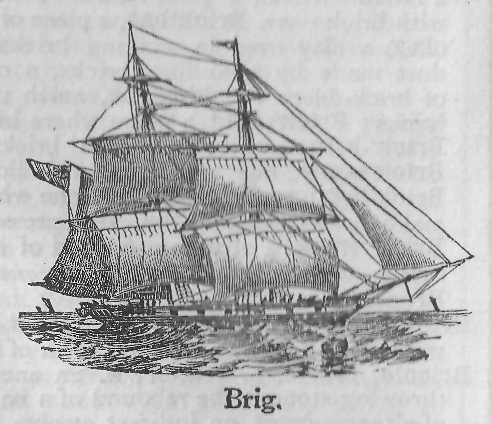
Brig, brig, n. a two-masted, square-rigged vessel. [Shortened from Brigantine.]
Brigade, brig-ād′, n. a body of troops consisting of two or more regiments of infantry or cavalry, and commanded by a general officer, two or more of which form a division: a band of people more or less organised.—v.t. to form into brigades.—ns. Brigade′-mā′jor, a staff-officer attached to a brigade; Brigadier′, Brigadier′-gen′eral, a general officer of the lowest grade, who has command of a brigade. [Fr. brigade—It. brigata—Low L. briga, strife.]
Brigand, brig′and, n. a robber or freebooter.—ns. Brig′andage, freebooting: plundering; Brig′andine, Brig′antine, a coat-of-mail, composed of linen or leather, with steel rings or plates sewed upon it. [Fr.—It. brigante—briga, strife.]
Brigantine, brig′an-tīn, n. a two-masted vessel, with the mainmast of a schooner and the foremast of a brig. [Fr. brigantin—It. brigantine, a pirate ship.]
Bright, brīt, adj. shining: full of light: clear: beautiful: cheerful: clever: illustrious.—adv. (Shak.) brightly: clearly.—v.t. Bright′en, to make bright or brighter.—v.i. to grow bright or brighter: to clear up.—adv. Bright′ly.—n. Bright′ness.—adj. Bright′some, bright: brilliant. [A.S. beorht; cog. with Goth. bairhts, clear, L. flagr-āre, to flame.]
Bright's-disease, brīts′-diz-ēz′, n. a generic name for a group of diseases of the kidneys, which may be defined as comprising cases where structural changes in the kidneys, usually inflammatory, but without suppuration, lead to the presence of albumen in the urine. [From Dr Richard Bright (1789-1858).]
Brigue, brig, v.i. to intrigue.—n. strife, intrigue.—n. Brigu′ing, canvassing. [Fr. brigue; derivation uncertain.]
Brill, bril, n. a fish of the same kind as the turbot, spotted with white. [Ety. unknown.]
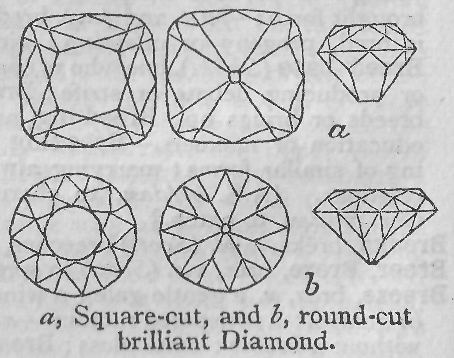
Brilliant, bril′yant, adj. sparkling: glittering: splendid.—n. a diamond of the finest cut (as opposed to rose-cut or other patterns).—ns. Brill′iancy, Brill′iance.—adv. Brill′iantly.—n. Brill′iantness.[Fr. brillant, pr.p. of briller, to shine, which, like Ger. brille, an eyeglass, is from Low L. beryllus, a beryl.]
Brim, brim, n. the margin or brink of a river or lake: the upper edge of a vessel: the rim of a hat.—v.t. to fill to the brim.—v.i. to be full to the brim:—pr.p. brim′ming; pa.p. brimmed.—adj. Brim′ful, full to the brim.—n. Brim′fulness (Shak.), fullness to the top.—adjs. Brim′less, without a brim; Brimmed, brimful: having a brim—used in composition.—n. Brim′mer, a bowl full to the brim or top.—adj. Brim′ming. [M. E. brymme—bremman, to roar.]
Brimstone, brim′stōn, n. sulphur: (fig.) a virago.—Fire and brimstone! an ejaculation. [Lit. burning stone; from A.S. brýne, a burning—byrnan, to burn, and Stone; cf. Ger. bernstein.]
Brinded, brin′ded, Brindled, brin′dld, adj. marked with spots or streaks.—n. Brin′dle, state of being brindled. [See Brand.]
Brine, brīn, n. salt water: the sea.—ns. Brine′-pit, a pit or pan in which brine is evaporated, so as to form salt: a salt spring; Brine′-shrimp, a small crustacean.—adjs. Brin′ish, like brine: somewhat salt; Brin′y, pertaining to brine or to the sea: salt.—The briny (slang), the sea. [A.S. brýne, a burning; applied to salt liquor, from its burning, biting quality.]
Bring, bring, v.t. to fetch: to carry: to procure: to occasion: to draw or lead:—pa.t. and pa.p. brought (brawt).—Bring about, to bring to pass, effect; Bring down, to humble; Bring forth, to give birth to, produce; Bring home, to prove, to impress; Bring in, to introduce; Bring off, to bring away, as by a boat from a ship, to rescue; Bring on, to cause to advance; Bring out, to express: to produce before the public, as a book, a play, a subscription: to introduce a young woman formally into so-called society; Bring over, to convert; Bring round, to restore from illness; Bring to, to check the course of, as a ship, by trimming the sails so as to counteract each other; Bring under, to subdue; Bring up, to rear or educate. [A.S. bringan, to carry, to bring; allied perh. to Bear.]
Brinjarry, brin-zhar′i, n. a travelling dealer in grain and salt in Southern India. [Hind. bānjāra.]
Brink, bringk, n. the edge or border of a steep place or of a river: (fig.) the very verge of time, at the very point of something—e.g. To be on the brink of death. [Dan. brink, declivity; Ice. bringa, a hillock.]
Brio, brī′o, n. liveliness, vivacity. [It. brio.]
Brioche, bri-osh′, n. a sponge-cake. [Fr.]
Briony. Same as Bryony.
Briquette, bri-ket′, n. a brick-shaped block of coal formed from coal-dust. [Fr. briquette, dim. of brique, a Brick.]
Brisk, brisk, adj. full of life and spirit: active: sharp: effervescing, as liquors.—v.t. to enliven, freshen.—v.i. to cheer up.—adjs. Brisk′ish, Brisk′y, (Shak.).—adv. Brisk′ly.—n. Brisk′ness. [Dr Murray notes that the word is first found in the end of the 16th century; prob. W. brysg, swift of foot; cf. Gael. brisg, Ir. briosg.]
Brisket, brisk′et, n. the breast of an animal: the part of the breast next to the ribs. [Fr. brechet, brichet.]
Bristle, bris′l, n. a short, stiff hair, as of swine.—v.i. to stand erect, as bristles.—v.t. to cover, as with bristles: to make bristly:—pr.p. bris′tling; pa.p. brist′led.—adj. Bristled (bris′ld), furnished with bristles.—n. Brist′liness.—adj. Brist′ly, set with bristles: rough.—To set up one's bristles, to show temper. [A.S. byrst; Scot. birse; cog. with Ger. borste, Ice. burst.]
Bristol-board, bris′tul-bōrd, n. a smooth pasteboard.—ns. Bris′tol-brick, an earthy material for scouring cutlery, like bath-brick; Bris′tol-dī′amond, a kind of crystal found near Bristol. [From the town of Bristol, in England.]
Brisure, bri-zhūr′, n. (fort.) any part of a rampart or parapet which breaks off at an angle from the general direction: (her.) a variation of a coat-of-arms, showing the relation of a younger to the main line. [Fr.—briser, to break.]
Britannia-metal, brit-an′i-a-met′l, n. a metallic alloy largely used in the manufacture of spoons, &c.
Britannic, brit-an′ik, adj. pertaining to Britannia or Great Britain: British.—adj. British, in ethnography, Old Celtic as opposed to Anglo-Saxon: pertaining to Great Britain or its people—ns. Brit′isher, a British subject (Amer.); Brit′on, a native of Britain.
Brittle, brit′l, adj. apt to break: easily broken: frail.—ns. Britt′leness; Britt′le-stars, or Sand-stars, one of the classes of Echinodermata, including forms not far removed from starfishes. [A.S. bréotan, to break.]
Britzka, Britzska, brits′ka, n. an open four-wheeled carriage with shutters to close at pleasure, and only one seat.—Also Britschka, Britska. [Polish bryczka, dim. of bryka, a wagon.]
Broach, brōch, n. a tapering, pointed instrument, used chiefly for boring: a spit: a church spire.—v.t. to pierce as a cask, to tap: to open up or begin: to utter.—n. Broach′er, a broach or spit: one who broaches or utters.—To broach the admiral, to steal some liquor from a cask while being carried by rail or otherwise, or when in store; To broach to, to turn a ship to windward. [Fr. brocher, to pierce, broche, an iron pin—L. brocchus, a projecting tooth.]
Broad, brawd, adj. wide: large, free or open: outspoken: coarse, indelicate: of pronunciation, e.g. a broad accent.—advs. Broad, Broad′ly.—ns. Broad′-ar′row, a mark, thus (), stamped on materials belonging to Government; Broad′-brim, a hat with a broad brim, such as those worn by Quakers: (coll.) a Quaker.—adj. Broad′cast, scattered or sown abroad by the hand: dispersed widely.—adv. by throwing at large from the hand, only in phrases, as, 'to scatter broadcast,' &c.—v.t. to scatter freely.—n. Broad′cloth, a fine kind of woollen fulled cloth, used for men's garments.—v.t. Broad′en, to make broad or broader.—v.i. to grow broad or extend in breadth.—adj. Broad′-eyed (Shak.), having a wide or extended survey.—ns. Broad′-gauge (see Gauge); Broad′ness.—n.pl. Broads, lake-like expansions of rivers.—ns. Broad′side, the side of a ship: all the guns on one side of a ship of war, or their simultaneous discharge: a sheet of paper printed on one side, otherwise named Broad′sheet; Broad′sword, a cutting sword with a broad blade: a man armed with such a sword.—Broad Church, a party within the Church of England which advocates a broad and liberal interpretation of dogmatic definitions and creed subscription—the name was first used in 1833 by W. J. Conybeare. [A.S. brád, Goth. braids.]

Brobdingnagian, brob-ding-nā′ji-an, n. an inhabitant of the fabulous region of Brobdingnag in Gulliver's Travels, the people of which were of great stature—hence a gigantic person.—adj. gigantic.—adj. Brobdingnag′, immense.
Brocade, brok-ād′, n. a silk stuff on which figures are wrought.—adj. Brocad′ed, woven or worked in the manner of brocade: dressed in brocade. [It. broccato, Fr. brocart, from It. broccare, Fr. brocher, to prick, stitch; from root of Broach.]
Brocage, brōk′āj, n. Obsolete spelling of Brokage (q.v. under Broker).
Brocard, brok′ärd, n. an elementary law or principle: a canon: (Fr.) a gibe. [Fr. brocard, Low L. brocarda, from Brocard or Burchard, Bishop of Worms, who published a book of ecclesiastical rules.]
Broccoli, brok′o-li, n. a cultivated kind of cabbage resembling cauliflower, of which it is originally a hardy variety. [It.; pl. of broccolo, a sprout, dim. of brocco, a skewer, a shoot.]
Broch, broh, n. the local name applied in the north of Scotland to the ancient dry-built circular castles, known also to the Gaelic-speaking people as duns, and to antiquaries as Pictish towers.—Also Brogh and Brough. [Old Norse borg; A.S. burh.]
Broch, brōch, obsolete spelling of Broach.
Brochure, bro-shōōr′, n. a pamphlet. [Lit. a small book stitched, Fr.—brocher, to stitch—broche, a needle. See Broach.]
Brock, brok, n. a badger—hence, from the smell, a dirty, stinking fellow.—adj. Brocked (Scot.), variegated, having a mixture of black and white. [From the Celt., as in Gael. broc, a badger, which is from Gael. breac, speckled.]
Brode, brōd, adv. (Spens.). Same as Abroad.
Brodekin, Brodkin, brōd′kin, n. a buskin. [Fr. brodequin.]
Brog, brog, n. a pointed steel instrument used for piercing holes: (Scot.) an awl.—v.t. to prick. [Ety. dub.; the Gael. brog; an awl, is prob. borrowed.]
Brogue, brōg, n. a stout coarse shoe: a dialect or manner of pronunciation, esp. the Irish. [Ir. and Gael. brog, a shoe.]
Broider, broid′ėr, Broidery, broid′ėr-i. Same as Embroider, Embroidery.—Broidered (B.) = Embroidered.
Broil, broil, n. a noisy quarrel: a confused disturbance—(Scot.) Brul′yie, Brul′zie.—n. Broil′er, one who stirs up broils. [Fr. brouiller, to trouble.]
Broil, broil, v.t. to cook over hot coals: to grill.—v.i. to be greatly heated. [Ety. dub.]
Broke, brōk, pa.t. and old pa.p. of Break.—p.adj. Brok′en, rent asunder: infirm: humbled or crushed: dispersed, routed: altered in direction: shattered in estate or position: incomplete, fragmentary: uncertain.—adjs. Brok′en-backed, having the back broken, applied to a ship so loosened in her frame as to droop at both ends; Brok′en-down, decayed, ruined in character or strength; Brok′en-heart′ed, crushed with grief: greatly depressed in spirit.—adv. Brok′enly.—ns. Brok′en-man, one under outlawry, esp. in the Highlands and Border country; Brok′en-meat, the leavings of a banquet; Brok′enness.—adj. Brok′en-wind′ed, having short breath or disordered respiration, as a horse.
Broker, brōk′ėr, n. one employed to buy and sell for others: a second-hand dealer: a pander: a commissioner.—v.i. Broke, to bargain, negotiate: (Shak.) to act as a pander or go-between:—pr.p. brōk′ing; pa.p. brōked.—ns. Brok′erage, Brok′age, the business of a broker: the commission charged by a broker: a commission charged for transacting business for others; Brok′ery, the business of a broker.—p.adj. Brok′ing, doing business as a broker: practised by brokers. [M. E. brocour—A.S. brucan; Ger. brauchen, to use, to profit.]
Bromate. See Bromine.
Brome-grass, brōm′-gras, n. a kind of grass bearing a strong resemblance to oats. [Gr. brōmos, and bromos, grass.]
Bromine, brōm′in, n. one of the elements, closely allied to chlorine, so called from its disagreeable smell.—adj. Brom′ic, pertaining to bromine.—ns. Brom′ate, a combination of bromic acid with a salifiable base; Brom′ide, a combination of bromine with a base.—Bromic acid, an acid composed of bromine and oxygen. [Gr. brōmos, a disagreeable odour.]
Bronchiæ, brongk′i-ē, n.pl. a name given to the ramifications of the windpipe which carry air into the lungs.—adjs. Bronch′ic, Bronch′ial.—n. Bronchī′tis, inflammation of the bronchiæ. [L.—Gr. bronchia, the bronchial tubes.]
Broncho, Bronco, brong′ko, n. (U.S.) a half-tamed horse. [Sp. bronco, rough, sturdy.]
Brond. Same as Brand.
Bronze, bronz, n. an alloy of copper and tin used in various ways since the most ancient times: anything cast in bronze: the colour of bronze: (fig.) impudence.—adj. made of bronze: coloured like bronze.—v.t. to give the appearance of bronze to: (fig.) to harden.—adj. Bronzed, coated with bronze: hardened.—ns. Bronze′-steel, or Steel-bronze, a specially hardened bronze; Bronze′-wing, Bronze′-pi′geon, a species of Australian pigeon having wings marked with a lustrous bronze colour.—v.t. Bronz′ify, to make into bronze.—ns. Bronz′ing, the process of giving the appearance of bronze; Bronz′ite, a lustrous kind of diallage.—adj. Bronz′y, having the appearance of bronze.—Bronze age or period, a term in prehistoric archæology denoting the condition or stage of culture of a people using bronze as the material for cutting implements and weapons—as a stage of culture coming between the use of stone and the use of iron for those purposes—not an absolute division of time, but a relative condition of culture. [Fr.—It. bronzo—L. Brundusium, the modern Brindisi.]
Broo, brōō (mod. Scot.—vowel sounded like Ger. ü), n. (Scot.) broth. [Ety. dub.: prob. O. Fr. bro, breu, broth; prob conn. with Bree.]
Brooch, brōch, n. an ornamental pin or instrument for fastening any article of dress, consisting for the most part either of a ring or disc, or of a semicircle, there being a pin in either case passing across it, fastened at one end with a joint or loop, and at the other with a hook.—v.t. (Shak.) to adorn as with a brooch. [Fr. broche, a spit. See Broach.]
Brood, brōōd, v.t. to sit upon or cover in order to breed or hatch: to hatch: to cover, as with wings: to mature or foster with care: to meditate moodily upon.—v.i. to sit as a hen on eggs: to hover over: to think anxiously for some time: to meditate silently (with on, over): to be bred.—n. something bred: offspring, children, or family: a race, kind: parentage: the number hatched at once.—adj. for breeding, as in brood-mare, &c.—adv. Brood′ingly.—adj. Brood′y, inclined to sit or incubate. [A.S. bród; Dut. broed; what is hatched.]
Brook, brōōk, n. a small stream.—ns. Brook′let, a little brook; Brook′lime, a species of speedwell found in ditches. [A.S. bróc, water breaking forth; Dut. broek, Ger. bruch.]
Brook, brōōk, v.t. to enjoy: to bear or endure. [A.S. búrcan, to use, enjoy; Ger. brauchen, L. frui, fructus.]
Brool, brōōl, n. a deep murmur. [Ger. brüll, a roar.]
Broom, brōōm, n. a name given to a number of species of shrubs of the closely allied genera Cytisus, Genista, and Spartium: a besom made of its twigs.—v.t. to sweep with a broom.—ns. Broom′-corn, a species of plant resembling maize, cultivated for its seed and its spikes, of which brooms are made; Broom′-rape, a parasitic plant found adhering to the root of broom, clover, &c.; Broom′staff, Broom′stick, the staff or handle of a broom.—adj. Broom′y, abounding in or consisting of broom.—To marry over the broomstick, or To jump the besom, to go through an irregular form of marriage, in which both jump over a broomstick. [A.S. bróm; Ger. bram.]
Broose, brüz, n. (Scot.) a race at weddings in Scotland. [Derivation unknown.]
Brose, brōz, n. a simple and nutritious food, made by pouring boiling water or milk on oatmeal, seasoned with salt and butter.—Athole brose, a mixture of whisky and honey. [Scot.; O. Fr. broez.]
Broth, broth, n. an infusion or decoction of vegetable and animal substances in water.—A broth of a boy (Irish), a first-rate fellow. [A.S. broth—bréowan, to brew. See Brew.]
Brothel, broth′el, n. a house of ill-fame. [M. E. brothel—A. S. broð-en, ruined, bréðen, to go to ruin.]
Brother, bruth′ėr, n. a male born of the same parents: any one closely united with or resembling another; associated in common interests, occupation, &c.: a fellow-member of a religious order, a fellow-member of a guild, &c.: a fellow-creature, fellow-citizen, a co-religionist: (B.) a kinsman: pl. Broth′ers and Breth′ren, the latter esp. used in the sense of fellow-membership of guilds, religious communities, &c., and is a name given to certain sections of the Church of Christ, as Christian Brethren, Moravian Brethren, Plymouth Brethren, &c.—ns. Broth′er-ger′man, a brother having the same father and mother, in contradistinction to a half-brother, by one parent only; Broth′erhood, the state of being a brother: an association of men for any purpose; Broth′er-in-law, the brother of a husband or wife: a sister's husband.—adjs. Broth′er-like, Broth′erly, like a brother: kind: affectionate.—n. Broth′erliness, state of being brotherly: kindness. [A.S. broðor; cog. with Ger. bruder, Gael. brathair, Fr. frère, L. frater, Sans. bhrátar.]