LIST OF ABBREVIATIONS USED IN THIS DICTIONARY. (continued 3)
Reading edition
Ananas, an-an′as, n. the pine-apple: the West Indian penguin.—Also Anan′a. [Peruvian.]
Anandrous, an-an′drus, adj. without stamens, or male organs, applied to female flowers. [Gr. an, neg., and anēr, andros, a man.]
Anantherous, an-an′thėr-us, adj. without anthers. [Gr. an, neg., and Anther.]
Ananthous, an-an′thus, adj. without flowers. [Gr. an, neg., and anthos, a flower.]
Anapæst, Anapest, an′a-pest, n. (in verse) a foot consisting of three syllables, two short and the third long, or (in Eng.) two unaccented and the third accented, as colonnadé—a familiar example of a poem in this metre is Byron's Destruction of Sennacherib.—adjs. Anapæs′tic, -al. [Gr. anapaistos, reversed, because it is the dactyl reversed.]
Anaphora, an′af-or-a, n. (rhet.) the repetition of the same word or phrase in several successive clauses, as in 1 Cor. i. 20. [Gr.; ana, back, pher-ein, to bear.]
Anaphrodisiac, an-af-rō-diz′i-ak, adj. and n. tending to diminish sexual desire, or a drug supposed to have that effect. [Fr. an, neg., and adj. from Aphrodite.]
Anaplasty, an′a-plas-ti, n. the reparation of superficial lesions by the use of adjacent healthy tissue, as by transplanting a portion of skin.—adj. An′aplastic. [Gr.; that may be formed anew, ana, again, plass-ein, to form.]
Anaplerosis, an′a-plē-rō′sis, n. the filling up of a deficiency, esp. in medicine: the filling up of parts that have been destroyed, as in wounds, cicatrices, &c.—adj. Anaplerot′ic. [Gr.; from ana, up, and plēro-ein, to fill up.]
Anaptotic, an-ap-tot′ik, adj. (philol.) again uninflected—a term sometimes applied to languages which have lost most of their inflections through phonetic decay. [Gr. ana, again, aptōtos, without case, indeclinable, aptōs, -ōtos, not falling, pipt-ein, to fall.]
Anarchy, an′ark-i, n. the want of government in a state: political confusion: conflict of opinion.—adjs. Anarch′al (rare); Anarch′ic, Anarch′ical.—v.t. Anarch′ise.—ns. An′archism, anarchy: the negation of government—the name adopted by a phase of revolutionary socialism associated with the names of Proudhon and Bakunin. Their ideal of society was of one without government of any kind, when every man should be a law unto himself; An′archist, An′arch, one who promotes anarchy. [Gr. a, an, neg., archē, government.]
Anarthrous, an-är′thrus, adj. without the article, of Greek nouns: (entom.) having neither wings nor legs.—adv. Anar′thrously. [Gr. an, neg., arthron, a joint, the article.]
Anastatic, an-a-stat′ik, adj. furnished with characters standing up, or raised in relief—esp. of the anastatic printing process, in which copies of drawings are printed from fac-similes produced in relief on zinc plates. [Gr. anastatikos—ana, up, statikos, causing to stand—histēmi, to make to stand.]
Anastomosis, an-as-to-mō′sis, n. the union or intercommunication of vessels with each other, as seen in the junction of the branches of the arteries.—v.i. Anas′tomose, to communicate in such a way.—adj. Anastomot′ic.
Anastrophe, an-as′tro-fi, n. an inversion of the natural order of words, as 'Loud roared the thunder,' for 'The thunder roared,' &c. [Gr.; ana, back, and streph-ein, to turn.]
Anathema, an-ath′em-a, n. a solemn ecclesiastical curse or denunciation involving excommunication: any person or thing anathematised: generally, any imprecation or expression of execration.—n. Anathematisā′tion—v.t. Anath′ematise, to pronounce accursed.—Anathema maranātha, as in 1 Cor. xvi. 22; maranatha (Syr. māran ethā, 'our Lord hath come') is properly a mere solemn formula of confirmation, like Amen, having no other connection with the antecedent anathema—it is so printed in the Revised Version.—It seems to have been used by the early Christians as a kind of watchword of mutual encouragement and hope. So the words in 1 Cor. xvi. 22 are nearly equivalent to the similar expressions in Phil. iv. 5; Rev. xxii. 20. [The classical Gr. anathēma meant a votive offering set up in a temple, ana, up, tithenai, to place; the anathĕma of the Septuagint and New Testament meant something specially devoted to evil, as in Rom. ix. 3.]
Anatomy, an-a′tom-i, n. the art of dissecting any organised body: science of the structure of the body learned by dissection: a skeleton, a shrivelled and shrunken body, a mummy: (fig.) the lifeless form or shadow of anything: humorously for the body generally: the detailed analysis of anything, as in Burton's famous treatise, The Anatomy of Melancholy.—adjs. Anatom′ic, -al, relating to anatomy.—adv. Anatom′ically.—v.t. Anat′omise, to dissect a body: (fig.) to lay open minutely.—n. Anat′omist, one skilled in anatomy. [Gr. ana, up, asunder, temnein, to cut.]
Anatopism, an-at′op-izm, n. (rare—Coleridge) a faulty arrangement. [Gr. ana, up, topos, a place.]
Anatta, an-at′ta, n. the reddish pulp surrounding the seeds of the Bixa orellana, a medium-sized tree growing in Guiana and elsewhere. It yields a dye which gives a bright orange tint to cloth, and is much used to add colour to butter and cheese.—Also Anat′to, Annat′to, Arnot′to. [Supposed to be a native Amer. word.]
Anbury, an′bėr-i, n. a disease in turnips, produced by one of the slime-fungi, and usually the result of improper cultivation. It is often confounded with Finger-and-toe (dactylorhiza), which is rather a degeneration of the plant than a disease, the bulb branching out into a number of taproots, while the skin remains unbroken. Anbury causes a scabbed and broken skin, and tubercular growths on the roots and at the base of the bulb. [Often explained as a disguised form of A.S. ampre, a crooked swelling vein; more probably, a variant of anbury = angberry, A.S. ang-, pain, as in ang-nail.]
Ancestor, an′ses-tur, n. one from whom a person has descended: a forefather:—fem. An′cestress.—adj. Ances′tral.—ns. An′cestor-wor′ship, the chief element in the religion of China and other countries—erroneously supposed by Herbert Spencer to be the foundation of all religion; An′cestry, a line of ancestors: lineage. [O. Fr. ancestre—L. antecessor—ante, before, cedĕre, cessum, to go.]
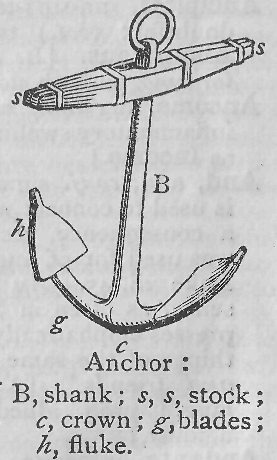
Anchor, ang′kor, n. an implement for retaining a ship in a particular spot by temporarily chaining it to the bed of a sea or river. The most common form has two flukes, one or other of which enters the ground, and so gives hold; but many modifications are used, some with movable arms, some self-canting.—Anchors are distinguished as the starboard and port bowers, sheet, spare, stream, kedge, and grapnel, or boat anchors: (fig.) anything that gives stability or security.—v.t. to fix by an anchor: to fasten.—v.i. to cast anchor: to stop, or rest on.—ns. Anch′orage, the act of anchoring: the place where a ship anchors or can anchor: (Shak.) the anchor and all the necessary tackle for anchoring: a position affording support: (fig.) anything that gives a resting-place or support to the mind: duty imposed on ships for anchoring; Anch′or-hold, the hold of an anchor upon the ground: (fig.) security.—adj. Anch′orless, without such: unstable.—n. Mushroom-anchor, an anchor with a saucer-shaped head on a central shank, used for mooring.—At anchor, anchored.—To cast anchor, to let down the anchor, to take up a position; To weigh anchor, to take up the anchor so as to be able to sail away. [A.S. ancor—L. ancora—Gr. angkyra, angkos, a bend. Conn. with Angle.]
Anchoret, ang′kor-et, Anchorite, ang′kor-īt, n. one who has withdrawn from the world, especially for religious reasons: a hermit.—The form Anach′oret occurs in many books on church history for the recluses of the East in the early history of the church.—ns. Anch′or (Shak.), an anchorite—earlier still also an anchoress, as in the book-title Ancren Riwle, the 'Rule of Nuns;' Anch′orage, the retreat of a hermit; Anch′oress, a female anchorite: a nun—also Anc′ress, Ank′ress, Anch′oritess.—adjs. Anch′oretic, -al. [Gr. anachōrētēs—ana, apart, chōrein, to go.]
Anchovy, an-chō′vi, n. a small fish of the herring family, much fished in the Mediterranean for pickling, and for a sauce made from it, anchovy-paste, &c.—n. Anchō′vy-pear, the fruit of a myrtaceous Jamaica tree, pickled and eaten like the East Indian mango, which it much resembles in taste. [Sp. and Port. anchova; Fr. anchois. Of doubtful etymology. The Basque anchoa, anchua, has been connected with antzua, dry.]
Anchylosis, Ankylosis, ang-kī-lō′sis, n. the coalescence of two bones, or the union of the different parts of a bone: stiffness in a joint through destruction of the articular cartilages, or a thickening and shortening of the natural fibrous tissues around the joint. [Gr.; angkylos, crooked.]
Ancient, ān′shent, adj. old: belonging to former times, specifically, of times prior to the downfall of the western Roman empire (476 A.D.): of great age or duration: of past times in a general sense: venerable: antique, old-fashioned.—n. an aged man, a patriarch: a superior in age or dignity.—adv. An′ciently.—ns. An′cientness; An′cientry, ancientness, seniority: ancestry: dignity of birth: (Shak.) old people.—n.pl. An′cients, those who lived in remote times, esp. the Greeks and Romans of classical times: (B.) elders.—The Ancient of days, a title in the Holy Scriptures for the Almighty, applied by Byron to Athens. [Fr. ancien—Low L. antianus, old—L. ante, before. See Antique.]
Ancient, ān′shent, n. (obs.) a flag or its bearer: an ensign. [Corr. of Fr. enseigne. See Ensign.]
Ancillary, an′sil-ar-i, adj. subservient, subordinate (with to). [L. ancilla, a maid-servant.]
Ancipital, an-sip′i-tal, adj. two-headed: double: doubtful: (bot.) two-edged and flattened.—Also Ancip′itous. [L. anceps, ancipit-is, double—an for amb, on both sides, and caput, the head.]
Ancome, ang′kum, n. (prov.—Scot. income) a small inflammatory swelling, coming on suddenly. [Same as Income.]
And, and, conj. signifies addition, or repetition, and is used to connect words and sentences, to introduce a consequence, &c.—in M. E. (but not A.S.) it was used for if, and often also with added if, as in Luke xii. 45. An became common for and in this sense, as often in Shakespeare.—It sometimes expresses emphatically a difference in quality between things of the same class, as 'there are friends ... and friends.' [A.S., and in the other Teut. lang.; prob. allied to L. ante, Gr. anti, over against.]
Andante, an-dan′te, adj. and n. (mus.) moving with moderate and even expression: a movement or piece composed in andante time.—adj. Andanti′no, of a movement somewhat slower than andante, but sometimes meaning 'with less of andante' = somewhat quicker.—Andante affettuoso, slow but pathetically; Andante cantabile, slow, but in a singing style; Andante con moto, slow, but with emotion; Andante grazioso, slow, but gracefully; Andante maestoso, slow, with majesty; Andante non troppo, slow, but not too much so. [It.—pr.p. of andare, to go.]
Andean, an-dē′an, adj. of or like the Andes Mountains.
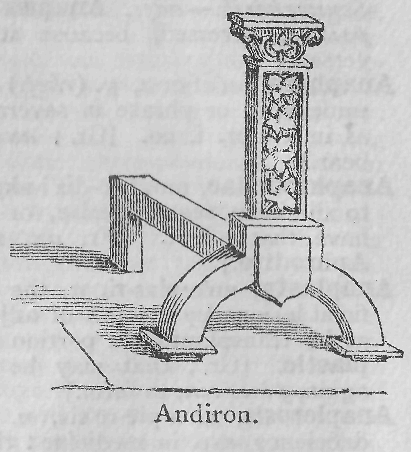
Andiron, and′ī-urn, n. the iron bars which support the ends of the logs in a wood fire, or in which a spit turns. [O. Fr. andier (Mod. Fr. landier—l'andier); Low. L. anderius, andena; further ety. dubious, perhaps ultimately cog. with End. The termination was early confused with iron, hence the spellings and-iron, hand-iron.]
Androcephalous, an-dro-sef′a-lus, adj. having a human head, as a sphinx or Assyrian bull. [Gr. anēr, andros, a man, kephalē, a head.]
Androgynous, an-droj′i-nus, adj. having the characteristics of both male and female in one individual: hermaphrodite: (bot.) having an inflorescence of both male and female flowers—also Androg′ynal (rare).—n. Androg′yny, hermaphroditism. [Gr.; anēr, andros, a man, and gynē, woman.]
Android, an′droid, n. an automaton resembling a human being.—Also Andrō′ides.
Andromeda, an-drom′e-da, n. a genus of shrubs of the heath family: the name of a northern constellation. [Andromeda, in Greek mythology, a maiden bound to a rock, and exposed to a sea-monster, but delivered by Perseus.]
Ane, ān, or yin, Scotch form of One.
Aneal, Anele, an-ēl′, v.t. to anoint with oil: to administer extreme unction. [M. E. anele, from an A.S. verb compounded of A.S. on, on, and ele, oil.]
Anear, a-nēr′, adv. nearly: near.—prep. near.—v.t. to approach, to come near to.
Anecdote, an′ek-dōt, n. an incident of private life: a short story.—n. An′ecdotage, anecdotes collectively: garrulous old age.—adjs. An′ecdotal, Anecdot′ical, in the form of an anecdote. [Gr.; 'not published'—a, an, neg., and ekdotos, published—ek, out, and didonai, to give.]
Anelace. See Anlace.
Anelectrotonus, an′el-ek-trot′on-us, n. (phys.) the diminished excitability of a nerve near the anode of an electric current passing through it.—adj. An′elec′tric, parting readily with its electricity.—n. a body which readily gives up its electricity.—n. Anelec′trode, the positive pole of a galvanic battery.—adj. An′electrot′onic. [Gr. an, up, elektron, amber.]
Anemograph, a-nem′ō-graf, n. an instrument for measuring and recording the direction and velocity of the wind. [Gr. anemos, wind, graphein, to write.]
Anemometer, a-ne-mom′et-ėr, n. an instrument for measuring the velocity or pressure of the wind.—adj. Anemomet′ric.—n. Anemom′etry, the measurement of the force or velocity of the wind. [Gr. anemos, wind, and Meter.]
Anemone, a-nem′o-ne, n. a plant of the crowfoot family.—n. Sea′-anem′one, a popular name of Actinia and some allied genera of Actinoza. [Gr. anemōne, said to be from anemos, wind, because some of the species love exposed and wind-swept situations.]
An-end, an-end′, prep. phrase, to the end, continuously: upright.—Most an-end, almost always.
Anent, a-nent′, prep. and adv. in a line with: against: towards: in regard to, concerning, about. [Mainly prov. Eng. and Scot., M.E. anent—A.S. on- efen, 'on even with' (dat.).]
Aneroid, an′e-roid, adj. denoting a barometer by which the pressure of the air is measured without the use of quicksilver or other fluid.—n. a contr. of 'aneroid barometer.' [Fr.—Gr. a, neg., nēros, wet.]
Aneurism, an′ūr-izm, n. a soft tumour arising from the dilatation of an artery acting on a part weakened by disease or injury: (fig.) any abnormal enlargement—adjs. An′eurismal, An′eurismatic. [Gr. aneurysma—ana, up, eurys, wide.]
Anew, a-nū′, adv. afresh: again. [Of and New.]
Anfractuous, an-fract-ū′us, adj. winding, involved, circuitous.—n. Anfractuos′ity. [L. anfractuösus, anfract-us.]
Angel, ān′jel, n. a divine messenger: a ministering spirit: an attendant or guardian spirit: a person possessing the qualities attributed to such—gentleness, purity, &c.: one supposed to have a special commission, as the head of the Church in Rev. ii. and iii., or the angel of the Catholic and Apostolic Church, who corresponds in a limited sense to the bishop of other Christian denominations: (poet.) a messenger generally: in art, the conventional figure attributed to the angel—a figure of great beauty, youthful, clothed in flowing garments, with wings: an old Eng. coin = 10s., bearing the figure of an angel.—n. An′gel-fish, a voracious fish, allied to the shark, from six to eight feet long, with large, wing-like pectoral fins.—adjs. Angel′ic (an-), Angel′ical.—adv. Angel′ically.—ns. Angelol′atry (ān-), angel-worship; Angelol′ogy, the doctrine regarding angels; Angeloph′any, the manifestation of an angel to man. [Gr. angelos, a messenger.]
Angelica, an-jel′i-ka, n. a genus of umbelliferous plants, the roots and seeds of some species of which are used in making gin, bitters, &c.—the tender stalks and midribs of the leaves are candied and used as a confection: confections.—n. An′gel-wat′er, a perfumed liquid, at first made largely from angelica, then from ambergris, rose-water, orange-flower water, &c. [From their supposed magical properties.]
Angelus, an′je-lus, n. the 'Hail, Mary,' or prayer to the Virgin, containing the angelic salutation: the bell rung in Roman Catholic countries at morning, noon, and sunset, to invite the faithful to recite the Angelic Salutation. [From its first words, 'Angelus domini nuntiavit Mariæ.']
Anger, ang′ger, n. a strong emotion excited by a real or fancied injury, and involving a desire for retaliation.—v.t. to make angry: to irritate.—adj. An′gerless.—advs. An′gerly, a 17th-cent. form (still used in an archaic sense) for Angrily; Ang′rily.—n. Ang′riness.—adj. Ang′ry, excited with anger: inflamed: lowering. [Ice. angr; allied to Anguish.]
Angevin, an′je-vin, adj. pertaining to Anjou: relating to the Plantagenet house that reigned in England from 1154 to 1485, its first king, Henry II., being son of Geoffrey V., Count of Anjou, and Matilda, daughter of Henry I. of England. By some the term Angevin is only allowed until the loss of Anjou under John (1204); by others, till the deposition of Richard II. in 1399.
Angina, an-jī′na, n. any inflammatory affection of the throat, as quinsy, croup, &c.: usually in medical phraseology with adjective, as Angina rheumatica = rheumatic sore throat.—Angina pectoris, a disease of the heart marked by paroxysms of intense pain, beginning at the breastbone and radiating thence mainly towards the left shoulder and arm. [L. angĭna. See Anguish.]
Angiocarpous, an-ji-ō-kar′pus, adj. having the fruit in an envelope distinct from the calyx. [Gr. angeion, a case, karpos, fruit.]
Angiosperm, an′ji-o-sperm, n. a plant whose ovules or future seeds are enclosed in a closed ovary, and fertilised through the medium of a stigma, while in Gymnosperms the ovule is naked, and the pollen is applied directly to its surface.—adjs. Angiosperm′ous, Angiosperm′al, Angiosper′matous.
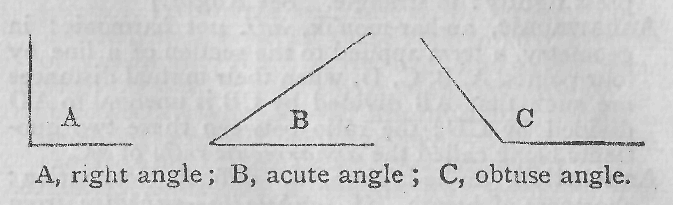
Angle, ang′gl, n. a corner: the point where two lines meet: (geom.) the inclination of two straight lines which meet, but are not in the same straight line: any outlying corner or nook.—adj. Ang′ular, having an angle or corner: (fig.) stiff in manner: the opposite of easy or graceful: bony and lean in figure.—n. Angular′ity.—adj. Ang′ulated, formed with angles. [Fr.—L. angulus; cog. with Gr. angkylos; both from root ank, to bend, seen also in Anchor, Ankle.]
Angle, ang′gl, n. a hook or bend: a fishing-rod with line and hook.—v.i. to fish with an angle.—v.t. to entice: to try to gain by some artifice.—ns. Ang′ler, one who fishes with an angle: a voracious fish about three feet long, not uncommon on British shores, and called also the Fishing-frog, the Sea-devil, and by the Scotch, Wide-gab; Ang′ling, the art or practice of fishing with a rod and line. [A.S. angel, a hook, allied to Anchor.]
Angles, ang′glz, n.pl. the Low German stock that settled in Northumbria, Mercia, and East Anglia.
Anglican, ang′glik-an, adj. English: belonging to, or characteristic of, the Church of England.—n. Ang′licanism, attachment to English institutions, esp. the English Church: the principles of the English Church.—v.t. Ang′licise, to express in English idiom.—n. Ang′licism, an English idiom or peculiarity of language.—v.t. Ang′lify, to make English.
Anglo-, ang′glo, pfx. English—used in composition, as Anglo-Saxon, &c.—ns. Ang′lo-Cath′olic, one who calls himself a Catholic of the Anglican pattern, refusing the name of 'Protestant;' used adjectively, as in 'Anglo-Catholic Library;' Ang′lo-Catho′licism.—adj. and n. Ang′lo-Sax′on, applied to the earliest form of the English language—the term Old English is now preferred. Properly it should have referred only to the Saxons of Wessex, Essex, Middlesex, and Sussex, as distinct from the Angles.—ns. Ang′lo-Sax′ondom; Anglo-Sax′onism.—Anglo-Israelite theory, an opinion held by not a few well-meaning persons, innocent of scientific ethnology, that the English are descended from the Israelites who were carried into captivity by the Assyrians under Sargon in 721 B.C.
Anglomania, ang′glo-mān′i-a, n. a mania for what is English: an indiscriminate admiration of English institutions.—ns. Ang′loman (rare), Ang′lomān′iac.
Anglophobia, ang-glō-fō′bi-a, n. fear and dislike of England.—ns. An′glophobe, Anglophō′bist.—adj. Anglophō′bic. [Fr. Anglophobe—L. Anglo-, English, Gr. phobein, to fear.]
Angora, ang-gō′ra, n. cloth made from the wool of the Angora goat.—Angora Wool, the long white silky hair of the Angora goat, highly valued in manufactures. [Angora, a city of Asia Minor, famous for its breed of goats.]
Angostura, ang-gos-tōō′ra, n. a town of Venezuela, on the Orinoco (renamed Ciudad Bolivar in 1819), giving its name to an aromatic bitter bark, valuable as a febrifuge and tonic.—Angostura bitters is an essence containing angostura, canella, cinchona, lemon peel, and other aromatics, but much of what is sold under that name contains no angostura, but consists mainly of cheretta or other simple tonic.
Angry. See Anger.
Anguine, ang′gwīn, adj. of or like a snake. [L. anguis, anguin-is, a snake.]
Anguish, ang′gwish, n. excessive pain of body or mind: agony.—n. Ang′uishment. [O. Fr. angoisse—L. angustia, a strait, straitness—ang-u-ĕre, to press tightly: to strangle. See Anger.]
Anharmonic, an-har-mon′ik, adj. not harmonic: in geometry, a term applied to the section of a line by four points, A, B, C, D, when their mutual distances are such that AB divided by CB is unequal to AD divided by CD; the ratio between these two quotients being called the anharmonic ratio of AC.
Anhelation, an-he-lā′shun, n. difficult respiration: shortness of breath. [L. anhelatio—anhelāre, from an, for amb, around, and hal-āre, to breathe.]
Anhungered. See Ahungered.
Anhydrous, an-hī′drus, adj. a term applied to a chemical substance free from water.—n.pl. Anhy′drides, a term now commonly given to the compounds formerly known as anhydrous acids—in some cases the result of the dehydration of acids, and in all cases representing in their composition the acid minus water.—n. Anhy′drite, a mineral consisting of anhydrous sulphate of lime, with some slight addition of sea-salt, appearing in several varieties—granular, fibrous, radiated and translucent, compact and of various shades—white, blue, gray, red. [Gr. a, an, neg., hydōr, water.]
Anight, a-nīt′, adv. (Shak.) of nights, at night. [Of and Night.]
Anil, an′il, n. a plant from whose leaves and stalks indigo is made. [Sp. anil; Ar. an-nil for al-nil, the indigo plant.]
Anile, an′īl, adj. old womanish: imbecile.—n. Anil′ity, imbecile dotage. [L. anus, an old woman.]
Aniline, an′il-in, n. a product of coal-tar extensively used in dyeing and other industrial arts. [Port. anil, indigo, from which it was first obtained.]
Animadvert, an-im-ad-vėrt′, v.i. to criticise or censure.—n. Animadver′sion, criticism, censure, or reproof. [L., to turn the mind to—animus, the mind, ad, to, and vertĕre, to turn.]
Animal, an′im-al, n. an organised being, having life, sensation, and voluntary motion—it is distinguished from a plant, which is organised and has life, but not sensation or voluntary motion: the name sometimes implies the absence of the higher faculties peculiar to man.—adj. of or belonging to animals: sensual.—n. Animalisā′tion, the act of converting into animal substance, or of endowing with animal attributes: brutalisation.—v.t. An′imalise, to endow with animal life: to convert into animal matter:—pr.p. an′imalīsing; pa.p. an′imalīsed.—n. An′imalism, the state of being actuated by animal appetites only: the exercise or enjoyment of animal life, as distinct from intellectual: brutishness: sensuality: (rare) a mere animal being.—adv. An′imally, physically merely.—Animal spirits, nervous force: exuberance of health and life: cheerful buoyancy of temper: (Milton) the spirit or principle of volition and sensation. [L.—anima, air, life, Gr. anemos, wind—aō, aēmi, Sans. an, to breathe, to blow.]
Animalcule, an-im-al′kūl, n. a small animal, esp. one that cannot be seen by the naked eye:—pl. Animal′cules, Animal′cula.—adj. Animal′cular. [L. animalculum, dim. of Animal.]
Animate, an′im-āt, v.t. to give life to: to enliven or inspirit: to actuate.—adj. living: possessing animal life.—adj. An′imated, lively: full of spirit: endowed with life.—adv. Animat′edly.—p.adj. An′imating.—adv. Animat′ingly.—ns. Animā′tion, liveliness: vigour; An′imator, he who, or that which, animates. [See Animal.]
Anime, an′im, n. the resin of the West Indian locust-tree—used also for other gums and resins. [Said to be Fr. animé, living, from the number of insects in it; but perhaps a native name.]
Animism, an′im-izm, n. a theory which regards the belief in separate spiritual existences as the germ of religious ideas. It is adopted by E. B. Tylor in his Primitive Culture as the minimum definition of religion, being considered to have arisen simply from the evidence of the senses, interpreted by the crude and child-like science of the savage: the theory of Stahl, which regarded the vital principle and the soul as identical.—n. An′imist.—adj. An′imistic. [L. anima, the soul.]
Animosity, an-im-os′i-ti, n. bitter hatred: enmity. [L. animositas, fullness of spirit.]
Animus, an′im-us, n. intention: actuating spirit: prejudice against. [L. animus, spirit, soul, as distinguished from anima, the mere life.]
Anise, an′is, n. an umbelliferous plant, the aromatic seeds of which are used in making cordials. The anise of Matt. xxiii. 23 (Gr. anēthon) is properly the dill.—ns. An′iseed; Anisette′, a cordial or liqueur prepared from anise seed. [Gr. anison.]
Anker, angk′ėr, n. a liquid measure used in Northern Europe, formerly in England, varying considerably—that of Rotterdam having a capacity of 10 old wine gallons, or 8⅓ imperial gallons. [Dut.]
Ankle, Ancle, angk′l, n. the joint connecting the foot and leg.—adj. Ank′led, having, or pertaining to ankles.—n. Ank′let, an ornament for the ankle. [A.S. ancléow, cog. with Ger. enkel, and conn. with Angle.]
Ankylosis. See Anchylosis.
Anlace, Anelace, an′lās, n. a short two-edged knife or dagger, tapering to a point, formerly worn at the girdle. [Low L. anelacius; perh. the old Welsh anglas.]
Anna, an′a, n. an Indian coin worth nominally 1½d sterling, but always the sixteenth part of a rupee. [Hind. ānā.]
Annals, an′alz, n.pl. records of events under the years in which they happened: any historical work that follows the order of time in its narrations, separating them off into single years, as the Annals of Tacitus: historical records generally: year-books.—v.t. Ann′alise, to write annals: to record.—n. Ann′alist, a writer of annals. [L. annales—annus, a year.]
Annat, an′at, Annate, an′āt, n. the first-fruits, or one year's income, or a specified portion of such, paid to the Pope by a bishop, abbot, or other ecclesiastic, on his appointment to a new see or benefice. It was abolished in England in 1534, and next year the right was annexed to the crown, the fund thus arising being administered for the benefit of the Church of England, afterwards transferred to the governors of Queen Anne's Bounty, next to the Ecclesiastical Commissioners: (Scots law) the half-year's stipend payable for the vacant half-year after the death of a parish minister, to which his family or nearest of kin have right under an act of 1672. [Low L. annata—L. annus, a year.]
Annatto. See Anatta.
Anneal, an-ēl′, v.t. to temper glass or metals by subjecting them to great heat and gradual cooling: to heat in order to fix colours on, as glass.—n. Anneal′ing. [Pfx. an-, and A.S. ælan, to burn.]
Annelida, an-el′i-da, n. a class of animals comprising the red-blooded worms, having a long body composed of numerous rings.—n. Ann′elid. [L. annellus, dim. of annulus, a ring.]
Annex, an-neks′, v.t. to add to the end: to join or attach: to take permanent possession of additional territory: to affix: append (with to).—n. something added: a supplementary building—often with the Fr. spelling annexe.—n. Annexā′tion, act of annexing.—n. and adj. Annexā′tionist.—ns. Annex′ion, Annex′ment (Shak.), addition: the thing annexed. [Fr. annexer—L. annex-um, annectĕre: ad, to, nect-ĕre, to tie.]
Annihilate, an-nī′hil-āt, v.t. to reduce to nothing: to put out of existence: to render null and void, to abrogate.—ns. Annihilā′tion, state of being reduced to nothing: act of destroying: (theol.) the destruction of soul as well as body; Annihilā′tionism, the belief that the soul dies with the body.—adj. Annihilā′tive.—n. Annihilā′tor, one who annihilates. [L. annihilatus, annihilāre; ad, to, nihil, nothing.]
Anniversary, an-ni-vėrs′ar-i, adj. returning or happening every year: annual.—n. the day of the year on which an event happened or is celebrated: the celebration proper to such, esp. a mass or religious service. [L. anniversarius; annus, a year, and vertĕre, versum, to turn.]
Annotate, an′not-āt, v.t. to make notes upon.—ns. An′notation, a note of explanation: comment; An′notator, a writer of notes, a commentator. [L. annotāre—ad, to, notāre, -ātum, to mark.]
Announce, an-nowns′, v.t. to declare: to give public notice of: to make known.—n. Announce′ment. [O. Fr. anoncer—L. annuntiāre—ad, to, nunti, -āre, to deliver news.]
Annoy, an-noi′, v.t. to trouble: to vex: to tease: to harm, esp. in military sense:—pr.p. annoy′ing; pa.p. annoyed′.—ns. Annoy (now poetic only), Annoy′ance, that which annoys.—adv. Annoy′ingly. [O. Fr. anoier (It. annoiare); noun, anoi (mod. ennui), acc. to Diez from L. phrase, in odio, as in 'est mihi in odio' = 'it is to me hateful.']
Annual, an′nū-al, adj. yearly: coming every year: requiring to be renewed every year: performed in a year.—n. a plant that lives out one year: a book published yearly, esp. applied to the sumptuous books, usually illustrated with good engravings, much in demand in the first half of the 19th century for Christmas, New Year, and birthday presents.—adv. An′nually. [Through Fr. from L. annualis—annus, a year.]
Annuity, an-nū′i-ti, n. a payment generally (but not necessarily) of uniform amount falling due in each year during a given term, such as a period of years or the life of an individual, the capital sum not being returnable.—n. Annū′itant, one who receives an annuity.—Certain annuity, one for a fixed term of years, subject to no contingency whatever; Contingent annuity, one that depends also on the continuance of some status, as the life of a person whose duration is calculated by the theory of probabilities. An annuity is usually held payable to the end of each year survived; but when, in addition, a proportion of the year's annuity is payable up to the day of death, the annuity is said to be Complete—the ordinary annuity being sometimes, for distinction, referred to as a Curtate annuity. When the first payment is due in advance, the annuity is known as an Annuity due; when the first payment is not to be made until the expiry of a certain number of years, it is called a Deferred or Reversionary annuity.
Annul, an-nul′, v.t. to make null, to reduce to nothing: to abolish:—pr.p. annul′ling; pa.p. annulled′.—n. Annul′ment, the act of annulling. [Fr. annuler—Low L. annullā-re, to make into nothing—L. ad-, to, nullus, none.]
Annular, an′nūl-ar, adj. ring-shaped.—adjs. An′nulate, An′nulated, formed or divided into rings.—ns. Annulā′tion, a ring or belt: a circular formation; An′nulet, a little ring: (archit.) a small flat fillet, encircling a column, &c., used either by itself or in connection with other mouldings: (her.) a little circle borne as a charge on coats of arms.—adj. An′nulose, having rings: composed of rings. [L. annularis; annulus or anulus, a ring—dim. of anus, a rounding or ring.]
Annunciation, an-nun-si-ā′shun, n. the act of announcing.—v.t. Annun′ciate, to proclaim.—n. Annunciā′tion-day, the anniversary of the Angel's salutation to the Virgin Mary, the 25th of March, Lady-day. [See Announce.]
Anode, an′ōd, n. a term in electrolysis introduced by Faraday to designate the positive pole, or that surface by which the galvanic current enters the body undergoing decomposition (electrolyte)—as opp. to Cathode, the negative pole. [Gr. ana, up, hodos, way.]
Anodyne, an′o-dīn, n. a medicine that allays pain, whether acting on the nerves and nerve terminations (aconite, belladonna, cocaine), on the brain (chloral, Indian hemp), or on all these parts (opium, bromide of potassium). [Gr.; a, an, neg., and odynē, pain.]
Anoint, an-oint′, v.t. to smear with ointment or oil: to consecrate with oil.—n. Anoint′ment, the act of anointing or state of being anointed.—The Anointed, the Messiah. [= an+oint. See Ointment.]
Anomaly, an-om′al-i, n. irregularity: deviation from rule: (astron.) the angle measured at the sun between a planet in any point of its orbit and the last perihelion.—adjs. Anomalist′ic, -al, anomalous: departing from established rules: irregular.—n. Anom′alite, an irregular mineral.—adj. Anom′alous, irregular: deviating from rule.—Anomalistic year, the interval that elapses between two successive passages of the earth through its perihelion, or point of nearest approach to the sun = 365 days 6 hr. 13 min. 49 sec., being 4 min. 39 sec. longer than the sidereal year. [Gr. anōmalos—a, an, neg., and homalos, even—homos, same.]
Anon, an-on′, adv. in one (instant): immediately.
Anonymous, an-on′im-us, adj. wanting a name: not having the name of the author, as distinguished from pseudonymous, when another than his real name has been given.—ns. An′onym, a person whose name is not given: a pseudonym; Anonym′ity, the quality or state of being anonymous.—adv. Anon′ymously. [Gr. anōnymos—a, an, neg., and onoma, name.]
Another, an-uth′ėr, adj. not the same: a different or distinct (thing or person): one more: a second: one more of the same kind: any other.—One another, now used as a compound reciprocal pronoun (of two or more); One with another, taken all together, taken on the average.—You're another, the vulgar Tu quoque. [Orig. an other.]
Anserine, an′sėr-īn, or -in, adj. relating to the goose or goose-tribe: stupid, silly. [L. anserinus, anser.]
Answer, an′sėr, v.t. to reply to: to satisfy or solve: to repay: to suit: to suffer the consequences of.—v.i. to reply: to reply favourably: to act in conformity with, as 'to answer the helm:' to be accountable for (with for): to correspond: to be advantageous to: to turn out well.—n. a reply: a solution.—adj. An′swerable, able to be answered: accountable: suitable: equivalent: proportional (with to).—adv. An′swerably.—n. An′swerer.—adv. An′swerless. [A.S. andswar-ian—andswaru; and-, against, swerian, to swear.]
Ant, ant, n. a small insect: the emmet or pismire.—ns. Ant′-bear, one of the largest species of the ant-eaters, found in the swampy regions in Central and Southern America, also called the Great Ant-eater; Ant′-cow (see Aphides); Ant′-eat′er, a genus of edentate South American quadrupeds, feeding on insects, and chiefly on ants, which they procure by means of their very long cylindrical tongue covered with a viscid saliva; Ant′-hill, the hillock raised by ants to form their nest: also figuratively applied, as to the earth; Ant′-thrush, a general name applied to birds of tropical and sub-tropical countries which feed to a large extent on ants. [A contr. of Emmet—A.S. æmete.]
An't, a contr. of aren't, are not; colloquial for am not, is not, has not.—An't = on't, on it (Shak.).
Antacid, ant-as′id, n. a medicine which counteracts acidity.—adj. possessing such quality. [Gr. anti, against, and Acid.]
Antagonism, ant-ag′on-izm, n. a contending or struggling against: opposition (with to, and also with).—n. Antagonisā′tion.—v.t. Antag′onise, to struggle violently against: to counteract the action of an opposite muscle.—p.adj. Antag′onised, made antagonistic, opposed beyond hope of reconciliation.—n. Antag′onist, one who contends or struggles with another: an opponent.—adjs. Antag′onist, Antagonist′ic, contending against: opposed to.—adv. Antagonis′tically. [Gr. anti, against—agōn, contest. See Agony.]
Antalkali, ant-al′ka-li, n. anything that counteracts the action of an alkali. [Ant- and Alkali.]
Antarctic, ant-ärkt′ik, adj. opposite the Arctic: relating to the south pole or to south polar regions.—adj. Antarct′ical.—adv. Antarct′ically (obs.). [Gr. anti, opposite, and Arctic.]
Antarthritic, ant-ar-thrit′ik, adj. counteracting gout. [Gr. anti, against, and Arthritic.]
Antasthmatic, ant-ast-mat′ik, adj. counteracting asthma. [Gr. anti, against, and Asthmatic.]
Antecedent, an-te-sēd′ent, adj. going before in time: prior.—n. that which precedes in time: (gram.) the noun or pronoun to which a relative pronoun refers: (logic) a statement or proposition from which another is logically deduced: (math.) the antecedent of a ratio is the first of two terms which compose the ratio—the first and third in a series of four proportionals: (pl.) previous principles, conduct, history, &c.—n. Anteced′ence.—adv. Anteced′ently. [L. antecedent-em; ante, before, cedĕre, cessum, to go.]
Antecessor, an-te-ses′sor, n. (rare) a predecessor.
Antechamber, an′te-chām-bėr, n. a chamber or room leading to the chief apartment. [Fr. anti-chambre, ante-chambre.]
Antechapel, an′te-cha-pl, n. the outer part of the west end of a college chapel. [L. ante, before, and Chapel.]
Antedate, an′te-dāt, n. a date assigned which is earlier than the actual date.—v.t. to date before the true time: to assign an event to an earlier date: to bring about at an earlier date: to be of previous date: to accelerate: to anticipate. [L. ante, before, and Date.]
Antediluvian, -al, an-te-di-lū′vi-an, -al, adj. existing or happening before the Deluge or Flood: resembling the state of things before the Flood: very old-fashioned, primitive.—adv. Antedilū′vially.—n. Antedilū′vian, one who lived before the Flood: one who lives to be very old. [See Deluge.]
Antefix, an′te-fiks, n. (usually in pl.) term in ancient architecture, used of the ornamental tiles placed on the eaves of buildings to conceal the ends of the common or roofing tiles:—pl. An′tefixes, An′tefixa.—adj. An′tefixal. [L. ante, before, in front, and fixum, figĕre, to fix.]
Antelope, an′te-lōp, n. a quadruped belonging to the hollow-horned section of the order of Ruminants, differing from the goat in its beardless chin—a gregarious, peaceable animal, remarkable for grace, agility, and swiftness. [O. Fr. antelop—L. antalopus—Gr. antholops, of which the origin is uncertain, perhaps from Gr. anthein, to blossom, shine, and ōps, eye, and thus equivalent to 'bright-eyes.']
Antelucan, an-te-lōō′kan, adj. before dawn or daylight. [L. antelucanus—ante, before, lux, luc-is, light.]
Antemeridian, an-te-me-ri′di-an, adj. before midday or noon. [See Meridian.]
Antemundane, an-te-mun′dān, adj. before the existence or creation of the world. [L. ante, before, and Mundane.]
Antenatal, an-te-nā′tal, adj. existing before birth.—n. An′te-na′ti, those born before a certain time, as opposed to Post′-na′ti, those born after it—of Scotsmen born before 1603, and Americans before the Declaration of Independence (1776). [L. ante, before, and Natal.]
Ante-nicene, an′te-nī′sēn, adj. before the first general council of the Christian Church held at Nice or Nicæa in Bithynia, 325 A.D.
Antennæ, an-ten′ē, n.pl. the feelers or horns of insects, crustaceans, and myriopods.—adjs. Antenn′al, Antenn′ary, Antenn′iform, Antennif′erous. [L. antenna, a sailyard, the L. translation of Aristotle's keraiai, horns of insects, a word also used of the projecting ends of sailyards.]
Antenuptial, an-te-nupsh′al, adj. before nuptials or marriage. [L. ante, before, and Nuptial.]
Anteorbital, an-te-or′bit-al, adj. situated in front of the eyes. [L. ante, before, and Orbit, eye-socket.]
Antepaschal, an-te-pas′kal, adj. relating to the time before Easter. [L. ante, before, and Paschal.]
Antepast, an′te-past, n. (obs.) something to whet the appetite: a foretaste. [L. ante, before, and pastum, pascĕre, to feed.]
Antependium, an-te-pend′i-um, n. a frontlet, forecloth, frontal, or covering for an altar, of silk, satin, or velvet, often richly embroidered. [L. ante, before, and pend-ĕre, to hang.]
Antepenult, an-te-pen′ult, n. the syllable before the penult or next ultimate syllable of a word: the last syllable of a word but two.—adj. Antepenult′imate. [L. ante, before, and Penult.]
Anteprandial, an-te-prand′i-al, adj. before dinner. [L. ante, before, and prandium, dinner.]
Anterior, an-tē′ri-or, adj. before, in time or place: in front.—ns. Anterior′ity, Antē′riorness.—adv. Antē′riorly. [L.; comp. of ante, before.]
Anteroom, an′te-rōōm, n. a room before another: a room leading into a principal apartment. [L. ante, before, and Room.]
Antevenient, an-te-vē′ni-ent, adj. coming before, preceding. [L. antevenient-em; ante, before, ven-īre, to come.]
Anthelion, ant-hēl′yun, n. a luminous coloured ring observed by a spectator on a cloud or fog-bank over against the sun:—pl. Anthel′ia. [Gr. anti, opposite, hēlios, the sun.]
Anthelmintic, an-thel-mint′ik, adj. destroying or expelling worms. [Gr. anti, against, and helmins, helminthos, a worm.]
Anthem, an′them, n. a piece of sacred music sung in alternate parts: a piece of sacred music set to a passage from Scripture: any song of praise or gladness.—v.t. to praise in an anthem.—adv. An′themwise. [A.S. antefn—Gr. antiphona—anti, in return, phōne, the voice. See Antiphon.]
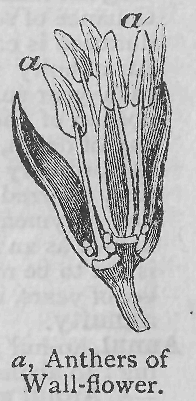
Anther, an′thėr, n. the top of the stamen in a flower which contains the pollen or fertilising dust.—adjs. An′theral; Antherif′erous, bearing anthers; Anth′eroid, resembling an anther. [L. anthera, which meant a medicine extracted from flowers, and consisting esp. of the internal organs of flowers—Gr. anthēros, flowery—anthos, a flower.]
Antheridium, an-ther-id′i-um, n. the male reproductive organs of many cryptogams, as ferns, horse-tails, mosses, &c. [L. anthera, and -idium, Gr. dim. ending.]
Antherozooid, an-ther-o-zō′oid, n. a minute moving body in the antheridia of cryptogams. [L. anthera, and zooid—Gr. zōōeidēs, like an animal—zōon, animal, and eidos, shape.]
Anthocarpous, an-tho-kär′pus, adj. (bot.) bearing fruit resulting from many flowers, as the pine-apple. [From Gr. anthos, a flower, karpos, fruit.]
Anthoid, an′thoid, adj. flower-like. [Gr. anthos, a flower, and -eidēs, like.]
Antholite, an′tho-līt, n. a flower turned into stone, a fossil flower. [Gr. anthos, a flower, lithos, stone.]
Anthology, an-thol′oj-i, n. (lit.) a gathering or collection of flowers: a collection of poems or choice literary extracts, esp. epigrams, orig. applied to the collections of Greek epigrams so called.—adj. Antholog′ical. [Gr. anthos, a flower, legein, to gather.]
Anthomania, an-thō-mān′ya, n. a madness for flowers.——n. Anthomān′iac. [Gr. anthos, and mania, madness.]
Anthony (St), an′ton-i, the patron saint of swineherds: the smallest pig in a litter.—Anthony's fire, a popular name for erysipelas.
Anthozoa, an′tho-zō-a, n.pl. another name for Actinozoa, one of the three classes of Cœlenterates, including sea-anemones, corals, &c. [Gr. anthos, a flower, zōa, animals.]
Anthracene, an-thra-sēn′, n. a hydrocarbon obtained as one of the last products in the distillation of coal-tar, of value as the source of artificial alizarin. [Gr. anthrax, coal, and -ene.]
Anthracite, an′thras-īt, n. a kind of coal that burns nearly without flame, smell, or smoke, consisting almost entirely of carbon, and not readily ignited.—adjs. Anthracif′erous, yielding anthracite; Anthracit′ic.—n. Anthracit′ism. [Gr. anthrakitēs, coal-like—anthrax, coal.]
Anthrax, an′thraks, n. a widely distributed and very destructive disease, most common among sheep and cattle, the first infectious disease proved to be due to the presence of microscopic vegetable organisms (bacilli)—other names are Splenic Apoplexy, Splenic Fever, and as it occurs in man, Malignant Pustule and Woolsorter's Disease: a carbuncle or malignant boil.—adjs. Anthra′cic, An′thracoid. [L.—Gr. anthrax; coal, a carbuncle.]
Anthropical, an-throp′ik-al, adj. (rare) connected with human nature. [Gr. anthropikos, human, anthrōpos, man.]
Anthropinism, an-thrōp′in-ism, n. the looking at things in their relation to man. [Gr. anthropinos, human (anthrōpos), and -ism.]
Anthropocentric, an-thrō-po-sent′rik, adj. centring all the universe in man. [Gr. anthrōpos, man, and kentron, centre.]
Anthropography, an-thro-pog′ra-fi, n. that branch of anthropology which treats of the human race according to its geographical distribution. [Gr. anthrōpos, man, graphia, description—graphein, to write.]
Anthropoid, an′throp-oid, adj. in the form of or resembling man.—n. the anthropoid ape, the highest and most man-like monkey.—adj. An′thropoidal. [Gr. anthrōpos, man, eidos, form.]
Anthropolatry, an-thro-pol′a-tri, n. the giving of divine honours to a human being, a term always employed in reproach. It was used by the Apollinarians against the orthodox Christians of the 4th and 5th centuries, with reference to the doctrine of the perfect human nature of Christ. [Gr. anthrōpos, man, latreia, worship.]
Anthropolite, an-throp′o-līt, n. human remains turned into stone, fossil human remains. [Gr. anthrōpos, man, lithos, stone.]
Anthropology, an-throp-ol′oj-i, n. the science of man, more especially considered as a social animal: the natural history of man in its widest sense, treating of his relation to the brutes, his evolution, the different races, &c.—adj. Anthropolog′ical.—adv. Anthropolog′ically.—n. Anthropol′ogist, one versed in anthropology. [Gr. anthrōpos, man, and logos, discourse—legein, to say.]
Anthropometry, an-thrō-pom′et-ri, n. the measurement of the human body to discover its exact dimensions and the proportions of its parts, for comparison with its dimensions at different periods, or in different races and classes.—adj. Anthropomet′ric. [Gr. anthrōpos, man, and metrein, to measure.]
Anthropomorphism, an-throp-o-morf′izm, n. the representation of the Deity in the form of man or with bodily parts: the ascription to the Deity of human affections and passions.—adj. Anthropomorph′ic.—v.t. Anthropomorph′ise, to regard as or render anthropomorphous.—ns. Anthropomorph′ist; Anthropomorph′ite; Anthropomorph′itism. [Gr. anthrōpos, man, morphē, form.]
Anthropomorphosis, an-thrō-po-morf-os′is, or -morf′os-is, n. transformation into human shape.—adj. Anthropomorph′ous, formed like or resembling man. [Gr. anthropomorphōsis—anthrōpos, man, and a verb of action, formed from morphē, shape.]
Anthropopathism, an-thro-pop′a-thizm, n. the ascription to the Deity of human passions and affections—also Anthropop′athy.—adj. Anthropopath′ic.—adv. Anthropopath′ically. [Gr. anthrōpos, man, pathos, suffering, passion.]
Anthropophagy, an-thro-pof′aj-i, n. cannibalism.—n.pl. Anthropoph′agi, man-eaters, cannibals.—ns. Anthropophagin′ian (Shak.) a cannibal; Anthropoph′agite.—adj. Anthropoph′agous. [Gr. anthrōpos, man, phag-ein, to eat.]
Anthropophuism, an-thrō-pof′ū-izm, n. the ascription of a human nature to the gods. [Gr. anthrōpos, man, and phuē, nature, and -ism.]
Anthroposophy, an-thrō-pos′o-fi, n. the knowledge of the nature of men: human wisdom.—n. Anthropos′ophist, one furnished with the wisdom of men. [Gr. anthrōpos, man, and sophia, wisdom.]
Anthropotomy, an-thrō-pot′om-i, n. anatomy of the human body. [Gr. anthrōpos, man, and temnein, to cut.]
Anti, ant′i, pfx. against, in opposition to, rivalling, simulating. It forms numerous derivatives, alike nouns and adjectives, as antichrist, antipope, anticlimax, anti-tobacconist; anti-Ritualistic, anti-Semite. [Gr. anti, against, instead of, &c.]
Antiar, an′ti-ar, n. the upas-tree (see Upas). [Jav. antjar.]
Anti-attrition, an′ti-at-trish′on, n. anything which counteracts attrition or friction—also figuratively. [Pfx. Anti- and Attrition.]
Antibilious, an′ti-bil′yus, adj. of use against biliousness. [Anti- and Bilious.]
Antiburgher, an-ti-burg′ėr, n. that section of the Scottish Secession Church which parted from the main body (the Burghers) in 1747, holding it unlawful to take the oath administered to burgesses in Edinburgh, Glasgow, and Perth, because of the reference to 'the true religion presently professed within this realm.' They read into it an allusion to the Church as by law established, while others interpreted it as signifying simply the Protestant religion. [Anti- and Burgher.]
Antic, ant′ik, adj. grotesque: odd: ridiculous in shape, dress, &c.—n. a fantastic or ancient figure, caricaturing or combining grotesquely animal or vegetable forms, or both together: (Shak.) a grotesque pageant: a buffoon, clown, mountebank: a trick, mostly in pl.—v.t. (Shak.) to make grotesque.—v.i. An′ticize (Browning), to play antics. [It. antico, equivalent to It. grottesco, and orig. used of the fantastic decorations composed of human and other forms found in the remains of ancient Rome—L. antiquus.]
Anticatholic, an-ti-kath′o-lik, adj. opposed to what is Catholic. [Anti- and Catholic.]
Antichlor, an′ti-klōr, n. a substance used in the making of paper to free the pulp from the injurious after-effects of chlorine. [Anti- and Chlor-ine.]
Antichrist, an′ti-krīst, n. the great opposer of Christ and Christianity: the name of a great enemy of Christ always expected to appear by the early Church, applied by some to the Pope and his power.—adj. Antichristian (-krist′-), relating to Antichrist: opposed to Christianity.—n. Antichrist′ianism.—adv. Antichrist′ianly. [Gr.; anti, against, and Christ-os.]
Anticipate, an-tis′ip-āt, v.t. to be beforehand with (another person or thing), to forestall or preoccupy: to take in hand, or consider, before the due time: to foresee: realise beforehand, or count upon as certain: to expect.—v.t. and v.i. to accelerate: to occur earlier than.—adj. and n. Antic′ipant, anticipating, anticipative.—n. Anticipā′tion, act of anticipating: assignment to too early a time: foretaste: previous notion, or presentiment: expectation.—adjs. Anti′cipātive, Anti′cipātory.—advs. Anticipā′tively, Anticipā′torily (rare). [L. anticipāre, -ātum—ānte, before, cap-ĕre, to take.]
Anticivic, an-ti-siv′ik, adj. opposed to citizenship, esp. the conception of it engendered by the French Revolution.—n. Anticiv′ism.
Anticlimax, an-ti-klīm′aks, n. the opposite of climax: a sentence in which the ideas become less important towards the close: also of any descent as against a previous rise—e.g. Waller's
'Under the Tropicks is our language spoke, And part of Flanders hath receiv'd our yoke.'
[Gr. anti, against, and Climax.]
Anticlinal, an-ti-klīn′al, adj. sloping in opposite directions.—n. (geol.) applied to strata which are inclined in opposite directions from a common axis—in a roof-like form. [Gr. anti, against, klin-ein, to lean.]
Anticyclone, an-ti-sī′klōn, n. name given to the rotatory flow of air from an atmospheric area of high pressure.—adj. Anticyclon′ic. [Anti- and Cyclone.]
Antidote, an′ti-dōt, n. that which is given against anything that would produce bad effects: a counter-poison: (fig.) anything that prevents evil (with against, for, to).—adj. An′tidotal. [Gr. antidotos—anti, against, didōmi, to give.]
Antient. See Ancient.
Antifebrile, an-ti-feb′rīl, adj. efficacious against fever.—n. a substance with such properties.—Also Antifebrif′ic.
Anti-federal, an-ti-fed′e-ral, adj. opposed to federalism; applied to the U.S. party whose fundamental principle was opposition to the strengthening of the national government at the expense of the States. Later names for the party were Republican, Democratic Republican, and Democratic alone.—ns. Anti-fed′eralism; Anti-fed′eralist.
Antifriction, an-ti-frik′shun, n. anything which prevents friction. [Anti- and Friction.]
Anti-Gallican, an-ti-gal′ik-an, adj. and n. opposed to what is French: or esp. opposed to the Gallican liberties of the French Church.—n. Anti-Gall′icanism. [Anti- and Gallican.]
Antigropelos, an-ti-grōp′el-os, n. waterproof leggings. [Said to be made up from Gr. anti, against, hygros, wet, and pēlos, mud. Prob. this barbarous word was orig. an advertisement.]
Antihelix, an′ti-hē-liks, n. the inner curved ridge of the pinna of the ear:—pl. Antihēl′ices.—Also An′thelix.
Anti-Jacobin, an′ti-jak′o-bin, adj. opposed to the Jacobins, a party in the French Revolution, hence an opponent of the French Revolution, or of democratic principles.—n. one opposed to the Jacobins: a weekly paper started in England in 1797 by Canning and others to refute the principles of the French Revolution.—n. An′ti-Jac′obinism. [Anti- and Jacobin.]
Antilegomena, an-ti-leg-om′en-a, n.pl. a term applied to those books of the New Testament not at first accepted by the whole Christian Church, but ultimately admitted into the Canon—the seven books of 2 Peter, James, Jude, Hebrews, 2 and 3 John, and the Apocalypse.—The other books were called Homologoumena, 'agreed to.' [Gr., lit. 'spoken against.']
Antilogarithm, an-ti-log′a-rithm, n. the complement of the logarithm of a sine, tangent, or secant. [Anti- and Logarithm.]
Antilogy, an-til′o-ji, n. a contradiction. [Gr. antilogia, contradiction, antilegein, to contradict.]
Antimacassar, an-ti-mak-as′ar, n. a covering for sofas, cushions, &c., to protect them from grease, esp. in the hair, also for ornament. [Anti- and Macassar.]
Antimask, Antimasque, an′ti-mask, n. a ridiculous interlude dividing the parts of the more serious mask. [Gr. anti, against, and Mask.]
Antimetabole, an-ti-me-tab′ol-e, n. (rhet.) a figure in which the same words or ideas are repeated in inverse order, as Quarles's 'Be wisely worldly, but not worldly wise.' [Gr.]
Antimetathesis, an′ti-me-tath′e-sis, n. inversion of the members of an antithesis, as in Crabbe's 'A poem is a speaking picture; a picture, a mute poem.' [Gr.]
Antimnemonic, an-ti-ne-mon′ik, adj. and n. tending to weaken the memory. [Anti- and Mnemonic.]
Antimonarchical, an-ti-mon-ark′i-kal, adj. opposed to monarchy and monarchical principles.—n. Antimon′archist. [Anti- and Monarchical.]
Antimony, an′ti-mun-i, n. a brittle, bluish-white metal of flaky, crystalline texture, much used in the arts and in medicine.—adjs. Antimōn′ial, Antimon′ic. [Through Fr. from Low L. antimonium, of unknown origin, prob. a corr. of some Arabic word.]
Anti-national, an-ti-nash′un-al, adj. hostile to one's nation.
Antinephritic, an-ti-ne-frit′ik, adj. acting against diseases of the kidney. [Gr. anti, against, and Nephritic.]
Antinomianism, an-ti-nōm′i-an-izm, n. the belief that Christians are emancipated by the gospel from the obligation to keep the moral law—a monstrous abuse and perversion of the Pauline doctrine of justification by faith, esp. applied to the party of Johann Agricola in the German Reformation.—n. and adj. Antinom′ian, against the law: pertaining to the Antinomians. [Gr. anti, against, nomos, a law.]
Antinomy, an′ti-nom-i, or an-tin′o-mi, n. a contradiction in a law: a conflict of authority: conclusions discrepant though apparently logical.—adjs. Antinō′mic, Antinō′mical. [Gr. anti, against, nomos, a law.]
Antinous, an-tin′ō-us, n. an ideal of youthful manly beauty, from the name of the favourite of the Roman emperor Hadrian so famous in ancient art.
Antiochian, an-ti-ō′ki-an, adj. of or pertaining to the city of Antioch, or the eclectic system in philosophy of Antiochus of Ascalon.—n. Antiō′chianism, a school of theology in the 4th and 5th centuries which spread over the whole Græco-Syrian Church, and was a revolt against the allegorical interpretation of Scripture favoured by the Alexandrian school.
Antiodontalgic, an-ti-ō-dont-alj′ik, adj. of use against toothache. [Gr. anti, against, odous, tooth, and algein, to suffer pain.]
Antipathy, an-tip′ath-i, n. dislike: repugnance: opposition: the object of antipathy (with against, to, between of persons).—adjs. Antipathet′ic, -al; Antipath′ic, belonging to antipathy: opposite: contrary.—n. Antip′athist, one possessed by an antipathy. [Gr. anti, against, pathos, feeling.]
Antiperiodic, an-ti-pē-ri-od′ik, adj. destroying the periodicity of diseases, such as ague, whose attacks recur at regular intervals: a drug with such an effect, esp. cinchona bark and its alkaloids (quinine), and arsenic.
Antiperistaltic, an-ti-per-i-stal′tik, adj. contrary to peristaltic motion: acting upwards. [Anti- and Peristaltic.]
Antiperistasis, an-ti-per-ist′a-sis, n. opposition of circumstances: resistance exerted against any train of circumstances. [Gr.; anti, against, and peristasis, a circumstance—peri, around, and histēmi, make to stand.]
Antiphlogistic, an-ti-floj-ist′ik, adj. of remedies acting against heat, or inflammation, as blood-letting, purgatives, low diet.—n. a medicine to allay inflammation. [Anti- and Phlogistic.]
Antiphon, an′tif-ōn, n. alternate chanting or singing: a species of sacred song, sung by two parties, each responding to the other—also Antiph′ony.—adj. Antiph′onal, pertaining to antiphony.—n. a book of antiphons or anthems—also Antiph′onary and Antiph′oner.—adjs. Antiphon′ic, Antiphon′ical, mutually responsive.—adv. Antiphon′ically. [Gr.; anti, in return, and phōnē, voice. A doublet of Anthem.]
Antiphrasis, an-tif′ra-sis, n. (rhet.) the use of words in a sense opposite to the true one.—adjs. Antiphras′tic, -al, involving antiphrasis: ironical.—adv. Antiphras′tically. [Gr.; anti, against, phrasis, speech.]
Antipodes, an-tip′od-ēz, n.pl. those living on the other side of the globe, and whose feet are thus opposite to ours: the inhabitants of any two opposite points of the globe: places on the earth's surface exactly opposite each other, the region opposite one's own: the exact opposite of a person or thing:—sing. An′tipode.—adjs. Antip′odal, Antipodē′an.—At antipodes, in direct opposition. [Gr. anti, opposite to, pous, podos, a foot.]
Antipole, an′ti-pōl, n. the opposite pole: direct opposite. [Anti- and Pole.]
Antipope, an′ti-pōp, n. a pontiff elected in opposition to one canonically chosen, e.g. those who resided at Avignon in the 13th and 14th centuries. [Gr. anti, against, and Pope.]
Antipopular, an-ti-pop′ū-lar, adj. adverse to the people or the popular cause. [Anti- and Popular.]
Antipyrin, an-ti-pī′rin, n. a white crystalline powder, tasteless, colourless, and soluble in water, obtained from coal-tar products by a complex process, with valuable qualities as a febrifuge, but not as an antiperiodic.—adj. Antipyret′ic.
Antiquary, an′ti-kwar-i, n. one who studies or collects old things, esp. the monuments and relics of the past—but not very ancient things, and rather from curiosity than archæological interest.—adj. (Shak.) ancient.—adj. and n. Antiquār′ian, connected with the study of antiquities, also one devoted to the study.—n. Antiquār′ianism. [See Antique.]
Antique, an-tēk′, adj. ancient: of a good old age, olden (now generally rhetorical in a good sense): old-fashioned, after the manner of the ancients.—n. anything very old: ancient relics: an American name for a kind of type of thick and bold face in which the lines are of equal thickness—Egyptian in England.—v.t. An′tiquate, to make antique, old, or obsolete: to put out of use:—pr.p. an′tiquāting; pa.p. an′tiquāted.—adj. An′tiquated, grown old, or out of fashion: obsolete: superannuated.—n. Antiquā′tion, the making obsolete: abrogation: obsoleteness.—adv. Antique′ly.—n. Antique′ness.—adj. Antiq′uish, somewhat antique.—The Antique, ancient work in art, the style of ancient art. [Fr.—L. antiquus, old, ancient—ante, before.]
Antiquity, an-tik′wi-ti, n. ancient times, esp. the times of the ancient Greeks and Romans: great age: (Shak.) old age, seniority: ancient style: the people of old time: (pl.) manners, customs, relics of ancient times.—n. Antiquitār′ian, one attached to the practices and opinions of antiquity. [Fr.—L. antiquitat-em—antiquus, ancient.]
Antirrhinum, an-tir-rī′num, n. the genus of plants to which Snapdragon belongs. [Neo-Latin, from Gr. anti, opposite, and ris, rinos, nose; from its resemblance to a beast's mouth.]
Antiscian, an-tish′i-an, adj. of or pertaining to people living on different sides of the equator, whose shadows at noon fall in opposite directions.—n.pl. Antis′ciī. [Gr.; anti, opposite, skia, a shadow.]
Antiscorbutic, an-ti-skor-būt′ik, adj. acting against scurvy.—n. a remedy for scurvy. [Gr. anti, against, and Scorbutic.]
Antiscriptural, an-ti-skrip′tūr-al, adj. opposed to Holy Scripture. [Anti- and Scriptural.]
Anti-Semites, an′ti-sem′īts, n.pl. the modern opponents of the Jews in Russia, Roumania, Hungary, and Eastern Germany.—adj. Antisemit′ic.
Antiseptic, an-ti-sept′ik, adj. and n. counteracting putrefaction and analogous fermentive changes: preventing moral decay.—adv. Antisept′ically. [Gr. anti, against, and sēpein, to rot.]
Antisocial, an-ti-sōsh′al, adj. opposed to the principles and usages of society. [Anti- and Social.]
Antispasmodic, an-ti-spaz-mod′ik, adj. opposing spasms or convulsions.—n. a remedy for spasms or convulsions. [Gr. anti, against, and Spasmodic.]
Antispast, an′ti-spast, n. in metre, a foot composed of an iambus and a trochee.—adj. Antispast′ic. [Gr. antispastos, antispa-ein, to draw into a contrary direction.]
Antistrophe, an-tis′trōf-e, n. (poet.) the returning movement from left to right in Greek choruses and dances, the movement of the strophe being from right to left: the stanza of a song alternating with the strophe: an inverse relation.—adj. Antistroph′ic, pertaining to the antistrophe. [Gr.; anti, against, and streph-ein, to turn.]
Antitheism, an-ti-thē′izm, n. the doctrine which denies the existence of a God.—n. Antithē′ist.—adj. Antitheist′ic.
Antithesis, an-tith′e-sis, n. a figure in which thoughts or words are set in contrast: a counter-thesis, counter-proposition: opposition: the contrast:—pl. Antith′esēs.—n. Ant′ithet (rare), an instance of antithesis.—adjs. Antithet′ic, -al.—adv. Antithet′ically. [Gr.; anti, against, tithēmi, to place.]
Antitoxin, an-ti-tok′sin, n. the name applied to substances present in the blood of an animal which neutralise the action of toxins or bacterial poisons.—adj. Antitox′ic.
Antitrade, an′ti-trād, n. a wind that blows in the opposite direction to the trade-wind—that is, in the northern hemisphere from south-west, and in the southern hemisphere from north-west.
Antitrinitarian, an-ti-trin-it-ār′i-an, n. and adj. opposed to the doctrine of the Trinity.—n. Antitrinitar′ianism.
Antitype, an′ti-tīp, n. that which corresponds to the type: that which is prefigured by the type, as Christ by the paschal lamb.—adjs. Antityp′al, -typ′ical.
Antler, ant′lėr, n. a bony outgrowth from the frontal bones of deer—restricted to males, except in the reindeer: branch of a stag's horn.—adj. Ant′lered. [O. Fr. antoillier—Late L. ant(e)ocular-em (ramum), the branch of a stag's horn in front of the eyes.]
Ant-lion, ant′-lī′on, n. the larva of an insect of the order Neuroptera, remarkable for the ingenuity of its insect-catching habits. [Trans. of Gr. murmēkoleōn in the Septuagint; murmēx, ant, leōn, lion.]
Antonomasia, ant-on-om-āz′i-a, n. a figure of speech which uses an epithet on the name of an office or attributive for a person's proper name, e.g. his lordship for an earl; and conversely, e.g. a Napoleon for a great conqueror. [Gr.; anti, instead, and onomazein, to name, onoma, a name.]
Antonym, ant′ō-nim, n. a word which is the opposite of another. [Gr. anti, against, onoma, a name.]
Antre, an′tėr, n. a cave or grotto. [Fr.; L. antrum, a cave.]
Anura, a-nū′ra, n.pl. tailless amphibia, as the frog and toad.—Also Anou′ra. [Gr. an-, priv., oura, tail.]
Anus, ān′us, n. the lower orifice of the bowels. [L., for as-nus, 'sitting-part,' from root as, to sit.]
Anvil, an′vil, n. an iron block on which smiths hammer metal into shape.—On or Upon the anvil, in preparation, under discussion. [A.S. anfilte, on filte; on, on, and a supposed filtan, to weld, appearing also in Felt.]
Anxious, angk′shus, adj. uneasy regarding something doubtful: solicitous.—n. Anxī′ety, state of being anxious—adv. An′xiously.—n. An′xiousness. [L. anxius—ang-ĕre, to press tightly. See Anger, Anguish.]
Any, en′ni, adj. one indefinitely: some: whoever. n. An′ybody, any single individual.—adv. Anyhow, in any way whatever: in any case, at least.—ns. An′ything, a thing indefinitely, as opposed to nothing: any whit, to any extent; Anythingā′rian, one with no beliefs in particular; Anythingā′rianism—advs. An′yway, An′yways, in any manner: anyhow: in any case; An′ywhere, An′ywhen, in any place whatever, at any time; An′ywise, in any manner, to any degree.—Any one, any single individual, anybody.—At any rate, whatever may happen, at all events.—If anything, if in any degree. [A.S. ænig—an, one.]
Aonian, ā-ō′ni-an, adj. pertaining to Aonia in Greece, or to the Muses supposed to dwell there.—Aonian fount, the fountain Aganippe, on a slope of Mount Helicon—the Æonian mount.
Aorist, ā′or-ist, n. the name of certain tenses in the Greek verb expressing indefinite time.—adj. Aorist′ic. [Gr. aoristos, indefinite—a, neg., and horistos, horizein, horos, a limit.]
Aorta, ā-or′ta, n. the great arterial trunk which, rising from the left ventricle of the heart, sends its branches ramifying through the whole body—in man subdivided into the arch, the thoracic aorta, and the abdominal aorta.—adjs. Aor′tal, Aor′tic. [Gr. aortē—aeir-ein, to raise up.]
Apace, a-pās′, adv. at a quick pace: swiftly: fast: said of the flight of time generally. [Prep. a, and Pace.]
Apagogic, -al, ap-a-goj′ik, -al, adj. proving indirectly by an apagoge or reduction to an absurdity, the truth of the thesis being evinced through the falsehood of its opposite—opposed to direct or ostensive proof. [Gr. apagōgē, leading away, abduction, apagein, to lead off.]
Apanage. See Appanage.
Apart, a-pärt′, adv. separately: aside: asunder, parted: separate: away from all employment: out of consideration, not considered for the moment (with from).—n. Apart′ness.—To set apart, to separate, consecrate. [Fr. à part—L. a parte, from the part or side.]
Apartment, a-pärt′ment, n. a separate room in a house occupied by a particular person or party: (arch.) a suite or set of such rooms—now in this sense the pl.: (obs.) a compartment.—adj. Apartment′al. [Fr. appartement, a suite of rooms forming a complete dwelling, through Low L., from L. ad, and partīre, to divide—pars, a part.]
Apathy, ap′ath-i, n. want of feeling: absence of passion: indifference.—adjs. Apathet′ic, Apathet′ical (rare).—adv. Apathet′ically. [Gr.; a, neg., pathos, feeling.]
Apatite, ap′a-tīt, n. a phosphate of lime of great variety of colour. [Gr. apatē, deceit, its form and colour being deceptive.]
Apay, a-pā′, v.t. (arch.) to satisfy, content: (obs.) to repay. [O. Fr. apayer, from L. ad, and pacāre pac-em, peace.]
Ape, āp, n. a monkey: a monkey without a tail or with a very short one: a simian proper, linking man and the lower animals, and hence termed Anthropoid—gorilla, chimpanzee, orang-outang, or gibbon: one who plays the ape, a silly imitator: (Shak.) an imitator in a good or neutral sense.—v.t. to imitate as an ape.—ns. Ape′dom; Ape′hood; Ap′ery, conduct of one who apes, any ape-like action: a colony of apes.—adj. Ap′ish, like an ape: imitative: foppish.—adv. Ap′ishly.—ns. Ap′ishness, Ap′ism (Carlyle).—God's ape, a born fool.—To lead apes in hell, believed to be the lot of old maids there; To make any one his ape, To put an ape in his hood (obs.), to make a fool of any one. [A.S. apa; Ger. affe.]
Apeak, Apeek, a-pēk′, adv. (naut.) vertical—the anchor is apeak when the cable is drawn so as to bring the ship's bow directly over it. [a, to, and Peak.]
Apelles, a-pel′ez, n. any consummate artist, from the great Greek painter Apelles, under Alexander the Great.
Apepsy, a-pep′si, Apepsia, a-pep′si-a, n. weakness of digestion. [Gr. apepsia, indigestion; a, priv., peptein, to digest.]
Aperçu, a-per′sōō, n. a summary exposition: a brief outline. [Fr. aperçu, pa.p. of apercevoir, to perceive.]
Aperient, a-pē′-ri-ent, adj. opening: mildly purgative.—n. any laxative medicine. [L. aperientem, aperīre, to open.]
Apert, a-pert′, adj. (arch.) open, public—opp. to Privy.—n. Apert′ness. [L. apert-um, pa.p. of aperīre, to open.]
Aperture, a′pėrt-ūr, n. an opening: the space through which light passes in an optical instrument: a hole. [L. apertura—aperīre, to open.]
Apetalous, a-pet′al-us, adj. (bot.) without petals. [Gr. a, neg., and petalon, a petal.]
Apex, ā′peks, n. the summit or point: the vertex of a triangle: the culminating point, climax of anything:—pl. Apexes (ā′peks-ez), Apices (ap′i-sēz). [L. apex, the peak of the flamen's cap.]
Aphæresis, Apheresis, a-fer′i-sis, n. (gram.) the taking away of a letter or syllable at the beginning of a word. [Gr. aphairesis, a taking away, apo, away, and haire-ein, to take.]
Aphaniptera, af-an-ip′tėr-a, n.pl. a small order of insects having but rudimentary scales in place of wings.—adj. Aphanip′terous. [Gr. aphanēs, invisible, pteron, wing.]
Aphasia, a-fā′zi-a, n. inability to express thought in words by reason of some brain disease: or, more widely still, the loss of the faculty of interchanging thought, without any affection of the intellect or will.—adj. Aphas′ic. [Gr.; a, neg., phasis, speech—phanai, to speak.]
Aphelion, a-fē′li-on, n. the point of a planet's orbit farthest away from the sun:—pl. Aphē′lia. [Gr. apo, from, hēlios, the sun.]
Apheliotropic, a-fē-li-o-trop′ik, adj. turning away from the sun. [Gr. apo, away, hēlios, sun, and tropikos, belonging to turning—trep-ein, to turn.]
Aphemia, a-fēm′i-a, n. loss of speech caused by difficulty in articulation due to paralysis. [Gr. a, neg., and phēmē, voice, fame—phanai, to speak.]
Apheresis. See Aphæresis.
Aphesis, af′es-is, n. the gradual loss of an unaccented vowel at the beginning of a word, as in squire = esquire—a special form of Aphæresis.—adj. Aphet′ic. [Coined by Dr Murray. Gr.]
Aphis, ā′fis, n. a family of small 'plant-lice' belonging to the order of hemipterous insects, occurring in temperate regions as parasites on the roots, leaves, stems, &c. of plants. Some kinds are tended, protected, and imprisoned by ants for the 'honey-dew' which they secrete, hence called Ant-cows:—pl. Aphides (af′i-dēz).—adj. and n. Aphid′ian. [Ety. unknown; one conjecture connects the word with Gr. apheideis, unsparing (a, neg., and pheidomai, to spare), from the remarkable rapidity of propagation.]
Aphony, af-on-i, n. loss of voice: dumbness—the more common form is Aphō′nia.—adjs. Aphon′ic, Aphon′ous, voiceless. [Gr. a, neg., phōnē, voice.]
Aphorism, af′or-izm, n. a concise statement of a principle in any science: a brief, pithy saying: an adage.—v.t. and v.i. Aph′orise, to coin or use aphorisms.—ns. Aph′oriser; Aph′orist, a writer of aphorisms.—adj. Aphoris′tic, in the form of an aphorism.—adv. Aphorist′ically. [Gr. aphorizein, to mark off by boundaries—apo, from, and horos, a limit.]
Aphrodisiac, af-ro-diz′-i-ak, adj. exciting to sexual intercourse.—n. that which excites to sexual intercourse.—adj. Aphrodis′ian, belonging to Venus, devoted to sensual love. [Gr. aphrodisiakos—Aphroditē, Venus, the goddess of love.]
Aphthæ, af′thē, n.pl. small whitish ulcers on the surface of a mucous membrane. [Gr. aphtha, mostly in pl. aphthai, usually connected with hapt-ein, to set on fire.]
Aphyllous, a-fil′us, adj. (bot.) destitute of leaves. [Gr. a, neg., phyllon, a leaf.]
Apiary, āp′i-ar-i, n. a place where bees are kept.—adjs. Apiar′ian, Ap′ian, relating to bees or bee-keeping.—n. Ap′iarist, one who keeps an apiary: one who studies the habits of bees. [L. apiarium—apis, a bee.]
Apical, ap′ik-al, adj. relating to the apex, or top.—adv. Ap′ically. [See Apex.]
Apices. See Apex.
Apician, a-pish′yan, adj. relating to Apicius, the Roman epicurean in the time of Tiberius: luxurious and expensive in diet.
Apiculture, ā′pi-cult-ūr, n. bee-keeping. [L. apis, bee, and cultura, keeping—colĕre, to keep.]
Apiece, a-pēs′, adv. for each piece, thing, or person: to each individually.—adv. Apiec′es (obs.), in pieces.
Apinch, a-pinsh′, adv. pinching, so as to pinch. [Prep. a, and Pinch.]
Aplacental, ap-la-sen′tal, adj. having no placenta. [a and Placental. See Placenta.]
Aplomb, a-plom′, n. the perpendicular, perpendicularity: self-possession, coolness. [Fr. aplomb, perpendicular position—à plomb, according to plummet.]
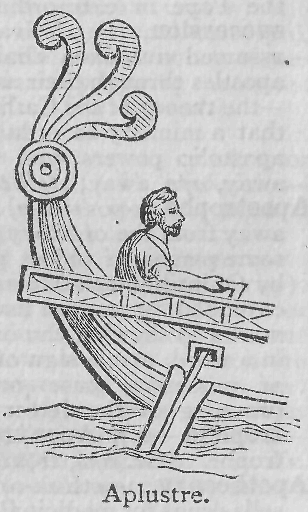
Aplustre, ap-lus′tėr, n. the ornament rising above the stern of ancient ships, often a sheaf of volutes. [L.—Gr. aphlaston.]
Apnœa, ap-nē′a, n. a cessation of breathing. [Gr. apnoia.]
Apocalypse, a-pok′al-ips, n. the name of the last book of the New Testament containing the 'revelation' granted to St John: any revelation or disclosure.—ns. Apoc′alypst, Apoc′alypt, a revealer of the future.—adjs. Apocalypt′ic, -al.—adv. Apocalypt′ically.—n. Apocalypt′ist, the writer of the Apocalypse.—Apocalyptic number, the mystical number 666, spoken of in the Apocalypse. The best solution of the riddle is Neron Kesar—Hebrew form of the Latin Nero Cæsar. The vowels e and a are not expressed in the ancient Hebrew writing: accordingly NeRON KeSaR gives
N R O N K S R
50 + 200 + 6 + 50 + 100 + 60 + 200 = 666.
[Gr.; a revelation, an uncovering—apo, from, kalypt-ein, to cover.]
Apocarpous, ap-o-kär′pus, adj. (bot.) having the carpels distinct. [Gr. apo, from, karpos, fruit.]
Apocatastasis, a-po-ka-tast′a-sis, n. (theol.) the final restitution of all things, when at the appearance of the Messiah the kingdom of God shall be extended over the whole earth—an idea extended by Origen to imply the final conversion and salvation of all created beings, the devil and his angels not excepted. [Gr.; apo-kathistanai, to set up again.]
Apocopate, a-pok′o-pāt, v.t. to cut off the last letter or syllable of a word:—pr.p. apoc′opāting; pa.p. apoc′opāted.—ns. Apocopā′tion; Apocope (a-pok′op-ē), n. the cutting off of the last letter or syllable of a word. [Gr. apo, off, koptein, to cut.]
Apocrypha, a-pok′rif-a, n. as applied to religious writings = (1) those suitable for the initiated only; (2) those of unknown date and origin; (3) those which are spurious—the term generally means the fourteen books or parts of books known as the Apocrypha of the Old Testament—found in the Septuagint but not the Hebrew or Palestinian canon:—(1) First, or Third, Esdras; (2) Second, or Fourth, Esdras; (3) Tobit; (4) Judith; (5) the parts of Esther not found in Hebrew or Chaldee; (6) The Wisdom of Solomon; (7) The Wisdom of Jesus, the son of Sirach, or Ecclesiasticus; (8) Baruch; (9) The Song of the Three Holy Children; (10) The History of Susannah; (11) Bel and the Dragon; (12) The Prayer of Manasses, king of Judah; (13) First Maccabees; (14) Second Maccabees. The Apocryphal books of the New Testament, as the Protevangelium of James, the Gospel of Thomas, the Gesta Pilati, &c., stand on quite a different footing, never having been accepted by any as canonical, or in any way authoritative: hidden or secret things.—adj. Apoc′ryphal, of doubtful authority. [Gr., 'things hidden'—apo, from, krypt-ein, to hide.]
Apodal, ap′od-al, adj. without feet: without ventral fins. [Gr. a, neg., pous, podos, a foot.]
Apodeictic, a-po-dīk′tik, adj. a logical term signifying a proposition which is necessarily true—demonstrative without demonstration, beyond contradiction—opp. to Dialectic.—adj. Apodeic′tical.—adv. Apodeic′tically. [Gr. apodeiktikos—apodeiknunai (apo and deiknunai), to show off, demonstrate.]
Apodiabolosis, a-po-di-a-bol′o-sis, n. (rare—Hare) lowering to the rank of a devil. [Gr. apo, and diabolos, devil. Formed like Apotheosis.]
Apodosis, a-pod′o-sis, n. (gram.) the consequent clause in a conditional sentence, as opp. to the Protasis. [Gr.; apo, back, didonai, to give.]
Apodyterium, a-po-di-tēr′i-um, n. the apartment in an ancient bath where the clothes were deposited. [Gr.; apodyein (apo, from, and dy-ein), to undress.]
Apogee, ap′o-jē, n. properly the greatest distance of the earth from any of the heavenly bodies (the earth being regarded as the centre of the universe in the old Ptolemaic astronomy), now restricted to the sun and moon, the sun's apogee corresponding to the earth's aphelion, and the moon's being the point of its orbit farthest from the earth: the highest point, climax—opp. to Perigee.—adjs. Apogæ′ic, Apogē′an; Apogeotrop′ic, turning away from the ground (of leaves, &c.).—adv. Apogeotrop′ically.—n. Apogeōt′ropism. [Gr. apogaion; apo, from, gē, the earth.]
Apograph, a′po-graf, n. an exact copy. [Gr. apographon, a copy—apo-graph-ein, to write off, copy.]
Apolaustic, a-po-law′stik, adj. devoted to the search of enjoyment.—n. the philosophy of the pleasurable. [Gr. apolaustikos—apolau-ein, to enjoy.]
Apollinarianism, a-pol-i-nā′ri-an-izm, n. the doctrine that the Logos, or divine nature in Christ, took the place of the rational human soul or mind, and that the body of Christ was a spiritualised and glorified form of humanity—taught by Apollinaris the younger, Bishop of Laodicea in Syria (died 390 A.D.), condemned as denying the true human nature of Christ by the second Œcumenical Council at Constantinople (381).—adj. Apollinā′rian.
Apollonian, a-po-lōn′i-an, adj. having the characteristics of Apollo, sun-god of the Greeks and Romans, patron of poetry and music: named from Apollonius of Perga, who studied conic sections in the time of Ptolemy Philopator.—Also Apollon′ic.
Apollonicon, a-pol-ōn′i-kon, n. a chamber organ of vast power, supplied with both keys and barrels, first exhibited in 1817. [Formed from Apollonic, as harmonicon from harmonic.]
Apollyon, a-pol′yun, n. the destroyer: Satan (same as Abaddon, Rev. ix. 11). [Gr. apollyōn, destroying utterly; apolly-ein, apo-, and ollynai, to destroy.]
Apologetic, -al, a-pol-oj-et′ik, -al, adj. excusing: regretfully acknowledging: said or written in defence.—adv. Apologet′ically.—n. Apologet′ics, that branch of theology concerned with the defence of Christianity. It falls under the two heads of natural and revealed theology—in the former it proves the existence of God, of the soul in man, a future state; in the latter, the canonicity, inspiration, and trustworthiness of Scripture.
Apologue, a′pol-og, n. a fable, parable, or short allegorical story, intended to serve as a pleasant vehicle for some moral doctrine—applied more particularly to one in which the actors are animals or inanimate things, e.g. the apologue of Jotham in Judges, ix. 7-15. [Fr.—Gr. apologos, a fable—apo, from, logos, speech.]
Apology, a-pol′oj-i, n. something spoken to ward off an attack: a defence or justification: frank acknowledgment of an offence: a poor substitute (with for; of is obsolete).—v.i. Apol′ogise, to make excuse: to express regret for a fault (with for).—n. Apol′ogist, one who makes an apology: a defender by argument. [Gr.; apo, from, -logia, speaking—leg-ein, to speak.]
Apomorphia, a-po-morf′i-a, n. an alkaloid prepared from morphia by heating hydrochloric acid—a rapid and powerful emetic. [Gr. apo, from, and Morphia.]
Apoop, a-pōōp′, adv. on the poop, astern.
Apopetalous, ap-o-pet′al-us, adj. (bot.) having distinct or free petals. [Gr. apo, away, and petalon, a leaf.]
Apophlegmatic, a-po-fleg-mat′ik, adj. and n. promoting the removal of phlegm. [Gr. apo-, and Phlegmatic.]
Apophthegm, Apothegm, a′po-them, n. a pithy saying, more short, pointed, and practical than the aphorism need be, e.g. 'God helps them that help themselves.'—-adjs. Apophthegmat′ic, -al, pertaining to the nature of an apophthegm, pithy, sententious.—adv. Apophthegmat′ically.—v.i. Apophtheg′matise, to speak in apophthegms.—n. Apophtheg′matist. [Gr. apophthegma—apo, forth, and phthengesthai, to utter.]
Apoplexy, a′po-pleks-i, n. loss of sensation and of motion by a sudden stroke, generally applied by modern medical writers to rupture of a blood-vessel, with hemorrhage in the brain or its membranes, whether with or without consciousness—also figuratively.—adjs. Apoplec′tic, -al, pertaining to or causing apoplexy: suffering from, or likely to suffer from, apoplexy.—adv. Apoplec′tically.—n. Ap′oplex (arch.), apoplexy.—adj. Ap′oplexed (Shak.), affected with apoplexy. [Gr. apoplēxia—apo, from, away, and plēss-ein, to strike.]
Aposiopesis, a-po-si-o-pē′sis, n. a figure by which the speaker suddenly stops as though unable or unwilling to proceed, e.g. Virgil, Æneid, i. 135, 'Quos ego——' [Gr.;—apo-siōpa-ein, to keep silent, apo and siōpē, silence.]
Apostasy, Apostacy, a-post′a-si, n. abandonment of one's religion, principles, or party: a revolt from ecclesiastical obedience, from a religious profession, or from holy orders.—n. Apost′ate, one guilty of apostasy: a renegade from his faith from unworthy motives.—adj. false: traitorous: fallen.—adjs. Apostat′ic, -al.—v.i. Apost′atise. [Gr. 'a standing away;' apo, from, stasis, a standing.]
A posteriori, ā pos-tē-ri-ō′ri, adj. applied to reasoning from experience, from effect to cause, as opposed to a priori reasoning, from cause to effect: empirical: gained from experience. Synthetic and analytic, deductive and inductive, correspond in a general way to a priori and a posteriori. [L. a = ab, from, posteriori, abl. of posterior, comp. of posterus, after.]
Apostil, -ille, a-pos′til, n. a marginal note. [Fr. apostille. See Postil.]
Apostle, a-pos′l, n. one sent to preach the gospel: specially, one of the twelve disciples of Christ: the founder of the Christian Church in a country, e.g. Augustine, the apostle of the English; Columba, of the Scots; Boniface, of Germany, &c.: the principal champion or supporter of a new system, or of some cause: the highest in the fourfold ministry of the Catholic and Apostolic Church: one of the twelve officials forming a presiding high council in the Mormon Church.—ns. Apos′tleship, the office or dignity of an apostle; Apost′olate, the office of an apostle: leadership in a propaganda.—adjs. Apostol′ic, -al.—ns. Apostol′icism, profession of apostolicity; Apostolic′ity, the quality of being apostolic—Apostles' creed, the oldest form of Christian creed that exists, early ascribed to the apostles, and indeed substantially, if not strictly, apostolic; Apostle spoons, silver spoons with handles ending in figures of the apostles, a common baptismal present in the 16th and 17th centuries; Apostles, Teaching of the Twelve—often called merely the Didachē (Gr. 'teaching')—the title of a treatise discovered in 1883 on Christian doctrine and government, closely connected with the last two books (vii.-viii.) of the Apostolic Constitutions.—Apostolic Constitutions and Canons, notes of ecclesiastical customs held to be apostolical, written in the form of apostolic precepts, and erroneously ascribed by tradition to Clement of Rome; Apostolic Fathers, the immediate disciples and fellow-labourers of the apostles, more especially those who have left writings behind them (Barnabas, Clement of Rome, Ignatius, Hermas, Polycarp); Apostolic see, the see of Rome; Apostolic Vicar, the cardinal representing the Pope in extraordinary missions.—Apostolical succession, the derivation of holy orders by an assumed unbroken chain of transmission from the apostles through their natural successors, the bishops—the theory of the Catholic Church: the assumption that a ministry so ordained enjoy the succession of apostolic powers and privileges. [Gr.; one sent away, apo, away, stell-ein, to send.]
Apostrophe, a-pos′trof-e, n. (rhet.) a sudden turning away from the ordinary course of a speech to address some person or object present or absent, explained by Quintilian as addressed to a person present, but extended by modern use to the absent or dead: a mark (') showing the omission of a letter or letters in a word, also a sign of the modern Eng. genitive or possessive case—orig. a mere mark of the dropping of the letter e in writing.—adj. Apostroph′ic.—v.t. Apos′trophise, to address by apostrophe. [Gr. apo, from, and Strophe, a turning.]
Apothecary, a-poth′ek-ar-i, n. one who prepares and sells drugs for medicinal purposes—a term long since substituted by druggist, although still a legal description for licentiates of the Apothecaries' Society of London, or of the Apothecaries' Hall of Ireland. [Through Fr. and L. from Gr. apothēkē, a storehouse—apo, away, and tithe-nai, to place.]
Apothecium, ap-ō-thē′si-um, n. the spore-case in lichens. [Gr. apothēkē, a storehouse. See Apothecary.]
Apothegm. See Apophthegm.
Apotheosis, a-po-thē′o-sis, or a-po-the-ō′sis, n. deification, esp. the formal attribution of divine honours to a deceased Roman emperor, or special object of the imperial favour—a logical corollary to the worship of ancestors, degenerating naturally by anticipation into the adoration of the living: the glorification of a principle or person: ascension to glory, release from earthly life: resurrection.—v.i. Apothē′osise, Apoth′eosise. [Gr.; apotheo-ein, apo, away from what he was, theos, a god.]
Apozem, a′po-zem, n. a decoction or infusion. [Gr. apozema—apo, off, and ze-ein, to boil.]
Appal, ap-pawl′, v.i. (Spens.) to wax faint, fail, decay.—v.t. and v.i. (obs.) to dim, weaken: to terrify, dismay:—pr.p. appal′ling; pa.p. appalled′.—p.adj. Appal′ling, shocking.—adv. Appal′lingly. [Perh. from O. Fr. apalir, apallir, to wax pale, also to make pale. See Pall and Pale.]
Appanage, Apanage, ap′pan-āj, n. the assignation or conveyance by the crown of lands and feudal rights to the princes of the royal family, a provision for younger sons, a dependency: any perquisite: an adjunct or attribute.—p.adj. Ap′panaged, endowed with an appanage. [Fr. apanage—L. ad, and pan-is, bread.]
Apparatus, ap-par-ā′tus, n. things prepared or provided, material: set of instruments, tools, natural organs, &c.: materials for the critical study of a document. [L.; ad, to, parātus (parāre), prepared.]
Apparel, ap-par′el, n. covering for the body, dress: aspect, guise: (arch.) the rigging of a ship.—v.t. to dress, adorn:—pr.p. appar′elling or appar′eling; pa.p. appar′elled or appar′eled.—ns. Appar′elling, Appar′eling. [O. Fr. apareiller, through obscure Low L. forms from L. par, equal, like.]
Apparent, ap-pār′ent, adj. that may be seen: evident: palpable: seeming, as opposed to what really is: (Shak.) by ellipsis for heir-apparent.—adv. Appar′ently.—ns. Appar′entness; Heir′-appar′ent, applied to one who will undoubtedly inherit if he survives the present possessor. [Through Fr. from L. apparent-em, apparē-re.]
Apparition, ap-par-ish′un, n. an appearance—of a visitor, a comet, the appearance in history: an immaterial appearance—of a spirit of the departed, as of a real being, a ghost: (astron.) the first appearance of a celestial body after occultation.—adj. Appari′tional. [See Appear.]
Apparitor, ap-par′it-or, n. an officer who attends on a court, or on a magistrate, to execute orders: still applied to the officer of an archiepiscopal, episcopal, archidiaconal, or other ecclesiastical court, sometimes to the beadle of a university bearing the mace: (rare) one who appears. [L. See Appear.]
Appay, ap-pā′, v.t. See Apay.
Appeach, ap-pēch′, v.t. (obs.) to accuse, censure, or impeach.—n. Appeach′ment. [O. Fr. empechier—L. impedicāre, to catch by the feet—in, in, and pedica, a fetter. See Impeach.]
Appeal, ap-pēl′, v.i. to call upon, have recourse to (with to): to refer (to a witness or superior authority): make supplication or earnest request to a person for a thing: to resort for verification or proof to some principle or person.—v.t. to remove a cause (to another court).—n. act of appealing: a supplication: removal of a cause to a higher tribunal.—adjs. Appeal′able; Appeal′ing, relating to appeals.—adv. Appeal′ingly.—n. Appeal′ingness. [O. Fr. apeler—appellāre, -ātum, to address, call by name; also to appeal to, impeach.]
Appear, ap-pēr′, v.i. to become visible: to present one's self formally before an authority or tribunal, hence to act as the representative or counsel for another: to be manifest: to be in one's opinion, to seem: to come into view, to come before the public, to be published (of a book): to seem though not real.—ns. Appear′ance, the act of appearing, e.g. in court to prosecute or answer a charge: the publication of a book: the effect of appearing conspicuously, show, parade: the condition of that which appears, form, aspect: outward look or show: a natural phenomenon: an apparition; Appear′er, one that appears: one who puts in an appearance in court.—It appears (impers.).—To all appearance, so far as appears to any one; To keep up appearances, to keep up an outward show with intent to conceal the absence of the inward reality; To put in an appearance, to appear in person. [Through Fr. from L. apparē-re—ad, to, parēre, paritum, to come forth.]
Appease, ap-pēz′, v.t. to pacify: propitiate one who is angry: to quiet: to allay: to pacify by granting demands.—adj. Appeas′able.—n. Appease′ment, the action of appeasing: the state of being appeased.—adv. Appeas′ingly. [O. Fr. apese-r, to bring to peace—L. pac-em, peace.]
Appellant, ap-pel′ant, n. one who makes an appeal from the decision of a lower court to a higher: one who makes earnest entreaty of any kind: (obs.) one who challenges another to single combat: one of the clergy in the Jansenist controversy who rejected the bull Unigenitus issued in 1713, appealing to a pope 'better informed,' or to a general council.—adj. Appell′ate, relating to appeals. [See Appeal.]
Appellation, ap-pel-ā′shun, n. that by which anything is called: a name, especially one attached to a particular person.—adj. Appellā′tional.—n. Appell′ative, a name common to all of the same kind, as distinguished from a proper name: a designation.—adj. common to many: general: of or pertaining to the giving of names.—adv. Appell′atively. [See Appeal.]
Append, ap-pend′, v.t. to hang one thing to another: to add.—n. Append′age, something appended.—adj. Append′ant, attached, annexed, consequent.—n. an adjunct, quality.—n. Appendicī′tis, inflammation of the vermiform appendix of the cæcum.—adj. Appendic′ular, of the nature of or belonging to an appendix.—n. Appendiculā′ria, a genus of Ascidians whose members retain the larval vertebrate characters which are lost in the more or less degenerate sea-squirts.—adj. Appendic′ulate, furnished with appendages.—n. Append′ix, something appended or added: a supplement: an addition to a book or document, containing matter explanatory, but not essential to its completeness: (anat.) a process, prolongation, or projection:—pl. Append′ixes, Append′ices.—Appendix auriculæ, the appendix of the auricle of the heart; Appendices epiploicæ, saccular processes, containing fat attached to the serous covering of the large intestine; Appendix vermiformis, or Vermiform appendix, a blind process terminating the cæcum in man. [L. ad, to, pendĕre, to hang.]
Appentice, a-pen′tis, n. (archit.) a pent-house.
Apperception, ap-er-sep′shun, n. the mind's perception of itself as a conscious agent: an act of voluntary consciousness, accompanied with self-consciousness.
Apperil, a-per′il, n. (Shak.) peril. [L. ad, and Peril.]
Appertain, ap-pėr-tān′, v.i. to belong to, as a possession, a right, or attribute.—n. Apper′tainance.—p.adj. Appertain′ing, proper, appropriate (with to).—n. Appertain′ment (Shak.), that which appertains to any rank or dignity.—adj. Apper′tinent, pertaining or belonging to.—n. (Shak.) that which pertains to anything else. [Through Fr. from L. ad, to, pertinē-re, to belong. See Pertain.]
Appetency, ap′pet-ens-i, n. a seeking after: craving or appetite: desire, especially sensual desire—also Ap′petence.—adj. Ap′petent. [L. appetent-em, appetĕre—ad, to, petĕre, to seek.]
Appetite, ap′pet-īt, n. physical craving, accompanied with uneasy sensation (hunger, thirst, sex): natural desire: inclination: desire for food: hunger (with for).—adjs. Ap′petible, Ap′petitive.—v.t. Ap′petise, to create or whet appetite.—ns. Appetise′ment; Appetis′er, something which whets the appetite.—p.adj. Appetis′ing.—adv. Appetis′ingly. [Through Fr., from L. appetitus, appetĕre.]
Applaud, ap-plawd′, v.t. to praise by clapping the hands: to praise loudly: to express loudly approval of anything: to extol.—n. Applaud′er.—p.adj. Applaud′ing.—adv. Applaud′ingly.—n. Applause′, praise loudly expressed: acclamation.—adj. Applaus′ive.—adv. Applaus′ively. [L. applaud-ĕre—ad, to, plaudĕre, plausum, to clap. See Explode.]
Apple, ap′l, n. the fruit of the apple-tree.—ns. Ap′ple-blight, the rotting substances found on apple-trees, caused by the Apple-aphis (see Aphis); Ap′ple-John (Shak.) a variety of apple considered to be in perfection when shrivelled and withered—also John′-ap′ple; Ap′ple-pie, a pie made with apples; Ap′ple-wife, Ap′ple-wom′an, a woman who sells apples at a stall.—Apple of discord, any cause of envy and contention, from the golden apple inscribed 'for the fairest,' thrown by Eris, goddess of discord, into the assembly of the gods, and claimed by Aphrodite (Venus), Pallas (Minerva), and Hera (Juno). The dispute being referred to Paris of Troy, he decided in favour of Aphrodite, to the undying and fatal wrath of Hera against his city; Apple of Sodom, or Dead Sea fruit, described by Josephus as fair to look upon, but turning, when touched, into ashes: any fair but disappointing thing; Apple of the eye, the eyeball: something especially dear; Apple-pie order, complete order. [A.S. æppel; cf. Ger. apfel, Ice. epli, Ir. abhal, W. afal.]
Appliqué, ap′lik-ā, n. work applied to, or laid on, another material, either of metal-work or of lace or the like. [Pa.p. of Fr. appliquer.]
Apply, ap-plī′, v.t. to lay or put to: to administer a remedy: to bring a general law to bear on particular circumstances: (obs.) to ascribe: to employ: to fix the mind on: to bring (a ship) to land.—v.i. to suit or agree: to have recourse to: to make request: (Milton) to assign or impute blame to:—pr.p. apply′ing; pa.p. applīed′.—adj. Applī′able, that may be applied: compliant, well disposed.—ns. Applī′ableness; Applī′ance, anything applied: means used: (Shak.) compliance.—ns. Applicabil′ity, Ap′plicableness.—adj. Ap′plicable, that may be applied: suitable.—adv. Ap′plicably.—n. Ap′plicant, one who applies: a petitioner.—adj. Ap′plicate, put to practical use, applied.—n. Applicā′tion, the act of applying, e.g. the administration of a remedy: diligence: employment, use of anything in special regard to something else, as in the 'application' of a story to real life, the lesson or moral of a fable: close thought or attention: request: a kind of needlework, appliqué: (obs.) compliance.—adj. Ap′plicative, put into actual use in regard to anything: practical.—adj. and n. Ap′plicatory, having the property of applying. [O. Fr. aplier—L. applicāre, ātum—ad, to, plicāre, -ātum, to fold.]
Appoggiatura, ap-pod-ja-tū′ra, n. an Italian musical term, designating a form of embellishment by insertion of notes of passage in a melody. [It. appoggiare, to lean upon. See Appui.]
Appoint, ap-point′, v.t. to fix: to settle: assign, grant: to name to an office: to destine, devote: to equip (obs. except in pa.p..).—p.adj. Appoint′ed, established: furnished.—n. Appoint′ment, settlement: engagement: direction: situation: arrangement: (obs.) allowance paid to a public officer: (pl.) equipments. [O. Fr. apointer, Low L. appunctare—L. ad, to, punctum, a point. See Point.]
Apportion, ap-pōr′shun, v.t. to portion out: to divide in just shares: to adjust in due proportion.—n. Appor′tionment. [L. ad, to, and Portion.]
Appose, a′pōz, v.t. to apply one thing to another, e.g. a seal to a document: to place side by side. [Formed from L. apponĕre, -positum.]
Apposīte, ap′poz-īt, adj. adapted: suitable.—adv. Ap′positely.—n. Ap′positeness. [L. appositus, pa.p. of apponĕre, to put to—ad, to, ponĕre, to put.]
Apposition, ap-poz-ish′un, n. the act of adding: state of being placed together or against: juxtaposition: (gram.) the annexing of one noun to another, in the same case or relation, in order to explain or limit the first: also used of a public disputation by scholars, and still the word in use for the 'Speech Day' at St Paul's School, London.—adjs. Apposi′tional; Appos′itive, placed in apposition. [See Apposite.]
Appraise, ap-prāz′, v.t. to set a price on: to value with a view to sale: to estimate the amount and quality of anything.—adj. Apprais′able.—ns. Apprais′al, appraisement; Appraise′ment, a valuation: estimation of quality; Apprais′er, one who values property: one who estimates quality. [Late in appearing; for some time used in the same sense as praise. Perh. formed on analogy of the synonymous Prize, Apprize.]
Appreciate, ap-prē′shi-āt, v.t. to estimate justly, to be fully sensible of all the good qualities in the thing judged: to estimate highly: to raise in value, to advance the quotation or price of, as opposed to depreciate.—v.i. to rise in value.—adj. Apprē′ciable.—adv. Apprē′ciably.—n. Appreciā′tion, the act of setting a value on, also specially of a work of literature or art: just—and also favourable—estimation: rise in exchangeable value: increase in value.—adjs. Apprē′ciative, Apprē′ciatory, implying appreciation.—n. Appreciā′tor, one who appreciates, or estimates justly. [L. appretiātus, pa.p. of appretiāre—ad, to, and pretium, price.]
Apprehend, ap-pre-hend′, v.t. to lay hold of: to seize by authority: to be conscious of by means of the senses: to lay hold of by the intellect: to catch the meaning of: to consider or hold a thing as such: to fear.—n. Apprehensibil′ity.—adj. Apprehens′ible.—n. Apprehen′sion, act of apprehending or seizing: arrest: (arch.) conscious perception: conception: ability to understand: fear: (obs.) sensitiveness, sensibility to.—adj. Apprehens′ive, pertaining to the laying hold of sensuous and mental impressions: intelligent, clever: having an apprehension or notion of: fearful: anticipative of something adverse.—n. Apprehens′iveness. [L. apprehendĕre—ad, to, prehendĕre, -hensum, to lay hold of.]
Apprentice, ap-prent′is, n. one bound to another to learn a trade or art: one learning the rudiments of anything, a novice.—v.t. to bind as an apprentice.—ns. Apprent′icehood (Shak.), apprenticeship; Apprent′iceship, the state of an apprentice: a term of practical training: specially, a period of seven years.—To serve apprenticeship, to undergo the training of an apprentice. [O. Fr. aprentis, aprendre, to learn—L. apprehendĕre. See Apprehend.]
Apprise, ap-prīz′, v.t. to give notice: to inform. [Fr. apprendre, pa.p. appris—L. adprendĕre. See Apprehend.]
Apprize, -ise, a-prīz′, v.t. (Scots law) to put a selling price on: to value, appreciate.—n. Appriz′er, a creditor for whom an appraisal is made. [O. Fr. apriser—à, to, and prisier, to price, prize. See Appraise, Praise, and Prize.]
Approach, ap-prōch′, v.i. to draw near: to draw nigh (of time or events): to come near in quality, condition, &c.: (arch.) to come into personal relations with a person.—v.t. to come near to: to resemble: attain to: to bring near in any sense.—n. a drawing near to in military attack, in personal relations: access: a path or avenue: approximation: (pl.) trenches, &c., by which besiegers strive to reach a fortress.—n. Approachabi′lty.—adj. Approach′able. [O. Fr. aprochier, Low L. adpropiare—L. ad, to, prope, near.]
Approbation, ap-prob-ā′shun, n. formal sanction: approval: (Shak.) confirmation.—v.t. Ap′probate, to approve authoritatively (obs. except in U.S.): (Scots law) to approve of as valid.—adjs. Ap′probatory, Ap′probative, of or belonging to one who approves.—To approbate and reprobate, a phrase in Scotch law which means that no one can be permitted to accept and reject the same deed or instrument, analogous in the law of England to Election. [See Approve.]
Approof, ap-prōōf′, n. trial, proof: sanction, approbation.
Appropinquate, ap-pro-pink′wāt, v.i. to come near to.—ns. Appropinquā′tion, Appropin′quity. [L. appropinquāre, to approach—ad, to, and propinquus, near (prope).]
Appropriate, ap-prō′pri-āt, v.t. to make the private property of any one: to take to one's self as one's own: to set apart for a purpose: (arch.) to select as suitable (with to).—adj. set apart for a particular purpose: peculiar: suitable.—adv. Appropriately.—ns. Apprō′priateness; Appropriā′tion, the act of appropriating: in Church law, the making over of a benefice to an owner who receives the tithes, but is bound to appoint a vicar for the spiritual service of the parish: in Constitutional law, the principle, that supplies granted by parliament are only to be expended for particular objects specified by itself.—adj. Apprō′priative.—ns. Apprō′priativeness; Apprō′priator, one who appropriates.—Appropriation clause, a clause in a parliamentary bill, allotting revenue to any special purpose or purposes. [L. appropriāre, -ātum—ad, to, proprius, one's own. See Proper.]
Approve, a-prōōv′, v.t. to show, demonstrate (also reflexively): to sanction or ratify: to think well of, to be pleased with, to commend: (Shak.) to put to the trial, hence also, to convict upon proof.—v.i. to judge favourably, to be pleased (with of).—adj. Approv′able, deserving approval—ns. Approv′al, the act of approving: approbation; Approv′er, one who approves: (law) an accomplice in crime admitted to give evidence against a prisoner.—adv. Approv′ingly. [O. Fr. aprover—L. approbāre—ad, to, and probāre, to test or try—probus, good.]
Approve, a-prōōv′, v.t. (law) to turn to one's profit, increase the value of. [Confused with Approve, but from O. Fr. aproer, approuer—à, to (L. ad), and pro, prou, advantage. See Prow-ess.]
Approven, ap-prōōv′n, old pa.p. of Approve.
Approximate, ap-proks′im-āt, adj. nearest or next: approaching correctness.—v.t. to bring near.—v.i. to come near, to approach.—adv. Approx′imately.—n. Approximā′tion, an approach: a result in mathematics not rigorously exact, but so near the truth as to be sufficient for a given purpose.—adj. Approx′imative, approaching closely. [L. approximāre, -atum—ad, to, proximus, nearest, superl. of prope, near.]
Appui, ap-wē′, n. the reciprocal action between the mouth of the horse and the rider's hand.—vs.t. Appui, Appuy, to support, e.g. to post troops in order to support.—Point d'appui, a point at which troops form as a base of operations. [O. Fr. apuyer—Low L. appodia-re—L. ad, to, and podium, support (Fr. puy, a hill).]
Appulse, ap-puls′, n. a striking against: the approach of a planet to a conjunction with the sun or a star.—n. Appul′sion.—adj. Appul′sive. [L. appuls-us—appell-ĕre, ad, towards, pell-ĕre, to drive.]
Appurtenance, ap-pur′ten-ans, n. that which appertains to: an appendage or accessory: (law) a right belonging to a property.—adj. and n. Appur′tenant. [O. Fr. apurtenance. See Appertain.]
Apricate, ap′ri-kāt, v.i. to bask in the sun.—v.t. (rare) to expose to sunlight.—n. Apricā′tion. [L. appricat-, apricāri, to bask in the sun, apricus, open to the sun.]
Apricot, ā′pri-kot, n. a fruit of the plum kind, roundish, pubescent, orange-coloured, of a rich aromatic flavour—older form A′pricock. [Port. albricoque (Fr. abricot)—Ar. al-birquq. But bīrquq is a corr. of Late Gr. praikokion, which is simply the L. præcoquum or præcox, early ripe; the form is perh. due to a fancied connection with L. apricus, sunny. See Precocious.]
April, ā′pril, n. the fourth month of the year.—n. A′pril-fool, one sent upon a bootless errand on the 1st of April, perhaps a relic of some old Celtic heathen festival. In Scotland called gowk (a cuckoo, a fool). [L. Aprilis, usually regarded as from aperire, as the month when the earth opens to bring forth new fruits.]
A priori, ā pri-ō′rī, a term applied to reasoning from what is prior, logically or chronologically, e.g. reasoning from cause to effect; from a general principle to its consequences; even from observed fact to another fact or principle not observed, or to arguing from pre-existing knowledge, or even cherished prejudices; (Kant) from the forms of cognition independent of experience.—ns. Apriō′rism, Apriō′rity; Apriō′rist, one who believes in Kant's view of a priori cognition. [L. a, ab, from, priori, abl. of prior, preceding.]
Apron, ā′prun, n. a cloth or piece of leather worn before one to protect the dress, or as part of a distinctive official dress, as by Freemasons, &c.—aprons of silk or the like are often worn by ladies for mere ornament: the short cassock ordinarily worn by English bishops: anything resembling an apron in shape or use, as a gig-apron, &c.—v.t. to cover with, as with an apron.—adj. A′proned.—ns. A′pron-man (Shak.), a man who wears an apron, a mechanic; A′pron-string, a string by which an apron is attached to the person.—To be tied to a woman's apron-strings, to be bound to a woman as a child is bound to its mother. [O. Fr. naperon—nappe, cloth, tablecloth—L. mappa, a napkin.]
Apropos, a-pro-pō′, adv. to the purpose: appropriately: in reference to (with to and of).—adj. opportune. [Fr. à propos. See Propose.]
Apse, aps, n. an arched semicircular or polygonal recess at the east end of the choir of a church—here, in the Roman basilica, stood the prætor's chair.—adj. Ap′sidal.—n. Apsid′iole, a secondary apse, as one of the apses on either side of the central or main apse in a church of triapsidal plan. [See Apsis.]
Apsis, ap′sis, n. one of the two extreme points in the orbit of a planet, one at the greatest, the other at the least distance from the sun: one of the two points in the orbit of a satellite—one nearest to, the other farthest from, its primary; corresponding, in the case of the moon, to the perigee and apogee:—pl. Apsides (ap′si-dēz).—adj. Ap′sidal. [L. apsis—Gr. hapsis, a connection, an arch—hapt-ein, to connect. See Apt.]
Apt, apt, adj. liable: ready for or prone to anything: prompt, open to impressions (with at).—adv. Apt′ly.—n. Apt′ness. [L. apt-us, fit, suitable, apposite; cog. with Gr. hapt-ein.]
Apterous, ap′tėr-us, adj. without wings.—adj. Ap′teral, without wings: (archit.) without lateral columns. [Gr. a, neg., pteron, a wing.]
Apteryx, ap′tėr-iks, n. a bird found in New Zealand, wingless and tailless, reddish-brown, about the size of a large hen. [Gr. a, neg., pteryx, wing.]
Aptitude, apt′i-tūd, n. fitness: tendency: readiness, teachableness, talent (with for). [Low L. aptitudo—L. apt-us.]
Aptote, ap′tōt, n. a noun without any variation of cases. [Gr. aptōtos—a, priv., ptōsis, a falling, a case—pipt-ein, to fall.]
Apyretic, a-pir-et′ik, adj. without pyrexia or fever, especially of those days in which the intermission of fevers occurs in agues—n. Apyrex′ia. [Gr. a, neg., and pyretos, fever.]
Aqua-fortis, ā′kwa-for′tis, n. nitric acid, a powerful solvent, hence used figuratively.—ns. Aquafort′ist, one who prepares etchings or engravings by means of aqua-fortis; A′qua-mirab′ilis, a preparation distilled from cloves, nutmeg, ginger, and spirit of wine; A′qua-rē′gia, a mixture of nitric and hydrochloric acids, so called because it dissolves the royal metal, gold; A′qua Tofa′na, a poisonous fluid (prepared from arsenic) made in Palermo in the 17th cent. by a woman Tofana; A′qua-vi′tæ, an old name for alcohol, used of brandy, whisky, &c.; cf. Fr. eau de vie, and usquebaugh. [L. aqua, water, fortis, strong.]
Aquamarine, ā′kwa-ma-rēn′, n. the beryl.—adj. bluish-green, sea-coloured. [L. aqua, water, marīna—mare, the sea.]
Aquarelle, ak-wa-rel′, n. water-colour painting, or a painting in water-colours.—n. Aquarel′list. [Fr.,—It. acquerella, acqua—L. aqua.]
Aquarium, a-kwā′ri-um, n. a tank or series of tanks for keeping aquatic animals, usually made mostly of glass, filled with either fresh or salt water, having rocks, plants, &c. as in nature: an artificial pond or cistern for cultivating water-plants:—pl. Aquā′riums, Aquā′ria. [L.—aqua, water.]
Aquarius, a-kwā′ri-us, n. the water-bearer, the eleventh sign of the zodiac, which the sun enters about 21st January, so called from the constellation of the same name, supposed to represent a man holding his left hand upward, and pouring with his right water from a vase into the mouth of the Southern Fish. [L.—aqua, water.]
Aquatic, a-kwat′ik, adj. relating to water: living or growing in water.—n.pl. Aquat′ics, amusements on the water, as boating, &c.
Aquatint, ā′kwa-tint, n. a mode of etching on copper, by which imitations are produced of drawings in Indian ink, &c.—also Aquatint′a.—v.t. and v.i. A′quatint, to engrave in aquatint. [It. acqua tinta—L. aqua, water, and tingĕre, tinctum, to wet, to colour.]
Aqueduct, ak′we-dukt, n. an artificial channel for conveying water, most commonly understood to mean a bridge of stone, iron, or wood for conveying water across a valley: also a bridge carrying a canal for the purposes of navigation. [L. aqua, water—ducĕre, ductum, to lead.]
Aqueous, ā′kwe-us, adj. watery: deposited by water.—adv. A′queously.—Aqueous humour, the watery fluid which fills the space between the cornea and the crystalline lens in the eye; Aqueous rocks, in geology, rocks composed of matter deposited by water.
Aquiferous, ak-wif′ėr-us, adj. bearing water. [L. aqua, water, fero, I bear.]
Aquiform, ā′kwi-form, adj. having the form of water. [L. aqua, water, and Form.]
Aquiline, ak′wil-in, or -īn, adj. relating to or like the eagle: curved or hooked, like an eagle's beak. [L. aquila.]