Chapter IX
Reading edition
"The Prophet of the Most High"
"Zacharias was filled with the Holy Ghost, and prophesied, saying, ... "Yea, and thou, child, shalt be called the prophet of the Most High: For thou shalt go before the face of the Lord to make ready His ways."—Luke i. 67, 76.
"There came a man, sent from God, whose name was John. The same came for witness, that he might bear witness of the light, that all men might believe through him."—John i. 6, 7.
"He was the lamp that burneth and shineth."—John v. 35.
"In devotional pictures we see St. John the Evangelist and St. John the Baptist standing together, one on each side of Christ."—Mrs. Jameson.
Salome and Mary had a cousin named Elizabeth. Her home was not in Galilee, but in Judæa—the southern part of the Holy Land—probably near Hebron, possibly near Jerusalem. She had a son also named John. He was so called because the angel Gabriel, who had told Mary to call her son Jesus, had said to Zacharias, an aged high priest, the husband of Elizabeth, concerning their son, "Thou shalt call his name John." This name means "The Gift of God." Born in their old age he seemed especially such to them. He was a gift not only to his parents, but to his country and mankind. While Zebedee and Salome had not been told what their John should become, Zacharias and Elizabeth had been told the future of their John. The angel declared, "He shall be great." Had he said only this, we might think he meant great in power, or learning, or in other things which men call great, but which the Lord does not. Gabriel said, "He shall be great in the sight of the Lord."
Mary visited the home of Elizabeth and the happy cousins praised God for what He had revealed to them concerning their sons.
The greatness to which Elizabeth's son was to attain was that of a prophet—greater than Elijah, or Isaiah, or any other who had lived before him. With exultation Zacharias said to him, "Thou, child, shalt be called the prophet of the Most High."
God had arranged that he should be ready to proclaim the coming One just before the Messiah should appear among men. For this reason he was called the Fore-runner of the Messiah. But though Jesus was in the world, the time for His appearance as the Messiah had not yet come.
John was greatly saddened by what he saw of the wickedness of men, even those who professed to be the people of God, and their unfitness to receive Him for whom they were looking. Led by the Spirit of God, John retired to the wilderness of Judæa, in the region of the Dead Sea and the Jordan, for meditation and communion with God. But he was not entirely concealed. There were a few who heard of his sanctity and wisdom, sought instruction from him, and abode with him, becoming his disciples. He seems to have had special influence over young men. Our Bethsaidan boys have now grown to be such since we saw them in their early home, and as school and fisher boys. They were now toiling at their nets with their fathers, closer than ever in their friendship for each other, still waiting and watching for Him whom they had been taught from their earliest days to expect. We think of their interest in the rumors concerning the prophet of Judæa.
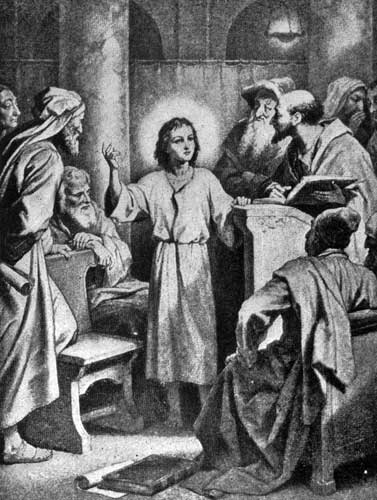
The Boy Jesus in the Temple—H. Hofmann Page 54
As the two pair of brothers talk together, we can hear one of them saying, "I must see and hear and know for myself. I will lay aside my fishing, and go to the wilderness of Judæa." To this the others reply, as on another occasion to Peter, "We also come with thee." Leaving the quiet shores of Gennesaret, they follow the road each has traveled annually since twelve years of age on his way to the feast in Jerusalem.
They met the hermit in the wilderness. His appearance was strange indeed. His hair was long and unkempt; his face tanned with the sun and the desert air; his body unnourished by the simple food of locusts and wild honey. His raiment was of the coarsest and cheapest cloth of camel's hair. His girdle was a rough band of leather, such as was worn by the poor,—most unlike those made of fine material, and ornamented with needlework. His whole appearance must have been a great contrast to his gentle and refined namesake from Galilee.
The solemn earnestness of the prophet, and the greatness of the truths he taught, were well calculated to excite the greatest interest of the young Galileans. They looked upon him with increasing conviction that he was "a prophet of God." Instead of returning to their homes, they remained in Judæa and attached themselves to him, and became known as his disciples. In their new service there was a new bond of union for themselves, which—though they then knew it not—would lead to another yet stronger.
At last "the word of the Lord came unto" John, when he was about thirty years old, calling him to a more public ministry. So "He came into all the country about Jordan." Beginning in the south he moved northward from place to place.
Rumors concerning the new strange prophet spread rapidly. "There went out to him Jerusalem, and all Judæa, and all the region round about Jordan." Shepherds left their flocks and flocked around him. Herdsmen left their fields, and vine-dressers their vineyards, and Roman soldiers their garrisons, for the wilderness. Rabbis left their parchments in the synagogue, the schoolroom and the home, to hear the living voice of a teacher greater than any one of them. Self-righteous Pharisees and common people followed them. Some sought the preacher only from curiosity; some to hear the truth. John's preaching was summed up in two phrases,—"Repent ye," and "The kingdom of heaven is at hand."