Chapter X
Reading edition
The Messiah Found
"They found Him not, those youths of noble soul; Long seeking, wandering, watching on life's shore, Reasoning, aspiring, yearning for the light. "But years passed on; and lo! the Charmer came, Pure, simple, sweet, as comes the silver dew, And the world knew Him not,—He walked alone, Encircled only by His trusting few." —H.B. Stowe.
"We"—Andrew and John—"have found the Messiah."—Andrew to Peter.
"We"—Andrew and Peter, James and John, and Philip—"have found Him, of Whom Moses in the law, and the prophets did write, Jesus of Nazareth."—Philip to Nathanael.
"The fulness of the time was come," not only when "God sent forth His Son," but "when the Son should reveal Himself to the world." So Jesus came forth from His retirement in Nazareth to enter on His public ministry.
"Then cometh Jesus from Galilee to Jordan, unto John to be baptized of him." What a meeting! Probably the first in their lives. It is no marvel that John said, "I have need to be baptized of Thee, and comest Thou to me?" But he obeyed Jesus' bidding, "Suffer it to be so now." "So He was baptized of John in Jordan." Then followed the prayer of the Son of God; and then "the Spirit of God descending like a dove, and lighting upon Him"; and then the voice of the Father, saying, "Thou art my beloved Son: in Thee I am well pleased." Let us remember that voice: we shall hear it again.
And then for forty days and forty nights Jesus was hidden completely from the face of man, alone on the Mount of Temptation, with wild beasts, until ministering angels come to Him from heaven.
He returned to the region where the Baptist was preaching. "John seeth Jesus coming to him." His eye is turned away from the multitude thronging about him, and is fastened upon Jesus only. His thought is of Him of whom Isaiah wrote long before—"He is brought as a lamb to the slaughter." Pointing to Jesus he exclaims, "Behold the Lamb of God which taketh away the sin of the world!"
The Galilean disciples were doubtless present, and were deeply moved by their Master's exclamation. Because of their previous training in their homes, and in the wilderness with the prophet, it must have kindled in them deeper emotion than it did in any others of that astonished throng. But it was to become deeper still. This was especially true of two of them.
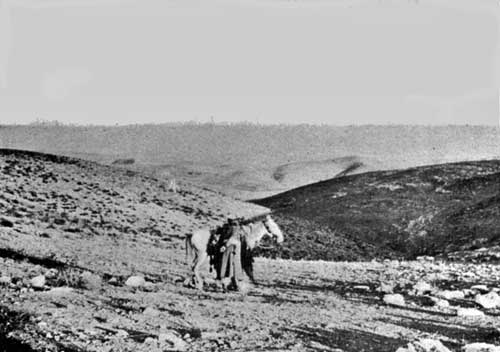
The Wilderness of Judea—From Photograph Page 59
The next day, probably a Sabbath, was to become a memorable day in the history of the two and of their master. It was a morning hour. We think of the three as alone, before the multitudes had gathered, or the day's ministry of preaching and baptizing had begun. They walked along the bank of the river communing together of Him whom they had seen the day before. In the distance John saw the Figure again. In awe and reverence, and with a fixed gaze, "John was standing, and two of his disciples; and he looked upon Jesus as He walked, and saith, Behold, the Lamb of God!" The exclamation was in part that which they had heard in the presence of the multitude; but that was not enough. It was as if John had said, "Behold the Messiah for whom our nation has waited so long; Him of whom our Scriptures have told us; Who has been the theme in our homes from childhood; of whom I have been the prophet and herald. He it is of whom I have taught you, my disciples, as you have followed me in the wilderness until I now can bid you behold Him. Henceforth follow Him."
John says that one of the two was Andrew. There is no doubt that the other was himself. We shall notice in his writings that he never uses his own name. This incident is our first definite knowledge of him. All we have said hitherto is what we think must have been true, judging from circumstances of which we do know, and from his character revealed after this time.
We long to know whether "Jesus as He walked" came near the Baptist, and with what salutation they met, and what were their parting words, for this seems to be the last time of their meeting. If Mary and Salome were sisters, and Elizabeth was their cousin—as we use the term—John of Galilee and Jesus were related to John the Baptist in the same way. But there was a closer relationship than that of family. In this Jesus was the connecting link between the two Johns. "One on each side of Christ"—this was their joy and their glory. One was the last prophet to proclaim His coming: the other was to be the last evangelist to tell the story of His life on the earth.
When the Baptist the second time uttered the cry, "Behold the Lamb of God!" "the two disciples heard Him speak and followed Jesus." Their old master saw them turn from him without a jealous, but with a gladsome thought. Encouraged by him, and drawn by Jesus, with reverential awe, in solemn silence or with subdued tone, they timidly walked in the footsteps of the newly revealed Master. The quickened ear before them detected their footsteps or conversation. "Jesus turned and saw them following," as if to welcome their approach, and give them courage. He then asked them a question, "What seek ye?" It was not asked because He was ignorant, but to encourage them in familiar conversation, as He did at other times. Their answer was another question, "Rabbi, where abidest Thou?" They longed for a fuller opportunity than that on the road to be taught by Him. "Come and see," was His welcome reply. "They came and saw where He dwelt, and abode with Him that day." First by a look, then a question, then an invitation, then hospitality, they were drawn to Him, and into His service.
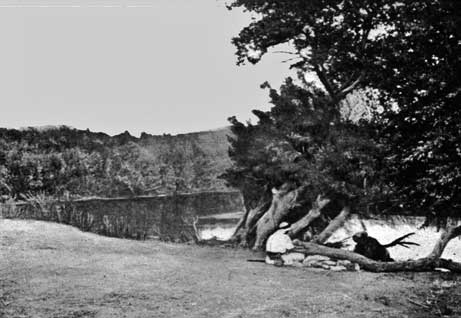
Traditional Place of Christ's Baptism—From Photograph Page 63
Often in after years must Andrew and John have recalled that walk with Jesus, and "rehearsed the things that happened," and said one to another, "Was not our heart burning within us while He spake to us in the way?" So afterward did other two, of Emmaus, when "Jesus Himself drew near and went with them." But the eyes of Andrew and John were not "holden that they should not know Him." The pleasing dream of years was past: they were wakening to a glorious reality. Their following of Him in that hour has been claimed to be "the beginning of the Christian Church."
That day of abiding with Jesus was the first of many days these disciples spent with Him, knowing Him more and more perfectly, and the truth which He alone could reveal. They were then passing from the school of the Baptist to that of the Greatest Teacher. What was said in those sacred hours? John has reported other private interviews with Jesus, but concerning this one his lips are sealed. Did he tell of his surprise and joy to learn that He, Jesus, the son of his aunt, Mary, was the Messiah of whom his mother, Salome, had taught him from his early days? Were there any memories of childhood—of the sandy beach of Bethsaida, or the hills of Nazareth; or, were all such thoughts buried in newer and deeper question? Was there any hint of their future relation too sacred for others then to know? Was this the beginning of that sweet intimacy so private then, but of which the whole world should hear in all coming time?
After the evening meal in Emmaus the two disciples there "rose up the same hour, and returned to Jerusalem," with joyful and quickened steps to report the glad tidings of what they had seen and heard. Andrew and John were to be of the number who, in three years, would hail these disciples from Emmaus. Like them, Andrew and John hastened away from the sheltering booth on the Jordan bank on a like errand. But they went not together, nor to an assembled company. They each went in search of his own brother—Andrew for Peter, and John for James. Andrew found his brother first. Afterward John found his: so we infer from his narrative. Each carried the same tidings, "We have found the Messiah!"
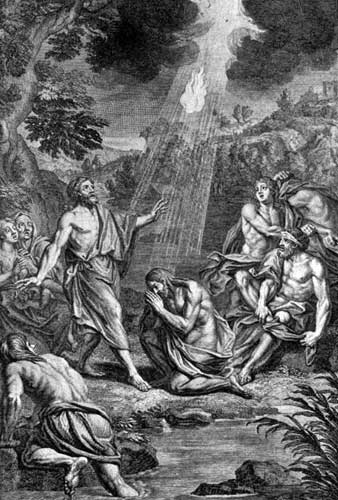
The Baptism of Jesus—Old Engraving Page 64
Andrew is thought to have asked leave to bring his brother. "He brought him to Jesus." When John wrote that simple statement, he did not think how much was included in it concerning Peter and his own relation to him. As little did Andrew think to what the promptings of his brotherly affection would lead. His mission seems to have been that of bringing others to Christ—his own brother, the lad with five loaves and two fishes, and certain Greeks who desired to see Jesus. John only has made note of these three incidents. In so doing he has given to us the key to the character of his friend, and caused him to be held in everlasting remembrance. Andrew is remembered in the cross that bears his name; in his anniversary day; in the choice of him for the patron saint of Scotland; in orders of knighthood, and in Christian societies of brotherhood named after him, as an example and inspiration to the noblest of Christian endeavor—that of bringing old and young to Christ.
It is John alone who wrote of that memorable day on the Jordan. His impressions were deep and lasting. The record of them is so fresh and minute that we seem to be perusing a notebook which was in his hands when these events were transpiring. His memory is distinct of the exact location of each; of the attitudes and movements of the actors,—as when "John stood," and "Jesus walked," and "Jesus turned"; of the fixed and earnest look of Jesus—as on Andrew and John in the way, and Peter in the place of His abode. John remembered the words of the Baptist, and of his two disciples, and of Jesus. He remembered the day not only, but that "it was about the tenth hour when he accepted the invitation to come and see where Jesus was tarrying."
All these pictures hung unfading on the walls of John's memory. This was not strange. It was the day and the hour for which he looked through all his early years, and to which he looked back in his latest. Then was the beginning of a most blessed relationship, alone in the history of mankind; that which was to make his name immortal, and radiant with a halo which encircles none other.
"The day following, Jesus would go forth into Galilee, and findeth Philip, and saith unto him, Follow Me. Now Philip was of Bethsaida, the city of Andrew and Peter." So writes John, recalling to us the Galilean group of Bethsaidan boys. When we became familiar with their names, there was no prospect that the two pairs of brothers and their friend would head the roll of disciples of the Messiah for whom they were looking. But such a day had come. We know not that Philip had a brother whom he could bring to Jesus, as did Andrew and John, but he was as full of wonder and joy as they. Like them he must go in search of some one to whom he could repeat their exclamation. The search was not long. John tells the result. "Philip findeth Nathanael and saith unto him, We have found Him." But this simple declaration is not enough for Philip. He recalls those Scripture scrolls in his home and the Rabbi's school, and the synagogue, that told of the coming Messiah, and so he exclaims, "We have found Him of whom Moses and the Law, and the Prophets did write"—thus repeating the phrase we were to remember till we should hear it again. Nathanael, coming to Jesus declared in wonder and admiration, "Thou art the Son of God; Thou art the King of Israel." His name was added to those of the Galilean group.
The disciples now numbered five or six—Andrew, John, Peter, Philip, Nathanael, and probably James. These were one half of a completed circle to surround Jesus. All but one of them were of the Bethsaidan band. John has drawn lifelike pictures of them, more complete than those of the other apostles,—except that of Judas, whom he contrasts with all the rest. We have thought of James and John as nearest to Jesus in kinship. We are already beginning to think of John as nearest in discipleship.