Chapter XV
Reading edition
John in the Home of Jairus
"He suffered no man to follow with Him, save Peter, and James, and John. And they came to the house of the ruler of the synagogue."
"And taking the child by the hand, He saith unto her, Talitha cumi; which is, being interpreted, Damsel I say unto thee, Arise. And straightway the damsel rose up, and walked."—Mark v. 37, 38, 41, 42.
The first scene in which we find John as one of the favored three is in the house of mourning. It was the home of Jairus in Capernaum. He was a ruler of the synagogue. "He had an only daughter, about twelve years of age, and she lay a dying." He hastened to Jesus, fell at His feet, worshiped Him, and besought Him saying, "Come and lay Thy hands on her that she may be healed; and she shall live."
Did he not have in mind Peter's wife's mother, living in the same town, and how Jesus "came and took her by the hand and lifted her up; and immediately the fever left her"? Jesus started for the house, followed by a throng, some doubtless full of tender sympathy for their townsman, and some curious to see what the wonder-worker would do.
A messenger from Jairus' home met him saying, "Thy daughter is dead; trouble not the Master." But the father's faith in Jesus was not limited to the power to heal. Could not the hand that had already touched the bier of the widow's only son, be laid on his only daughter, with life-restoring power? Could not the command spoken in Nain "I say unto thee, arise," be repeated in Capernaum, and in like manner be obeyed? Without heeding the messenger's question about troubling the Master, he cried out yet more earnestly, "My daughter is even now dead; but lay Thy hand upon her, and she shall live." But the father's entreaty was unnecessary, for Jesus was already responding to the messenger's words as, turning to Jairus, He said, "Fear not, only believe."
How eagerly the curious crowd hastened toward the ruler's home, because of a possible miracle, even raising the dead. But they were not to be witnesses of such display of Divine power. Yet even if the throng be excluded, might not the Twelve, following close to Jairus and Jesus, expect admission to the home? What was the surprise and disappointment of nine of them to be forbidden admission by Him whom they were following. But so it was. "When He came to the house He suffered not any man to enter in with Him, save Peter, and John and James, and the father of the maiden, and her mother."
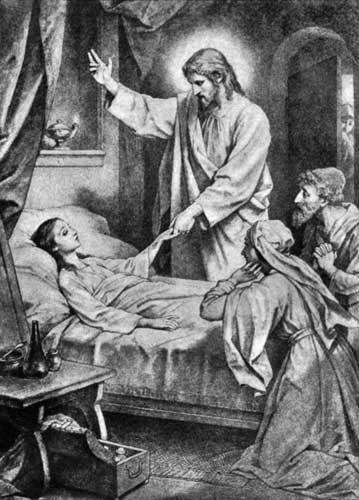
Raising the Daughter of Jairus—H. Hofmann Page 99
This is the first we know of this distinction in the apostolic band. We almost hear the nine saying, "Why is this?" Can it be that, in that hour, at the door of this house of mourning, there was awakened the feeling of jealousy which afterward appeared? Did it inspire in the three a sense of superiority, and ambition to be higher in position than the rest in the kingdom of their Lord? Did James and John especially hope for promotion above the nine, and even the ten including Peter? So it will appear. But all this was to pass away when the band better understood the nature of their Lord's kingdom, and possessed more of His spirit.
The death-chamber was too sacred a place for numbers, even for the nine, whose admittance would be more fitting than that of the hired mourners whom Jesus excluded with them. He had His own wise reasons for the choice of the three. We do not wonder that John was one of them. With all his manifest failings—which he at last overcame—he was the most like his Master. In that death-chamber the Lord was to show His "gentleness and delicacy of feeling and action" such as John could understand, and with which he could sympathize.
"And taking the child by the hand, He saith unto her, Talitha, cumi." We are glad that Mark has preserved for us the very words that must have thrilled the heart of John. They had been interpreted, "My little lamb, my pet lamb, rise up." In them was a lesson for John. They were a revelation of his Master's tenderness toward childhood. It was a needed lesson, which he finally learned.
As John and Peter saw the returning life of the little maid, and heard their Master's command "that something should be given her to eat," they thought not of the time when they should stand together again near the same spot with the same Master, Himself risen from the dead, and hear Him utter another command, "Feed My lambs."
As they with James followed their Lord out from the death-chamber—such no longer—and heard His charge "that no man should know" what had happened, the very secrecy drew more distinctly the line of the inner circle about the three. It was not to be erased during the Lord's earthly sojourn with the twelve.