Chapter XXVIII
Reading edition
John at the Tomb
"Now on the first day of the week cometh Mary Magdalene early, while it was yet dark, unto the tomb, and seeth the stone taken away from the tomb. She runneth therefore, and cometh to Simon Peter, and to the other disciple, whom Jesus loved.
"Peter therefore went forth, and the other disciple, and they went toward the tomb.
"Simon Peter ... entered into the tomb.
"Then entered in therefore the other disciple also, ... and he saw and believed."—John xx. 1, 2, 3, 6, 8.
"Let us take John for our instructor in the swiftness of love, and Peter for our teacher in courage."—Stalker.
"Oh, sacred day, sublimest day! Oh, mystery unheard! Death's hosts that claimed Him as their prey He scattered with a word; And from the tomb He valiant came; And ever blessed be His name." —Kingo. Trans. Hymns of Denmark.
"Mine eye hath found that sepulchral rock That was the casket of Heav'n's richest store." —Milton.—The Passion.
Of the women who visited the tomb of Jesus on the morning of the Resurrection, John was especially interested in Mary Magdalene, from whom seven demons had gone out, probably in his presence; thus giving him opportunity to see the marvelous change from a most abject condition, to grateful devotion to her Healer, perhaps beyond that of any other one whom He healed. John long remembered her starting on her errand "while it was yet dark." So he remembered Judas starting when "it was night" on his errand, of which Mary's was the sad result. One was a deed of love which no darkness hindered: the other was a deed of hate which no darkness prevented or concealed.
John had a special reason for remembering Mary. When she had seen that the stone was taken away from the tomb, it had a different meaning to her from what it did when she and John saw it on Friday evening. And when she "found not the body of the Lord Jesus," she imagined that either friends had borne it away, or foes had robbed the tomb. In surprise, disappointment and anxiety, her first impulse was to make it known—to whom else than to him who had sorrowed with her at the stone-closed door? So she "ran"—not with unwomanly haste, but with the quickened step of woman's love—"to Simon Peter and to the other disciple whom Jesus loved." They were both loved, but not in the fuller sense elsewhere applied to John. Astonished at her early call, startled at the wildness of her grief, sharing her anxiety, "they ran both together" "toward the tomb" from which she had so hastily come. But it was an uneven race. John, younger and nimbler, "outran Peter and came first to the tomb." "Yet entered he not in." Reverence and awe make him pause where love has brought him. For a few moments he is alone. His earnest gaze confirms the report of Mary that somebody has "taken away the Lord." He can only ask, Who? Why? Where? No angel gives answer. Still his gaze is rewarded. "He seeth the linen cloths lying." These are silent witnesses that the precious body has not been hastily and rudely snatched away by unfriendly hands, such as had mangled it on the cross.
Peter arriving, everywhere and evermore impulsive, enters at once where John fears to tread. He discovers what John had not seen,—"the napkin that was upon His head, not lying with the linen cloths, but rolled up in a place by itself." John does not tell whose head, so full is he of the thought of his Lord.
"Then entered in therefore that other disciple also," says John of himself, showing the influence of his bolder companion upon him. Though the napkin escaped his notice from without the tomb, it found a prominent place in his memory after he saw it. Who but an eye-witness would give us such details? What does he mean us to infer from the "rolled" napkin put away, if not the calmness and carefulness and triumph of the Lord of Life as He tarried in His tomb long enough to lay aside the bandages of death. When he saw the careful arrangement of the grave-cloths, "he believed" that Jesus had risen. We are not to infer from his mention of himself only that Peter did not share in this belief. We can believe that Luke does not complete the story when he says that Peter "departed to his home wondering at that which was come to pass." As they came down from the Mount of Transfiguration they were "questioning among themselves what the rising again from the dead should mean." As they came from the tomb they questioned no longer.
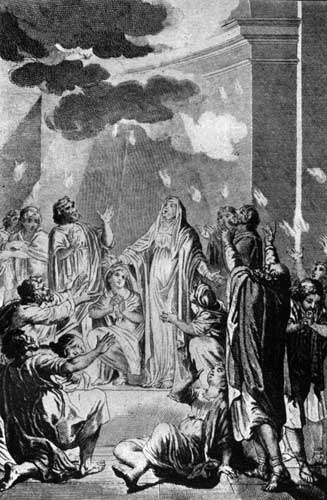
The Descent of the Holy Spirit—Old Engraving Page 224
We long for a yet fuller record than that which John has given of what passed when he and Peter were within the tomb. He frankly tells us that "as yet they knew not the Scriptures, that He must rise again from the dead." Neither prophecy, nor the Scriptures, nor the Lord's repeated declarations, had prepared them for this hour of fulfilment.
We imagine them lingering in the tomb, talking of the past, recalling the words of their Lord, illumined in the very darkness of His sepulchre, and both wondering what the future might reveal. At last they left the tomb together. There was no occasion now for John to outrun Peter. They were calm and joyful. There was nothing more to see or to do. "So the disciples went away again unto their own home."
"But Mary was standing without at the tomb weeping." In these words John turns our thoughts from himself to her who had summoned him and Peter, and then followed them. After they had left the sepulchre she continued standing, bitterly weeping. She could not refrain from seeking that which she had told the disciples was not there. Her gaze was "at the very cause of her grief." "She stooped and looked into the tomb" as John had done.
From the infancy of Jesus to His death there was no ministry of angels to men, though they ministered to Him. "The Master being by, it behooved the servant to keep silence." But the angelic voices that proclaimed His birth, were heard again after His resurrection. According to John's minute description Mary "beholdeth two angels in white sitting, one at the head, and one at the feet, where the body of Jesus had lain." The angelic silence was broken by them both, with the question, "Woman, why weepest thou"—so bitterly and continuously? They might have added, "It is all without a cause." Her answer was quick and brief; and without any fear of the shining ones who lightened the gloomy tomb, and were ready to lighten her darkened spirit. Her reply was the echo of her own words to Peter and John, slightly changed to show her personal loss;—"Because they have taken away my Lord, and I know not where they have laid Him."—Am I not wretched indeed? Is there not a cause? Why should I check my tears?
To answer was needless. Were not the angels in the blessed secret which was immediately revealed? Were they not glancing from within the tomb, over her bowed head, to the gently moving form without? Did Mary become suddenly conscious of some presence as "she turns herself back, and beholdeth Jesus standing, and knew not that it was Jesus"? His question seemed an echo of the angelic voices, "Woman, why weepest thou?" with the added question, "Whom seekest thou?" This was the first utterance of the risen Lord. In the garden, at this early hour, who—so thought Mary—can this be but the gardener? As such she addressed Him, "Sir, If thou hast borne Him hence, tell me where thou hast laid Him, and I will take Him away." We can hardly restrain a smile when we see how the strength of her love made her unmindful of the weakness that would attempt to "take Him away."
"Jesus saith unto her, Mary." That name, that familiar voice, that loving tone, sent a thrill through her heart which the name "woman" had failed to excite. More completely "she turned herself, and saith unto Him, Rabboni," with all the devotion of her impassioned soul.
Let us recall John's account of Mary's report of her first visit to the tomb, full of sadness—"They have taken away the Lord," and then in contrast place by its side his record of her second report, full of gladness—"Mary Magdalene, cometh and telleth the disciples, I have seen the Lord." The one was a mistaken inference; the other a blessed reality. Between these two utterances on the same day what revelations to them both. But the end was not yet.
"When therefore it was evening, on that day, the first day of the week, and when the doors were shut where the disciples were, for fear of the Jews, Jesus came and stood in the midst, and saith unto them, Peace be unto you." So John describes the first meeting of Jesus with the disciples after His resurrection. He gives hints of some things of which other Evangelists are silent. With emphasis he notes "that day" as the day of days whose rising sun revealed resurrection glory. That "evening" must have recalled the last one on which they had been together. Then the Lord had said unto them, "Peace I leave with you." But the benediction had seemed almost a mockery, because of the sorrow which followed. But now it was repeated with a renewed assurance of His power to bestow it. Through fear of the Jews they had closed the doors of probably the same Upper Room where they had been assembled before. These doors were no barrier to His entry, any more than the stone to His leaving His tomb.
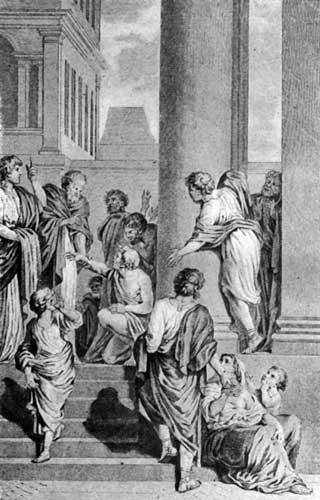
St. Peter and St. John at the Beautiful Gate—Old Engraving Page 225
As John alone preserved the incident of the pierced side, he alone tells how Jesus "showed unto them His ... side," and said to Thomas, at the next meeting, "Reach hither thy hand and thrust it into My side;" and how this was followed by Thomas' believing exclamation, "My Lord, and my God." With this and the Lord's beatitude for other believing ones, John originally ended his story of the Lord, in these words,—"Many other signs therefore did Jesus in the presence of His disciples which are not written in this book: but these are written, that ye may believe that Jesus is the Christ, the Son of God; and that believing ye may have life in His name."