Chapter XXVII
Reading edition
Lone Disciple at the Cross—Continued
Three sayings on the cross reported by John:
"Woman, behold, thy son! Behold, thy mother!" "I thirst." "It is finished."
—John xix. 26, 27, 28, 30.
Of the seven sayings of Christ on the cross, three are preserved by John only; one of love, another of suffering, and another of triumph. The first is that to Mary and John himself. The second is the cry, "I thirst"—the only one of the seven concerning the Lord's bodily sufferings. John was a most observing eyewitness, as is shown by the details of the narrative,—the "vessel full of vinegar," the "sponge filled with vinegar," and the hyssop on which it was placed, the movements of the soldiers as they put it to Christ's lips, and the manner in which He received it. He was willing to accept it to revive His strength to suffer, when "He would not drink" the "wine mingled with gall" that would relieve Him from the pain He was willing to endure. The end was drawing near. The thirst had long continued. He had borne it patiently for five long hours. Why did He at last utter the cry, "I thirst"? John gives the reason. A prophecy was being fulfilled, and Jesus would have it known. It was this: "In My thirst they gave Me vinegar to drink." So "Jesus, ... that the Scripture might be fulfilled, saith, 'I thirst.'"
John watched Him as He took His last earthly draught. It was probably of the sour wine for the use of the soldiers on guard. What varied associations he had with wine,—the joyful festivities of Cana, the solemnities of the Upper Room, and the sadness of Calvary.
When Jesus therefore had received the vinegar, He said, "It is finished." This is the third of the sayings of Jesus on the cross preserved by John, who was a special witness to the chief doings of his Lord on the earth. So the declaration meant more to him than to any other who heard it. Yet it had a fulness of meaning which even he could not fully know. Jesus' life on earth was finished. He had perfectly obeyed the commandments of God. The types and prophecies concerning Him had been fulfilled. His revelation of truth was completed. The work of man's redemption was done. On the cross He affirmed what John said He declared in the Upper Room to His Father: "I have glorified Thee on the earth, having accomplished the work Thou hast given Me to do."
All four Evangelists tell of the moment when Jesus yielded up His life, but John alone of the act that accompanied it as the signal thereof, which his observant eye beheld. "He bowed His head,"—not as the helpless victim of the executioner's knife upon the fatal block, but as the Lord of Life who had said, "No one taketh it away from Me, but I lay it down of Myself."
John makes mention of another incident without which the story of the crucifixion would be incomplete. Mary Magdalene and other loving women had left the cross, but were gazing toward it as they "stood afar off." John remained with the soldiers who were watching the bodies of the crucified. "The Jews, ... that the bodies should not remain upon the cross upon the Sabbath, asked of Pilate that their legs might be broken"—to hasten death—"and that they might be taken away." As John saw the soldiers "break the legs of the first and of the other which was crucified with" Jesus, with what a shudder did he see them approach His cross; but what a relief to him when they "saw that He was dead already, and brake not His legs."
In a single clause John pictures a scene ever vivid in Christian thought. He knew that Jesus "gave up His spirit" when "He bowed His head." The executioners pronounced Him dead. "Howbeit one of the soldiers"—to make this certain beyond dispute—"with a spear pierced His side, and straightway there came out blood and water." There was now no pain to excite the Apostle's sympathy, and yet he reports the incident as being of special importance. He calls attention to the fact that he was an eye-witness, and that there was something in it that should affect others as well as himself. He says, "He that hath seen hath borne witness, and his witness is true; and he knoweth that he saith true, that ye also may believe." He explains why these incidents so deeply impressed him. They recalled two prophecies of the Old Testament. One was this, "A bone of Him shall not be broken." This reminded John of the Paschal Lamb which should be perfect in body; and of Jesus as the Lamb of God, by which name He had been called when pointed out to him as the Messiah. All through life Jesus had been preserved from accident that would have broken a bone, and in death even from the intended purpose that would have defeated the fulfilment of the prophecy.
The other prophecy was this,—"They shall look on Him whom they pierced." Because of what John saw and tells, we pray in song,
"Let the water and the blood From Thy riven side which flowed, Be of sin the double cure: Cleanse me from its guilt and power."
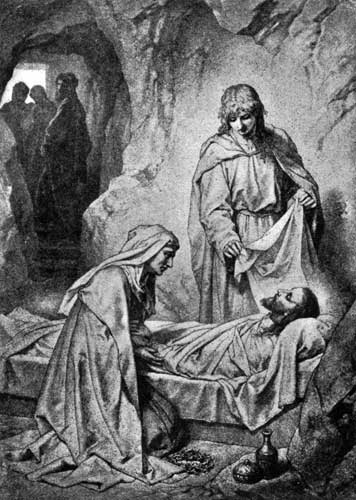
In the Sepulchre—H. Hofmann Page 201
John once more furnishes a contrast between Jesus' foes and friends. He says that the Jews asked Pilate that the bodies of the crucified might be taken away. This was to the dishonored graves of malefactors. John more fully than the other Evangelists tells of Joseph of Arimathæa who "besought Pilate that he might take away the body of Jesus"—for honorable burial. Other Evangelists tell of his being "rich," "a counsellor of honorable estate," "a good man and a righteous," who "had not consented to" the "counsel and deed" of the Sanhedrin of which he was a member, because he "was Jesus' disciple." Mark says, "He boldly went in unto Pilate and asked for the body of Jesus." He had summoned courage so to do. Hitherto as John explains he had been "a disciple of Jesus, but secretly for fear of the Jews." John implies that Joseph was naturally timid like Nicodemus. As Pilate had delivered Jesus to His open enemies to be crucified, he delivered the crucified body to Joseph, the once secret but now open friend. The Jews "led him"—the living Christ—"away to crucify Him." Joseph "came" and tenderly "took away His body" from the cross.
"There came also Nicodemus," says John, "he who at the first came to Him by night." Yes, that night which John could not forget, in which to this same Nicodemus Jesus made known the Gospel of God's love, manifested in the gift of His Son whose body in that hour these timid yet emboldened members of the Sanhedrin took down from the cross. They were sincere mourners with him who watched their tender care as they "bound it in linen cloths with the spices" for burial, with no thought of a resurrection.
Perhaps Joseph and Nicodemus recalled moments in the Sanhedrin when they whispered together, speaking kindly of Jesus, but were afraid to defend Him aloud; thus silently giving a seeming consent to evil deeds because timidity concealed their friendship. But at last the very enmity and cruelty of His murderers emboldened them as they met at the cross.
It is John who tells us that Jesus the night before His crucifixion went "where was a garden into which He entered," and who also says, "Now in the place where He was crucified there was a garden." The one was ever more suggestive to him of a coming trial; the other of that trial past. "There," in the garden—probably that of Joseph—John says "they laid Jesus." There also were laid John's hopes, which seemed forever buried when Joseph "rolled a great stone to the door of the sepulchre, and departed." What a contrast in his thoughts and feelings between the rolling away of the stone from the tomb of Lazarus, and the rolling to that of Jesus. The one told him of resurrection; but the other of continued death; for as he afterward confessed, "as yet" he and Peter "knew not that Jesus must rise from the dead."
Two mourners at least lingered at the closed tomb. "Mary Magdalene was there, and the other Mary, sitting over against the sepulchre" of their Lord, after they "beheld where He was laid." John's parting from them at that evening hour was in sadness which was to be deepened when he met Mary Magdalene again.
It is not easy for us to put ourselves in the place of John, as he turns from the tomb toward his lonely home. We know what happened afterward, but he did not know what would happen, though his Lord had tried to teach him. He is repeating to himself the words he had heard from the cross, "It is finished," but he is giving them some difference of meaning from that which Jesus intended. He is walking slowly and sadly through the streets of Jerusalem, dimly lighted by the moon that shone in Gethsemane the night before upon him and his living Lord. We imagine him saying to himself:—"Truly it is finished: all is over now. How disappointed I am. I do not believe He intended to deceive me, yet I have been deceived. From early childhood I looked, as I was taught to do, for the coming of the Messiah. On Jordan I thought I had found Him. He chose me for one of His twelve, then one of the three, then the one of His special love. What a joy this has been, brightening for three years my hopes and expectations. I have seen Him work miracles, even raising the dead. I have seen Him defeat the plots of evil men against Him, and did not believe any power on earth could destroy Him. I have watched to see Him the great and glorious King. But to-day instead of this I have seen Him crucified as the feeblest and worst of men. I do remember now how Moses and Elijah, when we were with them on the Holy Mount, talked with Him of 'His departure which He was about to accomplish at Jerusalem.' But I did not understand them, nor even Himself when, just before we ascended the Mount, He told us 'how that He must go to Jerusalem and suffer many things, ... and be killed.' I do not wonder that Peter then said to Him, 'Be it far from Thee, Lord,' though the Lord was right in rebuking him. Can it be only last night He said, 'Tarry with Me.' How gladly would I do it now. But He is dead, and buried out of my sight. Oh that I might see Him rise, as I did the daughter of Jairus. Oh that I might roll away the stone from His tomb as I helped to do from that of Lazarus, and see Him come forth. How gladly would I 'loose Him' from His 'grave-bands' and remove the 'napkin bound about His face.' I know it was a mean and shameful taunt of His revilers when they said, 'If Thou art the Son of God, come down from the cross.' But why did He not do it? I remember how once He said concerning His life, 'no one taketh it away from Me.' But have not Pilate and the Jews taken it away? I shall never lean upon His bosom again. But this I know—He loved me, and I loved Him, and love Him still. The mysteries are great, but the memories of Him will be exceedingly precious forever."
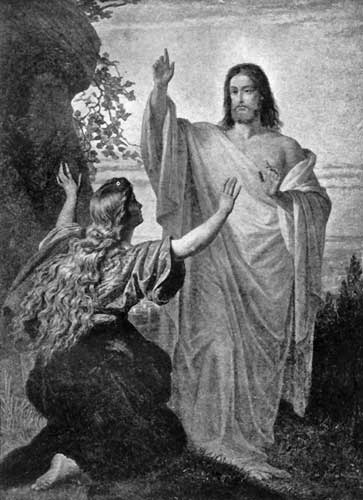
Jesus Appearing to Mary Magdalene (Easter Morning)—B. Plockhorst Page 209
Poor John. He forgot those other words of His Lord concerning His life,—"I have power to lay it down, and I have power to take it again." The Lord had done the one already: He was soon to do the other, though His sorrowing disciple understood it not. Meanwhile we leave him, resting if possible from the weariness of the garden and the palace and Calvary, during that Friday night, which was to be followed by a day of continued sadness, and that by another night of sorrowful restlessness.