Chapter XX
Reading edition
John a Herald of the King
Prophecy:
"Rejoice greatly, O daughter of Zion; shout, O daughter of Jerusalem: behold, thy King cometh unto thee: ... lowly, and riding upon ... a colt."—Zech. ix. 9.
Prophecy Fulfilled:
"He sent two of his disciples, saying, Go your way into the village over against you; in the which as ye enter ye shall find a colt tied: ... loose him, and bring him.... And they brought him to Jesus: and they threw their garments upon the colt, and set Jesus thereon."—Luke xix. 30, 35.
Prophecy Understood:
"These things understood not His disciples at the first: but when Jesus was glorified, then remembered they that these things were written of Him, and that they had done these things unto Him."—John xii. 16.
"Daughter of Zion! Virgin Queen! Rejoice! Clap the glad hand and lift th' exulting voice! He comes,—but not in regal splendor drest, The haughty diadem, the Tyrian vest; Not arm'd in flame, all glorious from afar, Of hosts the chieftain, and the lord of war: Messiah comes!—let furious discord cease; Be peace on earth before the Prince of Peace!" —Heber's Palestine.
Zechariah foretold the coming of Christ five hundred years before the angels over Bethlehem heralded His birth. The prophets saw Him as the Messiah-king, but not such a ruler as most of the Jews of Christ's day expected. Even the disciples, believing Him to be the Messiah, had mistaken views of His kingdom. Yet He was the King foretold by the prophets; the Son of David who sang of Him as the "King" and as the "Lord's anointed"; the Messiah or Christ; the king of the Jews not only, but of all men. As such He would make a triumphal entry into the "City of the Great King." This would not be in the pride and pomp of an earthly conqueror, but in the "lowly" manner which Zechariah had foretold.
All the accounts of Jesus' journeyings leave the impression that He went a-foot. Only once do we know that He rode; that was in fulfilment of prophecy. That prophecy He purposed to fulfil the day after the feast of Bethany. This was intended by Christ to be His royal and Messianic entry into Jerusalem. The hour had come. A colt unused, and so fitted by custom for sacred purposes, was ready for His use. Having left the village "He sent two of His disciples to bring it to Him." These two are understood to be Peter and John, for whose united service He would soon call again. We may think of the owner of the colt as friendly toward their Master. When told by the disciples, "The Lord hath need of him," he was ready to serve Him by the loan of his beast. That "need"—whatever the owner or the disciples thought—was not so much to aid in Christ's journey as to make true the prophetic words concerning Him, "Thy King cometh ... riding upon ... a colt."
The two disciples "brought him to Jesus, and they threw their garments upon the colt, and set Jesus thereon."
We may think of Peter and John, having arranged for the royal ride, as heralds of their Lord, leading the procession from Bethany, and the first to greet with signal and shout the other coming from Jerusalem.
Beside their King, perhaps leading the colt on which they had placed Him, they would be the first to tread where "a very great multitude spread their garments in the way," and others "branches from the trees," and yet others "layers of leaves which they had cut from the fields"—thus carpeting the road winding around the slope of Olivet.
Were not Peter and John leaders in song when "at the descent at the Mount of Olives the whole multitude of the disciples began to rejoice and praise God," and especially when "the City of David" came into view? The joyful strains were from the Psalms of David—"Hosanna to the Son of David, Hosanna in the Highest Blessed is the kingdom that cometh, the kingdom of our Father David. Blessed is the King that cometh in the name of the Lord; peace in heaven, and glory in the highest."
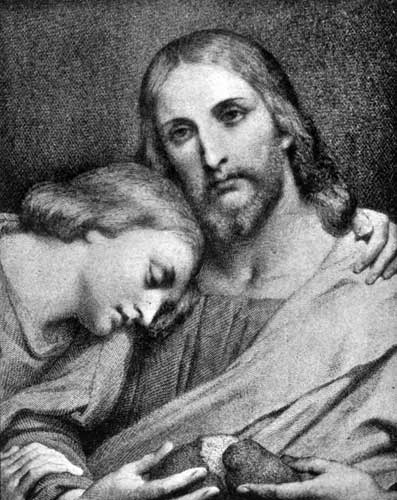
Christ and St. John—Ary Scheffer Page 155
In that last strain it would almost seem as if the angelic song of thirty-three years before, over the plain of Bethlehem, had not yet died away, and was echoed from Olivet.
In that hour did John and James have thoughts about sitting one on the right hand and the other on the left in a kingdom which seemed near at hand? Did they and the other disciples, who had been disappointed because their Lord had refused on the shore of Galilee to be made king, imagine that He certainly would now be willing to be crowned in Jerusalem?
When John wrote his account of the triumphal entry into Jerusalem, he recalled the prophecy concerning it. It is claimed that he speaks of himself and Peter in particular when he says, "These things understood not the disciples at first; but when Jesus was glorified, then remembered they that these things were written, and that they had done these things unto Him." This was a frank confession of his own dulness and ignorance: it is also an assurance of his later wisdom.
We see John on the highway of Olivet, a chosen disciple to aid His Lord in the hour of His earthly glory. We shall see him, even down to old age, in a yet nobler sense, a Herald of the King.