Chapter XII
Reading edition
John and Nicodemus
"There was a man of the Pharisees, named Nicodemus, a ruler of the Jews: the same came unto Him by night."
"We speak that we do know, and bear witness of that we have seen."—John iii. 1, 2, 11.
"There is Nicodemus, who visited Jesus by night—to the astonishment of St. John—but who was soon afterward Jesus' friend."—John Watson.
"The report of what passed reads, more than almost any other in the gospels, like notes taken at the time by one who was present. We can almost put it again into the form of brief notes.... We can scarcely doubt that it was the narrator John who was the witness that took the notes."—Alfred Edersheim.
Three incidents mentioned by John only comprise all we know of Nicodemus. In each of them he refers to him as coming to Jesus by night. That visit seems to have made a deep impression on John. We may think of Him as present at the interview between the Pharisee and the "Teacher come from God."
We are not told why Nicodemus came at a night hour. Perhaps he thought he could make sure of a quiet conversation, such as he could not have in the daytime. Perhaps he did not want to appear too friendly to Jesus until he knew more about Him, though he already had a friendly feeling toward Him. Perhaps he was afraid of the Sanhedrin, the highest Jewish Court. Most of its members hated Jesus and had commenced their opposition to Him, which was continued during His life, and resulted in His death. Not so felt Nicodemus, though a member. At a later day he opposed their unjust treatment of Him. If he did not think of Jesus as the Messiah, he yet thought of Him as a prophet, "a teacher come from God." He was anxious to know more. So cautiously and timidly he sought Jesus in the night.
We suppose that, at the time of Jesus' death, John had a home in Jerusalem. It has been thought possible that when and before he became a disciple of Jesus he had an abode there, attending to the business connected with the sale of fish from his home in Galilee. There Jesus might be found in the guest-chamber on the roof of the oriental house which was reached by an outside stair. Nicodemus had no invitation, such as Andrew and John had to Jesus' abode on the Jordan, but he had an equal welcome to John's home, whither he had come on a like errand, though with different views of Jesus, to learn of Him. He sees still burning in the upper chamber the night lamp of Him whom he is to know as "the light of the world." He ascends the stair, stands at the door and knocks; and it is opened. Apparently without lengthy salutation, or introduction, he makes known his errand in the single sentence, "Rabbi, we know that Thou art a teacher come from God, for no man can do these signs that Thou doest, except God be with Him." He might have added, "What shall I do?" Jesus gave a very solemn answer to his question,—"Except a man be born anew, he cannot see the kingdom of God." He taught him that doing certain things, and not doing others, was not enough; he must be good. To be good there must be a change of spirit. As a child has a beginning of its earthly life, he must have the beginning of a spiritual life, or he cannot be fitted for the kingdom of God in this world or that which is to come. That great change comes "from above," from God Himself.
Listen to some of the wonderful truths Jesus taught to Nicodemus. They are for us as well as for him. 1. Those who do not have this change of spirit must "perish." 2. But none need to perish, for "eternal life" has been provided. 3. This life is through the suffering and death of the "Son" of God. 4. God "gave His only begotten Son" to do all this. 5. God did this because He "so loved the world." 6. This "eternal life" can be had only by "believing on" the Son of God. 7. "Whosoever" so believes may have eternal life.
All this is included in one sentence:
"God so loved the world, that He gave His only begotten Son, that whosoever believeth on Him should not perish, but have eternal life."
This is the golden text of St. John's Gospel, and of the whole Bible. Through all the ages it has sounded, and will sound to the end of time, as the gospel itself.
John must have been a most attentive listener to all that Jesus said. This was at the beginning of His Lord's ministry. Fresh truths easily impressed him. They were the buddings of which he was to see the bloom, of whose fruitage he would partake most abundantly, and which he would give to others long after the echo of the Great Teacher's words had died in the chamber where he and Nicodemus heard them.
It was long after that nightly visit that John wrote his account of it, including the golden text whose keyword was Love. It is supposed that he wrote his Epistle about the same time. That text was so present in his thought that he repeated it in almost the same words: "Herein was the Love of God manifested in us, that God hath sent His only begotten Son into the world, that we might live through Him."
At the close of his long life, in which he had learned much of the power and justice and holiness and goodness of God, it seemed to him that all these were summed up in the one simple saying, "God is love."
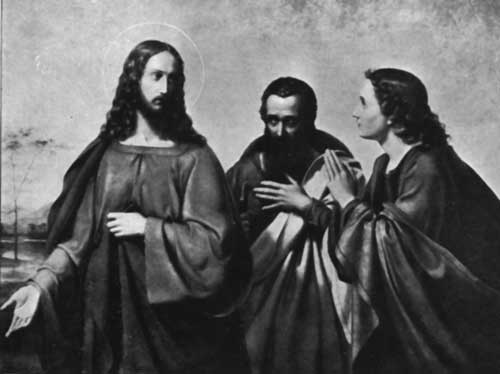
The First Disciples—Ittenbach Page 67
When John bade Nicodemus good-night, he could not look forward to the time, nor to the place where we see them together again. John the lone apostle with Nicodemus and his Lord at the beginning of His ministry, is the lone apostle at the cross. Then and there, he recalls the first meeting of the three as he beholds the Rabbi approaching. This is his record; "Then came also Nicodemus, who at the first came to Jesus by night."
There is a tradition concerning Nicodemus that after the Resurrection of Jesus, his faith in Him was strengthened. The "teacher come from God" he now believed to be the Son of God. The timid Rabbi became a bold follower of the Lord whom he once secretly sought. For this he was no longer permitted to be a ruler of the Jews. He was hated, beaten, and driven from Jerusalem. At last he was buried by the side of the first martyr Stephen, who had baptized and welcomed him into the fellowship of the Christian Band.