Chapter XXX
Reading edition
St. John a Pillar-Apostle in the Early Christian Church
"James and Cephas and John, they who are reputed to be pillars."—Paul. Gal. ii. 9.
"They went up into the upper chamber where they were abiding; both Peter and John and James and Andrew, Philip, ..."—Acts i. 13.
"When the day of Pentecost was now come, they were all together in one place."—Acts ii. 1.
"An angel of the Lord by night opened the prison doors, and brought them out."—Acts v. 19.
"Now when the Apostles which were in Jerusalem heard that Samaria had received the word of the Lord, they sent unto them Peter and John."—Acts viii. 14.
"He (Herod) killed James the brother of John with the sword."—Acts xii. 2.
The next place where we may think of John with his Lord was on a mountain in Galilee. At least once before His death, and twice after His resurrection, He directed His Disciples to meet Him there. For what purpose? Evidently to receive His final commission.
"Jesus came to them and spake unto them, saying, All authority hath been given unto Me in Heaven and on earth. Go ye therefore, and make disciples of all the nations, baptizing them into the name of the Father and of the Son and of the Holy Ghost: teaching them to observe all things whatsoever I commanded you: and lo, I am with you alway, even unto the end of the world."
But the disciples were not yet prepared to fulfil this commission. So He appointed another meeting, to be held in Jerusalem, where He met them, "speaking of the things pertaining to the kingdom of God." Here the command on the mountain was limited by another—not to depart from Jerusalem immediately. "Wait" said He, "for the promise of the Father which you heard from Me." That promise we find in John's record:—"I will pray the Father, and He shall give you another Comforter, that He may abide with you forever." "The Comforter, which is the Holy Ghost, shall teach you all things." " He shall testify of Me." In the fulfilment of that promise, the disciples were to find the preparation to "go" and "preach." For that preparation they were to "wait."
Jesus then reminds them of the assurance given by John the Baptist concerning Himself:—"He shall baptize you with the Holy Ghost." Once more John is carried back to the Jordan, and reminded of the time when he and Jesus had been baptized. All those former scenes must have been recalled when Jesus at the final meeting in Jerusalem declared, "John truly baptized with water, but ye shall be baptized with the Holy Ghost not many days hence."
These words revived in the disciples the hope which had died in them when Jesus died upon the cross. So, with yet mistaken ideas, they asked, "Lord, wilt Thou at this time restore again the kingdom to Israel?" John and the rest of the Bethsaidan band, who had heard the Baptist say that the kingdom of God was at hand, hoped that "at this time" it would appear. But, as when Jesus gave no direct answer to the two pairs of brothers on Olivet concerning the time of the destruction of Jerusalem, or to Peter's question concerning John's future, so now He avoided a direct answer to this last question. He reminded them of something more important for them than knowledge of the future: that was their own duty,—not to reign, but to be witnesses for Him, first in Jerusalem, then throughout Judæa, then in Samaria, then "unto the uttermost parts of the earth." Yet this could not be until they had "received power after that the Holy Ghost had come upon them." This was promised them: they did not clearly understand what was meant: they were waiting to see.
"He led them out until they were over against Bethany,"—well-remembered Bethany. From there Jesus had made His triumphal entry into the City of the Great King: from there He would make a more glorious entry into the New Jerusalem. John was not His herald now. He, with the other ten, was "led" by Him to witness His departure.
As He ascended Olivet the last time, did He not give a parting glance down the slope into the village below, His eye resting on the home of those He loved, made radiant for us by the search-light thrown upon it by the loved disciple at His side? In thought did He not say, "Lazarus, Martha, Mary, farewell."
The lifted hands, the parting blessing, the luminous cloud, and the vanishing form—such is the brief story of the Ascension.
"Ye men of Galilee, why stand ye looking into Heaven?" The questioners were two angels. Without waiting for answer, they gave promise of Jesus' return. "Then returned the disciples unto Jerusalem from the Mount called Olivet." Whither bound? We are told, "They went up into the upper chamber." No longer simply "A large upper room" to which Jesus had told Peter and John they would be guided. Were they not now the guide of the nine thither, to the place where they had six weeks before "prepared" for the Passover? Did not the goodman of the house give the Disciples a second welcome, and offer it to them as a temporary place for the Christian Church? So it would appear, for again we are told, "they were there abiding." Once more Luke gives their names, in the Acts as he did in his Gospel. All except Judas answered, in that upper room, to the roll call of the company scattered from Gethsemane, but reunited in a closer union. In each of Luke's lists he begins with the Bethsaidan band. But he does not preserve the same order. In the latter he begins, not with the two pairs of brothers as such—Peter and Andrew, James and John,—but with the Apostles whom Christ had drawn into His inner circle, Peter, John and James, naming first the two who were already becoming the acknowledged leaders of the Christian band. In that list we find the name of Andrew recorded the last time in Holy Writ.
But the eleven were not alone: others resorted thither for the same purpose. What was that purpose? and who were some of them? This is the answer:—"These all with one accord continued steadfastly in prayer, with the women, and Mary the Mother of Jesus, and with His brethren."
It is here, for the last time, that we read of Mary, in the Gospels. In what better place could we bid her farewell than in the room consecrated by the presence of her Son. How we rejoice with her that in that place the longing of her heart must have been satisfied as she joined "with one accord in prayer ... with His brethren"—her sons who during His life had not believed on Him. What a welcome to that room did they receive from John, their adopted brother! May we not indulge the thought that among "the women" were her own daughters; and that we hear her joyfully asking the once carping question of the Jews concerning "the carpenter's son," but with changed meaning, saying, "His sisters, are they not all with us?" If so "His Mother called Mary," "and His brethren," "and His sisters," and John the adopted son and brother, were at last a blessed family indeed. Mary on her knees with her children around her, rejoicing in God her Saviour, of whom she had sung in the infancy of her Son—that certainly is a fitting scene to be the last in which we behold the Mother of Jesus.
"When the day of Pentecost was now come, they were all together in one place." They were united in feeling, purpose and devotion, in the "one place," the home of the early Church.
The hour had come for the fulfilment of the promise of their Lord, for which they were to tarry in Jerusalem and wait. There was a great miracle,—a sound from Heaven as of the rushing of a mighty wind which filled the house. Flame-like tongues, having the appearance of fire rested on the heads of the disciples, who were "all filled with the Holy Ghost." He gave them utterance as they spoke in languages they had not known before. Crowds of foreigners in the city "were confounded because that every man heard them speaking in his own language."
On the morning of that day the Church numbered one hundred and twenty. "There were added unto them in that day about three thousand souls."
St. John was one of those filled with the Holy Ghost, according to the prophecy he had heard by the Baptist, and the promise by Christ. On him rested a fiery tongue. To him the Spirit gave utterance, perhaps in the languages of those among whom he was to labor in Asia Minor, from where some of these strangers had come. He was in full sympathy with that Christian company, an actor with them, a leader of them, a pillar for them strong and immovable.
But the Upper Room was not the only place where John worshiped. The Temple was still a sanctuary where such as he communed with God. The hour for the evening prayer was nearing when "Peter and John were going up into the Temple." They reached the Beautiful Gate, which Josephus describes as made of Corinthian brass, surpassing in beauty other temple gates, even those which were overlaid with silver and gold. By it they saw what doubtless they had often seen before, a lame man who, during most of the forty years of his life, had been daily brought thither. His weakness was a great contrast to the massive strength of the pillar against which he leaned, as he counted the long hours and the coins he received in charity. His haggard appearance and ugly deformity were a greater contrast to the richness and symmetry of the gate which was so fittingly "called Beautiful."
Was there something especially benignant in the faces of the two Apostles, that encouraged the poor creature to hail them as he saw them "about to go into the Temple"? They were willingly detained. "Peter, fastening his eyes on him, with John, said, 'Look on us.'" A gift was bestowed richer far than that for which he had hoped. They were full of joy themselves, and of pity for him, and of a sense of the power of their Lord, so often exercised in their presence. Therefore the command, "In the name of Jesus Christ of Nazareth, walk."
That was a strange sight to those who had long known the beggar, as he held Peter with one hand and John with the other, as if leading them into the Temple, into which he entered, "walking, and leaping, and praising God."
The glad shout of the healed man attracted a crowd around him, "greatly wondering." The Apostles declared that the miracle was by no power of their own, but by that of Jesus who had been killed, but had risen from the dead. For this they were arrested and put in prison—strange place for such men and for such a reason. On the next day they were brought before the rulers who demanded by what power they had done this thing. Again the disciples declared it was in the name of Jesus Christ of Nazareth, whom the Jews crucified, but whom God had raised from the dead. The rulers were amazed when "they saw the boldness of Peter and John." They had known the power of Jesus' words: they saw a like power in the words of the Apostles, whom they were assured had been with Him and been aided by Him. But this did not check their rage, which was increased as they saw how many believed the Apostles. The three thousand converts on the day of Pentecost were increased to five thousand.
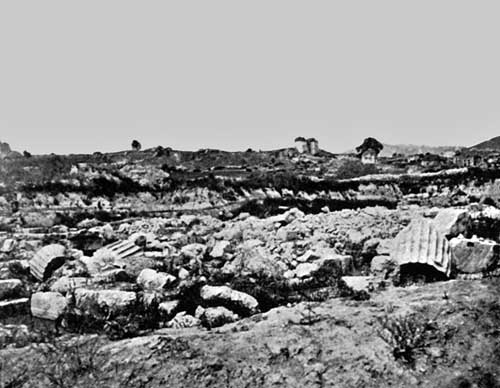
Ephesus—From Photograph Page 232
As leaders of the Christian company Peter and John were again put into prison—into the public jail for malefactors. But the divine power which had been used through them was now used for them. A solemn warning was given to the daring wickedness of the rulers. When they thought their prisoners kept "with all safety," in the darkness, behind bolted doors, "an angel of the Lord by night opened the prison doors, and brought them out, and said, 'Go ye, and stand and speak in the temple to the people all the words of this Life.'"
We know not the manner in which he led them out as he invisibly opened and closed the doors through which they passed, to obey without fear the heavenly bidding. With consternation the rulers heard a messenger declare, in words almost echoing the angel's command, "Behold the men whom ye put in prison are in the temple standing and teaching the people."
Persecution scattered Christians who fled from Jerusalem, telling wherever they went, of Christ as the Saviour. A deacon named Philip preached in Samaria with great effect. "Now when the Apostles which were at Jerusalem heard that Samaria had received the word of God, they sent unto them Peter and John, who, when they were come down, prayed for them that they might receive the Holy Ghost."
These two were chosen because they had taken the most active part in establishing the church in Jerusalem, and were specially fitted for similar work elsewhere. With what peculiar feelings John must have entered Samaria. He must have recalled a day when hot and weary he had journeyed thither with his Lord and met the Samaritaness at the well. Perhaps he now met her again, and together they talked over that wonderful conversation which made her the first missionary to her people, many of whom declared, "We know that this is indeed the Saviour of the world."
Did John on this visit enter into "a village of the Samaritans"—the same where he had said, "Lord, wilt Thou that we bid fire to come down from heaven and consume them?" Is it of them that it is now said he "prayed for them"? His fire of indignation and revenge had changed to the fire of love. The pentecostal flames had rested on his head.
Once more—only once—we find the names of James and John together. One short sentence, full of pathos, of injustice and cruelty, of affection and sorrow, tells a story of the early Church: Herod "killed James the brother of John with the sword." He was the first martyr of the Apostles. The smaller circle of the three, and the larger one of the twelve, is broken. For these brothers we may take up David's lamentation over Saul and Jonathan, slightly changed, and say, "They were lovely and pleasant in their lives: but in their death they were divided,"—for through half a century John mourned the loss of his loved companion from childhood.
After James—one of the three whom Paul named pillars—had fallen, the other two, Peter and John, stood for awhile side by side in strength and beauty. To each of them he might have given the name Jachin by which one of the pillars of Solomon's temple was called, meaning, "whom God strengthens." Peter was the next to fall, after which John long stood alone, until at last the three whom first we saw by the Sea of Galilee, stood together by the glassy sea, in each of them fulfilled the promise made through John, by their Lord,—"He that overcometh, I will make him a pillar in the Temple of my God, and he shall go out thence no more."