Chapter XVI
Reading edition
John a Beholder of Christ's Glory
"We beheld His glory, glory as of the only begotten from the Father."—St. John i. 14.
"We were eyewitnesses of His majesty. For He received from God the Father honor and glory ... when we were with Him in the holy mount."—2 Peter i. 16-18.
"As brightest sun, His face is bright; His raiment, as the light, is white, Yea, whiter than the whitest snow. Moses, Elias, spake with Him. Of deepest things, of terrors grim, Of boundless bliss, and boundless woe, Of pangs that none but Christ may know. "A voice sublime I panting hear, A voice that conquers grief and fear, Revealing all eternity; Revealing God's beloved Son, Born to redeem a world undone; Filled with God's fulness from on high, To gain God's noblest victory." —Trans. Kingo of Denmark.
We may think of the twelve as Christ's family with whom He often prayed apart from the multitude. One such occasion was in Cæsarea Philippi. The prayer was followed by two earnest and solemn questions. "He asked the disciples, saying, Who do men say that the Son of Man is? And they said, Some say John the Baptist; some, Elijah; and others, Jeremiah or one of the prophets."
How strange these sayings must have sounded to St. John and his Jordan companions, who had been directed by the Baptist to their Messiah. Three of them were soon to witness Elijah's tribute to Him, as being more than the "Son of Man." Such already had He become to them. He was more interested in the opinions of the disciples than in those of the multitude. So He asked with emphasis, "But who say ye that I am? And Simon Peter answered and said, Thou art the Christ, the Son of the living God. And Jesus answered and said unto him, Blessed art thou, Simon Bar-Jona: for flesh and blood hath not revealed it unto thee, but My Father which is in heaven."
But in the mind of Jesus even this blessed revelation was not enough for His believing yet frail disciples. Even the three, the most enlightened of the twelve, needed a clearer vision of Him and His kingdom, and strength for trials they were to endure. So they needed His prayers.
"From that time began Jesus to show unto His disciples how that He must go to Jerusalem, and suffer many things, ... and be killed." He needed prayer also for Himself. So "Jesus taketh with Him Peter, and James and John, and bringeth them up into a high mountain apart by themselves." The favored three, who had witnessed His power in the raising of Jairus' daughter, were to be witnesses of his glory. Luke says He "went up into the mountain to pray." Not Tabor,—for which mistaken tradition has claimed the honor—but Hermon was doubtless the "high mountain." This kingly height of the Lebanon range was a fitting place for Jesus the King. The glittering splendor of its snows is a fitting emblem of His character. It was the highest earthly spot on which He stood. From it He had His most extensive views. Here He had His most exalted earthly experience. Peter rightly named it "the Holy Mount" because of its "glory that excelleth" all other mountains.
We do not know the thoughts or feelings or words of the nine when Jesus "taketh with Him the three." We wonder whether their wonder was at all mixed with jealousy. As they saw the three "apart by themselves," their lessening forms ascending Hermon, and at last hidden from their view by the evening shades, can it be that the dispute began which cast a gloom over their Lord when He descended from that mountain of glory?
And the three themselves—what were their emotions as they looked down upon their companions in the plain below, and upward to the height whither their Master was bringing them. Did they whisper together concerning the word He had just spoken—that He must die. They must have had such mingling of feelings as they never had before.
It was the evening after a Sabbath. At the close of the weary summer day, after the long and steep ascent of the mountain, and in the strong mountain air, it is no wonder that the three disciples were "weighted with sleep."
Luke not only tells us that Jesus went up "to pray" but also that "He prayed." Would that John had recorded that prayer, as he did those supplications in the Upper Room and in Gethsemane. "As we understand it," says Edersheim, "the prayer with them had ceased, or merged into silent prayer of each, or Jesus now prayed alone and apart."
On the banks of the Jordan, where Jesus and the three had met, while He "was praying, the heavens were opened," and the dove-like form descended upon Him, and His Father's voice was heard. And now "as He prayed," there came an answer, immediate and glorious: "He was transfigured before them."
The disciples though "weighted with sleep," "having remained awake, they saw His glory, and the two men that stood with Him." It was many years after this vision that John, speaking for the three, testified, "We saw His glory."
"The fashion of His countenance was altered." "His face did shine as the sun." "His garments became exceeding white; so as no fuller on earth can whiten them," "white as the light," "glistering," "dazzling."
"Behold there appeared unto them Moses and Elijah talking with Him." How did the disciples know the Lawgiver and the Prophet? We are not told. There may have been given them some supernatural powers of discernment. They may have known by the conversation between Jesus and His celestial visitants, as, in earthly language with heavenly tone, they "spoke of His departure which He was about to accomplish at Jerusalem," of which He had told them on the plain below.
It was that Moses who fifteen hundred years before came down from Mount Sinai with the two tables of the law in his hands, when Aaron and the children of Israel stood in awe before His shining face. But now He had come, not from the mount which Paul describes as "darkness," but unto that other whose snowy whiteness has given it the name of Lebanon. He had come from Heaven, to yield homage to Him to whom He would sing with us,
"My dear Redeemer and my Lord, I read my duty in Thy Word; But in Thy life the Law appears, Drawn out in living Characters."
"The children of Israel could not look steadfastly upon Moses for the glory of His face." In the "excellent glory" by which Peter describes the scene on Hermon, the whole figure of His Lord was bathed in light. But the glory of that vision was not yet complete. A cloud, brighter than any on which the moon was shining, enwrapped Jesus and Moses and Elijah. It was no other than the Shechinah, once more returning to the earth,—"the symbol of Jehovah's presence."
This cloud overshadowed the disciples. As its light gleamed upon them, they were filled with reverential fear. They were ready to do the heavenly visitors immediate and humble service. But the mission of the two was ended. Their last words of comfort to Jesus had been spoken. If they could be detained, it must be done quickly. So, awed and confused by the strange vision, yet longing for its continuance, the disciples, Peter being the spokesman, proposed to make booths for their Master and His two heavenly visitors. But the two had gone, and the crown of glory that had enveloped them spread to the disciples, filling them with yet increasing awe. The silence that had followed Peter's call was broken. "There came a voice out of the cloud, This is My Beloved Son; hear ye Him." Startled by such a response, "they fell on their face and were sore afraid." They did not dare to look about them. The Cloud of Glory lifted. How long they lay prostrate and trembling, we do not know. At last a hand gently touched them. It was the hand of Jesus. His voice bid them, "Arise, and be not afraid. And when they had lifted up their eyes they saw no man, save Jesus only."
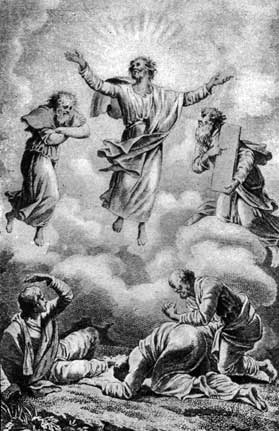
The Transfiguration—Old Engraving Page 106
The Transfiguration was over. Its grand purpose was accomplished. Master and disciples were prepared for the labors and trials to which they must return. The night ended. As the morning sun glistened on the peaks of Hermon, while darkness yet overspread the plain below, Jesus descended with the three, to the nine awaiting their return.
"And as they were coming down from the mountain, He charged them that they should tell no man what things they had seen, save when the Son of Man should have risen again from the dead. And they kept the saying, questioning among themselves what the raising again from the dead should mean."
Peter's and John's memories of that vision of their Lord were ever distinct and precious. When it was no longer a secret, Peter wrote in ecstasy of the hour in which they "were eyewitnesses of His majesty, ... when they were with Him in the holy mount."
Let us notice the record by John. In the beginning of his gospel he says "The Word was made flesh and dwelt amongst us." By this he means that the Son of God became a man, and lived among men who witnessed His life. But of all the events of that life which John had seen, there was a special one in his mind, which not all men had witnessed. So he adds, "We beheld His glory." This probably refers to the Transfiguration and the Shechinah, which he and Peter and James had seen. And then he thinks of how much greater Jesus was than John the Baptist, "a man sent from God," "to bear witness of" Him. He thinks also of the great Lawgiver of whom he says, "the Law was given through Moses; grace and truth came by Jesus Christ."
We imagine that ever after the Transfiguration, John thought of Moses and the Shechinah together. Had he with his companions been permitted to build three tabernacles or booths, "one for Moses," what delightful visits John would have made him there, like that one which he had made in the abode of Jesus on the banks of the Jordan.
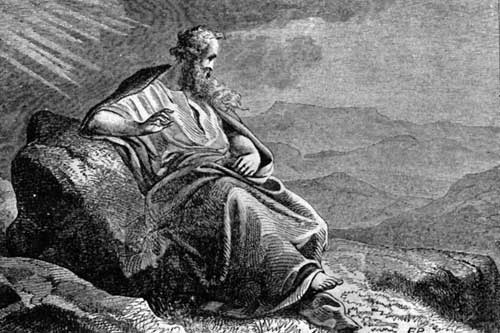
Moses on Mt. Pisgah—Artist Unknown Page 109
I seem to hear Moses telling John something of his own history when on the earth, and teaching him lessons from it in words like these: "This is not the first time I have heard the Lord's voice, from out this cloud of glory. Out of the burning bush He called me, 'Moses, Moses.' At Sinai He said, 'Lo, I come unto thee in a thick cloud.' And again He appeared in 'a pillar of a cloud,' and said, 'Behold thou shall sleep with thy fathers.' I saw not that cloud again on earth until you beheld it. My thoughts were about death. I prayed about it, not as your Master and mine has done in preparation therefor, but that I might not then die. This was my prayer: 'Let me go over I pray Thee and see the good land that is beyond Jordan, that goodly mountain, and Lebanon,'—the very mountain where we now are. But the Lord would not hear me. I prayed yet again more earnestly, and the Lord said unto me, 'Let it suffice thee; speak no more unto me of this matter.' From yonder mountain of Nebo He showed me all the land we now see from Hermon; and then I died. The Lord buried me in yonder land of Moab. No man knoweth my sepulchre unto this day. I died, my great hope of forty years disappointed. My repeated earnest prayer was ungranted then, but it has not been unanswered. This 'goodly' Lebanon, to which I looked from Nebo with longing eyes, is more 'goodly' now than when it sadly faded from my dying vision. You, John, are one of the witnesses to the answer to my dying prayer. Never did the Shechinah at Horeb, or Sinai, or the Tabernacle, seem so resplendent as on this Mount Hermon. Here it has enwrapped Elijah and me, the favored two whose mission Gabriel might have envied. We were sent down from heaven to talk with Jesus concerning His death, of which He has told you. In view of it He has lead you, the favored three hither to pray. It was while He prayed that ye 'beheld His glory.' Not only for me, but much more for Him, is Hermon the mount—'The Holy Mount,' because the mount of Prayer, and therefore the mount of Transfiguration."