Chapter VIII
Reading edition
Jesus the Hidden Messiah
"There has been in this world one rare flower of Paradise—a holy childhood growing up gradually into a holy manhood, and always retaining in mature life the precious, unstained memories of perfect innocence."—H.B. Stowe.
The aged Simeon in the Temple, with the infant Jesus in his arms, said, "Now lettest Thou Thy servant depart, O Lord, ... in peace; for mine eyes have seen Thy salvation"—the expected Messiah. But it was not for Him to proclaim His having come. The aged Anna could not long speak "of Him to all them that looked for redemption in Jerusalem," or anywhere else. For awhile the shepherds told their wonderful story, and then died. The angels did not continue to sing their hymn of the Nativity over the plains of Bethlehem. The Wise Men returned to their own country. Herod died, and none thought of the young child he sought to kill. The hiding in Egypt was followed by a longer hiding of another kind in Nazareth. The stories of those who gathered about the infant cradle were soon forgotten, or repeated only to be disbelieved. Mary, and her husband Joseph—who acted the part of an earthly father to the heaven-born child—carried through the years the sacred secret of who and what Jesus was.
We long to know something of the holy childhood. We have allowed our imagination to have a little play, but this does not satisfy our curiosity, nor that desire which we have concerning all great men, to know of their boyhood. What did He do? Where did He go? What was His life at home, and in the village school? Who were His mates? How did He appear among His brothers and sisters? So strong is a desire to know of such things that stories have been invented to supply the place of positive knowledge; but most of them are unsatisfactory, and unlike our thoughts of Him. Thus much we do know, that, "He grew in wisdom and stature" not only, but also "in favor with God and man."
It has been finally said; "Only one flower of anecdote has been thrown over the wall of the hidden garden, and it is so suggestive as to fill us with intense longing to see the garden itself. But it has pleased God, whose silence is no less wonderful than His words, to keep it shut." That "one flower" refers to Jesus' visit to Jerusalem just as He was passing from childhood to youth, when He tarried in the Temple with the learned Rabbis, asking them questions with which His mind was full, and making answers which astonished them.
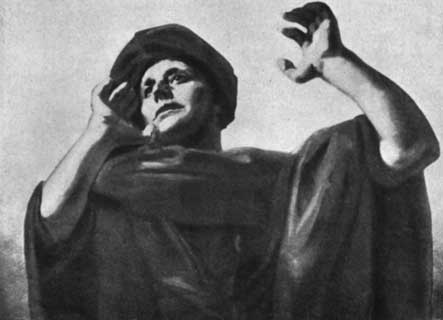
The Prophet Isaiah—Sargent Page 50
A most interesting question arises in connection with that visit; Did Jesus then and there learn that He was the Messiah? When He asked His mother, "Wist ye not that I must be in My Father's house," or, "about My Father's business?" did He have a new idea of God as His Father Who had sent Him into the world to do the great work which the Messiah was to perform?
There were eighteen silent years between His first visit to Jerusalem, and the time when, at thirty years of age, he made Himself known as the Messiah. They were spent as a village carpenter. He was known as such. No one suspected Him to be anything more. In His work He must have been a model of honesty and faithfulness. We can believe that "all His works were perfect, that never was a nail driven or a line laid carelessly, and that the toil of that carpenter's bench was as sacred to Him as His teachings in the Temple, because it was duty."
In His home He was the devoted eldest son. It was of that time that the poet sings to Mary;—
"O, highly favored thou, in many an hour Spent in lone musings with thy wondrous Son, When thou didst gaze into that glorious eye, And hold that mighty hand within thine own. "Blest through those thirty years when in thy dwelling He lived as God disguised with unknown power, And thou His sole adorer, His best love, Trusted, revering, waited for His hour." —H.B. Stowe.
Joseph had probably died, and the care of Mary fell especially on Jesus. But in the carpenter's shop, in the home, and wherever He was, He had thoughts and feelings and purposes hidden from all others. They were such as no mere human being could have. He was alone in the world. In silence and solitude His communions were with His Father in heaven. Calmness and peace filled His soul. His great work was before Him, ever present to His thought. So was His cross, and the glory which should come to God, and the blessedness to man, when His work on earth was done. As John long after declared, "He was in the world and the world knew Him not." As a great King He had come from heaven, and was waiting for a certain one to proclaim His coming. Toward that herald let us turn and with John listen to his voice.