Chapter VI
Reading edition
First Visit to Jerusalem
At twelve years of age a Jewish boy was no longer thought of as a child, but a youth. Before he reached that age he looked forward to an event which seemed to him very great. It was his first visit to Jerusalem. Peter was probably older than James or John. With boyish interest they listened to the report of his first pilgrimage to the Holy City. When the time came for James to accompany him, John's interest would increase as he heard his brother's story; and much more when he could say, "Next year I too shall see it all." And when at last he, probably the youngest of the five Bethsaidan boys, could be one of the company, a day of gladness indeed had come. With his father, and perhaps his mother, he joined the caravan of pilgrims, composed chiefly of men and boys. Their probable route was across the Jordan, then southward, through valleys and gorges, and along mountain-sides which echoed with the Psalms which were sung on these pilgrimages, called "Songs of Degrees."
At Bethabara, nearly opposite Jericho, the travelers recrossed the Jordan. There John might think of that other crossing many years before when Joshua led the hosts of Israel between the divided waters; and when Elijah smote them with his mantle, and there was a pathway for him and Elisha. John was to add to his memories of the spot. At a later day he would there witness a more glorious scene.
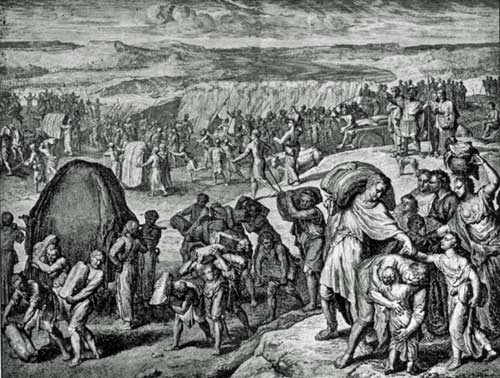
Joshua's Host Crossing the Jordan—Old Engraving Page 45
At last from the Mount of Olives, at a turn in the road, he had his first view of the Holy City; its walls and seventy towers of great height, and the Holy House—the Temple of God, with which in after years he was to become familiar. There he saw for himself of what he had often heard;—the Holy Altar and lamb of sacrifice—reminders of the coming Messiah; the offering of incense; and the many and varied forms of stately worship.
At the time that John made this visit to Jerusalem, there was a celebrated school known as that of Gamaliel, who was the most noted of the Jewish Rabbis, or teachers. Boys were sent to him from all parts of Palestine, and even from distant countries in which Jews lived. There was one such boy from the town of Tarsus, in the Roman province of Cilicia in Asia Minor. Though living in a heathen city, surrounded by idolatry, he had received a Jewish training in his home and in the synagogue school, until he was old enough to go to Jerusalem to be trained to become a Rabbi. Like John he had learned much of the Old Testament Scriptures, but it does not appear that he had the special influences which we have imagined gave direction to the thoughts and plans of the five boys of Galilee. In his boyhood he was known as Saul; afterward as Paul. He and John in their early days differed in many things; in the later days they became alike in the most important thoughts, feelings, purposes and labors of their lives. And because of this they became associated with each other, and are remembered together as among the best and greatest of mankind.
It is possible that John visited the school of Gamaliel, and that the boy from Bethsaida and the one from Tarsus met as strangers, who would some day meet as friends indeed. It is more probable that they worshiped together in the temple at the feast, receiving the same impressions which lasted and deepened through many years, and which we to-day have in what they wrote for the good of their fellow-men.
When John returns from Jerusalem to his home we lose even the dim sight of him which our imagination has supplied. During the silent years that follow we have two thoughts of him,—as a fisherman of Galilee, and as one waiting for the coming of the Messiah. His parents' only thought of him is a life of honest toil, a comfort in their old age, a sharer in their prosperity, and an heir to their home and what they would leave behind. They little think that he will be remembered when kings of their day are forgotten; that two thousand years after, lives of him will be written because of a higher relationship than that of mere cousinship to Jesus; and that their own names will be remembered only because John was their son. Only God sees in the boy playing on the seashore, and in the fisherman of Gennesaret, the true greatness and honor into which He will guide him.