Chapter XIX
Reading edition
John's Memorial of Mary
"When Jesus was in Bethany, ... there came unto Him a woman having an alabaster cruse of exceeding precious ointment, and she poured it upon his head, as He sat at meat."—Matt. xxvi. 6, 7.
"Verily I say unto you, wheresoever this gospel shall be preached in the whole world, that also which this woman hath done shall be spoken of for a memorial of her."—Matt. xxvi. 13.
"It was that Mary which anointed the Lord with ointment, and wiped His feet with her hair."—John xi. 2.
"There is something touchingly fraternal in the momentary pleasure which He (Christ) appears to have taken in the gift of the alabaster box."—Austin Phelps.
"Her eyes are homes of silent prayer, Nor other thought her mind admits But, he was dead, and there he sits, And He that brought him back is there. "Then one deep love doth supersede All other, when her ardent gaze Rose from the living brother's face, And rests upon the life indeed." —Tennyson.
That is an impressive picture drawn by Saints Matthew and Mark, of a scene in Bethany, where an unnamed woman brought a flask of ointment which she poured on the head of Jesus, thus exciting murmuring and indignation against her, who was defended by Him, with assurance of perpetual remembrance of her deed.
Yet a comparison of the accounts of these two Evangelists with the story given by John, suggest the thought that he was not satisfied with the picture. His remembrance of the things that happened before and after that scene, his friendship for the family of Bethany, his understanding of the Master's feelings and thoughts, his sense of justice to himself and to his fellow-disciples, the omission of an important figure in the grouping, and especially his tender sympathy for the unnamed heroine of the story—these things demanded in his mind additions and re-touchings to make the picture complete.
Let us imagine ourselves before him while he is reading the manuscripts of Matthew and Mark, long after they were written. He tells us of incidents, unmentioned by them, that enlarge and make clearer our view of the scene. We note the impressions we may suppose were made on him at the time of the event, and were still fresh in his old age when he tells the story.
"I remember distinctly"—so he might say—"this scene in Bethany, both what these two writers report, and what they do not. The hour was drawing near when my Lord must die. So He had told me; but somehow I did not understand that this must be. It seems strange to me now that I did not, as well as one of my friends did, who realized the nearness of the sad hour. I had arrived with Him at Bethany 'where Lazarus was which had been dead, whom He raised from the dead.' It was a great joy to meet again the friend whom I had welcomed from the tomb."
It is true, as here written by Mark, that Jesus "sat at meat." But this does not tell the whole story. The people of Bethany wished to unite in doing Him honor: "So they made Him a supper there." It was fitting that it should be "in the house of Simon" whom Jesus had healed from leprosy, and who was probably a relative or special friend of the family loved by Jesus. I wonder that their names do not appear in the story given by these two Evangelists: I could not forget them. I remember how "Martha served" at the table, as if in her own home, seeming more of a hostess than a guest; and how "Lazarus was one of them that sat at the table with Him" who had bid him rise from the tomb; and how Mary showed her gratitude for her brother's restoration, and love for his Restorer. To me that supper loses half its interest without the mention of these names, so suggestive of near relation to the Lord. Here I read, "There came unto Him a woman." That is indeed true; but I find no hint of who this unknown woman was. Could Matthew probably present, have forgotten it? Had Mark absent, never been told?
Matthew says she had "an alabaster cruse of precious ointment," which Mark explains was "spikenard very costly." This also is truly said, for I learned that "Mary ... took a pound of ointment of spikenard very precious." This she could well afford. Some have suggested that perhaps, like oriental girls of fashion, she had bought it in her pride, but after coming under the influence of Jesus, had left it unused. But I am more inclined to believe she intended it from the first as an expression of overflowing love.
Mark says "she broke the cruse." I remember, as she crushed the neck of it, all eyes were turned upon her, watching her movements. Lazarus, reclining at the table, gazed upon her with brotherly interest; and Martha, moving around it glanced at her with sisterly affection. There was one man whose expression was something more than curiosity. In it there was a shade of displeasure.
These two Evangelists tell that Mary "poured the ointment upon" and "over" the "head" of Jesus. This was a common custom in rendering honor and adoration. But it did not satisfy Mary, if the Lord could only say with David, "Thou anointest my head." Her anointing was so profuse that He could say,—as Matthew testifies that He did—"She poured this ointment upon My body." But I would testify to another act, fuller yet of meaning. She "anointed the feet of Jesus." This meant far more than the washing of feet, as an humble act of hospitality and honor. It was an unusual act of adoration. I saw bathed in spikenard what I have since seen bathed in blood. But that was not all. Making of her long tresses a fine but unwoven towel, "she wiped His feet with her hair"; kneeling in devotion where she had loved to sit in learning.
I noticed the glowing rapture in her face, and an occasional glance into that of her Lord, unmindful of the presence of all others, while He looked kindly upon her. It was then that I discovered that "the house was filled with the odor of the ointment." But, alas, not so with the perfume of her deed. "There were some that had indignation among themselves, ... and they murmured against her": so says Mark. "When the disciples" saw Mary's deed "they had indignation": so says Matthew. It is true that signs of dissatisfaction came from the group of the disciples, but it is the voice of one of them that has ever since rung in my ears, to whom "the unworthy grumbling should be assigned." In justice to the disciples he should not be unnamed. Mary was still in the act of her devotion to Jesus. "But Judas Iscariot, one of His disciples, which should betray Him, saith, 'Why was not this ointment sold for three hundred pence, and given to the poor?' This he said, not because he cared for the poor"—not he—"but because he was a thief and, having the bag, took away what was put therein." He it was who from the first showed displeasure at Mary's act. His words were both an exclamation and a question, a sort of soliloquy, and yet addressed to anybody who might hear and answer: but they needed no answer. It was too late to gather up the ointment already used, and sell it for the poor or for any other purpose. But Judas' purpose I well understand. I see through his hypocrisy now more clearly than I did then.
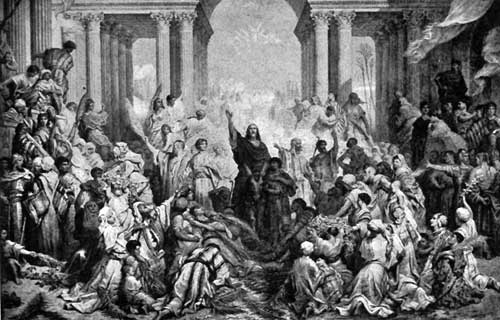
Triumphal Entry into Jerusalem—Gustav Doré Page 138
With the sharp, reproving voice of Judas, Mary glanced into his angry face. This would have filled her with terror had she not immediately looked into that of Jesus beaming upon her. One hand of His was over her, as if in protection and benediction, while the other waved in a reproving gesture. As I read how He answered the question of Judas with another, "Why trouble ye her?" and then commanded, "Let her alone"; and then declared, "She hath wrought a good work upon me," I recall the changing expressions of His face, and His tones of indignation and affection.
I was startled by the reason He gave for letting her alone,—that she might preserve what remained of the ointment, not for the poor, but to be used for His burial, near at hand.
She it was of whom I have spoken who understood better than I or any of my fellow-apostles, that our Lord's life was nearing its end.
I find here in the records of Matthew and Mark the assurance of the Lord concerning the unnamed woman of whom they have written. It is this, "Verily I say unto you, 'Wheresoever this gospel shall be preached in the whole world, that also which this woman hath done shall be spoken of for a memorial of her.' Let it be known that this woman was Mary of Bethany, then at Jesus' feet. Henceforth let her name be linked with her deed."
Thus ends the words we have imagined St. John might have spoken with the Gospels of Matthew and Mark in his hand. The additions to their story are suggested by his own Gospel. He has drawn a beautiful picture of Mary, in brighter colors and more delicate shades than has any other. To him artists are chiefly indebted for their ideas of her. His own character was so completely in harmony with hers that he understood what his fellows did not. By them she was misjudged and condemned; he saw and admired the sweetness of her spirit, and the purity and nobleness of her motive. Upon the monument reared by other Evangelists, he inserted her name. In her he saw a reflection of her Lord and his. His memory and his record alone secured for her in particular the fulfilment of the Lord's prophecy concerning the remembrance of her deed. Every Christian home in the whole world has been, or will be, filled with the spiritual fragrance of her offering. But the prophecy is more than fulfilled. That which she hath done is not only "spoken of," for in many a home inspired by her spirit, her name has been given as a memorial of her whom John distinguished from all others as "that Mary which anointed the Lord with ointment and wiped His feet with her hair." It was of Mary that Jesus said, "She hath done what she could."
John's picture of her is all the brighter because of his dark background of Judas. He has forever associated their names in contrast. In his mind, the anointing was ever suggestive of the betrayal. He remembered how the "thief" asked his hypocritical question at the moment of the greatest perfume; and how Judas was planning the betrayal while Mary was meditating on the death to which it would lead. It appears almost certain that Judas, stung by the Lord's reproof of him and defence of Mary, ready to sell his Lord's body for a less sum than he valued the ointment, turned from the feast in anger, hastening to the chief priest with the cursed question and promise, "What will ye give me, and I will deliver Him unto you?" Wheresoever the gospel is preached throughout the whole world, that also which this man hath done is spoken of—but not for a memorial of him.
John's picture of Mary, Judas and Jesus is a most suggestive grouping. What harmony and contrast! What light and shade! What revelation of love and hate, of friendship and enmity, of devotion and sacrilege! To no other scene does Christ sustain quite the same relation. The friendship of His first feast—that of Cana—is deeper and tenderer in His last, at Bethany.
There is something sublime in this Son of God having all power, pleading with Judas that Mary might be permitted to continue her service of love for Him.
Add John's own likeness to the three at whom we have been looking, and what a grouping we have—Jesus with His loved Mary, and John the most beautiful illustration of human friendship, and Judas the betrayer. Let imagination complete what no artist has attempted.
When John recalls the odors of Mary's ointment filling the house, he seems to catch a refrain from Solomon's song, and addresses it to her,—"Thine ointments have a goodly fragrance; thy name is as ointment poured forth; therefore do the maidens love thee."
It is not the "maidens" alone, especially the Marys of Christendom, that "love" her, but all to whom the gospel is preached, who join in John's refrain, while thanking him for his "memorial of her."