Chapter III
Reading edition
John's Royal Kindred
It seems almost certain that Salome and Mary the mother of Jesus, were sisters. Royal blood was in their veins. They were descendants of David. The record of their ancestry had been carefully preserved for God's own plans, especially concerning Mary, of which plans neither of the sisters knew until revealed to her by an angel from God. We think of them as faithful to Him, and ready for any service to which He might call them, in the fisherman's home of Salome, or the carpenter's home of Mary. Mary's character has been summed up in the words, "pure, gentle and gracious." Salome must have had something of the same nature, which we find again in her sons.
If Salome and Mary were sisters, our interest in James and John deepens, as we think of them as cousins of Jesus. This family connection may have had something to do with their years of close intimacy; but we shall find better reason for it than in this kinship. There was another relation closer and holier.
We wonder whether Jesus ever visited Bethsaida, and played with His cousins on the seashore, and gathered shells, and dug in the sand, and sailed on Gennesaret, and helped with His little hands to drag the net, and was disappointed because there were no fish, or bounded with glee because of the multitude of them.
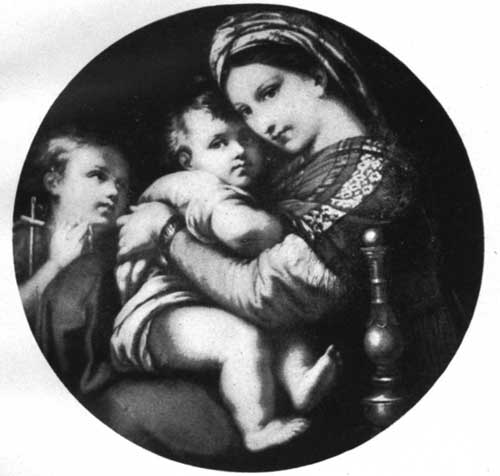
Virgin, Infant Jesus, and St John (Madonna della Sedia)—Raphael Page 31
We wonder whether James and John visited Jesus in Nazareth, nestled among the hills of Galilee. Did they go to the village well, the same where children go to-day to draw water? Did James and John see how Jesus treated His little mates, and how they treated Him—the best boy in Nazareth? Did the cousins talk together of what their mothers had taught them from the Scriptures, especially of The Great One whom those mothers were expecting to appear as the Messiah? Did they go together to the synagogue, and hear the Rabbi read the prophecies which some day Jesus, in the same synagogue, would say were about Himself?
Jesus was the flower of Mary's family, the flower of Nazareth, of Galilee, of the whole land, and the whole world. Nazareth means flowery—a fitting name for the home of Jesus. It was rightly named. So must James and John have thought if their young cousin went with them to gather daisies, crocuses, poppies, tulips, marigolds, mignonette and lilies, which grow so profusely around the village. Did they ramble among the scarlet pomegranates, the green oaks, the dark green palms, the cypresses and olives that grew in the vale of Nazareth, and made beautiful the hills that encircled it? Did they climb one of them, and gain a view of the Mediterranean, and look toward the region where John would live when his boyhood was long past, in the service of his cousin at his side?
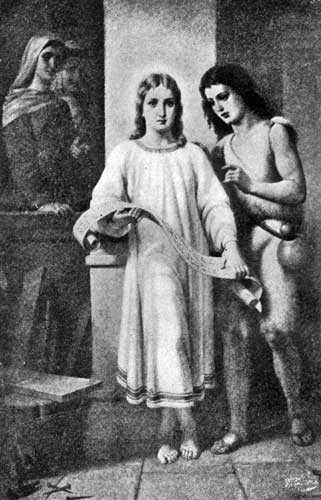
A great artist, Millais, painted a picture of the boy Jesus, representing Him as cutting His finger with a carpenter's tool, and running to His mother to have it bound up. Did John witness any such incident? How little did he think of a deeper wound he was yet to behold in that same hand.
We cannot answer such questions. These things were possible. They help us to think of Jesus as a boy, like other boys. James and John thought of Him as such only until long after the days of which we are speaking.
While thinking of John and Jesus as cousins, we may also think of a kinsman of theirs, a second cousin of whom we shall know more. John was to have a deep interest in both of the others, and they were to have more influence on him than all other men in the world.
There were some things common to them all. They were Jews. According to Jewish customs they were trained until six years of age in their own homes. Their library was the books of the Old Testament. They learned much of its teachings. They read the stories of Joseph, Samuel and David. At six they went to the village school, taught by a Rabbi. Some attention was paid to arithmetic, the history of their nation, and natural history. But, as at their homes, the chief study was the Scriptures. They were taught especially about One—"Of whom Moses in the law and the prophets did write." Let us remember those words for we shall hear them again. That One was called the Messiah—He whom we call Jesus, the Christ, the Saviour of the world. He had not then come. We look back to the time when He did come: those boys looked forward to the time when He would come. The Messiah was the great subject in the homes of the pious Jews, and in the synagogues where old and young worshiped on the Sabbath.