Chapter XIII
Reading edition
St. John and the Samaritaness
"He cometh to a city of Samaria, called Sychar.... Jacob's well was there. Jesus therefore, being wearied with His journey, sat thus on the well. There cometh a woman of Samaria to draw water. Jesus said unto her, Give Me to drink."—John iv. 5-7.
"Probably John remained with the Master. They would scarcely have left Him alone especially in that place; and the whole narrative reads like one who had been present at what passed."—Edersheim.
The vale of Sychar is one of the most interesting spots in the Holy Land. Jacob's well is one of the sacred sights about whose identity there is no dispute. I count the Sabbath when my tent overshadowed it one of the most memorable of my life. It was a privilege to read on the spot John's story of the Master tarrying there, and of the truths there revealed.
John tells us that Jesus, on His way from Judæa to Galilee, passed through Samaria, arrived at Jacob's well, and "being wearied with His journey sat thus on the well," while His disciples went "away unto the city to buy food."
It is not necessary to suppose that all of the six went to the neighboring city. Probably John remained with the Master. His narrative is one of the most distinct word-paintings in the whole Gospel story. He writes like one who saw and heard all that passed, not only when the other disciples were with him, but also and especially what happened when they were absent from the well.
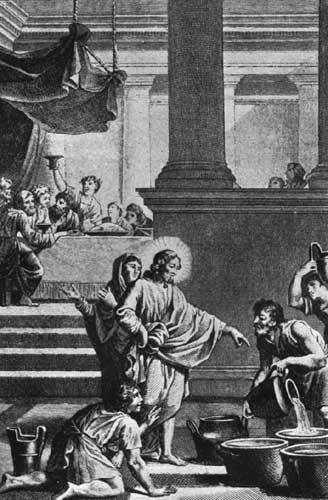
The Marriage at Cana—Old Engraving Page 72
John tells us that Jesus "was wearied with His journey." The observing, tender-hearted disciple saw and remembered his Master's weariness. In this simple, brief record, he reminds us of Jesus' humanity, and so how much He was like ourselves. How much of his Lord's weariness and suffering the sympathizing disciple was yet to witness.
We may think of John alone with Jesus, seated in an alcove which sheltered them from the sun. They may often have been thus found in loving companionship. With what delight would we read of those private interviews. How sacred and precious they must have been to John.
At the well, what subjects there were for conversation, suggested by memories of the spot. Here Abraham had erected his first altar in Canaan to the true God, whom Jesus was about to reveal more perfectly. This was the parcel of ground which Jacob had bought, and in which he had buried the false gods of his household. Here Joseph had been a wanderer seeking his brethren. This was the place which Jacob when dying had given to his son Joseph, on whose tomb Jesus and John looked as they talked together. The twin mountains of Ebal and Gerizim looked down upon them, reminders of the days of Joshua, when the two Israelitish bands called to each other in solemn words, and the valley echoed with their loud "Amen." Not every Jew could have the personal interest in that well, such as the two weary travelers could claim, through the family records of their common ancestor even to Abraham. It was not on account of John that these records had been kept, but of the "Son of Man" at his side, whom he had learned to look upon as "the Son of God." As they sat together John could not look into the future, as his Master could, and think of the time when they would be in the region together with an unfriendly reception; nor of that other time when John would come to it again and have a friendly reception, but with memories only of his Lord.
Belshazzar's Feast—Old Engraving Page 74
But their visit alone did not last until the return of His disciples. It was suddenly interrupted. "There cometh a woman of Samaria to draw water." She was no fitting companion for them. She was not prepared to enter into their thoughts and feelings. She was an ignorant woman of the lower order of society, sinful, and not worthy of the respect of those who knew her. "Give me to drink," said Jesus—fatigued, hungry, thirsty. She gazed upon Him with astonishment. She knew by His appearance and dress that He was a Jew. She supposed that any such would be too full of hatred and pride to ask even such a simple favor of a Samaritan. Her answer showed her surprise. He gently spoke of her ignorance of Him, and of a richer gift than the one He asked, and which He was ready to bestow. It was "living water"—"the grace and truth of which He was full." Changing her manner toward Him, and addressing Him more respectfully, she asked, "Art Thou greater than our father Jacob?" She meant, "Surely Thou art not greater." How strange this must have sounded to John as his eye turned from her, to Him before whom Jacob would bow in adoration could he have joined that circle on the spot where he had built an altar many years before. Jesus explained more fully the difference between the water for which He had asked, and that which He would give. He had asked a very small favor of her; He would bestow the greatest of gifts, even eternal life.
Not fully understanding Him, and yet believing He was some wonderful person, she repeated His own request, but with a changed meaning,—"Sir, give me this water." Perhaps to make her feel her sinfulness and to lead her into a better life, He showed her that though He was a stranger, He knew her past history. Her astonishment increased and she exclaimed, "Sir, I perceive that Thou art a Prophet." Ashamed, she quickly changed the subject.
She and her people claimed that Mount Gerizim was the holy place of the Holy Land; while the Jews said that Jerusalem was "the place where men ought to worship." She wanted the Prophet she had so unexpectedly met to decide between them. With calmness, solemnity and earnestness, He made a sublime declaration to her, meant for Jews, Samaritans and all men. It was this: "Woman, believe me, the hour cometh, when neither in this mountain, nor yet in Jerusalem, shall ye worship the Father.... The hour cometh, and now is, when the true worshipers shall worship the Father in spirit and truth: for such doth the Father seek to be His worshipers. God is a spirit: and they that worship Him must worship in spirit and truth."
But this did not satisfy her. It was all so new and strange, so different from what she and her people believed, that she was not prepared to accept it from an unknown stranger, though he seemed to be a prophet. She thought of One greater than she thought He could be, One who was wiser than any prophet then living, or who ever had lived, One who she believed was to come. So, with a sigh of disappointment, her only reply was, "I know that Messiah cometh; ... when He is come, He will declare unto us all things."
How the quickened ear of John must have made his heart thrill at the name Messiah. Until a few weeks before, he too had talked of His coming, but already had heard Him declare many things which no mere prophet had spoken. Is he not prompted to break the silence of a mere listener? Is not his finger already pointed toward Jesus? Are not the words already on his tongue?—"O woman, this is He," when Jesus makes the great confession he made before Pilate, saying to the Samaritaness, "I that speak unto Thee, am He."
So it was that He whose coming the angels in their glory announced to the shepherds in Bethlehem, He whom the Baptist proclaimed to multitudes on the Jordan, He whose glory was manifested to the company in Cana, made Himself known to this low, ignorant, sinful, doubting, perplexed stranger, in words "to which all future ages would listen, as it were with hushed breath and on their knees."
These words of Jesus to the woman, "I am He," closed their conversation, so unexpected to her when she came with her water-pot, in which she had lost all interest. Her mind and heart had been filled instead. She had drawn from Him richer supplies than Jacob's well could ever contain. From that hour she thought of it, not so much as Jacob's well as the Messiah's well.
The disciples returning from the city, coming within sight of Jesus, "marveled that He was speaking with a woman." The people then and there had a mistaken idea that to do so was very improper. The disciples were the more astonished because she was a Samaritan. But they had such a sense of His goodness, that they did not dare to ask, "Why talkest Thou with her?"
She was interrupted in her conversation with Jesus, by the coming of the disciples. She left her water-pot at the well. Too full of wonder and gratitude to stop to fill it, or to be hindered in carrying it, she hastened to the city with the good news of what she had seen and heard. So had Andrew and John each carried the good news to his brother saying, "We have found the Messiah." She believed she had found Him. But the good news seemed almost too good to be true, and she wanted the men of the city to learn for themselves. So she put her new belief in the form of a question, "Is not this the Christ?" A great number obeyed her call, and believed with her that Jesus was the Messiah.
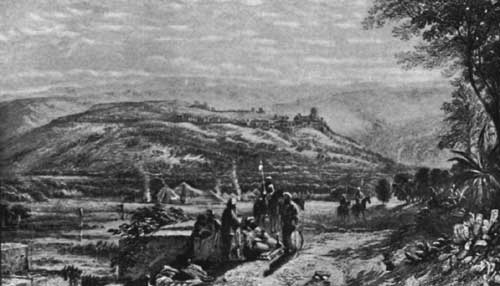
The Hill of Samaria—Old Engraving Page 84
Meanwhile the disciples asked Him to eat of the food they had brought. But His deep interest in the woman, and joy in the great change in her, was so great that for the moment He felt no want of food. So He said to them, "I have meat to eat that ye know not." ... "My meat is to do the will of Him that sent Me." Never again did the disciples marvel that their Master talked with a woman, or with a sinner of any kind. We seem to see John, weary and hungry as his Master, but unmindful of bodily discomforts, because of his intense interest in what is passing. His record does not give his own experiences, but we can imagine some of them. His watchful eye detects every movement and expression of his companions,—the calm, earnest, loving, pitying look of Jesus; and the excited, scornful, surprised, joyful, constantly changing looks of the woman. He first marks her pertness of manner; then the respectful "Sir"; then the reverence for a prophet; and at last the belief and joy in the Messiah.
Whether or not John was witness to all that passed at the well, or whether Jesus gave him the minute details, or whether the Samaritaness, during the two days that Jesus and His disciples remained in Sychar, told Him all, his story is one of the most lifelike in the Gospels, teaching the greatest of truths.
If that noon hour at Jacob's well was a memorable one for the woman, it was also for John. For him Christ was the Well of Truth. Of it he was to drink during blessed years. Standing nearest to it of any mortal, receiving more than any other, he was to give of it to multitudes thirsting for the water of life.