Chapter XXVI
Reading edition
John the Lone Disciple at the Cross
"When they came unto the place which is called Calvary, there they crucified Him."—Luke xxiii. 33.
"At Calvary poets have sung their sweetest strains, and artists have seen their sublimest visions."—Stalker.
"Now to sorrow must I tune my song, And set my harp to notes of saddest woe, Which on our dearest Lord did seize ere long, Dangers, and snares, and wrongs, and worse than so, Which He for us did freely undergo: Most perfect Hero, tried in heaviest plight Of labors huge and hard, too hard for human wight." —Milton.—The Passion.
Even careful students of the life of John are not together in their attempts to follow him on the day of crucifixion. Some think they find evidence, chiefly in his silence concerning certain events, that after hearing the final sentence of Pilate condemning Christ to be crucified, he left the palace and joined the other disciples and faithful women and the mother of Jesus, and reported what he had seen and heard during the night; and at some hour during the day visited Calvary, and returning to the city brought the women who stood with him at the cross: and witnessed only what he minutely or only describes. Other students think he followed Jesus from the palace to the cross, remaining near Him and witnessing all that transpired. This is certainly in keeping with what we should expect from his peculiar relation to Christ. It is in harmony with what we do know of his movements that day. So we are inclined to follow him as a constant though silent companion of Jesus, feeling that in keeping near him we are near to his Lord and ours. This we now do in the "Dolorous Way," along which Jesus is hurried from the judgment-seat of Pilate to the place of execution.
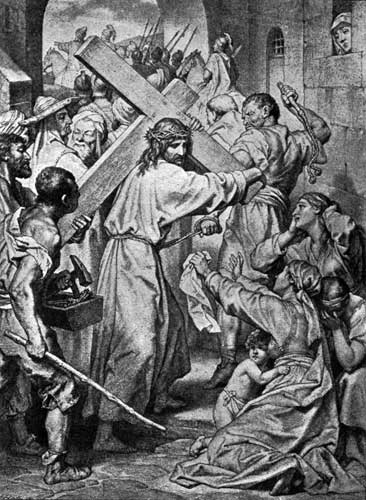
Christ Bearing His Cross—H. Hofmann Page 185
It is John who uses the one phrase in the Gospels which furnishes a tragic subject for artists, and poets and preachers, on which imagination dwells, and excites our sympathies as does no other save the crucifixion itself. His phrase is this,—"Jesus ... bearing the cross for Himself." We notice this all the more because of the silence of the other Evangelists, all of whom tell of one named Simon who was compelled to bear the cross. As John read their story, there was another picture in his mind, too fresh and vivid not to be painted also. He recalled the short distance that Christ carried the cross alone, weakened by the agonies of the garden and the scourging of the palace, until, exhausted, He fell beneath the burden. We are not told that the crown of thorns had been removed, though the purple robe of mockery had been. So this added to His continued pain. As John looked upon those instruments of suffering he heard the banter and derision of shame that always accompanied them.
There followed Jesus "a great multitude of the people," whose morbid curiosity would be gratified by the coming tragedy. But there were others—"women who bewailed and lamented Him."
It is surmised that at the moment when Jesus could bear His cross no longer, and was relieved by Simon, He turned to the weeping "Daughters of Jerusalem" following Him, and in tenderest sympathy told of the coming days of sorrow for them and their city, of which He had told John and his companions on Olivet.
John says that Jesus "went out ... unto the place called the place of a skull, which is called in Hebrew Golgotha." The place was also called Calvary. We do not certainly know the sacred spot, though careful students think it is north of the city, near the Damascus gate, near the gardens of the ancient city, and tombs that still remain. We think of John revisiting it again and again while he remained in Jerusalem, and then in thought in his distant home where he wrote of it. "There," says John, "they crucified Jesus, and with Him two others, on either side one, and Jesus in the midst." How few his words, but how full of meaning. We long to know more of John's memories of that day—of all that he saw and felt and did. They were such in kind and number as none other than he did or could have.
There were two contrasted groups of four each around the cross, to which John calls special attention. One, the nearest to it, was composed of Roman soldiers, to whom were committed the details of the crucifixion—the arrangement of the cross, the driving of the nails, and the elevation of the victim upon it.
Having stripped Jesus of His clothing, according to custom they divided it among themselves; the loose upper garment or toga to one, the head-dress to another, the girdle to another, and the sandals to the last. John watched the division—"to every soldier a part." But his interest was chiefly in the under-garment such as Galilean peasants wore. This must have been a reminder of the region from which he and Jesus had come. He thinks it worth while to describe it as "without seam, woven from the top throughout." Perhaps to him another reminder—of Mary or Salome or other ministering women by whose loving hands it had been knit. If ever a garment, because of its associations, could be called holy, surely it is what John calls "the coat" of Jesus. Even without miraculous power, it would be the most precious of relics. We notice John's interest in it as he watches the soldiers' conversation of banter or pleasantry or quarrel, in which it might become worthless by being torn asunder. He remembered their parleying, and the proposal in which it ended,—"Let us not rend it, but cast lots for it whose it shall be." How far were their thoughts from his when their words recalled to him the prophecy they were unconsciously fulfilling,—"They part My garments among them, and upon My vesture do they cast lots."
With what pity did Jesus look down upon the lucky soldier—so he would be called—sporting with the coat which had protected Him from the night winds of Gethsemane. How He longed to see in the bold and heartless heirs to His only earthly goods, the faith of her, who timidly touched the hem of His garment. What a scene was that for John to behold! What a scene for angels who had sung the glories of Jesus' birth, now looking down upon His dying agonies of shame—and upon the gambling dice of His murderers! No marvel John added to the almost incredible story, "These things ... the soldiers did."
It is at this point that we notice a sudden transition in John's narrative. He points us from the unfriendly group of four, to another of the same number; saying as if by contrast, "But there were standing by the cross of Jesus His mother, and His mother's sister, Mary the wife of Clopas and Mary Magdalene." By "His mother's sister" we understand Salome.
The centurion had charge of the plundering soldiers; John was the guardian of the sympathizing women. He had a special interest in that group, containing his mother and aunt, and probably another relative in Mary the wife of Clopas. Mary Magdalene was not of this family connection, though of kindred spirit. So must John have felt as she stood with him at the cross, and at a later hour when we shall see them together again.
In the days of the boyhood of John and Jesus, we thought of their mothers as sisters, and of parents and children as looking for the coming Messiah. None thought of the possibilities of this hour when they would meet in Jerusalem at the cross. By it stands John the only one of the Apostles. Judas has already gone to "his own place." If Peter is following at all it is afar off. The rest have not rallied from their flight enough to appear after their flight. James the brother of John is not with him. As their mother looks upon Jesus between two robbers, does she recall her ambitious request, "Command that these my two sons may sit, one on Thy right hand, and one on Thy left hand"? She understands now the fitness of the reply she had received,—"Ye know not what ye ask"?
But Salome and John are loyal to the uncrowned King. Though they may not share the glory of His throne, they are yet ready to stand beneath the shameful shadow of His cross.
But another is there,—drawn by a yet stronger cord of affection. She heads John's list of the women "by the cross of Jesus—His mother," whose love is so deep that it cannot forego witnessing the sight that fills her soul with agony. Yes, Mary, thou art there.
"Now by that cross thou tak'st thy final station, And shar'st the last dark trial of thy Son; Not with weak tears or woman's lamentation, But with high, silent anguish, like His own." —H.B. Stowe.
As she stands there we seem to read her thoughts: "Can that be He, my babe of Bethlehem, my beautiful boy of Nazareth, in manhood my joy and my hope! Are those hands the same that have been so lovingly held in mine; those arms, outstretched and motionless, the same that have so often been clasped around me! Oh! that I might staunch His wounds, and moisten His parched lips, and gently lift that thorny crown from His bleeding brow."
But this cannot be. There is being fulfilled Simeon's prophecy, uttered as he held her infant in his arms,—a foreboding which has cast a mysterious shadow on the joys of her life.
"Beside the cross in tears The woeful mother stood, Bent 'neath the weight of years, And viewed His flowing blood; Her mind with grief was torn, Her strength was ebbing fast, And through her heart forlorn, The sword of Anguish passed."
She can only draw yet nearer to His cross and give the comfort of a mother's look, and perhaps receive the comfort of a look from Him, and—oh, if it can be—a word of comfort from His lips for the mother-heart. Perhaps for a moment her thoughts are on the future,—her lonely life, without the sympathy of her other sons who believed not on their brother. Oh! that they were like John, to her already more of a son than they.
In childhood Jesus had been "subject" to her: in youth and manhood He had been faithful to her. In the Temple He had thought of her as His mother, and of God as His Father. But no exalted relation, no greatness to which He had attained on earth, had made Him disloyal to her. While claiming to be the Son of God, He was still the loving son of Mary. Such He would show Himself to be on the cross. We thank John for the record of that moment when "Jesus ... saw His mother." "The people stood beholding" Him, but His eyes were not on them; nor on those passing by His cross wagging their heads, nor the malefactor at His side reviling Him; nor on the chief priest and scribes, the elders and soldiers mocking Him; nor the rulers deriding Him. His thought was not on them, nor even on Himself in His agonies, as His eyes rested keenly on His mother. It was a deep, tender, earnest gaze.
John tells that Jesus also "saw" "the disciples standing by, whom He loved." The Lord turned His head from His mother to His disciple. This could be His only gesture pointing them one to the other.
The prayer for His murderers had apparently been uttered when His hands were pierced, before the cross was raised. He may have spoken once after it was elevated, before He saw the two special objects of His love. His eyes met His mother's. She saw Him try to speak. The utterance of His parched lips, with gasping breath, was brief, full of meaning and tenderness—"Woman! behold, thy son!" Then turning toward John He said, "Behold! thy mother!"
In these words Jesus committed His mother to John without asking whether he would accept the charge.
"From that hour the disciple took her unto his own home." It is a question whether or not the phrase, "from that hour," is to be taken literally. It may be that the blessed words, "mother" and "son," were as a final benediction, after which John led her away, and then returned to the cross. Or, it may be that the mother-heart compelled her to witness the closing scenes.
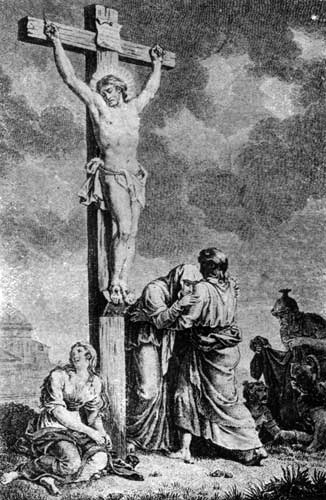
The Virgin and St. John at the Cross—Old Engraving Page 193
If we pause long enough to inquire why John was chosen to be trusted with this special charge, we can find probable answer. Jesus' "brethren" did not then believe on Him. Mary's heart would go out toward him who did, especially as he was her kindred as well as of a kindred spirit. His natural character, loving and lovable, made him worthy of the trust. Apparently he was better able to support her than were any other of the Apostles, and perhaps even than her sons. He seems to have been the only Apostle or relative of Mary who had a home in Jerusalem, where she certainly would choose to dwell among the followers of the Lord. Above all John was the beloved disciple of Mary's beloved son. So to him we can fittingly say:
"As in death He hung, His mantle soft on thee He flung Of filial love, and named the son; When now that earthly tie was done, To thy tried faith and spotless years Consigned His Virgin Mother's tears." —Isaac Williams.—Trans. An. Latin Hymn.
Blessed John. When Jesus called His own mother "thy mother," didst thou not almost hear Him call thee "My brother"?
One tradition says that John cared for Mary in Jerusalem for twelve years, until her death, before his going to Ephesus. Another tradition is that she accompanied him thither and was buried there. What a home was theirs, ever fragrant with the memory of Him whom they had loved until His death. No incidents in His life, from the hour of brightness over Bethlehem to that of darkness over Calvary, was too trivial a thing for their converse. That home in Jerusalem became what the one in Nazareth had been, the most consecrated of earth. What welcomes there of Christians who could join with Mary as she repeated her song of thirty-three years before, "My soul doth magnify the Lord, and my spirit hath rejoiced in God my Saviour." Of her we shall gain one more distinct view—the only one.