Chapter II
Reading edition
Five Boys of Bethsaida—Rambles About Home
"Walking by the Sea of Galilee, He saw two brethren, Simon who is called Peter, and Andrew his brother."—Matt. iv. 18.
"And going on from thence, He saw other two brethren, James the son of Zebedee, and John his brother."—v. 21.
"Philip was from Bethsaida, of the city of Andrew and Peter."—John i. 44.
Bethsaida was honored as being the home of five of the Apostles of Jesus. We know nothing definitely concerning them until their manhood. We wish we knew of their childhood. It is only because of their relation to Jesus that they have been remembered. Had it not been for this they would, like many other boys of Galilee, have lived on the shores of Gennesaret, fished in its waters, died, and been forgotten. These five Bethsaidan boys were two pairs of brothers and a friend. The names of one pair were Andrew and Peter. They were the sons of Jonas, a fisherman. As they grew up they were engaged with him in casting the net and gathering fish, by day or by night, and thus securing a livelihood without thought of change of occupation. It was a Jewish custom for boys to learn a trade or business, which was generally that of their fathers.
The names of the other pair of brothers were James and John. Their father was named Zebedee. He also was a fisherman having so much prosperity in his business that he employed servants to help him. Judging by what we know of the family they must have been highly respected by the people among whom they lived.
We do not know the exact date of John's birth. He was probably younger than James, and several years younger than Peter.
The mother of James and John was named Salome. We know more of her than of her husband. She was a warm friend of Jesus, ministering to Him when He was living, and was one of the few who cared for His dead body. Her sons seemed to be greatly attached to her. All were of kindred spirit, having like thoughts, feelings and plans.
James and John were brothers indeed, companions until the death of James separated them. The feelings of boyhood must have been greatly strengthened in later scenes, and by influences which we shall have occasion to notice. As we know of them as daily companions in manhood, we think of the intimacy and affection of boyhood. It will help us to gain an idea of their companionship, and the influences of their surroundings, if we notice some things with which they were familiar in the region of their home.
Standing on one of the hills behind Bethsaida they beheld a magnificent panorama. In the northeast Hermon rose like a mighty giant, called by the people of the land the "Kingly Mountain." They knew it by the name Moses had given it—"the goodly mountain." They were to know it by the name which Peter would give in after years, "The Holy Mount," so called for a blessed reason of which all of them were to learn. Down from its snowy glittering sides a thousand streamlets blended in larger streams combining in the Jordan, which flowed through marshes and Lake Merom until it entered Gennesaret near their home. Eastward, across the lake, the rugged cliffs of Gadara cut off their view. Perhaps at this very hour the winds from Hermon rushed through the gorges, first ruffling the placid waters of the lake, and then tossing them as if in rage. They little thought of a coming time when they themselves would be tossed upon them until they heard a voice saying, "Peace be still." And now
"The warring winds have died away, The clouds, beneath the glancing ray, Melt off, and leave the land and sea Sleeping in bright tranquillity. Below, the lake's still face Sleeps sweetly in th' embrace Of mountains terraced high with mossy stone."
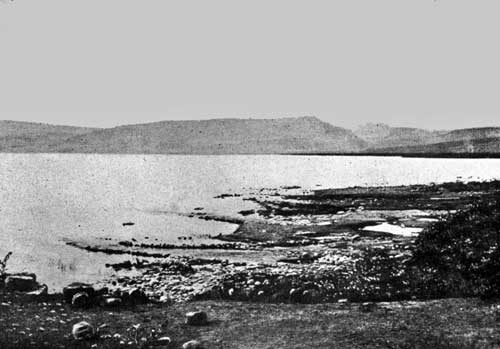
Calm on Galilee—From Photograph Page 26
In another hour they watch the more quiet movements of pleasure boats,—gay barges and royal galleys—and trading vessels, and fishing boats,—all crowding together seemingly covering the lake.
As it narrows in the southern distance, the Jordan commences the second stage of its journey of one hundred and twenty miles through rugged gorges. As it leaves the quiet lake, we can almost hear them saying to it
"Like an arrow from the quiver, To the sad and lone Dead Sea, Thou art rushing, rapid river, Swift, and strong, and silently, Through the dark green foliage stealing, Like a silver ray of light."
Descending from the hill we may follow James and John in their rambles in the region near their home. On the northern extremity of the lake, among the colossal reeds, and meadow grass and rushes, they watch the little tortoises creeping among them; and the pelicans which make them their chosen home; and the blue and white winged jays that have strayed from the jungles through which the Jordan has pushed its way; and the favorite turtle-doves; and the blue birds so light that one can rest on a blade of grass without bending it; and the confiding larks and storks which, not fleeing, seem to welcome the visitors to their haunts. Here grow oleanders of such magnificence as is seen nowhere else in the country, twenty feet high, sometimes in clumps a hundred feet in circumference; and "masses of rosy red flowers, blushing pyramids of exquisite loveliness."
Our ramblers follow the western shore to the shallow hot stream, where boy-like,—or manlike as I did—they burn their hands in trying to secure pebbles from its bottom. They rest under the shade of an olive or a palm. They gather walnuts which are in great abundance; and grapes and figs, which can be done ten months in the year; and oranges and almonds and pomegranates.
They wander through meadows rich in foliage, and gay with the brightness and richness of flowers which retain their bloom in Galilee when they would droop in Judæa or Samaria.
We hear the poet Keble asking them,
"What went ye out to see O'er the rude, sandy lea, Where stately Jordan flows by many a palm, Or where Gennesaret's wave Delights the flowers to lave, That o'er her western slope breathe airs of balm? "All through the summer night, These blossoms red and white Spread their soft breasts unheeding to the breeze, Like hermits watching still, Around the sacred hill, Where erst our Saviour watched upon His knees."
To the poet's question James and John would answer that they "went out to see the blue lupin and salvia, the purple hyacinth, the yellow and white crocus, the scarlet poppy, and gladiolus, the flowering almond, the crimson and pink anemone."
They also saw the cultivated fields, and the sower casting his seed which fell on the hardened pathway, or barren rocks, or bounteous soil. They watched the birds from mountain and lake gather the scattered grain. They thought not of the parable into which all these would be weaved; nor of Him who would utter it in their hearing near where they then stood. They saw the shepherds and their flocks, the sparrows and the lilies, that became object lessons of the Great Teacher yet unknown to them. In their rambles they may have climbed the hill, only seven miles from their home, not thinking of the time when they would climb it again; after which it would be forever known as the Mount of Beatitudes.
Such were some of the charming and exciting scenes with which John was familiar in his early life, and which would interest his refined and observing nature, of which we know in his manhood. They must have had an important influence in the formation of his character.
We have spoken of five Bethsaidan boys—Andrew and Peter, James and John—and a friend. His name was Philip. We know but little of him. What we do know is from John. He tells us that "Philip was of Bethsaida, the city of Andrew and Peter." Perhaps he was their special friend, and so became one of the company of five, as he afterward became one of the more glorious company of twelve. We shall find three of these five in a still closer companionship. They are Peter, James and John. One of these shall have the most glorious honor of all. It is John.