III.—DRAMA. (Table-Case K and Glass Shade above.)
Reading edition
The antiquities illustrating the ancient drama are placed in one half of Table-Case K, and under the glass shade standing above it.
Greek Drama.—This was in its origin essentially religious, and retained up to the decline of tragedy at the end of the fifth century B.C. the character of a religious ceremony. Thus tragedy gradually developed out of the rude dances in honour of the wine-god Dionysos, which were performed at country vintage festivals. The name tragedy means "goat-song," and is probably to be associated with the sacrifice of the goat, the enemy of the vines.
The dramatic part of a tragedy was at first confined to a dialogue between a single actor and the leader of the chorus, with long musical interludes, but the number of actors was gradually increased, with the result that more stress was laid on the dramatic action. Aeschylos introduced a second actor, Sophokles a third, and Euripides, the last of the great tragedians, reduced the lyrical element of the play to comparatively insignificant proportions.
Comedy underwent a development not unlike that of tragedy. It also had its origin in the coarse buffoonery common at the rustic festivals which celebrated the vintage. Introduced into Athens from the neighbouring Megara early in the sixth century B.C., it did not receive recognition from the state until the middle of the fifth century. The comedy of the closing years of that century is inseparably connected with the name of Aristophanes, who combined merciless political satire with exquisite poetry.
In the fourth century B.C. a great change came over comedy at Athens. The later plays of Aristophanes mark the beginning of the comedy of manners, which took the place of the old political comedy. The master of this new comedy was Menander. Through Roman translations and adaptations of Menander and his fellow poets by Plautus and Terence, comes the comedy of Molière and modern Europe.
The theatre, in which these ancient plays were performed, was of slow development. The grassy slopes of a hill, bordering on a circular dancing-place (orchestra), satisfied the earliest audiences. Later on, a definite place was set apart for theatrical performances, and a wooden structure erected for the actors. It was not until the fourth century that permanent stone seats were laid down in the Theatre of Dionysos at Athens, although performances had been given there for more than a century.
The more important Roman comedies were adapted from the New Comedy of the Greeks. These adaptations are familiar to us from the surviving plays of Plautus (254-184 B.C.) and Terence (ca. 185-159 B.C.). Actors at Rome had long to be content with temporary wooden structures, which were pulled down when the performances were over. A permanent theatre was not erected in Rome till 55 B.C.
The objects illustrating the ancient drama can conveniently be divided into (a) representations of scenes from plays, and (b) figures of actors and masks.
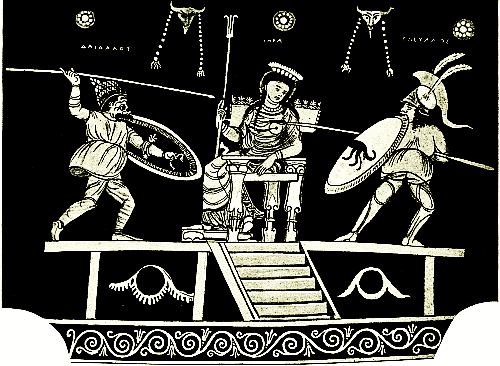
Fig. 16.—Scene from a Mock-Tragedy. Combat between Ares and Hephaestos before Hera (No. 52).
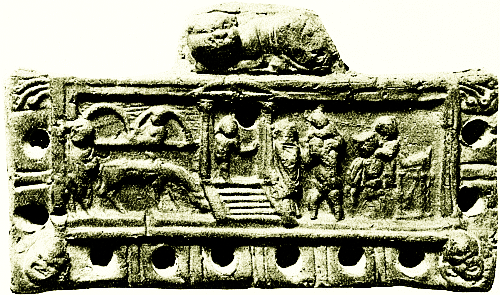
Fig. 17.—Marriage Scene from a Roman-Comedy (No. 54). 2:3.
The two large vases illustrate Greek dramatic performances of a considerably later date. They give us scenes from phlyakes, a class of burlesques which were in vogue in the Greek cities of Southern Italy, especially at Tarentum, at the end of the fourth and the beginning of the third century B.C. They are associated with the name of Rhinthon, a Syracusan poet. These plays dealt in the wildest spirit of farce with subjects drawn from Greek mythology and legend, as well as with scenes from daily life. One of the vases (No. 52; fig. 16) shows a contest upon the stage, between actors representing Ares (Ἐνευάλιος) and Hephaestos (Δαίδαλος) fighting in the presence of Hera. The grotesque mask, the padded figures, and the general air of exaggeration are indicative of the character of these plays, which earned for them the title of mock-tragedies (ἱλαροτραγῳδίαι). The other vase (No. 53) is a parody of the myth of Cheiron cured by Apollo. The blind Centaur, whose equine body is represented pantomime-fashion by a second actor pushing behind, ascends the steps leading up to the stage, where stands the slave Xanthias. Behind is the Centaur's pupil Achilles, and looking on from a cave are two grotesquely ugly nymphs.
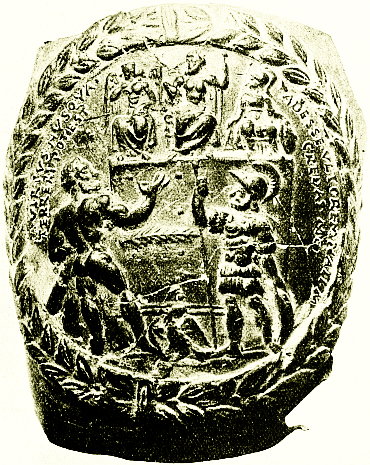
Fig. 18.—Scene from a Roman Tragedy. Hercules Disputing with Mars (No. 55). 1:1.
Case K contains two interesting representations of Roman comedy and tragedy respectively. The oblong lamp (No. 54; fig. 17) gives a scene from a comedy, not improbably the mock-marriage scene from the fourth act of the Casina of Plautus. The steps leading up to the door of the house divide the actors into two groups. On the left is the bridegroom (Olympio?) with his mule, in preparation for his departure into the country. On the right comes the marriage procession approaching a woman (Pardalisca?) who stands by the steps. First walks a Silenus, carrying a Cupid on his shoulders; next comes the bride, carried aloft by a man, in order that she may be lifted over the threshold in conformity with the usual Roman marriage rite (see below, p. 212). Behind is an altar in the courtyard of the house. A Cupid waits at the door to receive the bride.
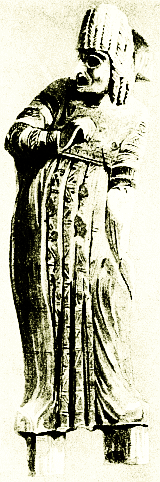
Fig. 19.—Ivory Statuette of a Tragic Actor.
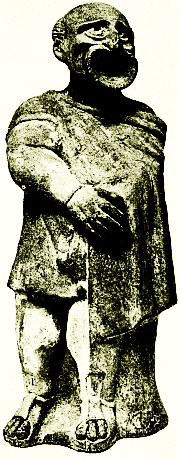
Fig. 20.—Terracotta Statuette of Comic Actor (Money-Lender?) (No. 60). Ht. 7⅞ in.
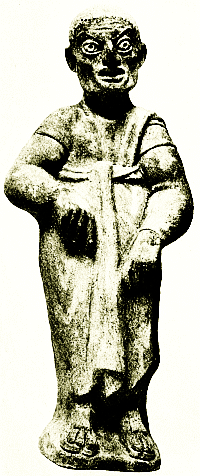
Fig. 21.—Terracotta Statuette of Comic Actor (Slave?) (No. 61). Ht. 8½ in.
(b) Figures of actors and masks.—In tragedy the actors probably wore a dress differing from that of the spectators only in a certain richness of material and colour, and in an adherence to the fashion of an earlier period. Two features, however, distinguished them in appearance from ordinary men, the buskin (κόθορνος) or high-soled boot, and the tragic mask. The use of the former (which increased in height as time went on) was due to a desire to enhance the wearer's dignity by raising him somewhat above the common height of men. The wearing of the mask was brought about chiefly by tradition, partly by the great size of ancient theatres, which rendered some easily recognized type of face a practical necessity. The tragic mask (fig. 22 below, right) was usually surmounted by a high projection over the forehead, called the onkos, on which the hair was raised to a height varying with the social position of the character. The mask illustrated (No. 56) is of ivory and finely worked. It is a mask such as would have been worn by some king in tragedy, an Agamemnon or a Kreon. The general appearance of a tragic actor is finely brought before us by an ivory statuette (not in the Museum) which was found near Rieti, a place about 35 miles N.E. of Rome (fig. 19). The elaborately embroidered robe is coloured blue, and the onkos, mask, and buskins are clearly seen. (Mon. dell' Inst. xi. pl. 13.)
The figures of actors and the comic masks exhibited under the glass shade and in Table-Case K bring before us the different characters prominent in Athenian comedy of the fourth and third centuries B.C., and in the Roman comedy derived from it. It was a comedy of everyday life, in which the same well-known types were constantly reappearing. Such were the parasite (No. 57), who bears all the marks of a fondness for good living, and carries a flask and a ham; the glutton (Nos. 58 and 59), distinguished by his large padded stomach; the money-lender (No. 60), with his acute and cunning expression, grasping his purse tightly by his side with both hands, and partially concealing it beneath his cloak (fig. 20). The adventures of the slave and his punishments were a favourite theme with poets of the new comedy. No. 61 (fig. 21) may represent the trusted elderly slave aghast at the misdoings of his young master. A still greater favourite is the runaway slave who seeks refuge from his irate master in the protection of the altar. The bronze statuette (No. 62), and the terracotta (No. 63) show him seated on the altar, and in No. 64 his hands are tied behind him. A typical comic mask (No. 65) is illustrated above (fig. 22, left), characterised by its exaggerated features, especially the wide open mouth, the snub nose and thick bushy eyebrows. The satyric play, which of the three kinds of Greek drama kept nearest in spirit to the early Dionysiac village revel, is illustrated by the satyric masks (No. 66; fig. 22, centre), with their high upstanding hair and semi-bestial features, as well as by the masks of the bald-headed Seilenos, the constant companion of Dionysos in his revels.
Most of the examples of masks shown in the case are merely representations. A few such as No. 67 with pierced eye and mouth-holes, and of life size, may have been intended for use. Two heads of actors from marble reliefs (Nos. 68, 69) show to what extent the face of the actor could be seen, within the apertures of the mask.
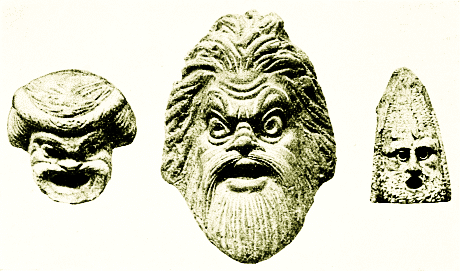
Fig 22.—Comic, Satyric, and Tragic Masks (Nos. 65, 66, 56). Ca. 5:8.
(50) Cat. of Vases, II., B 80; Journ. Hell. Stud., I., pl. 7; (51) Cat. of Vases, II., B 509; Journ. Hell. Stud., II., pl. 14; (52) Cat. of Vases, IV., F 269; cf. Heydemann in Jahrb. d. arch. Inst., I. (1886), p. 260 ff.; (53) Cat. of Vases, IV., F 151; (54) Cat. of Lamps, 446; Cf. Froehner, Hoffman Sale Cat., 1886, p. 38, No. 127; (55) Cat. of Roman Pottery, M 121; Gazette Arch., 1877, p. 66, pl. 12.
On the ancient theatre generally, see Haigh, The Attic Theatre, edn. 3, where references to literature will be found. For Masks, see Daremberg and Saglio, Dict., s.v. Persona.
Adesse ultorem nati m[e] credas mei. [Invic]ta virtus nusqua(m) terreri potest.