XXIV.—MARRIAGE. (Wall-Case 53.)
Reading edition
Greek Marriage.—Though neither Greek nor Roman marriage was definitely associated with the religion of the state, it was, however, among both peoples closely associated with religious rites of a domestic character. Plato in his Laws makes it the distinguishing mark of the legally wedded wife that "she had come into the house with gods and sacred marriage rites." These rites are sometimes represented upon Greek vases, as may be seen from the objects and illustrations placed in this Case. The ceremonies may be conveniently divided into those concerning (a) the preparation of the bride; (b) the removal of the bride from the house of her father to that of her husband; (c) the reception at that house; and (d) the presents given on the day following the marriage (ἐπαύλια).

Fig. 246.—Decking of a Greek Bride (No. 635).
(a) On the day before her wedding the bride not infrequently made an offering of the playthings of her childhood to some deity, presenting her toys to Artemis in particular. On the day before marriage, too, water for the bridal bath was brought in procession in the special form of tall vase called a λουτροφόρος; a small model is seen in Case 59 (No. 634). The vase is also seen standing on the chest in the room of the bride here depicted (No. 635; fig. 246). The scene is taken from the design on a toilet box of the fifth century B.C. (E 774), which shows the bride being adorned for her marriage. Besides the tall amphora already mentioned, two vases called "marriage bowls" (λέβητες γαμικοί) are seen standing on tall stems before the door, on the further side of which one of the bride's friends is turning the magic wheel intended to inspire the bridegroom with a greater longing of love. So Theocritus sings:
"Draw to my home, O mystic wheel,
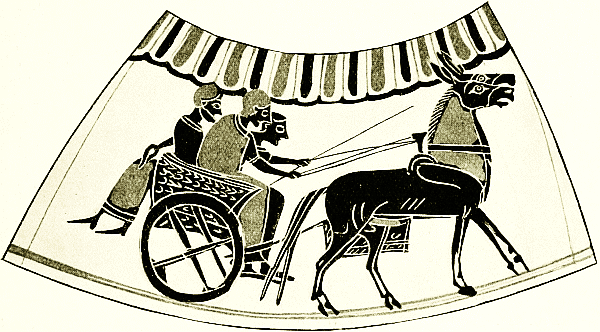
Fig. 247.—The Wedded Pair Driving to the Bridegroom's Home (No. 637).
(c) The actual progress of the bride to her husband's home is depicted on the black-figured vase No. 637, of sixth-century date (fig. 247). The departure took place at nightfall by torch-light, and the bride and bridegroom usually (as in the present instance) made the journey in a mule-car, attended by a friend called the parochos. On the vase (fig. 247) the bride and bridegroom are seen in front of the mule-car, and the parochos is seated behind. When the pair reached their home, they were welcomed by the father and mother of the bridegroom, and a procession was formed to the hearth-altar. This is a scene depicted on No. 638, a reproduction of a painting on a toilet-box in the Third Vase Room (D 11, on Case F). The bridegroom leads the bride by the hand towards the hearth-altar, by the side of which stands the hearth-goddess Hestia, holding a sceptre and what is probably a fig, an allusion to the figs, dates and other fruits showered over the wedded pair as they reached the hearth, and thence called καταχύσματα (down-pourings). Before the pair go a boy playing on the double-flutes and two women holding torches, who probably move round the altar, as well as another woman, who perhaps leads the way to the bridal chamber (figs. 248 and 249).
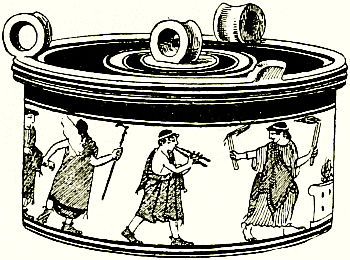
Fig. 248.—Toilet-Box with Wedding Procession.

Fig. 249.—Bridegroom Leading Bride to Hearth-Altar. Design on the toilet-box (No. 638).
Roman Marriage.—Roman practice recognised various methods of lawful marriage. The illustrations and objects shown in this Case deal only with certain ceremonies which were common to all of them. They concern (a) the betrothal; (b) the actual wedding rites; and (c) the escorting (deductio) of the bride to the house of the bridegroom.
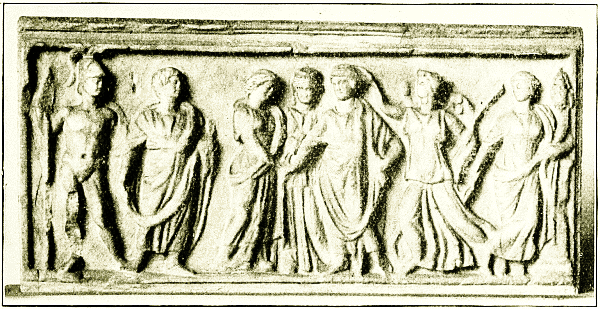
Fig. 250.—Roman Wedding Ceremony (No. 641).
(a) The betrothal took the form of a solemn contract between the fathers and guardians on either side. In all Roman contracts it was customary that a pledge should be given, and this pledge often consisted in a ring. It was fitting, therefore, that a ring given to the woman by her betrothed should come to be a sign of the betrothal contract. It is natural to identify these rings with a series of Roman rings which have for their design two clasped right hands. An example in gold of about the third century A.D. (No. 639) is shown in this Case.
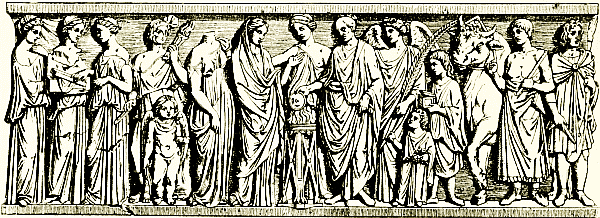
Fig. 251.—Roman Wedding Sacrifice.
(635) Cat. of Vases, III., E 774; Furtwängler and Reichhold, Griech. Vasenmalerei, I., pl. 57 (3); (637) Cat. of Vases, II., B 485; (638) Cat. of Vases, III., D 11; Ath. Mitt., XXXII., 1907, p. 80 ff.; (639) Cat. of Rings, 276; (640) Cat. of Sculpt. 2379; (641) Journ. of Hellenic Studies, XXXVI., p. 85.
See also Daremberg and Saglio, s.v. Matrimonium.