XVIII.—INDUSTRIAL ARTS. (Table-Case H.)
Reading edition
In Table Case H we have objects illustrating the craft of the metal worker, the potter, the turner, and the woodworker.
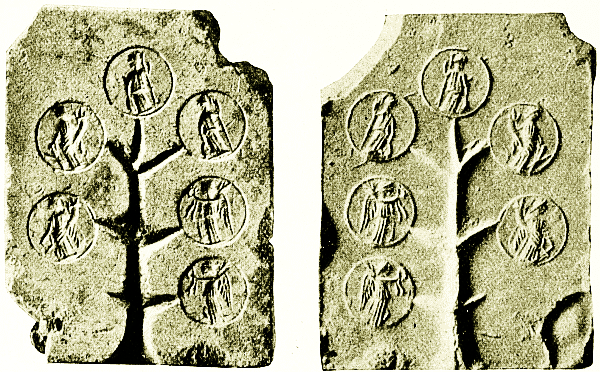
Fig. 214.—Limestone Half-Mould, with Cast from Same (No. 531). Ht. 4½ in.
Towards one end of the case are objects illustrating the processes of metal work. A Greek vase of the sixth century B.C. depicts a man in the act of thrusting a mass of metal into a blazing furnace. Anvil, tongs, and hammers are visible (No. 526). Beside it is a reproduction of a Vase in the Ashmolean Museum at Oxford, showing an armourer at work on a helmet (No. 527). Two limestone moulds of a very early period are for casting primitive implements (No. 528). Note also a mould (No. 529) for a metal weight of a type similar to that with the head of Herakles in Case 41. The mould shows a female head with a cornucopia before it, apparently a personification of Profit (Κέρδος), whose name appears above the head. Another mould (No. 530) is intended for a series of lead weights of values αʹ to ηʹ, that is, 1 to 8. (Compare a similar set in Case 42.) It should be observed that the moulds seen here are, for the most part, only half-moulds, or in some cases even less. A corresponding half-mould had to be placed in position before casting could be effected. This is well shown by a limestone half-mould from Rome (No. 531; fig. 214) for casting lead counters, with designs representing Victory, Fortune, and Athena. Here can be seen the channels by which the molten metal was introduced, and the holes for the studs joining the two half-moulds together. In one of these a lead stud still remains.
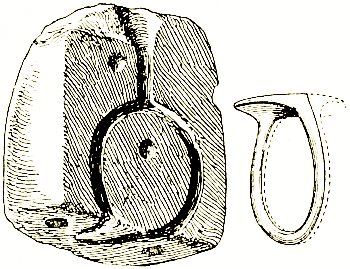
Fig. 215.—Part of Mould for a Ring of the shape indicated (No. 532).
The steatite mould for a ring of the Mycenaean period (No. 532; Fig. 215) required a counterpart piece, and a third piece at the bottom to complete it. Some of the steatite moulds which have no channels for the molten metal, were probably used for the production of ornaments by pressing and rubbing thin foil into the forms.
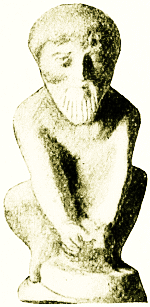
Fig. 216.—Greek Potter at Work (No. 533). Ht. 4½ in.
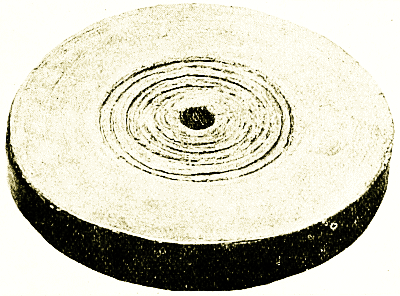
Fig. 217.—Potter's Wheel in Terracotta (No. 534). Diam. 9¾ in.
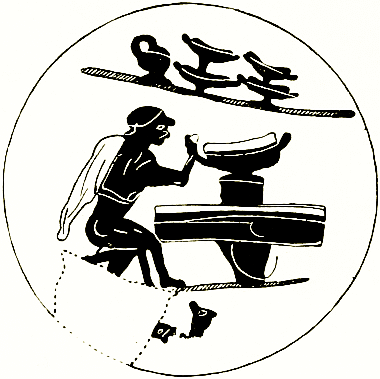
Fig. 218.—Greek Potter attaching Handle to Vase (No. 535).
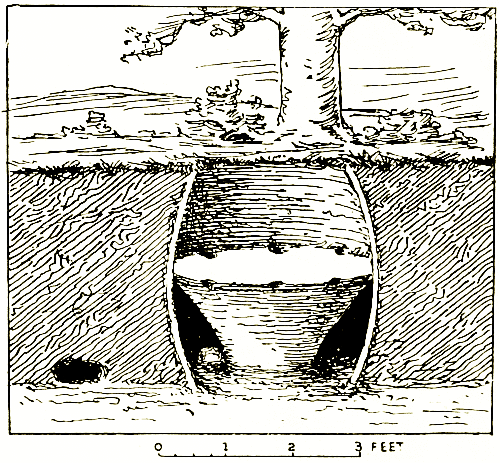
Fig. 219.—Potter's Kiln (No. 536).
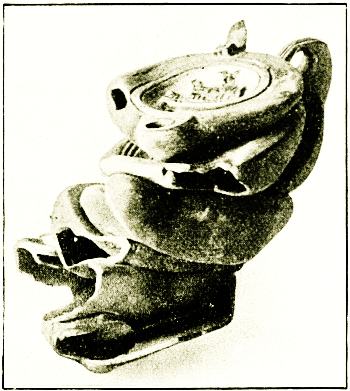
Fig. 220.—Clay Lamps Spoiled in Baking (No. 538). Ca. 1:2.
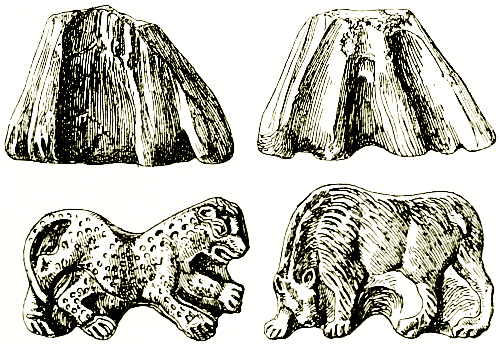
Fig. 221.—Stamps for Making Moulds for Vases in Relief (No. 545).
A mould (No. 543) for making a bowl of the ware called Arretine from its place of manufacture, Arretium in Central Italy, is shown, with a cast from the mould beside it. An impression is also shown of the mark of M. Perennius, the most noted of the Arretine potters, in combination with his slave Bargates (No. 544). Near the mould are stamps, one with a design of a slave heating some fluid in a caldron, and others of a bear and lion (No. 545; fig. 221). These stamps were used for producing the designs in the moulds, being impressed in the clay while it was soft. Several specimens of these moulds and bowls, which are of about the first century B.C., will be seen in Cases 39-40 of the Fourth Vase Room.
The moulds for parts of Roman lamps, show the way in which these objects were produced. The clay was pressed into the lower mould (such as No. 546; fig. 222) and also into a corresponding upper mould (compare No. 547), and then the two halves were joined together and ready for baking.
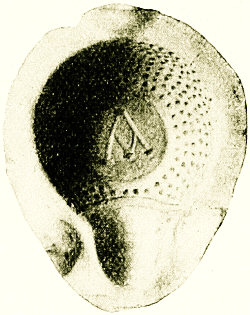
Fig. 222.—Mould for Lower Part of Clay Lamp (No. 546). L. 4¼ in.
(526) Cat. of Vases, II., B 507; (528) Excavations in Cyprus, p. 26, fig. 50; (531) Cf. Bull. della Comm. Arch. xxxiii. (1905), p. 146 ff; (532) Cat. of Jewellery, No. 609; (533) Excavations in Cyprus, p. 93, fig. 145; (535) Cat. of Vases II., B 432; (536) Proc. of Soc. of Ant., Ser. II., xvi., p. 40; (542) Cat. of Terracottas, B 376. pl. 20; (545) Cat. of Roman Pottery, M 82, 83; (546) Cat. of Lamps, 1401.
Gems and Pastes.—In the next division of Case H are objects illustrating the processes of producing Gems and Pastes. These include a series of scarabs, scarabaeoids, and other beads at various stages of manufacture (No. 548); a series of clay moulds for Graeco-Egyptian porcelain scarabs from Naukratis (No. 549) and a fine specimen of a paste cameo head of Silenos (No. 550). Here also are examples of stone socket-handles for a bow-drill (No. 551). In this and the next compartment several pieces of work are incised with designs intended to be filled in with inlay (No. 552). See also a series of fragments of an acanthus pattern in ivory, evidently intended to be inlaid. A piece of rock crystal is carved with ears of corn in intaglio, gilded (No. 553). See also examples of enamel work, of the period of the Roman empire, on studs, seal boxes, etc. (cf. p. 135, 155).
Woodworking, etc.—An interesting wooden box of Roman date is derived from Panticapaeum, in the Crimea (No. 554). This has two sliding lids, above and below respectively, each furnished with two catches. The interior was divided by a horizontal partition, and was again subdivided into numerous small divisions. An inlaid pattern decorates the border of the box. Another box of simpler construction (No. 555) was found in a grave in Bulgaria. Various specimens of fretwork in jet and ivory are shown, and two pieces of an egg and tongue moulding, carved in wood, and coloured with scarlet and gilding, from a sarcophagus, also found at Panticapaeum (No. 555*).
The Lathe.—In the next division are examples of work finished on the lathe, in a variety of materials, as marble, alabaster, coloured stones, crystal, bronze, ivory, bone, and wood; also a rough piece of alabaster from Cyprus, derived from a lathe mandrel.