XII.—DOMESTIC ARTS. (Table-Case G.)
Reading edition
In this Table Case, under the general heading of "The Domestic Arts," objects are exhibited connected with the house industries of spinning, weaving, and sewing, together with various groups of objects connected with home life, such as locks and keys, seals, knives, etc.
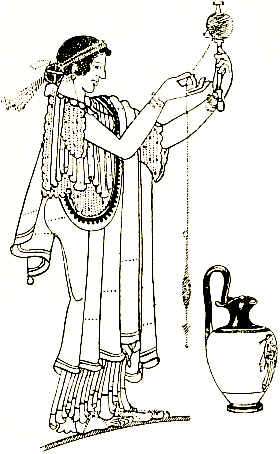
Fig. 171.—Woman Spinning (No. 421). Ht. of Vase 8¾ in.
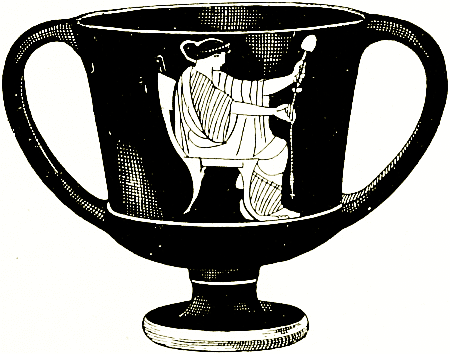
Fig. 172.—Woman Spinning (No. 422). Ht. of Vase 4½ in.
Two bronze spindles (No. 423) are seen in the Case and are illustrated on either side of fig. 173. In the same figure are shown four ivory whorls from spindles (No. 424).
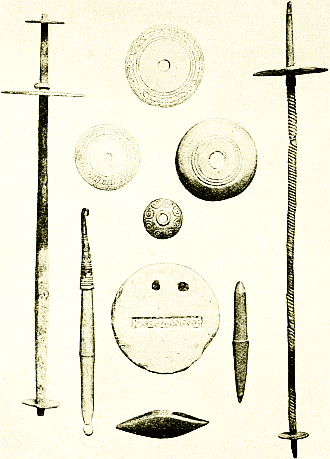
Fig. 173.—Spindles and Whorls, Shuttle and Loomweight. 2:5.
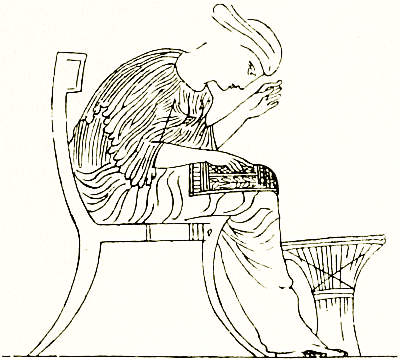
Fig. 174.—Woman with Epinetron on Knee.
Before the wool was placed upon the distaff it appears to have been rubbed, with a view to the separation of the fibres, upon an instrument known as the epinetron or onos. This was semi-cylindrical in form and was placed upon the knee. Several examples in terracotta had long been known, and were explained with little plausibility as covering-tiles. One, however, was found with a painted design which first gave the clue to its real use (Fig. 174). One of these epinetra B 96 (No. 425) is exhibited in this Case, together with a fragment of a second. Other examples are to be seen in the Second Vase Room (Cases 24 and 25), and one of these is illustrated here (No. 426; fig. 175). A miniature example was found with the girl doll seated in a chair, exhibited in Table-Case J with the other dolls (p. 195, fig. 234, below).
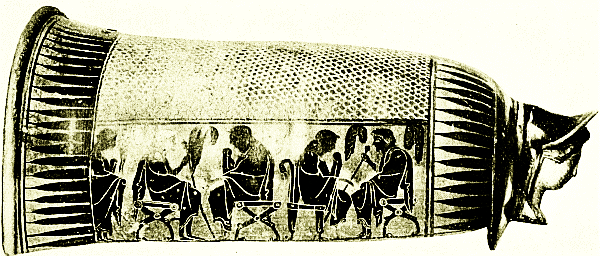
Fig. 175.—Epinetron or Spinning Instrument (No. 426). L. 14½ in.
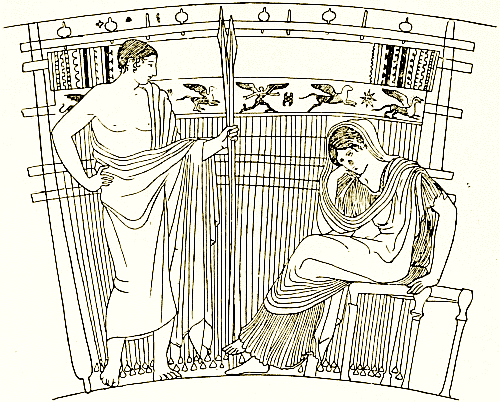
Fig. 176.—Penelope at the Loom.
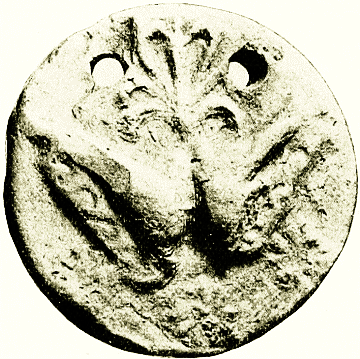
Fig. 177.—Loom Weight (No. 428). 2:3.
The art of tapestry weaving was highly developed during the later Roman Empire, especially in Egypt. See a fragment from Antinoe, fourth to fifth centuries A.D. (No. 434). The art of embroidery, that is, of working with a needle on an already woven fabric, was practised from very early times. See the small vase with a woman seated working on a four-sided embroidery frame, supported on her lap (No. 435).
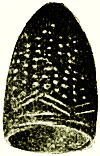
Fig. 178.—Bronze Thimble (No. 436). 2:3.
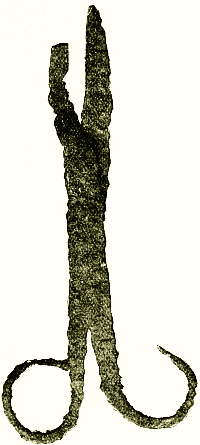
Fig. 179.—Iron Scissors from Priene (No. 437). 2:3.
The objects illustrating ancient sewing, etc., speak pretty well for themselves. Such are the bronze thimble (No. 436; fig. 178), the iron scissors (No. 437; fig. 179), and the series of pins, needles, bodkins, netting needles, etc. (figs. 180, 181). The needles and pins are arranged in the Case according to their supposed order of development, starting from the thorn or bone fragment with a hole pierced in it. The Roman bronze needle-case from France (No. 438; fig. 182) is worthy of note. Similar cases were used by Roman surgeons for their instruments.
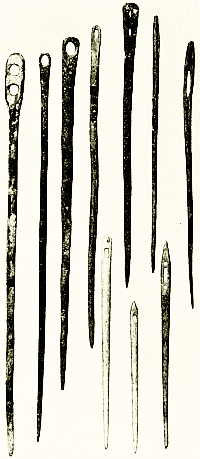
Fig. 180.—Needles, etc. 2:5.

Fig. 182.—Bronze Needle-Case (No. 438). 2:3
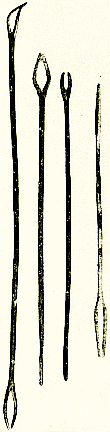
Fig. 181.—Netting-Needles. 2:5.
(421) Cat. of Vases, III., D 13; (433) Petrie, Hawara, pl. viii., 2; (435) Journ. of Hellen. Stud., xxxi., p. 15; cf. Blümner, Technologie, 2nd ed., pp. 220, 221; (438) Cf. Deneffe, La trousse d'un chirurgien gallo-romain, pl. 2.
On the ancient loom, see Daremberg and Saglio, s.v. Textrinum; Blümner, Technologie, I., 2nd. ed., p. 135 ff.
Cutlery.—At the east end of Table-Case G will be seen a series of Greek and Roman knives, ranging from the long Mycenaean hunting knife from Ialysos in Rhodes (No. 438) to the numerous Roman pocket-knives with bronze handles, frequently in the form of animals (No. 439). The iron blade has often rusted away, as will be seen from the illustration (fig. 183), which gives a selection of these knives. (a) represents a handle in the form of a panther catching a deer, (b) one in the form of a ram's head, with a leg projecting below to assist the grip, (e) a hound catching a hare. The iron blades are still preserved in the case of (c) and (d). The first, from Nîmes, has a bronze handle ending in a woman's head; (d) has a handle of the same material in the form of a hound catching a hare.
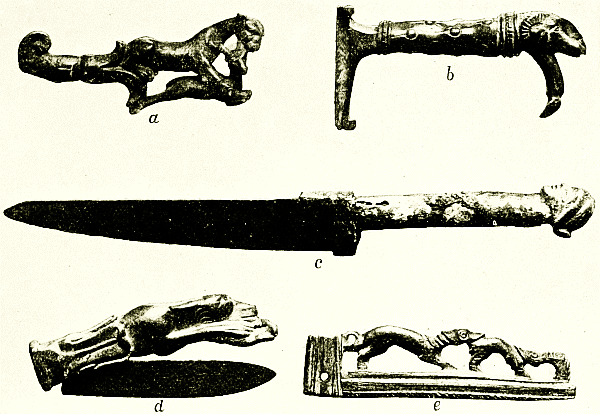
Fig. 183.—Roman Knives and Knife-Handles (No. 439). Ca. 1:2.
For two reliefs of a cutler's forge and a cutler's shop, see below, pages 156, 157.
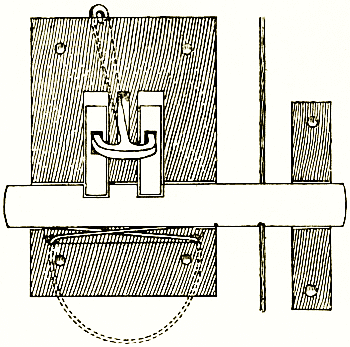
Fig. 184.—Homeric Lock(Restored).
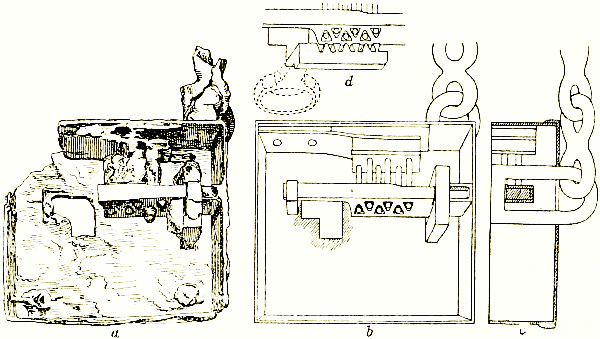
Fig. 185.—Roman Lock, with Restorations showing Original Mechanism and Use of Key (No. 441). 3:7.
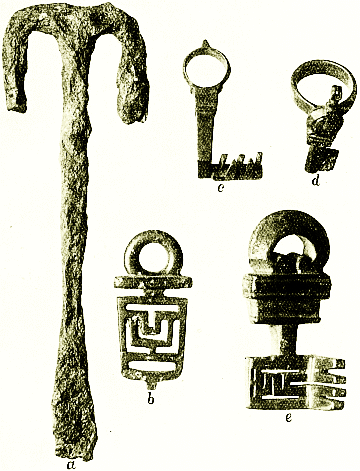
Fig. 186.—Roman Keys. 2:3.
The majority of Roman locks, though of a more complicated structure, are made on the same principle, as may be seen from the ancient lock No. 441 (probably from Pompeii) here exhibited, together with model lock of the same type (No. 442) and a diagram showing its original arrangement (fig. 185a-d). Here the bolt has been shot through the end link of a chain, part of which remains (fig. 185c). It is secured by pins, the ends of which fit into a series of perforations in the bolt and are kept down by a spring. The bolt was released by a key fitted with teeth corresponding to the perforations (fig. 185d). The key lifted the pins out of the holes and took their place. The bolt was then drawn aside, as the key was moved along the horizontal slot. On account of the double movement, first vertical and then horizontal, the keyhole is in the shape ┌. Several bolts, keys (e.g. No. 442; fig. 186c), and door plates for locks of this type are exhibited in this Case. Three keys from Syria are shown (No. 443) fitted into the wards of the actual bolts for which they were made. Notice the projections on the ring of key c, which were used for shooting a supplementary bolt, a common device in Roman locks.
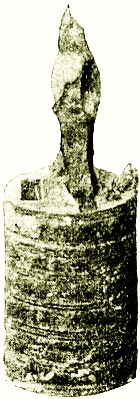
Fig. 187. Roman Padlock, with Key rusted in it (No. 445). Ca. 1:3.
The modern type of lock, in which the key works on a pivot and moves the bolt backwards and forwards by a rotatory movement, after passing through a series of wards, was also known to the Romans. This is proved by the existence of several Roman keys solely adapted to a lock of this character (e.g., No. 444; fig. 186d). Such keys are frequently found combined with finger-rings, a convenient method of lessening the danger of loss. We may conclude that this type of key was a favourite one for use with small padlocks.
Padlocks of Roman date are common. In this Case three of a barrel form are shown. One (No. 445; fig. 187) has the key still rusted in it. The padlock has traces of a chain attachment at one end, and was probably kept hanging to a doorpost, while the bolt was shot into the end link of a chain attached to the door. Two other Roman padlocks illustrated (fig. 188) are more ornamental in character. One (No. 446) is in the form of a circular box with hinged handle, the free end of which was fastened by pin-bolts within the box. There is also a secret catch underneath. The other padlock (No. 447) is furnished with a chain attached to one side of it. The last link of the free end was fastened inside the box, the lid of which was closed with a secret catch. The head on the cover is that of a Sphinx, a hint that the riddle of opening was not easy to solve. A hole in the floor of the box makes it probable that it was fastened to the object to be secured.
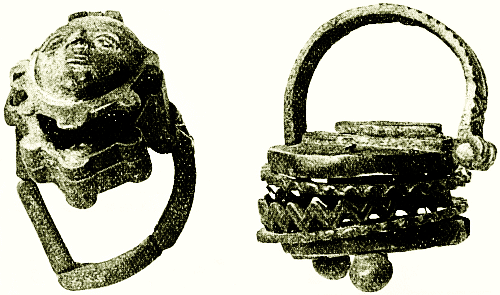
Fig. 188.—Roman Padlocks (Nos. 446, 447). 1:1.
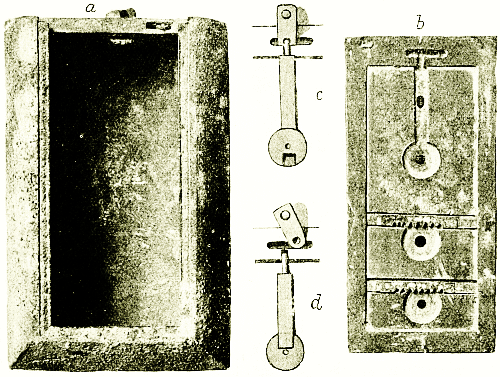
Fig. 189.—Bronze Strong-Box, with Cover seen on Inner Side. c and d explain the working of the Bolt (No. 450). 1:2.
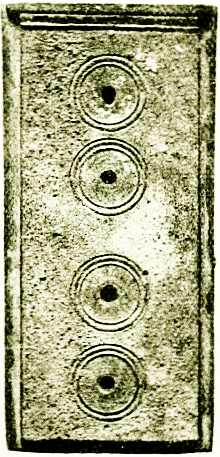
Fig. 190.—Cover of above Strong-Box (Outer Side). 1:2.
Other objects deserving mention are the keys for raising latches (No. 448; fig. 186b), and the combined ward and pin keys (No. 449; fig. 186e), and also the very interesting Graeco-Roman bronze strong-box from Tarentum (No. 450; fig. 189). The box (a) has a sliding lid (b), originally furnished on the inside with four separate fastenings. Two are horizontal bolts shot home by turning toothed discs from the outside; the third is the catch seen at the end, which was held fast in the slot by a pin-bolt (c). This bolt was moved by a disc on the outside of the cover, and was itself locked by the turning of another disc behind it; it could only be drawn back when the slot in that disc was brought into line with the bolt, as indicated in design d of the figure. The small catch on the right at the end of the box fell into position automatically when the cover was closed, and could only be unfastened by turning the box on its side. The outside of the lid shows four similar circles, over which were the revolving or sliding discs now lost (fig. 190).
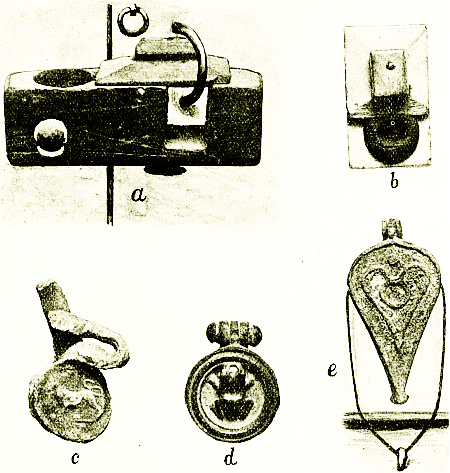
Fig. 191.—Seals and Seal-Locks (Nos. 452-4). 1:1.
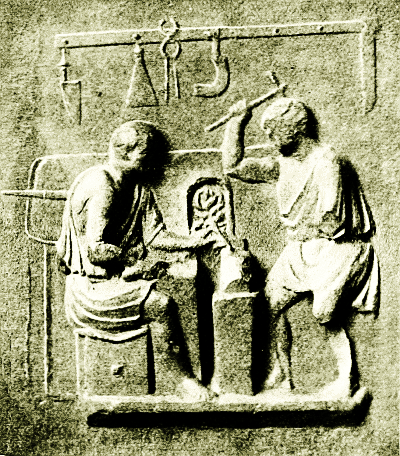
Fig. 192.—Roman Cutler's Forge (No. 457). Ht. 18¾ in.
Another form of seal was that consisting of two lead discs connected by a loop (No. 454). The discs were pressed together and stamped on the outer surfaces with a design (as in fig. 191c). In this way the loop was securely attached to the object to be protected. Probably these seals were attached to merchandise by manufacturers or customs officials, just in the same way as lead seals are used in our own time. Their use appears to have been confined almost, if not entirely, to Sicily.
A variety of labels in lead, bronze, and ivory is shown in this Case. They generally have a hole for attachment, and bear the name and initials of their owner. The bronze label (No. 455), to which a portion of the iron object to which it was attached still adheres, has the name of the owner, C. Junius Hermetus, inscribed upon it. A second label has the name of another member of the family, Decius Junius Hermetus (No. 456).
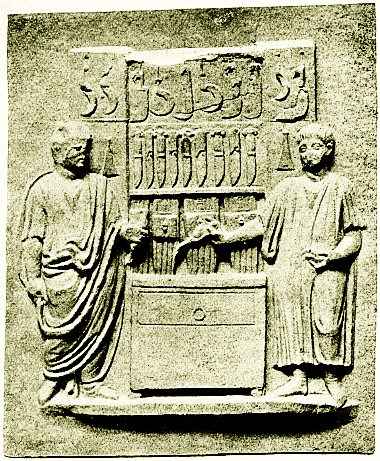
Fig. 193.—Roman Cutler's Shop (No. 458). Ht. 19½ in.
Seals were applied by the use of signet rings of gold, silver, or bronze with the impression of the seal cut in the metal or on a gem set in the bezel (see p. 136). The engraved ring was usually employed for purely personal purposes, such as the sealing of a letter or document, and the device of the seal was more or less ornamental. For the somewhat allied group of bronze tablets, used for marking objects, rather than securing them, see p. 192.
(441) On ancient locks, see Diels, Parmenides, p. 117 ff.; Fink, Der Verschluss bei den Griechen u. Römern; Daremberg and Saglio, s.v. Sera; (453) Cf. Num. Chron., 1897, p. 293 ff.; (454) Cf. Annali dell' Inst., 1864, p. 343 ff., and Mon. dell' Inst., VIII., pl. xi.
αὐτίκ' ἄρ' ἥ γ' ἱμάντα θοῶς ἀπέλυσε κορώνης,
ἐν δὲ κληῖδ' ἧκε, θυρέων δ' ἀνέκοπτεν ὀχῆας,
ἄντα τιτυσκομένη.