XXV.—MUSIC AND DANCING. (Wall-Cases 54-56.)
Reading edition
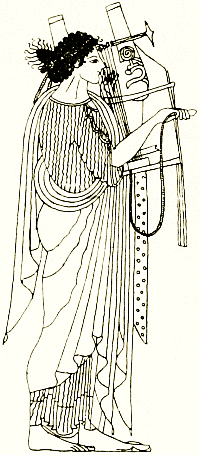
Fig. 252. Apollo playing on a Kithara.
Of the stringed instruments used among the Greeks, the lyre was the most prominent. There were two varieties of this, the kithara and the lyre proper. The kithara, an instrument with a large wooden sounding board and upright arms, was played chiefly by professional musicians, such as the kitharist represented on a fine vase in the Third Vase Room, who has won a victory at one of the great musical contests (E 460; Pedestal 7). The illustration (fig. 252), taken from an amphora of the fifth century (E 256, Case H, Third Vase Room), shows Apollo playing on the kithara, which is supported by a band passing round his left wrist, but leaving the fingers of the left hand free to play on the strings. In his right hand he holds the plectrum, which is attached by a cord to the instrument. The plectrum was of various forms, but its most essential part was the tooth for catching and sounding the wires. The lyre proper (fig. 253) is distinguished by its curving arms and sounding board of tortoiseshell (hence called chelys). The wooden framework and parts of the shell of a Greek lyre found in a tomb near Athens are shown in Case 56 (No. 642). As the popular instrument, the lyre was naturally taught in schools. Two interesting Greek vases (Nos. 643 and 644), exhibited in these Cases, give pictures of boys receiving music lessons at a school. In one instance a boy is learning the lyre, in another the boy is playing the flutes, while the master, who holds a plectrum, is playing on a lyre. Domestic animals are freely admitted, and the discipline seems far from severe.
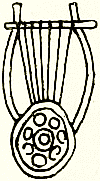
Fig. 253. Lyre.
A framed impression from a Greek hymn to Apollo inscribed on stone is here exhibited (No. 648). Musical notes, indicated by letters of the Greek alphabet in various positions, are placed at intervals over the letters to guide the singer. The inscription was found at Delphi, where other inscriptions of a similar character have come to light.
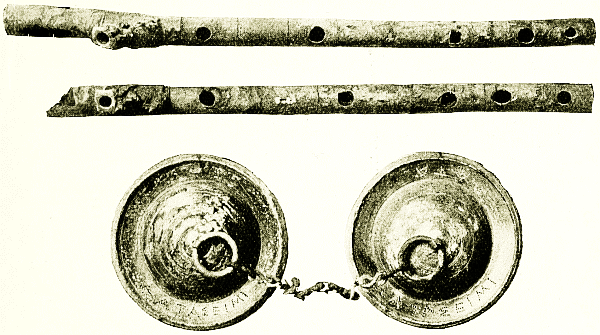
Fig. 254.—Bronze Flutes and Cymbals (Nos. 646, 654). 1:3.
The simplest of all ancient wind instruments is the rustic Pan's pipe (syrinx), usually formed of seven or eight hollow reeds fastened together with wax. The Greek Pan's pipe has the reeds of equal length, the different notes being produced by the different positions of the natural joints of the reed. An example may be seen among the Cypriote sculptures in the Gold Ornament Room passage. The Roman syrinx had its lower edge sloping, the result of cutting off the reeds immediately below the natural joints. A terracotta statuette in Case 55 (No. 652) represents a shepherd boy playing on a Pan's pipe of the Roman kind, and a marble relief from Ephesus at the top of Case 54 (No. 653) shows a beardless man seated with a large syrinx in his hands. The Greek inscription tells us that the relief was dedicated by Ebenos, a "first flute," to Hierokles his piper.
It was the Pan's pipe which gave Ktesibios of Alexandria (third century B.C.; cf. p. 120) the model on which he constructed his water-organ, an instrument which became popular with the Romans. A Roman "contorniate" shown in Case 58 has one of these water-organs represented upon it. The air was supplied by water pressure and the notes were played by means of a key-board.
Cymbals were largely used by the Greeks and Romans in religious ceremonies of an ecstatic character, such as the mysteries of Demeter and Kore and the worship of Kybele. Among the cymbals in Case 56 is an interesting pair (No. 654; fig. 254) inscribed in Greek with the name of Oata their owner (Ὠάτας εἰμί). They were originally joined together by a chain, part of which still remains. In the lower part of Cases 55-56 is a considerable variety of bells in bronze (No. 655).
(643) and (644) Cat. of Vases, III., E 171, 172; (645) For the structure of the ancient flute, cf. especially Baumeister, Denkmäler, s.v. Flöten; (648) Bull. de Corr. Hell., XVIII., pl. 21; (652) For the syrinx, cf. Tillyard in Journ. Hell. Stud., XXVII. (1907), p. 167 ff.; (653) Cat. of Sculpt., II., 1271.
See in general, Camb. Comp. to Gk. Stud., pp. 370-374; Daremberg and Saglio, s.v. Musica.
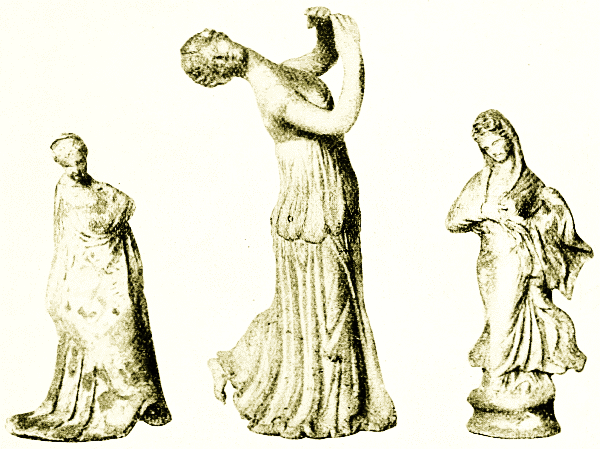
Fig. 255.—Greek Women Dancing. Ca. 2:7.
(656) Cat. of Vases, III., E 185; (657) Ibid., E 642: (658) Cat. of Terracottas, B 370. For Greek dancing in general, cf. Emmanuel, La danse grecque.
cantabat fanis, cantabat tibia ludis, cantabat maestis tibia funeribus.
si vox est, canta; si mollia bracchia, salta.