II.—COINS. (Table-Case K.)
Reading edition
The coins which are selected to represent the Greek and Roman currencies extend over a period of just one thousand years, in the course of which the coinage went through all the developments and anticipated all the varieties of type and fabric which it has since experienced, while in artistic merit it reached an excellence which will probably never be surpassed. The Greek coinage, moreover, has the great interest of being that upon which all later coinages have been modelled—for the Chinese money, which originated about the same time, and apparently independently, may be left out of account.
The example, once set, was quickly followed by the more important Greek cities, until by the middle of the sixth century the art of coinage had travelled from Ionia across the mainland of Greece to the colonies in Italy and Sicily. Owing to the peculiar political conditions of Greece, where every town held a separate and independent sovereignty, each state was jealous to assert its autonomy on its coins, with the result that the Greek coinage presents an enormous variety of types, held together, however, as the money of one people by the uniformity of their general character and of the art in which they are expressed.
We may now proceed to consider a few representative coins, which in the midst of innumerable local issues were important enough by their purity of weight and metal, or by their abundance, or by the commercial reputation of their issuing states, to predominate in the Greek world as a sort of international currency and standard of exchange.
The earliest electrum stater of Ionia is interesting on account of its fabric only, for it has no type. It is a bean-shaped lump of metal, one side of which has been stamped with a flat die marked with parallel scratches, the other with three punches, which have left deep impressions (No. 24; fig. 12a). The pieces which immediately followed, such as the silver money of Aegina (No. 25; fig. 12d), have a real type on the obverse, while the punch-mark on the reverse is more regular, and is often ornamented with some design of a special character, though it does not contain a type until later.
With the introduction of coinage into European Greece, a change was made in the metal of the currency, for gold and electrum, which were plentiful in Asia, were not common in Greece proper, and a silver coinage was there the rule until Philip of Macedon took possession of the Thracian gold mines. The few gold issues before his time were due to exceptional circumstances; thus the gold coinage of Athens (No. 26) was occasioned by great financial stress, when treasure was melted down to supply the currency. There was, however, no lack of gold money in Greece, for after the first electrum issues came the fine gold staters of Croesus, in the early sixth century (No. 27; fig. 12b), and, on his overthrow by Cyrus, an international gold coinage was still available in the enormous issues of the Persian darics (No. 28; fig. 12c), which were in common use all over the ancient world until the Macedonian gold replaced them. A few subsidiary electrum coinages survived in Asia, the most famous being the Kyzikene staters (No. 29; fig. 12m), which were a standard exchange in the Aegean and Black Sea regions. A peculiarity of this coinage is that the distinctive type of the town, the tunny, is relegated to a secondary place, while the main type is a constantly changing design. In the piece illustrated the subject is taken from a group of the Athenian tyrannicides, Harmodios and Aristogeiton, which stood in the market place of their native city.
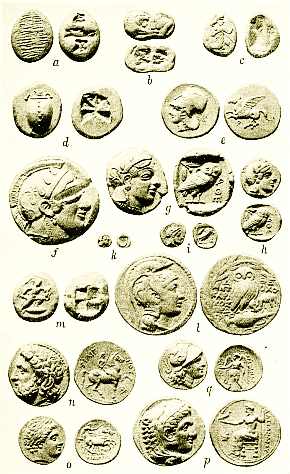
Fig. 12.—Greek Coins. 1:1.
Another important currency, used especially in western Greece, the "colts" of Corinth, took its type from the local myth that the winged horse Pegasos was captured by Bellerophon at the fountain Peirene, which flowed from the acropolis of the town (No. 30; fig. 12e). The original punch-mark on the reverse was soon replaced by the helmeted head of Athena, who also had a part in the Pegasos myth, and these two types were constant as long as the Corinthian state existed. The money which enjoyed the fairest reputation was that of Athens, which, at the time of the Athenian empire, superseded the issues of the subject cities and became the standard currency in the Aegean Sea. It penetrated into the far East, and there are extant examples of native imitations from India and Arabia. The wide circulation of these staters among barbarous peoples was the cause of their peculiar style; for not only were the types of Athena's head and her owl and olive-branch unaltered from the first sixth-century design, but the execution was an imitation of the primitive manner, the stiffness of archaic art being reproduced in an affected archaism. As the money of Athens was the foremost in the Greek world, it is useful to note the extraordinary number of denominations which were struck in silver at its most flourishing period, the fifth century B.C. A large, but still not complete, series is exhibited here (No. 31). It consists of the Decadrachm (10 drachmae, fig. 12f), an early and rare coin, the Tetradrachm (4 drachmae, fig. 12g), which was the famous Athenian stater or standard piece, the Didrachm (2 drachmae), the Drachm (fig. 12h), the unit of weight, which contained six obols, the Triobol (3 obols), the Diobol (2 obols), the Obol (fig. 12i), the Tritemorion (¾ obol), the Hemiobol (½ obol), the Trihemitetartemorion (⅜ obol), and the Tetartemorion (¼ obol, fig. 12k), the half of the last piece being equivalent to the largest bronze coin, the Chalkous (No. 32).
On the conquest of Athens by Macedon, at the end of the fourth century B.C., the autonomous Athenian coinage was largely superseded by the Macedonian regal issues, and did not recover its position until late in the next century. It was renewed in a different form, with none of the old archaism, of which the occasion was past. The coins of the new style exemplify the thin flat fabric of the period, and although the types of Athena and the owl are preserved, their arrangement is much more complicated. The new head of Athena is a copy from the colossal ivory and gold statue which Pheidias made, and on the reverse of the coins the owl and olive spray are accompanied by many new devices, of which the most remarkable are the names, symbols, and monograms of the monetary magistrates; eminent personages sometimes figure in this place. On the coins exhibited (No. 34; fig. 12l) one of the officials is Antiochos, who was afterwards Epiphanes, king of Syria.
In the interval between the old and new coinages, when the Athenian money was scanty, the currency was supplied by the regal issues of the Macedonian kings and their successors. Under Philip II. and his son Alexander the Great, the Macedonian monarchy extended its dominion by conquest, not only over the isolated Greek cities, but over the ancient empire of Persia. The opportunity was thus provided for a universal coinage, and it was realised in the gold and silver issues of Philip and Alexander (Nos. 35, 36; fig. 12n-q). The acquisition of the Thracian gold-mines gave Philip the means for an abundant coinage of gold, the first considerable Greek issue of the kind, which contributed in no small measure to his political success. The style of these coins of Philip is not different from that of other Greek money, except that they are inscribed with a personal name—of Philip—instead of the name of a whole people, and the types, a horse and jockey and a two-horse chariot, are also personal, as they commemorate the racing successes of the king. The fine heads on the obverse, however, are still divine, that of Zeus appearing on the silver and the young Apollo on the gold, for the idea of representing a living personage on a coin was still distant. Of this money the gold especially was struck in enormous quantities, and the types were imitated more and more crudely, as time went on, in Gaul and Britain. (See the series shown in the Room of Roman Britain.) The coinage of Alexander was even more widely spread. His types were more orthodox than those of Philip: the head of Athena and a Victory on the gold, and the head of young Herakles, wrapped in the lion-skin, with a figure of Zeus enthroned, on the silver staters, although in the head of Herakles there is some suggestion of the features of Alexander. These coins were struck all over the world which Alexander conquered, and lasted after his death as the money of his successors and of independent cities, in some cases even for two centuries; but the kings who divided his great empire modified the type by introducing real portraits of Alexander, as a deified hero, and later of themselves, as living deities, so that the representation of a ruler's head on coins, which is still practised to-day, began with quasi-religious Greek coin-types. The regularity of the Greek coinage which Alexander established was only temporary, and his influence was fast disappearing when the subjection of the world by the Romans in the first century B.C. merged all provincial issues in the complete uniformity of the Imperial mint.
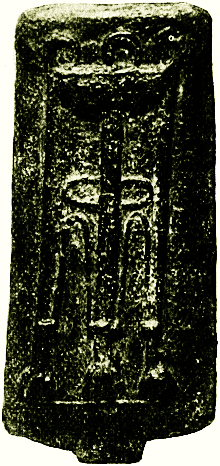
Fig. 13.—Aes Signatum (No. 37). 1:3.
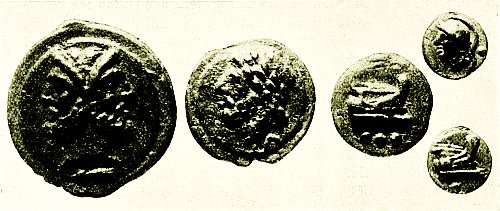
Fig. 14.—Aes Grave (No. 38). As, Semis, Quadrans, and Uncia. 1:2.
The heavy bronze coinage of the city of Rome was only one among many similar currencies of the central Italian states. As the Romans conquered the neighbouring territories, where there existed local weight-systems, which, in the interests of commerce, it was well to preserve, instead of imposing their own money, they inaugurated subordinate issues at the dependent mints. On this principle it was natural that when the march of Roman conquest came upon the peoples of South Italy, where a silver currency had been long ago introduced by the Greek colonists, a local issue for those parts was instituted as a subsidiary coinage. To this class of Roman money belongs the silver stater or didrachm with Campanian types (the head of Mars and the bust of a horse) which was struck by the Romans—as the legend ROMANO(rum) shews—in Capua for the use of the Campanian district (No. 39; fig. 15a). With the extension of power and territory the old bronze pieces were inadequate, and in the year 268 B.C. a silver coinage was begun at Rome itself. At the same time the Campanian mint was closed, and the heavy bronze coins, being subordinated to the silver unit, were issued as token-money in a reduced and more convenient size.
The first Roman silver coinage bears the types of the goddess Roma, wearing a winged helmet, and on the reverse the patron deities of trade and commerce, Castor and Pollux, the Heavenly Twins or Dioscuri (No. 40; fig. 15b-d). They are armed with spears and ride on horseback, with their stars above their heads. These types occur on all three denominations of the earliest silver, the Denarius (marked X), which was worth 10 asses; its half, the Quinarius (V); and the Sestertius (IIS) of 2½ asses, which became the unit in reckoning accounts. The two smallest silver pieces were not always struck; but the denarius, with the reduced copper for small denominations, remained in use during the period of the Republic at Rome and long into the Empire. Although both series had a great variety of types, the fabric and general appearance were unaltered.
With the change to the Empire, reform in all directions was begun, and the coinage was set on a new basis. Gold was introduced to meet the needs of the metropolis of the world, and two new coins, the Aureus and its half, were struck in this metal. They were modelled on the silver pieces. The standard silver coin was still the denarius, and the only change which it experienced was in type. The head of the emperor took the place of those of deities, with a superscription, which was the forerunner of modern coin-legends. It consisted of the name and titles of the emperor, often with the date of striking, arranged in a circle round the edge of the coin. The minting of gold and silver was assumed by the emperor, but the lower denominations were left to the senate, whose authority is expressed on each piece by the letters S·C (Senatus Consulto, "by decree of the Senate"). The senatorial series consisted of the Sestertius, the equivalent of the smallest silver coin, now valued at 4 asses instead of the original 2½; the Dupondius, of 2 asses; the As, and fractions of the as, Semis and Quadrans, which are of less frequent occurrence. These coins sometimes differed as to the metal used, the as and semis being of copper, and the dupondius and sestertius of brass; or in the style of the emperor's head; or, as in the case of the coins exhibited, the as is marked I and the dupondius II (fig. 15h and i). Usually, however, the two pieces are confused, and are loosely termed by collectors "second brass," the sesterce being "first brass," and all denominations lower than the as "third brass." The reverse types were very numerous, and, with the exception of the mark S·C on the senatorial issues, none of them was peculiar to any denomination. The series which is selected here to illustrate the Imperial coinage is of the reign of Nero (54-68 A.D.); all the pieces, therefore, bear the image and superscription of that Caesar, and their reverses have complimentary references to the emperor and his family, or topical allusions to current events (No. 41; fig. 15e-l).
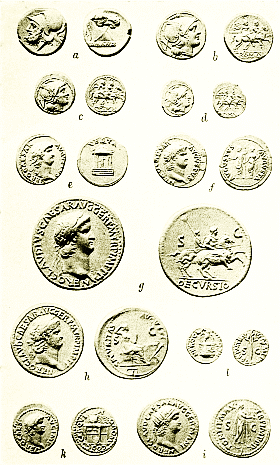
Fig. 15.—Roman Coins. 1:1.
Nero was the first emperor to reduce the weight of the denarius, and from his time the degeneration was rapid. A series of seven pieces, from Tiberius to Probus (14-281 A.D.), illustrates the debasement of the metal, which is apparent to the eye (No. 42). By the time of Gordianus Pius (238-244 A.D.) no trace of silver is visible, and the coin of Probus here exhibited is plainly copper. Yet these pieces represent the only silver money which was then coined.
Many of the coins which have come down to us have been preserved by the care or avarice of their former owners, who hid their wealth for security and were unable to recover it. Portions of two such hoards are shown at the end of the case. One consists of Athenian staters of the late fifth century B.C. (No. 43), which were found in the Greek settlement of Naukratis, and the other is a large collection of late Roman coins of the fifth century A.D. (No. 44). These were buried in another Egyptian town, Hawara, in the egg-shaped jug which is shown with them. At Pompeii, a city which was overwhelmed by the volcano in the midst of its daily life, money, like all other things, has been found ready to hand and actually in use. There is in this Case all that the fire has left of a Pompeian money-box, and among the coins which it contains is a brass sesterce of Nero, whose reign ended eleven years before the catastrophe. Shreds of a net purse are also visible in the box (No. 45).
Special uses of Coins.—A silver stater of Sikyon (No. 46), is marked by an inscription punctured by the dedicator—To Artemis in Lakedaemon. A religious character attaches also to the bronze coin of Laodikeia in Phrygia, which is pierced and suspended from a wire loop for wearing as a charm against sickness, by virtue of the figures which it bears of Asklepios and Hygieia, the deities of health (No. 47).
A curious coin, struck for a special religious purpose, is the copper piece of Nemausus (Nîmes, in the South of France), which is made in the shape of a ham for dedication to the deity of the local fountain (No. 48). The offering was probably originally paid in kind.
Ancient false Coins.—With the exception of the Italian heavy copper, which was cast, nearly all ancient coins were struck in dies, and most of the false pieces which have survived are defective in the quality of the metal, while the fabric is good. In the later Roman Empire, when all the standard money was of base metal, the surface was so bad that the coins could easily be counterfeited by casting, and great numbers of the clay moulds used by forgers or by the monetary authorities date from this period. Among the large collection here exhibited (No. 49) there are some unbroken moulds, and some with the run metal still adhering. Base metal was detected by the use of the touch-stone, and pieces of doubtful weight were tested by the balance. An ivory folding balance is shown (No. 49*). The long arm is made just too light to counterpoise a good denarius—the test being that if the coin were heavy enough it would fall off the plate at the end.
For Greek and Roman coins in general, see Hill, Handbook of Greek and Roman Coins (with the Bibliography there given); G. Macdonald, Coin Types (Glasgow, 1905); Head, Historia Numorum (2nd ed. 1911.)
i. 94.