Volume 2 — CHAPTER IX. (continued 2)
Reading edition
* Major Kelley continued cutting away a portion of the bridge while the balls of the enemy were menacing his life. He was cutting away a log on which some of the timbers rested, when it gave way sooner than was expected, and he was precipitated into the stream. His men, supposing him to be lost, fled to Princeton. He got out of the water; but his frozen clothes and exhaustion so retarded his progress, that he was made a prisoner by the enemy.
** This cannon is now in the center of the Campus, in the rear of the College of New Jersey, at Princeton. It was one of the pieces which Washington was unable to carry away with him.
*** This substantial stone bridge, over Stony Brook, is upon the site of the wooden one destroyed on the 3d of January, 1777. The old mill on the left is now owned by Josiah S. Worth, a son of the proprietor during the Revolution. This sketch was made from the road on the bank of the stream, along which Mercer and his detachment marched to secure the bridge.
Disappointment of the Enemy.—The Loss sustained.—Washington's Pursuit.—Fatigue of the Americans.
battery cautiously, intending to take it by storm. These movements delayed them an hour, and when they arrived at the breast-work and the village, great was their astonishment and chagrin to find both deserted, and not a rebel in sight! Washington, with his little army and prisoners, was far on his way toward the Millstone Enver, in hot pursuit of the fortieth and fifty-fifth regiments.
The battle at Princeton and its results, following closely upon the brilliant affair at Trenton, produced a strong impression upon the public mind favorable to the commander-in-chief and the patriot cause.

Considering the numbers engaged, it was one of the severest conflicts of the war, and in no engagement did the skill and bravery of both parties appear more conspicuously. The enemy lost about one hundred in killed, and three hundred in wounded and prisoners. The loss of the Americans was about one hundred, including several valuable officers. Never was a general more exposed to death than was Washington, when leading the troops to the support of Mercer's riflemen; yet he escaped without a wound. *
Washington pursued the fugitive regiments as far as Kingston, beyond the Millstone River, three miles northeast of Princeton. There he held a council of war with his officers, on horseback. The rich prize at New Brunswick was very tempting, and a wish was generally expressed to continue the march thither and secure the British stores. Such a step would have been fatal; for Cornwallis, with fresh troops, and superior in numbers, was in close pursuit; while the Americans, who had fought at Trenton on the 2d, marched all night before the battle of Princeton on the 3d, and had not slept for thirty-six hours, were completely exhausted. More than half of them had not been able to procure breakfast or dinner; many were destitute of shoes or stockings, and in every way were utterly unable to contend with an enemy. To save his army, Washington filed off on the left, at Kingston, along a narrow road running to Rocky Hill. He destroyed the bridge at Kingston, which checked the progress of Cornwallis for some time, and, after having crossed the Millstone twice, he reached Pluckemin that evening. On the way, overcome by fatigue, many soldiers laid down and slept on the frozen ground. Washington remained no longer at Pluckemin than to give his troops rest and refreshments, and then advanced to Morristown, where he established his winter quarters. His subsequent movements, by which New Jersey was soon purged of the enemy, are mentioned on page 307, vol. i.
Cornwallis repaired, and then crossed the bridge at Kingston, and, believing Washington to be on the road to New Brunswick, pushed eagerly forward—so eagerly, over the rough
* Mr. Custis, in his Recollections of the Life and Character of Washington, gives a graphic picture of the scene when the commander-in-chief brought the militia and riflemen into action. "The discomfited Americans rally on the instant, and form into line. The enemy halt, and dress their line. The American chief is between the adverse posts, as though he had been placed there a target for both. The arms of both are leveled. Can escape from death he possible? Fitzgerald (Washington's aid), horror-struck at the death of his beloved commander, dropped the reins upon his horse's neck, and drew his hat over his face, that he might not see him die. A roar of musketry succeeds, and then a shout. It was the shout of victory. The aid-de-camp ventures to raise his eyes. Oh, glorious sight! the enemy are broken and flying; while dimly, amid the glimpses of the smoke, is seen the chief alive, unharmed, and without a wound, waving his hat, and cheering his comrades to the pursuit. Colonel Fitzgerald, celebrated as one of the finest horsemen in the American army, now dashed his rowels in his charger's flanks, and, heedless of the dead and dying in his way, flew to the side of the chief, exclaiming, 'Thank God! your excellency is safe!' while the favorite aid, a gallant and warm-hearted son of Erin, a man of thews and sinews (and albeit unused to the melting mood), gave loose to his feelings, and wept like a child, for joy. Washington, ever calm amid scenes of the greatest excitement, affectionately grasped the hand of his aid and friend, and then ordered, 'Away, my dear colonel, and bring up the troops; the day is our own!'"
Capture of British Baggage-wagons.—Evacuation of New Jersey by the British.—Estimate of Washington's Character in Europe.
and frozen roads, that several of his baggage-wagons were broken down. Leaving them in charge of a detachment of between two and three hundred men, * he pressed onward, and reached New Brunswick at sunset. Again the Americans had eluded his pursuit; yet he rejoiced in the safety of his stores.
The armed parties frequently sent out by Washington from his hill-quarters were generally successful, and the people, incensed at the bad faith of the English and the depredations of the Hessians, joined the Americans in all their expeditions. The British quarters were straitened, their supplies were cut off', and in a short time New Jersey was evacuated by the enemy. Alluding to these results, the eloquent Charles Botta observes, "Achievements so stirring gained for the American commander a very great reputation, and were regarded with wonder by all nations, as well as by the Americans. The prudence, constancy, and noble intrepidity of Washington was admired and applauded by all. By unanimous consent he was declared to be the savior of his country; all proclaimed him equal to the most renowned commanders of antiquity, and especially distinguished him by the name of the American Fabius. His name was in the mouths of all; he was celebrated by the pens of the most distinguished writers. The most illustrious personages of Europe lavished upon him their praises and their congratulations. ** The American general, therefore, wanted neither a cause full of grandeur to defend, nor occasion for the acquisition of glory, nor genius to avail himself of it, nor the renown due to his triumphs, nor an entire generation of men perfectly well disposed to render him homage."
Washington exercised the dictatorial powers which Congress had conferred upon him with energy and great circumspection, and with a single eye to the good of his country. His recommendations were promptly seconded by Congress, and soon great vitality was visible every where. He took care to provide for meritorious officers in his appointments, when organizing the sixteen battalions authorized by Congress. At that time public clamor was strong against Dr. Morgan, * the successor of the traitor, Church, as head of the medical de-
* A small company of fifteen or twenty militia, having learned the situation of this baggage, resolved to capture it. After dark, they arranged themselves among the trees, in a semicircular form, around the place where the soldiers were guarding their wagons, and, on a concerted signal, they set up a tremendous shout, and commenced firing. The British, believing the assailants to be as strong in numbers as themselves, and taken completely by surprise, retreated with a few of the wagons that were fit for traveling, and fled to New Brunswick. Those left behind were taken to the American camp, and found to contain, what the army greatly needed, woolen clothes.
** It is said that Frederic the Great of Prussia declared that the achievements of Washington and his little band of compatriots, between the 25th of December and the 4th of January, were the most brilliant of any recorded in the annals of military achievements.
*** Morgan afterward procured an inquiry into his conduct by a committee of Congress, and was honorably acquitted. Doctor John Morgan was born in Philadelphia in 1735. He completed his medical studies under Dr. Redman, and entered the army as surgeon and lieutenant during the French and Indian war He went to Europe, to prosecute his studies, in 1760, where he attended the lectures of the celebrated Hunter. He was admitted to the degree of Doctor of Medicine in 1764. He returned to Philadelphia in 1765, and was elected professor of the theory and practice of medicine in the medical school founded by Dr. Shippen and others. He was ever active in literary and scientific projects. He, was appointed by Congress director general and physieian-in-chief to the general hospital in 1775, in place of Dr. Church, and immediately repaired to head-quarters at Cambridge. He was removed from office, without just cause, in 1777. * He died October 15, 1789, aged about fifty-four years. Dr. Benjamin Rush was his successor in the professor's ehair..
* The following are the names of the principal officers in the medical department, appointed on the 11th of April, 1777: William Shippen, Jun., director general; Waller Junes, physician general of the hospital in the middle department; Benjamin Rush, surgeon general of the hospital in the middle department; John Cochran, physician and surgeon general of the army in the middle department; Isaac Forster, deputy director general of the hospital in the eastern department; Amini Uuhannah Cutter, physician general of the hospital in the eastern department; Philip Turner, surgeon general of the same; William Burnet, physician and surgeon general of the army in the eastern department; Jonathan Potts, deputy director general of the hospital in the northern department; Malachi Treat, physieian general of the same; Dr. Forque, surgeon general of the same; John Bartlett, physician and surgeon general of the army in the northern department.
Appointment of general Officers for the Continental Army.—Its Reorganization.—Visit to the Princeton Battle-ground.
partment, and he was dismissed by Congress, and Dr. Shippen, * of Philadelphia, January 9, 1777 was appointed in his place, with Dr. Craik ** as his assistant.
On the 19th of February, Stirling, St. Clair, Lincoln, Mifflin, and Stephen were commissioned as major generals; while Arnold, on account of his conduct at Montreal, where he obeyed the injunction "put money in thy purse," at the expense of honor and honesty, was overlooked. This soured him, and doubtless planted the first noxious seed of treason in his heart. During the spring, eighteen new brigadiers *** were commissioned. Four regiments of horse were enlisted, under Colonels Bland, Baylor, Sheldon, and Moylan. Cadwallader and Reed were both, in turn, offered the general command of the horse, but declined. Timothy Pickering was appointed adjutant general in the place of Joseph Reed, who had resigned. Mifflin remained at the head of the quarter-master's department, which was regulated, and more thoroughly organized by the appointment of subalterns.
Congress attempted to reorganize the commissary department, and claimed the right to make subordinate appointments. So much did this new arrangement interfere with the efficiency of the department, that Joseph Trumbull, Jun., commissary general, resigned. The meddling of Congress with the smaller appointments and the minute affairs of chief officers in the various departments of the army, was very mischievous in effect; for the personal friends of members of that body, often incompetent, were appointed to places requiring talent, energy, and honesty. On the whole, however, the army was upon a better footing in the spring of 1777 than it had ever been.
I visited Princeton and the battle-grounds subsequently to my tarry at Trenton when on my way south. It was a very cold evening in December when I arrived there December 12, 1849from Philadelphia, the snow about ten inches deep upon the ground. Early the next morning, in company with Colonel Cumming of Princeton, who kindly offered to accompany me, I rode first to the battle-ground and Clark's house, where General Mercer died, and made the sketch on page 236. The air was very keen, and the snow half-kneedeep, circumstances which were quite unfavorable to deliberate sketching in the open fields. I persevered, however, and was successful in delineating such objects as I desired. From Clark's house we crossed the fields to the Quaker meeting-house, and then rode to the bridge at Worth's Mills, where I made the sketch on page 238. Returning to Princeton on the old Trenton road, we met Mr. Worth, an aged man, and present proprietor of
* William Shippen was a graduate of the College of New Jersey, at Princeton, in the class of 1754. He completed his medical education at Edinburgh. He delivered the first lectures on anatomy ever pronounced in America, at Philadelphia, in 1764; and on the finishing of the medical school in that city, he was appointed its first professor of anatomy, in 1765. He first addressed ten students; * he lived to address two hundred and fifty at one time. He was appointed director general of the medical department on the 11th of April, 1777. He resigned his professorship in the medical college, in 1806, into the hands of his colleague, Dr. Wistar. Dr. Shippen died at Germantown, July the 11th, 1808, aged seventy-four years.
* James Craik was a native of Scotland. He accompanied Washington in the expedition against the French and Indians in 1754; and in 1755 was with Braddock, and assisted in dressing his wounds. He was director general of the hospital at the, siege of Yorktown, in 1781. After the war, Washington invited him to settle near Mount Vernon, and he was the physician of the patriot chief until his death. He died in Fairfax county, Virginia, February 6, 1814, aged eighty-three years.
* These were Poor, of New Hampshire; Glover, Paterson, and Learned, of Massachusetts; Varnum, of Rhode Island; Jedediah Huntington, of Connecticut; George Clinton, ol New York; Wayne, De Hass, Cadwallader, Hand, and Reed, of Pennsylvania; Weeden, Muhlenburg, Woodford, and Scott, of Virginia; Nash, of North Carolina; and Conway, an Irishman by birth, but a Frenchman by education.
* Dr. Shippen experienced a great deal of persecution when he first commenced his lectures on anatomy, a good deal of feeling against him having been excited by the utterance of horrid tales respecting his dissections. The public mind was filled with ideas such as made the burden of the Ghost's Complaint:
"The body-snatchers! they have come Don't go to weep upon my grave, And made a snatch at me; And think that there I be; It's very hard them kind of men They haven't left an atom there Won't let a body be! Of my anatomy!"
Morven, Stockton's Estate.—Desolated by the British.—Sufferings and Death of the Owner.—Annis Stockton.
the mill, who gave me a narrative of events there, substantially as related. We stopped at Morven, in the suburbs of Princeton. This is the homestead estate of Commodore Stockton, and the residence, during the Revolution, of his paternal grandfather, Richard Stockton, one of the signers of the Declaration of Independence.
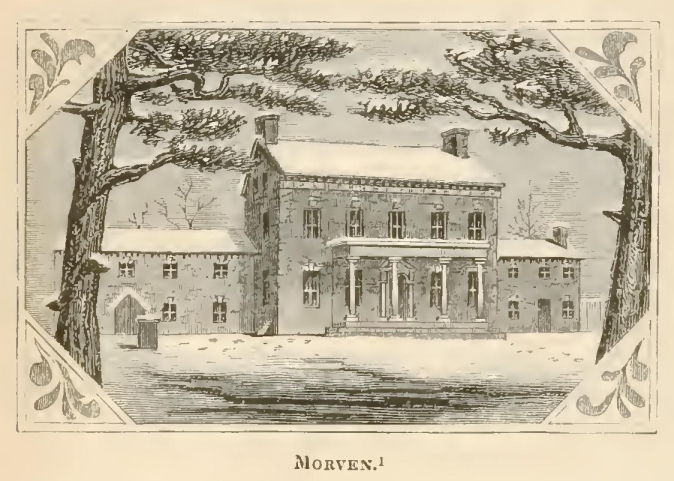
There, affluence and taste lent its power in dispensing its blessings to the poor, and in creating the joys of social intercourse, before the Revolution; there, suffering and woe held terrible rule after Cornwallis and his army swept over the plains of New Jersey. Like others of the signers of the great Declaration, Mr. Stockton was marked for peculiar vengeance by the enemy. So suddenly did the flying Americans pass by in the autumn of 1776, and so soon were the Hessian vultures and their British companions on the trail, that he had barely time to remove his family to a place of safety before his beautiful mansion was filled with rude soldiery. The house was pillaged; the horses and stock were driven away; the furniture was converted into fuel; the choice old wines in the cellar were drank; the valuable library and all the papers of Mr. Stockton were committed to the flames, and the estate was laid waste. The plate had been hastily buried in the woods, in boxes. A treacherous servant revealed their place of concealment, and two of the boxes were disinterred and rifled of their contents; the other was saved. ** Mr. Stockton and his family took refuge with a friend in Monmouth county. His place of concealment was discovered by a party of refugee Loyalists, who entered the house at night, dragged him from his bed, and, treating him with every indignity which malice could invent, hurried him to Amboy, and from thence to New York, where he was confined in the loathsome provost jail. There he suffered dreadfully; and when, through the interposition of Congress, he was released, his constitution was hopelessly shattered, and he did not live to see the independence of his country achieved. He died at Morven, in Princeton, in February, 1781, blessed to the last with the tender and affectionate attentions of his Annis, whom he called "the best of women." *** Night and day she was at his bed-side, and when his spirit was about to depart, she wrote, impromptu, several verses, of which the following is indicative of her feelings:
"Oh, could I take the fate to him assign'd,
And leave the helpless family their head,
How pleased, how peaceful to my lot resign'd.
I'd quit the nurse's station for the bed!"
Morven is a beautiful spot, and, hallowed by such associations, it is exceedingly attractive to the resident and stranger.
* This sketeh is from the lawn in front, which is shaded by venerable pines and other ornamental trees. The mansion stands upon level grounds, beautifully laid out, having carriage entrances from the street. Every thing was covered with snow when I was there, and dreariness prevailed where summer charms delight the visitor.
** Mrs. Ellett, in an interesting biography of Annis Stockton, the wife of the signor, says that Mrs. Field, her daughter, now residing in Princeton, has several pieces of silver that were in this box. She also relates that when Mrs. Stockton (who was quite a literary lady) heard of the destruction of the library, she remarked that there were two books in it she would like to have saved—the Bible, and Young's Night Thoughts. Tradition says that these two books were the only ones left. Mrs. Field has in her possession the original portraits of her father and mother. Both were pierced with bayonets.—Women of the Revolution, iii., 16.
*** A biographical sketeh of Mr. Stockton may be found among those of the signers of the Declaration of Independence, printed in the Appendix. His portrait is in the frontispiece of this volume.
Nassau Hall.—Governor Belcher's Donation.—Rittenhouse's Planetarium.—Life of its Inventor.
Nassau Hall, the principal edifice of the College of New Jersey, is a spacious building, one hundred and seventy-six feet long, fifty wide, and four stories high, built of stone. It was erected in 1757. The college was commenced by Jonathan Dickinson, in Elizabethtown, and was first incorporated in 1756. Governor Belcher was one of its earliest and most efficient patrons. He made "generous donation of his library of books, * with other valuable ornaments," to the college; and, upon his recommendation, Nassau Hall was so called in memory "of the glorious King William the Third, who was a branch of the illustrious house of Nassau." The Hall stands in the center of spacious grounds, fronting on the principal street in Princeton. The edifice on the left of Nassau Hall, containing the college library and the philosophic hall, was erected after a conflagration in 1802. The library contains about eight thousand volumes, and the libraries of two societies of the institution about four thousand more, making twelve thousand volumes. There is also a mineralogical cabinet, a museum of natural history, and a fine collection of drawings made for the purpose of elucidating lectures on astronomy and architecture. There is also a good collection of philosophical apparatus there, which includes that wonderful piece of scientific mechanism, the planetarium of Doctor David Rittenhouse. ** Through the politeness of Professor MacLean, I was permitted to examine its construction, and view the wonderful precision with which the machinery performed its difficult functions. On the front is inscribed,
"INVENTED BY DAVID RITTENHOUSE, A.D. 1768; REPAIRED AND EXTENDED BY HENRY VOIGHT, 1806; BOTH OF PHILADELPHIA."
Dr. Gordon, writing in 1790, says of this planetarium, "There is not the like in Europe. An elegant and neatly-ornamented frame rises perpendicular near upon eight feet, in the front of which you are presented, in three several apartments, with a view of the celestial system, the motions of the planets around the sun, and the satellites about the planets. The wheels, &c., that produce the movement are behind the wooden perpendicular frame in which the orrery is fixed. By suitable contrivances, you in a short time tell the eclipses of the sun and moon for ages past and ages to come; the like in other cases of astronomy." It is said that it was Lord Cornwallis's intention to carry this planetarium away, and take it to England with him; but the Americans kept him too busily engaged in affairs of greater personal moment, while in Princeton, to permit him to plunder the college of this great treasure. This intention on the part of an enemy was not as reprehensible as the proposition which Silas Deane, the American commissioner, made, who suggested the propriety of presenting it to the French government as a bonus for its good will!
I have mentioned that the first cannon-ball which entered Nassau Hall, when Washington opened a fire upon it, passed through the portrait of George the Second, and destroyed it. The frame was uninjured, and left suspended upon the wall. It is alleged that Wash-
* It consisted of four hundred and seventy-four volumes, many of them very rare and of great value. The Hall being used alternately by the American and British troops during the war, a large portion of the books were purloined or destroyed. The few that remained were destroyed by fire in 1802, when the Hall was burned, leaving nothing but the strong walls, which were not materially injured by the fire.
* David Rittenhouse was born near Germantown, Pennsylvania, on the 8th of April, 1732. His ancestors were from Holland. His early life was spent in agricultural pursuits, and was marked by a love of mathematical studies. Feeble health would not allow him to pursue the labor of a farm, and he became, by self-instruction, a proficient clock and mathematical instrument maker. It was while working at his trade he planned and executed his orrery, a piece of mechanism far superior, for its intended purposes, to any thing before constructed. It was purchased by the College of New Jersey. Another was made by him, after the same model, for the College of Philadelphia. He pursued his trade in that city for several years. His first philosophical publication was an account of his calculations of the transit of Venus, as it was to happen on the 3d of June, 1769. He observed the phenomenon, a spectacle never seen but twice before by an inhabitant of earth, and he was so much affected by its proof of the accuracy of his calculations, that he fainted. He was engaged in government surveys, fixing territorial boundaries, &c., during the Revolution, and became one of the leading practical philosophers of the day. On the death of Franklin in 1791, he was chosen president of the Philosophical Society, which office he held by annual election until his death. He was treasurer of Pennsylvania from 1777 to 1789. In 1792 he was appointed director of the Mint of the United States, but his ill health compelled him to resign the office in 1795. He died on the 26th of June, 1796, aged sixty-four years. His birth-place is yet standing, a mile west of Germantown.
Portraits of Washington and Mercer by Peale.—Character of the College of New Jersey.—White Hall.
ington, in order to make good to the college the damage sustained by the cannonade, made the trustees a present, from his private purse, of two hundred and fifty dollars, which sum they, expended in procuring a full-length portrait of the eommander-in-chief.
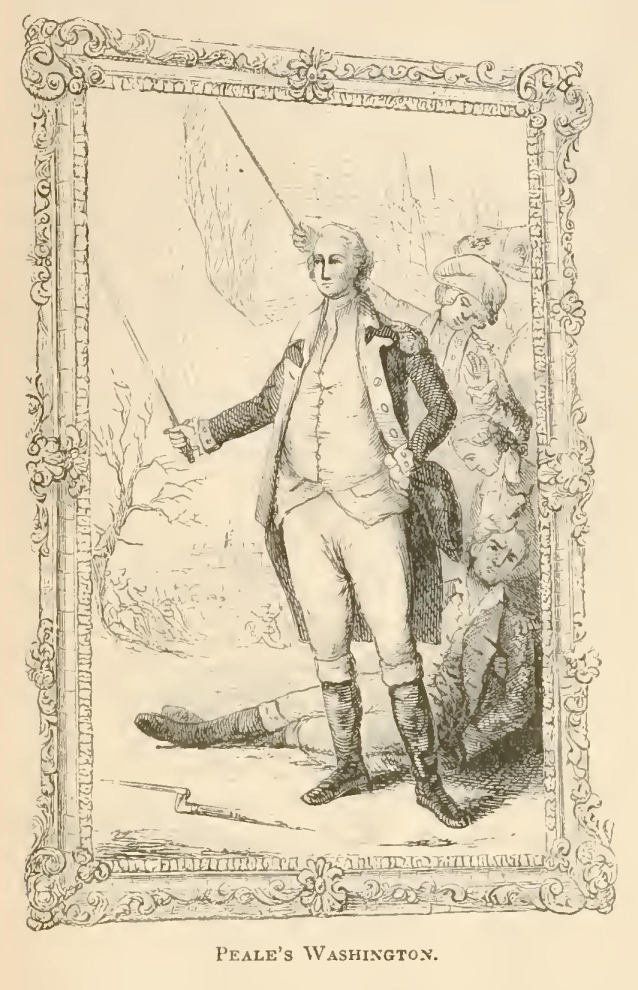
It was painted by Charles Wilson Peale, and occupies the identical frame in which hung the king's portrait. The annexed sketch is an outline of this interesting picture. In the back-ground is seen Nassau Hall, and in the middle and fore-ground a sketch of the battle of Princeton, in which the death of Mercer is represented.
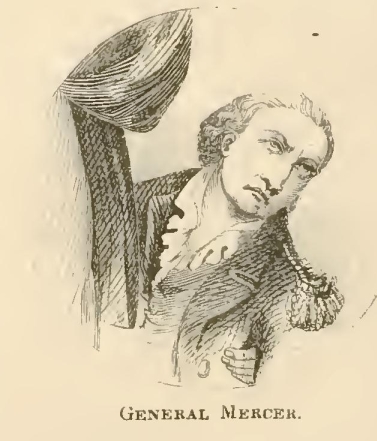
The portrait of Mercer there given was painted from his brother, who sat for it, and who greatly resembled him. It was considered a good likeness by those who knew the general. The portrait given below I copied from Peale's picture, in which I have preserved the languid expression of a wounded man, as given him by the artist. On the left is seen a portion of the skirt of Washington's coat, and his chapeau. Many pleasing memories crowd upon the mind of the visitor to this aneient seat of learning, where so large a number of the active young men of the Revolution who lived in the Middle States were educated.
Under the guidance of the learned and patriotic Dr. Witherspoon, who in the pulpit, academic hall, or legislative forum, was the champion of good, it was the nursery of patriots. He was a lineal descendant of John Knox, the great English reformer, and, like that bold ancestor, he never shrunk from the post of danger, if called to it by duty. Like Yale under Daggett, and Harvard under Langdon, the College of New Jersey, under Witherspoon, made its influence felt in the council and the field during the war for independence.
Of the meetings of Congress at Princeton in 1783, and the Farewell Address of General Washington to the armies November 2, 1783 of the United States, written at Rocky Hill, a a few miles distant, I shall hereafter write. Let us now return to Trenton.
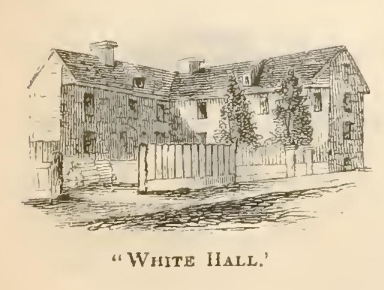
As I hoped and anticipated, the storm that came down so furiously, on my return from M'Conkey's Ferry, subsided during the night, and the morning sun came forth, only half hidden by broken clouds. Accompanied by Mr. Smythe, my companion on the previous day when I visited the ferry, I went out early to view and sketch localities of interest about Trenton, all of which are given in preceding pages, except "White Hall," a large stone building, standing on the south side of Front Street. This was used for barracks by the Hessians during their occupancy of Trenton in 1776.
The Floral Arch in Honor of Washington.—His Triumphal Journey.—His Reception by the Ladies at Trenton.
I called upon Stacey G. Potts, Esq., who kindly permitted me to copy a picture in his possession, painted by G. W. Flagg, and illustrating the interesting scene of the capture of Emily Gieger, an incident of one of Greene's Southern campaigns. The picture and narrative will be found in another part of this work. Mr. Potts informed me that the floral arch erected in honor of Washington, while on his way from Mount Vernon to New York city to take the oath of office as President of the United States, was erected upon the bridge over the Assanpink, close by the "Stacey Mill," seen in the picture on page 233. The arch was preserved on the premises of the Misses Barnes, near the Episcopal church in Warren Street, until 1824, when it was placed in front of the State House to grace the reception of La Fayette. Remains of the arch, when I visited Trenton, were in the possession of Dr. Francis Ewing of that city, and supported the branches of a venerable rose-bush in his garden. With a notice of the events connected with that arch we will close the historic volume and bid adieu to Trenton.
The journey of Washington from Mount Vernon to New York was like a triumphal march. He had hardly left his porter's lodge, when he was met by a company of gentlemen from Alexandria, who escorted him to that town. Every where the people gathered to see him as he passed along the road, and every town sent out its first citizens to meet him on his approach. Entertainments were given in his honor, and public addresses were received by him and answers returned. Militia companies escorted him from place to place, and his approach to the principal cities was announced by the firing of cannon and the ringing of bells. At Trenton, his reception was of a peculiar nature, full of pure sentiment and the most loyal patriotism. There, a little more than twelve years before, one of his most brilliant military feats was achieved, and it was a fitting place for an unusual display of respect and reverence. The ladies took the matter in hand, and upon Trenton Bridge they caused to be erected an areh, which they adorned with laurel leaves and flowers from the forests and their hot-houses, and the first spring contributions from their gardens. Upon the crown of the arch, in large letters, formed of leaves and flowers, were the words "December 26th, 1776 and on the sweep beneath was the sentence, also formed of flowers, "The Defender of the Mothers will be the Protector of the Daughters." Beneath this arch the president elect was obliged to pass on entering Trenton. There he was met by a troop of females. On one side a row of little girls, dressed in white, and each bearing a basket of flowers, were arranged; on the other side stood a row of young ladies similarly arrayed, and behind them were the married ladies. The moment Washington and his suite approached the arch, the little girls began to strew flowers in the road, and the whole company of the fair sang the following ode, written for the occasion by Governor Howell: *
"Welcome, mighty chief, once more
Welcome to this grateful shore.
Now no mercenary foe
Aims again the fatal blow—
Aims at thee the fatal blow
"Virgins fair and matrons grave,
Those thy conquering arm did save,
Build for thee triumphal bowers.
Strew, ye fair, his way with flowers-"
Strew your hero's way with flowers!"
After passing the arch, the general turned his horse's head toward the choir, and listened to this tribute of sweet voices with much emotion. After receiving the salutations of the citizens, Washington handed to the Reverend J. F. Armstrong a note acknowledging his
* Governor Richard Howell was a native of Delaware. He commanded a New Jersey regiment from 1776 to 1779, when, in consequence of a new arrangement of the army, he resumed the profession of the law. In 1788 he was appointed clerk of the Supreme Court of New Jersey, which office he held until June, 1793, when he was chosen governor of the state. To this office he was elected eight years successively. He died, April 28th, 1802, aged forty-seven years.
Interest of the Scene.—Washington's Note to the Ladies.—Reflections.—Grave of Mr. Armstrong.
obligations to the ladies of Trenton. * The whole scene was one of exceeding interest. A hundred-fold more glorious was that arch, erected by such hands, to greet the presence of such a hero, than the gorgeous triumphal arches under which passed the blood-stained Roman conquerors, with their pageants of misery, and the rich spoils of desolated kingdoms. It was the tribute of the pure in heart to the truly great—
"Great, not like Cæsar, stain'd with blood,
But only great as he was good."
* The following is a copy of the note: "General Washington can not leave this place without expressing his acknowledgments to the matrons and young ladies who received him in so novel and grateful a manner at the triumphal arch in Trenton, and for the exquisite sensation he experienced in that affecting moment. The astonishing contrast between his former and actual situation at the same spot, the elegant taste with which it was adorned for the present occasion, and the innocent appearance of the white-robed, choir who met him with the congratulatory song, has made such an impression upon his remembrance as, he assures them, will never be effaced. "Trenton, April 21, 1789."
* This note was read to the ladies, who were called together at the house of Judge Smith, and then deposited in the hands of that gentleman's wife. It passed into the hands of Miss Lydia Imlay, his adopted daughter, who preserved it with great care until just before her death, when she gave it to the late Chief-justice Ewing. It was placed in a handsome frame, and is now a precious relic in possession of his family. The grave of Mr. Armstrong is in the old burial-ground of the Presbyterian church at Trenton. Upon his plain monument is the following inscription: "Sacred to the memory of the Rev. James Francis Armstrong, thirty years a pastor of the church at Trenton, in union with the church at Maidenhead. Born in Maryland of pious parents, he received the elements of his classical education under the Rev. John Blair, finished his collegiate studies in the College of New Jersey, under the Rev. Dr. Witherspoon, and was licensed to preach the Gospel in the year 1777. An ardent patriot, he served through the War of Independence as chaplain. In 1790 he was chosen a trustee of the College of New Jersey. A warm and constant friend, a devout Christian, a tender husband and parent, steady in his attentions on the judicatories of the Church, throughout life he was distinguished as a fervent and affectionate minister of the Gospel, and resigned his soul to his Creator and Redeemer on the 19th of January, 1816. 'Blessed are the dead who die in the Lord.' Amen! Even so come, Lord Jesus."
Departure from Trenton.—Buck's County.—St. Tammany.—Old Villages.—Frankford.