Volume 2 — CHAPTER XI. (continued 2)
Reading edition
Attack on Fort Mifflin.—American Flotilla.—Lieutenant-colonel Smith.
The firing of the first gun from the Hessian battery upon Fort Mercer was the signal for the British vessels to approach and attack Fort Mifflin. They had already made their way through the lower barrier at Billingsport, and the Augusta, a sixty-four gun ship, and several smaller vessels, were anchored just above it, waiting for flood tide.
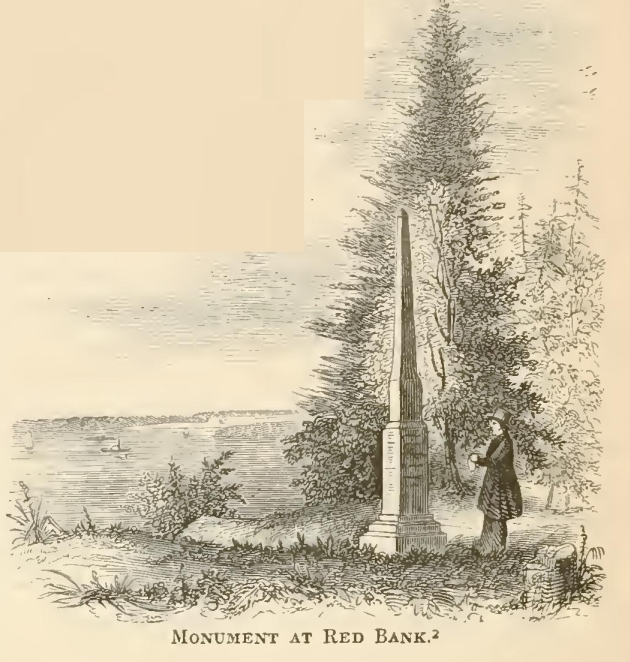

As soon as Fort Mercer was attacked, the Augusta, with the Roebuck, of forty-four guns, two frigates, the Merlin, of eighteen guns, and a galley came up, but were kept at bay by the American galleys and floating batteries. These galleys did good execution, not only upon the British vessels, but by flanking the assailants at Red Bank.
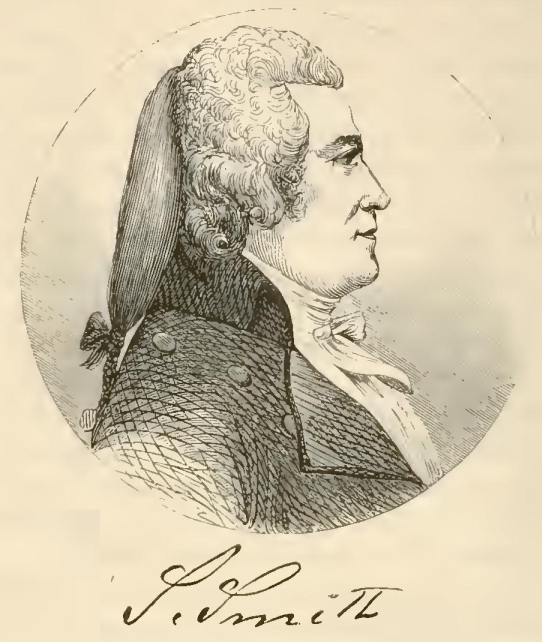
The attack upon Fort Mifflin was deferred October 23, 1777 until next morning, when, the Hessians being driven from Fort Mercer, the whole power of the American flotilla was brought to bear upon the British fleet. A heavy cannonade was opened upon Fort Mifflin, and attempts were made to get floating batteries in the channel in the rear of Mud Island. Lieutenant-colonel Smith, * the commandant at Fort Mifflin, who was vigilant and brave, thwarted every attempt thus to outflank him (if the term may be used in reference to a garrison in a fort), and by a gallant defense essentially aided the American flotilla in repulsing the enemy. The fire was so fierce and incessant, that the British ships endeavored to fall down the river. A hot shot struck and set fire to the Augusta; and at noon, while lying aground upon a mud bank near the Jersey Monument at Red Bank. **
* Samuel Smith was born in Lancaster county, Pennsylvania, July 27th, 1752. His education, commenced at Carlisle, was completed at an academy at Elkton, in Maryland, after his father made Baltimore his place of residence. He was in his father's counting-house five years, and then, in 1772, sailed for Havre in one of his father's vessels, as supercargo. Having traveled extensively in Europe, he returned home to find his countrymen in the midst of the excitements of the opening of the Revolutionary hostilities. The battles of Lexington, Concord, and Bunker Hill had been fought. Fired with patriotic zeal, he sought to serve his country in the army, and in January, 1776, obtained a captain's commission in Colonel Smallwood's regiment. He was soon afterward promoted to the rank of major, and early in 1777 he received a lieutenant colonel's commission. In that capacity he served with distinction in the battles of Brandywine and Fort Mifflin, suffered at Valley Forge, and participated in the action on the plains of Monmouth. At the close of the war he was appointed a brigadier general of militia, and commanded the Maryland quota of troops in the "Whisky Insurrection" in Pennsylvania. He served as major general in the war of 1812, and commanded the troops assembled for the defense of Baltimore in 1814. During a riot in Baltimore in 1836, when the civil power was inadequate to quell the violence of the mob, the aged general, then eighty-four years old, appeared in the streets with the United States flag, placed himself at the head of peaceful citizens, and very soon restored order and tranquillity. In the autumn of that year he was elected mayor of the city, which office he held until his death on the 22d of April, 1839, at the age of eighty-seven years. General Smith was elected a representative in Congress in 1793, and served until 1803. He was again elected in 1816, and served six years longer. He was also a member of the United States Senate for a period of twenty-three years. The accompanying portrait is from an engraving by St. Memin, an artist who engraved a large number of the distinguished men of our country at about the commencement of the present century. The signature is from a frank, kindly sent to me by his son, General Smith, president of the Maryland Historical Society.
** This view includes the monument, a portion of the Delaware, and the mouth of the Schuylkill, on the western shore.
Successful Defense of Fort Mifflin.—Preparations for another Attack.—Plan of the Fort.
shore, she blew up. The engagement continued with the other vessels until three o'clock in the afternoon, when the Merlin also took fire and blew up, near the mouth of Mud Creek. The conflict now ceased; the Roebuck dropped down the river, and passed below the chevaux de frisé * at Billingsport, and the Americans remained masters of the Delaware forts for a short season. **
It was, indeed, cut a short season that quiet possession of the river was vouchsafed the patriots. Although repulsed, his ships beaten back, and his mercenary allies decimated, Howe was not discouraged; and he labored eagerly and hopefully to dislodge the Americans from their strong posts upon the only avenue through which his army could receive food and clothing, and his magazine supplies for the winter.
A timely re-enforcement from New York enabled him to act with energy. He took possession of Province Island, lying between Fort Mifflin and the main, and at different points works were thrown up to strengthen his power and annoy the patriots. This was on the 1st of November; and from that time never, was a garrison more harassed than that at Fort Mifflin; and never was patience and courage more nobly exhibited than was then shown by Lieutenant-colonel Smith and his compatriots.
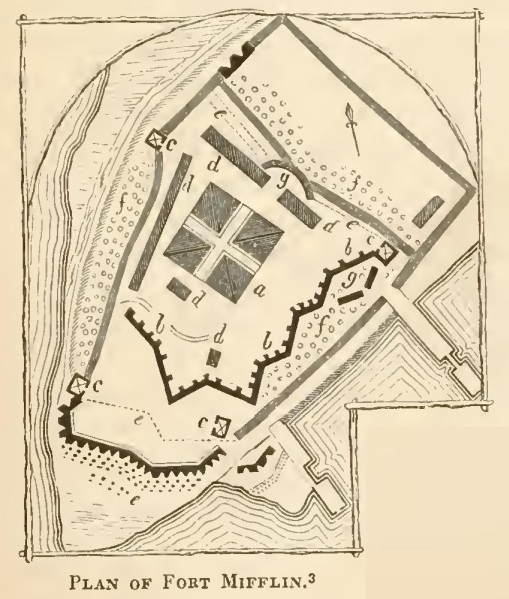
Old Fort Mifflin was upon the lower end of Mud (now Fort) Island, having its principal fortification in front, for the purpose of repelling ships that might come up the river.
On the side toward Province Island (a low mud bank, nearly covered at high water, and separated from Mud Island by a narrow channel) the fort had only a wet ditch, without ravelin or abatis. This part was flanked by a blockhouse at each of its angles. These were not strong. When the Americans saw the enemy take possession of Province Island, and begin the planting of batteries to bruise their weakest points, they were sensible that Fort Mifflin would be untenable if the British completed their works. Such, too, was the painful conviction of Washington, and from his camp at Whitemarsh he put forth all his energies to prevent the evil. But, weak in numbers, and deficient in every thing which constitutes the strength of an army, he was obliged to see the enemy, day alter day, rearing his battle-works, without being able to interpose. He had sent anxious requests to General Gates to forward re-enforcements from the North, Burgoyne's invading army being cap-
* The Merlin, like the Augusta, had got aground, and stuck so fast that it was impossible to get her off. The obstructions which the Americans had placed in the river had caused such a change in the channels, that the pilots of the British vessels were completely at fault.
** On the 4th of November, ten days after the battle, Congress honored Lieutenant-colonel Smith and Commodore Hazlewood, by voting each an elegant sword.—Journals of Congress, iii., 374.
*** Explanation.—A, the inner work or redoubt; bbb, a high, thick stone wall, built by Montressor, with indentations, where the men boiled their kettles. This wall was pierced with loop-holes for musketry. cccc block-houses, built of wood, with loop-holes, and mounting four pieces of cannon each, two on the lower platform; ddd, barracks; eee, stockadoes; fff trous de Loup; g g, ravelins. On the southeast side were two strong piers, and a battery mounting three cannons.
Washington's Efforts to Re enforce his Army.—Conduct of Gates and Putnam.—Second Attack on Fort Mifflin.
tured, and no other formidable enemy requiring a large force in that quarter; but that officer, doubtless willing to see his rival unsuccessful, gave no heed to his orders until longer non-compliance would have been positive disobedience. * To break up the encampment at Whitemarsh, and move the army to the west side of the Schuylkill, would be to leave depositories of stores and hospitals for the sick within reach of the enemy. It would also leave the fords of the Schuylkill in the custody of the royal troops, and render a junction of the expected Northern forces with the main army difficult, if not impossible. Furthermore, it might bring on a general engagement, which, with his weakened forces, the commander-inchief knew might be fatal. Thus situated, Washington viewed the progress of the enemy in his designs upon Fort Mifflin with intense anxiety.
The British erected five batteries on Province Island, of eighteen, twenty-four, and thirty-two pounders, within five hundred yards of Fort Mifflin. They also brought up, by the new channel made between Hog Island and the main by the changing of the current by the chevaux de frise, a large floating battery, mounting twenty-two twenty-four pounders, within forty yards of an angle of the fort. They also brought to bear upon the fort four sixty-four gun ships, within nine hundred yards, and two forty gun ships. Altogether the enemy had fourteen strong redoubts, and these were well manned and furnished with heavy artillery. On the 10th of November, the enemy opened their batteries on land and water, and for six consecutive days poured a storm of bombs and round shot upon the devoted fortification. With consummate skill and courage, Lieutenant-colonel Smith directed the responses from the ordnance of the fort. The artillery, drawn chiefly from Colonel Lamb's regiment, were commanded by Lieutenant Treat, who was killed on the first day of the siege, by the bursting of a bomb. On that day the barracks alone suffered, but on the morning of the 11th the direction of the enemy's fire was changed; a dozen of the strong palisades were demolished, and a cannon in an embrasure was disabled. The firing did not cease until midnight, and many of the garrison were killed or wounded. Colonel Smith, the commander, had a narrow escape. He had just gone into the barracks to write a letter to General Varnum, when a ball passed through a chimney. He was struck by the scattered bricks, and for a time lay senseless. He was taken across to Red Bank, and the command devolved on Lieutenant-colonel Russell, of the Connecticut line. That officer was disabled by fatigue and ill health, and Major Thayer, of the Rhode Island line, volunteered to take his place. Major Henry, who sent daily reports to Washington of the progress of the siege, was also wounded on the 11th, but he continued with the garrison. On the 12th, a two-gun battery of the Americans was destroyed, the northwest block-house and laboratory were blown up, and the garrison were obliged to seek shelter within the fort. The enemy continued to throw shells at night, and fearful indeed was the scene. At
* Gates had ample stores and a formidable force; and had he acted with the energy of true patriotism, he might have re-enforced Washington, by which the Delaware forts could have been saved, and the enemy driven out of Philadelphia. But he was vainly expecting soon to supersede Washington in the chief command, and he treated his orders with indifference. So tardy were his movements, when he concluded to comply, that Washington sent Colonel Hamilton to hasten his march. When Hamilton arrived at Albany, he found Gates reluctant to part with any of his troops; but, after much persuasion, he consented to send Morgan's corps and some thin brigades to the commander-in-chief. Hamilton was indignant, and by plain speech caused Gates to send a stronger re-enforcement. These, on their march down the Hudson, encountered a check from Putnam, who, dreaming of glory to be derived from an attack on New York, had actually detained a part of the force sent forward by Gates, and had marched them to Tarrytown, while he had himself advanced to White Plains. Thus, by tardy movements in Congress, and the undutiful ambition of subordinate officers, Washington was often foiled. Hamilton, by advice of Governor Clinton, assumed the authority of issuing a peremptory order to Putnam to put the Continental troops in motion for Whitemarsh.
* I now, sir," he wrote, "in the most explicit terms, by his excellency's authority, give it as a positive order from him, that all the Continental troops under your command may be immediately marched to King's Ferry, there to cross the river, and hasten to re-enforce the army under him." The Massachusetts militia and some new recruits were to replace the Continental soldiers thus sent away. So much did Hamilton censure Putnam when he returned to head-quarters, that it was thought a court martial would arraign the veteran; but the matter was passed over without notice, obedience having followed the peremptory order of Washington's representative.
Gallant Defense of Fort Mifflin.—Destructive Effects of Cannons and Bombs.—Plan of Operations on the Delaware
sunrise on the 13th, thirty armed boats made their appearance; and during that night the heavy floating battery was brought to bear upon the fort.
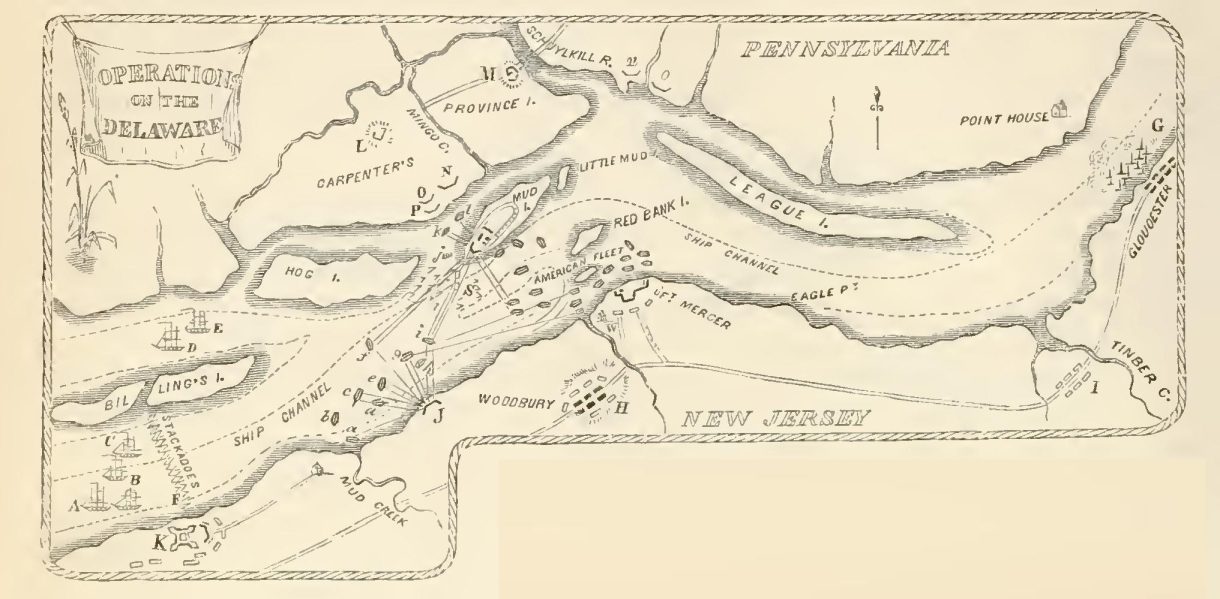
It opened with terrible effect on the morning of the 14th, yet that little garrison of only three hundred men managed to silence it before noon. Hitherto the enemy did not know the real weakness of the garrison; on that day a deserter, in a boat, carried information of the fact to the British, who were seriously thinking of abandoning the siege, for they had suffered much. Hope was revived, and preparations were made for a general and more vigorous assault. At daylight, on the 15th, the Iris and Somerset, men-of-war, passed up the east channel to attack the fort on Mud Island in front. Several frigates were brought to bear on Fort Mercer; and the Vigilant, an East Indiaman of twenty twenty-four pounders, and a hulk with three twenty-four pounders, made their way through a narrow channel on the western side, and gained a position to act in concert with the batteries on Province Island, in enfilading the American works. At ten o'clock, while all was silent, a signal-bugle sent forth its summons to action, and instantly the land batteries and the shipping poured a terrible storm of missiles upon Fort Mifflin. The little garrison sustained the shock with astonishing intrepidity, and far into the gloom of evening an incessant cannonade was kept up. Within an hour, the only two cannons in the fort which had not been dismounted shared the fate of the others. Every man who appeared upon the platform was killed by the musketeers in the tops of the ships, whose yards almost hung over the American battery. Long before night not a palisade was left; the embrasures were ruined; the whole parapet leveled; the block-houses were already destroyed. Early in the evening Major Thayer sent all the remnant of the garrison to Red Bank, excepting forty men, with whom he remained. Among those sent was the brave Captain
* Note. Explanation of the Map.—This shows the main operations upon the Delaware between the middle of October and the close of November, 1777. Fort Mifflin is seen on the lower end of Mud Island. A, B, two British transports; C, the Experiment; D, the Vigilant frigate; E, the Fury sloop; F, a passage opened through the stockadoes; G, American fleet burned at Gloucester; H. the village of Woodbury and Cornwallis's encampment on the 21st of November, 1777; I, camp on the 24th, between the branches of Timber Creek; J, a battery of two eighteen pounders and two nine pounders; K, fort at Billingsport, Colonel Stirling's corps, and Cornwallis's camp on the 18th of November; L, redoubt on Carpenter's Island; M, on Province Island, to cover the bridge in the direction of Philadelphia; N, a battery of six twenty-four pounders, one eight-inch howitzer, and one eight-inch mortar; 0, a battery with one eight-inch howitzer and one eight-inch mortar; P, a battery with one thirteen-inch mortar; n, two twelve pounders; o, one eighteen pounder; S, stockadoes in the channel in front of Fort Mifllin; a, a small vessel; b. wreck of the Merlin; c, the Liverpool: d. Cornwallis galley; e, the Pearl; f the Somerset; g, the Roebuck; h, wreck of the Augusta; i, the Iris; j. ship sunk; k, the Vigilant; l, the Fury; W, the Whitall house, just below Fort Mercer. The parallelograms around Fort Mercer denote the attack bv Donop, on the 22d of October. The small island between Red Bank Island and the Jersey shore is Woodbury Island, on which the Americans erected a small battery. The creek, just below Fort Mercer, is Woodbury Creek, a deep and sluggish stream, near the Delaware.
Retreat of the Garrison.—Destruction of the Fort.—Movements in New Jersey.—Fort Mercer Abandoned.
(afterward Commodore) Talbot, of the Rhode Island line, who was wounded in the hip, having fought for hours with his wrist shattered by a musket ball. At midnight, every defense and every shelter being swept away, Thayer and his men set fire to the remains of the barracks, evacuated the fort, and escaped in safety to Red Bank. Altogether it was one of the most gallant and obstinate defenses made during the war. In the course of the last day, more than a thousand discharges of cannon, from twelve to thirty-two pounders, were made against the works on Mud Island. Nearly two hundred and fifty men of the garrison were killed and wounded. The loss of the British was great; the number was not certainly known. *
Fort Mercer was still in possession of the Continental troops. Howe determined to dislodge them; for, while they remained, the obstructions in the river could not, with safety, be removed. While a portion of his force was beating down Fort Mifflin, he was busy in fortifying Philadelphia. He had extended intrenchments across from the Delaware to the Schuylkill. Having received more re-enforcements from New York, he sent Cornwallis to fall upon Fort Mercer in the rear. That officer, with a detachment of about two thousand men, crossed the Delaware from Chester to Billingsport, where he was joined by some November 18, 1777 troops just arrived from New York. Washington had been apprised of this movement, and had detached General Huntington's brigade to join that of Varnum in New Jersey. He also ordered Major-general Greene to proceed with his division to the relief of the garrison, and to oppose Cornwallis. That able officer, accompanied by La Fayette, who had not yet quite recovered from a wound received in the battle on the Brandywine, crossed the Delaware at Burlington, and marched with a considerable force toward Red Bank. He expected to be re-enforced by Glover's brigade, then on its march through New Jersey, but was disappointed. Ascertaining that the force of Cornwallis was greatly superior to his own in numbers, General Greene abandoned the plan of giving him battle, and filed off toward Haddonfield. Colonel Greene, deprived of all hope of succor, evacuated Fort Mercer, leaving the artillery, with a considerable quantity of cannon-balls and stores, in the hands November 20 of the enemy. Cornwallis dismantled the fort and demolished the works. His army was augmented by re-enforcements, and, with about five thousand men, he took post at and fortified Gloucester Point, whence he might have a supervision of affairs in Lower Jersey. Morgan's rifle corps joined General Greene, but the Americans were not strong enough to venture a regular attack upon Cornwallis. A detachment of one hundred and fifty riflemen, under Lieutenant-colonel Butler, and an equal number of militia, under La Fayette, attacked a picket of the enemy three hundred strong, killed between twenty and thirty of them, drove the remainder quite into the camp at Gloucester, and returned without losing a man. General Greene soon afterward withdrew from New Jersey and joined Washington, and Cornwallis returned to Philadelphia. The American fleet, no longer supported by the forts, sought other places of safety. On a dark night, the galleys, one November 21, 1777 brig, and two sloops, crept cautiously along the Jersey shore past Philadelphia, and escaped to Burlington. Seventeen other vessels, unable to escape, were abandoned by their crews, and burned at Gloucester. ** The American defenses on the Delaware were now scattered to the winds; the obstructions in the river were removed; the enemy had full possession of Philadelphia; Congress had fled to the interior, and the broken battalions of the patriot army sought winter quarters on the banks of the Schuylkill, at Valley Forge.
Gloomy indeed were the November twilights of 1777 to the eye and heart of the patriot, for there were no brilliant omens of a pleasant to-morrow. Not so was the bright sunset and radiant twilight of that November evening in 1848, when we left the ruins at Red Bank and sought a waterman to convey us back to League Island. There was no cloud in the heavens; an orange glow suffused the chambers of the west where the king of day had gone to his couch, and promises of a fair to-morrow were revealed in the clear sky.
* Gordon, ii., 276. Botta, ii., 51. Washington's Letters.
** See plan on the preceding page.
Ancient Philadelphia.—The "Slate-roof House" and its Associations.