Volume 2 — CHAPTER XXXI. (continued 2)
Reading edition
Retreat of the Americans.—The Loss.—Withdrawal to North Castle.—Conflagration.
and retreat to the intrenchments at White Plains. This was done in good order down the southeastern side of Chatterton's Hill, and across the Bronx, near the present rail-way station, under cover of troops, led by Putnam.
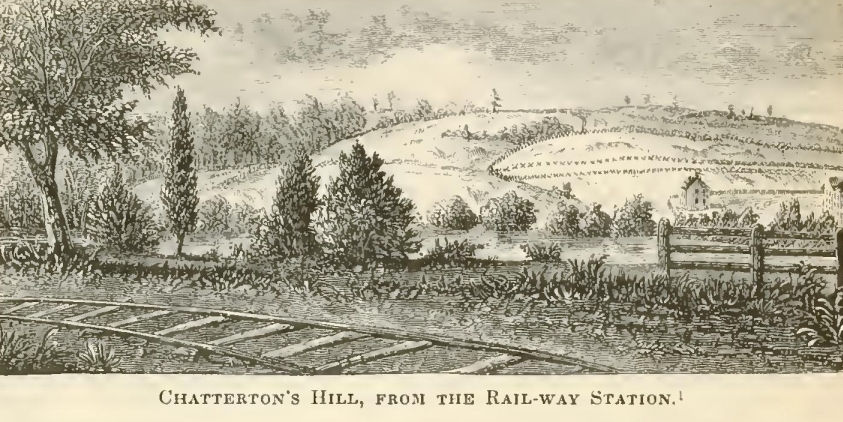

M'Dougal carried off his wounded and artillery, and left the victors in possession of only the inconsiderable breastworks upon the hill.
The militia, who were scattered among the Greenburg hills, soon collected in the intrenched camp at the village, and there the American army rested, almost undisturbed, until the evening of the thirty-first.Oct, 1778The British troops rested upon their arms all night after the battle, and the next day, after a skirmish with Glover's brigade, they encamped within long cannon shot of the front of the American lines. Awed by the apparent strength of Washington's intrenchments, Howe dared not attack him, but awaited the arrival of Lord Percy, with four battalions from New York and two from Mamaroneck. **
The loss of the Americans, from the twenty-sixth to the twenty-ninth, did not exceed, probably, three hundred men, in killed, wounded, and prisoners; that of the British was about-the same.
Earl Percy arrived in the evening of the thirtieth, and preparations were made to storm the American works the next morning. A tempest of wind and rain arose at midnight, and continued for twenty hours. All operations were delayed, and on the night of the thirty-first, while the storm clouds were breaking and the British host were slumbering, Washington withdrew, and encamped upon the heights of North Castle, toward the Croton River, where he had erected strong breast-works along the hills which loom up a hundred feet above the waters of the Bronx. *** Howe was afraid to attack him there, and on the night of the fourth of November,1776 he retreated toward the junction of the Hudson
* This is a view of the southeastern side of Chatterton's Hill, from the rail-way station. They crossed the Bronx at a point seen on the extreme right. On the top of the hill, in the edge of the woods on the left, Hamilton's cannons were placed.
** The intrenchments, which appeared so formidable through Howe's telescope, were exceedingly weak, composed of earth and sods laid upon heaps of cornstalks. They were no protection against cannon-balls, and had Howe attacked these lines first, instead of the really stronger position on Chatterton's Hill, the complete dispersion, if not loss of the American army, would doubtless have been the result. His caution was too faithful in its promptings, and he wasted time and energy, for two or three days, in attempts to gain Washington's rear.
*** A little southeast of the house occupied by Washington (see sketch on page 821), on the brow of a steep hill overlooking an extensive region of country, are yet (1852) prominent remains of some of these breast-works. These are nearest the village of White Plains, and easiest of access for the student or antiquary. Gordon relates that while the British were at White Plains, the garden of a widow was robbed at night. Her son, a mere boy, asked and obtained leave to catch the thief. With a loaded gun he concealed himself in some bushes, when a British grenadier, a strapping Highlander came, filled a bag with fruit, and placed it on his shoulder. The boy appeared behind him with his gun cocked, and threatened him with instant death if he attempted to lay down the bag. Thus the boy drove him into the American camp. When he laid down his bag, and saw that he had been driven in by a stripling, he was excessively mortified, and could not suppress the exclamation, "A British grenadier made a prisoner by such a damned brat!
*** On the night of the evacuation, the Presbyterian church and other buildings were fired and consumed, but without the knowledge or approval of Washington. Bolton (ii., 366) says the incendiary was Major Osborne, of the Massachusetts line. Gordon (ii., 121) remarks that "Colonel Austin, of the Massachusetts, who commanded the guards and sentries, being heated with liquor, burned the town on White Plains unnecessarily and without any orders."
Retreat to New Jersey.—Fort Washington menaced.—A Surrender refused.—Re-enforced.
and Harlem Rivers, and encamped upon the heights of Fordham, extending his left wing almost to King's Bridge. *
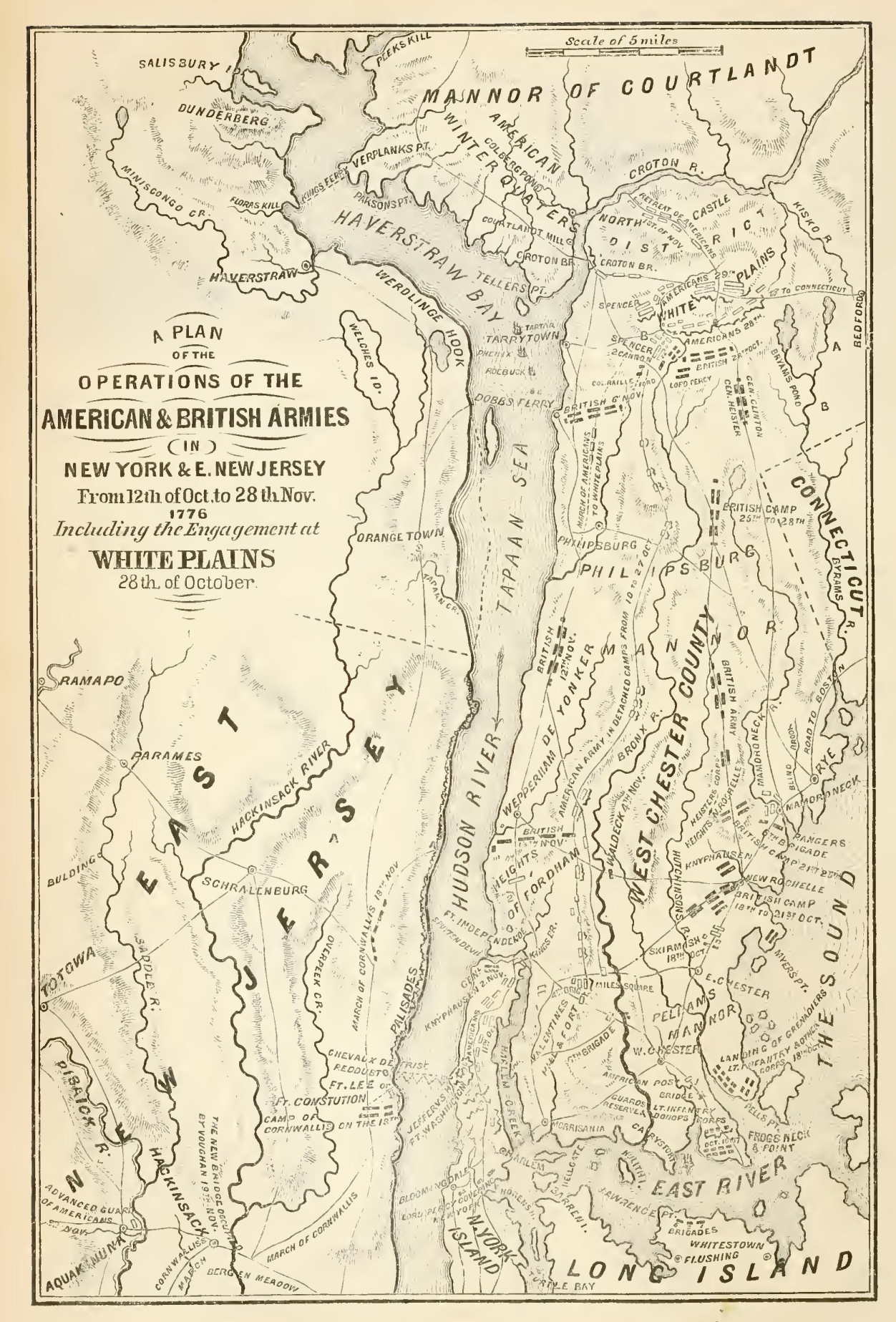
An attack upon Fort Washington, now environed by a hostile force, though at a distance, was to be the next scene in the drama. Washington called a council of war, and it was unanimously resolved to retreat into New Jersey with the larger portion of the army, leaving all the New England troops on the east side of the Hudson to defend the Highlands. This movement was speedily executed. By the twelfthNovember the main army were in New Jersey, some crossing from Tarrytown to Paramus (Sneeden's Landing), and others from Tiller's Croton; Point to the mouth of Tappan Creek (Piermont). The chief, after inspecting places at Peekskill and vicinity, crossed King's Ferry,Nov. 14, 1776 and hastened to form his camp, with his head-quarters at Hackinsack, in the rear of Fort Lee. ** General Heath was left in command in the Highlands, and General Lee, with a dissolving force *** of more than eight thousand men, remained at North Castle, with orders to join the main army in New Jersey if the enemy should aim a blow in that quarter.
On the day of the battle at White Plains, Knyphausen, with six German battalions, marched from New Rochelle, crossed the head of Harlem River, at Dyckman's Bridge, **** took possession of the abandoned works in the vicinity of King's Bridge, and encamped upon the plainNov. 2 between there and Fort Washington.
The Americans in Fort Independence and redoubts near, fled, on his approach, to Fort Washington, and now the whole country beyond Harlem, between Dobbs's Ferry and Morrisania, west of the Bronx, was in the possession of the royal army. Fort Washington was completely environed by hostile forees. On the seventh, three British ships of war passed up the Hudson unharmed, and on the night of the fourteenth, a large number of flat-boats went up and were moored near King's Bridge. The commander-in-chief would now have ordered the evacuation of Fort Washington, had not Greene urged the necessity of holding it, in connection with Fort Lee, for the defense of the river.
On the fifteenthNov. 1776 Howe was informed of the real condition of the garrison and works at Fort Washington, by a deserter from Magaw's battalion, and he immediately sent a messenger with a summons for the commander to surrender, or peril his garrison with the doom of massacre. Magaw, in a brief note, promptly refused compliance, and sent a copy of his answer to Washington at Hackinsack. Confident of success, Howe ordered a cannonade to be opened upon the American outworks from two British redoubts, situated upon the east side of the Harlem River, a little above the High Bridge. The cannonade commenced early on the morning of the sixteenth, to cover the landing of troops which crossed the Harlem there, preparatory to a combined attack at four different points. Expecting this, Magaw made a judicious disposition of his little force. (v) Colonel Rawling's
* Gordon, ii., 116-121. Stedman, i., 210-216. Marshall, i., 110-114.
** This fortification was situated upon a sort of plateau, about three, hundred feet above the river, at the present landing and village of Fort Lee, and opposite the present One hundred and Sixtieth Street, of New York. Some of the mounds are yet visible, covered with low trees. A little above was a redoubt, opposite Jeffery's Hook, to cover the chevaux-de-friese in the river. Few traces of this redoubt now remain.
*** The time of service of seven thousand five hundred of these men would expire within a week, and the remainder would be free on the first of December. When the time of dissolution came, some were induced to remain, but the largest portion went home dispirited.
**** For this and other localities made memorable by military operations between Fort Washington and the Highlands, the reader may profitably consult the map on the preceding page. It is copied from Stedman, whose orthography of proper names, it will be observed is often incorrect. There is an important error in the map, which was not observed, until it was engraved, namely, the transposition of the names of Heights of Fordham and Valentine's Hill. The former is in the vicinity of Morrisania; the latter near Wepperham, or Yonkers. Mile Square should be placed about two and a half miles further up the Bronx.
* (v) The garrison consisted of only about twelve hundred men, when Knyphausen first sat down at King's Bridge. Greene sent a re-enforcement from Mercer's Flying Camp, and when the fort was attacked there were about three thousand men within the lines. When Washington heard of lhe summons to surrender, he hastened from his camp to Fort Lee, and at nine in the evening, while crossing the Hudson, he met Greene and Putnam returning from Fort Washington. They assured him that Magaw was confident of a successful defense, and the chief returned with them to Fort Lee.
Disposition of the Garrison.—Plan of Attack.—Knyphausen's Assault
with his Maryland riflemen, was posted in a redoubt (Fort George) upon a hill north of Fort Washington, and a few men were stationed at the outpost called Cock-hill Fort.
Militia of the Flying Camp, under Colonel Baxter, were placed on the rough wooded hills east of the fort, along the Harlem River, and others, under Colonel Lambert Cadwalader, of Pennsylvania, manned the lines in the direction of New York. Magaw commanded in the fort.
The plan of attack was well arranged.
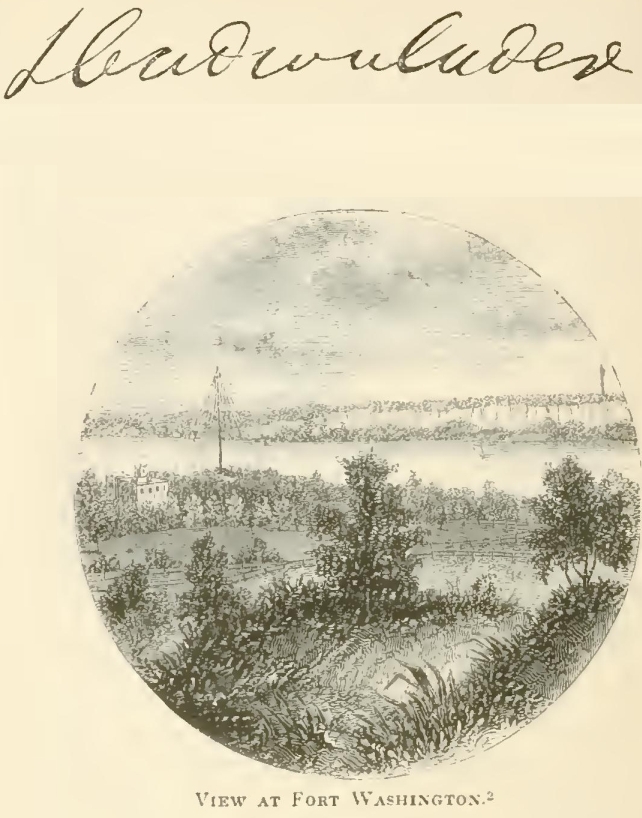
Knyphausen, with five hundred Hessians and Waldeckers, was to move to the attack on the north simultaneously with a division of English and Hessian troops, under Lord Percy, who were to assail the lines on the south. At the same time, Brigadier Mathews, supported by Cornwallis, was to cross the Harlem River, with the guards, light infantry, and two battalions of grenadiers, and land above Fort Washington, under cover of the guns on the West Chester Hills, just mentioned, * while Colonel Stirling, with the 42d regiment, was to cross at a point a little above the High Bridge. These arrangements were carried out. Knyphausen divided his forces. One division, under Colonel Rall (killed at Trenton seventy days afterward), drove the Americans from Cock-hill Fort, while Knyphausen, with the remainder, penetrated the woods near Tubby Hook, and, after clambering over felled trees and other obstructions, attacked Rawlings in Fort Tryon. The fort was gallantly defended for some time, and many Hessians were slain. Rawlings was finally forced to yield, and retreated to Fort Washington, under cover of its guns, when Knyp-hausen planted the Hessian flag upon Fort Tryon. In the mean while, Percy had crossed near Harlem, swept over the plain, drove in the American pickets at Harlem Cove (Manhattanville), and attacked Cadwalader at the advanced line of intrenchments. *** Percy's force was eight hundred strong; Cadwalader had only one hundred and fifty men, and one eighteen-pounder. Both parties fought bravely, and Percy, yielding, moved toward the American left, behind a wood, and the combat ceased for a while.
While Rawlings and Cadwalader were keeping the as-
* Mathews landed in the cove or creek at about Two hundredth Street.
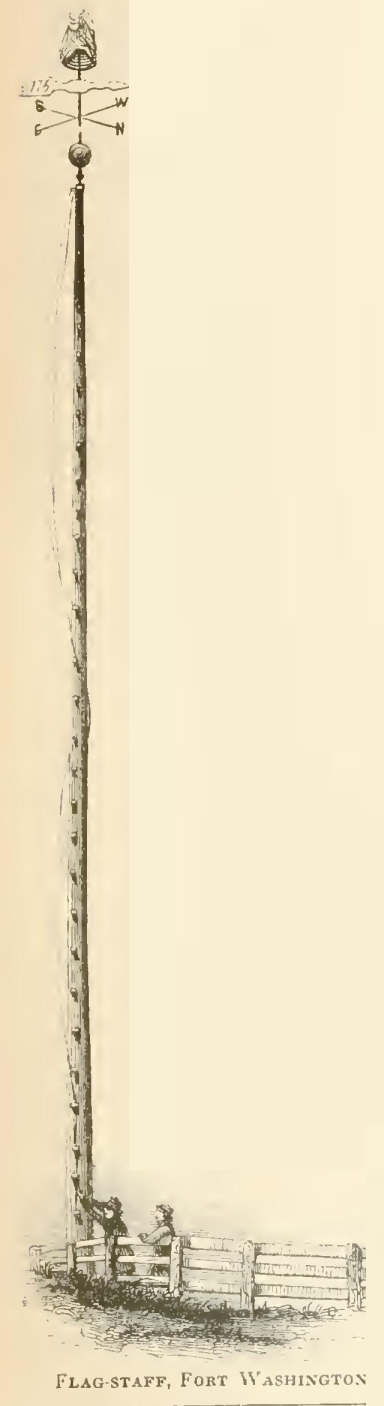
** This is a view from the site of the interior works at Fort Washington from the foot of the flag-staff, looking southwest. In the foreground are seen the remains of the embankments. The tall mast seen near the river below is the support for telegraph wires which cross the Hudson there, from the rocky point of Jeffery's Hook. In the distance aeross the river are the Palisades, and the mast upon their summit denotes the site of the redoubt north of Fort Lee. This little sketch exhibits the relative position of Forts Washington and Lee.
*** Preparatory to this attack, a cannonade was opened upon the American works by two pieces on the high ground north of Motthaven on the Harlem.
"**** This flag-staff, indicating the center of the fort, is a prominent object to passengers upon the Hudson.
Attack of Stirling and Percy.—Surrender of the Fort.—The Loss.—Mr. Battin.
sailants at bay, Mathews and Stirling landed. The latter pushed up the wooded heights, drove Baxter's troops from their redoubt (Fort George) and rocky defense, and stood victor upon the hills overlooking the open fields around Fort Washington. Stirling, after making a feigned landing, dropped down to an estuary of the river, landed within the American lines, and, rushing up the acclivity by a sinuous road, attacked a redoubt on the summit, and made about two hundred prisoners. * Informed of this, and perceiving the peril of being placed between two fires, Cadwalader retreated along the road nearest the Hudson, closely pursued by Percy, and battling all the way.
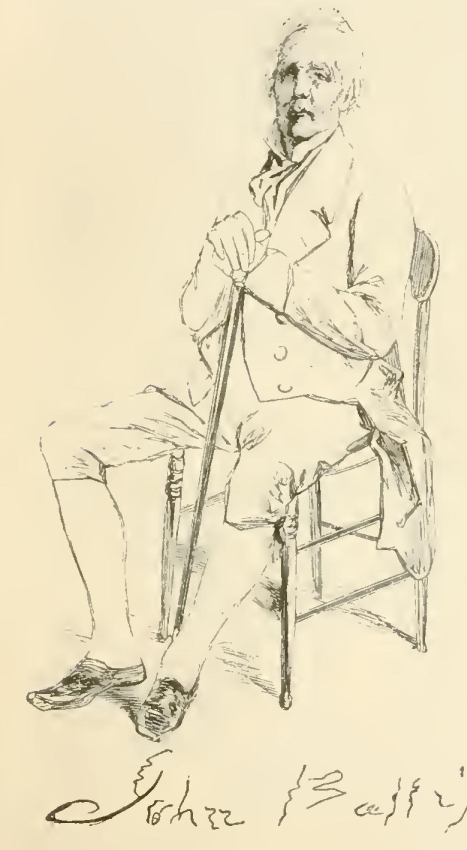
When near the upper border of Trinity Cemetery (One hundred and Fifty-fifth Street), he was attacked on the flank by Colonel Stirling, who was pressing aeross the island to intercept him. ** He continued the retreat, and reached the fort, after losing a few killed, and about thirty made prisoners. On the border of the cemetery, and near the fort, severe skirmishes took place, and many of the Hessian pursuers were slain. The defense was gallant; but pike, ball, and bayonet, used by five thousand men, overpowered the weakened patriots, and at meridian they were nearly all gathered within the ramparts of the fort. General Howe now sent another summons to surrender. Perceiving further resistance to be vain, Magaw complied, *** and at half past one o'clockNov. 16, 1776 the British flag was waving where the Union banner was unfurled defiantly in the morning. The garrison, amounting to more than two thousand men, were made prisoners of war, **** and with these the jails of New York were speedily gorged. It was a terrible disaster for the little Republican army. Of all the gallant men who battled there on that day, not one is known among the living. Probably the last survivor of them all, and the last living relic of the British army in America, was the venerable John Battin, who died at his residence in Greenwich Street, in the city of New York, on the twenty-ninth of June, 1852, at the age of one hundred years and four months. His body is entombed in Trinity Cemetery, upon the very ground where he fought for his king seventy-six years before. (v)
Washington, standing upon Fort Lee with his general officers, and the author of "Common Sense," (Thomas Paine) saw some of the slaughter near the doomed fortress, and
* Stirling's landing-plaee was at about the foot of One hundred and Fifty-second Street, at the head of the Eighth Avenue, three fourths of a mile below the High Bridge, "within the third line of defense whieh crossed the island."—Marshall, i., 117. The road up which he passed is still there, and, as mentioned in the note on page 816, the lines of the redoubt on the "wooded promontory' (Stedman, i., 218) are quite visible.
** It was at this stage of affairs that Washington, with Putnam, Greene, and Mercer, crossed the Hudson, ascended the heights, and from Morris's house surveyed the scene of operations. Within fifteen minutes after they had left that mansion, Stirling and his victorious troops approached and took possession of it. It was a narrow eseape for the chief commanders.
*** At this moment Captain Gooch came over from Fort Lee with a note from Washington, assuring Magaw that if he could hold on till night the garrison should be brought off. It was too late.
**** The number of regulars was about two thousand. There were six or seven hundred militia, volunteers, and stragglers, all of whom were probably included in Howe's report of "two thousand six hundred prisoners." The loss of the Americans, in killed and wounded, did not exceed one hundred; that of the royal army was almost one thousand. The Hessians, as usual, suffered most severely. Washington was blamed for yielding to the opinions of Greene in endeavoring to hold this fort. Lee, who was opposed to it from the beginning, wrote to Washington, "O! general, why would you be overpersuaded by men of inferior judgment to your own? It was a cursed affair."
* (v) Mr. Battin came to America with the British army in 1776, and was engaged in the battles near Brooklyn, at White Plains, and Fort Washington. After the British went into winter quarters in New York, and Cornwallis's division (to which he was attached), returned from Trenton and Princeton, he took lessons in horsemanship in the Middle Dutch church (now the city post-office), then converted into a circus for a riding-school. He then joined the cavalry regiment of Colonel Bird, in which he held the offices of orderly sergeant and cornet. He was in New York during the "hard winter" of 1779-80, and assisted in dragging British cannons over the frozen bay from Fort George to Staten Island. He was always averse to fighting the Americans, yet, as in duty bound', he was faithful to his king. While Prince William Henry, afterward William the Fourth, was here, he was one of his body-guard. Twice he was sent to England by Sir Henry Clinton with dispatches, and being one of the most active men in the corps, he was frequently employed by the commander-in-chief in important services. With hundreds more, he remained in New York when the British army departed in 1783, resolved to make America his future home. He married soon after the war, and at the time of his death had lived with his wife (now aged eighty-three) sixty-five years. For more than fifty years, he walked every morning upon first the old, and then the new, or present Battery, unmindful of inclement weather. He always enjoyed remarkable health. He continued exercise in the street near his dwelling until within a few days of his death, though with increasing feebleness of step. The gay young men of half a century ago (now gray-haired old men) remember his well-conducted house of refreshment, corner of John and Nassau Streets, where they enjoyed oyster suppers and good liquors. The preceding sketch of his person is from a daguerreotype by Insley, made a few months before his departure.
Washington's Disappointment.—Wayne's Expedition near Bull's Ferry.—Lee's Attack on Paulus's Hook.
with streaming eyes he beheld the meteor flag of England flashing above its ramparts in the bright November sun. The fort was lost forever, and its name was changed to Knyphausen.
The chief now turned his thoughts toward the defense of the federal city of Philadelphia, for he penetrated the design of Howe to push thitherward. Fort Lee was abandoned, but before its stores could be removed, Cornwallis had crossed the Hudson with six thousand men, and was rapidly approaching it. * The garrison fled to the camp at Hack-
* The Americans lost at Fort Lee the whole of the mounted cannons, except two twelve-pounders, a large quantity of baggage, almost three hundred tents, and about a thousand barrels of flour and other stores. The ammunition was saved.
[Ill 8838]
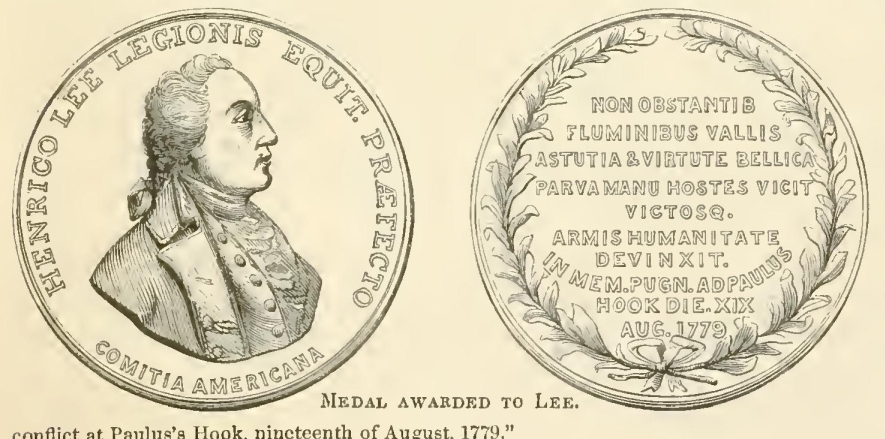
* Three or four miles below Fort Lee, at the base of the Palisades, is a little village called Bull's Ferry. Just below the village, on Block-house Point, was a block-house, occupied in the summer of 1780 by a British picket, for the protection of some wood cutters, and the neighboring Tories. On Bergen Neck below was a large number of cattle and horses, within reach of the British foragers who might go out from the fort at Paulus's Hook. Washington, then at Hopper's, near Suflferns, sent General Wayne, with some Pennsylvania and Maryland troops, horse and foot, to storm the work on block house Point, and to drive the cattle within the American lines. Wayne sent the cavalry, under Major Lee, to perform the latter duty, while he and three Pennsylvania regiments marched against the block-house with four pieces of artillery. They made a spirited attack, but their cannons were too light to be effective, and after a skirmish, the Americans were repulsed, with a loss, in killed and wounded, of sixty-four men. After burning some wood-boats near, and capturing the men in charge of them, Wayne returned to camp, with a large number of cattle, driven by the dragoons. This expedition was made the subject of a satirical poem by Major André, called The Cow-chase (see page 198), published in Rivington's paper. A copy of this celebrated production may be found in the Supplement. Major Lee made a more successful attack upon the British post at Paulus's Hook (now Jersey City) toward the close of the summer of 1779. The Hook is a sandy peninsula, and at that time was connected with the main by a narrow marshy neck. Upon this peninsula the British erected quite strong military works, and used it as an outpost, while they were in possession of the city of New York. The main works were upon rising ground in the vicinity of the intersection of Grand and Greene Streets. One (A) redoubt was of circular form, and mounted six heavy guns. It had a ditch and abatis. The other (B), a little southeast of it, was of oblong form, and had three twelve-pounders and one eighteen, a a, were block houses; b b b b b, breast-works fronting the bay; c, part of the 57th regiment of five hundred men, under Major Sutherland; d, pioneers; e, carpenters; fff, barracks; g, new bridge built by the British. A deep ditch was dug across the isthmus with a barred gate Thirty feet within this diteh were abatis. This ditch, with the surrounding marshes, made the peninsula an island. After the recapture of Stony Point toward the close of ihe summer of 1779, while Sir Henry Clinton was encamped upon Harlem Heights, a plan was formed for surprising the garrison at Paulus's Hook. The enterprise was intrusted to Major Henry Lee, then on the west side of the Hudson, back of Hoboken. A feeling of security made the garrison careless, and they were unprepared for a sudden attack when it was made. Preparatory to the attack, troops were stationed near the Hudson to watch the distant enemy, who might cross the river and intercept retreat, for it was not designed to hold the post when captured. Lee marched with three hundred picked men, followed by a strong detachment from Lord Stirling's division, as a reserve. Lee's march toward Bergen excited no surprise, for foraging parties of Americans as large as this were often out in that direction. The reserve halted at the new bridge over the Hackinsack, fourteen miles from the Hook, from which point Lee had taken the road among the hills, nearest the Hudson. At three o'clock on the morning of the nineteenth of August (1779), Lee reached the Harsimus Creek, at the point where the railway now crosses it, and within half an hour he crossed the ditch through the loosely-barred gate, and entered the main work undiscovered. The sentinels were either absent or asleep, and the surprise was complete. He captured one hundred and fifty-nine of the garrison, including officers, and then attacked the circular redoubt, into which a large portion of the remainder retreated, with the commander. It was too strong to be effected by small arms, and Lee retreated with his prisoners, with the loss of only two killed and three wounded, and arrived at camp in triumph at about ten o'clock in the morning. This gallant act was greatly applauded in the camp, in Congress, and throughout the country, and made the enemy more cautious. On the twenty second of September following, Congress honored Lee with a vote of thanks, and ordered a gold medal to be struck and presented to him.—See Journals, v., 278. On one side "The American Congress to Henry Lee, colonel of cavalry."

* "Notwithstanding rivers and intrenchments, he with a small band conquered the foe by warlike skill and prowess, and firmly bound by his humanity those who had been conquered by his arms. In memory of the conflict at Paulus's Hook, nineteenth of August, 1779."
Medal awarded to Lee.—American and British near King's Bridge.—Events near Tippett's Creek.
insack, and now commenced the retreat of Washington across the Jerseys, toward the Delaware, noted on pages 221—22 of this volume.
Before leaving these heights consecrated by valor and patriotism, let us turn, toward the distant hills of West Chester, where almost every rood of earth is scarred by the intrencher's mattock, or made memorable by deeds of daring and of suffering, and consider the most important military transactions which occurred within ten leagues of our point of observation.
We can not tarry long; to the local historian we must refer for the whole story in detail.
General Knyphausen held Fort Washington and the neighboring works, while the main British army was operating elsewhere in 1777. The fortifications were strengthened, and King's Bridge and vicinity presented a formidable barrier to the invasion of York Island by land. After the fall of Fort Washington, and the departure of both Americans and British to New Jersey General Heath established a cordon of troopsJanuary, 1777 from the heights at Wepperharn (Yonkers) to Mamaroneck, under the command of Brigadier John Morin Scott.
That officer left the army two months later for civil employment, and the Americans retired, so that their left rested upon Byram River. While the strong detach-
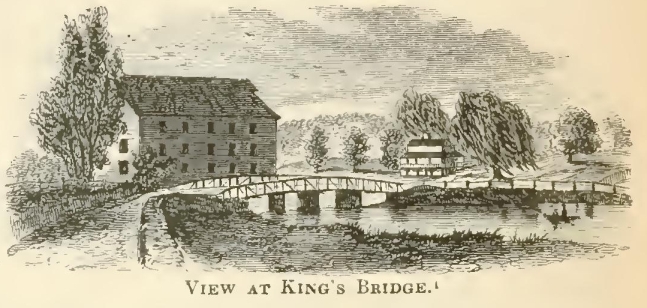
* This view is from the southwest side of the stream, from near the tide-mill. The house beyond, shaded by willows, is the residence of the widow of the late Robert M'Comb. *
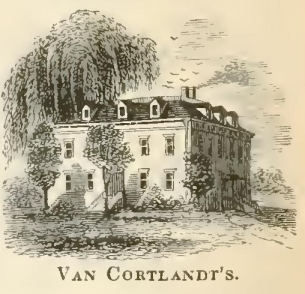
* This vicinity was the scene of many stirring events during the Revolution. Near here was a severe skirmish between a detachment of General Heath's troops and some Hessians, on the seventeenth of January, 1777. It was the result of an attempt by the Americans to dislodge the Hessians from Fort Prince. A little west of the bridge, Tippett's brook flows into the Hudson. Following the course of the valley through which this creek passes, on a bright autumn morning in 1850, I reached the vale of Yonkers, and the Van Cortlandt mansion, a beautiful residence in the midst of a broad lawn and profusion of shrubbery. This was the quarters of a Hessian picket-guard in 1777, and here Washington and his staff dined in July, 1781, when the British pickets were driven beyond King's Bridge by Lincoln. North of the man-. sion is Vault Hill, where many of the Van Cortlandt family lie.
* Upon this, hill those American troops were encamped whom Washington left to deceive Sir Henry Clinton, while he marched with the main army southward, to assist La Fayette in Virginia (see page 213). On this estate, and a short distance from Vault Hill, is Indian Field and Bridge, the site of a severe engagement on the thirty-first of August, 1778, between British light troops and some Stockbridge Indians, under the chief, Nimham. Lieutenant-colonel Emmerick, while patrolling in that direction, was attacked and driven back, when he met Simcoe coming to his relief. Emmerick was sent back to take post so as to cover an attack upon the Americans in flank and rear, but on his way fell into an ambush by the Indians. While fighting, Simcoe and Tarleton advanced, and a hot conflict ensued. The Indians fought bravely but were at last obliged to give way. A body of American light infantry, under Stewart (distinguished at Stony Point), were engaged in the skirmish, but escaped. Nimham and about forty of his sixty braves perished.—Simcoe's Journal, page 83. "The scene of the conflict," says Bolton, "lies on the land of the late Frederick Brown, now (1848) occupied by his widow.".
Loyalist Patrols.—The Delanceys and their Movements.
ments of the two armies were occupying their relative positions, many skirmishes took place, especially between the Americans and corps of Loyalists, formed under various leaders. The latter traversed Lower West Chester, annoyed the American outposts and patrols, and distressed the inhabitants. *
In the summer of 1777, Washington, believing the post at New York to be weak, because the main army of the British was in New Jersey and a large detachment was on
* One of the earliest, most influential, and efficient of the Loyalist leaders was Oliver Delancey, who, with his son Oliver, and nephew James, performed active service for the king in Lower West Chester. He was a brother of Chief Justice (also lieutenant governor) Delancey, and was a man of large property and great influence. He was a member of the King's Council before the Revolution; and at the beginning of hostilities, leaned rather to the popular side. Deprecating a separation from Britain, he espoused the royal cause after the Declaration of Independence went forth. He was commissioned a brigadier, and authorized to raise three battalions of Loyalists. This he finally effected. His son Oliver was commissioned a captain of horse in 1776; was present at the capture of General Woodhull; became major of the 17th regiment of dragoons; and, after Major Andre's death, was appointed adjutant general, with the commission of lieutenant colonel. At the close of the war General Delancey went to England, was elected a member of Parliament, and died at Beverly in 1785, at the age of sixty-eight years. His son Oliver accompanied him, and rose gradually to the rank of major general. At the time of his death he was almost at the head of the British army list. James, a nephew of General Delancey, commanded a battalion of horse in his uncle's brigade. Because of his activity in supplying the British army with cattle from the farms of West Chester, his troopers were called Cow-boys. Sir William Draper, "the conqueror of Manilla," married General Delancey's daughter. The Confiscation Act of the New York Legislature swept away the largest portion of the Delancey estate in America. *
* Many attempts were made to destroy or disperse the Delancey Loyalists. On the twenty-fifth of January. 1777, some Americans attacked a block-house, erected hy Delancey on the site of Mapes's Temperance House, at West Farms. Several of the guard were wounded, but none were killed or made prisoners. In the winter of 1779, Colonel Aaron Burr, with some Americans, attacked this block house to destroy it. Provided with hand grenades, combustibles, and short ladders, about forty volunteers approached cautiously, at two o'clock in the morning, and cast their missiles into the fort, through the port-holes. Soon the block house was on fire in several places, and the little garrison surrendered without firing a shot. A few escaped. A corp of Delancey's battalions occupied the house of Colonel Lewis G. Morris, at Morrisania, for a short time. They were attacked there on the fifth of August, 1779, by some of Weedon's and Moylan's horse, a detachment from Glover's brigade, and some militia. Fourteen Loyalists were made prisoners. These attacks becoming frequent, Delancey was compelled to make his head quarters at the house now owned by Mr. Samuel Archer, in the vicinity of the High Bridge, where he was under the guns of fort No. 8, one of the redoubts mentioned on page 825, cast up by the British to cover the landing of their troops on the morning of the attack upon Fort Washington.
* Near the entrance to Mr. Archer's mansion was a building wherein Colonel Hatfield had his quarters in January, 1780, when he was attacked by some levies and volunteers from Horseneck and Greenwich. The assault was made at one o'clock in the morning. Unable to dislodge the enemy, the assailants fired the house. Some escaped after leaping from the windows; the colonel and eleven others were made prisoners.
* In May, 1780, Captain Cushing, of the Massachusetts line, guided by Michael Dyckman, surprised Colonel James Delancey's corps near No. 8. He captured over forty of the corps; the colonel was absent. Cushing retreated, followed some distance by a large number of Yagers and others. In January, 1781, Lieutenant-colonel Isaac Hull (General Hull of the war of 181214), who was in command of a detachment of troops in advance of the American lines, successfully attacked Colonel Oliver Delancey at Morrisania, with three hundred and fifty men. Hull surrounded the Loyalists, forced a narrow passage to their camp, took more than fifty prisoners, cut away a bridge, burned several huts and a quantity of stores, and retreated to camp, closely pursued. A covering party, under Colonel Hazen, attacked the pursuers, and killed and captured about thirty-five more. Hull lost twenty-six men in killed and wounded. At sunrise on the fourth of March, 1782, Captain Hunneywell and a body of cavalry, having a covering party of infantry under Major Woodbridge, entered Delancey's camp at Morrisania, dispersed the Loyalists, and killed and wounded several. Others in the neighborhood were collected and pursued Hunneywell, when they fell into an ambush formed by Woodbridge, and were driven back. In this skirmish Abraham Dyckman was killed.
* At Jefferd's Neck, in the township of West Farms, Colonel Baremore, a notorious Tory marauder, was captured by Colonel Armand (see page 466) on the night of November 7th, 1779. Baremore was at "the Graham Mansion," which stood on the site of the house of William H. Leggett, Esq., and with five others was made a prisoner. The Graham family were dispossessed of their house, to make room for British officers. When Colonel Fowler, who last occupied it, was about to leave, it was fired, and consumed while that officer and his friends were eating dinner in a grove near by. That night Colonel Fowler was mortally wounded while leading a marauding party in East Chester. On another occasion, Armand marched down from Croton to the vicinity of Yonkers, below Cortlandt's house, made a furious charge, with his cavalry, upon a camp of Yagers, and captured or killed almost the whole party.
* The ancestor of the American Delanceys (De Lanci) was Etienne, or Stephen, a Huguenot, who came to New York in 1681. He was descended from a noble French family, known in history in the sixteenth century. He married Ann Van Cortlandt, and became active in public affairs. The chief justice and the general were his sons. Another son, James, married a daughter of Caleb Heathcote, lord of the Manor of Scarsdale. James's third son was the father of William Heathcote Delancey, D.D., the present Protestant bishop of the diocese of Western New York. The seat of General Oliver Delancey was upon the Bronx, opposite the village of West Farms, three miles from the mouth of that stream. There he had extensive mills, which are now the property of Mr. Philip M. Lydig. The old mansion, where British officers were so often entertained, was destroyed by fire several years ago. He owned another residence at Blooming-dale, on York Island, which was burned on the night of the twenty-fifth of November, 1777. It is supposed to have been fired by some daring Whigs, in retaliation for the burning of some houses in the vicinity of Yonkers, by the Tories.
Operations near King's Bridge.—Valentine's Hill and its Associations.
Rhode Island, ordered General Heath to approach King's Bridge, and if circumstances appeared to promise success, to attack the fortifications there. The withdrawal of troops from New Jersey or Rhode Island, if not the possession of New York, were hoped for results. Heath advanced, and summoned Fort Independence, on Tetard's Hill, to surrender. The commandant refused, and while preparing for attack, Heath received intelligence of movements in the East, which made it prudent to withdraw and watch his Highland camp and fortifications. In the succeeding autumn, Sir Henry Clinton captured Forts Clinton and Montgomery, and Kingston was destroyed. Several months before, a British detachment had destroyed stores at Peekskill (see page 173), and Tryon had desolated Danbury and vicinity. * These events, which have already been considered, directed the attention of Washington more to the security of the Highlands than offensive operations against New York.
After the battle at MonmouthJanuary 1778 and the retreat of the British army to New York, Knyphausen again took command near King's Bridge, with his quarters at Morris's house. The Queen's Rangers, under Simcoe, and other Loyal corps, a troop of light horse under Emmerick, and Delancey's battalions, now became active in patroling Lower West Chester. To oppose their incursions, General Charles Scott, of Virginia, with quite a strong force, took post on the Greenburg Hills, and extended his left toward New Rochelle. Sometimes he advanced as far as Valentine's Hill, ** and the foraging parties of the enemy were kept in check. Frequent skirmishes occurred, and the most vigilant and wary were the most successful.
When the French army, marching from New England in the summer of 1781, approached the Hudson, Washington was informed that a large detachment of British troops had left New York for a marauding incursion into New Jersey. Washington had long cherished a desire to drive the enemy from New York Island, and now there appeared to be a favorable opportunity to strike the garrison at King's Bridge and vicinity. Arrangements were made to begin the attack on the night of the second of July,1781 believing
* See page 403, volume i.
** Valentine's Hill, rising on the west of the beautiful vale of Mile Square (a favorite eamp-ground for all parties during the war), affords some of the most charming prospects in West Chester. It is upon the road leading from Yonkers to the Hunt's Bridge Station, on the Harlem rail-way. From its summit the rough hills and cultivated valleys of that region are seen spread out like a panorama, and the eye catches glimpses of the Palisades on the Hudson, and the more distant varieties of feature displayed by Long Island Sound and the villages upon its borders. Southward, stretching away toward King's Bridge, is the beautiful vale, sparkling with Tippett's Brook, famous in the annals of West Chester for deeds of valor in partisan warfare. When I visited this region in 1850, Miss Elizabeth Valentine, aged eighty-three, was yet living there with the present owner of the farm, Elijah Valentine. She well remembers being caressed by Washington, and afterward frightened by the fierce-looking Highlanders and Hessians. The dwelling of the Revolution stood a little northwest of the present mansion. *
* On the summit of Valentine's Hill intrenchments were cast up in the summer of 1776, and here Washington was encamped a few days before the battle at White Plains. Here Sir William Erskine was encamped with a detachment of British troops in January, 1778; and in the autumn, a few weeks before he sailed to attack Savannah, Sir Archibald Campbell was here with the 71st regiment of Highlanders. During the whole war, Colonel James Delancey kept recruiting officers at Mile Square; and in this vicinity Simcoe, with the Queen's Rangers, often traversed, and sometimes penetrated to the Croton River. Heath says that on the sixteenth of September, 1782, foragers, with a covering party five or six thousand strong, accompanied by Sir Guy Carleton, and the young prince William Henry, made an incursion as far as Valentine's Hill. After this, the vicinity was abandoned by the military, and then the lawless marauders of that region harassed the people. Prince Charles's Redoubt and Negro Fort were on the east side of Valentine's Hill. On the second of July, 1779, a skirmish oeeurred in Poundridge between a portion of the corps of Sheldon and Tarleton. The British were repulsed, and, while retreating, set fire to the meeting house and Major Lockwood's dwelling. The chief object of Tarleton was the capture of Lockwood. The Americans lost eighteen in wounded and missing, and twelve horses. On the thirtieth of August, a skirmish occurred near Tarrytown, between some of Sheldon's horse, under Captain Hopkins, and part of Emmerick's corps. The latter were led into an ambuscade, and suffered terribly. Twenty-three of his men were killed, and the remainder were dispersed. Hopkins, while pursuing Emmerick, was in turn surprised by riflemen, and was obliged to retreat toward Sing Sing, across Sleepy Hollow Creek. In Beckman's woods Hopkins wheeled, captured two or three of his pursuers, and retreated in good order to Sing Sing. Near Crompond, Rochambeau encamped with his army in 1781. The spot is still known as French Hill. Remains of some of his ovens may be seen at the present time. On the third of February, 1780, a patrol of the enemy, horse and foot, attacked Lieutenant Thompson, who was stationed at The Four Corners. He was defeated, with a loss of thirteen killed and seventeen wounded. Thompson, six other officers, and eighty nine rank and file, were made prisoners.
Attempted Invasion of New York.—Vigilance of the British.—Yonkers and its Associations.
Rochambeau would arrive by that time. A part of the plan was to cut off Delancey's light troops along the Harlem River. This enterprise was intrusted to the Duke De Lauzun, then approaching, to whose legion Sheldon's dragoons and some Continental troops, under Colonel Waterbery, were to be attached.

On the night of the first of July, a strong detachment, under General Lincoln, went down the river from Tappan, in boats with muffled oars, and landed half a mile below the village of Yonkers, * upon the land now owned by Thomas W. Ludlow, Esq. ** Lincoln marched cautiously over the hills to Tippett's Brook, unobserved by Emmerick, who, with his light horse, was patrolling toward Boar Hill. Also avoiding Pruschanck's corps, stationed upon Cortlandt's Bridge, Lincoln reached the house of Montgomery, near King's Bridge, before dawn, where he was discovered and fired upon by the enemy's pickets. Delancey, at fort No. 8, ever on the alert, heard the firing, and retreated in time for safety, for Lauzun had not approached by West Farms as was intended. Washington had advanced to Valentine's Hill, and when he heard the firing he pressed forward to the aid of Lincoln. The British troops immediately fell back, and withdrew behind their works, near King's Bridge. Lincoln ascertained that the detachment had returned from New Jersey; that the British were re-enforced by some fresh troops; that a large party was on the north end of the island, and that a ship of war was watching at the mouth of the creek, near King's Bridge. In view of these difficulties, Washington withdrew to Dobbs's Ferry, where he was joined by Rochambeau on the sixth, and both armies were soon on their way to Virginia to capture Cornwallis. No other military operations of importance took place in this vicinity until the passage of King's Bridge by American troops in the autumn of 1783, when the British were about to evacuate New York.
Stretching away eastward beyond the Sound, is Long Island, all clustered with historical associations. Almost every bay, creek, and inlet witnessed the whale-boat warfare while
* Yonkers is an old settlement on the Hudson, at the mouth of the Nepera or Saw-mill River, about four miles north of King's Bridge. Here was the later residence of the wealthy proprietor of the Phillipse manor, and here is the spacious stone manor-house where, on one of his rent days, the patroon feasted his friends and tenantry.
* Its exterior is plain, but the interior displays rich wainscotings and cornices, and elaborately wrought chimney-pieces. Here, on the third of July, 1730, Mary Phillipse was born; she was the young lady of whom Washington became enamored (see pages 141, 816) in 1756. She is represented as a beautiful and accomplished woman. She was attainted of treason, and the whole Phillipse estate was confiscated. It is believed that she and her sister (Mrs. Robinson), and the wife of Reverend Charles Inglis, rector of Trinity church, in New York, were the only females who suffered attainder during the war.

* They were guilty of no crime but attachment to the fortunes of their husbands. The last lord of the manor was Colonel Frederick Phillipse, who died in England in 1785. Upon Locust Hill, the high eminence eastward of the manor-house, the American troops were encamped in 1781, when Rochambeau was approaching. Near the eastern base of Boar Hill, a short distance from the village, was the parsonage of Reverend Luke Babcock, occupied by his widow. There Colonel Gist was stationed in 1778, and was attacked by a combined force under Simcoe, Emmerick, and Tarleton. After traversing the vale of Yonkers, they approached at separate points to surround the American camp. The vigilant Gist discovered their approach and escaped. Some of his cavalry were dispersed by Tarleton, his huts were burned, and forage was carried off. At about the same time, Simcoe captured Colonel Thomas near White Plains, whose house he surrounded. In the same neighborhood Captain Sackett was captured (December 4th, 1781), and his command left with Lieutenant Mosher. That brave officer, with eighteen men, beat back and repulsed seventy men, under Captain Kip. The captain was badly wounded. In front of Yonkers, a naval engagement occurred in 1777, between the British frigates Rose and Phoenix, and American gun-boats. The latter had a tender filled with combustibles, in tow, with which they intended to destroy the British vessels. After the exchange of several shots, the gun-boats were compelled to seek shelter in the mouth of the Saw-mill or Nepera River.
** Bolton.
Operations upon Lloyd's Neck.—Simcoe's Fortified Camp at Oyster Bay.
the British occupied the island. * In its swamps and broad forests partisan scouts lurked and ambushed, and almost every fertile field was trodden by the depredator's foot.
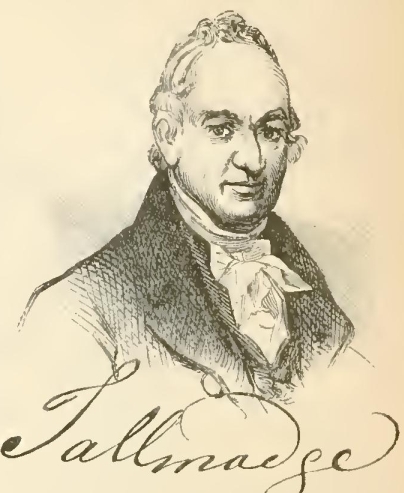
Local historians have made the record in detail; we will only glance at two or three of the most important military operations there, in which Major Benjamin Tallmadge was the chief leader. **
On the fifth of September, 1779, Major Tallmadge proceeded from Shipan Point, near Stamford, Connecticut, with one hundred and thirty of his light dragoons, dismounted, and at ten o'clock at night attacked five hundred Tory marauders, who were quite strongly intrenched upon Lloyd's Neck, on Long Island. *** The surprise was complete, and before morning he landed upon the Connecticut shore with almost the whole garrison as prisoners. He did not lose a man.
In the autumn of 1780, some Rhode Island Tory refugees took possession of the manor-house of General John Smith, at Smith s Point, fortified it and the grounds around it, and began cutting wood for the British army in New York.
* The expedition of Colonel Meigs against the enemy at Sag Harbor, and other exploits, will be noticed in the account of the whale-boat warfare, in the Supplement.
** Benjamin Tallmadge was born at Setauket, Long Island, on the twenty-fifth of February, 1754. He graduated at Yale College in 1773, and soon afterward took charge of a high school at Wethersfield. He entered a corps of Connecticut troops as lieutenant, in 1776, and was soon promoted to adjutant. He was one of the rear-guard when the Americans retreated from Brooklyn, and was in several of the principal battles in the Northern States during the war. His field of active exertions was chiefly in the vicinity of Long Island Sound. He had the custody of Major Andre from his arrest until his execution, and after that was actively employed against the enemy on Long Island. He was for a long time one of Washington's most esteemed secret correspondents. He retired from the army with the rank of colonel. He married the daughter of General William Floyd, of Mastic, in 1784. In 1800 he was elected a member of Congress from Connecticut, and served his constituents, in that capacity, for sixteen years. He died on the seventh of March, 1835, at the age of eighty-one years.
*** Lloyd's Neck is an elevated promontory between Oyster Bay and Huntington harbor. It was a strong position, and the fort covered the operation of wood-cutters for miles around. There the Board of Associated Loyalists established their head-quarters after their organization in December, 1780. This board was for the purpose of embodying such Loyalists as did not desire to enter military life as a profession, but were anxious to do service for the king. Governor William Franklin was president of the board, and in the course of 1781, they collected quite a little navy of small vessels in the Sound, and made Oyster Bay the place of general rendezvous. * Their chief operations were against the Whig inhabitants ol Long Island and the neighboring shore, by which a spirit of retaliation was aroused that forgot all the claims of common humanity. The manifest mischief to the royal cause which this association was working, caused its dissolution at the close of 1781. In July of that year, Count Barras, then at Newport, detached three frigates, with two hundred and fifty land troops, to attack this post, then garrisoned by about eight hundred refugee Tories. The enterprise proved unsuccessful, and, after capturing some British marines in Huntington Harbor, returned to New York. The stockade on Lloyd's Neck was called Fort Franklin.
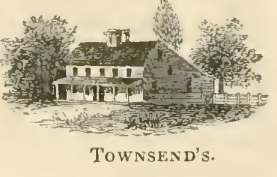
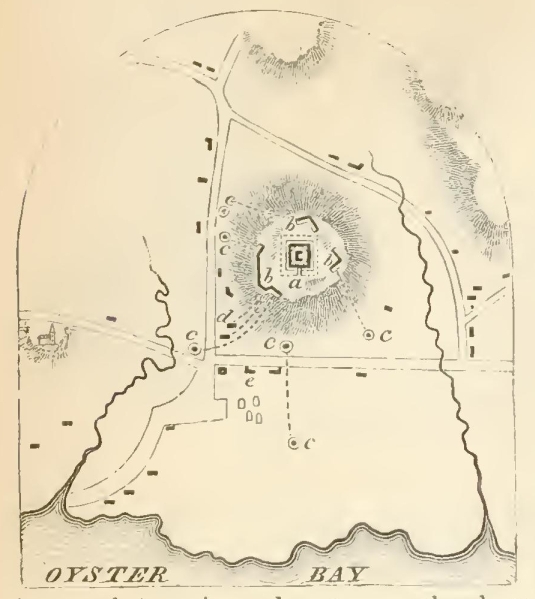
* Oyster Bay was an important point during the British occupation of the island. Sheltered from the Sound by a large island, it afforded a secure place for small vessels, and the fertile country around supplied ample forage. It was the head-quarters of Lieutenant-colonel Simcoe with the Queen's Rangers (three hundred and sixty in number), who made the village of Oyster Bay his cantonment during the winter of 1778-9. He arrived there on the nineteenth of November, 1778, and immediately commenced fortifying his camp. He constructed a strong redoubt upon an eminence toward the west end of the town, now (1851) the property of the Rev. Marmaduke Earle. The diteh and embankments are yet very prominent. This work was capacious enough for seventy men, and completely commanded the bay. These preparations were made chiefly because General Parsons was encamped on the Connecticut shore with about two thousand militia, and controlled a large number of whale-boats. Oyster Bay was made the central point of operations in this quarter. According to Simcoe's account, great vigilance was necessary during the winter, to prevent a surprise. For a sketch and explanation of Simcoe's camp at Oyster Bay, see the next page. Simcoe made his quarters at the house of Samuel Townsend, who was a member of the Provincial Assembly of New York in 1776, and there Major André and other young officers of the army often visited. His daughter, Miss Sarah Townsend, was then about sixteen years of age, and very attractive in person and manner. She was the toast of the young officers, and on Valentine's day, 1779, Simcoe presented her with a poetical address in laudation of her charms. This production may be found in Onderdonk's Revolutionary Incidents of Long Island, i., 215. Miss Townsend died in December, 1842, at the age of eighty years. The dwelling now belongs to her grand-niece, Mrs. Sarah T. Thorne.
Capture of Fort George.—Destruction of Stores at Corum.—Capture of Fort Siongo.—Badge of Military Merit.
At the solicitation of General Smith, and with the approval of Washington, Major Tallmadge proceeded to dislodge them. They had named their fortress Fort George, and appeared too strongly intrenched to be in fear. * Tallmadge crossed the Sound from Fairfield with eighty dismounted dragoons, and landed in the evening at Old Man's, now Woodville.Nov. 21, 1780 On account of a storm, he remained there until the next night, when, accompanied by Heathcote Muirson, he marched toward Fort George.
At the mills, about two miles from the fort, he procured a faithful guide, ** and at dawn he and his gallant soldiers burst through the stockade on the southwestern side, rushed across the parade, and, shouting "Washington and Glory!" they furiously assailed the redoubt upon three sides. The garrison surrendered without resistance. At that moment a volley was fired from the upper windows of the mansion. The incensed Americans burst open the doors, and would have killed every inmate, had not Major Tallmadge interfered.
Having secured his prisoners (three hundred in number), demolished the fort, and burned vessels lying at the wharf, laden with a great amount of stores, Tallmadge set out on his return at sunrise. On his way, leaving his corps in command of Captain Edgar, he proceeded with ten or twelve men to Corum, and there, after overpowering the guard, they destroyed three hundred tons of hay collected for the British army in New York. He arrived at Fairfield with his prisoners early in the evening, without losing a man. This brilliant exploit drew from Washington a very complimentary letter, and from Congress a gratifying resolution. ***
At Treadwell's Neck, near Smithtown, a party of Tory wood-cutters (one hundred and fifty in number) erected a military work, whieh they called Fort Siongo. This Major Tallmadge determined to assail.

On the evening of the ninth of October, 1781, he embarked one hundred and fifty of his dismounted dragoons, under Major Trescott, at the mouth of the Saugatuck Ptiver. They landed at four o'clock the next morning, and at dawn assailed the fort. Some resistance was made, when the garrison yielded, and Trescott was victorious without losing a man. He destroyed the blockhouse and two iron four-pounders, made twenty-one prisoners, and carried off a brass three pounder, the colors of the fort, seventy stand of arms, and a quantity of ammunition. ****
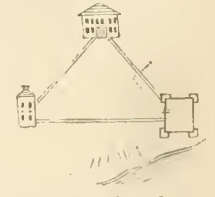
* Explanation of the above Plan of Oyster Bay Encampment.—a, redoubt; b b b, fleches; c c c c c c, quarters separately fortified; d, quarters of the Hussars; c, Townsend's house, Simcoe's quarters.
* This fort was upon Smith's Point, a beautiful and fertile promontory projecting into South Bay, at Mastic. It commands a fine view of the bay, and the village of Bellport. The property now belongs to the sons of General Smith. The fort consisted of a triangular inclosure of several acres of ground, at two angles of which was a strong barricaded house, and at the third was a strong redoubt, ninety-six feet square, with bastions, a deep ditch, and abatis. Between the houses and the fort were stockades twelve feet in height. It was embrasured for six guns; two only were mounted. This fort was intended as a depository of stores for the Tories of Suffolk county.—Onderdonk, ii., 96; Thompson, 289.
** This guide was William Booth, who resided near the mills. Mrs. Smith was also there, having been driven from her home. When Tallmadge informed her that he might be compelled to destroy her house, she at once said, "Do it and welcome, if you can drive out those Tories." The position of the house is seen in the diagram, at the top of the triangle. The dotted lines indicate the line of march in the attack. When I visited the spot in 1851, the lines of the fort might be distinctly traced northwestward of the mansion of the present occupant.
*** Journal, vi., 171.
**** In this enterprise as well as at Fort George, Sergeant Elijah Churchill, of the 2d regiment of dragoons, behaved so gallantly, that Washington rewarded him with the badge of military merit. *
* Washington established honorary badges of distinction in August, 1781.
They were to be conferred upon non commissioned officers and soldiers who had served three years with bravery, fidelity, and good conduct, and upon every one who should perform any singularly meritorious action. The badge entitled the recipient "to pass and repass all guards and military posts as fully and amply as any commissioned officer whatever." A board of officers for making such awards was established, and upon their recommendation the eommander-inchief presented the badge. The board, in Churchill's case, consisted of Brigadier-general Greaton, president; Colonel Charles Stewart, Lieutenant colonel Sprout, Major Nicholas Fish (father of ex-governor Fish, of New York), and Major Trescott. The MS. proceedings of the minutes of the board on this occasion are in the possession of Peter Force, Esq., of Washington City.
British occupation of New York City.—Residences of several of the Officers.—Prisons and Hospitals.
Every where eastward of Hempstead minor events of a similar character, but all having influence in the progress of the Revolution, were almost daily transpiring.
Let us now follow the British army into the city, and take a brief survey of the closing events of the war.
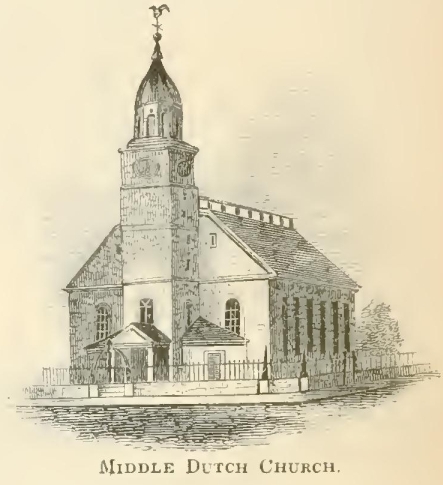
When the British felt themselves firmly seated on Manhattan Island after the fall of Fort Washington, they leisurely prepared for permanent occupation. General Robertson immediately strengthened the intrenchments across the island from Corlaer's Hook, erected barracks along the line of Chambers Street from Broadway to Chatham, and speedily placed the army in comfortable winter quarters. Nearly all of the Whig families whose means permitted them had left the city, and their deserted houses were taken possession of by the officers of the army and refugee Loyalists. *
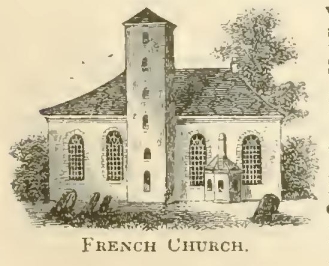
The dissenting churches were generally devoted to military purposes, ** and the spacious sugar-houses, then three in number, were made prisons for the American captives, when the cells of the City Hall and the provost prison were full. *** Looking with contempt upon the rebels in field and council, the British felt no anxiety for their safety, and every pleasure that could be procured was freely indulged in by the army.
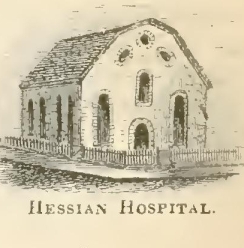
A theatre was established, tennis courts and other kinds of amusements were prepared, and for seven years the city remained a prey to the licentiousness of strong and idle detachments of a well-provided army.
This was the head-quarters of British power in America during that time, and here the most important schemes for operations against the patriots, military and otherwise, were planned and put in motion. The municipal government was overthrown, martial law prevailed, and the business of the city degenerated almost into the narrow operations of suttling.
* Sir Henry Clinton occupied No. 1 Broadway, and Sir William Howe the dwelling adjoining it. Toward the close of the war, Sir Guy Carleton (Lord Dorchester) also occupied No. 1. General Robertson resided first in William, near John Street, and afterward in Hanover Square. Knyphausen, when in the city, occupied Verplanck's house in Wall Street, near the Bank of New York, where also Colonel Birch, of the dragoons, resided. Admiral Digby and other naval officers, and also Prince William Henry (afterward William the Fourth of England), when here, occupied the city mansion of Gerardus Beekman, on the northwest corner of Sloat Lane and Hanover Square. Admiral Rodney occupied a house, now 256 Pearl Street, and Cornwallis's residence was three doors below it. Carleton's country residence was the mansion at Richmond Hill, corner of Variek and Charlton Streets, long the property of Colonel Aaron Burr. Admiral Walton occupied his own house (yet standing in Pearl Street, number 326, opposite the publishing house of Harper and Brothers), and there he dispensed generous hospitality.
** The Middle Dutch church (now the city post-office), on Nassau, Liberty, and Cedar Streets, was converted into a riding-school, where the British cavalry were taught lessons in horsemanship. The French Protestant church (Du St. Esprit), built by the Huguenots in 1704, near the corner of Pine and Nassau Streets, and the North Dutch church, corner of William and Fulton Streets, were converted first into prisons and then into hospitals. The quaint old church edifice which stood on the corner of William and Frankfort Streets until 1851 (when it was demolished, and a large hotel was placed upon its site), was a hospital for the Hessians, and all around the borders of the swamp close by, many of the poor Germans were buried.
*** These, and the events connected with them, will be noticed under the head of "Prisons and Prison-Ships," in the Supplement.
Counterfeit Continental Bills.—Expedition to Staten Island.—Second great Fire in New York.
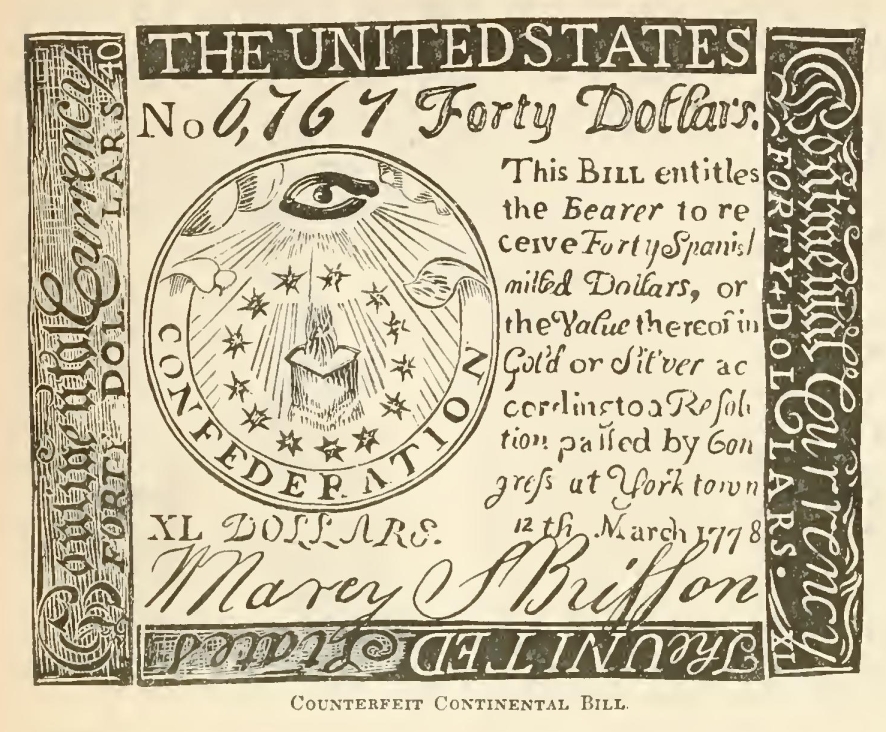
Here many petty depredating expeditions were planned; and from Whitehall many a vessel departed with armed troops to distress the inhabitants of neighboring provinces, * or with secret emissaries to discover the weakness of patriot camps, to encourage disaffection in the Republican ranks, and, by the circulation of spurious paper money ** and lying proclamations, to disgust the people and win their allegiance to the crown.
A record of the stirring incidents of the armed occupation of New York would fill a volume. *** It tempts the pen by many allurements, but I must leave the pleasure of such a task to the local historian, and hasten to a considera-
* We have already noticed most of these expeditions. Staten Island was held by the British during their occupancy of New York, and several schemes were planned to expel them. In the summer of 1777, the British force on the island amounted to between two and three thousand men, nearly one half of whom were Loyalists. General Sullivan, with Colonel Ogden of New Jersey, and a part of the brigades of Smallwood and Deborre.
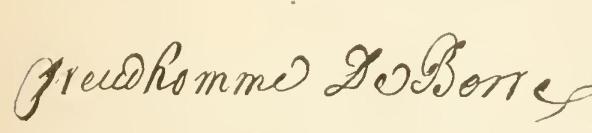
* (see page 381), crossed from Elizabethtown before daylight on the twenty-second of August. Two of the Tory parties, commanded by Colonels Lawrence and Barton, stationed near the present Factoryville, were surprised, and eleven officers and one hundred and thirty privates were made prisoners. Wanting a sufficient number of boats to convey the captives, a party of British attacked Sullivan's rear-guard, and made many of them prisoners. The whole loss of the Americans was three officers and ten privates killed, fifteen wounded, and nine officers and one hundred and twenty-seven privates made prisoners. General Campbell, who commanded the British on the island, reported two hundred and fifty-nine prisoners. It was during the cold month of January, 1780 ("the hard winter"), that Lord Stirling went on an expedition against the British on Staten Island. It was a re-enforcement of troops after this attack (see page 311, volume i.) that crossed the bay of New York, with heavy cannons, upon the ice.
** Among other schemes for annoying the Americans, and casting discredit upon Congress, the British resorted to the issue of "cart loads" of counterfeit Continental bills, so as to depreciate the currency. This fact is alluded to on page 318, volume i. It was no secret at the time, as appears by an advertisement * in Gaine's New York Mercury, April 14th, 1777. For two or three years these bills were circulated extensively, and doubtless had great effect in depreciating the Continental money. Francis, in his History of the Bank of England, ii., 79-80, says, that Premier Pitt, the younger, resorted to a similar trick, by causing a large number of French assignats to be forged at Birmingham, to depreciate the currency of the French Republic. Napoleon also caused forged notes of the Austrian Bank to be distributed throughout the Austrian Tyrol.
*** A second great conflagration in the city, during the British occupation, occurred on Saturday night, the seventh of August, 1778. It commenced at Cruger's Wharf, Coenties Slip, and before it was subdued three hundred houses were consumed. The next day was excessively hot, and at noon, while the smoke of the smouldering fire was yet rising from the ruins, a heavy thunder-storm burst over the city. At about one o'clock, while raging at its height, the city was shaken as if by an earthquake, and suddenly a column of dense smoke arose in the east and spread over the town. Tiles were shaken from the roofs of houses, and crockery was broken in some houses at Franklin Square. The shock was occasioned by the explosion of the magazine of a powder vessel lying in the East River, which was struck by lightning. The vessel had just arrived from England, and the event was regarded as a special interposition of Providence in behalf of the Americans.—See Dunlap, ii., 164.
* "Advertisement.—Persons going into other colonics may be supplied with any number of counterfeited Congress notes, for the price of the paper per ream. They are so neatly and exactly executed, that there is no risk in getting them off, it being almost impossible to discover that they are not genuine. This has been proven by bills to a very large amount which have already been successfully circulated. Inquire of Q. E. D., at the Coffee-house, from 11 A. M. to 4 P. M., during the present month."
Treaties for Peace.—The Continental Army.—Congress at Princeton.—Mutiny.—Washington's Circular Letter.
tion of the final evacuation of the city by the British army, and the parting of Washington with his officers.
After protracted negotiations for a year and a half, a definitive treaty of peace was signed at ParisSept. 3, 1783 between American and English commissioners. A provisional treaty had been signed about nine months previously,Nov. 30, 1782 and in the mean while preparations for a final adjustment of the dispute had been made. On account of the pecuniary embarrassments of Congress, the arrearages of pay due to the soldiers, and the prospect of a dissolution of the army without a liquidation of those claims, general gloom and discontent prevailed.
We have seen its alarming manifestation at Newburgh in the spring of 1783 (see page 106), and, though suppressed, it was never entirely subdued. It required all the personal influence and sagacity of Washington to keep the remnant of the Continental army in organization until the final evacuation of the British in the autumn of that year, and when that event took place the Republican troops were a mere handful. *
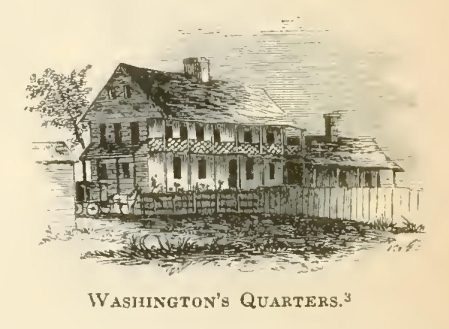
In August, Washington was called to attend upon Congress, then sitting at Princeton. ** He left General Knox in command of the little army at Newburgh and vicinity, and, with Mrs. Washington and a portion of his military family, he made his residence at Rocky Hill, near the Millstone River, about four miles from Princeton, where he remained until November, when he joined Knox and the remnant of the Continental army at West Point, preparatory to entering the city of New York. ****
* The number of soldiers furnished for the Continental army by each state, during the war, was as follows: New Hampshire, 12,497; Massachusetts, 67,907; Rhode Island, 5,908; Connecticut, 31,939; New York, 17,781; New Jersey, 10,726; Pennsylvania, 25,678; Delaware, 2,386; Maryland, 13,912; Virginia, 26,678; North Carolina, 7,263; South Carolina, 6,417; Georgia, 2,679. Total, 231,791.
** The cause of the assembling of Congress at Princeton was the violent spirit manifested by some of the Continental troops of the Pennsylvania line. These had marched in a body (June 21), three hundred in number, surrounded the State House, where Congress was in session, and, after placing guards at the door, demanded action for redress of grievances, within the space of twenty minutes, at the peril of having an enraged soldiery let in upon them. Congress was firm; declared that body had been grossly insulted, and resolved to adjourn to Princeton, where the members assembled on the twenty-sixth. As soon as Washington was informed of this mutiny, he sent General Robert Howe, with fifteen hundred men, to quell it. He soon quieted the disturbance. Some who were found guilty on trial were pardoned by Congress.
*** This is a view of the southwest front of the mansion. The room occupied by Washington is in the second story, opening out upon the piazza. It is about eighteen feet square, and in one corner is a Franklin stove like that delineated on page 328, volume i. The situation of the house, upon an eminence an eighth of a mile eastward of the Millstone River, is very pleasant. It is now quite dilapidated; the piazza is unsafe to stand upon. The occupant, when I visited it in 1850, was Mr. James Striker Van Pelt.
**** A great portion of the officers and soldiers had been permitted during the summer to visit their homes on furlough, and on the eighteenth of October Congress virtually disbanded the Continental army, by discharging them from further service. Only a small force was retained, under a definite enlistment, until a peace establishment should be organized. These were now at West Point, under the command of General Knox. The proclamation of discharge, by Congress, was followed by Washington's farewell address to his companions in arms. He had already issued a circular letter (Newburgh, eighth of June, 1783) to the governors of all the states on the subject of disbanding the army. It was designed to be laid before the several State Legislatures. It is a document of great value, because of the soundness of its doctrines, and the weight and wisdom of its counsels. Four great points of policy constitute the chief theme of his communication, namely, an indissoluble union of the states; a sacred regard for public justice; the organization of a proper peace establishment; and a friendly intercourse among the people of the several states, by which local prejudice might be effaced. "These," he remarks, "are the pillars on which the glorious fabric of our independency and national character must be supported." No doubt this address had great influence upon the minds of the whole people, and made them yearn for that more efficient union which the Federal Constitution soon afterward secured.
British prepare to Evacuate New York.—Washington's Farewell Address to the Army.—The Evacuation.—Clinton and Knox.
On the seventh of August,1783 Sir Guy Carleton, then in chief command of the British army, received instructions to evacuate the city of New York.
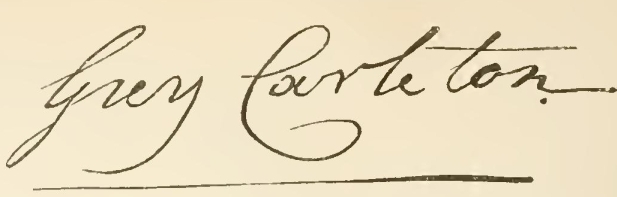
This event was delayed in order to make arrangements for the benefit of the Loyalists in the city and state, and it was not until late in October when Carleton notified Washington of his determination to leave our shores.
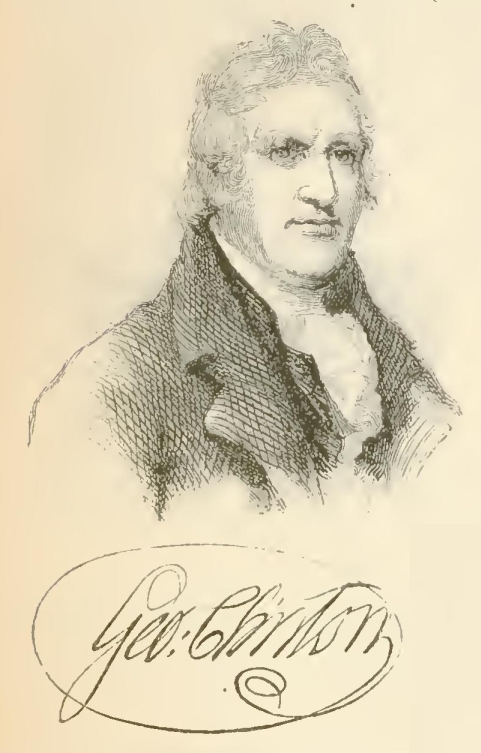
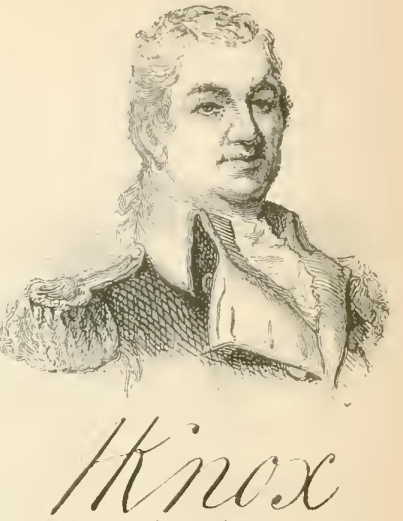
On the second of November, Washington issued his "Farewell Address to the Armies of the United States" ** from Rocky Hill, and on the fourteenth of the same month he conferred with Governor Clinton, *** and made arrangements to enter and take possession of the city. Clinton issued an appropriate proclamation on the fifteenth, and summoned the officers of the civil government to meet him in council at East Chester. A day or two afterward, Washington, Clinton, and Carleton held a conference at Dobbs's Ferry (see page 195), and the twenty-fifth was fixed upon as the time for the exodus of the British troops. Both parties adopted measures for the preservation of order on the occasion. On the morning of that day—a cold, frosty, but clear and brilliant morning—the American troops, under General Knox, **** who had come down from West Point and encamped at Harlem, marched to the Bowery Lane, and halted at the present junction of Third Avenue and the Bowery. There they remained until about one o'clock in the afternoon, when the British left their posts in that vicinity and marched to Whitehall. (v) The
* The Loyalists, fearful of meeting with unpleasant treatment from the irritated Americans, prepared to leave the country in great numbers, and fled to the British province of Nova Scotia. The delay in question was in consequence of a want of a sufficient number of transports to convey these people and their effects. A further notice of the Loyalists will be found in the Supplement.
** This, like his letter to the governors, was an able performance. After affectionately thanking his companions in arms for their devotedness to him through the war, and for their faithfulness in duty, he gave them sound and wise counsel respecting the future, recommending them, in a special manner, to support the principles of the Federal government, and the indissolubility of the union.
*** George Clinton was born in Ulster eounty, New York, in 1739. He chose the profession of the law for his avocation. In 1768, he was elected to a seat in the Colonial Legislature, and was a member of 'he Continental Congress in 1775. He was appointed a brigadier in the army of the United States in 1776, and during the whole war was active in military affairs in New York. In April, 1777, he was elected governor and lieutenant governor, under the new Republican Constitution of the state, and was continued in the former office eighteen years. He was president of the convention assembled at Poughkeepsie to consider the Federal Constitution in 1788. He was again chosen governor of the state in 1801, and three years afterward he was elected Vice-president of the United States. He occupied that elevated position at the time of his death, which oeeurred at Washington City in 1812.
**** Henry Knox was born in Boston in 1750. He was educated at a common sehool, and at the age of twenty years commenced the business of bookseller in his native town. He was engaged in that vocation when the Revolutionary storm arose, and his sympathies were all with the patriots. He was a volunteer in the battle of Bunker Hill, and for this and subsequent services Congress commissioned him a brigadier, and gave him the command of the artillery department of the army, which he retained during the whole war. He was always under the immediate command of Washington, and was with him in all his battles After the capture of Cornwallis, Congress commissioned him a major general. In 1785, he succeeded Lincoln in the office of Secretary of War, which position he held for eleven years, when he retired into private life. He died at Thomaston, Maine, in 1806, at the age of about fifty-six years. To General Knox is conceded the honor of suggesting that noble organization, the Society of the Cincinnati.
* (v) The British claimed the right of possession until noon of the day of evacuation. In support of this claim, Cunningham, the infamous provost marshal exercised his authority. Dr. Alexander Anderson, of New York, related to me an incident which fell under his own observation. He was then a lad ten years of age, and lived in Murray, near Greenwich Street. A man who kept a boarding-house opposite ran up the American flag on the morning of the twenty-fifth. Cunningham was informed of the fact, and immediately ordered him to take it down. The man refused, and Cunningham attempted to tear it down. At that moment the wife of the proprietor, a lusty woman of forty, came out with a stout broomstick, and beat Cunningham over the head so vigorously, that he was obliged to decamp and leave the "star-spangled banner" waving. Dr. Anderson remembers seeing the white powder fly from the provost marshal's wig.
Entrance of the Americans.—Parting of Washington with his Officers.—Rejoicings in New York.
American troops followed, * and before three o'clock General Knox took formal possession of Fort George amid the acclamations of thousands of emancipated freemen, and the roar of artillery upon the Battery.
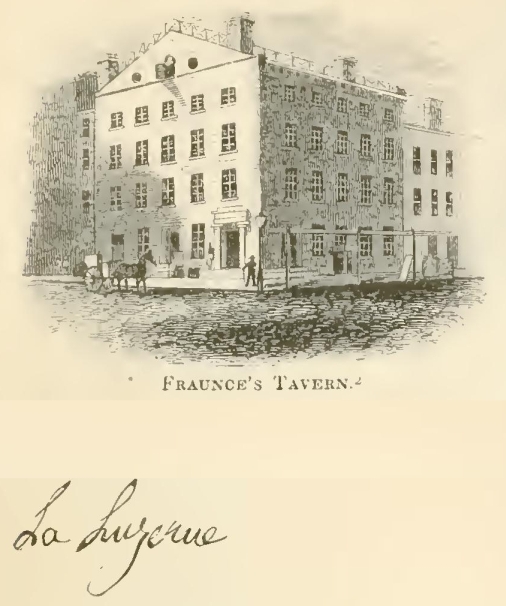
Washington repaired to his quarters at the spacious tavern of Samuel Fraunce, and there during the afternoon, Governor Clinton gave a public dinner to the officers of the army, and in the evening the town was brilliantly illuminated.
Rockets shot up from many private dwellings, and bonfires blazed at every corner. On Monday following,Dec. 1,1783 Governor Clinton gave an elegant entertainment to Luzerne (the French embassador), General Washington, the principal officers of the State of New York and of the army, and more than a hundred other gentlemen.
On ThursdayDec. 4 the principal officers of the army yet remaining in service assembled at Fraunce's, to take a final leave of their beloved chief. The scene is described as one of great tenderness. Washington entered the room where they were all waiting, and taking a glass of wine in his hand, he said, "With a heart full of love and gratitude, I now take leave of you. I most devoutly wish that your latter days may be as prosperous and happy as your former ones have been glorious and honorable." Having drank, he continued, "I can not come to each of you to take my leave, but shall be obliged to you if each will come and take me by the hand." Knox, who stood nearest to him, turned and grasped his hand, and, while the tears flowed down the cheeks of each, the commander-in-chief kissed him. This he did to each of his officers, while tears and sobs stifled utterance.*** Washington soon left the room, and passing through corps of light infantry, b Dec. 4
* The troops entered the city from the Bowery, through Chatham Street, in the following order: 1. A corps of light dragoons. 2. Advanced guard of light infantry. 3. A corps of artillery. 4. A battalion of light infantry. 5. A battalion of Massachusetts troops. 6. Rear-guard.
* Washington with his staff, and Governor Clinton and the state officers, soon afterward made a public entry, as follows: 1. The general and governor, with their suite, on horsebaek, escorted by a body of West Chester light horse, commanded by Captain Delavan. 2. The lieutenant governor and the members of the council for the temporary government of the Southern District of the state, four abreast. 3. Major-General Knox and the officers of the army, eight abreast. 4. Citizens on horsebaek, eight abreast. 5. The speaker of the Assembly and citizens on foot, eight abreast.
* The British army and the refugees who remained were all embarked in boats by three o clock in the afternoon, and at sunset they were assembled upon Staten and Long Islands, preparatory to their final embarkation. * Before they left, the British flag was nailed to the flag-staff in Fort George, the eleets were knocked off, and the pole was greased so as to prevent ascent. New eleets were soon procured, a sailor-boy ascended as he nailed them on, and, taking down the British flag, placed the stripes and the stars there, while the cannons pealed a salute of thirteen guns.
** See note 1, page 796.
*** Gordon, iii., 377; Marshall, ii., 57. Only one of the participators in this interesting scene is now living. That honored man is Major Robert Burnet, whose portrait may be found on page 118. Major Burnet commanded the rear-guard on the entrance of the American army into the city.
* The British left these two islands a few days afterward, and then the evacuation of the sea-board was complete. Western and northern frontier posts (Oswegatchie, Oswego, Niagara, Presque Isle, Sandusky, Detroit, Mackinaw, and others of less note) continued in the possession of British garrisons for some time afterward.
Washington's Departure for, and Journey to Annapolis.—His account current of Expenses.—Lady Washington.
he walked in silence to Whitehall, followed by a a barge to proceed to Paulus's Hook on his way to lay his commission at the feet of Congress, at Annapolis. *
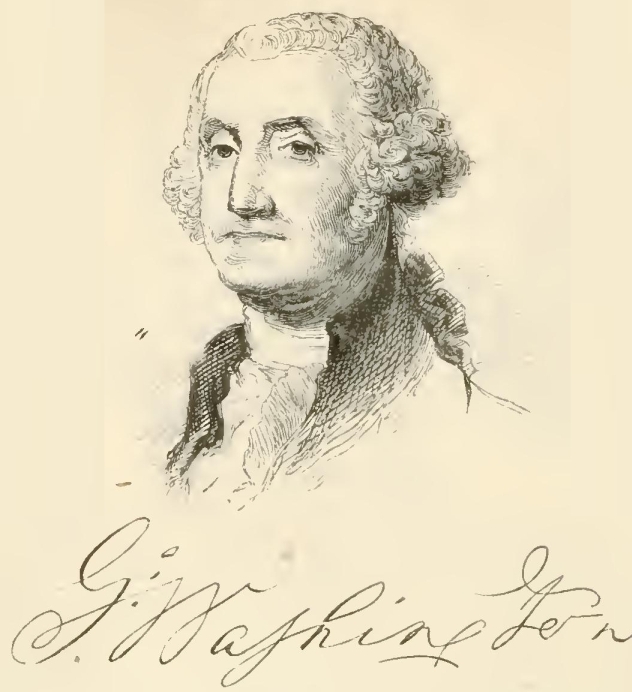
When he entered his barge, he turned to the people, took off his hat, and waved a silent adieu to the tearful multitude. *
Washington remained a few days in Philadelphia, where he delivered in his accounts to the proper officers, ** and then hastened, with his wife, to Annapolis, where he arrived on the evening of the nine-with ladies, among whom was Mrs. Washington vast procession, and at two o'clock entered.Dec. 1783 The next day he informed Congress of his desire to resign his commission as commander-in-chief of the armies of the United States. That body resolved that it should be done at a public audience the following Tuesday,Dec. 23 at meridian. The day was fine, and around the State House (see page 402) a great concourse was assembled. The little gallery of the Senate Chamber was filled. ***
* Congress had adjourned to meet at Annapolis, in Maryland, on the twenty-sixth of November. A quorum was not present until Saturday, the thirteenth of December, when only nine states were represented.
** The account current of his expenditures for the public service during the war, rendered by Washington, was in his own handwriting. The total amount was about seventy-four thousand four hundred and eighty-five dollars. * The disbursements were for reconnoitering and traveling, secret intelligence service, and miscellaneous expenses. It will be remembered that Washington refused to receive any compensation for his own services.
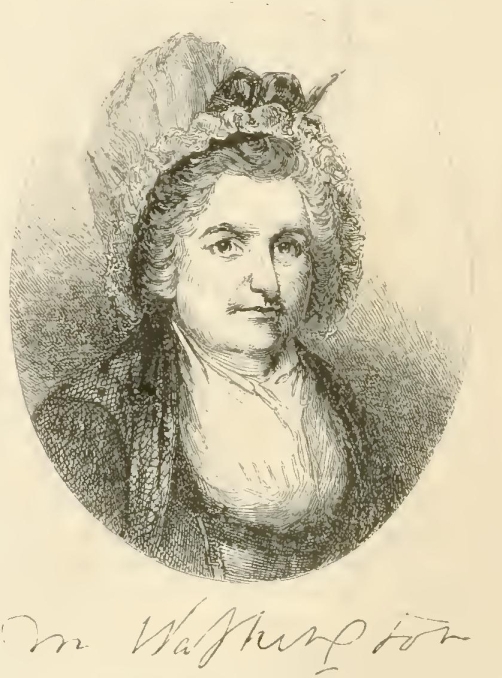
*** Martha Dandridge was born in New Kent county, Virginia, in May, 1732. In 1749 she was married to Colonel Daniel Parke Custis, of New Kent, and settled with her husband on the bank of the Pamunky River, where she bore four children. Her husband died when she had arrived at the age of about twenty-five, leaving her in the possession of a large fortune. In 1758 she became acquainted with Colonel Washington, whose greatness was just budding, and whose fame had spread beyond Virginia. He became her suitor, and they were married. The exact period of their marriage has not been found on record; it is supposed to be in 1759. They removed to Mount Vernon soon after that event, and there was their home during the remainder of their lives. During the war for independence, she occasionally visited her husband in camp. Almost at the very hour of his great victory at Yorktown, a cloud came over her, for then her only surviving child expired. While Washington was President of the United States, Mrs. Washington presided with dignity in the mansion of the chief magistrate. The quiet of private life had more charms for her than the brilliancy of public greetings, and she joyfully sought the banks of the Potomac when her husband's second presidential term was ended. A little more than two years afterward, she was called to mourn his death. **
* The pecuniary cost of the war, exclusive of the vast losses by the ravages of plantations, burning of houses and towns, plunder by Indians and the British soldiery, &c., &c., was not less than one hundred and seventy millions of dollars. Of this sum, Congress disbursed about two thirds; the remainder was spent by the individual states. It had been raised "by taxes under the disguise of a depreciating currency; by taxes directly imposed; by borrowing; and by running in debt."—See Hildreth's History of the United States, iii., 445.
** We have already noted (see page 425) the principal events in the public life of General Washington, until his appointment.
Volume I.