Volume 2 — CHAPTER XXXI.
Reading edition
"In the year seventy-six came the two noble brothers.
With an army and fleet fit to conquer a world;
And Cornwallis, and Rawdon, and Tarleton, and others—
And murder and rapine on our country were hurl'd."
Yankee Chronology.
"There the old-fashioned colonel galloped through the white infernal
Powder cloud;
And his broad sword was swinging, and his brazen throat was ringing
Trumpet loud:
There the blue bullets flew,
And the trooper jackets redden at the touch of the leaden
Rifle breath;
And rounder, rounder, rounder, roared the iron six-pounder,
Hurling Death!"
Knickerbocker Magazine.


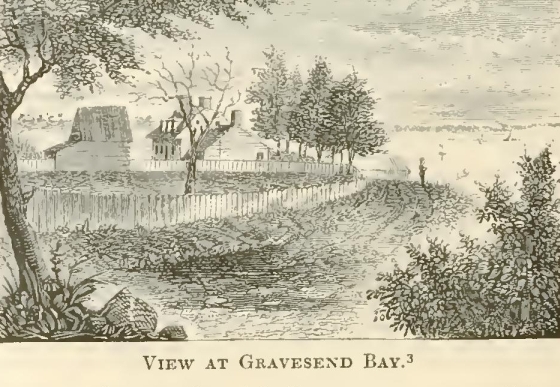
N Thursday morning, the twenty-second of August, 1776, the British troops under General William Howe landed upon Long Island, in the vicinity of New Utrecht. Four thousand men crossed the ferry from Staten Island, at the Quarantine Ground, to Denyse's strong stone house, where Fort Hamilton now stands, and landed under cover of the guns of the Rainbow, anchored where Fort La Fayette looms up in the center of the Narrows. Some riflemen, under Colonel Edward Hand, posted on the hill above, retired toward Flatbush. An hour afterward, British and Hessian troops poured over the sides of the English ships and transports, and in long rows of boats, directed by Commodore Hotham, five thousand more soldiers landed upon Long Island, in the bow of Gravesend Bay (at a place known as Bath, in front of New Utrecht), under cover of the guns of the Phonix, Rose, * and Greyhound.
The chief commanders of the English were Sir Henry Clinton, Earls Cornwallis and Percy, and Generals Grant and Sir William Erskine. Count Donop, who was killed at Red Bank in 1777, landed, with some Hessians, with the first division, and on the twenty-fifth,August, 1776 the veteran De Heister, ** with Knyphausen, and two Hessian brigades, also landed near New Utrecht. The whole invading force was about ten thousand men well armed, with forty cannons. Lieutenant-colonel Dalrymple remained to keep Staten Island.
* The Rose and Phoenix, after remaining in Haverstraw Bay three weeks, had passed the American batteries and joined the fleet.—See page 802.
** Lieutenant-general De Heister was an old man, and warmly attached to his master, the Landgrave of Hesse Cassel. The long voyage of almost fourteen weeks dispirited him, "and," says Sir George Collier, "his patience and tobacco became exhausted." A sniff of land breeze revived him. "He called for Hock, and swallowed large potations to the health of his friends."
*** This view is from the road on the high shore, a little below Fort Hamilton, looking southeast; the house in the center belonged to Simon Cortelyou, a Tory, during the Revolution, and has not been altered. Gravesend Bay is seen beyond the house, and the distant land is Coney Island beach.
Alarm in New York.—General Putnam.—General John Morin Scott
When this movement of the enemy was known in New York, alarm and confusion prevailed. * Re-enforcements were sent to General Sullivan, then encamped at Brooklyn, and the next day the veteran General Putnam ** was ordered thither by Washington, to take the supreme command there. The military works on Long Island had been constructed under the immediate direction of General Greene, who made himself acquainted with every important point between Hell Gate and the Narrows. Unfortunately, he fell sick, and none knew so well as he the importance of certain passes in the rear of Brooklyn. The chief fortifications were within the limits of the present city, *** while at the passes alluded to
* Many Whig families left the city, and for seven long years of exile they endured privations with heroic fortitude. * Many of their houses were destroyed by fire, and others were ruined by military occupants.
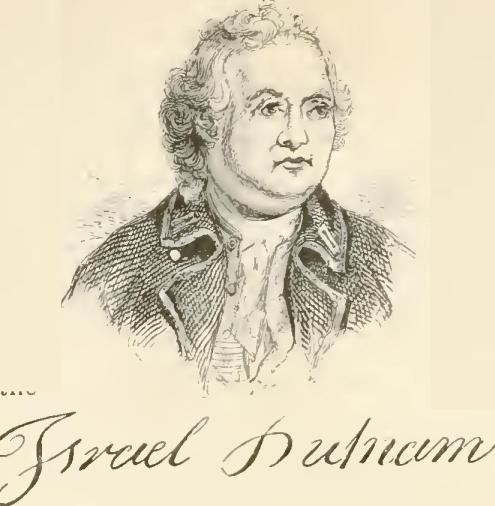
** Israel Putnam was born in Salem, Massachusetts, on the seventh of January, 1718. He was a vigorous, athletic lad, and in 1739 we find him cultivating land in Pomfret, Connecticut. He was appointed to the command of the first troops raised in Connecticut for the French and Indian war in 1755, in which capacity the reader has met him several times in these volumes. He returned to his farm after the peace, where he remained until he heard of the affair at Lexington. At the head of Connecticut troops, he distinguished himself in the battle of Bunker Hill. He was one of the four major generals appointed by Congress in 1775. His services during the war are mentioned in many portions of this work, and we will not repeat them here. His last military services were performed at West Point and vicinity in 1779, where he was chiefly engaged in strengthening the fortifications. Paralysis of one side impaired the activity of his body, but his mind retained its powers until his death. He lived in retirement after the war, and died at Brooklyn, Windham county, Connecticut, on the twenty-ninth of May, 1790, aged seventy-two years. His remains repose beneath a marble slab in the grave-yard south of the village, upon which is an appropriate inscription.
*** Over all the sites of Revolutionary fortifications, near Brooklyn, the modern city is rapidly spreading. Streets and avenues reticulate the whole area, and it is difficult now to identify the consecrated places.
* I have before me a manuscript letter, written by a daughter of General John Morin Seott, from Elizabethtown, three days after the landing of the British on Long Island, whieh exhibits the alarms and privations to which wealthy families, who had left the city, were subjected. After mentioning their hourly expectation of the landing of the British at Elizabethtown Point, she says: "We have our coach standing before our door every night, and the horses harnessed ready to make our escape, if we have time. We have hardly any clothes to wear: only a second change." Warned by Governor Livingston to leave Elizabethtown, the family of General Scott fled at night to Springfield, in the midst of a terrible thunder-storm. The writer continues: "We were obliged to stop on the road and stay all night, and all the lodging we could get was a dirty bed on the floor. How hard it seems for us, that have always been used to living comfortable!... Papa, with his brigade, has gone over to Long Island, whieh makes us very uneasy. Poor New York! I long to have the hattle over, and yet I dread the consequences." This letter is in the possession of her grandson, Charles S. M'Knight, Esq., of New York.
* John Morin Scott was an early opponent of British oppression, the coadjutor of Sears, Lamb, Willett, and others. He was a descendant of the baronial family of Scott of Ancram, Teviotdale, Scotland, and was born in New York in 1730. He graduated at Yale College in 1746. He adopted the profession of the law, married Helena Rutgers, of New York, and made that city his field of active usefulness. With William Livingston, of New Jersey, his voice and pen boldly advocated extreme measures, and, because of his ultra Whig principles, the timid ones defeated his election to the General Congress in 1774. He was one of the most active and influential members of the General Committee of New York in 1775, and was a member of the Provincial Congress that year. On the ninth of June, 1776, he was commissioned a brigadier, which office he held until March, 1777. He was with his brigade in the battle of Long Island, and was one of the Council of War called by Washington to decide whether lo fight longer or retreat. He was afterward with General Heath in the lower part of West Chester, but left the service in March, 1777, when he was appointed secretary of the State of New York. He was a member of the General Congress in 1782 and 1783. In 1784 he was elected an honorary member of the Society of the Cincinnati. He died on the fourteenth of September of the same year, in the fifty-fifth year of his age. His remains lie in Trinity church-yard with those of his ancestors, close by the railing on Broadway, north of the great entrance-door to the church. I am indebted to John Morin Scott, Esq., of Philadelphia, a grandson of the general, for the materials of this brief sketch.
** This monument is erected to the memory of the Honorable Israel Putnam, Esq., major general in the armies of the United States of America; who was born at Salem, in the Province of Massachusetts, on the seventh day of January, 1718, and died at Brooklyn, in the State of Connecticut, on the twenty-ninth day of May, A.D. 1700. Passenger, if thou art a soldier, go not away till thou hast dropped a tear over the dust of a Hero, who, ever tenderly attentive to the lives and happiness of his men, dared to lead where any one dared to follow. If thou art a patriot, remember with gratitude how much thou and thy country owe to the disinterested and gallant exertions of the patriot who sleeps beneath this marble. If thou art an honest, generous and worthy man, render a sincere and cheerful tribute of respect to a man whose generosity was singular; whose honesty was proverbial; and who, with a slender education, with small advantages, and with powerful friends, raised himself to universal esteem, and to offices of eminent distinction by personal worth, and hy the diligent services of a useful life."
The "Passes."—Miles and Woodhull.—Fortifications near Brooklyn.
breast-works were cast up. These rows to the Jamaica road, at the present East New York, and in broken elevations further on. There were several roads traversing the flat country in the rear of these hills.
These Colonel Miles, of Pennsylvania, was directed to reconnoiter with his regiment, to watch and report upon the progress of the enemy. To Sullivan was intrusted command of the troops without the lines, assisted by Brigadier-general passes were in a range of hills extending from the Nar—Lord Stirling; General Woodhull (late president of the Provincial Congress), now in arms, was commissioned to deprive the invaders of provisions by removing the live stock to the plains of Hempstead.
The invading army prepared for marching soon after the debarkation. The Hessians, under De Heister, formed the center or main body; the English, under General Grant, composed the left wing, which rested
* By a careful comparison of maps, military plans, and other authorities, with maps of the modern city, I have endeavored to locate the various works. I am satisfied that there will be found no material errors in the statement.
* The first work erected, after fortifying Red Hook and constructing Fort Stirling, on Brooklyn Heights (see page 799), was a redoubt called Fort Putnam, upon a wooded hill near the Wallabout, now known as Fort Greene and Washington Square. This was a redoubt with five guns; and when the trees were felled, it commanded the East River, and the roads approaching Brooklyn from the interior. An intrenchment extended from Fort Putnam northwesterly down the hill to a spring now(1852,) in a tanning yard, with a pump in it, near the intersection of Portland Street and Flushing Avenue. This spring was then on the verge of the Wallabout. From the western side of the fort an intrenehment extended in zigzag course across the Flatbush road, near the junction of Flatbush Avenue and Power Street, to Freek's mill-pond, at the head of Gowanus Creek, near the junction of Second Avenue and Carroll Street. Near the intersection of Nevins and Dean Streets, about half way between Fort Putnam and the mill pond, on the land of Debevoise and Vanbrunt, a redoubt was constructed with five guns, and called Fort Greene.
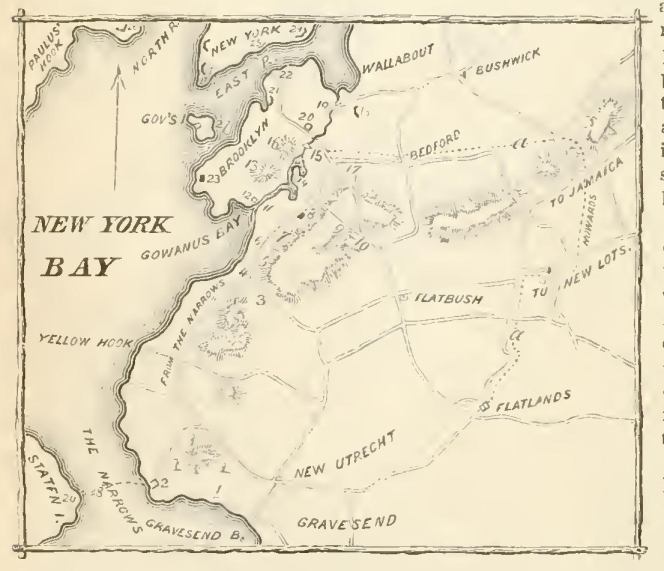
* A little eastward of Fort Putnam, near the Jamaica road, was a small redoubt; and upon the slope of Bergen Hill (also ealled Boerums's Hill), opposite Brower's mill, was a small redoubt with four guns. It stood between Smith Street and First Avenue, not far from the termination of Hoyt Street, at Carroll. This is supposed to be Box Fort. It was afterward strengthened by the British while a detachment lay encamped on Bergen Hill. Last year (1851) a friend of the writer picked up arrow heads, and buttons marked "42" (42d Highlanders), on the site of this redoubt. At the head of the tunnel of the Long Island rail way, in the vicinity of Boerum and Atlantic Streets, was a high, conical hill, called Ponkiesbergh and Cobble Hill. A redoubt for three cannons was constructed on the top of this hill, and, from the circumstance that an intrenchment extended spirally from summit to base, it was called Cork-screw Fort.—(See Onderdonk's Revolutionary Incidents of Long Island, ii" 118.) This redoubt remained until 1812, when it was strengthened and ealled Fort Swift. Fort Putnam was strengthened at the same time, and called Fort Greene. The banks then raised on those of the fort of the Revolution were very prominent until the present year (1852), when diluted patriotism and bad taste allowed them to be leveled so as to give the face of Washington Square a smooth appearance. To the eye of a true American there is more beauty in a single mound consecrated by patriotism than in a score of graveled walks trodden by the gay and thoughtless. These several fortifications, with other localities and events mentioned in the account of the battle, will be better understood by reference to the accompanying map, which is a reduced copy of one carefully prepared by Henry Onderdonk, Jr., and published in his valuable collection of Revolutionary Incidents of Long Island. Mr. Onderdonk has thoroughly explored the ground we are considering; and to him, as a cicerone, when visiting the field of conflict, I am much indebted for a knowledge of the various localities.
* Explanation of the Plan.—Figure 1, Gravesend beach, where the British landed; 2, Denyse's (Fort Hamilton); 3, Martense's Lane, along the southern boundary of Greenwood Cemetery, extending from Third Avenue, at the lower end of Gowanus Bay, to the Flatbush and New Utrecht road; 4, Red Lion tavern; 5, Grant's forces; 6, Stirling's forces; 7, Stirling's last encounter; 8, Cortelyou's house; 9, Port or Mill road; 10, Flatbush pass; 11, Americans retreating across the creek; 12, Party of Americans covering the retreat; 13, Box Fort; 1-1, Brower's mill; 15, Fort Greene, near the mill-pond; 16, Cork-screw Fort; 17, Baker's tavern, near the junction of Fulton and Flatbush Avenues; 18, British redoubt, cast up after the battle; 19, Fort Putnam, now Fort Greene; 20, Stone church, where Washington held a council of war; 21, Fort Stirling; 22, The ferry, foot of Fulton Street; 23, Fort at Red Hook; 24, Corlaer's Hook; 25, Battery, foot of Catharine Street; 20, Panlus' Hook; 27, Governor's Island; 28, The Narrows; 29, Vandeventer's Point; 30, Shoemaker's Bridge, near New Lots. Bennet's Cove is near figure 4, where, it is said, three thousand British troops landed on the morning of the twenty-seventh of August, the day of the battle, a a, track of the left wing of the British army, under the immediate command of General Howe, from Flatlands, by way of the present East New York (Howard's half-way house) to Brooklyn. While in possession of New York and vicinity, the British so strengthened Fort Stirling, on Brooklyn Heights, that it assumed the character of a regular fortification, with four bastions, similar to Fort George, in New York. They also east up a line of intrenchments along the brow of the hill from the Heights to the present Navy Yard.
March of the British.—Advantage gained.—Advance of Grant toward Gowanus.
on New York Bay; and the right wing, designed for the principal performance in the drama about to be opened, was composed of choice battalions, under the command of Clinton, Cornwallis, and Percy, accompanied by Howe, the commander-in-chief. While Grant and De Heister were diverting the Americans on the left and center, the right was to make a circuitous march by the way of Flatlands, to secure the roads and passes between that village and Jamaica, and to gain the American left, if possible. This division, under the general command of Clinton, moved from Flatlands on the evening of the twenty-sixth,August, 1776 and, guided by a Tory, passed the narrow causeway, over a marsh near the scattered village of New Lots, * called Shoemaker's Bridge. At two o'clock in the morning they gained the high wooded hills within half a mile of the present village of East New York, unobserved by Colonel Miles and the American patroles, except some subaltern officers on horseback, whom they captured. Informed that the Jamaica road was unguarded, Clinton hastened to secure the pass, and before daylight that important post and the Bedford pass ** were in his possession, and yet General Sullivan was ignorant of the departure of the enemy from Flatlands. Expecting an attack upon his right, in the vicinity of Gowanus, all his vigilance seems to have been turned in that direction, and he did not send fresh scouts in the direction of Jamaica. The advantage thus gained by Clinton decided the fortunes of the day.
While the British right wing was gaining this vantage ground, General Grant, with the left, composed of two brigades, one regiment, and a battalion of New York Loyalists raised by Tryon, made a forward movement toward Brooklyn, along the coast road, *** by way of Martense's Lane—"the road from Flatbush to the Red Lion" (4) mentioned by Lord Stirling. The guard at the lower pass (3) gave the alarm, and at three o'clock in the morningAugust 27 Putnam detached Lord Stirling, **** with Pennsylvania, Delaware, and Maryland regiments, commanded by Atlee, Haslet, and Smallwood, to oppose Grant. The militia guard at Martense's Lane were driven back by Grant to the hills of Greenwood Cemetery, a little north of Sylvan Water, where they were rallied by Parsons, and maintained a conflict until the arrival of Stirling (v) at daybreak, with fifteen hundred men.
* New Lots village is about a mile south of the rail-way station at East New York, upon the same plain. The morass at Shoemaker's Bridge (30 on map, page 806) is now only a wet swale, with a small sluggish stream, and presents none of the difficulties of passage of former days. It is said that at the time in question a single regiment might have kept the whole British force at bay at Shoemaker's Bridge.
** There were four important passes through the hills which should have been well guarded, namely, at Martense's Lane (3), on the southern border of Greenwood Cemetery; the Flatbush pass, at the junction of the present Brooklyn and Flatbush turnpike and the Coney Island Plank road; the Bedford pass, about half a mile northward of the junction of the Flatbush and Bedford roads; and the Jamaica pass, a short distance from East New York, on the road to Williamsburgh, just at the entrance to the Cemetery of the Evergreens. At East New York, "Howard's half-way house" of the Revolution is yet standing, though mueh altered. William Howard, a son of the Whig tavern-keeper, is yet (1852) living there, at the age of ninety. He told me that he remembers well seeing the British approaching from New Lots, and then taking his father a prisoner and compelling him to show them the Jamaica pass, and the best route over the hills east of it, to the open country toward Brooklyn. We sat in the room in which he was born eighty-nine years before.
*** It must be remembered that the present road along the verge of the high bank from Yellow Hook to Gowanus did not exist. The "coast road" was on the slopes further inland, and terminated at Martense's Lane.
**** Lord Stirling was in the English House of Commons on the seeond of February, 1775, when this same General Grant declared in debate that the Americans "could not fight," and that he would undertake to march from one end of the Continent to the other with five thousand men."—Duer's Life of Lord Stirling, 162; Par. Reg., i., 135.
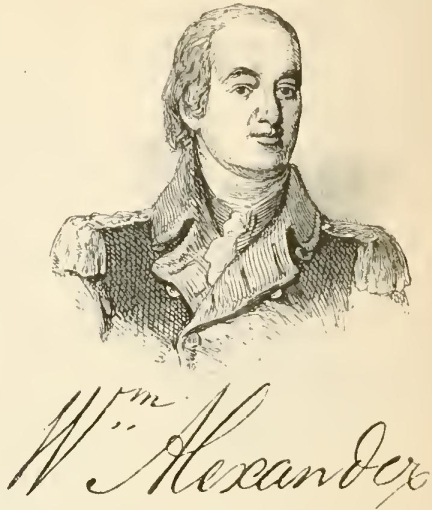
* (v) William Alexander, earl of Stirling, was born in the eity of New York in 1726. His father, James Alexander, was a native of Scotland, and took refuge in America in 1716, after an active espousal of the ling took position upon the slopes a little northwest of "Battle Hill," in Greenwood, and Atlee ambuscaded in the woods on the left of Martense's Lane, near the Firemen's Monucause of the pretender, in the rebellion the previous year. His mother was the widow of David Provoost, better known in the city of New York, a little more than a century ago, as "Ready-money Provoost."* Young Alexander joined the army during a portion of the French and Indian war, and was aid-de-camp and secretary to General Shirley. He accompanied that officer to England in 1755, and while there he made the acquaintance of some of the leading statesmen of the time. By the advice of many of them, he instituted legal proceedings to obtain the title of Earl of Stirling, to which his father was heir presumptive when he left Scotland" Although he did not obtain a legal recognition of the title, his right to it was generally conceded, and from that time he was addressed as Earl of Stirling. He returned to America in 1761, and soon afterward married the daughter of Philip Livingston (the second lord of the manor), a sister of Governor Livingston, of New Jersey, and built a fine mansion (yet standing) at Baskenridge, in that state. He was a member of the Provincial Council of New Jersey for several years. In 1775, the Provincial Convention of New Jersey appointed him colonel of the first regiment of militia, and in March, 1776. the Continental Congress gave him the commission of brigadier. Lee left him in command at New York in April. He was conspicuous in the battle near Brooklyn in August, and in February ensuing Congress appointed him a major general. He performed varied and active service until the summer of 1781, when he was ordered to the command of the Northern army, his head-quarters at Albany.
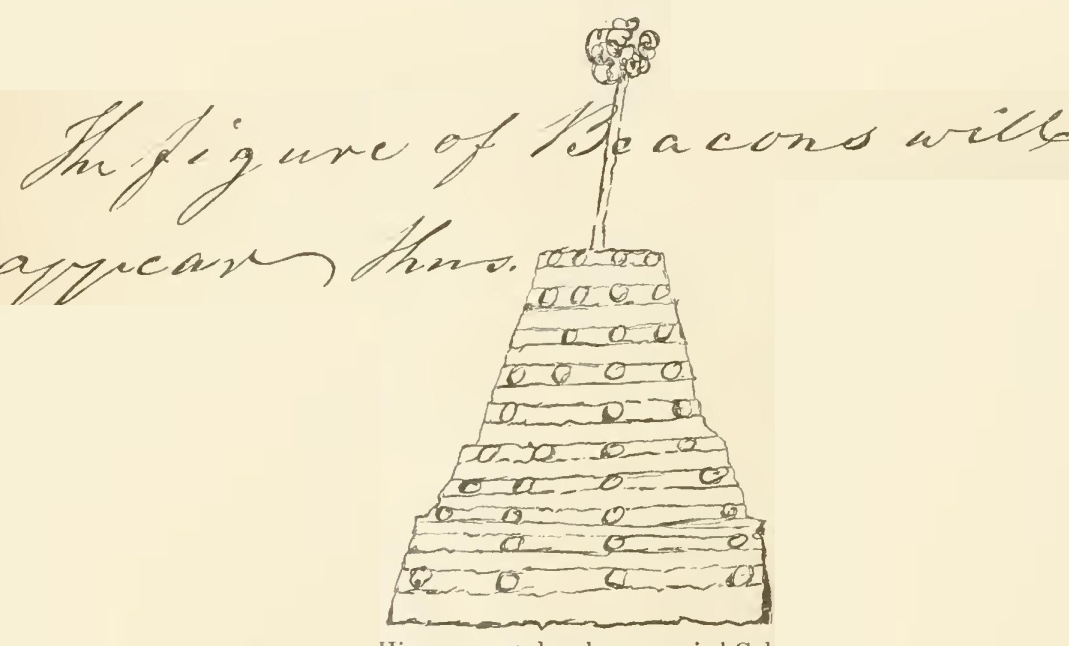
* An invasion from Canada was then expected. Quite a large British force prevailed above the Highlands. He was at Ticonderoga and vicinity, under St. Leger, who have already met detachments, was repulsed at Fort Stanwix in 1777. and at that time were several respecting beacons and alarm posts. From one of them, in possession of the son of Colonel Aaron Burr, I copied the annexed sketch, made by the pen of Lord Stirling, together with the full order of Lord Stirling who died at Albany on the fifteenth of January 1783, in the fifty-seventh year of his age. It is a singular fact that at different periods during the war. Lord Stirling had under his command every brigade of the American army except Colonel William Duer, and became Judge John Duer, of the city of Duer. LL.D.
* The vigorous and effective preparations made by Lord Stirling intimidated St. Leger, and he returned to Canada. Late in the autumn Stirling took the chief command in New Jersey, and the following summer he was again in command at Albany, with a general supervision of military affairs between that place and New York. Among other orders issued by him at those of South Carolina and Georgia. His youngest daughter married the brother of William A. Duer, late president of Columbia College, at New York.—See Life of Lord Stirling, by his grandson, William A.
* He acquired this title because he won riches rapidly by the illicit trade in which the colonists were then engaged. His family vault may now (1852) be seen a few rods from the bank of the East River, in "Jones's Woods," between Seventieth and Seventy-first Streets. On the top is a large marble slab, placed there in memory of the wife of his son David.
**The following is a copy of the order: "Each of the beacons are to be of lhe following dimensions: at bottom, fourteen feet square, to rise in a pyramidal form to about eighteen or twenty feet high, and then to terminate about six feet square, with a stout sapling in the center of about thirty feet high from the ground. In order to erect them, the officer who oversees the execution should proceed thus: he should order the following sized logs to be cut as near the place as possible: twenty logs of fourteen feet long and about one foot diameter; ten logs of about twelve feet long; ten logs of about ten feet long; ten logs of about nine feet long; ten logs of about eight feet long; twenty logs of about seven feet long; twenty logs of about six feet lone. He should then sort his longest logs as to diameter, and place the four longest on the ground, parallel to each other, and about three feet apart from each other. He should then place the four next logs in size across these at right angles, and so proceed till all the logs of fourteen feet be placed. Then he is to go on in the same manner with logs of twelve feet long, and when they are all placed, with those of a lesser size, till the whole are placed, taking care, as he goes on, to fill the vacancies between the logs with old dry split wood or useless dry rails and brush, not too close, and leaving the fifth tier open for firing and air. In the beginning of his work, to place a good stout sapling in the center, with part of its top left, about ten or twelve feet above the whole work. The figure of the beacon will appear thus. [The sketch above given.] The two upper rows of logs should be fastened in their places with good strong wooden plugs or trunnels." These beacons were erected upon hills from the Hudson Highlands through New Jersey by way of Morristown, Pluckemin, and Middlebrook, and upon the Neversink Hills at Sandy Hook. They were to be used as signals denoting the approach of the enemy, for the assembling of the militia at certain points, and to direct the movements of certain Continental battalions.
*** I have before me an old manuscript schedule of Lord Stirling's wardrobe, in which the material and color of each article is given. I print the number as a curious example of the personal provisions of a gentleman of his class at that time, namely: Thirty-one coats, fifty-eight vests, forty-three pairs of breeches, six powdering gowns (used when powdering the hair), two pairs of trowsers, thirty shirts, seventeen handkerchiefs, twenty seven stocks, twenty-seven cravats, eight razor cloths, one hundred and nineteen pairs of hose, six pairs of socks, fifteen night-caps, five pairs of drawers, two pairs of gloves, fourteen pairs of shoes, four pairs of boots; total, four hundred and twelve garments.
Skirmish between Grant and Stirling.—-Storming of the Flatbush Redoubt.—-Descent of Clinton.—Surrender of the Americans.
After two or three rounds Atlee fell back to the left of Stirling, on the top of the hills.
At this moment Kichline and his riflemen, De Haas and his battalion, and Captain Carpenter, with two field-pieces, arrived. Grant advanced and took post in an orchard, * within one hundred and fifty yards of Stirling, and a severe skirmish ensued. Grant had also two field-pieees, but neither party made much use of their cannons. In that position the belligerents remained, without severe fighting, until eleven o'clock in the forenoon, ** when events on the left wing of the American army changed the whole aspect of affairs.
While Grant and Stirling were thus engaged, De Heis-ter and his Hessians moved from Flatbush, and cannonaded the works at the Flatbush pass, where Sullivan was in command with the regiments of Colonels Williams and Miles.
In the mean while, Clinton had descended from the wooded hills and attacked the extreme left of the Americans on the plain at Bedford. The firing was understood by De Heister, who immediately ordered Count Donop to storm the redoubt at the pass, while he pressed forward with the main body of the Hessians. A fierce and bloody combat ensued,3 when Sullivan, perceiving the peril of his little army (for Clinton was rapidly gaining his rear), ordered a retreat to the lines at Brooklyn. The opportunity was gone, and on descending the rough slope from Mount Prospect, they were met by Clinton's light infantry and dragoons, who drove them back in confusion upon the Hessian bayonets. Sullivan and his ensnared soldiers fought desperately, hand to hand, with the foe, while driven backward and forward between the full ranks of the assailants. Many broke through the gleaming fence of bayonets and sabers, and
* A few trees of this orchard yet remain in the southwest part of Greenwood Cemetery.
** During the morning the Roebuck frigate approached Red Hook and cannonaded the battery there. This, like the movement of Grant, was intended to divert the Americans from the operations of Clinton on their left.
*** The Hessians fought with desperation, and gave no quarter. They had been told that the Americans would not suffer one of them to live, and their sentiment was total extermination. "Our Hessians and our brave Highlanders gave no quarter," wrote an offieer of the 71st, "and it was a fine sight to see with what alacrity they dispatched the rebels with their bayonets, after we had surrounded them so they could not resist."—Sec Onderdonk's Revolutionary Incidents, ii., 138.
Battle between Stirling and Cornwallis.—Retreat across the Gowanus.—Defeat and Capture of Stirling.
escaped to Fort Putnam, * while their less fortunate companions died upon the field or were made prisoners.
Among the latter were General Sullivan and several subordinate officers. Those who escaped were followed up to the verge of the American lines, and the pursuing grenadiers were with difficulty restrained from storming Fort Putnam. An easy victory would doubtless have been the result.
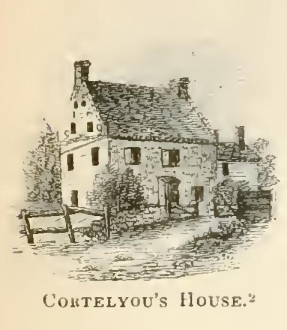
Stirling was not aware of the disasters on the left until Cornwallis had marched down the Port or Mill road (9), took position near the ancient dwelling known as "the Cortelyon House," near Gowanus, and fired two guns as a signal for Grant to press forward. That officer immediately attacked the Americans, and in the engagement Colonel Atlee was made a prisoner. Hemmed in by the foe, Stirling saw no opportunity for escape except across the Gowanus Creek, at the dam of the "Yellow Mill," and other places below Brower's Mill.
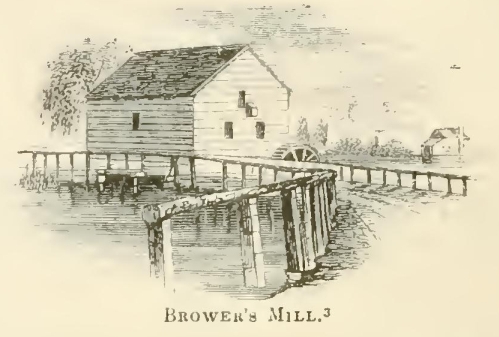
To effect this, it was necessary to attack Cornwallis, and while a few—a forlorn hope—should keep him at bay, a large part of the Americans might escape. No time was to be lost, for the tide was rising, and soon the creek would be impassable. Changing his front, and leaving his main body in conflict with Grant, Stirling, at the head of a part of Smallwood's battalion, commanded by Major (afterward General) Gist, fell upon Cornwallis, and blood flowed freely. For twenty minutes the conflict was terrible. Stirling endeavored to drive the earl up the Port road, get between him and Fort Box, and under cover of its guns escape across Brower's dam. He was successful, but while with his handful of brave young men he was keeping the invader in check, a large part of his companions in arms, consisting now chiefly of Haslet's Delawares and a part of Smallwood's Marylanders, reached the creek. Some passed it in safety, but many sunk into silence in the deep mud on its margin or beneath its turbid waters. Stirling was obliged to yield when despoiled of nearly all of his brave men. **** He became a prisoner, and was sent immediately on board the Eagle, Lord Howe's flag-ship. Thus ended the battle, when the sun was at meridian; when it disappeared behind the low hills of New Jersey, one third of the five thousand patriots who had contended for victory were lost to their country—dead, wounded, or prisoners. * Soon many of the latter were festering with
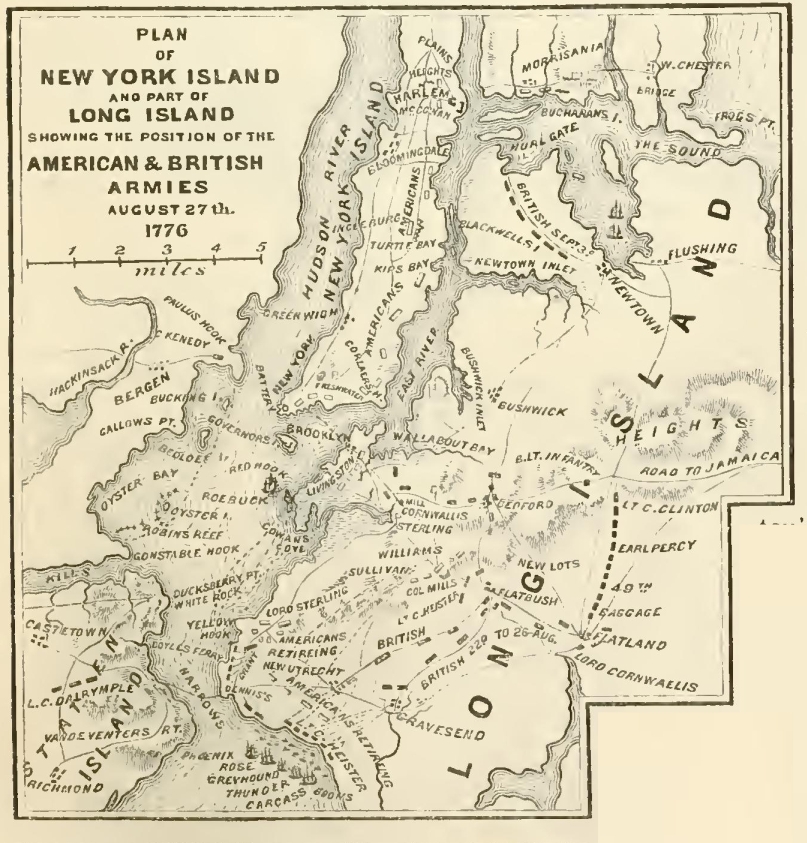
* The most sanguinary conflict occurred after the Americans had left the Flatbush pass, and attempted to retreat to the lines at Brooklyn. The place of severest contest, and where Sullivan and his men were made prisoners, was upon the slope between the Flatbush Avenue and the Long Island rail-way, between Bedford and Brooklyn, near "Baker's Tavern" (17), at a little east of the junction of these avenues. The preceding map, compiled from those of the English engineers for Marshall's Life of Washington, will assist the reader in obtaining a proper understanding of the movements of the two armies.
** This house, built of stone, with a brick gable from eaves to peak, is yet (1852) standing upon the eastern side of the road leading from Brooklyn to Gowanus. It was built by Nicholas Vechte in 1699, and was one of the first houses created between Brooklyn and New Utrecht.
*** This is a view of the old mill of the Revolution, as it appeared when I made the sketch in 1850, before it was destroyed. The view is from the west side of Gowanus Creek, looking southeast. In the extreme distance is seen the "Yellow Mill" between which and the one in the foreground so many of the patriots perished.
****Smallwood's regiment was composed chiefly of young men belonging to the most respectable and influential families in Maryland. Two hundred and fifty-nine of them perished in this conflict with Cornwallis's grenadiers near the "Cortelyon House."
* (v) Dispatches of Washington and General Howe; Letter of R. H. Harrison, quoted by Sparks, Washington's Writings, iv., 513; Letters of Haslet and Sullivan, 516, 517; Doer's Life of Lord Stirling, 163; Life and Correspondence of President Reed, i., 218—224; Gordon, ii., 96—101; Marshall, i., 87—91; Sted-man, i., 191-196; Onderdonk, ii.. 127-131. The loss of the Americans is not precisely known. Howe estimated it at 3300; it probably did not exceed 1650, of whom about 1100 were made prisoners. Howe stated his own loss at 367 killed, wounded, and made prisoners.
Capture, Treatment, and Death of General Woodhull.—Preparations to Besiege the Works at Brooklyn.
disease in the loathsome prisons in New York, or in the more loathsome prison-ships at the Wallabout. * General Woodhull was made a prisoner at Jamaica the next day, ** and at the close of summer no man was in arms against the crown in Kings, Queens, and Richmond counties.
The victors encamped in front of the patriot lines, and reposed until the morning of the twenty-eighth,August, 1778 when they broke ground within six hundred yards of Fort Putnam, cast up a redoubt (18), and cannonaded the American works. Washington was there, and joyfully perceived the design of Howe to commence regular approaches instead of rapid assaults. This fact was a ray of light in the midst of surrounding gloom. The
* An account of the New York prisons and prison-ships may be found in the Supplement to this work.
** Nathaniel Woodhull was born at Mastic, Long Island, December 30, 1722. Agriculture was the chief pursuit of his life. He was a major, under Abercrombie, in the attack upon Crown Point and Ticonderoga, and afterward accompanied Bradstreet against Fort Frontenac. He was a colonel, under Amherst, in 1760, and at the close of the campaign he returned home and married Ruth Floyd, He espoused the popular side in the Stamp Act movements, and, possessing the esteem of the people, he was elected, with William Nicoll, a representative of Suffolk county, in the Colonial Assembly in 1769. He represented Suffolk in the first Provincial Congress in 1775, and was elected president of that body.
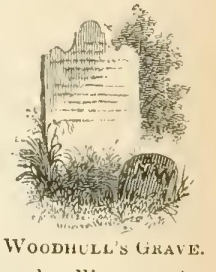
** He was appointed a brigadier of militia in August of that year, and in July, 1776, he was summoned home to embody the militia of Suffolk and Queens, to assist in repelling invasion. He was engaged in this serviee when he was made a prisoner,* cruelly wounded by a British officer, and died of his injuries three weeks afterward at New Utrecht. His wife, who was with him in his last moments, conveyed his body to Mastic, and there, in a secluded family cemetery, a short distance from his residence, his remains rest. A marble slab marks his grave, and bears the following inscription:
** "In memory of General Nathaniel Woodhull, who, wounded and a prisoner, died on the twentieth of September, 1776, in the fifty-fourth year of his age; regretted by all who knew how to value his many private virtues, and that pure zeal for the rights of his country to which he perished. Woodhull's Grave." The mansion of General Woodhull was burned in 1783, and in 1784, the present dwelling on the homestead farm was erected near the spot. It is now (1852) owned by Henry Nicoll, Esq., a great-grandson of General Woodhull.
* In consequence of the tardy movements of others, on whom devolved the duty of furnishing him with a proper force to perform the labors assigned him, General Woodhull (Udell in many old accounts) did not participate in the battle on the twenty-seventh of August He made his head-quarters at Jamaica, and with his inadequate force he scoured the country for miles around, watching the movements of the enemy, and driving large numbers of cattle to Hempstead plains. When he perceived the position of Clinton, near the Jamaica pass, on the morning of the twenty-seventh, he sent urgent messages to the Provincial Congress asking for re-enforcements. It was now too late, for the regiments of Smith and Remsen, of Kings and Queens counties, could not be spared from the lines at Brooklyn.
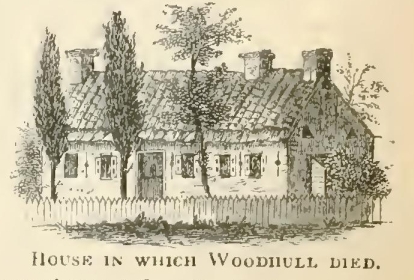
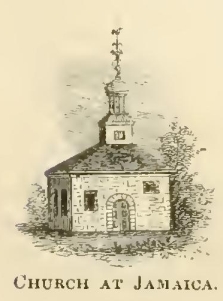
* With a soldier's impatience he was obliged to listen to the distant roar of battle, for with a soldier's strict discipline he would not move without orders. When apprised of the disasters of the day, he ordered his little band to fall hack four miles beyond Jamaica, on the morning of the twenty-eighth, while he awaited orders from camp. In the afternoon, he left Jamaica with two companions, to join his soldiers, and while taking refuge from a thunder-storm in the inn of Increase Carpenter, two miles east of Jamaica village, he was made a prisoner by a party of British, under Captain Sir James Baird (whom we met at Savannah, page 732), piloted by some Tories. Tradition says that Baird ordered Woodhull to shout "God save the King!" and because instead he cried "God save us all!" he smote him with his broadsword, and would have killed him on the spot, if Major Delancey, who accompanied Baird, had not interfered. The blow badly wounded the head of the general, and mangled his left arm the whole length. He and his companions were taken to Jamaica, confined until the next morning in the Presbyterian stone church (which stood in the middle of the present Fulton Street, at the head of Union Hall Street. It was demolished in 1832), then taken to the British camp at Brooklyn, and conveyed to a loathsome cattle transport in Gravesend Bay. A Church at Jamaica, humane British officer procured his removal to a house in the village of New Utrecht, where his arm was amputated at the elbow. Woodhull sent for his wife, with a request that she should bring; with her all the money in her possession, and all she could borrow. This was distributed among his fellow-prisoners. His wife arrived in time to attend him in his last moments, for the unskillful amputation resulted in mortification, and he died in the fifty fourth year of his age. I am indebted to Mr. Onderdonk for the sketch of the old Jamaica church. With him 1 visited New Utrecht (1850) to make a drawing of the house wherein General Woodhull died. It had just been demolished, and a modern house placed on its site by the owner, Mr. Barent Wyckoff. To the patriotism and artistic skill of Miss C. Lott, living near, I am indebted for the sketch of that venerated edifice, probably the first house erected in that town. It was of stone, covered with red tiles, and answered the description of a dwelling erected in 1658, by De Sille, the attorney general of the province.—See Doc. Hist, of New York, i., 634. The New House in which Woodhull died. Utrecht church, which stood near, was of octagon form like one at Jamaica. The weather cock from its steeple now graces the barn of Mr. Lott, and the gilt dove from the pulpit sounding-board is perched upon the roof of his well.
Situation of the Two Armies.—Council of War.—Retreat of the Americans to New York.
chief had crossed from New York early in the morning, and had witnessed the destruction of some of his finest troops, without ability to send them aid except at the peril of the safety of the camp or of the city, and his whole army. Ignorant of his real strength, Howe dared not attempt an assault, and Washington had time to conceive and execute measures for the safety of his troops.
The morning of the twenty-eighthAugust 1776 dawned drearily. Heavy masses of vapor rolled up from the sea, and at ten o'clock, when the British cannonade commenced, a fine mist was falling. Although half dead with fatigue, the Americans had slumbered little, for it was a night of fearful anxiety to them. At five in the morning, General Mifflin, who had come down from King's Bridge and Fort Washington with the regiments of Shee, Magaw, and Glover, a thousand strong, in obedience to an order sent the day before, crossed the East River, and took post at the Wallabout. The outposts of the patriots were immediately strengthened, and during the rainy day which succeeded there were frequent skirmishes. Rain fell copiously during the afternoon, and that night the Americans, possessing neither tents nor barracks, suffered dreadfully. A heavy fog fell upon the hostile camps at midnight, and all the next dayAugust 29 it hung like a funeral pall over that sanguinary battle-field. Toward evening, while Adjutant-general Reed, accompanied by Mifflin and Colonel Grayson, were reconnoitering near Red Hook, a light breeze arose and gently lifted the fog from Staten Island. There they beheld the British fleet lying within the Narrows, and boats passing rapidly from ship to ship, in evident preparation for a movement toward the city. Reed hastened to the camp with the information, and at five o'clock that evening the commander-in-chief held a council of war. * An evacuation of Long Island, and a retreat to New York, was the unanimous resolve of the council. Colonel Glover, whose regiment was composed chiefly of sailors and fishermen from Marblehead and vicinity, ** was ordered to collect and man boats for the purpose, and General M'Dougal was directed to superintend the embarkation. The fog still rested heavily upon the island, the harbor, and the adjacent city, like a shield of the Almighty to cover the patriots from the peril of discovery. Although lying within a few hundred yards of the American lines, the enemy had no suspicion of the movement. ***
At eight o'clock in the evening the patriot regiments were silently paraded, the soldiers ignorant of the intent; but, owing to delay on account of unfavorable wind, and some confusion in orders, it was near midnight when the embarkation commenced at the Ferry Stairs, foot of Fulton Street, Brooklyn. For six hours those fishermen-soldiers plied their muffled oars; and boat after boat, filled with the champions of freedom, touched at the various wharves from Fulton Ferry to Whitehall, and left their precious burdens. At six in the morning, nine thousand men, with their baggage and munitions, except heavy artillery, had crossed. Mifflin, with his Pennsylvania battalions and the remains of the regiments of Smallwood and Haslet, formed the covering party, and Washington and his staff, who had been in the saddle all night, remained until the last company had embarked. **** At dawn
* The council was held in the stone Dutch church (20), which stood near the junction of the present Fulton and Flatbush Avenues. This church was designated in the order for the evening as an alarm post during the night, where they might rendezvous, in the event of the movement being discovered by the British. The officers present at the council were Washington, Putnam, Spencer, Miffin, M'Dougal, Parsons, John Morin Scott, Wadsworth, and Fellows.—See Life, &c., of President Reed, i., 417.
** The uniform of these men, until they were attached to the Continental line, consisted of blue round jackets and trowsers, trimmed with leather buttons. They were about five hundred in number.
*** A late English author complains bitterly of the apathy of the British general on this occasion. He says, his troops "kept digging their trenches on one side, while Washington was smuggling his forces out on the other, and ferrying them over the East River to the city of New York.... The high-feeding English general slept on, and his brother the admiral (Lord Howe), though not so apt to doze, did not move a single ship or boat, and was to all appearance unconscious of what was going on."—Pict. Hist, of the Reign of George the Third, i., 273. Notwithstanding his want of energy on this occasion, General Howe received the honors of knighthood from his king for this victory. The ceremony was performed by Knyp-hansen, Clinton, and Robertson, in November, 1776.
**** In his dispatches to the president of Congress, Washington said that he had scarcely been out of the lines from the twenty-seventh till the morning of the evacuation, and forty-eight hours preceding that had hardly been off his horse and never closed his eyes. Yet a popular English author of our day (see Pict. Hist, of the Reign of George the Third, i., 273) mendaciously says, "Washington kept his person safe in New York."
British first aware of the Retreat.—Condition of the Army.—Disposition of the British Army.
the fog lifted from the city, but remained dark and dreary upon the deserted camp and the serried ranks of the foe, until the last boat left the Long Island shore. Surely, if "the stars in their courses fought against Sisera," in the time of Deborah, the wings of the Cherubim of Mercy and Hope were over the Americans on this occasion.
Intelligence of this movement reached the British commander-in-chicf at half past four in the morning. Cautiously Captain Montressor and a small party climbed the embankments of Fort Putnam and were certified of the fact. * It was too late for successful pursuit, for when battalion after battalion were called to arms, and a troop of horsemen sped toward the East River, the last boat was beyond pistol shot; and as the fog rolled away and the sunlight burst upon the scene, the Union flag was waving over the motley host of Continentals and militia marching toward the hills of Rutgers' farm, beyond the present Catharine Street. ** Howe was greatly mortified by the event, for he felt certain that his prey could not escape his meshes.
Although the American army was safe in New York, yet sectional feelings, want of discipline, general insubordination of inferior officers and men, and prevailing immorality, appeared ominous of great evils. Never was the hopeful mind of Washington more clouded with doubts than when he wrote his dispatches to the president of Congress, in the month of September.1776
Those dispatches and the known perils which menaced the effort for independence led to the establishment of a permanent army. ***
On the evacuation of Long Island, the British took possession of the American works, and, leaving some English and Hessian troops to garrison them, Howe posted the remainder of his army at Bushwick, Newtown, Hell Gate, and Flushing.
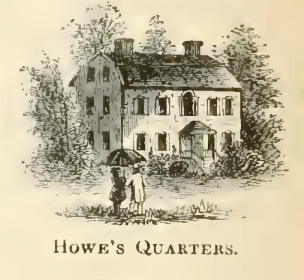
Howe made his head-quarters at a house in Newtown (yet standing), now the property of Augustus Bretonnier, and there, on the third of September, he wrote his dispatch, concerning the battle, to British ministry. On the thirtieth,August, 1776 Admiral Howe sailed up the bay with his fleet and anchored near Governor's Island, within cannon-shot of the city. During the night, after the battle, a forty-gun ship had passed the batteries and anchored in Turtle Bay, somewhat damaged by round shot from Burnt Mill or Stuyvesant's Point, the site of the Novelty Iron-works. **** Other vessels went around Long Island, and passed into the East River from the Sound, and on the third of September the whole British land force was upon Long Island, except four thousand men left upon Staten Island to awe the patriots of New Jersey. A blow was evidently in preparation for the republican army in the city. Perceiving it, Washington made arrangements for evacuating New York, if necessary. (v)
* Onderdonk (ii., 131) says that a Mrs. Rapelye, living near the ferry, sent her servant to inform the British of the retreat. The negro was arrested by a Hessian guard, who could not understand a word that he uttered. He was detained until morning, when he was taken to head-quarters, and revealed the seeret, but too late.
** A cannonade was opened upon the pursuers from Waterbery's battery, where Catharine Market now stands.
*** See page 225. In his letter of the second of September, Washington evidently foresaw his inability to retain his position in the city of New York. He asked the question, "If we should be obliged to abandon the town, ought it to stand as winter quarters for the enemy?" and added, "If Congress, therefore, should resolve upon the destruction of it, the resolution should be a profound secret, as a knowledge of it will make a capital change in their plans." General Greene and other military men, and John Jay and several leading civilians, were in favor of destroying New York. But Congress, by resolution of the third of September, ordered otherwise, because they hoped to regain it if it should be lost.—See Journal, ii., 321.
**** Washington sent Major Crane of the artillery to annoy her. With two guns, upon the high bank at Forty-sixth Street, he cannonaded her until she was obliged to take shelter in the channel east of Blackwell's Island.
* (v) On the approach of the fleet, the little garrison on Governor's Island and at Red Hook withdrew to New York. One man at Governor's Island lost an arm by a ball from a British ship, just as he was embarking.*
Howe's proposition for a Conference.—Meeting with a Committee of Congress.—Bushnell's "Marine Turtle" or Torpedo.
Lord Howe now offered the olive-branch as a commissioner to treat for peace, not doubting the result of the late battle to be favorable to success.
General Sullivan and Lord Stirling were both prisoners on board his flag-ship, the Eagle.
The former was paroled, * and sent with a verbal message from Howe to the Continental Congress, proposing an informal conference with persons whom that body might appoint. Impressed with the belief that Lord Howe possessed more ample powers than Parliament expressed in his appointment, Congress consented to a conference, after debating the subject four days. A committee, composed of three members of that body, was appointed, and the conference was heldSept. 11, 1776 at the house of Captain Billop, formerly of the British navy, situated upon the high shore of Staten Island, opposite Perth Amboy. ** The event was barren of expected fruit, yet it convinced the Americans
* Both officers were exchanged soon afterward, Sullivan for General Prescott, captured nine months before (see vol. i., page 181), and Lord Stirling for Governor Brown, of Providence Island, who had been captured by Commodore Hopkins. Lord Stirling was exchanged within a month after he was made prisoner.
** The committee consisted of Benjamin Franklin, John Adams, and Edward Rutledge. When they reached Perth Amboy, they found the barge of Lord Howe in waiting for them, with a British officer who was left as a hostage! The meeting was friendly, and Lord Howe, who was personally acquainted with Franklin, freely expressed to that statesman his abhorrence of the war, and his sincere personal desire for peace. * The whole interview was distinguished by courtesy and good feeling. Howe informed the committee that he would not recognize them as members of Congress, but as private gentlemen, and that the independence of the colonies could not be considered for a moment They told him he might call them what he pleased, they were nevertheless representatives of a free and independent people, and would entertain no proposition which did not recognize the independence of the colonies. The gulf between them was evidently impassable, and the conference was soon terminated, for Howe had nothing acceptable to offer. He expressed his regret because of his obligation now to prosecute the war. Franklin assured him that the Americans would endeavor to lessen the pain he might feel on their account by taking good care of themselves. Thus ended the conference. * In the third volume of the collected Writings of John Adams may be found an interesting sketch from the pen of that patriot, describing the events of a night passed in bed with Dr. Franklin at New Brunswick, on the night preceding this conference.
* It was while the Eagle laid near Governor's Island that an attempt was made to destroy her by an "infernal machine," called a "Marine Turtle," invented by a mechanic of Saybrook, Connecticut, named Bushnell. Washington approved of the machine, on examination, and desired General Parsons to select a competent man to attempt the hazardous enterprise. The machine was constructed so as to contain a living man, and to be navigated at will under water. A small magazine of gunpowder, so arranged as to be secured to a ship's bottom, could be carried with it. This magazine was furnished with clockwork, constructed so as to operate a spring and communicate a blow to detonating powder, and ignite the gunpowder of the magazine. The motion of this clock-work was sufficiently slow to allow the submarine operator to escape to a safe distance, after securing the magazine to a ship's bottom. General Parsons selected a daring young man, named Ezra Lee. He entered the water at Whitehall, at midnight on the sixth of September. Washington and a few officers watched anxiously until dawn for a result, but the calm waters of the bay were unruffled, and it was believed that the young man had perished. Just at dawn some barges were seen putting off from Governor's Island toward an object near the Eagle, and suddenly to turn and pull for shore. In a few moments a column of water ascended a few yards from the Eagle, the cables of the British ships were instantly cut, and they went down the Bay with the ebbing tide, in great confusion. Lee had been under the Eagle two hours, trying in vain to penetrate the thick copper on her bottom. He could hear the sentinels above, and when they felt the shock of his "Turtle" striking against the bottom, they expressed a belief that a floating log had passed by. He visited other ships, but their sheathing was too thick to give him success. He came to the surface at dawn, but, attracting the attention of the bargemen at Governor's Island, he descended, and made for Whitehall against a strong current. He came up out of reach of musket shot, was safely landed, and received the congratulations of the commander-in-chief and his officers. Young Lee was afterward employed by Washington in secret service, and was in the battles at Trenton, Brandywine, and Monmouth. He died at Lyme, Connecticut, on the twenty-ninth of October, 1821, aged seventy-two years.
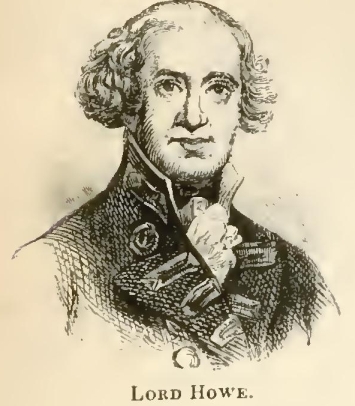
** Richard, Earl Howe, was born in 1725, and was next in age to his brother, the young Lord Howe, who fell at Tieonderoga in 1758 (see vol. i., page 118). He sailed with Lord Anson to the Pacific as midshipman at the age of fourteen years, and had risen to the rank of admiral at twenty. He was appointed rear-admiral in 1770, and, before coming to America, he was promoted to Vice-admiral of the Blue. After the American war, he was made first Lord of the Admiralty. He commanded the English fleet successfully against the French in 1794. His death occurred in 1799, at the age of seventy-four years. In 1774, Lord Howe and his sister endeavored to draw from Franklin the real intentions of the Americans. The philosopher was invited to spend Christmas at the house of the lady, and it was supposed that in the course of indulgence in wine, chess, and other socialities, he would drop the reserve of the statesman and be incautiously communicative. The arts of the lady were unavailing, and they were no wiser on the question when Franklin left than when he came.
** William Howe, brother of the earl, succeeded General Gage in the chief command of the British forces in America, and assumed his duties at Boston in 1775. He commanded at the attack on Breed's Hill, and from that time until the spring of 1778, he mismanaged military affairs in America. He was then succeeded by Sir Henry Clinton, and with his brother, the admiral, returned to England. He is represented as a good-natured, indolent man—"the most indolent of mortals,' said General Lee, "and never took pains to examine the merits or demerits of the cause in which he was engaged."
Evacuation of the City by the Americans.—Washington's Quarters.—Captain Hale.—Beekman's Green-house.
that Britain had determined upon the absolute submission of the colonies.
This conviction increased the zeal of the patriots, and planted the standard of resistance firmer than before.
At a council of war held on the seventh,Sept. 1776 a majority of officers were in favor of retaining the city; but on the twelfth, another council, with only three dissenting voices (Heath, Spencer, and Clinton), resolved on an evacuation.
The movement was immediately commenced, under the general superintendence of Colonel Glover. The sick were taken to New Jersey, and the public stores were conveyed to Dobbs's Ferry, twenty miles from the city. The main body of the army moved toward Mount Washington and King's Bridge on the thirteenth, accompanied by a large number of Whigs and their families and effects. * A rear-guard of four thousand men, under Putnam, was left in the city, with orders to follow, if necessary, and on the sixteenth Washington made his head-quarters at the deserted mansion of Colonel Roger Morris, ** on the
* Washington made the house ol Robert Murray, on Murray Hill (see page 788), his quarters on the fourteenth, and on the fifteenth he was at Mott's tavern, now the properly of Mr. Penlz, near One hundred and Forty-third Street and Eighth Avenue. It was at Murray's house that Captain Nathan Hale received his secret instructions for the expedition which cost him his life. *
** This elegant mansion is yet standing and unaltered, upon the high bank of the Harlem River, at One Hundred and Sixty-ninth Street, a little below the High Bridge of the Croton Aqueduct. Its situation is one of the most picturesque on the island, commanding a fine view of the Harlem River and village, Long Island Sound, Flushing, and Astoria, with the green fields of Long Island beyond. Below are seen the plains of
* The commissioners immediately afterward issued a proclamation similar in character to the one sent out in July. This proclamation, following the disasters upon Long Island, had great effect, and many timid Americans availed themselves of the supposed advantages of compliance. In the city of New York more than nine hundred persons, by petition to the commissioners, dated sixteenth of October, declared their allegiance to the British government. To counteract this, in a degree, Congress, on the twenty-first, provided an oath of allegiance to the American government.
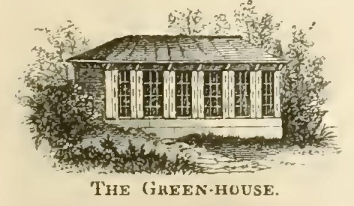
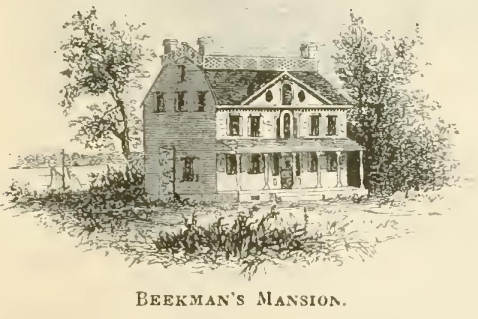
** Anxious to know the exact condition and intentions of the British on Long Island, Washington called a council of officers, when it was determined to send a spy into their camp. Colonel Knowlton, who commanded a choice regiment called Congress's Own, was directed to select a competent man from his corps. Captain Nathan Hale, of Coventry, Connecticut, volunteered for the service, and, bearing instructions from Washington to the commanders of all-American armed vessels to convey him whithersoever he might desire to go, he crossed the Sound to Huntington (some say to Oyster Bay), and made his way to the British camp at Brooklyn and vicinity. There he made sketches and notes, and, unsuspected, returned to Huntington with valuable information. There he was recognized and exposed (tradition says by a Tory relative), and was taken immediately to Howe's head quarters at Beekman's house, at Turtle Bay. He was confined in the green house of the garden during the night of the twenty-first of September, and the next morning, without even the form of a regular trial, was delivered to Cunningham, the brutal provost marshal, to be executed as a spy. He was treated with great inhumanity by that monster. The services of a clergyman and the use of a Bible were denied him, and even the letters which he had been permitted by Howe to write to his mother and sisters during the night, were destroyed. He was hanged upon an apple-tree in Rutgers' Orchard, near the present intersection of East Broadway and Market Streets. His last words were, "I only regret that I have but one life to give to my country!" His body was buried beneath the gibbet-tree. The name of this youthful patriot martyr appears luminous upon the pages of our country's history, and the grateful citizens of his native town have erected a handsome monument to his memory there. I made the above sketch of the green-house a few days before it fell, with all the glories of the beautiful garden of the Beekman mansion, at the touch of the street commissioner, in July, 1852. Its locality is now in the center of Fifty-second Street, a little east of First Avenue. It was erected, with the mansion delineated on page 817, in 1764. I am indebted to the Honorable James W. Beekman, the present owner of the grounds, for a copy of a curious document preserved among the family papers. It is a memorandum, kept by the gardener of James Beekman (the original proprietor); during the war, showing the time that several British officers, in succession, made the house their head-quarters. The following is a copy, with the heading by the pen of Beekman: "At the undermentioned time my country seat was occupied by the following generals" [the gardener's report]: "General Howe commenced fifteenth of September, 1776—seven and a half months. Commissary Loring the first of May, 1777—one year and five months. General Clinton the twentieth of October, 1778—three years and six months. General Robison [Robertson] May the first, 1782—eleven and a half months. Mr. Beekman the sixteenth of April, 1783—two months. General Carleton the sixteenth of June, 1783, to the evacuation, is five months—in the whole, is seven years one and a half months."—For Hale's capture and death, see Onderdonk's Revolutionary Incidents, ii" 48, 53
Preparation to invade New York.—Revolutionary Fortifications on the north part of the Island.
heights of Harlem River, about ten miles from the city. Every muscle and implement was now put in vigorous action, and before the British had taken possession of the city the Americans were quite strongly intrenched. *
Howe now prepared to invade the island and take possession of the city of New York. Large detachments were sent in boats from Hallet's Point to occupy Buchanan's and Moutressor's (now Ward's and Randall's) Islands, at the mouth of the Harlem River, and early on Sunday morning the fifteenth.
Sir Henry Clinton, with four thousand men, crossed the river in flat bottomed boats from the mouth of Newtown Creek, and landed at Kip's Bay (foot of Thirty-fourth
* At Turtle Bay, Horn's Hook, Fort Washington and the heights in the vicinity, on the Hudson and Harlem Rivers, and near King's Bridge, traces of these fortifications may yet be seen. *
* The Americans cast up a redoubt at Turtle Bay, on the East River, between Forty-fourth and Forty sixth Streets; a breastwork at the Shot Tower, Fifty-fourth Street; another at the foot of Seventy-fourth Street; a third at the foot of Eighty-fifth, near Hell Gate Ferry; and a strong work called Thompson's Battery, upon Horn's Ilook (now a beautifully shaded grassy point), at Eighty-ninth Street. This redoubt commanded the mouth of Harlem River and the narrow channel at Hell Gate. They also built a small work upon Snake Hill (now Mount Morris, in Mount Morris Square), near Harlem, and a line of breastworks near the Harlem River, extending from One hundred and Thirty-sixth Street to Bussing's Point, near M'Comb's Dam. Upon each aide of "Harlem Cove," at Manhattanville, a battery was constructed (One hundred and Thirty-first and One hundred and Thirty-third Streets), and along the central hills whereon the Convent of the Sacred Heart stands with a line of works extending to One hundred and Fiftieth Street. These were small batteries, without connecting breast-works, and overlooked Harlem River. From near "The Grange" (the country residence of General Hamilton, yet standing), in the vicinity of One hundred and Fifty-first Street, was a line of intrenchments, with three batteries and abatis extending to the Hudson, a distance ot almost a mile. The batteries of this line were upon three eminences. Almost upon the line of One hundred and Sixty-first and One hundred and Sixty-second Streets, was another line, with three batteries and abatis. These formed the "double lines of intrenchments," mentioned in the histories. The quite prominent outlines of a redoubt on the lofty bank of the Harlem River, at the foot of One hundred and Fifty-sixth Street, were pointed out to me by Henry O'Reilly, Esq., who resides near. From this redoubt, down the steep hill to the cove where Colonel Stirling landed (see page 827), the old road is yet (1852) open and passable. From Colonel Morris's (Madame Jumel's) house was a line of shallow intrenchments to the North River, with a single battery upon the eminence above the residence of the late Mr. Audobon the ornithologist, a little north of Trinity Cemetery. Upon the high west bank of the Harlem, yet rough and wooded, were two breast works. These the British afterward strengthened, and called it Fort George. This was between One hundred and Ninety-second and One hundred and Ninety-sixth Streets. On the King's Bridge road below, at Two hundred and Sixth Street, a strong four-gun battery was erected.
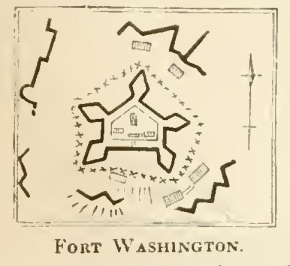
Fort Washington, situated between One hundred and Eighty-first and One hundred and Eighty-sixth Streets, upon the highest eminence on the island (between ten and eleven miles from the City Hall), was a strong earth-work of irregular form, covering, with its ravelins, several acres. It contained an inner work, a sort of citadel, within which was the magazine. About twenty heavy cannons were mounted upon it, besides several smaller pieces and mortars. Its chief strength consisted in its position. On the promontory below it (Jeffery's Hook), where the Telegraph mast stands (between One hundred and Seventy-sixth and One hundred and Seventy-seventh Streets), was a redoubt, intended as a covering to chevaux de frisé constructed in the channel there. The banks of this redoubt, among dwarf cedars upon the rocks, are yet (1852) very prominent. Northward of Fort Washington, on the same lofty bank of the Hudson, between One hundred and Ninety-fifth and One hundred and Ninety sixth Streets, was a redoubt with two guna, which was afterward strengthened by the British and called Fort Tryon. Near the extreme point of this range, at Spyt den Dyvel Kill (Spite the Devil Creek), at Two hundred and Seventeenth Street, was a little redoubt of two guns, called Cock Will Fort; and across the creek, on Tetard's Hill, was a square redoubt, with bastions, called Fort Independence. At the point where the Hudson River railway strikes the West Chester shore, was a small battery, and upon a hill commanding King's Bridge from the south side, between Two hundred and Twenty-fifth and Two hundred and Twenty-sixth Streets (just above (he present mill), was a redoubt. This was strengthened in 1781 by the British, and called Fort Prince, in honor of Prince William (afterward William the Fourth), then in New York. The embankments of Fort Washington, and all of the works mentioned in this paragraph, are yet visible. Those of the Citadel of Fort Washington (indicated at the foot of the flag-staff, page 826) are well defined. The military works mentioned in this note, with those in the note on page 799, composed the whole of the Revolutionary fortifications upon Manhattan Island, except sortie breast-works at M'Gowan's Pass, between One hundred and Fifth and One hundred and Eighth Streets and the Fifth and Sixth Avenues, now known as Mount St. Vincent. The embankments now seen at M'Gowan's Pass, and the square excavation in the rock a few rods northwest of the Roman Catholic school, were constructed in 1812. Very few of the streets mentioned in this note have yet been opened; all of them have been surveyed and located upon the city maps. The streets are generally opened and graded as far as the State Arsenal, Sixty-third Street.
Flight of the Americans on the Landing of the British.—Washington's Mortification.—Evacuation of the City.
Street) under cover of a severe cannonade from ten ships of war, which had sailed up and anchored opposite the present House of Refuge, at the foot of Twenty-third Street. * Another division, consisting chiefly of Hessians, embarked a little above, and landed near the same place. The brigades of Parsons and Fellows, panic-stricken by the cannonade and the martial array, fled in confusion (many without firing a gun) when the advanced guard of only fifty men landed. Washington, at Harlem, heard the cannonade, leaped into the saddle, and approached Kip's Bay in time to meet the frightened fugitives.
Their generals were trying in vain to rally them, and the commander-in-chief was equally unsuccessful. Mortified, almost despairing, at this exhibition of cowardice in the face of the enemy, Washington's feelings mastered his judgment, and casting his chapeau to the ground, and drawing his sword, he spurred toward the enemy, and sought death rather than life. One of his aids caught his bridle-rein and drew him from danger, when reason resumed its power. ** Unopposed, the British landed in full force, and, after skirmishing in the rear of Kip's house with the advance of Glover's brigade, who had reached the scene, they marched almost to the center of the island, and encamped upon the Incleberg, an eminence between the present Fifth and Sixth Avenues and Thirty-fifth and Thirty-eighth Streets. The Americans retreated to Bloomingdale, and Washington sent an express to Putnam in the city, ordering him to evacuate it immediately. Howe, with Clinton, Tryon, and a few others, went to the house of Robert Murray, on Murray Hill (see page 789), for refreshments and rest.
With smiles and pleasant conversation, and a profusion of cake and wine, the good Whig lady detained the gallant Britons almost two hours; quite long enough for the bulk of Putnam's division of four thousand men to leave the city and escape to the heights of Harlem by the Bloomingdale road, with the loss of only a few soldiers. *** General Robertson, with a strong force, marched to take possession of the city, and Howe made his headquarters at the elegant mansion of James Beekman, at Turtle Bay, then deserted by the owner and his family. **** Before sunset his troops were encamped in a line extending from Horn's Hook
* The ships went up the Hudson, at the same time, as far as Bloomingdale. One of these vessels was the detested Asia, of sixty-four guns. Captain Talbot, anxious to be useful, attempted its destruction by a fire-ship. From near Fort Washington he proceeded cautiously, at two o'clock in the morning of the sixteenth, and soon he was alongside the enemy, with his ship in a blaze. Lingering too long, he was badly burned, but escaped to the Jersey shore in safety. The Asia managed to extricate herself from the peril.—See Tuckerman's Life of Commodore Talbot, p. 24-29.
** Gordon, ii., 111.
*** Putnam, Knox, and other officers in the city were quite ignorant of the island beyond the intrenchments. They were perplexed on learning that the enemy occupied the east and middle roads, for they knew of no other way among the woods and swamps of the island. Fortunately, Major Aaron Burr, then one of Putnam's aids, knew the ground well, and under his direction the troops left Independent Battery, on Bunker Hill (where they were preparing for defense), and passing through the woods west of the present Broadway, they reached a road leading from Greenwich (the property of Sir Peter Warren) to Blooming, dale. They were discovered by a patrole, after passing the camp upon the Incleberg, and a detachment of light infantry were sent in pursuit. These overtook the rear of the Americans in a path extending from Bloomingdale to Harlem Lane, near M'Gowan's Pass, and a warm skirmish was the result. This skirmish was at about the intersection of One hundredth Street and Eighth Avenue.
**** See note on page 815. This view of Beekman's mansion is from the grounds looking toward the East River. The fine lawns and blooming gardens are now reticulated by eity streets, and in a few years, no doubt, this elegant specimen of the houses of "the olden time" will be swept away by the broom of improvement. The carved family arms have been removed from their long resting-place over the elaborately wrought chimney-piece of the drawing-room, and an ancient sun-dial, which marked the hours in the garden for almost a century, has been laid away in security. The elegant coach of the first proprietor, emblazoned with the Beekrnan arms, is yet there, a rich old relic of the aristocracy of New York a century ago. * There General Riedesel and his family resided during the summer of 1780.
* The family arms consist of an irregular broad line, representing running water (Beekrnan signifies brook-man) drawn across a shield, and upon each side of it is a full-blown rose. The crest is a helmet, surmounted by spread wings: the legend, "Menteonscia recti." The Beekmans trace their family to Germany as early as 1470. William, the ancestor of the American branch of the family, came to America, with Stuyvesant, in 1647. He was appointed vice-governor on the Delaware in 1658, was afterward sheriff of Keopus, in Ulster county, and burgomaster and alderman in New Amsterdam. There were other Beekmans who settled in the vicinity of Albany.—See Holgate's American Genealogy, page 66.
Americans on Harlem Heights.—Battle on Harlem Plains.—Death of Knowlton and Lietch.
across the island to Bloomingdale. Harlem Plains divided the hostile camps. For seven a Sept. 15, years, two months, and ten daysSept. 15, 1776 to Nov. 25, 1783 from this time, the city of New York remained in possession of the British troops.
The wearied patriots from the city, drenched by a sudden shower, slept in the open air on the heights of Harlem that night.
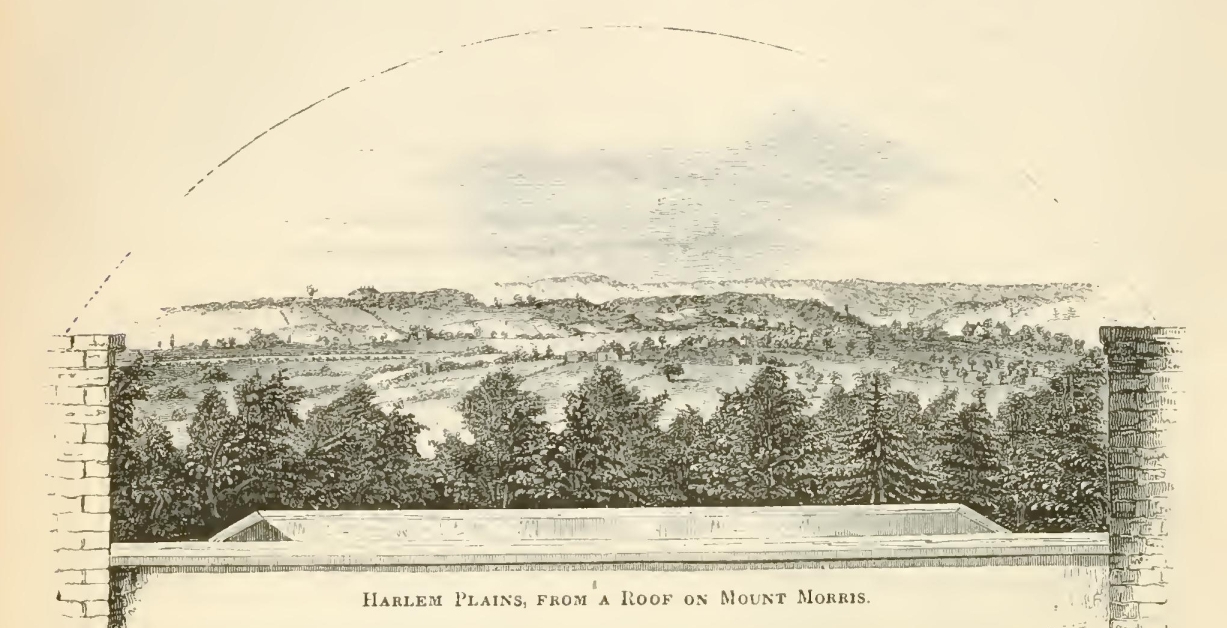
Early the next morningSept. 16 intelligence came that a British force, under Brigadier Leslie, was making its way by M'Gowan's pass to Harlem Plains. The little garrisons at Mount Morris and Harlem Cove (Manhattanville) confronted them at the mouth of a deep rocky gorge, * and kept them in partial check until the arrival of re-enforcements. Washington was at Morris's house, and hearing the firing, rode to his outpost, where the Convent of the Sacred Heart now stands. There he met Colonel Knowlton, of the Connecticut Rangers (Congress's Own), who had been skirmishing with the advancing foe, and now came for orders. The enemy were about three hundred strong upon the plain, and had a reserve in the woods upon the heights. Knowlton was to hasten with his Rangers, and Major Leitch with three companies of Weedon's Virginia regiment, to gain the rear of the advance, while a feigned attack was to be made in front. Perceiving this, the enemy rushed forward to gain an advantageous position on the plain, when they were attacked by Knowlton and Leitch on the flank. Re-enforcements now came down from the hills, when the enemy changed front and fell upon the Americans. A short but severe conflict ensued. Three bullets passed through the body of Leitch, and he was borne away. A few moments afterward, Knowlton received a bullet in his head, fell, and was borne off by his sorrowing companions. ** Yet their men fought bravely, disputing the ground inch by inch as they fell back toward the American camp. The enemy pressed hard upon them, until a part of the Maryland regiments of Colonels Griffiths and Richardson re-enforced the patriots. The British were
* This rocky gorge has not yet been touched by the hand of improvement. It remains in all its primal roughness, covered by low shrubbery, shoots from the roots of the ancient forest-trees. It extends on a line with and between the Fifth and Eighth Avenues, from the southern extremity of Harlem Plains.
** Major Leitch died the following day. Knowlton was earned to the redoubt, near the Hudson, at One hundred and Fifty-sixth Street, where he expired before sunset, and was buried within the embankments. His death was a public loss. His bravery at Bunker Hill commanded the highest respect of Washington. In general orders in the morning after the battle on Harlem Plains, the commander-in-ehief, alluding to the death of Knowlton, said, "He would have been an honor to any country."
Great Fire in New York.—Departure of the British Army for West Chester.—Landing upon Throck's Neck.
driven back across the plain, when Washington, fearing an ambush, ordered a retreat. The loss of the Americans was inconsiderable in numbers; that of the British was eighteen killed and about ninety wounded. This event inspirited the desponding Americans, and nerved them for the contest soon to take place upon the main.
The British strengthened M'Gowan's Pass, placed strong pickets in advance of their lines, and guarded their flanks by armed vessels in the East and North Rivers. General Robertson, in the mean while, had taken possession of the city, and commenced strengthening the intrenchments across the island there. He had scarcely pitched his tents upon the hills in the present Seventh and Tenth Wards, and began to look with complacency upon the city as snug winter quarters for the army, when columns of lurid smoke rolled up from the lower end of the town. It was midnightSept. 20-21,1776 Soon broad arrows of flame shot up from the darkness, and a terrible conflagration began.' It was stayed by the exertions of the troops and sailors from the ships, but not until about five hundred houses were consumed.
Perceiving the Americans to be too strongly intrenched upon Harlem Heights to promise a successful attack upon them, Howe attempted to get in their rear, to cut off their communication with the north and east, and hem them in upon the narrow head of Manhattan Island.
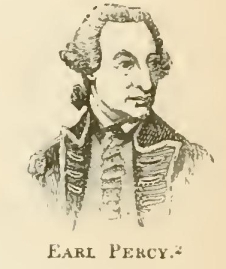
Leaving a sufficient force of British and Hessians, under Lord Percy, to guard the city, and others to man his lines toward Harlem, he embarked the remainder of his army upon ninety flat-boats, passed through the narrow and turbulent strait of Hell Gate, and landed upon Throck's Neck,Oct. 12, 1774a low peninsula jutting into the East River from the main of West Chester county, sixteen miles from the city. *** A few days afterwardOct. 17
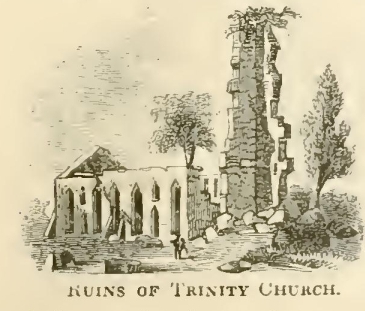
* Mr. David Grim, a merchant of New York, who saw the conflagration, has left a record of the event. He says the fire broke out in a low groggery and brothel, a wooden building on the wharf, near Whitehall Slip. It was discovered between one and two o'clock in the morning of the twenty-first of September. The wind was from the southwest. There were but few inhabitants in the city, and the flames, for a while unchecked. spread rapidly. All the houses between Whitehall and Broad Streets, up to Beaver Street, were consumed, when the wind veered to the southeast and drove the fire toward Broadway. It consumed all on eaeh side of Beaver Street to the Bowling Green, a little above which it crossed Broadway, and swept all the buildings on both sides, as far as Exchange Street. On the west side it consumed almost every building from Morris Street to Partition (Fulton) Street, devouring Trinity church * in its way, and destroyed all the buildings toward the North River. For a long time the new (St. Paul's) church was in peril, for the fire crept in its rear to Mortkile (Barclay) Street, and extended west of King's (Columbia) College to Murray Street. The exact number of buildings consumed was four hundred and ninety-three. The city then contained about four thousand houses. "The ruins," says Dunlap (who wandered over the scene at the close of the war), "on the southeast side of the town were converted into dwelling places by using the chimneys and parts of walls which were firm, and adding pieces of spars with old canvas from the ships, forming hovels—part hut and part tent." This was called Canvas Town, and there the vilest of the army and Tory refugees congregated. The Tories, and British writers of the day attempted to fix the crime of incendiarism upon the Whigs, but could not. It was well known that the fire had an accidental origin, yet British historians continue to reproduce the libel.
** The officer who went out to Lexington with re-enforcements in April, 1775.—See page 528, vol. i.
*** This is spelled Throck's, Throg's, and Frog's, in different histories. It was originally owned by a man named Throckmorton, who was called Throck for the sake of brevity. On the extreme point of this peninsula, at the entrance to Long Island Sound, stands Fort Schuyler, a strong work completed in 1842.
* Trinity church was erected at the close of the seventeenth century. The first building was small and square. Queen Anne granted to the corporation in 1705 the land extending along the west side of Broadway to Christopher Street, known as the Queen's Farm. The edifice was enlarged in 1737 to one hundred and forty-eight feet in length, including the tower and chancel, and seventy-two feet in breadth. The steeple was one hundred and seventy-five feet in height. This was the edifice consumed by the great fire in 1776. The sketch of the ruins is from a picture made on the spot, and published in Dr. Berrian's History of Trinity Church. It was rebuilt in 1788, taken down in 1839, and on the twenty-first of May, 1846, the present edifice was consecrated to Christian worship.
Landing-place of the Hessians.—Howe confronted.—Skirmish near New Rochelle.—General Heath
other troops from Montressor's Island * and Flushing landed there; and on the twenty-second, Knyphausen, with the second division of German hirelings, just arrived at New York, ** landed upon Myers's Point, now Davenport's Neck, near New Rochelle. ***
When Washington perceived this movement, he sent strong detachments, under General Heath, **** to oppose the landing of the British, and occupy lower West Chester.
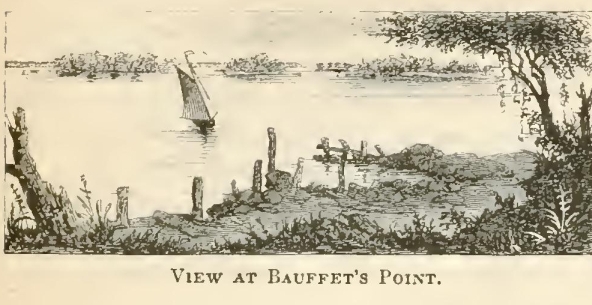
A redoubt had been thrown up on the hills, near William's Bridge; all the passes to King's Bridge were well guarded, and a detachment was at White Plains making intrenchments there. The causeways to Throck's and Pell's Necks were also guarded, the latter by Colonel Hand and his riflemen; and on the night of the first landing,October 12the bridge was removed, and General Howe was left upon an island.

He suspected his Tory guides of treachery, but he soon ascertained the truth and decamped, after being driven back from the causeway by Hand, with the aid of Prescott (the hero of Breed's Hill) and a three-pounder, under Lieutenant Bryant. (v) Howe crossed in his boats to Pell's Point, a little above,October 18 and marched over Pelham Manor toward New Rochelle.
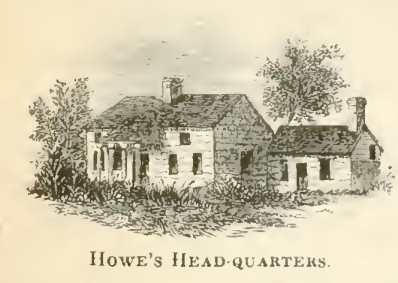
After a hot skirmish with Glover's brigade, of Sullivan's division, in which the Americans were repulsed, Howe encamped upon high ground between Hutchins's River and New Rochelle village, where he remained until the twenty-first, when he took post upon the heights of New Rochelle, (v) north of the village, on the road to White Plains and Scarsdale. Knyphausen and his division arrived the next day, and encamped upon the land now owned by E. K. Collins, Esq., between New Rochelle and Mamaroneck.
* On the twenty-fourth of September, Colonel Jackson, with Major Henly (aid-de-eamp to General Heath), and two hundred and forty men, made a descent upon the British on Montressor's Island in flat-boats. They were repulsed with a loss of twenty-two men. Among them was Major Henly, who was shot while at the head of his men. He was carried to the vamp, and buried by the side of the brave Knowlton.
** These re-enforcements arrived on the eighteenth of October. The fleet consisted of seventy-two sail, having on board four thousand Hessians, six thousand Waldeckers, two companies of chasseurs, two hundred English recruits, and two thousand baggage horses.
*** The main body of the Germans landed upon Bauflet's Point, on the east side of Davenport's Neck, where, it is said, the Huguenot settlers of New Roehelle first touched our shores. Davenport's Neck is a beautiful fertile peninsula, jutting into the Sound near the village of New Roehelle. The view here given is from the high rocky bank at Bauflet's Point, looking southeast upon the wooded islands whieh here dot the Sound. The shores of Long Island are seen in extreme distance.
**** William Heath was a native of Roxbury, Massachusetts, near whieh some of his descendants still reside. He was appointed a provincial brigadier in 1775. The Continental Congress gave him the same commission, and on the ninth of August, 1776, made him a major general, together with Spencer, Sullivan, and Greene. He commanded near King's Bridge after the Americans left New York, and in the following year he was in chief command in the Eastern department. Burgoyne's captured army were in his custody. In 1779 he commanded on the Hudson, and there was the principal theater of his military life, until the close of the war. General Heath was a useful officer, but circumstances prevented his making much display. He published an interesting volume, entitled "Heath's Memoirs," which is now mueh sought after by collectors of valuable American books. General Heath died in 1814, the last survivor of the major generals of the Revolution.
* (v) Heath's Memoirs, page 67. For a sketeh of Colonel Prescott, see page 539, vol. i.
* (vi) These heights are now (1852) partly wooded and partly cultivated; then they were covered by the primitive forest, except around the house above delineated, where Howe made his quarters. That house is upon the eastern side of the highway from New Roehelle to White Plains, about a mile from the former village. It was very much dilapidated when I visited it, and was occupied by a colored family. Half a mile beyond this dwelling, on the same side of the road, is the marble monument erected to the memory of Thomas Paine. A sketch of this monument may be found in the Supplement, page 853.
American Army in West Chester.—Skirmishes.—Condition of the Army.
Washington viewed this first planting of the British standard upon the main land in proclaimed free America with great anxiety, for clouds were gathering In the horizon of the future. Nominally, he had an army of nineteen thousand men, but in discipline, order, and all the concomitants of true soldiers * they were not one third of that number. The time of service of many of them was drawing to a close, and cold weather was approaching to chill the ardor of half-clad patriots. A powerful enemy, well provided, was crouched as a tiger within cannon-voice, ready to spring upon its prey. Yet Washington's spirit did not quail, and he resolved to confront the foe with his motley troop, as if with a parity of veterans. He called a council of war at his quarters at Morris's house,Oct 16, 1776 to decide upon the propriety of evacuating Manhattan Island. General Lee, fresh from the field of victory at Charleston, had just arrived and gave his weighty opinion in favor of a total abandonment of the island.
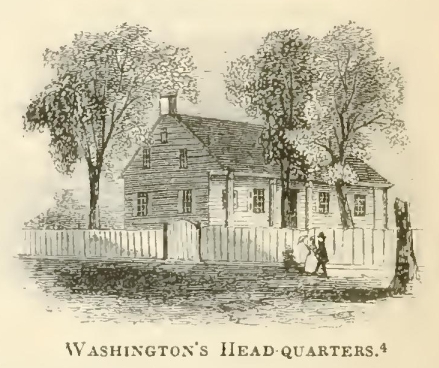
The main army was speedily marched toward the Bronx, in West Chester, leaving a garrison, under Colonel Magaw, of Pennsylvania, sufficient to hold Fort Washington and its dependencies. In four divisions, under Generals Lee, Heath. Sullivan, and Lincoln, the American army moved slowly up the western side of the Bronx, and formed a series of intrenched camps upon the hills from the heights of Fordham to White Plains, a distance of about thirteen miles. While presenting a front parallel to that of Howe, frequent skirmishes occurred, in which the Americans were generally the winners. ** General Greene with a small force garrisoned Fort Lee, situated upon the Palisades, *** nearly opposite Fort Washington, and on the twenty-first of October the commander-in-chief left Morris's house and made his head-quarters near White Plains, where, directed by a French engineer, the Americans
* Cotemporary waiters give a sad picture of the army at that time. Among many of the subordinate officers, greed usurped the place of patriotism. Officers were elected on condition that they should throw their pay and rations into a joint stock for the benefit of a company; surgeons sold recommendations for furloughs, for able-bodied men, at sixpence each, and a captain was cashiered for stealing blankets from his soldiers. Men went out in squads to plunder from friend or foe, and immorality prevailed throughout the American army. Its appointments, too, were in a wretched condition. The surgeon's department lacked instruments According to a general return of fifteen regiments, there were not more than sufficient instruments for one battalion.—See Washington's Letter to Congress, Sept. 24, 1776; Gordon, ii., 114.
** On the night of the twenty-first of October, Lord Stirling sent Colonel Haslet, with Delaware and Maryland troops, to surprise some Loyalists then lying at Mamaroneck, under Colonel Rogers, the ranger during the French and Indian wars. These troops were the Queen's Rangers, afterward commanded by Simcoe. Almost eighty men were killed or captured, and the spoils were sixty stand of arms, and provisions and clothing. Rogers escaped. On the twenty-third, Colonel Hand and his riflemen attacked two hundred and forty Hessian chasseurs near East Chester, and routed them; and almost nightly the British pickets were disturbed by the Americans. These events made Howe cautious and slow in his movements.
*** The high perpendicular rocks extending along the western bank of the Hudson from Weehawken north about twenty-three miles, are so called on account of their resemblance to palisades. Congress had ordered Washington, "by every art and whatever expense, to obstruct effectually the navigation of the North River, between Fort Washington and Mount Constitution [whereon Fort Lee stood], as well to prevent the regress of the enemy's frigates lately gone up, as to hinder them from receiving succors."—Journals, ii., 385.
**** The house occupied by Washington while the army was at White Plains is yet standing. It is a frame building, on the east side of the road, about two miles above the village. This view is from the road, looking northeast. When I last visited it (1851), Miss Jemima Miller, a maiden ninety-three years of age, and her sister, a few years her junior, were living therein, the home of their childhood. A chair and table, used by the chief, is carefully preserved by the family, and a register for the names of the numerous visitors is kept. This house was in the deep solitude of the forests, among the hills, when Washington was there; now the heights and the plain near by smile with cultivation. The present owner of the property is Abraham Miller.
The two Armies at White Plains.—The Battle there.—The Intrenchments.
cast up breast-works, rather as a defense for an intrenched camp in preparation upon the hills of North Castle two miles beyond than as permanent fortifications. * Both armies were near White Plains on the morning of the twenty-eighth of October.1776 The Americans were chiefly behind their breast-works near the village, and the British were upon the hills below, eastward of the Bronx.
Chatterton's Hill, a commanding eminence on the opposite side of the stream, was occupied on the evening of the twenty-seventh by Colonel Haslet, with his Delawares, some Maryland troops and militia, in all about sixteen hundred men. Early the next morning, M'Dougal was ordered to reenforce Haslet with a small corps and two pieces of artillery under the charge of Captain Alexander Hamilton, and to take the general command there.
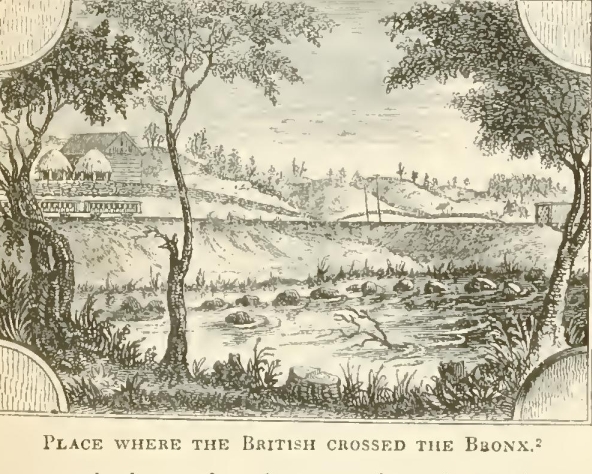
At ten o'clock the British army moved toward the village in two columns, the right commanded by General Clinton, the left by De Heister and Sir William Erskine; in all thirteen thousand strong. Howe was with the second division, and when near the village, he held a council of war on horseback, which resulted in a change in the point of attack. Inclining to the left, the British placed fifteen or twenty pieces of artillery upon the slope southeast of the rail-way station, and, under cover of their fire, constructed a rude bridge over the Bronx, and attempted to cross and ascend the steep wooded heights to dislodge the Americans from their hastily constructed breastworks upon Chatterton's Hill. Hamilton had placed his two guns in battery, on a rocky ledge, and these swept whole platoons from the margin of the hill they were attempting to ascend.
The British recoiled, fell back to their artillery, and joined another division, under General Leslie (consisting of the second British brigade, the Hessian grenadiers under Colonel Rail, a battalion of Hessian infantry, and two hundred and fifty cavalry), who were then crossing the Bronx a quarter of a mile below. There the assailants joined, and the whole force pushed up the slopes and ravines along the southwestern declivities of Chatterton's Hill.
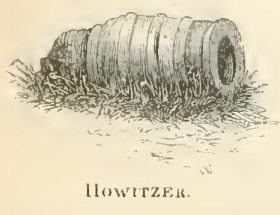
Gaining a gentle slope toward the top, they endeavored to turn M'Dongal's right flank. His advance, under Smallwood and Ritzema, gallantly opposed them while slowly retreating toward the crown of the eminence, until the British cavalry attacked the American militia on the extreme right and dispersed them. M'Dongal with only six hundred men, consisting chiefly of his own brigade and Haslet's corps, sustained an obstinate conflict for an hour. Twice the British light infantry and cavalry were repulsed, when an attack upon his flank by Rail compelled M'Dougal to give way
* A square redoubt of earth was erected in the main street of the village, the remains of which may yet be seen a little northeast of Mr. Swinburn's Literary Institution, and where now (1852) lies a shattered howitzer, dug up from the trenches a few years ago. From this redoubt-a line of breast-works extended westerly over the south side of Purdy's Hill to the Bronx, and easterly across the hills to Horton's Pond. These were not quite finished when the battle occurred on the twenty-eighth of October.—See Address of J. W. Tompkins, 1845, quoted by Bolton, ii., 368.
** This view is from the southeastern side of the Bronx, a little more than half a mile below the rail-way station at While Plains, looking north. The rail-way bridge is seen on the extreme right. Between that and the barn on the left the British ascended. In the field, seen a little to the left of the telegraph posts, toward the center, and the one on the summit beyond, the hottest of the engagement occurred. The latter is on the land of Mr. Cornelius Horton. In a hollow, near a large hickory-tree, on the southwest side of Chatterton's Hill, are the graves of many of the slain.