Volume 2 — CHAPTER XVI. (continued 2)
Reading edition
* The shield with the stars and stripes, on the right, forms the seal of General Washington. A copy of it, taken from a death warrant, may be found in the Appendix.
Virginia Residence of the Washington Family.—Early Life of General Washington.—Death of his Brother Laurence.
Virginian farm-houses. It had four rooms, with an enormous chimney at each end, on the outside. The estate on the Rappahanuock was owned by his father, Augustine Washington.
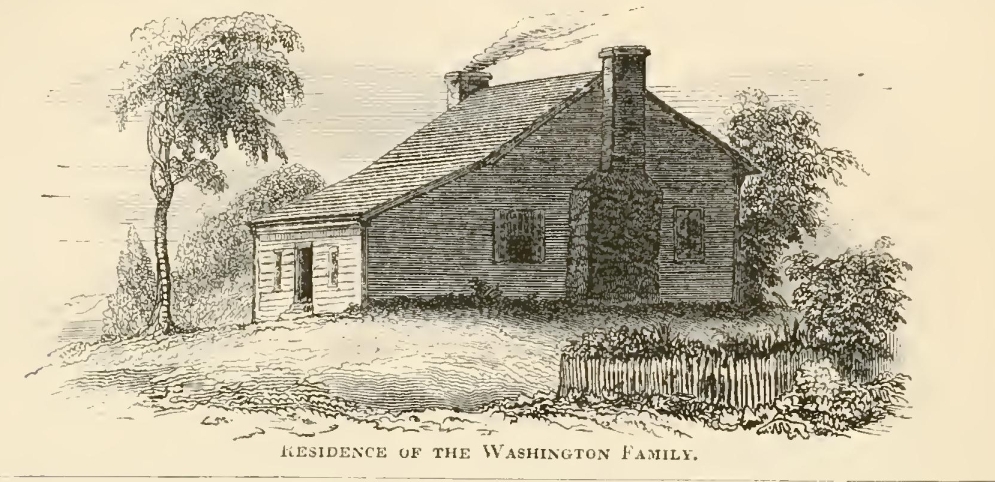

The Washington Farm.—Residence of the Mother of Washington.—His early Military Career.
several years before his marriage with Mary Ball (daughter of Colonel Ball, of Lancaster), the mother of the illustrious patriot. It is nearly opposite Fredericksburg, in Stafford county, and when I visited that city, (a) it was the property of the Reverend Thomas a 1848 Teasdale. The mansion-house, which stood near the present residence of Mr. King, a short distance below the rail-road bridge, has long since gone to decay and disappeared, and to the skillful pencil of J. G. Chapman, Esq., I am indebted for the accompanying picture.
The storm continuing, and nothing of interest being left upon the soil known as "The Washington Farm," I did not visit it, but contented myself with a distant view of its rolling acres as I rode out of Fredericksburg to pursue my journey southward.
On the northwest corner of Charles and Lewis streets, in Fredericksburg, is the house (the residence of Richard Stirling, Esq ) where the mother of Washington resided during the latter years of her life, and where she died. There that honored matron, and more honored son, had their last earthly interview in the spring of 1789, after he was elected President of the United States. Just before his departure for New York to take the oath of office, and to enter upon his new duties, Washington, actuated by that filial reverence and regard which always distinguished him, * hastened to Fredericksburg to visit his mother. She was then fourscore and five years old, bowed with age and the ravages of that terrible disease, a deep-rooted cancer in the breast. Their interview was deeply affecting. After the first emotions incident to the meeting had subsided, Washington said, "The people, madam, have been pleased, with the most flattering unanimity, to elect me to the chief magistracy of the United States; but before I can assume the functions of that office, I have come to bid you an affectionate farewell. So soon as the public business which must necessarily be encountered in arranging a new government can be disposed of, I shall hasten
* It is related that on one occasion, during the Revolution, his mother was with him at a large social gathering. At nine o'clock in the evening the aged matron approached her son, placed her arm in his, and said. "Come, George, it is time for us to be at home; late hours are injurious." With the docility of a child the general left the company with his mother; "but," as Mrs. Hamilton said to me, when speaking of the circumstance, "he came back again."
Washington's last Interview with his Mother.—Her Death, and unfinished Monument.—Cornerstone laid by President Jackson.
to Virginia, and—" Here the matron interrupted him with, "You will see me no more.
My great age, and the disease which is fast approaching my vitals, warns me that I shall not be long in this world. I trust to God I am somewhat prepared for a better. But go, George, fulfill the destiny which Heaven appears to assign you; go, my son, and may Heaven's and your mother's blessing be with you always." Washington wept; the great man was again a little child, and he kissed the furrowed cheek of his parent with all the tender affection and simplicity of a loving boy. With a full heart he went forth to "fulfill the destiny" which Heaven assigned him, and he saw his mother no more. She died in the autumn of 1789, and was buried on a beautiful knoll upon the estate of her son-in-law. Colonel Fielding Lewis, * within sound of the busy hum of the city.
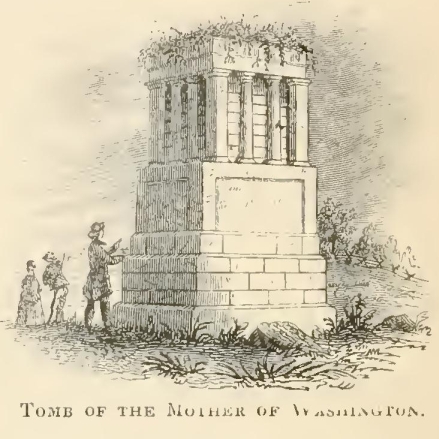
In the midst of the thickly-falling sleet, I made a pilgrimage to the grave of the mother of Washington, and sketched the half-finished and neglected monument which was erected over it a few years ago. It stands near a ledge of rocks, where she often resorted in fine weather for private meditation and devotion. Years before her death she selected that spot for her grave. The monument is of white marble, and, even in its unfinished state, has an imposing appearance. The corner-stone was laid by Andrew Jackson, then President of the United States, on the 7th of May, 1833, in the presence of a great concourse of people. He went down the Potomac from Washington City on the 6th, ** and was met at Potomac Creek, nine miles from Fredericksburg, by the Monument Committee of that city. He was also met by a military escort, and conducted to the residence of Doctor Wallace, where he was entertained. A large military and civic procession was formed the following day, and proceeded to the grave, where the imposing ceremonies were to be performed. Mr. Basset, in behalf of the citizens of Fredericksburg, first addressed the president on the character of her whom they sought to honor. The president made an eloquent reply; and, as he deposited an inscribed plate in the hollow corner-stone, he said, "Fellow-citizens, at your request, and in your name, I now deposit this plate in the spot destined for it; and when the American pilgrim shall, in after ages, come up to this high and holy place, and lay his hand upon this sacred column, may he recall the virtues of her who sleeps beneath, and depart with his affections purified, and his piety strengthened, while he invokes blessings upon the memory of the mother of 'Washington."
Referring to this event, Mrs. Sigourney thus beautifully wrote for the Fredonia Arena:
"Long hast thou slept unnoticed. Nature stole
In her soft minstrelsy around thy bed.
* Colonel Fielding Lewis married Elizabeth, the sister of Washington. He was proprietor of half the town of Fredericksburg, and of an extensive territory adjoining. During the war, in which his feelings were warmly enlisted, he superintended the great manufactory of arms in his neighborhood. He was a local magistrate for many years, and often represented his county in the Legislature. He died in December, 1781, at the age, of fifty-five years. His son George was at one time a captain in the Commander-in-Chief's Guard, and his other three sons were active public men. His daughter Elizabeth married Charles Carter Esq.
** While the boat was lying at the wharf at Alexandria on this occasion, Lieutenant Randolph, who had lately been dismissed from the navy, went on board, and proceeding into the cabin, where the venerable president sat at table reading and smoking, made a brutal and cowardly attack upon him. Randolph was instantly seized by the captain, when a number of his friends, who accompanied him, rescued him, and bore him to the wharf. A citizen of Alexandria hearing of the outrage, was so greatly incensed that he said to the president, "Sir, if you will pardon me in case I am tried and convicted, I will kill Randolph! for this insult to you, in fifteen minutes." "No, sir," responded the president, "I can not do that. I want no man to stand between me and my assailants, nor none to take revenge on my account. Had I been prepared for this cowardly villain's approach, I can assure you all that he never would have the temerity to undertake such a thing again."
The unfinished Obelisk for the Tomb of Washington's Mother.—Departure from Fredericksburg.—General Mercer's Son
Spreading her vernal tissue, violet-gemm'd,
And pearl'd with dews.
She bade bright Summer bring
Gifts of frankincense, with sweet song of birds,
And Autumn east his reaper's coronet
Down at thy feet, and stormy Winter speak
Sternly of man's neglect. But now we come
To do thee homage—Mother of our chief!—
Fit homage, such as honoreth him who pays.
Methinks we see thee, as in olden time—
Simple in garb, majestic, and serene;
Unmoved by pomp or circumstances: in truth
Inflexible; and, with a Spartan zeal,
Repressing vice and making folly grave.
Thou didst not deem it woman's part to waste
Life in inglorious sloth—to sport a while
Amid the flowers, or on the summer wave.
Then, fleet like the Ephemeron, away,
Building no temple in her children's hearts,
Save to the vanity and pride of life
Which she had worship'd.
For the might that clothed
The "Pater Patria"—for the glorious deeds
That make Mount Vernon's tomb a Mecca shrine
For all the earth, what thanks to thee are due.
Who, mid his elements of being wrought,
We know not—Heaven can tell."
Almost twenty years have passed away since the imposing pageant at the laying of the corner-stone was displayed, and yet the monument is unfinished,
Still may Spring, and Summer, and
"Stormy Winter speak
Sternly of man's neglect
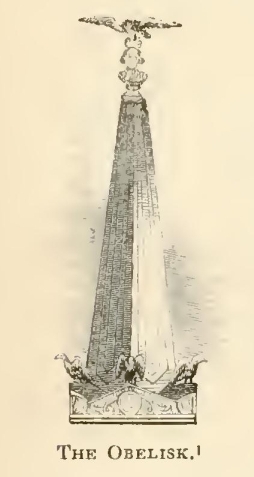
for the huge marble obelisk, as it came from the quarry, lies there yet, defaced and mutilated by rude hands, and silently appealing to local pride and general patriotism to sculpture its ornaments, and place it where it was designed to be. Year after year the dust of the plain has lodged upon the top of the half-finished pile, and the seeds of wild flowers have been borne thither upon the wings of the zephyrs; and where the base of the noble obelisk should rest, Nature, as if rebuking insensate man, hath woven green garlands, and hung flowery festoons. Upon the broad tablet whereon was to be inscribed the beautiful memorial, "Mary, the Mother of Washington," dark green fungi have made their humiliating record instead.
I left Fredericksburg ** at two o'clock, with the intention of lodging at Bowling Green, in Caroline county, twenty-two miles distant. The post-road is one of the finest I ever traveled; broad, and in good condition. It passes through a gently rolling, fertile country, and apparently well cultivated. When within about twelve miles of my destination I passed a farm-house, from which two men, with a span of horses and a rickety market wagon,
* This is a sketch, from the original design of the monument, of the obelisk and its surmountings, intended to be placed upon the present structure. Why half-hewn marble has been allowed to remain so long unfinished that Vandal relic-seekers have ruined it, I can not comprehend. Is there not public spirit enough in Virginia to complete this memorial of her most honored daughter? Independent of the reflected glory of her son, she was a noble woman, because truly excellent in all her relations in life; a sincere Christian; kind and benevolent; and a mother who, like Cornelia, regarded her children as her jewels, and cherished them accordingly.
** It is to me a matter of sincere regret, that when I was at Fredericksburg, I was not aware that Colonel Hugh Mercer, the son of the lamented General Mercer, who was killed at Princeton, was a resident of that city. Educated at the public expense, by order of Congress, his name and character belong to history. A portrait of this "foster-child of the Republic" will be found in another part of this work.
The Wrong Road.—Pamunkey River.—Hanover Court House.—The old Tavern.—Anecdote.
were just departing for Richmond, whither I was making my way. They, too, intended to lodge at Bowling Green, and offered to pilot me. Their fresh horses tried Charley's speed and bottom to the utmost. We crossed the Mattapony River, a tributary of the Parnunkey, at twilight, over two high bridges. Night came on with sudden and intense darkness; so dark that I could not see my pilots. At a fork I "lost my reckoning they taking one branch and I the other. Charley neighed, and tried to follow them. "I was wise in my own conceit," and reined him into the other fork. I rode on for nearly an hour without passing a habitation, and entirely unconscious of the nature or direction of the road I was traveling.
A heavy mist shrouded the country. At length the rays of a candle came feebly from a window at the road-side. I hailed, and asked for and obtained lodgings for the night. It was the hospitable mansion of Mr. Burke, a planter, some seven miles from Bowling Green. I had wandered four miles from the direct road to that village, but was not far from the nearest highway to Hanover Court House, my next point of destination.
I resumed my journey at daybreak, leaving Bowling Green on the left; breakfasted at a small tavern, after a ride of six miles, and soon overtook my pilots, who, in attempting to reach a point beyond Bowling Green the night before, had broken an axle while crossing a swamp. We journeyed on together to Hanover Court House, within nineteen miles of Richmond. The appearance of the country changed materially after crossing the Mattapony. It became more hilly, sandy, and sterile, producing dwarf pines in abundance. We crossed the Parnunkey a little below the confluence of its branches (the North and South Anna), and, at a mile distant, reached Hanover Court House in time for a late dinner. The village now (a) consists of the ancient court-house and tavern, one brick house, several negro huts, and a jail. The latter was in process of reconstruction a 1851 when I was there, having been burned a few months previously. Here was a flourishing town before Richmond, now containing thirty thousand inhabitants, was an incorporated village. The Parnunkey was then navigable for sloops and schooners; now the channel is filled with sand. Hanover was a place of considerable business. Sixteen hundred hogs-heads of tobacco were annually exported from it, and it was regarded as an eligible site for the state capital. When the House of Burgesses were deliberating upon the subject of removing the Capitol from Williamsburg, they came within a few votes of deciding upon Hanover instead of Richmond. Where the populous village once stood I saw traces of a recent corn crop, but not a vestige of former habitation.
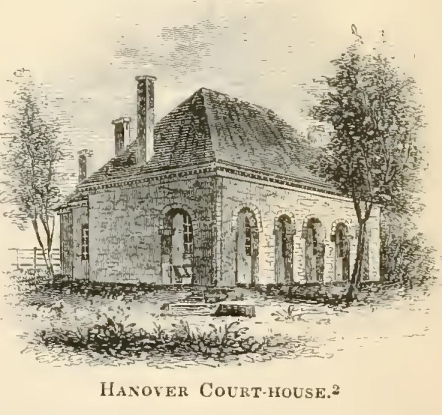
The old tavern where I lodged, and the court-house, are objects of much interest, from the circumstance that in the former Patrick Henry was a temporary bar-tender, * and in the latter he made those first efforts at oratory which burst forth like meteors from the gloom of his obscurity. He had passed his youth-
* The Marquis de Chastellux, who visited Hanover in 1781, mentions this tavern as "a tolerably handsome inn, with a very large saloon, and a covered portico, and destined to receive the company who assemble every three months at the court-house, either on private or publie affairs." I slept in the "large saloon," and under shelter of the "covered portico" mentioned bv the marquis, I sketched the court-house. The general external appearance of the house. I was informed, has been changed. The marquis relates the following anecdote respecting the passage of the English through that county: "Mr. Tilghman, our landlord, though he lamented his misfortune in having lodged and boarded Cornwallis and his retinue, without his lordship having made the least recompense, could not help laughing at the fright which the unexpected arrival Tarleton spread among a considerable number of gentlemen who came to hear the news, and were assembled in the court-house. A negro, on horseback, came full gallop to let them know that Tarleton was not above three miles off. The resolution of retreating was soon taken: but the alarm was so sudden, and the confusion so great, that every one mounted the first horse he could find, so that few of those curious gentlemen returned upon their own horses."—Travels, ii., 13, 14.
** This view is from the front, looking east-northeast. The 'building is of imported brick, with an arcade in front. It was erected about 1740. An addition has been made to the rear, wherein is the judge's bench.
Early Years of Patrick Henry.—The "Parsons's Cause."—His Début as an Orator, described by Wirt
ful days in apparent idleness, and, lacking business tact and energy, he failed to succeed in mercantile pursuits, in which he was engaged. He became bankrupt, and no one was willing to aid him. He had married at eighteen, and yet, in the twenty-fourth year of his age, he had done little toward supporting a wife. They lived most of the time with his father-in-law (Mr. Shelton), who kept the tavern at Hanover, and when the proprietor was absent, young Henry took his place behind the bar. As a last resort, he studied law. He applied himself diligently for six weeks, when he obtained a license, but for nearly three years he was "briefless;" indeed, he hardly knew how to draw a brief correctly. At the age of twenty-seven, he was employed in the celebrated Parsons's Cause; and in Hanover court-house, on that occasion, his genius was first developed. The case was a controversy between the clergy and the Legislature of the state, relating to the stipend claimed by the former! A decision of the court in favor of the clergy had left nothing undetermined but the amount of damages in the cause whieh was pending. Young Henry took part against the clergy, and in his plea his wonderful oratory beamed out, for the first time, in great splendor. Wirt has vividly described the scene in his life of the "American Demosthenes." *
* "The array before Mr. Henry's eyes was now most fearful. On the bench sat more than twenty clergymen, the most learned men in the colony, and the most capable, as well as the severest critics before whom it was possible for him to have made his début. The court-house was crowded with an overwhelming multitude, and surrounded with an immense and anxious throng, who, not finding room to enter, were endeavoring to listen without in the deepest attention. But there was something still more awfully disconcerting than all this; for in the chair of the presiding magistrate sat no other person than his own father. Mr. Lyons opened the cause very briefly; in the way of argument he did nothing more than explain to the jury that the decision on the demurrer had put the act of 1758 entirely out of the way, and left the law of 1748 as the only standard of their damages. He then concluded with a highly-wrought eulogium on the benevolence of the clergy. And now came on the first trial of Patrick Henry's strength. No one had ever heard him speak, and curiosity was on tiptoe. He rose very awkwardly, and faltered much in his exordium. The people hung their heads at so unpromising a commencement; the clergy were observed to exchange sly looks with each other; and his father is described as having almost sunk with confusion from his seat. But these feelings were of short duration, and soon gave place to others of a very different character; for now were those wonderful faculties which he possessed for the first time developed, and now was first witnessed that mysterious and almost supernatural transformation of appearance, which the fire of his own eloquence never failed to work in him; for, as his mind rolled along, and began to glow from its own action, all the exuviæ of the clown seemed to shed themselves spontaneously. His attitude, by degrees, became erect and lofty. The spirit of his genius awakened all his features. His countenance shone with a nobleness and grandeur which it had never before exhibited. There was a lightning in his eye which seemed to rivet the spectator. His action became graceful, bold, and commanding; and in the tones of his voice, but more especially in his emphasis, there was a peculiar charm, a magic, of which any one who ever heard him will speak as soon as ever he is named, but of which no one can give any adequate description. They can only say that it struck upon the ear and upon the heart in a manner which language can not tell. Add to all these his wonder-working fancy, and the peculiar phraseology in which he clothed its images, for he painted to the heart with a force that almost petrified it. In the language of those who heard him on this occasion, 'he made their blood run cold, and their hair to rise on end.'
* "It will not be difficult for any one who ever heard this most extraordinary man to believe the whole account of this transaction, which is given by his surviving hearers; and from their account, the court-house of Hanover county must have exhibited, on this occasion, a scene as picturesque as has been ever witnessed in real life. They say that the people, whose countenances had fallen as he arose, had heard but a very few sentences before they began to look up, then to look at each other with surprise, as if doubting the evidence of their own senses; then, attracted by some strong gesture, struck by some majestic attitude, fascinated by the spell of his eye, the charm of his emphasis, and the varied and commanding expression of his countenance, they could look away no more. In less than twenty minutes they might be seen, in every part of the house, on every bench, in every window, stooping forward from their stands, in death-like silence, their features fixed in amazement and awe, all their senses listening and riveted upon the speaker, as if to catch the last strain of some heavenly visitant. The mockery of the clergy was soon turned into alarm, their triumph into confusion and despair; and at one burst of his rapid and overwhelming invective, they fled from the bench in precipitation and terror. As for the father, such was his surprise, such his amazement, such his rapture, that, forgetting where he was, and the character which he was filling, tears of ecstasy streamed down his cheeks, without the power or inclination to repress them.
* "The jury seem to have been so completely bewildered that they lost sight not only of the act of 1748, but that of 1758 also; for, thoughtless even of the admitted right of the plaintiff, they had scarcely left the bar when they returned with a verdict of one penny damages. A motion was made for a new trial; but the court, too, had now lost the equipoise of their judgment, and overruled the motion by a unanimous vote. The verdict, and judgment overruling the motion, were followed by redoubled acclamation from within and without the house. The people, who had with difficulty kept their hands off their champion from the moment of closing his harangue, no sooner saw the fate of the cause finally sealed, than they seized him at the bar, and, in spite of his own exertions and the continued cry of 'order' from the sheriffs and the court, they bore him out of the court-house, and, raising him on their shoulders, carried him about the yard in a kind of electioneering triumph."
New Castle.—Road from Hanover to Richmond.—Birth-place of Henry Clay.—Virginia Market wagons.
We shall meet Patrick Henri again presently in more important scenes.
Upon the Pamunkey, a few miles below Hanover Court House, is New Castle, once a flourishing village, but now a desolation, only one house remaining upon its site.
That is the place where Patrick Henry assembled the volunteers and marched to Williamsburg, for the purpose of demanding a restoration of the powder which Lord Dunmore had removed from the public magazine, or its equivalent in money. Of this I shall hereafter write.
I lodged at Hanover, and, after an early breakfast, departed for Richmond, the rain yet falling. Between three and four miles from Hanover Court House,
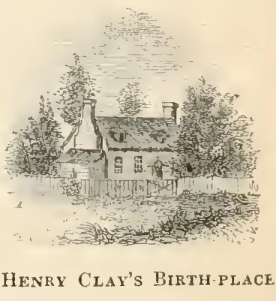
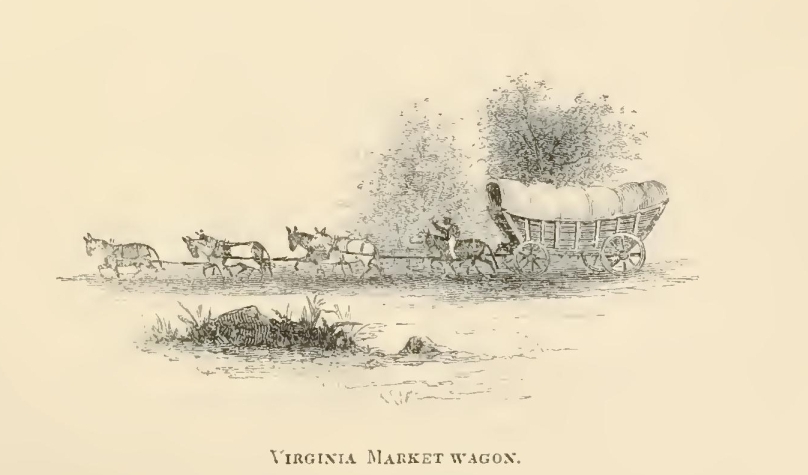
I passed the birth-place of Henry Clay. It stands upon the right of the turnpike to Richmond, in the midst of the flat piny region called the slashes of Hanover. * It is a frame building, one story high, with dormer windows, and two large chimneys on the outside of each gable. Here the great statesman was born in 1777. The roads through this desolate region are wretched, abounding in those causeways of logs known as corduroy roads. Within ten miles of Richmond the scenery becomes diversified, and the vicinage of a large town is denoted by the numerous vehicles upon the broad road, consisting chiefly of uncouth market-wagons, drawn by mules, frequently six or eight in a team, as pictured in the sketch below. The negro driver is usually seated upon one of the wheel mules, and without guiding lines, conducts them by the vocal direction of haw and gee. To the eyes of a Northern man looking upon these caravans for the first time, they appear quite picturesque.
I reached Richmond at meridian, (a) where I tarried with esteemed friends for a Dec. 14, 1848. several days.
* The word slashes is applied to tracts of fiat clay soil, covered with pine woods, and always wet. The clay is almost impervious to water, and as evaporation goes on slowly in the shadow of the pines, the ground is seldom dry. "The mill-boy of the slashes" was an electioneering phrase applied to Henry Clay some years ago, when he was a candidate for the presidency of the United States. Mr. Clay, who is now (1852) a representative of Kentucky in the Senate of the United States, is the last survivor of the Commissioners who negotiated the treaty at Ghent in 1815, with the representatives of the British government.
Early Settlement at Rockett's and Powhatan.—Captain Smith.—Abandonment of "Nonesuch."—Fort Charles.