Volume 2 — CHAPTER VIII. (continued 2)
Reading edition
* It is said that Washington never saw Major Andre, having avoided a personal interview with him from the beginning.
** The place of Andre's execution is now designated by a stone, lying on the right of a lane which runs from the highway from Tappan village to old Tappan, on the westerly side of a large peach orchard owned by Dr. Bartow, about a quarter of a mile from Washington's head-quarters. The stone is a small bowlder, on the upper surface of which is inscribed "André executed Oct. 2d, 1780." It is about three feet in length. This stone was placed there and inscribed in 1847, by a patriotic merchant of New York. A more elegant and durable monument should be erected upon the spot.
The Captors, of André rewarded.—Disinterment of Andre's Remains.—Honored by the Duke of York
handkerchief from his eyes, and said, 'I pray you to bear me witness that I meet my fate like a brave man.' The wagon being now removed from under him, he was suspended, and instantly expired. It proved, indeed, 'but a momentary pang.' He was dressed in his royal regimentals and boots. His remains, in the same dress, were placed in an ordinary coffin, and interred at the foot of the gallows * and the spot was consecrated by the tears of thousands. Thus died, in the bloom of life, the accomplished Major André, the pride of the royal army, and the valued friend of Sir Henry Clinton." **
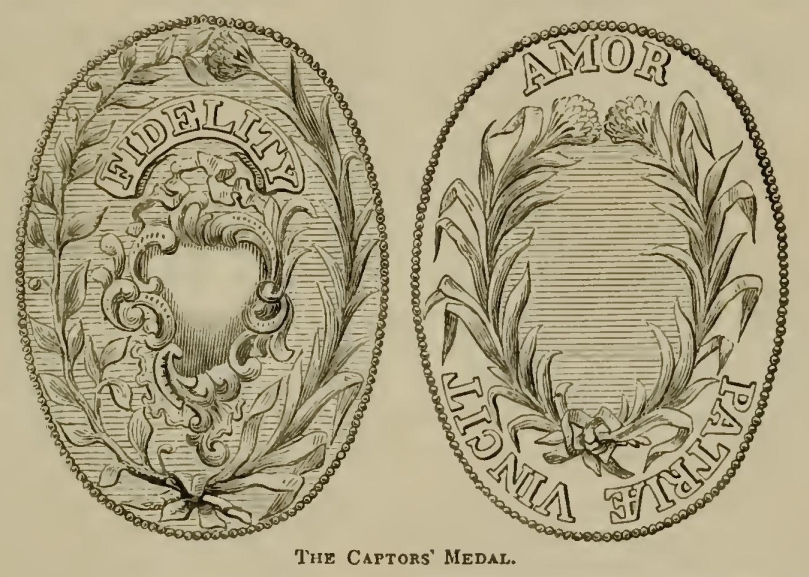

The captors of Andre (Paulding, Williams, *** and Van Wart), were nobly rewarded by Congress for their fidelity. In a letter to the president of Congress, Washington said, October 7,1780 "Their conduct merits our warmest esteem; and I beg leave to add, that I think the public would do well to allow them a handsome gratuity. They have prevented, in all probability, our suffering one of the severest strokes that could have been meditated against us." Pursuant to this recommendation, Congress adopted a resolution November, 1780 expressive of the public sense of the virtuous and patriotic conduct of the "three young volunteer militia-men," and ordered "that each of them receive annually, out of the public treasury, two hundred dollars in specie, or an equivalent in the current money of these states during life, and that the Board of War procure for each of them a silver medal, on one side of which shall be a shield with this inscription; Fidelity; and on the other the following motto: 'the love of country conquers,' and forward them to the commander-in-chief, who is requested to present the same, with a copy of this resolution and the thanks of Congress, for their fidelity, and the eminent service
* In a subsequent publication by Doctor Thacher, entitled Observations relating to the Execution of Major Andre, he says that the regimentals of that officer were given to his servant. His remains were taken up in 1831 by Mr. Buchanan, the British consul at New York, removed to England, and deposited near his monument in Westminster Abbey. As no metallic buttons were found in his grave, it is evident he had been stripped of his regimentals before burial. He was interred in an open field then belonging to a Mr. Mabie.
* Mr. Buchanan published an interesting account of the disinterment in 1831. It was done by command of the Duke of York. On opening the grave, the moldering coffin was found about three feet below the surface. The roots of a peach-tree, which some sympathizing hand had planted at the head of his grave, had twined like a net-work around the young hero's skull. A leather string, which he had used for tying his hair, was perfect; this Mr. Buchanan sent to Andre's surviving sisters. While a prisoner after his capture at St. John's in 1775, Andre parted with his watch. This was also obtained and sent to his sisters. Two small cedars were growing by the grave. A portion of one of these was sent to England with the remains, and Mr. Buchanan suggested to the duke the propriety of having a snuff-box made of some of the wood, as a present for the Reverend Mr. Demarest, of Tappan, who greatly assisted the consul in the disinterment. The duke had an elegant box made, lined with gold, and inscribed "From his royal highness the Duke of York to the Reverend Mr. Demarest." Mr. Buchanan received a silver inkstand, inscribed "The surviving sisters of Major Andre to James Buchanan, Esq., his majesty's consul, New York." They also sent a silver cup, with a similar inscription, to Mr. Demarest,
** Military Journal, p. 222, 223.
*** David Williams was born in Tarrytown, October 21st, 1754. He entered the army in 1775, was under Montgomery at St. John's and Quebec, and continued in the militia service until 1779. He took an active part against the Cow-boys and Skinners on the Neutral Ground. He was not in regular service when he joined in the expedition the day before the capture of André. After the war he married a Miss Benedict, and settled in Schoharie county. He died at Broome, in that county, on the 2d day of August, 1831, at the age of seventy-seven. His remains were interred, with military honors, at Livingstonville, in the presence of a large concourse of citizens. His widow, I believe, is yet living with her son at Broome, at the age of ninety-four. Ten years after the death of her husband, she obtained a continuance of his pension, which had been stopped at his death, receiving $2000 at once. Congress has been repeatedly petitioned for an appropriation to erect a monument to Williams, but without success. See Simms's Schoharie County.
Desire to secure Arnold.—A Plan to Abduct him.—Its Execution committed to Major Henry Lee.
they have rendered their country." * The medals were afterward given to the three individuals by Washington himself, at head-quarters, and the captors enjoyed the annuity during their lives. **
Commensurate with the strong feeling of sympathy evinced for Andre was the sentiment of indignant hatred and disgust of Arnold, and it was the ardent desire of Washington and his compatriots to obtain possession of the person of the arch-traitor and punish him as his wickedness deserved. Various plans were arranged, secret and open, to capture him, and several expeditions were formed for that avowed object. One, while the army was yet at Tappan, and the tears of sympathy for poor Andre were hardly dry upon the cheeks of the soldiers, was almost successful. It was known only to Washington, Major Henry Lee, and Sergeant Champe, the latter the principal actor in the movement.
Washington had learned that Arnold's quarters in New York were next door to those of Sir Henry Clinton (now No. 3 Broadway), and that he seemed to feel so secure with his new friends that his usual caution was but little exercised. The chief conceived a plan for abducting the traitor and bringing him to the American camp. The principal difficulty appeared to be to procure the proper instruments for such an enterprise. Recent events had made the commander-in-chief suspicious, for he knew not where smaller traitors might be lurking. He sent for Major Henry Lee, the commandant of a brave legion of cavalry; a man in whose patriotism, prudence, and judgment he knew he could confide. Already he had intrusted to this officer the delicate service of ascertaining the truth of many flying rumors that other officers of high rank were likely to follow Arnold's example. To him Washington disclosed his wishes. "I have sent for you, Major Lee," he said, "in the expectation that you have in your corps individuals capable and willing to undertake an indispensable, delicate, and hazardous project. Whoever comes forward on this occasion will lay me under great obligations personally, and in behalf of the United States I will reward him amply. No time is to be lost; he must proceed, if possible, to-night." The nature of the service was disclosed to Lee, and he promptly replied to his commander that he had no doubt his legion contained many men daring enough to undertake any enterprise, however perilous; but for the service required there was needed a combination of talent rarely found in the same individual. *** Lee suggested a plan which was highly approved of by Washing-
* Journals of Congress, vi., 154.
** In 1817, Mr. Paulding applied to Congress for an augmentation of his annuity. Major Tallmadge, who was then a member of the House of Representatives, strongly opposed the prayer of the petitioner, on the ground that he and his companions had been more than compensated for the real patriotism which they exercised on the occasion of making Major Andre a prisoner. The statements of Andre, at the time, impressed Tallmadge with the belief that the plunder of a traveler was their first incentive to arrest his progress, and that, could they have been certified of their prisoner's ability to perform his promises of large pay for his release, they would not have detained him. Andre solemnly asserted that they first ripped up the housings of his saddle and the cape of his coat, in search of money, but finding none, one of the party said, "He may have it [money] in his boots." The discovery of the papers there concealed gave them the first idea that he might be a spy. Major André was of opinion that if he could have given them a small sum in specie at first, they would have let him pass; but he only had a small amount in Continental bills, which was given him by Smith. While we may not claim entire purity of intent on the part of the captors when they first arrested the progress of Andre, we can not doubt the strength of their patriotism to withstand the lure of large bribes after they discovered his real character. For particulars on this point, see a small volume, entitled Vindication of the Captors of Major Andre, published in New York in 1817; also Walsh's American Register, vol. ii., 1817. In this volume of the Register may be found a translation of Marbois's Complot du Arnold.
*** In addition to the capture of Arnold, the emissary was to be commissioned to ferret out information touching the alleged defection of other officers of the Continental army. Already, as we have noticed, a sergeant under the command of Captain Ogden had been employed for such a purpose, and satisfied Washington of the innocence of one general officer who was accused!
Sergeant Champe.—His Sense of Honor.—Consents to attempt the Abduction of Arnold.—His Desertion favored by Lee.
ton. He named Champe, the sergeant major of his cavalry, as every way well qualified for the service, but he was afraid his sense of personal honor would not allow him to take the first step in the perilous expedition—desertion—for he was anxiously awaiting a vacancy in the corps to receive a promised commission. *
Lee sent instantly for Champe, communicated to him the wishes of Washington, and depicted, with all the earnestness and eloquence of which he was master, the glory that awaited him, if successful. Champe listened with the deepest attention, his countenance evincing the greatest excitement of feeling. He expressed himself charmed with the plan, and its proposed beneficial results; declared that he was ready to embark in any enterprise for his country's good, however perilous, which did not involve his honor; but the idea of desertion to the enemy, and hypocritically espousing the cause of the king, were obstacles in his way too grave to be disregarded, and he prayed to be excused. Lee combated these scruples with every argument calculated to impress the heart of a brave soldier. He spoke of the personal honor which success promised; the honor of the corps to which he belonged; the great service which he would perform for his beloved eommander-in-ehief, and the plaudits of his countrymen. He told him that desertion, by request of his general, for a laudable purpose, earned with it no dishonor, and that the stain upon his character would remain only until prudence should allow the publication of the facts. After long persuasion, the sergeant major consented to undertake the mission, and preparations were immediately made.
Washington had already drawn up instructions. These were read to Champe, and he carefully noted their import in such a way that their true meaning could not be understood by another. He was to deliver letters to two individuals in New York, unknown to each other, who had long been in the confidence of the general. He was to procure such aid in bringing Arnold away as his judgment should dictate; and he was strictly enjoined to forbear killing the traitor under any circumstances. ** These preliminaries being settled, the difficulties that lay in his way between the camp and the enemy's outposts at Paulus's Hook, were next considered. There were many pickets and patrols in the way, and straggling parties of American irregulars often ventured almost to Bergen Point in search of booty or an adventure. Major Lee could offer the sergeant no aid against these dangers, lest he should be involved in the charge of favoring his desertion, and Champe was left to his own resources. All that Lee could do was to delay pursuit as long as possible, after it should be ascertained that the sergeant major had deserted.
At eleven o'clock at night, Champe took his cloak, valise, and orderly-book, October 20, 1780 mounted his horse secretly, and with three guineas in his pocket, which were given him by Lee, "put himself on fortune." Lee immediately went to bed, but not to sleep. Within half an hour, Captain Carnes, the officer of the day, came to him in haste, and informed him that one of the patrols had fallen in with a dragoon, who, on being challenged, put spurs to his horse and escaped. Lee complained of fatigue and drowsiness, pretended to be half asleep, and thus detained the captain some minutes before he seemed fairly to understand the object of that officer's visit. He ridiculed the idea that one of his own dragoons had deserted, for such an event had occurred but once during the whole war. The captain was not to be convinced by such arguments, but immediately mustering the whole squadron of horse, by Lee's reluctant order, satisfied both himself and his commander that one had deserted, and that he was no less a personage than Champe, the sergeant major, who had decamped with his arms, baggage, and orderly-book. Captain Carnes ordered an
* John Champe was a Virginian. "He was-a native of Loudon county," says Lee, in his Memoirs, "and at this time twenty-three or twenty-four years of age; enlisted in 1776; rather above the common size; full of bone and muscle; with a saturnine countenance, grave, thoughtful, and taciturn, of tried courage and inflexible perseverance, and as likely to reject an overture, coupled with ignominy, as any officer in the corps."—Memoirs, p. 272.
** Lee made an arrangement with Mr. Baldwin, of Newark, to aid Champe. With him the sergeant was to have daily intercourse, as if by accident, and through him Lee was to receive communications from his sergeant major. He agreed to pay Baldwin, if successful, one hundred guineas, five hundred acres of land, and three negroes.
Pursuit of Champe.—His Skill in eluding his Pursuers.—He Escapes to a British Galley.—Sir Henry Clinton deceived
immediate pursuit. Lee made as much delay in the preparation as possible, and when all was ready, he ordered a change in the command, giving it to Lieutenant Middleton, a young man whose tenderness of disposition would cause him to treat Champe leniently, if he should be overtaken. By parleying and other delays, Champe got an hour the start of his pursuers.
It was a bright starry night, and past twelve o'clock, when Middleton and his party took the saddle and spurred after the deserter. A fall of rain at sunset had effaced all tracks in the road, and thus favored the pursuit, for the single foot-prints of the dragoon's horse were easily traced and recognized. * Often, before dawn, when coming to a fork or a cross-road, a trooper would dismount to examine the track. Ascending an eminence at sunrise near the "Three Pigeons," ** a tavern a few miles north of the village of Bergen, they descried from its summit the deserting sergeant, not more than half a mile in advance. The pursuers were discovered by Champe at the same moment, and both parties spurred onward with all their might. They were all well acquainted with the roads in the vicinity. There was a short cut through the woods to the bridge below Bergen, which left the great road a little below the Three Pigeons. There Middleton divided his party, sending a detachment by the short road to secure the bridge, while himself and the others pursued Champe to Bergen. He now felt sure of capturing the deserter, for he could not reach Paulus's Hook without crossing the bridge in question. The two divisions met at the bridge, but, to their great astonishment, Champe had eluded their vigilance, and was not to be found. He, too, was acquainted with the short cut, and shrewdly considered that his pursuers would avail themselves of it. He therefore wisely determined to abandon his design of going to the British post at Paulus's Hook, and seek refuge on board one of two of the king's galleys which were lying in the bay in front of the little settlement of Communipaw, about a mile from Bergen.
Middleton retired hastily from the bridge to Bergen, and inquired if a dragoon had been seen there that morning. He was answered in the affirmative, but no one knew which way he went from the village. The beaten track no longer gave a legible imprint of his horse's shoes, and for a moment his pursuers were foiled. The trail was soon discovered on the road leading to Bergen. The pursuit was vigorously renewed, and in a few moments Champe was discovered near the water's edge, making signals to the British galleys. He had lashed his valise, containing his clothes and orderly-book, upon his back. When Middleton was within a few hundred yards of him, Champe leaped from his horse, cast away the scabbard of his sword, and with the naked blade in his hand, he sped across the marsh, plunged into the deep waters of the bay, and called to the galleys for help. A boat filled with strong oarsmen responded to his call, and he was soon on board the galley, with all the evidences of the sincerity of his desertion in his possession. The captain of the galley gave him a letter to Sir Henry Clinton, in which the scene just mentioned was described, and before night the sergeant was safely quartered in New York.
Middleton recovered the horse, cloak, and scabbard belonging to Champe, and returned to Tappan. Lee was grieved when he saw the supposed evidence that poor Champe was slain; but equally great was his joy when he learned from Middleton that the sergeant had escaped safely on board one of the enemy's galleys. Four days afterward Lee received a letter from Champe, in a disguised hand, and without signature, informing him of the occurrence just narrated.
Champe was sent by Clinton, for interrogation, to his adjutant general. The faithfulness of the legion to which he had hitherto been attached was well known in the British army, and this desertion was regarded as an important sign of increasing defection among the Americans. This opinion Champe fostered by adroit answers to questions proposed, Sir Henry Clinton also questioned him closely; and so sincere seemed to be the sergeant's desire to serve the king, that he won the entire confidence of the British general. Clinton
* The horses of Lee's legion were all shod by a farrier attached to the corps, and every shoe, alike in form, had a private mark put upon it. By this means the foot-prints of Champe's horse were recognized, and the course of the deserter made obvious to his pursuers. There is now a hamlet of that name there, situated on the high road from Haekensack to Hoboken.
Champe sent to Arnold.—Joins his Legion.—Preparations for carrying off the Traitor.
gave Champe a couple of guineas, and recommended him to call upon General Arnold, who was engaged in raising an American legion, to be composed of Loyalists and deserters. This was exactly the course to which Champe had hoped events would tend. Arnold received him courteously, and assigned him quarters among his recruiting sergeants. The traitor asked him to join his legion, but Champe begged to be excused, on the plea that if caught by the rebels, he would surely be hanged; but promised Arnold that, if he changed his mind, he would certainly join his legion.
Champe found means to deliver the two letters before mentioned, and five days after his arrival in New York, he made arrangements with one of "Washington's October 23, 1789 correspondents to assist him in abducting Arnold, and then communicated the facts to Major Lee. * He enlisted in the traitor's legion, so as to have free intercourse with him, and ascertain his night habits and pursuits. In the rear of Arnold's quarters was a garden, extending down to the water's edge. ** Champe ascertained that it was Arnold's habit to return to his quarters at about midnight, and that previous to going to bed he always visited the garden. Adjoining the garden was a dark alley leading to the street. These circumstances were favorable to Champe's plans. He had arranged with two accomplices (one of whom was to have a boat in readiness) to seize and gag Arnold, on a certain night, in his garden, convey him to the alley, and from thence, through the most unfrequented streets, to the river. In case of detection while carrying the traitor, they were to represent him as a drunken soldier whom they were conveying to the guard-house. Once in the boat, they might pass in safety to Hoboken.
Champe carefully removed some of the palings between the garden and the alley, and replaced them so slightly that they might again be removed without noise. When all was arranged, he wrote to Lee, and appointed the third subsequent night for the November 5, 1780 delivery of the traitor on the Jersey shore. On that evening, Lee and a small party left the camp, with three accoutered horses—one for Arnold, one for the sergeant, and one for his associate—and at midnight concealed themselves at an appointed place in the woods at Hoboken. Hour after hour passed, and the dawn came, but Champe and his prisoner did not arrive. Lee and his party returned to camp greatly disappointed. A few days afterward he received a letter from his sergeant, explaining the cause of his failure, and an assurance that present success was hopeless. On the very day when Champe was to execute his plan, Arnold changed his quarters, to superintend the embarkation of troops for an expedition southward, to be commanded by himself. *** In this expedition the American le-
* In this first communication he assured Lee that his inquiries concerning the alleged defection of other American officers were satisfactory, and that no such defection existed.
** Arnold's quarters were at No. 3 Broadway, adjoining those of Sir Henry Clinton. The house is yet standing, and is represented, with Clinton's quarters, on page 592, of volume ii. The garden extended along the street to the northern boundary of the Atlantic Hotel, No. 5, where the dark alley, mentioned in the text, divided it from the premises No. 9, now known as the Atlantic Garden. The shore of the liver was formerly a few yards west of Greenwich Street, West Street being all "made ground."
*** Arnold received, as the price of his desertion from the Americans and attempted betrayal of the liberties of his country into the hands of the enemy, a commission as colonel, with a brevet rank of brigadier, in the British army, and the sum of nearly fifty thousand dollars. It may be mentioned, for the information of those unskilled in the technicalities of the military service, that the term brevet is used to a commission giving nominal rank higher than that for which pay is received. A brevet major serves and draws pay as a captain, and a brevet brigadier as colonel. Arnold was lower in office, both actual and nominal, among his new friends than he had been in the American army. But large bribes of gold was a salvo to that nice sense of honor for which he had so often wrangled. He was heartily despised by the British officers, and he was frequently insulted without possessing the power to show his resentment. Many anecdotes illustrative of this point have been related. It is said that, on one occasion, a British statesman, as he rose to make a speech in the House of Commons, saw Arnold in the gallery. "Mr. Speaker," he said, "I will not speak while that man (pointing toward Arnold) is in the house." George the Third introduced Arnold to Earl Balcarras, one of Burgoyne's officers at Bemis's Heights. "I know General Arnold and abominate traitors," was the quick reply of the earl, as he refused his hand and turned on his heel. When Talleyrand was about to come to America, he was informed that an American gentleman was in an adjoining room. He sought an interview, and asked for letters to his friends in America. "I was born in America, lived there till the prime of my life, but alas! I can call no man in America my friend," replied the stranger. That stranger Arnold.
Champe foiled.—Taken by Arnold to Virginia.—Escapes and rejoins his Legion in the Carolinas.—Ramapo Valley.
gion was to be employed, and poor Champe, who had enlisted in it to carry out his plans, was in a sad dilemma. Instead of crossing the Hudson that night, with the traitor his prisoner, he found himself on board of a British transport, and that traitor his commander! December 16, 1780 The expedition sailed, and Champe was landed on the shores of Virginia. He sought opportunities to escape, but found none, until after the junction with Cornwallis at Petersburg, where he deserted. He passed up toward the mountains, and into the friendly districts of North Carolina. Finally, he joined the legion of Major Lee, just after it had passed the Congarec in pursuit of Lord Rawdon. Great was the surprise of his old comrades when they saw him, and it was increased at the cordial reception which the deserter received at the hands of Lee. His story was soon told, and four-fold greater than before his desertion was the love and admiration of his corps for him. They felt proud of him, and his promotion would have been hailed by general acclamation. Knowing that he would immediately be hanged if caught by the enemy, he was discharged from service. The commander-in-chief munificently rewarded him; and seventeen years afterward, when President Adams appointed Washington to the chief command of the armies of the United States, then preparing to defend the country from the threatened hostility of the French, the chief sent to Colonel Lee for information concerning Champe, being determined to bring him forward in the capacity of a captain of infantry. But the gallant soldier had removed to Kentucky, and was asleep in the soil. *
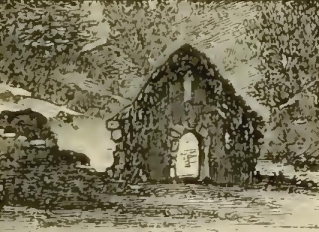
A few months after my visit to Tappan, I made another tour to the vicinity.. I passed two days in the romantic valley of the Ramapo, through which the New York and Erie rail-way courses. Every rocky nook, sparkling water-course, and shaded glen in that wild valley has a legendary charm. It is a ravine sixteen miles in extent, opening wide toward the fertile fields of Orange county. It was a region peculiarly distinguished by wild and daring adventure during the Revolution, and, at times, as important military ground. There the marauding Cow-boys made their rendezvous; and from its dark coverts, Claudius Smith, the merciless freebooter, and his three sons, with their followers, sallied out and plundered the surrounding country. ** Along the sinuous Ramapo Creek, before the war of the Revolution broke out, and while the ancient tribe of the Ramapaughs yet chased the deer on the rugged hills which skirt the valley, iron-forges were established, and the hammer-peal of spreading civilization echoed from the neighboring crags. Not far distant from its waters the great chain which was stretched across the Hudson at West Point was wrought; *** and the remains of one of the Ramapo forges, built at the close of the war, now form a picturesque ruin on the margin of the rail-way. **** A few miles below it, Ramapo village, with its extensive machinery, sends up a per-
* See Lee's Memoirs of the War in the Southern Department of the United States, from page 270 to 284 The reader, by observing the dates of his correspondence with Washington, will perceive that Lee has con founded the effort of Ogden to save André by having Arnold given up, and the desertion of his sergeant, with the expedition of Sergeant Champe. In his account of Champe's maneuver, he makes the salvation of André a leading incentive to efforts to capture Arnold; but André was executed on the 2d of October, whereas Champe did not desert until the 20th of the same month.
** Claudius Smith was a large, fine-looking man, of strong mind, and a desperado of the darkest dye. Himself and gang were a terror to Orange county for a long time, and tempting rewards were offered for his apprehension. He was finally captured near Oyster Bay, on Long Island, and taken to Goshen, where he was chained to the jail floor, and a strong guard placed over him. He was hung in the village on the 22d of January, 1779, with Gordon and De la Mar—the former convicted of horse-stealing, and the latter of burglary. Smith's residence was in the lower part of the present village of Monroe, on the Erie railway. Several murders were afterward committed by Smith's son Richard, in revenge for the hanging of his father; and for a while the Whigs in that region suffered more from the desperate Cow-boys than before the death of their great leader. For a detailed account of transactions connected with Claudius Smith, see Eager's History of Orange County, p. 550-564.
*** See page 700.
**** This ruin is situated about half way between the Sloatsburgh station and Monroe works. The forge was built in 1783—4. by Solomon Townshend, of New York, to make bar-iron and anchors, and was named the Augusta Works. A sketch of the ruin forms a pretty frontispiece to The Salamander (or Hugo, as it is now called), a legend of the Ramapo Valley, by Mrs. Elizabeth Oakes Smith. The historic anecdote related in the introduction to this charming legend. I also heard from the lips of the "venerable Mr. P———— through whose kindness I was enabled to visit the "Hopper House." The relics of the Revolution are pleasingly grouped in the introduction referred to.
Ramapo Village. Mr. Pierson.—Movements of the two Armies in 1777.—Washington's Perplexities.
petual hymn of industry from the wilderness. This village, now containing a population of three hundred, * is owned by the Piersons, the elder having established iron-works there fifty years ago. Jeremiah II. Pierson, the original proprietor, is yet living there at the age of eighty-four, and to the kind hospitality of himself and family I am indebted for October, 1850 much of the pleasures and profit of my visit to the Ramapo Valley. God has taken his eyesight from him, but mercifully vouchsafes good health, sound mind, sunny cheerfulness, and the surroundings of a happy family. I listened with interest to a narrative of his clear recollections of the past, and the traditions gathered from his scattered neighbors when he first sat down there in the almost wilderness. Not twenty years had elapsed since the war closed when he erected his forges, and the sufferers were living in small groups all around him. They have all passed away, and volumes of unwritten traditionary history are buried with them.
The American army under Washington was encamped in the vicinity of Ramapo for a few days in July, 1777. The head-quarters of Washington had been at Morristown during the previous winter and spring. Believing it prudent to act on the defensive, he had waited anxiously for Sir William Howe, who was quartered in New York city, to make some decided movement. Summer approached, and yet the British commander gave no intimations respecting his designs for a campaign. It was believed that he would either make a demonstration against the strong posts in the Highlands, or attempt a passage of the Delaware and a seizure of Philadelphia. Washington's position at Morristown was an eligible one for acting promptly and efficiently when Howe should move either way.
General Howe had a considerable force stationed at New Brunswick. This force was augmented early in May, and Washington received information that they had begun to build a portable bridge there, so constructed that it might be laid upon flat boats. Believing this to be a preparation for crossing the Delaware, Washington collected the new levies from Virginia and the Middle States, at Morristown, and ordered those from the eastward to assemble at Peekskill. Toward the close of May, the American army moved from Morristown, and encamped upon the heights of Middlebrook, in a very strong position, 1777 and commanding the country from New Brunswick to the Delaware. The maneuvers of detachments of the two armies in this vicinity in June (a) are noticed on page 331, a 1777vol. i. The British finally crossed over to Staten Island from Amboy (b) on the b 1777 bridge which they had constructed at New Brunswick, and entirely evacuated the Jerseys.
The next day Washington received intelligence of the approach of Burgoyne from Canada, and at the same time spies and deserters from New York informed him that a fleet of large vessels and transports were preparing in the harbor of that city. The commander-in-chief was greatly perplexed. At first it appeared probable that Howe was preparing to sail with his army southward, go up the Delaware, and attack Philadelphia by land and by water; but the intelligence that Washington continued to receive from the North made it appear more probable that a junction with Burgoyne, and the consequent possession of the Hudson River, by which the patriots of the Eastern and Middle States would be separated, and a free communication with Canada be established, would engage the efforts of Sir William Howe. The possession of the Hudson River had been a prominent object from the beginning of the war.
* When the large cotton factory (the spindles of which are now idle) and the screw factory of Mr. Pierson were in operation here, the village contained about seven hundred inhabitants. The whole valley of the Ramapo has but three or four owners. Many thousand acres belong to the Townsends; the Lorillard family own another immense tract; Mr. M'Farland another; the Sloats have considerable possessions, and the lower part belongs to the Piersons.
March of the American Army toward the Highlands.—Howe's Destination determined.—The Clove.
Washington remained at Middlebrook with the main division of the army, anxiously awaiting the movements of the enemy, until toward the middle of July. He dispatched two regiments to Peekskill, on the Hudson, and had his whole army in readiness to march in that direction, if circumstances should require.
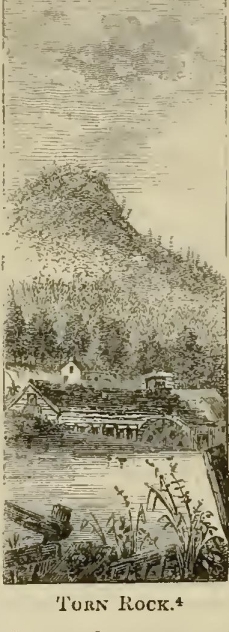
When it was certainly known that the British army had actually embarked on board the fleet, Washington moved slowly toward the Highlands by way of Morristown, Ramapo, * and the Clove. *** He encamped in the latter place on the 15th, eleven miles above the Ramapo Pass (of which I shall presently July, 1777 write) and immediately sent forward Lord Stirling, with a division, to Peekskill. He established his head-quarters at Ramapo on the 23d; but so much was that region infested with Cow-boys and other Tories, that it was with great difficulty that he could obtain correct information from a distance. *** Northward from the present Ramapo village rises a range of lofty hills, upon the highest summit of which is upreared a huge mass of granite, shaped like a mighty dome, the top covered with trees. From this eminence, five hundred feet above the village, a small portion of New York Bay, Staten Island, and the ocean near Sandy Hook, may be distinctly seen on a clear day, the distance being about thirty-five miles. To this observatory, it is said, Washington was piloted, and with his glass saw a portion of the fleet of the enemy near Sandy Hook. The Weehawken Hill obstructed a full view of New York Harbor, and the commander-in-chief was uncertain whether the whole fleet had dropped down to the Hook; but, on returning to his quarters at Ramapo, he received positive information that the British fleet had gone to sea. Convinced that Philadelphia was the destination of Howe, Washington recalled Stirling's division from Peekskill, broke up his encampment in the Clove, and the army pursued various routes toward the Delaware. The battle of Brandywine, and other events in the vicinity of Philadelphia, which June 1,1779. occurred soon afterward, will be noticed in subsequent chapters.
On the return of Commodore Sir George Collier and General Matthews from a marauding expedition to Virginia, at the close of May, 1779, they sailed up the Hudson River to attack the forts in the Highlands. This expedition, as we have noticed on page 175, was under the command of Sir Henry Clinton. As soon as Washington was advised of this movement, he drew his troops from their cantonments in New Jersey, and, by rapid marches, reached the Clove on the 7th with five brigades and two Carolina regiments. He pressed forward to Smith's Clove, whence there were mountain passes to the forts in the Highlands, and there he encamped. Small detachments for observation and protection to couriers were stationed at different points from the encampment
* Ramapo, or Romopoek, was a small settlement on the Ramapo River, about five miles south of the present Suffern's Station on the New York and Erie rail-way, and within the province of New Jersey. It was nearly seven miles below the present village of Ramapo, founded by Mr. Pierson.
** The Clove here mentioned was chiefly the Ramapo Valley extending to Smith's Clove, which continues northward from the former, in the vicinity of Turner's Station, on the New York and Erie rail-road, far in the rear of Haverstraw and Stony Point. Through this clove, by the way of Ramapo, was the best route for an army from New Windsor into the upper part of New Jersey. The main division of the Continental army was again encamped in the Clove in 1779, when General Wayne captured Stony Point.
*** "I can not give you any certain account of General Howe's intended operations," wrote Washington to General Schuyler. "His conduct is puzzling and embarrassing beyond measure. So are the informations which I get. At one time the ships are standing up toward the North River; in a little while they are going up the Sound; and in an hour after they are going out of the Hook. I think in a day or two we must know something of his intentions."
**** This view is from the verge of the dam above the Ramapo works, near the rail-way, looking northeast. The eminence is called Torn Rock, from its ragged appearance on its southeastern side. There is a deep fissure in a portion of the bare rock, from which comes up a sound like the ticking of a watch, caused by the water which percolates through the scams in the granite. A tradition was long current that Washington lost his watch in the fissure, and that, by some miraculous power, it continued to tick!
The Ramapo Pass. March of the allied Armies to Virginia.—Clinton Deceived by Washington's Letters.
southward to old Ramapo, and strong intrenchments were thrown up at the Pass, a narrow gorge about half a mile below the present Ramapo village. The passage between the hills here is only wide enough for the stream, the rail-way, a. wagon-road, and a narrow strip ol meadow-land.
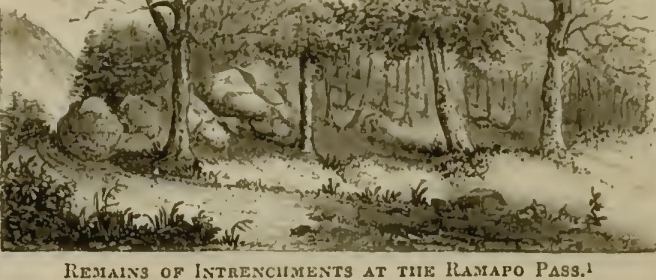
The hills on each side rise abrupt and rocky. It was a place almost as easy to fortify and guard as the pass of old Thermopylae The ditch and bank from the wagon-road eastward are yet quite prominent. Large trees have overgrown them, and with care these mementoes of the past may be long preserved.
While the army was encamped at Smith's Clove, the successful expedition of General Wayne against Stony Point was accomplished. This success, the subsequent evacuation of that post and of Verplanek's Point by the British, and the necessity for sending re-enforcements to General Lincoln at the South, caused the camp in the Clove to be broken up early in the autumn. The main portion of the army went into winter quarters at Morristown, where the eommander-in-chief established himself, and strong detachments were stationed at different points among the Highlands.
Once again, and for the last time, the Ramapo Valley became the temporary theater of military operations. It was in the summer of 1781, when the allied armies took up their line of march for Virginia to achieve the defeat of Cornwallis. They had conjoined upon the Hudson for the purpose of making an attack upon the head-quarters of the British army in the city of New York. The failure of Count De Grasse, commander of a French fleet then in the West Indies, to co-operate with the land forces, made Washington abandon this project, and turn his attention to the military operations at the South. To prevent obstacles being thrown in his way by Sir Henry Clinton, or re-enforcements being sent to Cornwallis, Washington kept up the appearance of a meditated attack upon New York.
The two armies, which had remained nearly six weeks in the vicinity of Dobbs's Ferry, crossed the Hudson at Verplanck's Point, and marched by different routes to Trenton, under the general command of Lincoln; some passing through the Ramapo Valley and the Pass to Morristown, and others taking the upper route above the Ringwood Iron-works. The French took the river route, by Tappan and the Hackensack Valley, to Newark and Perth Amboy. At the latter place they built ovens, constructed boats, collected forage, and made other movements indicative of preparations to commence an attack, first upon the British posts on Staten Island, and then upon New York. Previous to the passage of the Hudson, Washington had caused deceptive letters to be written and put in the way of being intercepted, ** all of which deceived Sir Henry Clinton into the belief that an attack upon New
* This view is from the road, looking north toward the village of Ramapo. The remains of the intrenchments are seen along the right in the foreground. On the left, in the distance, is seen a glimpse of the hills on the other side of the narrow valley.
** One of the bearers of these letters was a young Baptist clergyman, named Montagnie, an ardent Whig, who was directed by Washington to carry a dispatch to Morristown. He directed the messenger to cross the river at King's Ferry, proceed by Haverstraw to the Ramapo Clove, and through the Pass to Morristown. Montagnie, knowing the Ramapo Pass to be in possession of the Cow-boys and other friends of the enemy, ventured to suggest to the commander-in-chief that the upper road would be the safest. "I shall be taken," he said, "if I go through the Clove." "Your duty, young man, is not to talk, but to obey!" replied Washington, sternly, enforcing his words by a vigorous stamp of his foot. Montagnie proceeded as directed, and, near the Ramapo Pass, was caught. A few days afterward he was sent to New York, where he was confined in the Sugar House, one of the famous provost prisons in the city. The day after his arrival, the contents of the dispatches taken from him were published in Rivington's Gazette with great parade, for they indicated a plan of an attack upon the city. The enemy was alarmed thereby, and active preparations were put in motion for receiving the besiegers. Montagnie now perceived why he was so positively instructed to go through the Ramapo Pass, where himself and dispatches were quite sure to be seized. When they appeared in Rivington's Gazette, the allied armies were far on their way to the Delaware. Montagnie admired the wisdom of Washington, but disliked himself to be the victim. Mr. Pierson, from whom I obtained the narrative, received it from the lips of Montagnie himself. Upon this incident Mrs. Elizabeth Oakes Smith (who also received the narrative from Mr. P.) founded her interesting prize tale called the Ramapo Pass. She also mentions it in her introduction to The Salamander.
The "Hopper House."—Patriotism of the Owner.—Interesting Relics.—Burr's Head-quarters.
York city was the grand object of the Americans. The allied armies had crossed the Delaware, and were far on their way toward the head of Elk, before the British commander was fully aware of their destination.
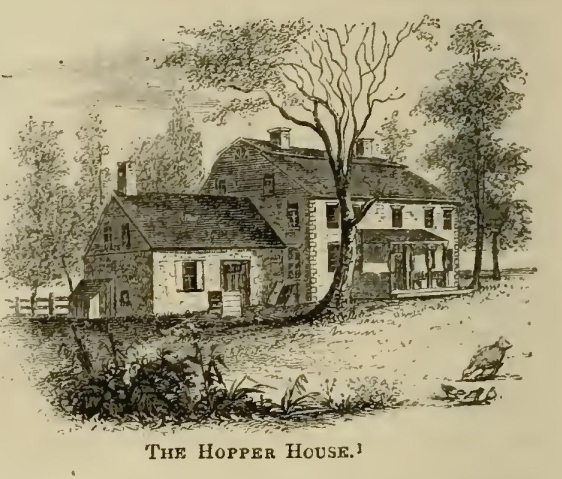
About four miles south of the Ramapo Pass, and three from Suffern's Station, on the road to Morristown, is the "Hopper House," where Washington made his head-quarters from the 2d until the 18th of September, 1780. The mansion was owned by ———— Hopper, one of the most active Whigs of the day. He was often employed by Washington in the secret service, and frequently visited his friends in New York city while the enemy had possession of it. On such occasions, he obtained much valuable information respecting the strength of the enemy, without incurring suspicion, as he never committed a word to paper. The remains of the patriot rest beneath a small marble monument, in a family cemetery, upon a grassy knoll by the road side, not far from the mansion.
This is the house wherein those letters of Washington, beginning with "Head-quarters, Bergen county," were written; it being in New Jersey, about two miles from the New York line. It was here that he received the news of the defeat of Gates at the disastrous battle near Camden, on the 16th of August, 1780; and from hence he set out on his journey to Hartford, on Monday, the 18th of September,1780 to meet the French officers in council, the time when Arnold attempted to surrender West Point into the hands of the enemy. The venerable widow of Mr. Hopper resided there until her death in 1849, when she had reached the ninety-ninth year of her life. Her daughter, who was often dandled on the knee of Washington, is still living, but was absent on the day of my visit, and I was denied the gratification of viewing those relics of the Revolution which are preserved in the house with much care. **
Close by Suffern's Station is an old building coeval with the original Hopper house. It was the head-quarters of Lieutenant-colonel Aaron Burr, while stationed there in command of Malcolm's regiment in September, 1777. It has been sometimes erroneously called the head-quarters of Washington. While encamped here for the purpose of guarding the Ram-
* This view is from the road, looking northeast. The low part, on the left, is a portion of the old mansion of the Revolution, which contained the dining-hall. It was a long stone building. A part of it has been taken down, and the present more spacious edifice, of brick, was erected soon after the war.
** Mrs. Smith, in her introduction to The Salamander, makes mention of the centenarian, and of these relics. "The ancient matron," she says, "has none of the garrulity of old age; on the contrary, as she adverted to past scenes, a quiet stateliness grew upon her, in beautiful harmony with the subject. Rarely will another behold the sight, so pleasing to ourselves, of five generations, each and all in perfect health and intelligence, under the same roof-tree. She spoke of this with evident satisfaction, and of the length of lime her ancestors had been upon the soil; in truth, we had never felt more sensibly the honorableness of Gray hairs.......We were shown the bed and furniture, remaining as when he [Washington] used them, for the room is kept carefully locked, and only shown as a particular gratification to those interested in all that concerns the man of men. Here were the dark chintz hangings beneath which he had slept; the quaint furniture; old walnut cabinets, dark, massive, and richly carved; a Dutch Bible, mounted with silver, with clasps and chain of same material, each bearing the stamp of antiquity, yet all in perfect preservation; largo China bowls; antique mugs; paintings upon glass of cherished members of the Orange family. These and other objects of interest remain as at that day."
Colonel Aaron Burr at Sufferns.—Confusion of the Militia.—Night Attack upon the British Pickets near Hackensack.
apo Pass, Colonel Burr performed an exploit which was long remembered in the neighborhood.
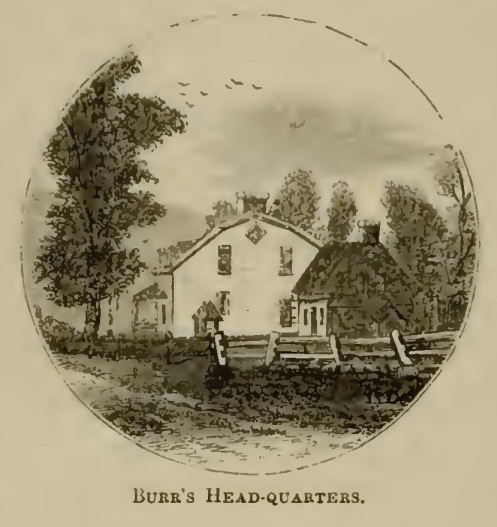
He received intelligence that the enemy were in considerable force at Hackensack, and advancing into the country. Leaving a guard to protect the camp, Burr marched with the remainder of his effective men to Paramus, a distance of sixteen miles, in the direction of Hackensack. They arrived there at sunset, and found the militia of the district gathered in great confusion in the woods, ordered them to sleep until he should awaken them, and then went alone to reconnoiter. A little before daylight he returned, aroused his men, and directed them to follow him, without speaking a word or firing a gun until ordered, on pain of death.
Having arranged them in order, Burr marched forward with thirty picked men, and at ten o'clock at night approached the pickets of the enemy. When within three miles of Hackensack, Burr led his men upon the enemy before they had time to take up their arms. Leading them unobserved between the sentinels, until within a few yards of the picket-guard, he gave the word Fire! His men rushed forward. A few prisoners and some spoil was carried off by the Americans, without the loss of a man on their part. Burr sent an order to Paramus by an express for all the troops to move, and to rally the country. This success inspirited the militia, and they flocked in great numbers to the standard of Burr. The enemy, thoroughly frightened, retreated in haste to Paulus's Hook (Jersey City), leaving behind them a greater portion of the plunder which they had collected.
We will now leave the Ramapo, and, saying farewell to the Hudson and its associations, wend our way toward the sunny South.
Departure for the South.—Mode of Traveling.—Characteristics of the Journey.—Interesting Associations.