Volume 2 — CHAPTER XXVI. (continued 2)
Reading edition
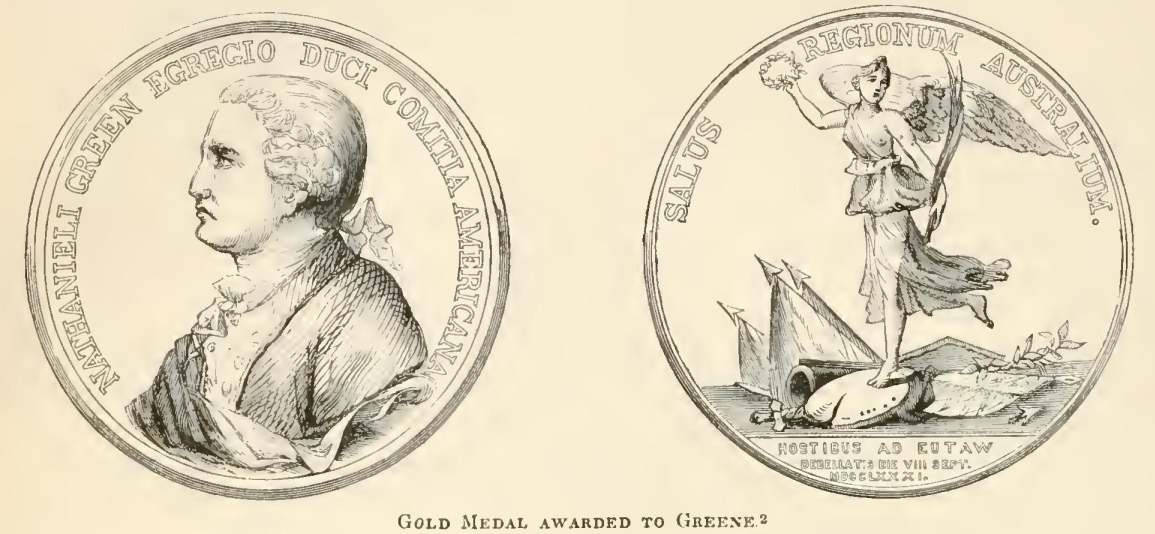

The loss of both parties, considering the number engaged, was very heavy. The Americans had one hundred and thirty rank and file killed, three hundred and eighty-five wounded, and forty missing; in all, five hundred and fifty-five. There were twenty-two officers killed, and thirty-nine wounded. The loss of the British, according to their own statement, was six hundred and ninety-three men, of whom eighty-five were killed on the field. Including seventy-two wounded, whom they left in their camp when they abandoned it the day after the battle, Greene took five hundred prisoners.
On the day succeeding the battle, Lieutenant-colonel Stuart, confident that he could not maintain his position, decamped for Charleston, after destroying a great quantity of his stores So precipitate was his retreat, that he left seventy-two of his wounded to be taken care of by the Americans. He also left behind him one thousand stand of arms. He was pursued for some distance, when intelligence being received that Major M'Arthur was advancing with re-enforcements for Stuart, the Americans returned to their camp. It was fortunate for M'Arthur that he met StuartSept. 10, 1781 as soon as he did, for Marion and Lee had been dispatched to fall upon any detachment coming up from Charleston, and were then only a few miles off. Even with this re-enforcement Stuart did not feel strong enough to meet Greene in battle, and he continued his retreat to Monk's Corner, twenty-five miles from Charleston, leaving the Americans the acknowledged victors at Eutaw.
When Greene was apprised of the positive retreat of Stuart, he followed and pursued
* On the twenty-ninth of October, Congress adopted a series of resolutions, expressive of its high appreciation of the services of Greene and his officers and soldiers. In these resolutions, the various corps engaged in the battle were named; also Captains Pierce and Pendleton, Major Hyrne, and Captain Shubrick, his aids-de-camps. Marion was also thanked for the part he had taken in this battle, and also for his gallant conduct on the thirtieth of August, in attacking the British at Parker's Ferry. Congress ordered the Board of War to present a sword to Captain Pierce, who bore Greene's dispatches to that body.—See Journals of Congress, vii., 166. On the same day, Congress adopted the complimentary resolutions in honor of the defeat of Cornwallis at Yorktown.
** This is a representation of each side of the medal, the full size of the original. On one side is a profile of Greene, with the words, "The American Congress to Nathaniel Greene, the distinguished leader." Upon the other side is a figure of Victory, lighting upon the Earth, and stepping upon a broken shield. Under her feet are broken weapons, colors, and a shield. The legend is, "The Safety of the Southern Department." "The Foe conquered at Eutaw, 8th of September, 1781."
*** Journals of Congress, vii., 167.
Retirement of the Americans to the Santee Hills.—Mutiny.—Relic from the Battle-field.—Nelson's Ferry.
him almost to Monk's Corner. Perceiving the strength of the enemy there, he returned to Eutaw, and having a vast number of his troops sick, he proceeded from thence, by easy marches, to his favorite retreat upon the high hills of Santee.* Sept. 18, 1781 There he remained until the eighteenth of November, when the health of his army being recruited, he marched into the low country, where he might obtain an abundance of food. In the mean while, the army of Cornwallis had been captured at Yorktown;Oct. 19 St. Clair had driven the British from Wilmington; and the whole upper country of the Carolinas and Georgia were in possession of the patriots.
Nothing now remained but to drive in the British outposts, and hem them within the narrow precincts of their lines at Charleston and Savannah. With this view, Greene, at the head of his cavalry, and about two hundred infantry, proceeded toward Dorchester, a British post in the neighborhood of Charleston, while the main army, under Colonel Williams, crossed the Santee, and marched to the fertile plains upon the Four-hole Creek, a tributary of the Edisto. Here we will leave the two armies for the present, to meet many of the troops again upon other fields of conflict.
As there were no works of consequence thrown up at Eutaw, not a vestige of the camp or of the battle remained when I visited the spot in 1849, except the few scattered bricks of the "citadel" already referred to. On returning to his house, Mr. Sinkler showed me a gold watch which one of his negroes found ten years before, while making holes with a stick in planting cotton seed, in the field where Washington was defeated. The negro hit a hard substance, and as there are no stones in the field, he had the curiosity to search for the obstruction, when he drew forth the watch. The hands were almost destroyed by rust; otherwise the watch is well preserved.
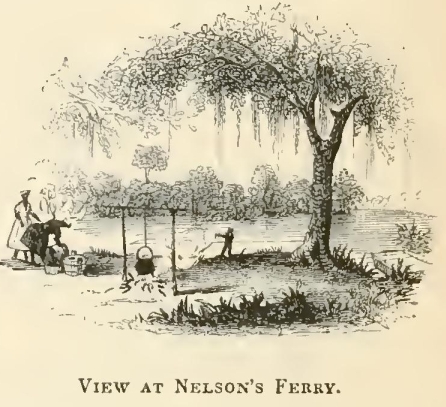
Guided by one of Mr. Shindler's servants, I crossed the Eutaw Creek, near his house, and rode down to Nelson's Ferry, at the mouth of the stream, about a mile and a half distant. At its entrance into the Santee, the bateau of the ferryman was moored, and almost filled its narrow channel. Beneath the moss-draped trees upon the bank of the river, some negro women were washing clothes, and when they found themselves portrayed in my drawing, in all the dishabille of a washing-day, they wanted to arrange their dresses and caps, and be sketched in better plight. Time was too precious to allow compliance, for I wished to get as far toward Orangeburg that evening as possible. Promising to improve their toilet when I got home, I closed my port-folio, and, taking the reins, hastened toward Vance's Ferry.
Nelson's Ferry, the spot here portrayed, was an important locality during the Revolution. It was the principal crossing-place of the Santee for travelers or troops passing between Camden and Charleston, and as such, commanded the attention of the British after they captured the latter city. A redoubt was cast up there upon the north side of the Santee, and garrisoned by a small detachment; and to that point, as we have seen, Lord Rawdon retreated from Camden.
We have noticed, on page 685, that Marion, while in the camp of Gates, was called to
* A mutinous spirit was soon manifested in the camp upon the hills, chiefly among the Marylanders. They wished to go home, complained of want of pay and clothing, and in petitions to Greene set forth their various grievances. Finally, some stole away from the camp with their arms, when stringent measures were deemed necessary to prevent open disorder. Things were brought to a crisis by a South Carolina soldier, named Timothy Griffin. He had heard whispers of disaffection, and one day, while drunk, went up to a group of soldiers who were talking to an officer, and said, "Stand to its boys—damn my blood if I'd give an inch!" He supposed they were altercating with the officer, which was not the fact. Griffin was instantly knocked down by Captain M'Pherson, of the Maryland line, and then sent to the provost. The next day he was tried for mutinous conduct, found guilty, and at five o'clock in the evening was shot in the presence of the whole army. This terrible example suppressed all mutinous proceedings.—Gordon, iii., 246
Success of Marion at Nelson's Ferry.—Site of Fort Watson.—Movements of Colonel Watson.
the command of the patriots of Williamsburg District, and went to duty in the lower country. Ignorant of the operations of the Americans under Gater that brave partisan was striking successful blows against the enemy here and there, while his commander-in-chief was becoming ensnared in the net of disaster which gathered around him near Camden.
On the day after Gates's defeat,Aug. 17, 1780 Marion had placed Colonel Peter Horry in command of four companies of cavalry, which he had just formed and sent to operate against the British in the vicinity of Georgetown, while he, with a small band of followers, marched rapidly toward the Upper Santee. On his way, he was informed of the defeat of Gates, but withheld the sad intelligence from his men, fearing its effects upon their spirits. That night his scouts advised him of the approach to Nelson's Ferry of a strong British guard, with a large body of prisoners from Gates's army. Though much inferior in numbers, he resolved to attack them.
Just before daylight, he detached Colonel Hugh Horry, with sixteen resolute men, to occupy the road at the Horse Creek Pass, in a broad swamp, while with the remainder he should fall upon the enemy's rear. The maneuver was successfully performed at dawn,Aug. 20, 1780 and on that day the brave partisan wrote the following dispatch to Colonel Peter Horry: "On the 20th instant, I attacked a guard of the 63d and Prince of Wales's regiment, with a number of Tories, at the Great Savannah, near Nelson's Ferry; killed and took twenty-two regulars and two Tories prisoners, and retook one hundred and fifty Continentals of the Maryland line one wagon and a drum; one captain and a subaltern were also captured. Our loss is one killed; and Captain Benson is slightly wounded on the head."
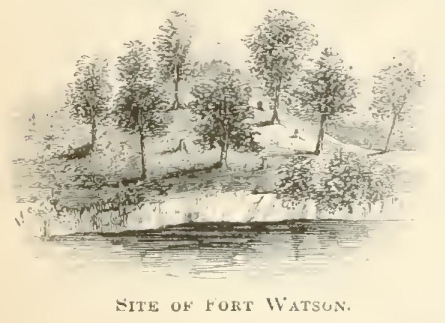
It was past meridian when I reached Vance's Ferry, about ten miles above Eutaw, and one from Mr. Avinger's, where I lodged the night before. I crossed the Santee into Sumter District in a bateau; and driving about five miles up the river, reached Scott's Lake, an expansion of the Santee, a few miles below the junction of the Congaree and Wateree. Upon the north side of the lake, upon the land of Mr. Rufus Felder, at Wright's Bluff Postoffice, is an ancient tumulus, almost fifty feet in height, and now covered with trees. Upon the top of this mound the British erected a stockade; and in honor of Colonel Watson, under whose direction it was built, it was called Fort Watson. Its elevated position, and its close proximity to the water, made it a strong post, yet not sufficiently impregnable to resist the successful assault of Marion and Lee in April, 1781. Let us consider that event.
We have noticed the junction of the forces of Marion and Lee, in the swamps of the Black Hiver, in Williamsburg District.Illustration: April 14, 1781 Lee immediately laid the plans of General Greene before Marion; and a scheme of operations was decided upon within a few hours. Colonel Watson, with about five hundred infantry, was near the site of the present town of Marion, on Cat-fish Creek, in Marion District. He had received orders to re-enforce Lord Rawdon at Camden. For some time he had been greatly annoyed by Marion, who would appear on his flank or rear, strike a severe blow, and then as suddenly disappear among the interminable swamps of the low country. Marion was preparing to smite Watson once more, when he was informed of the approach of Lee. He sent a guide to conduct that partisan over the Pedee, in boats which he kept concealed; and on the day after their forces were united, they started toward Fort WatsonApril 15leaving Captain Gavin Witherspoon on the trail of Watson, then fleeing
* "It will scarcely be believed," says Simms (Life of Marion, page 126), that, of this hundred and fifty Continentals, but three men consented to join the ranks of the liberator. It may be that they were somewhat loth to be led, even though it were to victory, by the man whose ludicrous equipments and followers, but a few weeks before, had only provoked their amusement." The reason they gave was, that they considered the cause of the country to be hopeless, and that they were risking life without an adequate object.
** Marion was very anxious to pursue Watson, who, to facilitate his march toward Camden, had sunk his two field-pieces in Cat-fish Creek, burned his baggage, and was making forced marches toward Georgetown. It was evident, from the circuitous direction of his march, that Watson feared Marion excessively, for, instead of making a direct line westward toward Camden, across the Great Pedee, he crossed the Little Pedee eastward; marched southward through the present Horry District; crossed the Waccamaw at Greene's Ferry, and Winyaw Bay where it was three miles wide; traversed its western border to Georgetown, and from thence crossed the country toward the Santee, following that stream up as far as the junction of the Congaree and Wateree. Greene's instructions to operate against the British posts below Camden prevented a pursuit.
Fort Watson attacked by Marion and Lee.—Mayham Tower.—Sketch of Colonel Mayham.
toward Georgetown. They sat down before Fort Watson on the evening of the same day.
Fort Watson was garrisoned by eighty regulars and forty Loyalists, under the command of Lieutenant M'Kay, a brave and active young officer of the British army. Marion immediately sent a flag demanding the unconditional surrender of the fort and the garrison. M'Kay promptly refused, for he doubtless hourly expected the approach of Watson with his large force, who, he knew, was on his march thither from Georgetown. Perceiving the garrison to be well supplied with water from Scott's Lake, that resource was cut off by the besiegers; but M'Kay and his men opened another communication with the lake three days afterward. They sunk a well within the stockade to a depth below the level of the lake, and dug a trench at the base of the mound from the well to the water, and secured it by an abatis. This circumstance perplexed the assailants, for they had no cannons, and the stockade was too high to be seriously affected by small arms. To the fertile genius of Lieutenant-colonel Maham, * of Marion's brigade, this disadvantage was overcome. Near the fort was a small wood. The trees were cut down, carried upon the shoulders of the men within rifle shot of the fort, and piled up so as to form a quadrangular tower of sufficient height to overlook the stockades. Upon the top of this, a parapet was made of smaller trees, for the defense of those upon the top of the tower. All of this work was accomplished during the darkness of the night, which was intensified by a cloudy sky; and at dawn the garrison were awakened by a deadly shower of balls from a company of sure marksmen upon the top of the tower. At the same moment, a party of volunteers of Marion's militia, under Ensign Johnson, and another from the Continentals, of Lee's legion, ascended the mound and attacked the abatis with vigor. Resistance was vain; and the fort thus assailed was untenable. M'Kay had anxiously awaited the approach of Watson, but that officer, unwilling to allow any thing to impede his progress toward Camden, left this post to its fate. The garrison, no longer able to hold the fort, surrendered by capitula-
* Hezekiah Maham was born on the twenty-sixth of June, 1739. We have no record of his early life. He was a member of the first Provincial Congress of South Carolina; and in the spring of 1776 was elected a captain in Colonel Isaac Huger's regiment. He was with that officer at the siege of Savannah, and at the battle of Stono. As lieutenant colonel of an independent corps of cavalry, he performed many daring exploits in the low country of the Carolinas. At the close of the campaign of 1781, he was obliged to leave active service on account of sickness. While at home, he was made a prisoner and paroled, by which he was not allowed to enter the army again during the war. He died in 1789, at the age of fifty years. His descendant, J. J. Ward, Esq., living near Georgetown, erected a handsome monument to his memory in 1845, upon which are the following inscriptions: Front side.—"Within this Cemetery, and in the bosom of the homestead which he cultivated and embellished while on earth, lie the mortal remains of Colonel Hezekiah Maham. He was born In the parish of St. Stephen's, and died A.D. 1789, aet. fifty years; leaving a name unsullied in social and domestic life, and eminent for devotion to the liberties of his country, and for achievements in arms, in the Revolution which established her independence." Right side.—"Impelled by the spirit of freedom which animated his countrymen, he devoted himself to its support, and promoted the cause of American Independence, by his service in the state committees, instituted by recommendation of the General Congress, in the Jacksonborough Assembly, and in various other civil capacities." Left side.—"Successively a captain in the first rifle regiment, a commander of horse in Marion s brigade, and lieutenant colonel of an independent corps of cavalry, raised by authority of General Greene, he bore an efficient and conspicuous part in the capture of the British posts, and in the series of skillful maneuvers and gallant actions, which resulted in the final extinction of the British dominion in South Carolina, and secured to her and to the confederacy the blessings of Peace, Liberty, and Independence." On the back.—"His relative, Joshua John Ward, of Waccamaw, unwilling that the last abode of an honest man, a faithful patriot, and a brave and successful soldier, should be forgotten and unknown, has erected this memorial, A.D. 1845."
Marion's Residence.—The Wife of Marion.—Return to Orangeburg—Sketch of Marion's House.
tion,April 23, 1781 and Marion with his prisoners and booty, pushed forward and encamped upon the high hills of Santee, to await further orders from Greene, while Lee turned his attention to the movements of Watson. The loss of the Americans was only two killed, and three Continentals and three militia-men wounded. The subsequent movements of Marion and Lee, in efforts to prevent Watson's junction with Rawdon, have been noticed in the preceding chapter.
I tarried at the site of Fort Watson only long enough to make the sketch on page 706, when I hastened back to Vance's Ferry, and pushed on toward Orangeburg. Late in the evening I reached the house of Mr. M'Ance, within fifteen miles of Orangeburg, where I was hospitably entertained.
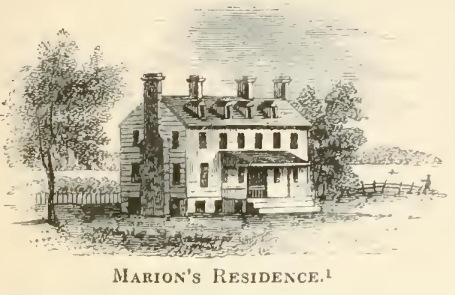
There I met an elderly lady who had been very intimate with the wife of Marion for several years previous to her death. She informed me that Mrs. Marion (whose maiden name was Videau, one of the Huguenot families) was much younger than the general. She was a large woman, weighing, a year or two before her death, two hundred and thirty pounds. My informant had often visited her at her residence, built by the general at Fond Bluff-, on the Santee (near the Nelson's Ferry road to Charleston), about three miles below Eutaw Springs. Miss Videau brought wealth to her husband, and their dwelling was always the abode of liberal hospitality.
I left M'Ance's before daylight on the following morning, traversed the narrow causeway across the Four-hole Swamp by the feeble light of the stars, and arrived at Orangeburg in time to enter the cars for Augusta, on the Savannah River, eighty-five miles distant.
* This mansion was demolished a few years before my visit to Eutaw and vicinity (1849). and this drawing was made from a minute description given me by a gentleman with whom I rode in the mail-coach from Augusta to the Ninety-mile station, on the great central rail-way, in Georgia. His brother had resided there for many years and he was perfectly familiar with its appearance. At the station I made this sketch, and my informant pronounced it an excellent representation of the residence of General Marion.
From Orangeburg to Augusta.—A Turkish Traveler.—Augusta.—Hamburg.—Liberty Hill.