Volume 2 — CHAPTER VII. (continued 2)
Reading edition
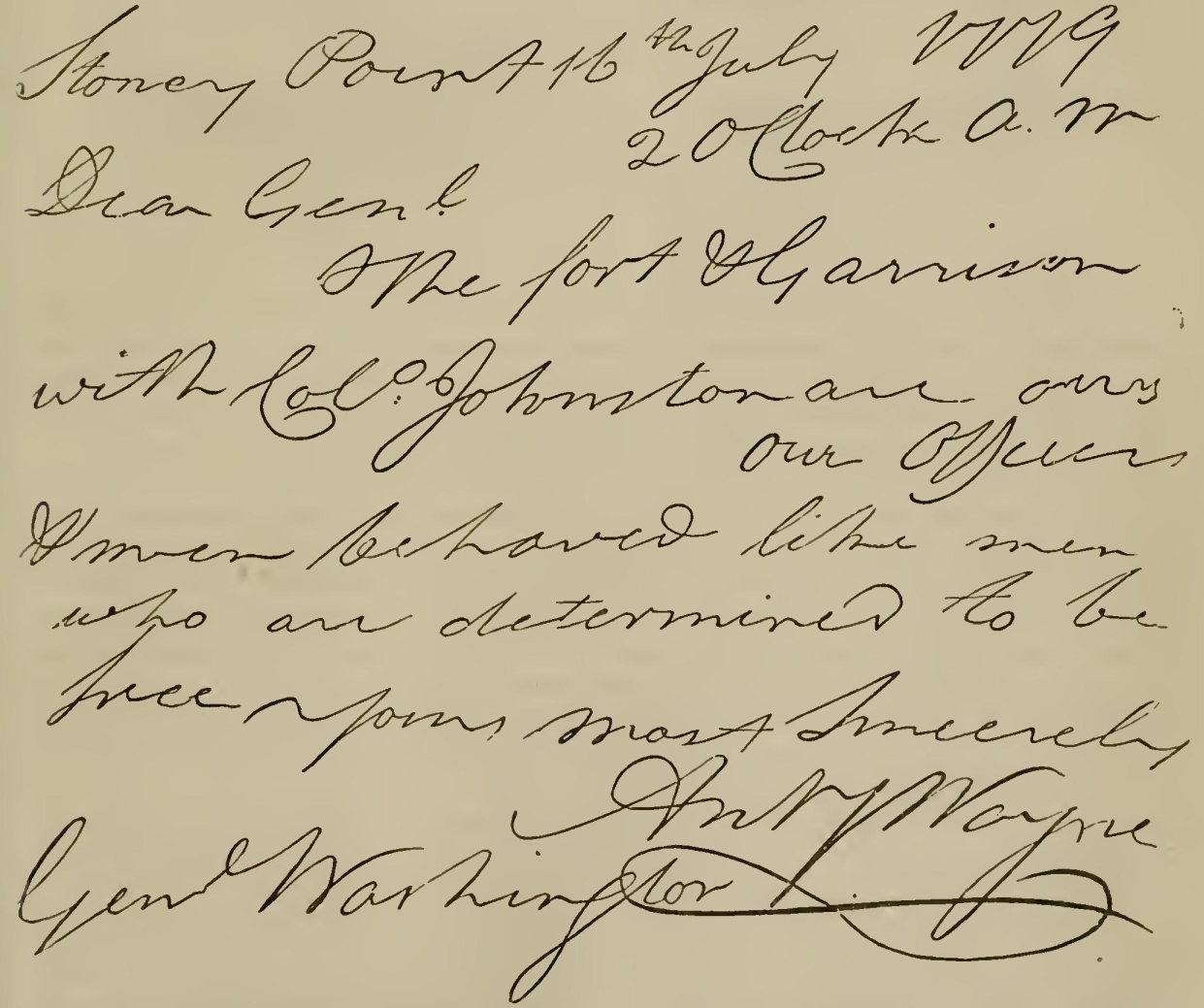

* Wayne's official dispatch, dated at Stony Point, July 17, 1779.
** This is the number given in the American account. Colonel Johnson, in his official dispatch, says he had only twenty killed.
Fort Fayette Cannonaded.—Relieved by Sir Henry Clinton.—Galley with Ordnance sunk at Caldwell's.
At dawn the next morning the cannons of the captured fort were turned upon the enemy's works at Verplanck's Point under Colonel Webster, and a desultory bombardment was kept up during the day. Major-general Robert Howe had been sent to attack Fort Fayette, but on account of delays, and some misconceptions of Washington's orders, he did not make the attack in time to dislodge the garrison. News of Webster's critical situation and the capture of Stony Point was speedily communicated to Sir Henry Clinton, and he immediately sent relief to the menaced garrison at Verplanck's. Howe withdrew, and the enterprise was abandoned.
Washington, clearly perceiving the danger of attempting to retain the post at Stony Point with so few troops as could be employed in the service, concluded to order an evacuation, and a destruction of the works after the ordnance and stores should be removed. This was accordingly done on the night of the eighteenth. All that was originally intended July, 1779. was accomplished, namely, the destruction of the works and the seizure of the artillery and stores. A large portion of the heavy ordnance was placed upon a galley to be conveyed to West Point. As soon as the vessel moved, a cannonade from Verplanck's and the British shipping was commenced upon it. A heavy shot from the Vulture struck it below water-mark, and the galley went down at the point just above Caldwell's Landing, where speculation recently made credulity seek for treasures in a sunken vessel alleged to have belonged to the famous Captain Kidd. If, as asserted, a cannon was drawn up from a vessel lying at the bottom of the river there, it was doubtless one of the pieces taken from Stony Point, and the "ship's timbers" there discovered are the remains of the old galley. The "treasures," if secured, would be of little worth in these "piping times of peace."
The British repossessed themselves of Stony Point on the 20th, but they had little of value left them but the eligible site for a fortification.
The storming and capture of Stony Point, regarded as an exhibition of skill and indomitable courage, was one of the most brilliant events of the war. General Wayne, the leader
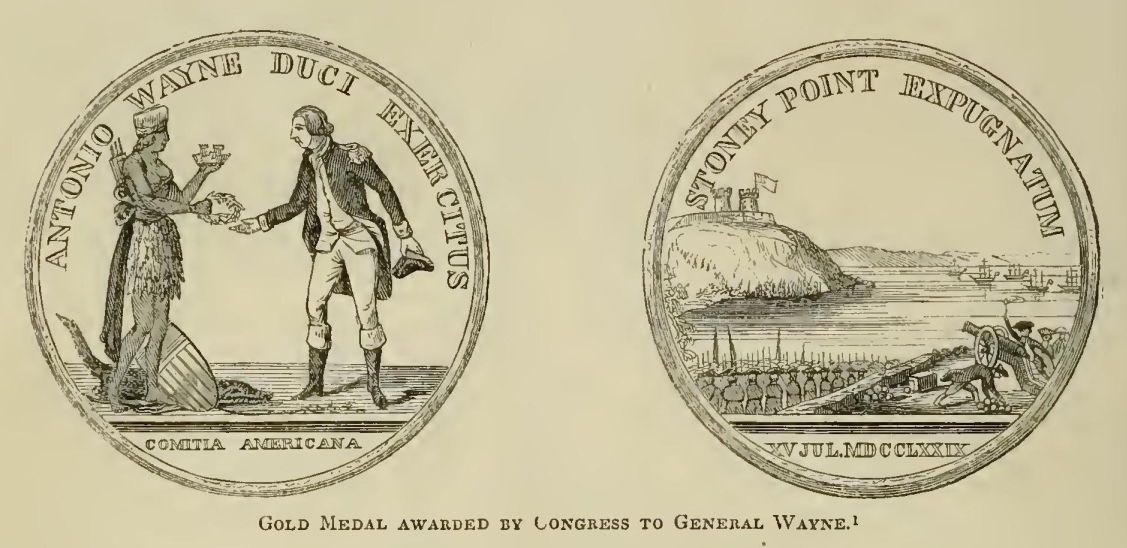
* This is a representation of the medal, the size of the original. On one side 3s a device representing an Indian queen crowned, a quiver on her back, and wearing a short apron of feathers. A mantle hangs from her waist behind, the upper end of which appears as if passed through the girdle of her apron, and hangs gracefully by her left side. With her right hand she is presenting a wreath to General Wayne; in her left she is holding up a mural crown toward his head. At her feet, on the left, an alligator is lying. The American shield is resting against the animal. Over the figure is the legend "Antonio Wayne Duci Exercitus," and beneath, "Comitia Americana "The American Congress to General Anthony Wayne. On the reverse is a fort on the top of a hill; the British flag flying; troops in single file advancing up the hill, and a large number lying at the bottom. Artillery are seen in the foreground, and six vessels in the river. The inscription is, "Stony Point expugnatum, xv. Jul. mdcclxxix. "Stony Point captured, July 15, 1779."
Medal awarded to Wayne.—His Popularity.—Medal awarded to Colonel De Fleury
of the enterprise, was every where greeted with rapturous applause. * Congress testified their grateful sense of his services by a vote of thanks "for his brave, prudent, and soldierly conduct." It was also resolved that a medal of gold, emblematical of this action, should be struck, and presented to General Wayne. Thanks were also presented by Congress to Lieutenant-colonel De Fleury ** and Major Stewart, and a medal of silver was ordered to be struck and presented to each.
The conduct of Lieutenants Gibbon and Knox was warmly applauded, and brevets of captain was given to each, and to Mr. Archer, the volunteer aid of Wayne, who was the bearer of the general's letter to Washington on the occasion. Pursuant to the recommendation of the commander-in-chief, and in fulfillment of promises made by Wayne before the assault, with the concurrence of Washington, Congress resolved, "That the value of the military stores taken at Stony Point be ascertained and divided among the gallant
* General Charles Lee, who was not on the most friendly terms with Wayne, wrote to him, saying, "I do most seriously declare that your assault of Stony Point is not only the most brilliant, in my opinion, throughout the whole course of the war, on either side, but that it is the most brilliant I am acquainted with in history; the assault of Schiveidnitz, by Marshal Laudon, I think inferior to it." Dr. Rush wrote, saving, "Our streets rang for many days with nothing but the name of General Wayne. You are remembered constantly next to our good and great Washington, over our claret and Madeira. You have established the national character of our country; you have taught our enemies that bravery, humanity, and magnanimity are the national virtues of the Americans."
** De Fleury was descended from Hercule Andre de Fleury, a French nobleman, who was the preceptor of the grandson of Louis XIV. during the latter years of the life of that monarch. He was afterward made cardinal and prime minister. The subject of our sketch came to America soon after the news of the revolt reached France. Washington received him kindly, obtained for him a commission, and he proved to be a brave and worthy soldier. Educated as an engineer, his talents were brought into requisition here. In that capacity he was acting at the time of the engagement at Fort Mifflin, on the Delaware. He was at the battle of Brandywine, and for his gallantry there Congress gave him a horse. He returned to France soon after the capture of Stony Point.
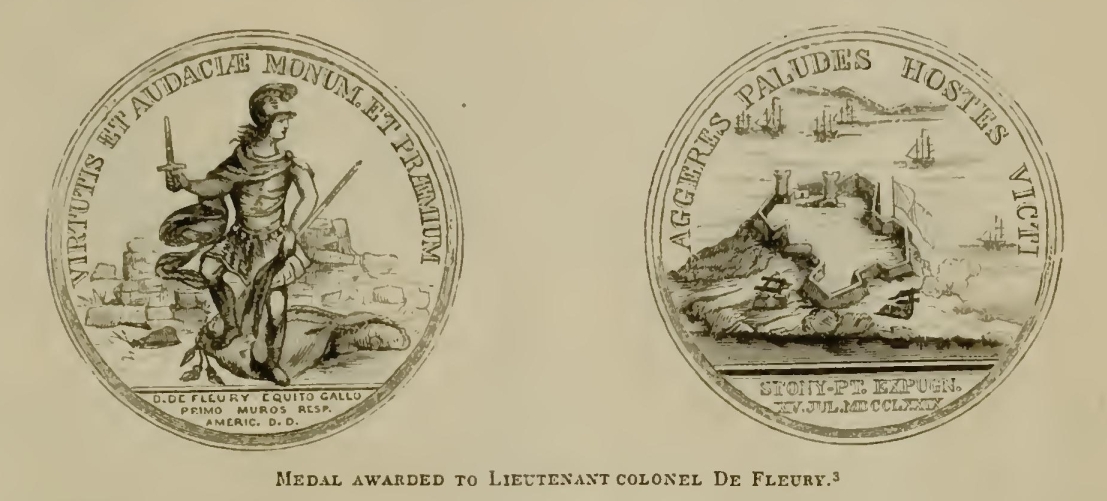
*** This is a representation of the medal, the size of the original. The device is a helmeted soldier, standing against the ruins of a fort. His right hand is extended, holding a sword upright; the staff of a stand of colors is grasped by his left; the colors are under his feet, and he is trampling upon them. The legend is, "A memorial and reward of valor and daring. The American Republic has bestowed (this medal) on Colonel D. de Fleury, a native of France, the first over the walls (of the enemy)." On the reverse are two water batteries, three guns each; a fort on a hill, with a flag flying; a river in front, and six vessels before the fort. The legend is, "Mountains, morasses, foes, overcome." Exergue, "Stony Point stormed, 15th of July, 1779."
*** This identical silver medal was found by a boy while digging in a garden at Princeton, New Jersey, toward the close of April, 1850, and was deposited in the bank at that place for the inspection of the curious. How the medal came there is uncertain. Do Fleury returned to France before the medal was struck, and it probably was never in his possession. Congress was afterward in session at Princeton, and the medal may have been lost by the secretary, in whose custody it properly belonged until delivered to the recipient of the honor.
Promised Rewards for the bravest Men.—Division of the Spoils among the Troops.—Medal awarded to Major Stewart
troops by whom it was reduced, in such manner and proportions as the commander-in-chief shall prescribe." *
* See Journals of Congress, v., 226, 227. The following rewards were promised: To the first man who entered the enemy's works, five hundred dollars; to the second, four hundred; to the third, three hundred; to the fourth, two hundred; to the fifth, one hundred: being fifteen hundred dollars in the aggregate. The ordnance and other stores were estimated at one hundred and fifty-eight thousand six hundred and forty dollars in value, whieh amount was divided among the troops in proportion of officers and privates.—Sparks's Washington, vi., 540.
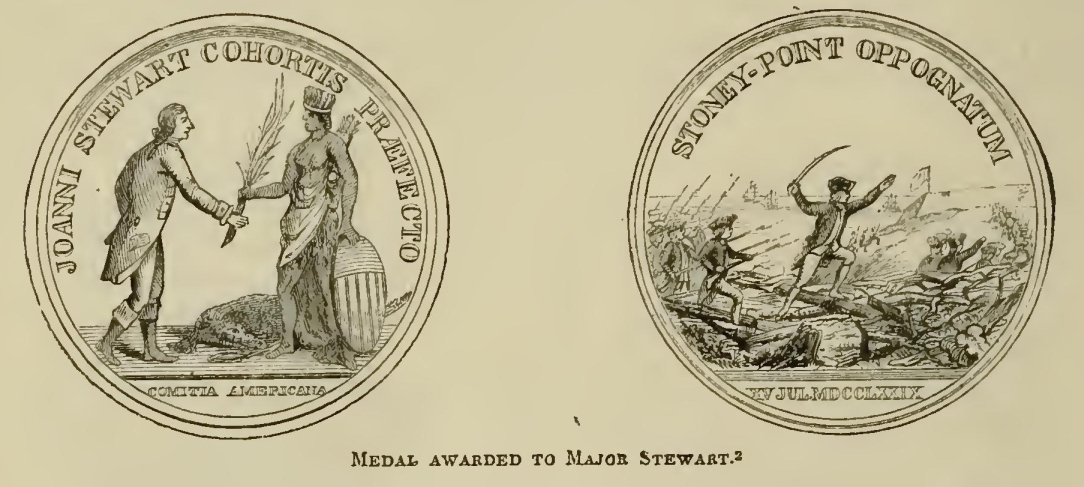
** This represents the medal the size of the original. The device is America personified by an Indian queen, who is presenting a palm branch to Major Stewart. A quiver is at her back; her left hand is resting on the American shield, and at her feet is an alligator crouchant. The legend is, "The American Congress to Major John Stewart." On the reverse is a fortress on an eminence. In the foreground an officer is cheering on his men, who are following him over abatis with charged bayonets, the enemy flying. Troops in single file are ascending to the fort on one side; others are advancing from the shore; ships are in sight. The inscription is, "Stony Point attacked 15th of July, 1779."
** I believe there is no biography of Major Stewart extant. Professor Wyatt, in his Memoirs of American Generals, Commodores, &c., says he was killed by a fall from his horse, near Charleston, South Carolina.
** Lieutenant James Gibbon, who commanded one of the "forlorn hopes," was finally promoted to major. He died at Richmond, Virginia, on the first of July, 1834, in the seventy-seventh year of his age. His remains were interred with military honors.
King's Ferry.—Jolly old Waterman.—Stony Point.—Evening walk toward Haverstraw