Volume 2 — CHAPTER XXVII.
Reading edition

HE rail-way journey from Orangeburg to Augusta was extremely monotonous in scenery and incident. At Branchville, on the banks of the Edisto, where the rail-way from Charleston connects, the immobility into which the passengers were subsiding was disturbed by the advent among us of a "turban'd Turk," in full Oriental costume. His swarthy complexion, keen eye, flowing black beard, broad turban, tunic, and trowsers, made him the "observed of all observers," and kept the passengers awake for an hour, for "Yankee curiosity" was too busy to allow drowsiness. "Whence I came, and whither I go, ye know not," were as plain as a written phylactery upon his imperturbable features, and I presume the crowd who gathered around him in the street at Augusta knew as little of his history and destiny as we. It is pleasant sometimes to see curiosity foiled, even though
"It came from heaven—it reigned in Eden's shades—
It roves on earth, and every walk invades:
Childhood and age alike its influence own;
It haunts the beggar's nook, the monarch's throne;
Hangs o'er the cradle, leans above the bier,
Gazed on old Babel's tower—and lingers here."
—Charles Sprague.
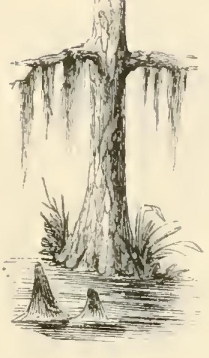
The scenery by the way-side alternated between oozy swamps embellished with cypresses, cultivated fields, and extensive forests of oak and pine, garnished occasionally by a tall broad-leaved magnolia. The country was perfectly level through Barnwell District, until we passed Aiken into Edgefield, and turned toward Silver Bluff, on the Savannah River, * when we encountered the sand hills of that region. These continued until we reached the termination of the road at Hamburg, on the northern bank of the Savannah, opposite Augusta.' There we were packed into huge omnibuses, and conveyed to the city across Schultz's bridge.January 24, 1849 It was sunset—a glorious sunset, like those at the north in September—when we reined up at the United States. A stroll about the city by moon-light that evening, with a Northern friend residing there, was really delightful; for the air was balmy and dry, and the moon and stars had nothing of the crisp, piercing, and glittering aspect which they assume in a clear January night in New England.
Early on the following morning we rode over to Hamburg, and ascended to the summit of Liberty Hill, a lofty sand bluff, three fourths of a mile from the river. Flowers were blooming in the gardens on its brow; and over its broad acres green grass and innumerable cacti were spread. The view from this eminence was charming. At our feet lay the little village of Hamburg, and across the shining Savannah was spread out in panoramic beauty the city of Augusta—the queen of the inland towns of the South. Like a sea in repose, the level country extended in all directions; and city, river, forest, and plain were bathed in the golden haziness which characterizes our Indian summer at the North. From that point the eye could survey the whole historic arena around Augusta, where Royalists and Republicans battled, failed, and triumphed during our war for independence. While the spirit is charmed with associations awakened by the gleanings of sensuous vision, let us for a moment open the tome of history, and give inquiring thought free wing.
* For an account of the capture of Fort Galphin or Dreadnought, at Silver Bluff, see page 690.
** This village was projected by a German named Schultz, who called it Hamburg, in honor of the "free city" of that name in his native land. He also built the noble bridge across the Savannah at that place,' delineated on page 715.
Local History of Augusta.—Growth of Democratic Principles.—Republican Legislature and Governor.
Augusta has a history anterior to the Revolution. Her local historians have preserved but little of it which is of general interest, and its records do not bear date back to that period. It was founded in 1735, under the auspices of Oglethorpe; and in 1736, a small garrison was stationed there, in a stockade fort, as a protection for the settlers against any enemy that might appear. Warehouses were built, and quite an extensive trade was opened with the friendly Indians upon the Savannah and its tributaries. Fort Augusta became a general resort for the Indian traders; and there, and at Fort Moore, on the bluff near Sand-bar Ferry, all the Indian treaties were held, down to the year 1750. In 1751, several Quaker families settled there and at a place called Quaker Springs. When French emissaries, about 1754, stirred up the Indian tribes against the English, the fort was strengthened, its magazine was well supplied, and the men were "mustered and drilled for service." Nothing of importance occurred to disturb the quiet of the people, and the settlement flourished. Living in almost unrestrained freedom, far away from the sea-board and its varieties, the agitations wrought throughout the colonies by the Stamp Act and kindred measures, scarcely elicited a thought from the quiet people of this region; but when, month after month, intelligence arrived that chains were forging to fetter their free spirits, they were aroused, and all through the region between the Alatamaha and Savannah Rivers, and especially in the vicinity of Augusta, the Tree of Liberty budded and blossomed, green, vigorous, and beautiful as the native magnolia. Although Georgia was not represented in the first Continental Congress, yet her children were not less alive to the teachings of the spirit of liberty; and the American Association was early approved, and its operations efficiently established. The lines between Whigs and Tories were distinctly drawn, and the requirements of the association were promptly enforced. *
When the British attacked Savannah, in March, 1776, the Legislature, a majority of which was inimical to the royal government, adjourned to Augusta, where the people were generally friendly. On the fall of Savannah, in 1779, the Legislature was dispersed. John Wereat, then president of the executive council, issued a proclamation, ordering an election of legislators, who were to assemble at Augusta. That town now became the center of Republican power in Georgia, and thither the most active friends of the patriot cause at Savannah fled. George Walton, one of the signers of the Declaration of Independence, was chosen governor under the Constitution (adopted in 1777), ** notwithstanding Sir James Wright had now1779 re-established royal rule in the province. William Glascock was chosen speaker, and the Legislature transacted business without reference to the existence of any other power in the state. ***
For the encouragement and support of the Loyalists in the interior, and to awe the Republicans in that quarter after the fall of Savannah, Colonel Campbell, who commanded at
* At about mid-summer in 1775, Thomas Brown and William Thompson having openly reviled the cause of the Whigs, and at a dinner-party gave toasts in which the friends of that cause were ridiculed, the Parish Committee of Safety ordered their arrest. Thompson escaped into South Carolina, but Brown, who attempted to flee with him, was captured and brought back. He was tried, and sentenced to be tarred and feathered, and publicly exposed in a cart, to be drawn three miles, or until he was willing to confess his error, and take his oath that he would espouse the cause of the Republicans. He chose the latter course; but he was not a very warm Republican long. His course illustrated the fact that
"He who's convinced against his will, Remains to be convinced still."
for he joined the British army, was made lieutenant colonel, and afterward, while commandant of Augusta, fiercely retaliated upon the Whigs.
** John Adam Trueitlen was chosen the first governor under the new Constitution. He was succeeded in 1778, by John Houstoun; and after the fall of Savannah, Sir James Wright, the last of the royal governors, re-established British rule in the state.
*** A curious legislative act occurred during this session. A resolution was passed censuring Governor Walton for having transmitted a letter to the President of Congress, "containing unjust and illiberal representations respecting General M'Intosh." The attorney general was ordered to prosecute the governor. On the day preceding the passage of these resolutions, the same Legislature had elected Governor Walton chief justice of Georgia. He was thereby made president of the only tribunal competent to try him! To have condemned himself would have been an exercise of "Roman virtue" hardly to be expected.
Tories under Colonel Boyd.—Augusta in possession of the British.—Partisan Skirmishes.—General Elbert.
the siege of that city, was ordered by General Prévost to advance with about two thousand regulars and Loyalists,Jan. 1779 upon Augusta.' Already he had sent emissaries among the South Carolina Tories to encourage them to make a general insurrection; and he assured them that, if they would cross the Savannah and join him at Augusta, the Republicans might be easily crushed, and the whole South freed from their pestilential influence. Thus encouraged, about eight hundred Loyalists of North and South Carolina assembled westward of the Broad River, under Colonel Boyd, and marched along the frontier of South Carolina, toward the Savannah. Like a plundering banditti, they appropriated every species of property to their own use, abused the inhabitants, and wantonly butchered several who opposed their rapacious demands. While these depredators were organizing, and Campbell was proceeding toward Augusta, General Elbert ** crossed the Savannah, joined Colonels Twiggs and Few, and skirmished with the British van-guard at Brier Creek and other places, to impede their progress. They effected but little, and on the twenty-ninth of January1779 Campbell took possession of Augusta, and placed the garrison under Lieutenant-colonel Brown, the Loyalist just mentioned, who, with Lieutenant-colonel M'Girth, had preceded him thither. Campbell then proceeded to establish military posts in other parts of Western Georgia.
The Whigs who could leave with their families crossed the Savannah into Carolina. The oath of allegiance was every where administered; the habitations of those who had fled into Carolina were consumed; and Georgia seemed, for the moment, permanently prostrate at the feet of the invaders. The quiet that ensued was only the calm before a gathering storm. Colonel John Dooly collected a body of active militia on the Carolina shore, thirty miles above Augusta, while Colonel M'Girth, with three hundred Loyalists, was watching him on the other side. Dooly crossed over into Georgia, and these partisans had several skirmishes. Finally, Major Hamilton, an active officer under M'Girth, drove Dooly across the Savannah, a short distance below the mouth of Broad River, and encamped at Waters's plantation, about three miles below the present town of Petersburg, in Elbert county. Dooly took post opposite to Hamilton, where he was joined by Colonel Pickens. Their united forces amounted to about three hundred and fifty men.
Colonel Pickens, who was the senior officer, assumed the command of the whole, and with Dooly crossed the river at Cowen's Ferry, to attack Hamilton.Feb. 10, 1779 That officer had broken up his encampment and marched to Carr's Fort, not far distant, to examine its condition and administer the oath of allegiance to the surrounding inhabitants. The Americans besieged the fort, and were confident of capturing it, having cut off the supply of water for the garrison, when, at ten o'clock at night, a message came to Colonel Pickens, from his brother, informing him of the march of Boyd and his banditti through the district of Ninety-Six. Unwilling to distress the families who had taken shelter within the fort, Pickens declined a proposition to burn it, and raising the siege, he hastened to confront Boyd, the more important foe. He crossed the Savannah near Fort Charlotte, when Boyd, hearing of his approach, hastened toward the Cherokee Ford. At that ford was a redoubt, garrisoned by eight men, with two swivels. They successfully disputed the passage of Boyd,
* General Prévost had come from St. Augustine, captured the fort at Sunbury on the way, and, with Campbell's troops, had a force of about three thousand regulars and one thousand militia.
** Samuel Elbert was born in South Carolina in 1740. He became an orphan at an early age, went to Savannah, and there subsequently engaged in commercial pursuits. He joined the Continental army in Georgia early in 1776, as lieutenant colonel, having been a few months previously a member of the Savannah Committee of Safety. He was promoted to colonel in the autumn of 1776, and in May, 1777, commanded an expedition against the British in East Florida. In the following year he was actively engaged in the neighborhood of Savannah, and behaved bravely when it was attacked by Campbell at the close of December. He was promoted to brigadier, and was with Colonel Ashe at Brier Creek, where he was made prisoner. After his exchange, he went to the North, joined the army under Washington, and was at the capture of Cornwallis at Yorktown. At the close of the war, he was commissioned a major general. He was elected governor of the state in 1785. General Elbert died at Savannah, on the second of November, 1788, at the age of forty-five years. His remains were buried in the family cemetery on the mount, at Rae's Hall, five miles above Savannah. Elbert county, in Georgia, was named in honor of the general.
Dispersion of Boyd's Tories.—Alarm of Campbell.—Ashe ordered to Brier Creek.—General Williamson.
and he marched five miles up the river, crossed on rafts, and pushed on toward Augusta. He was pursued by a detachment of Americans, under Captain Anderson, who attacked him in a cane-brake. A severe skirmish ensued. Boyd lost one hundred men in killed, wounded, and missing; the Americans lost sixteen killed, and the same number taken prisoners.
Boyd hastened forward, and on the morning of the thirteenthFeb. 1779 crossed the Broad River, near the fork, in Oglethorpe county, closely pursued by Pickens, with about three hundred militia. The latter marched in battle order. Colonel Dooly * commanded the right wing; Lieutenant-colonel Clark the left; and Colonel Pickens the center. Boyd, ignorant of the proximity of his pursuers, halted on the north side of Kettle Creek, turned his horses out to forage upon the reeds of a neighboring swamp, and proceeded to slaughter cattle for his army. In this condition he was attackedFeb. 14 by the Americans. The Tory pickets fired, and fled to the camp. The utmost confusion prevailed, and Boyd and his followers began to retreat in great disorder, while skirmishing with the assailants. The contest lasted almost two hours. About seventy of the Tories were killed, and seventy-five were made prisoners. The Americans lost nine killed and twenty-three mortally wounded. Colonel Boyd was severely wounded, and expired that night. His whole force was scattered to the winds. The seventy prisoners were taken to South Carolina, tried for high treason, and condemned to death. Five of the most active ones were hanged, the remainder were pardoned. ** This was one of the severest blows which Toryism in the South had yet received.
Encouraged by this success, General Lincoln, then in command of the Southern army, determined to drive the British from their posts in the interior, back to Savannah. He formed encampments at Black Swamp, and nearly opposite Augusta, while small detachments of militia took post at various points on the Savannah, above Augusta. Lincoln ordered General John Ashe, then in the neighborhood of Purysburg, to march up the easterly side of the Savannah with about fifteen hundred North Carolina militia, and the remains of the Georgia Continentals, to re-enforce General Williamson opposite Augusta. Ashe arrived at Williamson's camp on the evening before the defeat of Boyd.Feb. 13, 1779 This imposing display opposite Augusta, and intelligence of the close pursuit of Boyd, alarmed Campbell, and he speedily decamped that same night with all his force, and hastened toward the sea-coast. He left behind him a considerable quantity of provisions, ammunition, and some arms. At Hudson's Ferry, fifty miles below Augusta, Lieutenant-colonel Prevost had constructed a fortified camp and mounted some light artillery. There Campbell halted, with the determination to attempt to regain the advantage he had just lost, but finally continued his retreat to Savannah.
General Lincoln, who was then encamped at Purysburg, in Beaufort District, about twenty-five miles above Savannah, with three thousand men, sent orders to Colonel AsheFeb. 16 to cross the Savannah, and proceed as far as Brier Creek in pursuit of Campbell. At this time, General Rutherford, of North Carolina, was encamped at Black Swamp, on the Carolina side of the Savannah, a few miles above the mouth of Ebenezer Creek, with seven hundred men; and General Williamson, *** with twelve hundred men, was opposite
* Colonel John Dooly entered the Continental army in Georgia, as captain, in 1776, and, rising to the rank of colonel, was very active in the neighborhood of the Savannah, until 1780, when a party of Tories, sent out from Augusta by Colonel Brown, entered his house, in Wilkes county, at midnight, and barbarously murdered him in the presence of his wife and children.—M'Call, ii., 306.
** See M'Call's History of Georgia, i., 190-203.
*** We have already noticed the services of this gentleman while colonel of militia in the District of Ninety-Six, against the Indians. (See page 647.) Andrew Williamson was born in Scotland, and when young was taken by his parents to Ninety-Six, in South Carolina. He was a very active lad, and it is believed that he attended Montgomery in his expedition against the Indians in 1760. He was with Colonel Grant in a similar expedition in 1761. He early espoused the Whig cause, and, as we have seen, was active in opposition to the Cunninghams and other Tories. He was promoted to brigadier, and in that capacity was employed in opposing the inroads of Prévost from Florida into Georgia. After the fall of Savannah, he was engaged in watching the movements of the enemy upon the Savannah River. He took possession of Augusta when Campbell retreated from it, and was for some time engaged against the Tories in that vicinity, in co-operation with General Elbert. He was afterward engaged in the battle at Stono Ferry, below Charleston, and was at the siege of Savannah when D'Estaing aided the Americans. After that, his conduct awakened suspicions that he was becoming unfriendly to the American cause. When Lincoln was besieged in Charleston, he withheld efficient aid; and when that city surrendered, he accepted a British protection. Williamson was called the "Arnold of the South," in miniature. It is generally conceded that he was a double traitor; for while he was with the British in Charleston, he communicated valuable information to General Greene. The time and place of his death is not certainly known. He lived in obscurity and poverty after the war.—See Johnson's Traditions and Reminiscences of the Revolution, 144: Charleston, 1851.
The Americans at Brier Creek.—Preparations for Battle.—The Attack.—Retreat of the Carolinians.
Augusta. General Ashe crossed the river on the twenty-fifth, and proceeded toward Brier Creek, a considerable stream, which flows into the Savannah in Severn county, about forty-five miles below Augusta. He reached Brier Creek on Saturday morning, the twenty-seventh,Feb. 1779 and discovered that the bridge across the stream (which is there skirted with a deep swamp three miles wide) was completely destroyed by the enemy.
General Rutherford, with part of his brigade, was at Mathew's Bluff five miles above, on the opposite side of the Savannah; and Colonel Marbury, of the Georgia horse, lay a few miles up Brier Creek. Ashe's force consisted of General Bryan's brigade, Lieutenant-colonel Lyttle's light infantry, and some Georgia Continentals; in all about twelve hundred men. His artillery consisted of one four pound brass field-piece, and two iron two pound swivels, mounted as field-pieces. Bryant and Elbert were instructed to form the camp, while Ashe crossed the river to confer with General Lincoln. A guard was dispatched to conduct the baggage across to Mathew's Bluff, in case it was found necessary to retreat; and other guards were stationed at the fords of the creek above, while fatigue-parties were detailed to construct bridges, and to make a road to the river for the passage of Rutherford's troops with two brass field-pieces.
Ashe returned on the evening of the third,March 1779 and was chagrined at not finding the bridge which Campbell had destroyed, repaired. Early the following morning workmen were employed in that duty, but it was too late, and the Americans were quite unprepared for offensive or defensive operations. While in this exposed situation, intelligence came from General Williamson, then on his march from Augusta, that the enemy, under the general command of Prevost, was within eight miles of the American camp above, approaching in full force. Already Marbury, with his dragoons, had encountered the British van, but his express to Ashe had been intercepted. Reconnoitering parties had approached the American pickets, yet they produced neither apprehension nor vigilance. That indifference proved fatal. Prevost, with about eighteen hundred men, had crossed Brier Creek, fifteen miles above Ashe's camp, made a wide circuit, and, unperceived, had gained his rear. To retreat was now impossible. The drums immediately beat to arms; the troops were formed for action, and cartridges were distributed among them. * They then advanced about a quarter of a mile; General Elbert and his command, with Colonel Perkins's regiment, forming the advance. The British formed their line when within one hundred and fifty yards of the Americans, and at the moment of their advance, Elbert and Perkins, opened a severe fire upon them. The Georgians, after delivering two or three rounds, unfortunately inclined to the left, by which the fire of the advancing Newbern regiment was impeded. At the same moment, the Edenton regiment, moving to the right, left a vacancy in the line. This the enemy perceived, and pushed forward on a run, with a loud shout. The Halifax regiment on the left, panic-stricken, broke and fled, without firing a gun. The Wilmington regiment, except a small part under Lieutenant-colonel Young, advanced and delivered two or three volleys, wheeled, and retreated. The Newbern and Edenton regiments followed their example, and in a few minutes the whole of the North Carolina troops were flying to the coverts of the swamps. The Georgia Continentals maintained their
* M'Call and others censure General Ashe for not having the soldiers served with cartridges much sooner. Ashe in his letter to Governor Caswell on the seventeenth of March, says, that "prudence forbade a distribution of cartridges until they were wanted; for, lacking cartouch-boxes, the men had already lost a great many." He says that when they marched to meet the enemy, some carried their cartridges "under their arms; others in the bosoms of their shirts; and some tied up in the corner of their hunting-shirts."—MS. Letter of General Ashe to Governor Caswell.
Defeat of the Americans.—The Loss.—Ashe Censured.—Acquitted by Court martial.—His Public Life.
ground gallantly for some time; but they, too, were finally repulsed, and General Elbert and a large number of his men were made prisoners. General Ashe tried in vain to reach the front of the fugitives and rally them. They had scattered in all directions; took shelter in the swamps; and, on reaching the Savannah, escaped across it, some by swimming, and others upon rafts. In this retreat many were drowned, and others were lost in the swamps. General Ashe reached Mathew's Bluff in safety, and afterward collected the remnants of his little army at Zubley's Ferry,March 16, 1779 two miles above Purysburg. The loss of the Americans in this action was estimated at one hundred and fifty killed and drowned; twenty-seven officers, and one hundred and sixty-two non-commissioned officers and privates, were taken prisoners; and seven pieces of artillery, a quantity of ammunition, provisions, and baggage, with five hundred stand of arms, were either lost or fell into the hands of Prevost. The British lost only one commissioned officer, and fifteen privates killed and wounded. *
General Ashe" was much censured by contemporary opinion and early historians; and modern compilers have repeated those censures, because he allowed himself to be surprised. Viewing the whole affair from this remote point, and in the light of calm judgment, he appears no more censurable than most other men who were losers instead of winners. Had he succeeded in becoming a victor, his alleged remissness would never have been mentioned; the unfortunate are always blamed. Conscious of having exercised both courage and vigilance, General Ashe appealed from the voice of public opinion to a court-martial, of which General Moultrie *** was president.March 9, 1779 The court acquitted him of every charge of cowardice and deficiency of military skill, but gave their opinion that he did not take all necessary precautions to secure his camp and watch the movements of the enemy. It was an unfortunate affair, for it deprived Lincoln of about one third of his available force, and opened a free communication between the British, Indians, and Tories, in Florida, Western Georgia, and the Carolinas.
We have observed that after the fall of Charleston,May 12, 1780 and the dispersion of Lincoln's army, royal power in South Carolina and Georgia was fully established. The Republican governor of Georgia and part of his council fled into North Carolina, and narrowly escaped being captured on the way. Lieutenant-colonel Thomas Brown, whom Campbell placed in command of Augusta early in 1779, now proceeded to that place and
* MS. Letter of General Ashe to Governor Caswell; Ramsay, ii., 16; Gordon, ii., 415; M'Call, ii, 206.
** John Ashe was born in England in 1721. He came to America with his father in 1727, who settled on the Cape Fear River, in North Carolina. He served his district in the Colonial Legislature for several years, and was speaker of the Assembly from 1762 to 1765. He warmly opposed the Stamp Act in 1765, and, with others, announced to Governor Tryon his determination to resist its operations. Assisted by General Hugh Waddell, Ashe, then colonel of the militia of New Hanover, headed an armed force, and compelled the stamp-master to resign. He accompanied Tryon against the Regulators in 1771; but when royal rule became odious, and he saw the liberties of his country in peril, he was one of the most zealous advocates, in the North Carolina Assembly, of Republican principles. As a member of the Legislature, and of the Committee of Correspondence and of Safety at Wilmington, he was exceedingly active and vigilant. He was one of the first projectors of a Provincial Congress, and became the most aetive opponent of Governor Martin, for he was exceedingly popular as a man. With five hundred men, he destroyed Fort Johnston in 1775, and was denounced as a rebel against the crown. He was a member of the first Provincial Congress, convened that year. When he returned home, he raised and equipped a regiment at his own expense; and throughout the whole region around Wilmington, his eloquent words and energetic acts inspired the people with burning patriotism. In 1776, the Provincial Congress appointed him a brigadier of Wilmington District. He was actively engaged in military and civil duties in his district, until the close of 1778, when he joined Lincoln in South Carolina, with regiments from Halifax, Wilmington, Newbern, and Edenton. After his surprise and defeat at Brier Creek, he returned home. Wilmington became a British post in 1781, and Colonel Ashe and his family suffered much at their hands. He was made a prisoner, and suffered a long confinement, during which time he contracted the small-pox. He was released on parole while sick, and died of that disease in October, 1781, at the age of sixty years, while accompanying his family to a place of quiet, in Duplin county.
*** The other members of the court were General Rutherford, Colonels Armstrong, Pinckney, and Locke, and Edmond Hyrne, deputy adjutant general.—See Moultrie's Memoirs, i., 338.
Cruelty of Brown.—Forts Cornwallis and Grierson.—March toward Augusta, of Clark and M'Call.
garrisoned the fort with a strong force. Brown, as we have seen (page 710), was an early victim of Whig indignation at Augusta, his native place, and he used his power, while in command there, with a fierceness commensurate with his wrath. He sent out detachments to burn the dwellings of patriots in his vicinity, and dispatched emissaries among the Indians to incite them to murder the inhabitants on the frontier. * His command at Augusta consisted of two hundred and fifty men, of several corps, principally of Florida rangers; two hundred and fifty Creek and fifty Cherokee Indians; in all, five hundred and fifty. The defenses consisted of a strong fort, situated on the northwest side of the town, upon a bank about one hundred yards from the river.
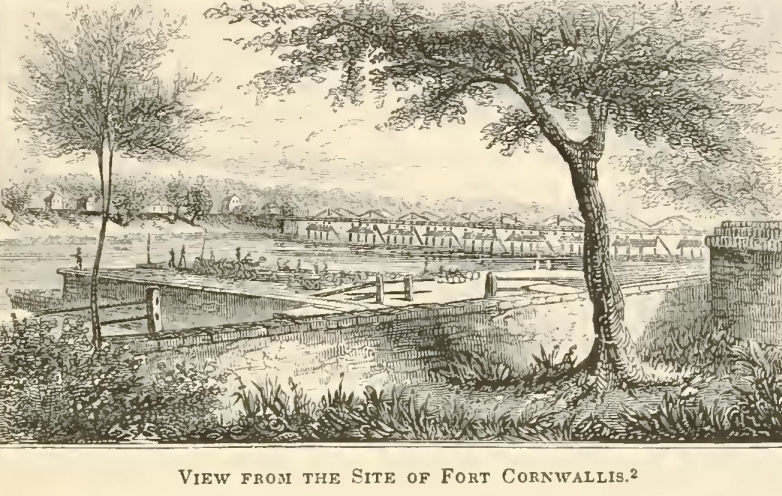
This was the main work, and was called Fort Cornwallis. A little less than half a mile westward of Fort Cornwallis, was a swampy ravine extending up from the river, with a stream running through it. On the western margin of this lagoon, between the present Upper Market and the river, was a smaller work called Fort Grierson, so named in honor of the militia colonel who commanded its garrison.
About the first of September,1780 Colonel Elijah Clark, a brave partisan of Wilkes county, Georgia, and Lieutenant-colonel M'Call, made efforts to raise a sufficient force to capture the fort at Augusta, and drive the British from the interior of the state to the sea-coast. These were the brave partisans who fought at the Cowpens a few months later. Clark recruited in his own county, and M'Call went to the district of Ninety-Six and applied to Colonel Pickens for aid. He wanted five hundred men, but procured only eighty. With these he marched to Soap Creek, forty miles northwest of Augusta, where he was joined by Clark, with three hundred and fifty men. With this inadequate force they marched toward Augusta. So secret and rapid were their movements, that they reached the outposts before the garrison was apprised of their approach.Sep. 14, 1780 The right was commanded by M'Call, the left by Major Samuel Taylor, and the center by Clark. The divisions approached the town separately. Near Hawk's Creek, on the west, Taylor fell in with an Indian camp, and a skirmish ensued. The Indians retreated toward the town, and Taylor pressed forward to get possession of a strong trading station called the
* Brown's authority was a letter which Cornwallis had sent to the commanders of all the British outposts, ordering that all those who had "taken part in the revolt should be punished with the utmost rigor; and also that those who would not turn out should be imprisoned, and their whole property taken from them or destroyed." Every militia-man who had borne arms in the king's service, and afterward joined the Whigs, was to be "immediately hanged." This letter was a foul stain upon the character of Cornwallis. It was a "lash of scorpions" in the hands of cruel men like Brown. "Officers, soldiers, and citizens," says M'Call (ii., 319), were brought up to the place of execution, without being informed why they had been taken out of prison. The next morning after this sanguinary order reached Augusta, five victims were taken from the jail by order of Colonel Brown, who all expired on the gibbet.
** Fort Cornwallis occupied the ground in the rear of the Episcopal church, now a grave-yard. This view is from within the inclosure, looking northeast, and includes a portion of Schultz's bridge, the Savannah River, and Hamburg upon the opposite bank. In the foreground is seen portions of the church-yard wall, and upon the brink of the river below are negroes employed in placing bales of cotton upon the wharves for transportation, to the sea-coast. The wharves are two stories in height, one to be used at low water, the other when the river is "up." There were remains of the ditch and embankments of the fort within the grave-yard when I was there; and the trench leading to the water-gate, where the "Pride-of-India" tree is seen, was very visible.
Skirmish at the White House.—Brown wounded.—Defeat of the Americans. Fate of Prisoners.
White House, a mile and a half west of the town. The Indians reached it first, and were joined by a company of King's Rangers, under Captain Johnson. Ignorant of the approach of other parties, Brown and Grierson went to the aid of Johnson and the Indians. While absent, the few men left in garrison were surprised by Clark and M'Call, and Forts Cornwallis and Grierson fell into their hands. A guard was left to take charge of the prisoners and effects in the fort, and Clark, with the remainder, hastened to the assistance of Taylor. Brown and Grierson, perceiving their peril, took shelter in the White House. The Americans tried in vain to dislodge them. A desultory fire was kept up from eleven o'clock in the morning until dark, when hostilities ceased. During the night the besieged cast up a slight breast-work around the house, made loop-holes in the building for musketry, and thus materially strengthened their position. Early in the morning,Sept. 15 Clark ordered field-pieces to be brought from Grierson's redoubt, to be placed in a position to cannonade the White House. They were of little service, for Captain Martin, of South Carolina, the only artillerist among the besiegers, was killed soon after the pieces were brought to bear upon the building.
No impression was made upon the enemy during the fifteenth. On that morning, before daylight, the Americans drove a body of Indians from the river bank, and thus cut off the supply of water for those in the house. Colonel Brown and others had been severely wounded, and now suffered great agony from thirst. On the night of the fifteenth, fifty Cherokee Indians, well armed, crossed the river to re-enforce Brown, but were soon repulsed. Little was done on the sixteenth, and on the seventeenth Clark summoned Brown to surrender. He promptly refused; for, having sent a messenger to Colonel Cruger at Ninety-Six, on the morning when the Americans appeared before Augusta, Brown confidently expected relief from that quarter. Nor was he disappointed. On the night of the seventeenth, Clark's scouts informed him of the approach of Colonel Cruger with five hundred British regulars and Loyalists, and on the morning of the eighteenth this force appeared upon the opposite side of the river. Clark's little army was greatly diminished by the loss of men who had been killed and wounded, and the desertion of many with plunder found in the forts. At ten o'clock he raised the siege, and departed toward the mountains. The American loss on this occasion was about sixty killed and wounded; that of the British is not known. Twenty of the Indians were killed. Captain Ashby and twenty-eight others were made prisoners. Upon these Brown and his Indian allies glutted their thirst for revenge. Captain Ashby and twelve of the wounded were hanged upon the stair-way of the White House, so that the commandant might have the satisfaction of seeing their sufferings. Others were given up to the Indians to torture, scalp, and slay. Terrible were the demoniac acts at Augusta on that beautiful autumnal day, when the white and the red savage contended for the meed of cruelty!
The British remained in possession of Augusta until the spring and summer of 1781, when their repose was disturbed. After the battle at Guilford Court House, and when the determination of Greene to march into South Carolina was made known, Clark and M'Call proceeded to co-operate with him by annoying the British posts in Georgia. M'Call soon afterward died of the small-pox, and Clark suffered from the same disease. After his recovery, he, with several other partisans, were actively engaged at various points between Savannah and Augusta, and had frequent skirmishes with the British and Tory scouts. In an engagement near Coosawhatchie, in Beaufort District, South Carolina, where Colonel Brown then commanded, the Americans were defeated; and several who were taken prisoners were hanged, and their bodies given to the Indians to scalp and otherwise, mutilate. *
* Among the prisoners taken on this occasion was a young man named M'Koy, the son of a widow, who, with her family, had fled from Darien, in Georgia, into South Carolina. She went to Brown and implored the life of her son, who was only seventeen years of age. The miscreant's heart was unmoved, and the lad was not only hanged, but his body was delivered to the Indians to mutilate by scalping and otherwise. All this occurred in the presence of the mother. Afterward, when Brown, as a prisoner, passed where Mrs. M'Koy resided, she called to his remembrance his cruelty, and said, "As you are now a prisoner to the leaders of my country, for the present I lay aside all thoughts of revenge, but if you resume your sword, I will go five hundred miles to demand satisfaction at the point of it for the murder of my son.—See M'Call's Georgia, ii., 365; Garden's Anecdotes.
Siege of Augusta.—Colonel Pickens.
This was Brown's common practice, and made his name as hateful at the South as that of "Bloody Bill Cunningham."
On the sixteenth of April,1781 the Georgia militia, under Colonels Williams, Baker, and Hammond, Major James Jackson (afterward governor of the state), and other officers, assembled near Augusta, and placed the garrison in a state of siege. Williams, who had the general command during Clark's sickness, encamped within twelve hundred yards of Forts Cornwallis and Grierson, and fortified his camp.
Colonel Brown, who was again in command at Augusta, deceived respecting the numbers did not attack them; and in this position the respective forces remained until the middle of May, when Clark came with one hundred new recruits and resumed the command. About that time, Major Dill approached Augusta with a party of Loyalists to force the Americans to raise the siege.
A detachment of Carolina mountaineers and Georgians, under Shelby and Carr, sent by Clark, met them at Walker's bridge, on Brier Creek, killed and wounded several.
Pickens could not immediately comply, for the Indians having recommenced hostilities on the frontiers of Georgia and Carolina, he had sent part of his force in that direction. Perceiving the importance of seizing Augusta, Pickens informed Greene of the situation of affairs there. That general, then advancing upon Ninety-Six, immediately ordered Lientenant-colonel Lee, with his legion, to join Pickens and Clark in besieging Augusta. The rapid march of Lee, the capture of Fort Galphin and its stores, and his arrival at Augusta, have been noticed on page 691.
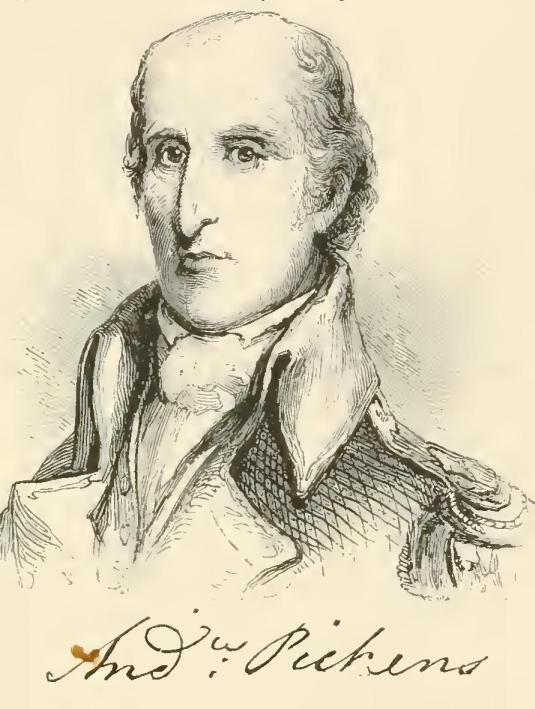
The capture of Fort GalphinMay 21, 1781 was an important prelude to the siege of Augusta. Other little successes made the Americans at Augusta feel so strong that Clark determined to attempt an assault. An old iron five pounder, which he had picked up, was mounted within four hundred yards of Fort Grierson, and other dispositions for an attack were made. Powder was scarce, and he sent a message to Colonel Pickens,* who was maneuvering between Augusta and Fort Ninety-Six, asking for a supply.
* Andrew Pickens was born in Paxton township, Pennsylvania, on the nineteenth of September, 1739. His parents were from Ireland. In 1752, he removed, with his father, to the Waxhaw settlement, in South Carolina. He served as a volunteer in Grant's expedition against the Cherokees, in which he took his first lessons in the art of war. He beeame a warm Republican when the Revolution broke out, and, as we have seen in preceding pages of this work, he was one of the most active of the military partisans of the South. From the close of the war until 1794, he was a member of the South Carolina Legislature, when he was elected to a seat in Congress. He was commissioned major general of the South Carolina militia in 1795, and was often a commissioner to treat with the Indians. President Washington offered him a brigade of light troops under General Wayne, to serve against the Indians in the northwest, but he declined the honor. He died at his seal in Pendleton District, South Carolina—the scene of his earliest battles—on the seventeenth of August, 1817, at the age of seventy-eight years. His remains lie by the side of his wife (who died two years before), in the grave-yard of the "Old Stone Meeting-house" in Pendleton. In 1765, he married Rebecca Calhoun, aunt of the late John C. Calhoun, one of the most beautiful young ladies of the South. Mrs. Ellet, in her Women of the Revolution (iii., 302), gives some interesting sketches of this lady and her life during the Revolution. Her relatives and friends were very numerous, and her marriage was attended by a great number. "Rebecca Calhoun's wedding" was an epoch in the social history of the district in which she resided, and old people used it as a point to reckon from.
Junction of American Troops before Augusta.—Plan of Attack.—Maykam Tower.—The Garrison subdued.
Colonel Brown was deprived of a considerable body of reserved troops and of valuable stores.
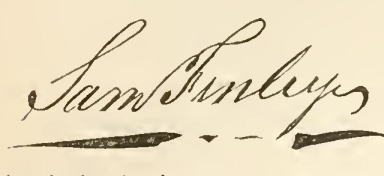
The latter were of great importance to Greene, then approaching Ninety-Six. After the capture of this redoubt, Lee allowed his troops to repose a few hours, and then ordered Major Eggleston, with Captains O'Neal and Armstrong, to cross the Savannah with the cavalry, a little below Augusta, and join Pickens and Clark. On the same evening, Lee, with the field-piece of Captain Finley, crossed the river, and on the morning of the twenty-third joined the besiegers.
Eggleston, on his arrival, summoned Brown to surrender, at the same time informing him of the approach of a strong force from General Greene's army. Brown did not credit the information, treated the flag with contempt, and declined giving a written answer. Lee had now arrived, and an immediate assault on Fort Grierson was determined upon. The first measure attempted was to cut off his retreat to Fort Cornwallis. Pickens and Clark were to attack Fort Grierson on the northwest, with the militia; Major Eaton's battalions and some Georgia militia, under Major Jackson, were to pass down the river and attack it on the northeast; while Lee, with his infantry, took a position south of the fort, so as to support Eaton, or check Brown if he should make a sortie in favor of Grierson. In the skirt of the woods south of Lee, Eggleston, with the cavalry, was stationed. When Brown discovered the peril of Grierson, he made a sortie with two field-pieces, but was soon checked by Lee. Grierson, at the same time, endeavored to evacuate his redoubt, and attempt to throw his command into Fort Cornwallis. Passing down the ravine on the margin of the lagoon, some of the garrison effected their purpose; but thirty of them were slain, and forty five were wounded and taken prisoners. Grierson was captured, but was instantly killed by a Georgia rifleman, who, on account of cruelties inflicted upon his family by his victim, could not be restrained from dealing a blow of vengeance. * In this assault Major Eaton was slain.
The Americans now turned their attention to Fort Cornwallis. They were without artillery, except the old iron piece in possession of Clark, and Finley's grasshopper; and their rifles had but little effect upon the fort. Lee suggested the erection of a Mayham tower, which was used so efficiently at Fort Watson and Ninety-Six. This was done, under cover of an old frame house which stood directly in front of the present Episcopal church. This procedure made Brown uneasy, and on the night of the twenty-eighth he sent out a detachment to drive the Americans from their labor. After a severe skirmish, the enemy were driven into the fort at the point of the bayonet. On the succeeding night, a similar attempt was made, with the same result. The tower was completed on the first of June, and for its destruction Brown used every effort in his power. Sallies were made under cover of night, and some severe conflicts ensued. He tried stratagem, ** and failed in that.
On the thirty-first of May, Brown was summoned to surrender. He refused, and that night a six pounder, brought from Fort Grierson, was placed in battery on the tower. Toward noon, riflemen stationed upon it opened a galling fire upon the garrison, which was continued throughout the day. The guns were soon unmanned by the rifle balls, and the six pounder dismounted them. The garrison dug vaults within the fort to save themselves from the murderous fire of the assailants, and thus the siege went on until the morning of the fourth,June, 1781 when a general assault was agreed upon. While the Americans were forming tor attack, Brown, perceiving the maintenance ot his post to be im-
* This rifleman was Captain Samuel Alexander, whose aged father had been a prisoner in Fort Cornwallis for some time, and was cruelly treated by both Brown and Grierson. The son was the deliverer of his father soon after he dispatched Grierson.
** Brown opened a communication with a house in front of the tower, and placed a quantity of powder in it. He then sent a Scotchman, under the cloak of a deserter, who advised the Americans to burn that old house, as it stood in their way. Had they done so, the explosion of the powder might have destroyed the tower. Lee suspected the man, and had him confined. Brown finally applied a slow match and blew up the house, but the tower was unharmed.
Surrender of the Forts at Augusta.—Liberty Hill.—Departure for Savannah.—A Night Journey.
possible, sent out a flag and offered to make a conditional surrender to Pickens and Lee. The day was spent in negotiations, and early the next morning the fort was surrendered to Captain Rudulph, who was appointed to take possession. The garrison marched out and laid down their arms, and Brown and his fellow-prisoners were paroled to Savannah under a sufficient guard, who marched down the river on the Carolina side. * Pickins and Lee soon hastened to the aid of Greene, then investing Ninety-Six. In this siege of Augusta, the Americans had sixteen killed and thirty-five wounded; seven of them mortally. The loss of the British was fifty-two killed: and three hundred and thirty-four, including the wounded, were made prisoners of war. ** The British never had possession of Augusta after this event.
Let us close the chronicle for a while.
It was toward noon when we descended Liberty Hill, looked in upon the slave-market at Hamburg (the first and last I ever saw), and crossed Shultz's bridge to Augusta. After dinner I visited the site of Fort Cornwallis, and made the sketch on page 715; also the site of Fort Grierson, of which no vestiges remain. The rivulet is still there, and the marshy lagoon on the brink of the river; but the "gulley" mentioned in the local histories was filled, and houses and gardens covered the site of the redoubt and its ravelins. At the office of the mayor, I saw (and was permitted to copy) a sketch of the proposed monument to be erected in the middle of the broad and beautifully shaded Greene Street, directly in front of the City Hall, in honor of the Georgia Signers of the Declaration of Independence. It is to be a granite obelisk, forty-five feet in height, composed of square blocks of stone. The base of the obelisk will be six feet eight inches square at the bottom, and gradually tapered to the top. It will rest upon a base twelve feet eight inches square, elevated two feet above the ground. The corner-stone is already laid, and it is to be hoped that another will soon be added to the few monuments already erected to the memory of Revolutionary patriots.
I left Augusta on the evening of the twenty-fifthJan. 1849 with real regret, for the beauty of the city, ornamented with water-oaks, wild olives, holly, palmettoes, magnolias, and other evergreens; the gardens blooming; the orange-trees budding in the bland air, and the courtesy of the citizens whom I met, wooed me to a longer tarry. But "home, sweet home," beckoned me away, and at eight o'clock I entered a mail-coach, with a single fellow-passenger, for a ride of fifty-two miles to the "Ninety-mile Station," on the Great Central Railway. I had a pleasant companion while he kept awake, and we whiled away the tedious night hours by agreeable conversation until we reached Waynesborough, *** where we exchanged horses and the mails. After leaving the village, I endeavored to sleep. My companion complained that he never could slumber in a coach; and I presume his loud snoring always keeps him awake, for in ten minutes after leaving the post-office his nasal pipes were chanting bass to the alto of the coach-wheels.
We breakfasted at sunrise at a log-house in the forest, and arrived at the rail-way, on the upper border of Severn county, near the banks of the Great Ogeeche, at eleven o'clock, where we dined, and at one departed for Savannah. Swamps, plantations, and forests, with scarcely a hill, or even an undulation, compose the monotonous scenery. While enjoying the pleasing anticipation of an early arrival in Savannah, our locomotive became disabled by the breaking of a piston-rod. We were yet forty miles from our goal, in the midst of a vast swamp, ten miles from any habitation, near the road. The sun went down; the twilight faded away, and yet we were immovable. At intervals the engineer managed to start his steed and travel a short distance, and then stop. Thus we crawled along, and at eleven
* The brother of young M'Koy, who was hanged and scalped by Brown's orders, and who, thirsting for revenge, had joined Clark before Augusta, endeavored to kill Brown, but was prevented by the guard. It was during this march to Savannah, when at Silver Bluff, that Brown encountered Mrs. M'Koy, as related on page 716.
** M'Call, ii., 370; Lee, 238; Ramsay, ii., 238.
*** Waynesborough is the capital of Burke county. It is upon a branch of Brier Creek, about thirty-five miles above the place of General Ashe's defeat.
Detention in a Swamp.—Picturesque Scenery.—Savannah.—Greene and Pulaski Monument
o'clock at night we reached the thirty mile station, where we supped at the expense of the rail way company. At our haltings we started light-wood fires, whose blaze amid the tall trees draped with moss, the green cane-brakes, and the dry oases, garnished with dwarf palmettoes, produced the most picturesque effects.
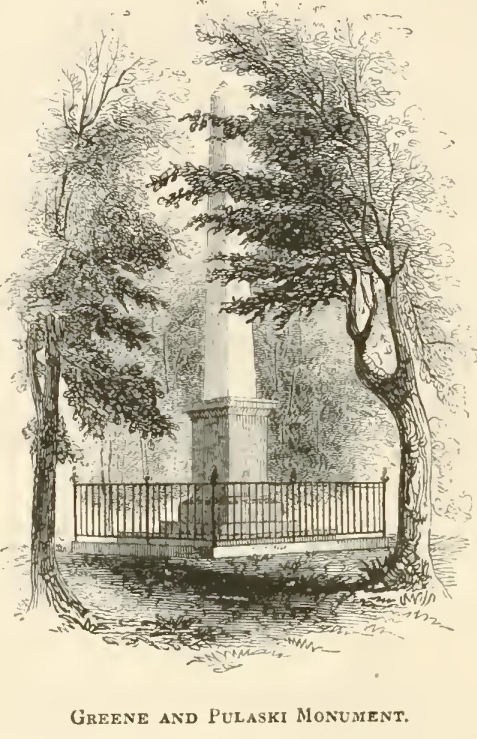
A hand-car was sent down to Savannah for another engine, and at six o'clock in the morning we entered that city. I breakfasted at the Pulaski House, a large building fronting upon Johnson Square, amid whose noble trees stands a monument erected by the citizens of Savannah to the memory of General Greene and the Count Pulaski. *
Savannah is pleasantly situated upon a sand-bluff, some forty feet above low-water-mark, sloping toward swamps and savannahs, at a lower altitude in the interior. It is upon the south side of the river, about eighteen miles from the ocean. The city is laid out in rectangles, and has ten public squares. The streets are generally broad and well shaded, some of them with four rows of Pride-of-India trees, which, in summer, add greatly to the beauty of the city and comfort of the inhabitants. With interest in Savannah and suburbs, let us open the interesting pages of its history, and note their teachings respecting Georgia in general, and of the capital in particular, whose foundations were laid by General Oglethorpe.
We have already considered the events which led to the settlement of the Carolinas, within whose charter limits Georgia was originally included, and we will here refer only to the single circumstance connected with the earlier efforts at settlement, which some believe to be well authenticated, namely, that Sir Walter Raleigh, when on his way to the Orinoco, in South America, entered the Savannah River, and upon the bluff where the city now stands stood and talked with the Indian king. ** There are reasonable doubts of the truth of this statement.
As late as 1730, the territory lying between the Savannah and Alatamaha Rivers was entirely uninhabited by white people. On the south the Spaniards held possession, and on the west the French had Louisiana, while the region under consideration, partially filled with powerful Indian tribes, was claimed by Great Britain. To prevent France and Spain from occupying it (for the latter already began to claim territory even north of the Savannah), and as a protection to the Carolina planters against the encroachments of their hostile neighbors, various schemes of emigration thither were proposed, but without being effected. Finally, in 1729, General James Oglethorpe, a valorous soldier and humane Christian, then a member of Parliament, made a proposition in that body for the founding of a colony to be composed of poor persons who were confined for debt and minor offenses in the prisons
* In March, 1825, at a meeting of the citizens of Savannah, it was determined to take the occasion of the expected visit of General La Fayette to that city to lay the corner-stones of two monuments, one to the memory of Greene, in Johnson Square; the other in memory of Pulaski, in Chippewa Square. These corner-stones were accordingly laid by La Fayette on the twenty-first of March, 1825. Some donations were made; and in November, 1826, the State Legislature authorized a lottery, for the purpose of raising $35,000 to complete the monuments. The funds were accumulated very slowly, and it was finally resolved to erect one monument, to be called the "Greene and Pulaski Monument." The structure here delineated is of Georgia marble upon a granite base, and was completed in 1829. The lottery is still in operation, and since this monument was completed has realized a little more than $12,000.—Bancroft's Census and Statistics of Savannah, 1848. The second monument, a beautiful work of art, will soon be erected in Chippewa Square. Launitz, the sculptor, of New York, is intrusted with its construction.
* See M'Calfs History of Georgia, note, i., 34.
Oglethorpe's Colonial Plan.—Charter for Georgia.—First Emigrants.—Interview with the Indian King.
of England. * He instituted an inquiry into their condition, which resulted in the conviction that their situation would be more tolerable in the position of a military colony, acting as a barrier between the Carolinians and their troublesome neighbors, than in the moral contamination and physical miseries of prison life.
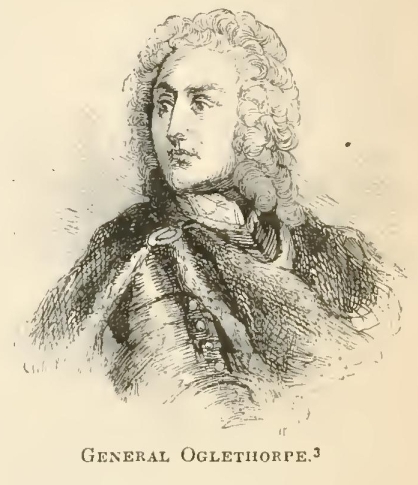
The class of persons whom he designed to transplant to America were not wicked criminals, but chiefly insolvent debtors. Oglethorpe also proposed to make the new colony an asylum for the persecuted Protestants of Germany and other Continental states, and in this religious idea he included the pious thought of spiritual benefit to the Indian tribes. The Earl of Shaftesbury (the fourth bearing that title) and other influential men warmly espoused the scheme, and a general enthusiasm upon the subject soon pervaded the nation. A royal charter was obtained in 1732 for twenty-one years; ** large sums were subscribed by individuals; and in the course of two years, Parliament voted one hundred and eighty thousand dollars in support of the scheme. ****
Oglethorpe volunteered to act as governor of the new colony, and to accompany the settlers to their destination. Accordingly, in November, 1732, he embarked with one hundred and twenty emigrants, and in fifty-seven days arrived off the bar of Charleston. He was warmly welcomed by the Carolinians, and on the thirteenth of January he sailed for Port Royal. While the colonists were landing, Oglethorpe, with a few followers, proceeded southward, ascended the Savannah River to the high bluff, and there selected a spot for a city, the capital of the future state. With the Yamacraw Indians, half a mile from this bluff, dwelt Tomo Chichi, the grand sachem of the Indian confederacy of that region. Oglethorpe and the chief both desired friendly relations; and when the former invited the latter to his tent, Tomo Chichi came, bearing in his hand a small buffalo skin, appropriately ornamented, and addressed Oglethorpe in eloquent and conciliatory terms. (v) Friendly rela-
* In 1728, Oglethorpe's attention was drawn to the condition of debtors in prison by visiting a gentleman confined in the Fleet Jail, who was heavily ironed and harshly treated. He obtained a parliamentary commission to inquire into the state of debtor-prisoners throughout England, of which he was made chairman. They reported in 1729, and efforts at reform were immediately made. The most popular proposition was that of Oglethorpe, to use the prison materials for founding a new state in America.
** This charter was unlike all that had preceded it. Instead of being given for purposes of private advantage, as a money speculation, it was so arranged that the administrators of the affairs of the new colony could derive no profit from it whatever; they acted solely "in trust for the poor." It was purely a benevolent scheme. They were to manage the affairs of the colony for twenty-one years, after which it was to revert to the crown. In honor of the king, who gave the scheme his hearty approval, the territory included within the charter was called Georgia. The seal of the new province bore a representation of a group of silk- worms at work, with the motto "Not for themselves, but for others."
*** James Edward Oglethorpe was born in Surrey, England, on the twenty-first of December, 1698. He entered the army at an early age, and served under Prince Eugene as his aid-de-camp. He was for many years a member of Parliament, and while in that position successfully advocated a scheme for colonizing Georgia. He founded Savannah in 1733. In prosecution of his benevolent enterprise, he crossed the ocean several times. He performed a good deal of military service in Georgia and Florida. He returned to England in 1743, and was married in 1744. In 1745, he was promoted to the rank of brigadier in the British army, and in 1747 to major general. He was employed, under the Duke of Cumberland, against the Pretender, during 1745. When General Gage went to England in 1775, the supreme command of the British army in North America was offered to Oglethorpe. His merciful conditions did not please ministers, and General Howe received the appointment. He died at Grantham Hall, on the thirtieth of June, 1785, at the age of eighty-seven years, and was buried in Grantham Church, Essex, where his tomb bears a poetic epitaph.
**** Graham, iii., 180-184.
* (v) "Here," said the chief, "is a little present; I give you a Buffalo's skin, adorned on the inside with the head and feathers of an Eagle, which I desire you to accept, because the Eagle is an emblem of speed, and the Buffalo of strength. The English are swift as the bird, and strong as the beast, since, like the former, they flew over vast seas to the uttermost parts of the earth; and like the latter, they are so strong that nothing can withstand them. The feathers of an Eagle are soft, and signify love; the Buffalo's skin is warm, and signifies protection; therefore, I hope the English will love and protect our little families."
Founding of Savannah.—Progress of the Colony.—Methodists.—Defenses against the Spaniards.
tions were established, and on the twelfth of February1732 the little band of settlers came from Port Royal and landed at the site of the future city of Savannah.
For almost a year the governor lived under a tent stretched upon pine boughs, while the streets of the town were laid out, and the people built their houses of timber, each twenty-four by sixteen feet in size.
In May following, a treaty with the Indian chiefs of the country was held; and on the first of June, it was signed, by which the English obtained sovereignty over the lands of the Creek nation, as far south as the St. John's, in Florida. Such was the beginning of one of the original thirteen states of our confederacy.
Within eight years after the founding of Savannah, twenty-five hundred emigrants had been sent out to Georgia, at an expense of four hundred thousand dollars. * Among these were one hundred and fifty Highlanders, well disciplined in military tactics, who were of essential service to Oglethorpe. Very strict moral regulations were adopted; ** lots of land, twenty-five acres each, were granted to men for military services, and every care was exercised to make the settlers comfortable. Yet discontent soon prevailed, for they saw the Carolinians growing rich by traffic in negroes; they also saw them prosper commercially by trade with the West Indies. They complained of the Wesleyans as too rigid, and these pious Methodists left the colony and returned home. Still, prosperity did not smile upon the settlers, and a failure of the scheme was anticipated.
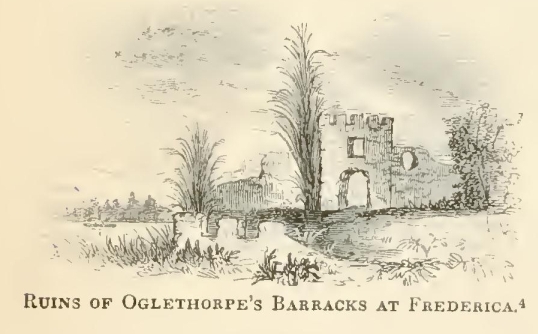
Oglethorpe, who went to England in 1734, returned in 1736, with three hundred emigrants. A storm was gathering upon the southern frontier of his domain. The Spaniards at St. Augustine regarded the rising state with jealousy, and as a war between England and Spain was anticipated, vigilance was necessary. Oglethorpe resolved to maintain the claim of Great Britain south to the banks of the St. John's, and the Highlanders, settled at Darien, volunteered to aid him. With a few followers, he hastened in a scout-boat to St. Simon's Island, where he laid the foundations of Frederica, and upon the bluff near by he constructed a fort of tabby *** the ruins of which may still be seen there. He also caused forts to be erected at Augusta, Darien, on Cumberland Island, and near the mouth of the St. Mary's and St. John's. Perceiving these hostile preparations, the Spanish authorities at St. Augustine sent commissioners to confer with Oglethorpe. They demanded the evacuation of the whole of Georgia, and even of the region north of the Savannah to St. Helena Sound. This demand was accompanied by a menace of war in the event of non-compliance. Thus matters stood for several months.
In the winter of 1736—7, Oglethorpe again went to England, where he received the commission of brigadier general, with a command extending over South Carolina as well as
* Among those who went to Georgia during this period were John and Charles Wesley, the founders of the Methodist sect. Also in 1733, quite a large body of Moravians, on the invitation of the Society for the Propagation of the Gospel, left the Old Continent for the New, and pitched their tents near Savannah, after a long voyage. They soon made their way up the Savannah to a beautiful stream, where they settled down permanently, and called the creek and their settlement, Ebenezer, a name which they still bear. Whitfield came in 1740, and established an orphan-house at Savannah. He sustained it for a while, by contributions drawn from the people of the several provinces by his eloquence; but when he was asleep in the soil of New England, it failed. All Christians were admitted to equal citizenship, except Roman Catholics; they were not allowed a residence there.
** The importation of rum was prohibited, and, to prevent a contraband trade in the article, commercial intercourse with the West Indies was forbidden. The importation of negroes was also forbidden.
*** Tabby is a mixture of lime with oyster-shells and gravel, which, when dry, form a hard rocky mass.
**** This is from a sketch made by W. W. Hazzard, Esq., in 1851. Mr. Hazzard writes: "These ruins stand on the left bank or bluff of the south branch of the Alatamaha River, on the west side of St. Simon's Island, where the steamers pass from Savannah to Florida." This fort was a scene of hostilities during the war of the Revolution, and also that of 1812; and is one of the most interesting military relics of our country. Mr. Hazzard states that, in his field in the rear of it, his men always turn up "bomb-shells and hollow shot whenever they plow there." The whole remains are upon his plantation at West Point.
Expedition against St. Augustine.—Return of Oglethorpe to England.—Georgia a Royal province.
Georgia. There he remained a year and a half, when he returned to his colony with a regiment of six hundred men to act against the Spaniards. England declared war against Spain in the latter part of 1739, and Oglethorpe immediately planned an expedition against St. Augustine. The St. Mary's was then considered (as it remains) the boundary between Georgia and Florida. Over that line Oglethorpe marched in May, 1740, with four hundred of his regiment, some Carolinians, and a large body of friendly Indians. He captured a Spanish fort within twenty-five miles of St. Augustine. A small fortress, within two miles of that place, was surrendered on his approach, but a summons to give up the town was answered by defiant words. The invaders maintained a siege for some time, when the arrival of re-enforcements for the garrison, and the prevalence of sickness in the camp, obliged them to withdraw and return to Savannah.July, 1740
In 1742, the Spaniards invaded Georgia. A fleet of thirty-six sail, with more than three thousand troops from Havana and St. Augustine, entered the harbor of St. Simons,July 16, 1742 and a little above the town of the same name, erected a battery of twenty guns. Oglethorpe, with eight hundred men, exclusive of Indians, was then on the island. He withdrew to his fort at Frederica, and anxiously awaited re-enforcements from Carolina. He skirmished successfully with attacking parties, and arranged for a night assault upon the enemy's battery. A deserter (a French soldier) defeated his plan; but the sagacity of Oglethorpe used the miscreant's agency to his subsequent advantage, by bribing a Spanish prisoner to carry a letter to the deserter, containing information that a British fleet was about to attack St. Augustine. Of course the letter was handed to the Spanish commander, who arrested the Frenchman as a spy. The intelligence contained in Oglethorpe's letter alarmed the garrison, and the Spaniards determined to assail the English immediately, and then return to St. Augustine as speedily as possible. On their march to the attack of Frederica, they fell into an ambuscade. Great slaughter ensued, and they retreated precipitately. The place of conflict is called Bloody Marsh to this day. On their retreat, by water, they attacked Fort William, at the southern extremity of Cumberland Island, but were repulsed with loss. The expedition was disastrous to the Spaniards in every particular, and the commander was tried by a court-martial at Havana, and dismissed from the service in disgrace.
After ten years of service in and for the colony of Georgia, Oglethorpe returned to England, and his feet never again pressed the soil of America. His rule had been chiefly military. A civil government was now established,1743 under the control of a president and council, who were instructed to administer it as the trustees should dictate. Prosperity did not yet gladden the settlers, and the colony had a sickly existence. At length the moral and commercial restrictions began to be evaded; slaves were brought from Carolina, and hired first for a few years, and then for a hundred years, or during life. This was equivalent to a purchase, and was so considered by the parties; for a sum, equal to the value of the slave, was paid in advance. Finally, slave ships came directly to Savannah from Africa; slave labor was generally introduced, and Georgia, like Carolina, became a planting state. In 1752, the trustees, wearied with the complaints of the colonists, resigned the charter into the hands of the king, and from that period until the war of the Revolution, Georgia was a royal province. * When the treaty of Paris in 1763 guarantied, as far as possible, general peace in America, the province, for the first time, began to flourish and take an important place among the Anglo-American colonies; and in the hostilities against the Indians on the frontiers its people performed their part well in furnishing provisions and men for the armies.
The inhabitants of Georgia first began to feel the hand of British taxation, when, in 1767, Governor Wright communicated his instructions from the king to require implicit obe-
* John Reynolds was the first royal governor. He was appointed in 1754. and was succeeded in 1757 by Henry Ellis. Sir James Wright, who was the last royal governor of Georgia, succeeded Ellis in 1760, and held the office until 1776.
Political Agitation.—Committee of Correspondence.—Movements of the Sons of Liberty.—Their names
dience to the Mutiny Act. * They were compelled to acquiesce, but it was with reluctance They had not realized the practical iniquity of the Stamp Act; and when, in 1768, the Assembly at Savannah appointed Dr. Franklin an agent to attend to the interests of the colony in Great Britain, they had no formal special complaint to make, nor difficulties with government for him to adjust. They generally instructed him to use efforts to have the acts of Parliament repealed, which were offensive to all the colonies. To a circular letter from the speaker of the Massachusetts Assembly,1768 proposing a union of the colonies, an answer of approval was returned. In 1770,Feb, 1770 the Legislature spoke out boldly against the oppressive acts of the mother country, by publishing a Declaration of Rights, similar in sentiment to that of the "Stamp Act Congress" at New York. Governor Wright was displeased, and viewing the progress of revolutionary principles within his province with concern, he went to England1771 to confer with ministers. He remained there about a year and a half. During his absence, James Habersham, president of the council, exercised executive functions.
The republicans of Georgia had become numerous in 1773, and committees of correspondence were early formed, and acted efficiently. A meeting of the friends of liberty was called in Savannah in the autumn of that year, but Sir James Wright, supported by a train of civil officers, prevented the proposed public expression of opinion. The wealthy feared loss of property by revolutionary movements, while the timid trembled at the thought of resistance to royal government. Selfishness and fear kept the people comparatively quiet for a while. In the mean time, a powerful Tory party was organizing in South Carolina and in Georgia, and emissaries were sent by the governors of these provinces among the Indians on the frontiers, to prepare them to lift the hatchet and go out upon the war-path against the white people, if rebellion should ensue. Such was the condition of Georgia when called upon to appoint representatives in the Continental Congress, to be held at Philadelphia in 1774. Half encircled by fierce savages, and pressed down by the heel of strongly-supported royal power in their midst, the Republicans needed stout hearts and unbending resolution. These they possessed; and in the midst of difficulties they were bold, and adopted measures of co-operation with the other colonies in resistance to tyranny.
On the fourteenth of July,1774 the Sons of Liberty were requested to assemble at the liberty pole at Tondee's tavern, ** in Savannah, on Wednesday, the twenty-seventh instant, in order that publie matters may be taken under consideration, and such other constitutional measures pursued as may then appear most eligible." *** The call was signed by Noble W. Jones (who in 1780 was a prisoner in Charleston), Archibald Bullock, John Houstoun, and George Walton. A meeting was accordingly held at the watch-house in Savannah.July 27, 1774 where letters from Northern committees were read, and a committee to draft resolutions was appointed. **** These proceedings were published, and the governor, alarmed at the progress of rebellion around him, issued a countervailing proclamation.August He called upon the people to discountenance these seditious men and measures, and menaced the disobedient with the penalties of stern British law.
On the tenth of August another meeting was held, when it was resolved to concur with their sister colonies in acts of resistance to oppression. After strongly condemning the Boston Port Bill, they appointed a committee to receive subscriptions for the suffering peo-
* A proviso of this act, as we have elsewhere noticed, required the colonists to provide various necessaries lor soldiers that might be quartered among them.
** The first liberty-pole was erected in Savannah, on the fifth of June, 1775, in front of Peter Tondee's tavern. His house stood upon the spot now (1849) occupied by Smet's new stores.
*** M'Call, ii., 16.
**** John Glenn was chosen chairman of the meeting. The following-named gentlemen were appointed the committee to prepare the resolutions: John Glenn, John Smith, Joseph Clay, John Houstoun, Noble W. Jones, Lyman Hall, William Young, Edward Telfair, Samuel Farley, George Walton, Joseph Habersham, Jonathan Bryan, Jonathan Cochran, George M'Intosh, Sutton Banks, William Gibbons, Benjamin Andrew, John Winn, John Stirle, Archibald Bullock, James Seriven, David Zubley, Henry Davis Bourguin, Elisha Butler, William Baker, Parminus Way, John Baker, John Mann, John Benefield, John Stacey, and John Morel. These were the leading Sons of Liberty at Savannah in 1774.
Contributions for Boston.—Tory Influence.—Whig Boldness.—Spiking of Cannon.—Tar and Feathers.
ple of that city, and within a few hours after the adjournment of the meeting, five hundred and seventy-five barrels of rice were contributed and shipped for Massachusetts. The governor assembled his friends at the court-house a few days afterward, and their disapprobation of the conduct of the Republicans was expressed in strong terms. Agents were sent throughout the province to obtain the signatures of the people to a printed denunciation of the Whigs; and by means of menaces and promises, an apparent majority of the inhabitants declared in favor of royal rule. * So powerfully did the tide of opposition against the Whigs flow for a while, that they did not appoint delegates to the Continental Congress, which convened in Philadelphia in September, and Georgia was not represented in that first Federal Republican council, ** yet they heartily approved of the measure, and by words and actions nobly responded to that first great resolution, adopted by the Continental Congress on the eighth of October, 1774, *** which approved of the resistance of Massachusetts.
The Republicans continued to assemble during the winter of 1774—5, and in May following they determined to anticipate an act on the part of Governor Wright similar to that of Gage at Boston. Accordingly, on the night of the eleventh of May,1775 six of the members of the Council of Safety, **** and others, broke open the magazine, (v) took out the powder, sent a portion of it to Beaufort, South Carolina, and concealed the remainder in their garrets and cellars. The governor offered a reward of one hundred and fifty pounds sterling for the apprehension of the offenders, but the secret was never revealed till the patriots used the powder in defense of their liberties.
On the first of June, Governor Wright and the Loyalists of Savannah prepared to celebrate the king's birth-day. On the night of the second, some of the leading Whigs spiked the cannon on the battery, and hurled them to the bottom of the bluff. Nineteen days afterward, a meeting was called for the purpose of choosing a committee to enforce the requirements of the American Association, put forth by the Congress of 1774. (vi) The first victim to his temerity in opposing the operations of the committee was a man named Hopkins. He ridiculed the Whigs, and they, in turn, gave him a coat of tar and feathers, and paraded him in a cart through the town for four or five hours. About this time, a letter from Governor Wright to General Gage was intercepted by the vigilant Whigs of Charles-
* The only newspaper in the province (the Georgia Gazette, established in 1762) was under the control of Governor Wright, and through it he disseminated much sophistry, and sometimes falsehoods among the people.
** The committees of St. John's parish convened on the ninth of February, 1775, and addressed a circular letter to the committees of other colonies, asking their consent to the reception of a representative in Congress from that particular parish. Encouraged by the answer they received, they met again on the twenty-first of March, and appointed Dr. Lyman Hall to represent them. When he went to Philadelphia, he took with him, from Sunbury, one hundred and sixty barrels of rice, and two hundred and fifty dollars, as a present to the people of Boston.
*** The whole record of the proceedings of Congress on that day is as follows: "Saturday, October 8, 1774.—The Congress resumed the consideration of the letter from Boston, and, upon motion, Resolved, That this Congress approve the opposition of the inhabitants of Massachusetts Bay to the execution of the late Acts of Parliament; and if the same shall be attempted to be carried into execution by force, in such case, all America ought to support them in their opposition." The proceedings of that one day should be written in brass and marble; for the resolution then adopted was the first Federal gauntlet of defiance cast at the feet of the British monarch. The eighth of October, 1774, should be placed by the side of the fourth of July, 1776, as one of the most sacred days in the calendar of Freedom.
**** These were Noble Wimberly Jones, Joseph Habersham, Edward Telfair, William Gibbons, Joseph Clay, and John Milledge.
* (v) The magazine was at the eastern extremity of the town. It was sunk about twelve feet under the ground, inclosed with brick, and secured by a door in such a way that the governor did not consider a guard necessary.
* (vi) This committee consisted of sixteen leading men of Savannah, among whom was Samuel (afterward General) Elbert, and George Walton, one of the signers of the Declaration of Independence. M'Call (ii., 45) says that, after the meeting adjourned, "a number of gentlemen dined at Tondee's tavern, where the Union flag was hoisted upon the liberty-pole, and two pieces of artillery were placed under it." The Union flag, of thirteen red and white stripes, was not adopted until the first of January, 1776, when it was first unfurled in the American camp, near Boston.
Intercepted Letter.—Seizure of Powder.—Imprisonment of the Governor.—His Escape.—A Traitor.
ton. It contained a request for Gage to send some British troops to suppress the rebellious spirit of the Georgians. *
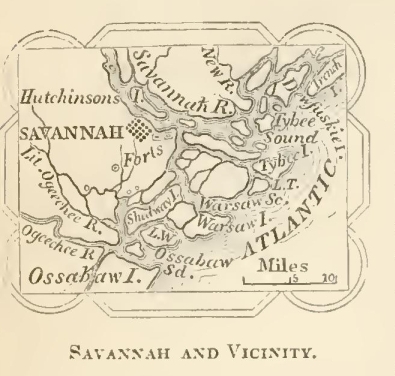
The Republicans were exceedingly indignant; and when, a day or two afterward, it was known that Captain Maitland had arrived at Tybee Island, at the mouth of the Savannah, with thirteen thousand pounds of powder and other articles for the British and Indians, it was determined to seize the vessel. The Georgia Assembly was then in session. ** The leading Whigs approved of the enterprise, and on the night of the tenth of July, thirty volunteers, under Commodore Bowen and Colonel Joseph Habersham, embarked in two boats, took possession of the ship, discharged the crew, and placed the powder in the magazine in Savannah, except five thousand pounds, which they sent to the army then investing Boston, under General Washington. ***
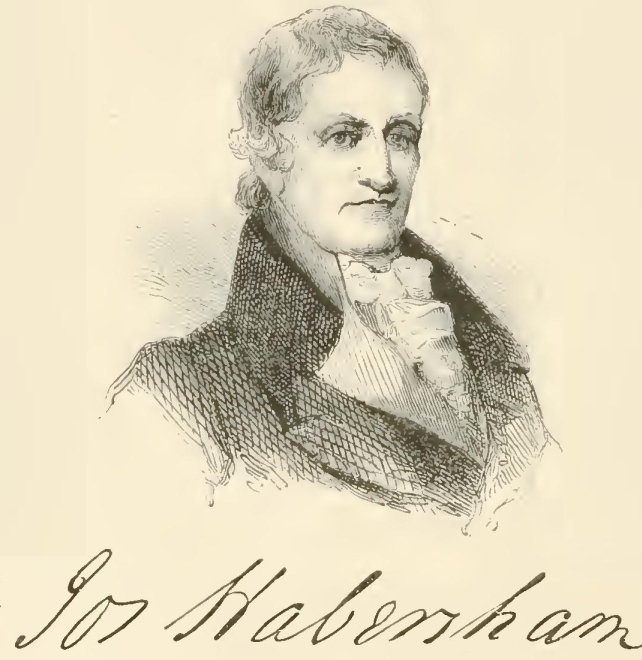
The Indian hostilities, which occurred at this time on the western Miles frontiers, we have considered in preceding chapters.
The spirit of resistance waxed stronger and stronger during the autumn of 1775. In January, 1776, it assumed a form of strength and determination hitherto unknown in Georgia. On the eighteenth of that month, Colonel Joseph Habersham, **** who was a member of the Assembly, raised a party of volunteers, took Governor Wright a prisoner, and paroled him to his own house, (v) before which a sentinel was placed, and forbid all intercourse between him and persons inimical to the Republican cause. On the night of the eleventh of February,1776 during a storm, the governor escaped from a back window of his house, with John Muloyne, and went down the river five miles, to Bonaventure, the residence of that gentleman. There a boat and crew were waiting for him, and he was conveyed to Tybec Sound, and took shelter on board the armed ship Scarborough.
Royal rule had now actually ceased
* The Secret Committee at Charleston, who intercepted this letter, placed another in the cover, with Governor Wright's name counterfeited, and sent it on to Gage. In that letter they said (as if Governor Wright was penning it), "I have wrote for troops to awe the people, but now there is no occasion for sending them, for the people are again come to some order." Gage was thus misled.
** They met on the fourth of July. On the fifteenth, they elected Archibald Bullock, John Houstoun, John Joachim Zubley, Noble Wimberly Jones, and Lyman Hall, to represent that province in the Continental Congress. These were the first delegates elected by the representatives of the whole people, for Hall represented only the parish of St. John's. Fifty-three members signed their credentials. Zubley afterward became a traitor. While the subject of independence was being debated in 1776, Samuel Chase, of Maryland, accused Zubley of communicating with Governor Wright. Zubley denied the charge, but while Chase was collecting proof, the recusant fled.
*** One of the men engaged in this adventure was Ebenezer Smith Platt. He was afterward made a prisoner, and being recognized as one of this daring party, was sent to England, where he lay in jail many months, under a charge of high treason. He was eventually considered a prisoner of war, and was exchanged.
**** Joseph Habersham was the son of a merchant of Savannah, who died at New Brunswick, in New Jersey, in August, 1775. Joseph Habersham held the rank of lieutenant colonel in the Continental army. In 1785, he was a member of Congress from Savannah; and in 1795, Washington appointed him postmaster general of the United States. He held that office until 1800, when he resigned. He was made president of the Branch Bank of the United States, at Savannah, in 1802, which position he held until his death, in November, 1815, at the age of sixty-five years. The name of his brother James, late President of the Council, appears upon the first bill of credit issued by the Provincial Congress of Georgia in 1776.
* ( v) Governor Wright's house was on the lot in Heathcote Ward, where the Telfair House now stands. The Council House was on the lot where George Schley. Esq., resided in 1849.
Congressional Delegates.—Savannah Menaced.—British Repulsed.—Party Lines.—Lee's Expedition.
in Georgia, and the Assembly assumed governmental powers. They elected new delegates to the Continental Congress;1776 passed a resolution to raise a battalion of Continental troops;Feb. 4 and issued bills of credit in the form of certificates, and ordered them to be received at par in payment of debts and for merchandise.
Governor Wright wrote a letter to the AssemblyFeb. 13 very conciliatory in its tone, but receiving no answer, he resolved to allow the armed vessels at the mouth of the river to force their way to the town, and procure such supplies as they needed. Eleven merchant vessels, laden with rice, were then at Savannah ready to sail. These were seized by the war ships, and Majors Maitland and Grant landed, with a considerable force, upon Hutchinson's Island, opposite Savannah, preparatory to an attack upon the townMarch 6, 1776 The patriots were on the alert, and sent a flag to Maitland, warning him to desist.
This flag was detained, and another was fired upon. Further parley was deemed unnecessary, and the next day two merchant vessels, lying in the stream, were set on fire by the patriots. Floating down to the one containing Maitland and Grant, with their men, great consternation was produced. Some of the soldiers jumped overboard and swam ashore; some stuck in the mud, and many lost their fire-arms; while the officers escaped in boats to Hutchinson's Island. At this critical moment, four hundred Carolinians, under Colonel Bull, arrived, and aided the Georgians in repulsing the assailants. Three of the merchant vessels were burned, six were dismantled, and two escaped to sea.
The breach between the Whigs and Tories was now too wide to be closed, and the line was very distinctly drawn by stringent measures on the part of the former. *** These tended to winnow the chaff from the wheat, and many Tories, possessed of no property, left Georgia and took refuge in East Florida, where Governor Tonyn was actively engaged in fitting out privateers to prey upon the infant commerce of the Southern colonists, and to ravage their coasts. The Tories there organized under the title of the Florida Rangers, and were led by Thomas Brown, the Augusta Loyalist, who afterward commanded the garrison at that place. A fort built by Governor Wright's brother, on the St. Mary's, was their place of rendezvous, whence they went out and levied terrible contributions, in the way of plunder, upon the people of Southern Georgia, who were thinly scattered over the country.
The war had now fairly commenced, and the flame of patriotism which burned so brightly at the North was not less intense in Georgia. The Declaration of Independence was received in Savannah with great joy. **** August 10, 1776 Pursuant to the recommendation of the Continental Congress, the people turned their attention to the organization of civil government, upon the basis of independence, and in strengthening their military power. To weaken the British and Tories in the South, an expedition against St. Augustine (then in possession of the English) was planned, and General Charles Lee, then at Charleston, was invited to take the command of troops that might be sent. Lee perceived the advantages to be derived from such a measure, and acquiescing, he immediately ordered Brigadier Robert Howe to proceed to Savannah with troops. Howe had marched as far as Sunbury, at the mouth of the Midway River,August, 1776 when sickness, want of artillery and
* Archibald Bullock, John Houstoun, Lyman Hall, Button Gwinnett, and George Walton.
** Lachlin Mflntosh was appointed colonel; Samuel Elbert, lieutenant colonel; and Joseph Habersham, major.
*** When the British first appeared in the attitude of assailants, the Committee of Safety appraised such houses in Savannah as were owned by Republicans, with the determination of applying the torch if they could not repulse the enemy. The houses of the Tories were not noticed; and therefore, in the event of a general conflagration, their property would not be accounted for.
**** Archibald Bullock, president of the council, convened that body, on the receipt of the Declaration (which came by express in thirty-five days from Philadelphia), when they ordered it to be publicly read in front of the council-chamber. There, under a military escort, the council proceeded to the liberty-pole, where they were saluted by thirteen cannon-peals and small arms from the first Continental battalion, under Colonel M'Intosh. Proceeding to the haltery, another salute of thirteen guns was fired. The people then partook of a dinner in a grove, where thirteen toasts were given. In the afternoon, there was a funeral procession, and the royal government was buried, with the customary ceremonies. In the evening, the town was brilliantly illuminated.—M'Call, ii., 90.
Boldness of the Tories.—Organization of Civil Government.—M'Intosh and Gwinnett.—A Duel.
other necessaries for the campaign, caused Lee to abandon the enterprise. The effect of this movement was disastrous to the Whigs.
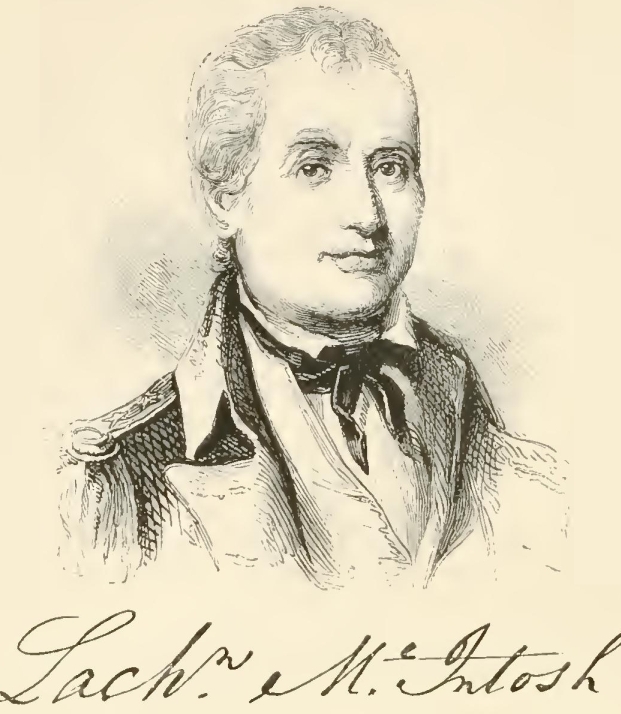
The Tories gained confidence; and on the seventh day of February, 1777, they attacked Fort M'Intosh. * The garrison was commanded by Captain Richard Winn, of South Carolina. After holding out for two days, he was obliged to surrender.
The officers and privates of the garrison were all paroled except two young officers, who were taken to St. Augustine and kept as hostages.
During the autumn of 1776, a convention was held in Savannah to form a state Constitution, with a bullet in the thigh. M'Intosh recovered; Gwinnett died, murder, at the instance of Gwinnett's friends, and was acquitted.
It was adopted on the 5th of February following: Button Gwinnett, one of the signers of the Declaration of Independence, was chosen president of the council, an office equivalent in its functions to that of governor. In consequence of military rivalry, a serious difficulty arose between Gwinnett and Colonel M'Intosh, ** who had just been elected brigadier general of the Georgia Continental troops. A duel ensued, when both were wounded, each M'Intosh was tried for This quarrel produced a serious local agitation, which at one time menaced the Republican stability of Georgia, and the true friends of the cause were alarmed. To allay party feeling, General M'Intosh consented to accept of a station at the North; and Washington appointed him commander-in-chief of the Western Department, with his head-quarters at Pittsburg, where we have already met him. (See page 500.)
During the summer and autumn of 1777, Colonels Elbert, Scriven, Baker, and others, attempted to dislodge the Tories from East Florida, and several skirmishes occurred. These expeditions were fruitless of advantage to the patriots, and much suffering ensued. Frederica was attacked by the enemy; some Americans and negroes were captured, and considerable property was carried off. Often, during the autumn, predatory excursions were made
* This was a small stockade, one hundred feet square, with a block-house in the center, and a bastion at each corner. It was situated upon the northeast side of Saltilla River, in the present Camden county.
** Lachlin M'Intosh was born near Inverness, in Scotland, in 1727. He was the son of John M., who was at the head of the Borlam branch of the clan M'Intosh. He came to Georgia with General Oglethorpe in 1736, when Lachlin was nine years of age. His father being made a prisoner and sent to St. Augustine, Lachlin was left to the care of his mother at the age of thirteen years. His opportunities for education were small, yet his strong mind overcame many difficulties. Arrived at maturity! he went to Charleston, where, on account of his fine personal appearance and the services of his father, he commanded attention. He and Henry Laurens became friends, and he entered that gentleman's counting-room as clerk. He left commercial pursuits, returned to his friends on the Alatamaha, married, and engaged in the profession of a land surveyor. He made himself acquainted with military tactics, and when the War for Independence broke out, he was found, when needed, on the side of the Republicans. He was first appointed colonel, and in 1776 was commissioned a brigadier. He was persecuted by his rival, Button Gwinnett, until he could no longer forbear; and finally, pronouncing that gentleman a scoundrel, a duel ensued, and Gwinnett was killed. M'Intosh afterward commanded in the Western Department, and led an expedition against the Indians. (See page 500). He returned to Georgia in 1779, and was at the siege and fall of Savannah. He was with Lincoln at Charleston, where he was made prisoner. After his release, he went with his family to Virginia, where he remained until the close of the war. When he returned to Georgia, he found his property nearly all wasted; and in retirement and comparative poverty, he lived in Savannah until his death, which occurred in 1806, at the age of seventy-nine. General M'Intosh, when young, was considered the handsomest man in Georgia.
Expedition to Florida.—Troops under General Howe.—His public Life.—Duel with Gadsden.
upon the southern frontiers of Georgia, the marauders frequently penetrating as far as the Alatamaha and even beyond, and the settlements suffered terribly.
During the winter and spring of 1778, the opponents of the new government became formidable, and indications of an invasion of Georgia, from Florida and from the Indian territory in the West, was perceived.
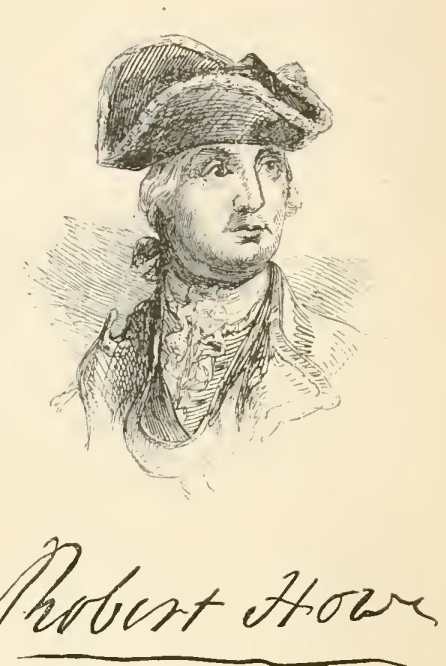
Tories gathered at Ninety-Six] and crossed the Savannah, while those of Florida, joined by the Indians, continued to scatter desolation along the southern frontier. Robert Howe, * of North Carolina, now promoted to the rank of major general, was in the chief command of the Southern army, and favored the yet cherished design to march into Florida and disperse the Loyalists. In fact, this measure had become a chief desideratum, for the gathering storm on the frontier of that state was pregnant with evil omens for the whole South. The Loyalists were gaining strength on the St. Mary's, St. John's, and at Pensacola, and re-enforcements of British troops were expected at St. Augustine.April, 1778 Howe moved his head-quarters from Charleston to Savannah.
His regulars, who were in a condition to take the field, did not exceed five hundred and fifty men. These were joined by the commands of Colonels C. C. Pinckney, Bull, and Williamson. Governor Houstoun, of Georgia, who was requested to furnish three hundred and fifty militia, cheerfully complied.
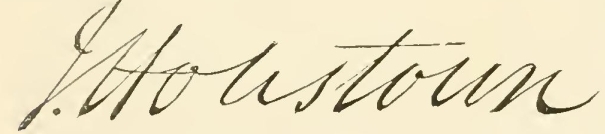
Thus prepared, Howe marched toward the Alatamaha, when he was informed that a body of British regulars, under General Augustine Prévost, a large force of Loyalists, under Colonel Brown, and numerous Indians, were moving toward the St. Mary's for the purpose of invading Georgia. Already Colonel Elbert had been victorious at Frederica, ** and Howe felt certain of success, when, on the twentieth of May,1778 he reached the Alatamaha, and learned how rumors of his expe-
* Robert Howe was a native of Brunswick, North Carolina. History bears no record of his private life, and his biography has never been written. He appears to have been one of the earliest and most uncompromising of the patriots of the Cape Fear region, for we find him honored with an exception, together with Cornelius Harnett, when royal clemency was offered to the rebels by Sir Henry Clinton, in 1776. He was appointed colonel of the first North Carolina regiment, and with his command went early into the field of Revolutionary strife. In December, 1775, he joined Woodford at Norfolk (see page 536), in opposition to Lord Dunmore and his motley army. For his gallantry during this campaign, Congress, on the twenty-ninth of February, 1776, appointed him, with five others, brigadier general in the Continental army, and ordered him to Virginia. In the spring of 1776, British spite toward General Howe was exhibited by Sir Henry Clinton, who sent Cornwallis, with nine hundred men, to ravage his plantation near old Brunswick village. He was placed in chief command of the Southern troops in 1778, and was unsuccessful in an expedition against Florida, and in the defense of Savannah. His conduct was censured, but without just cause. Among others whose voice was raised against him, was Christopher Gadsden, of Charleston. Howe required him to deny or retract. Gadsden would do neither, and a duel ensued. They met at Cannonsburg, and all the damage either sustained was a scratch upon the ear of Gadsden by Howe's ball. *
** Colonel Elbert, who was stationed at Fort Howe, on the Alatamaha, early in the spring of 1778, went with three hundred men to Darien, where he embarked on board three galleys, accompanied by a detachment of artillery on a flat-boat, and proceeded to attack a hostile party at Oglethorpe's Fort. He was successful. A brigantine was captured, and the garrison, alarmed, fled from the fort to their boats, and escaped, leaving Elbert complete victor. On board of the brigantine were three hundred uniform suits, belonging to Colonel Pinckney's regiment, which had been captured while on their way, in the sloop Hatter, from Charleston to Savannah.
* Major André wrote a humorous account, in rhyme, of this affair, in eighteen stanzas. Bernard Elliott was the second of Gadsden, and General Charles Cotesworth Pinckney, of Howe. The duel occurred on the thirteenth of August, 1778. After this affair, Howe and Gadsden were warm friends.
March toward Florida.—Divided Commands.—Failure of the Expedition.—Minor Expeditions.