Volume 2 — CHAPTER XIX. (continued 2)
Reading edition
** It was while the expedition was slowly winding its way down this hill above Cincinnati (then an unknown name, now a city with almost 120,000 inhabitants), that Captain M'Cracken, then dying from the effects of a wound in his arm, proposed that they should all enter into an agreement that, fifty years thereafter, the survivors should "meet there and talk over the affairs of the campaign." On the fourth of November, 1832, many of those veterans met in Cincinnati, and more would doubtless have been there, had not the ravages of the cholera prevented. Kenton was still living, but debility prevented his joining his old companions in arms.—See Collins's Kentucky.
Affairs at Williamsburg.—Patrick Henry's bold Resolutions in favor of Military Preparations.—His eloquent Defense of them.
We left Governor Dunmore and the Virginia House of Burgesses in open rupture. The governor had dissolved them, and they had assembled at the Raleigh tavern in convention, and appointed delegates to represent Virginia in the approaching General Congress. That Congress met; its acts have elsewhere been noticed in detail. * The breach between the governor and the people continued to widen; the affairs of Great Britain and her American colonies rapidly approached a crisis. Every day the power of royal governors became weaker; every day the representatives of the people became bolder. To sagacious minds war appeared inevitable, and preparations for it were regarded as acts of common prudence.
In the Virginia Legislature, convened at Richmond in March, 1775, Patrick Henry, in a series of resolutions, recommended a levy of volunteer troops in each county, for the better defense of the country; in other words, a standing army of minute-men, pledged to the republican cause. He had seen with impatience the temporizing spirit of his colleagues, and he determined to test their courage and patriotism by a bold proposition in' the form of resolutions. Like his famous Stamp Act resolutions ten years before, these filled the House with consternation. His proposition was considered as premeditated rebellion, and it was opposed as rash and premature by several who afterward became his most zealous co-workers. Opposition aroused all the fire of Henry's genius, and he poured forth a flood of brilliant eloquence such as the Virginia Assembly had never heard. March 23, 1775 He closed his speech with a loud cry of "Give me Liberty or give me Death!" and when he sat down, not a murmur of applause or of disapprobation was heard. ** "After the trance
* See pages 265-270 inclusive.
** Mr. Wirt, in his life of Patrick Henry, gives the following report of his speech on that occasion. Referring to the apparently gracious manner in which the king had received their petitions, he exclaimed: "Sutler not yourselves to be betrayed by a kiss. Ask yourselves how this gracious reception comports with those warlike preparations which cover our waters and darken our land. Are fleets and armies necessary to a work of love and reconciliation? Have we shown ourselves so unwilling to be reconciled, that force must be called in to win us back to our love? Let us not deceive ourselves, sir! These are the implements of war and subjugation; the last arguments to which kings resort. I ask, gentlemen, what means this martial array, if its purpose be not to force us to submission? Has Great Britain any enemy in this quarter of the world, to call for all this accumulation of armies and navies? No, sir, she has none. They are meant for us; they can be meant for no other. They are sent over to bind and rivet upon us those chains which the British ministry have been so long forging. And what have we to oppose them? Shall we try argument? Sir, we have been trying argument for the last ten years.... We have petitioned; we have supplicated; we have prostrated ourselves before the throne, and have implored its interposition to arrest the tyrannical hands of the ministry and Parliament. Our petitions have been slighted: our remonstrances have produced additional violence and insult; our supplications have been disregarded; and we have been spurned with contempt from the foot of the throne. In vain, after these things, may we indulge the fond hope of reconciliation. There is no longer any room for hope. If we wish to be free; if we wish to preserve inviolate those inestimable privileges for which we have been so long contending: if we mean not basely to abandon the noble struggle in which we have been so long engaged, and which we have pledged ourselves never to abandon until the glorious object of our contest shall be obtained, we must fight! I repeat it, sir, we must fight! An appeal to arms and to the God of hosts is all that is left us. "They tell us, sir, that we are weak—unable to cope with so formidable an enemy. But when shall we be stronger? Will it be next week, or next year? Will it be when we are totally disarmed, and when a British guard shall be stationed in every house? Shall we gather strength by irresolution and inaction? Shall we acquire the means of effectual resistance by lying supinely on our backs, and hugging the delusive phantom of hope, until our enemies shall have bound us hand and foot? Sir, we are not weak, if we make a proper use of those means which the God of nature hath placed in our power. Three millions of people, armed in the holy cause of Liberty, and in such a country as that which we possess, are invincible by any force which our enemy can send against us. Besides, sir, we shall not fight our battles alone. There is a just God who presides over the destinies of nations, and who will raise up friends to fight our battles for us. The battle, sir, is not to the strong alone; it is to the vigilant, the active, the brave. And again, we have no election. If we were base enough to desire it, it is now too late to retire from the contest. * There is no retreat but in submission and slavery! Our chains are forged! Their clanking may be heard on the plains of Boston! The war is inevitable! and let it come!! I repeat it, sir, let it come!!! It is vain, sir, to extenuate the matter. Gentlemen may cry peace, peace; but there is no peaee! The war is actually begun! The next gale that sweeps from the north will bring to our ears the clash of resounding arms!* Our brethren are already in the field! What is it that gentlemen wish? What would they have? Is life so dear, or peace so sweet, as to be purchased at the price of chains and slavery? Forbid it, Almighty God! I know not what course others may take, but as for me," he cried, with both arms extended aloft, his brow knit, every feature marked with the resolute purpose of his soul, and with his voice swelled to its loudest note, 'Give me Liberty or give me Death!!!'"
* This prediction was speedily fulfilled; for almost "the next gale from the north" conveyed the boom of the signal-gun of freedom at Lexington.
* The boldness of Mr. Henry, and the great influence whieh he exerted, caused him to be presented to the British government in a bill of attainder. His name, with that of Thomas Jefferson, Peyton Randolph, John Adams, Samuel Adams, John Hancock, and several others, were on that black list.
Effect of Henry's Speech.—Seizure of Powder by Dunmore.—Patrick Henry with a Military Force.—A Compromise.
of a moment," says Wirt, "several members started from their seats. The cry to arms! seemed to quiver on every lip, and gleam from every eye. Richard Henry Lee arose, and supported Mr. Henry with his usual spirit and eloquence, but his melody was lost amid the agitations of that ocean which the master spirit of the storm had lifted on high. That supernatural voice still sounded in their ears, and shivered along their arteries. They heard, in every pause, the cry of Liberty or Death! They became impatient of speech—their souls were on fire for action." The resolutions were adopted by a large majority.
During the spring of 1775, secret orders came from the British ministry to the royal governors to remove the military stores out of the reach of the colonists, if there should appear symptoms of rebellion. The attempt by Governor Gage, of Boston, to execute their orders, produced the conflicts at Lexington and Concord;April 19, 1775 and a similar attempt made by Governor Dunmore, on the very next dayApril 20 brought the Virginians out in open rebellion. The British man-of-war Magdalen, Captain Collins, was lying at anchor in the York River, a little below Williamsburg, and at midnight Dunmore had the powder in the old magazine secretly removed to that vessel. The movement was discovered, and at dawn the minute-men of Williamsburg assembled, with their arms, and were with difficulty restrained from seizing the governor. The people also assembled, and sent a respectful remonstrance to Dunmore, complaining of the act as specially wrong at that time, when a servile insurrection was apprehended. Dunmore made an evasive reply. He pretended that he feared a slave insurrection in a neighboring county, and said that in case a rising of the negroes in James City county should occur, the powder should be restored. His reply was quite unsatisfactory, and the people demanded the immediate surrender of the ammunition. Patrick Henry was then at his home in Hanover county. When intelligence of the movement reached him, he assembled a corps of volunteers at New Castle, * and marched immediately for the Capitol to secure the treasury from a like outrage, and to procure a restoration of the powder. His corps augmented on its march, and numbered about one hundred and fifty well-armed men when he arrived at Doncaster's ordinary, within sixteen miles of the capital. There he was met by some of the Virginia delegation to Congress, on their way to Philadelphia, and was informed that his approach had frightened the governor. There he also met Corbin, the receiver-general, who came with authority from the governor to compromise the matter. Henry demanded and received the value for the powder (three hundred and thirty pounds), and immediately sent it to the treasury at Williamsburg. ** The volunteers were disbanded,May 4, 1775 and they returned to their homes. Henry departed for Philadelphia a week afterward, he being a delegate to Congress.
Dunmore was greatly irritated by the result, and menaced the people. He swore by
* See page 431.
** All the arms and ammunition in the magazine were not sufficient to cause a disturbance, for they were too small in amount to have been of much service to either party. The amount of powder removed by Dunmore was fifteen half barrels, containing fifty pounds each. In fact, it was not the value of the powder, nor the harm that might result from its removal, which probably induced Patrick Henry to summon to his standard the volunteers of Hanover. He deemed it of higher importance that the blow, which must be struck sooner or later, should be struck at once, before an overwhelming royal force should enter the colony. The Honorable Charles Augustus Murray, a Scotch gentleman, who visited this country in 1836 (and in 1851 was married to a lady of New York, since dead), is a lineal descendant of Lord Dunmore. In his published narrative of his travels, he mentions, as a rather singular coincidence, that when he went down the Chesapeake from Baltimore for the purpose of visiting Williamsburg, the steam-boat that conveyed him was named Patrick Henry.
Dunmore's Oath.—General Excitement.—Proceedings of the Assembly.—Attempt to Destroy the Magazine.—Dunmore's Flight.
the living God, that if any of his officers were injured, he would raise the royal standard, enfranchise all the negroes, and, arming them against their masters, lay the city of Williamsburg in ashes. He also issued a proclamationMay 6 against "a certain Patrick Henry, of the county of Hanover, and a number of deluded followers," and forbade all persons countenancing them in the least. He converted his palace into a garrison, filled it with his adherents, and surrounded it with cannon. The injudicious course of Dunmore, especially his savage threats and the fortifying of his palace, greatly exasperated the people throughout the colony. Six hundred inhabitants of the upper country, full armed, assembled at Fredericksburg, and offered their services to defend the Capitol against the governor. They were restrained from marching to Williamsburg by the prudent advice of Randolph and Pendleton, who begged them to remain quiet until the Continental Congress should adopt some relative measure. * In every county committees of vigilance and safety were formed, and at public meetings the conduct of Patrick Henry was loudly applauded. Some of Dunmore's letters to ministers were brought to light, and, like Governor Hutchinson on a similar account, he was despised for the meanness which they exhibited. ** Dunmore unwittingly raised a whirlwind which swept away every vestige of his power.
In the midst of the excitement, the governor unexpectedly convened the Assembly.June 1 His object was to obtain the approbation of the Burgesses for a conciliatory plan proposed by Lord North. That plan was as specious and deceptive as the king's gracious speech against which Patrick Henry had warned them, and the Burgesses rejected it. *** While the Assembly was in session, some inconsiderate young men attempted to procure arms from the magazine, June 5 and one of them was wounded by a spring gun, placed there by order of the governor. This event exasperated the people, and a large concourse assembled, broke open the magazine, and took away most of the arms. Leading members of the Burgesses induced them to return them, and the next day the keys of the magazine, by order of the governor, were delivered to the speaker of the House. On examination, several barrels of powder were found under the floor, evidently designed by Dunmore to blow up the magazine. This discovery augmented the excitement, and when, on the seventh,June 1775 a rumor prevailed that Captain Collins, of the Magdalen, had slipped her cables, and was coming up the river with one hundred marines in boats, the citizens flew to arms. The report was untrue, but the readiness of the people to seize arms on every occasion of alarm, was a lesson of deep import to Dunmore; and fearing personal violence, he left Williamsburg, with his family, early on the morning of the eighth, and proceeded to Yorktown, where he went on board the Fowey man-of-war. He was the first royal representative who "abdicated government here."
From the Fowey, Lord Dunmore sent letters, messages, and addresses, to the House of Burgesses, and received the same in return. They were mutually spirited. Finally, when the necessary bills were passed, and the House asked him to return to Williamsburg to sign them, at the same time pledging their honor for the safety of his person, he refused, and demanded that they should present themselves at his present residence (the ship-of-war) for signature. Of course they would not comply, for the demand was unwarrantable.
They then adjournedJuly 18 until October, after having appointed a committee of the del-
* They held a council on the receipt of this advice, and it was by a majority of only one that they concluded to disperse. They sent forth an address, which was tantamount to a declaration of independence. They pledged themselves to resist by force of arms all tyranny, and by the same to defend the laws, liberties, and rights of Virginia, or any sister colony. The address was sent to the neighboring counties, and read with approval at the head of each company of volunteers. In large letters, at the bottom of the address were the words, God save the Liberties of America!
** In a letter to Lord Dartmouth, Dunmore charged the colonists with a desire to subvert the government, in order to avoid the payment of heavy sums of money due to merchants in Great Britain. That some unprincipled men were flaming patriots for such a purpose, there is no doubt, but it was the rankest injustice to charge the whole people with such a motive.
*** "We examined it minutely," said the Burgesses in an address to the governor; "we viewed it in every point of light in which we were able to place it, and, with pain and disappointment, we must ultimately declare it only changes the form of oppression, without lightening the burden."
Military Preparations.—Dunmore at Norfolk.—New Government planned.—Militia Organized.—Great Sea.
egates, as a permanent convention, to whom was intrusted the unlimited powers of government. * That committee immediately took measures to raise a sufficient armed force to defend the colony. ** Dunmore's flight, and this act of the people, terminated royal power in Virginia.
Early in the autumn, the British fleet, with Dunmore, proceeded to Norfolk, where his lordship established his head-quarters and put his threat of hostility into execution. He unfurled the royal ensign from the Fowey, and proclaimed freedom to all the slaves who should repair to it and bear arms for the king.Nov 7, 1775 He also issued a proclamation declaring martial law throughout Virginia, and in various ways assumed an attitude of deadly hostility to the colony. The result we shall consider presently.
The Virginia committee of safety exercised its delegated powers with industry and energy. Having provided for the military defense of the colony, its attention was directed to a new organization of government.
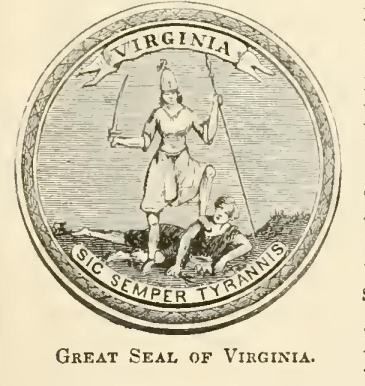

Elections were held throughout the state, and on the sixth of May following,1776 a general convention of delegates assembled at Williamsburg. *** The old House of Burgesses also met on the same day, but as they had not been summoned by a governor, they conceived that they could not act legally, and accordingly dissolved themselves. With that dissolution passed away forever the forms of royal rule in Virginia, and the convention exercised all the functions of government. By resolution, the delegates of Virginia in the Continental Congress, were instructed to propose a total separation from Great Britain.May 15, 1776 The convention also appointed a committee to prepare a Declaration of Rights, and a plan of government for the colony. The former was adopted on the twelfth of June, and the latter on the twenty-ninth. ****
On the fifth of July, it was decreed that the name of the king should henceforth be suppressed in all the public prayers, and the Church Liturgy was altered accordingly. It was also ordained that the great seal of the commonwealth should be changed, upon which Virtue should be represented as the tutelar genius of the province, robed in the drapery of an Amazon, resting one hand upon her lance, and holding a naked sword in the other; trampling upon tyranny, under the figure of a prostrate man, having near him a crown fallen from his head, and bearing in one hand a broken chain, and in the other
* The following-named gentlemen composed the committee of safety, Edmund Pendleton, George Mason, John Page, Richard Bland, Thomas Ludwell Lee, Paul Carrington, Dudley Digges, James Mercer, Carter Braxton, William Cabell, and John Tabb.
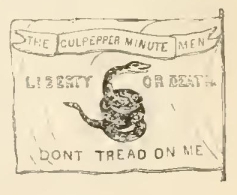
** The convention appointed Patrick Henry colonel of the first regiment, and "commander of all the forces raised and to be raised for the defense of the colony." He immediately summoned corps of volunteers from various parts of the colony. Three hundred minute-men instantly assembled at Culpepper Court House, and marched for Williamsburg. One third of them were Culpepper men, who adopted a flag with the significant device of a coiled rattle-snake, * seen in the engraving. They were dressed in green hunting shirts, with Henry's words, Liberty or Death, in large white letters, on their bosoms. They had bucks' tails in their hats, and in their belts tomahawks and scalping-knives. Their fierce appearance alarmed the people as they marched through the country. They did good service in the battle at the Great Bridge in December following. William Woodford was appointed to the command of the second regiment. Alexander Spottswood was appointed major, and the heroic Captain Bullit, who had distinguished himself at Fort Duquesne, was made adjutant general.
*** Edmund Pendleton was chosen president, and John Tazewell, clerk. Patrick Henry, who, to the great regret of the Virginians, had resigned his military commission, was elected a member of the convention for Hanover county, and took his seat on the first day of the meeting.
**** These documents were drawn by George Mason, the friend and associate of Washington. Mr. Jefferson then a member of the Continental Congress, also prepared a constitution and sent it to the Convention. It arrived a day or two after the adoption of Mason's form. The convention prefixed Jefferson's preamble to it, which, in a great degree, resembles the Declaration of Independence.—See Tucker's Life of Jefferson.
* This device was upon many flags in the army and navy of the Revolution. The expression "Don't tread on me," had a double signification It might be said in a supplicating tone, "Don't tread on me or menacingly, "Don't tread on me."
Declaration of Independence proclaimed at Williamsburg.—Officers under the new Government.—Freneau's Prophecy
a scourge. Over the device was placed the word Virginia; and beneath, Sic semper tyrannis. "Thus we serve tyrants." * The convention adjourned on the fifth of July, and the government under the new Constitution was established. **
The Declaration of Independence was proclaimed at Williamsburg on the twenty-fifth of July, amid great rejoicings, and from that time until 1779, when the government offices were removed to Richmond, the old Capitol of the commonwealth for eighty years, was the center of Revolutionary energy in Virginia.
Here let us close the chronicle and depart for Yorktown, the scene of the last great triumph of the patriot armies of the Revolution.
* The device on the reverse of the great seal is a group of three figures. In the center is Liberty, with her wand and cap; on the right side, Ceres, with a cornucopia in one hand, and an ear of wheat in the other; and on her left side, Eternity, holding in one hand the globe on which rests the Phoenix.
** The following-named gentlemen were appointed to fill the respective offices provided for by the Constitution: Patrick Henry, governor; John Page, Dudley Digges, John Taylor, John Blair, Benjamin Harrison of Berkeley, Bartholomew Dandridge, Charles Carter, and Benjamin Harrison of Brandon, counselors of state; Thomas Whiting, John Hutchings, Champion Travis, Thomas Newton, Jr., and George Webb, commissioners of admiralty; Thomas Everard, and James Cooke, commissioners for settling accounts; and Edmund Randolph, attorney general. The General Assembly of Virginia met at Williamsburg for the first time on the seventeenth of October, 1776. Then commenced her glorious career as a sovereign state of a "great and free confederacy. It was a joyful day for her patriot sons; and her sages, scanning the future with the eye of faith and hope, were prone to exclaim, in the words of Freneau, written a year before:
"I see, I see Freedom's established reign; cities and men, Numerous as sands upon the ocean shore, And empires rising where the sun descends! The Ohio soon shall glide by many a town Of note; and where the Mississippi's stream, By forests shaded, now runs sweeping on, Nations shall grow, and states not less in fame Than Greece and Rome of old! We, too, shall boast Our Scipio's, Solon's, Cato's, sages, chiefs That in the lapse of time yet dormant lie, Waiting the joyous hour of life and light. Oh snatch me hence, ye muses, to those days When, through the veil of dark antiquity, A race shall hear of us as things remote, That blossom'd in the morn of days!"
Ride to Yorktown.—William Nelson, Esq.—Location and Appearance of Yorktown.—Its early Settlement