Volume 2 — CHAPTER V.
Reading edition
"By wooded bluff we steal, by leaning lawn,
By palace, village, cot, a sweet surprise
At every turn the vision breaks upon;
Till to our wondering and uplifted eyes
The Highland rocks and hills in solemn grandeur rise.
"Nor clouds in heaven, nor billows in the deep,
More graceful shapes did ever heave or roll;
Nor came such pictures to a painter's sleep,
Nor beam'd such visions on a poet's soul!
The pent-up flood, impatient of control,
In ages past here broke its granite bound,
Then to the sea in broad meanders stole,
While ponderous ruin strew'd the broken ground,
And these gigantic hills forever closed around."
Theodore S. Fay.

VERY place made memorable by Revolutionary events has an interest in the mind and heart of the American, and claims the homage of regard from the lover of freedom, wheresoever he may have inspired his first breath. But there are a few localities so thickly clustered with associations of deep interest, that they appear like fuglemen in the march of events which attract the historian's notice. Prominent among these are the Highlands, upon the Hudson, from Haverstraw to Newburgh, the scenes of councils, battles, sieges, triumphs and treason, in all of which seemed to be involved for the moment, the fate of American liberty. Thitherward I journeyed at the commencement of our beautiful Indian summer, * the season
"When first the frost
Turns into beauty all October's charms;
When the dread fever quits us; when the storms
Of the wild equinox, with all its wet,
Has left the land as the first deluge left it,
With a bright bow of many colors hung
Upon the forest tops,"
Brainerd.
and rambled for a week among those ancient hills and the historic grounds adjacent. I arrived at Newburgh on the morning of the 25th of October. The town is pleasantly situated upon the steep western bank of the Hudson, sixty miles from New York, and in the midst of some of the finest scenery in the world, enhanced in interest to the student of history by the associations which hallow it. In the southern suburbs of the village, on the brow of the hill, stands the gray old fabric called "The Hasbrouck House," memorable
* The week or ten days of warm, balmy weather in autumn, immediately preceding the advent of winter storms, when, as Irving says of Sleepy Hollow, a "drowsy, dreamy influence seems to hang over the land and pervade the very atmosphere," appears to be peculiar to the United States, and has attracted the attention of travelers and philosophers. It is called Indian summer, because it occurs at a season when the natives gathered in their crops of maize or Indian corn. The atmosphere is smoky, and so mellows the sunlight that every object wears the livery of repose, like the landscapes of Southern Italy. The cause of the warmth and other peculiarities of this season is an unexplained question. It is the season when the fallen leaves of our vast forests begin to decay. As decadence is slow combustion, may not the heat evolved in the process produce the effects noticed?
The "Hasbrouck House" and Vicinity.—Its interior construction.—Purchased hy the State.—Ceremonies at its Dedication.
as the head-quarters of Washington at the close of the Revolution.
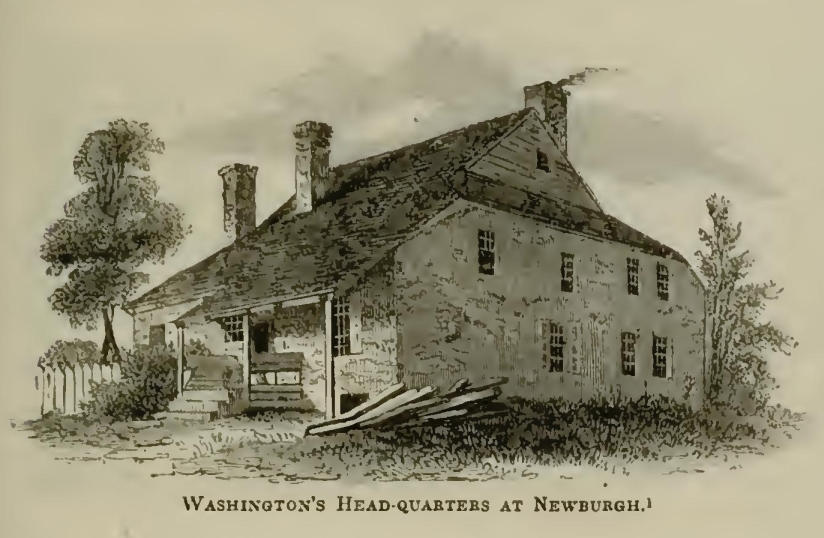
From the rickety piazza or stoop on the river front may be seen the historic grounds of Fish-kill, New Windsor, Plumb Point, Pollopel's Island, and the Beacon Hills; and through the mighty gateway in the Highlands, whose posts are Breakneck and Butter Hills, in altitude fifteen hundred feet, appear glimpses of distant West Point and the amphitheater of mountains which surround it. Let us take a peep within the venerable mansion; and as the morning sun is shining pleasantly upon the porch, we will there sit down, and glance over the pages of the old clasped volume, the vade mecum and Mentor of our journey.
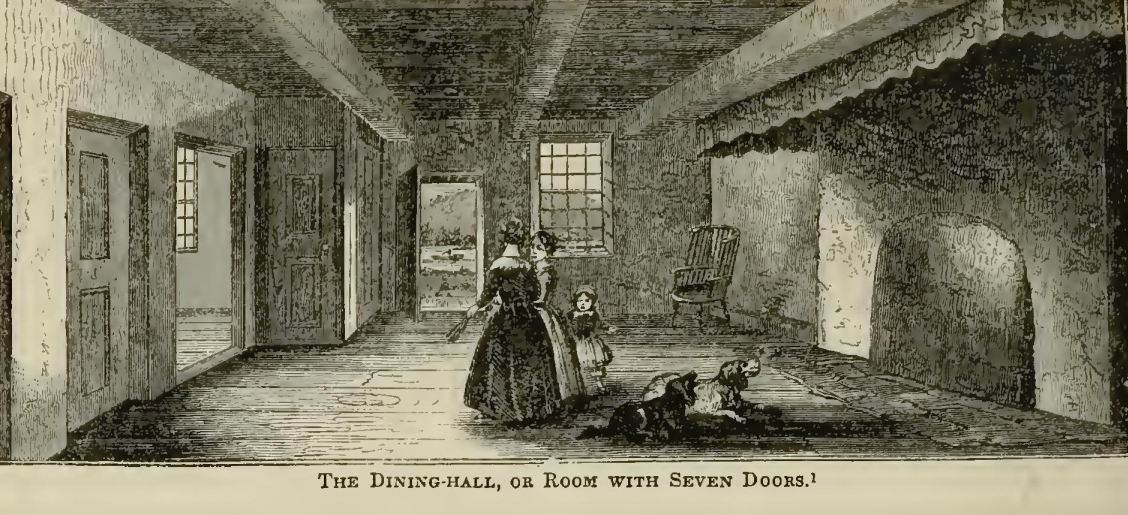
The front door opens into a large square room, which was used by Washington for his public audiences, and as a dining hall. It is remarkable for the fact that it has seven doors, and only one window. Of the two doors on the left in the picture, the nearest one to the spectator was the entrance to the chief's sitting-room; the other, to his bed-room. There is no plaster ceiling above; the heavy beams, nine inches wide and fourteen deep, completely exposed, give it a strong as well as antique appearance. Properly taken care of,
* This view is from the northeast, comprising the north gable and east or river front. The house is substantially built of stone, and is now (1850) just one hundred years old. This remark applies only to the portion containing the large room with seven doors, and the two bed-rooms on the north of it. This portion was built in 1750. Afterward a kitchen was built on the south end, and in 1770 an addition was made to it, on the west side, of the same length and height of the old part. The dates of the first and last additions are cut in the stones of the building. The fire-place in the large room is very spacious, "in which," says Mr. Eager, "a small bullock might have been turned upon a spit." * The house has been in the possession of the Hasbrouck family (one of the oldest of the Huguenot families in the county) from the time of its erection until recently, when it was purchased by the State of New York for the purpose of preserving it as a relic of the Revolution. It is placed in charge of the trustees of the village of Newburgh, who are required to expend a certain amount in repairs, ornamenting the grounds, &e. The family residing in the house is employed for the purpose of receiving and attending visitors. The house has been thoroughly repaired since the above sketch was made, under the direction of an advisory committee for its restoration and the embellishment of the grounds. Some of the modern alterations within have been changed, and the whole appearance of the edifice is now as much like that of the era of the Revolution as it is possible to make it. Interesting ceremonies were had upon the occasion of its dedication, on the 4th of July, 1850. There was a civic and military procession. The ceremonies on the green before the house were opened with prayer by Reverend Doctor Johnson, and an address by J. J. Monell, Esq., of Newburgh. While a choir was singing the following last stanza of a beautiful ode, written by Mrs. Monell,
"With a prayer your faith expressing, Raise our country's flag on high; Here, where rests a nation's blessing, Stars and stripes shall float for aye! Mutely telling Stirring tales of days gone hy,"
major-general Scott, who was present, hoisted the American flag upon a lofty staff" erected near. The Declaration of Independence was read by Honorable F. J. Betts, after which Honorable J. W. Edmonds pronounced an oration, marked by evidences of much historic research. Henceforth this venerated relic belongs to the people of New York; and doubtless its cabinet of Revolutionary remains, already begun, will be augmented by frequent donations, until a museum of rare interest shall be collected there.
* History of Orange County.
Washington's Dining-hall.—Anecdote concerning it.—Lady Washington's Gardening.—Settlement of Newburgh.
this relic of the Revolution may remain another century. The timbers are sound, the walls massive, and the roof and weather-boards were well preserved.
Lady Washington was a resident of the "Hasbrouck House" during the summer of 1783, and, in gratification of her taste for gardening, a large space in front of the house was cultivated by her. Mr. Eager, the historian of Orange county, informed me that within his remembrance the brick borders of her flower-beds remained. Washington, with his lady, left there about the middle of August, to attend upon Congress, then in session at Princeton, New Jersey, leaving the portion of the Continental army then in service under the command of General Knox. The commander-in-chief did not return to Newburgh, but made his head-quarters, for a few days in November, at West Point, from whence he re-November 25, 1783 paired to New York and took possession of that city on its evacuation by the British troops.
Orange county was among the first settled portions of the State of New York. It was organized in 1683; its name was given in honor of William, prince of Orange, afterward King of England. The first permanent settlers in the county were Germans, and their original location was in the present town of Newburgh, at a place called by the Indians Quassaic, on a creek of that name, a little below the village. They obtained a patent from Queen Anne, in 1719, for twenty-one hundred and ninety acres, extending north from the Quassaic Creek, and proceeded to lay out a village which they called New Burgh or New
* In the December number of the New York Mirror for 1834, is an interesting account of this old building, by Gulian C. Verplanck, Esq. He relates the following anecdote connected with this room, which he received from Colonel Nicholas Fish, father of the late governor of the State of New York. Just before La Fayette's death, himself and the American minister, with several of his countrymen, were invited to dine at the house of that distinguished Frenchman, Marbois, who was the French secretary of legation here during the Revolution. At the supper hour the company were shown into a room which contrasted quite oddly with the Parisian elegance of the other apartments where they had spent the evening. A low boarded, painted ceiling, with large beams, a single small, uncurtained window, with numerous small doors, as well as the general style of the whole, gave, at first, the idea of the kitchen, or largest room of a Dutch or Belgian farm-house. On a long rough table was a repast, just as little in keeping with the refined kitchens of Paris as the room was with its architecture. It consisted of a large dish of meat, uncouth-looking pastry, and wine in decanters and bottles, accompanied by glasses and silver mugs, such as indicated other habits and tastes than those of modern Paris. "Do you know where we now are?" said the host to La Fayette and his companions. They paused for a few minutes in surprise. They had seen something like this before, but when and where? "Ah! the seven doors and one window," said La Fayette, "and the silver camp-goblets, such as the marshals of France used in my youth! We are at Washington's head-quarters on the Hudson, fifty years ago!" The view here given is from the west door of the dining-hall, looking out of the east door upon the Hudson, the green fields of Fishkill, and the North Beacon of the Highlands, whereon the Americans lighted watch-fires when occasion demanded it. The fire-place on the right is within the area of the room, having a heavy hewn stone for a back-log. The visitor may stand there, and look up the broad-mouthed chimney to the sky above.
First Settlements in Orange County.—Indian Wars.—Sufferings of the People.—Attack on Minisink.
Town. Five hundred acres were reserved as glebe land, and under favorable auspices the village of Newburgh was founded. The Germans in time became dissatisfied, sold out their patent and dispersed, some going to Pennsylvania, and others to the Mohawk country. Some English, Irish, New Englanders, and a few Huguenots from Ulster filled their places, and flourishing settlements were soon planted along the river, or upon the rich bottoms of the water-courses. They also spread interiorly, and Goshen, Minisink, Wawarsing, and other thriving towns started up in the midst of the red men. The ante-revolutionary history of this section of the state is full of stirring incidents, for the wily Indian, properly suspicious of the pale faces, was ever on the alert to do them damage; and the privations, alarms, and sufferings of those who opened the fertile bosom of the country to the sun and rain, and spread broad acres of cultivation where the deer grazed in shady solitudes, compose a web of romance wonderful indeed. And when the Revolution broke out, and the savages of the Mohawk Valley and of Western New York were let loose upon the remote settlements, the people of Orange county were intense sufferers, particularly those upon its frontier settlements, in the direction of the wilderness. The Tories and their savage associates spread terror in every direction, and in Wawarsing and vicinity many patriots and their families were the victims of ambuscade or open attack. But I will not repeat a tale of horror such as we have already considered in viewing the history of the Mohawk Valley. The atrocities committed in Orange county were but a counterpart in character and horror of the former. * Strong houses were barricaded and used as forts; the people went armed by day, and slept armed at night; and almost hourly murder and rapine stalked boldly abroad. It was a time of darkest misery; and not until the Indian power of the West was "broken, and the Tories failed to receive their aid, was the district blessed with quiet.
The invasion of Minisink, * alluded to in a former chapter, was one of those prominent links in the chain of Indian and Tory depredations, that I may not pass it over with only brief mention. Here let us consider it. There were very few engaged in the battle that ensued, yet that few fought with wonderful valor, and suffered a terrible slaughter.
Count Pulaski and his legion of cavalry were stationed, during a part of the winter of 1778—9, at Minisink. In February, he was ordered to South Carolina, to join the army under Lincoln. The settlement was thus left wholly unprotected, which being perceived by Brant, the accomplished Mohawk warrior, he resolved to make a descent upon it. During the night of the 19th of July, at the head of sixty Indians, and twenty-seven Tories, disguised as savages, he stole upon the little town, and before the people were aroused 1779 from their slumbers he had fired several dwellings. With no means for defense, the inhabitants sought safety in flight to the mountains, leaving their pretty village and all their worldly goods a spoil to the invaders. Their small stockade fort, a mill, and twelve houses and barns were burned, several persons were killed, some taken prisoners, the orchards and plantations were laid waste, cattle were driven away, and booty of every kind was carried to Grassy Brook, on the Delaware, a few miles above the mouth of the Lackawaxen, where the chief had left the main body of his warriors. When intelligence of this invasion reached Goshen, Doctor Tusten, colonel of the local militia, issued orders to the officers of his regiment to meet him at Minisink the next day, with as many volunteers as they could muster. The call was promptly responded to, and one hundred and forty-nine hardy men were gathered around Tusten the following morning. Many of these were principal gentlemen of the vicinity. A council was held, and it was unanimously determined to pursue the invaders.
* For details of the trials of the settlers, and the atrocities committed by the Indians and Tories in this section, see a pamphlet published at Rondout, entitled "The Indians; or, Narratives of Massacres, &c., in Wawarsing and its Vicinity during the American Revolution."
** Minisink was one of the most ancient settlements in Orange county. It was in existence as a white settlement as early as 1669, when a severe battle was fought with the Indians on the 22d of July, ninety years, to a day, previous to the conflict in question. From that time until the Revolution it was often the scene of strife with the red men, and almost every dell, and rock, and ancient tree has its local tradition. The place of the ancient settlement is situated about ten miles northwest of Goshen, among the Shawangunk Mountains, between the Wallkill and the Navasink Valleys.
Intemperate zeal of the Volunteers.—Unwise Decision.—Battle of Minisink.—Its Location.—The Massacre
Colonel Tusten, who well knew the skill, prowess, caution, and craftiness of Brant, opposed the measure, as a hazardous undertaking with so small a force. He was overruled, and the debates of the council were cut short by Major Meeker, who mounted his horse, flourished his sword, and shouted, "Let the brave men follow me; the cowards may stay behind!" These words ignited the assembly, and the line of march was immediately formed. They traveled seventeen miles, and then encamped for the night. The next morning, Colonel Hathorn, of the Warwick militia, with a small re-enforcement, joined them. He was Tusten's senior officer, and took the command. They resumed their march at sunrise, and at Half-way Brook came upon the Indian encampment of the previous night; the smoldering watch-fires were still smoking. The number of these fires indicated a large savage force, and the two colonels, with the more prudent of the company, advocated, in council, a return, rather than further pursuit. But excited bravado overcame prudence, and a large majority determined to pursue the Indians; the minority yielded, and the march was resumed.
A scouting party, under Captain Tyler, was sent forward upon the Indian trail. The pursuers were discovered, and a bullet from an unseen foe slew the captain. There was momentary alarm; but the volunteers pressed eagerly onward, and at nine in the morning they hovered upon the high hills overlooking the Delaware near the mouth of the Lackawaxen.
The enemy were in full view below, marching in the direction of a fording-place. Hathorn determined to intercept them there, and disposed his men accordingly. The intervening hills hid the belligerents from each other. Brant had watched the movements of his pursuers, and comprehending Hathorn's design, he wheeled his column, and threading a deep and narrow ravine which the whites had crossed, brought his whole force in the rear of the Americans. Here he formed an ambuscade, and deliberately selected his battle ground.
The volunteers were surprised and disappointed at not finding the enemy where they expected to, and were marching back when they discovered some of the Indians. One of them, mounted on a horse stolen at Minisink, was shot by a militia-man. This was a signal for action, and the firing soon became general. It was a long and bloody conflict. The Indians were greatly superior in numbers, and a detachment of Hathorn's troops, consisting of one third of the whole, became separated from the rest at the commencement of the engagement. Closer and closer the savages pressed upon the whites, until they were hemmed within the circumference of an acre of ground, upon a rocky hill that sloped on all sides. The ammunition of the militia was stinted, and they were careful not to fire at random and without aim. Their shots were deadly, and many a red man was slain. The conflict began July 22, 1779 at eleven o'clock, and continued until the going down of the sun, on that long July day. At twilight the battle was yet undecided, but the ammunition of the whites being exhausted, a party of the enemy attacked and broke their hollow square at one corner. The survivors of the conflict attempted to retreat. Behind a ledge of rocks, Doctor Tusten had been dressing the wounds of the injured during the day. There were seventeen men under his care when the retreat commenced. The Indians fell upon them furiously, and all, with the Doctor, were slain. Several who attempted to escape by swimming across the Delaware were shot by the Indians; and of the whole number that went forth, only about thirty returned to relate the dreadful scenes of the day. * This massacre of the wounded is one of the darkest stains upon the memory of Brant, whose honor and humanity were often more conspicuous than that of his Tory allies. He made a weak defense of his conduct by asserting that he offered the Americans good treatment if they would surrender;
* The place of conflict is about two miles from the northern bank of the Delaware, and the same distance below the Lechauachsin or Lackawaxen River. It is about three miles from the Barryville station, on the New York and Erie rail-road. The battle ground and the adjacent region continue in the same wild state as of old, and over the rocky knolls and tangled ravines where the Indians and the Goshen militia fought, wild deer roam in abundance, and a panther occasionally leaps upon its prey. The place is too rocky for cultivation, and must ever remain a wilderness. At the Mohackamack Fork (now Port Jervis, on the Delaware) was a small settlement, and a block-house, called Jersey Fort.
Brant's Defense.—Effect of the Massacre.—Salvation of Major Wood.—Interment of the Remains of the Slain.—Monument
that he warned them of the fierceness of the thirst for blood that actuated his warriors, and that he could not answer for their conduct after the first shot should be fired; and that his humane proposition was answered by a bullet from an American musket, which pierced his belt. *
Goshen and the surrounding country was filled with the voice of mourning, for the flower of the youth and mature manhood of that region was slain. The massacre made thirty-three widows in the Presbyterian congregation at Goshen. At the recital, a shudder ran throughout the land, and gave keenness to the blade and fierceness to the torch which, a few weeks afterward, desolated the Indian paradise in the country of the Senecas and Cayngas.
Orange county labored much and suffered much in the cause of freedom. Newburgh and New Windsor, within it, having been the chosen quarters of Washington at different times, from December, 1780, until the conclusion of peace in 1783, and a portion of that time the chief cantonment of the American army, the county is a conspicuous point in the history of the war. At the close of 1780, the army was cantoned at three points: at Morristown, and at Pompton, in New Jersey, and at Phillipstown, in the Hudson Highlands. Washington established his head-quarters at
* During the battle, Major Wood, of Goshen, made a masonic sign, by accident, which Brant, who was a Free-mason, perceived and heeded. Wood's life was spared, and as a prisoner he was treated kindly, until the Mohawk chief perceived that he was not a Mason. Then, with withering scorn, Brant looked upon Wood, believing that he had obtained the masonic sign which he used, by deception. It was purely an accident on the part of Wood. When released, he hastened to become a member of the fraternity by whose instrumentality his life had been spared. The house in which Major Wood lived is yet standing (though much altered), at the foot of the hill north of the rail-way station at Goshen. The house of Roger Townsend, who was among the slain, is also standing, and well preserved. It is in the southern part of the village. The Farmers' Hall Academy, an old brick building, two stories high, and now used for a district school-house, is an object of some interest to the visitor at Goshen, from the circumstance that there Noah Webster, our great lexicographer, once taught school. An old gentleman of the village informed me that he had often seen him at twilight on a summer's evening in the grove on the hill northward of the rail-way station, gathering up the manuscripts which he had been preparing in a retired spot, after school hours.
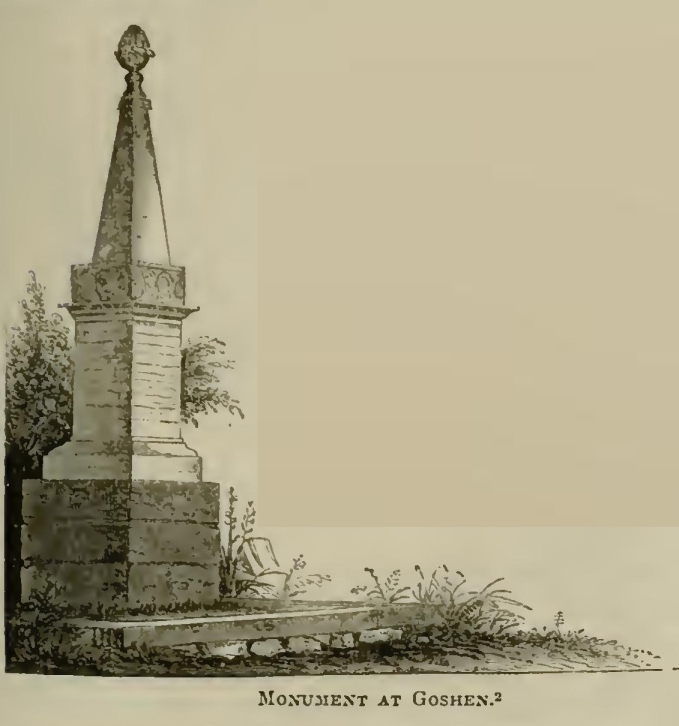
** In 1822, the citizens of Orange county collected the bones of those slain in the battle of Minisink, which had been left forty-three years upon the field of strife, and caused them to be buried near the center of the green at the foot of the main street of the village. On that occasion there was a great gathering of people, estimated at fifteen thousand in number. The cadets from West Point were there, under the command of the late General Worth, then a major. The corner-stone was laid by General Hathorn, one of the survivors of the battle, then eighty years of age. He accompanied the act with a short and feeling address. A funeral oration was pronounced by the Reverend James R. Wilson, now of Newburgh. Over these remains a marble monument was erected. It stands upon three courses of brown freestone, and a stone pavement a few feet square, designed to be surrounded by an iron railing. In consequence of neglecting to erect the railing, the monument has suffered much from the prevailing spirit of vandalism which I have already noticed. Its corners are broken, the inscriptions are mutilated, and the people of Goshen are made to feel many regrets for useless delay in giving that interesting memorial a protection. On the east side of the pedestal is the following inscription:
* "Erected by the inhabitants of Orange county, 22d July, 1822. Sacred to the memory of their fellow-citizens who fell at the battle of Minisink, 22d July, 1779." Upon the other three sides of the pedestal are the following names of the slain: "Benjamin Tusten, colonel; Bezaleel Tyler, Samuel Jones, John Little, John Duncan, Benjamin Vail, captains; John Wood, lieutenant; Nathaniel Finch, adju'ant; Ephraim Mastin, Ephraim Middaugh, ensigns; Gabriel Wisner, Esq., Stephen Mead, Mathias Terwilliger, Joshua Lockwood, Ephraim Fergerson, Roger Townsend, Samuel Knapp, James Knapp, Benjamin Bennet, William Barker, Jonathan Pierce, James Little, Joseph Norris, Gilbert Vail, Abraham Shepperd, Joel Decker, Nathan Wade, Simon Wait,———Tallmadge, Jacob Dunning, John Carpenter, David Barney, Jonathan Haskell, Abraham Williams, James Mosher. Isaac Ward, Baltus Nierpos, Gamaliel Bailey, Moses Thomas, Eleazer Owens, Adam Emitter, Samuel Little, Benjamin Dunning, Samuel Reed."
Cantonment of the Army near Newburgh.—Head-quarters of the Officers.—Nicola's Proposition to Washington.
1782.
New Windsor in December, 1780, where he remained until June, 1781, when the French, who had quartered during the winter at Newport and Lebanon, formed a junction with the Americans on the Hudson. In April, 1782, he established his head-quarters at Newburgh, two miles above the village of New Windsor, where he continued most of the time until November, 1783, when the Continental army was disbanded.
For a short time in the autumn of 1782, while the head-quarters of Washington were at Newburgh, the main portion of the army was encamped at Verplanck's Point, in pursuance of an engagement with Rochambeau to form a junction of the American and French forces at that place, on the return of the latter from Virginia. The allies marched eastward late in autumn, when the American army crossed the Hudson at West Point, traversed the mountains, and arrived in the township of New Windsor on the 28th of November, where it was hutted for the winter. The main portion of the army was encamped in the neighborhood of Snake Hill; of this we will write presently. Washington continued his head-quarters at the stone house at Newburgh; Generals Knox and Greene, who had the immediate command of the chief forces and of the artillery, were quartered at the house of John Ellison (now Captain Charles Morton's), in the vicinity of the main camp near Snake Hill; Gates and St. Clair, with the hospital stores, were at Edmonston's, at The Square; La Fayette was at William Ellison's, near by; and the Baron Steuben was at the house of Samuel Verplanck, on the Fishkill side of the river.
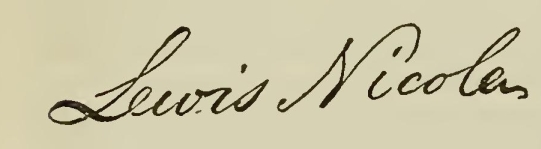
At Newburgh occurred one of the most painful events in the military life of Washington. For a long time the discontents among the officers and soldiers in the army respecting the arrearages of their pay and their future prospects, had been increasing, and in the spring of 1783 became alarmingly manifest. Complaints were frequently made to the commander-in-chief. Feeling the justice of these complaints, his sympathy was fully alive to the interests of his companions in arms. Colonel Nicola, an experienced officer, and a gentleman possessed of much weight of character, was usually the medium for communicating to him, verbally, their complaints, wishes, and fears. In May, Colonel Nicola addressed a letter to Washington, the tenor of which struck harshly upon the tenderest chord in that great man's feelings. After some general remarks on the deplorable condition of the army, and the little hope they could have of being properly rewarded by Congress, the colonel entered into a political disquisition on the different forms of government, and came to the conclusion that republics are, of all others, the least susceptible of stability, and the least capable of securing the rights, freedom, and power of individuals. He therefore inferred that America could never become prosperous under such a form of government, and that the English government was nearer perfection than any other. He then proceeded to express his opinion that such a government would be the choice of the people, after due consideration, and added, "In this case it will, I believe, be uncontroverted, that the same abilities which have led us through difficulties apparently insurmountable by human power to victory and glory—those qualities, that have merited and obtained the universal esteem and veneration of an army—would be most likely to conduct and direct us in the smoother paths of peace. Some people have so connected the idea of tyranny and monarchy as to find it very difficult to separate them. It may, therefore, be requisite to give the head of such a constitution as I propose some title apparently more moderate; but, if all other things were once adjusted, I believe strong arguments might be produced for admitting the title of king, which I conceive would be attended with some national advantage." How amazingly Colonel Nicola, and those officers and civilians (and they, doubtless, were not a few) whom he represented, misapprehended the true character of Washington, may be readily inferred from the prompt and severe rebuke which they received from his hand. The commander-in-chief replied as follows:
Washington's Letter of Rebuke to Nicola.—Patriotism of the Chief.—Discontents in the Army.—Memorial to Congress.
"Sir,—With a mixture of great surprise and astonishment, I have read with attention the sentiments you have submitted to my perusal. Be assured, sir, no occurrence in the course of this war has given me more painful sensations than your information of there being such ideas existing in the army as you have expressed, and which I must view with abhorrence and reprehend with severity. For the present, the communication of them will rest in my own bosom, unless some further agitation of the matter shall make a disclosure necessary.
I am much at a loss to conceive what part of my conduct could have given encouragement to an address which to me seems big with the greatest mischiefs that can befall my country. If I am not deceived in the knowledge of myself, you could not have found a person to whom your schemes are more disagreeable. At the same time, in justice to my own feelings, I must add, that no man possesses a more serious wish to see ample justice done to the army than I do; and, as far as my power and influence, in a constitutional way, extend, they shall be employed to the utmost of my abilities to effect it, should there be any occasion. Let me conjure you, then, if you have any regard for your country, concern for yourself or posterity, or respect for me, to banish these thoughts from your mind, and never communicate, as from yourself or any one else, a sentiment of the like nature. I am, &c." .
In this affair the disinterested patriotism of Washington shone with its brightest luster. At the head of a victorious army; beloved and venerated by it and by the people; with personal influence unbounded, and with power in possession for consummating almost any political scheme not apparently derogatory to good government, he receives from an officer whom he greatly esteems, and who speaks for himself and others, an offer of the scepter of supreme rule and the crown of royalty! What a bribe! Yet he does not hesitate for a moment; he does not stop to revolve in his mind any ideas of advantage in the proposed scheme, but at once rebukes the author sternly but kindly, and impresses his signet of strongest disapprobation upon the proposal. History can not present a parallel.
The apprehensions which this event produced in the mind of Washington, though allayed for a while, were painfully revived a few months later. The same circumstances of present hardship and gloomy prospects that disturbed the army when Nicola addressed Washington, not only continued to exist, but reasons for discontent daily increased. After the return of the army from Verplanck's Point, and their settlement in winter quarters in the neighborhood of Newburgh and New Windsor, the officers and soldiers had leisure to reflect upon their situation and prospects. Expecting a dissolution of the Revolutionary government when peace should be established, and a thorough reorganization of civil and military affairs, they apprehended great difficulties and losses in the adjustment of their claims, particularly those appertaining to the long arrearages of their pay. They were aware of the poverty of the treasury and the inefficiency of the existing government in commanding resources for its replenishment; a condition arising from the disposition of individual states to deny the right of Congress to ask for pecuniary aid from their respective treasuries in satisfying public creditors. This actual state of things, and no apparent security for a future adjustment of their claims, caused great excitement and uneasiness among the officers and soldiers, and in December they addressed a memorial to Congress on the subject of 1782 their grievances. ** A committee, composed of General M'Dougal, Colonel Ogden, and Colonel Brooks, were appointed to carry the memorial to Philadelphia, lay it before Congress, and explain its import. Congress appointed a committee, consisting of a delegate from each state, to consider the memorial. The committee reported, and, on the 25th of January, Congress passed a series of resolutions, which were not very satisfactory. In
* Sparks's Life and Writings of Washington, viii., 300, 302. Washington's letter to Colonel Nicola is dated at Newburgh, 22d May, 1782.
** This memorial comprehended five different articles: 1. Present pay; 2. A settlement of the accounts of the arrearages of pay, and security for what was due; 3. A commutation of the half-pay authorized by different resolutions of Congress, for an equivalent in gross; 4. A settlement of the accounts of deficiencies of rations and compensation; 5. A settlement of the accounts of deficiencies of clothing and compensation
Resolutions of Congress respecting Claims.—The Army still dissatisfied.—Action of the Officers.—Major Armstrong.
regard to present pay, the superintendent of finance was directed to make "such payment and in such measure as he shall think proper," as soon as the state of public finances would permit. In relation to arrearages and the settlement of accounts, it was resolved "that the several states be called upon to complete, without delay, the settlements with their respective lines of the army, up to the 1st day of August, 1783, and that the superintendent of finance be directed to take such measures as shall appear to him most proper for effecting the settlement from that period."
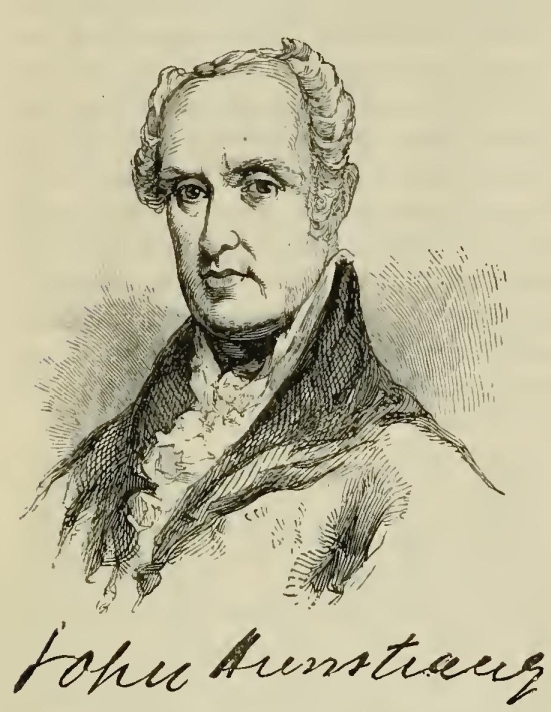
Concerning security for what should be found due on such settlement, Congress declared, by resolution, that they would "make every effort in their power to obtain from the respective states substantial funds, adequate to the object of funding the whole debt of the United States, and will enter upon an immediate and full consideration of the nature of such funds, and the most likely mode of obtaining them." * In these resolutions, Congress, feeble in actual power and resources, made no definite promises of present relief or future justice; and when General Knox, who had been appointed by the army to correspond with their committee, reported the facts, the discontent February 8, 1783 tent and dissatisfaction was quite as great as before the action of Congress. Some thought it necessary to further make known their sentiments and enforce their claims, and to this end it was deemed advisable to act with energy. A plan was arranged among a few "for assembling the officers, not in mass, but by representation; and for passing a series of resolutions, which, in the hands of their committee, and of their auxiliaries in Congress, would furnish a new and powerful lever" of operation. Major John Armstrong, ** General Gates's aid-de-camp, a young officer of six-and-
* Journals of Congress, viii., 82. The remainder of the report was referred to a committee consisting of Messrs. Mann, Osgood, Fitzsimmons, Gervais, Hamilton, and Wilson.
** John Armstrong was born at Carlisle, in Pennsylvania, on the 25th of November, 1758. He was the youngest of two sons of General John Armstrong, of Carlisle, distinguished by his services in the French and Indian war in 1756. In 1775, at the most critical period of the American Revolution, young Armstrong, then a student of Princeton College, joined the army as a volunteer in Potter's Pennsylvania regiment. He was soon after appointed aid-de-camp by General Hugh Mercer, and remained with him till the connection was severed on the bloody field of Princeton by the death of his chief. He subsequently occupied the same position in the family of Major-general Gates, and served through the campaign which ended in the capture of Burgoyne. In 1780 he was made adjutant general of the Southern army, but falling sick of fever on the Pedee, was succeeded by Colonel Otho Williams, a short time previous to the defeat at Camden. Resuming his place as aid, he remained with General Gates till the close of the war. He was the author of the celebrated Newburgh Addresses, the object of which has been greatly misrepresented, and very generally misunderstood. They were intended to awaken in Congress and the States a sense of justice toward its creditors, particularly toward the army, then about to be disbanded without requital for its services, toils, and sufferings. General Washington, in 1797, bore testimony to the patriotic motives of the author. Armstrong's first civil appointments were those of Secretary of the State of Pennsylvania, and adjutant general, under Dickenson's and Franklin's administrations; posts which he continued to occupy till 1787, when he was chosen a member of the old Congress. In the autumn of the same year, he was appointed by Congress one of the three judges for the Western Territory; this appointment he declined, and having married, in 1789, a sister of Chancellor Livingston, of New York, removed to that state. Here he purchased a farm, and devoted himself to agricultural pursuits; and, though offered by President Washington, in 1793, the place of United States supervisor of the collection of internal revenue in the State of New York, he declined this and other invitations to public office, until, in the year 1800, he was elected United States senator by an almost unanimous vote of both houses of the Legislature. Having resigned in 1802, he was again elected in 1803, and, the year following, appointed by Mr. Jefferson minister plenipotentiary to France; which post, at a very critical period of our relations with that country, he filled with distinguished ability for more than six years, discharging incidentally the functions of a separate mission to Spain with which he was invested. In 1812 he was appointed a brigadier general in the United States army, and commanded in the city of New York until called by Mr. Madison, in 1813, to the War Department. This office he accepted with reluctance, and with little anticipation of success to our arms. In effecting salutary changes in the army, by substituting young and able officers for the old ones who had held subordinate stations in the army of the Revolution, he made many enemies. The capture of the city of Washington in 1814 led to his retirement from office. Public opinion held him responsible for this misfortune, but, as documentary history has shown, without justice. No man took office with purer motives, or retired from it with a better claim to have faithfully discharged its duties. General Armstrong died at his residence at Red Hook, N. Y., on the 1st of April, 1843, in the eighty-fifth year of his age. He was among the remarkable men of a remarkable generation. The productions of his pen entitle him to rank with the ablest writers of his time and country. These consist of a voluminous correspondence, diplomatic and military; a valuable treatise on agriculture, the result of some experience and much reading; and "Notices of the War of 1812," a work written with great vigor of style. The portrait of General Armstrong, printed on the preceding page, is from a painting in possession of his daughter, Mrs. William B. Astor, drawn from life by John Wesley Jarvis.
Meeting of Officers privately called.—Anonymous Address to the Army.—Dangerous Tendency of its Recommendations.
twenty, and possessing much ability, was chosen to write an address to the army suited to the subject; and this, with an anonymous notification of a meeting of the officers, was circulated privately. * The address exhibits superior talents, and was calculated to make a deep impression upon the minds of the malcontents. Referring to his personal feelings, and his sacrifices for his country, the writer plays upon the sensibilities of his readers, and prepares their minds for a relinquishment of their faith in the justice of their country, already weakened by circumstances. "Faith," he says, "has its limits as well as temper, and there are points beyond which neither can be stretched without sinking into cowardice or plunging into credulity. This, my friends, I conceive to be your situation; hurried to the verge of both, another step would ruin you forever. To be tame and unprovoked, when injuries press hard upon you, is more than weakness; but to look up for kinder usage, without one manly effort of your own, would fix your character, and show the world how richly you deserved the chains you broke." He then takes a review of the past and present—their wrongs and their complaints—their petitions and the denials of redress—and then says, "If this, then, be your treatment while the swords you wear are necessary for the defense of America, what have you to expect from peace, when your voice shall sink, and your strength dissipate by division; when those very swords, the instruments and companions of your glory, shall be taken from your sides, and no remaining mark of military distinction left but your wants, infirmities, and scars? Can you, then, consent to be the only sufferers by the Revolution, and, retiring from the field, grow old in poverty, wretchedness, and contempt? Can you consent to wade through the vile mire of dependency, and owe the miserable remnant of that life to charity, which has hitherto been spent in honor? If you can, go, and carry with you the jest of Tories and the scorn of Whigs; the ridicule, and, what is worse, the pity of the world! Go, starve, and be forgotten."
The writer now changes from appeal to advice. "I would advise you, therefore," he says, "to come to some final opinion upon what you can bear and what you will suffer. If your determination be in proportion to your wrongs, carry your appeal from the justice to the fears of government. Change the milk-and-water style of your last memorial; assume
* This notice was circulated on the 10th of March, 1783. It was in manuscript, as well as the anonymous address that followed. The originals were carried by a major, who was a deputy inspector under Baron Steuben, to the office of Barber, the adjutant general, where, every morning, aids-de-camp, majors of brigades, and adjutants of regiments were assembled, all of whom, who chose to do so, took copies and circulated them. Among the transcribers was the adjutant of the commander-in-chief's guard, who probably furnished him with the copies that were transmitted to Congress. The following is a copy of the anonymous notification:
"A meeting of the field officers is requested at the Public Building on Tuesday next at eleven o'clock. A commissioned officer from each company is expected, and a delegate from the medical staff. The object of this convention is to consider the late letter of our representatives in Philadelphia, and what measures (if any) should be adopted to obtain that redress of grievances which they seem to have solicited in vain."
Bold Tone of the Address.—Similar Opinions held by Hamilton.—Washington's Counteraction.—Second anonymous Address
a bolder tone, decent, but lively, spirited, and determined; and suspect the man who would advise to more moderation and longer forbearance. * Let two or three men who can feel as well as write, be appointed to draw up your last remonstrance—for I would no longer give it the suing, soft, unsuccessful epithet of memorial." He advises them to talk boldly to Congress, and to warn that body that the slightest mark of indignity from them now would operate like the grave, to part them and the army forever; "that in any political event, the army has its alternative. If peace, that nothing shall separate you from your arms but death; if war, that, courting the auspices and inviting the direction of your illustrious leader you will retire to some unsettled country, smile in your turn, 'and mock when their fear cometh on.' Let it represent, also, that should they comply with the request of your late memorial, it would make you more happy, and them more respectable."
A copy of these papers was put into the hands of the commander-in-chief on the day of their circulation, and he wisely determined to guide and control the proceedings thus begun, rather than to check and discourage them by any act of severity. In general orders the March 11, 1783 next morning, he referred to the anonymous papers and the meeting. He expressed his disapprobation of the whole proceeding as disorderly; at the same time, he requested that the general and field officers, with one officer from each company, and a proper representation of the staff of the army, should assemble at twelve o'clock on Saturday the 15th, at the New Building (at which the other meeting was called), for the purpose of hearing the report of the committee of the army to Congress. He requested the senior officer in rank (General Gates) to preside at the meeting. On the appearance of this order, the writer of the anonymous address put forth another, rather more subdued in its tone, in which he sought to convince the officers that Washington approved of the scheme, the time of meeting only being changed. The design of this interpretation the commander-in-chief took care to frustrate, by conversing personally and individually with those officers in whose good sense and integrity he had confidence. He impressed their minds with a sense of the danger that must attend any rash act at such a crisis, inculcated moderation, and exerted all
* This sentence, particularly alluded to by Washington in his address to the officers, was the one which drew down upon the head of the writer the fiercest anathemas of public opinion, and he alone has been held responsible for the suggestion that the army should use its power to intimidate Congress. Such a conclusion is unwarrantable. It is not likely that a young man of twenty-six, acting in the capacity of aid, should, without the promptings of men of greater experience who surrounded him, propose so bold a measure. It is well known, too, that many officers, whose patriotism was never suspected, were privy to the preparation of the address, and suggested many of its sentiments; and there ean be no reasonable doubt that General Gates was a prominent actor. Nor was the idea confined to that particular time and place. General Hamilton, one of the purest patriots of the Revolution, wrote to Washington from Philadelphia, a month before (February 7, 1783), on the subject of the grievances of the army, in which he held similar language. After referring to the deplorable condition of the finances, the prevailing opinion in the army "that the disposition to recompense their services will cease with the necessity for them," and lamenting "that appearances afford too much ground for their distrust," he held the following language: "It becomes a serious inquiry, What is the true line of policy? The claims of the army, urged with moderation but with firmness, may operate on those weak minds which are influenced by their apprehensions more than by their judgments, so as to produce a concurrence in the measures which the exigencies of affairs demand. They may add weight to the applications of Congress to the several states. So far, a useful turn may be given to them."* What was this but "carrying their appeal from the justice to the fears of government?" Hamilton further remarked, that the difficulty would be "to keep a complaining and suffering army within the bounds of moderation;" and advised Washington not to discountenance their endeavors to procure redress, but, "by the intervention of confidential and prudent persons, to take the direction of them." Hamilton was at that time a member of Congress. In a letter to him, written on the 12th of March, Washington remarked that all was tranquillity in the camp until after the arrival from Philadelphia of "a certain gentleman" (General Walter Stewart), and intimated that the discontents in the army were made active by members of Congress, who wished to see the delinquent states thus forced to do justice. Hamilton, in reply, admitted that he had urged the propriety "of uniting the influence of the public creditors" (of whom the soldiers were the most meritorious) "and the army, to prevail upon the states to enter into their views." ** But, while Hamilton held these views, he deprecated the idea of the army turning its power against the civil government. "There would be no chance of success," he said, "without having recourse to means that would reverse our Revolution." ***
* See the Life of Hamilton, by his son, John C. Hamilton, ii., 47.
** Ibid., it.. 71.
*** Ibid., ii., 158.
Meeting called by Washington.—Major Burnet's Recollections.—Washington's Address to the Officers.
his powers of argument to appease their discontents. They were thus prepared to deliberate in the proposed convention without passion, and under a deep sense of the responsibilities which rested upon them as patriots and leaders.
The meeting was held pursuant to "Washington's orders. There was a full attendance of officers, and deep solemnity pervaded the assembly when the commander-in-chief stepped forward upon the platform to read an address which he had prepared for the occasion. * This address, so compact in construction of language; so dignified and patriotic; so mild, yet so severe, and, withal, so vitally important in its relation to the well-being of the unfolding republic and the best interests of human freedom, I here give entire, in a foot-note, for a mere synopsis can not do it justice. **
* Major Robert Burnet, of Little Britain, Orange county, who was one of the officers present, informed me that the most profound silence pervaded the assembly when Washington arose to read his address. As he put on his spectacles, * he said, "You see, gentlemen, that I have not only grown gray but blind in your service." This simple remark, under such circumstances, had a powerful effect upon the assemblage. Humphreys, in his Life of Putnam, mentions this circumstance; so, also, does Mr. Hamilton, in the Life of his father.
** "Gentlemen,—By an anonymous summons, an attempt has been made to convene you together; how inconsistent with the rules of propriety, how unmilitary, and how subversive of all order and discipline, let the good sense of the army decide. In the moment of this summons, another anonymous production was sent into circulation, addressed more to the feelings and passions than to the reason and judgment of the army. The author of the piece is entitled to much credit for the goodness of his pen, and I could wish he had as much credit for the rectitude of his heart; for, as men see through different optics, and are induced by the reflecting faculties of the mind to use different means to attain the same end, the author of the address should have had more charity than to mark for suspicion the man who should recommend moderation and longer forbearance; or, in other words, who should not think as he thinks, and act as he advises. "But he had another plan in view, in which candor and liberality of sentiment, regard to justice, and love of country have no part; and he was right to insinuate the darkest suspicion to effect the blackest design. That the address is drawn with great art, and is designed to answer the most insidious purposes, that it is calculated to impress the mind with an idea of premeditated injustice in the sovereign power of the United States, and rouse all those resentments which must unavoidably flow from such a belief; that the secret mover of this scheme, whoever he may be, intended to take advantage of the passions while they were warmed by the recollection of past distresses, without giving time for cool, deliberate thinking, and that composure of mind which is so necessary to give dignity and stability to measures, is rendered too obvious, by the mode of conducting the business, to need other proofs than a reference to the proceedings. "Thus much, gentlemen, I have thought it incumbent on me to observe to you, to show upon what principles I opposed the irregular and hasty meeting which was proposed to have been held on Tuesday last, and not because I wanted a disposition to give you every opportunity, consistent with your own honor and the dignity of the army, to make known your grievances. If my conduct heretofore has not evinced to you that I have been a faithful friend to the army, my declaration of it at this time would be equally unavailing and improper. But, as I was among the first who embarked in the cause of our common country; as I have never left your side one moment, but when called from you on public duty; as I have been the constant companion and witness of your distresses, and not among the last to feel and acknowledge your merits; as I have ever considered my own military reputation as inseparably connected with that of the army; as my heart has ever expanded with joy when I have heard its praises, and my indignation has arisen when the mouth of detraction has been opened against it, it can scarcely be supposed, at this last stage of the war, that I am indifferent to its interests. But how are they to be promoted? The way is plain, says the anonymous addresser. "If war continues, remove into the unsettled country; there establish yourselves, and leave an ungrateful country to defend itself." But who are they to defend? Our wives, our children, our farms, and other property which we leave behind us? or, in this state of hostile separation, are we to take the two first (the latter can not be removed), to perish in a wilderness, with hunger, cold, and nakedness? "If peace takes place, never sheathe your swords," says he, "until you have obtained full and ample justice. This dreadful alternative of either deserting our country in the extremest hour of her distress, or turning our arms against it—which is the apparent object—unless Congress can be compelled into instant compliance, has something so shocking in it, that humanity revolts at the idea. My God! what can this writer have in view by recommending such measures? Can he be a friend to the army? Can he be a friend to this country? Rather, is he not an insidious foe? some emissary, perhaps, from New York, plotting the ruin of both, by sowing the seeds of discord and separation between the civil and military powers of the Continent? And what a compliment does he pay to our understandings, when he recommends measures, in either alternative, impracticable in their nature? "But, here, gentlemen, I will drop the curtain, because it would be as imprudent in me to assign my reasons for this opinion, as it would be insulting to your conception to suppose you stood in need of them. A moment's reflection will convince every dispassionate mind of the physical impossibility of carrying either proposal into execution. There might, gentlemen, be an impropriety in my taking notice, in this address to you, of an anonymous production; but the manner in which that performance has been introduced to the army, the effect it was intended to have, together with some other circumstances, will amply justify my observations on the tendency of that writing. "With respect to the advice given by the author, to suspect the man who shall recommend moderate measures and longer forbearance, I spurn it, as every man, who regards that liberty and reveres that justice for which we contend, undoubtedly must; for, if men are to be precluded from offering their sentiments on a matter which may involve the most serious and alarming consequences that can invite the consideration of mankind, reason is of no use to us. The freedom of speech may be taken away, and dumb and silent we may be led, like sheep, to the slaughter. I can not, injustice to my own belief, and what I have great reason to conceive is the intention of Congress, conclude this address, without giving it as my decided opinion that that honorable body entertains exalted sentiments of the services of the army, and, from a full conviction of its merits and sufferings, will do it complete justice; that their endeavors to discover and establish funds for this purpose have been unwearied, and will not cease till they have succeeded, I have not a doubt. But, like all other large bodies, where there is a variety of different interests to reconcile, their determinations are slow. Why, then, should we distrust them, and, in consequence of that distrust, adopt measures which may cast a shade over that glory which has been so justly acquired, and tarnish the reputation of an army which is celebrated through all Europe for its fortitude and patriotism? And for what is this done? To bring the object we seek nearer? No; most certainly, in my opinion, it will cast it at a greater distance. For myself (and I take no merit in giving the assurance, being induced to it from principles of gratitude, veracity, and justice, a grateful sense of the confidence you have ever placed in me), a recollection of the cheerful assistance and prompt obedience I have experienced from you under every vicissitude of fortune, and the sincere affection I feel for an army I have so long had the honor to command, will oblige me to declare, in this public and solemn manner, that in the attainment of complete justice for all your toils and dangers, and in the gratification of every wish, so far as may be done consistently with the great duty I owe my country, and those powers we are bound to respect, you may freely command my services to the utmost extent of my abilities. "While I give you these assurances, and pledge myself in the most unequivocal manner to exert whatever ability I am possessed of in your favor, let me entreat you, gentlemen, on your part, not to take any measures, which, viewed in the calm light of reason, will lessen the dignity and sully the glory you have hitherto maintained. Let me request you to rely on the plighted faith of your country, and place a full confidence in the purity of the intentions of Congress, that, previous to your dissolution as an army, they will cause all your accounts to be fairly liquidated, as directed in the resolutions which were published to you two days ago, and that they will adopt the most effectual measures in their power to render ample justice to you for your faithful and meritorious services. And let me conjure you, in the name of our common country, as you value your own sacred honor, as you respect the rights of humanity, and as you regard the military and national character of America, to express your utmost horror and detestation of the man who wishes, under any specious pretenses, to overturn the liberties of our country, and who wickedly attempts to open the flood-gates of civil discord, and deluge our rising empire in blood. "By thus determining and thus acting, you will pursue the plain and direct road to the attainment of your wishes; you will defeat the insidious designs of our enemies, who are compelled to resort from open force to secret artifice; you will give one more distinguished proof of unexampled patriotism and patient virtue rising superior to the pressure of the most complicated sufferings; and you will, by the dignity of your conduct, afford occasion for posterity to say, when speaking of the glorious example you have exhibited to mankind, 'Had this day been wanting, the world had never seen the last stage of perfection to which human nature is capable of attaining.'—Journals of Congress, viii., 180-183.
* It is said that the identical spectacles used by Washington during the Revolution are now (1850) in the possession of an aged lady, named Marsh, who resides in Detroit, Michigan. They came to her from a deceased relative, who exchanged spectacles with the general. "They are of a heavy silver frame," says the Detroit Advertiser, "with very large, round glasses, and apparently constructed after the style we have been accustomed to see, in the books, upon the nose of Red Riding Hood's grandmother.'
Washington's Address.—Action of the Meeting of Officers.—A strong Resolution
After reading the address, Washington retired without uttering a word, leaving the officers to deliberate without restraint. Their conference was brief; their deliberations short. They passed resolutions, by unanimous vote, thanking their chief for the course he had pursued; expressing their unabated attachment to his person and their country; declaring their unshaken confidence in the good faith of Congress, and their determination to bear with patience their grievances, until in due time they should be redressed.
One of the resolutions is expressed in the following strong language:
"Resolved unanimously, That the officers of the American army view with abhorrence and reject with disdain the infamous propositions contained in a late anonymous address to the officers of the army, and resent with indignation the secret attempts of some unknown persons to collect the officers together in a manner totally subversive of all discipline and good order." At that time the author of the anonymous addresses was unknown except to a few; and for forty years there was no certainty in the publie mind that Major Armstrong was the writer. That he was generally suspected of being the author, among those who were acquainted with his abilities, is evident from a letter to him written by Colonel Timothy Pickering, in after years, in which he says, that so certain was he, at the time, of the identity of the author, that he endorsed the copy of the address which he received, "Written by Major John Armstrong, Jr." An article appeared in the January number of the United States Magazine for 1823, in which the author, understood to be General Armstrong, avowed himself the writer of the Newburgh Addresses. The article in question contains a history of the event we have been just considering, and defends the course of the writer on that occasion with the plea that apparent urgent necessity justified the act. Subsequent events proved the writer to be mistaken in his views, and his proposition to be highly dangerous to the common good. General Armstrong has, consequently, been greatly censured, and his patriotism has been questioned by writers and speakers who have judged him by results instead of by the circumstances in which he was placed. I can see no reason to doubt the purity of his motives and the sincerity of his patriotism. Other men, as we have noticed in a preceding note, who were far above suspicion, held similar views. Unfortunately for his reputation, in this particular, he was the aid-de-camp and confident of Gates, whose ambition had made him a plotter against Washington. In faet, the commander-in-chief plainly alluded to Gates, when, writing to Hamilton concerning the scheme, he said that some believed it to be "the illegitimate offspring of a person in the army."
It appears that the first president was made acquainted with the authorship of these addresses toward the close of his seeond administration, some fourteen years after they were penned. His estimate of the motives of the writer may be understood by the following letter, addressed to Armstrong:
"Philadelphia, February 23d, 1797.
"Sir,—Believing that there may be times and occasions on whieh my opinion of the anonymous letters and the author, as delivered to the army in the year 1783, may be turned to some personal and malignant purpose, I do hereby declare, that I did not, at the time of writing my address, regard you as the author of said letters; and further, that I have since had sufficient reason for believing that the object of the author was just, honorable, and friendly to the eountry, though the means suggested by him were certainly liable to much misunderstanding and abuse.
"I am, sir, with great regard, your most obedient servant, George Washington."
Record of Proceedings sent to Congress.—Washington's Opinion of Armstrong's Motives.—His farewell Address
signed by General Gates, as president of the meeting; and on the 18th, WashingtonMarch, 1783ton, in general orders, expressed his entire satisfaction. All the papers relating to the affair were transmitted to Congress, and entered at length upon their Journals. *
It was in this old building at Newburgh, on the porch of which we are sitting, that Washington wrote his address to the officers, on the occasion just considered; and here, also, he penned his admirable circular letter addressed to the governors of all the states, on disbanding the army. This was his last official communication with these functionaries. June 8. 1783 "This letter," says Sparks, "is remarkable for its ability, the deep interest it manifests for the officers and soldiers who had fought the battles of their country, the soundness of its principles, and the wisdom of its counsels. Four great points he aims to enforce, as essential in guiding the deliberations of every public body, and as claiming the serious attention of every citizen, namely, an indissoluble union of the states; a sacred regard to public justice; the adoption of a proper military peace establishment; ** and a pacific and friendly disposition among the people of the states which should induce them to forget local prejudices, and incline them to mutual concessions for the advantage of the community. These he calls the pillars by which alone independence and national character can be supported. On each of these topics he remarks at considerable length, with a felicity of style and cogency of reasoning in all respects worthy of the subject. No public address could have been better adapted to the state of the times; and coming from such a source, its influence on the minds of the people must have been effectual and most salutary." *** The Legislatures that were then in session passed resolves highly commendatory of the public acts of the commander-in-ehief; and he received letters from several of the governors, expressing their thanks and gratitude for his long and successful services in the cause of his country.
Many of the troops now went home on furlough, and Washington, having leisure, pro-
* Journals of Congress, vol. viii.
** Washington proposed the establishment of a military academy at West Point as early as April, 1783 His proposition will be hereafter noticed.
*** Sparks's Life and Writings of Washington, i., 395.
Washington's Tour to the Northern Battle Fields.—Called to Princeton.—A Statue ordered by Congress.—General Clinton
ceeded up the Hudson with Governor Clinton to visit the principal fields of military operations at the north. He passed over the battle ground at Stillwater, with Generals Schuyler and Gansevoort, and extended his journey as far northward as Ticonderoga and Crown Point, and westward to Fort Schuyler (now Rome), on the Mohawk. He returned to Newburgh after an absence of nineteen days, where he found a letter from the President of Congress requesting his attendance upon that body, then in session at Princeton, in New Jersey. While he was awaiting the convalescence of Mrs. Washington, and preparing to go, Congress conferred upon the chief the distinguished honor of voting, unanimously, that an equestrian statue of him should be executed by the best artist in Europe, under the direction of the minister of the United States at the court of Versailles, and erected at the place where the residence of Congress should be established. * Like other similar memorials authorized by Congress to be made in honor of their servants, this statue has never been constructed.
Upon the lawn before us, now covered with the matted and dull-green grass of autumn, Washington parted with many of his subalterns and soldiers forever, on the day he left the August 18, 1783 army to attend upon Congress at Princeton. It was an affecting prelude to the final parting with his official companions in arms at Fraunce's tavern, in New York, a few months subsequently, and furnishes a noble subject for the pencil of art. The scenery is beautiful and grand, and here I would fain loiter all the day, musing upon the events which hallow the spot; but the sun has climbed high toward meridian, and I must hasten away to adjacent localities, all of which are full of interest.
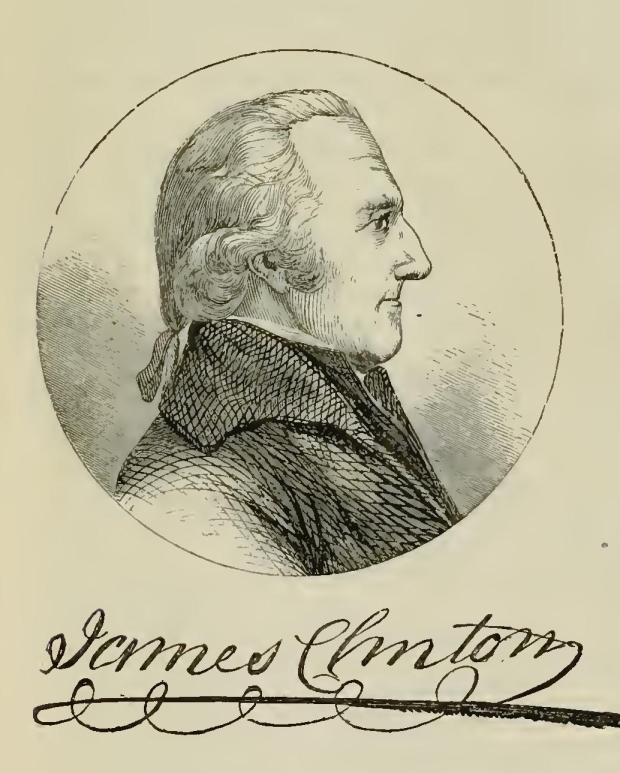
I left Newburgh toward noon, and rode down to New Windsor, two miles below, along a fine sandy road upon the beach. The little village, once the rival of Newburgh, is nestled in a pleasant nook near the confluence of Chambers's Creek with the Hudson, on the western rim of the bay. Its sheltered position and fertile acres wooed the exploring emigrants from Ireland, who were seeking a place whereon to pitch their tents on the banks of the Hudson, and here some of them sat down. Among them was Charles Clinton; and at a place called Little Britain, a few miles interior, were born his four sons; two of whom, James and George, were distinguished men of the Revolution. The former was a major general in the army, and the latter a brigadier, and Governor of New York during the contest.
New Windsor claims the distinction of being the birth-place of Governor Dewitt Clinton, a son of General James Clinton;
* The following is a description of the proposed statue, as given in the resolution of Congress adopted on the 7th of August, 1783: "Resolved, That the statue be of bronze: the general to be represented in a Roman dress, holding a truncheon in his right hand, and his head encircled with a laurel wreath. The statue to be supported by a marble pedestal, on which are to be represented, in basso relievo, the following principal events of the war, in which General Washington commanded in person, viz., the evacuation of Boston; the capture of the Hessians at Trenton; the battle of Princeton; the action of Monmouth; and the surrender of York. On the upper part of the front of the pedestal to be engraved as follows: The United States in Congress assembled, ordered this statue to be erected in the year of our Lord 1783, in honor of George Washington, the illustrious commander-in-chief of the armies of the United States of America, during the war which vindicated and secured their liberty, sovereignty, and independence."
** A biographical sketch of General Clinton may be found on page 272, ante, and also a brief notice of his father on page 255
A very little Maiden.—Her Dignity.—Plum Point—Fortifications there.—An Acrostic.
but evidence is adduced to prove that a violent snow storm, which detained his mother at "the Fort," in Deerpark, the residence of her brother, deprived the village of the intended honor. * Although denied the distinction of the paternity of a great man, it can boast the residence, for a time, of one of the smallest of women, beautiful, witty, and good. The name of this "pretty, charming little creature" was Anna Brewster; her height, in womanhood, three feet; her symmetry of form perfect; her face sweet and intelligent; her mind active and pure; her extraction truly noble, for her ancestor was Elder Brewster, of the May Flower. Too little to be wooed, too wise to be won, she was loved and admired by every body. She lived a charming maiden until she was seventy-five years old, when she died. Fifty years before, a rustic poet, inspired by her charms during an evening passed in her company, portrayed her character in verse. **
Mrs. Washington, pleased with the sprightly little maiden, invited her, on one occasion, to visit her at head-quarters while the chief was at New Windsor, *** but she declined, believing it to be curiosity rather than respect that prompted the invitation. It was a mistake; but she had through life such a dignified self-respect, that it repelled undue familiarity, and closed all opportunities for the indulgence of prying curiosity.
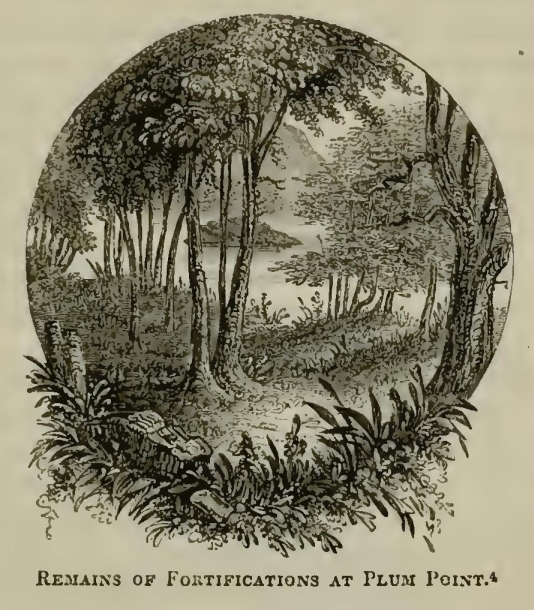
From New Windsor I rode to Plum Island, or Plum Point, the fine estate of Philip A. Verplanek, Esq. At high tide, this alluvial height, which rises about one hundred and twenty feet above the Hudson, is an island, approached by a narrow causeway from the main, which bridges a rivulet, with a heavy stone arch. Murderer's Creek washes its southwestern border, and a marsh and rivulet inclose it upon the land side. Upon a broad, level table-land of some thirty-five acres in extent, stands the mansion of Mr. Verplanck, noted for the beauty and grandeur of the scenery which encompasses it. Accompanied by the proprietor, I strolled down the winding pathway to the base of the steep river bank, where, overgrown by a new forest, are well-preserved remains of a fortification, erected there
* See Eager's History of Orange County, page 630.
** His poetic effort produced the following ACROSTIC
A pretty, charming little creature, N eat and complete in every feature, N ow at New Windsor may be acen, A ll beauteous in her air and mien. B irth and power, wealth and fame, R ise not to view when her we name: E very virtue in her shine, W isely nice, but not o'er fine. S he has a soul that's great, 'tie said, T hough small's the body of this maid: E 'en though the casket is but small, R eason proclaims the jewel's all. October 8, 1791.
*** Washington established his head-quarters at New Windsor village, first on the 23d of June, 1779, and again toward the close of 1780, where he remained till the summer of 1781. He lived at a plain Dutch house, long since decayed and demolished. In that humble tenement Lady Washington entertained the most distinguished officers and their ladies, as well as the more obscure who sought her friendship. On leaving New Windsor in June, 1781, Washington established his quarters, for a short time, at Peekskill.
**** This view is from the interior of the redoubt looking eastward upon the river. In the distance is seen Pollopel's Island, near the upper entrance to the Highlands, beyond which rise the lofty Beacon Hills, whereon alarm-fires often gleamed during the war.
Redoubt on Plum Point.—Chevaux-de-frise.—Anecdote.—Head-quarters of Greene and Knox
partly at an early period of the war, and partly when the American army was in the vicinity. It was a redoubt, with a battery of fourteen guns, and was designed to cover strong chevaux-de-frise and other obstructions placed in the river, and extending from the flat below Murderer's Creek to Pollopel's Island. * It would also rake the river channel at the opening in the Highlands. The chevaux-de-frise were constructed under the superintendence of Captain Thomas Machin, in the summer of 1778. Had they and the strong redoubt on Plum Point been in existence a year sooner, the marauding expedition of Vaughan and Wallace, up the Hudson, could not have occurred. The remains of this battery, the old Continental road, and the cinders of the forges, extend along the river bank several hundred feet. The embrasures are also very prominent.
Mr. Verplanck pointed out the remains of the cellar of a log-house, which stood a little above the battery, and belonged to a man named M'Evers, long before the Revolution. M'Evers was a Scotchman, and when about to emigrate to America, he asked his servant, Mike, if he would accompany him. Mike, who was faithful, and much attached to his master, at once consented to go, saying, in illustration of the force of his love, "Indeed, gude mon, I'll follow ye to the gates o' hell, if ye gang there yersel'." The voyage was long and tempestuous, and instead of entering New York harbor by the Narrows, the vessel sailed through Long Island Sound and the East River. At the whirlpool called Hellgate, the ship struck upon the Hog's Back with a terrible crash. The passengers, in affright, rushed upon deck, and none was more appalled than Mike. The vessel arrived safely in New York, gardener on Plum Point.
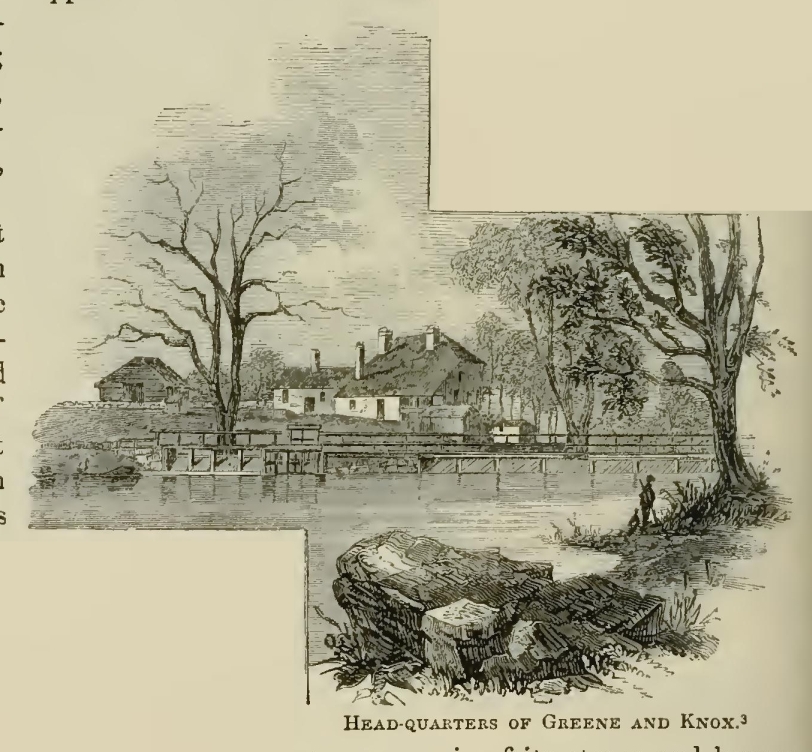
A pleasant ride of about three miles westward from Plum Point placed me at the residence of Charles E. Morton, Esq., a picturesque old mansion on the south side of the New Windsor road. It was built about 1735 ** by John Ellison, one of the first settlers in New Windsor. The material is stone, and its dormer windows and spacious and irregular roof give it the appearance of a large cottage in rural England. A living stream passes through a rocky glen within a few yards of it. Just below is the old mill, erected more than a hundred years ago by the first proprietor; nor has the monotonous music of its stones and hopper yet ceased.
This old mansion was the head-quarters of Generals Greene and Knox while Washington was domiciled at the Hasbrouck House in Newburgh, and it was from hence that the com-
* According to a survey made by Henry Wisner and Gilbert Livingston in the autumn of 1776, the channel of the river, wherein these chevaux-de-frise were placed, was about fifty feet deep, and eighty chains, or about five thousand two hundred and eighty feet broad. The channel east of Pollopel's Island was not deep enough for the passage of ships of war.
** One of the fire-places has a cast-iron back, on which, in raised letters, is the date 1734.
*** This view is from the turnpike road, looking southeast. The water in front is a mill-pond, over the dam of which passes a foot-bridge. The mill is hidden by the trees in the ravine below. This side was originally the rear of the house, the old Goshen road passing upon the other side. The old front is a story and a half high. Captain Morton, the proprietor, is a son of the late General Jacob Morton, of New York city.
Ball at the Quarters of Greene and Knox.—Signatures of young Ladies.—Washington on Dancing.—The Square.
mander-in-chief, accompanied by those generals, after taking some refreshments, rode to the "New Building," to attend the meeting of officers convened by Washington on account of the anonymous addresses just considered. Here the accomplished Lucy Knox gave her choice soirées, graced by the presence of Mrs. Washington, and other ladies of taste and refinement with which that region abounded; and here, if tradition is truthful, Washington opened a ball on one occasion, having for his partner Maria Colden, then one of the pretty belles of Orange county. *
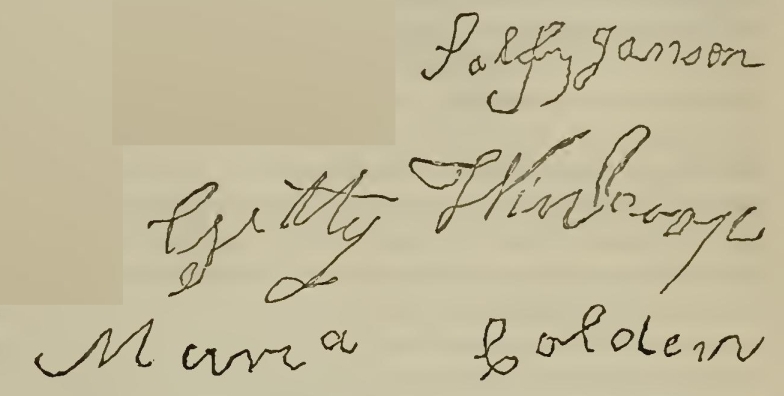
I dined with Mr. Morton in the old drawing-room, which, with the other apartments, is preserved by him, with scrupulous care, in the original style. The ceilings are high, and the wainscoting displays architectural taste. The heavy window-sashes, with their small squares of glass, remain; very few of the panes have been broken and replaced since the Revolution. On one of them, inscribed by a diamond, are the names of three young ladies of the "olden time" (Sally Janson, Gitty Winkoop, and Maria Colden), one of whom was the reputed partner of Washington at the ball. May not these names have been written on that occasion?
Believing it probable, I copied the signatures, and present them here for the gratification of the curious and the sentimental.
In October, 1777, the vicinage we are now considering was the scene of much commotion.
Forts Clinton and Montgomery, amoung the Hudson Highlands, fell beneath one heavy blow, suddenly and artfully dealt by a British force from New York, and the smitten October 6, 1777 garrisons were scattered like frightened sheep upon the mountains; not, however, until they had disputed the possession of the fortresses with the besiegers long and desperately. General James Clinton and his brother George were in command of the fortresses, and escaped up the river. At a place afterward called Washington Square, ** about four
* I was informed by the venerable Mrs. Hamilton that Washington never danced. He often attended balls by invitation, and sometimes walked the figures, but she never saw him attempt to dance. Probably no lady of that day, if we except Mrs. Knox, was more often at parties and social gatherings with Washington than Mrs. Hamilton. It may not be inappropriate here to give a copy of a letter on the subject of dancing, written by Washington a short time before his death. It was in reply to an invitation from a committee of gentlemen of Alexandria to attend the dancing assemblies at that place. I copied it from the original in the Alexandria Museum.
* "To Messrs. Jonathan Swift, George Doncale, William Newton, Robert Young, Charles Alexander, Jr., James H. Hoole, Managers..
* "Mount Vernon, 12th November, 1799.
* "Gentlemen,—Mrs. Washington and myself have been honored with your polite invitation to the assemblies of Alexandria this winter, and thank you for this mark of your attention. But, alas! our dancing days are no more. We wish, however, all those who have a relish for so agreeable and innocent an amusement all the pleasure the season will afford them; and I am, gentlemen,
* "Your most obedient and obliged humble servant,
* "Geo. Washington."
* "The Square" is a small district of country, and so called from the fact that the public roads ran in such a direction as to form a diamond-shaped inclosure, as seen in the diagram, in which a is the road to Newburgh; b, to Goshen; c, to Little Britain; and d, to New Windsor. 1 denotes the house of Mrs Falls; 2, the quarters of St. Clair and Gates;* and, 3, the quarters of La Fayette.
* There are two ancient houses at this angle of "The Square," but I could not ascertain which was occupied by those officers. It is probable, however, that the one on the northwest aide of the road, which is supposed to have been Edmonston's, was the one.
A Spy in the American Camp.—Dispatch in a silver Bullet.—Name and Fate of the Spy
miles west of the village of New "Windsor, Governor Clinton established his head-quarters at the house of a Mrs. Falls, and there the dispersed troops were collected, preparatory to their marching for the defense of Kingston.
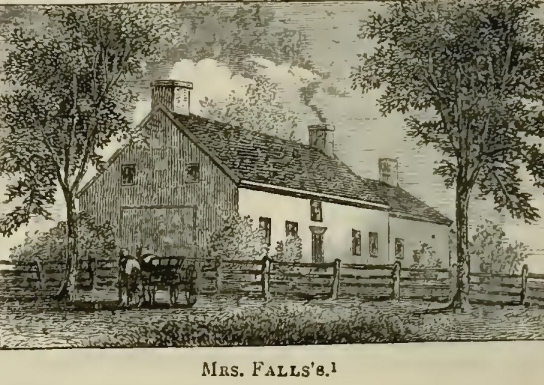
At about noon on the 10th of October,1777 a horseman, apparently in great haste, approached the disordered camp. The sentinel on duty challenged him, when he replied, I am a friend, and wish to see General Clinton." The horseman was a messenger, bearing a secret dispatch from Sir Henry Clinton to Burgoyne, the latter being then hedged round by the Americans at Saratoga. The messenger supposed the American forces in the Highlands to be utterly broken and destroyed, and having never heard of a general Clinton ** in the patriot army, he believed himself to be among his friends. He was conducted to Clinton's quarters, and, when ushered into his presence, he perceived his mistake. "I am lost!" he exclaimed, in a half subdued voice, and immediately cast something into his mouth and swallowed it. Suspicion was aroused, and he was arrested. Dr. Moses Higby, who was then residing near Mrs. Falls's, was summoned. He administered to the prisoner a powerful dose of tartar emetic, which soon brought from his stomach a silver bullet of an oval form. Though closely watched, the prisoner succeeded in swallowing it a second time. He now refused the emetic, but yielded when Governor Clinton threatened to hang him upon a tree and search his stomach by the aid of the surgeon's knife. The bullet again appeared. It was a curiously-wrought hollow sphere, fastened together in the center by a compound screw. Within it was found a piece of thin paper, on which was written the following note: ***
"Fort Montgomery, October 8,1777.
"Nous y voici, **** and nothing now between us and Gates. I sincerely hope this little success of ours may facilitate your operations. In answer to your letter of the 28th of September, by C. C., (v) I shall only say, I can not presume to order, or even advise, for reasons obvious. I heartily wish you success.
"Faithfully yours, H. Clinton.
"Gen. Burgoyne."
The prisoner's guilt was clear; out of his own mouth he was condemned. Governor Clinton soon afterward marched to Esopus, or Kingston, taking the spy with him. At Hurley, a few miles from Kingston, he was tried, condemned, and hanged upon an apple-tree near the old church, while the village of Esopus was in flames, lighted by the marauding enemy. (vi)
* This house, now (1850) owned by Mr. Samuel Moore, is a frame building*, and stands on the right side of the New Windsor road, at the southeastern angle of "The Square." It is surrounded by locust and large balm-of-Gilead trees. There Major Armstrong wrote the famous Newburgh Addresses, and there those in the secret held their private conferences.
** The British officers in this country adhered pertinaciously to the resolution of not dignifying the rebel officers with their assumed titles. They were called Mr. Washington, Mr. Clinton, Mr. Greene, &c. It is amusing to look over the Tory newspapers of the day, particularly Rivington's Gazette, and observe the flippant and attempted witty manner in which the American generalissimo was styled Mister Washington.
*** Letter of Governor Clinton to the Council of Safety, dated "Head-quarters, Mrs. Falls's, 11th October, 1777."
**** "Here we are." I copied this note from a transcript in the handwriting of Governor Clinton, which is among the manuscripts of General Gates in the library of the New York Historical Society. It is endorsed "Sir Henry Clinton to J. Burgoyne, 8th of October, 1777, found in a silver bullet." That identical bullet was, a few years ago, in the possession of the late General James Tallmadge, executor of the will of Governor George Clinton. It is now the property of one of Clinton's descendants.
* (v) Captain Campbell. See page 79, vol. i.
* (vi) The name of the spy was Daniel Taylor. He was a sergeant in the British service. The father of the late Judge Woodward, of the Supreme Court of the State of New York, acted as judge-advocate on the occasion. On page 389, ante, I have alluded to this occurrence, and remarked that Kingston was the place of the execution of the spy. Hurley was then included in the township of Kingston.
Site and probable Form of the Temple.—View from it.—The Camp Ground and Vicinity.
Leaving Mr. Morton's, I proceeded to visit the site of the "New Building," or Temple, as it was called, where the meeting of officers was held.
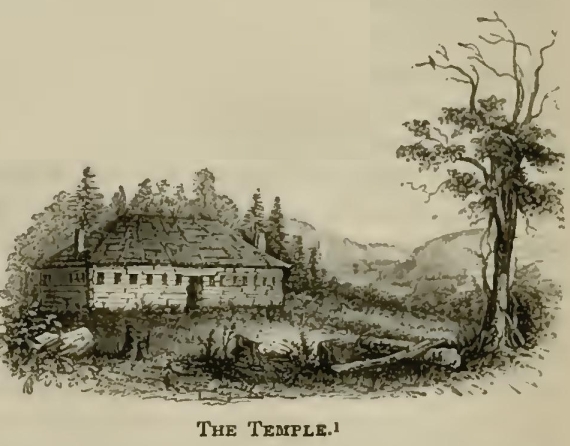
It is in a field now belonging to Mr. William M'Gill (formerly to the late Jabez Atwood), upon a commanding eminence about one hundred rods east of the road to Newburgh, and two miles northward of Morton's. The day was foggy and drizzly, and the distant scenery was entirely hidden from view; but, on a second visit, upon a bright summer day, with some Newburgh friends, I enjoyed the magnificent prospect to be obtained from that observatory.
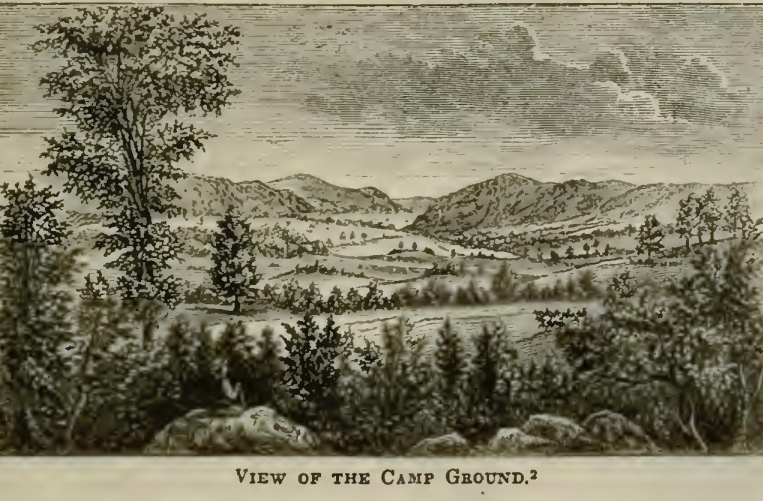
On the southeast loomed the lofty Highlands, cleft by the Hudson; North and South Beacons, and Butter Hill, rising above their hundred lesser companions, were grouped in a picture of magnificence and beauty. Glittering in meridian sunlight were the white houses of Cornwall and Canterbury; and far up the slopes of the mountains, stretching westward to Woodcock Hill, yellow grain-fields and acres of green maize variegated the landscape. In the far distance, on the northwest, was the upper Shawan-gunk range, and an occasional glimpse was caught of the blue high peaks of the Catskills, sixty miles northward. Across the meadows westward we could distinctly trace the line of the old causeway, constructed while the army was encamped there; and in the groves which skirt the slopes (whither we soon afterward went) we found the remains of several huts that were built for the use of the soldiers.
The Temple was a large, temporary structure, erected by command of Washington for the several purposes of a chapel for the army, a lodge-room for the fraternity of Free-masons which existed
* This view is from the site of the Temple, looking southeast. In the distance is seen the opening of the Highlands into Newburgh Bay. On the right is Butter Hill, and near it is the village of Cornwall. The form and appearance of the Temple was drawn from the description given by Major Burnet, and doubtless has a general resemblance to the original.
** This is from a painting by Tice, in my possession. The land on which the encampment on the west side of the meadow was, is now owned chiefly by Gilbert Tompkins and Nathaniel Moore. This view is from the land of Mr. Tompkins, looking east-southeast. On the slopes seen in the foreground, and on the margin of the meadow beyond, Van Cortlandt's New York regiment, and the Maryland and Virginia troops were encamped. On the east side of the meadow, upon the most distant elevation in the middle ground, the New England troops were stationed. On the slope toward the right of that elevation stood the Temple. In the distance is seen the upper entrance of the Hudson into the Highlands. The meadow was formerly ealled Beaver Dam Swamp, from the circumstance that beavers constructed dams at the lower extremity, causing the waters to overflow the low grounds. The Americans built a causeway across, and a stone dike, or levee, on the west side, to protect their parade. I saw the remains of this causeway; its site is marked by the light lino across the flat. About a quarter of a mile north of the site of the Temple is an ancient stone house, seen in the picture, the only dwelling near in the time of the war. It was built by Samuel P. Brewster in 1768, as appears from an inscribed stone in the front wall. It was owned by a Mr. Moore. Its present occupant is Francis Weyant.
The Temple as described by Major Burnet.—Two living Patriots.—Visit to Major Burnet.
among the officers, and for public meetings of various kinds. When erected, it was called The Temple of Virtue; when dedicated, the suffix was properly omitted, and it was named simply The Temple. The orgies held on the occasion of its dedication disrobed it of its mantle of purity. It was described to me by Major Burnet, who is still living (1851) in the neighborhood, as a structure of rough-hewn logs, oblong square in form, one story in height, a door in the middle, many windows, and a broad roof. The windows were square, unglazed, and about the size of ordinary port-holes in a man-of-war. There was a small gallery, or raised platform, at one end, for speakers and presiding officers. We traced, near an old apple-tree in Mr. M'Gill's field, evident lines of the foundation of the building. It must have been some eighty feet long and forty wide. On the crown of the hill northward are traces of fire-places, and there, at the beginning of the present century, a long building was standing. Some have supposed this to have been the Temple; it was only the barracks for the New England troops stationed there. In a few years those faint land-marks and that old apple-tree will be no more seen.
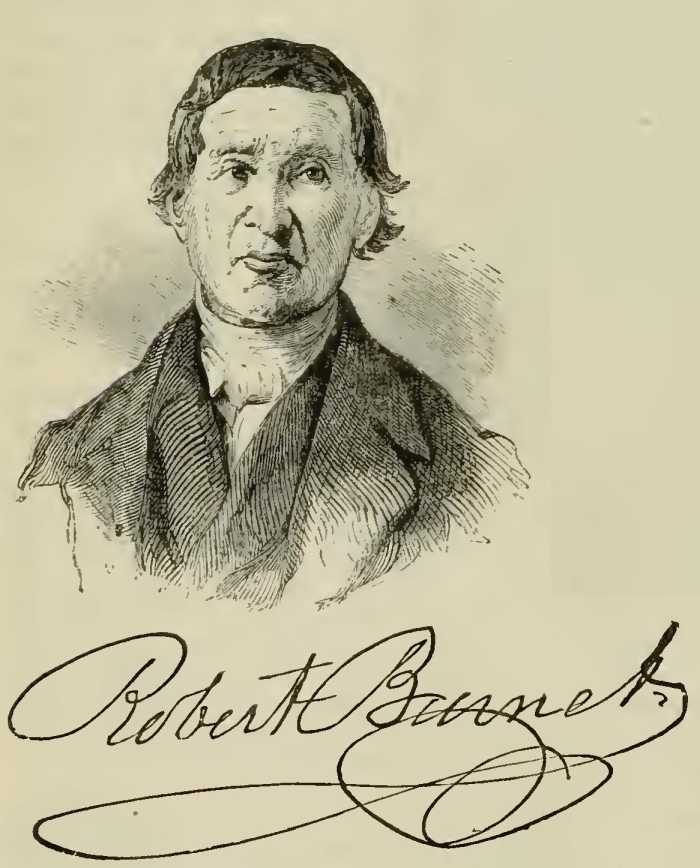
The spot is consecrated by one of the loftiest exhibitions of true patriotism with which our Revolutionary history abounds. There love of country, and devotion to exalted principles, achieved a wonderful triumph over the seductive power of self-love and individual interest, goaded into rebellion against higher motives by the lash of apparent injustice and personal suffering. It is, indeed, a hallowed spot; and if the old stone house at Newburgh is worthy of the fostering regard of the state because it was the head-quarters of the beloved Washington, surely the site of the Temple, where he achieved his most glorious victory, deserves some monument to perpetuate the memory of its place and associations.
At Little Britain, a few miles from the Temple, and within a quarter of a mile of each other, reside two of the sons of Orange county, who loved and served Washington and their country in the war for independence. These are Robert Burnet and Usual Knapp. Of the once long list of Revolutionary pensioners in Orange county, these only remain, honored living witnesses of the prowess of those who wrestled successfully for freedom. I left the Temple field on the occasion of my first visit with the intention of seeing these patriot fathers, but missing the proper road, and the night shadows coming thickly with the fog and rain, I made my way back to Newburgh.
Kind friends afterward procured likenesses and autographs of both for me. * Better than this, I subsequently enjoyed the pleasure of a personal interview with Major Burnet at his residence. It was on the occasion of my second visit to the camp ground. At dark, on that August i, sultry day, we made our way up a green lane, flanked by venerable willows—a few 1850-cast down by a recent tornado—and sat down in the spacious hall of the old soldier's man-
* I am indebted to Mr. Charles U. Cushman, of Newburgh, for a daguerreotype, from life, of Major Burnet, from which the picture above was copied. The likeness of Mr. Knapp is from an excellent painting of the almost centenarian's head, by Mr. Charles W. Tice, an accomplished self-taught artist of Newburgh, who kindly furnished me with a copy for my use.
Public Life of Major Burnet and Sergeant Knapp.—Washington's Letter to Greene.
sion. He had just retired to his bed-room, but soon appeared, standing before us as erect and manly as if in the prime of his life, although then in his ninetieth year.
The father of Major Burnet was a Scotchman, his mother a native of Ireland. He was a lieutenant in Captain Stevens's company, and commanded Redoubt No. 3, at West Point, at the time of Arnold's defection. He afterward attained to the rank of major in the service, and was one of the delegates who attended the meeting of officers at the Temple. * He continued in the army, under the immediate command of the chief, until the disbanding of the forces in 1783. When the Americans marched into the city of New York as the British evacuated it, he commanded the rear guard. He told me that he remembered November 25, 1783 distinctly the dignified appearance of Washington, when, with Governor Clinton and other civil and military officers, he stood in front of an old stone house, ** about two miles below Kingsbridge, while the troops, with uncovered heads, passed by. He saw Cunningham, the wicked provost-marshal at New York, strongly guarded by his friends, in the march to the place of embarkation, while the exasperated populace were eager to seize and punish him according to his deservings.