Volume 2 — CHAPTER VI. (continued 2)
Reading edition
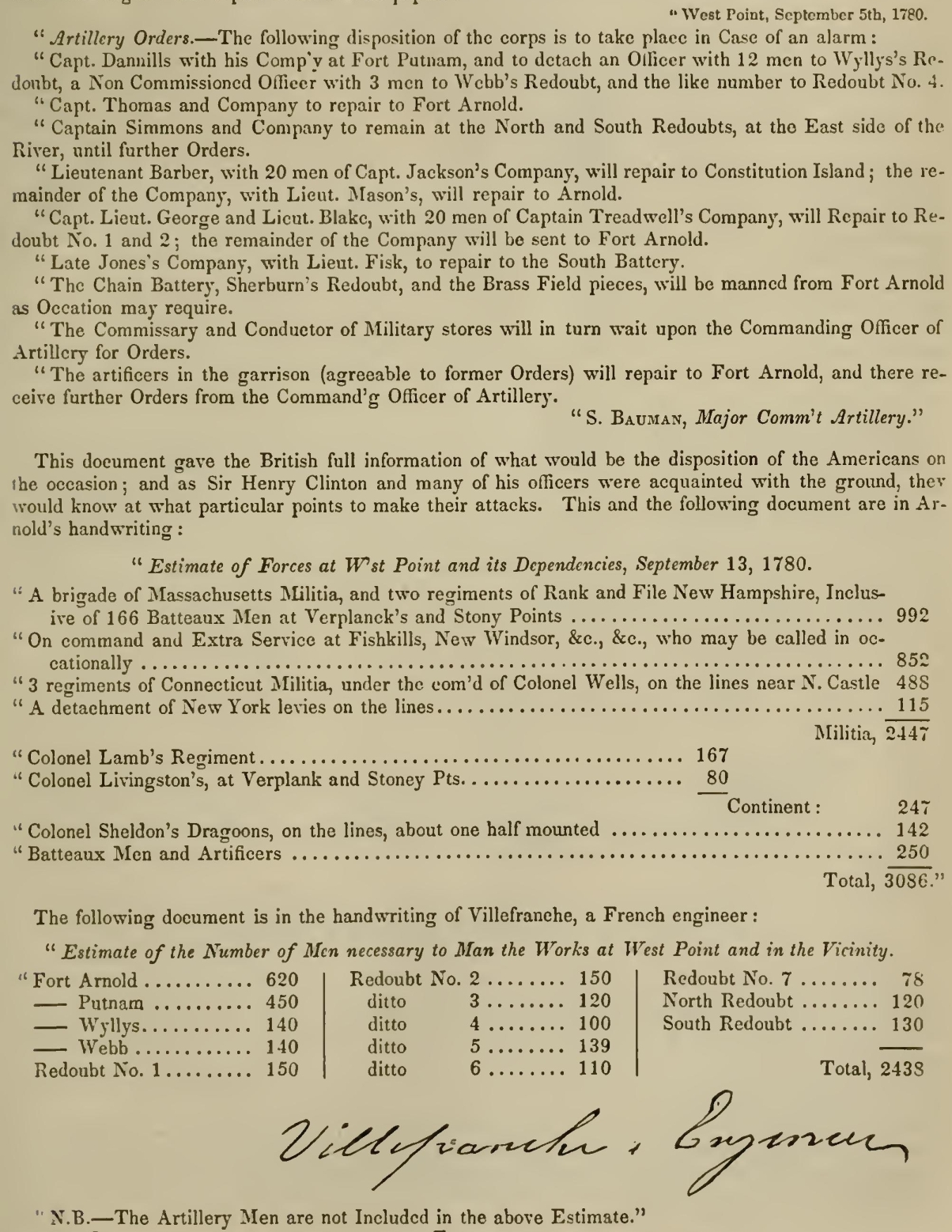

"N.B.—The Artillery Men are not Included in the above Estimate."
Return of the Ordnance in the different Forts at West Point.—Arnold's Description of the Works.
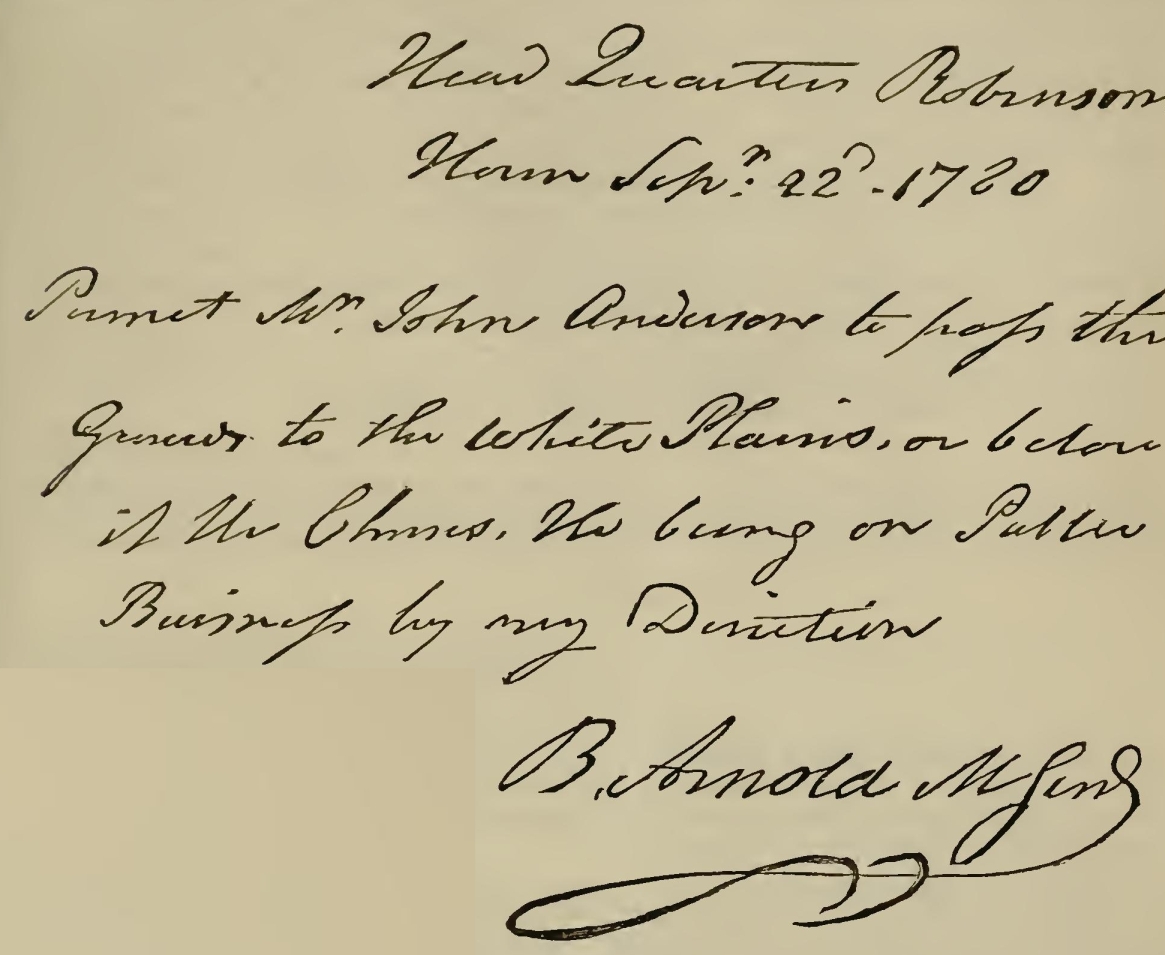
stockings and feet, and in the event of accident, to destroy them. He then gave him a pass, a fac simile of which is printed on the next page, and bidding Andre adieu, Arnold went
The following table is in the handwriting of Bauman, Major Commandant of Artillery:
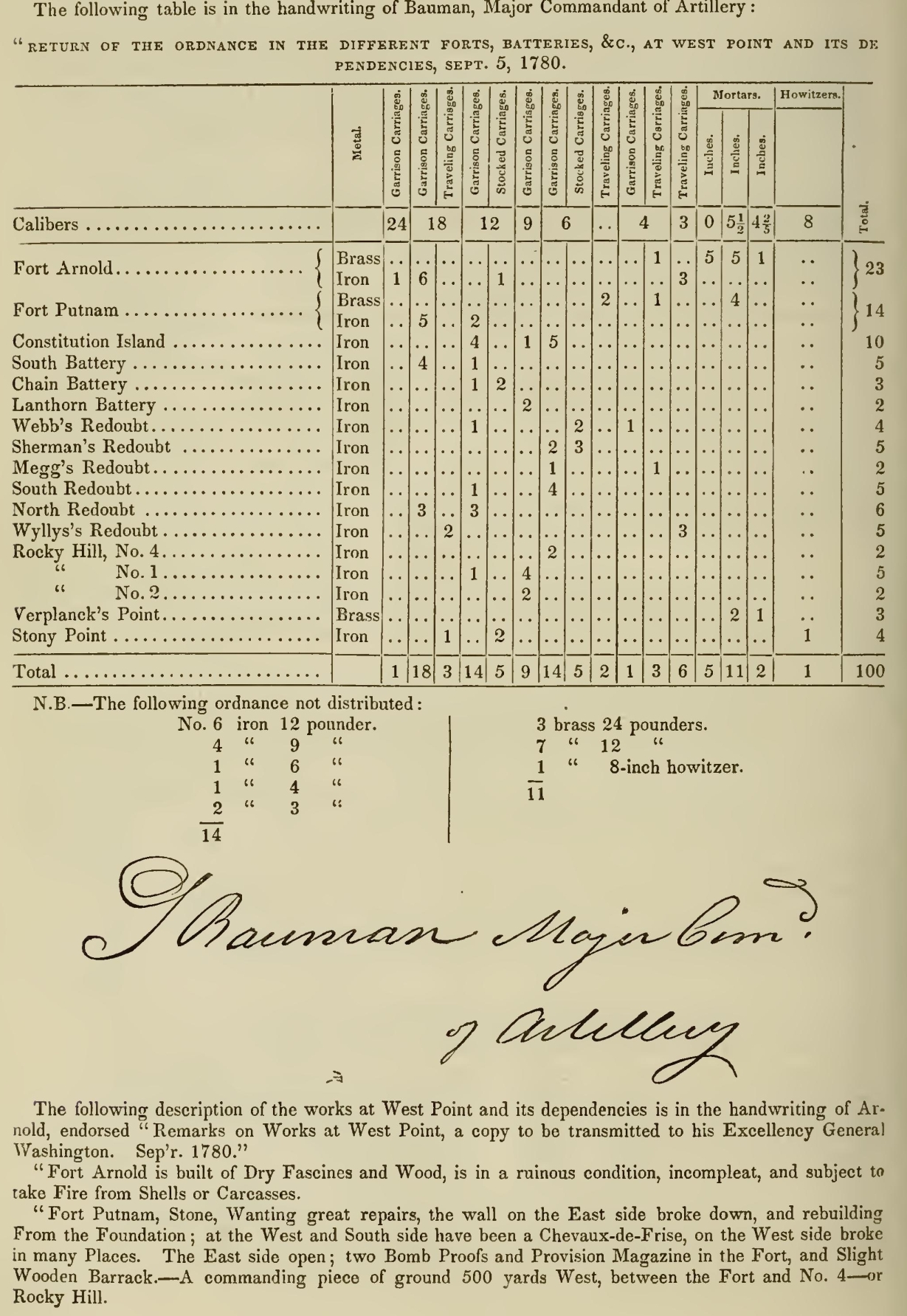
The following description of the works at West Point and its dependencies is in the handwriting of Arnold, endorsed "Remarks on Works at West Point, a copy to be transmitted to his Excellency General Washington. Sep'r. 1780."
"Fort Arnold is built of Dry Fascines and Wood, is in a ruinous condition, incompleat, and subject to take Fire from Shells or Carcasses.
"Fort Putnam, Stone, Wanting great repairs, the wall on the East side broke down, and rebuilding From the Foundation; at the West and South side have been a Chevaux-de-Frise, on the West side broke in many Places. The East side open; two Bomb Proofs and Provision Magazine in the Fort, and Slight Wooden Barrack.—A commanding piece of ground 500 yards West, between the Fort and No. 4—or Rocky Hill.
"Fort Webb, built of Fascines and Wood, a slight Work, very dry, and liable to be set on fire, as the approaches are very easy, without defenses, save a slight Abattis.
"Fort Wyllys, built of stone 5 feet high, the Work above plank filled with Earth, the stone work 15 feet, the Earth 9 feet thick.—No Bomb Proofs, the Batteries without the Fort.
"Redoubt No. 1. On the South side wood 9 feet thick, the Wt. North and East sides 4 feet thick, no cannon in the works, a slight and single Abattis, no ditch or Pickett. Cannon on two Batteries. No Bomb Proofs.
"Redoubt No. 2. The same as No. 1. No Bomb Proofs.
"Redoubt No. 3, a slight Wood Work 3 Feet thick, very Dry, no Bomb Proofs, a single Abattis, the work easily set on fire—no cannon.
"Redoubt No. 4, a Wooden work about 10 feet high and fore or five feet thick, the West side faced with a stone wall 8 feet high and four thick. No Bomb Proof, two six pounders, a slight Abattis, a commanding piece of ground 500 yards Wt.
"The North Redoubt, on the East side, built of stone 4 feet high; above the Stone, wood filled in with Earth, Very Dry, no Ditch, a Bomb Proof, three Batteries without the Fort, a poor Abattis, a Rising piece of ground 500 yards So., the approaches Under Cover to within 20 yards.—The Work easily fired with Faggots diptd in Pitch, &c.
"South Redoubt, much the same as the North, a Commanding piece of ground 500 yards due East—3 Batteries without the Fort."
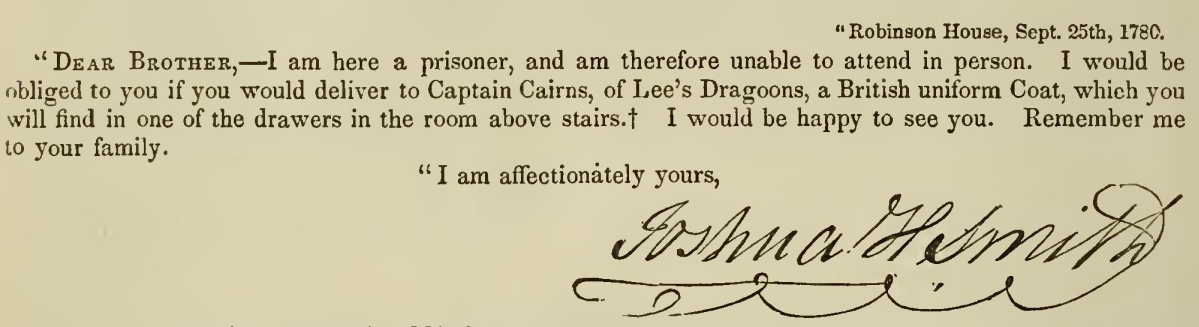
The "Artillery Orders" of September 5, 1780; the estimate of forces at West Point; estimate of men to man the works, by Villefranche; the "Return" of Bauman; the description of the works at West Point and vicinity, and a copy of a council of war held at Washington's quarters, September 6, 1780, are the papers which were taken from Andre's stocking. The latter document, which set forth the weakness, wants, and gloomy prospects of the American army, was a statement made by Washington to the council. It is too long for insertion here. Preserved among these papers are five passes, signed by Arnold; a memorandum, which, from its ambiguity, is unintelligible, * and the following letter from Joshua Smith to his brother Thomas, after his arrest on suspicion of being an accomplice with Arnold:
"Robinson House, Sept. 25th, 1780.
"'Dear Brother,—I am here a prisoner, and am therefore unable to attend in person. I would be obliged to you if you would deliver to Captain Cairns, of Lee's Dragoons, a British uniform Coat, which you will find in one of the drawers in the room above stairs.f I would be happy to see you. Remember me to your family.
"I am affectionately yours,
I have before me three interesting MS. letters, written by Smith and his two brothers, at about this time. The first is from the Tory Chief Justice Smith, of New York, to his brother Thomas; the second is from Thomas to Governor Clinton, covering the one from Judge Smith; and the third is from Joshua H. Smith, written in the jail at Goshen. See Note * on page 752.
"New York, 12th October, 1180.
"Dear Sir,—You will naturally suppose us in great anxiety for our brother Joshua, though General Arnold assured us that he knew nothing of his designs, and that he has written to General Washington more than once asserting his, and the innocence of several others still more likely to be suspected, from their connections with him, while in his confidence. Joshua meets with a faithful reward from his old friends. God Almighty protect him. I hope his relations, at least, have not deserted him in his afflictions. Our last accounts were, that he was still in the hands of the army, which appears strange to all here that have just views of civil liberty, or know any thing of Thomas Smith, Esq., that that model for a Constitution poor Joshua helped to frame at Kingston as an improvement upon that under which we were all born.
"Your friends here would be all well, if they thought you were so. Our sister, Livingston, has spent several weeks with us, and will return sooner than we wish.
"Your son's health seems at length to be established, and he seems inclined to winter in South Carolina. I have suspended iny assent to the voyage till I know your opinion; which ought to come soon, to avoid the danger of a winter voyage.
"Commend me to all friends. I add no more, from an attention to your condition in an angry and suspicious hour. God preserve you and yours through the storm, which I hope is nearly over.
"Ever most affectionately yours, William Smith."
"16th October, 1780.
"Dear Sir,—-The inclosed was this moment delivered me by Mrs. Hoffman, who came out in a Flag via Elizabeth Town, as I wish to receive no letters from my brother but such as are subject to public inspection. I have taken the liberty to inclose it for your perusal. The situation in which the unhappy affair of my brother Joshua has placed me and all the family, calls for the greatest care to avoid suspicion. I am yours, with esteem and affection, Thomas Smith.
"His Excellency Governor Clinton.
"P.S. I should be glad, if your house at Windsor is not engaged, to hire it, as I am determined to quit this place."
"Goshen, Orange County, 19th Nov., 1180.
"Sir,—In pursuance of a warrant of the Commissioners of Conspiracy, I was on the 12th day of this instant committed to the close custody of the sheriff of this County. My long and severe confinement before and during my trial by the court-martial has greatly impaired my health, and I find my constitution much shattered. I have been subject to repeated attacks of a bilious colic and an intermittent fever; and am advised that a close confinement will soon terminate my existence, unless I can be permitted to use some exercise. I have, therefore, to request some indulgence on this head, in compassion to my distressed situation.
"As I have never been officially acquainted with the sentence of the court-martial, I have also to request your Excellency to favor me with a copy of it by Major Hatfield, and thereby much oblige,
"Your Excellency's most obedient and distressed humble servant,
"His Excellency George Clinton, Esq., &c., Ac. "JOSHUA H. SMITH."
** This was Major Andrê's coat, which that officer exchanged with Smith for a citizen's dress-coat, as mentioned in the text.
*** Sec page 387 of this volume. .
Arnold's Pass.—Smith's Refusal to take André back to the Vulture.—His insufficient Excuse.
up the river, in his own barge, to head-quarters, fully believing that no obstacle now interposed to frustrate his wicked scheme. Andre passed the remainder of the day alone, and
as soon as evening came, he applied to Smith to take him back to the Vulture. Smith positively refused to go, and pleaded illness from ague as an excuse. If he quaked, it was probably not from ague, but from fear, wrought by the firing upon the Vulture; for he offered to ride half the night with Andre, on horseback, if he would take a land route. Having no other means of reaching the vessel, André was obliged to yield to the force of circumstances. He con-
Andrè's Exchange of Coats.—He and Smith cross the Hudson.—Smith's Letter to his Brother.—Ambiguous Memorandum.
sented to cross King's Ferry to Verplanck's Point, and make his way back to New York by land. He had been prevailed upon by Arnold, in the event of his taking a land route (which had been talked of), to exchange his military coat for a citizen's dress. This act, and the receiving of papers from Arnold, were contrary to the express orders of Sir Henry Clinton, but André was obliged to be governed by the unforeseen circumstances in which he was placed. Smith agreed to attend him on the way as far as the lower outposts of the American lines. September, 1780 A little before sunset, on the evening of the 22d, accompanied by a negro servant, they crossed King's Ferry. At dusk, they passed through the works at Verplanck's
Point, and turned their faces toward White Plains. While they are pursuing their route toward the Neutral Ground, let us consider events at the Robinson House, and then resume our own journey. We shall overtake the travelers presently, when the concluding portion of the narrative of Arnold's treason will be given.
Arnold's Composure in Presence of his Aids.—Washington's Return from Hartford.—His Approach to Arnold's Quarters.