Volume 2 — CHAPTER XIII. (continued 2)
Reading edition
"No single art engaged his manly mind, In every scene his active genius shined. Nature in him, in honor to our age,
* At once composed the soldier and the sage.
** Trumbull, in his M'Fingall, thus alludes to the:
Behold, at Briton's utmost shifts Comes Johnstone, loaded with like gifts, To venture through the Whiggish tribe, To cuddle, wheedle, coax, and bribe; And call, to aid his desp'rate mission, His petticoated politician: "Firm to his purpose, vigilant and bold, Detesting traitors, and despising gold, He scorn'd all bribes from Britain's hostile throne, For all his country's wrongs were thrice his own."
* of Mrs. Ferguson in Johnstone's efforts at bribery:
"While Venus, join'd to act the farce, Strolls forth embassadress of Mars. In vain he strives; for while he lingers, These mastiffs bite his off ring fingers; Nor buys for George and realms infernal One spaniel but the mongrel Arnold."
Sir Henry Clinton Commander-m-Chief.—Condition of the American Army.—Exchange of General Lee.—Oaths of Allegiance.
crossed the Delaware into New Jersey. Sir Henry Clinton had succeeded Sir William Howe as generalissimo, and took command of the British army on the 11th of May. In the instructions to Clinton as Howe's successor, the ministry ordered him to evacuate Philadelphia. He had resolved to do so as early as the 23d of May, and to proceed by water to New York. Fearing he might be delayed by head winds, and that Washington would push forward to and capture New York city, he changed his plan and determined to proceed by land. In the mean while, Washington, informed of the evident intention of the enemy to evacuate Philadelphia, placed his army in a condition to march immediately at the beating of the drum. His condition was very much changed for the better. Major-general Charles Lee had been exchanged for Prescott, and was now in camp, and reinstated in his old command as second general officer of the army. * The troops fit for service numbered about fifteen thousand; and the warmth and comforts of pleasant summer time, co-operating with the good news from France, made the soldiers cheerful and hopeful. **
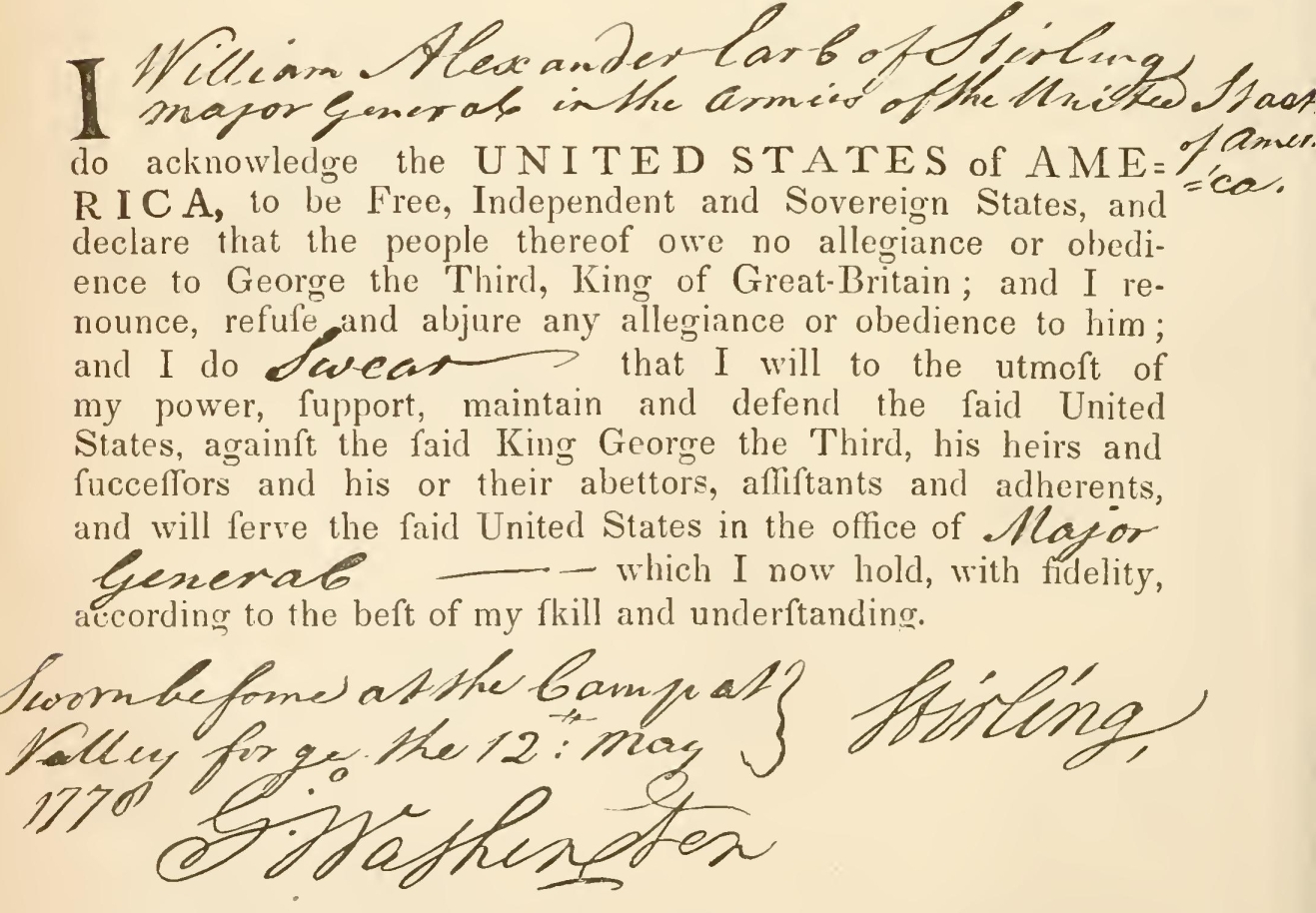

* Washington was directed, by a resolution of Congress, to administer the oath of allegiance to the officers of the army before leaving Valley Forge. The oath was administered to several at one time, each officer placing his hand upon the Bible. Just as the commander-in-ehief began to repeat the oath, General Lee withdrew his hand. This movement was repeated, to the astonishment of all. Washington inquired the cause of his strange conduct, when Lee replied, "As to King George, I am ready enough to absolve myself from all allegiance to him; but I have some scruples about the Prinee of Wales." Even the grave Washington was obliged to join in the laughter which followed this odd reply. Lee eventually took the oath with the rest, and subscribed his name. In the archives of the State Department at Washington City, the original oaths of allegiance, signed by all the officers of the army at Valley Forge, are well preserved, and present an interesting collection of autographs. The oath was printed on a slip of paper, with blanks, in which the name and rank of the officer was written, with his signature at bottom. I observed that Generals Lord Stirling, Knox, and Greene administered the principal portion of the oaths. The following is a fac simile of Lord Stirling's oath, administered by Washington:
* do acknowledge the UNITED STATES of AMERICA, to be Free, Independent and Sovereign States, and declare that the people thereof owe no allegiance or obedience to George the Third, King of Great-Britain; and I renounce, refute and abjure any allegiance or obedience to him; I will to the utmost of my power, support, maintain and defend the said United States, against the said King George the Third, his heirs and successors and his or their abettors, affiliants and adherents.
** Of these, 11,800 were at Valley Forge, which comprehended the sick and those who might be called into action on an emergency. There was a detachment at Wilmington of 1400; and on the Hudson River there were 1800. At=a council of war held on the 18th of May, it was thought reasonable to anticipate that, when all the re-enforcements were brought in, the whole army, fit for duty, would amount to about 20,000 men.
Evacuation of Philadelphia by the British.—Pursuit by the Americans.—The British harassed in New Jersey
Sir Henry Clinton made his preparations for evacuation with so much adroitness, that Washington was not certified of his destination until he had actually crossed the Delaware. Suspecting, however, that he would take a land route for New York, the commander-inchief had dispatched Maxwell's brigade to co-operate with General Dickinson and the New Jersey militia in retarding the march of the enemy. It was a little before dawn on the morning of the 18th of June, when the British army left the city, and commenced 1778 crossing the Delaware at Gloucester Point. * At ten o'clock the rear-guard landed; and toward evening that motley host of British regulars and Loyalists, Hessians, and a crowd of camp-followers, were encamped around Haddonfield, on the south side of Cooper's Creek, five miles southeast of Camden.
When intelligence of the evacuation reached Washington, he broke up his encampment at Valley Forge, and, with almost his whole army, pushed forward in pursuit. General Arnold, whose wound would not allow him to engage in active service, took possession of Philadelphia with a small detachment, while the main army marched rapidly toward the Delaware. The admirable arrangements of the quarter-master general's department, under the able management of General Greene, enabled the army to move with facility. The divisions of Greene and Wayne first crossed the Delaware at Coryell's Ferry, a short June 20, 1778 distance above the place where Washington passed to the attack of the Hessians at Trenton eighteen months previously; and these were followed by the chief and the remainder of the "army on the two following days. Colonel Morgan was sent with six hundred men to re-enforce Maxwell. The army halted at Hopewell, within five miles of Trenton, and there Washington called another council of war. ** The tardy movements of Clinton induced the belief that he was maneuvering to entice the Americans into a general action. "Will it be advisable to hazard a general engagement?" was the question which the chief proposed to the council. The decision was a negative; but it was recommended to send detachments to harass the enemy on their march. General Lee was opposed to this measure, and objected to any interference whatever with the enemy. Pursuant to the recommendation of the council, Washington ordered Morgan's corps to gain the rear of the enemy's right flank, Maxwell's brigade to hang on their left, and Brigadier-general Scott, *** with about fifteen hundred chosen men, to annoy them on the rear and flanks. To these were added the New Jersey militia under General Dickinson, and a party of volunteers from Pennsylvania under Cadwallader.
Sir Henry Clinton intended to march from Haddonfield directly to Brunswick, and embark his troops on the Raritan Hiver. He moved on slowly, by the way of Mount Holly, ****
* Gloucester Point is on the Jersey side of the Delaware, three miles below Camden and Philadelphia.
** A council of war was held on the 17th, the day before the Americans left Valley Forge, and among other questions proposed was, "If the enemy march through Jersey, will it be prudent to attack them on the way, or more eligible to proceed to the North River in the most direct and convenient manner, to secure the important communication between the Eastern and Southern States?" Nearly all the officers were opposed to an attack, on account of the inequality of force, but some thought it should defend on circumstances. Washington was desirous of attacking the enemy, but was obliged to yield to the force of circumstances.
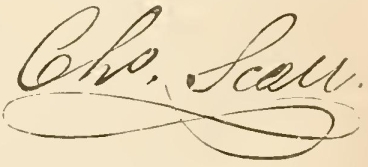
*** Charles Scott was a native of Cumberland county, in Virginia. He raised the first company of volunteers in that state, south of the James River, that actually entered into the Continental service. So much was he appreciated, that, in 1777. the shire-town of Powhatan county was named in honor of him. Congress appointed him a brigadier in the Continental army on the 1st of April, 1777. He served with distinction during the war, and at its termination he went to Kentucky. He settled in Woodford county, in that state, in 1785. He was with St. Clair at his defeat in 1791; and in 1794 he commanded a portion of Wayne's army at the battle of the Fallen Timber. He was governor of Kentucky from 1808 to 1812. He died on the 22d of October, 1820, aged seventy-four years.
**** Mount Holly is the scat of justice for Burlington county. It is situated on the north branch of the Raneoeus Creek, about nineteen miles from Trenton. During the war, a Whig, named William Denning, who afterward resided in Mount Holly, constructed a wrought-iron cannon. It was made of iron staves, hooped like a barrel with the same material. There were four layers of staves, firmly bound together, and then bored and breeched like other cannons. He finished one in Middlesex, Pennsylvania, and began another in Mount Holly. The former was captured at the battle of Brandywine, and is now in the Tower of London; the latter was placed in the Philadelphia arsenal. Denning died a few years since, at the age of ninety-four.
Extent of the British Line.—Washington's Determination to Fight.—Preparations of both Armies for Battle.
to Crosswicks and Allentown. There being but a single road, his long train of baggage-wagons and bat-horses, together with his troops, made a line nearly twelve miles In extent. He was obliged to build bridges and causeways over the streams and marshes, and his progress, consequently, was very tardy. When at Allentown, perceiving Washington almost on his front, Clinton changed his course, rather than risk a general action with all his encumbrances. Turning to the right, he took the road leading to Monmouth court-house and Sandy Hook, with the determination of embarking his troops at the latter place. The American June 25 army had now reached Kingston, on the Millstone River. General Lee was still strongly opposed to any interference with the movements of the enemy, and, being next in command to Washington, his opinions had considerable weight with the other officers. Yet six general officers were in favor of continued annoyances by detachments, and three of them (Greene, La Fayette, and Wayne) declared in favor of a general action. Washington was at first embarrassed by these divided opinions; but, relying upon his own judgment, which was strongly in favor of an engagement, he asked no further advice, but proceeded to make arrangements for a battle. He immediately ordered a detachment of one thousand men, under General Wayne, to join the troops nearest the enemy; gave General La Fayette the command of all the advanced parties, amounting to almost four thousand June 26, 1778 men, including the militia, * and moved forward with the main body to Cranberry.
The weather was intensely hot, which circumstance, in connection with a heavy storm that commenced about nine in the morning, made it impossible to resume the march without injury to the troops.
Early on the morning of the 27th, La Fayette, with the advanced forces, proceeded to Englishtown, a hamlet about five miles westward of Monmouth court-house. Sir Henry Clinton was advised of the movements of the Americans, and, properly apprehending an attack upon his flanks and rear, changed the disposition of his line. He placed the baggage train in front, and his best troops, consisting of the grenadiers, light infantry, and chasseurs of the line, in the rear. The baggage of the whole army (in which term were included the bat-horses and wheel-carriages of every department) was placed under the charge of General Knyphausen. With his army thus arranged, Clinton encamped in a strong position near Monmouth court-house, secured on nearly all sides by woods and marshy grounds. His line extended, on the right, about a mile and a half beyond the court-house to the parting of the roads leading to Shrewsbury and Middletown, and on the left, along the road from Monmouth to Allentown, about three miles.
The alteration in the disposition of his line of march made by Sir Henry Clinton, obliged Washington to increase the number of his advanced corps, and accordingly he sent Major-general Lee with two brigades to join La Fayette at Englishtown, and, as senior officer, to take command of the whole division designed for making the first attack. The main army marched the same day, and encamped within three miles of Englishtown; Morgan's June 27. corps was left hovering on the British right; and about seven hundred militia, under
* This force properly fell under the command of General Lee. As he was totally opposed to the movement, it placed him in an unpleasant situation. This embarrassment was mentioned to Washington by La Fayette, who offered to take command of that division. Washington agreed to give it to La Fayette, if General Lee would consent to the arrangement. That officer readily consented, and La Fayette was placed in command. Lee afterward changed his mind, and applied to Washington to be reinstated. He could not, with justice or propriety, recall the orders given to La Fayette; and the commander-in-chief endeavored to preserve harmony by giving Lee the command of two brigades, with orders to join the advanced detachments, when, of course, his rank would entitle him to the command of the whole. He ordered Lee to give La Fayette notice of his approach, and to offer him all the assistance in his power for prosecuting any enterprise he might have already undertaken. Washington wrote, also, to La Fayette, explaining the dilemma, and counting upon his cheerful acquiescence.
British Camp near Monmouth Court house.—Their Movement—Ward Sandy Hook.—Lee ordered to attack the British.
Dickinson, menaced their left. Washington foresaw the increased strength the enemy would gain by reaching the heights of Middletown, which were about three miles in advance. To prevent them obtaining that advantage, he determined to attack their rear the moment they should attempt to move. For this purpose he ordered General Lee to make the necessary disposition, and to keep his troops in readiness to move at the shortest notice. Sir Henry Clinton, perceiving that an immediate action was inevitable, made preparations accordingly. The night of the 27th was one of great anxiety to both parties.
The 28th of June, 1778, a day memorable in the annals of the Revolution, was the Christian Sabbath. The sky was cloudless over the plains of Monmouth when the morning dawned, and the sun came up with all the fervor of the summer solstice. It was the sultriest day of the year; not a zephyr moved the leaves; nature smiled in her beautiful garments of flowers and foliage, and the birds carolled with delight, in the fullness of love and harmony. Man alone was the discordant note in the universal melody. He alone, the proud "lord of creation," claiming for his race the sole mundane possession of the Divine image, disturbed the chaste worship of the hour, which ascended audibly from the groves, the streams, the meadows, and the woodlands. On that calm Sabbath morning, in the midst of paradisal beauty, twenty thousand men girded on the implements of hellish war to maim and destroy each other—to sully the green grass and fragrant flowers with human blood!
At about one o'clock in the morning, Lee sent an order to General Dickinson to June 28 detach several hundred men as near the British lines as possible, as a corps of observation. Colonel Morgan was also directed to approach near enough to attack them on their first movement. Orders were likewise given to the other divisions of the advanced forces to make immediate preparations to march; and, before daylight, Colonel Grayson, with his regiment, leading the brigades of Scott and Varnum, was in the saddle, and moving slowly in the direction of Monmouth court-house.
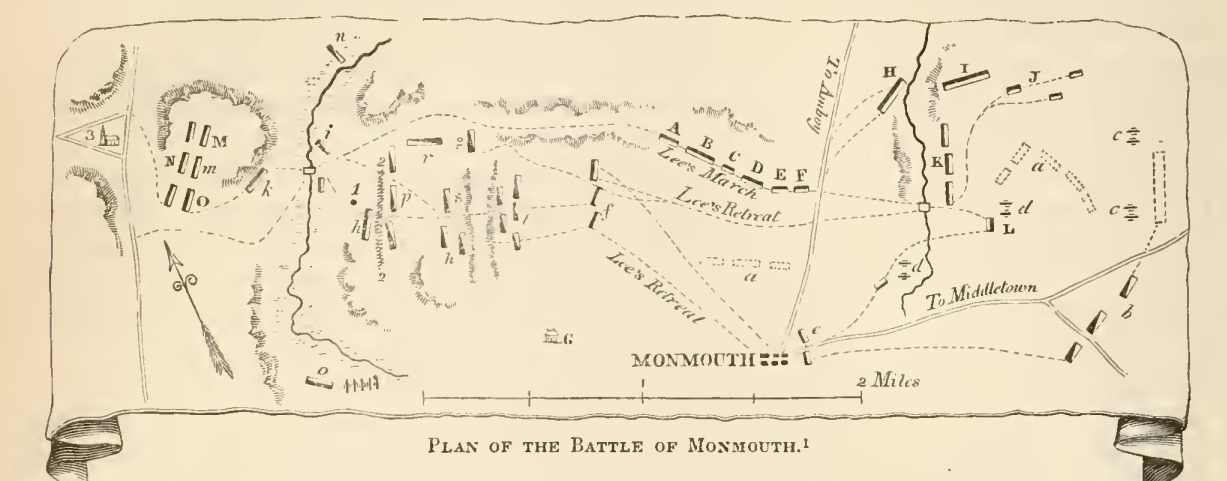
General Knyphausen, with the first division of the British troops, among which was the chief body of the Hessians, and the Pennsylvania and Maryland Loyalists, moved forward at daybreak. Sir Henry Clinton, with the other division, consisting of the flower of his army, ** did not follow until eight o'clock. Dickinson observed the earliest movement, and sent an express to Lee, and to the commander-in-chief, the moment Knyphausen began his march. Washington immediately put the army in motion, and sent orders to General Lee to press forward and attack the enemy, unless there should be very powerful reasons to the contrary. This discretionary clause in the orders eventuated in trouble. Lee advanced immediately with the brigades of Wayne and Maxwell and sent an order to Grayson to press forward and attack the pickets of the enemy as speedily as possible, while he himself pushed forward to overtake and support him. Grayson, with the two brigades, had passed the Freehold meeting-house, two miles and a half from Monmouth, when he received the order. Lee's aid, who bore it, gave it as his opinion that he had better halt, for he had learned on the way that the main body of the British were moving to attack the Americans. This information was erroneous, but it caused Grayson to tarry. General Dickinson, who was posted on a height on the eastern side of a morass, near s in the plan, received the same intelligence, and communicated it to Lee, through the aid, on his return. Lee conformed to the reports, and, after posting two regiments of militia upon a hill southeast
* William Grayson was a native of Prince William county, in Virginia. He was appointed one of the commissioners to treat with Sir William Howe respecting prisoners, while the army was at Valley Forge. In the battle of Monmouth he commanded a regiment in the advanced corps, and behaved with valor. At the close of the war he returned to his native state, and was elected a representative in Congress in 1784. In 1788 he was a member of the Virginia Convention, called for the purpose of considering the Constitution of the United States. With Patrick Henry he opposed the ratification of that instrument. He was appointed one of the first senators from Virginia in 1789, with Richard Henry Lee. He died at Dumfries, while on his way to Congress, on the 12th of March, 1790.
** It was composed of the thirty-fourth and fifth brigades of British, two battalions of British grenadiers, the Hessian grenadiers, a battalion of light infantry, the Guards, and the sixteenth regiment of light dragoons.
Approach of the American advanced Corps.—Conflicting Intelligence.—Preparation for Battle.—Plan of the Action.
of the meeting-house, to secure a particular road, he pushed forward, with his staff, across the morass, at a narrow causeway near the parsonage indicated by an oblong upon the stream toward the left of the plan, and joined Dickinson upon the height.
There conflicting intelligence was brought to him. At one moment it was asserted that the enemy had moved off with precipitation, leaving only a covering party behind; at another, that the whole army was filing off to the right and left to attack the Americans. While he was endeavoring to obtain reliable information on which to predicate orders, La Fayette arrived at the head of the main body of the advanced corps.
Having satisfied himself that no important force of the enemy was upon either flank, Lee determined to march on. His whole command now amounted to about four thousand troops, exclusive of Morgan's corps and the Jersey militia. The broken country was heavily wooded to the verge of the plain of Monmouth. Under cover of the forest, Lee pressed forward until near the open fields, when he formed a portion of his line for action, and, with Wayne and others, rode forward to reconnoiter. From observations and intelligence, he concluded that the column of the British army which he saw deploying on the left were only a covering party of about two thousand men; and entertaining hopes that he might succeed in cutting them off from the main army, he maneuvered accordingly. Wayne was detached, with seven hundred men and two pieces of artillery, to attack the covering party in the rear; not, however, with sufficient vigor to cause them to retreat to the main body. Meanwhile Lee, with a stronger force, endeavored, by a short road leading to the left, to gain the front of the party. Small detachments were concealed in the woods, at different points on the enemy's flanks, to annoy them.
At about nine o'clock in the morning, just as Wayne was prepared to make a descent upon the enemy, a party of American light horse, advancing on the right, observed the Queen's Dragoons upon an eminence in the edge of a wood, parading as if they intended to
* Explanation of tiie Plan.—a a, position occupied by the British army the night before the battle. 6, British detachment moving toward Monmouth, c c, British batteries, d d, Colonel Oswald's American batteries, e, American troops formed near the court-house, f, first position taken by General Lee in his retreat, g, attack of a party of the British in the woods, h h, positions taken by General Lee. i, a British detachment. k, last position of the retreating troops on the west side of the marsh, m, army formed by General Washington after he met Lee retreating, n, British detachment, o, American battery, p, plaee of the principal action near the parsonage, r, first position of the British after the action, s, second position, f, place where the British passed the night after the battle. 1, the spot where Washington met Lee retreating. 2, a hedgerow. 3, the Freehold meeting-house, yet standing. A, Maxwell's brigade; B, Wayne's; C, Varnum's; D, Scott's. E and F, Jackson's and Grayson's regiments. G, Carr's house. H, I, and J, the brigades of Maxwell and Scott, with the regiments of Grayson and Jackson, marching to the attack. K and L, Greene and Varnum. M, Lord Stirling. N, La Fayette; and 0, Greene, with Washington. Lee's march toward Monmouth court-house, the present village of Freehold, was north of the old road to Englishtown. The present road from Freehold to the meeting-house varies from the old one in some places, and is very nearly on a line with Lee's retreat.
The British attacked by Wayne.—Oswald's Artillery.—Wayne checked by Lee.—Strange Conduct of Lee.
make an attack. Lee ordered his light horse to allow the dragoons to approach as near as could be done with safety, and then to retreat to where Wayne was posted, and let him receive them. The maneuver was partially successful; the dragoons followed the retreating light horse, until fired upon by a party under Colonel Butler, ambushed in the edge of a wood, when they wheeled, and galloped off toward the main column. Wayne ordered Colonel Oswald to bring his two pieces of artillery to bear upon them, and then pushed forward himself, with his whole force, to charge the enemy with bayonets. * Colonel Oswald ** crossed a morass, planted his guns on a small eminence (cl), and opened a cannonade at the same time. Wayne was prosecuting his attack with vigor, and with every prospect of full success, when he received an order from Lee to make only a feigned attack, and not push on too precipitately, as that would subvert his plan of cutting off the covering party. Wayne was disappointed, chagrined, irritated; he felt that his commander had plucked the palm of sure victory from his hand; but, like a true soldier, he instantly obeyed, and withheld his troops, hoping that Lee would himself recover what his untimely order had lost. In this, too, the brave Wayne was disappointed; for only a portion of the troops on the right, under Lee, issued out of the wood in small detachments, about a mile below the courthouse, and within cannon-shot of the royal forces. At that instant Sir Henry Clinton was informed that the Americans were marching in force on both his flanks, with the evident design of capturing his baggage, then making a line of several miles in the direction of Middletown. To avert the blow, he changed the front of his army by facing about, and prepared to attack Wayne with so much vigor, that the Americans on his flanks would be obliged to fly to the succor of that officer. This movement was speedily made by Clinton, and a large body of cavalry soon approached cautiously toward the right of Lee's troops. La Fayette perceiving this, and believing it to be a good opportunity to gain the rear of the division of the enemy marching against them, rode quickly up to Lee, and asked permission to make the attempt. "Sir," replied Lee, "you do not know British soldiers; we can not stand against them; we shall certainly be driven back at first, and we must be cautious." La Fayette replied, "It may be so, general; but British soldiers have been beaten, and they may be again; at any rate, I am disposed to make the trial." *** Lee so far complied
* This first attack occurred in the vicinity of Brier Hill, about three fourths of a mile east of the courthouse.
** Eleazer Oswald was a native of Massachusetts, and was among the earliest of the active patriots of the Revolution. He exhibited great bravery at the siege of Quebec, at the close of 1775, where he commanded the forlorn hope after Arnold was wounded. In 1777 he was commissioned a lieutenant colonel in Lamb's regiment of artillery, and soon afterward distinguished himself, with Arnold, at Compo, at the head of recruits raised in Massachusetts and Rhode Island. He was with Putnam when Forts Clinton and Montgomery were taken in 1777, and anxiously entreated his general to allow him to go to the relief of the forts, where his friend Lamb commanded the artillery. For his bravery at the battle of Monmouth, he was highly commended by Generals Knox and Lee. Being outranked soon after this engagement, he resigned his commission and left the service.
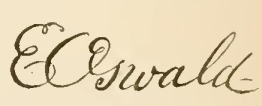
** He entered into the printing and publishing business at Philadelphia, was appointed public printer, and was a resident there at the time of Arnold's defection. Upon constitutional questions he was an opponent of General Hamilton, and in 1789 challenged that gentleman to fight a duel. Their friends adjusted the matter, and the meeting was prevented. In 1793, being in England on business, he went to the Continent, joined the French army, commanded a regiment of artillery, and was at the battle of Mons, or Jemappe. He fell a victim to the yellow fever which desolated New York in 1795, and was buried in St. Paul's church-yard on the 2d of October of that year.—See Leake's Life and Times of General Lamb.
*** The conduct of Lee throughout the day was very strange, and gives a coloring of truth to the conjecture that the thorn of envy was still rankling in his bosom, and that he preferred seeing the Americans disgraced by a defeat, rather than Washington honored by a victory. La Fayette, who had watched with the eye of ardent affection the progress and termination of the conspiracy against Washington a few months previously, in which the name of Lee was prominent as his proposed successor, was properly suspicious. Soon after his application to Lee for permission to attempt to gain the enemy's rear, one of Washington's aids arrived for information; and La Fayette took the occasion to inform his excellency, through the aid, that his presence upon the ground was of the utmost importance. He felt convinced that Lee's movements were governed either by cowardice or treachery, and he was anxious to have Washington controlling he movements of the day.
Lee's Orders misunderstood.—Retreat of two Brigades.—A general Retreat ordered by Lee.—General Maxwell.
as to order the marquis to wheel his column by his right, and gain and attack the enemy's left. At the same time, he weakened Wayne's detachment on the left, by ordering the regiments of Wesson, Stewart, and Livingston to the support of the right.
He then rode toward Oswald's battery to reconnoiter.
At that moment, to his great astonishment, as he said, Lee saw a large portion of the British army marching back on the Middletown road toward the court-house. Apparently disconcerted, he immediately ordered his right to fall back. The brigades of Scott and Maxwell, * on the left, were already moving forward and approaching the right of the royal forces, who were pressing steadily on in solid phalanx toward the position occupied by Lee, with the apparent design of gaining Wayne's rear and attacking the American right at the same moment. General Scott had left the wood, crossed a morass, and was forming for action on the plain, and Maxwell was preparing to do the same, when Lee ordered the former to re-enter the wood, arrange his column there, and wait for further directions. Perceiving the retrograde movement on the right, and perhaps mistaking the spirit of Lee's order, Scott recrossed the morass, and retreated through the woods toward the Freehold meeting-house, followed by Maxwell. As soon as intelligence of this movement reached Lee, he sent an order to La Fayette to fall back to the court-house. The marquis obeyed, but with reluctance. As he approached the courthouse, he learned, with surprise and deep mortification, that a general retreat had begun on the right, under the immediate command of Lee, and he was obliged to follow. The British pursued them as far as the court-house, where they halted, while the Americans pressed onward across the morass above Carr's house (G) to the broken eminences called the heights of Freehold, where they also halted. The heat was intense, and both parties suffered terribly from thirst and fatigue. In many places they sunk ankle-deep in the loose, sandy soil. Their rest was of short duration. The royal troops pressed forward; and Lee, instead of making a bold stand in his advantageous position, resumed his retreat toward the Freehold meeting-house. A panic seized the Republican troops, and over the broken country they fled precipitately and in great confusion, a large portion of them pressing toward the causeway over a broad morass, ** where many perished; while others, overpowered by the heat, fell upon the earth, and were trampled to death in the sand by those pressing on behind them. In the first retreat, a desultory cannonade had been kept up by both parties; but now nothing was heard but a few musket-shots and the loud shouts of the pursuing enemy.
While these maneuvers in the vicinity of Monmouth court-house were occurring, Washington, with the reserve, was pressing forward to the support of Lee. When the latter
* William Maxwell was a native of New Jersey. He joined the army at the commencement of the war. In 1776 he was appointed colonel, and raised a battalion of infantry in New Jersey. He was with General Schuyler on Lake Champlain, and in Oetober, 1776, was appointed a brigadier in the Continental army.
* After the battle at Trenton, he was engaged in harassing the enemy; and during the winter and spring of 1777 was stationed near the enemy's lines at Elizabethtown. In the autumn of that year he was engaged in the battles at the Brandywine and Germantown, and during the succeeding winter he was with the suffering army at Valley Forge. He was aetive in pursuit of Clinton aeross New Jersey the following summer, and sustained an important part in the battle at Monmouth. After that engagement, He was left, with Morgan, to annoy the enemy's rear in their retreat toward Sandy Hook. He was again near Elizabethtown during the winter and spring of 1780, and in June was engaged in the action at Springfield. In August he resigned his commission and quitted the service. He was highly esteemed by Washington, who, on transmitting his resignation to Congress, said, after speaking of his merits as an officer, "I believe him to be an honest man, a warm friend to his country, and firmly attached to its interests."
** This causeway, alluded to before, was near the parsonage, which is still standing, though greatly decayed, and known as "Tennent's House." The morass, which was then a deep quagmire, and thickly covered with bushes, is now mostly fine meadow land, coursed by a clear streamlet, spanned by a small bridge where the highway between Freehold and Englishtown, by way of the meeting-house, crosses.
Forward Movement of the Division under Washington.—Meeting of Washington and Lee.—Harsh Words between them.
made the discovery that a large covering party was in the rear of the royal army, and formed his plan to cut them off, he sent a messenger to the commander-in-chief, assuring him that success must follow.
On the reception of this intelligence, Washington ordered the right wing, under General Greene, to march to the right, "by the new church," or Freehold meeting-house, to prevent the turning of that flank by the enemy, and to "fall into the Monmouth road a small distance in the rear of the court-house," while he prepared to follow, with the left wing, directly in Lee's rear, to support him. To facilitate the march of the men, and to contribute to their comfort on that sultry morning, they were ordered to disencumber themselves of their packs and blankets.
Many laid aside their coats, and, thus relieved, prepared for battle.
While the chief was making this disposition near the Freehold meeting-house, a countryman, mounted on a fleet horse, came in hot haste from the direction of the contending forces. He brought the astounding intelligence that the Continental troops were retreating, with the enemy in close pursuit. The commander-in-chief could not credit the report, for he had heard only a few cannon-peals in the direction of the court-house, and he did not conceive it possible that Lee would retreat without first giving battle. He spurred forward, and, when about half way between the meeting-house and the morass, he met the head of the first retreating column. He was greatly alarmed on finding the advanced corps falling back upon the main army without notice, thereby endangering the order of the whole. Giving a hasty order to the commander of the first retreating division to halt upon an eminence, Washington, with his staff, pushed across the causeway to the rear of the flying column, where he met Lee * at the head of the second division of the retreating forces. The commander-in-chief was fearfully aroused by the conduct of that officer, and, as he rode up to Lee, he exclaimed, in words of bitter anger and tone of withering rebuke, "Sir, I desire to know what is the reason, and whence arises this disorder and confusion!" Stung, not so much by these words as by the manner of Washington, Lee retorted harshly, and a few angry words passed between them. It was no time to dispute, for the enemy was within fifteen minutes' march of them. Wheeling his horse, Washington hastened to Lamsay and Stewart, in the rear, rallied a large portion of their regiments, and ordered Oswald, with his two pieces of cannon, to take post upon an
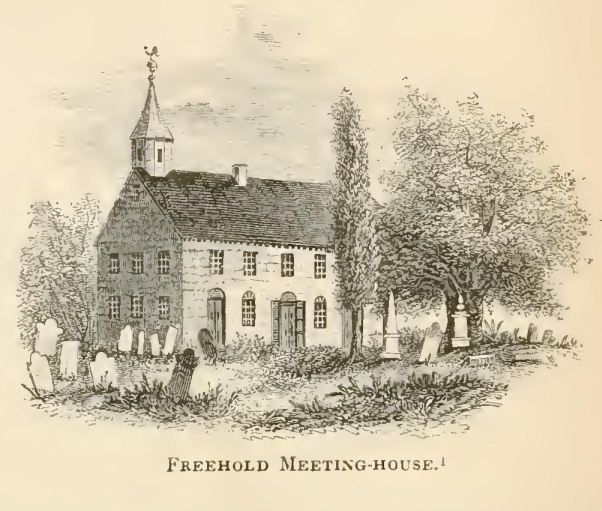
* This view is from the green, outside of the church-yard, near the school-house. The church is situated a short distance from the road leading from Freehold to Englishtown, and about midway between those places. It was erected in 1752, on the site of a former one, which was much smaller; hence it was called the new church.* It is of wood, shingled, and painted white; at present a very dingy color. For a century and a half, God has been worshiped on that spot. There Whitefield, Brainerd, the Tennents, and Woodhull preached and prayed. It has been asserted that bullet-marks, made during the battle in 1778, are visible upon the church. Such is not the fact, for it is a mile and a half distant from the parsonage, where the hottest of the battle occurred. At the church, and upon its roof and steeple, many were gathered in anxious suspense to witness the battle. A spent cannon-ball came bounding toward the church during the action, struck a man who sat upon a small grave-stone, and so wounded him that he died within an hour. He was carried into the church, and placed in the first pew on the right of the middle door, where he expired. Traces of his blood were upon the floor for nearly fifty years. The stone on which he sat is still there, not far from the grave of Colonel Monkton. Its top was broken by the hall, and tor more than seventy years the fracture was left untouched. Lately some vandal hand has broken a "relic" from it, and quite destroyed the moss-covered wound it first received. The obelisk seen on the right of the picture is over the grave of the Reverend Robert Roy. The other ornamental monument is over that of the Reverend Mr. Woodhull.
* See Washington's letter to the president of Congress, July 1,1778.
The pursuing Britons checked.—Courage and Skill of Washington.—Lee's Conduct, Trial, and Sentence.
eminence. By a well-directed fire from his battery, Oswald checked the pursuing enemy. The presence of the chief inspired the fugitives with courage, and within ten minutes after he appeared, the retreat was suspended, the troops rallied, and soon order appeared in the midst of the utmost confusion. Stewart and Ramsay formed under cover of a wood, and co-operated with Oswald in keeping the enemy at bay. While the British grenadiers were pouring their destructive volleys upon the broken ranks of the Americans, the voice of Washington seemed omnipotent with the inspiration of courage; it was a voice of faith to the despairing soldiers. Fearlessly he rode in the face of the iron storm, and gave his orders. The whole patriot army, which, half an hour before, seemed on the verge of destruction, panic-stricken and without order, was now drawn up in battle array, and prepared to meet the enemy with a bold and well-arranged front. This effected, Washington rode back to Lee, and, pointing to the rallied troops, said, "Will you, sir, command in that place?"
"I will," eagerly exclaimed Lee. "Then," said Washington, "I expect you to check the enemy immediately."
"Your command shall be obeyed," replied Lee; "and I will not be the first to leave the field." *
Back to the main army Washington now hurried, and with wondrous expedition formed their confused ranks into battle order on the eminences on the western side of the morass. Lord Stirling was placed in command of the left wing; while General Greene, on receiving intelligence of Lee's retreat, had marched back, and now took an advantageous position on the right of Stirling.
General Lee displayed all his skill and courage in obedience to the chief's order to "check the enemy." A warm cannonade had commenced between the American and British artillery on the right of Stewart and Ramsay when Washington recrossed the morass to form the main army, while the royal light horse charged furiously upon the right of Lee's division. At that moment Hamilton rode up to Lee, and exclaimed, "I will stay with you, my dear general, and die with you. Let us all die rather than retreat." But the enemy pressed so closely upon them with an overwhelming force, that the Americans were obliged
* It was evident that after the first vent of his indignation on seeing Lee making a shameful retreat before the enemy, Washington was willing to overlook the act, and forget and forgive Lee's harsh words spoken in anger. Had the latter been actuated by the same noble and generous spirit, all would have been well. But the rebuke of the commander-in-ehief struck deep into his pride, and he could not rest satisfied with the retort he had given to his general. On the day after the battle he wrote a letter to Washington, in which he demanded an apology, or its equivalent, for his remarks on the battle-field. Washington replied that he conceived his letter to be expressed in terms highly improper, and asserted his conviction that the words which he used when he met him retreating were warranted by the circumstances. He charged Lee with a breach of orders, and misbehavior before the enemy, in not attacking them, and in making an "unnecessary, disorderly, and shameful retreat." Lee wrote an insulting reply. "You can not afford me," he said, "greater pleasure than in giving me the opportunity of showing to America the sufficiency of her respective servants. I trust that temporary power of office, and the tinsel dignity attending it, will not be able, by all the mists they can raise, to obfuscate the bright rays of truth." In a seeond letter, dated the 30th of June (two days after the battle), Lee demanded a court of inquiry immediately, accompanying that demand with offensive remarks. Washington immediately sent Colonel Scammel, the adjutant general, to put Lee under arrest, on the following charges:
"First: Disobedience of orders in not attacking the enemy on the 28th of June, agreeably to repeated instructions. Secondly: Misbehavior before the enemy on the same day, by making an unnecessary, disorderly, and shameful retreat. "Thirdly: Disrespect to the commander-in-ehief, in two letters, dated the 1st of July and the 28th of June." *
* The court martial was convened on the 4th of July, at Brunswick, consisting of one major general (Lord Stirling, who was president), four brigadiers, and eight colonels. The court sat from time to time, until the 12th of August, when they declared their opinion that General Lee was guilty of all the charges, and sentenced him to be suspended from any command in the armies of the United States for the term of twelve months. The testimony on the trial exhibits a minute detail of the operations in the battle of Monmouth. Congress approved the sentence of the court martial on the 5th of December, by a vote of thirteen in the affirmative and seven in the negative, and ordered the proceedings to be published.—See Sparks's Washington, v., 552; Journals of Congress, iv., 501.
* These were both erroneously dated. Lee's letters were written on the 29th and 30th of June.
The fiercest of the Battle.—Picture by Mr. Custis.—Captain Molly.
to give way. As they emerged from the woods, the belligerents seemed completely intermingled.
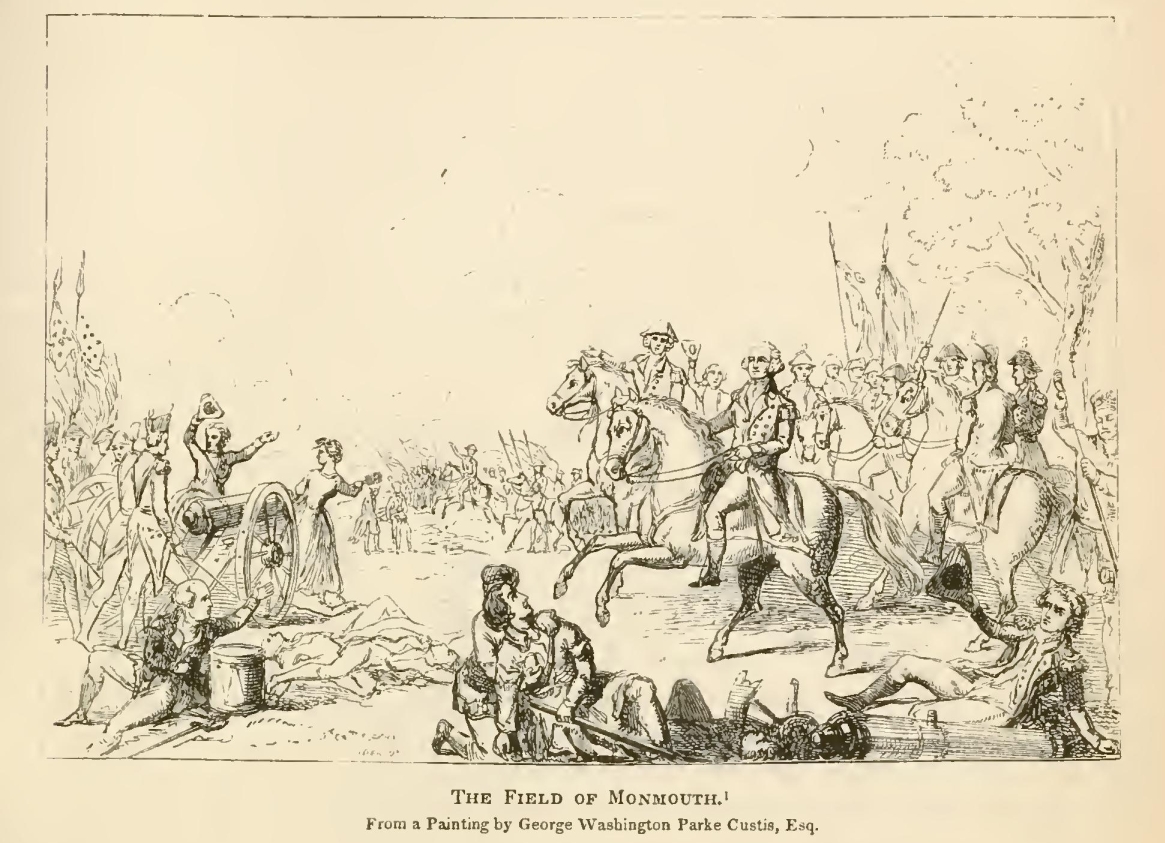
The enemy next attacked Livingston's regiment and Varnum's brigade, which lined a hedgerow ** that stretched across the open field in front of the causeway over the morass Here the conflict raged severely for some time. Some American artillery took post on an eminence in rear of the fence, and played with power; ** but the British cavalry, and a large
* This outline sketch is from a copy of the picture at Arlington House (the seat of Mr. Custis), which I made, by permission, in November, 1850. As it exhibits none of the horrid scenes of slaughter which generally characterize battle-pieces, I have not hesitated to introduce it, for the purpose of giving a specimen of pictorial composition upon an interesting historical subject from the pencil of the adopted son, and the only surviving executor of the will of the great Washington. The engraving was executed by Dr. Alexander Anderson, the pioneer wood-engraver in America, at the age of seventy-seven years. Both painter and engraver have passed several years beyond the age allotted to man. Since I made this copy, Mr. Custis has completed two other historical pictures—Germantown and Trenton; and it is his intention, if his life shall be spared, to thus perpetuate on canvas the memory of all of the battles in which his illustrious foster-father was engaged. In the picture here given, the chief is seen most prominently on his white charger, with his general officers. Washington and Greene are in front; Knox on the right, upon the most prominent horse; and behind them are Hamilton, Cadwallader, &c. On the left is seen the group of artillery, with "Captain Molly" at the gun. In the distance is seen a portion of the British army, and Colonel Monckton falling from his horse. On the right, in the foreground, lying by a cannon, is Dickinson, of Virginia; and on the left, by a drum, Bonner, of Pennsylvania. In the center is a wounded rifleman.
** It was during this part of the action that Molly, the wife of a cannonier, is said to have displayed great courage and presence of mind. We have already noticed her bravery in firing the last gun at Fort Clinton. (See page 164.) She was a sturdy young camp-follower, only twenty-two years old, and, in devotion to her husband, she illustrated the character of her countrywomen of the Emerald Isle. In the action in question, while her husband was managing one of the field-pieces, she constantly brought him water from a spring near by. A shot from the enemy killed him at his post; and the officer in command, having no one competent to fill his place, ordered the piece to be withdrawn. Molly saw her husband fall as she came from the spring, and also heard the order. She dropped her bucket, seized the rammer, and vowed that she would fill the place of her husband at the gun, and avenge his death. She performed the duty with a skill and courage which attracted the attention of all who saw her. On the following morning, covered with dirt and blood, General Greene presented her to Washington, who, admiring her bravery, conferred upon her the commission of sergeant. By his recommendation, her name was placed upon the list of half-pay officers for life. She left the army soon after the battle of Monmouth, and, as we have before observed, died near Fort Montgomery, among the Hudson Highlands. She usually went by the name of Captain Molly. The venerable widow of General Hamilton, yet living (1852), told me she had often seen Captain Molly. She described her as a stout, red-haired, freckled-face young Irish woman, with a handsome, piercing eye. The French officers, charmed by the story of her bravery, made her many presents. She would sometimes pass along the French lines with her cocked hat, and get it almost filled with crowns.
Gallant Conduct of Lee.—Forming of the second Line.—View of the Battle-ground.
body of infantry, skillful in the use of the bayonet, charging simultaneously upon the Americans, broke their ranks. Lee immediately ordered Varnum and Livingston, together with the artillery, to retreat across the morass, while Colonel Ogden, with his men drawn up in a wood near the causeway, gallantly covered the whole as they crossed. Lee was the last to leave the field, and brought off Ogden's corps, the rear of the retreating troops, in admirable order. Instantly forming them in line upon the slope on the western side of the morass, he rode to Washington, and said, "Sir, here are my troops; how is it your pleasure that I should dispose of them?" The poor fellows had thus far borne the whole brunt of the battles and retreats of the day; Washington, therefore, ordered him to arrange them in the rear of Englishtown, while he prepared to engage the enemy himself with the fresh troops of the second and main division of the army.
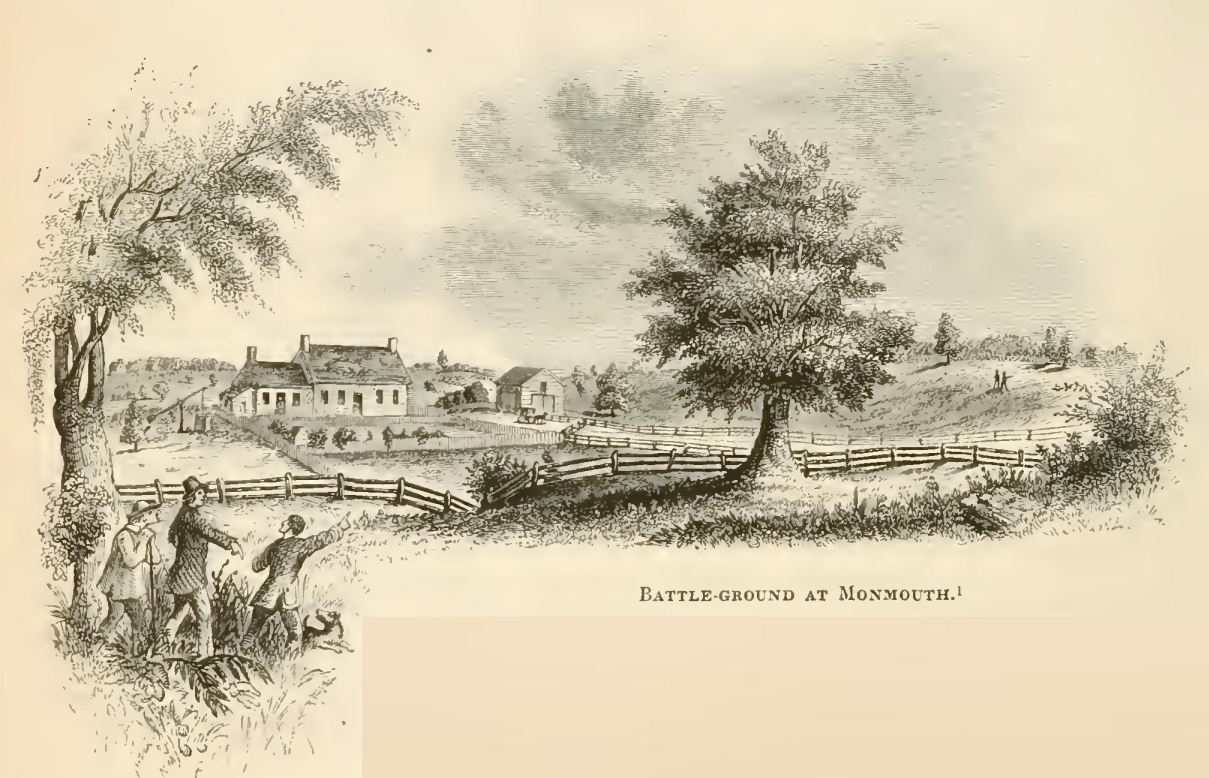
The action now became general. The second line of the main army was speedily formed in the wood which covered the eminence on the western side of the morass; the left commanded by Lord Stirling, the right by General Greene, and the center by Washington himself. Wayne, with an advanced corps, was stationed upon an eminence, in an orchard, a few rods south of the parsonage, while a park of artillery was placed in battery on Comb's Hill, beyond a marsh, on his right. This battery commanded the height on which the enemy was stationed, and did great service. The British, finding themselves warmly opposed in front, attempted to turn the American left flank, but were repulsed. They also moved toward the American right, but, being enfiladed by a severe cannonade from a battery under Knox, upon a commanding piece of ground occupied by General Greene, they fell back. Wayne, in the mean time, kept up a
* This view is from the orchard, upon the site of Wayne's position when Monckton fell. The old house on the left is the ancient parsonage, occupied, at the time of the hattle, by a man named Freeman. Beyond the house, extending right and left, is the place of the morass, now fine meadow land, with a clear stream running through it; and in the extreme distance are seen the slopes and elevations whereon the second division of the American army, under Washington, was drawn up. Upon the rising ground on the extreme right, the British grenadiers were stationed; and the two figures in the open field, about fifty yards distant from our point of view, denote the spot where Monckton was killed.
Advance of Grenadiers under Monckton.—Death of Monckton.—Close of the Day and the Battle
brisk fire upon the British center from his position in the orchard, and repeatedly repulsed the royal grenadiers, who several times crossed the hedgerow (2) and advanced upon him. Colonel Monckton, their commander, perceiving that success depended upon driving Wayne from his position, harangued his men, * and, forming them in solid column, advanced to the charge with all the regularity of a corps on parade. ** Wayne's troops were partially sheltered by a barn, situated very near the one now standing a few rods from the parsonage. He ordered them to reserve their fire until the enemy should approach very near, and then, with sure aim, pick out the officers. Silently the British advanced until within a few rods of the Americans, when Monckton, waving his sword, with a shout, ordered his grenadiers to the charge. At the same moment Wayne gave a signal; a terrible volley poured destruction upon the assailants, and almost every British officer fell. Among them was their brave leader, Colonel Monckton. *
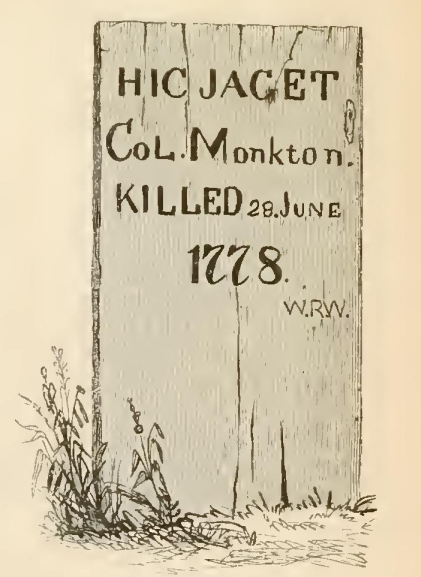
Over his body the warriors fought desperately, hand to hand, until the Americans secured it, and carried it to their rear. Hotly the conflict raged, not only at the center of the enemy's line, but at various other points. Wayne finally repulsed the grenadiers; and the whole British army soon gave way, and fell back to the heights (t) above Carr's house (3), occupied by General Lee in the morning. It was a strong position, flanked by thick woods and morasses, with only a narrow way of approach on their front.
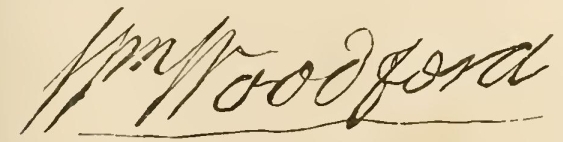
It was now almost sunset, yet Washington resolved to follow up his advantage, and attack them in their new and strong position. For that purpose, he ordered General Poor, with his own and the Carolina brigade, to move round to their right; General Woodford **** to gain their left, and the artillery to gall them in front. There were so many impediments, owing to the broken character of the ground, that twilight came on before a proper disposition for battle could be made, and the attack was postponed until morning.
The army reposed that night upon their arms upon the battle-field, ready to spring upon their prey at the first gleam of light. Wrapped in his cloak, the chief, overpowered with fatigue, slumbered, with his suite, beneath a broad oak, around which many of the slain slept their last sleep. He felt certain of victory when his troops, refreshed, should rise to battle; but the
* The belligerents were separated by only a few rods in distance, and that an open field. The patriots near the parsonage, and those with Wayne, at the barn, and in the orchard, distinctly heard the voice of Monckton when haranguing his men.
** It is said that the grenadiers marched with so much precision, that a ball from Comb's Hill, enfilading a platoon, disarmed every man.
*** Colonel Monckton was a gallant officer. He was a lieutenant colonel in the battle of Long Island, when he was shot through the body, but recovered. He was interred, on the day after the battle of Monmouth, in the burial-ground of the Freehold meeting-house, about six feet from the west end of the building, upon a stone of which his name is rudely cut. The only monument that marks the grave of that gallant officer is a plain board, painted red, on which is drawn, in black letters, the inscription seen in the picture. This board was prepared and set up a few years ago by a worthy Scotch schoolmaster, named Wilson, who taught the young people in the school-house upon the green, near the old meeting-house.
**** William Woodford was a native of Caroline county, in Virginia.
He early distinguished himself in the French and Indian wars. When the Virginia troops assembled at Williamsburg in 1775, in consequence of the hostile attitude assumed by Lord Dunmore, Woodford was appointed eolonel of the second regiment. Patrick Henry was colonel of the first regiment.
the Elizabeth River, in December, 1775, he was distinguished for his bravery. Congress promoted him to brigadier, and placed him in command of the first Virginia brigade. He was in the battles of Brandywine (in which he was wounded) and Monmouth, and was made a prisoner at Charleston, in South Carolina, during the siege in 1780. He was taken to New York by the British, where he died on the 13th of November of that year, in the forty-sixth year of his age.
In the battle at Great Bridge, on
Retreat of Sir Henry Clinton.—Character of the Monmouth Battle.—Clinton's Official Dispatch criticised.—The Loss.
morning light brought disappointment. At midnight, under cover of darkness, * Sir Henry Clinton put his weary host in motion. With silent steps, column after column left the camp and hurried toward Sandy Hook. So secret was the movement, and so deep the sleep of the patriots, that the troops of Poor, lying close by the enemy, were ignorant of their departure, until, at dawn, they saw the deserted camp of the enemy. They had been gone more than three hours. Washington, considering the distance they had gained, the fatigue of his men, the extreme heat of the weather, and the deep, sandy country, with but little water, deemed pursuit fruitless, and Sir Henry Clinton escaped. Washington marched with his army to Brunswick, and thence to the Hudson River, which he crossed at King's Ferry, and encamped near White Plains, in West Chester county. The Jersey brigade and Morgan's corps were left to hover on the enemy's rear, but they performed no essential service. The British army reached Sandy Hook on the 30th, where Lord Howe's June 1778 fleet, having come round from the Delaware, was in readiness to convey them to New York. **
The battle of Monmouth was one of the most severely contested during the war. Remarkable skill and bravery were displayed on both sides, after the shameful retreat of Lee; and the events of the day were highly creditable to the military genius of both commanders. Victory for the Americans was twice denied them during the day, first by the retreat of Lee in the morning, and, secondly, by the unaccountable detention of Morgan and his brave riflemen at a distance from the field. For hours the latter was at Richmond Mills, three miles below Monmouth court-house, awaiting orders, in an agony of desire to engage in the battle, for he was within sound of its fearful tumult. To and fro he strode, uncertain what course to pursue, and, like a hound in the leash, panting to be away to action. Why he was not allowed to participate in the conflict, we have no means of determining.
It appears probable that, had he fallen upon the British rear, with his fresh troops, at the close of the day, Sir Henry Clinton and his army might have shared the fate of the British at Saratoga.
The hottest of the conflict occurred near the spot where Monckton fell. Very few of the Americans were killed on the west side of the morass, but many were slain in the field with Monckton, and lay among the slaughtered grenadiers of the enemy. The Americans lost, in killed, six officers, and sixty-one non-commissioned officers and privates. The wounded were twenty-four officers, and one hundred and thirty-six non-commissioned officers and privates, in all two hundred and twenty-eight. The missing amounted to one hundred and thirty; but many of them, having dropped down through fatigue, soon joined the army. *** Among
* Sir Henry Clinton, in his official dispatch to Lord George Germaine, wrote, "Having reposed the troops until ten at night to avoid the excessive heat of the day, I took advantage of the moonlight to rejoin General Knyphausen, who had advanced to Nut Swamp, near Middletown." This assertion was the cause of much merriment in America, for it was known that the event took place about the time of new moon. Poor Will's Almanac, printed at Philadelphia by Joseph Cruikshank, indicates the occurrence of the new moon on the 24th of June, and that on the night of the battle being only four days old, it set at fifty-five minutes past ten. Trumbull, in his M'Fingal, alluding to this, says,
"He formed his camp with great parade, While evening spreads the world in shade, Then still, like some endanger'd spark, Steals off on tiptoe in the dark; Yet writes his king in boasting tone, How grand he march'd by light of moon! Go on, great general, nor regard The scoffs of every scribbling bard, Who sings how gods, that fearful night, Aided by miracle your night; As once they used in Homer's day, To help weak heroes run away; Tells how the hours, at this sad trial, Went back, as erst on Ahaz' dial, While British Joshua stay'd the moon On Monmouth's plain for Abalon. Heed not their sneers or gibes so arch, Because she set before you march."
* Ramsay; Gordon; Marshall; Sparks; D'Auberteuil; Stedman, &c.
*** The enemy suffered more from the heat than the Americans, on account of their woolen uniform, and being encumbered with their knapsacks, while the Americans were half disrobed. The Americans buried the slain which were found on the battle-field in shallow graves. In their retreat, the British left many of their wounded, with surgeons and nurses, in the houses at Freehold, and every room in the court-house was filled with the maimed and dying on the morning after the battle. A pit was dug on the site of the present residence of Dr. Throckmorton, of Freehold, wherein the wounded were thrown and buried as fast as they expired. It is said that nearly six hundred young men of Clinton's army, who had formed tender attachments during the winter cantonment in Philadelphia, deserted during the march through New Jersey, and returned to that city.
Sufferings of the Soldiers.—Visit to the Battle-ground.—Woodhull's Monument—William and Gilbert Tennent.
the slain were Lieutenant-colonel Bonner, of Pennsylvania, and Major Dickinson, of Virginia. The British left four officers, and two hundred and forty-five non-commissioned officers and privates on the field. They buried some, and took many of their wounded with them. Fifty-nine of their soldiers perished by the heat, without receiving a wound; they laid under trees, and by rivulets, whither they had crawled for shade and water. But why dwell upon the sad and sickening scene of the battle-field with the dead and dying upon it?
We have considered the dreadful events of the day; let us for a moment, before returning to Valley Forge from our long digression, glance at the ground now covered with the results of the peaceful tiller's conquests.
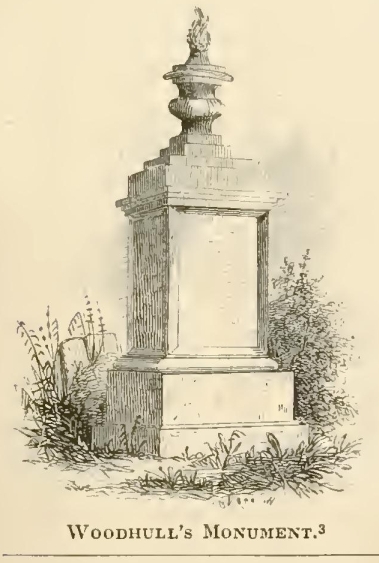
I visited the battle-ground of Monmouth toward the close of September, 1850, and had the good fortune to be favored with the company of Doctor John Woodhull, of Freehold, in my ramble over that interesting locality. Doctor Woodhull is the son of the beloved minister of that name who succeeded William Tennent in the pastoral care of the congregation that worshiped in the Freehold meeting-house, and who, for forty-six consecutive years, preached and prayed in that venerated chapel. Doctor Woodhull was born in the parsonage yet upon the battle-ground, and is so familiar with every locality and event connected with the conflict, that I felt as if traversing the battle-field with an actor in the scene. Dark clouds rolled up menacingly from the southwest when we left Freehold and rode out to the meeting-house; and while sketching the old fane, pictured on page 359, heavy peals of thunder from a cloud that rapidly approached broke over the country. I had scarcely finished my outline when the heavy drops came down, and we were obliged to take shelter in the church. Resting my port-folio upon the high back of a pew, I sketched, from the open door, the annexed picture of a neat monument erected to the memory of the reverend pastor just mentioned. Almost beneath the spot where I stood, under the middle aisle of the church, rest the remains of the Reverend William Tennent, who was pastor of that flock for forty-three years. * On the right of the pulpit is a commemorative tablet, with a brief inscription. ** Mr. Tennent was one of the most faithful ministers of his day; and his name is widely known in connection with curious physiological and psychological phenomena, of which he was the subject. For three days he remained in a cataleptic state, commonly called a trance, or apparent death of the body while the interior life is active. He had applied himself closely to theological studies, until his health suddenly gave way. He became emaciated, his life was despaired of, and,
* Mr. Tennent's brother, Gilbert, was also an eminent preacher. Garden, in his Revolutionary Anecdotes, relates the following circumstance: "When the American army entered Philadelphia in June, 1778, after the evacuation by the British troops, we were hard pressed for ammunition. We caused the whole city to be ransacked in search of cartridge-paper. At length I thought of the garrets, &c., of old printing-offices. In that once occupied as a lumber-room by Dr. Franklin, when a printer, a vast collection was discovered. Among the mass was more than a cart-body load of sermons on defensive war, preached by a famous Gilbert Tennent, during the old British and French war, to rouse the colonies to indispensable exertion. These appropriate manifestoes were instantly employed as cases for musket-cartridges, rapidly sent to the army, came most opportunely, and were fired away at the battle of Monmouth against our retiring foe."
** The following is a copy of the inscription: "Sacred to the memory of the Reverend William Tennent, pastor of the first Presbyterian church in Freehold, who departed this life the 8th of March, 1777, aged 71 years and 9 months. He was pastor of said church 43 years and 6 months. Faithful and Beloved."
*** This monument stands on the south side of the church. It is of white marble, about eight feet in height. The following is the inscription upon it: "Sacred to the memory of the Reverend John Woodhull, R.D., who died Nov. 22d, 1824, aged 80 years. An able, faithful, and beloved minister of Jesus Christ. He preached the Gospel 56 years. He was settled first in Leacock, in Pennsylvania, and in 1779 removed to this congregation, which he served as pastor, with great diligence and success, for 45 years. Eminent as an instructor of youth, zealous for the glory of God, fervent and active in the discharge of all publie and private duties, the labors of a long life have ended in a large reward." Reverend Dr. Woodhull was one of the most active patriots of his day, and his zeal in the cause of his country was largely infused into his congregation. On one occasion, while a pastor in Pennsylvania, every man in his parish went out to oppose the enemy, except one feeble old invalid, who bade them God speed. The zealous pastor went with them as chaplain.
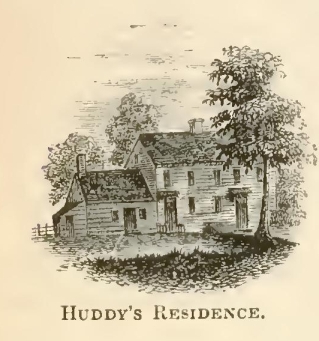
* Dr. Woodhull preached the funeral sermon on the occasion of the burial of Captain Huddy, at Freehold, in the spring of 1782, from the piazza of the hotel now kept by Mr. Higgins. Captain Huddy lived in the central part of Colt's Neck, about five miles from Freehold. He was an ardent Whig, and by his activity and courage became a terror to the Tories. In the summer of 1780, a mu latto, named Titus, and about sixty refugees, attacked Huddy's house, in the evening. The only inmates were Huddy and Lueretia Emmons (afterward Mrs. Chambers), a servant girl about twenty years of age. There were several guns in the house; these Lueretia loaded, while Huddy fired them from different windows. Titus and some others were wounded. They set fire to the house, when Huddy surrendered, and the flames were extinguished. The prisoners were taken on board of a boat near Black Point. Just as it was pushed off from the shore, Huddy leaped into the water, and escaped under fire of some militia who were in pursuit of the Tories. In the spring of 1782, Huddy commanded a block-house, situated a short distance north of the bridge at the" village of Tom's River. It was attacked by some refugees from New York, and his ammunition giving out, Huddy was obliged to surrender. Himself and companions were taken to New York, and afterward back to Sandy Hook, and placed, heavily ironed, on board a guard-ship. On the 12th of April, sixteen refugees, under Captain Lippincott, took Huddy to Gravelly Point, on the shore at the foot of the Navesink Hills, near the light-houses, and hung him upon a gallows made of three rails. He met his fate with composure. Upon the barrel on which he stood for execution, he wrote his will with an unfaltering hand. His murderers falsely charged him with being concerned in the death of a desperate Tory, named Philip White, which occurred while Huddy was a prisoner in New York. To the breast of Huddy, the infamous Lippincott affixed the following label: "We, the refugees, having long with grief beheld the cruel murders of our brethren, and finding nothing but such measures daily carrying into execution; we therefore determine not to suffer, without taking vengeance for the numerous cruelties; and thus begin, having made use of Captain Huddy as the first object to present to your view; and further determine to hang man for man, while there is a refugee existing. Up goes Huddy for Philip White!"
* Huddy's body was carried to Freehold, and hurried with the honors of war. His death excited the greatest indignation throughout the country. Dr. Woodhull earnestly entreated Washington to retaliate, in order that such inhuman murders might be prevented. The commander-in-chief acquiesced, but, instead of executing a British officer at once, he wrote to Sir Henry Clinton, assuring him that, unless the murderers of Huddy were given up, he should proceed to retaliate. Clinton refused compliance, and Captain Asgill, a young British officer (son of Sir Charles Asgill), who was a prisoner, was designated, by lot, for execution. In the mean while, Lippincott was tried by a court martial; and it appeared, in testimony, that Governor Franklin, president of the Board of Associated Loyalists, had given that officer verbal orders to hang Huddy. Lippincott was acquitted. Sir Guy Carleton, who had succeeded Sir Henry Clinton, in a letter to Washington, reprobated the death of Huddy, and acquainted him that he had broken up the Board of Associated Loyalists. Washington had mercifully postponed the execution of young Asgill, and, in the mean time, had received a pathetic letter from Lady Asgill, his mother, and an intercessory one from Count De Vergennes, the French minister. He sent these letters to Congress, and, on the 5th of November, 1782, that body resolved, "That the commander-in-chief be, and hereby is, directed to set Captain Asgill at liberty." The tenderest sympathies of Washington had been awakened in the young man's behalf, and he had resolved to do all in his power, consistent with duty, to save him; and yet the unfair compiler of the Pictorial History of England (v., 489) accuses Washington of foul dishonor, and expresses his belief that, "as at the crisis when he put Major André to death, and refused him the last sad consolation he asked for, he was now rendered gloomy and irascible by the constant and degrading troubles and mortifications in which he was involved." Nothing can be more unjust than this sentence. In a humorous poem, entitled Rivington's Reflections, Philip Freneau thus alludes to the ease of Asgill. He makes Rivington (the Tory printer in New York) say,
"I'll petition the rebels (if York is forsaken) For a place in their Zion which ne'er shall be shaken. I am sure they'll be clever; it seems their whole study; They hung not young Asgill for old Captain Huddy. And it must be a truth that admits no denying— If they spare us for murder they'll spare us for lying."
Inscription upon Woodhull's Monument—Capture and Execution of Captain Huddy.—Case of Captain Asgill.
one morning, while conversing with his brother, in Latin, on the state of his soul, he fainted, and seemed to expire. He was laid out, and preparations were made for his funeral. His
Remarkable Case of William Tennent.—His own Description of his Feelings.—Loss of his Papers.
physician, who was absent, was much grieved on his return. His skill detected symptoms of life, and he desired a postponement of burial. The body was cold and stiff; there were no signs of life to the common apprehension, and his brother insisted that he should be buried. But the entreaties of the physician prevailed; the funeral was postponed. On the third day after his apparent death, the people were assembled to bury him. The doctor, who had been at his side from the beginning, still insisted upon applying restoratives. The hour appointed for the burial arrived, and the brother of Tennent impatiently demanded that the funeral ceremonies should be performed. At that moment, to the alarm of all present, Mr. Tennent opened his eyes, gave a dreadful groan, and relapsed again into apparent lifelessness. This movement was twice repeated after an interval of an hour, when life permanently remained, and the patient slowly recovered. * Absolute forgetfulness of all knowledge marked his return to consciousness. He was totally ignorant of every transaction of his life previous to his sickness. He had to be taught reading, writing, and all things, as if he was a new-born child. At length he felt a sudden shock in his head, and from that moment his recollection was by degrees restored. These circumstances made a profound impression on the public mind, and became the theme of philosophical speculation and inquiry.
When the storm abated we left the church and proceeded to the battle-ground. The old parsonage is in the present possession of Mr. William T. Sutphen, who has allowed the parlor and study of Tennent and Woodhull to be used as a depository of grain and of agricultural implements! The careless neglect which permits a mansion so hallowed by religion and patriotic events to fall into utter ruin, is actual desecration, and much to be reprehended and deplored. The windows are destroyed; the roof is falling into the chambers; and in a few years not a vestige will be left of that venerable memento of the field of Monmouth.
We visited the spot where Monckton fell; the place of the causeway across the morass (now a small bridge upon the main road); and, after taking a general view of the whole ground of conflict, and sketching the picture on page 362, returned to Freehold in time to dine, and take the stage for the station at Jamesburg, on my way home. It had been to me a day of rarest interest and pleasure, notwithstanding the inclement weather; for no battle-field in our country has stronger claims to the reverence of the American heart than that of the plains of Monmouth.
* Mr. Tennent has left on record the following graphic account of his feelings while his body was in a state of catalepsy: "While I was conversing with my brother on the state of my soul, and the fears I had entertained for my future welfare, I found myself, in an instant, in another state of existence, under the direction of a Superior Being, who ordered me to follow him. I was accordingly wafted along, I know not how, till I beheld at a distance an ineffable glory, the impression of which on my mind it is impossible to communicate to mortal man. I immediately reflected on my happy change, and thought, Well, blessed be God! I am safe at last, notwithstanding all my fears. I saw an innumerable host of happy beings surrounding the inexpressible glory, in acts of adoration and joyous worship; but I did not see any bodily shape or representation in the glorious appearance. I heard things unutterable. I heard their songs and hallelujahs of thanksgiving and praise, with unspeakable rapture. I felt joy unutterable and full of glory. I then applied to my conductor, and requested leave to join the happy throng; on which he tapped me on the shoulder, and said, 'You must return to the earth.' This seemed like a sword through my heart. In an instant I recollect to have seen my brother standing before me disputing with the doctor. The three days during which I had appeared lifeless seemed to me not more than ten or twenty minutes. The idea of returning to this world of sorrow and trouble gave me such a shock, that I fainted repeatedly."—Life of William Tennent, by Elias Boudinot, LL.D.
* Mr. Tennent said that, for three years, the ravishing sounds he had heard and the words that were uttered were not out of his ears. He was often importuned to tell what words were uttered, but declined, saying, "You will know them, with many other particulars, hereafter, as you will find the whole among my papers." Boudinot was with the army when Tennent died, and, before he could reach his house, the family, with all his effects, had gone with a son to South Carolina. He was taken sick about fifty miles from Charleston, and amoung strangers. Although Boudinot was the executor of both father and son he never discovered any of Tennent's papers.
The Pine Robbers.
The men and women of the Revolution, but a few years since numerous in the neighborhood of Freehold, have passed away, but the narrative of their trials during the war have left abiding records of patriotism upon the hearts of their descendants. I listened to many tales concerning the "Pine Robbers" * and other Tory desperadoes of the time, who kept the people of Monmouth county in a state of continual alarm. Many noble deeds of daring were achieved by the tillers of the soil, and their mothers, wives, and sisters; and while the field of Monmouth attested the bravery and endurance of American soldiers, the inhabitants, whose households were disturbed on that Sabbath morning by the bugle and the cannon-peal, exhibited, in their daily course, the loftiest patriotism and manly courage. We will leave the task of recording the acts of their heroism to the pen of the local historian, and, hastening back to Valley Forge, resume the reins and depart for Paoli, for the short November day is fast waning.
* The Pine Robbers were a band of marauding Tories, who infested the large districts of pine woods in the lower part of Monmouth county, whence they made predatory excursions among the Whigs of the neighboring country. They burrowed caves in the sand-hills for places of shelter and retreat, on the borders of swamps, and, covering them with brush, effectually concealed them. From these dens they sallied forth at midnight to burn, plunder, and murder. Nor were the people safe in the daytime, for the scoundrels would often issue from their hiding-places, and fall upon the farmer in his field. The people were obliged to carry muskets while at their work, and their families were kept in a state of continual terror. Of these depredators, the most prominent were Fenton, Fagan, Williams, Debow, West, and Carter. Fenton was the arch-fiend of the pandemonium of the Pines. He was a blacksmith of Freehold, large and muscular. He early took to the business of the Tories, and began his career of villainy by robbery. He plundered a tailor's shop in Freehold township. Already a committee of vigilance was organized. They sent Fenton word that, if he did not return the plunder, he should be hunted and shot. Intimidated, he sent back the clothing, with the following savage note appended: "I have returned your damned rags. In a short time I am coming to burn your barns and houses, and roast you all like a pack of kittens!" Fenton soon proceeded to put his threat into execution. One summer night, at the head of a gang of desperadoes, he attacked the dwelling of an aged man near Imlaytown, named Farr. Himself, wife, and daughter composed the family. They barricaded the door, and kept the scoundrels at bay for a while. Fenton finally broke in a portion of the door, and, firing through the opening, broke the leg of the old man with a musket-ball. They forced an entrance at last, murdered the wife, and then dispatched the helpless old man. The daughter, badly wounded, escaped, and the miscreants, becoming alarmed, fled without taking any plunder with them. Fenton was afterward shot by a young soldier of Lee's legion, then lying at Monmouth court-house. The robber had plundered and beaten a young man while on his way from a mill. He gave information to Lee, who detailed a sergeant and two soldiers to capture or destroy the villain. The young man, and the sergeant disguised as a countryman, took a seat in a wagon, while the two soldiers, armed, were concealed under some straw in the bottom of the vehicle, and proceeded toward the mill, expecting to meet Fenton on the road. From a low groggery among the Pines the robber came out, with a pistol, and commanded them to halt. He then inquired if they had brandy, to which an affirmative was given, and a bottle handed to him. While drinking, one of the soldiers, at a signal from the sergeant, arose, and shot the villain through the head. His body was thrown into the wagon, and conveyed in triumph to Freehold.
* Fagan and West were also shot by the exasperated people. The body of the latter was suspended in chains, with hoop-iron bands around it, upon a chestnut by the road-side, about a mile from Freehold, on the way to Colt's Neck, where it was left to be destroyed by carrion birds. The sufferings of the people from these marauders made such a deep impression, that the lapse of years could not efface it from the hearts of those who felt their scourge, and even the third generation of the families of Tories were objects of hate to some of the surviving sufferers. An old lady, ninety years of age, with whom I conversed at Roundbrook, became greatly excited while talking of what her family endured from the Pine Robbers and other Tories, and spoke indignantly of one or two families in Monmouth eounty who were descendants of Loyalists.
Departure from Valley Forge.—The Paoli Tavern.—Place where Americans were Massacred.