Volume 2 — CHAPTER X. (continued 2)
Reading edition
* The following circular letter was sent to all the royal governors in America, soon after the proceedings of the Continental Congress were received in England. It was a "Bull" without horns, and did not alarm the patriots. "Whitehall, Jan. 4th, 1775. "Certain persons stiling" (sic) "themselves delegates of his majesty's colonies in America, having presumed, without his majesty's authority or consent, to assemble together, at Philadelphia, in the month of September and October last; and having thought fit, among other unwarrantable proceedings, to resolve that it will be necessary that another Congress should be held in this place on the 10th of May next, unless redress for certain pretended grievances be obtained before that time, and to recommend that all the colonies in North America should choose deputies to attend such Congress, I am commanded by the king to signify to you his majesty's pleasure, that you do use your utmost endeavors to prevent such appointment of deputies within the colony under your government; and that you do exhort all persons to desist from such unwarrantable proceedings, which can not but be highly displeasing to the king. "I am, sir, your most obedient servant, Dartmouth.
** "Every man in this assembly," wrote John Adams to his wife, "is a great man, an orator, a critic, a statesman; and therefore every man, upon every question, must show his oratory, his criticism, his political abilities. The consequence is, that business is spun out to an immeasurable length."
*** Joseph Galloway was one of the most popular of the leaders in Pennsylvania when the war of the Revolution broke out. He was once the confidential friend of Franklin, and had worked shoulder to shoulder with him against the proprietaries. He was elected a delegate to the first Continental Congress. In that body he submitted a plan, as a measure of accommodation, which seemed quite feasible. It proposed a union of the colonies, with a grand council authorized to regulate colonial affairs jointly with the British Parliament, each to have a mutual negation on each other. * This plan was favorably received, and on the question of its adoption it was rejected by a majority of only one. The debates were very warm, and it was on this occasion that Samuel Adams, regarding the proposition as a concession to tyranny, exclaimed, "I should advise persisting in our struggle for liberty, though it were revealed from heaven that nine hundred and ninety-nine were to perish, and only one of a thousand were to survive and retain his liberty! One such freeman must possess more virtue and enjoy more happiness than a thousand slaves; and let him propagate his like, and transmit to them what he has so nobly preserved." * Before the meeting of the next Congress, Galloway manifested lukewarmness; and in 1776 he abandoned the Whigs, and became the most virulent and proscriptive Loyalist of the time. He joined the royal army in New York, where he continued until 1778, when, accompanied by his only daughter, he went to England. There he remained until his death in September, 1803, at the age of seventy-three years. His pen, for many years, was continually employed in correspondence with Loyalists in America, and upon subjects connected with the war. The prominent position which he at first held among the Whigs, and his virulence against them after his defection, made him the target for many an arrow of indignant wit. Trumbull, in his M'Fingall, gave him some hard hits; and a writer in the Pennsylvania Journal of February 5, 1777, thus castigates him with some lines, after saying to the printer,
"If you think them severe enough, print 'em, egad I'' "Gall'way has fled, and join'd the venal Howe, To prove his baseness, see him cringe and bow; A traitor to his country and its laws, A friend to tyrants and their cursed cause. Unhappy wretch! thy interest must be sold For Continental, not for polish'd gold. To sink the money thou thyself cried down, And stabb'd thy country to support the crown. Go to and fro, like Lucifer on earth, And curse the Being that first gave thee birth. Away to Scotland and thyself prepare, Coal dust and brimstone is their only fare; Fit materials for such Tory blood, Who wrong their country and deny their God. There herd with Bute, Mansfield, and his brother; Bite, twist, sting, and poison one another."
*** Galloway's estate, valued at $200,000, was confiscated by Pennsylvania. A large part of it was derived from his wife. A considerable portion was restored to his daughter.
* This plan is printed in Sabine's Lives of the Loyalists, p. 309.
Opinions concerning the Adamses.—Sketch of Galloway's public Life.—Disposition of his Estate.
and they regarded the Adamses as men not only too much committed to violent measures by the part they had taken in Boston, but that they were desperate men, with nothing to lose, and hence unsafe guides to gentlemen who had estates to forfeit.
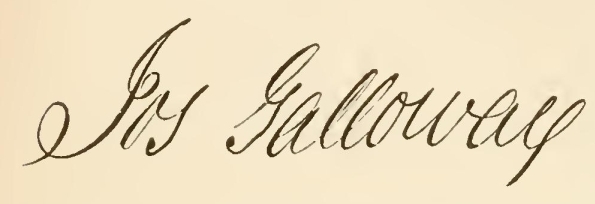

And yet Galloway, when he became a proscriptive Loyalist, and one of the most active enemies of the Republicans, was forced to acknowledge the stern virtues of many of the patriots of that assembly, and among them Samuel Adams. "He eats little, drinks little, sleeps little, and thinks much," he said, "and is most indefatigable in the pursuit of his object. It was this man who, by his superior application, managed at once the factions in Congress at Philadelphia, and the factions in New England." *
The proceedings of this first Congress went forth to the world with all the weight of apparent unanimity, and throughout the colonies they were hailed with general satisfaction. The American Association adopted and signed by the delegates was regarded by the people with great favor, and thousands in every province affixed their signatures to the pledge. These formed the fibers of the stronger bond of the Articles of Confederation afterward adopted, and may be considered the commencement of the American Union.
* Galloway's Historical and Political Reflections on the Rise and Progress of the American Rebellion: London, 1780. In this pamphlet the writer handles Sir William Howe and other British commanders with severity.
* Mr. Adams reiterated this sentiment when debating the resolution for independence twenty months afterward.
** Just before he left Philadelphia he discovered that his daughter was about to elope with Judge Griffin, who was afterward president of Congress. This doubtless hastened his departure.
*** Murray, confidential secretary to the Pretender, Prince Charles Edward.
The State House.—Independence Hall.—Hancock's Chair.—Portraits of Penn and La Fayette.